




Abstract
Scholars in different scientific fields and practitioners are analyzing the rise of production and diffusion of fake news and problematic information that is rapidly contaminating the digital world. Although problematic information might seriously affect brands, marketing and consumer behavior research is surprisingly limited. This article aims to provide a research agenda for marketing by analyzing the previous literature and identifying relevant insights suggested by different disciplines. Based on the review of 86 interdisciplinary scientific papers and 5 managerial reports, we speculate on future avenues for consumer behavior, marketing strategy, and marketing ethics research about fake news and problematic information.
Introduction
Fake news, defined as “news articles that are intentionally and verifiably false, and could mislead readers” (Allcott & Gentzkow, 2017, p. 213), has just recently gained scholarly attention predominantly in the fields of journalism, psychology, and political sciences. Less is done empirically in the marketing and consumer behavior literature, with some recent and few exceptions (e.g., Chen & Cheng, 2019; Peterson, 2019; Talwar et al., 2019; Visentin et al., 2019).
Fake news represents only one aspect of the ongoing crisis of problematic information, that is, “inaccurate, misleading, inappropriately attributed, or altogether fabricated information” (Jack, 2017, p. 2). Problematic information includes also hoaxes, conspiracy theories, propaganda, and true specialist information presented in distorted ways to support one’s viewpoint (our “true lies”). Conspiracy theories about vaccines, palm oil, and Coronavirus are just the most recent examples of true lies, of how it is possible to cause harm and have a strong negative impact on consumers, companies, and democracy at large. All these concepts describe the inaccuracy of media contents and take on different shades of meaning. Such differences may seem small, but they are important for getting a thorough understanding of the issue (Jack, 2017). The different shades of disinformation seem to appear along a continuum concerning the truthfulness (Berthon et al., 2019) and intent (Levi, 2017). At one extreme of the continuum, there is disinformation entirely created without a factual basis (i.e., fake news) but able to amplify and reinforce previous beliefs. At the other extreme, there is disinformation rooted in a truthful reality but distorted to the point that the core facts are no longer factual (i.e., conspiracy theories; Levi, 2017). The scientific literature still lacks in providing a convincing explanation of the determinants of creating and sharing problematic contents on social media and their consequences from a marketing point of view. Relatedly, extensive interaction with practice might shed light on the issue (e.g., Gu et al., 2017).
Does it really matter?
To understand the relevance of the problem for brands, we provide a sketch of three real illustrative cases. First, from a recent conceptual paper (Obadă, 2019) we know that “Pepsi Co. stock fell around 4just prior the 2016 US presidential election when a fake news story about Pepsi’s CEO, Indra Nooyi, telling Trump supporters to ‘take their business elsewhere” spread in social media” (p. 151). This is a case when fake news directly affects a brand. In the case of New Balance, a “fake news spreader misquoted the New Balance spokesman and repackaged the message with the headline ‘New Balance offers a wholesale endorsement of the Trump revolution’” (p. 153) causing anti-Trump groups burning New Balance shoes and sharing the video online. This is a case when fake news has an indirect impact negatively affecting the brand image. Third, Cova and D’Antone (2016) illustrate the contrasted reaction of consumers to a hoax, rooted in a real point raised by Greenpeace Italy in 2008, on the negative effects of palm oil, an ingredient of the iconic Nutella brand. Based on the strong attachment of consumer to the brand, some of them co-created and spread discourses that give any Nutella lover the possibility to relinquishing the new tension and support the idea that the brand should be kept as it is. As such, they ultimately reinforce the overall devotion to the brand. (Cova & D’Antone, 2016, p. 182)
A negative hoax added more brand content for Nutella in this case, showing an unexpected positive effect in terms of branding by boosting brand’s mythology (see also Red Bull; see Allen et al., 2008; Starbucks, see Thompson & Arsel, 2004).
These examples clearly show how disinformation can greatly undermine brand equity (Berthon & Pitt, 2018), especially when consumers collectively exhibit brand-dissociative behaviors, after being exposed to fake news (Ferreira et al., 2019). However, they also suggest that this topic deserves attention, as companies can turn a possible threat into an advantage by keeping primary control of their marketing agenda and avoiding to ceding it to outsiders.
State of the art
Two important and unexpected political outcomes encouraged the proliferation of academic interest on the possible impact of misinformation after 2016: the U.S. Presidential Elections and the Brexit Referendum (e.g., Allcott & Gentzkow, 2017). One of the main drivers of problematic information sharing on social media is confirmation bias (i.e., the individuals’ tendency to select only information consistent with their vision of the world; Kim & Dennis, 2019). Some people choose their personal truth or rely on their own authorities (e.g.,: scriptural inference in the work of Tripodi, 2018), preferring to hold on inaccurate beliefs (Zollo & Quattrociocchi, 2018). Consequently, people may keep on sharing problematic information even if it is known as false as they “care more about the point of view being advocated than the legitimacy of the [content]” (Newhoff, 2018). IT and computer science research subsequently proposed new techniques to automatically detect misinformation on social media (e.g., Zhang & Ghorbani, 2019). Because fake news, as we today define it, started targeting politicians and political organizations, marketing interest in the phenomenon came later when some multinational companies faced a boycott wave after falling victims of fake news (Obadă, 2019).
To date, few marketing studies focus on the negative effect of social media misinformation on brands (e.g., Berduygina et al., 2019; Berthon & Pitt, 2018). Recent research evaluated the possible consequences of fake news on brands, proposing different response strategies for companies (Mills & Robson, 2019; Vafeiadis et al., 2019). Some authors suggest the need to provide tools to improve fact-checking, assuming that individuals might change their mind when confronted with the evidence of facts (Talwar et al., 2019; Wang, 2017). Other scholars focus on possible cues that support sharing behavior, like media trust, self-efficacy, amount, and convergence of the information available (e.g.,: Chen & Cheng, 2019; Munzel, 2016; Stueckemann, 2019). In the attempt to determine the effect of coupling fake news to a brand ad, Visentin and colleagues (2019) supported that deception detection self-perceived efficacy does not affect the formation of attitudes toward the brand.
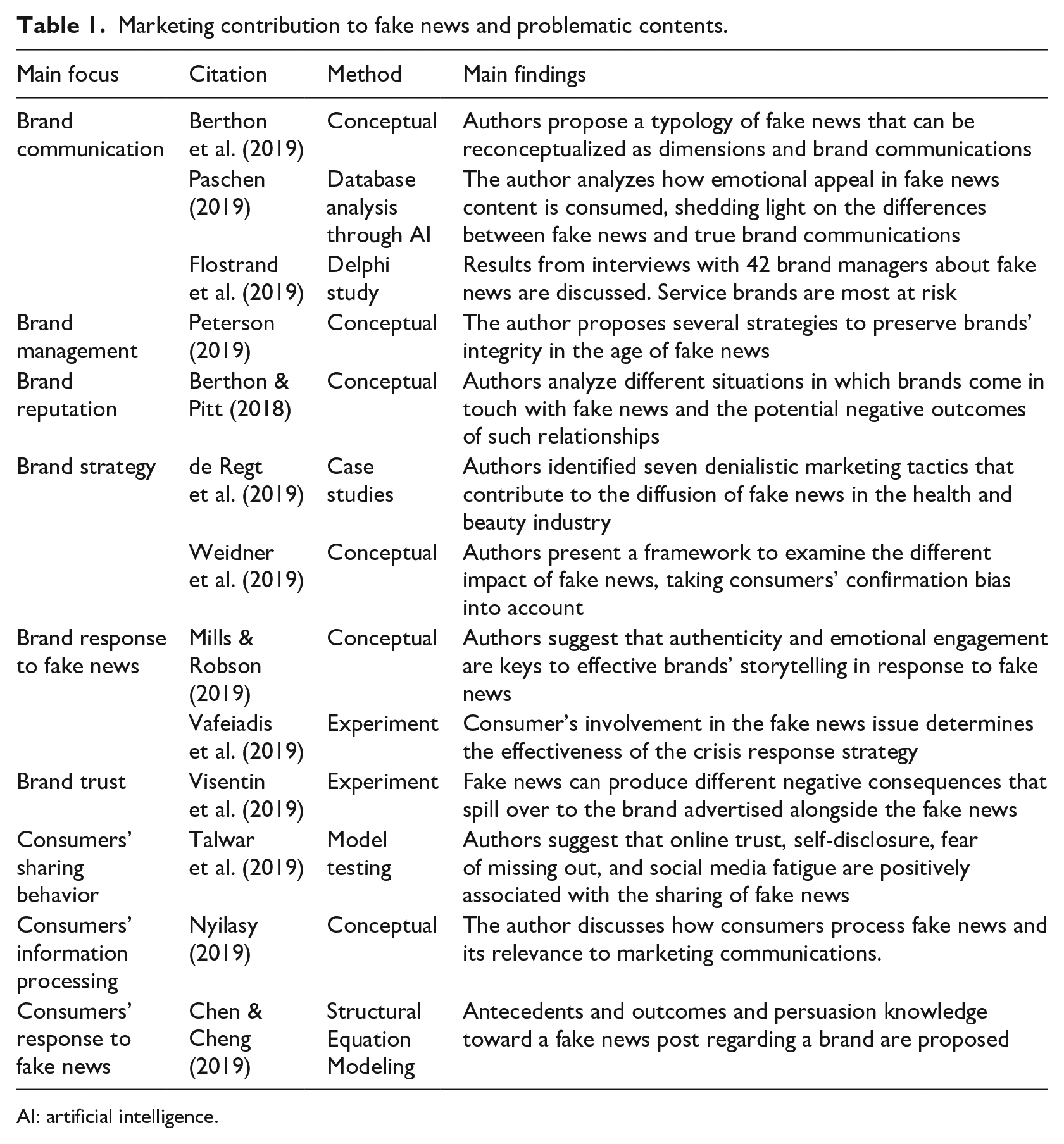
Given the initial phase of marketing studies around these topics, a question arises: How can marketing advance the knowledge on problematic information? To answer this question, we have reviewed the literature on fake news and problematic information, published in the past 3 years (2017 – 2020), finding 86 articles that mention one combination of the following keywords: “fake news,” “consequences,” “consumer behavior,” “social media,” “problematic information.” We also collected five reports from the managerial practice. The selected papers come from different scientific fields: 14 from psychology (e.g., Pennycook & Rand, 2019; Roets, 2017), 19 from computer science and IT (e.g., Del Vicario et al., 2019; Kim & Dennis, 2019), 15 from political sciences (e.g., Allcott et al., 2019; Clayton et al., 2019), 14 from journalism (e.g., Bakir & McStay, 2018; Tandoc et al., 2018), 13 from sociology and philosophy (e.g., Giglietto et al., 2019; Marwick, 2018), 8 from business and management (e.g., Baccarella et al., 2018; Chelliah & Swamy, 2018), and 13 from marketing. Table 1 provides an overview of marketing studies. Interestingly, 9 out of the 13 marketing studies were published in a 2019 Special Issue of the Journal of Product and Brand Management.
Marketing contribution to fake news and problematic contents.
AI: artificial intelligence.
Future agenda and challenges
Previous interdisciplinary research on fake news and reports coming from the practice may help marketing scholars in taking a step beyond in analyzing fake news and problematic information.
Future research in consumer behavior
Qualitative research and reports from practice suggest that we should reconsider classic models, assuming that individuals rationally evaluate their actions to achieve their goals. Individuals’ prior beliefs, attitudes, and the emotions aroused by reading misinformation might play a more significant role in shaping attitudes and behaviors toward the news, the source, and the object of the news (e.g., a brand, a company, a product category, a celebrity, and an idea; Bakir & McStay, 2018). Relatedly, do prior beliefs and attitudes moderate/mediate the relationship between source credibility and news credibility? And, in turn, what impact on brand attitudes? It would not be surprising, then, that negative emotions can affect the formation of brand attitudes—both negative and positive—when individuals are confronted with problematic information regarding a brand, inevitably affecting brands’ reputation. Marketing research should assess to what extent problematic information can tarnish the brand reputation and, more importantly, is problematic information something that has just short-term consequences or, as Van Duyn and Collier (2019) argue, does it prime individuals’ minds, affecting the subsequent evaluation of new information?
Further research should investigate how psychological differences might attenuate or exacerbate the effects of disinformation. Construal-level theory (Trope & Liberman, 2010) could provide the framework to identify the psychological elements that determine individuals’ construal level of fake news and how it influences the dissemination process.
Furthermore, even though IT scholars’ hard focus is on data and algorithms, they provide explanations that deserve further analysis to unveil the psychological and sociological processes behind the formation, the diffusion, and the effects of problematic information. Are there any sociodemographics that affect individuals’ susceptibility to fake news? As social media and websites rely on algorithms to maximize their ability to reach the right target and improve click rates, scholars should analyze more in-depth the relationship between behaviors, as they emerge from data, and the other levels (i.e., affective and cognitive) of an individual’s response. In doing this, qualitative research methods based on human agents might provide valuable support to automatic pattern-matching machines.
In addition, the concept of echo chamber provides several research opportunities (Del Vicario et al., 2019) as digital environments allow individuals to construct a particular image of the self, altering, in some cases, their self-representation. The challenge for marketing scholars is to identify elements of behavior mismatching in online and offline contexts, to analyze the different motivations behind disinformation sharing online, and the real impact on consumers in everyday life. It is also needed to better understand how social media users gain legitimacy and recognition within an echo chamber. What is the role of the frequency and tone of social media engagements (i.e., likes, comments, shares, followers, and friends) in shaping users’ influence?
Future research for marketing strategy
Oftentimes, fake news exposes brands to opponents’ attacks. However, as suggested by the palm oil case, companies can turn a threat into an advantage by carefully managing their stakeholders (Cova & D’Antone, 2016). Consistent with Berman and colleagues (2019), we suggest that managing the interaction and feedback in the brand community could make the difference in determining fake news’ outcomes. In particular, companies’ responses might trigger supportive comments from the brand community and discourage contribution from the opponents. Further research should expand the crisis management literature in the context of fake news (e.g., Vafeiadis et al., 2019), attempting to find what best practices companies can adopt to cope with the reputational threat and recover consumers’ trust.
Finally, collective strategies could be effective in fighting the spreading of disinformation. To date, companies in different industries agree on pulling their advertisements from fake news websites, even though the impact of fake news is detrimental to the brand regardless of the website where the ad is displayed (Visentin et al., 2019). It is possible that joining efforts to limit the spread and educate individuals about the risks of disinformation could result in setting new standards for information transparency and correctness. As in the case of Corporate Sustainability reporting (Fernandez-Feijoo et al., 2014), stakeholders’ pressures to adopt such standards would improve the overall quality of information.
Future research for marketing ethics
The proliferation of false and misleading contents poses serious issues for academic research on social media. Will research still be reliable even though conducted on social media data that are not authentic? In times when the trust in institutional authorities is at its lowest, academics must ensure that their research is conducted on validated data: What is the role that social media platforms play in this process, as they struggle to find a balanced compromise between giving the full freedom of speech to their users and fighting misinformation (Facebook, 2020)? Further research could help policymakers define this border. Another issue is represented by the easy access to users’ data that social media platforms provide companies, among them the so-called “Black PR,” to find out more about potential targets of their information operations through fake news (Silverman et al., 2020). Would it be “more ethical” to restrict access to such information just to universities and research centers? Finally, fake news spreading poses ethical problems for news outlets as well. In the case news outlets inadvertently publish fake news, are they obliged to remove that information and correct it? To what extent policymakers can find a balance between limiting the press’ freedom and the necessity of having well-informed citizens?
New dangers on the horizon
New forms of misleading contents have started spreading on social media, potentially more dangerous than other forms of problematic information. They are called “cheap fake” and “deep fake.” Cheap fakes employ a simple “selective editing” technique to change videos in ways that they do not show what really happened. Deep fakes, instead, use artificial intelligence to create entirely fictional videos, images, or audio. To date, these new techniques are utilized predominantly in politics, to discredit politicians or political organizations (“What are Deep Fake and How can You Spot Them,” 2019). What is the level of individuals’ susceptibility to these new techniques? And, what are the effects in term of attitudes and behavior?
Finally, it is inevitable to mention the opportunity for research in the wake of the Coronavirus emergency. Unfortunately, COVID-19 has triggered a massive spreading of disinformation. For example, fake news linking the spread of the virus to the development of 5G technology caused the vandalization of many cell phone masts in the United Kingdom, physical attacks to telecom engineers (BBC, 2020), and threatened the reputation of specific mobile communications (e.g., Vodafone) or technology (e.g., Huawei) companies. Many conspiracy theories—that center around the virus as a bioweapon created in Wuhan—are creating a climate of distrust where the public is treating official sources of information with growing skepticism (Oxford Analytica, 2020). For this reason, traditional media outlets are now facing severe problems of brand reputation, especially for what concerns the trustworthiness and credibility dimensions. Unlike previous outbreaks, the spreading of disinformation about COVID-19 has been dramatically amplified by social media to the extent that “We’re not just fighting an epidemic; we’re fighting an infodemic,” said World Health Organization (WHO) Director Ghebreyesus. Social media platforms (Larson, 2020), as well as Google and the WHO (Zarocostas, 2020), have taken actions for fighting the infodemic, intensifying collaborations with fact-checking organizations and promoting the sharing of reliable health information from acknowledged experts in the attempt to alleviating the risk of a strong negative impact on people’s trust in scientific data. However, given the overwhelming amount of information that flows in digital environments, and the fast “rise and decline” rates of trend topics on social media timelines, the empowerment of fact-checking organizations might be not sufficient. Accordingly, social media platforms, traditional media, and institutions should adopt a more “human-focused” approach, by instilling in people the necessity of spending more time and cognitive efforts confronting various legitimate sources before accepting information as true.
Footnotes
Declaration of conflicting interests
The author(s) declared no potential conflicts of interest with respect to the research, authorship, and/or publication of this article.
Funding
The author(s) received no financial support for the research, authorship, and/or publication of this article.
