




Abstract
Although numerous books and articles provide toolkit approaches to explain how to conduct literature reviews, these prescriptions regard literature reviewing as the production of representations of academic fields. Such representationalism is rarely questioned. Building on insights from social studies of science, we conceptualize literature reviewing as a performative endeavor that co-constitutes the literature it is supposed to “neutrally” describe, through a dual movement of re-presenting—constructing an account different from the literature, and intervening—adding to and potentially shaping this literature. We discuss four problems inherent to this movement of performativity—description, explicitness, provocation, and simulacrum—and then explore them through a systematic review of 48 reviews of the literature on corporate social responsibility (CSR) for the period 1975 to 2019. We provide evidence for the performative role of literature reviewing in the CSR field through both re-presenting and intervening. We find that reviews performed the CSR literature and, accordingly, the field’s boundaries, categories, and priorities in a self-sustaining manner. By reflexively subjecting our own systematic review to the four performative problems we discuss, we also derive implications of performative analysis for the practice of literature reviewing.
Keywords
In light of sustained academic production in management and organization studies, there is an according consensus on the importance of reviewing literatures—as evidenced by the creation of specialized literature review journals (e.g., International Journal of Management Reviews) or special issues fully dedicated to literature reviews in leading disciplinary journals (e.g., Journal of World Business). Yet there have been surprisingly few efforts to conceptualize what and how knowledge is at stake in literature reviewing—i.e., the activities involved in the process of producing and publishing literature reviews. Most guidelines for reviewing literatures are technical in nature; they focus on how to make reviews more systematic (e.g., Booth, Papaioannou, & Sutton, 2012; Denyer & Tranfield, 2009), evidence-based (e.g., Briner, Denyer, & Rousseau, 2009), creative (e.g., Short, 2009), and transparent (e.g., Aguinis, Ramani, & Alabduljader, 2018; Hart, 1998; Jones & Gatrell, 2014). These prescriptions are helpful to conduct literature reviews rigorously, and in aggregate, they have enhanced the sophistication of reviews.
However, such prescriptions usually build on a representational assumption about the relationship of literature reviews with the literatures they review. Representationalism “takes it for granted that the defining characteristic of science is its production of representations of nature, facts and theories” (Pickering, 1994, p. 413). Authors conducting literature reviews typically internalize such assumptions when they describe the reviewed literature as an entity on its own that can be “objectively” described through a specific narrative, systematic, network, or bibliometric technique or analysis. Interestingly, such assumptions are at odds with the impact of reviews that are on average more cited (Cropanzano, 2009), and thus have a stronger potential to change the literature they are supposed to describe.
Departing from representationalism, and building on insights from social studies of science (Hacking, 1983; Latour, 1999; Law, 2008) and the performativity concept (Gond, Cabantous, Harding, & Learmonth, 2016; Muniesa, 2014), this article conceptualizes literature reviewing as a performative endeavor characterized by a dual process of re-presenting the literature—constructing an account that is different from the existing literature—and intervening in the literature—adding to the literature and potentially transforming it. 1 Recognizing the performative nature of literature reviewing allows to capture the co-constitution of academic fields and literature reviews, but also calls attention to several problems inherent to performativity that we investigate relying on Muniesa’s (2014) analysis. Re-presenting and intervening are underpinned by the problem of description—literature reviews, like any description “add” to the literature they describe, hence necessarily shaping it; the problem of explicitness—literature reviews make categorizations explicit that are supposed to preexist them; the problem of provocation—literature reviews, like experiments, create the possibility for new conceptual or theoretical articulations; and the problem of the simulacrum—literature reviews, when influential, reshape the field to their image, and tend to become the literature they were supposed to describe.
To examine these problems and provide evidence of the value of a performative take on literature reviewing, we conducted a systematic review of literature reviews in the field of corporate social responsibility (CSR) from 1975 to 2019. We then subjected this systematic review to a performative analysis in light of the four problems we have described above. Our analysis shows how literature reviews shaped the field of CSR through re-presenting—each review “added” to the field by making their organizing categories more explicit over time, and provided lasting categories that became key organizing principles of the literature—and intervening, as some of these categories contributed to provoke turns in the literature, leading to the emergence of new subfields (e.g., “political CSR” or “micro-CSR”), and some became among the most cited and influential articles of the CSR field. Moving further, we critically examine our own methodological process of systematically reviewing CSR literature reviews through a performative lens to provide guidance on how performativity can enhance scholars’ reflexivity in their approach to literature reviewing.
Our analysis offers three contributions to organizational methods and theory. First, we provide an innovative, nonrepresentational conceptualization of literature reviewing as a “performative practice” (Boldyrev & Svetlova, 2016; Cabantous & Gond, 2011), which involves a dual movement of re-presenting and intervening and embeds multiple problematizations of performativity. Our analysis shows that literature reviewing can perform academic fields’ boundaries, categories, and priorities in a self-sustaining manner. Second, we offer empirical evidence of the performative effects of literature reviewing in the case of CSR, from which we derive guidance to work more reflexively with these effects when conducting a systematic review. Third and finally, we provide CSR scholars with an empirically informed account of how their field has been co-constituted through the regular production of literature reviews, which can help understand the intellectual history and legacy of such low-paradigm academic fields (Mitnick, 2019; Wood & Logsdon, 2019).
What Do Literature Reviews Do? A Performative Analysis of Reviewing Literature
Problematizing Literature Reviewing through Performativity
Departing from representationalism, developments in social studies of science about performativity emphasize the “constitution of new worlds through their articulation” (Garud & Gehman, 2019, p. 680), in line with Austin’s (1962) original view that language is constituting rather than representing the world (Pickering, 1994). Building on these insights, social studies of science have extended the ideas from Kuhn’s (1970) book The Structure of Scientific Revolutions by analyzing the production of scientific knowledge as a cultural activity associated with specific practices, rather than as a set of cognitive activities solely focused on theory or hypothesis testing (Barnes, 1974; Latour, 1984; Law, 2008).
Central to this stream of studies is the reconsideration of the representational nature of scientific knowledge and the view of knowledge as performative. Social studies of science challenge the view that knowledge “represents” an “external reality” that is “independent” from the researcher. For Hacking (1983), producing scientific knowledge involves multiple activities that aim at forming and testing representations, typically by designing experiments; in so doing, these activities change the world. This transformationist idea is taken further in a growing stream of studies dedicated to the “performativity of economics” (Callon, 1998, 2007), and more generally the analysis of performativity as “bringing theory into being” (see Gond et al., 2016, p. 447) in management and organization studies. Performativity studies show how concepts and theories from organization theory (D’Adderio & Pollock, 2014), economics (Cabantous & Gond, 2011), finance (MacKenzie & Millo, 2003), or CSR (Ligonie, 2018; Marti & Gond, 2018) contribute to shaping the world through calculative and material devices (Callon, 1998) that enable them to categorize the social world in a specific manner (Callon & Muniesa, 2005).
By reconsidering representationalism, a performative approach to literature reviewing can help uncover how literature reviews contribute to the constitution of literatures and academic fields they are supposed to describe neutrally or objectively. Relying on Hacking’s (1983) distinction between representation and intervention, we can model the performativity of literature reviewing as involving two continuously co-occurring movements: re-presenting the literature—i.e., constructing an account that is necessarily distinct from and partial to the original literature; and intervening in the literature—adding to, and potentially reconstructing and shifting the literature development by the token of producing a review. According to Muniesa’s (2014) analysis of performativity, re-presenting and intervening are concomitant, and we can make their coinfluence explicit by considering four “problems” in social sciences. Figure 1 presents the resulting framework that has guided our inquiry of the performativity of literature reviews. This framework bridges literature reviews—i.e., summative work based on purposively selected articles organized along categories and suggesting future directions for research—with academic fields, which encompass collections of literatures and articles, scholars with stakes in specific problems, concepts or methods, and their organization in ways that shape power positions and reputations (Bourdieu, 1984; Whitley, 2000). Academic fields are indeed “relatively well-bounded and distinct social organizations which control and direct the conduct of research on particular topics in different ways through the ability of their leaders to allocate rewards according to the merits of intellectual contributions” (Whitley, 2000, p. 7).
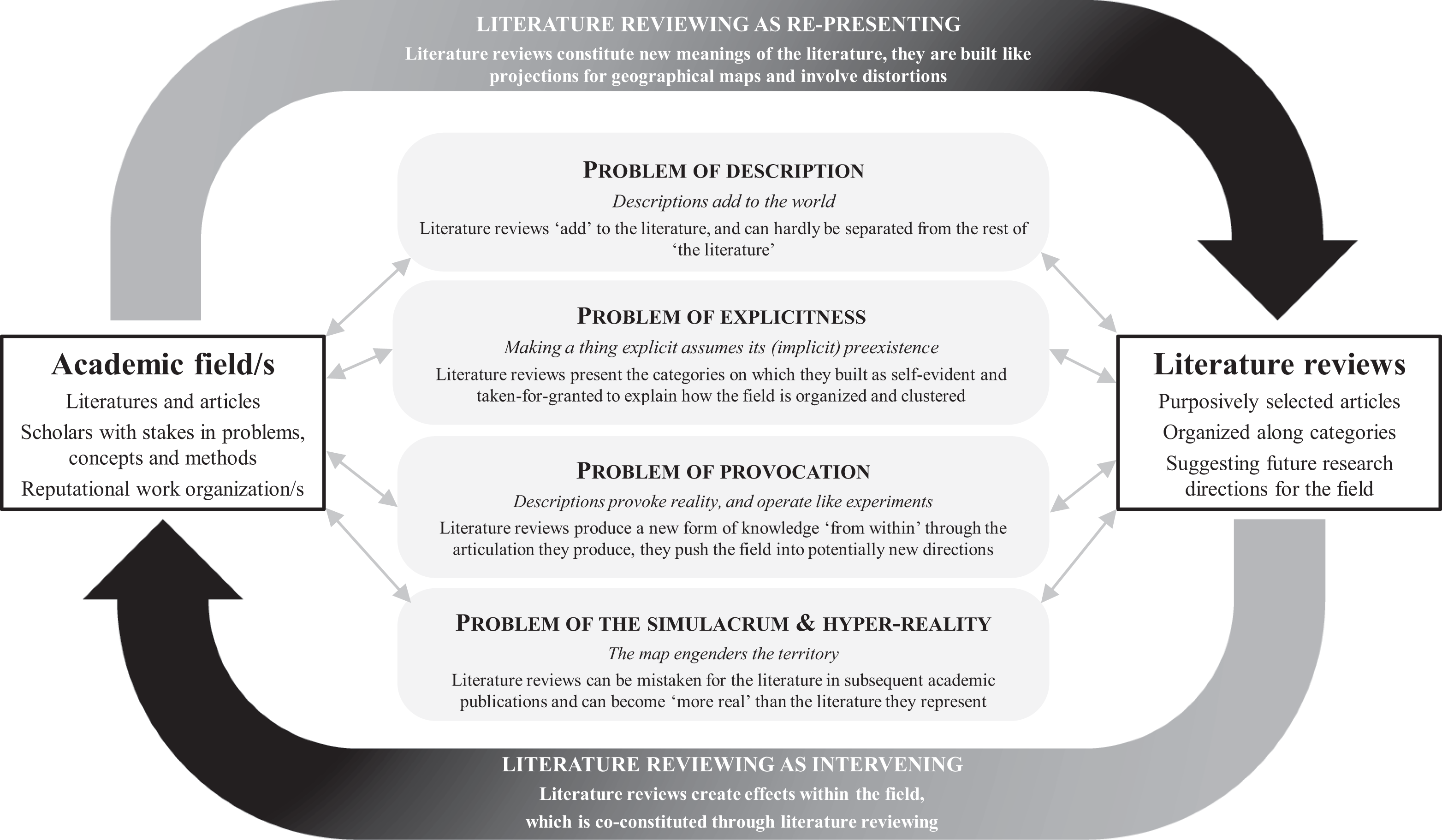
Performativity of literature reviews.
From a performative perspective, producing a literature review portrays and constitutes the meaningfulness of the preexisting literature. It thus re-presents the reviewed literature, that is, constructs an account of the field that is necessarily different from the original literature. Building on a geographical metaphor, saying that literature reviews are re-presentations means that we can study them as if they were world maps. A world map involves the reliance on a specific projection technique to present Earth (e.g., cylindrical vs. Mercator), and this projection will necessarily create distortions (e.g., a flat presentation of a round object). Literature reviewing similarly involves shaping the re-presentation of an academic field (e.g., contrast a European-centric to an Australian-centric world map); in a more or less controlled manner, by relying on specific categories (e.g., distinguishing macro vs. micro levels of analysis), by defining a deliberate purpose (e.g., consolidating a fragmented field), and by calling for the development of specific research directions (e.g., calling for the use of multilevel methods). Even more importantly for our purpose, the newly created map is not outside the world; it becomes an element of this world, it added the map to it—which hence differs from what existed before the map was put “out there.” Producing a world map creates a new signification of the world in the world: it changes the “re-presented” world.
A second important movement inherent to a performative analysis of literature reviewing relates to the agency acquired by literature reviews through their production. Literature reviews also intervene in the field they describe, in the same way that producing a map can help perform new journeys (think about the proverbial “treasure map” that plays a key role in so many novels). Adopting a performative take on literature reviewing is not just about studying how reviewing literature constitutes new significations for the field, but also about considering how reviews produce “reality as effects” (Muniesa, 2014, p. 2).
This bidirectional movement of re-presentation and intervention of literature reviews in academic fields can be specified and analyzed through Muniesa’s (2014) discussion of four problems associated with performativity: description, explicitness, provocation, and the simulacrum. We examine each in turn in relation to literature reviewing.
The Problem of Description
The problem of description points to the fact that even though “the thing that is described is supposed to be external to the description” (Muniesa, 2014, p. 17), descriptions necessarily “add to the world” (Muniesa, 2014, p. 18). As Muniesa (2014) notes, Austin (1962) identified this problem, as he became himself circumspect about his own, too neat, earlier distinction between “constative utterances,” that describe a state of the world, and “performative utterances,” that act in the world. Stating something is already an act that adds to the world. Sociological and organizational studies of financial derivatives illustrate this problem of description, as they show that the way a derivative is defined (or described) affects the way it is traded (or behaves) (MacKenzie, 2006). In the case of literature reviewing, the problem of description points to the fact that reviewing a literature is a process that “adds to the literature”—the literature review in itself is a new article in the CSR literature, and, thus, is added to it and changes the world (here, the CSR literature) it wishes to describe. In particular, review articles create boundaries around the field. Therefore, the problem of description calls for analyzing the methods and sampling strategies used to produce reviews (i.e., re-presentations of academic fields), and in particular the inclusions and exclusions that are involved in the constitutions of such maps of the literature.
The Problem of Explicitness
Performing a literature review, like producing a geographical map, also involves dealing directly with the philosophical “problem of explicitness.” When offering a re-presentation of the literature, it is tempting to assume that what has been made explicit “was there, already, implicit, existing in a latent, veiled, secret or potential form” (Muniesa, 2014, p. 24), like, for instance, national borders espousing natural features on a map. The suspicion underlying the idea that what was made explicit was already “out there,” calls for making the production process underlying the literature review more explicit and transparent, pushing for “trials of explicitness” (Muniesa, 2014, p. 24), a trend already documented in the domains of audit and accounting (see, e.g., Power, 2019). The problem of explicitness calls for analyzing how explicit literature reviews are about in their use of categories to organize the literature, and for making explicit the genesis and influence of such categories, which can intervene in a given academic field by becoming lasting organizing principles for that field.
The Problem of Provocation
The problem of provocation captures the idea that scientific accounts, or re-presentations, have effects in the world, specifically, they “provoke” reality like experiments (Muniesa, 2014, p. 23). Extending Latour’s (1999) insight about experimental events, that is, the notion that an experiment is an event that provokes new articulations between human and nonhuman entities, one can regard a literature review as producing a new form of knowledge “from within,” through the new articulations (e.g., bridging of ideas, statement of problems, identification of gaps, juxtaposing results, ordering definitions) it produces between preexisting articles. In so doing, a literature review can problematize concepts, phenomena, or theories differently; a review can ultimately provoke a new turn in an established field, or sometimes bring into being a new subfield or academic domain on its own. The problem of provocation invites to consider how literature reviews problematized the field in ways that reshape how scholars think about their field’s core tenets and developments, for instance by looking at the radicality of their departure from previous reviewing efforts, but also how they are later referenced and leveraged.
The Problem of the Simulacrum
The fourth performative problem described by Muniesa (2014, pp. 20-21)—after the writings of Jean Baudrillard (1994)—is the simulacrum, or hyperreality, which analyzes how a work becomes more real than what it intends to analyze or describe. A literature review is not only a re-presentation, it can also become an actual substitute for what it re-presents. Following this logic, “the map engenders the territory” (Baudrillard, 1994, p. 10), and the review becomes the literature in the eyes of scholars. Although this problem seems abstract, authors sometimes refer to a literature review in place of the literature itself. For example, for a newcomer to a field, a fresh literature review may easily be mistaken for a picture of the field itself. Through their large number of citations or status of “obligatory passage points” (Callon, 1986), literature reviews may de facto be a “more real” (or “hyperreal”) part of the literature or an academic field, in the sense that they may weigh more on the development of a field than other, nonreview articles. The problem of the simulacrum calls for evaluating the impact of some categories in the field used by literature reviews to sort out the literature, and for evaluating the influence of reviews in the constitution of academic fields and subfields.
To examine these four problems empirically and elaborate the theorization of the performative nature of literature reviewing, we conducted a literature review of literature reviews in the field of CSR.
Method: Systematic and Performative Reviews of CSR Reviews
CSR is an appropriate field to study literature reviews’ performativity because it is a low-paradigm field: heterogeneous, with no widely accepted view of how the concept should be defined or bounded (Mitnick, 2019; Wood & Logsdon, 2019). Therefore, it allows us to analyze more readily performative efforts by literature reviews in effecting the field and their subsequent impact. To examine the performativity of CSR literature reviewing, we first follow the canons of systematic literature review (SLR) (e.g., Denyer & Tranfield, 2009), and identify 48 reviews of the CSR field published between 1975 and 2019 that account in aggregate for the evolution of the CSR field. (Appendix A provides the final list of reviews—we discuss problems in selecting these and not other reviews in our discussion). We then in a second step analyzed these 48 reviews’ performative effects on the CSR literature, building on Muniesa fourfold problematization (Figure 1). We now describe briefly the SLR analysis and our subsequent examination of performativity.
Systematic Literature Review of CSR Reviews
We initially followed standard practice in SLR (Denyer & Tranfield, 2009; Tranfield, Denyer, & Smart, 2003) and relied on five stages: (a) question formulation, (b) locating studies, (c) study selection and evaluation, (d) analysis and synthesis, and (e) reporting.
Question formulation and context definition
In the first stage, we determined the review question (How do literature reviews of CSR review the literature?) and established the boundary conditions for our research in a review protocol. We made the decision to analyze peer-reviewed articles that provided a review of the CSR field from year 1975 to 2019 (44 years). Even though the literature on CSR can be thought as much older (e.g., Bowen, 1953; Clark, 1916), we chose Preston’s 1975 review as a starting point for our review of reviews, because it was from the 1970s that the field started to formally take shape (Carroll, 1999; Lee, 2008; Secchi, 2007). Prior to this period, books (e.g., Bowen, 1953) rather than journal articles were the main vehicles of CSR as an academic field (Carroll, 2008). Our focus on journal articles meant that we excluded books, book chapters, and nonacademic publications. The ambiguity in the field over the meanings of CSR and the changing labels also made our boundary-setting challenging (see also Gond & Moon, 2011; Wood & Logsdon, 2019). Figure 2 shows the changing use of labels over time.
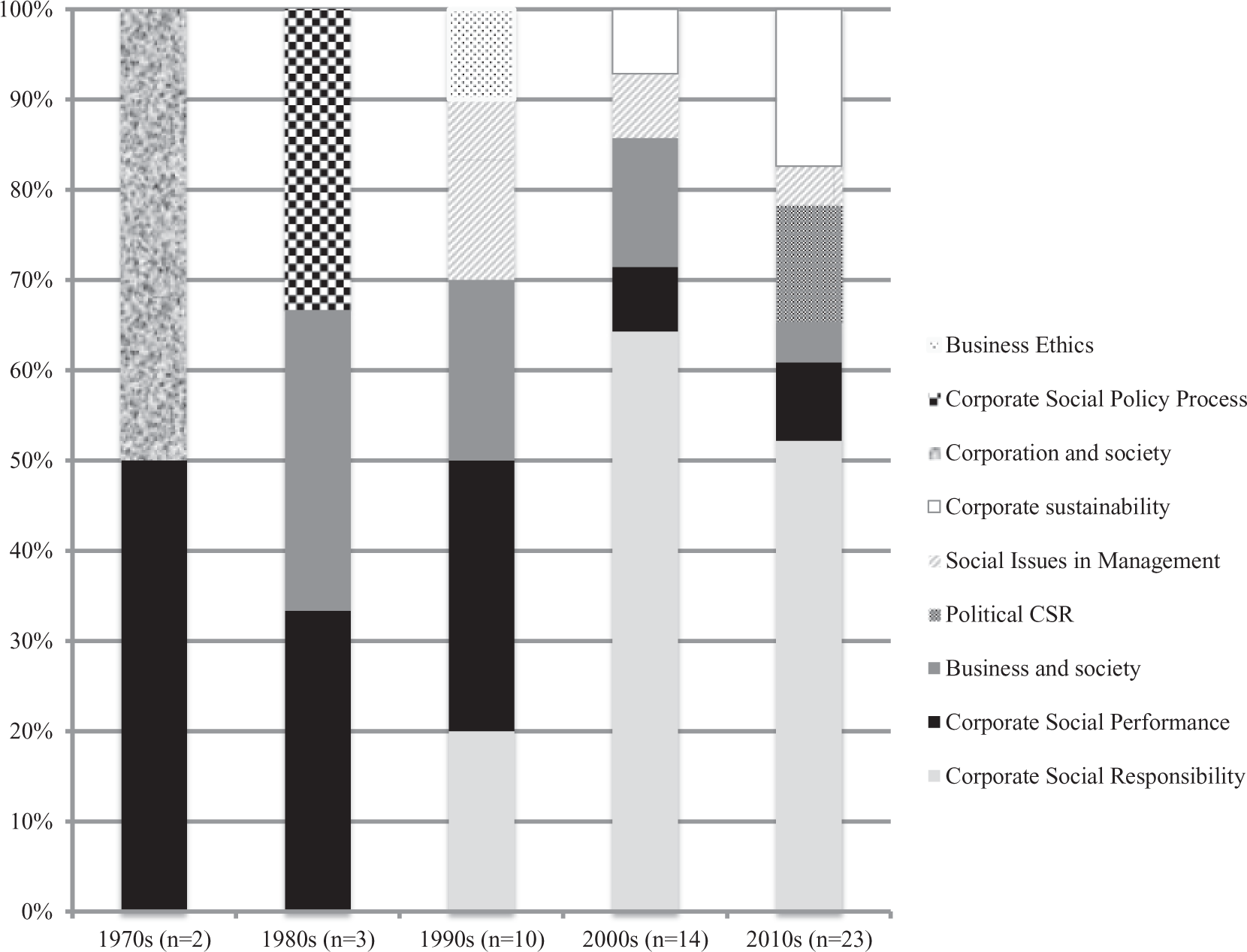
Evolution of labels used to describe the CSR research field (1975–2019, n = 48).
Locating and selecting literature reviews
We located relevant literature reviews in four steps: (a) we examined titles and abstracts of all issues of journals publishing reviews in management: International Journal of Management Reviews (1999-2019) and Journal of Management review issues (every January issue from 2008 and every July issue from 2010); (b) searched with keywords (“corporate social responsibility” or “sustainability” or “corporate responsibility” or “corporate social performance” or “corporate citizenship”) all issues of the Academy of Management Annals (2007-2019); (c) used keyword search (“literature review” in abstract) in all issues of CSR journals between 1975 and 2019 (Business Ethics Quarterly, Business Ethics: A European Review, Business & Society, Journal of Business Ethics, and Society and Business Review), and mainstream management and organization theory journals (Academy of Management Review, Academy of Management Journal, Administrative Science Quarterly, Journal of Management, Journal of Management Studies, British Journal of Management, Organization Science, Organization Studies, Human Relations); (d) and performed a general keyword search (“literature review” and “corporate social responsibility” or “sustainability” or “corporate responsibility” or “corporate social performance” or “corporate citizenship” in abstract) in an online library database. In this last step, we focused only on disciplines of business, social sciences, sociology, and social history and excluded marketing, supply chain, operation management and audit journals (too specialized for our purpose), and journals that are ranked the lowest by the Association of Business Schools (1 out of a scale of 4).
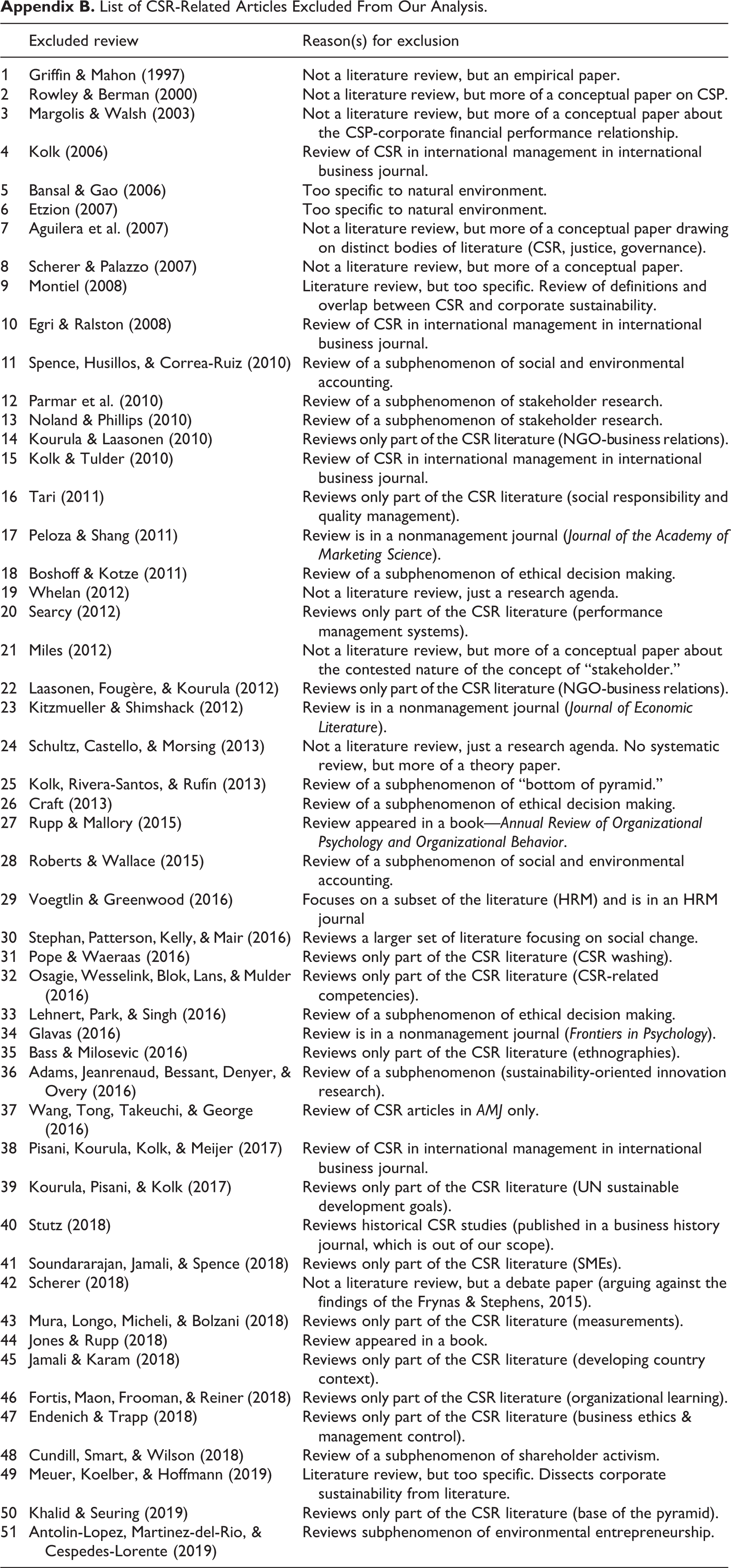
Titles and abstracts were reviewed for all articles by the three coauthors to determine whether the articles qualify as CSR literature reviews. We excluded a number of articles on the grounds of them not addressing CSR research or business and society as a whole (e.g., review of the subfield of environmental sustainability), addressed the field from a different discipline (e.g., accounting or psychology), or the article was not a literature review article (e.g., an empirical article or a research agenda). Appendix B displays the comprehensive list of rejected articles and reasons why they were excluded. Based on this procedure we short-listed 41 literature reviews.
We also sought recommendations from seven distinguished scholars from the field of CSR, to evaluate whether we missed important reviews, and whether our sample accurately captures most reviews of the field. This exercise resulted in the inclusion of a further seven reviews in our database. Finally, 48 reviews have been ultimately incorporated in the SLR. Figure 3 describes the distribution of the included and excluded CSR reviews over time; this figure indicates the explosion of more specific CSR literature reviews in recent years.
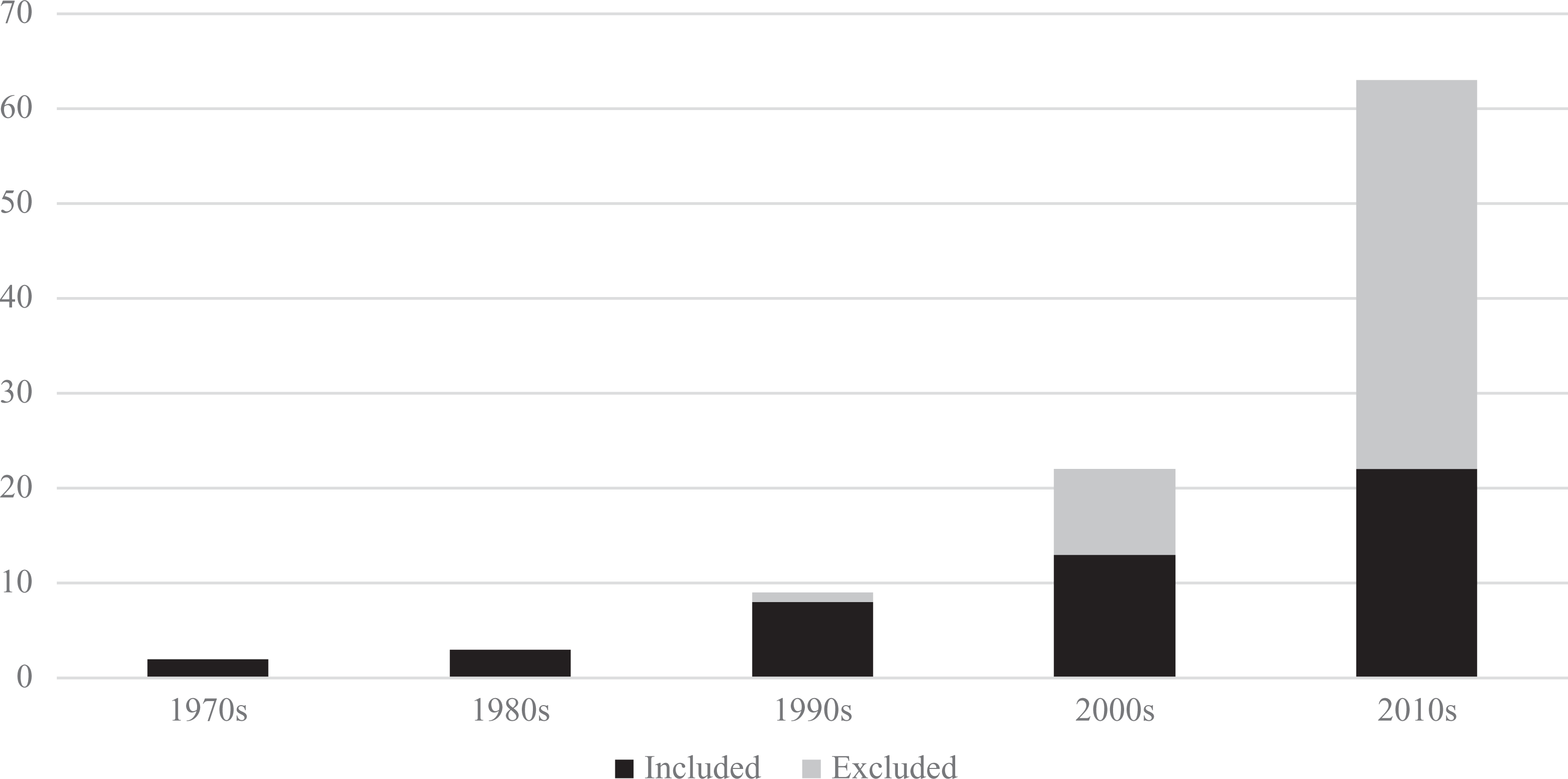
Distribution over time of CSR literature reviews included and excluded from our analysis (1975–2019, n = 99).
Analyzing, synthetizing, and reporting
We then focused on identifying key characteristics of literature reviews in terms of labels they used to describe the field (e.g., corporate social performance or CSR), their main purpose (e.g., “chart development of the field”), categorizations used to classify the literature (e.g., “macro/meso/micro”), and calls for new research orientations (e.g., “need to develop more individual-level study of political CSR”). These were identified through an in-depth examination of the full text of the reviews. (Appendix A shows the outcome of this SLR.)
Accounting for the Performativity of Literature Reviewing
To analyze the performativity of literature reviewing, we followed an iterative approach. We first engaged inductively with the reviews to understand how they necessarily portray the field of CSR partly and partially, and accordingly perform different aspects of the field over time. This led us to look at the goals, categories, and calls for future research and how they have evolved over time and potentially been discussed by subsequent reviews. As a result of the present article’s editorial review process, we then relied on Muniesa’s (2014) four problems to reconceptualize the performativity of literature reviews in CSR and reorganize our prior inductive categories (we thank our reviewer for this helpful suggestion). We reanalyzed our data in light of these four problems, by thinking creatively about how we could improve or expand our inductive categories to capture these problems. By going back to our data, refining our empirical “indicators” and iterating with the literature on performativity, we ended up with a robust explanation and illustration of the dual movement of re-presentation and intervention of literature reviews in academic fields, captured through each of the problems identified by Muniesa (2014).
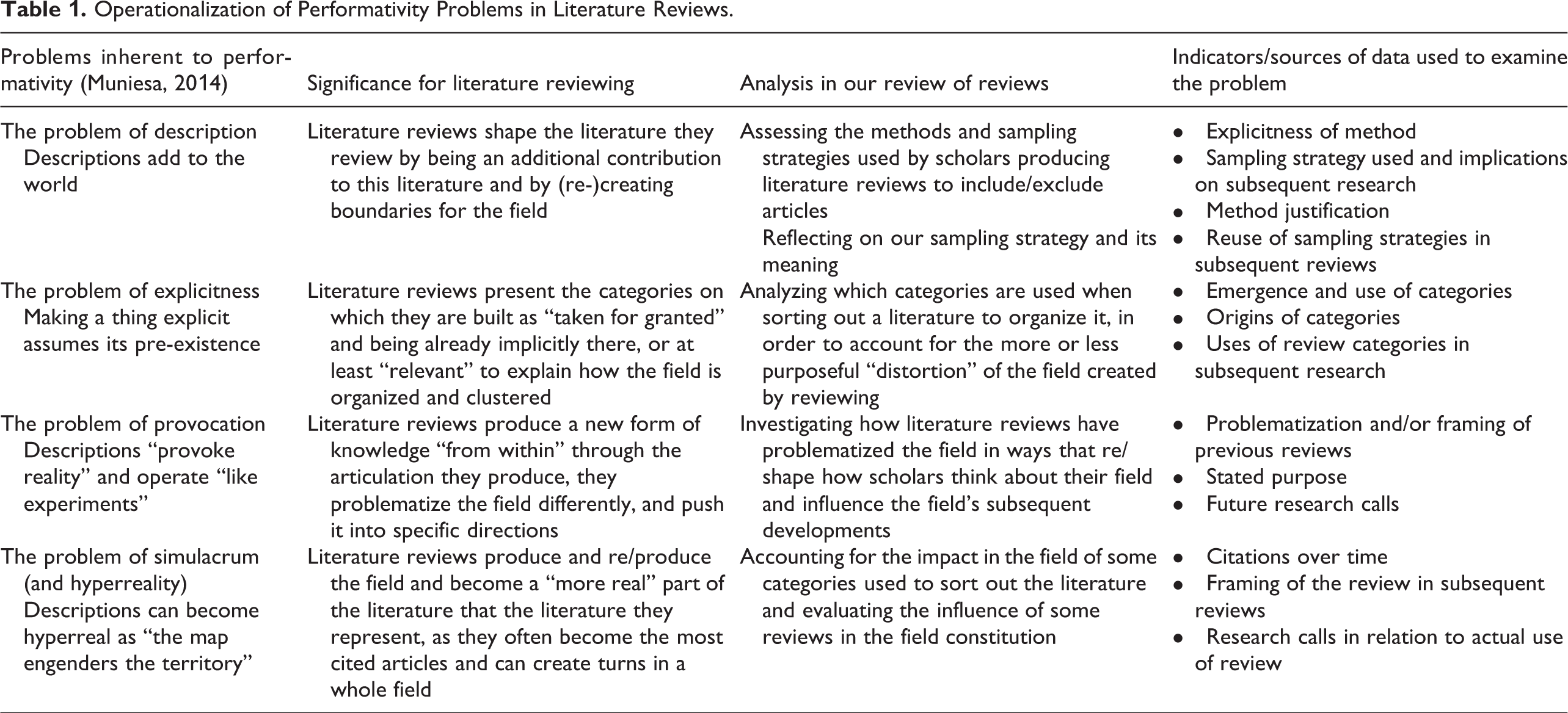
Table 1 provides details about how we “operationalized” the four problems and accordingly the type of evidence we identified in the reviews. 2 While the scope of our review was limited to literature reviews, we nevertheless collected additional evidence to capture the intervening effects of three highly cited and relatively recent reviews on not just literature reviews, but also regular, nonreview CSR articles: Aguinis and Glavas (2012), Garriga and Melé (2004), and Scherer and Palazzo (2011). We looked at the first 100 most recent citations for these three reviews on Google Scholar and analyzed how the reviews were used in these citing articles to clarify the potential intervening effect of literature reviews on the academic fields beyond merely subsequent literature reviews.
Operationalization of Performativity Problems in Literature Reviews.
Examining description
In order to account for the problem of description in the re-presentation of a field, we analyzed the methods and sampling used in CSR literature reviews. We assessed the reviews based on how explicit they were regarding their methodology (e.g., do they have a separate method section, do they talk about their reviewing approach, what sampling strategy they used to select articles to review, and how they justified their methodological choices). Moreover, to capture intervening effects, we examined how these methodological concerns were reflected in subsequent reviews. For instance, we looked at whether reviews referenced or relied on similar methodological choices than reviews published earlier (and that were included in our sample).
Examining explicitness
The problem of explicitness deals with how review categories become taken for granted in organizing a field. To analyze this problem and account for intervening effects in the field, we reviewed each review in terms of what categories it used to organize the literature (e.g., distinguishing between normative, descriptive or instrumental studies of CSR), when these categories were used for the first time in our sample, and how they evolved over time when reused by subsequent reviews. We also inductively coded how each review produced the categories (their source) and the reasoning and justification behind their use.
Examining provocation
We account for provocation by assessing how authors problematized the literature in ways that departed more or less radically from previous problematizations in reviews included in our sample. We analyzed the reviews based on how they framed previous literature reviews, what their stated purpose was for reviewing the field, and what direction for future research they called for. To assess intervening effects, we examined whether and to what extent such calls were answered in subsequent literature reviews, and in the aforementioned sample of nonreview articles citing the three prominent CSR reviews.
Examining the simulacrum
To investigate this problem, we assessed the impact of the reviews, which we partially achieved by looking at Google Scholar citation counts. We also investigated how a review was framed by subsequent reviews (e.g., Do later reviews ascribe to an earlier review’s view of the CSR field, or do they depart from it?) and compared this to their stated research calls (e.g., Did a review achieve its goal of affecting the field as evidenced by mentions of this review in subsequent ones?).
In a final step of analysis, we performed a reflective analysis on the performativity of our own systematic literature reviewing. We reflected on the four above-mentioned problems and how our SLR created performative effects, for instance by only selecting some reviews in our sample, effectuated the field through the assumption of the preexistence of some concepts, or reused preestablished categories. We present the results of this reflective analysis in our discussion rather than our findings, as we see this analysis as a valuable effort that could be included in future literature reviews more broadly.
Exposing Performative Movements in CSR Reviewing
Our findings present how the two performative movements of re-presenting and intervening occurred through CSR literature reviewing. We use the four performativity problems to explain how reviews simultaneously re-presented and intervened in the CSR academic field by performing its boundaries, categories, and priorities, in a self-constituting manner.
Description: (Re)Producing Literature Boundaries
The first four decades of CSR literature reviews (1975-2010) were mostly implicit in terms of their methods for reviewing (e.g., Carroll, 1979; Garriga & Melé, 2004), with the exception of four reviews (Gerde & Wokutch, 1998; Walsh, Weber, & Margolis, 2003; de Bakker, Groenewegen, & den Hond, 2005; Lockett, Moon, & Visser, 2006). From 2011 onward, all of the reviews started to detail how they went about reviewing the CSR literature, except reviews serving as introduction to special issues (e.g., Hahn, Figge, Aragón-Correa, & Sharma, 2017). Such systematization in CSR reviewing reflected the call for reviewing literatures more systematically in management and organization studies (Jones & Gatrell, 2014; Rousseau, Manning, & Denyer, 2008). For instance, Gerde and Wokutch (1998) state that “the use of meta-analysis and synthesis (Arlow & Wogan, 1996) will help move the [Social Issues in Management] field forward and at the same time lead to more precise terminology” (p. 437). Statements like those underpin the general assumption that the literature is something that can be accounted for and re-presented more precisely over time using more refined methods.
Yet, this move toward systematic methods (such as bibliometric analysis) was sometimes received with skepticism. For instance, one of the first systematic reviews based on bibliometric analysis published in 2005 by de Bakker and his colleagues (2005) faced a backlash because it omitted key works from Carroll—who authored some of the most influential reviews of the field (Carroll, 1979, 1999). As explained by John Mahon, then editor of the journal, in an editorial subsequent to this publication: When the paper was published Professor Archie Carroll communicated to me (and to the authors) a query that was powerful in its impact. He simply asked as a matter of curiosity why his widely cited works on CSP [corporate social performance] were not included in this analysis? (Mahon, 2006, p. 3)
This episode illustrates that the problem of description is particularly acute when it comes to selecting the articles included in a review, as it re-presents the literature by creating boundaries around what is considered “in” or “out” of its scope. Early CSR reviews, usually adopting a traditional narrative rather than systematic approach to literature reviewing (Jones & Gatrell, 2014; Tranfield et al., 2003), did not specify which articles they included or excluded in their scope. Early narrative reviews, by not disclosing their selection criteria, obscured that the scope of the literature is a question of active choice on the part of the authors, giving the impression of being comprehensive and representative in their review.
However, managing this impression necessarily became more and more difficult as the field expanded: since 2009, over 400 articles have been published each year on CSR (Lu & Liu, 2014, p. 118). Thus, over time, selection criteria became more explicit and specific in CSR reviews. Later reviews tended to focus solely on regular peer-reviewed journal articles, excluding for instance, “editorials, transcribed speeches, book reviews, and insubstantial articles (four pages or less)” (Lockett et al., 2006, p. 121), introductions to special issues (e.g., Aguinis & Glavas, 2012) or books and book chapters (e.g., Crane & Glozer, 2016). Recent reviews focused on, as per usual practice, top management journals, often defined in terms of their impact factor or appearance in an official journal list (e.g., Association of Business School or Financial Times lists). This choice was usually justified by the methodology used in previous literature reviews in targeted journals (e.g., Montiel & Delgado-Ceballos, 2014) or Podsakoff, Mackenzie, Bachrach, and Podsakoff’s (2005) study on the influence of management journals in the 1980s and 1990s (e.g., Aguinis & Glavas, 2012). Such a reliance on previous reviewing approaches to selection meant less diversity in reviewing the field. It also highlights the intervention of earlier reviews in the field: Their methods and selection criteria are reproduced, often without much justification.
Such intervention in the field, notably by focusing on top-tier management journals, led to an overemphasis on North American journals and hence research. This situation created a biased perspective, as CSR research is also conducted in other regions of the world (see Carroll, 1999). Similarly, research in another language than English was always excluded. Oftentimes, it was convenience and the material affordances of electronic databases that seemed to drive these decisions—what is included in a database, what is easy to search online, what overall number of articles is feasible to review within a given word count. These biases represent the field in the first place as North American, but also reconstitute it as such, by imposing their selection criteria as standard for subsequent reviews.
Finally, an important criterion that shaped the subsequent construction of the literature and thus intervened through reviewing is the use of keywords to search for relevant works to review. Some reviews exclusively focused on CSR (e.g., Aguinis & Glavas, 2012; Wood, 2010), while other reviews were broader and included keywords such as sustainability, stakeholder management, or business ethics (e.g., Linnenluecke & Griffiths, 2013; Montiel & Delgado-Ceballos, 2014). For a low paradigm field such as CSR (Wood & Logsdon, 2019), keyword choice shaped extensively field boundary setting. By intentionally choosing these keywords, authors did not only expand or limit the scope of the review, they also defined to a large extent what their readers should understand the field to be—re-presenting it. For example, Lockett et al. (2006) excluded corporate governance from the keyword search because they deemed this subfield, even though overlapping with CSR, to be long standing in its own right.
Our findings indicate that, when it comes to literature reviewing, boundaries of the field are being performed by description, through both re-presentation of and intervention in the literature, which produce, reproduce, and shift these boundaries in more or less visible ways. In the specific case of CSR, our analysis captures longitudinal moves toward systematization and automation when re-presenting the field, which in turn intervened in the literature by reproducing previous systematic reviewing approaches. Early reviews emphasized the need for a unifying paradigm (e.g., Jones, 1983; Wartick & Cochran, 1985), therefore being rather inclusive and adding to the literature a common search for this unique definition and boundaries of the CSR field. These reviews did not use systematic inclusion criteria, and their sampling strategy remained implicit. Over time, technological development has drastically reshaped the way we produce literature reviews, moving from the physical search of articles and books in a library and typewriting, to systematic searches in a given set of journals, allowing review producers’ claims to provide a more rigorous and comprehensive approach in selecting which works to review. These tools, however, necessarily brought about re-presentations that are contingent to their material affordances, as highlighted by the de Bakker et al.’s (2005) episode. This incident reveals that material devices such as databases coproduce the CSR field by shaping the activity of literature reviewing. As searching electronic databases started to become the new way of compiling literatures (as opposed to manual library searches), collecting and analyzing data electronically allowed for a generally broader scope and more systematic approach, yet also created new and less visible boundaries around what is considered in and out of the field—articles excluded from electronic datasets becoming, literally, invisible. Surprisingly, reliance on automation did not seem to have enhanced reviews’ homogeneity. While reviews intervened in the field by providing ready-made selection criteria and (systematic) reviewing methods, recent CSR reviews nevertheless kept “adding” diverse and heterogeneous representations of the field, as depending on the datasets, selection criteria or keywords used, the boundaries of the field could be reshaped drastically. Accordingly, the affordances and constraints of automation undermined representational claims for more “objective” reviews, as the diversity of CSR reviews could potentially expand, moving the literature far beyond homogenous or “neutral” representations.
Explicitness: Generating Structuring Categories
Most early reviews built on a variation of Carroll’s seminal contributions (1979, 1991, 1999), and used (a variation on) his categories of economic, legal, ethical, or philanthropic responsibilities of companies (e.g., Swanson, 1995; Wartick & Cochran, 1985; Wood, 1991a). Another common set of categories related to alternative concepts that were widely considered (although sometimes debated) as prominent research streams in CSR: business ethics, stakeholder theory, corporate social performance, or environmental responsibility to name a few (e.g., Schwartz & Carroll, 2008; Werhane & Freeman, 1999). Other ways of making categories explicit relied on epistemological and methodological grounds, such as levels of analysis (individuals, organizations, society, e.g., Walsh et al., 2003). Yet other categorizations related not to CSR research but took inspiration in other disciplines. For instance, a few CSR reviews relied on philosophical constructs, dividing CSR articles in normative and descriptive efforts, sometimes with an additional prescriptive or instrumental category (e.g., de Bakker et al., 2005; Wood & Logsdon, 2019). Other reviews relied on sociological, functionalist approaches to review the literature, such as Parsons’ four aspects of social systems (politics, ethics, economics, social integration) (e.g., Garriga & Melé, 2004), which also provided the basis for the categorization of CSR studies into input, process, output-focused (e.g., Wartick & Cochran, 1985; Wood, 1991a).
While the initial development of categories by a literature review implies re-presentation, there is evidence of intervention of these categories in subsequent reviews. Indeed, this latter categorization of input/process/output has been performed and reproduced throughout CSR reviewing, from Carroll’s (1979) CSP model (outlining principles of CSR, processes of management, and types of social issues) to current developments in “micro-CSR” (drivers of CSR, mediating mechanisms, organizational outcomes; see, e.g., Aguinis & Glavas, 2012; Bansal & Song, 2017; Gond, El Akremi, Swaen, & Babu, 2017).
To make the problem of explicitness more palpable, we examined how each review produced its categories and the reasoning and justification behind their use. We found three main types of sources for categories: inductive analysis, implicit theorizing, and previous theorizations. The first two sources were often not detailed and thus not reflexive in terms of how they re-presented the field. Inductive analysis meant categories were created from a data-led analysis of the content of the articles reviewed. The categories emerging from this analysis were presented as “real,” justified as empirically stemming from the data; the literature was “out there,” and you could extract categories from it. In a few cases, these categories were matched on to previous theorizations, as authors realized their analysis fitted with previous reviews (e.g., Gerde & Wokutch, 1998).
While inductive analysis tended to assume the greatest objectivity in terms of the categories used (i.e., the literature is structured along “real” categories that exist in the data and that were uncovered by the analysis), implicit theorizing also assumed an appropriate and taken-for-granted way to structure the literature to some extent. Yet, categories were not based on empirical grounds, and often had little theoretical grounding as well. Reviews using implicit theorizing tended to assume that the categories or structuring criteria used to review the literature were relevant without justifying them (e.g., Richardson, Welker, & Hutchinson, 1999, with capital markets’ related constructs). A few reviews were somewhat more prudent and reflexive. For instance, Jones (1983) used as explicit categories “five modes of control, each based (perhaps implicitly) [italics added] on a philosophy of control” (p. 561) and Schwartz and Carroll (2008) cautiously stated that “to address the confusion among the five constructs as currently described, it may be appropriate [italics added] to unpack or disaggregate each of the frameworks to identify the core concepts or elements that potentially bind each of them together” (p. 168).
The third source for categories consisted in relying on prior theorizations, either locally in the CSR field, or more broadly in management or yet another discipline. These reviews treated prior concepts/categories as real and relevant, yet often pointed them out as incomplete and in need of refinement or redirection. Thus, they did not challenge the existence of categories (or differences in CSR articles) to structure the literature, yet assumed there were better ways to do it. Wood (1991a) for instance, refined and repurposed Wartick and Cochran’s (1985) original categories of “input, process, output” as “principles, process, outcomes”—demonstrating the subsequent intervention of this early review in the field, and the lasting structuring influence of this categorization. In the early years of CSR, reliance on prior theorization was dominant and was based on Carroll’s (1979) or Wood’s (1991a) contributions—both the most highly cited reviews in the field. As the field expanded and spread, however, their intervening role became less central, and they were replaced by more recent and specific reviews of the field.
Yet, literature reviews not only intervene in academic fields through performative effects on subsequent literature reviews but also intervene in regular journal articles that may reuse categorizations of these literature reviews and take them for granted. Our examination of the 100 most recent citations on Google Scholar of three highly cited CSR reviews (Aguinis & Glavas, 2012; Garriga & Melé, 2004; Scherer & Palazzo, 2011) provides evidence for such intervention in the CSR field. We found numerous examples of categories from literature reviews being taken for granted. For instance, Bhattacharyya (2019) states that “a theoretical piece on [international CSR] would contain mixed elements of Garriga and Melé’s (2004) four dominant types of CSR theories” (i.e., instrumental, political, integrative, and ethical).
In summary, our analysis suggests that explicitness in the CSR academic field operates through the production and reproduction of categories explicitly aimed at re-presenting the literature, which deeply structured the subsequent development of the field. Indeed, such categories intervened in the field, as they were subsequently not essentially but only marginally challenged and further refined. These early categorizations were assumed to be “out there” in the literature, and were perpetuated over time, from review to review. In the process, blind spots were performed: as existing categories were reproduced, specific re-presentations that necessarily obscured or underplayed some parts of the literature, while emphasizing others, were reproduced over time as well. Since the 2000s, when recognition of diversity and varied perspectives on CSR increased, the categories used were broadened, yet often reused too (see, in particular, the “input, process, output” triptych or the “micro, meso, macro” levels of analysis), therefore also assuming some preexistence of these core categories, that often originated outside the CSR field.
Provocation: Problematizing the Field, (Re)Setting Priorities
Muniesa (2014, p. 23) states that “[to] have an effect is to provoke, to be an effect is a provocation of reality.” Literature reviews provoke reality, the “what is,” as they produce new forms of knowledge through the articulation of the literature they provide; they problematize a field’s key constructs or theories, and reset priorities in ways that can produce subsequent paradigmatic turns. As previously shown, early CSR reviews often built on prior reviews’ re-presentations, particularly key contributions like Preston’s (1975), Carroll’s (1979) or Wartick and Cochran’s (1985). Yet, doing so, they also emphasized that these early re-presentations were lacking to some extent (as discussed before) and attempted at offering an alternative, more or less departing from early re-presentations of the literature. Approaches that are critical of previous re-presentations, however, have the potential to have a more radical impact on the field through (re)conceptualizing the literature, borrowing from other disciplines, and through alternative conceptualizations (Macpherson & Jones, 2010). Accordingly, we found that later reviews of CSR tended to be more critical of previous efforts and did not build as explicitly on previous ones. They pointed to the fragmentation of the field and some of its shortcomings (e.g., lack of agreement, construct clarity) to justify a brand new reading and re-presentation of the literature, in aspects such as theory application (e.g., Frynas & Yamahaki, 2016).
To examine how provocation was played out through reviewing in the CSR field, we analyzed how a given literature review’s effect was assessed by subsequent reviews. We found that CSR literature reviews did acknowledge the effect of previous efforts in various ways: echoing prior reviewing efforts and the turns they provoked, calling for new turns in the literature, or engaging more explicitly with field integration or agenda setting. Early seminal reviews (e.g., Carroll, 1979; Wood, 1991a) were often referenced by later ones, at least ceremonially, usually to note how they started structuring the field. Yet, they were similarly often dismissed. A few exceptions were noted as turning points in the CSR literature (e.g., Carroll, 1999; Swanson, 1995) by subsequent reviews, even though these exceptions may have been less cited than other reviews; these turning points had their achievements echoed in more recent reviews. We found that in the CSR literature, these turning points yet less cited reviews were oft recognized by their addressing of the evolution over time of the CSR concept and associated constructs, to mitigate the confusion and lack of agreement in this low paradigm field. One such exception is Carroll (1999), which was acknowledged by a number of other reviews as a significant effort to clarify CSR constructs and bring order to the field. This review had therefore a clear intervening effect later in the field, which was recognized explicitly.
The second type of provocation—turn calling—involves analyzing whether and how “calls for future research” from reviews were picked up by later research and reviews. Early reviews in CSR focused on finding a single framework or paradigm that future research could build on, and these reviews all followed this call. Around the late 1990s and early 2000s, however, the acknowledgment of the fragmentation and expansion of the field led to the (implicit) abandonment of this call (e.g., Gond & Crane’s [2010] autopsy of the CSP paradigm), and called for research in more specific areas, whether topical, on subconcepts of CSR (e.g., political CSR, sustainability-related areas), levels of analysis (e.g., multilevel, individual level), or related theoretical backgrounds (e.g., environmental sciences, political science and governance). Hence, whereas some early reviews had a clear intervening effect on future research as shown by how they are discussed and built on by consecutive reviews, later reviews (also likely due to the expansion of the field and the number of studies), had less of an impact on subsequent studies, and crafted much more specific calls for research that were often left unanswered. For instance, in more recent CSR reviews, there was a recognition of the need for multidisciplinary research early on, and the incorporation of nonbusiness/management insights to bring to bear (e.g., Aguinis & Glavas, 2012; Linnenluecke & Griffiths, 2013; Wood, 2010). This was paralleled by a narrowing on contributions based on management studies, whereas some early reviews were broader in their outlook and scope and incorporated insights from public policy, political science, economics, ethics and philosophy, and other disciplines. This call for an interdisciplinary study of CSR went back to the roots of the field (e.g., Werhane & Freeman, 1999), in that it examined ethics and economics, or business and society, from multiple disciplinary backgrounds.
Finally, provocation was even more explicit in literature reviews that set out to integrate the field or set a new research agenda. The integration objective means that a review synthesizes findings from the literature to move research forward (Rousseau et al., 2008). Through this, authors wish to influence research by taking stock of what we know and what we do not know, and integrating what we know within overarching frameworks (e.g., Wartick & Cochran, 1985; Wood, 1991a). Agenda setting became almost a necessary requirement from 2010 onward, where authors explicitly stated calls for renewed directions for the field (e.g., Aguinis & Glavas, 2012; Frynas & Yamahaki, 2016; Scherer & Palazzo, 2011). Often we find that authors closed their review with an explicit wish to intervene in the field, such as Jones (1983): “Most importantly, this article may inspire further efforts to define and lend structure to this emerging discipline: ‘a journey of a thousand miles begins with the first step’” (p. 563); and Lee (2008): “I hope this study has been an important stepping stone towards new exploration in CSR research that can greatly enrich our understanding of business–society relations” (p. 70).
Although our analysis suggests that “turn calling” and “agenda setting” are purposive and in line with authors’ intention, this process may be heavily shaped by the editorial reviewing process and thus journal board orientation (Orlitzky, 2011). For instance, the present article would not have operationalized so systematically Muniesa’s categories was it not for one of our reviewers who attracted our attention to them—and who we thank gratefully for this suggestion. To gain insights into these processes, we conducted exploratory interviews with the authors of two reviews that spurred the subsequent development of two prominent CSR subfields, and therefore shifting the CSR landscape: “political CSR” (see Scherer & Palazzo, 2011) and “micro-CSR” (see Aguinis & Glavas, 2012). In both cases, from our interviews, the authors stated they aimed at provoking a shift in the literature, and even though they did not attribute this shift solely to their review, they both stressed their willingness not to compromise on the core tenet of their argument, to stimulate more politically inspired approaches to CSR studies, or the development of individual level studies of CSR, respectively.
We also complemented this analysis of intervention on subsequent reviews by an examination of citations in nonreview journal articles of three highly cited reviews. We found evidence that agenda setting and turn calling has an intervening effect, as a high number of articles relied on reviews’ calls for future research to motivate their study. For example, Cetindamar and Husoy (2007) state that their “paper modestly accepts the challenge introduced by Garriga and Melé (2004), namely integrating economics and ethics” (Cetindamar & Husoy, 2007, p. 163). Another example responds to Scherer and Palazzo’s (2011) call for the filling of global governance gaps by companies and stakeholders together: “our approach, which is grounded in solving market failures by addressing negative externalities, as opposed to the role of companies in creating positive externalities, aims to extend Scherer et al.’s PCSR” (Johnston, Amaeshi, Adegbite, & Osuji, 2019). Farooq, Rupp, and Farooq (2017) present the results of their investigation of employees’ reactions to CSR as being “in direct response to calls in the literature for exploring alternative mediation mechanisms explaining the psychology of CSR (Aguinis & Glavas, 2012)” (p. 956).
Our analysis of the problem of provocation in CSR reviewing highlights how the problematizations of the field have evolved, in ways that drastically shifted research priorities. Early re-presentations of the field emphasized the need for finding a single paradigm for this field. Over time, however, failure to respond convincingly to this call and increasing diversity in CSR research meant that new re-presentations abandoned the call for a unifying paradigm and rather called for more specific research directions (such as focusing on an individual level of analysis). Such specific calls for future research intervened in the field by allowing researchers to answer these calls pragmatically, as opposed to the idealistic early view that a unique paradigm could be found. This, in turn, contributed to increased diversity and heterogeneity in CSR research, which we examine next with the problem of the simulacrum.
Simulacra: Self-Sustaining Field’s Representations, Engendering Subfields
The simulacrum problem deals with the fact that some reviews tend to become what is perceived as being the literature for subsequent scholarly efforts, in ways that self-sustain the constitution of the field, but also potentially engender the emergence of distinct subfields. Literature reviews often become the most cited articles in a field and, as we have shown, can create turns in a whole field. The two previously mentioned reviews (Aguinis & Glavas, 2012; Scherer & Palazzo, 2011) played such a role, beyond their deliberate provocation, as they stimulated the abrupt and large development of the political CSR and micro-CSR subfields, respectively. Their role became so prominent that two systematic reviews were conducted a few years later to account for the explosion of studies in both “political CSR” (see Frynas & Stephens, 2015) and “micro-CSR” (see Gond et al., 2017). By becoming one of the most visible articles in their field, literature reviews can become the first point of contact for newcomers to a field (such as PhD students or scholars from neighboring fields)—shaping how these newcomers then approach and engage with this field because of the way it is re-presented in these reviews.
One obvious way to assess the prominence and impact of scholarly work is through citations. Literature reviews in particular tend to be highly cited, and relied on heavily by subsequent research—some become “obligatory passage point” (Callon, 1986) so that their citation, even if ritual, becomes a quasi-mandatory exercise (a fact also illustrated by the de Bakker et al., 2005, 2006, episode). Looking at citations to the reviews in our analysis, one unsurprisingly finds the above-mentioned seminal contributions (e.g., Carroll, 1979; Wood, 1991a) as highly cited, and more so over time—especially in recent years. Yet a few influential reviews in the early years (e.g., Swanson, 1995; Wartick & Cochran, 1985) did not increase in citations as much—despite having introduced long-lasting re-presentations of the CSR field (e.g., Wartick & Cochran’s [1985] “input, process, output” categorization).
Another indicator of the deployment of literature reviews as simulacra is the impact these studies had on later reviews and how they were framed by these works. The stated goal of the vast majority of CSR reviews up to the 2000s was to identify a single, unifying construct or paradigm for the field. For that, the reviews argued they needed an appropriate map to the literature from which this unifying paradigm could be constructed (Jones, 1983). Yet, these reviews, and especially early, seminal ones, were subsequently picked up by further reviews not as “maps” (or reviews) of the literature, but as the literature in itself. Indeed, most concepts from these articles (such as the many variants of the CSP model) were picked up to be refined, with little acknowledgment of the mapping (or origination) of the construct in the first place. This is particularly observable in how these reviews were cited: not as maps of previous works but as conceptual articles—and hence as the literature itself.
With increasing diversity and number of CSR studies, the field moved away from the search for this unifying paradigm, with an according acknowledgment of this diversity and thus an according need for maps accounting for this variety. Garriga and Melé’s (2004) review offers a telling example of such an influential turning point in the literature. Their stated goal was to map the CSR landscape and make sense of multiple theories and approaches—different from most reviews beforehand whose stated goal was to search for a unifying paradigm. Given this goal, the review was then later framed, not as a simulacrum for the literature, but as a map, a re-presentation, of the field that accounted for its newly acknowledged diversity (e.g., Maon, Lindgreen, & Swaen, 2010). From finding an appropriate map of the field, reviews then later moved on and started to focus on proposing new research directions, therefore moving back to treating former reviews as the literature, or actual “parts of the field,” rather than maps (e.g., Frynas & Stephens, 2015).
Despite the challenge of capturing empirically how much the problem of the simulacrum was deployed in the CSR field, our analysis suggests that some articles, such as the one published by Aguinis and Glavas (2012), gained considerable agency in the space of a few years, and enabled the engendering of the subfield of “micro-CSR” they initially foreshadowed. For instance, Gond and Moser (2019) argue that the stream of studies developed after Aguinis and Glavas’s (2012) review generated two distinct subfields of micro-CSR scholarship: one relying on industrial psychology and organizational behavior, focused on employees—psychological micro-CSR (e.g., Farooq et al., 2017), and one building on sociology and organization theory, focused on CSR managers and their practices—sociological micro-CSR (e.g., Wickert & de Bakker, 2018).
The simulacrum phenomenon was also salient through a process of substitutive referencing, by which references to reviews were used to challenge and discuss the “CSR literature” as a whole. Our cursory analysis of regular journal articles citing CSR reviews provides multiples examples. For instance, Schneider (2019) states that “CSR has become a widespread business practice and an important research field. The mainstream approach to CSR [italics added] asserts that CSR has the potential to serve as a remedy for the negative effects of business activities and capitalism more generally (for an overview of this approach, see Scherer & Palazzo, 2011).” Other articles associated a subfield of CSR with the broader field of CSR or even management studies: “One way to deal with external stakeholder pressure in a host country is to engage with social, political and environmental issues in order to make a contribution to global regulation, which the management and business ethics literature [italics added] mainly defines as political CSR (Scherer & Palazzo, 2007)” (Ingenhoff & Marschlich, 2019, p. 350).
Our analysis of the problem of the simulacrum in CSR reviewing found that some re-presentations, in particular in the later period, became mistaken for the field itself, thereby intervening in the field to self-constitute its existence. While early re-presentations were meant to map the existing but not unified CSR academic field, later re-presentations focused on charting new territories, yet unexplored by this field. Literature reviews’ intervening effects thus moved over time from homogenizing to heterogeneity and increasing diversity and new directions in the CSR academic field. Indeed, we found an increased consciousness from authors of CSR literature reviews in recent years that reviews operate like “maps” which uncover new “parts” of a field. Reviews thus became regarded as ways to chart new territories, and some of them have contributed to engender the subfields they foreshadowed.
Discussion and Implications
Our performative analysis of literature reviewing in the case of CSR highlights several important points for the practice of reviewing scholarly work. Building on a performative approach to knowledge derived from social studies of science, we have proposed a new conceptualization of literature reviewing as co-constituting the reviewed literature and the academic field through a dual movement of re-presenting and intervening. In so doing, our analysis offers new insights into organizational methods and theory. First, we provide a new conceptualization of literature reviewing as performative practice. Second, building on our own systematic review, we analyze how such performative practice could be used reflexively to derive guidelines for future literature reviews. Finally, we identify how literature review production and use create or accompany turning points in the “low paradigm” field of CSR. We discuss each of these insights in detail below.
Redefining Literature Reviewing as a Performative Practice
Our first contribution consists of moving beyond a representational approach to literature reviewing, which builds on positivist assumptions: scholars, thanks to specific techniques, can review “objectively,” and “systematically” a literature that is “external” to them. Although such approaches have produced important toolkits, techniques, and prescriptions, our analysis suggest that they leave plenty of room for shaping the boundaries of fields. Being aware of the performative nature of academic knowledge can help their users avoid being mystified by their claims of “neutrality” and “objectivity.” Recognizing that literature reviews shape the fields they are supposed to describe in important ways—not only related to generating traction and citations—can enhance the mindful use of such tools and prescriptions.
Our conceptualization of literature reviewing offers an alternative nonrepresentational perspective that acknowledges the performative nature of academic knowledge (Gond et al., 2016; Pickering, 2014). Our framework, summarized in Figure 1, translates the four core problems of performativity identified by Muniesa (2014) in the context of literature reviewing by explaining how reviews can co-constitute the literature (and potentially the field) it is supposed to describe through a dual movement of re-presenting and intervening.
More importantly, our empirical analysis enriches this conceptualization, by showing how these four problems were played out over time in the CSR field, as reviews performed the field’s boundaries, categories, and priorities, in a self-sustaining manner. We found description to involve the production, emergence, and then continuous renewing of the boundaries of the literature in a more or less visible manner, and in ways that were profoundly transformed by the search for systematization and forms of review automation. Explicitness was expressed through the generation of key (re-presenting) categorizations that had a structuring influence in the field (intervening) as it created forms of path-dependency. Provocation involved re-presentation through changing forms of problematizations that intervened in the field by re/setting priorities: echoing, turn calling, integrating, and agenda setting. Finally, the simulacrum accounts for substitutive referencing as well as for the self-sustaining forces by which the boundaries, categories, and priorities of the field embedded in reviews were re/produced, in ways that could trigger the emergence of new subfields.
The resulting “augmented” framework on literature reviewing specifies the four problems underlying literature reviewing approach as a “performative practice,” that is, a practice that contributes to re/producing specific theories while being performed (Boldyrev & Svetlova, 2016; Cabantous & Gond, 2011), as reviews perform fields’ boundaries, categories, and priorities in a self-sustaining manner. In so doing, our analysis extends prior analyses of performativity in organization studies (Gond et al., 2016), by showing that performative practices do not matter only to understand how organizational actors perform theory (e.g., Ligonie, 2018; Marti & Gond, 2018), but also to account for how academics re/produce specific theories while re-presenting their field’s literature.
An implication of the notion that literatures and literature reviews co-constitute each other (cf. Figure 1), is that our framework, and performativity studies more generally, can be used beyond the context of CSR and literature reviews to investigate more pragmatically how theories, as well as continuous attempts at re-presenting them (or intervening in their development), are involved in the actual constitution and evolution of academic fields. Such an approach could move prior discussion of academic developments (e.g., Hambrick & Chen, 2008) beyond their representational bias, and help consider the agency of theory in field development.
Engaging Reflexively With the Performativity Problems of Literature Reviewing
Our second contribution to the practice of literature reviewing consists of highlighting how the problems of performativity are not only deployed over time in a specific field, but also, through the process of conducting a SLR itself. Accordingly, we now mobilize our findings to reconsider reflexively and critically how performativity was involved in the process of conducting our own review of CSR reviews. Indeed, by relying on prescribed rules for systematic reviews and search automation with keywords and ultimately excluding 51 reviews, we were ourselves confronted with the performative problems we outlined.
Table 2 provides the outcome of such a reflexive analysis, reconsidering the stages of systematic review used in our method section, and analyzing how the four performativity problems were played out through this process, and how we dealt—or could have dealt—with them, as well as some guidance to make scholars more mindful of the limitations inherent to any prescriptions.
Implications for the Different Stages of Systematic Literature Review.
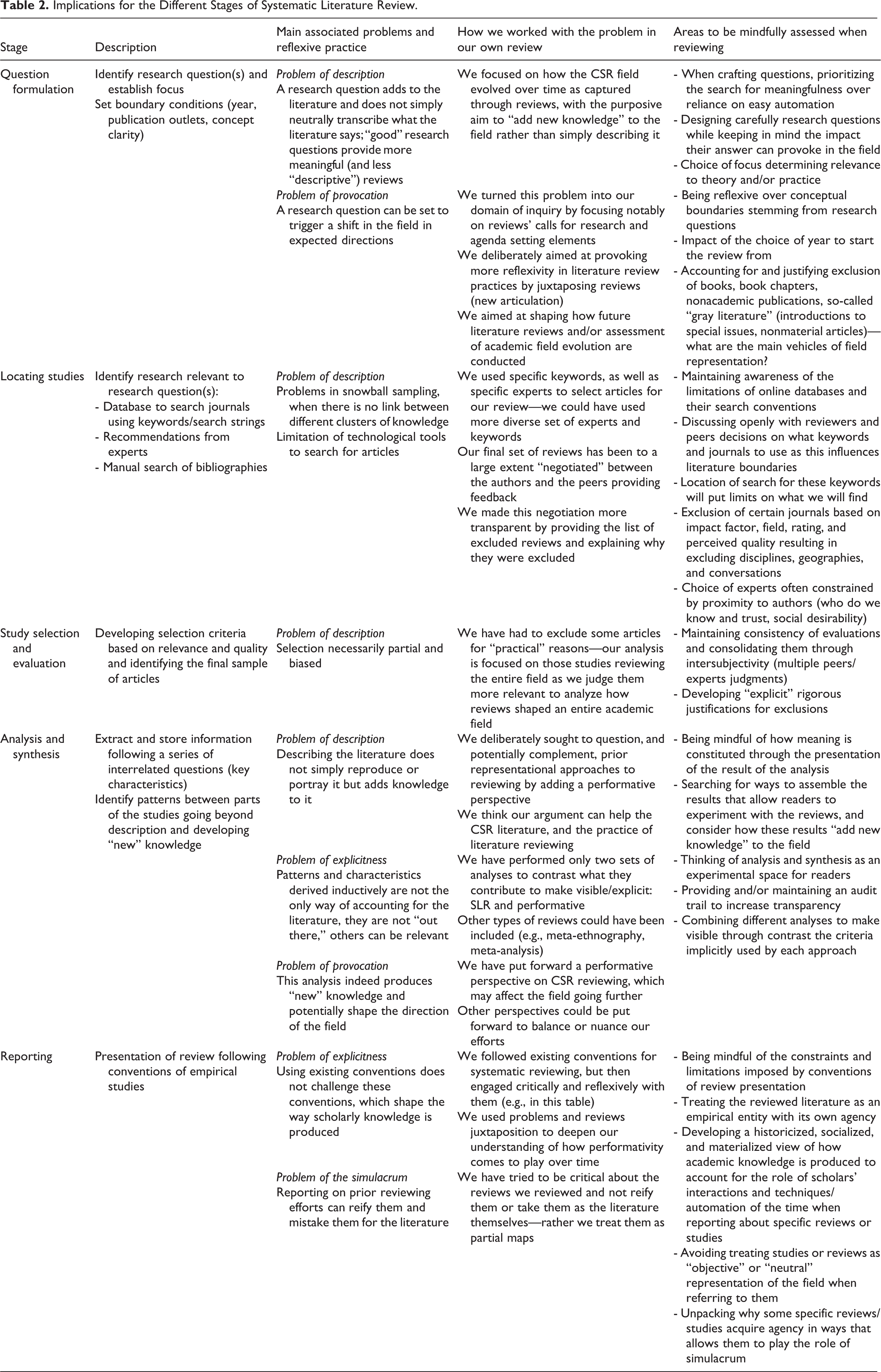
In particular, our analysis suggests that each stage of a SLR can be subjected to specific performativity problems. The analytical phase of SLRs faces three of the performative problems we have explored. First, it faces a problem of description, as the synthesis of the analysis adds knowledge to the field rather than simply recounts the literature, as well as a problem of provocation, as formulating questions may involve forms of agenda setting or the problematization of current issues in the field. Second, it has a problem of explicitness, as it necessarily builds on some existing categories (whether departing from them or not), that are assumed as existing in the literature. Third, it also faces an issue of provocation, as one guideline of systematic literature reviewing is to “add new knowledge” to the field. It therefore creates reality in the field, by producing such new knowledge. The problem of the simulacrum is rather present in the reporting phase of systematic literature reviewing, as it deals with how previous reviewing efforts are reported. Here, reviews can treat prior efforts as the literature in itself, rather than as maps or projections of that literature. Reporting also faces an issue of explicitness as it often uses existing criteria to report on the results of the literature review, without challenging those criteria.
It is tempting to follow a representational reading of these problems and recast them as “biases” or “problems” (Tranfield et al., 2003) to be ruled out through more stringent or explicit protocol, or controlled for through the review process. However, our performative take on reviewing, itself inspired by pragmatist philosophy (see Muniesa, 2014), suggests instead working productively and mindfully with them, as they offer powerful ways to develop a field—rather than trying to avoid or solve them at all costs. Accordingly, the fourth column of Table 2 provides some guidance and suggestions, about key areas to be assessed in order to “mindfully” conduct SLRs.
Literature Reviewing and Performativity in Low Paradigm Fields (and Beyond)
Our third contribution is to the field of CSR scholarship and recent calls for a more reflexive analysis of its developments as a field and a literature (Carroll, 2019; Mitnick, 2019; Wood & Logsdon, 2019). Our findings provide an account of some key shifts in the field that may have remained unnoticed without juxtaposing 48 CSR reviews of the literature, and demonstrate how the performative problems we conceptualized after Muniesa (2014) were deployed over time. Our analysis of these reviews offers an empirically informed account of how this field has been co-constituted and partially shaped through the regular production of literature reviews, which can help understand the intellectual history and legacy of such “low-paradigm” academic fields.
While some of our results can be idiosyncratic to the CSR field, we think some elements are useful to other low paradigm fields. For instance, we found that field beginnings are characterized by some heterogeneity in contributions but the according search for a homogenizing paradigm. This search is performed by a few key seminal works, whose influence (e.g., models, categories, and calls for research) is then reproduced in future reviews. The actual recognition of CSR being a low paradigm field only came later, as the field expanded and became even more heterogeneous. Such heterogeneity is then reproduced by future reviews carving increasingly smaller niches or subfields, as they become simulacra but nevertheless do not answer head on calls for research from prior reviews. We think such insights can be generalizable to a variety of other low paradigm fields, in particular in management and organization studies, given the common tools, techniques, and guidelines used to review literatures in our discipline.
Footnotes
List of CSR-Related Articles Excluded From Our Analysis.
| Excluded review | Reason(s) for exclusion | |
|---|---|---|
| 1 | Griffin & Mahon (1997) | Not a literature review, but an empirical paper. |
| 2 | Rowley & Berman (2000) | Not a literature review, but more of a conceptual paper on CSP. |
| 3 | Margolis & Walsh (2003) | Not a literature review, but more of a conceptual paper about the CSP-corporate financial performance relationship. |
| 4 | Kolk (2006) | Review of CSR in international management in international business journal. |
| 5 | Bansal & Gao (2006) | Too specific to natural environment. |
| 6 | Etzion (2007) | Too specific to natural environment. |
| 7 | Aguilera et al. (2007) | Not a literature review, but more of a conceptual paper drawing on distinct bodies of literature (CSR, justice, governance). |
| 8 | Scherer & Palazzo (2007) | Not a literature review, but more of a conceptual paper. |
| 9 | Montiel (2008) | Literature review, but too specific. Review of definitions and overlap between CSR and corporate sustainability. |
| 10 | Egri & Ralston (2008) | Review of CSR in international management in international business journal. |
| 11 | Spence, Husillos, & Correa-Ruiz (2010) | Review of a subphenomenon of social and environmental accounting. |
| 12 | Parmar et al. (2010) | Review of a subphenomenon of stakeholder research. |
| 13 | Noland & Phillips (2010) | Review of a subphenomenon of stakeholder research. |
| 14 | Kourula & Laasonen (2010) | Reviews only part of the CSR literature (NGO-business relations). |
| 15 | Kolk & Tulder (2010) | Review of CSR in international management in international business journal. |
| 16 | Tari (2011) | Reviews only part of the CSR literature (social responsibility and quality management). |
| 17 | Peloza & Shang (2011) | Review is in a nonmanagement journal (Journal of the Academy of Marketing Science). |
| 18 | Boshoff & Kotze (2011) | Review of a subphenomenon of ethical decision making. |
| 19 | Whelan (2012) | Not a literature review, just a research agenda. |
| 20 | Searcy (2012) | Reviews only part of the CSR literature (performance management systems). |
| 21 | Miles (2012) | Not a literature review, but more of a conceptual paper about the contested nature of the concept of “stakeholder.” |
| 22 | Laasonen, Fougère, & Kourula (2012) | Reviews only part of the CSR literature (NGO-business relations). |
| 23 | Kitzmueller & Shimshack (2012) | Review is in a nonmanagement journal (Journal of Economic Literature). |
| 24 | Schultz, Castello, & Morsing (2013) | Not a literature review, just a research agenda. No systematic review, but more of a theory paper. |
| 25 | Kolk, Rivera-Santos, & Rufín (2013) | Review of a subphenomenon of “bottom of pyramid.” |
| 26 | Craft (2013) | Review of a subphenomenon of ethical decision making. |
| 27 | Rupp & Mallory (2015) | Review appeared in a book—Annual Review of Organizational Psychology and Organizational Behavior. |
| 28 | Roberts & Wallace (2015) | Review of a subphenomenon of social and environmental accounting. |
| 29 | Voegtlin & Greenwood (2016) | Focuses on a subset of the literature (HRM) and is in an HRM journal |
| 30 | Stephan, Patterson, Kelly, & Mair (2016) | Reviews a larger set of literature focusing on social change. |
| 31 | Pope & Waeraas (2016) | Reviews only part of the CSR literature (CSR washing). |
| 32 | Osagie, Wesselink, Blok, Lans, & Mulder (2016) | Reviews only part of the CSR literature (CSR-related competencies). |
| 33 | Lehnert, Park, & Singh (2016) | Review of a subphenomenon of ethical decision making. |
| 34 | Glavas (2016) | Review is in a nonmanagement journal (Frontiers in Psychology). |
| 35 | Bass & Milosevic (2016) | Reviews only part of the CSR literature (ethnographies). |
| 36 | Adams, Jeanrenaud, Bessant, Denyer, & Overy (2016) | Review of a subphenomenon (sustainability-oriented innovation research). |
| 37 | Wang, Tong, Takeuchi, & George (2016) | Review of CSR articles in AMJ only. |
| 38 | Pisani, Kourula, Kolk, & Meijer (2017) | Review of CSR in international management in international business journal. |
| 39 | Kourula, Pisani, & Kolk (2017) | Reviews only part of the CSR literature (UN sustainable development goals). |
| 40 | Stutz (2018) | Reviews historical CSR studies (published in a business history journal, which is out of our scope). |
| 41 | Soundararajan, Jamali, & Spence (2018) | Reviews only part of the CSR literature (SMEs). |
| 42 | Scherer (2018) | Not a literature review, but a debate paper (arguing against the findings of the Frynas & Stephens, 2015). |
| 43 | Mura, Longo, Micheli, & Bolzani (2018) | Reviews only part of the CSR literature (measurements). |
| 44 | Jones & Rupp (2018) | Review appeared in a book. |
| 45 | Jamali & Karam (2018) | Reviews only part of the CSR literature (developing country context). |
| 46 | Fortis, Maon, Frooman, & Reiner (2018) | Reviews only part of the CSR literature (organizational learning). |
| 47 | Endenich & Trapp (2018) | Reviews only part of the CSR literature (business ethics & management control). |
| 48 | Cundill, Smart, & Wilson (2018) | Review of a subphenomenon of shareholder activism. |
| 49 | Meuer, Koelber, & Hoffmann (2019) | Literature review, but too specific. Dissects corporate sustainability from literature. |
| 50 | Khalid & Seuring (2019) | Reviews only part of the CSR literature (base of the pyramid). |
| 51 | Antolin-Lopez, Martinez-del-Rio, & Cespedes-Lorente (2019) | Reviews subphenomenon of environmental entrepreneurship. |
Acknowledgments
Because the paper is an equal collaboration, the order of authorship is alphabetical. The authors gratefully acknowledge the insightful comments of Jean Bartunek and three anonymous reviewers. An earlier draft of this paper was presented at the 2016 International Association for Business and Society (IABS) conference, Amsterdam, and an abridged version was published in the conference’s proceedings. We thank the participants of our session, and in particular Arno Kourula for his encouraging comments. Finally, we thank the business and society scholars who agreed to provide us with feedback on our list of reviews and/or to be interviewed in the context of this project. The usual disclaimer applies.
Declaration of Conflicting Interests
The author(s) declared no potential conflicts of interest with respect to the research, authorship, and/or publication of this article.
Funding
The author(s) received no financial support for the research, authorship, and/or publication of this article.
