




Abstract
The development of marketing theory continues to rest on the assumption that services and goods have distinct value creation implications. To further advance such theorizing and enhance the practical applications of marketing knowledge, this paper applies practice theory and the emerging Services-as-Practices framework to conceptualize goods, distinguish them from services, and integrate both within a common practice-based framework. The paper contributes by: (1) identifying a practice-based goods construct that captures how they cocreate and codestroy value, (2) differentiating the practice-based conceptualizations of goods and services in separate frameworks, and (3) relating these conceptualizations within a common framework that explains their mutual value cocreation and codestruction.
The development of marketing theory has long been structured around the idea that services and goods create value in different ways. Contemporary examples include research on servitization and Product–Service Systems (PSS) (Baines and Lightfoot, 2013; Kowalkowski et al., 2017), digitalization platforms and productization of services (Nambisan et al., 2017), and business model innovation (Amit and Zott, 2010). Earlier research did not always frame these differences explicitly in terms of value creation but nevertheless laid the conceptual groundwork by articulating how services differ from goods in terms of production, delivery, and development. This includes research on service quality (Parasuraman et al., 1985), service operations (Chase, 1978), and service development (Johne and Storey, 1998). Indeed, the entire service marketing field was articulated on the understanding that services possess characteristics that goods lack, in the form of Intangibility, Heterogeneity, Inseparability (of production and consumption), and Perishability (Araujo and Spring, 2006; Shostack, 1977; Zeithaml et al., 1985).
However, the IHIP conceptualization of services was eventually found to be flawed, as it did not match the reality of services. For example, some services, such as telecommunication or healthcare services, include tangible elements while others, such as fast food meals, are not heterogeneous but standardized (Edvardsson et al., 2005; Lovelock and Gummesson, 2004; Skålén, 2026). The critique of IHIP triggered the development of the service-dominant logic (SDL), often presented as a new paradigm for marketing theory. SDL focuses on service, that is, the process that actors engage in to cocreate value in use by integrating both tangible and intangible resources (Vargo and Lusch, 2004). For marketing theory, however, this move is problematic. By privileging service as a unifying process, SDL transcends and deemphasizes the theoretical and analytical distinction between goods and services, without offering a detailed conceptual account of what characterizes each. Given that key strands of marketing theory rests on a goods-services distinction, conceptual clarity—fundamental to the development of any research field (Bringmann et al., 2022)—of them is essential. In marketing, the lack of clear definition of services and goods hampers both the development of marketing theory and its practical applications (Grönroos, 2024) since “construct labels help academics and practitioners categorize situations and decide what to do” (MacInnis, 2011: 141). There is thus a persistent need to develop a precise understanding of services and goods that can provide a conceptual foundation for theory development in marketing.
The Services-as-Practices (SaP) framework (Skålén, 2026; Skålén and Gummerus, 2023) addresses a part of this problem by clarifying what services are. The SaP framework builds on Schatzki’s (1996, 2002, 2019) practice theory, complemented by the work of Reckwitz (2002) and Shove et al. (2012) as well as on prior marketing research using this theory (e.g., Korkman, 2006; Schau et al., 2009), to suggest that services can be understood in terms of value cocreation practices (VCPs). VCPs are organized, established, and collectively shared activities intended to cocreate value but may be performed in such a way that value is both cocreated and codestroyed.
However, the SaP framework does not advance a definition of goods, despite presupposing such a definition to conceptualize services. For example, Skålén (2026: 63) motivates the development of it by showing that service research commonly differentiates between “services and goods as two different types of entities” but develops theory only for the former. This not only makes the framework’s definition of services less clear but also blurs how services and goods are related through the value they cocreate and codestroy. Further development of the SaP framework can offer conceptual clarity on the definition of services and goods, as well as how they are related, which can be used to develop marketing theory that are based on these notions. We thus ask the following research questions in this conceptual paper: (1) How can a practice perspective be applied to conceptualize goods, understand how they cocreate and codestroy value, and distinguish them from services? (2) How can goods and services be synthesized within a common practice-based framework that accounts for their mutual value cocreation and codestruction?
To answer these research questions, we draw on the SaP framework and Schatzki’s practice theory that underpins it. We also draw on the philosophy of Martin Heidegger (1962), which not only provides an important foundation for Schatzki’s practice theory (Nicolini (2011) by suggesting that humans are embedded in and make the world intelligible through shared practices (Dreyfus 1991). It also provides the ontological ground for developing an understanding of goods and how people use them as part of practices through the notions of equipment (i.e., goods as useful tools), equipmentality (i.e., that which renders equipment as equipment), equipmental whole (i.e., the totality of interrelated equipment), and the referential structure (i.e., the multi-layered horizon showing how goods relationally and teleologically unfold in practices). On this basis of this framing, we develop a practice theory informed understanding of goods as sociomaterial configurations and how they relate to services-as-practices, which enables three core contributions to marketing theory. First, we contribute to identifying a practice-theoretically grounded goods construct that captures what they are and how they cocreate and codestroy value. Second, the paper contributes to differentiating the conceptualizations of goods and services as practices in separate frameworks. Third, it contributes to integrating these conceptualizations within a common framework.
The remainder of the paper is organized as follows. First, we present our conceptualization of goods, addressing the first research question. Second, we develop a framework detailing the relationships between goods and services, thereby addressing the second research question. We end the paper by discussing the implications of the paper for marketing theory and by outlining conclusions and suggestions for future research.
Understanding goods from a practice perspective
This section develops an understanding of goods against the backdrop of practice theory, the SaP framework, and Heidegger’s work. It also distinguishes goods and services from a practice perspective thus addressing the first research question.
What are goods?
Goods, in economic terms, are unsurprisingly considered tradeable entities (Callon et al., 2002). In marketing theory, goods are traditionally viewed as tangible static and manufactured things (Vargo and Lusch, 2004). In contemporary landscapes, goods, through digital (socio)materiality, have become increasingly liquidized and “synthetic” (e.g., artifacts and algorithms) (Monteiro and Parmiggiani, 2019; Orlikowski and Scott, 2008). This may blur the boundaries between traditional “material” goods (e.g., a table) and more modern “hybrid” goods (e.g., a smart device). The latter has become increasingly complex and ambiguous as they contain both material features (e.g., high-end cameras) and synthetic ones (e.g., interfaces with application-based functionalities) and they often contain linkages to services. As we elaborate later, this may yield goods-services packages (e.g., an iPhone as a material device coupled with the App Store and streaming services). In any case, goods seemingly carry inherent value, which is embedded during the production process. In this view, goods are finished products supposedly containing value ready to “be consumed.”
In marketing, this perspective was altered through the introduction of the SDL, which views goods as transmitters of embedded knowledge (Vargo and Lusch, 2004, 2008, 2016). Other marketing scholars stipulate that goods are value-supporting resources (Grönroos, 2008) that “become” resources through interactions among actors (e.g., providers and users) in the context of everyday practices (Grönroos and Gummerus, 2014). Nevertheless, we argue that goods have been conceptualized in a reductionist way (i.e., reducing goods to mere material “things” without embracing conceptual richness and real-world ambiguity) in marketing theory, and the dominant focus has been merely on services. Unpacking goods from a practice perspective enables to view goods in a more granular and situated way, thereby providing better epistemic and practical guidance for researchers and practitioners.
From a practice perspective, goods can be understood as sociomaterial configurations intended to cocreate value. This is in line with the SaP framework’s conceptualization of services, which is illustrated in Figure 1. Within this framework, services are conceptualized as bundles of VCPs that consist both of templates and performances (Skålén, 2026; Skålén and Gummerus, 2023). Templates are instructions for and guide concrete value-creating performances or activities. Hence, templates are enacted to carry out services within performances. However, performances are not tightly determined by templates. A VCP, such as conducting market segmentation, can be performed in multiple ways yet still be recognized as the same VCP, thus reproducing templates. In addition, variances in the performances of VCPs may contribute to changing or innovating services (Skålén and Gummerus, 2023). Furthermore, templates of VCPs are enacted for making services intelligible, such as making sense of the value that services cocreate, without being performed. Services-as-practices.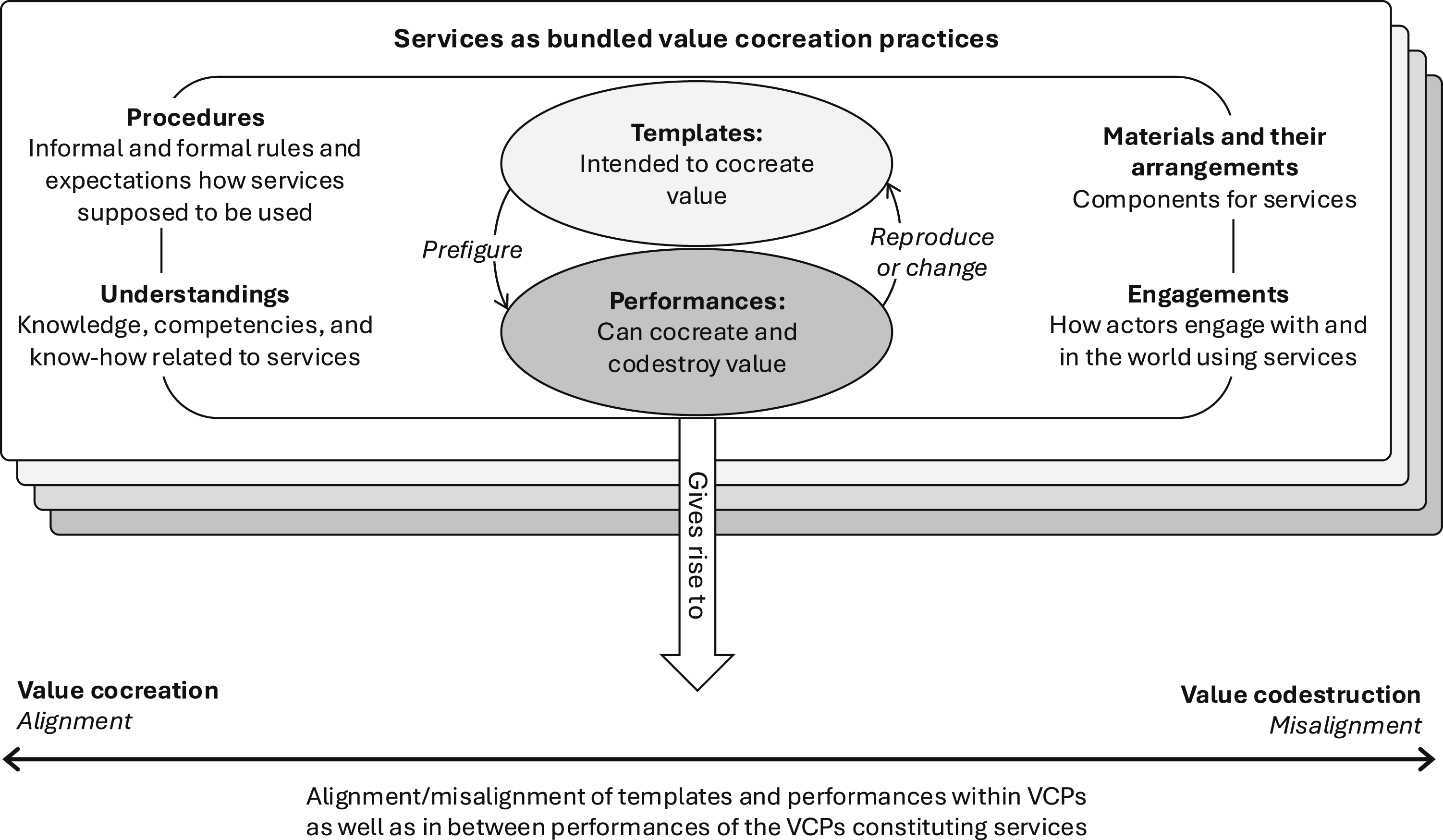
Templates and performances of VCPs are organized by different mixes of four elements: (1) understandings (i.e., knowledge, know-how, and skills); (2) procedures (i.e., explicit and implicit rules); (3) engagements (i.e., emotionally charged goals, ends, and purposes); and (4) materials (i.e., objects, tools, and technologies including digital artefacts and algorithms) (Skålén, 2026; Skålén and Gummerus, 2023). Actors access and interpret these elements based on prior practices and accumulated experiences (i.e., their “horizon of understanding”) (Sahhar and Loohuis, 2022) to perform services and to make sense of performances. Moreover, organizing elements connect VCPs, especially those belonging to the same bundle or service. Segmenting markets and targeting customers, for example, is based on overlapping engagements and understandings and takes place in the same material context. The idea that services consist of bundled or tightly interdependent VCPs is illustrated by the layered squares in different shades of gray in Figure 1. For illustrative purposes, four VCPs are bundled in Figure 1, but there may be more or fewer.
Similar to services, goods are informed by templates, which are organized by understandings, procedures, engagements, and materials, as shown in our conceptualization of goods in Figure 2. At a basic level, however, goods and services differ in their ontological condition, that is, their mode of existence. Goods persist as material artifacts (i.e., templates that can remain present even when not enacted) while becoming equipment or useful tools only when activated in practice. For example, a computer, a car, or a chair exists without being programmed, driven, or sat on. From a practice perspective, services, by contrast, exist as services only in enactment. What can “exist” without performance is the offering of a template (e.g., a hairdresser open and waiting, or an advertised haircut), but in order to be a service, the performance is ontologically necessary. Taking this further, one may imaginatively anticipate a haircut service, but the intelligibility of this depends on a prior practice-based understanding of the service’s organizing elements. If performances are decoupled (e.g., the hairdresser is temporarily or permanently closed), only the communicated template remains, whereas a service as enacted practice does not come into actual existence. Accordingly, in the practice theoretical sense, for services to exist, templates must be enacted in performances (Figure 1). Conversely, goods can exist independently of enactment as material artifacts intended to cocreate value, even when not being performed (see part I of Figure 2). An integrative framework for goods as practices.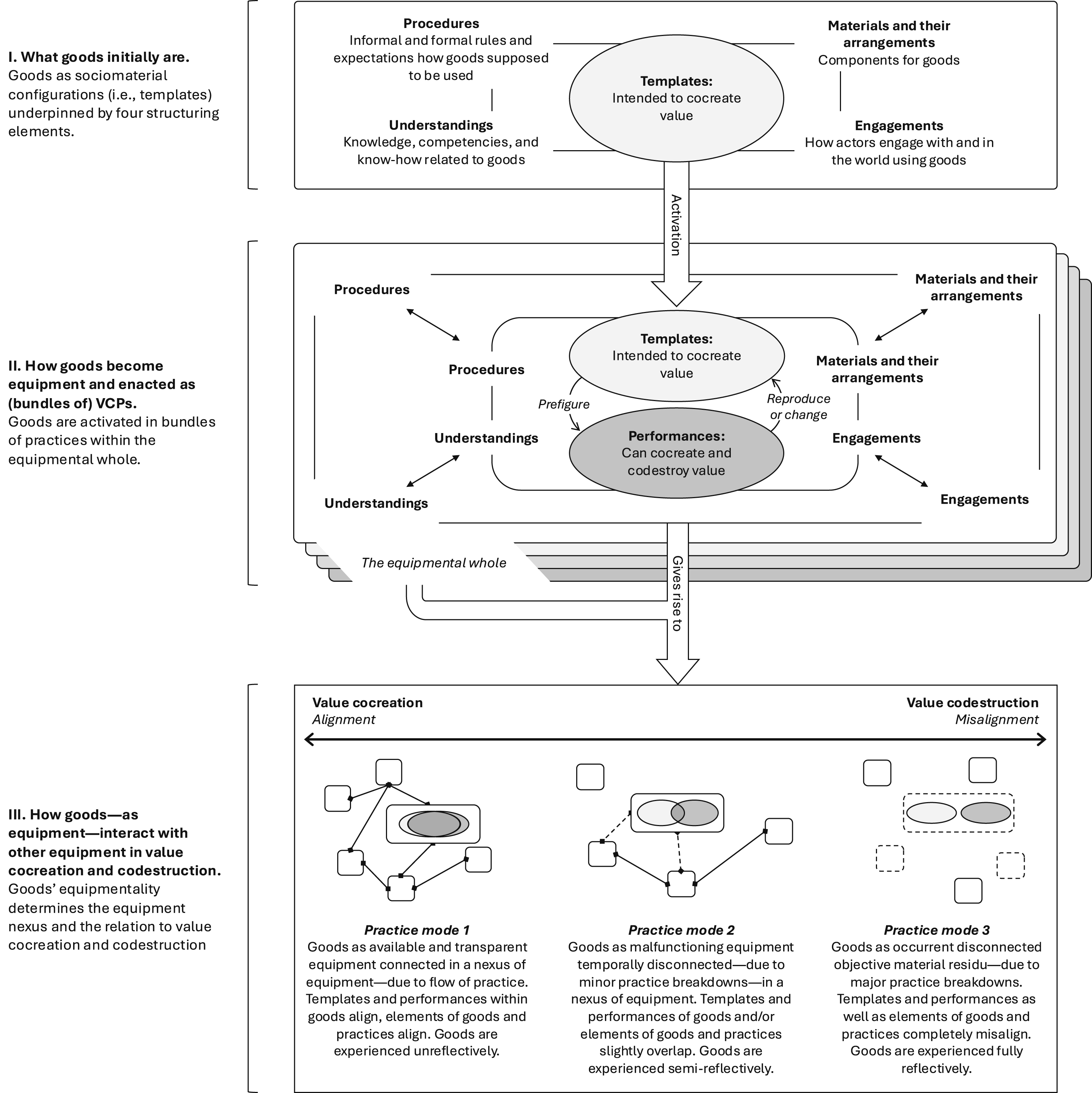
However, from a practice perspective (Heidegger, 1962; Schatzki, 1996; Shove et al., 2012), viewing goods as mere templates offers a limited understanding as it does not live up to how goods are actually practiced to cocreate value by actors in everyday life. In everyday life, goods, as templates, are activated by actors (human or non-human) to become goods as templates and performances. In other words, goods are transformed and become entangled in networks of socio-technical relations (Araujo, 2007; Callon and Muniesa, 2005). When this happens, all types of goods, including those built on digital (Monteiro and Parmiggiani, 2019) and sociomaterial configurations (Orlikowski and Scott, 2008), are incorporated into and used to carry out everyday practices: computers are used for programming, cars for driving, and chairs for sitting. By this, we do not mean that goods require physical manipulation; one can also imagine goods being incorporated into practices in more distant ways, such as a traffic sign helping commuters in navigation. In this way, goods are being “realized” through practical coping in bundled everyday practices that make up the social world (Dreyfus, 1991; Schatzki, 2002), illustrated in part II of Figure 2. The activation of goods is essential to our understanding of goods and transcends the reductionist view that prioritizes solely material objects or manufactured output. Furthermore, the activation of goods gives them a unique character that differentiates them from other traditions discussing goods.
From a practice perspective, goods thus appear far more dynamic and complex than traditionally conceived in marketing scholarship. They transform from objective materials to templates (i.e., sociomaterial configurations for value cocreation), to practices through performances, thereby taking shape as tools to fulfill tasks over time. In this process, templates prefigure performances, which in turn may alter templates again. Goods are thus, in practice, radically transformed as part of actors’ practices.
Ontologies of goods: Occurrent versus available
Viewing goods as manufactured things with mere material characteristics, a view in opposition to the one we advance, presupposes an ontology of the occurrent (Heidegger, 1962; Wrathall, 2021). This means that goods are entities/things constituted by structural characteristics that can be observed objectively. This stance is evident in accounts of the aesthetic, functional, and symbolic dimensions of product design (Homburg et al., 2015). It channels managerial attention toward specifying, designing, and monitoring such attributes, for example, through service blueprinting and process design (Shostack, 1982, 1984) and management of perceived quality (Parasuraman et al., 1985; Zeithaml, 1988). The fundamental problem with this framing is that it remains at the ontic and phenomenal levels: it focuses on the factual existence of goods, for example, as a constructed object made of wood and fabric, and on how goods appear to us, for instance, as a four-legged object with a seat and backrest. This overlooks how goods, including their meaning and conditions of intelligibility, are entrenched in and through human existence.
To overcome this, we depart from the ontology of availability (Dreyfus, 1991; Heidegger, 1962). This viewing discloses goods as equipment (Zeug) or useful things that are “given” to us as we exist in the world. For example, we typically encounter chairs as available “for sitting” and not as the ontic and phenomenal “wooden object with four legs.” A digital and liquid example is Spotify’s “Discover Weekly” playlists: a personalized, algorithmically generated selection of new music curated for users weekly based on their listening history. The Discover Weekly playlist shows up as “fresh music for a run” rather than an “algorithmic object with parameters and metadata.”
The ontology of availability thus gives primacy to the practice of entities. In this, goods derive their significance not merely from their material form or appearance but from their role within human practices and the broader context of being. As Heidegger (1962: 69) frames it: “The kind of being which equipment possesses—in which it manifests itself in its own right—we call ‘availableness’.” The ontology of availability thus suggests that how people make sense of things as equipment precedes and superimposes viewing goods as mere things (Wrathall, 2021). This perspective informs us that goods are constituted and made meaningful by the practices that make up the culture they exist in (Dreyfus, 1991; Schatzki, 1996). Including the ontological perspective of goods as “available” yields a full and granular view of goods being the meaningful components of human life and activity, that is, what they are for us in practice before what they are as material things.
The equipmentality of goods
Dreyfus (1991), in his authoritative interpretation of Heidegger’s magnum opus Being and Time, presents tools as enablers of human practices. At the ontological level and in actors’ most primordial modus operandi, or in actors’ more basic structure of existence, we simply use things at hand to get something done. A mug, for instance, appears as what one reaches for to sip coffee to remain focused during intellectual activity. Useful things, possessing “equipmental meaning” (the staying focused during intellectually challenging endeavors) at hand are referred to as “equipment” (the mug). Or, as Heidegger (1962: 68) puts it: “We shall call those entities which we encounter in concern ‘equipment’. In our dealings we come across equipment for writing, sewing, working, transportation, measurement, etcetera. The kind of being which equipment possesses must be exhibited. The clue for doing this lies in defining what makes an item of equipment—namely, its equipmentality.” Equipmentality, in other words, is the condition under which entities are encountered as equipment in practice. For example, the mug’s equipmentality lies in its practical utility: that is, to what extent the mug can hold a hot drink, allow us to drink coffee, and enable us to remain focused. It is what makes equipment useful, as “given” or “available.” Equipmentality, we argue, thus makes goods meaningful.
Strictly speaking, there is no such thing as an equipment (Heidegger, 1962). Equipment cannot exist in isolation from other equipment but only “in terms of its belonging to other equipment” (Wrathall, 2021: 283). Equipment is thus innately relational, suggesting that equipment is situated in a web of involvement with other equipment situated in practice and culture. Returning to the Spotify example again, we can illustrate the digital and sociomaterial intertwinement of equipment. The “Discover Weekly” playlists can only exist within a constellation of and in relation to other equipment, such as the synthetic metadata, the material smartphone, network connectivity, the Bluetooth earbuds, and so forth. An “item” of equipment thus only makes sense as a part of an “equipmental whole” (Dreyfus, 1991). Heidegger (1962: 68) thus stipulates: “To the being of any equipment there always belongs an equipmental whole.” This equipmental whole is basically the totality of interrelated equipment as illustrated by the constellation of equipment in the Spotify example. “An” equipment and the equipmental whole, are in this sense inseparable and mutually constitutive giving each other meaning. For something to function as equipment, through practices, useful things must be embedded in a nexus of other equipment within which they function (Dreyfus, 1991).
The extent to which goods-as-equipment can function depends on how actors can practically cope with them (Chia and Holt, 2006), which is constituted by their equipmental character, equipmental nexus, and equipmental contexture (Heidegger, 1982). According to Heidegger, equipmental character denotes the functional identity of a single piece of equipment, that is, what a thing is by virtue of its function. Equipmental nexus refers to the concrete instantiation of the referential structure linking each item to purposes beyond itself. Finally, equipmental contexture is the ambient, prereflective surrounding of equipment as it environs actors in everyday practical circumspection. Bundles of practices in which goods are activated constitute the equipmental whole. Bundles of practices and the equipmental whole are mutually constitutive, that is, they do not exist independently but coexist and sustain each other. Bundles of practices turn equipment into something meaningful and useful, only so when they are embedded in a coherent network of bundles. Referring once again to the Spotify playlist example, the involved equipment is reciprocally enabled by the continuously configuring, enacting, and maintaining of practices. The equipmental whole, in this sense, is not an independent overarching and static entity but enacted through the interplay of bundles of practices. Part II of Figure 2 illustrates this argument by suggesting that goods are activated in bundles of practices (the gray-shaded layers) within the equipmental whole.
The referential structure of equipment
Practice theory informs us that human intelligibility is constituted by practices, which have engagements that direct action toward certain goals (Reckwitz, 2002). We thus do, think, and always feel “toward” and “with” things in the world (Cerbone, 2008; Heidegger, 1962; Legrand, 2007; Van Manen, 2016). In a similar way, we use equipment in our lives to help us in our practices. Practices are thus teleologically structured (Schatzki, 2002, 2005). According to Heidegger (1962) and his interpreters (e.g., Dreyfus, 1991), equipment does not only play a role in relation to other equipment or to the equipmental whole, but also in the equipmental entity’s references to a project or broader purposes it renders useful (Wrathall, 2021). Consider the Spotify playlist again with phone, app, connection, and earbuds: it provides motivation to go for a run, supports maintaining a training plan, and contributes to a healthy lifestyle. In more precise philosophical terms, equipment is enacted in the “referential structure” of the available, characterized by the “in-order-to,” “towards-which,” and “for-the-sake-of” (Dreyfus, 1991; Heidegger, 1962). From this perspective, goods are enacted in-order-to perform a specific and immediate action. Subsequently, they serve a broader project towards-which actions are directed. Finally, goods are grounded in the bigger perspective for-the-sake-of human purpose and identity. Instead of simple linear causality, the referential structure enables us to view goods relationally and teleologically in a multi-layered horizon within unfolding practices.
We can flesh out this argument through the typical Heideggerian example of the hammer: the hammer exists in-order-to drive nails into wood. This immediate function serves a broader project towards-which the action is directed, such as building a table or constructing a house. Ultimately, these actions are carried out for-the-sake-of fulfilling deeper human purposes and identities, like creating a home to foster family life or engaging in skilled craftsmanship as part of one’s professional identity. Actors, in their practices, appropriate the hammer in the most utensil fashion, unveiling the “handiness” of the hammer (Heidegger, 1962). In such instances, “the less we just stare at the thing called hammer, the more we take hold of it and use it, the more original our relation to it becomes and the more undisguisedly it is encountered as what it is, as a useful thing” (Heidegger, 1962: 69). In this “practical” practice, the hammer transcends the notion of a static thematized object. It becomes actualized and renders meaning at multiple layers (i.e., the immediate action, the broader project, and the higher-order purpose) of human practice. This zooming-out (Nicolini, 2009) is essential to understanding goods as they only make sense in the bigger context of situated practice in the world.
Putting goods to work: Their threefold relation to value cocreation and codestruction
How goods, successfully or unsuccessfully, become equipment and create value for actors is not monolithically determined. To understand this, we must turn to how goods manifest in practice. Marketing theory adopting practice perspectives identifies three practice modes through which goods are put to work (Sahhar and Loohuis, 2022). Heidegger (1962) characterizes these practice modes as “ready-to-hand,” “unready-to-hand,” and “present-at-hand.” Each practice mode alters the role of goods as equipment in practice and their impact on equipmentality and thereby referential structure. Practice breakdowns, which are instances in which practices are ephemerally or in more permanent ways interrupted, work as switching mechanisms between the practice modes (Chia and Holt, 2006; Heidegger, 1962; Sahhar and Loohuis, 2022). We present the three practice modes on a continuum ranging from value cocreation to codestruction (see Part III of Figure 2).
The idea that goods cocreate value but may also codestroy or diminish it stems from practice theory informed marketing research which have put forward the SaP framework (Echeverri and Skålén, 2011, 2021; Skålén, 2026). In this tradition, value cocreation and codestruction are explained with reference to alignment (cocreation) and misalignment (codestruction) within and between VCPs, and more specifically in the enactment of the elements organizing single VCPs and linking bundles of VCPs (Echeverri and Skålén, 2021). However, it is always in the performances that the actual cocreation and codestruction of value takes place (Echeverri and Skålén, l2011, 2021). The performances of services can be seen as a continuum ranging from value cocreation to value codestruction, as illustrated at the bottom of Figure 1 describing the SaP framework (see Skålén and Trischler, 2025). Informed by this practice theoretical view on services, we now further disentangle how goods cocreate and codestroy value within the three practice modes.
Practice mode 1: Goods as available equipment cocreate value
In the first practice mode, goods function smoothly as equipment as they are completely embedded in the equipmental nexus making actors able to practically cope with situations at hand (Chia and Holt, 2006; Heidegger, 1962). When goods are activated within practices and these practices align, goods are ready-to-hand and enacted as something meaningful in relation to the totality of other goods (see Sandberg and Tsoukas, 2011). There is alignment between the organizing elements of goods and the organizing elements of the (bundles of) practices. Throughout the referential structure, practicing goods makes sense as actors spontaneously and unreflectively “deal” with situations (Cerbone, 2008; Sahhar and Loohuis, 2022; Sandberg and Tsoukas, 2011). Immediate actions can be seamlessly accomplished, bigger projects are smoothly progressing, and an ultimate purpose is served in meaningful ways. If we mobilize the Spotify example again, this practice mode would imply that Discover Weekly plays smoothly via the phone and app, connectivity is fluent and earbuds allow for an immersive sound experience. This suggest, in terms of the referential structure, that the runner presses play and runs without fiddling (immediate action achieved), the training session progresses (project advances), and the improvement towards a healthier lifestyle is quietly and continuously supported (ultimate purpose served). In sum, in this practice mode, actors cocreate value and unreflectively experience practice, backgrounding and translucidating equipment.
Practice mode 2: Goods as malfunctioning equipment give rise to minor value cocreation
The second practice mode suggests that goods manifest, throughout practice, as malfunctioning equipment due to mild practice breakdowns. Within practices, organizing elements of templates and performances slightly overlap. In this case, goods are being hampered from functioning properly yet actors are motivated to get going again in deliberate coping (Dreyfus, 1991). The equipmentality of goods is temporally interrupted in ongoing practice and some connections between entities of equipment may be disturbed or disconnected. The referential structure is thereby also altered; the immediate action is temporarily obstructed, causing the bigger project to be partially hindered and the ultimate purpose may still be served, but in questionable ways. Taking the Spotify example, one can imagine there is a mismatch in recommended songs or a brief drop-out of Bluetooth connection; the runner’s pace stutters (immediate action obstructed) but changes the settings and reconnects, the session can continue (project partially hindered), and the aim towards a healthier lifestyle is served ambiguously (ultimate purpose served questionably). This practice mode thus suggests that minor value cocreation occurs combined with semireflective experiences amongst actors.
Practice mode 3: Goods as occurring material objects codestroy value
In the final practice mode, goods cease to function and become mere material objects. In other words, they appear as occurrent, disconnected, and objective material residue. Actors encounter goods, appearing as present-at-hand, and thematize them as such. Templates and performances, as well as their organizing elements, and/or bundles of practices, completely misalign. Actors’ practices are bereft of accomplishing immediate actions, the bigger project is critically stalled, and the ultimate purpose is incompletely served. In this scenario, all that remains is a mere something whose properties are not connected to its function in any intelligible way (Dreyfus, 1991; Heidegger, 1962). In the Spotify Discover Weekly illustration, for example, the phone battery breaks down due to overheating, simultaneously disabling GPS tracking, heart rate monitoring, and audio guidance from Spotify; the run stops (immediate action fails), the training session is lost (project stalled), and one’s aim of a healthier lifestyle cannot advance (ultimate purpose incompletely served). This practice mode thus informs us that, due to major practice breakdowns, goods are bereft from their equipmentality and value codestruction occurs, hand in hand with fully reflective experience bracketed towards objective properties.
Throughout the three practice modes, it is important to take note that the practice breakdowns are always situated in and subject to context. Heidegger would refer to this wider context as “das Man” or the “they,” which is the collection of public norms of conformity and furnishes the shared frame of seeing and interpreting things (Ward, 2021). While we deploy practice breakdowns for the purpose of understanding equipment and its relation to value cocreation and codestruction, rendering phenomenological insights into how equipment is “available” versus “occurrent,” they are not exclusive to equipmental breakdowns. Next, we synthesize the conceptualizations of goods and services in a common framework.
Synthesis of practice theoretical conceptualizations of goods and services
Key distinctions of, and commonalities between, goods and services as practices.
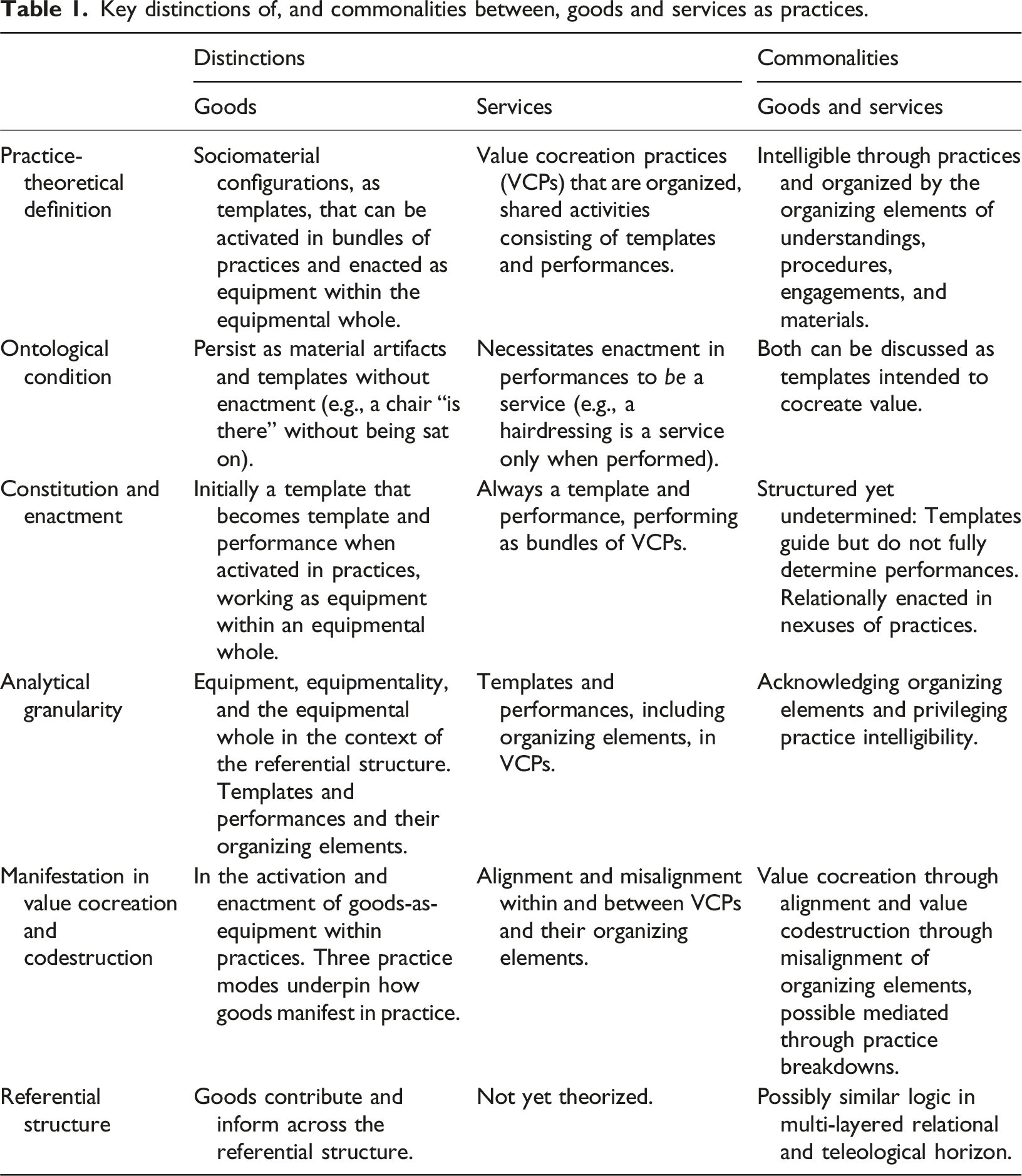
As we have grounded the conceptualization of services and goods in the same practice theoretical notions, we can utilize them to create an integrative framework (see Figure 3). Core to our argument in previous sections has been that the templates and performances of services and goods are organized by the elements of understandings, procedures, engagements, and materials. A logical consequence of this framing is that goods and services are related through these elements, which must be foregrounded to determine how they jointly cocreate and codestroy value, as illustrated by Part I of Figure 3. As we have explained, value cocreation and codestruction takes place in performances and is a function of the alignment and misalignment both in the enactment of the elements organizing single VCPs and in the elements linking VCPs, especially within bundles. Accordingly, the alignment or misalignment of elements within the performance of VCPs, together with the activation of goods in everyday practice, explains whether value is cocreated or codestroyed when services and goods are used in conjunction. A synthesis of practice theoretical conceptualizations of goods and services.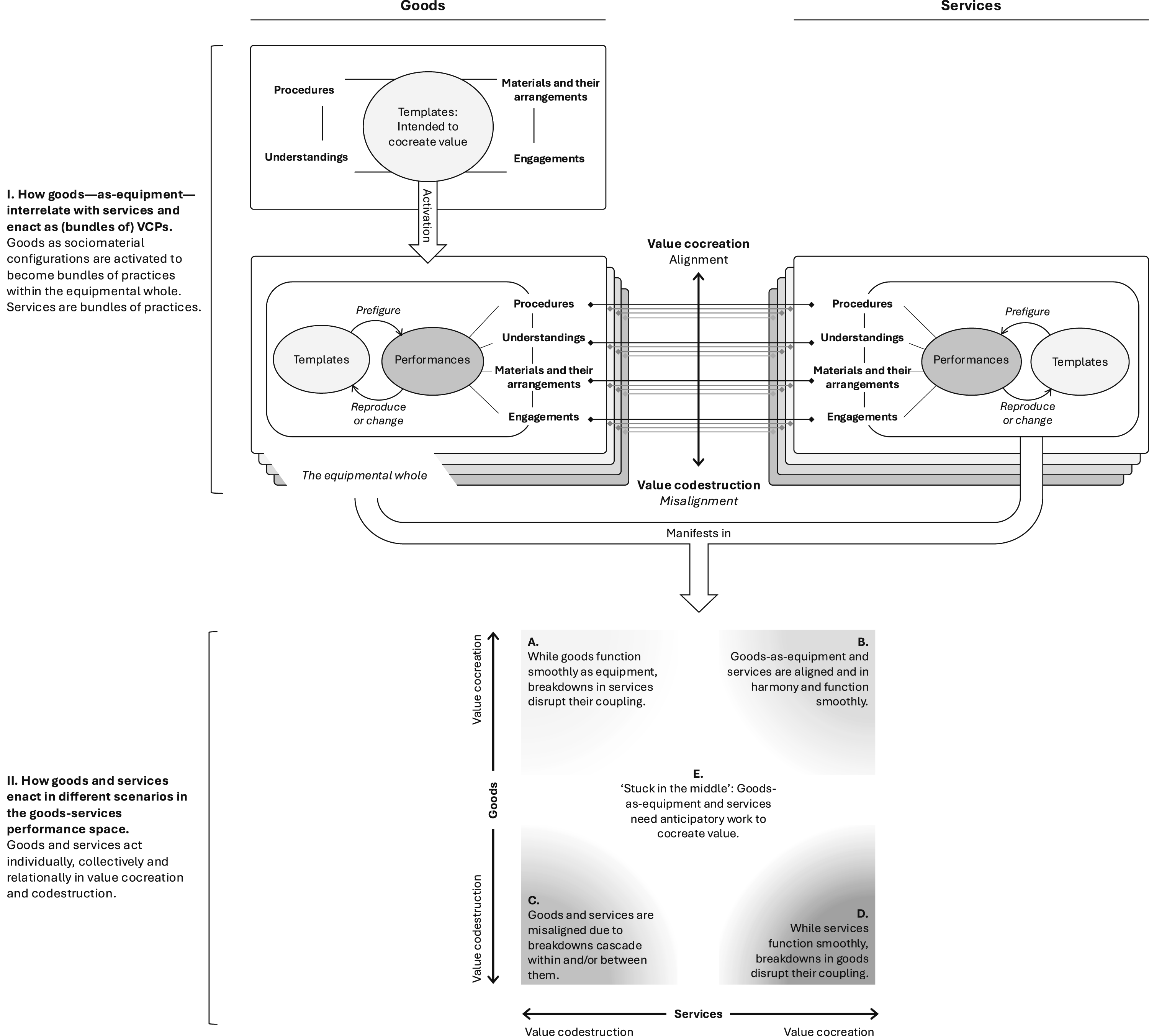
Part I of Figure 3 also depicts specific interrelations between goods and services and their structural elements. On the one hand, it describes how goods become equipment and are enacted as bundles of VCPs in relation to services. On the other hand, it suggests that goods and their associated equipmental wholes often coalesce with services in daily practice. Services may even depend on the equipmental whole of goods to exist and operate. For example, digital services commonly rely on goods such as servers and advanced computers.
The framework also envisions the cocreation and codestruction of value between services and the equipmental whole of goods within what we refer to as “the goods-services performance space” (see part II of Figure 3). The construction of this space is inspired by research suggesting that value is created in “value creation spaces” (Crowther and Donlan, 2011: 1448), cocreated and codestroyed in a “value variation space” (Echeverri and Skålén, 2021: 240), or in a “public services performance space” (Skålén and Trischler, 2025: 2206). The goods-services performance space is a combination of the continuums of value cocreation and value codestruction visualized in Figures 1 and 2 for services and goods. The combination of these continuums discloses that goods and services can individually, collectively, and relationally cocreate and/or codestroy value through timespace (Schatzki, 2020).
We identify five generic subspaces, labeled A to E in Figure 3, that represent different scenarios. These scenarios do not occur in discrete “bracketed” vacuums but rather unfold along a continuum in which the boundaries between subspaces are blurred. This implies that transitions between scenarios can occur either abruptly or gradually. Goods and services may complement each other and operate in harmony, leading to value cocreation (scenario B), or they may be in disharmony, resulting in value codestruction (scenarios C). In scenario B, where a fluent flow of value cocreation may render actors’ experiences unreflective, it is important to remain vigilant against taken-for-grantedness in practice (Chia and Holt, 2006; Sahhar and Loohuis, 2022). Scenario C invites serious and instant repair work through reversing destructive performances of practices to a more soothing state (Sahhar et al., 2023; Van Vaerenbergh et al., 2019). Moreover, services and goods can also contradict each other, where one cocreates value and the other codestroys it (scenario A and D). In these scenarios, patchwork in the functioning of one or the other is necessary. For example, focusing on stabilizing performances of practices to return to a normal order could prevent further codestruction. We also argue that goods and services may be “stuck in the middle,” represented by scenario E. This implies that neither goods nor services are performed, which in turn demands anticipation, such as activating and setting practices in motion in light of one’s referential structure (Sahhar et al., 2023).
The practice modes underpin the subspaces, determining in which subspace goods and services manifest. While practice modes are not confined to distinct subspaces, given the interdependencies among goods and services, their interrelation can be considered as follows. Practice mode 1, characterized by smooth functioning and unreflective coping, underpins subspace B when operative for both goods and services simultaneously. When practice mode 1 enables goods to function smoothly but practice mode 2 or 3—involving minor or major breakdown—governs services, or vice versa, actors are pushed toward subspaces A or D, respectively. In these instances, either goods or services cocreates value while the other codestroys it. Practice mode 3, involving major breakdowns and complete loss of equipmentality, situates actors in subspace C, where cascading misalignments across both goods and services drive value codestruction. Subspace E represents a more transitional condition, where goods and services oscillate between practice modes 1 and 2, requiring anticipatory and repair work to sustain value cocreation. Combinations of practice modes are therefore expected across subspaces, as goods may function smoothly while services malfunction, or vice versa. These symmetrical and asymmetrical value dynamics are captured in Figure 3.
The goods-services performance space, including its subspaces, is shaped by goods-services packages and underpinning practices and thus remains malleable and in constant flux. Practice breakdowns and repair practices are the key switching mechanisms between these scenarios. Practice breakdowns are brought to the fore by a variety of contingencies (e.g., material malfunctioning, surprise, lack of user competence, or institutional rigidity), and repair practices demand active anticipatory work. Within this space, goods-services combinations may also cease to exist, when, for example, severe breakdowns appear in practice. The space thus further underscores that value cocreation and codestruction is not only a function of the relationship between services and goods but of relationships within services and goods as well as between goods and the practices in which they are activated, as explained in Figures 1 and 2. This shifts the focus from understanding goods and services independently to one that views them in a nexus.
The goods-services performance space can be used both to illustrate the outcome of value cocreation and codestruction at a particular point in time (i.e., as a “snapshot”) but also the process over time (i.e., as an evolution). For the latter, we could imagine a line, representing the manifestation of goods-services packages, running through all the five scenarios of the goods-services performance space. However, because such a line would obscure the scenarios and reduce the aesthetic clarity of Figure 3, it is not included. Viewing goods and services independently, collectively and relationally thus enables to better understand their role in timespace. The goods-services performance space can also serve scholars and practitioners with a theoretical and analytical heuristic to comprehend the manifestation and evolution of goods-services packages in relation to value cocreation and codestruction, which in turn render customer insights and fertile ground for innovation.
Discussion
In this section, we discuss the contributions the present paper makes to marketing theory by conceptualizing services and goods, the relationship between them, and implications of these conceptualizations for value cocreation and codestruction from a practice theory perspective. To do so, we draw on MacInnis (2011), who suggests that contributions of conceptual articles in marketing can be structured around specific contribution types (e.g., identifying) and contribution entities (e.g., constructs).
First contribution: Identifying a conceptualization of goods as practices
Identifying is a contribution that shows that something exists or sees what has already been identified in previous research in a new and novel way (MacInnis, 2011). While marketing scholars have previously acknowledged that goods exist, they have so far glossed over conceptualizing goods, taking their epistemic richness and ontological grounding for granted. The practice perspective employed by us approaches goods in a novel way.
According to our framing (see Figure 2), goods have an independent existence as sociomaterial configurations or templates organized by the practice elements of understandings, procedures, engagements, and materials. In addition, goods are activated in bundles of practices within the equipmental whole, which enables explaining how goods as equipment cocreate and codestroy value. This facet of our argument extends the idea that goods are value-supporting resources for interactions amongst actors (Grönroos, 2008; Grönroos and Gummerus, 2014). Moreover, we stipulate that cocreation and codestruction are functions of the alignment and misalignment of both the elements of practices that organize goods internally and those organizing the practices within which goods are activated. Practice breakdowns mediate the different ways in which this manifest.
Developing this conceptualization contributes to understanding the construct of goods in marketing theory. It enables both marketing scholars and practitioners to view goods clearly and gain a heightened understanding of them compared to the extant static and oversimplified “manufactured things” perspective (Vargo and Lusch, 2004, 2008, 2016). Both marketing scholars and practitioners commonly refer to goods without critically reflecting on and understanding their conceptual meaning. Our work addresses this concern by providing a clear construct delineation and a novel perspective of what constitutes a good from a practice perspective. By doing so, it also contributes to the SaP framework (Skålén, 2026; Skålén and Gummerus, 2023) that presupposes but does not offer a conceptualization of goods to define services.
Second contribution: Differentiating goods and services as practices
Generating conceptual implications can also involve seeing differences in perspectives (MacInnis, 2011). Building on our conceptualization of goods, our paper contributes to differentiating constructs of goods and services. Figures 1 and 2 and Table 1, together with their accompanying discussion, clarify this distinction from a practice theory perspective. In particular, we describe differences in the constitution of goods and services and in how they cocreate and codestroy value. Hence, while we in line with prior marketing theory suggest that services and goods are different (Araujo and Spring, 2006; Shostack, 1977; Zeithaml et al., 1985), we add significant precision to how they differ. Namely, goods are preformatted templates intended to cocreate value but necessitate activation to function as equipment and cocreate value. Services, on the other hand, are always both templates and performances. They do not exist without activation. While we affirm that services and goods are different, we add that, in today’s synthetic and artificial environment, boundary cases blur the line between them, implying that hybrids can emerge. Examples include insurance contracts that institutionally and independently “exist out there” or smart and algorithmic offerings that fuse digital and material elements. These hybrid versions need additional nuanced analytical attention.
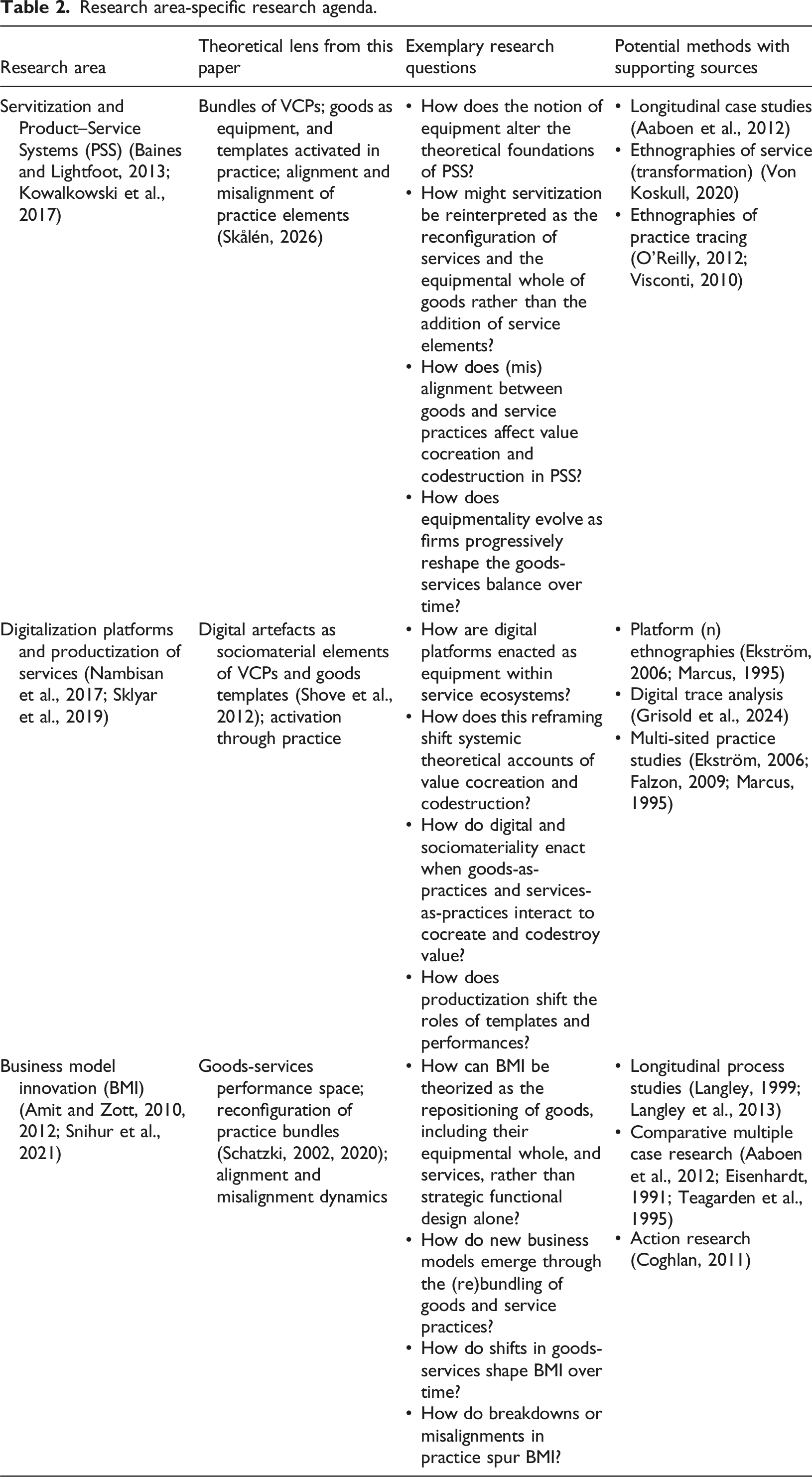
Prior research has used the differences between goods and services to develop and articulate fields of research in marketing, such as service marketing (Shostack, 1977; Vargo and Lusch, 2004). Distinctions between services and goods can also inform other fields of research that are premised on differentiating between these notions, such as research on servitization and PSS (Baines and Lightfoot, 2013; Kowalkowski et al., 2017), digitalization platforms and the productization of services (Nambisan et al., 2017), and business model innovation (Amit and Zott, 2012). In addition, marketing and other business practitioners commonly make distinctions between services and goods when developing marketing strategies (Morgan et al., 2019) and the market orientation of the firm (Gebhardt et al., 2019). In sum, our sharpened conceptual distinction between goods and services can assist researchers in individually and relationally studying services and goods, and practitioners in differentiating them.
Third contribution: Integrating goods and services through their organizing elements
This paper also contributes by conceptually integrating goods and services, thereby amplifying our understanding of them. Our practice-theoretical conceptualization of goods and services enables us to synthesize them in a common framework (see Figure 3). This integration contributes to practice theory informed marketing research (e.g., Skålén, 2026) by showing that services and goods are related through the elements that organize them and by explaining how goods and services cocreate and codestroy value together. In doing so, we draw on prior research on “value creation spaces” (Crowther and Donlan, 2011), the “value variation space” (Echeverri and Skålén, 2021), and the “public services performance space” (Skålén and Trischler, 2025) to coin the notion of the “goods-services performance space.” This space captures the outcome and process of the joint value cocreation and codestruction of goods and services, which are further detailed through five scenarios that provide both theoretical impetus and managerial guidance. These scenarios also contribute to prior research on value creation, variation, and performance spaces. By distinguishing different pathways of value cocreation and codestruction, typical processes of value formation within these spaces can be identified—something that has been lacking in previous research. In sum, our synthesis of goods and services into a common framework has implications for marketing theory and practice by illuminating how they can be combined and performed over time.
Limitations and future research
Despite these contributions, the paper has limitations that provide impetus for developing suggestions for future research. The paper’s conceptual nature creates fertile ground for empirical work to apply, develop, revise, and contest the proposed frameworks in situated settings where organizations and customers enact services and goods together. In line with Skålén et al. (2023), we encourage interpretive research in close attunement with marketing practitioners, enabling the generation of rich insights that can create a deeper understanding of how our conceptualizations of goods and services help practitioners in daily business. Furthermore, the notions of equipment, equipmentality, and the equipmental whole were useful for framing goods from a practice perspective. We see merit in further investigating the meaning and implications of these notions, especially in relation to generating customer insights, conceptualizing value propositions and innovations thereof. While this paper refrains from being normative or prescriptive, the scenarios in the goods-services performance space can help to theorize and empirically ground managerial coping strategies. Managers may use the scenarios to diagnose current goods and services practices and to initiate targeted improvements over time.
Beyond developing the framework, it already has implications for marketing theory more generally. By conceptualizing goods and services as practice-based phenomena rather than stable categories, the paper invites a reconsideration of foundational marketing constructs such as value, exchange, offerings, and markets. From this perspective, markets can be understood as evolving configurations of goods and services practices, rather than arenas in which predefined outputs are exchanged (Araujo and Spring, 2006).
This reconceptualization opens avenues for future research on market orientation by shifting attention from the possession of market intelligence or cultural orientations to the practices through which market understandings are enacted, stabilized, and transformed in everyday organizational activity. For example, research could examine how different configurations of goods and services understood as practices shape the generation, dissemination, and use of market intelligence, and how misalignments between such practices hinder organizational responsiveness to markets (Gebhardt et al., 2019; Kohli and Jaworski, 1990).
The framework also offers a practice-based lens for advancing marketing strategy research, particularly in relation to strategy process and implementation. Rather than treating marketing strategy primarily as a set of discrete decisions or plans, future studies could investigate how strategies emerge, persist, or change through the ongoing (re)integration of goods and services practices across organizational contexts. This perspective responds directly to calls for more practice-based, process-oriented, and theory-driven research in marketing strategy and strategic marketing more broadly (Morgan et al., 2019).
Research area-specific research agenda.
Conclusion
The development of marketing theory continues to be structured around the notion that services and goods have different value creation implications. To facilitate such theorizing and the practical application of marketing knowledge, this paper has contributed by developing a notion of goods and by distinguishing them from services in terms of how they cocreate and codestroy value, using a practice theory perspective. The paper has also contributed to understanding how services and goods as practices are related and how they jointly cocreate and codestroy value. We also delineate limitations and based upon these avenues for research that deepen and expand theorizing. Overall, this paper recasts goods-as-equipment and services manifesting in value cocreation and codestruction.
Footnotes

Funding
The authors received no financial support for the research, authorship, and/or publication of this article.
Declaration of conflicting interests
The authors declared no potential conflicts of interest with respect to the research, authorship, and/or publication of this article.