



Abstract
In today’s complex and interconnected marketplace, the study of services and service innovation among multiple actors is an underdeveloped, but a theoretically and managerially relevant research area for enabling value cocreation. Building on general practice theory, the scarce prior service research that has drawn on practice theory, and an empirical study of the Swedish music market, this paper outlines a framework that conceptualizes services and service innovation among multiple actors by focusing on value cocreation practices (VCPs). The framework contributes to service research by conceptualizing services as bundles of VCPs, providing a theoretical foundation for the research that studies services as activities. It also contributes to service research by conceptualizing service innovation as the creation of VCPs. The paper shows how actors’ concrete activities, in combination with the valancing of VCPs existing in the market, induce service innovation. A future agenda for research on services and service innovation is also proposed. In addition to these theoretical contributions, the paper offers practical insights into how managers, with the help of the framework, may broaden their focus to include the shared VCPs of the markets to secure a competitive advantage.
Introduction
Service innovation is a priority for both service research and managerial practice (Ostrom et al. 2015). However, Gustafsson, Snyder, and Witell (2020) argue that the treatment of service innovation as an empirical phenomenon without a distinct theoretical conceptualization hinders knowledge development in this area. The root cause of this shortcoming is, according to Toivonen and Tuominen (2009), the undetermined conceptualization of services. Consequently, a clear and consistent theoretically grounded conceptualization of service innovation and services has been called for.
This paper addresses this call for research by building on the few studies that have examined service innovation and services by drawing on practice theory (see, e.g., Edvardsson, Skålén, and Tronvoll 2012; Fuglsang and Sørensen 2011; McColl-Kennedy et al. 2012; Skålén et al. 2015a). Practice theory is an umbrella term for the different theories focusing on understanding the social world through practices (Feldman and Orlikowski 2011; Nicolini 2011; Reckwitz 2002). The common denominator across the various strands of practice theory is that practices encompass templates of organized routine activities that individual and collective actors (e.g., organizations) draw on to carry out concrete activities.
Prior practice-theory-informed service innovation research (see, e.g., Fuglsang and Sørensen 2011; Skålén et al. 2015a) focuses on the change of existing practices or the creation of new ones within firms. For example, Skålén et al. (2015a) examine how managers and employees change and create everyday micro-level practices, thereby generating guidance for managing service innovation. This firm-level focus is in line with the dominant stream of research (Blazevic and Lievens 2004; Gallouj and Weinstein 1997), but it implies that there is a lack of knowledge of how multiple actors create shared practices and how such processes are managed, which are essential features of service innovation in today’s interconnected marketplace (Chandler et al. 2019; Vink et al. 2021).
Prior research on services that has drawn on practice theory (see, e.g., Edvardsson, Skålén, and Tronvoll 2012; McColl-Kennedy et al. 2012; Skålén, Pace, and Cova 2015b) has focused on everyday value cocreation activities in firms, generating relevant insights for managers. However, practice theory has not been used to advance a conceptualization of services taking multiple value-cocreating actors into account, but it can fruitfully serve this purpose as it resonates with the persisting idea in service research that services entail collective activities (Edvardsson, Gustafsson, and Roos 2005; Lusch and Vargo 2014). Hence, practice theory may be used to construct the common conceptual ground for research on services and service innovation that has been called for. Therefore, the aim of this paper is to conceptualize services and service innovation from a practice theory perspective, and to do so in a way that accounts for multiple actors.
To fulfill this aim, we draw on practice theory research and an empirical study of practices in the Swedish music market, which offers an interesting context due to its high degree of internationalization and innovation (Johansson 2020). Our findings contribute to service research by advancing a framework that conceptualizes services and service innovation from a practice theory perspective, and that accounts for multiple actors. This framework depicts services as bundles of value cocreation practices (VCPs) that consist of templates of activities that prefigure (i.e., guide or foreshadow) the concrete activities of actors in such a way that VCPs are reproduced and maintained. Our stance provides a theoretical foundation for the conceptualization of services as activities (Edvardsson, Gustafsson, and Roos 2005). Service innovation, in turn, denotes the creation of bundles of VCPs. We show how multiple actors’ concrete activities, in combination with actors’ valancing of VCPs, induce service innovation. By doing so, our study adds to the understanding of how practices evolve and are created, which Skålén et al. (2015a) posit as a characteristic of service innovation and have called for more research on. We also single out the implications for the service innovation research streams identified by Helkkula, Kowalkowski, and Tronvoll (2018). Based on our findings, we further contribute to the field by outlining a broader practice theory-informed research agenda that invites service researchers to elaborate on our conceptualizations of services and service innovation. Our managerial implications shed light on how managers may relate to the shared VCPs of the markets their firms are active in and beyond to reach a competitive advantage.
The paper is structured as follows: in the next section, relevant works on practice theory are reviewed. Then, the research method is described, followed by a presentation of the findings from the study of the Swedish music market. Finally, the discussion section presents the framework that conceptualizes services and service innovation, the implications of the study, the broader research agenda, and the limitations.
Theoretical Background
In this section, we provide the basis for conceptualizing services and service innovation from a practice theory perspective by reviewing general practice theory works and the scarce previous research on service and service innovation that has drawn on practice theory.
A Practice Theory Framework of Services and Service Innovation
Practice-Theory-Informed Service Research.
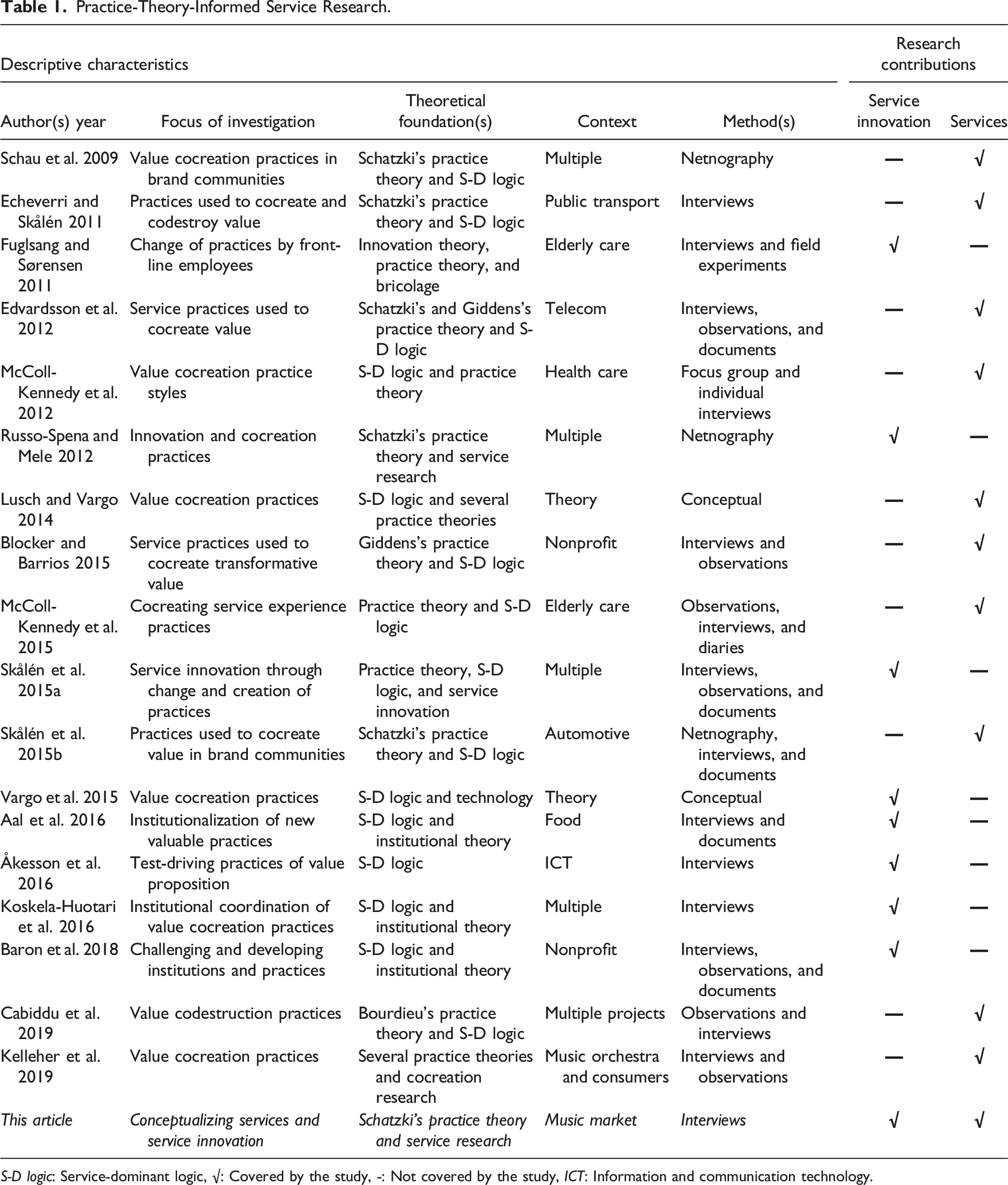
S-D logic: Service-dominant logic, √: Covered by the study, -: Not covered by the study, ICT: Information and communication technology.
To Schatzki (1996; 2002; 2019) and other practice theory scholars (Feldman and Orlikowski 2011; Nicolini 2011; Reckwitz 2002; Shove, Pantzar, and Watson 2012), practices encompass both covert templates of collectively shared and organized routine activities and the concrete overt everyday activities that actors perform. Specifically, Schatzki suggests that the templates prefigure actors’ concrete activities. Performing activities in line with the templates is commonly easier, safer, more convenient, and more socially acceptable than acting outside of or against them. Therefore, individuals often reproduce practices in accordance with templates. However, Schatzki (2019) argues that actors may choose to diverge from extant practices, although often at a cost, and act in new ways that constitute alternative ways of acting. If actors find these new ways of acting superior to the activities of established practices and adopt them, this may create new practices or change existing ones. Hence, Schatzki’s practice theory may contribute to the conceptualization of service innovation by focusing on how actors contribute to developing alternatives to existing practices.
Drawing on Schatzki (1996), Schau, Muñiz, and Arnould (2009) differentiate between three elements that characterize practices: “procedures” (i.e., rules), “understandings” (i.e., know-how or competencies), and “engagements” (i.e., emotionally-charged goals). Schatzki also emphasizes the importance of material entities, such as technologies, artifacts, and natural resources, but places these outside of practices, whereas many other practice theory scholars treat materials as an integral and central element of practices (Feldman and Orlikowski 2011; Nicolini 2011; Reckwitz 2002; Shove, Pantzar, and Watson 2012); this latter position is the way of conceptualizing practices that we adhere to. Hence, in our understanding the four elements of procedures, understandings, engagements, and materials constitute practices. These elements organize both the templates and the concrete activities that practices consist of and may contribute to both reproducing and creating practices. The templates of activities may prefigure what rules actors follow, the know-how and technology to make use of, and what goals to pursue when conducting an activity that contributes to the reproduction of practices. At the same time, actors can, as a part of their concrete activities, bend existing rules or make up new ones, develop new competencies, use novel technologies, and change their shared goals, thus contributing to the creation of new templates and to service innovation. In line with this reasoning, prior service research suggests that the usage of new technologies may change practices (Vargo, Wieland, and Akaka 2015) and that the different usage of elements of practices by interacting actors may induce service innovation through the creation of new practices (Skålén, Pace, and Cova 2015b). According to Schatzki (2019) and Shove, Pantzar, and Watson (2012), a change in one element of practices (such as the procedures) will lead to subsequent changes in the other elements and eventually to the creation of practices and associated service innovation. However, what triggers multiple actors to change the elements of practices, or come up with new elements in the first place, and contribute to service innovation is undetermined in both general practice theory and prior service research.
Actors also draw on the templates of activities that practices consist of to make sense of and reflect on their own or other actors’ past, ongoing, and future activities (Schatzki 2002). For instance, actors can compare the activities induced by one practice with those induced by alternative practices, think about and discuss how to modify practices, and critically evaluate practices based on the activities they enable. While prior research suggests that such reflections may contribute to service innovation through the creation of practices (Shove, Pantzar, and Watson 2012), how this takes place among multiple actors remains to be studied.
Schatzki’s work also offers the opportunity to conceptualize services and service innovation from the standpoint of bundles, which consist of several practices linked closely together in coordination with one another (Schatzki 1996; 2019). The modification of one practice may affect the other practices belonging to the same bundle and change them, too, thus inducing service innovation. However, why and how actors engage in this type of service innovation is unclear.
In sum, Schatzki’s practice theory provides a basis for conceptualizing services and service innovation among multiple actors by focusing on practices and how they are created, even though it is not explicitly designed to do that. In the next section, we review how services and service innovation have been studied from a practice theory perspective to further advance our conceptualization.
Studies of Practices in Service Research
Practice theory studies of services
A few service scholars have drawn on practice theory in their study of services, and four out of the 10 studies we identified have relied on Schatzki’s practice theory, as depicted in Table 1. However, this body of research has not explicitly conceptualized services in terms of multiple actors’ practices. In addition, this research stream has deemphasized the templates and elements (i.e., understandings, engagements, procedures, and materials) of practices when discussing services although our review of practice theory (see above) suggests templates and elements are essential for conceptualizing services. Instead, practice-theory-informed service research has focused on overt activities, with the common theme being that services entail value cocreation activities. Although this is an important contribution, conceptual disintegration characterizes previous studies, as different notions of practices have been drawn on, including “service practices” that are “enacted by people to cocreate value and integrate resources” (Edvardsson, Skålén, and Tronvoll 2012, p. 99), “collaborative practices” that interacting actors use to cocreate value (Skålén, Pace, and Cova 2015b), and “value cocreation practices,” which refer to customers overt activities, interactions, and roles (McColl-Kennedy et al. 2012). Since value cocreation is a common theme in prior research, it seems particularly fruitful to draw on the notion of VCPs as discussed by McColl-Kennedy et al. (2012) and others (Kelleher et al. 2019; Lusch and Vargo 2014; Schau, Muñiz, and Arnould 2009) to accomplish our aim of conceptualizing services from a practice theory perspective that takes multiple actors into account.
We further observe that service scholars have identified bundles of practices (Schatzki 1996; 2019), commonly referring to them as aggregates, and that they have shown that practices may be used by actors to codestroy or diminish value (Cabbidu, Moreno, and Sebastiano 2019; Echeverri and Skålén 2011; McColl-Kennedy et al. 2012; Schau, Muñiz, and Arnould 2009; Skålén et al. 2015a, Skålén, Pace, and Cova 2015b). In addition, a common denominator of practice theory works on services is their focus on one actor, such as firms or charities (Edvardsson, Skålén, and Tronvoll 2012; Blocker and Barrios 2015), or on customer and service provider dyads (Kelleher et al. 2019; McColl-Kennedy, Cheung, and Ferrier 2015; Skålén, Pace, and Cova 2015b). By contrast, Blocker and Barrios (2015) suggest that practices work jointly on a market, enabling collective value cocreation. Therefore, we expand our focus to multiple actors following the lead of recent research (Chandler et al. 2019; Vink et al. 2021).
In sum, prior service research has studied practices and bundles of practices to illuminate how single actors or actor dyads cocreate value. However, this body of research lacks conceptual integration and an explicit conceptualization of services as practices, although this would align the conceptual basis of services with prior studies on service innovation from a practice theory perspective, which we turn to next.
Practice theory studies of service innovation
Our review (see Table 1) identified eight studies that used practice theory to study service innovation. Only one of these studies (Russo-Spena and Mele 2012) draws systematically on Schatzki’s practice theory, which is probably because Schatzki only recently (2019) discussed the change and creation of practices in depth.
Several of the eight studies explore service innovation activities within companies, which is in line with Gallouj and Weinstein’s (1997) view that service innovation entails changes in the processes and competences a firm draws on to produce services. For example, Skålén et al. (2015a) focus on the practices constituting firms’ value propositions. Building upon the idea that studying service innovation entails a shift in the focus from “the production of innovative ‘products’ to resource integration and enhanced value propositions” (Michel, Brown, and Gallan 2008, p. 65), they propose a process model that shows how service innovation entails the development of practices. Similarly, Fuglsang and Sørensen (2011) argue that service innovation takes place through the gradual change of practices by front-line employees informed by customer interactions. Hence, there is emerging consensus among researchers that firm-level service innovation entails the change and creation of practices. This view provides an alternative to the research that has adapted the typical activities of innovation from the new product development literature to the service context, thereby illuminating the service development process (see, e.g., Blazevic and Lievens 2004; Sundbo 1997). Although research on the service development process has attended to activities, it has not been informed by practice theory, implying that the opportunities that practice theory offers to explain service innovation have not been utilized.
Moving beyond the intra-organizational level, Russo-Spena and Mele (2012) suggest that service innovation is conducted through inter-organizationally shared practices. A few studies (Aal et al. 2016; Baron et al. 2018; Koskela-Huotari et al. 2016; Vargo, Wieland, and Akaka 2015) have adopted an even broader stance, studying service innovation among value-cocreating actors in markets or within the service ecosystems of linked actors. For example, Vargo, Wieland, and Akaka (2015) posit that “…innovation is the collaborative recombination or combinatorial evolution of [market] practices that provide novel solutions for new or existing problems” (p. 64). In particular, service innovation has in this body of research been conceptualized as a process of institutionalization that denotes how institutions, which consist of shared norms, values, symbols, and formal rules, condition and shape practices. By implication, institutions and their institutionalization have been subject to more focus than the practices in this stream of research.
Based on our review, we conclude that while service scholars have conceptualized service innovation as the creation of new practices or a change of existing ones, how this takes place among multiple actors on a market remains unclear. We also conclude that a unifying framework that conceptualizes both services and service innovation from a practice theory perspective is lacking. The work of Schatzki may be drawn on to accomplish such a conceptualization, although it cannot be directly deduced from Schatzki’s practice theory, since this is not its focus. Therefore, we turn to our study of the Swedish music market to investigate how services and service innovation may be apprehended from a practice theory perspective.
Method
Like many other industries and markets, the music market has experienced a change from an emphasis on physical products to digital services, implying that new actors, such as digital intermediaries, have entered this market, the roles of established actors have been redefined, and the economic value of services has changed (Wikström 2020). To face such disruptions, market actors need to innovate to survive (Verhoef et al. 2021), making the music market an appropriate setting for service innovation studies. The Swedish music market was chosen as the specific geographical context due to its characterization by internationalization as well as early and high degrees of digital innovation (Johansson 2020). Hence, the setting constitutes what Flyvjbjerg (2006) calls a critical case, having “strategic importance in relation to the general problem” (p. 229), in our case allowing for the conceptualization of services and service innovation in a way that accounts for multiple actors. These prerequisites moved us to adopt a longitudinal qualitative design (Lincoln and Guba 1985).
Data Collection
To conceptualize services and service innovation among multiple actors by focusing on practices, 39 long interviews (McCracken 1988) were conducted with professionals and consumers active in the Swedish music market. The first author carried out 32 of the interviews between May 2016 and April 2017 with the assistance of a researcher not involved in writing the present paper; this body of work was complemented by seven additional interviews conducted by the first author in February and March of 2021 to strengthen the consumer data. For simplicity, we will use the pronoun “we” when describing the data collection. The interviewed professionals represented key actors in the music market, including record companies, music publishers, live performance organizers, artists, songwriters, “music pirates,” music streaming firms, and various trade organizations. These professionals shared their views about the evolution of the Swedish music market, but also about their experiences of music consumption. To avoid bias toward industry professionals, the interviewed consumers had not worked within the music industry.
Our focus was on understanding the music market and its evolution from the perspective of the informants. To accomplish this, two alternative interview guides containing 10 to 15 questions were used. The music professionals were asked about what the Swedish music market looked like at the time of their interviews, how its practices had changed over time, what mechanisms had been driving these changes, and what implications these changes had. Consumers were asked questions about practices related to music consumption and how these had changed over time. Probing questions were asked in relation to the answers given by informants during the interviews as well as the themes emerging from the data analysis (see below), implying that the interview guides evolved during the research. A sample interview guide can be found in Appendix A.
Interviews and Informants.

1A&R means “artists and repertoire” and refers to the staff at record companies and music publishers who find, develop, and record artists and songwriters.
Data Analysis and Trustworthiness
The data analysis procedure followed the guidelines of Spiggle (1994), which implies that the research process was characterized by iteration or a back-and-forth movement between data collection and analysis. The data were first categorized, which involved the coding, classifying, and labeling of the data, as well as recategorization along the iterations of the analysis. Our initial categorization focused on overviewing the services and service innovation in the Swedish music market. We found that three salient music services existed in this market—recording, sharing, and streaming—which resonated with music research (see, e.g., Leyshon 2014; Wikström 2020). In apprehending service innovation, we found that the three services varied in their market predominance, evolving from recording to sharing and streaming music. Notably, the new services added variability and choice in the market rather than entirely replacing old services.
In the next step, we combined categorization and abstraction, with the latter implying that higher-order constructs were created to generalize from empirical to theoretical statements (Lee and Baskerville 2003). The initial goal with this step of the data analysis was to inductively generate insights into how the three services of recording, sharing, and streaming, as well as their service innovation, could be conceptualized. Schatzki’s (1996; 2002; 2019) practice theory, as well as prior practice-theory-informed service research (see Table 1), were found helpful in abstracting the categorization, which moved us to adopt an abductive design to reflect the data in practice theory and vice versa.
The concepts and their inter-relationships that the categorization and abstraction generated are described in detail in the findings section. In summary, we found that the three services of recording, sharing, and streaming could be conceptualized as bundles of VCPs that consisted of two different types that we labeled generic and specific. We further found that the four types of elements of practices discussed above in the theoretical background section—i.e., understandings, engagements, procedures, and materials—constitute VCPs, and that these elements served the purpose of both reproducing and creating VCPs, which helped us to conceptualize both services and service innovation. Finally, we found that actors valance VCPs in a way that either cocreates or codestroys them, a finding that further helped us to conceptualize service innovation.
During the comparison and dimensionalization stages, the differences and similarities between the data were further explored, and the properties of the empirical instances and higher-order constructs were inspected to enhance the distinctiveness of the categorization and abstraction. Integration served the purpose of combining the results of our categorization and abstraction to abductively create a framework capable of conceptualizing services and service innovation. This framework is presented in the discussion section.
The trustworthiness of the research was ensured by using the criteria and techniques offered by Wallendorf and Belk (1989). Triangulation was accomplished by making sure that the findings communicated a story that resonated with all 39 interviewees. Since our interviewing was retrospective, we also triangulated our interview data in relation to a corpus of 562 articles containing the phrases “music market” or “music business” (in Swedish) that were published in Sweden’s eight major national dailies between 1995 and 2015. Hence, deviating descriptions of factual circumstances by individual informants were not accounted for. Integrity was ensured by safeguarding the anonymity of the informants and by using the interviewing techniques recommended by Wallendorf and Belk (1989). Accordingly, interviews began with broad and non-threatening questions to establish rapport with the informants, with more detailed and potentially sensitive questions being posed later. To ensure credibility, interview transcripts were presented to the informants to confirm their correctness. Following Wallendorf and Belk (1989), dependability, or the avoidance of unstable interpretations, was checked by comparing the interview statements made by the informants about the same phenomena, either in later interviews or in relation to previous research. Finally, a confirmability audit (Wallendorf and Belk 1989) was performed in two ways to secure a strong link between the data and the emerging conceptualizations. First, the original categorization and abstraction of the data by the first author was checked by the second author, which resulted in some minor changes. Second, the results of the paper were presented to other researchers on several occasions.
Findings
This section facilitates the conceptualization of services and service innovation by reporting findings on the three salient services that are present in the Swedish music market: recording, sharing, and streaming. Recording dominated the Swedish music market from the early 20th century up to the first years of the 21st century, when sharing gained a dominant position. Since about 2010, streaming has dominated the Swedish music market. Recording involves the sales and purchasing of physical recordings, such as vinyl records and compact discs (CDs), and the playing back of music with stereo systems. Sharing entails downloading music for free from file-sharing websites using a computer and playing back the music. Streaming implies subscribing to a music streaming service, such as Spotify, which has a dominant position in the Swedish market, and doing so gives consumers the right to listen to music without having to download it by connecting their own devices to the internet (Leyshon 2014; Wikström 2020). Appendix A provides a more thorough description of these three services.
Bundles of Value Cocreation Practices
Services as Bundles of Value Cocreation Practices.
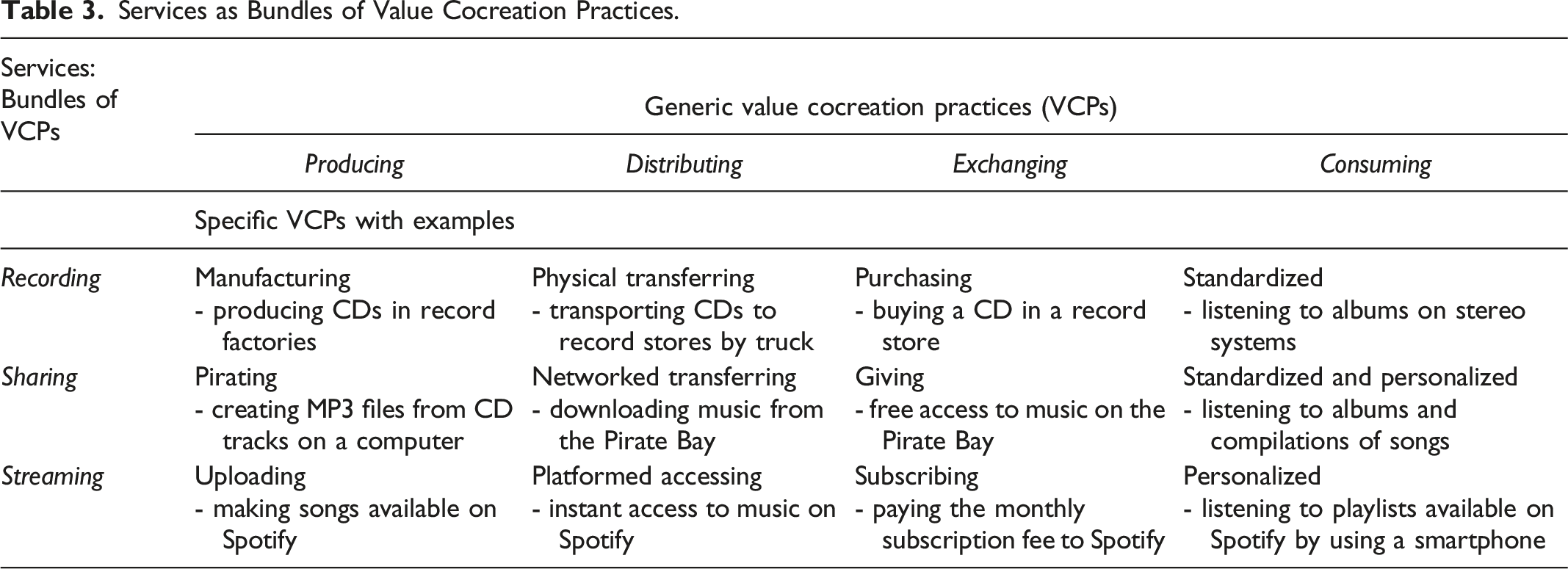
Producing
The generic VCP of producing refers to how music is being made. Recording is characterized by the manufacturing of physical goods, most often in the form of vinyl and CDs, in factories (Leyshon 2014). Marketing manager Lisa described the production process during recording as follows: “We pressed pieces of plastics.” Under sharing, producing implied the conversion or “ripping” of content to compressed digital file formats that could be uploaded to file-sharing sites on the internet, such as The Pirate Bay. “Music pirate” Ulf provided an example of how ripping was done: “I have an old friend who is totally obsessed with music. He bought a lot of VHS (Video Home Systems) tapes containing music videos that he ripped and put on The Pirate Bay.” As this ripping was commonly done by “pirates” and ordinary consumers without the consent of the copyright holders, the producing VCP associated with sharing was referred to as pirating by the informants. In streaming, a physical medium for playing back songs is bypassed, as digital files used for listening are produced directly. Hence, in streaming, producing is a simple practice that implies the uploading of songs onto the streaming services platforms, which can be done by any actor, such as an artist or a record company.
Distributing
The generic VCP of distributing refers to the movement of services—in our case, songs or collections of songs—from one place to another. As recording is associated with physical records, it implies the physical transferring of the records from the factories to the stores via distribution centers (Leyshon 2014).
By contrast, sharing and streaming involve consumers and are based on immaterial digital files, facilitated by ICTs (computers and broadband infrastructure), thus obliterating the step of physical distribution. In sharing, computers connected via the internet constitute file-sharing networks, such as The Pirate Bay. Music lawyer Ingemar explained how this form of distribution worked: “When you found the song you wanted on The Pirate Bay or any other pirate site, you downloaded the song to your computer from other persons’ computers.” Distribution thus takes place by moving music files from the memory of one or several computers to the memory of another computer. Therefore, we call this form of distribution networked transferring. In streaming, consumers gain access to music by clicking on songs on streaming services, which are made available via internet-based platforms. We call this form of distribution platformed accessing. Marketing manager Sven indicated that streaming and the platform offered by Spotify had eased distribution: “There are no hindrances to distributing music today. I don’t remember exactly, but each day there are between 20 and 25,000 new songs on Spotify.”
Exchanging
The generic VCP of exchanging refers to how consumers acquire services from providers. In recording, exchanging is characterized by people purchasing vinyl and CD records in record stores or by mail order. Daniel, a consumer, reflected on purchasing as a form of exchange: “I spent a lot of time in record stores searching for records, asking staff about records, and listening to records and sometimes buying one.” In sharing, people exchange music files by giving them for free to members of the same file-sharing network, such as The Pirate Bay. Hans, a CEO of a record company, said, “During the pirate years, you could download music for free, which many did, and thought that was great.” In line with several other informants, Bo suggested that streaming changed the music business “from a unit sales model [during recording] to a rental model.” Hence, we refer to the specific exchange VCP in streaming as subscribing. Paying a monthly fee or consenting to advertising exposure grants consumers access to all the music available on the streaming firms’ internet-based platforms.
Consuming
The final generic VCP, consuming, denotes the way in which people use services to increase their well-being, which in our case is by listening to music. In recording, people mostly listened to complete albums by one artist on stereo systems or music by different artists on the radio (Garofalo 1999; Sanjek 1988). We refer to this type of consumption associated with recording as standardized consuming (Hesmondhalgh and Meier 2018). John, a consumer who still listened to vinyl records, explained: “When me and my girlfriend cook food together, I often put on a vinyl album on the record player. We usually listen to all the songs.” In sharing, some consumers, exemplified here by Bertil, listened to music in a similar standardized way as under recording: “I downloaded albums from The Pirate Bay and burned them to CDs and then played them on my stereo system.” Others listened to compilations of songs they created themselves, representing personalized consumption. Therefore, we refer to consumption under sharing as standardized and personalized.
In streaming, informants reported that they mostly listened to playlists, commonly by using their smartphones connected to headphones, a finding that is supported by music research (Hesmondhalgh and Meier 2018; Wikström 2020). Playlists are compilations of songs often from many artists. Some informants listened to playlists they created themselves, while others listened to auto-generated playlists created by music streaming firms with the help of algorithms based on customer’s listening histories. Linda reported that she listened mostly to auto-generated playlists on Spotify: “Sometimes, I listen to a playlist called ‘chill out.’ That’s perfect if I want to relax. But if the girls are coming over before a Saturday night on the town, I put on a playlist called ‘pre-party,’ which is perfect for that occasion.” A few of our consumer informants reported that they listened to albums on Spotify, which represents a form of standardized consumption. Jonas said, “I still listen to albums. When David Bowie passed way, I listened to his records on Spotify.” However, according to marketing manager Lisa, “Today, the album is more and more seen as a physical object… Spotify doesn’t even have an album list any longer. The focus now is on playlists.” In sum, our findings suggest that personalized consumption is the typical form of music consumption in streaming.
This section has shown that services may be understood as bundles of VCPs, and that service innovation in a market implies the creation of VCPs. In the next section, we turn our attention to the role of elements of VCPs to both further understand services and to show that service innovation denotes the creation of VCPs.
Creation and Reproduction of Services Prefigured by Elements of Value Cocreation Practices
The findings reported in this section show that VCPs are constituted by four elements: understandings, engagements, procedures, and materials, which is in line with the review of practice theory presented in the theoretical background section above. We also show that these elements both reproduce and maintain services, as well as create and innovate them. In what follows, we organize the presentation of our findings in relation to the four elements of VCPs.
Understandings
The know-how or competencies that VCPs grant individual actors are referred to as understandings. Table 3 shows that recording is based on understandings of physical manufacturing, distribution, exchange, and consumption, while the VCPs of sharing and streaming are based on digital competencies. The informants argued that during the early 2000s in Sweden, when the transition from recording to sharing took place, the industry actors largely lacked the competencies to engage in the digitalization of music. As record company A&R specialist Mattias, who moved from IT (Information Technology) to the music industry in 1999, observed, “When I started working here [record company], I was struck by how low the level of knowledge of the internet and IT was at the company.” Kristina, an A&R specialist at a music publisher, agreed: “We’re not programmers. We work with music; that’s what we’re knowledgeable about.” Hence, the established understandings of recording prefigured the concrete activities of the relevant actors, which reproduced this bundle and prevented record companies and music publishers from engaging in the creation of sharing and streaming services.
In sharp contrast, the “music pirates” who promoted sharing had the understandings needed to realize digitalization. Fredrik Neij, one of the founders of The Pirate Bay, explained his motivation to contribute to the creation of the file-sharing site in the 2013 documentary The Pirate Bay Away From Keyboard: “It’s great fun to work with the technology. For me, The Pirate Bay is a technical challenge. To run such a large website [is a challenge] technically.” Ulf, another “music pirate,” spoke about how the peer-to-peer technology upon which The Pirate Bay was based made it an efficient and easy way to share music: “It was an optimum technology for many reasons. For example, while you were downloading a song, you were simultaneously uploading bits of it.” The “pirates” linked to The Pirate Bay and other file-sharing websites created the scripts (the lists of commands of computer programs) used in file sharing. Hence, the competencies of the “music pirates” made them engage in activities that gradually contributed to the creation of the templates of organized activities that constitute sharing. As other actors started to use sharing, they contributed to reproducing the service, including its understandings.
Engagements
The findings also illuminate how the engagements, or the emotionally-charged goal component of VCPs, both reproduce and create services. Engagements fuel the actors’ creation of VCPs. In the words of Fredrik Neij and Ulf, “music pirates” thought that it was “fun to work with the technology,” especially insofar as one was contributing to the development of the “optimum” peer-to-peer website. However, committing to sharing also restrained “music pirates” from contributing to the realization of streaming. As Ulf said, “Cultural products, such as music and films, should be free to be enjoyed by everyone. There’s a socialist mindset underpinning The Pirate Bay.” Ulf and other “pirates” were thus convinced that exchanging music should be characterized by giving (the specific exchange VCP of sharing), which prefigured the “pirates” to reproduce sharing rather than contribute to the creation of a commercial service.
Likewise, the engagements of streaming contribute to both creating and reproducing the service. For example, record company marketing manager Sven recognized the difference in the overall goals of his company’s business model during recording and streaming: “Earlier [under recording], our business relied on people spending as much money as possible on our products, whereas today, our business is about people spending as much time as possible on our products, and it sounds simple, but it is quite a different way of working, and the economy around how we work has changed. In particular, it has changed how we do our marketing.” The engagements of streaming prefigured Sven and his colleagues to make people spend as much time as possible listening to the music that the record company they worked for had a copyright for (or “our products,” in Sven’s words), which contributed to reproducing the reimbursement system of streaming and the bundle of VCPs more generally. However, in streaming, Sven and his colleagues had different goals with their marketing compared to those that they had during recording, and these new goals contributed to the creation of novel templates of marketing practices.
Procedures
The rules making up VCPs are referred to as procedures. A key procedure of recording and streaming is the system of copyright laws that prefigured the industry actors’ creation and reproduction of these services. The “pirates,” however, rejected copyright laws and thus remained committed to what Ulf described as a “socialist mindset,” in which the rule was not to charge for music. Accordingly, they created specific VCPs, such as distributing and exchanging music by networked transferring and giving it away for free via file-sharing websites such as The Pirate Bay, which, once established, prefigured their and other actors’ activities. Music consumer Robert explained the situation as follows: “I downloaded from file-sharing sites on the internet when this became possible at the end of the 1990s. I continued to buy some CDs, but downloading became my main way of accessing music.”
The contradictions between the procedures of recording and sharing led to a conflict between some record companies and The Pirate Bay, which resulted in multiple parties ending up in court in Sweden. The four founders of The Pirate Bay were given prison sentences of up to a year and were ordered to pay damages due to joint and several liabilities amounting to 46 million SEK, or about five million USD. Informants suggested that The Pirate Bay trial and the related negative publicity about sharing contributed to the realization of streaming, primarily represented by Spotify in Sweden, which launched its streaming service in 2008. According to Kjell, CEO of an independent record company, “The pirates did a lot of damage in the short run. But if you look in the rearview mirror, I think that piracy wasn’t such a bad thing. It was the trigger for lawful internet-based streaming.” Hence, The Pirate Bay trial made it clear to the actors that breaking laws representing common, socially agreed-upon procedures can be costly for the individual, thereby pushing them to follow common procedures (laws) in their creation and reproduction of streaming. Thus, procedures may contribute to both the creation and reproduction of services.
Materials
The findings of the present study also suggest that the material elements of VCPs, such as technologies, physical devices, and smart phone applications, may contribute to the reproduction and creation of services. In particular, the informants talked at length about how ICTs were a precondition for creating and reproducing sharing and streaming, a fact that is also supported by music research (Leyshon 2014; Wikström 2020). Bo, a PR (Public Relations) manager of a trade organization, made a representative statement: “Digitalization and the internet have transformed the whole business, from how songs are being written to how music is being consumed.” Hence, actors’ commitments to technology, including the physical elements constituting VCPs, contributed to the creation of sharing and streaming, which, once established, prefigured the activities of actors engaging in them. Informants further argued that the rapid expansion of broadband-connected computers triggered actors to create and reproduce sharing and streaming. Music lawyer Ingemar talked about the creation and reproduction of sharing on the Swedish music market, recalling, “There was a computer in each and every home, in all schools, in all offices… When all these computers and the broadband infrastructure were in place, it was only natural for people to use file-sharing networks.”
Another example of a significant material element that contributed to creating and reproducing streaming within the Swedish music market was the smartphone. Arne, CEO of an interest organization, remarked, “The big game-changer is streaming in combination with the smartphone.” The smartphone served as a platform for the creation of new VCPs specific to streaming, such as distributing and consuming music via applications connected to the databases containing the music that streaming firms offer, and for providing the possibility to charge for music by making consumers subscribe to streaming services. Karin, a consumer who subscribed to Spotify, said, “With smartphones, it became possible to use apps [applications], and Spotify has such a good app that makes it easy and convenient to listen to music. Today, I only listen to music by using my smartphone.” Once streaming was established, consumption became prefigured by it. Consumers started to listen to playlists via their smartphones, enabling personalized consumption as described in Table 3 and thus reproducing the service.
This section suggests that the elements of VCPs constitute templates of activities that prefigure actors to reproduce services. It also shows that actors, in their concrete activities, may use new elements of VCPs or change existing ones, which may create templates of VCPs and contribute to the innovation of services. Appendix A provides additional empirical evidence to substantiate the findings of this section. In the next section, we turn our attention to actors’ valancing of bundles and indicate what this implies for conceptualizing services and service innovation as the creation of VCPs.
Valancing Bundles of Value Cocreation Practices
The findings suggest that actors valance bundles of VCPs or services by comparing them to one another. Through valancing, actors ascribe value to bundles, thus evaluating services in relation to their relative advantages and disadvantages. We further show that actors simultaneously cocreate the services on the market they value the highest and codestroy those attributed less value, thus contributing to the innovation of services.
Comparison of recording and sharing
Several informants reported that when they compared recording and sharing, their conclusion was that sharing was advantageous to recording. A&R manager Gunnar said, “The pirates’ offering was so much better... I think most people wanted to do the right thing, but people didn’t want to buy CDs.” Jonas, a consumer, stated, “All of a sudden, music was available for free at my fingertips, which was absolutely fantastic.” Both informants pointed out the preference for the distributing and exchanging of VCPs of sharing (i.e., networked transferring and giving) over the physical distributing and purchasing VCPs of recording. This stance was generally shared among the informants across categories, although some informants deviated. For example, Ingrid, a consumer, said, “I have never downloaded music via pirate sites. I think that the ones who write and perform the music shall get paid.” Ingrid never engaged in sharing and valanced recording higher than sharing.
The bulk of the actors’ valancing of sharing as having higher value than recording made them adopt and cocreate the VCPs of this bundle, which simultaneously undermined and codestroyed the VCPs of recording. For example, consumers bought fewer CDs, spending their money on subscribing to music streaming services instead, which created financial problems for those actors dependent on recording but provided the means for streaming firms to develop their value propositions. The reduced demand also resulted in lower supply, thereby accelerating the codestruction of recording. Hence, the simultaneous cocreation and codestruction of services in a market that valancing implies contribute to the creation of bundles of VCPs (i.e., to service innovation).
Comparison of sharing and streaming
Several informants reported that they valued streaming higher than sharing. In A&R manager Gunnar’s view, “Spotify has been a leader and the best streaming service so far. It offers a service that’s really good, so why keep on downloading pirated copies? That just takes time and is tedious. For 99 SEK [about 10 USD] a month, I have access to virtually all the music available.” While Gunnar maintained that the exchange of music for free (in sharing) was superior to subscribing (in streaming), this was trumped by the hassle of downloading music files associated with the networked transferring of sharing. Likewise, Gustav, a consumer, contrasted sharing with streaming and valued the latter higher: “I remember the first time I tried Spotify in 2009; it was so simple… I was so used to waiting for the download to complete before I could play the song. Spotify was instant.”
By adopting streaming, actors contribute to the creation of the VCPs constituting the service. For example, by providing consumption data, consumers enabled streaming firms to create playlists with the help of algorithms. Consumers’ adoption of streaming also meant that actors’ computers were no longer nodes in file-sharing networks, thus codestroying sharing. Indeed, many informants, like songwriter Jan, argued that the widespread adoption of streaming contributed to the disappearance or codestruction of sharing. As Jan reported, “Illegal downloading has completely disappeared in Sweden thanks to Spotify.” Hence, intertwined processes of cocreation and codestruction in the music market contribute to service innovation.
While streaming was valanced higher than recording and sharing by our informants, we also note that some of them did not consume music only via streaming. In particular, some informants reported that they listened to vinyl albums, thus engaging in recording in addition to streaming. For example, John, a consumer, had negative feelings about the immaterial nature of streaming. He said: “I miss having an album cover in my hands when I listen to music.” Therefore, John engaged in recording. By valancing streaming and recording positively, these informants contributed to cocreating both these VCPs while codestroying sharing.
Role of other actors’ valancing
The findings showed that focal actors considered other actors’ valancing and evaluation of services, which made them promote viable services even when these were perceived as second-best options. Record company CEO Mats identified how the rise of sharing and the resulting slump in sales made record companies support Spotify and streaming even though they valued recording the most: “When I started working here [at a record company] in 2006, the market wasn’t working due to piracy… Some people in our organization thought that if we don’t do anything, it’s not certain that our Swedish operation will still be here in 5 years’ time. So, we had to take the chance and license Spotify despite many of us not believing in it.” Hence, the valancing of services among consumers made record companies realize that recording was untenable in the light of sharing and that streaming was the second-best option. Therefore, they decided to license their music catalogs to Spotify, which contributed to the cocreation of streaming and the codestruction of sharing, although this also meant the codestruction of recording, which they valued most among the available bundles of VCPs. By doing this, the record companies supported streaming and facilitated its service innovation. Appendix A provides additional empirical examples of valancing.
Discussion
A theoretically grounded and consistent conceptualization of service innovation and services that accounts for multiple actors has been called for in prior studies (Gustafsson, Snyder, and Witell 2020; Toivonen and Tuominen 2009). In this section, we heed this call for research by developing a framework of services and service innovation based on our empirical findings and our review of practice theory research. We also present the theoretical implications of our paper, an agenda for future practice-theory-informed research on services and service innovation, the managerial implications, and the limitations of our research.
Theoretical Contributions
Conceptualization of services and service innovation
The framework of services and service innovation, presented in Figure 1, conceptualizes services as bundles of tightly linked value cocreation practices (VCPs). According to our conceptualization, VCPs consist of both the templates of collectively shared and organized routine activities and the concrete everyday activities that individual actors perform to cocreate value; this particular understanding is supported by Schatzki’s (1996; 2002; 2019) conceptualization of practices. Conceptualization of services and service innovation.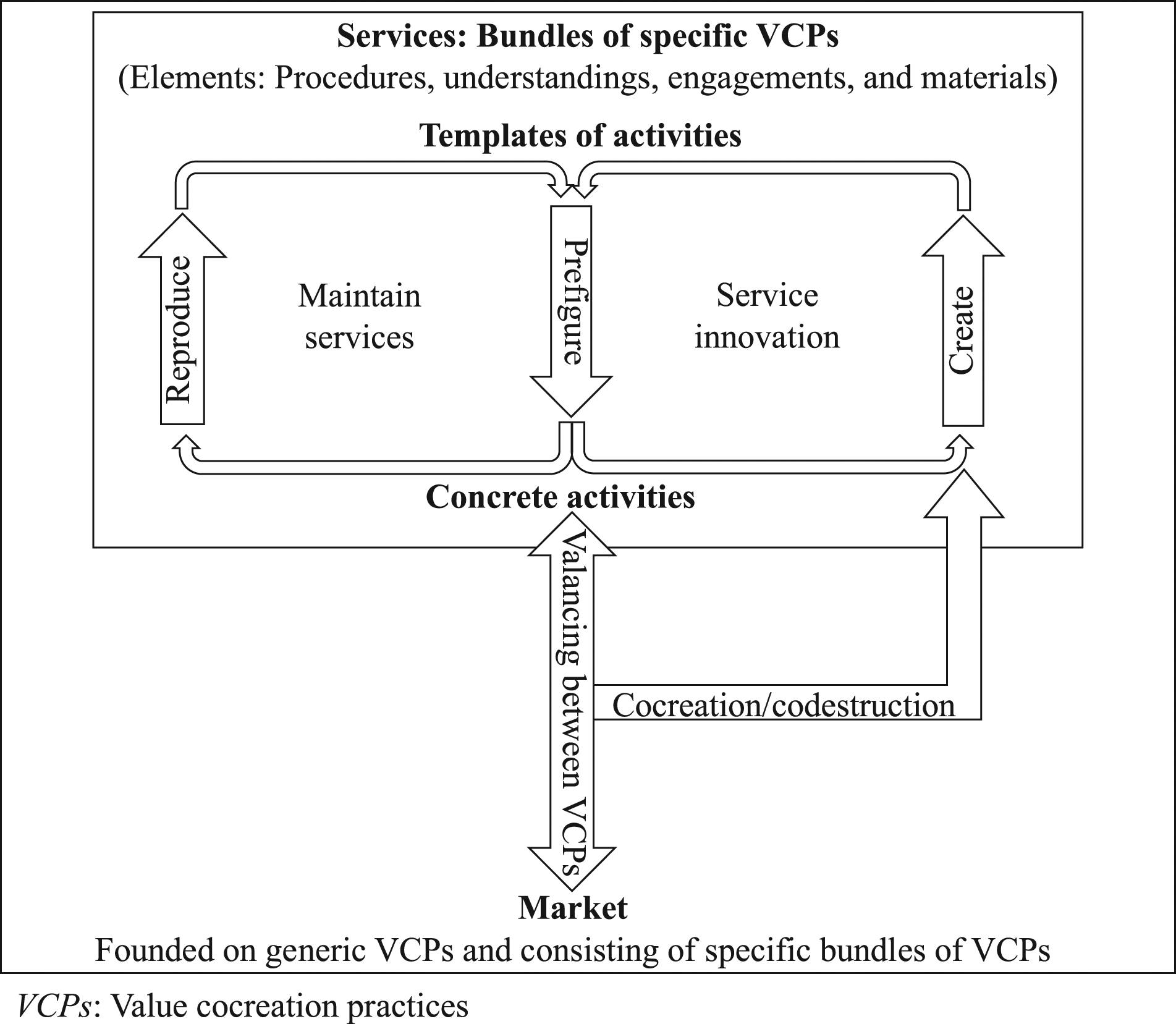
Four types of elements, understandings, engagements, procedures, and materials, constitute VCPs, which is in line with the work of practice theory scholars (Feldman and Orlikowski 2011; Schatzki 1996; 2019; Shove, Pantzar, and Watson 2012). Prior service research has highlighted the first three elements of practices, but not materials (see, e.g., Echeverri and Skålén 2011; Schau, Muñiz, and Arnould 2009), which, according to our findings, have a central role in services and service innovation, thus corroborating recent service research (Vink et al. 2021).
The four elements have a dual role in VCPs, as shown in Figure 1. First, they constitute the templates of organized routine activities that prefigure the concrete activities, which in turn reproduce these templates and contribute to the maintenance of VCPs. Second, actors use the elements to conduct concrete activities that may contribute to create new or modify existing activity templates that prefigure future concrete activities. This creation of VCPs is key to the conceptualization of service innovation we offer. Thus, we have found that prefiguration contributes both to maintaining services and to service innovation despite the fact that Schatzki (1996; 2002; 2019) suggests that prefiguration only maintains practices.
Actors’ valancing of VCPs contributes to service innovation in a market through the simultaneous cocreation and codestruction of services. Actors ascribe value to services by comparing how well the specific VCPs that are particular to services fulfill the role of the generic VCPs that all services in a market have in common. While prior service research has acknowledged the relationship between cocreation and codestruction (Cabbidu, Moreno, and Sebastiano 2019; Echeverri and Skålén 2011), our findings of how multiple actors’ valancing of generic and specific VCPs is associated with service innovation are novel. Next, we turn to the theoretical implications of the framework for research on services and service innovation.
Theoretical implications for research on services
The idea of “services” is one of the key concepts of service research, and our aim was in part focused on conceptualizing services from a practice theory perspective in a way that accounts for multiple actors. We contribute to the literature with a conceptualization of services as bundles of VCPs. Key to our conceptualization of services is the dual role of practices: bundles of VCPs entail both templates of reoccurring value-cocreating activities that prefigure actors’ activities, and the concrete value-cocreating activities carried out by actors that reproduce the templates, thus maintaining services (see Figure 1). Our conceptualization contributes to the research that has studied services as activities by providing a theoretical foundation and framework for such work (Edvardsson, Gustafsson, and Roos 2005; Lusch and Vargo 2014).
We also contribute to the service research that has drawn on practice theory (see Table 1), but which has lacked a distinct conceptual core and a coherent nomenclature using several notions, such as “service practices” (Edvardsson, Skålén, and Tronvoll 2012), “value cocreation practices” (McColl-Kennedy et al. 2012), and “collaborative practices” (Skålén, Pace, and Cova 2015b), to study services. Our definition of VCPs and the associated concepts included in our framework (see Figure 1) provide a distinct and coherent conceptual framework for studying services from a practice theory perspective. Our research builds on prior service research on practices, particularly on the research that has explicitly attended to VCPs (see Kelleher et al. 2019; Lusch and Vargo 2014; McColl-Kennedy et al. 2012; Schau, Muñiz, and Arnould 2009), but it also adds to it by shedding light on the invisible layer behind overt activities: the covert templates of activities, as well as the elements that constitute both the templates and the concrete activities of actors.
This developed conceptualization of services enables the exploration of constructs such as value propositions, firm-customer interactions, and service provision in a new light, as called for by Skålén et al. (2015a). The attractiveness of value propositions may be inspected in terms of the templates prefiguring mutual value cocreation, specifically the elements of VCPs. For example, understandings (know-how) of interacting actors may conflict, or procedures may restrict actors’ activities, and this is likely to decrease the attractiveness of value propositions. It is also possible to investigate which of the elements that enable high-quality customer interactions or potentially hinder them. Finally, our practice theory conceptualization of services suggests that the bundling of VCPs is key to service and competitive strength: by looking at alternative VCPs and their valancing among actors, services can be bundled and unbundled to improve the focal firm’s service provision.
We also make two specific contributions to service research. First, our study offers an alternative to service-dominant (S-D) logic’s view of value determination. According to S-D logic, value is “always uniquely and phenomenologically determined by the beneficiary” (Vargo and Lusch 2016, p. 8). Our findings show that most actors tend to valance services similarly, and some consistently higher than others (in our case, sharing higher than recording and streaming higher than sharing). While we also show that actors may deviate from the majority and valance VCPs differently, a key message of our findings is that value is not always uniquely and phenomenologically determined by the beneficiary. Rather, we find support for the coexistence of the intersubjective and subjective determinations of value due to actor interdependence. For example, while the managers of a firm may valance their extant services positively compared to other services on the market, they may also realize that the consumers prefer alternative services; therefore, the firm needs to change their services to ensure business survival. These findings echo those reported by Kelleher et al. (2020), who found that today’s actors in highly connected markets sometimes need to strike a balance between multiple actors’ contrasting value cocreation practices.
Second, service researchers have emphasized that service exchange is embedded in macro-level institutions (Baron et al. 2018; Vargo, Wieland, and Akaka 2015; Vargo and Lusch 2016). Hence, embedded agency, which implies that actors and their activities are enabled and constrained by shared norms, values, symbols, and formal rules is a core assumption of this research. The problem with conceptualizing services based on institutional theory is that it becomes hard to explain how actors engage in new behaviors or change existing ones, as this would imply acting in contradiction to the institutions that define them as actors and control their actions. Our conceptualization of services offers a way out of this cul-de-sac, but not by combining institution and practice theory as suggested by Vargo and Lusch (2016), as these theories advance incommensurable conceptualizations of action and social order (Schatzki 1996; 2002). Rather, we offer a practice theory interpretation of services, which suggests that actors’ activities are prefigured by the templates of reoccurring activities that constitute VCPs, and that actors may engage in concrete activities, sometimes triggered by valancing, that may make them diverge from these templates and create new ones. Hence, our conceptualization of services offers novel implications for how services are innovated, which we turn to next.
Theoretical implications for research on service innovation
According to Gustafsson, Snyder, and Witell (2020), research on service innovation has lacked a distinct theoretical conceptualization, which hinders knowledge development. To address this issue, a part of our aim is devoted to conceptualizing service innovation by multiple actors by elaborating on the emerging research on service innovation that draws on practice theory. The framework we have developed (see Figure 1) allows us to begin fulfilling this part of the aim. As we have emphasized, we understand service innovation as the creation of VCPs and bundles, which is achieved by multiple actors and triggered by valancing.
Our conceptualization offers implications to all four streams of research on service innovation recently identified by Helkkula, Kowalkowski, and Tronvoll (2018), which include the output, process, systems, and experiential streams. The output stream has been devoted to studying the characteristics of the services that firms create. Our paper offers an alternative view, as it suggests that service innovation entails the creation of VCPs by multiple actors. This does not imply that we reject that output is a central dimension of service innovation (Gallouj and Weinstein 1997). However, the “output” of service innovation from our perspective refers to new or changed VCPs and bundles, such as streaming.
Our findings also have implications for process research on service innovation. Traditionally, this body of research has focused on outlining process models for service development, with stages such as idea generation, project formation, service design, implementation, and market launch that take place within the firm itself (see, e.g., Blazevic and Lievens 2004; Sundbo 1997). Researchers drawing on practice theory and S-D logic have contributed to the creation of service innovation process models (Åkesson et al. 2016; Skålén et al. 2015a), but have also adopted a firm internal focus. Our conceptualization suggests instead that service innovation processes involve several actors, take place on the market to some extent, and are triggered by actors comparing two or several services. The service innovation process we describe here suggests that actors draw on understandings, engagements, procedures, and materials—that is, elements of VCPs—to conduct concrete activities that create new templates of activities that prefigure future concrete activities. Taken together, this constitutes a circular process of service innovation that takes place within bundles of VCPs (see Figure 1). This internal process is reinforced by the external process of valancing that contributes to service innovation by market actors cocreating and codestroying bundles of VCPs. This idea corroborates the findings of Kelleher et al. (2020), who suggest that codestruction could be latent when actors withdraw their resources from a service system, as well as the work of Skålén, Pace, and Cova (2015b), who argue that codestruction generates opportunities for actors to innovate but without specifying how this is done.
The systems research suggests that a relevant level of analysis for service innovation is markets or service ecosystems (Aal et al. 2016; Baron et al. 2018; Chandler et al. 2019; Koskela-Huotari et al. 2016; Lusch and Vargo 2014; Vargo, Wieland, and Akaka 2015), which is in line with our findings. Our discussion regarding how the services of the Swedish music market (recording, sharing, and streaming) evolved through valancing contributes to the systems research with insights about the dynamic relationship between service innovation and market evolution. We further note that the systems research, due to having its roots in institutional theory, has conceptualized service innovation as a process of institutionalization that denotes how institutions and their associated practices are created and become taken-for-granted by actors. Leading institutional theory scholars Tolbert and Zucker (1996) argue that institutionalization is not primarily about innovation per se, but about how innovations become institutions. By employing a practice theory lens, our paper expands upon the systems research by offering an alternative view to the dominating institutional theory to explain how multiple actors create services in the form of bundles of VCPs.
Finally, our paper advances the experiential service innovation research stream preoccupied with customers experiences and the sensemaking of innovations (Helkkula, Kowalkowski, and Tronvoll 2018). Our contribution to this body of research stems from the notion of valancing, which suggests that VCPs function as templates not only for concrete activities, but also for sensemaking (Schatzki 1996; 2002; 2019). In particular, valancing drives service innovation when actors make sense of services by evaluating them in relation to their relative advantages and disadvantages, which induces the cocreation and codestruction of services. Hence, our stance suggests that actors make sense of service innovation based on collectively shared VCPs in addition to their personal subjective views. Therefore, we argue that service innovation denotes a subjective and intersubjective sensemaking process.
Innovation and change have overall been neglected topics in general practice theory (Epp et al. 2014; Nicolini 2011), with the recent work of Schatzki (2019) that we have drawn upon constituting one exception. Our study integrates Schatzki’s practice theory with service research such that it can be used to study service innovation. Moreover, we have elaborated on several unclear aspects of Schatzki’s theory. The notion of valancing illuminates how actors’ comparisons of practices create new practices by constructing alternatives to established practices. It also explains what triggers actors to engage in creating new elements of practices and shows how actors reflect different practices in relation to one another, as well as how such reflections foster service innovation. We have also elaborated on Schatzki’s work by showing that prefiguration is not only associated with reproduction, as he suggests, but also with innovation.
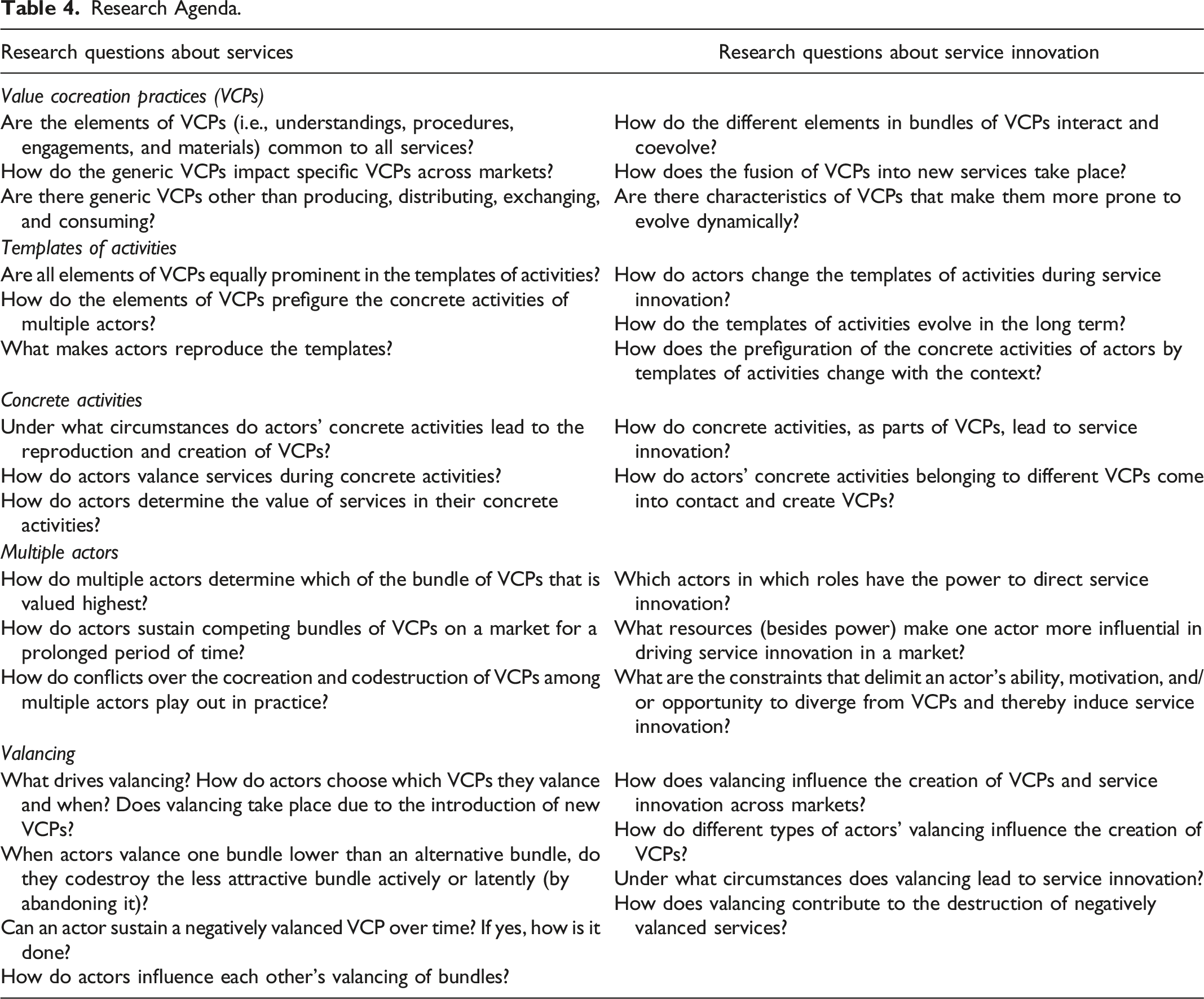
Research agenda
Research Agenda.
Managerial Implications
Conceptualizing services as bundles of VCPs that are shared and realized by several actors and service innovation as the creation of VCPs by multiple actors implies that service managers need to focus on the VCPs of the markets in which their firms are active, as well as on the VCPs of the larger context that may influence their respective firms (Ordanini and Parasuraman 2011; Vargo and Lusch 2016). The framework (see Figure 1) that we have developed provides them with the means to do so.
We advise managers to analyze the immediate and extended environments of their firms based on the generic VCPs by asking the following questions: How are producing, distributing, exchanging, and consuming conducted in the focal market? What changes have been taking place over time, and what changes are likely to take place in the near future? Is the market digitalizing? What are the general implications of these changes for the firm and its service innovation? What is happening in adjacent markets? Managers can then turn their focus to specific VCPs and ask questions like the following: What specific VCPs exist on the markets the firm is acting on and adjacent markets? Are any of the VCPs dominating? Are any new specific VCPs being created? What are the consequences for the firm? How is the firm positioned in relation to specific VCPs that are gaining and losing relevance for consumers? What can be done to improve the firm’s position?
When the managers have a map of the specific VCPs on the market, we advise them to focus on the elements—the understandings, engagements, procedures, and materials—these VCPs are constituted by. Does the firm have or lack the competencies needed to engage in a specific VCP that is on the rise? For example, we noted that record companies lacked the digital competencies needed to engage in the innovation of digital VCPs, which caused financial problems for them. Is there any new technology that may change the market, such as the smartphone and the computer in our case? How do new collective goals of actors, such as the pursuit of an environmentally sustainable lifestyle, affect the markets in which the firm is active? By engaging with the elements of VCPs, managers may also acquire an understanding of how actors engage in concrete activities to create VCPs. Is such service innovation an opportunity or a threat to the firm? Are there procedures that hinder the firm from developing new VCPs, and should the firm thereby aim to proactively influence the procedures? How can the firm engage with VCPs in the best way? Shall the firm buy an innovative start-up to acquire the innovation capacity needed?
By mapping the specific VCPs, managers may also be able to see what valancing is taking place in relevant markets and how this influences the firm. They can then ask themselves the following questions: How will the ongoing cocreation and codestruction of specific VCPs affect our firm? Which VCPs are cocreation and codestruction contributing to the creation of, and which are they undermining? What does this imply for the firm’s market position, and what shall be done to make the firm relevant to consumers and the society at large?
By shifting the focus of managerial activity from the firm to the shared VCPs of the market without losing track of internal processes, such as production, which we highlighted as one of the generic VCPs, managers may be able to lead their firms toward productively engaging in collective value cocreation activities and to be able to improve and create new activities. This is likely to create a competitive advantage for the focal firm and to benefit the society at large. Moreover, as our findings have shown, there is no such thing as a stable music market. Rather than regarding VCPs as operating within pre-defined markets, managers need to view markets as fluid and transforming (Araujo, 2007).
Limitations
As with all research, our study suffers from limitations. The main limitation of the present research is that it builds on a qualitative study of a single, quite specific context—the Swedish music market. Therefore, we outlined an agenda that future research may draw on to extend our work to other markets and geographical areas. In particular, future research needs to quantitatively test our conceptualization of services and service innovation by investigating several markets. Such research may contribute to revising our framework and re-formulating the research agenda. In addition, we focused on a new digital disruptive technology, whereas many services are still provided outside of the digital realm, and service innovation commonly focuses on aspects other than disruptive technologies, such as business models. Another major limitation in our work was the exclusion of the primary stages that take place prior to music becoming a commercial product (i.e., song writers’, artists’, producers’, and other industry actors’ original work with creating the music). Studying these stages may also generate new insights.
Furthermore, many services that are essential to the well-being of individuals and the society at large are public, whereas the focus in this paper was on a market setting, in line with the bulk of service research. This is another limitation, as our findings indicate that the state played an important role in the creation of VCPs. For example, the early development of broadband infrastructure in Sweden was crucial for the service innovation of sharing and streaming. Hence, future research needs to attend to public services and public service innovation. Our framework (see Figure 1) may provide a point of departure for such studies.
Conclusion
While service scholars have fruitfully drawn on practice theory, they have also agreed that the theoretical potential offered by practice theory to service research remains unfulfilled (Lusch and Vargo 2014; McColl-Kennedy, Cheung, and Ferrier 2015; Skålén et al. 2015a; Vargo and Lusch 2016). We have contributed to unleashing some of the potential of practice theory for service research by advancing the conceptualization of services and service innovation. Nevertheless, much work lies ahead, and the research agenda that we outlined is an invitation to other service scholars to join us in our endeavor to further unlock the potential of practice theory for service research.
Supplemental Material
sj-pdf-1-jsr-10.1177_10946705211062693 – Supplemental Material for Conceptualizing Services and Service Innovation: A Practice Theory Study of the Swedish Music Market
Supplemental Material, sj-pdf-1-jsr-10.1177_10946705211062693 for Conceptualizing Services and Service Innovation: A Practice Theory Study of the Swedish Music Market by Per Skålén and Johanna Gummerus in Journal of Service Research
Supplemental Material
sj-pdf-2-jsr-10.1177_10946705211062693 – Supplemental Material for Conceptualizing Services and Service Innovation: A Practice Theory Study of the Swedish Music Market
Supplemental Material, sj-pdf-2-jsr-10.1177_10946705211062693 for Conceptualizing Services and Service Innovation: A Practice Theory Study of the Swedish Music Market by Per Skålén and Johanna Gummerus in Journal of Service Research
Supplemental Material
sj-pdf-3-jsr-10.1177_10946705211062693 – Supplemental Material for Conceptualizing Services and Service Innovation: A Practice Theory Study of the Swedish Music Market
Supplemental Material, sj-pdf-3-jsr-10.1177_10946705211062693 for Conceptualizing Services and Service Innovation: A Practice Theory Study of the Swedish Music Market by Per Skålén and Johanna Gummerus in Journal of Service Research
Supplemental Material
sj-pdf-4-jsr-10.1177_10946705211062693 – Supplemental Material for Conceptualizing Services and Service Innovation: A Practice Theory Study of the Swedish Music Market
Supplemental Material, sj-pdf-4-jsr-10.1177_10946705211062693 for Conceptualizing Services and Service Innovation: A Practice Theory Study of the Swedish Music Market by Per Skålén and Johanna Gummerus in Journal of Service Research
Footnotes
Acknowledgments
The Authors wish to thank the informants of this study for sharing their expertise and experience in the Swedish music market. The Authors also wish to thank Mikko Laamanen, Marit Engen, Rolf Rønning, and Jenny Karlsson as well as the Associate Editor and the three anonymous reviewers for helpful comments on previous versions of this manuscript.
Declaration of Conflicting Interests
The author(s) declared no potential conflicts of interest with respect to the research, authorship, and/or publication of this article.
Funding
The author(s) disclosed receipt of the following financial support for the research, authorship, and/or publication of this article: The first Author received financial support for this research from Jan Wallanders and Tom Hedelius stiftelse as well as Tore Browaldhs stiftelse [Grant: P18-0028], Interreg Sweden-Norway program [Grant: 20201630], and the Region Värmland [Grant: RV2018-8].

Supplemental Material
Supplemental material for this article is available online.
Example of Interview Guide
Appendix B
Empirical illustration and interpretation of key concepts.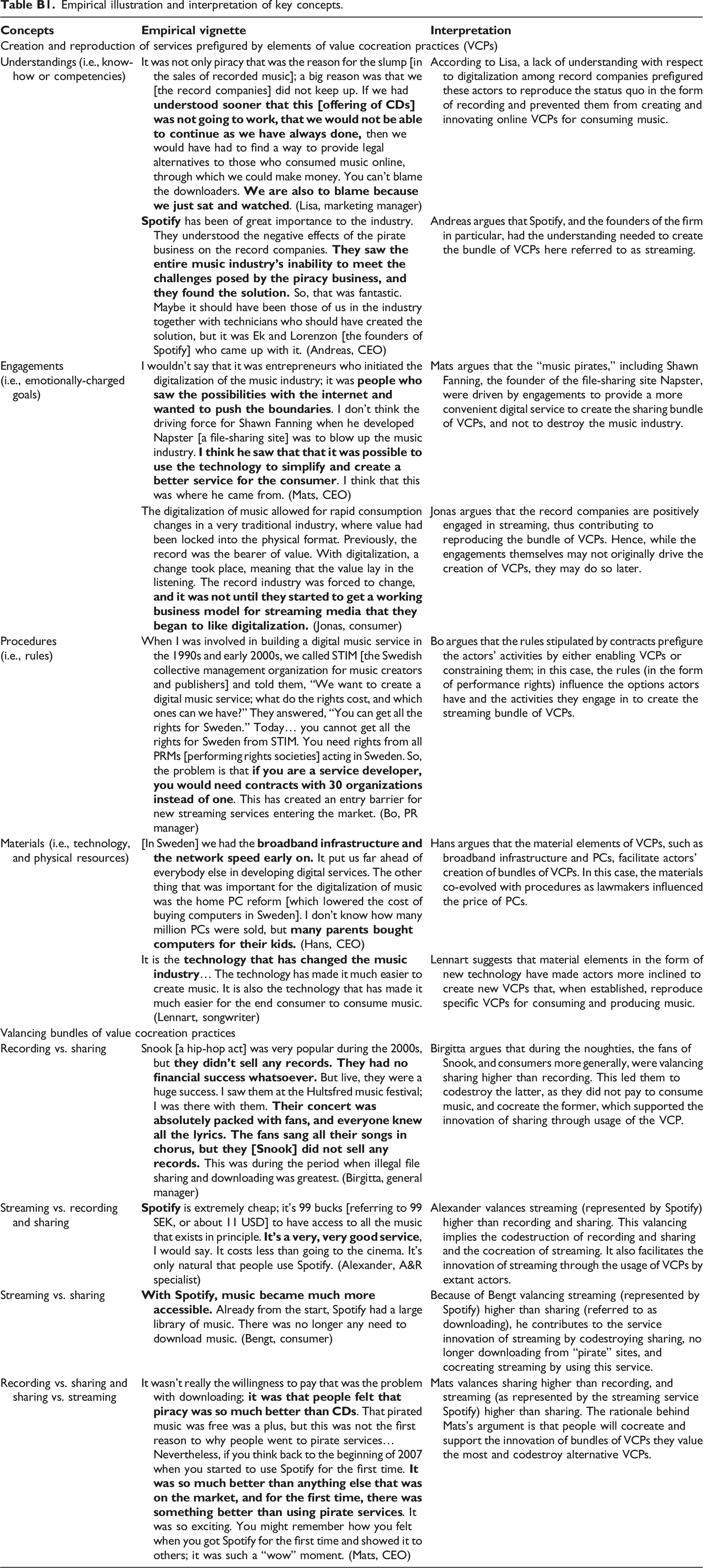
Creation and reproduction of services prefigured by elements of value cocreation practices (VCPs)
Understandings (i.e., know-how or competencies)
It was not only piracy that was the reason for the slump [in the sales of recorded music]; a big reason was that we [the record companies] did not keep up. If we had
According to Lisa, a lack of understanding with respect to digitalization among record companies prefigured these actors to reproduce the status quo in the form of recording and prevented them from creating and innovating online VCPs for consuming music.
Andreas argues that Spotify, and the founders of the firm in particular, had the understanding needed to create the bundle of VCPs here referred to as streaming.
Engagements
I wouldn’t say that it was entrepreneurs who initiated the digitalization of the music industry; it was
Mats argues that the “music pirates,” including Shawn Fanning, the founder of the file-sharing site Napster, were driven by engagements to provide a more convenient digital service to create the sharing bundle of VCPs, and not to destroy the music industry.
The digitalization of music allowed for rapid consumption changes in a very traditional industry, where value had been locked into the physical format. Previously, the record was the bearer of value. With digitalization, a change took place, meaning that the value lay in the listening. The record industry was forced to change,
Jonas argues that the record companies are positively engaged in streaming, thus contributing to reproducing the bundle of VCPs. Hence, while the engagements themselves may not originally drive the creation of VCPs, they may do so later.
Procedures
When I was involved in building a digital music service in the 1990s and early 2000s, we called STIM [the Swedish collective management organization for music creators and publishers] and told them, “We want to create a digital music service; what do the rights cost, and which ones can we have?” They answered, “You can get all the rights for Sweden.” Today… you cannot get all the rights for Sweden from STIM. You need rights from all PRMs [performing rights societies] acting in Sweden. So, the problem is that
Bo argues that the rules stipulated by contracts prefigure the actors’ activities by either enabling VCPs or constraining them; in this case, the rules (in the form of performance rights) influence the options actors have and the activities they engage in to create the streaming bundle of VCPs.
Materials (i.e., technology, and physical resources)
[In Sweden] we had the
Hans argues that the material elements of VCPs, such as broadband infrastructure and PCs, facilitate actors’ creation of bundles of VCPs. In this case, the materials co-evolved with procedures as lawmakers influenced the price of PCs.
It is the
Lennart suggests that material elements in the form of new technology have made actors more inclined to create new VCPs that, when established, reproduce specific VCPs for consuming and producing music.
Valancing bundles of value cocreation practices
Recording vs. sharing
Snook [a hip-hop act] was very popular during the 2000s, but
Birgitta argues that during the noughties, the fans of Snook, and consumers more generally, were valancing sharing higher than recording. This led them to codestroy the latter, as they did not pay to consume music, and cocreate the former, which supported the innovation of sharing through usage of the VCP.
Streaming vs. recording and sharing
Alexander valances streaming (represented by Spotify) higher than recording and sharing. This valancing implies the codestruction of recording and sharing and the cocreation of streaming. It also facilitates the innovation of streaming through the usage of VCPs by extant actors.
Streaming vs. sharing
Because of Bengt valancing streaming (represented by Spotify) higher than sharing (referred to as downloading), he contributes to the service innovation of streaming by codestroying sharing, no longer downloading from “pirate” sites, and cocreating streaming by using this service.
Recording vs. sharing and sharing vs. streaming
It wasn’t really the willingness to pay that was the problem with downloading;
Mats valances sharing higher than recording, and streaming (as represented by the streaming service Spotify) higher than sharing. The rationale behind Mats’s argument is that people will cocreate and support the innovation of bundles of VCPs they value the most and codestroy alternative VCPs.
Author Biographies
References
Supplementary Material
Please find the following supplemental material available below.
For Open Access articles published under a Creative Commons License, all supplemental material carries the same license as the article it is associated with.
For non-Open Access articles published, all supplemental material carries a non-exclusive license, and permission requests for re-use of supplemental material or any part of supplemental material shall be sent directly to the copyright owner as specified in the copyright notice associated with the article.
