



Abstract
The idea of conceptualizing services as a type of discrete entity that are different from goods provided the initial conceptual foundation of service research. Today, this foundation has been denounced and replaced by the service-dominant logic (SDL), which suggests that service is a logic reffering to how resources are integrated by actors in order to cocreate value-in-use. However, researchers and practitioners still commonly refer to services as a type of discrete entity. To facilitate the understanding of services, this paper develops a services-as-practices (SaP) framework consisting of six propositions. Key to the SaP framework is the fact that services are conceptualized as bundles of value cocreation practices (VCPs). These VCPs are organized and recurring activities that are intended to cocreate value, but they can also codestroy (i.e., diminish) value when performed. The SaP framework contributes to service research by developing: (1) a novel conceptualization of services that realizes the long-lasting opportunity to understand services-as-activities, (2) a novel conceptualization of value that aligns theoretically with this understanding of services, and (3) the service research discipline as a whole. The latter contribution is accomplished by revising the notion of services as a type of discrete entity in such a way that a fruitful alternative perspective to focusing on service as a logic along the lines of the SDL is achieved. The SaP framework also provides practitioners with a novel perspective as regards understanding, managing, and developing services.
Introduction
The idea that services (in the plural) represent a type of offering and output that differs from goods provided the initial conceptual foundation of the service research discipline (Brown, Fisk, and Bitner 1994; Shostack 1977). Vargo and Lusch (2004) critiqued this idea for centering on the production of value within firms, developing the service-dominant logic (SDL) as an alternative. The SDL acknowledges that goods and services are different entities, but transcends the distinction between them by suggesting that service (in the singular) is a logic—i.e., a worldview or a mindset—referring to how resources are integrated by actors in order to cocreate value-in-use (Lusch and Vargo 2014; Vargo and Lusch 2004, 2008, 2016).
The SDL has offered a new foundation for the service research discipline (Wilden et al. 2017), resulting in a reduced emphasis on conceptualizing services as a type of discrete entity (a concept which will at times just be referred to as services in the remainder of the article). However, researchers and practitioners still frequently refer to services. For example, Ostrom et al. (2021) use the term services multiple times in their paper on service research priorities, outlining several research questions about services. Additionally, it is commonplace to justify service research by arguing that the economy is dominated by services, thus distinguishing between services and goods as two different types of entities. Services are also commonly referred to in practice. For instance, the firm Verizon offers “Wireless, Internet, TV, and Phone Services,” 1 while the UK National Health Service states its mission as providing “…care and services that we and our families would want to use.” 2 In addition, customers commonly express their satisfaction or dissatisfaction with services.
There is thus a mismatch between the current SDL-based foundation of the service research discipline and the approach to services as a type of discrete entity commonly adopted by service researchers and practitioners. Identifying this mismatch can be described as a ‘problematization’ (Alvesson and Sandberg 2011) of the service research discipline. Problematization involves the identification and questioning of the core underlying assumptions of theories and disciplines, ultimately aimed at yielding significant theoretical contributions. A fundamental objective in any academic field is to provide conceptualizations that align with the perspectives of both researchers and practitioners, offering valuable guidance and insights (MacInnis 2011). Hence, there is a compelling need to develop a conceptualization of services benefiting not only the discipline of service research itself but also the practitioners it seeks to serve.
To accomplish that, this paper builds upon the enduring notion that services are activities (Edvardsson, Gustafsson, and Roos 2005; Lovelock and Gummesson 2004). Following an emerging body of service research that has studied the practices engaged in by actors in accomplishing service provision (e.g., Kelleher et al. 2019; McColl-Kennedy et al. 2012; Mele and Russo-Spena 2024; Skålén and Gummerus 2023), practice theory is adopted by the present paper as a method theory (Jaakkola 2020) for conceptualizing services-as-activities. A core argument of practice theory is that activities need to be understood in terms of practices. Practice theory scholars define practices as collectively shared templates of organized and recurring activities that actors, who may be both individual (e.g., a customer) or collective (e.g., an organization), enact in order to both perform everyday activities and make sense of the world (Nicolini 2011; Reckwitz 2002; Schatzki 1996, 2002, 2019; Shove, Pantzar, and Watson 2012). The aim of the paper is to develop a conceptualization of services-as-practices.
The paper sheds light on this aim by developing a framework of services-as-practices (henceforth SaP) in the form of six propositions, 3 making three significant contributions to service research. The first of these is further developing the notion that services are bundles of value cocreation practices (VCPs). The paper suggests that VCPs are practices that consist of templates intended to cocreate value (Skålén and Gummerus 2023), but which can both cocreate and codestroy it (i.e., diminish; Echeverri and Skålén 2021; Lumivalo, Tuunanen, and Salo 2024) when performed. Bundles of VCPs consist of VCPs that are tightly linked and interdependent. Conceptualizing services as bundles of VCPs makes a contribution by realizing the long-lasting opportunity, within service research, to study and understand services-as-activities (Edvardsson, Gustafsson, and Roos 2005; Lovelock and Gummesson 2004), and is accomplished by approaching activities as practices. This conceptualization of services makes a particular contribution to research on VCPs (e.g., Kelleher et al. 2019; McColl-Kennedy et al. 2012; Mele and Russo-Spena 2024; Skålén and Gummerus 2023), by showing how VCPs may codestroy value when performed by actors. It also makes a particular contribution to research focusing on how practices are enacted by actors in order to codestroy value (e.g., Echeverri and Skålén 2021), by showing that services can be defined as bundles of VCPs. The second contribution made by the paper is the development of a novel conceptualization of value that aligns with the practice-theory-informed concept of services. The paper shows that: the value of services can be understood as a function of both the commitment to and the time that actors spend on performing VCPs; that services are sensemaking frameworks that have value in and of themselves; and that the value of services is manifested as interdependent use value (i.e., the subjectively perceived utility of services) and exchange value (i.e., the objective worth of services in relation to other products). This conceptualization of value is an important contribution to service research as it moves the field beyond its focus on use value and value-in-use (Zeithaml et al. 2020) enabling us to understand the quantification, accumulation, production, and distribution of value. The third contribution made by the paper is to the service research discipline as a whole. The SaP framework contributes toward revising the notion that services are a type of discrete entity in such a way that a fruitful alternative perspective to the SDL is achieved. In doing so, the SaP framework can contribute toward overcoming the mismatch between approaching service as a logic of value-in-use and the approach to services as a type of discrete entity commonly adopted by service researchers and practitioners. The SaP framework also offers managers a novel vantage point from which to understand, manage, and develop services.
The article proceeds as follows: The first section presents the theoretical background to the SaP framework, which is then developed in the second section. The third section discusses the theoretical and the managerial implications and outlines a future research agenda. A short conclusion section closes the paper.
Theoretical Background
Following the problematization approach (Alvesson and Sandberg 2011), this section focuses on describing the conceptualizations of services and service that have been key to the development of service research. The emphasis is not on producing an exhaustive review of the numerous studies drawing on these conceptualizations in order to further develop and reinforce them, as this aligns more with the objectives of ‘gap-spotting’ research (Alvesson and Sandberg 2011). Instead, the objective is to provide overarching descriptions of conceptualizations of services and service on the basis of the seminal works that have contributed to their formation. This is done to establish a theoretical background against which the SaP framework can be developed.
The inception of this theoretical background coincides with the emergence of service research as a distinct academic discipline. During this period, the predominant focus of business research centered on understanding the production and consumption of goods. To substantiate the need for dedicated research into services (in the plural form, with an ‘s’ at the end), early service researchers characterized services as a type of offering and output generated by firms, as distinct from goods (e.g., Chase 1981; Rathmell 1966; Regan 1963; Shostack 1977). Historical overviews of the service research field suggest that eventually this endeavor provided the basis for the foundation of the service research discipline (Brown, Fisk, and Bitner 1994; Edvardsson, Gustafsson, and Roos 2005; Edvardsson and Tronvoll 2022). Received consensus was established to distinguish services from goods along the lines of the so-called IHIP framework, that is, that services have characteristics that goods lack, in the form of Intangibility, Heterogeneity, Inseparability (of production and consumption), and Perishability (Lovelock and Gummesson 2004; Zeithaml, Parasuraman, and Berry 1985). On the basis of the IHIP framework, service research evolved and knowledge of, for example, service quality, service encounters, and service development was developed by service scholars (Brown, Fisk, and Bitner 1994; Edvardsson and Tronvoll 2022).
The IHIP framework eventually faced critique and was found to be flawed (Edvardsson, Gustafsson, and Roos 2005; Lovelock and Gummesson 2004; Vargo and Lusch 2004). For example, Lovelock and Gummesson (2004) argued, in a key paper, that “…many services involve tangible performance activities…” (p. 27) and that “… the trend toward automation means that many services are no longer highly variable in terms of technical quality…” (p. 28). This questioning of the IHIP framework paved the way for articulating and establishing the SDL as a new foundation for the service research discipline (Wilden et al. 2017). The first foundational premise (FP) of the SDL is: “Service is the fundamental basis of exchange” (Vargo and Lusch 2016, p. 8). In the SDL, the notion of service (in the singular form, without an ‘s’ at the end) refers to the value being cocreated in use both for and by customers, firms, and other resource-integrating actors. The SDL further suggests that: “Value is always uniquely and phenomenologically determined by the beneficiary…” (FP 10; Vargo and Lusch 2016, p. 8), or by the service user. In addition, the SDL also stipulates that value cocreation is “…coordinated through actor-generated institutions…” (FP 11; Vargo and Lusch 2016, p. 8), with institutions denoting the rules, norms, values, and meanings that constitute the social context of value cocreation. Hence, the SDL not only offers an understanding of service as a logic, worldview or mindset of value-in-use, but also a framework for explaining value and its cocreation on the basis of phenomenology and theories about resources and institutions.
However, services are not completely absent from the SDL, despite the claim that “…there are no services in service-dominant logic…” (Vargo and Akaka 2009, p. 36). For example, ‘direct service provision’ entails offering services, defined in the SDL as “…intangible product[s]…” (Vargo and Lusch 2008, p. 2; see also Lusch and Vargo 2014). In contrast, ‘indirect service provision’ concerns one actor applying resources for the benefit of another, using either goods or money (Lusch and Vargo 2014). However, the primary focus of the SDL is not on conceptualizing services but on facilitating the understanding of the service or value-in-use that is being cocreated by resource-integrating actors (Vargo and Lusch 2008, 2016). In the words of Vargo, Koskela-Huotari, and Vink (2020, p. 10), the SDL “…is not about making services more important than goods, but rather about transcending the two types of outputs through a common denominator—service…”
Although the pioneering service researchers focused on differentiating services from goods, they also argued that services are activities. For example, Rathmell (1966, p. 33) suggested that: “…a service is an act… a deed, a performance, or an effort.” Another example here is Lovelock (1983, p. 10), who stated that: “…[a] service has been described as a deed, act or performance.” This way of defining services is underscored by the review of definitions of services done by Edvardsson, Gustafsson, and Roos (2005, see also Edvardsson and Tronvoll 2022), which shows that services have commonly been defined as activities that provide solutions to customer problems. In addition, Edvardsson, Gustafsson, and Roos (2005) also highlight interactions, performances, processes, experiences, and deeds as specific types of activities characterizing services. This conceptualization of services is reinforced by Lovelock and Gummesson’s (2004) key article on conceptualizations of services.
According to some influential service researchers (Edvardsson, Gustafsson, and Roos 2005; Lovelock and Gummesson 2004), writing when the service research discipline was moving toward adopting the SDL as its foundation, the notion of services-as-activities provided a possibility for articulating an alternative perspective both to the SDL and to the IHIP framework. However, this opportunity to conceptualize services-as-activities was not fully pursued. Edvardsson, Gustafsson, and Roos (2005) argued that it had proven problematic defining services-as-activities. They wrote: “The terms and concepts used in defining services are… open to different interpretations. It is not clear what we mean by activities, deeds, processes, performances, interactions, experiences, and solutions to customer problems” (p. 113). In other words, while service researchers have had a general understanding of activities as something that individual and collective actors do, and also of interactions, processes, performances, deeds, and efforts as different types of distinct activities, a method theory (Jaakkola 2020) able to provide a theoretically rigorous core, for conceptualizing service-as-activities, has been lacking. Therefore, the endeavor of defining services-as-activities has remained unfulfilled.
However, as shown in the introduction, both researchers and practitioners continue to refer to services as a type of discrete entity. Therefore, it is problematic that service research does not offer a distinct conceptualization of services that is able to inform and guide these researchers and practitioners. This paper addresses this problem by elaborating on the research that has studied service provision activities using practice theory (Nicolini 2011; Reckwitz 2002; Schatzki 2019; Shove, Pantzar, and Watson 2012) as a method theory (Jaakkola 2020), which implies understanding activities as practices (e.g., Kelleher et al. 2019; McColl-Kennedy et al. 2012; Mele and Russo-Spena 2024; Skålén and Gummerus 2023). While this research acknowledges the core insight of extant service research (Zeithaml et al. 2020), that is, that service provision revolves around value and its cocreation, it can also be drawn on to conceptualize services-as-practices. In taking a practice theory perspective on services, the present paper is also informed by the body of service research suggesting that actors may enact practices in order to both cocreate and codestroy value (Echeverri and Skålén 2021). However, this research has not offered a definition of services-as-practices, something which lies at the heart of the present paper.
In sum, service researchers have rather little to offer in terms of conceptualizing services that goes beyond the denounced IHIP framework, despite the fact that researchers and practitioners commonly refer to services as a type of discrete entity. Practice theory and its concept of practices provide a basis for advancing the notion that services are activities. Practice theory is thus drawn on in the next section in order to develop the SaP framework, along with service research on practices and research suggesting that value can be understood within the context of practices.
The Services-as-Practices Framework
In this section, practice theory, service research on practices, and value theory are drawn on to develop the SaP framework.
Practice Theory
The basic aim of any social science theory is to explain how the social world is constituted. Social science theories need to provide an answer to questions about how actors accomplish activities and how the social order, keeping society and groups of actors together, is constituted (Reckwitz 2002). Practice theory suggests that the social world can be explained by focusing on the activities of actors, given that these activities are understood as practices (Nicolini 2011; Reckwitz 2002; Schatzki 1996). This implies that not all activities should be focused upon if the aim is to understand the social world from the perspective of practice theory. Rather, the focus needs to be on practices, that is, on the collectively-shared templates of organized and recurring activities that actors enact in order both to perform everyday activities and to make sense of the world (Nicolini 2011; Reckwitz 2002; Schatzki 2019; Shove, Pantzar, and Watson 2012). The social order, according to practice theorists (Schatzki 1996, 2002; Shove 2022), is made up of the total web of practices existing in a particular social context (Edvardsson, Tronvoll, and Gruber 2011). This understanding of the constitution of the social world implies that practice theory belongs to the field of culture theories (Reckwitz 2002). The common assumption made by culture theories is that the social world consists of linked groups of actors which jointly construct their own specific webs of knowledge and meaning (i.e., cultures), both enabling and constraining the activities and the cognitive processes of the actors belonging to these groups. Practice theory is distinct from other culture theories in suggesting that it is the practices actors construct that make up the cultures of these groups (Reckwitz 2002; Schatzki 1996, 2019). For example, various occupational groups are dedicated to realizing certain established and shared practices that also constitute the cultures of these groups.
Practice theory offers an alternative to other prominent social science theories informing service research, for example, neo-classical economic theory. Neo-classical economic theory explains activity by focusing on how actors realize their goals by means of rational thinking, while social order is treated as the aggregate sum of the rational actors’ goal-fulfilling activities (Reckwitz 2002). Practice theory is also an alternative to classical sociological theory, as well as offshoots of it like institutional theory, which have informed service research (Vargo and Lusch 2016). Classical sociological theory is based on the idea that actors act according to shared social structures and institutions composed of norms, values, and meanings which also constitute the social order (Reckwitz 2002). Since practice theory suggests that the social world is organized around practices, it thus dissociates itself from the idea that “macro-level” social structures and institutions govern the activities of actors. However, practice theory scholars do not deny the existence of social entities that span practices, for example, rules, forms of knowledge, and materials. But they do suggest that these entities get their meaning from within and that they are acted upon as a part of everyday practices, which is why they need to be understood in the context of practices (Schatzki 1996, 2002, 2019; Shove 2022; Shove, Pantzar, Watson 2012). For example, driving rules both become meaningful and are acted upon as a part of the practice of driving. In addition, deemphasizing or denying institutions and social structures does not imply that the scope and reach of practices are unable to differ. Rather, practice theorists acknowledge that some practices, for example, making food, are dispersed throughout the world, while other practices, for example, cross-country skiing, are particular to specific contexts (Nicolini 2017).
Practice theory is not a unified formal theory but a common label for several specific theories about practices (Nicolini 2011). Therefore, it is essential to position any research within a specific practice theory. Skålén and Gummerus (2023) recently reviewed an emerging body of research that draws on practice theory to understand service provision activities. Their review shows that the practice theory of Schatzki (1996, 2002, 2019) has been especially used by service researchers. It makes sense to elaborate on this emerging research rather than to draw on an alternative practice theory or use an alternative theory of activity to practice theory, for example, activity theory or actor-network theory (Nicolini 2011), in order to conceptualize services-as-practices. Therefore, in what follows, Schatzki’s practice theory is drawn on to develop the SaP framework, along with some compatible theories.
Services as Bundles of Value Cocreation Practices
According to Ward (2013), Schatzki (1996, 2019) understands practices as the collectively-shared templates of, or prescriptions for, activities that actors enact in order to act and the realized performances of actors. Hence, Schatzki offers a theory for understanding activities as practices. A core trait of this theory is that the templates (or the prescriptions for activities) and the performance of practices (or the realized everyday activities) are co-constitutive. More specifically, the activities performed by actors as a part of practices are prefigured or guided by the templates of practices. However, templates do not control exactly the performance of practices, implying that a practice can be acted out in slightly different ways while still being considered the same practice. For example, payment can be rendered in several different ways, using cash, credit cards or smartphones, but all these types of payment performances will still be referred to as payment. Therefore, and due to the fact that it is usually easier, more convenient, and more socially acceptable for actors to act in line with the templates of established practices, actors’ performances of practices commonly contribute toward reproducing them (Reckwitz 2002; Schatzki 1996; Shove 2022). In line with this understanding, service researchers have identified the practices enacted by brand community members (Schau, Muñiz, and Arnould 2009), health care personnel and patients (McColl-Kennedy et al. 2012), and wellness self-service customers (Luyen, Shabbir, and Dean 2022) to cocreate value. However, the activities performed by actors are not determined by practices. Although actors are inclined to act in line with the templates of practices, they can act outside of or against practices. Such actions may contribute toward changing existing practices or creating new ones (Schatzki 2019; Shove, Pantzar, and Watson 2012), entailing that practice theory can be drawn on to account for service innovations (Russo-Spena and Mele 2012; Skålén and Gummerus 2023).
Drawing on the work of Schatzki (1996, 2002, 2019), some service researchers (Echeverri and Skålén 2011, 2021; Schau, Muñiz, and Arnould 2009) have also shown that both the templates and the performances of practices are commonly organized by three elements; (a) understandings, that is, knowledge, competencies, and know-how as regards what to do, (b) procedures, or formal and informal rules, and (c) engagements, involving emotionally-charged goals, ends, and purposes. Schatzki also highlights materials, in the form of physical things, technologies, and technical solutions, as an important element of human action, albeit placing these outside of practices, referring to materials and practice arrangements. Other practice theorists postulate that materials are a core element of practices (e.g., Nicolini 2011; Shove 2017; Shove, Pantzar, and Watson 2012), also being the case with some service researchers (Mele and Russo-Spena 2024; Skålén and Gummerus 2023). Since service researchers (Lovelock and Gummesson 2004) have shown that services are not only immaterial, but also material, it is argued here that materials are a part of practices. Hence, understandings, procedures, engagements, and materials are the elements that organize both the templates and the performances of practices. However, these elements do not organize all practices similarly. Widely-dispersed practices, for example, describing, examining, and reporting, are greatly organized by understandings, while all the elements commonly contribute equally toward organizing integrative practices that are specific to different contexts, for example, banking practices, cooking practices, and teaching practices (Schatzki 1996). Exactly how elements of practices are linked, as well as their relative weight in relation to each other in the organization of practices, constitutes an empirical question and may also vary with time (Schatzki 1996, 2002, 2019; Shove 2022; Shove, Pantzar, Watson 2012).
Schatzki’s (2019) notion of bundles of practices entails that some practices are interdependent and intersect as a part of actors’ performances. Furthermore, Schatzki (2019) also argues that linked bundles of practices form even larger aggregates, referred to as ‘constellations,’ with the concept of the ‘practice plenum’ referring to the totality of practices existing in the world. Service researchers have shown that service provision may be understood on the basis of the value being cocreated within bundles of practices (Kelleher et al. 2019; McColl-Kennedy et al. 2012; Russo-Spena and Mele 2012; Schau, Muñiz, and Arnould 2009). For example, Schau, Muñiz, and Arnould (2009) showed that one bundle of practices of brand communities is ‘social networking,’ which consists of three distinct practices: ‘welcoming,’ ‘empathizing,’ and ‘governing.’ However, it is only Skålén and Gummerus (2023) who have previously defined services-as-practices. More precisely, they defined services as “…bundles of value cocreation practices (VCPs), which are tightly-linked practices that actors perform to cocreate value” (p. 89, emphasis in original). This definition of services is a particularly important contribution to the present paper given its goal of developing an SaP framework.
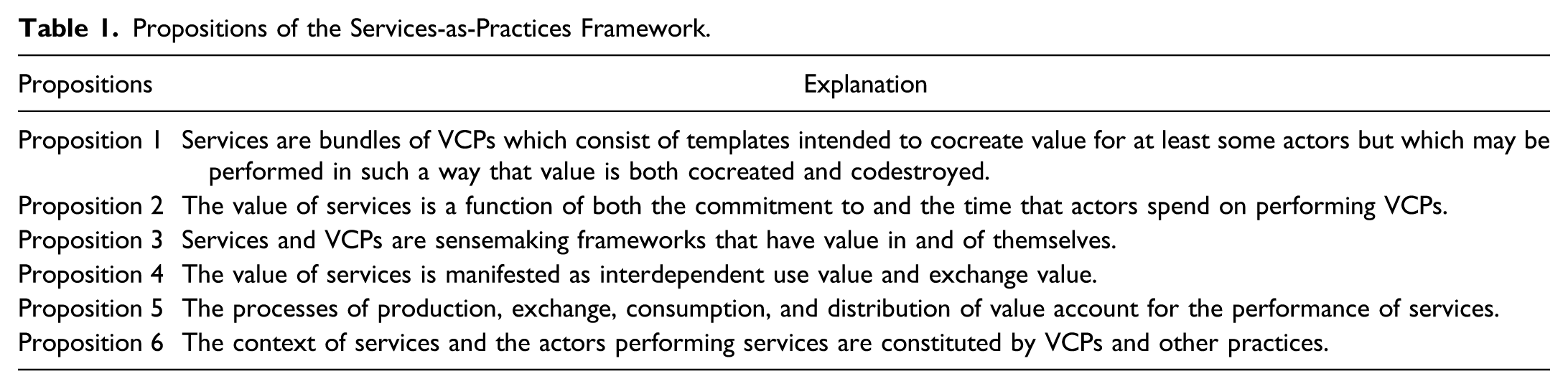
However, service researchers have also demonstrated that practices are drawn on to codestroy value when customers and other actors unintentionally enact the elements of the same practice, or several practices of the same bundle, in a misaligning fashion (Echeverri and Skålén 2021). In addition, Plé and Cáceres (2010) point out that the codestruction of value may be intended, which is the case, for example, when actors have different interests and engage in conflicts, using their power to shape collective action (Chowdhury Ilma Nur et al., 2016). Accordingly, it cannot be assumed, as Skålén and Gummerus (2023) do, that bundles of VCPs always result in the performance of value cocreating activities. However, on the basis of previous research, it can be assumed that the templates of VCPs are designed to foster value cocreation for at least some actors (McColl-Kennedy et al. 2012; Russo-Spena and Mele 2012; Schau, Muñiz, and Arnould 2009) while it will always remain an open question whether or not VCPs, when performed, will cocreate or codestroy value (Echeverri and Skålén 2021; Lumivalo, Tuunanen, and Salo 2024). Hence, the first proposition of the SaP framework being developed here is:
•
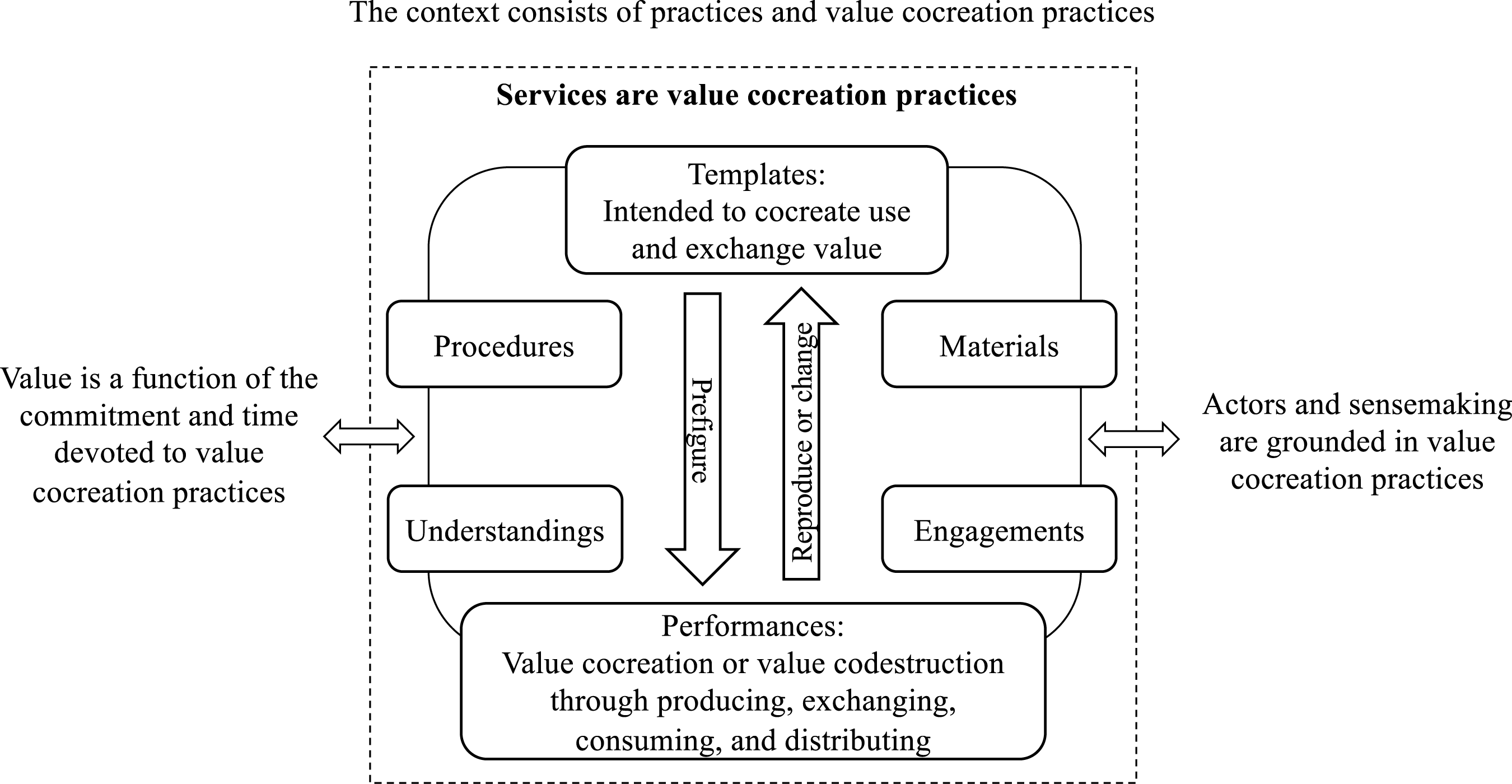
Figure 1 visualizes this notion of services. For illustrative purposes, Figure 1 shows a service in the form of five bundled VCPs. However, more VCPs can be bundled in services, or fewer. For example, restaurant services consist of several linked VCPs, such as welcoming, ordering, cooking, serving, eating, and paying, where each has a constitution and is bundled together as shown in Figure 1. Following the general understanding of practices as collectively-shared and shaped by actors (Reckwitz 2002; Schatzki 1996, 2019), this conceptualization of services suggests that templates and performances co-constitute VCPs. Commonly organized by means of elements of understandings, procedures, engagements, and materials, templates prefigure performances while performances reproduce and change templates. Furthermore, this conceptualization of services also underscores the fact that the VCPs of services are always cocreated. Templates of VCPs emerge from the cumulative result of the value cocreation and codestruction performances of actors, or from the ongoing process of social construction that continually reproduces or changes VCPs. Performances of VCPs are always cocreated by several actors, either in direct interaction and/or in relation to templates and elements of practices. Services as bundles of value cocreation practices.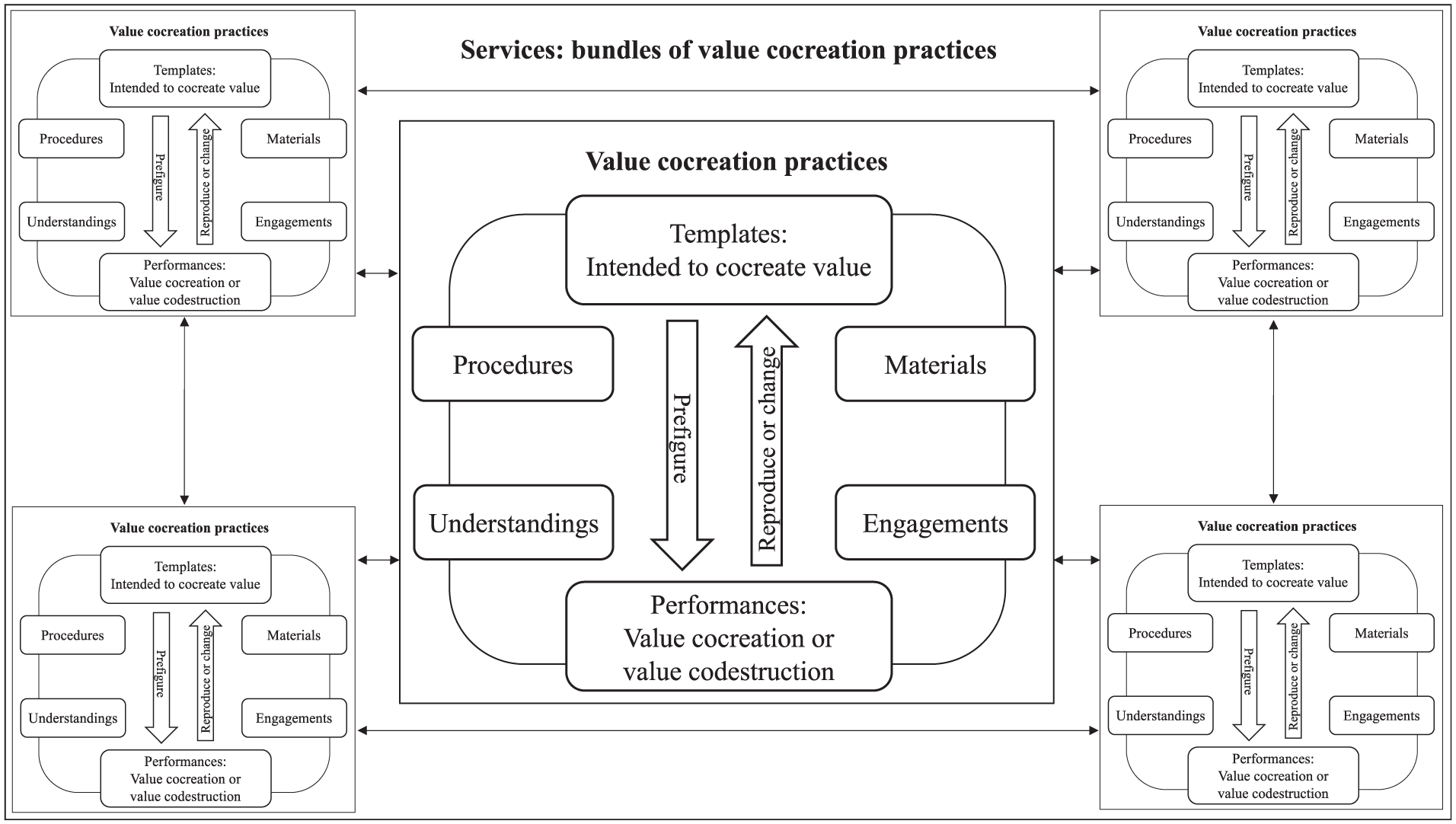
However, practice theory has little to say about the fundamental essence of value (Sayer 2013). Service research has emphasized use value as a core concept (Zeithaml et al. 2020) while service research on practices has drawn on the concept of value-in-use within the SDL (Vargo and Lusch 2016). However, service researchers do not offer an understanding of value within the context of practices. Therefore, research in the social sciences, suggesting that value can be understood in relation to everyday practices, is turned to next in order to further develop the SaP framework.
The Value of Services
The social scientists that understand value within the context of practices (Hägglund 2019; Hardt and Negri 1999, 2017; Pitts 2021) elaborate on the labor theory of value at the heart of classical economic theory (Marx [1859] 1973, [1867] 1990; Ricardo [1817] 1911; Smith [1776] 1904). The labor theory of value suggests that value is a function of ‘the socially necessary’ (Marx [1867] 1990; Pitts 2021), or the average time needed to produce goods via waged labor in factories. Contemporary social scientists have expanded the labor theory of value to include the production of services (Hardt and Negri 1999, 2017; Mazzucato 2018; Pitts 2021). They have also argued that services are not only produced in factories, but also in other spaces, for example, during direct interactions between providers and customers, in line with extant service research (Grönroos and Voima 2013).
Specifically, the contemporary elaboration of the labor theory of value suggests that value is a function of the practices that individuals are committed to spending their time on (Hägglund 2019; Hardt and Negri 1999, 2017; Pitts 2021). From this vantage point, the essence of value stems from the time actors spend engaging in practices and how committed or dedicated to these practices they are. The implications of this proposition, for developing the SaP framework, can be understood in relation to the notion that the templates and the performances of practices are co-constitutive (Schatzki 1996, 2002, 2019). The commitment to and the time that individual or collective actors spend on VCPs is manifested through their actual performances. However, it is not the commitment to and the time that individual actors spend on a specific performance of a VCP that constitute the value of services. Rather, the value of services is a function of both the total commitment to and the total time that all actors spend on performing VCPs. In other words, the value of services is a function of the collective and cumulative process of social construction implied by performing VCPs, which is also the process through which templates of VCPs emerge. Hence, the value of services is expressed through the templates of VCPs, but is ultimately a function of both the total commitment to and the total time that actors spend on performing VCPs. This is not to suggest that the value of services is always realized when preformed. Proposition 1 and prior research (Echeverri and Skålén 2011, 2021) make clear that when individual actors perform services, value can be both cocreated and codestroyed. On the basis of this discussion about the essence of value, the second proposition of the SaP framework is developed:
•
The emphasis on commitment in this proposition does not presuppose that actors always engage in VCPs solely from free choice. Due to the existence of power, actors are sometimes forced to spend time on, and commit to, VCPs that they would prefer not to (Chowdhury Ilma Nur et al. 2016; Hägglund 2019; Hardt & Negri 1999, 2017; Marx 1867). For example, employees are commonly ordered to do boring or dangerous duties to produce services in order to be able to provide for themselves.
Services Have Value in and of Themselves
The suggestion that the essence of value is a function of both the commitment to and the time spent on performing VCPs, and that this value is expressed through templates, also implies that practice theory entails that services have value in and of themselves (Sayer 2013). As has been pointed out above, practice theory stipulates that the social world is constituted by collectively-shared practices that prefigure both the everyday activities and the sensemaking of actors (Reckwitz 2002; Schatzki 2002; Shove 2022). Hence, actors can enact practices to make the world intelligible without performing these. Although practice theory suggests that actors can make sense of the world subjectively, outside of practices, practice theory maintains that actors primarily make sense of the world through the collectively-shared templates of practices, which are organized by the elements of understandings, procedures, engagements, and materials (Schatzki 2002, 2019; Shove 2022). Since practices are collectively shared and spatially dispersed, templates of practices foster intersubjective sensemaking about the world in general, and about the activities they are used to perform in particular (Schmidt 2017). This does not imply that actors spend all their time on sensemaking processes. However, when they make sense of the world, they primarily draw on templates of practices.
The notion that templates of practices inform actors’ sensemaking has several important implications for conceptualizing services as bundles of VCPs. First, the templates that VCPs consist of inform actors’ sensemaking with regard to services’ value-cocreating capacities. Put another way, when actors think about and determine the value of services, they primarily do that from the perspective of the elements that organize and constitute the templates of VCPs, and of practices more generally, which they have in common with other actors. For example, when customers, owners, and staff are valuing restaurant services, they do so based on the templates of the VCPs that constitute such services, for example, serving food. A second implication here is that the templates of VCPs grant actors a good sense of the value of services prior to performing them. Being knowledgeable about templates of VCPs, for example, through previous experience of performing VCPs, or by learning about them in a theoretical fashion (e.g., reading reviews of services), gives actors a good perception of the value of services regardless of whether the templates are being enacted to perform activities in a specific situation or not. In this way, the elements that organize templates of VCPs constitute the ‘value substance’ of services. Third, since VCPs and their templates are always shared by several actors, a focal actor will commonly have a good idea of how other actors value services. The implication here is that an intersubjectively shared understanding of the value of services exists among the members of a society or group. This is not to say that every member of a group agrees about the value of services, rather that these members can estimate it. For example, customers and restaurant staff can develop an intersubjectively shared understanding of the value of a restaurant visit by comparing it to the templates of the VCPs that constitute this service.
Hence, practice theory entails a substantive theorization of the value of services, standing in contrast to the relational theorization of value advanced by the SDL (Vargo and Lusch 2016). While relational value theories suggest that value is realized in use, either within the relationships between actors or between actors and resources, a substantive theorization stipulates that services are entities that have value (Pitts 2021). Consequently, the third proposition of the SaP framework is:
•
As actors, according to Proposition 3, have a shared notion of the value of services, they can exchange them indirectly using money, for example. Therefore, exchange value is an essential component of the SaP framework, in addition to use value or value-in-use, as emphasized in prior service research (Zeithaml et al. 2020). The next section further develops the SaP framework by focusing on use and exchange value.
The Use Value and Exchange Value of Services
According to Pitts (2021), a core notion of value theory is that value both manifests itself and is determined by actors in the form of use value and exchange value. Use value is qualitative and refers to the utility or benefit of services (and goods). Conceptualizing services as bundles of VCPs implies that the elements organizing templates of services have inherent use value, as elucidated in the earlier discussion on sensemaking. Furthermore, this use value is cocreated, which is a logical consequence of the fact that templates and performances of VCPs mutually shape each other (see Figure 1). Moreover, the idea that use value is cocreated as an integral part of performances accounts for the value created by customers and other actors in use—a concept that has been emphasized by the SDL (Vargo and Lusch 2016). However, the SaP framework recognizes that services possess inherent use value that shapes the cocreation of value in use. Therefore, use value holds a key position within the SaP framework, aligning it with the prevailing body of research on value (Pitts 2021).
Exchange value is quantitative and refers to how much a particular service is worth in relation to other products, measured in terms of money in a market economy. With the establishment of the contemporary capitalist market economy system (Mazzucato 2018), exchange value gained a prominent role (Graeber 2002) and came into focus at the expense of use value in neoclassical economic theory (Marshall [1890] 1927). This stance has been critiqued by some service researchers (Grönroos 2008; Vargo and Lusch 2008), who have emphasized use value or value-in-use over exchange value (Zeithaml et al. 2020). However, extant value theory (Mazzucato 2018; Pitts 2021) suggests that exchange and use value are mutually interdependent in capitalist market economies. To have exchange value, services need to have some kind of use value or utility, otherwise customers will not pay for them. On the other hand, if providers of services are not compensated with exchange value in the form of money paid for the use value they enable for their customers, they will not offer their services (Hägglund 2019; Marx [1859] 1973; Mazzucato 2018). Furthermore, a quantitative notion of exchange value is needed to be able to account for the accumulation of value and value added, as well as the associated notions of growth, profit, poverty, debt, economic inequality, and the distribution of value that all lie at the heart of economic theory and practice (Mazzucato 2018; Piketty 2014).
Hence, in a capitalist market economy, exchange value and use value are equally important. Indeed, the fact that these forms of value intersect, meaning that one of them may be transformed into the other even though they do not determine each other, has been key to explaining the working of capitalist market economies from the vantage point of value (Hägglund 2019; Mazzucato 2018). The classical economists (Marx [1859] 1973, [1867] 1990; Ricardo [1817] 1911; Smith [1776] 1904) suggest that value is typically added by means of capital owners paying workers’ salaries (a form of exchange value), granting capital owners the right to use workers’ labor power to make products that have use value. Capital owners convert the use value of these products back into exchange value by selling them in the marketplace, but at a higher price than they paid for the labor of their workers and other means of production. Some contemporary scholars in marketing, sociology, and economics have argued that this line of reasoning applies both to services and to actors other than waged laborers, for example, customers producing value in direct interaction with firms (Cova and Dalli 2009; Hardt and Negri 1999, 2017; Mazzucato 2018). Thus, deemphasizing the exchange value of services on the basis that it is produced within firms, as some service researchers have done (Grönroos 2008; Vargo and Lusch 2008), is not a valid argument. Furthermore, emphasizing value-in-use makes it impossible to account for the processes of production that contribute toward creating the value of services in capitalist market economies. This section provides the basis for formulating the following proposition of the SaP framework:
•
The next section discusses four general processes designating how value, use value, and exchange value are performed as a part of the VCPs of services.
Performances of Services
While VCPs consist of templates that prefigure actors’ performance of them, practice theory (Nicolini 2011; Schatzki 1996, 2002, 2019; Shove, Pantzar, and Watson 2012), service research (Echeverri and Skålén 2021; Kelleher et al. 2019; McColl-Kennedy et al. 2012; Mele and Russo-Spena 2024; Schau, Muñiz, and Arnould 2009), and value theory (Hägglund 2019; Hardt and Negri 1999, 2017) suggest that VCPs need to be performed in order for value cocreation (and codestruction) to occur. Prior research, informed by the labor theory of value (Cova and Dalli 2009; Hardt and Negri 1999, 2017; Harvey 2018; Mazzucato 2018), suggests that value is performed through four intertwined processes.
The process of production creates and destroys value, exchange and use value in particular (Hardt and Negri 1999, 2017; Harvey 2018; Mazzucato 2018). For example, health care services commonly create use value (i.e., a prolonged life), which customers are ready to pay for, entailing that such services create exchange value. However, a surgical procedure may go wrong and paralyze the patient, thus destroying both use value and the money (or exchange value) paid for the service. As has been explained above, the production of VCPs is not only a process conducted at firms by wage laborers, but also by a multitude of market actors, including customers. The exchange process concerns the realization of the exchange value of services. Put simply, exchange refers to what an actor offering services gets in return (Hardt and Negri 1999, 2017; Harvey 2018; Mazzucato 2018). In a market economy, the realization of exchange value entails monetization, which may be either positive/creative (a gain, a profit) or negative/destructive (a loss, a debt). Consumption concerns the realization of services’ use value (Harvey 2018; Mazzucato 2018). This realization may be positive when done by actors cocreating use value, and/or negative when done by actors codestroying use value (Echeverri and Skålén 2011, 2021). Production, exchange, and consumption are analytical distinctions. In services, understood as bundles of VCPs, the three processes are commonly simultaneous and intertwined. For example, customers and firms may produce and consume simultaneously.
The distribution of value concerns how the value created during production, and realized through exchange and consumption, is divided between different types of actors, for example, customers, workers, and capital owners (Hardt and Negri 1999, 2017; Harvey 2018; Marx [1867] 1990; Mazzucato 2018). Both exchange value and use value are distributed in a capitalist market economy, which is why the distribution of value needs to be understood on the basis of the intersection of these two types of value. On the one hand, exchange value determines both the extent of services and the use values an actor can consume. On the other hand, as use value refers to the utility of services, it determines which services (and associated exchange values) that matter to people, and thus the distribution of services that people prefer. The notion of the distribution of value is essential for understanding the social consequences of a capitalist market-based service economy, both in terms of wealth and poverty, as Piketty (2014) has shown. While the even distribution of value is associated with harmony, its uneven distribution may create conflicts and power struggles that may codestroy value (Lumivalo, Tuunanen, and Salo 2024; Plé and Cáceres 2010), potentially affecting the production, exchange, and consumption of value negatively.
In sum, the performance of value through services and the relationships between them, as well as the social consequences of the use and exchange value of services, may be explained by referring to the four processes of production, exchange, consumption, and distribution. This leads to the formulation of Proposition 5:
•
The focus thus far in developing the SaP framework has been on services, their value, and how this value is performed. In the next section, the focus turns to how the context of services, and the actors’ performing services, can be understood on the basis of practice theory. This is an important addition since the context and the actors of services have been core notions of service research (Edvardsson, Tronvoll, and Gruber 2011).
The Context and Actors of Services
As explained above, practice theory suggests that the social world can be understood on the basis of practices. A key proposition here is that we live in a world in which actors are surrounded by practices, meaning that practices not only provide actors with the means of performing everyday activities, and making sense of the world, they also constitute the social order in relation to which activities are being performed and which intelligibility is being articulated. As such, practice theory suggests that the actual performances and sensemaking of actors are both enabled and constrained by the very same practices that actors engage in to act and think (Nicolini 2011; Reckwitz 2002; Schatzki 1996, 2002, 2019; Shove 2022; Shove, Pantzar, and Watson 2012). While Schatzki (2019) points out that every human represents a unique life and that he or she can be uniquely creative through his or her activities and thinking, his position is that actors primarily perform and carry practices. In fact, an actor is understood as being constituted by practices or as being a “…unique crossing point of practices…,” according to Reckwitz (2002, p. 256). Hence, the context of services, for example, markets (Kjellberg and Helgesson 2007) for services, as well as the agency of the actors engaged in performing services, can be understood on the basis of VCPs and other practices. Therefore, the final and sixth proposition of the SaP framework is formulated thus:
•
Propositions of the Services-as-Practices Framework.
Discussion
In this section, the theoretical and practical implications of the SaP framework are presented. A future research agenda is also outlined.
Theoretical Implications
Following the advice on how conceptual papers can make contributions, offered by Jaakkola (2020) and MacInnis (2011), this section argues that the SaP framework makes three significant contributions to service research by: (1) developing a novel conceptualization of services that provide theoretical rigor and precision to the long-lasting notion that services are activities, which extends prior service research on practices, (2) developing a novel conceptualization of value that resonates with this practice-theory-informed understanding of services, which advances the understanding of value in service research, and (3) revising the notion that services are a type of discrete entity in such a way that a fruitful alternative perspective to focusing on service as a logic along the lines of the SDL is achieved, which contributes toward developing the service research discipline as a whole.
Contribution Toward Developing the Conceptualization of Services
Service researchers have consistently argued that services are activities (Edvardsson, Gustafsson, and Roos 2005; Lovelock and Gummesson 2004). However, the endeavor of conceptualizing services-as-activities has not been fulfilled. One key reason for this is that activities have been defined rather loosely using everyday language. A method theory (Jaakkola 2020) able to account for, and bring theoretical precision to, the concept of activities has been lacking in service research (Edvardsson, Gustafsson, and Roos 2005). This paper has addressed this issue by drawing on practice theory (Reckwitz 2002; Schatzki 1996, 2002, 2019; Shove, Pantzar, and Watson 2012) to show that activities can be understood as practices. Combining the insights of practice theory with prior service research on practices (e.g., Kelleher et al. 2019; McColl-Kennedy et al. 2012; Mele and Russo-Spena 2024; Russo-Spena and Mele 2012; Schau, Muñiz, and Arnould 2009; Skålén and Gummerus 2023) has contributed toward specifying and theoretically grounding the notion that services are activities. The following conceptualization of services, which is also the first proposition of the SaP framework (see Table 1), has been developed: Services are bundles of VCPs which consist of templates intended to cocreate value for at least some actors but which may be performed in such a way that value is both cocreated and codestroyed. Inherent to this conceptualization is that the four elements of understandings, procedures, engagements, and materials organize both the templates and performances of VCPs. The precision that practice theory concepts bring to the understanding of activities offers a richer and more nuanced understanding of services-as-activities, compared to using everyday language.
Understanding services as bundles of VCPs makes a particular contribution both to prior service research on VCPs and to research that has drawn on practice theory to conceptualize the codestruction of value. Prior research on VCPs has shown that service provision can be understood on the basis of VCPs (e.g., Kelleher et al. 2019; McColl-Kennedy et al. 2012; Mele and Russo-Spena 2024; Russo-Spena and Mele 2012; Schau, Muñiz, and Arnould 2009). However, the bulk of this research has not explicitly defined services in terms of VCPs. In fact, it is only the study by Skålén and Gummerus (2023) that has previously done so. But these scholars did not acknowledge that services, when performed by actors, can codestroy value in addition to cocreating it. However, research on value codestruction (Echeverri and Skålén 2011, 2021) has shown that practices may be enacted in such a way that value is cocreated and codestroyed. But the research on value codestruction has not offered a conceptualization of services-as-practices. Underpinned by practice theory, the present paper offers a conceptualization of services which shows that the templates of services are intended to cocreate value whereas services can be performed by actors in such a way that value is both cocreated and codestroyed. This conceptualization of services makes a contribution to research defining services as bundles of VCPs (i.e., Skålén and Gummerus 2023), by showing that services may codestroy value in addition to cocreating it. It also contributes to practice-theory-informed research on codestruction (Echeverri and Skålén 2021), by outlining a conceptualization of services that resonates with the theoretical basis of this research.
Furthermore, the SaP framework also contributes to service research on practices by developing an understanding of the context of services and the actors performing services which builds on practice theory. This contribution emerges from Proposition 6, which stipulates that the context of services and the actors performing them is constituted by VCPs and other types of practices. In contrast, the bulk of prior service research on practices (e.g., Echeverri and Skålén 2021; McColl-Kennedy et al. 2012; Russo-Spena and Mele 2012) has drawn on the SDL to conceptualize the context and actors of services using institutional theory, resource-based theory, and phenomenology (e.g., Edvardsson, Tronvoll, and Gruber 2011; Vargo and Lusch 2016). None of these theories refers primarily to practices when it comes to understanding social contexts and actors, but to social structures in the form of norms, values, and meanings (institutional theory), to rational cognitive processes in the minds of people (resource-based theory), and to people’s subjective perceptions of entities (phenomenology). Practice theory grounds our understanding of the context of services and the actors performing them in notions such as templates, performances, and elements of practices, developed to explain practices (Reckwitz 2002; Schatzki 2019). Hence, the SaP framework contribution to service research on practices with an understanding of the contexts and actors that build on its core theoretical premises.
Contribution Toward Developing the Conceptualization of Value
The previous section showed that the SaP framework contributes to service research by developing a theoretically solid conceptualization of services based on practice theory. While this conceptualization of services aligns with the extant service research claiming that services and service provision revolve around value (Grönroos and Voima 2013; Vargo and Lusch 2016; Zeithaml et al. 2020), Propositions 2, 3, and 4 of the SaP framework provide necessary and novel input by developing a conceptualization of value that is consistent with the practice-theory-informed understanding of services offered here. Developing this conceptualization of value makes a significant contribution to service research.
Prior research on VCPs (Kelleher et al. 2019; McColl-Kennedy et al. 2012; Mele and Russo-Spena 2024; Russo-Spena and Mele 2012; Schau, Muñiz, and Arnould 2009; Skålén and Gummerus 2023), as well as value codestruction within practices (Echeverri and Skålén 2011, 2021), has either implicitly or explicitly accepted the idea, within the SDL (Vargo and Lusch 2016), that resources are integrated to cocreate value-in-use. In contrast, this paper draws on research which suggests that value is realized as a part of practices (Hägglund 2019; Hardt and Negri 1999, 2017). Specifically, Proposition 2 of the SaP framework suggests that the value of services is a function both of the commitment to and the time that actors spend on performing VCPs. In addition, and based on the notion that practices are made up of templates, Proposition 3 suggests that the VCPs of services are sensemaking frameworks that have value in and of themselves, making it possible to understand both exchange and use value, as stipulated by Proposition 4. This is an important contribution to service research for several reasons. First, conceptualizing value in a way that is compatible with practice theory is a precondition for understanding services as bundles of VCPs. Second, the fact that the notion of services being developed here is based on notions of value, exchange value, and use value connects it with broader value theory, which has consistently shown that value has an exchange side and a use side (Pitts 2021). Third, emphasizing exchange value enables the quantification of value, which the focus on use value and value-in-use (Zeithaml et al. 2020), in previous service research, does not enable. The discussion linked to the development of Proposition 4 above shows that understanding the accumulation of value and value added, as well as growth, profit, poverty, debt, economic inequality, and the distribution of value, which all lie at the heart of the functioning of capitalist market economies, requires both a quantitative notion of exchange value and an account of the relationship between exchange value and use value. This paper contributes toward articulating such a conceptualization of value for service research.
Proposition 5 contributes by showing how value, exchange value, and use value are performed. In particular, it illuminates how the value of services is created and destroyed during production, how the exchange value of services is created and destroyed during exchange, how the use value of services may be cocreated or codestroyed during consumption, and the distribution of value. The production and distribution of value has been a neglected theme in service research due to the focus on the use value or value-in-use created both for and by customers and other types of users (Zeithaml et al. 2020).
Propositions 5 and 6 jointly contribute to our understanding of how services are reproduced and remain stable over time. The value-performing processes stipulated by Proposition 5, and the notion that actors are framed by the existing practices of the context when carrying out everyday activities that are key to Proposition 6, implies that services are commonly reproduced. However, it has also been noted that actors can deviate from established practices and VCPs, possibly leading to the innovation of new services (Russo-Spena and Mele 2012; Skålén and Gummerus 2023). In a similar fashion, Proposition 2 may contribute toward explaining the innovation and reproduction of services: If the time actors spend on performing VCPs and/or if actors’ commitment to VCPs is increasing/decreasing, services are likely to be reproduced/innovated.
In sum, the SaP framework makes a significant contribution to service research by developing novel conceptualizations of services and value. According to Jaakkola (2020) and MacInnis (2011), concept development grounded in theory is a key contribution emerging from conceptual articles.
Contribution to the Service Research Discipline
The third and final contribution made by the development of the SaP framework is to service research as a discipline. MacInnis (2011) explains that a common contribution made by conceptual articles is the linking of concepts together into a framework that have implications for an academic discipline. This view aligns with the problematization approach of Alvesson and Sandberg (2011) adopted by the present article, which implies generating significant theoretical contributions for a discipline against the backdrop of the identification and questioning of its core underlying assumptions. In the present paper, the conceptualizations of services and value that have been developed have been linked together in the SaP framework by the formulation of six propositions (see Table 1), which build on and mutually constitute one another. While the conceptualization of services outlined in Proposition 1 lies at the heart of the SaP framework, it is dependent on the development of the understanding of the value of services, the context of services, and the actors’ performing services accomplished by this paper for theoretical rigor and coherence, as described in the previous sections. In combination, the six propositions offer a framework for studying services-as-practices.
Outlining the SaP framework contributes toward developing the service research discipline in two ways. The first contribution concerns revising the idea that services are a type of discrete entity along the lines of the IHIP framework. MacInnis (2011) explains that revising implies “…reconfiguring or taking a novel perspective on something that has already been identified…” (p. 143), suggesting that is a key type of contribution made by conceptual articles. The theoretical background section above shows that the IHIP framework provided the initial conceptual foundation of service research (Lovelock and Gummesson 2004; Zeithaml, Parasuraman, and Berry 1985), that after a while it was found to be flawed and was then replaced by the SDL, but without offering any new and useable understanding of services (Lusch and Vargo 2014; Vargo and Lusch 2008, 2016). The implication of this development is that contemporary service research has little to offer the many researchers and practitioners that refer to services in terms of understanding these. Thus, by revising the conceptualization of services, the SaP framework makes an important contribution to the service research discipline.
The SaP framework offers a novel perspective on services as a type of discrete entity using practice theory as a method theory (Jaakkola 2020) but avoids the problems associated with the IHIP framework (e.g., Lovelock and Gummesson 2004; Vargo and Lusch 2004). For instance, the idea that services are intangible and highly variable in terms of production and consumption was found to be problematic with IHIP (Lovelock and Gummesson 2004). Defining services as bundles of VCPs avoids these problems by suggesting that one of the elements organizing VCPs is materials, meaning that services can be tangible, and also by suggesting that services are commonly produced and consumed in a similar fashion over time, as actors tend to perform VCPs in line with templates.
However, the SaP framework does not break completely with the IHIP framework. Both these conceptual frameworks suggest that services are a type of discrete entity intended to cocreate value for customers (Edvardsson, Gustafsson, and Roos 2005; Lovelock and Gummesson 2004). Indeed, understanding services as bundles of VCPs means that services can be produced and offered by organizations to their customers, which is an important objective of service organizations. But the SaP framework does not imply that it is only organizations that produce services, as the IHIP conceptualization implies. Customers and other actors also engage in and contribute toward realizing VCPs, which are collective open-ended entities. Neither does the SaP framework imply that services are just offerings or outputs, instead they are organized and recurring bundles of VCPs intended to cocreate value for a range of actors. Hence, by developing the SaP framework, the present paper contributes to the service research discipline by revising the understanding of services as a type of discrete entity in a way that addresses the problems inherent to the IHIP framework.
This first contribution made by the SaP framework to the service research discipline is a necessary stepping stone for accomplishing the second such contribution. It will be argued here that the SaP framework makes a contribution by offering an opportunity toward overcoming the current mismatch within the service research discipline that the problematization (Alvesson and Sandberg 2011) outlined in the opening of this article showcased. This mismatch concerns the approach to service as a logic of value-in-use adopted by the SDL and the approach to services as a type of discrete entity commonly adopted by service researchers and practitioners. The SDL challenged and replaced the IHIP framework, and its conceptualization of services as a type of discrete entity, as the foundation of the service research discipline at a point in time when the IHIP framework had been found to be flawed (Edvardsson, Gustafsson, and Roos 2005; Vargo and Lusch 2004). However, this paper has shown that the SaP framework addresses the problems inherent to the IHIP framework and that it is able to account for services as a type of discrete entity. In a manner similar to the SDL challenging the IHIP framework, the SaP framework offers an alternative approach for service research to focusing on service as a logic of value-in-use within the SDL. MacInnis (2011) infers that one important potential contribution made by the development of new frameworks for an academic discipline is “…challenging, disputing, or contesting a given perspective…” (p. 147).
The SaP framework makes a contribution by overcoming the current mismatch of the service research discipline, between conceptualizing service as a logic of value-in-use and approaching services as a type of discrete entity, by means of its focus on everyday practices or VCPs. This focus contrasts with the SDL and its focus on service as a logic of value-in-use. Vargo and Lusch understand a logic to be a “…generalizable mindset…” (2008, p. 3) or a “…worldview…” (2004, p. 2), acknowledging that focusing on logic implies “…viewing the world at a highly abstract level…” (2004, p. 2). The abstract nature of the SDL has been critiqued by Grönroos (2011) for not fully supporting the implementation and management of everyday business and marketing practice. To address this issue, Grönroos (2011) calls for a framework centering on everyday service provision activities and practices. The present paper has heeded this call for research by developing the SaP framework and the notion that services are bundles of VCPs.
Furthermore, the theoretical complexity of the SDL further contributes to its abstract nature. The SDL is informed by institutional theory, resource-based theory, and phenomenology (e.g., Vargo and Lusch 2016), which are all abstract and complex theories in themselves. In addition, these theories also make contradictory epistemological and ontological claims (Kleinaltenkamp, Kleinaltenkamp, and Karpen 2024). For example, institutional theory is a sociological theory which suggests that the phenomena under study should be explained with reference to the social structures that are external to actors. In contrast, resource-based theory is an economic theory which emphasizes the rational goal-fulfilling and utility-maximizing cognitive capabilities that are internal to individuals in explanations of the studied phenomena (Reckwitz 2002; Varman, Vijay, and Skålén 2022; see also the “Practice Theory” section above). The practice theory and the value theory that have informed the SaP framework are also, to a certain extent, complex and hard to grasp. In the present paper, a lot of effort has been devoted to presenting these theories as simply as possible and integrating them with service research by means of developing the SaP framework. This integration has also shown that the practice theory and the value theory informing the SaP framework are commensurable. The theoretical consistency of the SaP framework, in combination with the fact that it focuses on everyday practices or VCPs, can contribute toward decreasing the abstract nature of contemporary service research. To further investigate the potential of the SaP framework, suggestions for future service research based on it are presented next.
Future Research Agenda
Services-As-Practices Research Agenda.
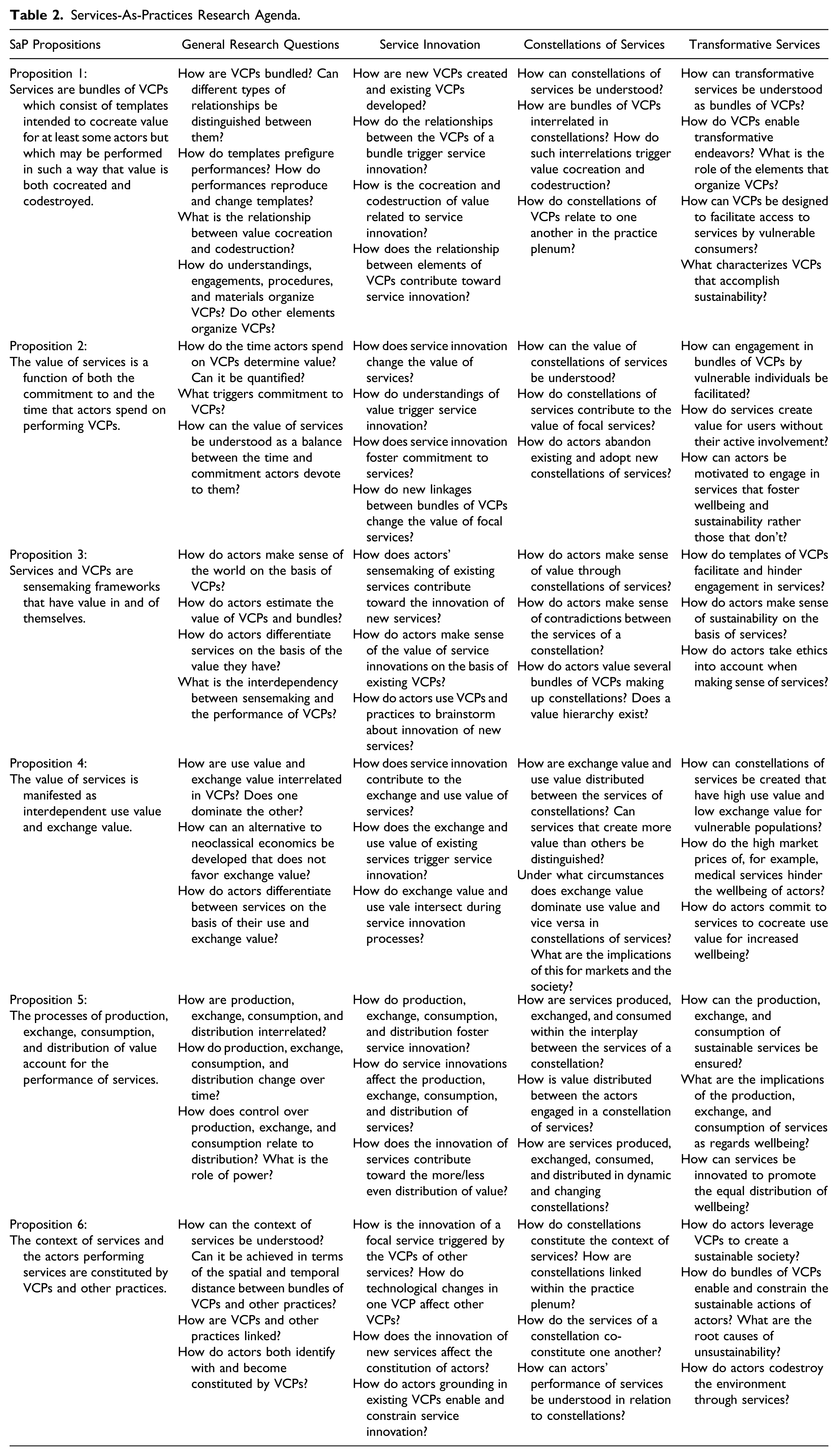
The SaP framework can also provide a basis for researching services in a range of business disciplines, for example, in management, informatics, and marketing, as well as in general economics, sociology, psychology, and anthropology. Research questions for doing so need to be developed in relation to the specific research problems relevant to these disciplines.
Managerial Implications
At several places in this paper, it has been pointed out that practitioners approach services as discrete entities but that contemporary service research offers no conceptualization of services that is able to inform and guide them. The SaP framework (see Table 1) outlined in this article has addressed this issue and offers valuable insights to managers and practitioners seeking to enhance their understanding, management, and development of services. To make the most of this framework, organizations should begin by reconsidering their services as bundles of VCPs. To do this effectively, managers can ask themselves the following questions: How are the services we offer intended to cocreate value? What elements (understandings, engagements, procedures, and materials) organize the VCPs of our services and how do they facilitate our overall business goals? What VCPs are bundled within services and how do they jointly contribute toward cocreating value for the customer and thus improve our market position? How do our VCPs, in less successful instances, codestroy value instead of cocreating it? What patterns of value cocreation and codestruction can be detected?
Once managers have a clear idea about their services as bundles of VCPs, they can analyze outcomes by asking themselves the following questions: Are our services being organized using the right elements and is the mix of elements optimal for our long-term business survival? Are VCPs being bundled into services in the optimal way in order to realize our business goals? Why do customers and other actors spend time on our services and what prevents them from doing so? Why are our customers or other actors committed, or uncommitted, to our services? What value do our services have? To what extent do our services accomplish use value and exchange value for our customers and other actors? What are the implications of mismatches between use value and exchange value from the customers perspective? How do the production, exchange, and consumption of services contribute toward the cocreation of value? Do our services contribute toward an even or uneven distribution of value, and what are the consequences for creating a sustainable society? How do our services contribute to realize other services and practices that the actors in the markets we are active in engage in? Are our services relevant to current demands for a sustainable world, for example? To illustrate the benefit of these questions, managers can analyze specific situations, such as customer complaints, from the viewpoint of which VCPs have been performed in a compelling or dissatisfactory way. By focusing on this and similar situations, a more holistic understanding of all the necessary VCPs needing to be in place for services to cocreate value is facilitated.
Once managers have figured out the reasons behind different outcomes of services, they can take appropriate actions guided by the SaP framework. Here are some actionable recommendations: • Making changes to the elements organizing services. New materials, improved employee knowledge and skill, and modified goals are all examples of changes to elements that may improve performances of services. For example, Spotify, the world-leading music streaming service, used digital technologies to change understandings of how music was distributed while developing goals aimed at maximizing the time customers listen to music, thus contributing to its strong market position. • Bundling the VCPs of services in new ways. Adding or subtracting VCPs of existing services, or bundling previously unbundled VCPs, may contribute to business success. For example, Airbnb built its business on an established VCP in the hotel industry, that is, offering people a place to spend the night, while making the VCP of renting out private residences the core to the service offered. • Making it more attractive for customers and other actors to commit to, spend time on, and consume the services offered. For example, helping customers to engage in services by posting instruction films on usage and repair on social media as Shimano, a bicycle component company, has effectively done. • Making changes to the production and exchange of services, to make sure that attractive templates are created and correctly understood. For example, it has become common to produce and exchange traditional face-to-face services, such as psychoanalytic therapy and courses for professional development, on online platforms. • Managers need to acknowledge that services are commonly carried out without reflection as they are ingrained in everyday ongoing VCPs. Therefore, it can be a good idea to hire personnel from other industries, to reflect upon, question and critique services with the goal of developing them further and gaining a better understanding of how different combinations of VCPs lead to value cocreation for customers.
Conclusion
This paper has argued that researchers and practitioners commonly refer to services as a type of discrete entity. However, under the influence of the SDL, service researchers have devoted scant attention to conceptualizing and studying services. The present paper has addressed this issue by developing the SaP framework, consisting of six propositions (see Table 1). In doing so, the paper has contributed toward service research by: (1) developing a conceptualization of services that realizes the long-lasting opportunity to conceptualize services-as-activities, (2) developing a conceptualization of value that aligns theoretically with this understanding of services, and (3) revising the notion of services as a type of discrete entity in such a way that a fruitful perspective, that can serve as an alternative to focusing on service as a logic along the lines of the SDL, is achieved, making a contribution to the service research discipline as a whole. Avenues for future research and practical implications have been suggested, which are an invitation to develop service research and practice along the lines of the SaP framework as a joint effort.
Supplemental Material
Supplemental Material - A Framework of Services-as-Practices
Supplemental Material for A Framework of Services-as-Practices by Per Skålén in Journal of Service Research
Footnotes
Acknowledgements
Bosse Edvardsson, Ingo Karpen, Johanna Gummerus, Per Echeverri, Mekhail Mustak, Elina Jaakkola, Jakob Trischler, Marit Engen, and Per Kristensson have read previous versions of this article. I like to thank them for valuable comments. Earlier versions of this article were presented at the HANKEN School of Economics (Department of marketing), Turku School of Economics (Department of marketing and international business), and at University of Naples Federico II (Department of management). I like to extend my gratitude to the comments that I received from the participants to these seminars.
Declaration of Conflicting Interests
The author(s) declared no potential conflicts of interest with respect to the research, authorship, and/or publication of this article.
Funding
The author(s) disclosed receipt of the following financial support for the research, authorship, and/or publication of this article: The research of this article was financed by the Bank of Sweden Tercentenary Foundation (Riksbankens Jubileumsfond, grant number SAB21-0057).

Supplemental Material
Supplemental material for this article is available online.
Notes
Author Biography
References
Supplementary Material
Please find the following supplemental material available below.
For Open Access articles published under a Creative Commons License, all supplemental material carries the same license as the article it is associated with.
For non-Open Access articles published, all supplemental material carries a non-exclusive license, and permission requests for re-use of supplemental material or any part of supplemental material shall be sent directly to the copyright owner as specified in the copyright notice associated with the article.
