



Abstract
COVID-19 has had a profound effect on consumer behaviour. This conceptual piece uses foraging theory, extending and developing the foraging ecology of consumption model, to examine consumer behaviour in a pandemic. It is argued that a foraging interpretation of consumer behaviour is more relevant in situations where supply is uncertain, risks are enhanced and resourcefulness is important. The paper assesses the underlying mechanisms of behaviour change-objectives, currency and constraints – from a foraging perspective and examines their role in changing both patch (retail) choices and which items are consumed (prey choices). Additionally, the paper examines temporal and social challenges within the pandemic. The paper considers whether pandemic consumption behaviours will remain as threat levels subside and concludes with suggestions for future research.
Introduction
When we began writing this paper we were amid a pandemic caused by the emergence of a novel coronavirus (SARS-CoV-2), or COVID-19. Early reports of COVID-19, began in November 2019, however, it was not until March 2020 that the World Health Organization (WHO) declared a pandemic. Today we are dealing with the aftermath of COVID-19, a crisis with significant ongoing consequences. With pandemics expected to become more frequent (Gibbs et al., 2020), it is vital that the consumer behaviours that emerged are more deeply understood especially as it appears that ‘covid shopping’ behaviours will outlast the pandemic (Pearson, 2020). This paper draws on foraging theory to explore and reflect upon pandemic consumption.
While a significant amount of research has examined how we respond to natural disasters, the three parameters of reach, duration and degree of ambiguity due to the epidemiology of the virus have uniquely defined COVID-19 (Chenarides et al., 2021). Globally governments responded through a variety of measures broadly classified into containment and closure (school/workplace closures, stay at home requirements, restrictions on movement and gatherings), economic (income support), health systems (information campaigns, testing and contact tracing) and vaccine policies (prioritisation, eligibility) (Hale et al., 2021). The UK experienced three ‘lockdowns’ of varying lengths and severity and these policies and their volatility continue to impact directly on both retailers and consumers.
Retailers responded to rules on social distancing and mask wearing by restricting consumer numbers in store and introducing queuing systems as servicescape innovations (Pilawa et al., 2022). Supply shortages led to price rises for both everyday products and essential products, with some (e.g. flour) costing up to 5 times higher than normal (Li et al., 2021). Additionally, staff shortages throughout supply chains caused some retailers to open for restricted hours or only offer reduced breadth and depth of brands and products compared to the pre-pandemic food retailing norms of the Global North traditionally based on diversity, abundance and certainty of choice (Dickins and Schalz, 2020).
Consumption and economic challenges were exacerbated as many citizens lost jobs, or were furloughed, causing families financial hardship (Yazdanparast and Alhenawi, 2022). Pandemic shopping also saw consumers forced to accept limited, often less convenient choices and more challenging or less valuable options (Knowles et al., 2020), an experience, from a socio-economic perspective, considered less beneficial and detrimental to wellbeing for consumers (Szmigin and Carrigan, 2004).
Consumer responses to non-pandemic and pandemic shocks
Consumers have never previously experienced a pandemic systemic shock (Boyle et al., 2022), although researchers have previously examined consumer responses to non-pandemic shocks such as drought or earthquakes. Here individuals report insecurity and loss of control (Phipps and Ozanne, 2017) and households jolted into sudden change (Gibson et al., 2015). Gibson et al. (2015) found that while people may be unable to control catastrophic forces, they discovered agency in re-evaluating the significance of consumption and possessions in everyday life. They were less disturbed about the prospect of doing without and adapted while reasserting order in their daily lives (Phipps and Ozanne, 2017). Accumulative practices comparable to hoarding were viewed as necessary stewardship of important material possessions, a way of compensating for a perceived loss of control (Yap, 2020) and whose value could be redistributed among the community, potentially engendering social bonds between neighbours; survival resources ultimately become social. To what extent similar behavioural responses featured in the pandemic is only now being analysed (e.g Boyle et al., 2022).
The pandemic combined with government and retailer actions, separately and in tandem, have affected consumer behaviour (Mason et al., 2020; Loxton et al., 2020) radically altering the environmental conditions in which we consume. Consumers reconfigured behaviour due to the perceived threat to their health and life via potential infection (Dickins and Schalz, 2020), reappraising formally safe, mundane activities and places (Loxton et al., 2020). Government and retailer changes and restrictions led to the threat of perceived food insecurity (uncertainty of finding food) (Dickins and Schalz, 2020) which was magnified and exacerbated by social media, leading to panic buying, bulk purchasing and in turn product shortages putting further pressure on already overstretched supply chains. Notable examples included pasta, cleaning products, tinned food and masks (Loxton et al., 2020); hand sanitiser gel recommended by WHO as a preventative measure (WHO, 2020) resulted in Kantar (2020) reporting a 255% sales spike. When products are perceived as scarce their value increases (Pantano et al., 2020) such that the pandemic triggered everyday store theft of in-demand products such as toilet roll (Newey, 2020).
Later in the pandemic, as stock shortages eased, and supply chains adapted, the perceptions of scarcity and potential scarcity remained (Dickins and Schalz, 2020) driving further over-consumption that meant persistent shortages despite media coverage that supermarket supplies were adequate and unaffected.
Overall, the pandemic forced a trade-off between lives and livelihoods (Das et al., 2021), representing a phenomenal challenge for consumers (Li et al., 2021) who, when faced with a threat, have adapted their behaviour (Park et al., 2021a) learning to shop differently in terms of what, when and where they buy (Gordon-Wilson, 2021; Janssen et al., 2021). Furthermore, Kirk and Rifkin (2020) highlight three phases of consumer response to the pandemic: reacting (hoarding and rejecting), coping (e.g. maintaining social connectedness, do-it-yourself behaviours, reframing brand attitudes) and longer term, adapting (e.g. potentially transformative changes in consumption and individual and social identity). Today, much early research attention has turned to pandemic consumer behaviours, yet we still know very little about how consumer behaviours have changed and adapted. This paper reflects upon these behaviours from the perspective of foraging, contributing an original theoretical framing.
A potential foraging approach?
Foraging encompasses the strategic feeding and consumption behaviour of animals (Stephens and Krebs, 1986) including behaviours such as search, identification, procurement, handling, utilisation and digestion (Mellgren and Brown, 1987). Foraging theory provides simple models which allow prediction of behaviour in the form of adaptive responses to different or changing environmental conditions in a habitat (Ydenberg et al., 2007). Foraging considers the organisms physiological state providing an understanding of how they reach appropriate decisions for changing circumstances (Winterhalder, 1981). Human foraging experiences are assumed to be integrated by cultural means and passed from generation to generation (Winterhalder, 1981). The link between animal behaviour and human shopping was first noted by Tullock (1971) in a paper titled ‘The coal tit as a careful shopper’. Hantula (2012: 549) notes that ‘just as we once foraged in forests and savannas we now forage in grocery stores and websites’.
In 2012, Wells proposed a foraging model of consumer behaviour building on the Behavioural Ecology of Consumption (BEC) (Rajala and Hantula, 2000; DiClemente and Hantula, 2003a, 2003b) which sought to develop a foraging ecology model of consumer behaviour, focussing on the environment to determine how and why decisions are made, utilising numerous aspects of established foraging theories (Hantula, 2012). In Wells’ (2012) exploration of foraging theory and its applications to consumer behaviour, she noted that, unlike when animals forage, ‘for many consumers in westernized societies, shopping is far from a life or death situation’ (p. 130). While reasonable to suggest in 2012, pandemic choice decisions appear more similar to the decisions animals make in the wild (Stokstad, 2020), where limited choices and the relative availability and acceptability of different options have to be negotiated, and a balance between risk and reward has to be found. Consuming in the pandemic has proven riskier and more uncertain than the pre-pandemic experience, with resourcefulness being more important (Dickins and Schalz, 2020), aligned to the changing environments in which animals forage. Solomon (2020) talks of ‘foraging for supplies’ during the pandemic, and Phipps and Ozanne (2017) note that previous shocks focused household shopping on resources for survival, further highlighting the relevance of foraging theory. This leads to our research question: What can foraging theory tell us about consumers pandemic shopping behaviours, their underlying mechanisms and changes over time?
In responding to this question, this paper makes the following contributions. Firstly, the paper contributes to marketing theory by determining whether the systemic pandemic shock is similar to previous shocks. To do so, we directly compare elements of foraging models to information we have about consumer reactions to the pandemic and use the pandemic as a vehicle to further expand and develop the consumer foraging ecology model proposed by Wells (2012) and to qualitatively test some model diameters. Consumer behaviour patterns show similar patterns to foraging behaviour exhibited by non-human animals (Kim and Hantula, 2016), yet a foraging perspective remains relatively unexplored in marketing. A foraging interpretation provides a set of theories and concepts with applicability across the full range of consumer behaviours, highlighting interactions between where we shop, what we purchase, with whom and at what time, rather than focussing on one element such as social media (Naeem and Ozuem, 2021), panic buying (Loxton et al., 2020; Chen et al., 2022), advertising messages (Park et al., 2021b) or online shopping (Truong and Truong, 2022).
Additionally, we attempt to identify the mechanisms underlying changes to consumer behaviour, noted as an important step by Janssen et al. (2021). This allows us to understand how behaviour has changed and continues to change through various pandemic stages. One way we do this, and a particular contribution of the study is to extend and develop Wells (2012) proposals about foraging currency. By highlighting the developing debates around foraging currencies, in particular examining single and multiple currency approaches, we develop this element significantly and suggest ways in which this might explain consumer behaviours, but also how they could be empirically studied in future to further test the predictions of behaviour highlighted here.
By taking a foraging approach, which focuses on logical explanations for behaviour (Hantula, 2012), based on environmental cues, constraints and changes, we also respond to literature that describes pandemic consumers behaviour as irrational and disordered (Chendarides et al., 2021; Li et al., 2021). The paper adds to the increasing body of work attempting to understand and predict pandemic consumer behaviour (and marketing which compared to economic and health consequences are less well understood (Das et al., 2021)) triggered by COVID-19. This will provide avenues for future research and allow anticipation of consumer responses in future pandemics (Loxton et al., 2020) which seem inevitable; as Jones et al. (2020) note, presumptive planning for future pandemics is socially responsible. Our approach is similar to Kirk and Rifkin (2020) in that our intention is exploratory but with an eye towards insights based on theory (here specifically foraging theory) and we inevitably trade off breadth and depth focussing more on the breadth of foraging elements rather than their depth.
The paper is organised as follows. Firstly, the paper outlines further details about foraging, its use within studies of consumer behaviour and its key characteristics. We then apply relevant aspects to pandemic consumer behaviour and close by questioning whether COVID-19 consumer behaviours will stay with us for the long term, suggestions for future research and implications for practitioners.
What is foraging theory?
Foraging theory provides an umbrella term for a range of theories and models designed to generate testable hypotheses, assist understanding (Winterhalder, 1981) and make explicit simplifications of complex decisions (Kaplan and Hill, 1992). These models examine different aspects of the foraging process (search, identification, procurement, handling, utilisation and digestion) and combine approaches from evolution and ecology (Krebs and Davies, 1997), while making connections with behavioural economics, animal learning, game theory and conservation biology (Krebs and Kacelnik, 2007). There is no grand unified foraging theory (Newman, 2007) and the foraging concept, focussing on strategic behaviour, incorporates a variety of theoretical propositions and empirical models (Hantula, 2012). While predominately focused on understanding animal behaviours in their natural environment foraging theories have also been used to study animal behaviours in the laboratory (Williams and Fantino, 1994), insects (Raudenheimer and Simpson, 2018) ancient and modern hunter-gatherer populations (Hawkes et al., 1997; Lemke, 2018) and other aspects of human behaviour such as comparing the behaviour of serial killers to bees (Raine et al., 2009).
Foraging model components
Foraging models share three key components (Kaplan and Hill, 1992; Stephens et al., 2007): (1) decisions/objective goals of the forager, (2) currency the forager uses to make their decisions and meet their objectives and (3) constraints which may affect the foragers ability to meet their objectives. Each of these may differ by species/animal (Newman, 2007).
For both non-human and human animals there are often multiple objectives and therefore decisions to make. The objective decision for human consumer foragers is choosing between products, brands and shops. This has analogies to animal foragers. Newman (2007) notes for sheep grazing and choosing grass/clover they may have a range of objectives such as to ‘graze with conspecifics, avoid areas of previous defecation to guard against parasite infection; eat a 65% clover, 35% grass diet; take a bite of 53 mg clover and 30 mg grass at a rate of 83 bites per minute from each, with 17 chews per gram of clover and 27 chews per gram of grass; and of 660 available minutes, spend 334 grazing clover, 166 grazing grass and 160 not grazing at all’ (pp 208). In COVID-19, the objectives/decisions for human consumer foragers were the same as pre-COVID but, as this paper discusses, the currency priorities and constraints altered, changing how they met these objectives and the decisions they made. It is important to understand what might happen if not all objectives can be met at once, if some objectives are defended more vigorously than others or if some take priority in certain circumstances (Newman, 2007), such as during COVID-19. We can understand these choices by first understanding the currency that the forager is using.
Foraging models assume that individuals maximise or seek for some minimum level (satisfice) of a particular currency (Kaplan and Hill, 1992). In classic foraging, theory currency is generally food energy acquired per unit of foraging time but some models have also examined protein, survivorship and fertility as currencies depending on species (Kaplan and Hill, 1992; Winterhalder, 1981). By determining a currency, a cost-benefit analysis can take place where foragers weigh the benefits (energy) of foraging versus the costs (time). There are also handling costs (for example, if an animal is killed it will need to be butchered and cooked) as well as opportunity costs (for example, not hunting other animals, clearing gardens or caring for children) (Kaplan and Hill, 1992). The currency must be identified to allow effective modelling of behaviour (Winterhalder, 1981). Kim and Hantula (2016) note that currency can be applied to human processing behaviour through the idea of the investment of time and energy to forage some form of value. We return to currency after discussing constraints.
Finally, any foraging model must examine constraints on the choices available to the forager, conceptualised as interactions between the forager and its environment (Hantula, 2012), such as restrictions in times patches can be accessed, a reduced set of prey caused by some form of environmental change (Kelly, 1995; Stephens et al., 2007), or processing capabilities (Kim and Hantula, 2016). As Winterhalder (1981) notes, human behavioural flexibility means there are many activities that also compete with foraging for time and energy including the desire for leisure and social interactions; these may lead to cultural constraints not relevant in non-human populations. Constraints increased considerably in the pandemic as government pandemic responses impacted the mobility of consumers (Das et al., 2021). Additionally, choice variables/options that were available pre-pandemic changed significantly during the pandemic due to supply chain disruption (Das et al., 2021). Overall, one constraint that has a become a key feature in COVID is risk/safety. 1 The pandemic led to enhanced levels of risk, and scarcity (whether real or perceived) leading to high levels of uncertainty, reduced information and loss of control (Das et al., 2021; Li et al., 2021) constraining consumer decisions (due to fewer and different quality of options to choose from). Mason et al. (2020) highlight how safety became a central focus for consumers during COVID and affected the decisions consumers made, buying food with a longer shelf life so that trips to retailers could be minimised, which also resulted in less fresh food being purchased (Janssen et al., 2021).
Foraging currency
The choice of a currency is a key feature within foraging models and is highly debated within the behavioural ecology literature. As noted above, the most comment currency used is food energy acquired per unit foraging time (Kaplan and Hill, 1992). If energy was used as a currency for foraging human consumers, most global north consumers, except potentially those in poverty, meet, and in many cases would exceed, their daily energy requirements. Energy, as Winterhalder (1981) notes, has analytic convenience and is amenable to clear operational study and quantification. He suggests that any currency used in human foraging should have the same characteristics. Hence, we propose that purchase satisfaction would provide a potential single overarching currency in human consumers, but this would require future research to allow quantification and to test its applicability. Consumer satisfaction is defined as ‘the consumer’s response to the evaluation of the perceived discrepancy between prior experiences and the actual performance of a products as perceived after its consumption’ (Tse and Wilton, 1988: 204) and contains affective, evaluation and time specific components (Giese and Cote, 2000). It is clear that consumers wish to be satisfied with their purchases (rather than dissatisfied) and therefore seek to maximise satisfaction. This would not have changed in lockdown/the pandemic but due to constraints and changing environmental decisions gaining maximum purchase satisfaction would have been harder. Consumers instead would have been willing to satisfice this currency, rather than maximise it. Kaplan and Hill (1992) note that the foraging utility generally derived from consumption of resources can be defined by level of satisfaction which further highlights satisfaction as a potential single human currency.
However, as Kaplan and Hill (1992) note humans may be likely to violate the assumptions of existing foraging models, especially in terms of currency, and especially if energy is used as a sole currency. While single currency models may suit non-humans, multiple currency models may be more realistic for humans (Kaplan and Hill, 1992; Pyke et al., 1977). Despite being proposed since the 1980s, this has yet to receive substantial theoretical or empirical focus. This approach draws on economic theory that suggests preferences are based not on single attributes but jointly on several attributes (Newman, 2007). Indeed, satisfaction noted above as a potential single currency is in itself a concept made up of a range of attributes. Studies of hunter gatherer populations suggest they consider calorie maximisation, alongside protein and lipid consumption (Kaplan and Hill, 1992) and that overall nutritional composition is more important than energy (Keegan, 1986). In animal foraging studies, there has also been growing support to not only consider single nutrients, rather than energy, as the determining forces behind forage selection but to look at the satisficing of multiple nutrients (Pyke et al., 1977; Pretorius et al., 2012). For example, in a study by Pretorius et al. (2012), the researchers showed that elephants satisfied requirements of some nutrients whilst maximising intake of others, in relation to the availability of resources (a constraint) and based on the seasonal availability of different plants prioritising different currencies in different seasons (dry/wet seasons). Kaplan and Hill (1992) also highlight that the indigenous Aché people in Paraguay biased meat and insect consumption over energy maximisation showing nutrient sensitive foraging.
Given these modifications, what might be the multiple currencies which consumers seek to maximise or satisfice in their consumer behaviour? Might foraging consumers have prioritised different currencies during COVID or looked for a different mix of currencies? Consumers aim to seek and maximise value and therefore currencies, inspired by studies of consumer behaviour, might include utility (Molina, 1996), pleasure/hedonism (Holmqvist and Lunardo, 2015), short wait time (Antonides et al., 2002), value for money (Sweeney and Soutar, 2001), quality (Agyekum et al., 2015) and status (O’Cass and McEwen, 2006) among others.
We propose that during the pandemic when consumers could no longer maximise some/all of these due to changing constraints, they instead sought to satisfice them. For example, due to supply chains issues and stock outages consumers found they could not buy their first, second or even third choice of product or brand which would maximise the level of quality for them. Instead consumers would have satisficed, taking the level of quality they could receive but finding themselves buying a brand never previously considered. Knowles et al. (2020) reported how consumers focused on function (category availability above brand preference) and more than half of respondents bought a brand that was new to them because their favourite brand was out of stock.
Consumers prior to the pandemic would have expected short wait times, expended little effort for most products and been able to maximise this (Antonides et al., 2002). Again, due to supply and mobility disruptions during the pandemic consumers would only have been able to satisfice this and instead faced longer waits and more effort in purchasing (e.g. visiting multiple stores searching for a single product) (Pantano et al., 2020). Knowles et al. (2020) highlight that consumers were willing to try direct to consumer offerings or shop online to get the products and brands they wanted. Additionally, while consumers might have normally tried to maximise a particular element through, for example, publicly consumed goods (e.g. status as a currency) (O’Cass and McEwen, 2006), they may have been happy to satisfice or disregarded this in COVID. As Mason et al. (2020) note, demand for publicly consumed goods like gym memberships, public transport and formal workwear reduced during COVID either because of unavailability or because it was no longer a priority or necessity. Knowles et al. (2020) also reported a loss of interest in status driven products and conspicuous consumption. There are also certain individual differences with currency. Value for money would have been a currency that consumers who were affected by furlough, early retirement or job losses sought to maximise focussing on essential items rather than luxury items (Das et al., 2021; Gordon-Wilson, 2021).
These currency shifts are continuing as we move out of the pandemic. Consumers are engaging in revenge buying, the act of overly prioritising hedonic and luxury purchases, as a balance to the deprivation they experienced through the pandemic (Aquino and Novaes, 2022), effectively maximising the pleasure and hedonism currency of purchases. However, it is not clear how extensive this will be with Moldes et al. (2022) noting that materialism has declined during the pandemic with a potential negative knock on effect to some luxury and conspicuous consumption.
Ydenburg et al. (2007) note that where there are multiple currencies there needs to be explanations sought for trade-offs between these which may be especially difficult for currencies with different conceptual status (Winterhalder, 1981) and for any two desirable traits an infinite number of combinations of the two could yield equal value (Kaplan and Hill, 1992; Newman, 2007). For example, Pretorius et al. (2012) note that elephants maximisation/satisficing of nutrients altered depending on the season and that they traded-off between plant quality and quantity. How might a consumer forager balance between quality, value for money and wait time?
While currency selection is a key component in determining foraging models Kaplan and Hill (1992) note that the initial selection of currency (and indeed constraints) may be incorrect and this failure to model behaviour effectively will lead to the search for more appropriate currencies. Pyke et al. (1977) state ‘in general, there is no recipe for determining just what the currency and constraints should be in a particular situation, and it will always be the job of the naturalist to understand the biology of an animal [here the behaviour of a consumers] sufficiently well to know which currency is being optimized’ (pp. 138). Winterhalder (1981) additionally notes that incorrect predictions and currency decisions can prove informative and assist in disentangling the multiple interacting factors affecting human behaviour. As such, we acknowledge that while this paper makes a number of proposals they require empirical testing.
Patch and prey models
The three foraging model components – Objectives, Currency and Constraints – are underlying mechanisms which influence a range of prey and patch models. Hantula (2012) notes that ‘consumer items are prey, stores are patches’ (pp. 563). Prey is the discrete entity which is the focus of the forager – what they want to obtain to meet their objectives. For both animals and humans, prey can be a single plant, insect or animal depending on their diet. Both Wells (2012) and Hantula et al. (2008) suggest that the closest analogy to prey is the product or brand that the consumer purchases and consumes. The prey chosen is expected to satisfice or maximise the currency or currencies and meet the objective(s) of the forager consumer.
The term patch denotes ‘any bounded spatial or temporal co-location of prey items’ (Hantula, 2010: p. 87). That is, where resources are clumped together (Kaplan and Hill, 1992). Therefore, a shop or groups of stores (for example, a shopping mall) is analogous to a patch for human consumer foragers. These three components are used to answer the four core questions which foraging models ask (Winterhalder, 1981): 1. which items the forager will consume (what prey will foragers select-prey choice – a within patch choice); 2. where in space the forager will seek food resources (patch choice – a between patch choice). Foragers face the decision of whether to enter a patch or to search for other patches in the habitat (Kaplan and Hill, 1992); 3. times when foraging will occur; 4. the circumstances in which foragers will form groups.
Prey and patch choice (questions 1 and 2) will also interact as not all prey will be available in all patches and some patches may have more variety or density of prey compared to others. Additionally, some patches may be far away, some closer, and the forager will continually be making decisions balancing which patch or patches to visit and the prey available there. The following section will examine each of these questions in turn.
Foraging theory application and discussion
Which items will a forager consume?
Prey choice
Foraging studies show that while foragers may choose a similar range of prey (their diet) for a long time (Newman, 2007) they do change their diet dramatically when environmental conditions, such as changes in prey (for example, plants, animals) happen. O’Connell and Hawkes (1981) highlight that only when there was an onset of arid conditions in Australia did human foragers begin to forage for and use seeds. Prior to the pandemic a wide variety of prey (product/brand) choice existed, with multiple brands/products plentiful in a range of shops (Kirk and Rifkin, 2020). During the pandemic, and more accentuated during the early stages, prey choice markedly reduced sometimes due to excessive consumption through bulk buying and hoarding, or because supermarkets reduced variety to manage supply and demand issues as noted above (Li et al., 2021). It is clear that like animals COVID consumers reacted significantly to the changing environment.
Choice of prey depends on the abundance of that prey type and the abundance of higher-ranked or more profitable/valuable types of prey (Davies et al., 2011; Pulliam 1974). For example, as abundance of more profitable items decreases (as consumers could not find/buy their preferred brand) less profitable prey would be added to the diet (Kaplan and Hill, 1992). Rindfleisch et al. (2009) note that materialistic consumers respond to insecurity by forming strong brand connections but Knowles et al. (2020) report that many consumers bought unfamiliar brands because their favourite brand was out of stock during the pandemic. Such changes in choice align with Lea (1982) who notes that as there is a decrease in all food densities less favourable prey will progressively become more acceptable.
Additionally, Winterhalder (1981) notes that foragers will become less discriminating in a poor environment (compared to being selective in a rich environment). For example, the consumer that usually buys perfect fruit accepts blemished fruit. Supply restrictions were commonplace within the pandemic (Li et al., 2021), and consumers sought solutions, that is, buying a new or unfamiliar brand, when their favourite brands/products were not available in line with their currency prioritisation (Knowles et al., 2020).
Prey and constraints
As noted, foraging models include constraint assumptions. These consider what might limit the animals’ feasible choices and what limits the pay-off (currency) that may be obtained (Stephens and Krebs, 1986). Time available may have become less of a constraint during lockdown (e.g. less commuting), while other constraints increased (e.g. income for those on furlough). Many supermarkets implemented online queuing systems, restricted numbers in store, one-way systems and rationing for certain high currency products meaning that the feasible options were limited even once lockdowns ended (Jones, 2020; Jordan, 2020). Those who lost jobs or earned less due to restricted hours or furlough experienced constraints through tighter budgets changing their prey choices and for some, making it hard to feed their families (Wheeler, 2020). Additionally, Ross et al. (2020) state that when consumers are undergoing budget constraints they revisit and rediscover their brand choices, identifying what matters most to them, with Hamilton et al. (2018) noting that consumers facing budget constraints are resilient and develop adaptive strategies to cope.
Handling prey
Aspects of shopping – trying on clothes, handling fruit to test for firmness or holidaying abroad were altered completely or discouraged during lockdowns. Handling is a key part of foraging and ‘denotes time and energy devoted to a prey item after it has already been acquired or captured and before any energy can be derived from it’ (Hantula, et al., 2008: 147). Kaplan and Hill (1992) using the example of Aché men who only pursued Armadillos below ground during seasons that assured this extra effort would be rewarded, show that extra handling is taken on board when necessary, and in response to changing environmental conditions. Pre-pandemic consumers might have preferred prepared food (from ready meals to pre-chopped salad) but the boredom and extra time available led many consumers to choose home cooking (Mintel, 2020a). Gibson et al. (2015) and Phipps and Ozanne (2017) note that these types of frugal practices can be revived when times are uncertain or in response to disasters. Overall, this meant an increase in handling time in terms of baking, cooking, with more time available for meal prep due to lockdowns (Janssen et al., 2021) and altered the types of products sought; a notable example was a surge in demand for products such as yeast and flour (Public Health England, 2020; Woolfson, 2020).
Handling is potentially also seen as riskier during the pandemic, with some consumers (those who perceived the biggest risk (Janssen et al., 2021)) uncomfortable handling products without packaging that can be cleaned or worried that clothes not tried on may need to be returned forcing them back into a dangerous shopping environment. Some consumers even chose to quarantine their shopping adding further handling to their purchases, a behaviour driven by the risk of infection (Downey, 2020), and many consumers purchased packaged food perceiving this as more hygienic (Janssen et al., 2021). Additionally, handling features added discomfort caused by queuing, mask wearing and sensory deprivation as trying on, touching and testing became discouraged or prohibited (BBC, 2020). One outcome was that UK supermarket sales slowed after face coverings were mandated (Partridge, 2020).
Prey recognition
Hughes (1979) notes that in foraging models a predator is assumed to be able to recognise prey types perfectly and instantaneously. With consumers forced to try unfamiliar brands and products (Knowles et al., 2020; Gordon-Wilson, 2021) such perfect recognition was unlikely during the pandemic resulting in partial preferences, rather than optimality of choice. As Dickins and Schalz (2020) suggest, optimal learning in a changeable environment is perhaps impossible. Shettleworth (1988) argues that partial preferences may be the norm. During lockdowns consumers bought what they could, rather than what they wanted (Loxton et al., 2020; Chenarides et al., 2021), although would still have sought to align these purchases with their currency priorities (at least satisficing where possible).
Prey, bulk buying and hoarding
Foraging models also suggest that choice is all or nothing; a prey type should either always or never be attacked when encountered. Wells (2012) noted that this was unlikely in 2012, however, COVID-19 meant this became increasingly possible for a number of products considered as fundamental, either to health (hand sanitizer and toilet rolls) or as part of changing behaviour in reaction to the lockdown (flour and yeast); consumers would buy regardless of brand and whenever encountered (Loxton et al., 2020; Chenarides et al., 2021).
Roux et al. (2015) and Gupta and Gentry (2019) highlight how resource scarcity results in a competitive orientation, where people react quickly and demonstrate more selfish and urgent behaviour and where empty shelves make the threat of scarcity more visible (Kirk and Rifkin, 2020).This ‘led consumers to skew their traditional patterns of spending towards purchases which might otherwise be undertaken at different times, at different volumes and perhaps not made at all’ (Loxton et al., 2020: 3) resulting in bulk buying and hoarding (Ahmadi et al., 2022).
Dickins and Schultz (2020) note that panic buying and hoarding in lockdown was a buffer against future uncertainty and risk; a common strategy for animals to take back control of the situation (Yap, 2020; Keane and Neal, 2021) and a self-protective activity (Loxton et al., 2020). Additionally, foragers store prey when there is variability in the supply of prey (Kaplan and Hill, 1992). Certainly, as Wells (2012) notes, in times of abundance pre-pandemic, consumers tended not to buy a product just because they saw it, even if it was a favoured product. Previously, the existence of a recent purchase or having some stored at home would have prevented consumers from purchasing more.
During the pandemic, consumer behaviour was aligned more closely to foraging animals, which was a feature of the pandemic. Bulk buying was a measured approach as consumers hoarded non-perishable items, which were relatively inexpensive and easy to inventory (Public Health England, 2020). Consequently, sales of staples rose significantly during this period (Boyle et al., 2022; Das et al., 2021; Janssen et al., 2021; Southey, 2020); a measured approach resonant with survival skills (Gibson et al., 2015). Boyle et al. (2022) also note an increase in fruit and vegetable shopping during this time which they ascribe to an increased interest in health and wellbeing, triggered by the pandemic and a wish to boost the immune system, and the pandemic as a moment to prioritise exercise and diet (Guèvremont et al., 2022). Additionally, Boyle et al. (2022) show that consumers purchased a larger basket size and value while visiting stores less often during the pandemic which they suggest may indicate a move from impulse or top up shops to main weekly shops. Arguably this behaviour is a coping mechanism to deal with loss of control and a way to reduce anxiety (Sim et al., 2020).
Prey scarcity and information
Kim and Hantula (2016) note that according to foraging theory scarcity of a prey item would be expected to motivate search for information about substitutes and substitutes themselves. Kim (2020) showed that consumers reacted to the perceived threat of COVID-19 by variety seeking and as many products/brands were unavailable or less abundant, consumers altered their consumption to buy brands normally shunned, or unfamiliar (Knowles et al., 2020) sampling a wider variety of products and brands (Loxton et al., 2020). Additionally, scarcity of a consumer’s normal brands prompted them to switch to a new brand, sampling another, potentially eroding brand loyalty (Das et al., 2021); three quarters of respondents were simply buying the food they could get due to out of stock conditions (Chenarides et al., 2021; Knowles et al., 2020).
As well as prey being related to brands or products, research shows that foragers will seek information (Pirolli, 2005) and seek to deal with incomplete information (Stephens, 2007). Wells (2012) noted that ‘informavores’ would extensively search pre-purchase for items. Stephens (2007) notes that foraging animals obtain information as they go about the process of feeding but when a forager faces incomplete information they try to reduce this uncertainty, although typically this has some cost in terms of currency and/or time. Human foragers have been observed reducing variability in their prey supply in several ways including information and food sharing (Kaplan and Hill, 1992) during the pandemic. With visits to shops restricted and information consequently incomplete, consumers actively engaged in social media forums (a primary medium during COVID – Das et al. (2021)) or hastily constructed community and street WhatsApp groups, highlighting extra purchases that could be shared or reporting local availability of products, trying to gain a complete information picture of resources. This reflects the increased sense of collective resilience which Guèvremont et al. (2022) highlight. Social media shortened the distance between people and usage increased due to people’s isolation and working from home, becoming a critical way to connect during COVID (Kaigo, 2012; Naeem, 2021). We discuss this further when examining social foraging below.
Prey choices post-pandemic
As lockdown forced consumers to experiment more widely in terms of prey, research is needed to examine whether these newly tested brands and products will remain incorporated into repertoires post-pandemic? Will the experience persuade consumers to feel more comfortable experimenting in the future? Will the pandemic have reduced brand loyalty? Past research (Ydenburg et al., 2007) notes that as foragers are dynamic hunters if more profitable prey becomes available (preferred brands return to shelves) they should return to these above lower profitability items. However, will pandemic exposure to different brands have changed what consumers value, see as profitable and what currency they seek? Knowles et al. (2020) suggest that COVID was a time for smaller, less well-known brands to gain visibility, but will consumers continue to choose these as supplies improve?
Bulk buying and hoarding behaviour rapidly decreased once consumers were reassured that stocks were secured, but this behaviour returned with each successive lockdown. As consumers learn to deal with uncertainty will such behaviours diminish, and if consumers experienced positive outcomes from the changes and new exposure will these choices be retained? Experiences such as shopping at a local butcher or baker rather than the supermarket, discovering possible price and quality improvements may persuade consumers to continue to buy in this way. Janssen et al. (2021) highlight that a positive experience in a newly tried behaviour may result in enduring behaviour change. Income restraints and financial risks caused by furlough, early retirement or job losses (Mason et al., 2020; Truong and Truong, 2022), or frugality induced by the pandemic (Das et al., 2021), might have led a consumer to shop in a local budget supermarket, rather than their further afield premium supermarket. Exposure to and enjoyment of the lower prices, new brands and reduced travel may potentially generate enduring behaviour change. Solomon (2020) predicts that consumers that switched to value-priced brands could continue to do so for several years. McKinsey (2020) also forecast that consumers have high intentions to incorporate new behaviours going forward, all fertile ground for future foraging research.
However, prey choices are not made in isolation. Wells (2012) stresses consumers make prey and patch choices concurrently, for example, visiting a particular store as they know it stocks a preferred brand. The pandemic has increased uncertainty and each of the prey decisions above is also related to patch availability (the shops open, stocked and functioning) as much as it is prey availability.
Where in space will a forager seek resources?
Retail/patch choice was significantly affected by COVID with individuals changing where, when and how they shopped (Gordon-Wilson, 2021). For example, consumers moved away from larger supermarkets to shop in smaller, local convenience stores. Some consumers moved away from physical stores altogether, favouring online retailers, and were more demanding of store cleanliness and size to enable social distancing (Gordon-Wilson, 2021; Lashgari and Shahab, 2022; Roggeveen and Sethuraman, 2020).
Fear and patch choice
Fear is an important feature in foraging models, resulting in more tentative foraging in fewer places at restricted times (Brown and Kotler, 2007; Grashuis et al., 2020), with foragers choosing different levels of foraging effort to apply depending on the risk of the situation (Bednekoff, 2007). Predation – fear of a predator – is a key component in foraging theories which demonstrate how and where foragers forage (Brown and Kotler, 2007). For example, black-capped chickadees sacrifice energetic gain to reduce the amount of time exposed at a feeder (Lima, 1985). Pre-pandemic consumers would have a range of patches to choose from, and the ability, if they wished, to travel many miles to visit a favourite patch. Pandemic restrictions altered this in two ways. First, non-essential shops were closed during many lockdowns, immediately restricting store availability and opening times. Second, travel restrictions required consumers to stay local, preventing travel to more distant preferred patches. Overnight consumers found themselves potentially unable to shop at preferred stores, forcing dramatic change in consumers’ shopping habits. Risk was increased and foragers, perhaps for the first time, had to balance the hunt for goods with safeguarding (Stephens et al., 2007). Within the pandemic itself, the risk of catching COVID-19 could be seen as a predator that affects behaviours, as could stock outages. This aligns with COVID purchase behaviours as foragers moved to less risky options, putting effort into online shopping, compared to in person shopping and preferring stores that had sufficient COVID safety measures (cleanliness and distancing) (Gordon-Wilson, 2021).
Central place foraging
For consumers foraging, particularly in the pandemic when restricted to stay at home, was an example of ‘central place foraging’ (Houston, 2010), where foragers initiate foraging excursions from a central location (in this case the home). Foragers employing central place foraging may at one extreme leave the central place and search for anything they need across numerous patches, behaviour noted among Aché hunters (Kaplan and Hill, 1992). At the other end of the continuum, as exhibited by Nunamiut Eskimo, Hiwi and !Kung foragers will leave the central place with a specific target prey, and patch in mind (Binford, 1978; Lee, 1979). Kaplan and Hill (1992) suggest most situations lie between these two however, during the pandemic when information suggested a scarce prey was available consumers would have acted more like the Nunamiut Eskimo, Hiwi and !Kung foragers leaving their central place with a particular target in mind.
Patch movement and timing
As Kaplan and Hill (1992) demonstrate, for foragers a key consideration in determining whether to move on to another patch is related to depletion, that is, if prey diminishes as they forage. For some patches, and an analogy to pre-COVID consumption, foraging by consumers did not broadly deplete prey significantly. As consumers consumed products they were restocked, and consumer foragers had no need to move between patches often unless they wanted to (Kaplan and Hill, 1992; Ydenberg et al., 2007). This is like the behaviour of the Inuit who, where there was no evidence of depletion, stuck to one patch (Smith, 1991). However, during COVID patches were depleted more readily and there were diminishing returns, as supply was limited. Foraging theory predicts that consumers move to another patch if unable to get the prey they need (Kaplan and Hill, 1992), something Das et al. (2021) highlighted occurring with COVID shoppers where uncertainty widened consumers search behaviour leading to multi-shop and multi-trip behaviours. Further, with many consumers fearful of physical contact with staff, they reported spending less time in store (Mason et al., 2020; Siddiqi et al., 2022).
Foraging distance
As travel time decreases between patches, as happens when visiting a local high street, foraging theory suggests that consumers will stay less time in each patch, as they can more easily travel between the patches (Kaplan and Hill, 1992). Studies advocate that when there is a longer travel time between patches the forager will remain for longer in their present patch demonstrating a more persistent approach (Elliffe et al., 1999; Roberts, 1993) and in the case of honey bees would not visit as many patches (Sherry and Mitchell, 2007). Pre COVID-consumers would have been able to travel further and would often have done much of their shopping in one place. During COVID however, consumers embraced their immediate locality, with consumers avoiding queuing at larger retail stores (Gordon-Wilson, 2021) and instead visited multiple local shops, changing their territory and foraging pathways (Winterhalder, 1981) as predicted by foraging theory (Mintel, 2020b). Ibbetson (2020) asserts that ‘the local grocer saved the panicked consumer […] newsagents, off-licences and butchers became the heroes of the high streets’.
Patch sampling
Patch sampling is common in foraging theory as consumers try new patches; this was accelerated during lockdown as consumers attempted efficient patch use, sampling through necessity rather than choice. Stephens (2007) states that sampling involves foragers uncovering information regarding the patch and potentially other nearby patches but also noting that errors can be made in this information collection. This in turn reveals to the consumers whether a patch is good (needs are met) or bad and whether they should stay in the patch or go to another (Stephens, 2007). How much consumers sampled and how this unfolded during pandemic conditions requires investigation. The Marginal Value Theory (Charnov, 1976) notes that the foragers should remain in the patch until the rate intake in that patch falls to the average for the environment (Shettleworth, 1988). For instance, if a forager detects a patch of equal quality to the one in which they are foraging they should move to it, if only to sample. Essentially, as noted above, patches are thought to provide diminishing returns through depletion as they are foraged (Stephens et al., 2007). Consumers will switch to another store when the perceived benefits of doing so outweigh the costs. This is moderated by travel time between patches and the effort involved in moving between patches as noted previously.
Online and new patches
Winterhalder (1981) notes that as humans are generalist (rather than specialist) foragers and can consume a large range of diversity of prey types they can extract value from a range of different prey and patches, meaning it is expected they would readily move to other modes of purchase if necessary. This was demonstrated during COVID when many consumers, due to poor patch quality, risk of infection or less travel time and effort moved their purchasing online (Grashuis et al., 2020; Gordon-Wilson, 2021; Mintel, 2020b; Truong and Truong, 2022). McKinsey (2020) noted that there was an average of over 30% growth in online consumer shopping base across many countries, with a doubling of UK online grocery shoppers and ‘Click and Collect’ services have seen significant growth (Das et al., 2021; George-Parkin, 2020; Janssen et al., 2021; Truong and Truong, 2022). In the US, there was a 255% increase in consumers using grocery pick up and a 158% increase in consumers that used a grocery delivery services (Chenarides et al., 2021). As well as moving online consumers also, due to budget constraints, had to consider patches such as food banks, discount stores and charity shops, patches that they may not have previously considered, with figures suggesting a 33% increase in usage in 2020 (Butler, 2021; Gordon-Wilson, 2021). Some consumers also took to wild foraging in local countryside to avoid shops altogether (Abernethy, 2020).
Times when foraging will occur
For a forager, time is a continually decreasing resource, especially important as foraging windows close (for example, the end of the day for a diurnal forager) (Hantula, 2012). Foragers coming to the end of their time window make riskier decisions if they have not managed to secure resources (Hantula, 2012). During lockdowns, shops, when allowed to open, often restricted opening hours. Gupta and Gentry (2019) highlight that limited time windows alongside scarcity created an urgency to buy, in line with foraging theory, potentially leading to hoarding behaviours. Alongside this, coupled with having little else to do, consumers’ perceptions of time, may have changed and those working at home or on furlough took a more flexible approach, visiting shops during hours not previously frequented. Ringel (2020) noted how we lost track of time and we were deprived of our temporal agency, that is, our ability to structure, manage and manipulate our experience of time. But consumers also reported that their time was still precious and wanted short time windows for picking up or delivery of groceries (Grashuis et al., 2020).
As Bednekoff (2007) notes, foraging animals in response to risk may restrict their feeding time and restrict it to the safest period. Following that behaviour, we can speculate consumers might seek to shop when they calculated the least risky timeframe. Consumers discovered altering the time they would visit avoided peak time queues and crowding. The first UK lockdown was accompanied by warm weather; consumers demonstrated willingness to queue in sunshine but queues were noticeably shorter in poor weather, with less appetite for waiting outside. Hospitality was severely affected by successive lockdowns with pubs and restaurants restricted to only serving customers in outside areas. This was capriciously weather dependent, and demand was much lower during poor weather. Pubs and restaurants reacted to this swiftly by either extending outside areas and/or covered spaces with heating. With a climate less suited to outside food and drink consumption, whether post-pandemic UK consumers will continue to seek these external spaces is yet to be tested.
The amount of time spent in store has also been affected by the pandemic, partly impacted by discomforts and constraints thrust upon consumers such as mask wearing; restrictions on touching goods; higher infection risks from interaction with strangers, and time limits and allocated slots in bars/restaurants. To avoid discomfort when shopping, consumers spent less time in premises (Aylott and Mitchell, 1998; Mintel, 2020b) and less time browsing, behaviours that are prevailing for some consumers even as restrictions ease, and need further investigation.
The circumstances in which foragers form groups
Social aspects of foraging and consumer behaviour are important and animals will also change their social behaviour under threat of illness. Honey bee foragers, for example, will social distance from other members of the colony when there is a risk of parasites (Pusceddu et al., 2021). In general, there are two key theories in foraging that consider social aspects; Ideal-Free Distribution (IFD) theory and Social Foraging.
Ideal-free distribution
IFD theory is concerned with the distribution of individuals across a habitat (Fretwell and Lucas, 1970) and considers that the suitability of any area of the environment will be a function of the density of competitors occurring there (Tregenza, 1994). The suitability of the patch will decrease with an increase in the density of individuals as there is more competition for resources. As the number of foragers increases, each individual gains a smaller proportion of resources such that the forager will do better to move to a different patch. Pre-pandemic, consumers were sometimes indifferent or actively sought more crowded environments for atmosphere, such as pubs, restaurants and some retail establishments (Mehta, 2013).
COVID-19 has discouraged crowds meaning that consumer density played a much greater role in patch choice. Even as lockdown restrictions were lifted concerns about infection remained high and consumers sought to spend less time in store (Aylott and Mitchell, 1998; Mintel, 2020b) choosing instead to click and collect or buy online or to use a variety of modes (Chenarides et al., 2021; Mason et al., 2020; Truong and Truong, 2022). Research has shown that consumers were put off visiting stores where distancing and COVID-19 safe procedures were lax (Untaru and Han, 2021) or they encountered longer queues. Consumers wishing to maintain social distancing may avoid shops that appear crowded, seeking ones that are clean, hygienic and spacious (Pilawa et al., 2022; Siddiqi et al., 2022) resulting in individualised rather than shared models of consumption (Cohen, 2020).
The ‘ideal free’ element stems from the notion that organisms are assumed to be ideal in their judgement of the profitability/suitability of each site and the organisms are assumed to be free to move between sites (Sutherland, 1983). If the assumptions of ideal and free are not met, foragers have been seen to undermatch or use high-quality patches less than expected by modelling (Waite and Field, 2007) suggesting that foraging strategies might not have been efficient during the pandemic. As noted above, consumers have often been restricted from visiting their preferred patch and due to the need to patch sample may not be aware of the profitability/suitability of a patch. Patches also rapidly changed during lockdown with supply shortages and changes in the physical environment, so even if a consumer had been certain about the patch suitability prior to the pandemic this rapid change meant the patch would no longer have resembled what they remembered. While consumers were free to move between patches pre-pandemic, COVID meant this was no longer the case either due to requirements to stay local, or public transport avoidance fearing risk of infection and other COVID-19 related factors (Truong and Truong, 2022).
Some studies also add competition to the IFD framework. This has included discussion of interference, at its lowest level simply interactions that reduce search efficiency, to the extreme of kleptoparasitism (outright expropriation of food from its finder) (Kennedy and Gary, 1993). During the pandemic competition for key products increased and consumers may well have observed higher levels of interference, with Kirk and Rifkin (2020) noting that others seeking the same goods were seen as adversaries leading to territorial behaviour. Further, as some products became especially sought after, kleptoparasitism became more prevalent (Newey, 2020). This has been seen in animal groups where scrounging behaviour, exploiting the finds of others, can be considered a cost of social foraging (Vickery et al., 1991). Moreover, consumer misbehaviour, where customers deliberately act in a thoughtless or abusive manner (Harris and Daunt, 2004) was also observed. This was played out in overbuying or hoarding (Keane and Neal, 2021), lack of respect for social distancing and poor mask etiquette. Foraging theory suggests that consumer misbehaviour may make patches seem riskier, with foragers more likely to move to safe patches (Brown and Kotler, 2007). Consumers were certainly seen to reward retailers whose COVID-19 policies were strongly adhered to (Untaru and Han, 2021).
Social foraging
Social foraging is related to the idea that two or more individuals concurrently influence each other’s energetic gains and losses and there are identifiable, mutual relationships (Giraldeau and Caraco, 2000). The best strategy for foraging is dependent on the strategy adopted by others (Waite and Field, 2007). For many foragers, the groups of people around them, comprising other shoppers, represent a central aspect of the environment (Stephens, 2007). In some pandemic shopping situations, consumers were encouraged to shop alone to ensure little, if any, social foraging (Jordan, 2020). Pleasure derived from a shared shopping experience (Holmqvist and Lunardo, 2015) or advantages such as two people to carry and collect shopping were reduced significantly.
Cooperative behaviours
Finally, positive cooperation through social foraging behaviour increased in lockdown with local communities pulling together to support each other (Reicher, 2021), stimulating resourcefulness, building new relationships and social bonds (Gibson et al., 2015; Yap, 2020) and in some cases ‘quaranteaming’ to maintain social contact (Kirk and Rifkin, 2020). Such behaviour included sharing information about what is in stock and where (essentially discussions about scarce resources), offering up surplus products for sharing or buying extra for a shielding neighbour. This is a behaviour seen in animals who use the actions of its groupmates as a source of information and is thought to improve foraging success by communicating about abundance, distributions and profitability (Ward and Zahavi, 1973). This aggregation of foragers increases the efficiency of individual foragers (Schoener, 1971). Additionally, this is seen in hunter gatherer foraging populations where individuals come together at the end of each day to share their foraging successes and failures (Kaplan and Hill, 1992). However, foraging research also suggests that sharing of information is likely to happen when there are abundant but heterogeneously and erratically distributed prey (Schoener 1971). Whether consumers during the pandemic only shared information about prey that meets this criteria is not known.
Yap (2020) describes hoarding practices as stewardship of resources whose value can be redistributed among the community, strengthening social bonds. Animal foraging models highlight the importance of groups and the value of neighbours in providing information within groups, improving success by more effective facilitation of opportunities (Stephens, 2007). Such information sharing reduces subsequent search time and will make patches easier to identify (Ward and Zahavi, 1973), discover and sample without direct personal physical sampling potentially through social media as seen in disasters (Kaigo, 2012). Waite and Field (2007) note that this altruistic sharing behaviour and unconditional cooperation (Giraldeau and Caraco, 2000), may result in those sharing having improved standing in the community. If there is an expectation that sharing will take place, this will affect the foragers strategy, perhaps meaning foragers will allocate time differently and may buy more than necessary when they come across prey (perhaps adding to the bulk buying problem) (Kaplan and Hill, 1992). This sharing is also expected to buffer foragers against variation in supply of prey (Kaplan and Hill, 1992) evident in the strategies of the Aché hunter gatherers (Kaplan and Hill, 1985). Loxton et al. (2020) highlights the role of a central authority or leading figure within the pandemic who cascades information into a social network influencing the decisions and behaviours of that network which is similar to the social standing seen by hunter gatherers who share information and resources (Waite and Field, 2007). During the pandemic, consumers started to improvise in their consumption behaviours due to resource scarcity and have bartered or swapped products (Sheth, 2020), either personally or through social media (Bearne, 2020).
Conclusion
COVID-19 has undoubtedly had a profound effect on consumer behaviour. Initially these behaviours might appear irrational, however, our analysis using foraging theory offers an explanation that locates these behaviours as both logical and understandable within the context of the pandemic, based on changing environment, constraints and currency assumptions.
Our research question was: What can foraging theory tell us about consumers pandemic shopping behaviours, their underlying mechanisms and changes over time? Figure 1 summarises our approach using foraging theory. We have shown that there are significant analogies between foraging theory and consumer behaviour both within and outside of the pandemic. Consumers, both within, and outside of the pandemic make both patch and prey choices. In turn, these are influenced by three underlying mechanisms (identification of which was highlighted as an important step by Janssen et al. (2021)) – the foraging components of objectives, currency and constraints. Objectives have remained the same, how consumers approach currency decisions (maximise or satisfice) has changed and constraints have increased within the pandemic each leading to changes in patch and prey choices. We have shown how currency, in its single and multiple forms can model the behavioural changes we and other researchers have observed during the pandemic. We explain how constraints, a key feature of foraging models have changed and grown more acute during the lockdown and have led to behavioural change. In turn, temporal and social aspects (such as group/social foraging using the foraging principles of ideal-free distribution, co-operation and social foraging theory) themselves changed due to the underlying mechanisms and have provided a context for the patch and prey choices. Foraging ecology pre and during pandemic.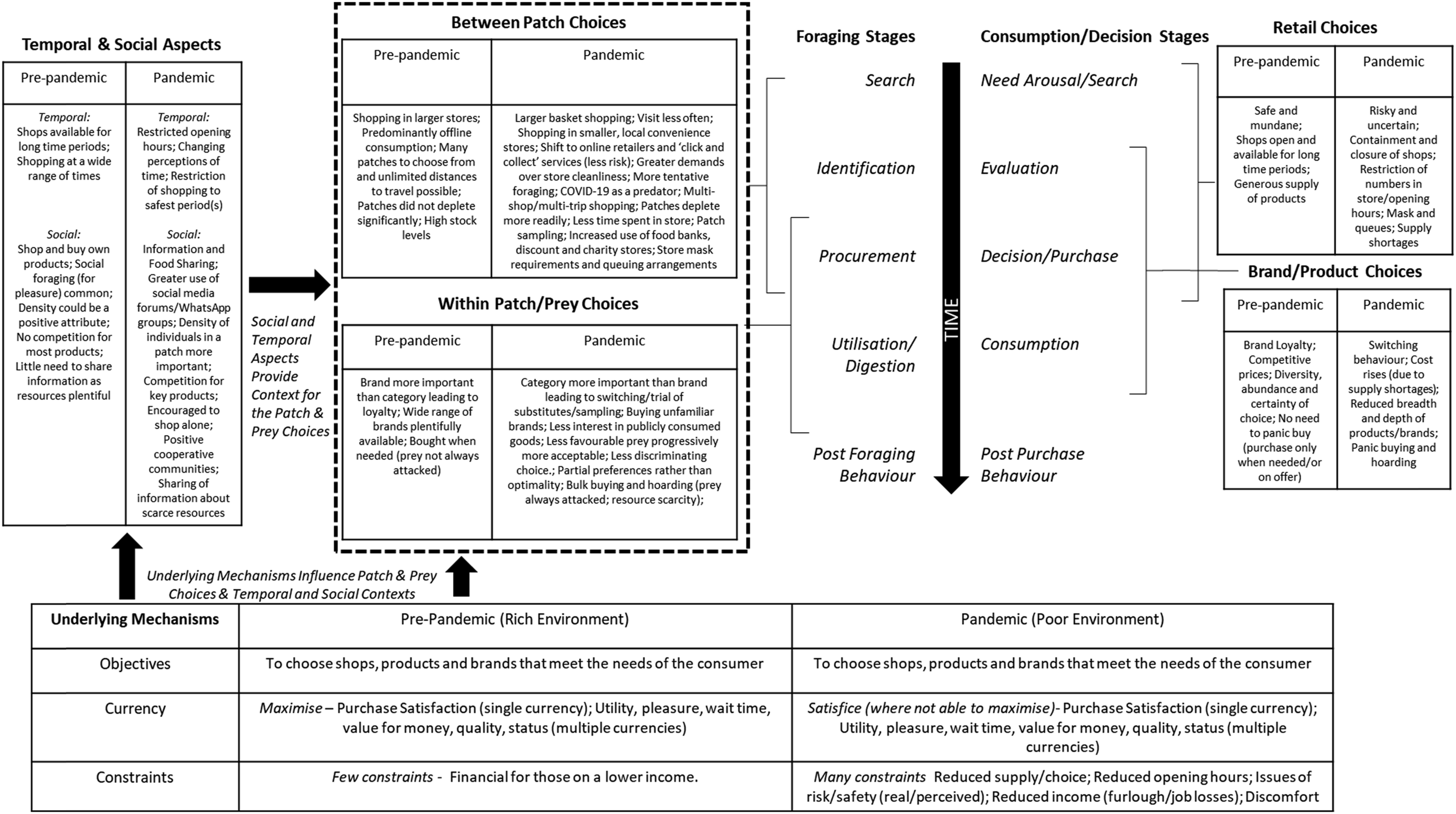
We have examined the role of the foraging principles of diet, abundance, handling, prey recognition and fear in changing prey/product choice through the pandemic. Additionally, we have used foraging principles of travel time, risk, central place foraging, depilation, sampling and patch movement to analyse pandemic store choice. We confirm that some aspects of the consumer response have shown similarities to earlier shocks studied with consumers focussing on survival and in line with their currencies and constraints reasserting order in their lives (Phipps and Ozanne, 2017). We have contributed by extending earlier foraging consumer models, in particular providing a more detailed discussion of potential currencies and constraints as mechanisms of change which show how foraging can explain and qualitatively model consumers reactions to environmental change.
Kirk and Rifkin (2020) highlight that some transient COVID behaviours may disappear quickly while some transformative behaviours may become more ingrained. Some transient elements of pandemic shopping behaviours will endure (for example, mask wearing) until consumers feel safe, fear of infection passes and consumers experience more confidence (Jones, 2020) and less vulnerability (Siddiqi et al., 2022) with Cohen (2020) noting that the longer consumers feel under threat the more ingrained change will be. When consumers respond to threats, there are long term psychological responses such as depression and anxiety, or possibly self-actualisation which may lead to more transformative behaviours (Campbell et al., 2020).
However, as threat levels subside, the question is what pandemic consumption behaviours remain (Campbell et al., 2020)? Wells (2012) notes that sampling can lead to the acceptance of something new, different or rarely purchased perhaps even resulting in long term improved profitability. Sampling may have improved the overall situation with consumers re-evaluating what is essential and important to them (Wilroy et al., 2020) opening the door to new brand relationships (Das et al., 2021); others may return to their traditional patches or prey choices. Consumers affected by the financial crisis changed their behaviour longer term, holding onto savvy shopping behaviours far beyond the recession (Mintel, 2020a). Current predictions of long-term changes in consumer behaviour are wide ranging and contradictory including predictions of the end of browsing (Lowe, 2020), a long-term shift towards online food shopping, more local community focus (Mintel, 2020c), a new appreciation for physical stores (Jansson-Boyd, 2021) and a post-pandemic ‘roaring 20s’ (Glenza, 2020) and that the pandemic will have accelerated a shift to healthier living (Guèvremont et al., 2022).
Future research and practical recommendations
Research examining the effect of the pandemic and various government interventions on consumer behaviours is ongoing and regularly published. The majority of this research has so far followed relatively standard methods such as interviews, questionnaires and analysis of secondary data. These cross-sectional studies will continue to be useful but due to the ebb and flow of infection rates and new variants of concern longitudinal methods will be valuable in future studies. Additionally, interviewees may forget and may recall details inaccurately (Roulston and Choi, 2018) so qualitative methods may become less accurate as time passes and as consumers have had time to process their experiences. Long term surveys (using multiple cross-sectional studies) are already underway (Joe, 2020) but panel data and diary methods could also be used to track changes in behaviour in real time and for foraging this would demonstrate changes in currency and shifts between patches more accurately as well as examining both prey and patch sampling behaviour. This may involve observing and recording actual foraging patterns including search times and measurements of patch and prey density (Winterhalder, 1981) as well as sampling rates, travel distances between patches and time spent shopping. It is agreed that we are likely to face further pandemics and methods such as these could be operationalised much more quickly given our experiences with COVID-19 or indeed a baseline could be collected prior to, and responses measured during a pandemic.
Central to further foraging examination for pandemic responses is determination of which currency or currencies are most relevant. The foraging literature suggests a number ways this could be achieved such as linear programming (Pretorius et al., 2012), indifference analysis (Kaplan and Hill, 1992), revealed preference analysis (Rosenzweig, 2007), expressed preference analysis and conjoint analysis (Newman, 2007). Each of these could be used to determine and model trade-offs amongst multiple currencies.
Studies also highlight a number of factors that should be considered in future studies and which may impact directly on responses to pandemics such as childhood socioeconomic status (Park et al., 2021a), gender (Collignon, 2020; Truong and Truong, 2022), vulnerability (Dickins and Schalz, 2020), concern about the pandemic (Rossetti et al., 2022) age, income, job stability (Mehta et al., 2020; Rossetti et al., 2022; Truong and Truong, 2022) and geographical distance from the epicentre of the pandemic (Li et al., 2021). Foraging studies on human hunter gatherer populations highlight how it may be important to study different roles within a community, and household and age-sex differences in goals and constraints (Kaplan and Hill, 1992). It is clear that not every consumer will have reacted in the same way especially given that some were able to continue work, and due to lack of outlets for spending made savings; some were furloughed while others suffered significant financial hardship, and fear for ongoing financial conditions through job losses (Truong and Truong, 2022). Each of these groups needs specific attention both regarding their consumer behaviours during, but also after the pandemic. Finally, as risk was a driving force during the pandemic is there a chance due to accumulated experience over a number of pandemics that consumers will react less extremely to these events and consumers will become more resilient in their behaviours (Li et al., 2021).
What we understand about pandemic consumer behaviours shows a number of implications for practitioners. Accurate, timely, transparent information from trusted sources have been highlighted as being of particular importance (Li et al., 2021). Governments must seek to convey accurate information and build trust and credibility (Jones et al., 2010). Kirk and Rifkin (2020) note that how brands responded to the pandemic will affect future purchase decisions. Individuals, either due to perceived poor responses or switching/sampling due to low stock or access issues, could open the door to consumers trying new brands and manufacturers should prepare for such opportunities in future pandemics (Das et al., 2021; Knowles et al., 2020). Additionally, brands need to signal their quality and their attention to safety issues, for example, in following up to date guidance on packaging (Das et al., 2021; Pilawa et al., 2022). Manufacturers and retailers should also be aware of how currencies shift during the pandemic and consumers priorities change perhaps highlighting key features that are sought, using targeted sales promotions and prioritise supply in a timely manner depending on stage of the pandemic. Finally, consumers are willing to travel further and wait longer for stores which they considered safer because they had good COVID safety procedures (Rossetti et al., 2022). Changes to the servicescape are both possible and welcomed (Pilawa et al., 2022) and stores should prepare those protocols for immediate action during a pandemic (Boyle et al., 2022).
Footnotes
Declaration of conflicting interests
The author(s) declared no potential conflicts of interest with respect to the research, authorship, and/or publication of this article.
Funding
The author(s) received no financial support for the research, authorship, and/or publication of this article.
