




Abstract
Family firms are the most prevalent form of economic organization in the world, but despite their reputation for resilience and agility, many of them are facing enormous challenges due to the Covid-19 pandemic. In this essay, we examine how the pressures to respond to this health emergency are affecting the ability of family firms to preserve their socioemotional wealth (SEW). In addition, we also provide implications for family business research in a post-Covid world.
Introduction
According to the Organization for Economic Cooperation and Development (2020), the Covid-19 pandemic is an unprecedented public health crisis which has severely affected consumer and business confidence. Governments have taken dramatic decisions to curb the spread of the virus ranging from contact restrictions to full national lockdowns. At the time of writing, several parts of the world are reintroducing restrictions which had been relaxed after months of initial lockdowns and social distancing measures. Such measures not only affect the everyday lives of individuals but also have significant consequences for businesses and society. In the United States, 2.4 million workers were unemployed for 27 weeks or more in October 2020 (Bureau of Labor Statistics, 2020), whereas in the United Kingdom, the unemployment rate has surged as the pandemic is continuing to hit jobs (Office of National Statistics, 2020). In addition, 7.6 million jobs or 24% of the workforce in the United Kingdom are at risk due to Covid-19-related lockdowns and restrictions (Allas et al., 2020). In Spain, the unemployment rate is in the range of 16.8% (Doncel, 2020) as the tourism industry, a mainstay of the Spanish economy, has come to a halt as a result of the pandemic. Many governments have yet to issue clear guidance to businesses with regard to personal safety and business relief measures.
Family firms account for approximately two-thirds of businesses worldwide, 70%–90% of the annual global product (GDP) and between 50% and 80% of all jobs in a majority of countries (De Massis et al., 2018). Family firms are defined by an intersection of family and business systems which confers a unique character to the firm (Davis, 1983). The uniqueness of family firms is often attributed to socioemotional wealth (SEW) which refers to the non-economic and affect-laden value that a family derives from a firm (Berrone et al., 2012). Several researchers have made extensive efforts to establish if family firms are distinctive from non-family firms with respect to behavior and decision-making (Gedajlovic & Carney, 2010). We argue that non-family firms may also display certain dimensions of SEW particularly if they are smaller in size. SEW dimensions such as binding social ties and strong emotional attachment among organizational members are commonly seen in smaller businesses despite the absence of bloodlines running through the firm. In these firms, managerial practices acknowledge employees as whole persons, take an active interest in their welfare, promote social cohesion, and build a sense of participation (Nicholson, 2008). Despite these similarities, family firms possess certain attributes such as the desire for family control, family identity, and dynastic succession which differentiate them from non-family firms.
The pandemic has severely challenged the resilience that gives family firms their competitive edge. The ability to adapt to this “new normal” is critical to the continued success of these businesses and their key stakeholders. This essay will discuss the challenges family firms face as they cope with the Covid-19 crisis. It will explain how every dimension of SEW, which is the affective endowment of a family firm, will be impacted due to the Covid-19 crisis. In addition, it will also examine how family firms can preserve their SEW in the midst of this pandemic and provide implications for family business research in the post-Covid world. Finally, we believe our framework can also offer insights to categories of non-family firms which exhibit cultures, practices, and capabilities that bear resemblance to family firms.
SEW, Covid-19, and challenges for family firms
While the world continues to witness unprecedented changes brought about by the Covid-19 pandemic, the uncertainty created by this crisis has produced significant challenges for family businesses (De Massis & Rondi, 2020). The pandemic has placed a lot of strain on the inherent strengths that have fostered longevity and stability in family firms. A core element that sustains the long-term success of family firms is its SEW (Gomez-Mejia et al., 2007; Martin et al., 2016). SEW has been defined as the affect-related value that a family derives from its ownership or control in a firm. It comprises of five dimensions including family control and influence, identification of family members with the firm, binding social ties, emotional attachment among family members and renewal of family bonds through dynastic succession (Berrone et al., 2012). It is widely acknowledged that family firms consider SEW preservation as their main reference point when they take important decisions, and when family owners or managers feel that family control may be at risk, they are willing to forego economic benefits to preserve their SEW (Gomez-Mejia et al., 2018). However, the disruptions caused by the Covid-19 crisis are placing considerable strain on the well-being of family and non-family employees and may undermine decision-making when family business leaders are faced with trade-offs between SEW and economic objectives (De Massis & Rondi, 2020). We discuss why family businesses will face distinctive challenges while trying to preserve the different SEW dimensions under this “new normal.”
Maintaining family control in an era of disruption
The first dimension of SEW signifies the owning family’s desire to control and influence the firm as a means of preserving their SEW (Swab et al., 2020). The ability to control the firm can be directly exerted by assuming key positions such as the CEO or the chairman of the board, or indirectly by appointing members of the top management team. Indeed, family control and influence are vital to the preservation of SEW and appeal strongly to family members. In the context of the Covid-19 crisis, the appeal of family control remains as strong as ever. Nonetheless, the crisis has also left family businesses in a vulnerable position, given the possibility that family owners and managers may fall seriously ill due to the virus or even die an untimely death. Anecdotal evidence suggests that when a firm unexpectedly loses its leader, its value begins to decline until a suitable successor is appointed (Favoro et al., 2015). Even after a successor is appointed, it can take several years for family firms to reclaim their lost value.
In addition, the conduct and performance of family business leaders is critical for ensuring effective decision-making and continued success of the firm. However, the pandemic is generating stressors that are affecting the mental health of family business leaders and can have a deleterious impact on business outcomes (Castoro & Krawchuk, 2020). Given that effective monitoring of family leaders is unlikely in the present circumstances, it is probable that poor decision-making by a family owner or manager would go unnoticed. Moreover, as there is little prospect of any countervailing influence exerted by other stakeholders in the business, an entrenched family business leader with lots of control might cause long-term reputational damage through neglect or mismanagement of the crisis which can hurt a family’s ability to preserve its SEW. For instance, many family businesses have been forced to make large sections of their workforce redundant due to the losses they have incurred during this pandemic (Washkuch, 2020), and some of these firms have garnered negative attention due to their ineffective handling of these situations (Tingle, 2020). Failure to tactfully deal with the crisis might result in questions being raised about a family business leader’s adequacy for the top job and damage their ability to assert control and influence over the firm. Being open and transparent about decisions taken during the crisis and keeping the public informed through regular updates on social media may help family firms surmount their fear of losing control and influence.
Economic turmoil and identification with the family business
Scholars in the area of family business have argued that the intertwined nature of family and business systems engenders a unique sense of identification within family firms (Berrone et al., 2012; Dyer & Whetten, 2006). The identity of family owners and managers is closely aligned with their organization, given that it often carries the family name and is seen as an extension of the family (Berrone et al., 2012). While the strong identification of family owners and managers can offer unique advantages to family firms, it also makes family members extremely sensitive to any negative reportage of their business. Family managers are deeply concerned about the reputation of their firm as they view it as a part of their family identity (Rosenblatt et al., 1985), but the economic turmoil created by the Covid-19 crisis has added to the challenges of maintaining a positive family identity. When faced with difficult situations, family firms are finding it challenging to align their responses with their values, identity, and public image. Effectively communicating the firm’s responses and emphasizing how they are consistent with the family identity is crucial to sustaining a positive image during the crisis and beyond.
The pandemic has compelled family firms to make tough business decisions including cost-cutting measures, closure of premises, and layoffs (Kraus et al., 2020). If it is perceived externally that these activities have not been managed with sensitivity and compassion, the owning family’s identity may suffer lasting damage. The reputational costs borne by the family firm in these situations will be a source of strain for family principals and managers as they are emotionally invested in the firm and place immense value on its identity. Indeed, due to a strong sense of identification with the firm, family members tend to suffer family defeats including those associated with corporate reputation with much greater intensity than non-family members (Deephouse & Jaskiewicz, 2013). Prior research has suggested the existence of a relationship between identity and disruptive change (Altman & Tripsas, 2015; Anthony & Tripsas, 2016; Kammerlander et al., 2018). Disruptive change such as the Covid-19 pandemic can severely challenge a firm’s existing assumptions about maintaining a favorable identity and reputation. The circumstances of the pandemic require family owners and managers to devise new ways of preserving and enhancing their firm’s corporate reputation. This might require an overhaul of governance processes and creation of a cross-functional taskforce that brings together various stakeholders who work collaboratively to deal with current problems. Ideally, these changes should also be complemented with effective communication processes which help in reinforcing a positive family identity.
Binding social ties in an era of social distancing
The third dimension of SEW refers to the social relationships within family firms. The close social ties that are commonly seen in family businesses are not restricted to family members alone but can include a wider set of constituencies (Berrone et al., 2012) as relationship ties among members of the extended family may engender strong social ties with the wider community (Berrone et al., 2012; Brickson, 2007). However, the social distancing measures that have been in place since the start of the pandemic have been putting immense strain on social relationships. The loss of spontaneous face-to-face interactions with external stakeholders makes it difficult for these ties to remain salient (Wiesenfeld et al., 2001). Given the current circumstances, in some family firms, preference may be given to kinship ties with family members rather than to community ties. Indeed, kin selection theory argues how individuals are more inclined to help relatives compared to non-relatives, and close relatives compared to distant relatives (Foster et al., 2006; Hamilton, 1964; Yu et al., 2020). Applying this reasoning to a family firm’s choices during the Covid-19 pandemic, it appears family principals would prioritize family ties over those with the community and focus predominantly on family-centric SEW goals.
Many family business owners also feel that the Covid-19 pandemic requires them to change their existing strategies for protection of their personal wealth. Although several family businesses are involved in philanthropic and charitable work, many are changing their current approach to address more pressing issues generated by the crisis. The risk of temporarily doing away with philanthropic activities is that family firms may no longer be held up in society as bringing a positive influence in their communities, which could potentially damage their social ties and erode their SEW. Without doubt, social capital rooted in community ties is an important source of SEW for family firms. Despite the challenges posed by social distancing, the backdrop of the Covid-19 pandemic could also offer family businesses an opportunity to differentiate themselves by supporting the communities in which they are enmeshed. Open communication with stakeholders about the firm’s financial situation and how it has influenced the decision to temporarily put on hold philanthropic activities may mitigate the negative impact of such decisions. Nonetheless, family firms can still choose to behave responsibly toward employees, maintain trusting relationships with customers and suppliers, engage in environmental protection initiatives and provide support for local communities (Berrone et al., 2010; Cennamo et al., 2012; Gomez-Mejia et al., 2007; Zellweger & Nason, 2008). Being open and transparent about the firm’s financial health while also doing their utmost to preserve their relationships with non-family stakeholders can allow family firms to create a consensual view of who they are as an organization and how other organizations should relate to them.
Emotional attachment under the “new normal”
The fourth SEW dimension refers to the role of emotions in family firms. Owing to the type of social ties that members of the owning family have among themselves, family firms provide a setting in which members satisfy their needs for belonging, care, and affection (Berrone et al., 2012; Kepner, 1983; Morgan & Gomez-Mejia, 2014). Several scholars have described the emotional attachment that arises due to family involvement in the business as a unique characteristic of family firms (Eddleston & Kellermanns, 2007; Tagiuri & Davis, 1996). A wide range of emotions might be experienced within a family business ranging from positive ones, such as warmth, affection, compassion, and happiness, to negative ones such as anger, anxiety, loneliness, sadness, and depression (Berrone et al., 2012; Epstein et al., 1993). These emotions are influenced by day-to-day situations or significant events that occur within a family business such as succession, divorce, illness, death, economic downturns, financial losses, and reputational damage among others (Berrone et al., 2012; Dunn, 1999; Gersick et al., 1997). Given that the boundaries between the family and business systems are porous in a family firm (Berrone et al., 2010), emotions have a pervasive impact on the organization and influence its decision-making processes (Baron, 2008).
The Covid-19 pandemic has created a range of complex issues in our social and work environments which have major consequences for the satisfaction of emotional needs. For instance, when there is a positive emotional climate within a family firm, benevolence and generosity will spread across the firm (Miller et al., 2020). However, when there is a negative climate, for example, due to the stressors generated by the Covid-19 crisis, we argue that the same contagion will work in the opposite direction and lead to less favorable outcomes such as conflicts and dysfunctional relationships among family members. However, even in these desperate times, a family firm can mitigate the negative impact of the Covid-19 crisis through altruistic behaviors and social support to enhance family well-being (e.g., communicating empathy, hosting virtual family events, and counseling sessions that support employees who might be dealing with emotional challenges).
Renewal of family bonds in times of uncertainty
The final dimension of SEW refers to the desire to hand over the family business down to future generations. This emphasis on dynastic succession has important implications for strategic decision-making in family firms (e.g., Chrisman et al., 2012; Chua et al., 1999). From the perspective of family principals, the family firm is not an asset that can be abandoned as the firm embodies the family’s heritage and tradition (Berrone et al., 2012; Casson, 1999; Tagiuri & Davis, 1992). The renewal of family bonds enables a close association between the past and the present (Filser et al., 2018; Zellweger et al., 2012) that allows for the transfer of the firm’s knowledge and the family’s shared values, beliefs, and norms across generations (De Massis et al., 2016). Indeed, prior research has shown that maintaining the business for future generations is a key SEW goal in family firms due to which they have long-term planning horizons with an emphasis on sustainability and competitiveness (Le Breton-Miller & Miller, 2006). We argue that in the context of the pandemic, family firms may face numerous challenges while managing succession issues and handing over the firm to the next generation.
Leadership contingency planning is essential for the success and longevity of a family firm. Although family business scholars have asserted that leadership succession planning is an intra-family process that should be methodically planned to enable a seamless and effective transition to the next generation (Cabrera-Suárez et al., 2001; De Massis & Rondi, 2020), the Covid-19 pandemic has challenged these assumptions. Several family business leaders have suddenly passed away (Fickenscher, 2020; Marquez et al., 2020), have fallen severely ill, or have decided to leave their business earlier than expected due to a difficult business environment which requires fresh perspectives, determination, and resilience (Mahoney et al., 2020). Owing to the vulnerability of family business leaders to the virus, there is heightened awareness that the succession process may take place in an unforeseen, accelerated, and unplanned way. In view of the ongoing crisis, family firms may need to consider alternatives to planned intra-family succession such as identifying a suitable external successor. Due to their long-term orientation, many family firms are keen to ensure that the next generation of successors form positive cognitive and emotional bonds with the business and are hence reluctant to appoint an external candidate to key positions. However, given the special circumstances of the Covid-19 pandemic, there may be an incentive for family firms to invest in the training and development of external successors, enhance their attachment to the firm and smoothen the succession process.
Implications for family business research: looking beyond the pandemic
In the previous section, we have drawn on family business research to understand the challenges involved in SEW preservation during the Covid-19 crisis. The perspectives we have discussed could provide useful insights to family owners and managers who would like to ensure the success and longevity of their firms. However, the Covid-19 pandemic has brought into focus major gaps in extant research which present interesting avenues for advancing the study of family firms. We argue that new approaches will be needed to address the challenges faced by family firms in a post-pandemic world. Below, we focus specifically on (1) how family firms can navigate uncertainty, (2) how family firms should manage succession in a post-Covid world, and (3) what family firms can do to preserve SEW in digitalized work environments. Table 1 lists new research directions for family firms in a post-Covid era.
New research directions for family firms in a post-Covid era.
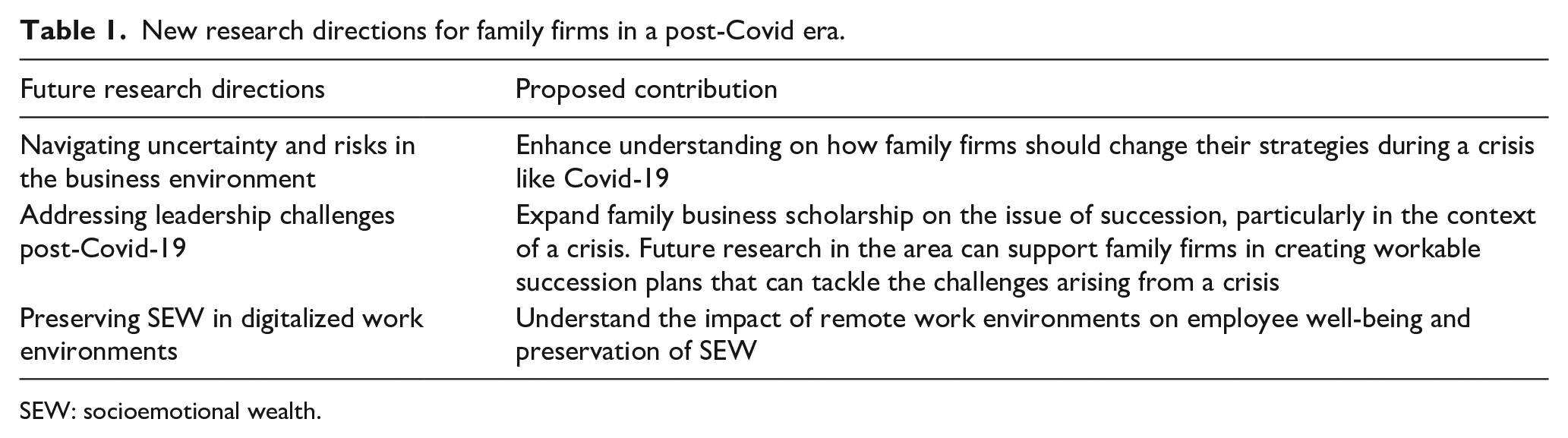
SEW: socioemotional wealth.
Navigating uncertainty
The business environment has always been associated with a certain degree of risk and uncertainty. Indeed, there is a large body of literature that focuses on the nature of risk and uncertainty, how it can affect business performance and how businesses might identify, forecast, and mitigate its influence in everyday operations (Sharma et al., 2020; Teece et al., 2016). In addition, prior research has classified uncertainty based on its source (environmental, industry, or firm characteristics) or its nature (exogenous or endogenous) in the context of business activity (Certo et al., 2008). Nevertheless, there is still no consensus on an exact definition of uncertainty. Most arguments assert that it is either an objective explanation of a firm’s environment (Milliken, 1987), or a subjective perception of individual decision-makers about the degree of uncertainty in the business environment (Michel, 2007; Milliken, 1987). Milliken (1987) has argued that uncertainty is a “perceived inability to predict something accurately” due to insufficient knowledge about a situation rather than a risk that affects a specific business problem or context. This definition of uncertainty is particularly relevant to the Covid-19 crisis as its pervasiveness across different regions and markets has made it challenging to make predictions about any single business or industry context (Sharma et al., 2020).
The pressures resulting from the Covid-19 crisis could drive some family firms toward greater difficulties unless they make unconventional choices and rethink their future. Many of the challenges faced by family firms involve questions such as what will their market look like, where their business is heading and how they should change their strategies against the backdrop of the uncertainty generated by the global pandemic. Family firms may also need to consider how the circumstances of the pandemic have influenced their relationships with their investors and other key stakeholders. Evaluating whether these relationships have strengthened or weakened during the crisis will allow family firms to reassess and strengthen their relationships with these stakeholders, consider forming new relationships, build their resilience, and ensure they have the support upon which they can rely in the future.
Leadership and succession in the post-Covid world
Leadership and succession planning is a top priority in family businesses at any time, but it gains much more importance during times of crisis and uncertainty. The Covid-19 pandemic has compelled many family firms to consider alternatives to existing succession plans and reflect carefully on how the next generation may play a role in reconfiguring the business for the future. Family firms that are keen to preserve their SEW will often prefer to choose a successor from within the family (Basco & Calabrò, 2017). Such an approach allows them to maintain family control, a sense of emotional attachment and pass the family’s legacy to the next generation. However, occasionally the best succession plan requires the family firm to choose an individual from outside the family to lead the firm. Irrespective of whether a successor comes from within or outside the family, family firms should think carefully about what comes next and who will take over when the incumbent leader retires or passes away. Although perpetuating the family legacy is an integral SEW goal espoused by many family firms, scholars should examine how family owners and managers can ensure that the next generation of leaders is willing to take the business toward that direction.
The ongoing Covid-19 pandemic has also shown that no one is invulnerable to the virus. A well-thought out succession plan is essential for ensuring continuity in management in case a senior leader or manager is incapacitated by illness and can no longer perform their duties. Scholarly research in this area could focus on the criteria that should be considered in identifying the right candidates for key leadership roles in times of crisis. Beyond this, scholars may also examine what type of experiences will best prepare a candidate for key positions within a family firm. In particular, what attributes and experiences should a candidate possess to convince employees, customers, investors, and other stakeholders that an orderly transition will happen? Allowing a new leader to assume responsibilities over time while incumbent executives are still available to provide guidance allows for a seamless takeover, but this may not be possible in the current circumstances. Given the risks of Covid-19 transmission, successors may be asked to assume crisis management responsibilities unexpectedly and without the benefit of a planned handover process. Future research in the area of succession should consider how family firms can create succession plans that are workable in times of crisis.
Preserving SEW in digitalized work environments
While the Covid-19 pandemic has shown us that work can be accomplished remotely, it has challenged social relationships in family firms. The maintenance of strong family ties and wider ties within the community is an integral element of SEW but preserving these ties has become more complex as firms have shifted to remote working wherever possible. In particular, the restrictions in response to Covid-19 have induced changes in the organization of work which have forced people to maintain social distancing and rely predominantly on virtual interactions. This has limited in person-interactions, which some commentators argue are essential for building strong ties and fostering SEW (Jaskiewicz & Dyer, 2017). Undoubtedly, in-person interactions are instrumental in cementing high levels of trust that builds and sustains relationships. Nevertheless, the use of digital technology has also kept people connected, offered innovative solutions to businesses and allowed them to adapt quickly to market needs (Zahra, 2020). Given that individuals and businesses have become more comfortable working remotely, it is unlikely they will revert to pre-pandemic patterns of working. With this in mind, family business scholars could examine the impact of digitalized work routines on the formation of trust, goodwill, and social capital.
In addition, the challenges encountered while working remotely during the Covid-19 pandemic have also shown that managing employees’ health and well-being is of critical importance. Family business scholars can consider investigating a number of relevant questions. For instance, how can family business managers continue to support the health and well-being of employees who work in essential worker roles and those who work remotely? What are the main stressors for employees in these roles and which stressors would make employees more vulnerable to anxiety and poorer mental health? Would remote work result in greater disparities in the treatment of family and non-family employees? How can family business leaders address these stressors and what initiatives can they utilize to mitigate the negative impact of isolation, loneliness, and other pressures arising from the pandemic?
Practical implications
Unlike many previous crises that were either financial or political in nature, the Covid-19 pandemic has affected every aspect of business and society. Table 2 lists the challenges faced by family firms during the pandemic and some practical recommendations for addressing them.
Challenges and practical recommendations for family firms in the aftermath of the pandemic.
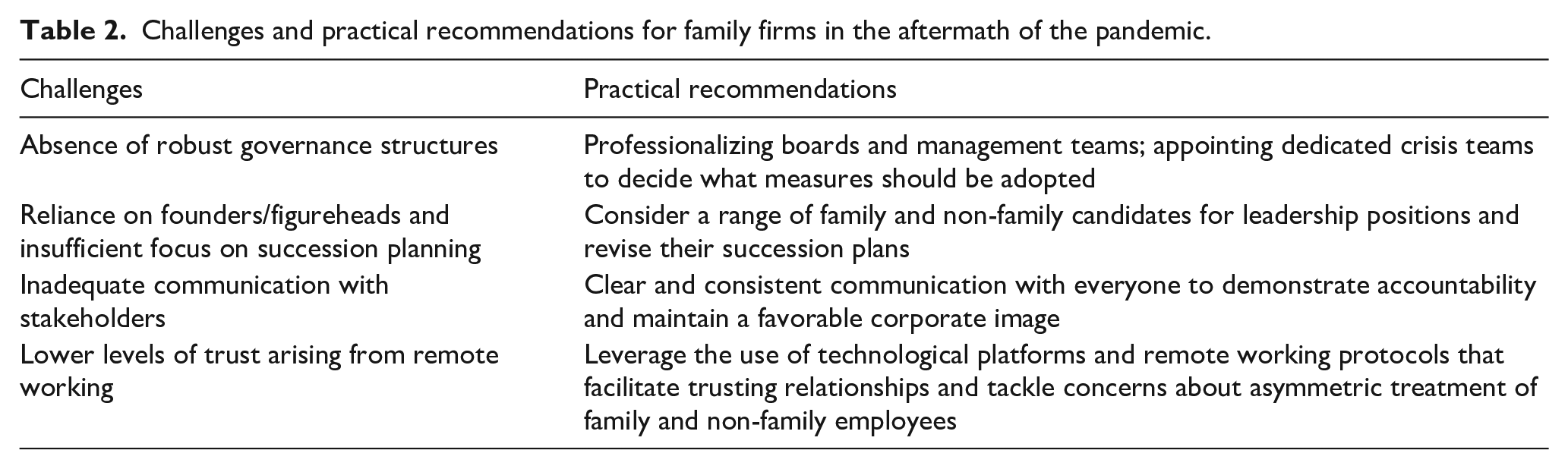
Firms with effective management practices may be more resilient in the face of this macro-level disruption. Given that many family firms do not have robust governance structures in place, they will need to reconfigure their existing processes to deal with the adverse circumstances caused by the pandemic. Dedicated crisis teams should be appointed to regulate and assess the situation and to decide what emergency measures should be implemented. However, if family firms do not professionalize their boards and management teams, they might find themselves ill-equipped to make effective decisions during a crisis. Hence, they should devise ways to professionalize their governance structures so that they align with the family’s values as well as the scope of the business.
Beyond assembling a professionalized governance system, the pandemic has also compelled many family businesses to acknowledge that excessive reliance on a founder or a figurehead can be risky. Ensuring business continuity requires that family firms should focus on succession planning at all stages of the firm’s life cycle. However, while most family firms plan to pass ownership to the next generation, many leaders are so overwhelmed by day-to-day business operations that they lose their objectivity on the issue of succession planning. Family firms should begin to rethink their existing approach to succession planning, consider a range of family and non-family candidates for leadership positions and offer them opportunities to learn and grow. This crisis also provides an opportunity for family firms to accelerate a shift toward the next generation of leaders as the pandemic has taught family firms that they can no longer maintain risk-averse attitudes or afford to ignore digitalization and other disruptive trends that are affecting their industries. Hence, a younger generation of leaders might help in moving away from the risk-averse and conservative strategies that are espoused by some family businesses.
Inadequate communication and lack of transparency during a crisis can tarnish the reputation and corporate image of a firm. The top leadership of a family business should keep various stakeholders informed of the steps being taken by them to respond to the challenges posed by the crisis. Leaders should communicate clearly, consistently, and empathetically to everyone instead of allowing the grapevine to become the dominant source of information. Family firms can also use various communication platforms to demonstrate accountability by showing how they are adjusting their strategies to navigate the consequences of the pandemic. For instance, Mercadona, a leading supermarket chain in Spain had shared their profits with their workforce (“Mercadona Owners Distribute 30% of the Profit With the Staff to Reward Them for Their Work in the COVID Crisis 19,” 2020) while Meituan Dianping, a Chinese online shopping and services platform managed to maintain grocery deliveries in Beijing by introducing an unmanned service in which driverless vehicles transported orders (Dawkins, 2020). Communicating such information can help in upholding a socially responsible image, maintaining social capital, and preserving the family identity.
Social distancing measures have compelled firms to shift predominantly to remote methods of working. Family firms should leverage the use of technological tools and adopt remote working protocols that facilitate trusting relationships so as to tackle concerns about the asymmetric treatment of family and non-family employees. In particular, a remote working environment might pose overwhelming challenges for non-family employees who could be facing unbalanced treatment in family firms. Organizing virtual catch ups to check how employees are coping at a personal level may help in mitigating anxiety, ensuring well-being, and fostering greater engagement. Using a range of communication channels to keep non-family employees in the loop regarding new developments will gradually build trust and make them feel like valued members of the family business system. Managers should be trained in devolving autonomy and providing employees with the support to work independently (Parker et al., 2020). Ultimately, family managers should adjust to supervising without a constant “line of sight” and avoid giving employees the impression that they are continuously tethered to their job as people are unlikely to return to pre-pandemic styles of working in the foreseeable future.
Conclusion
The experience of the Covid-19 pandemic has brought to the fore the gaps within the existing family business research. Although a lot of useful perspectives already exist within the family business literature, much of the research that informs our understanding on how to deal with disruptive change and uncertainty remains fragmented. This essay has discussed how family firms might face challenges in preserving their SEW, an affective endowment which gives them their competitive edge. Indeed, as argued in the essay, family firms will need to devise new ways of protecting their SEW and ensuring continued success in this era of macro disruptions. To this extent, the Covid-19 crisis presents family business scholars with an opportunity to develop impactful research and evidence to address the grand challenges of our time.
Footnotes
Declaration of conflicting interests
The author(s) declared no potential conflicts of interest with respect to the research, authorship, and/or publication of this article.
Funding
The author(s) received no financial support for the research, authorship, and/or publication of this article.