



Abstract
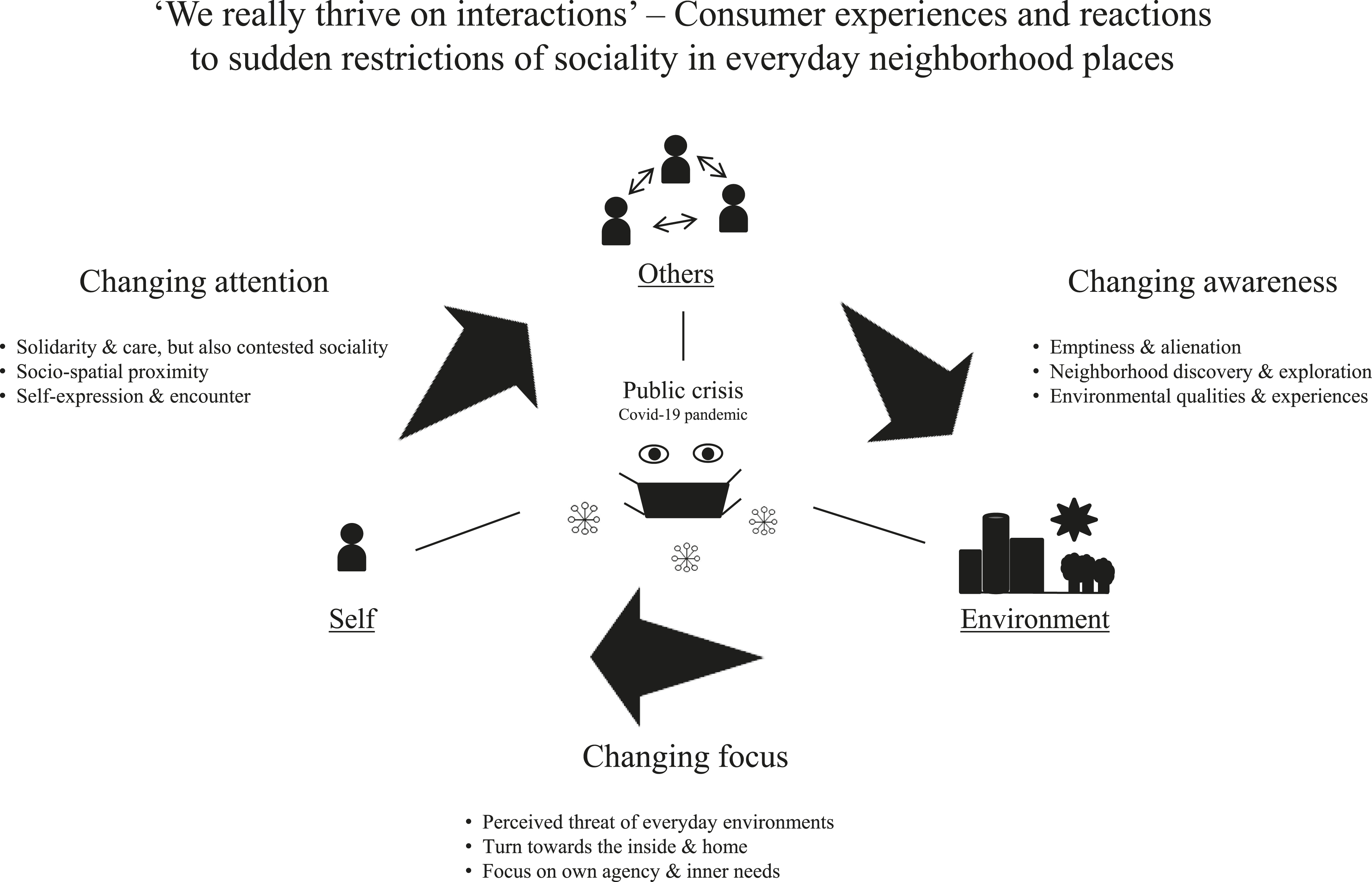
This research investigates how consumers experience and deal with the constrained sociality of everyday places in their neighborhood (shops, parks, etc.) in times of crisis, using the coronavirus (Covid-19) pandemic as a revelatory context. Everyday neighborhood places outside the home or workplace do not only satisfy functional needs; they also serve people’s social life and enhance well-being. However, a gap exists in the literature about the impact of sudden consumer agency constraints on the felt sociality of such places, which hinders knowledge and advice on how service managers can effectively address consumer needs in such times. Drawing from semi-structured interviews with consumers and service providers in French and German urban environments, we find that the enacted restrictions changed how people related to the self, to others, and to the environment. Using ‘sense of place’ as a theoretical lens, we show that constrained sociality modifies the dialectical relationships between people and places: while consumers attributed new meaning to natural environments and re-valued the social resources of their neighborhood, the public restrictions made them increasingly concerned about their own agency. Since consumers thrive on everyday sociality, we discuss different ways service managers can enhance the experience of everyday places during public crises.
Keywords
Get full access to this article
View all access options for this article.
References
Supplementary Material
Please find the following supplemental material available below.
For Open Access articles published under a Creative Commons License, all supplemental material carries the same license as the article it is associated with.
For non-Open Access articles published, all supplemental material carries a non-exclusive license, and permission requests for re-use of supplemental material or any part of supplemental material shall be sent directly to the copyright owner as specified in the copyright notice associated with the article.
