




Abstract
This article examines football fan choreographies as multimodal performances. Fan choreographies, which are regularly organized by supporter groups at football stadia around the world, combine collective embodied actions with diverse media such as banners and flags. Choreographies serve multiple communicative purposes ranging from celebrating a team to commemorating events or protesting against unwanted developments. The article proposes a novel approach to analysing fan choreographies, building on previous research on linguistic, communicative and semiotic aspects of football, which are combined with recent theories of multimodal semiotics. By employing a methodology that uses the notion of materiality as a foundation for multimodal analysis, the article demonstrates how choreographies integrate various media that differ in their potential for meaning-making into complex spatiotemporal organizations. The results, which underline the nature of choreographies as collective social actions that are strongly anchored in football culture and embedded within society at large, illustrate how applying theories of multimodality can provide an improved understanding of performances more generally.
Introduction
As the world’s most popular spectator sport, football is much more than a game – for many, it is a part of everyday life and a central form of cultural expression. According to Guschwan (2016), the stadium is not only the heart of football culture, but also a site for diverse cultural performances, which range from performing fan identities (File and Worlledge, 2023) to protesting against unwanted developments (Callies, 2023). Most if not all of these cultural performances are inherently multimodal, that is, they involve making and exchanging meanings using multiple modes of expression. Understanding how such performances are construed multimodally can offer valuable insights into football culture and the social context in which it is embedded.
In this article, we focus on fan choreographies as a form of communication in football stadia. Choreographies are typically performed by organized groups of supporters at football matches and serve multiple communicative purposes from celebrating one’s own team to mocking the opponents (Hauser, 2019). We seek to describe choreographies as particular kinds of multimodal performances in order to better understand what enables them to construe and communicate complex meanings. To do so, we synthesize previous research on fan communication, football culture and multimodal semiotics, and use this combination to examine choreographies organized by several organized supporter groups of SV Werder Bremen, a football club based in the city of Bremen in northwestern Germany.
Fan Communication In Football
Linguistic and multimodal perspectives on football fan communication
The increasing popularity and mediatization of football has led to an ever-growing media coverage and public attention which, in turn, has sparked considerable interest in the manifold communicative aspects of football. While new reporting genres and other text types have attracted particular attention (see, for instance, Chovanec, 2018), various forms of (multimodal) fan communication that can be observed in stadia around the world have largely been neglected in linguistic research to date (for general overviews of fan communication in football stadia, see Burkhardt, 2009; Claus and Gabler, 2018; Winands, 2015). From a broad perspective, football stadia can be considered semiotic spaces where fans communicate through chants, flags, banners and more complex choreographies. To what extent viewers are able to engage with communicative situations unfolding at stadia depends on whether they are present as spectators, watch a direct broadcast of the game or view user-generated content of these events online. Despite the fleeting nature of such communicative situations, they are regularly mediated by photographs and videos, which allows them to be taken up in other forms of football discourse. As we will show below, mediation also offers new possibilities for researching the nature of such communicative events.
So far, linguistic research has mainly focused on terrace chants and, more recently, banners displayed by active supporter groups. Beginning with chants, Kopiez and Brink (1998) and Burkhardt (2009) provide general discussions and taxonomies, while the linguistic features and socio-cultural significance of terrace chants have been studied in several European languages, focusing especially on the expression of regional and group identities as well as fan rivalries (see, e.g., Clark, 2006; Lavric, 2021; Schiering, 2008). Chants, singing and other forms of communication involving spoken language are used by the supporters to either cheer for their own team or to collectively denigrate or insult the supporters of a rival team. Thus, swear or taboo words regularly occur in fan chants and, in the specific context of the stadium, are accepted by most spectators as a common ingredient of fan culture (for recent work on invective discourse among football fans, see Meier-Vieracker, 2024).
In contrast to the aural nature of chants, fan banners are one of the most visible forms of direct communication used by supporters inside and outside stadia to visually express their views through rather unconventional and creative means of expression, but it is only very recently that they have been studied in research on linguistic landscapes and multimodality, and as particular forms of visual communication (for recent studies, see, e.g., Brunner, 2009; Callies, 2023; Guschwan, 2016; Siebetcheu, 2016). Banners integrate multiple semiotic modes such as written language, diverse forms of depiction, colour and layout in order to achieve various communicative goals (see, e.g., Figure 4). Similar to posters, banners are a medium that is intended primarily for public display and immediate impact. Their messages are not only directed at the audience, but also towards the photographers, TV cameras and journalists inside the stadium, and therefore they frequently receive considerable media attention. At the same time, their long-lasting documentation, dissemination and discussion on the internet and in social media extends their communicative reach.
Guschwan (2016: 300–304) proposes a general taxonomy of fan banners based on materiality and temporality: (1) fan-club banners, (2) banners displayed by individuals, and (3) large message banners held up by one or more rows of fans. Fan-club banners carry the name of the fan-club or supporter group and its colours and logo, usually picking up the colours of the football club that the group supports. Such banners are often professionally made of vinyl or thick fabric and, in terms of materiality, are of a more permanent nature as they are re-used for several years and fixed to the stadium boarding or fencing to mark the area where the supporter group habitually congregates at every home game (Winands, 2015: 99). They are thus on permanent display before and during the match.
Banners displayed by individual fans are shown only for shorter periods of time during a match. These banners are often made of old bedsheets or large sheets of paper, two plastic poles and spray paint. They can contain depictions, a textual message or a combination of both (Callies, 2023: 961–963). Large message banners are also displayed for shorter periods and are typically created for one-time display at a particular game. Such banners can be several meters long and stretch over an entire block or stand in the stadium, which requires the concerted action by a group of fans in the respective block. Block banners are often professionally made of vinyl or thick fabric and are sometimes re-used on other occasions. More typically, however, message banners consist of large sheets of (wall)paper or fabric, glued or taped together. They feature text-only messages by means of large block letters and require the coordination of several (rows of) fans to be displayed.
For message banners, Guschwan (2016: 302) distinguishes several thematic categories. They can, for example, mark important events in the history of the (fan) club or supporter group (such as an anniversary or the death of a supporter). They are also used to make fun of opposing teams or rival supporter groups, especially at matches played against local rivals. The possibly largest thematic category includes protest banners that express different forms of solidarity or disapproval. In particular, protest banners often highlight the manifold negative effects of the increasing marketization and commercialization of football on fan rights and fan culture. This has long been a major theme of fan protest and addresses issues such as the affordability of ticket prices, the increasing fragmentation of match days, the renaming of stadiums, or police surveillance and repression. Banners thus play a crucial role in enabling organized supporter groups to voice their protest against arguably negative developments within the football business but also wider socio-political issues at the intersection of fandom and political activism in the specialized setting of the football stadium.
Callies (2023) shows that the interpretation of the often implicit and coded messages conveyed through fan banners necessitates an understanding of the interplay of materiality, colour, imagery, text and sometimes even temporality. In particular, the colour coding of referents mentioned on the banners by means of the associated club colours, as well as complex imagery including metaphor, contribute significantly to the meaning-making process in fan banners. More complex displays of several large message banners at a time sometimes resemble fan choreographies that have been analysed as ‘coordinated multimodal forms of communicative collective action’ (Hauser, 2019: 117). Banners typically refer to and have to be interpreted against textual references and a complex public and often political (meta)discourse in which they are embedded.
Banners also play an important role in larger fan choreographies, which involve a wide range of coordinated collective actions, such as singing, chanting, the display of banners and embodied actions such as waving flags, to give just a few examples. As such, choreographies may be considered inherently multimodal because they involve both embodied and externalized forms of communication, as exemplified, for example, by singing and displaying banners. For this reason, understanding how choreographies integrate diverse forms of communication requires methodologies capable of explicating just how such activities are construed multimodally. Below, we propose that one possibility is to treat fan choreographies as multimodal performances.
Fan choreographies as multimodal performances
The study of performances is currently gaining increasing attention in the field of multimodality research. Sindoni et al. (2016: 333) characterize the emerging body of work as multimodal performance studies, whose scope includes: how different social actors (auteur, artist, producer, performer, etc.) produce artwork (object, practice, event, display, etc.) and grapple with tradition (e.g. continuity and stability of codes vs. innovation and experimentation), also in relationship with other social actors, be they spectators or collaborators (e.g. audience, listeners, and co-artists) and/or providing other forms of professional or financial participation (e.g. producers, agents, directors, event organizers, etc.).
Sindoni et al. also acknowledge that the concept of performance is frequently used to describe various social and cultural activities from equally diverse disciplinary perspectives, ranging from linguistics and literary studies to philosophy and sociology (p. 327). The widespread adoption of the concept has also led to the emergence of performance studies as an independent field of study, which focuses on both artistic performances and performative aspects of everyday life (Schechner, 2020). The latter category obviously also includes performances related to football: Guschwan (2016), for example, treats football matches as cultural performances that involve a wide range of participants, such as hardcore supporters, casual fans and tourists, who engage in performances characterized by different kinds of communicative behaviour. File and Worlledge (2023), in turn, identify distinct fan identities among the crowd and show how these identities are construed by engaging in different kinds of linguistic performances, which range from chanting and shouting to commenting on the game. Although the communicative acts performed at football matches are often multimodal, this perspective has been largely neglected in previous research (for an exception, see, e.g., Callies, 2023).
Adopting a multimodal perspective on performances may help to understand how they combine multiple modes of expression and materialities for making meaning, which range from the performers’ bodies to external media (Sindoni et al., 2016: 334). This is aptly illustrated by Tan et al. (2017), who show how theatrical performances combine stage design, embodied communication by the performers (speech, gestures, gaze, posture), costume, lighting and sound into a mise-en-scène, whose joint contribution is then offered up for interpretation by the audience. Previous work within multimodal performance studies has mainly focused on artistic performances, as exemplified by the volume edited by Sindoni et al. (2017), which contains multimodal analyses of theatre, opera, dance and drag performances, to name just a few examples. However, as Wildfeuer (2017) has shown, multimodal approaches can also inform the analysis of everyday performances, such as grieving and mourning on social media, which illustrates how performances may also involve the creation and use of multimodal artefacts such as social media posts. A similar example can be found in Philipps (2012), who studies the banners, posters, sculptures and other materials used by protesters in demonstrations.
Analysing the multimodality of performances presents methodological challenges because they may involve both embodied acts and external media, as exemplified by a protester waving a banner. Here the key challenge is imposing analytical control over the different forms of meaning-making and describing how they contribute to the overall performance. Some aspects of a performance may be transient, which means that signs constructed during the performance disappear over time (Bateman, 2021a: 46). A gesture by a performer, for example, is perpetually gone by the time it finishes, which is why analysing performances that unfold in time generally requires recording them on some external medium (Tan et al., 2017: 16). At the same time, the properties of the medium used for storing the recording determines which aspects of the original performance may be recovered. For example, photography may be used to secure access to materials used in a protest, but its ability to capture embodied communication is limited. Although photographs may capture traces of gestures, facial expressions and posture, their material properties do not allow capturing speech, chants and other aural forms of communication (see Philipps, 2012). Just like a photograph, a video recording of a performance is a multimodal artefact, which should not be equated with the original performance (Tan et al., 2017: 16).
For this reason, analyses of multimodal performances are commonly mediated by multimodal artefacts. This situation may be described using the notion of media depiction introduced in Bateman et al. (2017: 126), who propose that communicative situations and artefacts realized using different media can be represented within one another: one may encounter, for example, a photograph of a dance in a video posted on a website. Bateman et al. define a medium as ‘a historically stabilised site for the deployment and distribution of some selection of semiotic modes for the achievement of varied communicative purposes’ (p. 123). Just like the semiotic modes used for making and exchanging meanings, media emerge within communities of users, which may be either very broad or extremely narrow (Kress, 2014). Acknowledging this is particularly important for analysing multimodal performances, as the analyst must be able to identify the media used by the community of users responsible for producing the performance, as performances may involve complex constellations of media with diverse material properties that must be pulled apart during the analysis (Bateman, 2021b).
Such analyses may be pursued using the notion of materiality as every medium is assumed to have an underlying material substrate that can be manipulated for meaning-making. Bateman (2021a: 40–41) characterizes materiality along four dimensions: temporality, space, role and transience. These dimensions seek to describe the kinds of ‘traces’ that the material can support. In this context, a trace refers to the result of intentional manipulation of some material for communicative purposes, such as using a pen to write on a sheet of paper or using the body to perform a gesture. The dimension of temporality describes whether traces on the material can change over time (dynamic) or not (static), whereas space captures whether the traces have a spatial extent and, if so, what kind (e.g. 2D or 3D). Role attends to how users of some materiality are positioned in relation to the material, that is, whether the material is observed from outside or whether the user is embedded within the materiality. Finally, transience describes whether the traces on the materiality remain available for perception (permanent) or whether they disappear over time (fleeting). As Bateman points out, these dimensions are intended as an ‘external language of description’ (p. 39), which seek to capture the semiotic possibilities afforded by the material, that is, what kinds of semiotic modes the material can carry.
Applying this classification to data can help carve out ‘slices’ of material used for meaning making in communicative situations and artefacts (Bateman et al., 2017: 213–214). As set out in Bateman et al., meanings can only be realized by semiotic modes, which require a material substrate that may be manipulated for this purpose (p. 124). This bridge between materiality and semiotic modes is conceptualized using the notion of ‘canvas’, which refers to the aspects of materiality picked up by a semiotic mode (p. 47). To draw on an example from the context of a football match, imagine observing a person who shouts and gestures towards the pitch in reaction to some game event (File and Worlledge, 2023: 981). In this case, the materiality that is being manipulated is the human body. Spoken language carves out a particular canvas from this materiality, which supports traces that are dynamic, non-spatial, observable and fleeting. The gesture, in turn, occupies another canvas that supports dynamic, 3D, participatory and fleeting traces. The use of these two semiotic modes is naturally coordinated across the canvases. However, if the person were holding up a sign that displays the club’s name, drawing on written language would require a materiality capable of carrying traces that are static, 2D, observable and permanent. Such a canvas can be provided by, for example, cardboard, wallpaper or fabric (Callies, 2023: 961). This also illustrates how semiotic modes are not tied down to any specific materiality, but rather require materialities that are compatible with the ‘traces’ that they produce. Whatever ‘slice’ of materiality that holds these traces is then the canvas of that mode.
Furthermore, canvases may also be characterized in terms of the kinds of engagement they support and warrant, which Bateman et al. (2017: 105–106) describe using the notion of ergodicity and ‘ergodic work’. This attempts to capture what kind of participation is expected from anyone engaging with some canvas to co-construct the unfolding discourse. This may be exemplified by yet another example from the stand in the football stadium: if two individuals engage in a discussion of a game event (File and Worlledge, 2023: 982), this requires a canvas that supports dynamic, 3D, participatory and fleeting traces. In terms of ergodicity, this canvas may be characterized as mutable and ergodic as the interlocutors dynamically co-construct the communicative situation – they are essentially in control of the entire interaction, and may shape it within the constraints set by the materiality.
Data And Methods
We collected the research data from YouTube, as recordings of fan choreographies and other performances at football matches are commonly shared on social media platforms, following the approach presented in Callies (2023). Having participated in multiple choreographies ourselves, we decided that working with audiovisual recordings of the choreographies was the only way to achieve an understanding of their overall structure and how they unfold in time, as an individual participating in a choreography can only observe their immediate surroundings. However, working with audiovisual recordings comes with certain limitations that are discussed shortly below. We focused on choreographies performed by supporter groups of SV Werder Bremen, a Bundesliga club established in 1899 in the city of Bremen in the northwest of Germany. After surveying the videos of choreographies posted on YouTube by active supporter groups and individual users, we chose three choreographies from the years 2022, 2019 and 2014 for closer analysis on the basis of their spatial and temporal complexity, which would allow us to evaluate the applicability of the proposed approach.
We treat the choreographies as designed multimodal performances that serve a range of communicative purposes from celebrating the home team and commemorating events or individuals to mocking the opposing team and their supporters (Hauser, 2019). These choreographies are typically created by organized, often also politically active groups of supporters, known as ultras, a term adopted from Italian football culture (Guschwan, 2016). While we acknowledge the effort involved in producing and coordinating such choreographies, our analysis focuses on the actual choreography that is offered for interpretation. Although audiovisual recordings of choreographies are frequently distributed via social media, they provide limited access to singing, chanting, music and other aural phenomena taking place within choreographies due to ambient sounds and noise at the stadium. Given the constraints of working with audiovisual recordings of the choreographies, we focus on aspects of the choreographies that may be perceived visually.
To analyse how the choreographies are construed multimodally, we apply the methodology introduced in Bateman et al. (2017: 211–232), which involves characterizing the material properties of the communicative situation under analysis and, if necessary, decomposing the situation into more fine-grained parts if the material properties exhibit differences. To do so, we draw on the extended description of materiality introduced in Bateman (2021a) and consider the choreography as a whole as the ‘most inclusive’ canvas that provides a space of possibilities for meaning-making (Bateman et al., 2017: 214). In terms of temporality, choreographies are dynamic, which means that they support traces that can change over time. With regard to space, choreographies are three-dimensional, that is, the traces that they carry can unfold horizontally, vertically and in depth. Concerning role, choreographies are participatory, which means that those participating in them are placed within the traces. Finally, with respect to transience, choreographies are fleeting, as parts of a choreography may appear or disappear over time. In terms of ergodicity, we consider choreographies to be linear from the perspective of observers, as they are unable to manipulate the unfolding discourse. However, a choreography may also be micro-ergodic as the observers may need to determine how different parts that unfold in 3D space relate to each other (Bateman et al., 2017: 107).
It is important to understand that these material and ergodic properties describe the generic potential for meaning-making available for a choreography as a whole, which may be complemented by communicative actions and artefacts with distinct material properties. These include, among others, coordinated embodied actions by individuals and groups (dynamic/3D/participatory/fleeting), banners, signs and other external media (static/2D/observed/permanent) and music and announcements (dynamic/non-spatial/observed/fleeting). Following Bateman et al. (2017: 101), we treat these parts as subcanvases that are used to articulate choreographies. We also provide the German terms for the media deployed on these subcanvases, as these exemplify what the supporter community identifies as a medium.
Analysis
A choreography with a simple temporal organization
Figure 1 shows a choreography that took place at the game between SV Werder Bremen and SSV Jahn Regensburg on 15 May 2022. The choreography consists of a single white banner (1) that covers the fence at the edge of the lower stand, which is normally reserved for displaying the banners of supporter groups (the so-called fence banners or Zaunfahnen), and two large block banners or Blockfahnen (2–3). Whereas the lower banner (1) has already been unfurled at the beginning of the choreography, the two block banners are simultaneously drawn over the lower and upper stands as the choreography commences, as indicated by the arrows in Figure 1.
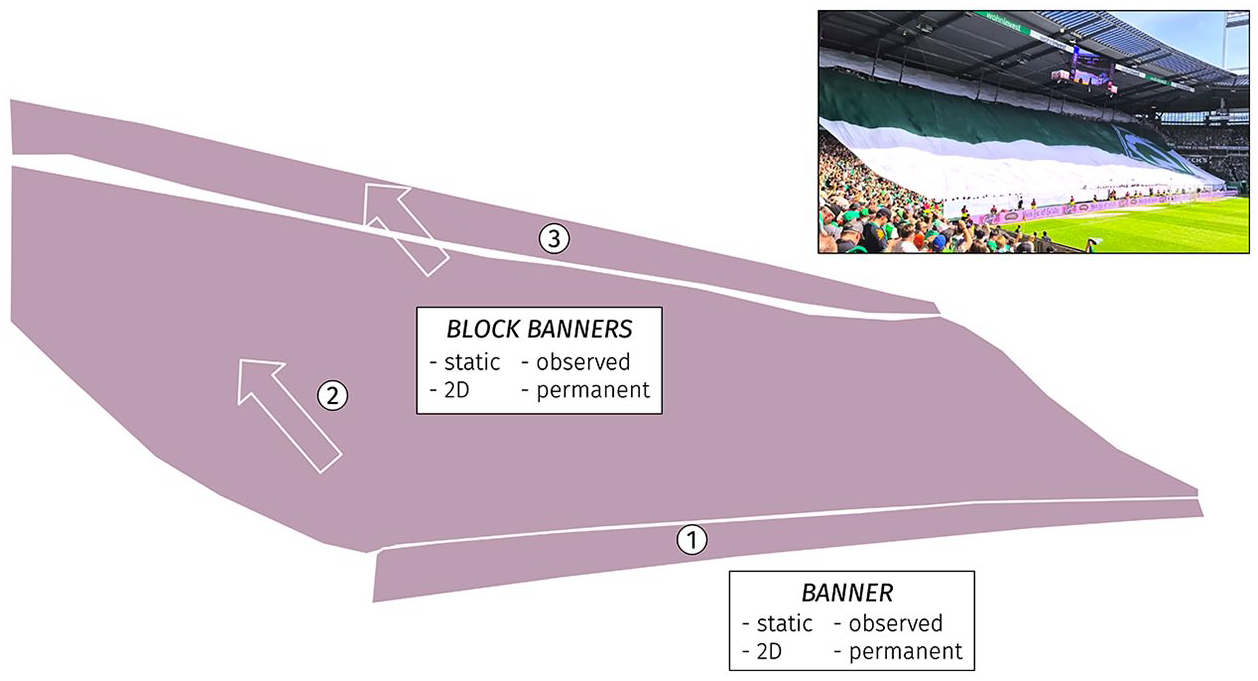
A simple choreography involving a banner that covers the fence between the lower stand and the pitch (1) and two block banners (2–3). Thumbnail from a video uploaded on YouTube by the user DiePapierkugel. Available at: https://www.youtube.com/watch?v=Cu-IGEDycGk (accessed 4 December 2023).
The three banners cover the entire stand and create a unified appearance, which highlights how choreographies often employ multiple subcanvases that are meant to be perceived together. In this context, the notion of a subcanvas describes how the main canvas – in this case the choreography – may be articulated using smaller component parts that have their own material properties (Bateman et al., 2017: 101). These may consist, for example, of various types of banners and collective actions.
In this case, these three subcanvases consist of the banners that are static, 2D, observable and permanent in terms of their materiality. To make sense of their joint contribution to the choreography as a whole, an observer must engage in the kind of ergodic work that Bateman et al. (2017: 107–108) characterize as composition, which involves reasoning about potential relations that may hold between semiotic modes across 2D space. In the case of Figure 1, the subcanvases are used to realize green and white graphic elements with the club crest superimposed on top. A successful composition on behalf of the observer yields an impression of a massive flag that covers the entire stand. The club crest is naturally a strong signifier of identity (Johannessen, 2017), which applies equally to the colours of Werder Bremen, green and white, as football clubs and other organizations often use ‘specific colours or colour schemes to denote their unique identities’ (Kress and Van Leeuwen, 2002: 347).
In terms of the temporal organization of the choreography, the subcanvases consisting of the banners are gradually added to the main canvas. The temporal organization may be characterized in greater detail using the concept of transience, which describes whether the traces left on the canvas remain available for perception (permanent) or not (fleeting) (Bateman et al., 2017: 104). Bateman (2021a: 46) extends this description by proposing that fleeting materialities may be further described in terms of their granularity (whether traces remain visible for longer or disappear immediately after their creation) and the manner in which they appear and disappear (attack and decay). As pointed out above, the banners are permanent in terms of transience because their materiality does not support traces that disappear over time. In contrast, the choreography as a whole is fleeting: additional canvases for carrying meanings may be introduced as time progresses, as exemplified by the two block banners drawn over the lower and upper stand. More specifically, the fleeting transience of the choreography may be characterized as having low granularity and slow attack/decay as the banners remain observable for a considerable amount of time and (dis)appear only slowly as they are taken down as the choreography ends.
This illustrates why a choreography as a particular type of multimodal performance may be argued to possess generalized transience, which refers to the ability to control the transience of its materiality (Bateman et al., 2017: 100). To exemplify, digital media such as computer games typically include both permanent and fleeting subcanvases with varying degrees of granularity (Stamenkovíc and Wildfeuer, 2021). As the following analysis shows, generalized transience enables choreographies to manipulate the main canvas by adding and removing subcanvases with diverse material properties, which allows them to construe even more complex spatiotemporal organizations.
A choreography with a more complex spatiotemporal organization
Figure 2 shows a two-stage choreography that celebrated the 120th anniversary of SV Werder Bremen, which took place before a match against FC Augsburg on 10 February 2019. The first stage of the choreography, which is visualized at the top of Figure 2, features three subcanvases that consist of a block banner (1) and two sets of collective action that take place in the upper stand (2–3). A block banner, which shows all the club crests of SV Werder Bremen over its then 120-year history, is drawn over the lower stand, while the sets of collective action involve supporters waving little green and white flags (Fähnchen). For an individual supporter participating in a collective action, the communicative situation of waving a flag may be characterized as dynamic, 3D, participatory and fleeting in terms of materiality, whereas the flag itself supports traces that are static, 2D, observed and permanent. As such, the collective action consists of individual actions (waving) and external media (flags), highlighting the complexity of material constellations within choreographies. As these actions could not exist without the underlying embodied materiality, we characterize these actions as participatory rather than observed. Here the collective actions of waving coloured flags provide a backdrop for the block banner, allowing the choreography to fill the entire stand.
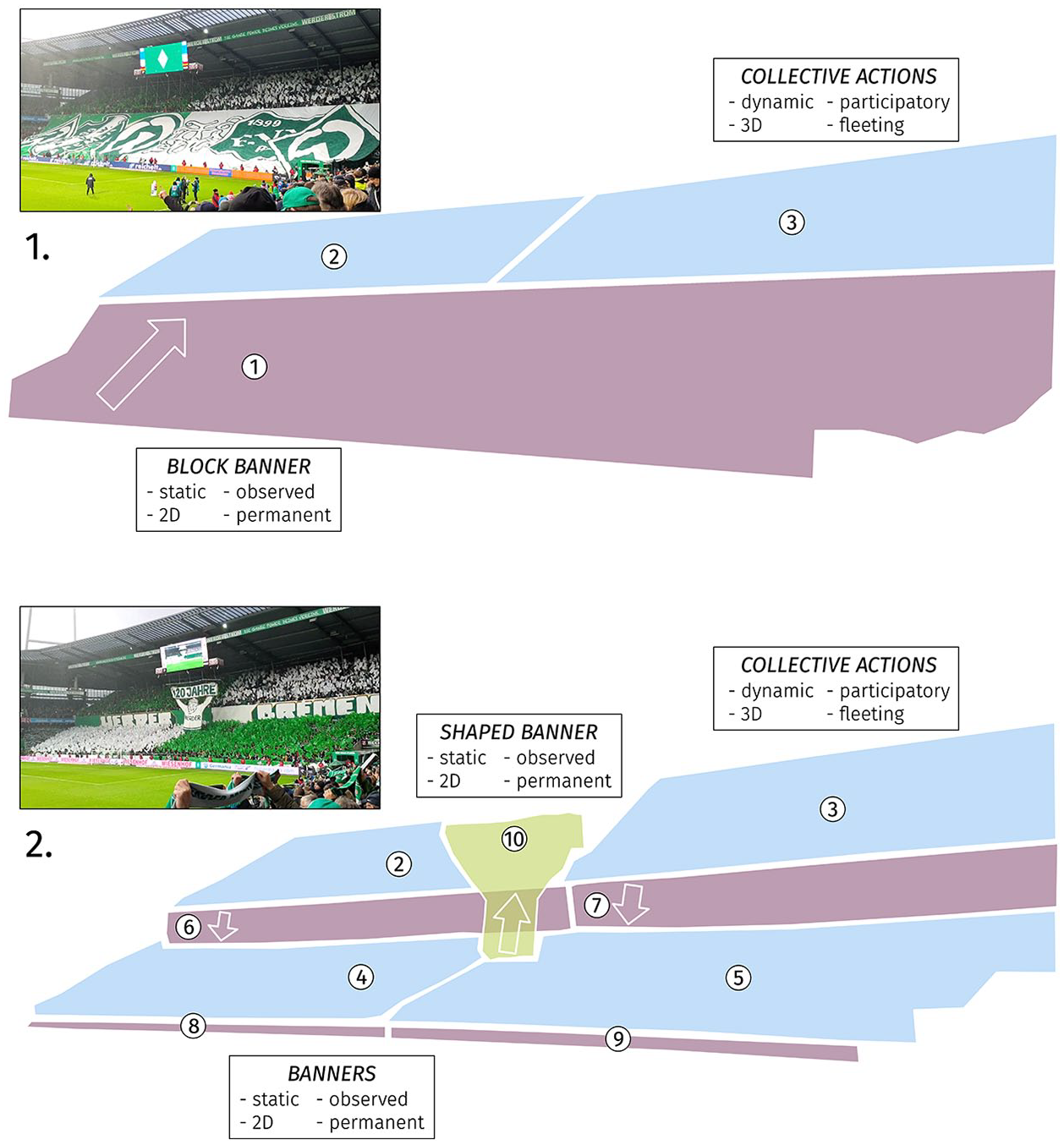
A choreography involving a block banner (1), collective actions (2–5), smaller banners (6–9) and a shaped banner (10). Thumbnails from a video uploaded on YouTube by the user Schuki schaefer. Available at: https://www.youtube.com/watch?v=WRIsVvPpXsQ (accessed 4 December 2023).
The second stage of the choreography is shown in the bottom half of Figure 2. At the beginning of the second stage, the block banner that covers the lower stands is pulled down and replaced with two sets of collective action similar to those in the upper stand (4–5), while simultaneously unfurling two banners from the fence of the upper stand that bear the club’s name (6–7). Just as in Figure 1, the spatial contiguity of these two banners illustrates how an observer is expected to perform composition by considering how subcanvases 6 and 7 relate to each other. Lowering the block banner also reveals two banners (8–9) that are used to cover the banners of the supporter groups in the lower stand. At this stage of the choreography, the entire spatial ‘real estate’ available for meaning making in the stand is reserved. However, the choreography may still be extended by hoisting objects under the screen above the stand, which constitutes yet another subcanvas afforded by the 3D spatial extent of the choreography. This subcanvas hosts a shaped banner (10) that features an illustration of an old fisherman who wears a shirt with the club name printed on it and who holds up a scarf that says 120 Jahre (‘120 years’).
This illustrates how choreographies use generalized transience to create temporal structures by adding and removing subcanvases. As the example in Figure 2 shows, choreographies can combine subcanvases with different material properties, such as sets of collective action (2–5) and banners (1, 6–9) into a common temporal structure. What is also worth noting is how the sequence of collective actions and banners provides a background for the shaped banner (10), which is hoisted above them. This suggests that choreographies possess a ‘layouting’ mechanism, which Bateman and Schmidt (2012: 51) conceptualize as being responsible for combining and sequencing distinct ‘parts’ of designed media, such as shots in a film. This mechanism may also be taken to apply to choreographies as designed multimodal performances, which lay out and sequence their subcanvases for display. Just what kinds of semiotic modes may be used for meaning-making on these subcanvases depends on their materiality, as they differ in terms of temporality and transience. Because the banners are static and permanent, this allows them to realize visual semiotic modes needed for displaying the club crests (1) and the illustration of the old man (10). In contrast, the four sets of collective action of waving flags are dynamic, 3D, participatory and fleeting. While such collective actions can deploy semiotic modes such as written language or simple geometric shapes by using, for example, coloured flags, the nature of their traces prevents them from realizing semiotic modes that manipulate the materiality more extensively for visual detail, such as complex illustrations.
The choreography shown in Figure 2 also illustrates interesting properties of generalized transience in choreographies and how they use these properties to instantiate subcanvases. As pointed out above, banners and other materialities capable of supporting static, 2D, observable and permanent traces are typically characterized by low granularity and slow attack/decay when mobilized within a choreography. Put differently, banners are slow to deploy and remove. In contrast, collective actions that are dynamic, 3D, participatory and fleeting, can have high granularity and rapid attack/decay, which allows them to be initiated and terminated quickly during the choreography. Another feature that sets the choreography shown in Figure 2 apart from that shown in Figure 1 is the inclusion of depicted media. The illustration of the old fisherman displayed in the shaped banner (10) who is holding a scarf may also be treated as a medium as scarves are often used for conveying diverse meanings ranging from club identity to achievements and even protests (Guschwan, 2016: 298). One way to understand examples such as the relationship between the scarf and the shaped banner is to treat them as a case of media depiction, which describes how media may be related to each other in a manner that allows each medium to bring in its medium-specific affordances, that is, what kinds of communicative situations typically unfold within the medium and using which semiotic modes (Bateman et al., 2017: 126–128). Media depiction is a powerful mechanism as it allows extending the semiotic ‘reach’ of communicative situations, as illustrated by the third choreography analysed below.
A complex choreography with depicted media
Figure 3 shows a choreography that was organized on 1 March 2014 before a match between SV Werder Bremen and Hamburger SV, two clubs that have an intense rivalry as the oldest and biggest clubs in northern Germany. The choreography marked the 100th time the clubs faced each other in the so-called Nordderby. Just like the previous example in Figure 2, the choreography features multiple stages and subcanvases. The first stage, shown in the top-left corner of Figure 3, commences with two sets of collective action at the left and right ends of the lower stands (2–3) that involve supporters displaying two-handed signs (Doppelhalter) made of plastic foil in the club colours of green and white. In terms of their material properties, these signs are static, 2D, observed and permanent, whereas the collective action may be characterized as dynamic, 3D, participatory and fleeting. On the left-hand side (2), the two-handed signs display a key from the coat of arms of the Free Hanseatic City of Bremen, whereas on the right (3) the signs show the Town Musicians of Bremen, the protagonists of a Grimm Brothers’ fairytale, another well-known symbol of the city of Bremen and local identity. Finally, the two-handed signs are distributed among the spectators in the stands in a way that they form a green cross on a white background.
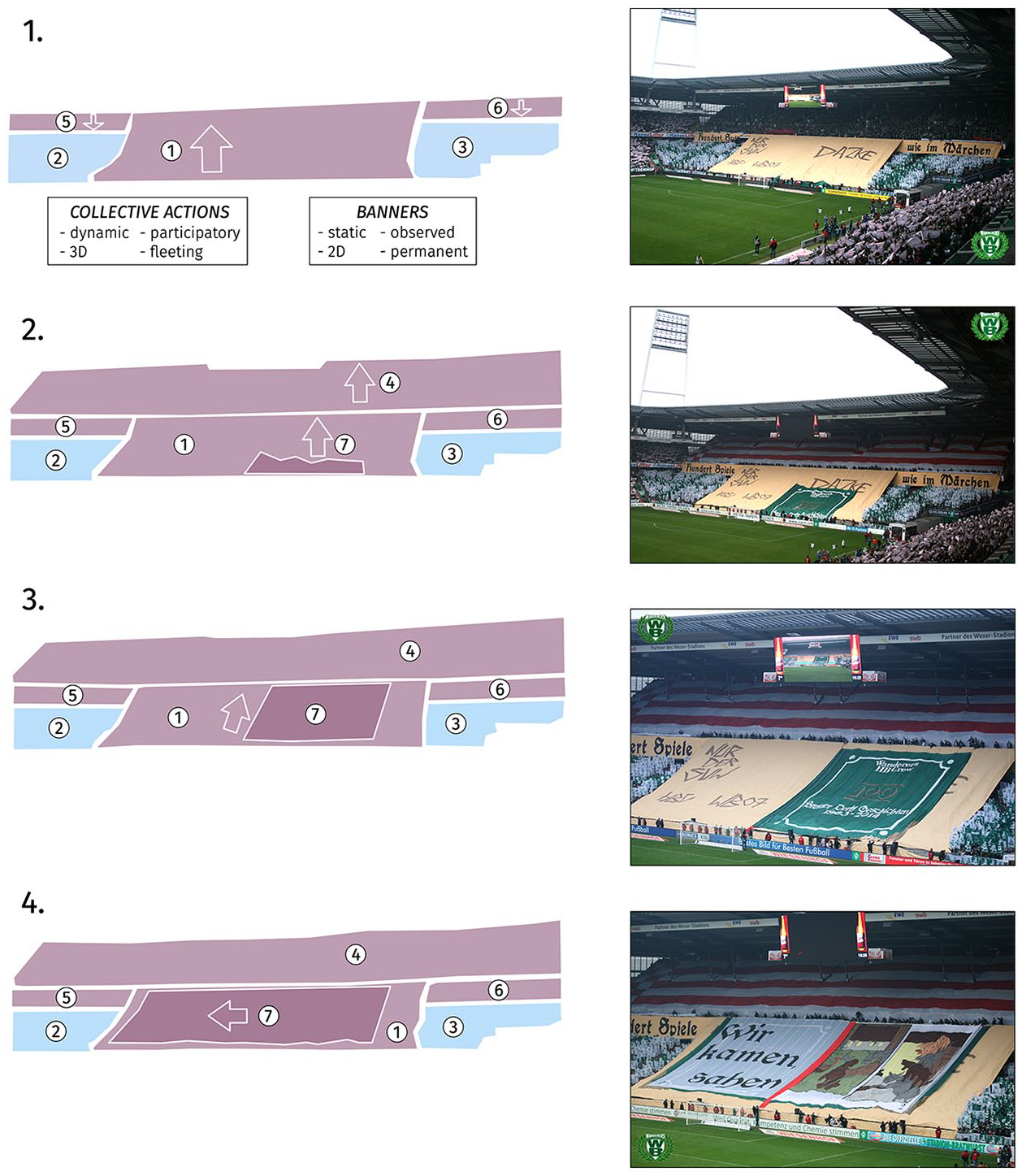
A complex choreography involving a sequence of collective actions (2–3), block banners (1, 4) and banners (5–7). © Photographs courtesy of Wanderers Bremen, used with permission.
The sets of collective action (2–3) are complemented by a single light brown block banner (1) that is extended over the central part of the lower stand, which features several instances of written text: Nur der SVW (‘Only SVW’), a phrase commonly associated with SV Werder Bremen, and abbreviations for the names of the supporter groups responsible for organizing the choreography (HBC for HB Crew and WB07 for Wanderers Bremen, a group established in 2007) and the non-word DAZKE in capital letters. We will return to the function of this word as a part of the choreography below. In addition to the large block banner (1) and sets of collective action (2–3), two banners (5–6) are unfurled over the fence of the upper stand, which share the same colour as the large block banner (1). The banner on the left (5) displays the words Hundert Spiele (‘a hundred games’), whereas the banner on the right (6) reads wie im Märchen (‘like in a fairytale’). Together with the block banner (1), these two banners serve to contextualize a smaller banner (7), which is drawn over the larger block banner (1), as shown in step 2 of Figure 3. At the same time, another large block banner (4) is drawn above the entire upper stand. This block banner features another prominent symbol of local identity, namely the red and white flag of Bremen. At this stage, the entire spatial extent afforded by the stand has been allocated to subcanvases.
The smaller banner (7) plays a prominent part in the third stage of the choreography, which is visualized in the bottom half of Figure 3 (steps 3 and 4). Initially, this block banner depicts the cover of a book entitled Bremer Derby Geschichten 1963–2014 (‘Bremen’s Derby Tales 1963–2014’), which refers to the derby games played between SV Werder Bremen and Hamburger SV. This block banner may be treated as another instance of a depicted medium, namely a children’s picture book. Recognizing the depicted medium as a picture book allows viewers to draw on their previous engagements with this medium, which includes assumptions about its material properties, what kind of semiotic modes are commonly deployed on the medium and for what communicative purposes, and what kinds of ergodic work are warranted by the medium. In this case, the kind of ergodic work required by the picture book is composition, as the viewer is expected to relate the written language and illustrations to one another (Bateman et al., 2017: 109).
The viewer’s ability to transfer knowledge about the medium of a picture book to the context of a choreography is necessary for making sense of the final stage of the choreography. The choreography ‘peels off’ a series of smaller banners (7) laid on top of each other to simulate the process of turning over the pages of a book. This sequence of ‘pages’ features a narrative, which is realized using written language and illustrations, as shown in Figure 4. Here, however, the text and the illustrations are only loosely connected. The text across the pages reads Wir kamen, sahen und siegten. Die Moral von der Geschicht; Bremen ist geil, Hamburg nicht (‘We came, saw and conquered. The lesson of the story: Bremen is awesome, Hamburg not’). The illustrations, in turn, show an adaptation of the Town Musicians of Bremen, the previously mentioned Grimm Brothers’ fairytale in which four animals came across a house inhabited by robbers, scared them off and took over the house. The illustration in panel 5 of Figure 4 depicts the fans of Hamburger SV as the robbers, whereas the animals represent Werder Bremen. The sixth panel in Figure 4 shows yet another intertextual reference, as a robber chased out of the house is shown tripping over a ball of paper. This refers to a high-stakes game between the two teams on 7 May 2009, in which a paper ball thrown on the pitch eventually resulted in a decisive goal for SV Werder Bremen.
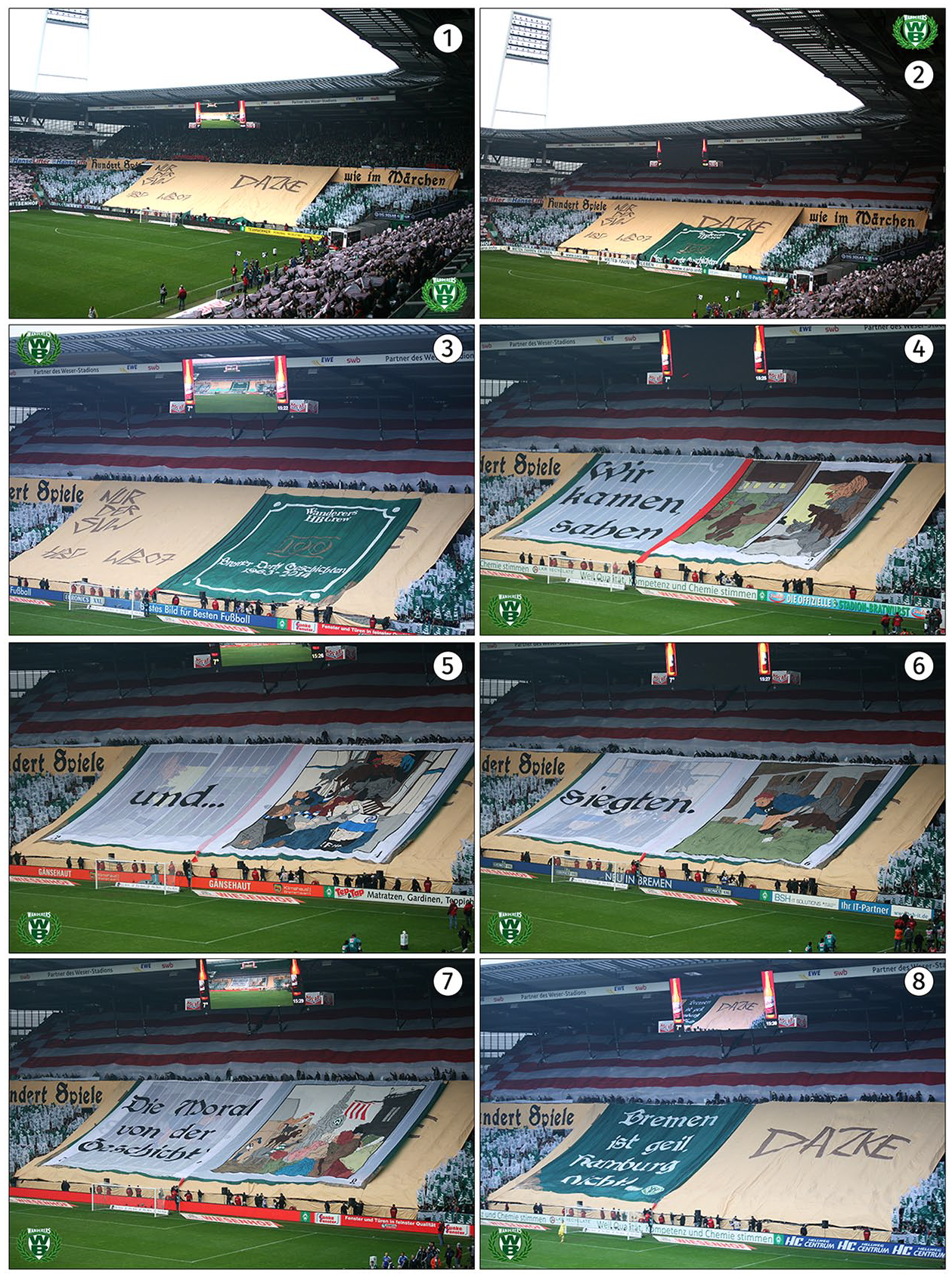
Photographs of the choreography in Figure 3. © Photographs courtesy of Wanderers Bremen, used with permission.
The choreography finishes as the book ‘closes’, finally revealing the word ‘DAZKE’ mentioned above (see panel 8 in Figure 4). This word refers to a mistake made by the supporters of Hamburger SV in a choreography that took place in 2004. A single banner carrying the letter N, which belonged to a group of banners that was intended to display the word DANKE (‘thank you’), was accidentally unfurled horizontally, which resulted in the representation of the non-word DAZKE. This illustrates how choreographies may establish intertextual references to each other, but also exemplifies how semiotic modes deployed on separate subcanvases may co-operate in a choreography. Here the word DAZKE, which is displayed on the block banner (1), is to be interpreted as marking the end of the narrative realized using the series of smaller banners (7). From a multimodal perspective, this illustrates the operation of the ‘layouting’ mechanism described above, but also the need for making discourse semantic interpretations about the semiotic modes deployed on individual subcanvases and their combinations within the context of the entire choreography.
Discussion
Our analysis has revealed that choreographies are complex multimodal performances, which may involve both collective embodied actions (clapping, chanting, singing, waving flags, displaying signs) and manipulating material artefacts (e.g. displaying banners and signs) for purposes of communication. In other words, all choreographies are fundamentally rooted in embodiment, regardless of whether the participants sing or draw a banner over a stand. As the analysis has also shown, these communicative actions may be effectively captured by treating them as subcanvases of the choreography, whose material properties determine what kinds of semiotic modes may be deployed on them for making meanings (Bateman, 2021a). To exemplify, the materiality of a collective action such as waving flags does not allow drawing on complex illustrations and other semiotic modes that generally require a permanent materiality. A banner, in contrast, provides precisely this.
We used the notion of generalized transience (Bateman et al., 2017: 100) to describe the choreographies’ ability to control how long embodied actions or materials remain visible for the audience. However, tapping into the semiotic potential afforded by generalized transience requires planning what is articulated, when and for how long, which is a key characteristic of designed performances. This bears close resemblance to the mechanism of layouting, which is responsible for combining and sequencing the parts of a designed performance or artefact in time and space (Bateman and Schmidt, 2012: 51). The operation of ‘layouting’ is visualized in Figure 5, which illustrates how the subcanvases in each choreography are organized logically and temporally into a coherent performance, while simultaneously negotiating the space available for doing so made available on the main canvas of a choreography, which is limited by the spatial extent of the stadium.

The logical organization of subcanvases in each of the three choreographies analyzed.
The first layout structure on the left, which corresponds to the example shown in Figure 1, consists of a simple grouping of three subcanvases that constitute the choreography. The second example in the middle shows the layout structure for the choreography in Figure 2, which features multiple stages. In this case, the choreography negotiates spatial constraints by removing the initial block banner (1) and replacing it with banners and four sets of collective action (4–9), which sets up the stage for the addition of the shaped banner (10). The third example on the right visualizes the structure of the choreography in Figure 3, which also features multiple stages, but negotiates the space differently by embedding the set of banners (7) that depict the storybook within the existing structure by laying the banners over the block banner (1).
From a broader perspective, the previously mentioned features emphasize the complexity of choreographies as multimodal performances and the collective effort required to plan, prepare and execute them. The choreographies are extensively planned in advance, but they cannot be rehearsed with actual participants. This also raises interesting observations and questions about the roles taken on by those who design choreographies and those who participate in them: it is important that future research considers the identities of the ‘sign producers’ as they are likely to be very diverse, yet they collectively participate in a performance with a common communicative goal. As such, choreographies are a powerful manifestation of supporter identity and football culture.
Conclusion
In this article, we have studied football fan choreographies as multimodal performances. Drawing on previous research on linguistic and multimodal aspects of football and fan communication, combined with recent theories of multimodal communication, we showed that choreographies may be treated as designed multimodal performances that can exhibit complex spatiotemporal organizations. Having set out a framework for analysing fan choreographies from a multimodal perspective, future research should explore the relationship between the multimodal structure of choreographies and their broader communicative functions (e.g. celebration, commemoration or protest), while also mapping their variation across cultures. In terms of theory, our work raises questions about the nature of multimodal performances beyond choreographies and how they integrate multiple media and semiotic modes. Pulling their respective contributions apart and identifying appropriate methods for their analysis is needed to achieve a more comprehensive understanding of their joint operation. At the same time, this effort needs to be supported by theoretical concepts that can prevent the analysis from unravelling, such as those of materiality and media depiction.
Footnotes
Acknowledgements
We thank Wanderers Bremen for granting us the permission to use the photographs included in Figures 3 and  .
.
Biographical Notes
TUOMO HIIPPALA is Professor of English Language and Digital Humanities in the Department of Languages at the University of Helsinki, Finland. His current research interests include multimodal corpora and computational methods for supporting empirical research on multimodality. He has been a member of SV Werder Bremen since 2015.
Address: University of Helsinki, PO Box 24, Helsinki 00014, Finland. [ email:
MARCUS CALLIES is Professor of English Linguistics in Faculty 10: Linguistics and Literary Studies at University of Bremen, Germany. His research focuses on corpus linguistics, World Englishes, and the language and discourses of football. He has been a member of SV Werder Bremen since 2012.
Address: Universität Bremen, Universitäts-Boulevard 13 (GW2), Bremen 28359, Germany. [ email: