



Abstract
The traditional construct of dance performances has predominantly positioned the audience as passive observers with little to no interaction with the unfolding narrative on stage. However, the advent of digital technology has paved the way for a more immersive and interactive performative experience. This paper elucidates the transformation of this dynamic through the lens of an interactive dance performance piece, “Moving Photon”, which endeavors to blur the entrenched demarcations between performers and spectators. By melding choreographic improvisation, interactive installations, and physiological sensing, “Moving Photon” cultivates a co-constitutive interaction, challenging conventional performative frameworks. Through two distinct configurations, performance and installation setting, the piece endeavors to transition spectators from passive observers to active collaborators in the narrative. The performance setting leverages real-time electroencephalogram (EEG) data from audience members to influence the kinetic dynamics of the installation, thus directly impacting the dancer's improvisational choreography. Conversely, the setup of the interactive installation invites participants to influence the musical score and the installation's robotic movements through motion-sensing devices, fostering a tangible feedback loop. The reflections gathered from initial exhibitions reveal a heightened sense of connectivity and shared authorship of the performance among both the performer and audience members. This innovative exploration signifies a step forward towards fostering more collaborative and multimodal engagements in digital art performances.
Keywords
Introduction
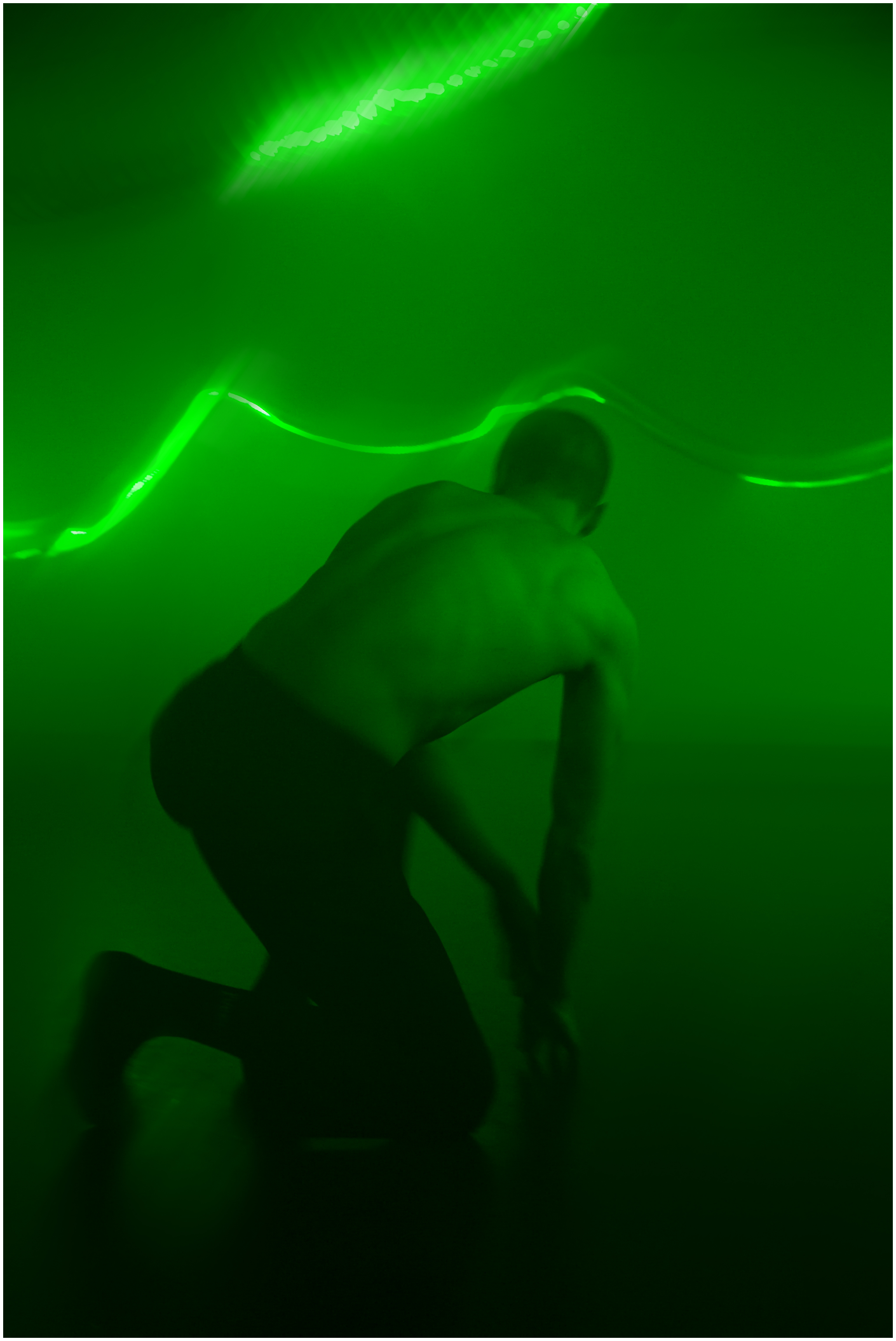
The traditional role of the spectator in a dance performance has largely been that of a passive observer. Audience members have typically been expected to sit quietly in a designated area, usually a theatre or auditorium, and watch the performance unfold on stage. They only engage with the performance through visual and auditory senses, absorbing the movements, costumes, lighting, music, and other elements that constitute the experience. In this conventional format, the spectators have no direct interaction with the dancers or influence over the performance itself. Instead, they receive the artistic message solely as interpreted and conveyed by the choreographer and performers. Their role is to appreciate, interpret, and emotionally respond to the dance, but not to actively participate in its execution. This one-way flow of expression and communication from the performers to the audience has been a defining feature and limitation of traditional dance performance.
In more recent times, the realm of dance has been expanding and diversifying to encompass many more forms of audience interaction. This shift reflects a trend towards multimodal engagement, where the audience's involvement transcends traditional visual and auditory senses. This can include interactive elements where spectators can influence aspects of the performance, either through direct participation or via digital interfaces, thereby adding tactile, kinaesthetic, or participatory dimensions. By incorporating these diverse modes of engagement, dance performances are transformed into more immersive and interactive experiences, fostering a deeper connection and a more dynamic interaction between performers and audience. In so doing this has initiated a reshaping and blurring of the boundaries between performers and spectators and a deconstruction of the barrier that existed between the two therefore breaking the fourth wall. The concept of the fourth wall, as discussed in Nicola Shaughnessy's chapter “Breaking the Fourth Wall," refers to the invisible barrier that separates performers from the audience in performing arts, particularly theatre (Shaughnessy, 2013). This metaphorical wall facilitates a conventional separation where actors do not acknowledge the audience's presence. When this barrier is broken, either through direct address or acknowledgment of the audience, it creates a unique interaction, often used for humour, engagement, or commentary, altering the traditional dynamics of performance and viewer engagement.
In many immersive performances, audiences are encouraged to move freely around the performance environment, engaging directly with dancers and taking part in the construction of the narrative. Examples of this include performances like “Sleep No More” by Punchdrunk (Suresh, 2003), which invites the audience to wander through a multi-story set, and “Then She Fell” by Third Rail Projects, where a limited audience explores a multi-room environment alongside the performers. Similarly, “FELA!” directed by Bill T. Jones (Sisario, 2008), and audience interactive dance performances by Monica Bill Barnes & Company (Lee, 2022), invite audiences to participate in the narrative or even in the dance itself, breaking the fourth wall that traditionally separates performers from the audience. “Bodies in urban spaces” (Haedicke, 2015) by Willi Dorner and “Gala” (Tate, 2016) by Jérôme Bel take this interaction into urban spaces or invite audience members to perform, respectively, expanding the performance environment beyond the traditional stage. These and others reshape the audience’s role from passive observers to active participants, evolving the field of interactive dance and performance art.
In the continuing endeavour to deconstruct the barriers and limitations of traditional dance performance, emerging technologies provide valuable tools for the development of novel forms of interaction. To date this has typically been explored via interaction between dancer and environment, for instance through projection mapping or visual graphics guided by physiological data. While choreographers and artists, such as Merce Cunningham, Wayne McGregor, Klaus Obermaier, Dawn Stoppiello, Mark Coniglio, Hiroaki Umeda and Dieter Vandoren, amongst others have pioneered the integration of technological elements into dance performances, a still relatively unexplored realm is how these technologies may be utilisable in enhancing direct interaction between audience and performer, and how these communicative pathways can break down traditional concepts of spectator roles.
This paper details the development of an interactive dance performance, “Moving Photon”, aimed at dismantling the remaining barriers between audience and performer. Through a multimodal approach of choreographic improvisation, interactive installation and physiological sensing, “Moving Photon” seeks to cultivate a co-constitutive interaction between performer and audience, challenging conventional performative frameworks. This text will briefly cover the conceptual inception, technical execution, and the ensuing audience-performer interactivity elicited by “Moving Photon,” aspiring to offer a novel approach in the domain of interactive performance art.
Moving Photon
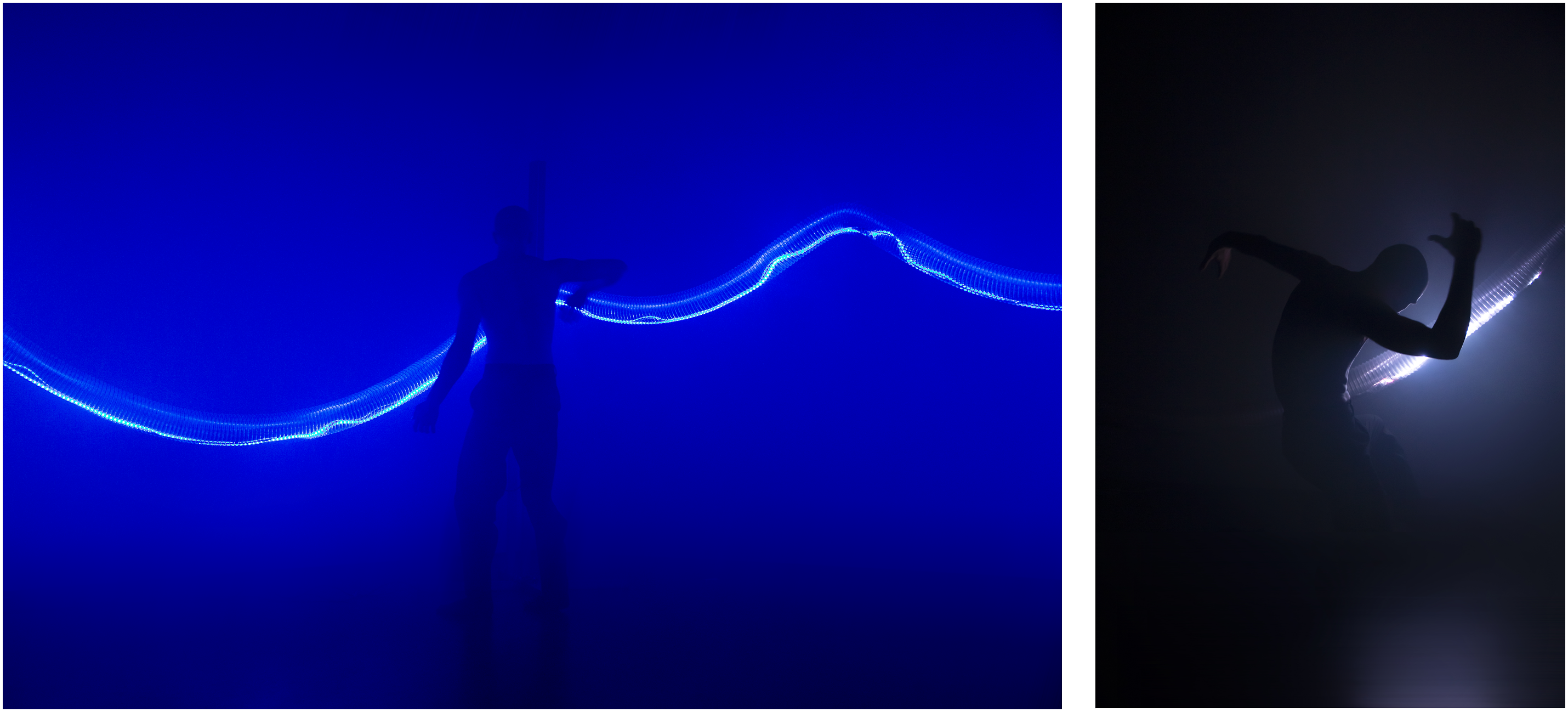
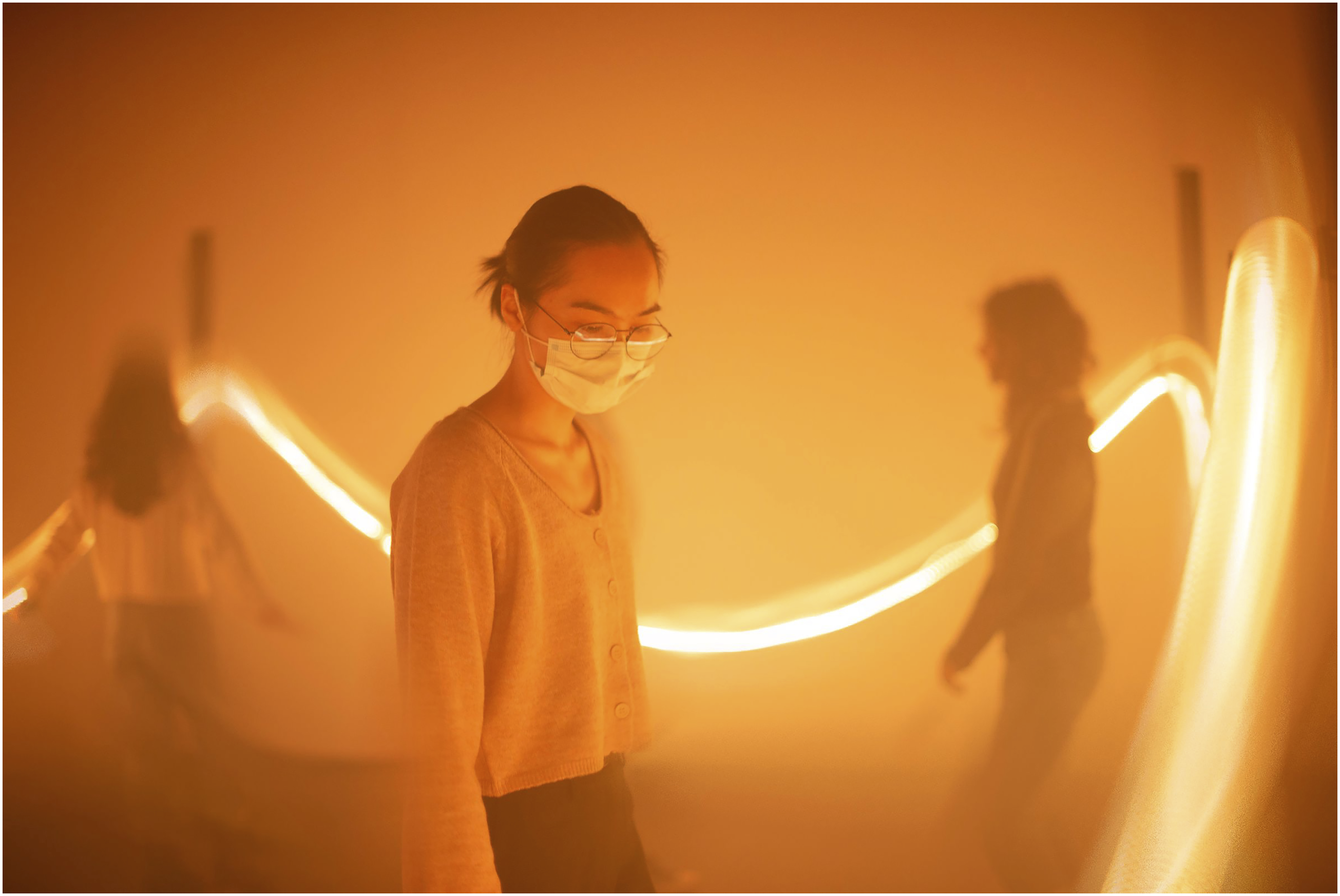
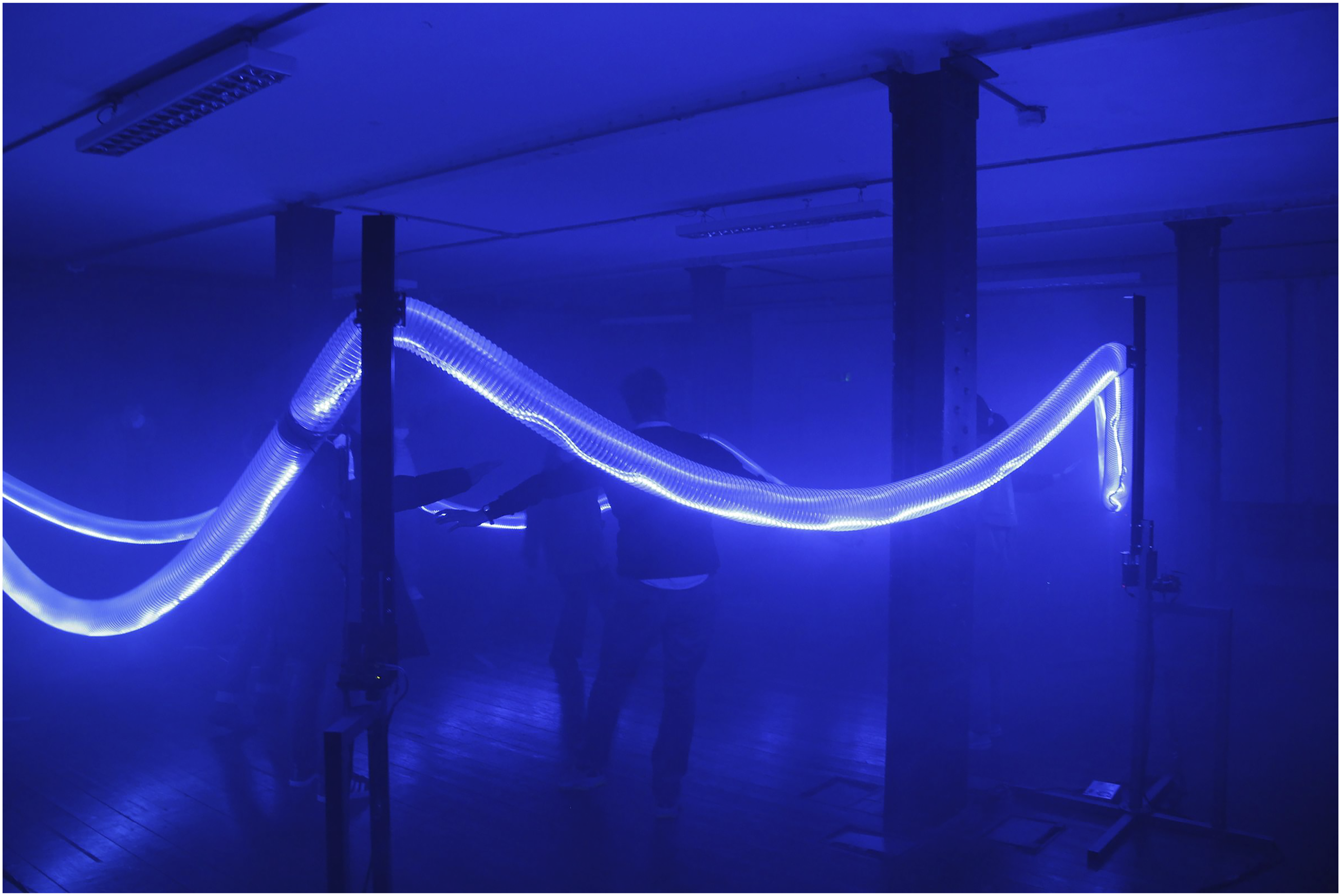
The creation of Moving Photon was driven by a desire to forge active communicative feedback loops between performer and participant. This culminated as an interactive installation & performance piece that delves into the disruption of traditional notions of embodiment, social connection, remote presence, and participation. The installation was comprised of a circular translucent plastic tube mounted on six robotic linear actuators, enabling a dynamic morphing of the tubing structure in response to inputs from several sensors. Threading through the tubing were programmable LED lighting strips, which could be either preprogrammed or responsive to data inputs. A portion of the inspiration for this work was derived from the social distancing mandates of the COVID-19 pandemic, which accentuated the necessity for novel settings of interactive and immersive artwork. Moving Photon operates in several settings, each modulating different facets of embodiment and presence, and each centred around disrupting a specific traditional aspect of performance.
The first configuration was the performance setting, which was centred on an improvised performance by a dancer within and around the installation. The kinetic aspect of the installation was driven by data harvested from electroencephalogram (EEG) scanning of two participants viewing the performance. EEG data, particularly from the motor and visual cortices of two participants, was streamed in real-time to govern the kinetic dynamics of the installation during the improvised dance sequence. The participants' perception of the machine was thereby instantaneously translated into movement, altering the dancer's improvisational choreography, which consequently manipulated the viewing experience of the participants. This established a feedback loop aimed at enhancing participant-performer communication and immersion. Additionally, the dancer was equipped with wristbands housing an Mbient MetaMotionR inertial measurement unit (IMU), which gathered accelerometer data, which was live streamed to alter certain aspects of the musical score throughout the performance. The audience was strategically positioned on the floor along the perimeter of the installation, thereby affording each individual a distinct vantage point from which to witness the performance.
The interactive installation invited up to six participants into the installation's core, sans the dancer or EEG components present in the performance. Each participant was equipped with a motion-sensing device, enabling them to influence both the musical score and the robotic elements' movements within the installation.
The installation setting utilized inertial measurement unit (IMU) devices (wearable wristbands) as inputs. In this instance, each of the six participants was provided with a single IMU. These IMUs recorded the acceleration data from each participant to control the movement of a single linear actuator. The participants were not informed about which of the six actuators were paired with their respective IMU devices. This design aimed to encourage participants to move and interact with the installation if they wished to determine which part they controlled. Gyroscope data was then collected using a Raspberry Pi and transmitted to a computer via OSC over the network to influence the linear motion of the installation.
The gyroscopic data were mapped to a range of values, which were subsequently used to control various sound parameters. Three-dimensional data were collected from the gyroscope, with the x- and y-axes used for ambient noises and the z-axis for impact sounds. When the data exceeded both ends of the range (e.g., from -550 to 550, positive and negative), one of the sounds in idle mode would be triggered as part of the main music composition. This design ensured a smooth transition, even when multiple participants moved synchronously, making it challenging to differentiate between the various new impact sounds.
This configuration aimed to transition participants from passive spectators to active collaborators, with the motion-sensing devices acting as conduits for interaction within the installation's physical realm. The robotic elements were programmed to respond in real-time to the participants' gestural inputs, establishing a tangible feedback loop. Through this setup, participants became integral to a dynamic choreography, blurring traditional performer-audience demarcations and exploring embodied interaction within a technologically augmented environment.
Reflections on Moving Photon
Observations made and discussions held during the initial showings of “Moving Photon” garnered a wide array of interesting findings regarding the fostering of communicative feedback loops between the performer and audience members. This section primarily encapsulates a subset of the reflections and responses from both participants and the dancer based on experiences gleaned from the initial exhibitions of the piece. The discussion focuses on a performance that intriguingly highlighted the dissolution of traditional barriers between performers and audiences. It also explored how digital technology enhances multimodal engagement, inviting audiences to interact through various sensory and interactive means.
In discussions following the first showings of the performance, the dancer articulated a unique resonance established between himself and certain audience members, notably those adorned with EEG headsets (see quotation below). This interaction ostensibly blurred the demarcation between the performer and the audience, engendering a nuanced dialogue on the reciprocity of reactions between the two. “The process of developing was interesting, it was an interesting one, coming in kind of completely blind with where I would be able to draw the inspiration. The first thing I would kind of respond to is the lights and the music that was my main kind of focal points. And then as we started to do previews and then finally into the show, the audience brings in a completely different dynamic. And it's really changed the meaning of what I want to convey through the piece with the EEG headsets interacting with the lights. There's already a special connection between specific audience members and myself as kind of blurring the line between the audience and performer who's reacting to who and who's creating the, you know, the artwork that happens in the space.”
The discourse extended into a contemplation of the authorship of the performance, which was perceived as a collective endeavour shared amongst the artist, the dancer, and the audience. The integrative spatial arrangement, inclusive of those audience members not equipped with EEG headsets, further accentuated this shared authorship, as everyone present within the performance arena inherently became integral constituents of the performative ecosystem (see quote below). The dancer also expressed appreciation for the environment driven by the audiences being seated on the floor in a circular assembly, remarking that this considerably reduced the hierarchical divide typical of conventional theatre settings. The dancer expressed that this arrangement facilitated a departure from the customary ‘fourth wall’, mitigating the disconnect and fostering a more immersive engagement. He found himself able to momentarily transition into an audience member himself, challenging conventional performance expectations and balancing the roles of the performer and audience member during the performance. Furthermore, the dancer described the emergent environment of the performance as an enriched conduit for exploring novel performative avenues, thus providing new routes for his own compositional and improvisational creativity. This augments the overarching premise of the installation in facilitating a symbiotic performer-audience relationship. “In this kind of beautiful area that we have, the fact that everyone is sitting on the floor and in the round, it's really kind of levelling out. In traditional theatre, I find that it's such a divide between the audience and the performer. It's kind of creating this different world with behind fourth wall. There's like really a disconnect there. So having broken that down and I found a real enjoyment in kind of breaking people's expectations of what my performance is going to be, kind of going outside of the circle, sitting with the audience and becoming an audience member myself and watching the lights draw a different attention to the different kind of collaborative elements. It's a really interesting kind of rabbit hole to explore that provides an inspiration.”
Participants too, echoed a heightened sense of connectivity with the performance, feeling more entrenched in the fabric of the piece. This sentiment was widely shared, reducing somewhat the divide that would have been expected between those engaged via EEG interaction and those without. The collective experience underscored the success of “Moving Photon” in not only bridging the traditional performer-audience divide but also in nurturing emergent collaborative authorship of the performance. This highlighted that through this interaction and environment design, we as artists have the capacity to provide dancers with novel performative avenues for their own composition and improvisation, and audiences with the licence to engage and feel an integral part of a performance. This highlights exciting potential for more intimate and collaborative performative explorations in the digital art realm.
Conclusion
This paper explores the paradigm shift from traditional dance spectacles towards a more immersive, interactive, and co-creative experience in the digital art realm, as demonstrated through the “Moving Photon” performance piece. By harnessing emerging technologies and integrating physiological sensing with choreographic improvisation, “Moving Photon” successfully dismantles the conventional boundaries between performers and spectators. It explores multimodal audience engagement, blending technology and performance in an innovative way. This endeavour not only enriches the performative landscape but also fosters a unique dialogic engagement, positioning the audience as active collaborators in the unfolding narrative. The nuanced feedback loops established between the performer, the installation, and the audience, particularly in the performance setting, redefine the notion of authorship, making it a collective endeavour. Through this innovative approach, “Moving Photon” encourages a departure from the customary ‘fourth wall', thereby nurturing a shared immersive environment where both performer and audience explore novel interactive and performative avenues. The findings from the initial exhibitions of “Moving Photon” underscore the potential for evolving the field of interactive performance art, opening a plethora of possibilities for more collaborative explorations.
Footnotes
Declaration of conflicting interests
The author(s) declared no potential conflicts of interest with respect to the research, authorship, and/or publication of this article.
Funding
This work is supported by the ERC Neurolive project (funding from the European Research Council (ERC) under the European Union's Horizon 2020 research and innovation programme [grant agreement No.864420 - Neurolive]), The Royal Society.
Author biography
