



Abstract
In May 2020, the world witnessed Derek Chauvin, a serving White police officer, murder George Floyd, a Black American male. A video of the murder, shot by Darnella Frazier, documented Chauvin kneeling on Floyd’s neck for a little under eight minutes. The video served as a call to action with protests erupting throughout the summer of 2020 across the USA. Activists took to the streets demanding an end to police brutality and systemic racism. The act of kneeling became a recurrent symbol of these protests. This article specifically focuses on instances where police officers have taken the knee opposite protesters. The author argues that, within this context, kneeling is a memetic performance; it is a unit of cultural information passed on through repetition and mutation. Through mutation (repetition with difference), the symbolic meaning of the act changes. In the case of police officers kneeling opposite protesters, the act purportedly symbolizes moments of solidarity and understanding between the two sides. Much like the video that inspired the protests, instances of officers kneeling opposite protesters were captured, disseminated via social media and went viral. The stillness of these moments promised hope for movement towards a more equitable and humane future. But these images serve as a form of dirty data as they document a future yet to materialize. To this end, the act of kneeling is a haunted gesture, serving as a form of counter-activism. The act of kneeling by police officers, irrespective of the intentions of the individuals involved, does not solicit an encounter with the ghosts of police brutality and systemic racism. Rather the act, as a mutated form of activism, simultaneously disrupts the atmosphere of protests and reclaims narratives about police conduct, without enacting meaningful change.
Keywords
In May 2020, the world witnessed Derek Chauvin, a serving White police officer, murder George Floyd, a Black American male. Chauvin killed Floyd by kneeling on his neck for a sustained period of time. 1 Floyd’s murder served as a call to action, sparking a global movement in summer 2020. Supported by the activities of the Black Lives Matter global network, activists took to the streets demanding an end to police brutality and systemic racism. Footage of activists kneeling in front of police lines and, in many instances, calling for police officers to take a knee, became a motif of these protests. This article examines kneeling within the context of social justice activism. It is concerned with what the act of kneeling represents and for whom. A theoretical contribution tested on a limited empirical case study is provided to argue that the act of kneeling is a haunted memetic practice in need of critical examination.
This article provides an historical overview of kneeling as a form of social justice activism by evidencing a potential lineage of kneeling to argue that, each time the gesture is enacted, it reactivates the histories attached to the action. The theoretical framework is built upon an application of memetics and hauntology to support a performance analysis of kneeling as activism. Kneeling functions as a unit of cultural information passed on through repetition and mutation. As a haunted meme, each time the action is performed, it reactivates the ghosts of police brutality and systemic racial violence and oppression and, simultaneously, has the potential to mutate (repetition with difference). These mutations have the potential to generate new symbolic meaning. By considering the act of kneeling as a haunted meme it is possible to examine the relationship between the symbolic meaning of new mutations and the manner in which the ghosts of racial injustice and police brutality are addressed or erased. For this case study, the article selects an incident on 1 June 2020, when around 50 to 60 on-duty officers kneeled opposite activists at a protest in Fayetteville, North Carolina. The incident purportedly symbolized a moment of solidarity, unity and understanding between law enforcement and activists. The stillness of these moments promised hope for movement towards a more equitable and humane future. But these images serve as a form of dirty data as they document a future yet to materialize.
This article focuses exclusively on the act of kneeling within the context of social mobilization for racial justice. Kneeling by activists promoting causes other than racial justice fall beyond the remit of this article. The act of kneeling within the context of the fight for racial justice is a haunted gesture with the potential to function as a form of counter-activism. The act of kneeling by police officers, irrespective of the intentions of the individuals involved, does not solicit an encounter with the ghosts of police brutality and systemic racism. Rather, the act, as a mutated and co-opted form of activism, simultaneously disrupts the atmosphere of protests and reclaims narratives about police conduct; it performs an image of unity and resolution without meaningfully enacting changes to systemic racism and police brutality. The mutation powerfully and dangerously changes the symbolic meaning of the gesture, transforming it from a potent performance of activism to a neutralized and neutralizing performative gesture.
Knee Taking as a Haunted Memetic Practice: An Historic Overview
The act of kneeling as a gesture linked to racial justice reform has a long history, which functions as a particular type of lineage and legacy. The following section provides a chronology of the gesture within the United States. In doing so, it draws upon Performance Studies scholarship to argue that to kneel within the context of racial justice activism serves as a reactivation of this legacy through reenactment. The section details four key moments of kneeling between the late 1700s and 2016. It argues that these four moments can be understood as instances of kneeling functioning as a meme. Within these moments, the context and the symbolic meaning of the gesture mutates but remains referential to the history of kneeling as a practice of racial justice activism. As Performance Studies scholar Rebecca Schneider observes, performance is ‘relentlessly citational’ (Schneider, 2011: 102). Each instance of kneeling described in this article, to coin Philip Auslander’s (2018) term, reactivates the instances of kneeling that came before. It brings the sociopolitical contexts of past instances of kneeling into dialogue with the present moment to be experienced within and alongside the current temporal and spatial context. The context and symbolic meaning of kneeling may change with each iteration, but the histories associated with it are reactivated with each performance, remaining in play and in need of critical consideration.
In the 1780s, the British Society for the Abolition of Slavery, ‘adopted as its official seal a woodcut of a kneeling [enslaved] man above a banner that read: “Am I not a man and a brother?”’ (Estes, 2005: 2). The image, used on broadsides, pamphlet frontispieces and medallions, as well as on chinaware and cufflinks, became ‘hugely popular’ and somewhat of a fashion statement for abolitionists and anti-slavery advocates within the United States (Trodd, 2013: 340). Estes argues that the image of a Black male on bended knee, imploring an unseen slaver for his freedom ‘came to symbolize the struggle for abolition’ but also demonstrates the expectation for Black bodies to ‘adopt a submissive posture of supplication when seeking emancipation’. Citing Benjamin Franklin, Trodd argues that the image sought to procure favour for the enslaved by presenting an individual suffering passively, posing ‘no threat through rebellion or resistance’. For Trodd, the image does not invite ‘solidarity with the enslaved but paternalistic association with the morally righteous abolitionists who will answer the helpless captive’s question by releasing his chains’ (p. 240). In presenting this image as the first instance of kneeling as a form of racial justice activism, I agree with Trodd that this image minimizes the agency of the enslaved. The mutations that follow demonstrate the potential power of this gesture as an embodied act of rebellion and resistance.
In the late 1700s, famed Black minister, Richard Allen, took a knee to protest against racial injustice. 2 When White leaders of the St George’s Methodist Church in Philadelphia, where Allen preached several times a day, announced they would segregate membership by building a gallery upstairs designed exclusively for the Black congregation, ‘Allen and his colleague Absalom Jones kneeled in prayer and refused to rise when White people tried to physically pull them up’ (Newman, 2018: 181). When Allen rose, as Newman observes, he launched ‘perhaps the most important institution in African-American life: the African Methodist Episcopal Church’ (Newman, 2018: 179). 3 The institution helped spread antislavery ideas in antebellum America, played an important role in the recruitment of Black soldiers during the Civil War, served as a key institutional base during the civil rights movement, hosted protest meetings after Emmitt Till’s murder, and fought apartheid in South Africa. Allen’s act of kneeling, whilst not as iconic as the seal adopted by abolitionists, produced a legacy of activism focused on emancipation, agency, religious recognition, and social and racial justice. It reactivates the image of the seal but shifts the focus away from an individual passively seeking to procure favour to one in dialogue with a higher authority and actively resisting White oppression.
In the 1960s, photography acted as a powerful and persuasive medium through which to document the ‘contradictions of contemporary southern race relations’ so pertinent to the civil rights movement (Raiford, 2007: 1129). An image taken by Danny Lyon for the Student Nonviolent Coordinating Committee (SNCC) on 14 July 1962 (see Figure 1), captures John Lewis, Field Secretary for the SNCC at the time, kneeling in prayer with two unidentified Black individuals during a protest outside a segregated pool in Cairo, Illinois. In 1963, the SNCC turned the photograph into a poster with the caption: ‘come let us build a new world together’. Raiford (2007: 1133) states that, ‘ten thousand copies were printed and offered “for a dollar each, mostly in the North.” The posters sold out.’ For the SNCC, the image of three kneeling members served as a powerful antidote to the images of police violence circulating in the 1960s. It offered an alternative concept of leadership, envisioning a future privileging group-centred leadership, where all individuals ‘stand, pray, and work side by side’ as equals (p. 1135). Images from this period, such as one of Dr Martin Luther King Jr, kneeling with and leading a group of civil rights workers in prayer on 1 February 1965 in Selma, Alabama, or the image of a line of Black protesters kneeling before City Hall in Birmingham, Alabama, on 6 April 1963, are now icons, ‘images that come to distill and symbolize a range of complex events, ideas, and ideologies’ (p. 1130). During the civil rights movement, the still image of kneeling, peaceful protesters contained powerful symbolic value as it was ‘a crucial means of capturing “fugitive” brutality, holding it still for scrutiny, and transmitting this “naked truth” to watching and judging audiences’ (p. 1129). Here, the naked truth of state brutality is painfully exposed through the juxtaposition of images of nonviolent protesters kneeling alongside images of police violence. Arguably, the images of kneeling civil rights protesters invoke and reactivate the histories of Allen and Jones. However, they do not escape the histories of the abolitionists’ seal and the expectations of how Black bodies ought to perform.
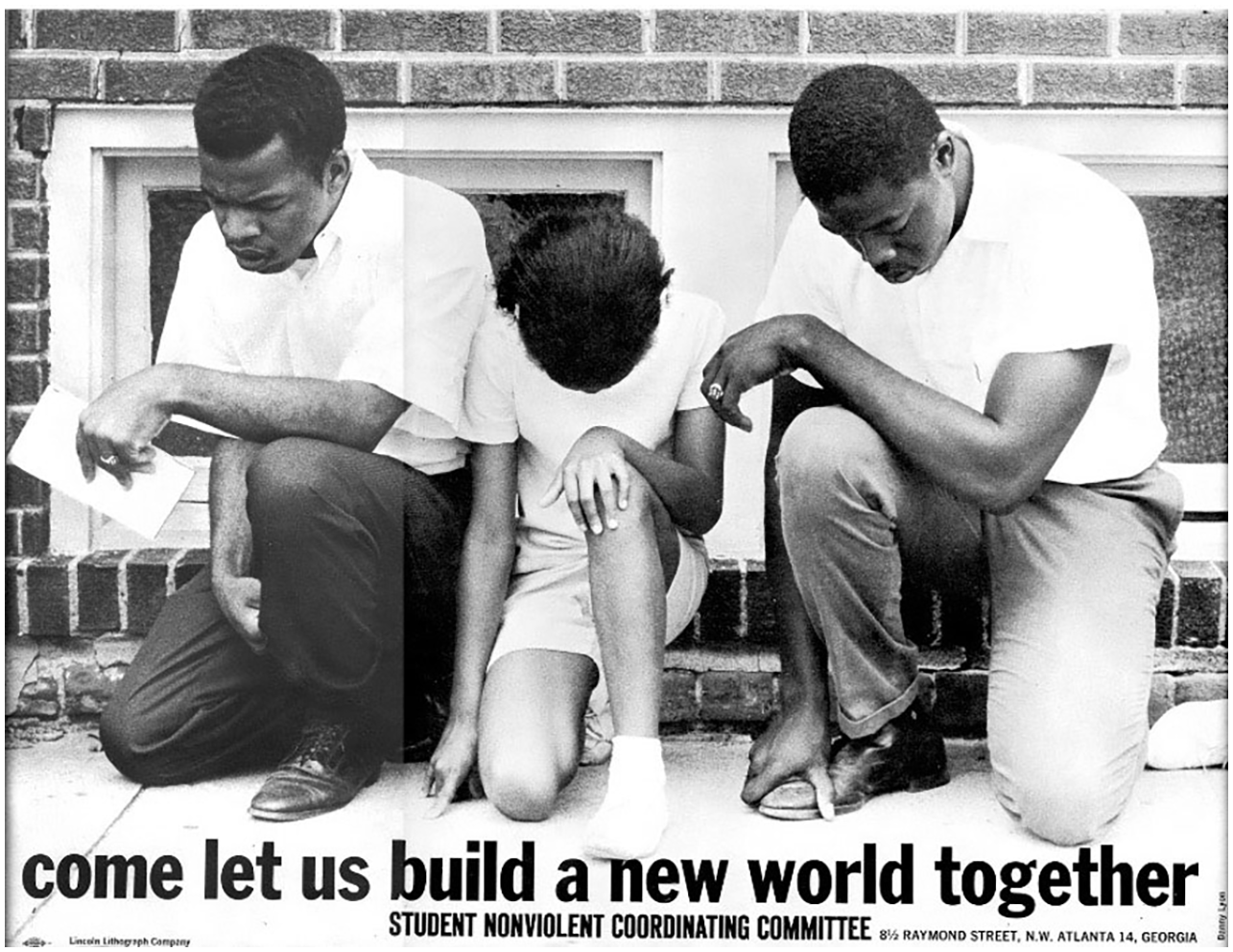
‘Come Let Us Build a New World Together’, SNCC poster (1962), Labadie Collection, University of Michigan, Mus. no. E.2738-1995. © Photograph: Danny Lyon. Reproduced courtesy of Edwyn Houk Gallery.
At a pre-season game against the San Diego Chargers on 1 September 2016, the NFL quarterback for the San Francisco 49ers, Colin Kaepernick, chose to kneel instead of stand during the national anthem. The choice to kneel was an active and deliberate refusal to ‘show pride in a flag for a country that oppresses black people and people of color . . . There are bodies in the street and people getting paid leave and getting away with murder’ (Kaepernick in Wyche, 2016: np). The protest was designed to raise awareness of the social injustices of systemic racism and police brutality within the United States. It is possible to apply theatre historian, Harvey Young’s analysis of the athlete activism performed by Muhammad Ali, to argue that Kaepernick’s performance of stillness ‘reveals his mastery over the presentation and re-presentation of his own body’ (Young, 2013: 112). Like Ali refusing to take a step to confirm his induction into the army and the Vietnam war, by taking a knee and refusing to stand, Kaepernick ‘actively refused to assume the position of the silent screen upon which the desires and thoughts of dominating culture would be projected’. As demonstrated by Kaepernick, the performance of the gestural embodied action of taking a knee demonstrates a rejection of the expected performance of an individual’s body in each moment. It is a rejection of the violence of systemic racism and police brutality within the United States. To take a knee in protest is an active rejection of projected expectations and the status quo. It is a controlled and controlling action, providing the enactor agency. For Kaepernick, control and agency of one’s body is linked to control and agency of the narratives that impact upon embodied experiences. In an interview with USA TODAY Sports, Kaepernick explained,
I learned early on that in fighting against systematic oppression, dehumanization and colonization, who controls the narrative shapes the reality of how the world views society . . . It controls who’s loved, who’s hated, who’s degraded and who’s celebrated. (cited in Bell, 2020: np)
Kaepernick’s act of kneeling rejects the paternalism inherent within the image on the abolitionists seal. It reactivates histories where Black bodies have agency, control over the presentation of self, and are active in the fight for racial justice.
Throughout history, kneeling as a form of racial justice activism has incurred potential personal cost to the individuals enacting the gesture. When Allen and Jones knelt in the late 1700s, their action was met with actual physical violence. When civil rights leaders at the Selma to Montgomery march in 1965 were ordered to disperse, they requested a moment to kneel in prayer. In response, the commanding officer, Major John Cloud, ordered his troopers to advance, resulting in law enforcement beating the protesters with night sticks and trampling them with horses. After opting out of his contract with the 49ers in March 2017, Kaepernick was not signed by any other NFL team. In addition to a loss of income, Kaepernick’s activism led to death threats, Navy SEALs in the US erected an effigy of Kaepernick that they had torn apart by dogs, and Kaepernick attracted a highly racialized and violent rage amongst the self-branded ‘alt-right’ of American politics, inspired by the very public verbal attacks on Kaepernick by the then presidential candidate, Donald Trump (see Zirin, 2021). This is to say that, throughout history, and up until and including Kaepernick’s enactment of the gesture, kneeling to protest racial injustice and/or police brutality was a non-violent but unsafe gesture.
Kneeling served as a prominent symbol of the Black Lives Matter protests in the summer of 2020. Across the globe, activists took the knee to protest against police brutality and systemic racism. In response, news outlets sought to contextualize the decision to kneel and the relationship between the gestural action and activism. Numerous news outlets linked the action to the protests instigated by Kaepernick in 2016 (Branch, 2020; Duffield, 2020; Kavanagh, 2020; Mallinson, 2020; Woodward and Mindock, 2020). In so doing, they further reactivated the histories associated with the gesture. Dave Zirin (2021: xi–xii) argues that Kaepernick’s protest ‘was the warning for a future that came to pass after the police murder of George Floyd, coming on the heels of the murders of Ahmuad Arbery and Breonna Taylor’. Commentators addressing why protesters knelt during summer 2020 comfortably referenced the legacies of kneeling outlined above. The act of kneeling, as a form of racial justice activism, reactivates the ghosts of past protests and is understood as embodying a particular gestural lineage (passed on from one historic protest to another). It is therefore both a haunted and memetic action. On 27 May 2020, NBA player, LeBron James posted to his personal Instagram account two juxtaposing images of individuals kneeling. The first was officer Derek Chauvin kneeling on the neck of George Floyd as he choked him to death. The second was Kaepernick kneeling before a 49ers game. For Marc Lamont Hill, there is an ‘eerie similarity’ between the two positions, and a horrific inversion of the message and intent (Lamont Hill in Zaru, 2020: np). Following the death of George Floyd, the act of kneeling during the protests in 2020 reactivates the legacies of the abolitionist movement, Allen and Jones, the civil rights movement, and Kaepernick, but it reactivates Floyd’s murder and the manner in which he was killed, thus making moments of kneeling post-Floyd’s death in need of further analysis.
During the protests of 2020 there were multiple high-profile instances of serving police officers kneeling at the same event as protesters in the United States (see Knowles and Stanley-Becker, 2020). When police officers knelt opposite protesters, they appropriated a gesture of activism and re-enacted a quelling of Black experiences of violence and oppression. Because the act is memetic it can reclaim the gesture and the narrative. Far from confronting naked truths, the action wittingly or unwittingly suppresses the issue of systemic inequality and police brutality through a momentary performance of solidarity. Kneeling as a form of activism has a long and complex history in search of a future yet to materialize. Kneeling has been adopted and co-opted for different causes and with different design, becoming memetic on account of its variants (its mutations) and haunted by a history intent on repeating itself. Kneeling as a form of protest must critically confront this history.
From Memes to Memetic Performance
Richard Dawkins first defined a meme as a unit of cultural information that is ‘passed on again and again’ taking on a life of its own through repetitive imitative practices (Dawkins, 1976: 249). For Dawkins, the functionality of memes is closely associated with that of genes. Memes provide the mechanism through which cultural information acts as a living structure. According to Dawkins, they ‘propagate themselves in the meme pool by leaping from brain to brain via a process, which in a broad sense, can be called imitation’. As Susan Blackmore (1999: 4) argues, to understand the value and importance of memes, imitation is the key, as ‘without imitation there is no replicator and no new evolutionary process’. Through the focus on the fidelity of replicators, replication and evolution, Dawkins and Blackmore subscribe to the mentalist approach to memetics. Here, imitation from host to host is crucial for good replication to occur. However, as Robert Aunger (2000) demonstrates, there exist alternate perspectives on what memes are and how they operate. Within the interaction or behaviourist approach, ‘any form of social learning’ can spawn the transmission of memes (p. 220). To demonstrate his point, Aunger uses the example of written messages rather than speech. The written message serving as an artefact rather than a signal through which a meme can be reconstructed through engagement with an ‘impoverished stimulus’ (p. 221). Within the field of memetics, the mentalist and behaviourist approach to memes produces limiting binary tensions. The application of Performance Studies theories is one way to respond to the lack of memetic literature on the meme–artefact interaction. In doing so, it responds to Aunger’s observation that little attention is paid in memetics to ‘the necessity of identifying mechanisms for either replication, selection, variation or transmission’ (p. 8).
Performance Studies is a useful theoretical framework through which to examine the function of memes on account of several shared principles. The qualities that define performance for Diana Taylor (2016: 26), the ‘constant state of again-ness’, are also the qualities that define a meme. 4 Performance is memetic because through a constant state of again-ness performance practices develop and can take on a life of their own, what Performance Studies scholar Rebecca Schneider (2011: 102) refers to as ‘transmutation’. Because, as Schneider argues, performances are relentlessly citational, they reactivate past performances, placing the mutation in dialogue with the original(s). As Performance Studies scholar, Philip Auslander (2018: 52) observes, reactivation brings past performances into the current temporal and spatial context, inviting dialogue with the spatiotemporal context of the original. Reactivation ‘makes the past performance real to us in our present and produces in us “an unruly desire” to know about it’. Through an Auslanderian Performance Studies frame, the fidelity of the replication and the means of transmission are less important than what the act of reactivation facilitates – a spatiotemporal bridge between iterations of the performance past and the current moment. To examine memetic performance is to interrogate the role and function of embodied gestural acts, to explore the repertoire, the reenacted and reactivated, to identify and bring awareness to instances of transmutation, and to invite cross spatiotemporal dialogue. In doing so, it facilitates a framework through which to identify moments where a memetic action has taken on a life of its own and what symbolic value the new iteration hides or communicates. This is urgent because memetic performances are certainly not apolitical.
Haunted Memes
Hauntology provides a framework through which to understand failed futures by examining the specters haunting the present. The act of kneeling as a form of racial justice activism is haunted by the failure to enact a future void of racial oppression and police brutality. As a memetic gesture, it reactivates histories of racial violence and police brutality against Black and Global Majority bodies that remain unresolved, unanswered and unaccounted for. The act of kneeling, adopted during the protests in 2020, serves to engage police forces with the ghosts of police brutality and racial oppression. When police officers kneel during protest, it is an opportunity to recognize and address these specters and an opportunity to take meaningful action to confront failures. However, officers who kneel perform a mutated version of the meme wherein the symbolic value is altered and there is limited space to address the specters and the haunt.
As Mark Fisher (2012: 16) states, the 21st century is haunted by ‘all the lost futures that the twentieth century taught us to anticipate’. For Avery Gordon (2008: 8) a haunting denotes a ‘seething presence’, it is both a violent and frightening marker of oppression and a producer of a ‘something-to-be-done’ (Introduction). However, as Katy Shaw (2018: 106) argues, on account of the hypervisibility of ghosts in contemporary culture, the paradox is that ‘specters seem prominent and familiar, yet also harder to “see” than ever before’. The danger is that this ‘undermines the unsettling effect of the specter’, rendering contemporary culture desensitized to the significance of the spectral return and distracted from the relevance of the message specters come to tell. Hauntology is needed to re-sensitize social actors to spectral messages, to enable them to ‘conceive of a world radically different from the one in which we currently live’ (Fisher, 2012: 16).
In its focus on building ‘a better future’ (Shaw, 2018: 3), through ‘co-opting the past’ (p. 2) there is a danger that hauntology is both overly optimistic and a framework in danger of supporting rather than confronting erasure. For Shaw, the spectral return is not about the act of reproduction but about bestowing new purpose and agency through acts that replace the original. It is through acts of replacement that I suggest hauntology and memetics are connected. Whilst, for Shaw, the new purpose and agency bestowed upon the returned does not signify repetition with difference, I argue it does. I suggest that the power and danger in memetics and hauntology are the mutation and transformation inherent in the returned and the reactivated. To extend the work of Schneider (2011) and apply it to notions of hauntology, the return of a specter represents a moment of mutually disruptive energy. The presence of the specter offers a cross-spatiotemporal disruption that demands attention by opening ‘the present to the many possibilities of that which came before’ (Shaw, 2018: 8). Specters are potent because their presence demands dialogue, ‘justice or, at the very least, a response from the haunted subject’ (p. 107). However, that potency can be missed if, on account of the transmutation of the specter, the haunted fail to recognize the ghosts that haunt them, or that they are haunted at all.
The act of kneeling during the protests of 2020 is haunted by many specters. When performed by the protesters, the gesture reactivates the histories and ghosts of racial justice activism, the repeated calls for equality and the demand for the end of police brutality. However, when performed by police officers, the gesture is powerfully complex. It reactivates the specter of George Floyd and performs a show of unity and solidarity between law enforcement and protesters. As a haunted memetic performance, this gesture captures and creates new narratives without necessarily being in dialogue with the specter. As such, haunted memetic performances represent a powerful danger, for they can appropriate action, lay claim to and rewrite narrative and, in doing so, neutralize the threat and transformative potential of the haunt.
‘What Protests Should Really be All About’
In response to the murder of George Floyd on 25 May 2020, activists in Fayetteville, NC began action calling for police reform. Various groups advocated for meaningful action from law enforcement and government officials to develop more equitable practices, transparent accountability and measures to counter previous failings. The following case study examines the act of kneeling by Fayetteville police officers on 1 June 2020 (see Figure 2). By kneeling, the police officers co-opt a haunted memetic gesture, altering the symbolic meaning of the act. A performance analysis methodology of memetic haunting serves to demonstrate how the reading of this performance silences the specters and the haunt. Here, the act of kneeling purports to usher in a new and brighter future. But, in fact, the performance, as an act of repetition with difference, enacts another lost future.
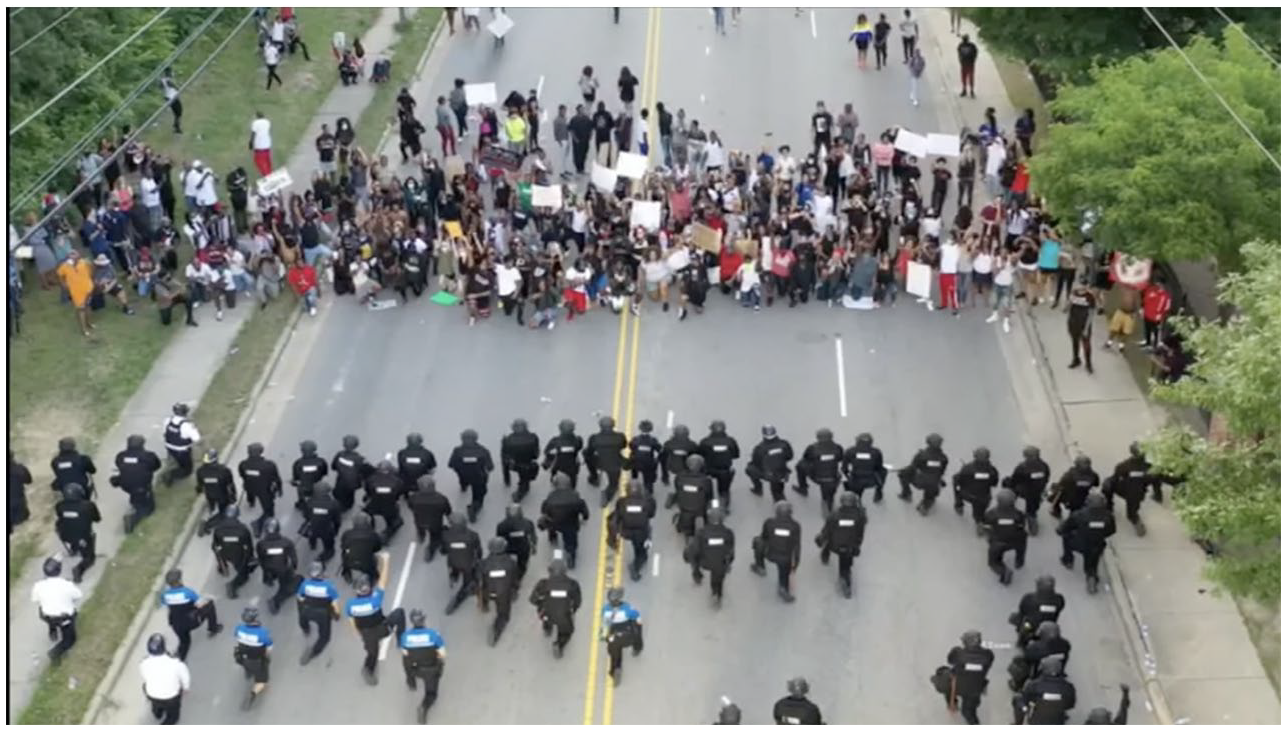
Officers from Fayetteville Police Department, NC, kneel opposite protesters on 1 June 2020. Screengrab from ABC11 News video (see Lozano, 2020) published on YouTube.
On 30 May, protesters marched on the Fayetteville Market House, a former slave market, in the city. Documentation from the march shows altercations between officers in riot gear and protesters. Images capture projectiles (in the form of bottles of water and road traffic cones) being thrown from the crowd of protesters towards the police. Images also show officers using tear gas, smoke and pepper spray against protesters. On the evening of 30 May, many individuals were captured on camera attempting to set fire to Market House. In response, on 31 May, Mayor Mitch Colvin invoked a State of Emergency Declaration imposing a curfew on the city. At 5 pm on 1 June, protesters gathered at Broncho Square and began marching towards Murchison Road. At 5.30 pm, as the group approached Murchison Road, several officers used tasers to detain and arrest one of the protesters, resulting in an intense stand-off between the two groups. The stand-off lasted for three hours. The National Guard remained on stand-by, ready to intervene if needed. Benjamin Zacharias, an on-duty officer, reached out to his friend, Joseph Wiley, a correctional officer and one of the protesters. Between them, they coordinated for protesters and officers to kneel to end the stand-off. As a memetic performative gesture, the act of kneeling de-escalated a potentially violent situation, bringing a temporary resolution to a highly fraught scenario.
In the early hours of 2 June 2020, the Fayetteville Police Department, NC, tweeted a short video clip of 50 to 60 police officers kneeling opposite the group of protesters on Murchison Road. The post on the official Fayetteville Police account, @FayettevillePD read:
As a show of understanding the pain that is in our community and our nation regarding equality, the #FYPD took a knee to show that we also stand for justice for everyone. We are committed to listening and treating everyone with dignity and respect. #LoveONE. (Fayetteville Police Department, 2020)
The Fayetteville Police Department video is shot from high above and behind the police line, giving the impression that it was captured via drone footage. The only sound that appears on the video is an upbeat instrumental track. The video provides no context for the demonstrations and in no way addresses the events that led to the stand-off between officers and protesters on 1 June. The start of the video depicts four or five lines of police officers standing in formation in front of a collection of protesters. There are approximately 50 officers dressed in black fatigues and riot gear, six officers from a bicycle unit in no riot gear, and three officers in limited riot gear and White shirts. Some of the protesters are already kneeling at the start of the video and, as the officers kneel in unison, a Black male emerges from the front line of protesters using hand gestures to signal to the protesters to kneel. Upon kneeling, several protesters also raise their arm in the Black Power salute. An officer from the bicycle unit reciprocates the gesture. After approximately 30 seconds of shared kneeling, the officers rise and resume their defensive formation. The officer who knelt with a raised fist moves towards the front of the police line, fist still raised, to interact with the protesters. He is forcibly pulled back by two officers in riot gear as the drone pans up, past the line of protesters, effectively taking the officer out of shot. Large numbers of protesters approach the line of police officers and interact with them in what appears to be a tactile and comforting manner. The video was subsequently picked up and shared by several local, national and international news outlets. The media coverage overwhelmingly described the incident as a show of unity and solidarity between protesters and law enforcement. Journalist Michael Lozano of ABC11 described the incident as ‘a way to show what protests should really be all about’ (Lozano, 2020: np).
By kneeling to demand an end to police brutality in the wake of George Floyd’s murder, the protesters in Fayetteville evoke the history of the embodied act. Kneeling, in the context of these demonstrations, draws upon the symbolic value of the gesture. It reactivates the histories of kneeling within the context of racial justice campaigns, conjuring the ghosts of police brutality and racial inequality that remain a seething presence demanding justice. When protesters kneel, they make visible the specters of police brutality and racial injustice. Here, the return of the specter is both exciting in what it promises – the possibility for change – and tragic in that its repeated presence serves as a reminder that the promised future of the past is not yet a reality in the present. Police officers kneeling opposite these protesters serve as a perverse enactment of the memetic gesture – it was on account of a police officer kneeling that George Floyd was murdered. The decision to kneel with protestors therefore reactivates the moment of Floyd’s death, but simultaneously reclaims the action and narrative from that of police violence to social unity and harmony. When performed by police, the gesture is injected with new power and agency. The gesture transforms, embodying new symbolic value different from when it is performed by protesters. The meme that emerges is the idea of solidarity, unity, and ‘good’ police. Lost or silenced are the stories of police brutality, of calls for police reform and any long-term concrete action to enact meaningful change. The demonstration against police brutality is quelled by officers repurposing the performative gesture of protest. It is dirty data because of what it reclaims and controls, what it makes visible and hides. Absent from the performative gesture is Floyd’s lifeless body. Absent is a reckoning with what has come before and that which is being repeated. Absent too is a sense of irony in how the re-performance of a political gesture by law enforcement neutralizes the potential for change; the performance of the gesture becomes almost an end to itself. The power of the gesture is such that, when performed by law enforcement, it erases other narratives and histories, fundamentally shaping how events are understood and remembered, shifting the political potency and disrupting the original intention of the act.
In my critique of the power of this gesture, I do not wish to project intentionality on the Fayetteville Police Department, or any other police officers performing the act of taking a knee. I argue that, regardless of the intentions, the act of kneeling has become a potent haunted memetic practice that has taken on a life of its own. In doing so, it plays a dominant role in the stories reported about the protests, effectively neutralizing counter stories, stripping context from the stories and preventing more holistic readings. To take a knee is a haunted memetic performative gesture requiring urgent critical attention. If the act of officers kneeling was underscored by a level of criticality requiring confrontation with past injustices and a dialogic experience with the specter, the act would constitute a powerful transformative haunt focused on social justice. Without this level of criticality, the memetic gesture remains powerfully transformative because it rewrites the narrative, shifting focus from police brutality and injustices to a performance of solidarity and unity. Here, the reenactment turns the police officers into heroes at a moment in history when police practices and procedures are in urgent need of examination. It becomes a performative gesture of unity and resolution, negating the need for actual reform and reckoning. The act of kneeling by police officers serves to neutralize a threat rather than embrace the specter with hospitality. If the narrative is allowed to be refrained, uncritically, by the performative memetic act, the haunt is rendered less visible. The unresolved social violence is (re)contained, repressed and blocked from view once more. Dirty data is viral data capable of pacifying calls to action.
Conclusion
When police officers knelt with Black Lives Matter protesters in 2020, they co-opted a potent and haunted gesture. In the 1780s, the image of a kneeling suppliant Black male symbolized a plea from an enslaved man to an unseen slaver for recognition and humanity. In the late 1700s, when Richard Allen and Absalom Jones, two former enslaved men, took the knee to pray at the St George’s Methodist Church in Philadelphia, the gesture was interpreted as protesting segregation. The revenant and nonviolent action, performed by Allen and Jones, was met with force from White members of the congregation, who could not tolerate seeing Allen, Jones and fellow Black worshippers kneeling in a newly segregated area of the church. Allen and Jones played a pivotal role in the foundation of the Free African Society in 1787 and Allen was ordained as the first bishop of the independent Black denomination African Methodist Episcopal Church in 1816 (see Bragg, 1915: 9). Through these organizations, Allen established a pulpit through which to advocate for individual and collective agency of Black Americans. He negotiated with and challenged White authorities and White authored accounts of Black experience with an aim to ‘alter the lived experiences of his people’ through the constitution of a position which ‘best represent[ed] their interests’ (McClish and Bacon, 2008: 2). Key to Allen’s activism was ‘prosecuting the struggle for justice’ (Newman, 2008: 96). The act of kneeling in prayer resurfaced as an act of protest within the civil rights movement in the 1960s. The images of kneeling activists in Birmingham and Selma became iconic symbols of nonviolent protest. The 1963 SNCC poster depicting John Lewis and two fellow protesters kneeling in prayer outside a segregated swimming pool in Cairo, Illinois, emphasized the possibility of a utopian vision of collective freedom. The text accompanying the image, ‘COME LET US BUILD A NEW WORLD TOGETHER’, is a call to action, functioning ‘as a catalyst to transform audiences into active participants’ (Raiford, 2007: 1137). For the individuals performing the action, kneeling as a form of protest comes with the threat of personal cost. From the violence committed against Allen, Jones and their Civil Rights counterparts, to the loss of contract and livelihood suffered by Colin Kaepernick, kneeling during protest is not without consequence.
The act of kneeling by officers wearing riot gear does not open the possibility of recognition and responsibility, for their performance does not position them as the haunted subject and they are not in dialogue with the specters of police brutality and racial injustice. The enactment of the memetic gesture simultaneously calls forth the specters of Black and Global Majority people killed whilst in police restraint and serves as an act of erasure to the visibility of the ghost of George Floyd. The act reclaims and repositions the narrative. It stages reconciliation, understanding and unity. But the actors remain costumed in the artifacts of state violence and institutional racism. The performance is dangerous because of how quickly it repurposes an act of violence into an act of solidarity and positive change. To focus on the imagined or actual intention of individual officers is to miss the point because the violence is committed by how the memetic gesture takes on a life of its own as a cultural performance and, importantly, then how that cultural performance is packaged, sold, consumed and reviewed. It cannot be allowed that the specters of racial injustice and police brutality are rendered invisible through performative memetic acts and gestures. The obscene must continue to be seen. Witness must be paid to the knee of officer Chauvin pressed into the lifeless neck of George Floyd. This specter must remain visible, as must the specters of the countless individuals who have died as a result of police action – the revenants that are in danger of being rendered invisible when a gesture is co-opted and staged. The return of the specter must be noted for what it reveals, a promised future still to be realized.
To successfully engage with the specters of social justice activism, individual actors must maintain a critical awareness to the symbolic meaning of the gestures they enact and the histories and revenants these performances reactivate. This can be achieved through a development of the concept of memetic haunting into a methodology for the analysis of cultural performances. This would support future research projects applying the concept of memetic haunting to an analysis of collective and repeated social acts.
Footnotes
Funding
The author received no financial support for the research, authorship and publication of this article, and there is no conflict of interest.

Notes
Biographical Note
Address: Northumbria University, Elison Building, Newcastle upon Tyne NE1 8ST, UK. [email: