



Abstract
Black Lives Matter, like many modern movements in the age of information, makes significant use of social media as well as public space to demand justice. In this article, we study the protests in response to the shooting of Keith Lamont Scott by police in Charlotte, North Carolina, on September 2016. Our goal is to measure the significance of urban space within the virtual and physical network of protesters. Using a mixed-methods approach, we identify and study urban space and social media generated by these protests. We conducted interviews with protesters who were among the first to join the Keith Lamont Scott shooting demonstrations. From the interviews, we identify places that were significant in our interviewees’ narratives. Using a combination of natural language processing and social network analysis, we analyze social media data related to the Charlotte protests retrieved from Twitter. We found that social media, local community, and public space work together to organize and motivate protests and that public events such as protests cause a discernible increase in social media activity. Finally, we find that there are two distinct communities who engage social media in different ways; one group involved with social media, local community and urban space, and a second group connected almost exclusively through social media.
Introduction
For the first time in history, since 2013, the majority of the world’s population lives in cities. Cities are the place where people live, work, and innovate, but they are also places where people face grave injustices and unfairness. The American city has consistently been a place where racial dynamics and injustice come to light. The civil rights movement in the 1960s took to the streets and focused on the public domain in an effort to narrow the racial divide. However, residential segregation has consistently remained a major feature of many American cities (Welch et al., 2001). These inherent racial biases are evident in many other aspects of cities and societies in the United States. African American neighborhoods are prone to food disparities (Gordon et al., 2011), higher disability rates (Brault, 2012), and unfair education systems (Dobbins et al., 2016).
Social media has changed the way activists try to address these injustices and increase the participation of underrepresented populations (Mohebbi et al., 2018). The Black Lives Matter movement has spurred demonstrations against ongoing police brutality, racial segregation, and injustice in the United States. Black Lives Matter is expressed using social media with the iconic #BlackLivesMatter hashtag, facilitating urban protests in many cities in response to the deaths of unarmed African Americans by police (Miller et al., 2017). One of the key features of the Black Lives Matter movement, as highlighted by the hashtag, is the integral role played by social media. The role of social media worldwide can be seen in the urban protests and revolutions such as the Arab Spring in Egypt and Tunisia, the Green movement in Iran, and the Indignados movement in Spain (Khonsari et al., 2010; Tufekci & Wilson, 2012). Black Lives Matter supporters not only use social media as a means to show individual support but they also use this tool to organize protests, to connect with other supporters, communicate and discuss their goals and demands, and transmit their agenda and their peaceful message (Carney, 2016).
The aim of this research is to understand the role of urban space, social media, and local community in contemporary urban protests. To do so, we focus on one instance of a Black Lives Matter protest that occurred in Charlotte, North Carolina, on September 2016. The protests were a response to the fatal shooting of Keith Lamont Scott by police and continued for at least 3 days. We studied these protests from three different perspectives: social media, local community, and urban space by adopting a mixed-method approach to capture this heterogeneous data. To study the protesters’ perspectives on the significance of urban spaces and social media in their activities, we conducted a series of interviews with activists in Charlotte, North Carolina. To study the protesters’ use of social media, we analyzed a large corpus of Tweets that included keywords related to the Charlotte protests. The analysis included natural language processing (NLP) and analysis of social network of mentions and retweets on Twitter. In this article, we explore the following research questions:
RQ1. What was the significance of different urban spaces in the Charlotte protests?
RQ2. What role did social media play in the protests?
RQ3. What was the overlap between social media and urban space, and how did local events influence social media activity?
In the next section, we review the existing literature regarding the relationships between protests, space and place, and social media. Next, we describe the case study, data sources, and methods used to conduct this research. We then discuss the results of our analyses and their implications by describing the results of the interviews of activists and protesters, and then, by conducting an in-depth analysis of Twitter data using knowledge derived from the interviews related to the Charlotte protests. Finally, we conclude by offering some remarks on how the results of this research would help us to better understand the relationships between place, social media, and activism within both the Black Lives Matter movement and in a broader context.
Literature Review
The emergence of social media had resulted in new terminology to describe its effect on activism. At the most general level, “horizontalism” describes how digital media has shifted the form of social movements to “leaderless” and “horizontal” movements (Juris, 2005) and “swarms” is invoked as an analogy for describing how new forms of communication create a collective intelligence that is more than the sum of the individual agents (Hardt & Negri, 2005). Some emphasize the “collective identity” created by social media (as well as traditional media) through the rapid sharing of ideas and symbols as the main role of social media in protests (Gerbaudo, 2014).
In addition to these general concepts, recent work has sought to provide alternative frameworks to better address the complexities of communication within social movements. Scholarship using the metaphor of media ecology (Treré & Mattoni, 2016) has focused on resisting reductionism, exploring a multiplicity of media forms, studying the unfolding of using media over time, and recognizing the corporate and state interest and involvement in media. Identification of the multiple audiences for mobile communication (Neumayer & Stald, 2014) provides another way to better understand the multiple affordances of this media. Identification of activist to activist, activist to mainstream media, and activist to authorities’ communications helps to clarify our understanding of power relationships and goals.
Some scholarship on social movement and media (Kaun, 2017) has sought to resist technological reductionism by connecting studies of protests movements to established models of mainstream media (Rucht, 2004) While recognizing the affordances of social media, this identification of adaption, abstention, attack, and alternatives gives central importance to protesters’ intention and motivation. Through a statistical and qualitative analysis of twitter data during the Egyptian revolution, a study by Kate Starbird highlights evidence of the different functionalities of Twitter for protesters, from being used by “on the ground” users as well as those who are not (Starbird & Palen, 2012).
In the context of Black Lives Matter, Carney considers social media as a new platform that increases access of activists to the public sphere. To understand the way social media is used during the events associated with the killing of Eric Garner and Michael Brown, she identifies a group of users that use Twitter to “Call to Action,” as well as a group that discusses the events in solidarity with the victims. However, she also identifies another more unsympathetic group that uses All Lives Matter as a way to protest the Black Lives Matter movement (Carney, 2016). Stewart et al. (2017) conduct a data driven analysis of Twitter users by creating a “shared audience graph” during Black Lives Matter protests and show that twitter was used in different ways including to mark participation, assert individual identity, and to support or challenge a specific frame.
The nature of social media and its effects on social movements are heavily debated. Alterman (2011) argues that even though social media such as Facebook and Twitter has, in fact, played an important role in mobilizing protesters in Egypt, news agencies such as Aljazeera made a greater impact on the events of the Egyptian revolution. In contrast, Earl and colleagues conduct research on a corpus of tweets related to the protest surrounding the G20 meeting in Pittsburgh in September 2009. They test a series of hypothesis regarding the usage of Twitter for sharing of protest location as well as police action and conclude that Twitter has played an integral role as the primary form of organization in these protests (Earl et al., 2013).
Although this conclusion has been widely accepted, there has not been as much focus on the relationships and dynamics of place, activism, and social media. Hardt and Negri argue that in the current globalizing world, place is not of primary importance. “The multitude,” which they define as a new form of social class, is created in the globalizing world and by the new forms of network communication. They claim that “the multitude” is irreducible to its individual agents and does not have a place (Hardt & Negri, 2005). Gerbaudo (2018), however, criticizes the idea and argues that place which is occupied by activists highlights a form of unity and togetherness that is inseparable from the process of mobilization.
Manuel Castells also sees a change in the way our societies function and discusses the relationship with urban space. He defines “network societies” as new forms of social structures influenced by globalization and the information and the communication revolution. Castells (2004) describes a network society as “a society whose social structure is made up of networks powered by micro-electronics-based information and communications technologies.” Individuals use social media to form virtual networks with other supporters of their cause. They use them to quickly and efficiently spread video and images of police brutality that start a protest, and they also use them to repel the forces against their ideas. The usage of social media, however, does not stop here. The Internet is used to call supporters to action in the streets, highways, and squares that have symbolic significance, and in some cases to disrupt the physical and material flows in cities (Castells, 2015).
A very clear example of this type of connection between virtual space and public space was the Tunisian rebellion. In his book, Networks of Outrage and Hope, Manuel Castells (2015) calls this phenomenon “a hybrid public space of freedom”:
The connection between free communication on Facebook, YouTube, and Twitter and the occupation of urban space created a hybrid public space of freedom that became a major feature of the Tunisian rebellion, foreshadowing the movements to come in other countries.
Our work builds on this approach, focusing in detail on the distinct and interwoven roles of local community, urban space, and social media in protest movements. Therefore, we study the Charlotte protest through three interconnected layers:
Local Community: The perspectives of people, friends, and families who meet each other in physical space or private media. Our goal is to study how people connect and distribute ideas and concerns. This will allow us to understand the motives of protesters and how they select and navigate urban space and social media.
Urban Space: The locations where both the local community and the social networks select and focus their protests. We study urban spaces where communities are formed, demands are made, and protests are focused.
Social Media: Sites on mobile social media where information and thoughts are shared, communication is rapidly made, and protests are planned. While some communication on social media is between people who know each other, much of it is anonymous, public, and widely distributed.
In the next section, we analyze the Charlotte protests through a Mixed-Methods approach.
Data Source and Methodology
This article uses a combination of qualitative and quantitative methods to study the Kieth Lamont Scott shooting in the context of the relationship between social media and urban space. In the section, we present an overview of data, methods, and tools used to conduct this study:
Data
To analyze the Charlotte Protest through the lens of social media, we used the Twitter GNIP API 1 to obtain a data set of Tweets that included keywords and hashtags such as #keithlamontscott, #charlotteprotest, and #charlotteriots. GNIP API allows for access to a complete collection of tweets based on the requested query. The data set consists of approximately 1.3 million tweets between September 20 and 25.
Qualitative Analysis
For the qualitative analysis of social networks of protesters, we interviewed protesters who were among the first to participate in the Charlotte protests. The sessions were semi-structured, with some open-ended questions. The interviews mainly consisted of discussing the multiple days of protest in Charlotte while focusing on the “why” and “how” of activists’ actions. We asked questions regarding the location’s activists went to and the significance of those places. We also inquired about the different types of social media they used and the role each social media played in their actions. The discussions made in the interviews were audio recorded, transcribed, and thematically analyzed.
Spatial Analysis
To measure the locations of protests, we looked at two measures of importance. First, we calculated Edge Betweenness Centrality of the street network. Given a street network with intersections as nodes and street segments as edges, Edge Betweenness Centrality denotes the number of shortest paths that go through each edge from all nodes to all nodes. This method has been used as a means of measuring structural importance of cities (Crucitti et al., 2006; Gao et al., 2013; Karduni et al., 2017). Using this metric, we evaluate whether protests in Charlotte occurred in areas of high connectivity, and whether this was a factor in protesters’ decision making. We create a network of Charlotte’s streets using GISF2E (Karduni et al., 2016) and calculate Betweenness Centrality using Python NetworkX (Hagberg et al., 2008).
Second, we calculate the density of businesses as a measure of functional importance within a city. To calculate business density, we divide Charlotte into a mesh of 0.25 by 0.25 km2. We will use business location data from yelp and count the number of businesses that fall into each square. Using this metric, we will evaluate whether protests in Charlotte occurred in areas of high business density and whether this was a factor in protesters’ decisions. We use ArcGIS 10.4 for visualizing the results of our spatial analysis.
Social Media Data: NLP
Since geographic data are often scarce in social media data, we use NLP methods to extract spatial information from the text of tweets. First, we conducted NLP on the text of the tweets to extract meaningful information regarding spatial information from tweets. We used the Stanford NLP’s Named Entity Recognizer (NER) to extract location information from the tweets (Manning et al., 2014). NER is a method that tags words in a document as being about a Location, Date, Person, Organization, or other similar tags. We used NER to detect mentions of Charlotte places and other spatial information from the texts of the tweets.
Social Media Data: Social Network Analysis
Social network analysis focused on user mentions and retweets to understand the different actors and their role in the social media. In this network, Twitter users are nodes and retweets or mentions are edges. For example, if User A retweets User B, there will be a directed edge between B and A. If this retweet act happens multiple times between these users, the weight of the edge between them will increase. This method results in a weighted directed social network.
We used different social network analysis methods and metrics to understand the features of this network and how different groups of people interact with each other on Twitter in the context of a protest. The first method to analyze the social network is community detection which automatically categorizes the nodes into different tightly connected groups. Community detection allows us to understand whether different users shape different clusters and whether they behave differently in these clusters. Similar to Stewart et al. (2017), we used Louvain modularity community detection to automatically detect major community structures in the social network (Blondel et al., 2008). The main question we answer using the community detection results is different communities in social media have a different relationship with the protests, specifically in terms of usage of space and spatial information.
To analyze the importance of Twitter users in the network, we used the PageRank algorithm (Page et al., 1999). PageRank was originally created by Larry Page of Google to measure the importance of Web pages in the World Wide Web based on their number of links and their proximity to other important nodes. The PageRank algorithm produces a probability distribution for each node representing the likelihood of a random surfer ending up on a specific node. Finally, for each node in the constructed network, we also count the number of time spatial information is used. We call this metric the placeMention of each node. We constructed the social network using NetworkX (Hagberg et al., 2008) and visualized and analyzed the data using Gephi (Bastian et al., 2009).
Anatomy of the Keith Lamont Scott Protests
This research was conducted through a case study of one Black Lives Matter protest in the city of Charlotte North Carolina. It is important to note that Black Lives Matter is a chapter-based organization that is active throughout different cities in the United States. However, the organization does not have a chapter in Charlotte. The protests in Charlotte could be considered as a sister movement that took place in solidarity. Thus, organizations in Charlotte may employ tactics that are not standardized or used by the official chapters of the Black Lives Matter movement. The Charlotte protests took place in the aftermath of the shooting of Keith Lamont Scott on 20 September 2016. We collected information using interviews and social media data analysis. Figure 1 shows a summary of our mixed-methods approach.

The mixed-methods approach of this research to study urban protests.
Qualitative Analysis: Local Community and Urban Space
For this study, we interviewed a total of 10 individuals who participated in the protests that occurred between September 20 and September 23 in Charlotte. The interviewees consisted of three individuals who did not self-identify as an activist and seven individuals who did consider themselves activists. We recruited participants through word of mouth and guidance from activist organizations in Charlotte. During the interview sessions, we asked the activists to give a narrative of their participation in the protest. We also occasionally put the focus on the whys and hows of going to certain spaces and utilization of specific social media. The discussions focused on the first two nights of the protests. The information gathered from the interviews allows us to understand:
The strategies adopted by protesters in both social media and urban space,
How protesters reach decisions to take actions to make demands in social media,
How urban space was understood and selected for protest actions.
First Night: Old Concord Road. Where the Shooting Occurred and the Protests Started
The first night of the protests was unplanned. All activist interviewees participated in the first night of the protest which happened near Old Concord Road and Harris Boulevard in Charlotte. Initial communication was organized through Facebook chat, and organizing efforts were coordinated via text messages to rally protesters to the shooting location. Based on the observations of the interviewees, physical proximity to the location of the incident was the first draw for the initial student group. One of the interviewees who did not identify as being an activist, mentioned that he first heard people shouting and went to the location to observe. It was only after hearing about the details of the event from the other protester that he started to protest against the police.
When we asked the interviewees why they went to Old Concord Road, almost everyone mentioned the desire to give support to the family of the victim. In addition, it was the most natural place to go to protest as it was close to the University of North Carolina at Charlotte where many of the protesters were students. When asked about the implications of choosing Old Concord Road, one of the activists described how the physical nature Old Concord Road impacted the protesters: “The reality is that it [the protest] had to be big because that area is so separated and it would be easy for police to surround or block off people.” Later the same evening, the protest moved from Old Concord Road to the intersection of a major freeway (Interstate 85) near the original site. The fact that Old Concord Road is not well-connected (which made it easy for the protesters to be contained) led to this tactical shift in location in an effort make the message louder.
Regarding how the first-night protest grew in size and how people were motivated to participate, interviewees replied that Facebook live, Periscope, and Instagram were all used to live stream the events. One of the interviewees said, “Everyone was live streaming, so when they got one of our phones, others would still show what was happening.” The news coverage, along with texting friends and live videos helped the first night of the protest to become loud and impactful. “By the end of the night, there were people protesting who came from Raleigh (the capital of North Carolina). A lot of them stayed with me that night.”
Second Night: Uptown Charlotte, a More Organized Continuation of the Protests
The second night of the protests happened with more organization and planning. The location of the protest changed from the University Area to Uptown Charlotte. All of the interviewees told a similar story about the sequence of events. One interviewee who did not identify as being an activist said that she was contacted by one of her friends and was told about a gathering at a church in Uptown. The church was a place that some of the in-person organizations took place. One of the activist interviewees was also present in the church.
Most of the other interviewees started the second night’s protest in Marshall Park, a park near an important government building in Uptown Charlotte without residential uses around it. Marshall Park is a place where most protests in Charlotte are sanctioned: “Marshall Park is one of the most central locations in the city, it’s where all protests pretty much start at. It’s also right by the jail, government center, etc.” Another interviewee said, “It’s easiest to find parking for free around Marshall Park and it’s easy to identify and use as a meeting place for people coming from different directions.” Another interviewee had a different perspective about the park: “Even though it’s close to Uptown, it is still separate from most of the activities . . .”
After Marshall Park, protesters flowed into the center of uptown, namely the intersection of Trade and Tryon streets which one of the activists described as “literally the center of the city.” Another interviewee described this interaction as: “I think that Trade and Tryon ended up being an important place because police tried to corner people into that area.” This shift caused a direct response from police officers who were in fact not concerned with the protests in the sanctioned area of Marshall Park. Epicentre, a mixed-use entertainment, retail and residential project, is another location in the immediate vicinity of Trade and Tryon where many of the protests were pushed: “Epicentre and the areas surrounding represents really what this city was made for right [wing], white people. It represents that these are the areas to disrupt.”
There were other places that were mentioned by some of the interviews but were not as prevalent. For example, a football stadium is also very close to Trade and Tryon:
It was really difficult to disrupt people in front of Panther’s games at the stadium because the stadium is technically “private” property so in order to avoid arrest we had to stay on “public” property which made it more difficult to interrupt as we were separated from the stadium and the people whose attention we were trying to get.
Social media played an important role in motivating people to participate in the protests. One of the protesters who did identify as being an activist said that he would not have participated if he did not see a live stream of the protest in Trade and Tryon. “When I saw the video on Facebook, I just had to go . . . you could see exactly what was happening and that is powerful.”
Encrypted text messaging was also considered as an important tool for communication. Activist interviewees mentioned that after the first night of protests many phones were investigated by the police. In response, protesters started using encrypted text messages for security purposes. Networks of friends were also a very important factor in bringing more people into the protest as described by one of the interviewees: “if my roommate didn’t text me, I wouldn’t have gone because I had a long day and I was really tired.”
In the duration of the protests, different types of social media were used but for different purposes. Events in Facebook were used to organize people for future protests. Photo sharing apps such as Snapchat and Instagram were used to share photos of protests as they happened. Chat applications were used to give support to other people and ensure their safety. Other social media such as Twitter were used to read and publish news about the protest in real time. Finally, live streaming the event played a crucial role in motivating people and contextualizing the protests for people who were not present at the protests.
Social Media and Urban Space
In this section, we first briefly study the temporal and spatial nature of these tweets and then analyze the data set as a social network.
The final part of the analysis consists of merging the results of the social media data analysis and interviews through the context of urban space. We first analyzed the social network by observing the users’ use of detailed spatial information in their tweets. This serves as another measure of “importance” for nodes in the networks by simply counting the number of times nodes are mentioning specific places in their tweets and studied nodes with high place mentions in the context of their social network.
Spatial Information in the Charlotte Protests Tweets
We analyzed the locations mentioned by our interviewees based on their surrounding areas to see whether they stand out based on different demographic and geographic information. Figure 2 shows that the areas around Uptown Charlotte are among the highest in terms of density of businesses and street connectivity. However, that was not the case for the area where the first night’s protests occurred. These results confirm the narratives we gathered from protesters about the significance of these different areas, More specifically, we can observe from a data standpoint that the location of protests in the first night had mostly a symbolic significance (in close proximity to where the shooting occurred), rather than the second night and third night as the protesters moved to a more functionally and structurally important area in the city. Figure 2 shows the location of the protests as well as measures of Betweenness centrality and Business Density.

Business density and street connectivity around protest areas. Darkest color the highest business density and white the lowest. Thickest streets highest connectivity. This map shows that the protest locations on the second night are in close proximity to functionally and structurally important areas.
Extracting geospatial information is crucial to understanding the spatial nature of social media usage. Unfortunately, our tweets data set is almost without geolocated tweets (less than 200 tweets have geolocation information). This lack of geolocation information is in line with the low rates of geolocation information on Twitter (around 1%). It could also be a strategic action to shield one’s location. This issue was not discussed during the interviews and would require further investigation.
To rectify this problem and mine geolocation information from other sources, we conducted NER on the text of all of the tweets to find all of the mentions of places in the text body of the tweets. The results of this NER analysis were saved in a database for further analysis. Figure 3 shows a visualization of the count of each place that is mentioned in the data set.

Visualization of mentions of specific place names in the text of tweets in the data set. Color and size correspond to frequency.
The highest number of place mentions found in the data set was Uptown Charlotte which fits well with the focus group results. Marshall Park, Trade Street, and Epicentre were also mentioned both in the interviews and in the NER results. These results show that tweets correspond to specific places where protests occur. Important places mentioned in the interviews are also found with higher numbers in the tweets data sets. However, not all tweets contain mentions of specific places. In fact, the majority of the data set contained tweets discussing the shooting or details of the subsequent events such as the request of the victim’s family demanding the release of the video, comments on the video itself, or questions as to if the victim held a gun in his hand or a book. Understanding how these places are mentioned and by which groups of users will help us better understand the relationship between social media and public space. To do so, we combined the results of the NER analysis with social network community detection to understand how different groups of people use geographic information in social media.
Spatial Information in Mention-Retweet Social Network of Charlotte Protests
We constructed a social network of the Charlotte protest by considering each Twitter user as a node in the network and the existence of a mention or a retweet between them as an edge. The accuracy and representativeness of this social network in comparison to other types such as ones constructed by first-person interviews or through Twitter following information has not been studied and requires further investigation. The constructed network was a directed graph with 341,066 nodes and 899,237 edges. The weight of edges in this network are the count of retweets or mentions between these two nodes. Each node also has the number of times they mention any of detailed places in Charlotte such as Marshall park, Epicentre, Trade and Tryon, and Omni hotel in the text of their tweets (we call this the placeMention of each node).
We started by conducting community detection on the whole network. As seen in Figure 4, the results show two main clusters that are highly connected within the cluster and less connected to the other. The community detection produced other clusters which were too small to be visible. We then calculated the PageRank of each node in the network. We can think of PageRank as a metric for the importance of each node in the network.

Social network constructed from retweets in the data set. Nodes are individual users and edges are retweets between them. The color of nodes and edges correspond to community detection results.
We used the results from these algorithms to explore the content of tweets and get an understanding of the different groups of users and the different ways Twitter content was used in the Charlotte protest. To do so, we studied the top nodes in the sympathetic and unsympathetic communities based on their PageRank and placeMentions. We then read tweets by the Top 20 users in each group and studied their Twitter page (if it existed) and tagged them based on whether they were local to Charlotte, whether they were pro, neutral, or against Black Lives Matter protests. We considered tweets that were simply reporting an event as neutral, and opinionated tweets were tagged as pro/against. We noted their occupation based on their Twitter user profile and noted whether they are the Twitter handle for a person, an organization, or a news agency.
Studying the Top 20 most influential nodes in the network immediately highlights important distinctions within the Twitter data as a social network (see Table 1). First, we can see that in the Top 20 most influential nodes in the network, there are some users that are not local to Charlotte. There are users who are against the protests and criticize the actions and there are users who are supportive of the protests. Moreover, we can observe that users who are against the protests are from Community 0 or “unsympathetic” community (colored purple in the tables and in the graph visualization) and the people who are neutral and pro the protests are almost uniformly from the Community 52 or “sympathetic” community (colored green in the tables and in the graph visualization). These results show distinctly different approaches to the Black Lives Matter protest from different groups.
Comparison of Two Major Communities in the Charlotte Protests Network*.
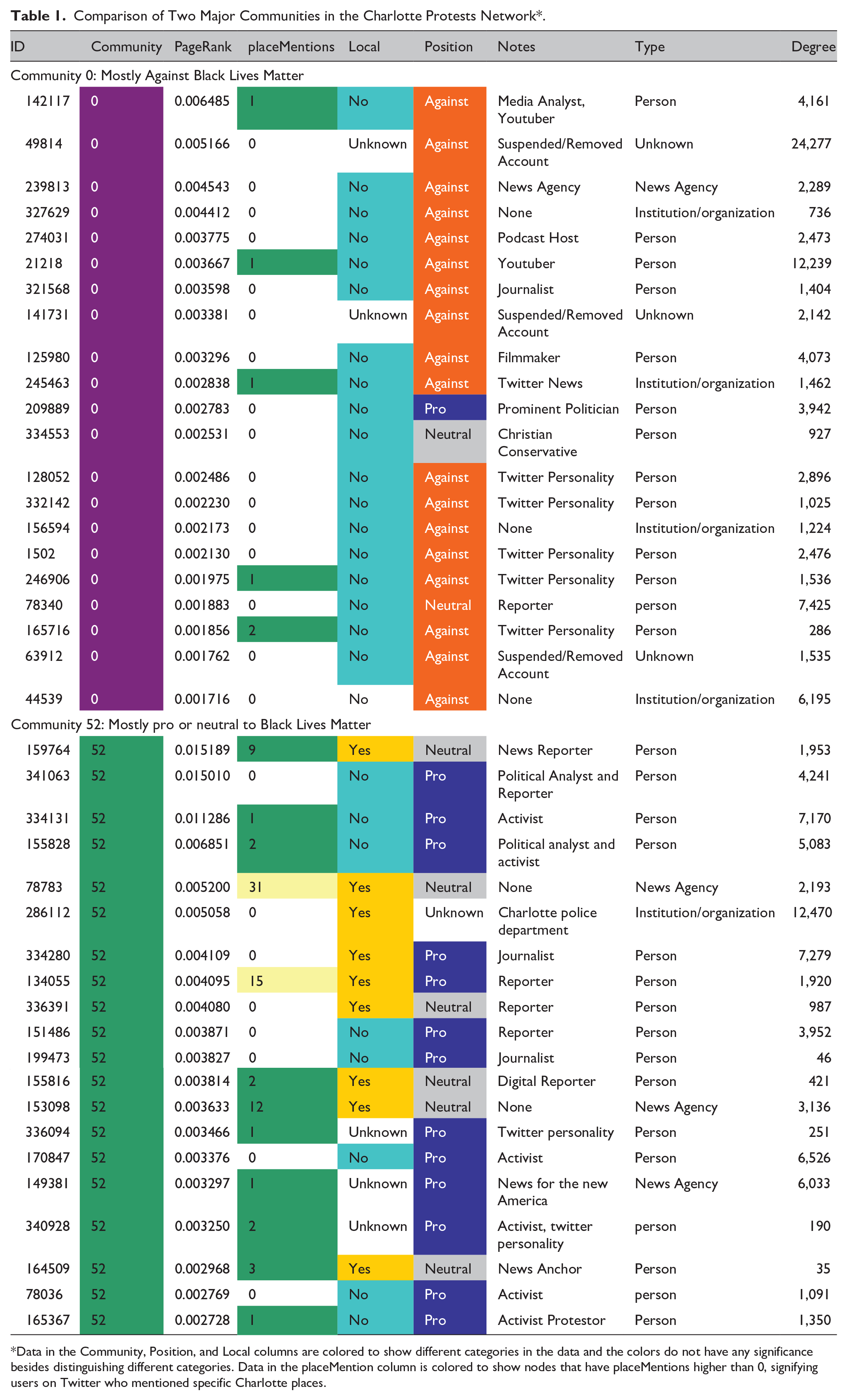
Data in the Community, Position, and Local columns are colored to show different categories in the data and the colors do not have any significance besides distinguishing different categories. Data in the placeMention column is colored to show nodes that have placeMentions higher than 0, signifying users on Twitter who mentioned specific Charlotte places.
None of the top influential nodes in the Unsympathetic community are local to Charlotte and there is an even distribution of local and non-local users in sympathetic community (Table 1). This indicates that supporters or criticizers of these protests are more likely to retweet each other and belong to the same community. We can also observe that there is very minimal mention of detailed Charlotte locations in the unsympathetic community, and we see more mention of places in the sympathetic community.
To investigate more deeply the role place plays, we studied the nodes with the highest mentions of Charlotte detailed places (see Table 2). With the exception of one user, all of the users with the highest mention of specific Charlotte places are either pro or neutral to the protests and they are in fact from the sympathetic community. Reading tweets from specific users shows that the users were not local, but in fact from the United Kingdom. All of the 29 mentions were retweets of one tweet that included the word “Marshall Park.” Furthermore, we can observe that 12 out of the Top 20 users with high placeMentions are local to Charlotte. Out of the Top 100 users with placeMention (lowest count of 5 placeMentions), 85 nodes belong to sympathetic community which are more likely to be supporters or neutral of Black Lives Matter.
Top Users That Mention Specific Charlotte Places in the Text of the Tweets.

We can further investigate this behavior by comparing the temporal behavior of these two communities with the unfolding of events in the Charlotte protests. Figure 5 shows social media activity in Twitter correlated with major events over the 2-day period. 2 The relationship of Twitter activity with protests in urban space is clear. Furthermore, the temporal behavior of these two communities is indeed different. The “sympathetic” community has a first spike of activity that coincides with the first night of protests on Old Concord Road. This community has a spike of similar magnitude during the second night of protests, and two slightly smaller spikes during all later events. The unsympathetic community has a single spike of activity on the second night of the protests corresponding to major national and international news coverage of these events.
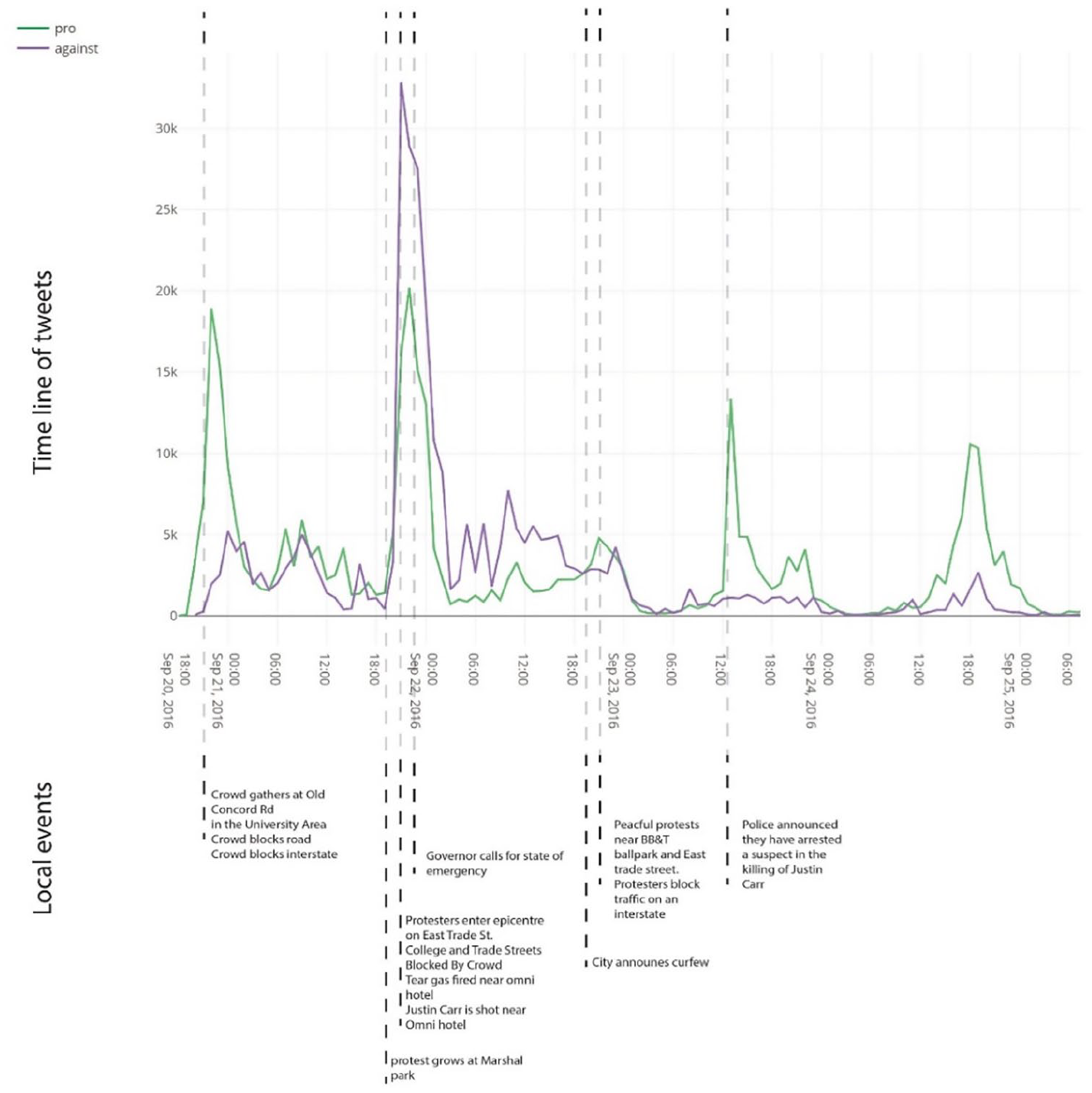
Comparing the temporal behavior of two communities in the social network of Charlotte protests with protest events.
Discussion
The protests that occurred in Charlotte in 2016 were spontaneous and had many news agencies around the world following the events. In this research, we aimed to study these events as a case for understanding the relative importance of urban space and social media in the context of Black Lives Matters.
From a set of interviews with local protesters, we found that interviewees all relied on social media of different types to diffuse information, contact friends, and organize and plan future events. However, every social media was used differently. Text messaging was used to virtually connect with friends and acquaintances. Encrypted messaging was used to communicate without the fear of being monitored. Some social media such as Facebook with features such as Events and chat group enabled protesters to organize future events. Some social media such as Instagram and Snapchat that are more multimedia focused were used to share images and videos of protests as they happened. Live streaming played a crucial role in motivating people by offering the most realistic and real-time snapshot of the protests. Twitter, which is the most public but most restricted platform in terms of content, offered a means for people to communicate with a large audience in a streamlined manner, to spread news quickly, to discuss issues, and to suggest movement in the city. Moreover, we infer that Twitter specifically was used by a larger non-local audience as well who had an interest in the protests. In line with work with Starbird and Palen (2012), evidence from our research shows that a group of users who we inferred to be more sympathetic to the Black Lives Matter protests used more spatial information specific to Charlotte within their tweets. Like Starbird, we infer that this group were more “on-the-ground” (RQ1).
We learned from the interviews and spatial analyses that protesters had an understanding for the relation between the type of urban space and the impact it could have on the protests. The interviewees provided us with a narrative about which places in the city were used and a rationale for why those places were important. Some places such as the area along Old Concord Road served a role in supporting the family of the victim where the shooting happened. Blocking and taking over highways and interstates served as a way to disrupt the physical flow of the city for higher impact. Many other places were identified as being important due to their strategic location, better accessibility, and proximity to economic activities in the city. Protests during the second and third nights moved to these central areas in Uptown Charlotte. Our spatial analyses show that these areas in uptown were near high business density as well as central streets and highways in the city.
Interestingly, we found that the areas within Uptown were not treated uniformly by protesters. During the second night of protests, activists purposefully moved from areas around Marshall Park in the periphery of Uptown, to Trade and Tryon which is at the center. These actions caused a direct response from police officers, who were not concerned with the protests occurring in the sanctioned areas of Marshall Park at the margins of the center city. This strategy reveals the policies of segregation that motivated the separation of these two urban spaces. Analyzing the geographic and demographic features around these areas highlighted a gap between these two areas that are near each other but have very different features in terms of demographics and accessibility. Privatization of public space was another factor mentioned in the interviews that could be seen as a strategy to curb public protests. The data analysis showed little to no mention of attempted disruption of a football game (RQ2).
Indeed, the use of social media is distinguished both by selective use of media (public social media vs private messages) as well as the function that such media plays relative to public space. There were two distinct nights of protest, and social media played an important role in motivating participation in each night and setting the initial locations. Based on our analysis of interviews and tweet data, the tactical shifts in the focus of the protest from the neighborhood of the shooting on the first night and from Marshall Park to the Square at Trade and Tryon on the second were, by contrast, largely directed in person or through private messages (RQ3).
From our analysis, we infer two distinct groups with different usage of social media. Social network analysis allowed us to see that users interacted mostly with individuals with similar stances toward the movement. Community detection resulted into two major communities with contrasting stances toward Black Lives Matter. These results support previous examples of echo-chambers in social media (Colleoni et al., 2014). Our finding that the two detected communities treated spatial information differently supports a body of research that highlight the significance of location and place on social behaviors and specifically on protests (Carter et al., 2016; Endres & Senda-Cook, 2011; Gül et al., 2014). Furthermore, the two communities show different temporal behaviors. The sympathetic community was the first to massively utilize social media in the first night of protests. The first-night protest happened in close proximity of the shooting, an area that is mostly residential and is within walking distance of the University. As the activists and protesters gathered in uptown Charlotte, the protests gained national and international news coverage. The Twitter activity of the sympathetic community remained virtually the same as the first night, while the unsympathetic community had a huge spike. Given our observation that the “against” community contains many non-local users, this spike might be due to a national social media activity in criticism of the protests (RQ3).
Conclusion
In this research, we focused on the Keith Lamont Scott shooting as a case study for understanding the dynamics of protests involving local communities, social media, and urban space. We conclude that
Social media (both public and private messages), local community, and public space work together to organize and motivate protests and are best understood as an integrated system;
Spatial events such as protests cause a discernible increase in social media during the event (and we suspect near the location of the event);
Social media can operate at different scales. In the case of Charlotte protests, there are two distinct communities; one largely local group involved with social media, local community and urban space, and a second more widely dispersed group connected almost exclusively through social media; the agendas of these two groups may be in conflict based on their access and involvement with events.
We found from interviews a narrative about which places in the city were used and a rationale for why those places were important. Some places such as Old Concord Road served a symbolic role to support the family of the victim where the shooting happened. However, taking highways and interstates served as a way to disrupt the physical flow of the city for higher impact. Many other places were identified as being important due to their strategic location, better accessibility, and their proximity to many varied economic activities in the city. Protests in the second and third nights moved to these areas in Uptown Charlotte Activism is a complex phenomenon. Indeed, in the current atmosphere and with the prevalence of information and communication technologies, activism happens across many different layers.
One of our most salient findings is the highly polarized and segregated opinions of social media users. People who are supportive have stronger connections with each other; similarly, individuals who are against these movements are strongly connected. Significantly, we find that the structural engagement of the users in these two groups is distinct. Users connected through social media and community and public space are different from those who communicate solely on social media. Detailed spatial information is spread strongly through the former group that supports the movement, while criticism of the protests does not engender spreading spatial information. We have limited evidence from a single study, but we suspect that this bifurcation of opinions is a structural property of the nature and density of a user’s involvement rather than one determined by content.
This information is not spread only in textual format. One point evident from the interviews was the power of live streaming on Facebook. The amount of information included in video streams allows for motivating people from around the country to show physical and virtual support to the protests. As these technologies progress, more seamless and realistic information will allow for real-time communication of spatial, emotional, and political information during protests.
The converse of the use of social media to enable public events is the effect that such events have on the frequency and character of social media data. We have found clear evidence that during these protests, social media activity is correlated with public demonstrations; temporal spatial events provoke bursts of social media activity. Furthermore, tweet activity by the sympathetic community is heavily influenced by participation in public events, while the unsympathetic community is lower in overall frequency and influenced only by media coverage. We conclude that social media can serve as an extension of a discourse begun in public space.
The study of the Charlotte protests showed that different urban spaces indeed have different functions for activists and protesters. Some serve a symbolic role, while some serve functional and strategic roles. This can be reflected in people’s narratives and in social media data. We see evidence that social media can help to amplify the impact of these protests and transcend the localities of these movements. This is evidenced by the immediate support in our Twitter data set for the Charlotte protests in Chicago and New York, and participation of people from other cities of North Carolina and the United States.
Our current study is limited by its focus on a single series of related events in a single city. To better understand the dynamics of protests, we need to study different cities with different spatial structures. One important question that remains unanswered is the type of cities that Charlotte may represent. Denser, larger, culturally diverse, and polycentric cities might require a different analysis of spatial information public protests. Our goal is to continue the study of protests within these layers with a wider variety of locations and events to allow for a comparative understanding of activism in the United States and in the world. Another intriguing question in the dynamic between urban space, social media, and protests is the impact of Misinformation on users’ behavior. This dynamic has been recently addressed extensively (Arif et al., 2018; Karduni et al., 2018; Lazer et al., 2018; Pennycook & Rand, 2019; Stewart et al., 2017). Studying the impact of misinformation on users’ spatial behavior is yet to be explored which is among our plans to extend this study.
Public spaces that connect people both physically and socially continue to provide an opportunity for gatherings around a wide range of important civic issues. Urban spaces provide public stages for the expression of pressing social issues that connect and extend through social media and other forms of dialogue. Rather than being rendered obsolete by digital media, they are interwoven in ways that stimulate and expand important political discourse.
Footnotes
Declaration of Conflicting Interests
The author(s) declared no potential conflicts of interest with respect to the research, authorship, and/or publication of this article.
Funding
The author(s) received no financial support for the research, authorship, and/or publication of this article.
