




Abstract
Introduction:
Hypertension is a serious risk factor affecting up to 30% of the world’s population with a heritability of more than 30–50%. The aim of this study was to investigate the contribution of the polymorphisms localized in the angiotensinogen (AGT) gene, a main component of the renin–angiotensin–aldosterone system, in inducing the susceptibility to essential hypertension (EH) among isolated populations (Yi and Hani minorities) with low prevalence rate from the remote region of Yunnan in China.
Methods:
A case-control association study was performed, and all subjects were genotyped for the seven single nucleotide polymorphisms localized in the AGT region by polymerase chain reaction–restriction fragment length polymorphism analysis.
Results:
Three polymorphisms, i.e. rs5046, rs5049, and rs2478544, were significantly associated with EH among the Hani minority. The associations, found in the Yi minority, did not reach a conclusive level of statistical significance. The polymorphisms of rs2478544 and rs5046 caused the transformations of exonic splicing enhancer sites and transcription factor binding sites, respectively, in the bioinformatic analyses. The haplotype-rs5046T, rs5049A, rs11568020G, rs3789679C, rs2478544C was susceptible for EH among the Hani minority.
Conclusion:
Our findings suggested that the AGT polymorphisms have played a vital role in determining an individual’s susceptibility to EH among the isolated population, which would be helpful for EH management in the remote mountainous region of Yunnan in China.
Keywords
Introduction
Essential hypertension (EH) is characterized as high blood pressure (BP) with no clear cause, affecting up to 95% of hypertensive patients. 1 It has become a major public concern in the world due to its high prevalence and lethal complications. 2 In 1991, a survey on the prevalence of hypertension among the 56 Chinese ethnic groups indicated that the populations of Yi and Hani ethnics had the lowest prevalence ratios of less than 4.06%. 3 The majority of the Hani and Yi populations dwell in countryside, have to work hard to wrest a living from the soil, and have a low-carb diet. A survey among the Yi population found that the Yi population moving to towns have higher systolic blood pressure (SBP) and diastolic blood pressure (DBP) levels than those who stayed at the countryside, 4 which indicated that the original living conditions and habits of these populations could be the protection factors for EH. It is known that many ethnic minorities, including the Yi and Hani minorities, reside in the remote rural area of Yunnan province. Therefore, those isolated populations have low frequency of migration and intermarriage with other minorities, which brings about their narrow genetic background. The Yi minority group is one of the largest non-Han minority groups residing in the ChuXiong and HongHe Prefecture of northwestern Yunnan. The Hani minority group mostly inhabits the valleys of HongHe and LanCang River regions of Yunnan province. They both reside in a remote mountainous area of Yunnan province, which increases the possibility of detecting genetic factors contributing to EH. Their living conditions and habits seem to be different, which leads to the different genetic backgrounds of these two groups. It is necessary to determine the relationship between the genetic backgrounds and low prevalence rate of hypertension of these two minorities in Yunnan province.
As a complex disorder, EH is affected by the interaction of individual genetic background and environmental exposure. 5 It has been estimated that genetic components account for 30–50% of the blood pressure variability among populations.6–8 Numerous genetic linkage and candidate gene association studies have been carried out, and various loci were found to be implicated with the BP adjusting pathways, among which the renin–angiotensin–aldosterone system (RAAS) has been well studied. 9 It is well known that the RAAS system, as a circulating and hormonal system, plays a crucial role in the regulation of renal sodium, water absorption, vascular tone, and blood pressure levels, and it has been established to be one of the most important systems in the pathogenesis of hypertension. 10 Angiotensinogen (AGT) is known to be involved in the formative process of angiotensin I, 11 the precursor protein of angiotensin II. Angiotensin II is a major active vasopressor molecule in the RAAS system. The concentration of the plasma AGT depends on the expression level of AGT gene. 12 Therefore, the polymorphisms localized in the AGT gene region could cause the quantitative change for the body’s concentration of plasma AGT, which would lead to a parallel variation in the formation of angiotensin II and then would affect the BP levels. 13
The AGT gene is mapped in the chromosome 1q42.3 which spans 13 kb, including five exons and four introns. 14 In 1992, it was firstly reported that the AGT polymorphisms were involved with the risk of hyper-tension in the populations of Utah and France. 13 Since then, the associations between these polymorphisms and the risk of EH had been extensively studied in the populations of Caucasians,15 –20 African Caribbeans, 21 Mexican populations,22–26 African Americans,16,18,27–34 European Americans,27,33 Europeans,35–39 Japanese,40–44 Indians,45 –53 pure Malays, 54 Mongolians, 55 Australians, 56 Brazilians, 57 Saudi Arabians, 58 Africans, 59 Caucasians, 59 Turks, 60 Iranians, 61 Dutch, 62 Asians,20,39,59,63 Chinese,64–86 and Taiwanese.87–89 A mass of polymorphisms localized in the AGT gene have been identified, and four of them, namely rs5050 (A-20C), rs5046 (C-532T), rs4762 (p.T174M, C3889T), and rs5049 (G-217A), were reported frequently to be strongly associated with EH among the populations among different regions.
However, studies into the relationship between the AGT polymorphisms and the development of EH among the Yunnan Hani and Yi populations are rare. In the present study, four well-studied variants (rs5046, rs5049, rs5050, rs4762) and another three tag single nucleotide polymorphisms (SNPs) (rs11568020, rs3789679, rs2478544) localized in this gene were selected to examine the associations with EH susceptibility among the Chinese Hani and Yi minorities in Yunnan province, attempting to provide a new insight into the biology of BP regulation and the impact on public health and clinical care.
Materials and methods
Subjects
Each subject of Hani and Yi populations was the resident of a remote mountainous area in Yunnan province. A total of 692 Hani (346 cases and 346 controls) and 630 Yi (315 cases and 315 controls) subjects were enrolled in our study. Yunnan province, which is located in southwestern China, is mainly inhabited by minorities in compact communities. The ethnic pluralism in Yunnan is related to its geo-environment. The geo-factors like climate, topography, water resources, and bio-resources have exerted great influence on the formation of ethnic groups in Yunnan.
90
Because of a plateau landscape and region-isolated living styles and conditions, the minorities in Yunnan, including the Yi and Hani populations, tend to not migrate or have intermarriage with other minorities. Indeed, our study samples are genetically homogeneous. In this case-control study, the group of patients met the 1999 World Health Organization criteria (WHO/ISH criteria) for hypertension (defined as a SBP ⩾ 140 mmHg and/or a DBP ⩾ 90 mmHg),
2
under the condition of ruling out the patients diagnosed with secondary hypertension, cerebrovascular accident, myocardial infarction, or other serious diseases. The control group, with normal blood pressure levels (defined as SBP
Clinical measurements
For the sample collection, the questionnaires were managed for the information collection involved with the history of hypertension, anthropometric parameters of patients, and medications. The measurements were performed after 30 min rest by using standard mercury sphygmomanometers on the right arm of the subjects in the sitting position. Three measurements were obtained for each subject at 5 min intervals, and the average BP values were taken for analysis.
SNP identification and genotyping
The common SNPs of AGT were obtained from the Han Chinese data set of the International HapMap Consortium (http://www.hapmap.org/index.html.ja). The Haploview4.1 software (http://www.broad.mit.edu/mpg/haploview) was used to screen the tag SNPs, under the condition of squared correlation coefficient (r2) ⩾ 0.8. Three tag SNPs (rs11568020, rs3789679, rs2478544) and another four well-studied variants (rs5046, rs5049, rs5050, rs4762) localized in this gene were selected in this study. The AGT gene structure and relative location of these seven SNPs are shown in Figure 1.

The structure of AGT (angiotensinogen) gene and the relative position of seven single nucleotide polymorphisms. The black boxes indicate exons, the lines indicate introns, and the gray boxes indicate 5′-UTR and 3′-UTR.
Genomic DNA samples, which were extracted from the peripheral blood leukocytes of the subjects by the phenol–chloroform method, 91 were stored at −80°C. The genotypes of seven SNPs were examined by the method of polymerase chain reaction–restriction fragment length polymorphism analysis. The information about the primer sequences and restriction enzymes applied for the genotyping is shown in the Table 1. The genotyping call rates for all seven SNPs were approximately 98.41% (1301/1322) in the whole subjects. In order to guarantee the accuracy of genotyping, 50 randomly selected samples were repeated for each SNP, and 100% accordance was noticed between the results of the two tests. In addition, 50 samples were randomly selected for direct sequencing, and 100% concordance was observed between these two genotyping methods.
The primer sequences and restriction enzymes used in genotyping.
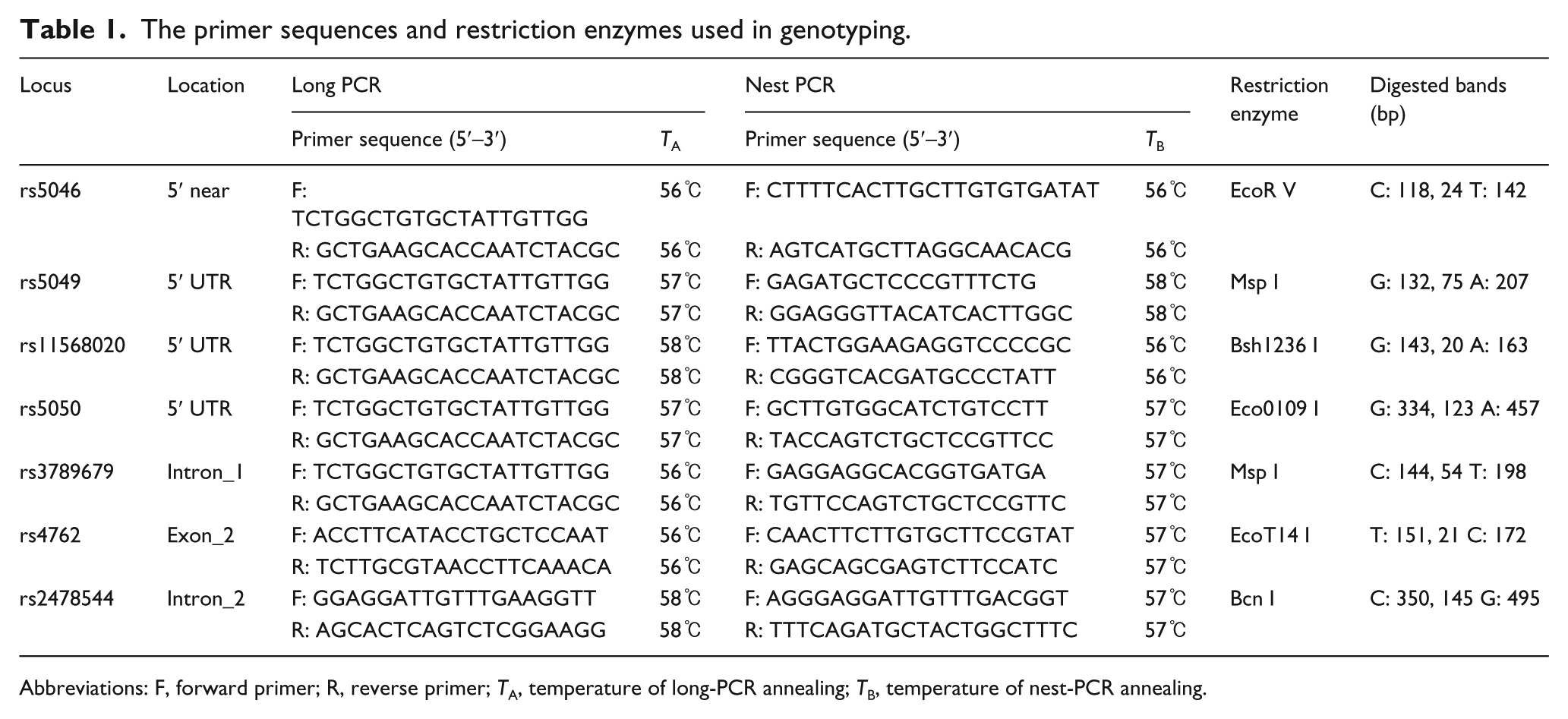
Abbreviations: F, forward primer; R, reverse primer; TA, temperature of long-PCR annealing; TB, temperature of nest-PCR annealing.
Statistical analysis
The mean ± standard deviation (SD) and percentages were used to express the quantitative variables and categorical variables, respectively. Quantitative variables were compared by the t-test between the case and control groups. The Hardy–Weinberg equilibrium analyses for each SNP were calculated by using the Chi-square test (χ2 test). The rs5050/rs4762 and rs11568020/rs3789679 were ruled out for the further analyses among the Hani and Yi populations, respectively, because they were not in the Hardy–Weinberg equilibrium among the Hani and Yi normotensive controls (p < 0.001). The differences of the BP levels among the different genotype and allele groups were compared by the analysis of covariance (ANCOVA) with age, gender, and body mass index (BMI) as covariates. The associations of each SNP with the risk of EH were evaluated by logistic regression analyses. In genetic model analyses (co-dominant, dominant, recessive, over-dominant, and additive), the minor allele of each SNP was regarded as the risk factor, and each analysis was adjusted by age, gender, and BMI. In order to explore the combined effect of the seven SNPs localized in the AGT gene region, SHEsis software (http://analysis.bio-x.cn/myAnalysis.php) was used to analyze the possible relationship between statistically inferred haplotypes and EH among these two populations. The whole analyses were conducted using SPSS (version 16.0; SPSS Inc., Chicago, IL, USA), and a two-tailed value of p < 0.05 was considered as statistically significant. The Bonferroni correction was applied to estimate the false-positive associations by multiple comparisons (p < 0.05/5).
Bioinformatic analysis
P-match, a kind of function prediction tool (http://www.gene-regulation.com/cgi-bin/pub/programs/pmatch/bin/p-match.cgi), helps in predicting the effects of polymorphisms on the sequence structures of the potential binding sites for transcription factors (TFs). A library of mononucleotide weight matrices as well as sets of aligned known TF binding sites from the TRANSFAC® is used in this tool. All the available TF binding sites around the SNPs lying in the promoter region of target gene are taken into consideration in this software.
Human splicing finder (HSF) software is a kind of bioinformatics tool (http://www.umd.be/HSF/) to predict the effects of mutations on splicing signals and to identify splicing motifs in any human sequence. This software contains all the genes and alternative transcripts as well as intronic sequences, which are extracted from the Ensembl human genome database (http://www.ensembl.org/), 92 to allow the study of virtually any human sequence. Already published algorithms, such as the RESCUE-ESE and ESE-Finder,93,94 use available matrices to identify cis-acting elements, which also harbor data extracted from the Ensembl Variation database, 92 to study the potential effects of SNPs on splicing.
Result
Population characteristics
The general characteristics of the study subjects are summed up in the Table 2. In the both Hani and Yi populations, the distribution of age showed no significant difference between the case and control groups, whereas the BP and BMI levels were significantly higher in the patients group than in the controls group. As the development of hypertension would be affected by multiple confounding factors, the confounding factors (including gender, age, and BMI) were adjusted as covariant in the further analyses.
The basic characteristics of the study sample.
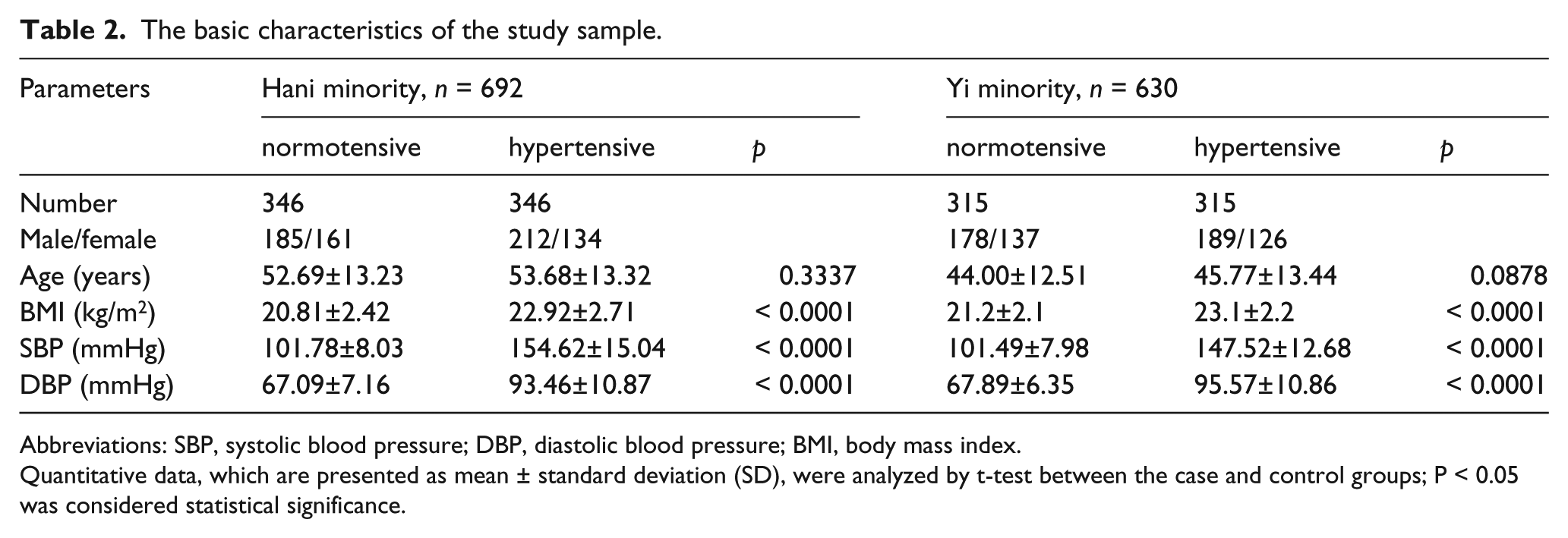
Abbreviations: SBP, systolic blood pressure; DBP, diastolic blood pressure; BMI, body mass index.
Quantitative data, which are presented as mean ± standard deviation (SD), were analyzed by t-test between the case and control groups; P < 0.05 was considered statistical significance.
The genotype distributions of seven SNPs between case-control groups in the two minority populations are shown in Table 3. The rs5046, rs5049, rs11568020, rs3789679, rs2478544 were consistent with Hardy–Weinberg equilibrium in the Hani population (p > 0.05), and the rs5046, rs5049, rs5050, rs4762, rs2478544 were consistent with Hardy–Weinberg equilibrium in the Yi population (p > 0.05).
The Hardy–Weinberg equilibrium analyses for each SNP.
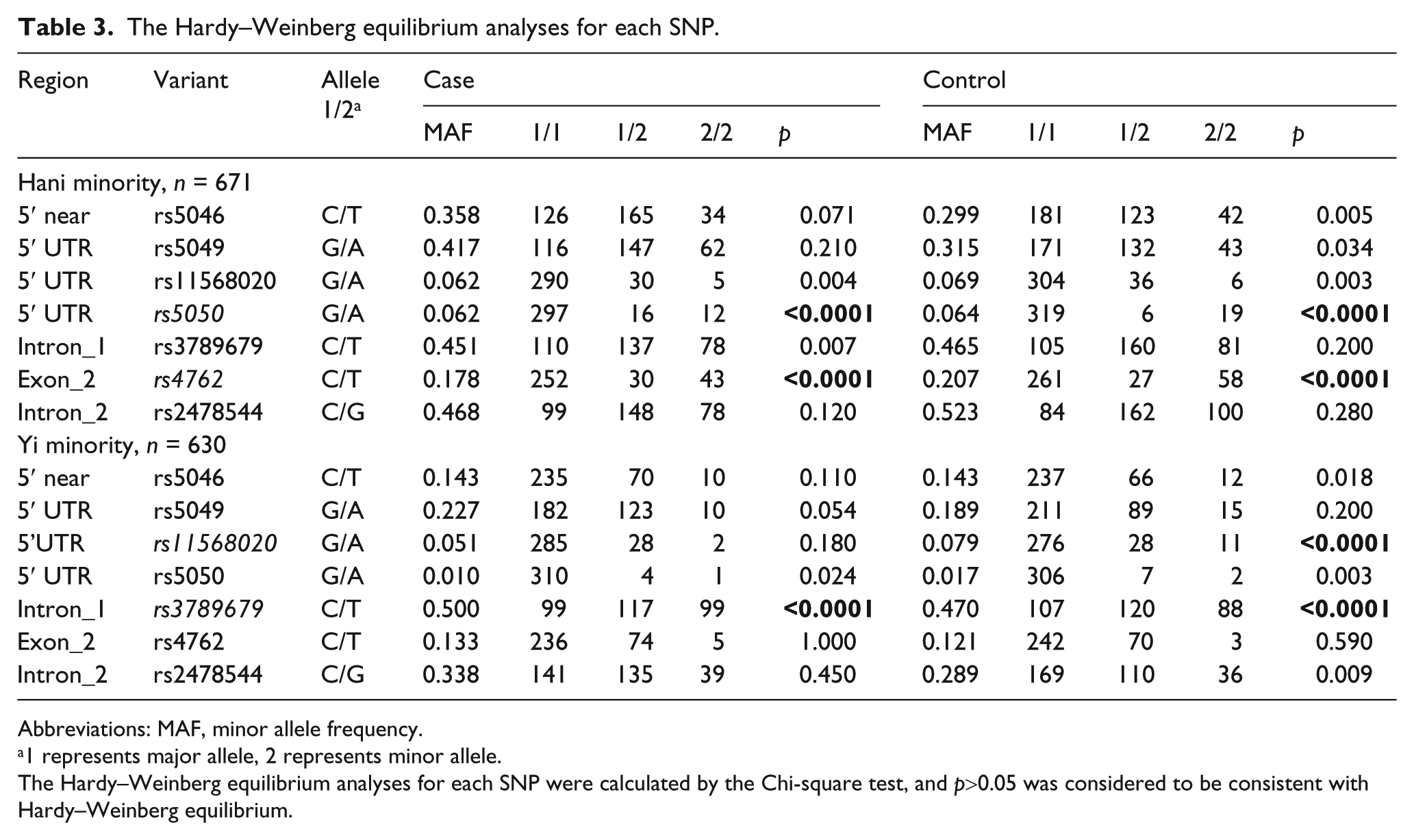
Abbreviations: MAF, minor allele frequency.
1 represents major allele, 2 represents minor allele.
The Hardy–Weinberg equilibrium analyses for each SNP were calculated by the Chi-square test, and p>0.05 was considered to be consistent with Hardy–Weinberg equilibrium.
Single-site analyses
The results of single-site analyses for the SNPs localized in the AGT region are shown in Tables 4–6. In the Hani population, the minor allele rates of rs5046 (p = 0.029, odds ratio (OR) = 1.292) and rs5049 (p = 0.0003, OR = 1.520) were found to be significantly greater in the patient group than the control group, and the minor alleles of rs5046 (mean difference (MD) = 4.775, p = 0.004) and rs5049 (MD = 4.286, p = 0.009) were also found to be significantly associated with the increased SBP levels. However, the minor allele frequency of rs2478544 (p = 0.044, OR = 0.801) was found to be significantly smaller in the patient group than the control group, and the minor allele of rs2478544 was also found to be significantly associated with the decreased BP levels (MDSBP = −5.126, pSBP = 0.001, MDDBP = −2.969, pDBP = 0.001). Such associations were not observed in the Yi population (Table 4).
The associations of minor-alleles of SNPs in the AGT region with the risk of EH and BP levels among Yunnan Hani and Yi populations.
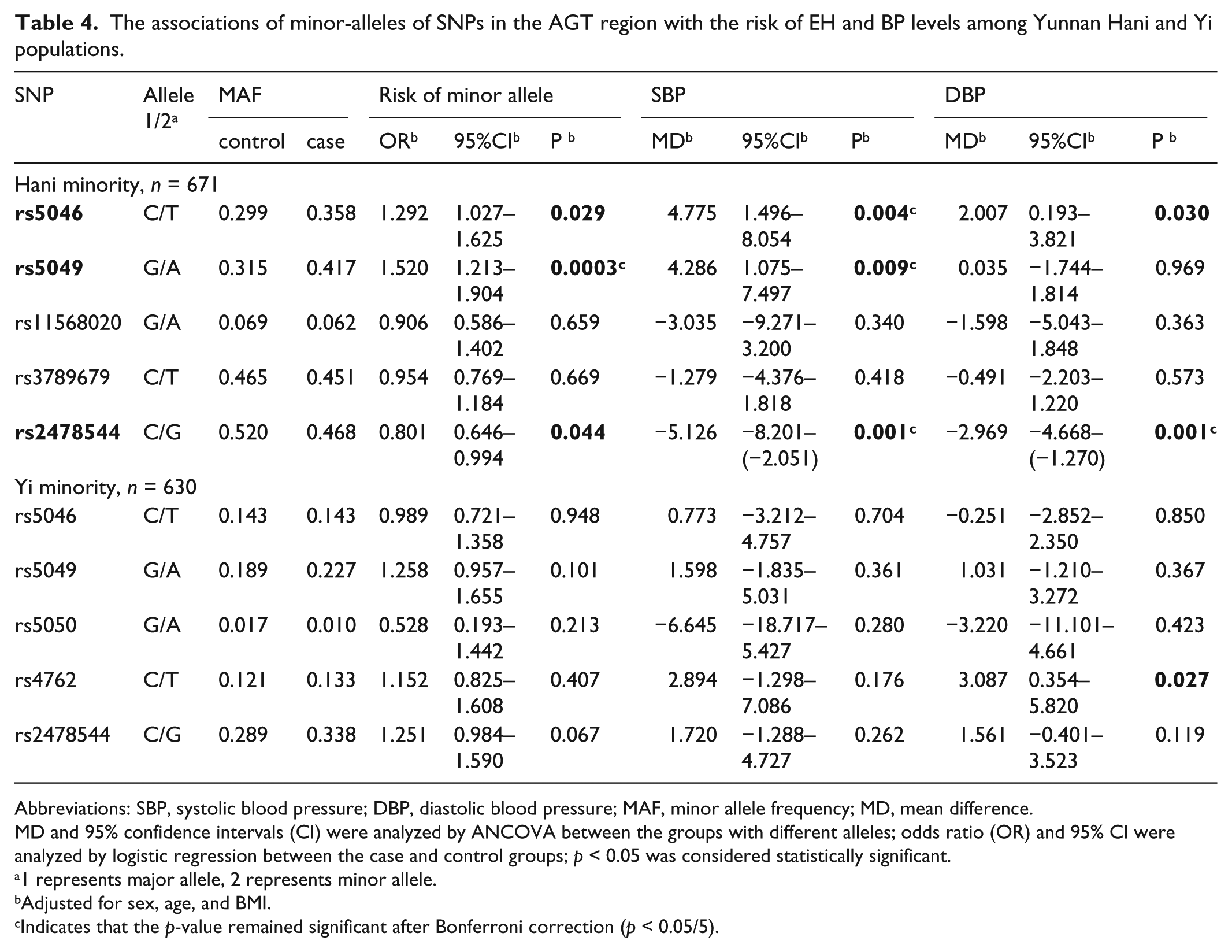
Abbreviations: SBP, systolic blood pressure; DBP, diastolic blood pressure; MAF, minor allele frequency; MD, mean difference.
MD and 95% confidence intervals (CI) were analyzed by ANCOVA between the groups with different alleles; odds ratio (OR) and 95% CI were analyzed by logistic regression between the case and control groups; p < 0.05 was considered statistically significant.
1 represents major allele, 2 represents minor allele.
Adjusted for sex, age, and BMI.
Indicates that the p-value remained significant after Bonferroni correction (p < 0.05/5).
The differences of BP levels among the groups with different genotypes were analyzed by ANCOVA analyses with multiple comparison correction, and the results are shown in the Table 5. In the Hani population, by adjusting for age, gender, and BMI, the SBP and DBP levels of subjects with CT+TT genotypes of rs5046 were significantly higher than those of the subjects with CC genotype (pSBP = 2.51 × 10⁻⁶, pDBP = 1.41 × 10⁻⁴); the SBP levels of subjects with GA+AA genotypes of rs5049 were significantly higher than those of the subjects with GG genotype (pSBP = 9.41 × 10⁻⁴); the SBP and DBP levels of subjects with CG+GG genotypes of rs2478544 were significantly lower than those of the subjects with CC genotype (pSBP = 5.84 × 10⁻³, pDBP = 9.67 × 10⁻³). These results retained statistical significance via Bonferroni corrections. In the Yi minority, the associations of polymorphisms with BP levels did not achieve the significance level (p < 0.05/5) after Bonferroni correction.
The associations of SNPs in the region of AGT with SBP, DBP levels among the Yunnan Hani and Yi populations.
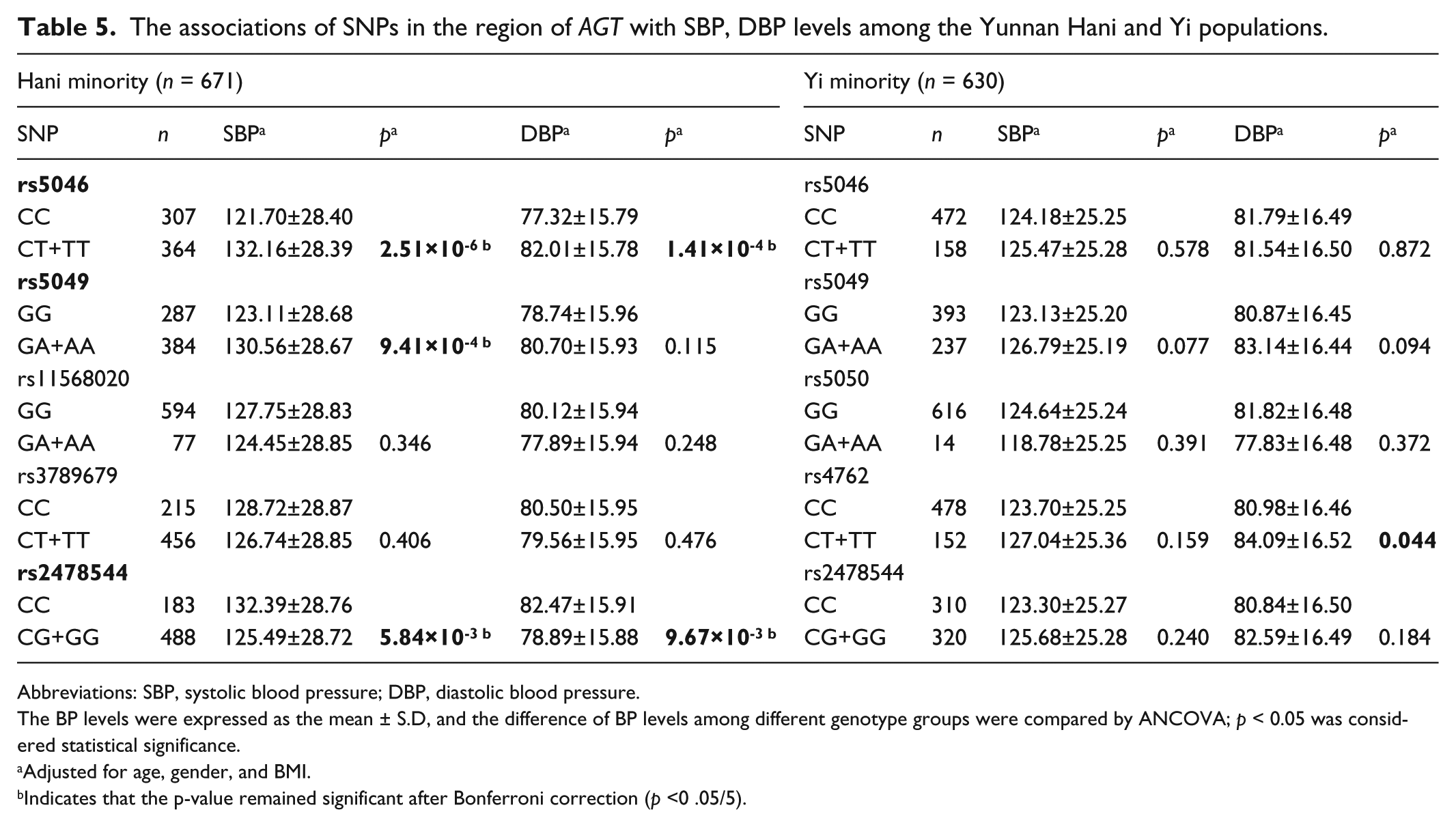
Abbreviations: SBP, systolic blood pressure; DBP, diastolic blood pressure.
The BP levels were expressed as the mean ± S.D, and the difference of BP levels among different genotype groups were compared by ANCOVA; p < 0.05 was considered statistical significance.
Adjusted for age, gender, and BMI.
Indicates that the p-value remained significant after Bonferroni correction (p <0 .05/5).
In order to find a comprehensive view of the effects mediated by the genetic risk factors on the development of EH, different genetic models were used to identify the associations between these polymorphisms and the risk of EH (Table 6). By adjusting for age, sex, and BMI, the rs5046 (codominant model: p = 4 × 10⁻⁴, CT vs. CC: OR = 1.90, TT vs. CC: OR = 1.13; dominant model: p = 4 × 10⁻⁷, OR = 1.71; over-dominant model: p = 1 × 10⁻⁴, OR = 1.85; log-additive model: p = 0.030, OR = 1.29) was found to be significantly associated with the risk of EH among the Hani minority, whereas no association was found between this polymorphism and the risk of EH among the Yi minority, before or after Bonferroni corrections. The rs5049 was found to be significantly associated with the risk of EH among the both Hani (codominant model: p = 0.0016, GA vs. GG: OR = 1.63, AA vs. GG: OR = 2.04; dominant model: p = 6 × 10⁻⁴, OR = 1.73; recessive: p = 0.031, OR = 1.59; log-additive model: p = 5 × 10⁻⁴, OR = 1.47) and Yi (codominant model: p = 0.014, GA vs. GG: OR = 1.60, AA vs. GG: OR = 0.77; dominant model: p = 0.018, OR = 1.48; over-dominant model: p = 0.042, OR = 1.63) populations, but these positive correlations only exist in the Hani population via Bonferroni corrections. The rs2478544 was found to be associated with the risk of EH in the both Hani (log-additive model: p = 0.051, OR = 0.81) and Yi (dominant model: p = 0.037, OR = 1.40) populations, but these positive correlations did not exist after Bonferroni correction among the both Hani and Yi populations.
The associations of SNPs in the region of AGT with the risk of EH among the Yunnan Hani and Yi populations, analyzed by genetic models.

Abbreviations: OR: odds ratio; CI: confidence interval.
1 represents major allele, 2 represents minor allele.
Estimated by logistic regression analyses via adjusting for age, gender, and BMI.
Indicates that the p-value remained significant after Bonferroni correction (p < 0.05/5).
OR and 95% CI were calculated by logistic regression analysis model; p < 0.05 was considered statistically significant; OR > 1 implied that the factors to be calculated was risky, and OR < 1 implied that the factors to be calculated was protective.
Bioinformatic analyses
Six SNPs (including rs5046, rs5049, rs11568020, rs5050, rs3789679 and rs2478544) excluded the exonic polymorphisms of AGT gene were further analyzed for the effects on the sequence structures of TF binding sites by using p-match. The results showed that the sequence (TGTGTTTTCC) containing the C allele of rs5046 (c.-570C>T, -532T/C) could be captured by the TF c-Rel, suggesting that the single nucleotide substitution of C→T at the position -570 before the exon 1 of the AGT could change the sequence structure of the TF binding site. There was not any TF binding site being found around the loci rs5049, rs11568020, rs5050, rs3789679, and rs2478544. Moreover, rs5050 was found to be located near the RSRFC4 TF binding site (cagctataAATAGggc).
These SNPs (rs5049, rs11568020, rs5050, rs3789679, rs4762, rs2478544) localized in the exons or introns of AGT gene were also analyzed for the effects on the process of mRNA splicing by using HSF. The results revealed that the rs4762 (c.620C>T) polymorphism localized at the 620 nucleotide of the exon 2 of AGT gene led to the creation of the new exonic splicing silencer (ESS, including Motif 3, ESR, Motif 1, IIEs, Motif 2, Fas) sites and the destruction of the exonic splicing enhancer (ESE, including 9G8, SC35, SF2/ASF(Ig), SF2/ASF) sites, thereby weakening the process of splicing; the rs2478544 (c.856+1545G>C) polymorphism localized at the 1545 nucleotide of the intron 2 of AGT gene generated the new ESE sites (EIEs, SF2/ASF(Ig)), possibly enhancing the splicing.
Haplotype analyses
The summarized results of haplotype analyses for the combined effect of rs5046, rs5049, rs11568020, rs3789679, rs2478544 SNPs in the Hani minority and the combined effect of rs5046, rs5049, rs5050, rs4762, rs2478544 in the Yi minority are shown in Table 7. The haplotypes with frequency < 0.01 were excluded in the further analysis. The results showed that the frequencies of Hh1 (CGGCC) and Hy1(CGGCC) were higher than other haplotypes in the Hani and Yi populations, respectively. In consequence, by taking Hh1 and Hy1 as reference, the relative risk of EH related to different haplotypes were evaluated by logistic analyses in the Hani and Yi minorities, respectively. The Hh6 (TAGCC) (frequency: 0.0556, p = 0.03) exerted significant association with the increased risk of EH in the Hani minority via adjusting for age, gender and BMI, but this positive association did not exist after Bonferroni correction (p < 0.05/17). None of the haplotypes showed any association with the risk of EH in the Yi minority.
The associations between the AGT gene haplotypes and EH among the Yunnan Hani and Yi populations.

The haplotype structure of the AGT gene were rs5046(C/T), rs5049 (G/A), rs11568020 (G/A), rs3789679 (C/T), rs2478544 (C/G) in the Hani minority, and rs5046(C/T), rs5049 (G/A), rs5050 (G/A), rs4762(C/T), rs2478544(C/G) in the Yi minority. OR and 95% CI were calculated by a haplotype-based logistic regression analysis. The haplotypes with frequencies < 0.01 were not included in the table; p < 0.05 was considered statistically significant.
Abbreviations: CI, confidence interval; OR, odds ratio.
Discussion
EH has become a major public concern in the world due to its high prevalence and fatal complications. 95 The AGT gene, a main component of the RAAS system which is a major BP-adjusting system, is emerging as a shared risk factor for EH.14,16–18,36 The genetic screening test based on the analyses of multiple SNPs for evaluating the potential of hypertension occurrence could be useful for disease control. However, there is limited data on the AGT genetic determinants of this complex disease for patients among isolated populations (Yi and Hani minorities) with low prevalence rate of hypertension. This study sought to determine the contribution of seven SNPs localized in the AGT gene region (including rs5046, rs5049, rs5050, rs4762, rs11568020, rs3789679, and rs2478544) in inducing susceptibility to EH among these isolated minorities in Yunnan province. We found that: (1) the rs5046, rs5049, and rs2478544 were significantly associated with EH among the Chinese Hani minority. Most notable, this report is the first one in the literature showing the association of rs2478544 polymorphism with a clinical condition; (2) the rs5049, rs4762 and rs2478544 could be associated with EH among Chinese Yi minority, but these correlations did not reach a conclusive level of statistical significance; (3) in the bioinformatic analyses, the polymorphisms of rs2478544 and rs5046 caused the creation of ESE sites and the transformation of TF binding sites, respectively, thereby functionally affecting the expression level of AGT gene; (4) the haplotype Hh6 (rs5046T, rs5049A, rs11568020G, rs3789679C, rs2478544C) was found to be susceptible for EH among Hani minority.
Several reports have investigated the relationship of rs5046 polymorphism (-532T/C, c.-570C>T) with the development of EH among different populations. A research in a sample selected from the HyperGEN study revealed that the two promoter SNPs (rs5046 and rs5049) were strongly associated with SBP response to postural change, and the rs5046 was also strongly associated with postural DBP response in Blacks. Only borderline association (rs5046 and rs5049) were found in Whites. 96 A haplotype analysis conducted by five SNPs (positions -1074, -532, 384, 1164 and 2186) indicated that haplotype TTAAT was associated with high plasma level among populations from Nigerians and African Americans. 30 A HyperGEN study among Americans showed strong association of -532T/C with postural SBP/DBP response. 24 A research among Caucasians indicated that untreated hypertensives carrying the AGT -532T allele had significantly higher SBP/DBP and ambulatory BP values compared to respective non-carriers. 97 Studies conducted among subjects from France, Poland, Russia, and Italy revealed significant associations of C-532T variant with arterial properties and left ventricular mass.98,99 However, no association was found with EH in this polymorphism among African Americans and European Americans. 33 The study among Mexicans also showed no association with coronary artery disease in this polymorphism. 26 In our present study, by adjusting for age, gender, and BMI, the minor T-allele of rs5046 was found to be significantly associated with the increased EH risk and BP levels, and the subjects with CT+TT genotypes were found to have higher EH risk and BP levels than the subjects with CC genotype among the Hani minority. Indeed, individuals who carried the T allele of rs5046 could be more susceptible to EH among the Yunnan Hani population. Our findings about the Hani minority were in accordance with the reports of Gu et al.24,30,96,97 However, our research about the Yi minority showed no association in -532T/C (rs5046), which was in accordance with the finding of Zhu et al. 33 This inconsistency could be attributed to the different genetic backgrounds, living habits, and environmental factors among different populations. Since the previous studies revealed that the variants localized near the 5′ region of a gene might be associated with the regulation of this gene expression level,100–102 the functional effect of rs5046 polymorphism localized at the promoter region of AGT gene on the expression level of this gene was predicted by p-match. The result revealed that the sequence (TGTGTTTTCC) containing the C allele of rs5046 could be captured by the TF c-Rel, suggesting that the C→T single nucleotide substitution of rs5046 would change the sequence structure of the TF binding site, thereby affecting the binding affinity between this TF c-Rel and its binding site. Taken together, our findings suggest that the rs5046 was strongly associated with EH by influencing the level of AGT transcription, which was mediated by the variation of binding affinity between TF and its biding site. Further studies to reveal its role in the process of binding affinity variation would be essential to understand its functional mechanism in the pathogenesis of hypertension.
The rs5049 (c.-255G>A, G-217A) localized at the 5′ untranslated region of the AGT gene was reported frequently in the literature. Jain et al. reported that the recombinant glucocorticoid receptor (GR) bound strongly to nucleoside A compared with nucleoside G at -217 position of the AGT 5′ UTR, 32 thereby increasing the promoter activity of human AGT gene. Li et al. found that the haplotype AAT (constructed by -532T, -793A, and -1074T) almost occurring with -217A has increased promoter activity of AGT gene. 29 Dickson et al. illustrated that the -20 and -217 polymorphisms have large influence on the AGT transcription. 103 Indeed, the A/G polymorphism at -217 (rs5049) could affect the promoter activity of the human AGT gene, thereby being associated with EH. However, the associated findings between rs5049 polymorphism and EH were different among different ethnic groups. Studies among the populations from Melanesians, 104 African Americans,18,31,105 Africans, 59 Caucasians,18,59 Asians, 59 Taiwanese,87,88 and Chinese, in Shandong, 66 have found that the A-allele and AA-genotype at rs5049 was a risk factor for EH. In contrast, other studies, on populations from Minneapolis Americans, 106 African and European Americans, 33 and Italians, 36 have revealed the absence of association of G-217A. Besides, the research about Mexicans showed no association with coronary artery disease in the G-217A mutation. 26 Among Caucasian and African American women, 107 -217 polymorphism was not found to be associated with the increased risk of preeclampsia. In the present study, the A-allele and AA+AG-genotypes of this polymorphism showed strongly associations with the increased SBP level and EH risk in the Hani minority. Our results among the Hani minority were in accordance with the reports of Wu et al.18,31,59,66,87,88,104,105 However, such significant association was not observed in the Yi minority, which was consistent with the reports of Zhu et al.33,36,106 This inconsistency could also be attributed to the different genetic background, living habits, and environmental factors.
These polymorphisms rs5050 (A-20C, c.-58A>C) and rs4762 (T174M, C3389T, c.620C>T) have been investigated in lots of association studies of EH. Several studies have reported a significant association of the C allele and CC genotype of rs5050 with the increased risk of EH among the Mexicans,22,23 Asians, 108 Taiwanese, 88 Li nationality of Hainan, 74 Han population of Shanghai, 78 Nanjing, 72 and Jinan, 66 the latter four from China. On the contrary, the A-allele of rs5050 was found to confer susceptibility to EH among African-American males, African-American females, Europeans, 108 Caucasian females, 18 and the Chinese population in Henan province. 79 Besides, A/A+A/C genotypes of this polymorphism were found to be a high-risk genotype for chronic kidney disease among the Taipei population. 89 Also, insignificant associations with EH were reported from the populations of Japan,109,110 Mexico, 19 and Northern China. 85 Among African Americans, 111 Mexicans, 22 and female Caucasians, 112 this mutation was found to be associated with left ventricular mass, plasma AGT levels, and the rate of renal function decline, respectively. Functional studies indicated that the A-20C variant could increase the expression level of AGT by affecting the transcription level of AGT.36,103,109 Among the Mexican population,22,23 the A-20C and C3389T were found to be strongly associated with increased plasma AGT levels. Considering that the exonic polymorphism T174M (Thr174Met) contributed to the increased plasma AGT levels, this variant could be associated with the development of EH. The homozygote wild-type genotype at the T174 site was more frequent than the mutation and occurred at a rate of 91.7% in African Americans. 113 A research conducted in 1092 human genomes showed that the rs4762 was a deleterious site. 114 Lots of the association studies uncovered that the 174M allele was associated with the increased risk of hypertension among the populations of Argentineans, 115 Japanese, 43 Taiwanese, 88 and Chinese in Beijing and Nanjing province.68,72 Besides, other research, among the rural Chinese, 84 Americans in Ontario Oji-Cree, 116 Canadian Caucasians, 117 and Europeans, 118 showed the associations between the T174M polymorphism and glomerular filtration rate, the risk of metabolic syndrome, heart failure, and myocardial infarction, respectively. In contrast, other studies, among the populations of northern Chinese Han individuals,64,85 Asians, 39 Europeans, 39 African Americans, 33 and European Americans, 33 have indicated the absence of association of T174M with EH. In addition, other studies, among the Mexicans, 26 black and white participants, 119 Americans in the Delaware Valley Region, 106 Americans, 120 Caucasians, 121 Chinese Han, 122 and Taiwanese, 89 showed no association between this polymorphism and the risk of the non-familial atrial fibrillation, lower extremity arterial disease, decline in renal function post-transplantation, preeclampsia, pseudoxanthoma elasticum, coronary artery disease, and chronic kidney disease in this mutation, respectively. In our study, no association was observed between these two polymorphisms (including A-20C and T174M) and EH among the both Hani and Yi populations. Previous researches have shown that the polymorphisms localized in the introns,35,123 and exons, 124 close to the splice site would have effects on the process of mRNA splicing. In the bioinformatic analysis, it was observed that the c.620C>T (rs4762) led to the creation of new ESS (Motif 3, ESR, Motif 1, IIEs, Motif 2, Fas ) sites and the destruction of ESE (9G8, SC35, SF2/ASF(Ig), SF2/ASF) sites, thereby weakening the splicing. These results suggested that the exonic polymorphism T174M(rs4762) was not only a Thr to Met amino acid substitution, but also a functional site for AGT gene expression by affecting the process of mRNA splicing. The failure to find an association among the both Hani and Yi populations could be attributed to the insufficient sample size. Further studies in a larger sample size for these two populations are needed to identify its relationship with EH.
Detection of intron 2 rs2478544 (c.856+1545G>C) polymorphism in our samples revealed that this variant was associated with the risk of EH in the both Hani and Yi populations. However, after Bonferroni correction this positive correlation with the EH risk did not exist in both two populations. In addition, the minor G-allele and GG+CG genotypes of this polymorphism were found to be significantly associated with the decreased BP levels among Hani population, before or after the Bonferroni correction. To date, little was known about the association of this polymorphism with EH. The research among the Chinese Han population showed no association with non-familial atrial fibrillation in this mutation. 122 This polymorphism localized in the intronic regions was further analyzed for the effect on the mRNA splicing by using HSF. The result indicated that the rs2478544 polymorphism generated the new ESE sites (EIEs, SF2/ASF(Ig)), possibly enhancing the splicing process. This study is the first to demonstrate the association of rs2478544 with EH and to predict its functional effect on the spicing process of AGT mRNA, though functional studies about its role in the expression level of AGT are needed to find further evidence to support these results.
Regarding rs3789679 (c.-4+138C>T) and rs11568020 (c.-190G>A) polymorphisms, little was known about the associations between these two polymorphisms and EH up to now. The T-allele of rs3789679 was found to be significantly associated with the increased risk of atherosclerosis and obesity involved with hypertension among the Saudi population. 58 The haplotype rs5051A, rs3789679C, rs2004776A, rs4762C, rs3789670G, rs2493132G, rs2478523C, rs7079C was found to be associated with the risk of myocardial infarction among the Europeans. 118 Our present study among both Hani and Yi populations showed no association of these two polymorphisms with EH.
In order to enhance the study power, the haplotype analysis was performed. The result exhibited the high frequency of haplotype Hh6 (rs5046T, rs5049A, rs11568020G, rs3789679C, rs2478544C) in the patients as compared to the controls among the Hani minority (p < 0.05). Detection of haplotypes in the Yi samples did not exert any association with EH. Fejerman et al. reported that individuals with -1074T, -532T, 384A, 1164A and 2186T haplotype were associated with high plasma level among the Nigerian African Americans. 30 Markovic et al. reported that the haplotype -6A, -20A, -217A, -793A, -776 T among African Americans and Caucasians could confer susceptibility to hypertension. 18 Pandey et al. demonstrated that Hap -6A/-217A was associated with human hypertension. 125 Jiang et al. found that the haplotype of AGT -6A, 174C, -217G and -20A could decrease the risk of EH among a remote countryside population in Nanjing of China. 72 Kong et al. indicated that the haplotype -217G, -152G, -20A, -6G, +31T, 174T, 235M was significantly higher in controls than patients (p = 0.010) among a Chinese population in Henan province. 79 Taken together, those reports suggested that the haplotypes containing risk alleles of -532T (rs5046-T) or -217A(rs5049-A) could increase the risk of hypertension, which was identical with our results in the Hani minority. Indeed, the risk effects of rs5046-T and rs5049-A alleles were shown in the haplotype Hh6, whereas the protective effect of rs2478544-G allele was not shown in the haplotype Hh6, which showed significantly association with the increased risk of EH.
It is tempting to suggest that the mutations of AGT gene could be a genetic risk factor for EH among the isolated populations (Hani and Yi population) with low prevalence rate of EH in Yunnan province of China. Indeed, the RAAS system plays a crucial role in the BP regulation, and it is established to be one of the most important systems in the pathogenesis of hypertension. 10 As a main component of this BP-adjusting system, AGT could be involved in the formative process of angiotensin I, the precursor protein of angiotensin II which is a major active vasopressor molecule in the RAAS system. The single nucleotide polymorphisms of this gene would have impacts on the RAAS system and then would influence the maintenance of water, salt homeostasis, vascular tone, and BP regulation. Taken together, our findings suggest that these polymorphisms localized at the region of the AGT gene could confer the predisposition to acquired EH among the Chinese isolated populations with low prevalence rate of hypertension. It is reasonable to suggest that the AGT gene polymorphisms were susceptible factors for the pathogenesis of hypertension and thus can be serve as a new therapeutic target and diagnostic marker for EH.
Some potential limitations should be noted to our study. First, due to the fact of that the recruitment was confined to the populations in the remote mountainous area, we could not gather all the information on the physiological values of the participants. A previous study found that the increased plasma AGT level was strongly associated with A-20C and C3389T polymorphisms among Mexicans.22,23 In the further study, we do need to measure the physiological values of RAAS and analyze its effect on the association of selected SNPs with the risk of EH among the Hani and Yi minorities. Second, since EH is generally accepted as a complex polygenic disorder, further investigation in a large sample size on the level of gene-environment interaction might be essential to further verify our results. Third, considering that mechanism of AGT variants affecting on BP regulation are still unknown, further functional studies on the pathogenesis of hypertension are needed to be conducted.
Footnotes
Acknowledgements
We are grateful to all the patients participating in this study.
Declaration of Conflicting Interests
The author(s) declared no potential conflicts of interest with respect to the research, authorship, and/or publication of this article.
Funding
The author(s) disclosed receipt of the following financial support for the research, authorship, and/or publication of this article: This work was supported by the National Natural Science Foundation of China (grant number U0932603).