




Abstract
Background:
Previous studies have reported the relation between the adiponectin polymorphisms and the risk of ischemic stroke. However, the findings is inclusive. In the present study, we performed a meta-analysis to clarify the relation between the adiponectin polymorphisms and the stroke.
Methods:
Relevant studies were identified by searching PubMed, EMBASE, ISI Web of Science, ScienceDirect, Wiley Online Library, Wanfang database in China, and Chinese National Knowledge Infrastructure databases (CNKI) through July 2013 and other method such as reviewing the reference of retrieved literatures. We selected literatures that reported Odds ratio (OR) and 95% confidence interval (CI) for the relation between the ischemic stroke and the adiponectin genetic polymorphisms. With 1720 stroke cases and 5549 controls, were included. Our results showed that rs2241766 was associated with the risk of ischemic stroke in a recessive model (GG vs (TT+TG), OR = 1.29, 95% CI: 1.01–1.64, p = 0.04). However, rs1501299 and rs266729 were not found to be associated with ischemic stroke in our analysis.
Conclusion:
The present study suggested that rs2241766 polymorphism of adiponectin gene was associated with the risk for ischemic stroke.
Introduction
Stroke is the leading cause of disability in the world and post-stroke disability places a heavy burden on our society. 1 Strong evidence from genetic association studies indicates that genetic predisposition, in addition to recognized risk factors such as hypertension, smoking, diabetes, obesity, and advanced age, contributes to the development of stroke. 2 In addition, individuals with a family history of stroke are more likely to suffer a stroke. Understanding these genetic influences may lead to better prevention of and intervention in stroke.
Adiponectin, an adipose tissue-specific plasma protein, is structurally homologous to collagens VIII and X and complement factor C1q 3 and plays an important role in regulating energy homeostasis, glucose and lipid metabolism, and anti-inflammatory responses in the vascular system.4–6 Low plasma concentrations of adiponectin have been associated with myocardial infarction 7 and ischemic stroke. 8 Recent evidence has implicated the genetic polymorphism of the adiponectin gene (ADIPOQ) in association with risk of coronary heart disease and ischemic stroke.9–20 Three single-nucleotide polymorphisms (SNPs) including rs266766 (T is converted to G), rs1501299 (G is converted to T) and rs266729 (C is converted to G) were focused on in these studies. However, the conclusions of these studies were inconsistent. Leu et al. 18 did not find any association between ADIPOQ polymorphisms and ischemic stroke. But Liu et al. 19 found a positive association of ADIPOQ polymorphisms with ischemic stroke. In their studies, compared with CC genotype, GG genotype of rs266729 increased the risk of ischemic stroke in a Chinese Han population (odds ratio (OR) = 2.062, 95% confidence interval (CI) = 1.145–3.715, p = 0.016). After adjustment for potential risk factors by multivariate logistic analysis, rs266729 remained in positive correlation with ischemic stroke (OR = 2.165; 95% CI = 1.116–4.197, p = 0.022). Also, Arregui et al.’s findings 11 suggest that rs2943634 of ADIPOQ is associated with ischemic stroke risk and with plasma levels of high-density lipoprotein (HDL)-cholesterol and adiponectin in this German population.
Since the relatively small sample size of a single study may not have enough power to detect slight effects of ADIPOQ on stroke, meta-analysis may provide more credible evidence by systematically summarizing existing data. In this study, we have extensively reviewed the literature and performed a meta-analysis based on all eligible case-control published data to evaluate the association between ADIPOQ genetic polymorphisms and stroke susceptibility.
Materials and methods
Literature search and selection
We carried out a publication search in PubMed, EMBASE, ISI Web of Science, ScienceDirect, Wiley Online Library, Wanfang database in China, and Chinese National Knowledge Infrastructure (CNKI) databases with the following search terms: (“ADIPOQ” or “adiponectin”) and (“stroke” or “brain infarction” or “cerebrovascular disease”) and (“SNP” or “polymorphism” or “mutation”) by two independent investigators. Publication language was not restricted in our search. Abstracts, reviews or editorials were not included. The references of all identified publications were searched for any additional studies, and the related articles option was used to search for further potentially relevant articles. The following criteria have to be meet by the included studies. 1)the study must be case-control study; 2) the ischemic stroke diagnosis must confirmed by computed tomography (CT) or magnetic resonance imaging (MRI); 3) reported the relation between ADIPOQ polymorphism and ischemic stroke and 4) sufficient data for examining an OR and 95%CI. If a study in line with 1) patients were under 18 years of age, or 2) original genotype data were not provided must be excluded from the meta-analysis.
Data extraction
The data extraction was performed by two independent investigators (DZS and SLX). The first author’s last name, the publication year, country, the genotype data of cases and controls, and the methods for genotyping for each study were collected.
Statistical analysis
We recalculated the Hardy-Weinberg equilibrium (HWE) by χ2 test. The OR value of each polymorphism and its 95%CI were calculated to measure the strength of the genetic association. Meta-analysis was performed by using RevMan 5.0 software provided by the Cochrane Collaboration. We directly used Q-test and I2 test to examine the heterogeneity between each study. By heterogeneity test, if p > 0.05, we select the fixed-effects model, and if p < 0.05, we selected the random-effects model to merge OR. Analysis of sensitivity includes the difference of point estimation and CIs of the combined effects value at a different model, to observe whether it changes the result. To test the publication bias, we used the RevMan 5.0 statistical software to make the funnel plot. Each SNP was tested for associations with stroke susceptibility based on different genetic models. To contrast the wild-type homozygote, we first estimated the risk of the rare allele homozygote and heterozygous genotypes on stroke, then evaluated the risk of stroke under a dominant model and a recessive model. The statistical significance of the pooled OR was determined with the Z test, and a p value of <0.05 was considered significant.
Results
Literature search
As shown in Figure 1, 213 literatures were searched firstly. Of these, we excluded 198 studies for significant irrelevance to our study aim. We reviewed the full texts of fifteen studies and further excluded 8 literatures because of overlapping cases or their data were not extractable or having no control population. Finally, a total of seven articles met the criteria and were included the present meta-analysis.16,18,19,21–24
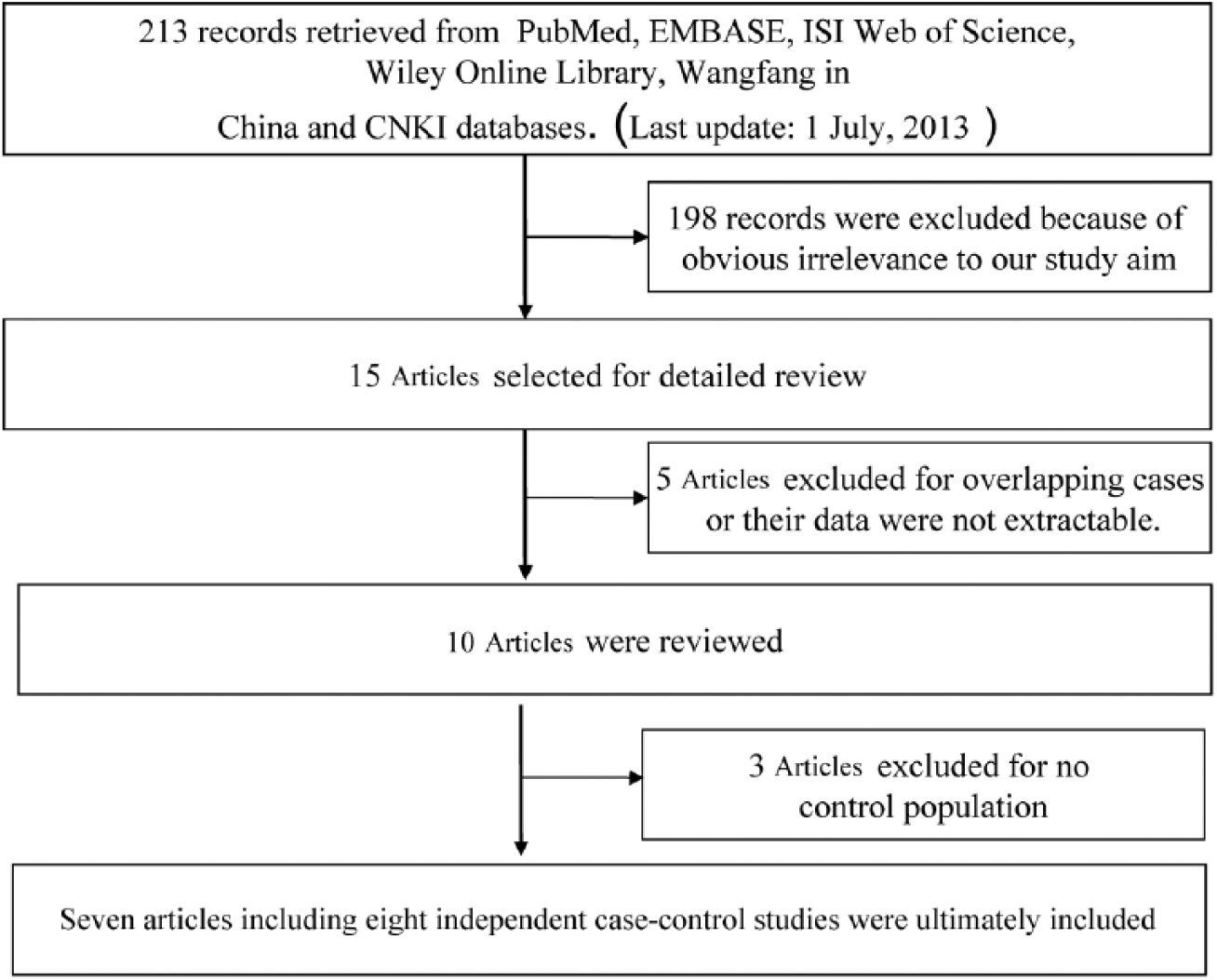
Flow diagram of study identification.
Study characteristics
As shown in Table 1, we summarized the characteristics of included studies. These eight included studies were published between 2005 and 2011 involving 7269 subjects (1720 of stroke patients and 5549 of control individuals). There were seven studies of Asian descendants and one study of European descendants. In all of these eight studies, a classic polymerase chain reaction assay were carried out. The genotype distributions in each study were in agreement with HWE.
The characteristics of included studies.
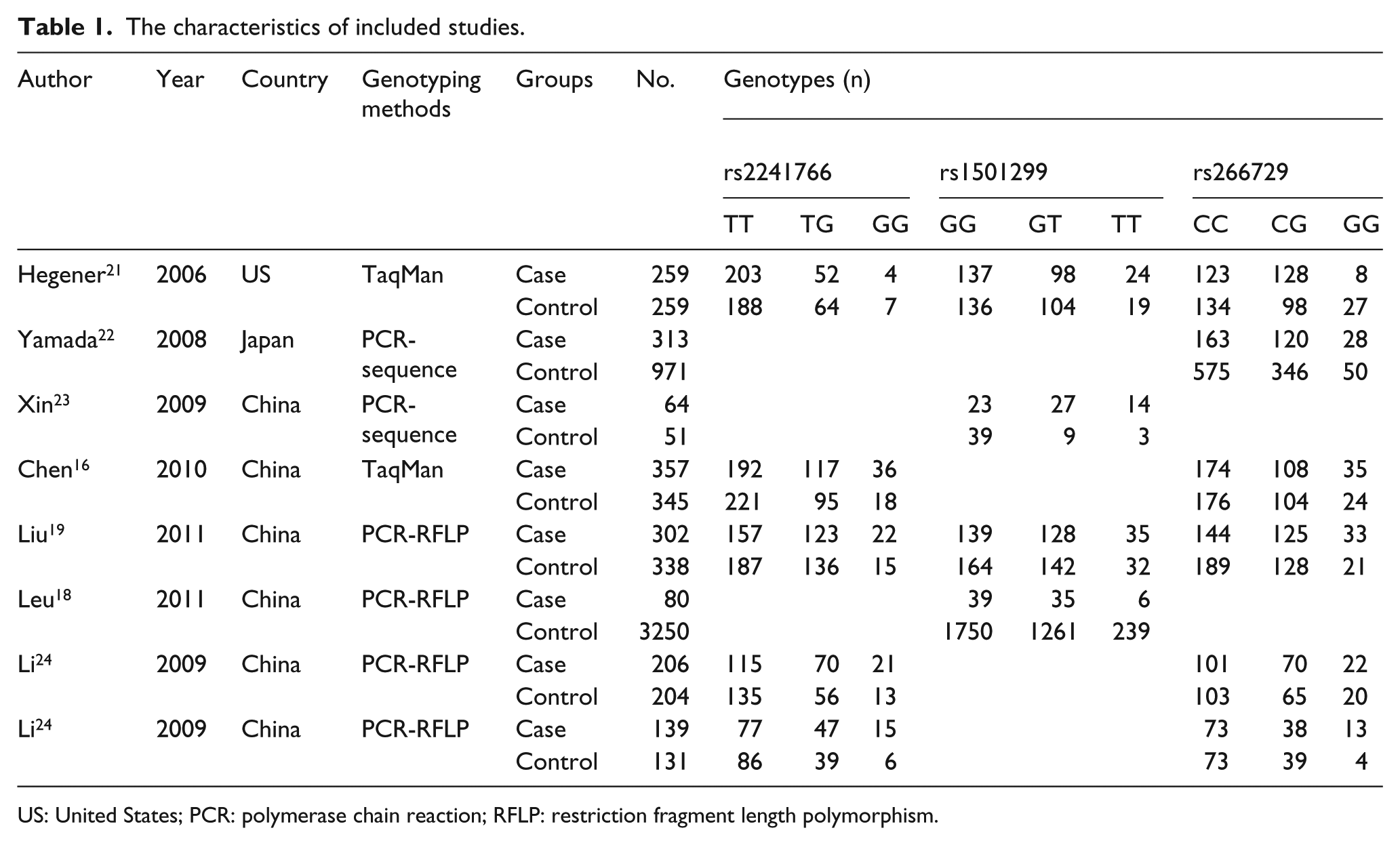
US: United States; PCR: polymerase chain reaction; RFLP: restriction fragment length polymorphism.
Meta-analysis
The association between ADIPOQ polymorphisms and susceptibility to stroke was analyzed in eight independent studies with 1720 ischemic stroke cases and 5549 control subjects. Results of the meta-analysis are shown in Figures 2–4. Q-test in all of the genetic models showed no significant heterogeneity. Therefore, fixed-effects model was used to analysis the association. As shown in Figure 2, rs2241766 was associated with the risk of stroke in a recessive model (GG vs (TT+TG), OR = 1.29, 95% CI: 1.01–1.64, p = 0.04) (Figure 2(b)). We did not find any association between rs2241766 and stroke in a dominant model (TT vs (TG+GG), OR = 0.90, 95% CI: 0.77–1.07, p = 0.23) (Figure 2(a)), an additive model (GG vs TT, OR = 0.76, 95% CI: 0.54–1.08, p = 0.12) ( Figure 2(c)), and another model (TG vs TT, OR = 0.93, 95% CI: 0.79–1.11, p = 0.43) ( Figure 2(d)).
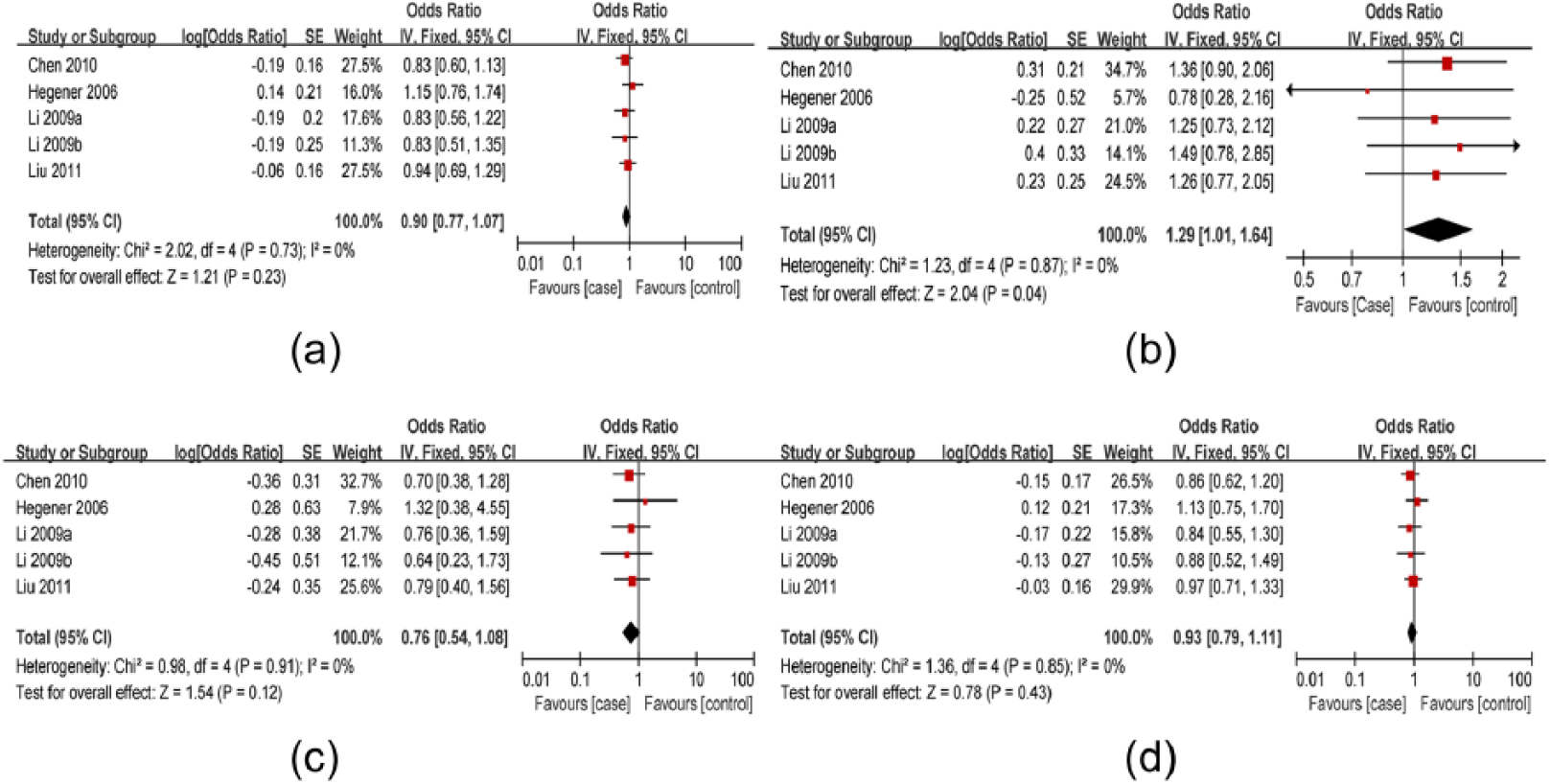
Forest plot of stroke and rs2241766. The horizontal lines correspond to the study-specific odds ratio (OR) and 95% confidence interval (CI), respectively. The area of the squares reflects the study-specific weight. The diamond represents the pooled results of OR and 95% CI. In this analysis, a fixed-effects model was used. (a) TT vs (TG+GG); (b) GG vs (TG+TT); (c) GG vs TT; (d) TG vs TT.
As shown in Figures 3 and 4, we did not find any association between rs1501299 or rs266729 and susceptibility to stroke in any of the genetic models. For rs1501299, GG vs (GT+TT), OR = 0.93, 95% CI: 0.76–1.13, p = 0.45; TT vs (TG+GG), OR = 0.86, 95% CI: 0.65–1.14, p = 0.30; TT vs GG, OR = 0.86, 95% CI: 0.60–1.23, p = 0.40; TG vs GG, OR = 0.94, 95% CI: 0.76–1.16, p = 0.57.

Forest plot of stroke and rs1501299. The horizontal lines correspond to the study-specific odds ratio (OR) and 95% confidence interval (CI), respectively. The area of the squares reflects the study-specific weight. The diamond represents the pooled results of OR and 95% CI. In this analysis, a fixed-effects model was used. (a) GG vs (GT+TT); (b) TT vs (TG+GG); (c) TT vs GG; (d) TG vs GG.

Forest plot of stroke and rs266729. The horizontal lines correspond to the study-specific odds ratio (OR) and 95% confidence interval (CI), respectively. The area of the squares reflects the study-specific weight. The diamond represents the pooled results of OR and 95% CI. In this analysis, a fixed-effects model was used. (a) CC vs (CG+GG); (b) GG vs (CG+CC); (c) GG vs CC; (d) GC vs CC.
For rs266729, CC vs (CG+GG), OR = 0.91, 95% CI: 0.80–1.05, p = 0.19; GG vs (CG+CC), OR = 0.84, 95% CI: 0.69–1.03, p = 0.10; GG vs CC; OR = 0.85, 95% CI: 0.65–1.10, p = 0.21; GC vs CC, OR = 0.92, 95% CI: 0.80–1.07, p = 0.29.
Test of heterogeneity and sensitivity
No heterogeneity between studies was observed in our analyses (p > 0.05, I2 = 0%). For the sensitivity analysis, we deleted one single study from the overall pooled analysis each time to check the influence of the removed data set to the overall ORs. The pooled ORs and 95% CIs were not significantly altered when any part of the study was omitted, which indicated that any single study had little impact on the overall ORs.
Publication bias
Funnel plot and Egger’s test were performed to assess the publication bias of the literature. Symmetrical funnel plots were obtained in the SNPs tested in all of the models. Egger’s test further confirmed the absence of publication bias in this meta-analysis (p > 0.05) (Figure 5).

Begg’s funnel plot for publication bias tests. Each point represents a separate study for the indicated association. Log(OR) represents natural logarithm of the odds ratio. The vertical line represents the mean effects size. (a) rs2241766; (b) rs1501299; (c) rs2667.
Discussion
In this meta-analysis, an association between the three common SNPs in ADIPOQ (rs2241766, rs1501299 and rs266729) and ischemic stroke risk was evaluated by the pooled results from eight published studies. The results demonstrated that rs2241766 was associated with an increased risk for developing ischemic stroke, and that rs1501299 and rs266729 were not observed to be associated with stroke.
This is the first meta-analysis to evaluate the association of ADIPOQ genetic polymorphisms with ischemic stroke. Although several previous studies focusing on the relation between ADIPOQ polymorphism and ischemic stroke did not come to same conclusion, the present study clarified this association.
Adiponectin is also called GBP-28, apM1, ADIPOQ and Acrp30. 25 It was identified as an adipocytokine, a 244-amino-acid protein, the product of the ADIPOQ gene, which is highly expressed in adipose cells. 3 ADIPOQ, a novel adipose tissue-specific protein, is a structural homolog of collagen VIII and X, complement factor C1q, and tumor necrosis factor-α (TNFα).26,27 ADIPOQ regulates the homeostasis of glucose, energy storage, and fatty acid metabolism6,28 and acts as an anti-inflammatory 29 and anti-atherogenic plasma protein.30,31
ADIPOQ is associated with obesity, metabolic syndrome, type 2 diabetes mellitus, hypertension and coronary artery diseases. Furthermore, low levels of plasma adiponectin have been linked to ischemic cerebrovascular disease (CVD).7,8 And a recently published paper suggested the genetic polymorphisms of ADIPOQ were associated with ischemic stroke.9–24 In this meta-analysis, a total of eight case-control studies were analyzed to provide a comprehensive assessment of the association between ADIPOQ polymorphisms and ischemic stroke. Genotypes in all studies were detected with genetic DNA from blood samples using a total of three genotyping methods. All of the studies checked genotypes for quality control. Genotype distribution of controls in all studies was consistent with HWE. By the meta-analysis, our results did support a genetic association between rs2241766 and susceptibility to ischemic stroke.
Exploring heterogeneity is one of the important goals of meta-analysis. In the present study no significant heterogeneity was found among the included studies. Sensitivity analysis also showed that omission of any single study did not have a significant impact on the combined ORs. Furthermore, funnel plot did not reflect obvious asymmetry, and Egger’s test further indicated no considerable publication bias in this meta-analysis. This made the results of this meta-study more reliable to some extent.
Be that as it may, there remained some limitations in this meta-analysis. In the studies included, the genotyping methods used were not the same. In addition, other clinical factors such as age, sex and different chemotherapies in each study might lead to bias. Determining whether these factors influence the results of this meta-analysis would need further investigation.
Conclusion
Our study suggested that SNP rs2241766 in the ADIPOQ gene was associated with a significantly increased risk of ischemic stroke. Larger well-designed epidemiological studies with ethnically diverse populations and functional evaluations are warranted to confirm our findings.
Footnotes
Conflict of interest
None declared.
Funding
This work was financially supported by the National Natural Science Foundation of China (No.81202731), the China Postdoctoral Science Foundation (No.2014M550999) and the Shanghai Municipal Health Bureau Found (No.20114047).