




Abstract
Introduction:
The CYP11B2 gene has been suggested to play an important role in the pathogenesis of ischemic stroke. However, the results have been inconsistent. In this study, we performed a meta-analysis to clarify the association of the CYP11B2 −344C/T variant with ischemic stroke.
Methods:
Published literature from PubMed and Embase were retrieved. Pooled odds ratio with 95% confidence interval was calculated using a fixed- or random-effects model. A total of seven studies (2765 stroke cases and 3118 controls) for the CYP11B2 −344C/T variant were included in the meta-analysis.
Results:
The meta-analysis indicated that the CYP11B2 −344C/T variant was significantly associated with ischemic stroke under a homogeneous co-dominant model (TT vs. CC: odds ratio=2.04, 95% confidence interval=1.21–3.45), dominant model (TT+TC vs. CC: odds ratio=1.67, 95% confidence interval=1.09–2.57) and recessive model (TT vs. TC+CC: odds ratio=1.56, 95% confidence interval=1.18–2.05) but not under a heterogeneous co-dominant model (TC vs. CC: odds ratio=1.43, 95% confidence interval=0.98–2.07). Further subgroup analysis showed that the CYP11B2 −344C/T variant was significantly associated with ischemic stroke in East Asian and South Asian populations, but not in a Caucasian population.
Conclusion:
The present meta-analysis supported the positive association of the CYP11B2 −344C/T variant with ischemic stroke. Further large-scale studies considering gene–gene/gene–environment interactions should be conducted to investigate the association.
Introduction
Ischemic stroke is a major health problem worldwide. It is a complex disease that is influenced by both genetic and environmental factors. 1 Although environmental factors such as obesity, hypertension, diabetes and smoking influence the pathogenesis of ischemic stroke, family and twin studies have demonstrated the main role of genetics predisposing to this disease. 1
The renin–angiotensin–aldosterone system (RAAS) plays an important role in cardiovascular homeostasis and diseases of the cardiovascular system. 2 Aldosterone, one of the main effectors of the RAAS, affects sodium balance, blood volume and blood pressure. In humans, aldosterone synthase is encoded by the CYP11B2 gene. The C–344T promoter variant (rs1799998) is a common polymorphism that involves a C→T substitution in the steroidogenic transcription factor-1 binding site. 3 The C–344T variant is associated with enhanced aldosterone production. 4 To date, several studies have investigated the association between the CYP11B2 −344C/T variant and ischemic stroke.5–10 However, the results have been inconsistent. The discrepancy might be due to the modest effect of the studied variant and the low statistical power of individual study. A previous meta-analysis by Tu et al. 8 indicated the significant association of the CYP11B2 −344C/T variant with ischemic stroke. However, that meta-analysis did not address the significant between-study heterogeneity. Also, there were no results on sensitivity analysis and publication bias test in that meta-analysis. In addition, two new additional studies have been published after that meta-analysis.9,10
Therefore, in this study, we performed an updated meta-analysis to clarify the association between the CYP11B2 −344C/T variant and ischemic stroke across different ethnic populations.
Materials and methods
Literature and search strategy
Literature databases including PubMed and Embase were searched. The search strategy to identify all possible studies involved the use of the following key words: (aldosterone synthase gene OR CYP11B2) and (variant OR variation OR polymorphism OR genotype) and (stroke OR cerebral infarction OR cerebrovascular disease). All related studies published in English language were included. The reference lists of retrieved articles were manually searched. If more than one article were published using the same data, only the study with largest sample size was included. The literature search was updated on 13 February 2013.
Inclusion criteria and data extraction
The studies included in the meta-analysis must meet all the following inclusion criteria: (1) evaluating the association between the CYP11B2 −344C/T variant and ischemic stroke; (2) using case–control or cohort design; (3) providing sufficient data for calculation of odds ratio (OR) with 95% confidence interval (CI). The following information was extracted from each study: (1) name of the first author; (2) year of publication; (3) country; (4) ethnicity; (5) source of controls; (6) sample size of cases and controls; (7) genotype distribution in cases and controls; (8) p value for Hardy–Weinberg Equilibrium test. The two authors independently assessed the articles for compliance with the inclusion/exclusion criteria, resolved disagreements and reached a consistent decision.
Statistical analysis
The association between the CYP11B2 −344C/T variant and ischemic stroke was estimated by calculating pooled OR and 95% CI under a co-dominant, a dominant or a recessive model. The significance of pooled OR was determined by Z test (p<0.05 was considered statistically significant). Q test was performed to evaluate to the between-study heterogeneity. A random- (DerSimonian-Laird method 11 ) or fixed- (Mantel-Haenszel method 12 ) effects model was used to calculate pooled OR in the presence (p<0.10) or absence (p>0.10) of heterogeneity, respectively. Subgroup analysis by ethnicity was performed to examine the source of heterogeneity. Sensitivity analysis was performed by excluding one study at a time. Publication bias was assessed by Begg’s test 13 and Egger’s test 14 (p<0.05 was considered statistically significant). Data analysis was performed using STATA version 11 (StataCorp LP, College Station, Texas, USA).
Results
Characteristics of the studies
The literature search identified a total of 41 potentially relevant papers. Of these, 32 papers were excluded because of obvious irrelevance by reading the titles and abstracts. In addition, one paper was excluded because it was published in Russian; 15 one paper was excluded as it was a duplicated publication; 16 one paper was excluded because it examined the association between the CYP11B2 −344C/T variant and hemorrhagic stroke. 17 Thus, six papers met the primary inclusion criteria. However, two studies were included in the paper by Tu et al. 8 and they were considered as separate studies in the following meta-analysis. Finally, seven studies (2765 stroke cases and 3118 controls) for the CYP11B2 −344C/T variant were included in the final meta-analysis.5–10 A flow chart describing the exclusion/inclusion of individual studies is presented as Figure 1. The characteristics of the included studies are listed in Table 1.

Flow chart describing the exclusion/inclusion of individual studies.
Characteristics of included studies of association between the CYP11B2 −344C/T variant and ischemic stroke risk.
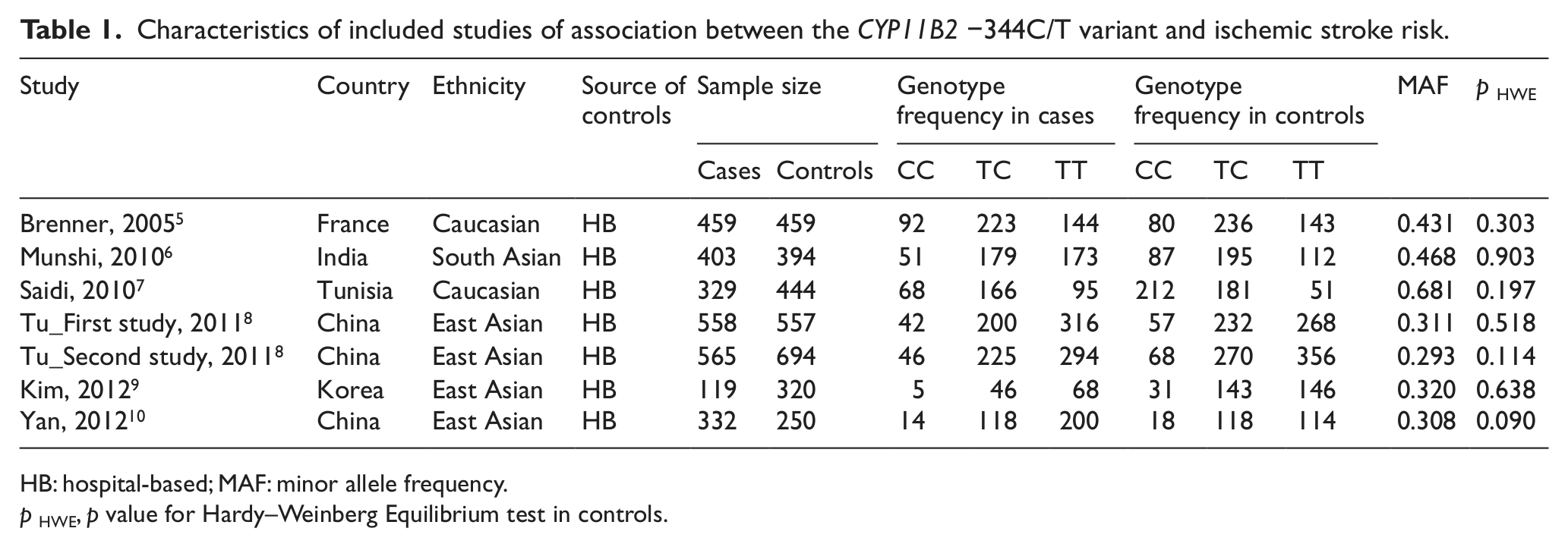
HB: hospital-based; MAF: minor allele frequency.
p HWE, p value for Hardy–Weinberg Equilibrium test in controls.
Meta-analysis results
The meta-analysis indicated that the CYP11B2 −344C/T variant was significantly associated with ischemic stroke under a homogeneous co-dominant model (TT vs. CC: OR=2.04, 95% CI=1.21–3.45, p<0.001, I2=87.9%, p for heterogeneity<0.001, Figure 2), dominant model (TT+TC vs. CC: OR=1.67, 95% CI=1.09–2.57, p=0.019, I2=85.2%, p for heterogeneity<0.001, Figure 4), recessive model ( TT vs. TC+CC: OR=1.56, 95% CI=1.18−2.05, p=0.002, I2=83.6%, p for heterogeneity<0.001, Figure 5) but not under a heterogeneous co-dominant model (TC vs. CC: OR=1.43, 95% CI=0.98−2.07, p=0.060, I 2 =77.8%, p for heterogeneity<0.001, Figure 3). Further subgroup analysis showed that the CYP11B2 −344C/T variant was significantly associated with ischemic stroke in an East Asian population (except for under heterogeneous co-dominant model) and a South Asian population, but not in a Caucasian population (Figures 2 –5). The subgroup analysis demonstrated that the between-study heterogeneity was from two studies conducted in Caucasian populations (Figures 2 –5).

Meta-analysis of the association between the CYP11B2 −344C/T variant and ischemic stroke risk under a homogeneous co-dominant model (TT vs. CC) by ethnicity.

Meta-analysis of the association between the CYP11B2 −344C/T variant and ischemic stroke risk under a heterogeneous co-dominant model (TC vs. CC) by ethnicity.

Meta-analysis of the association between the CYP11B2 −344C/T variant and ischemic stroke risk under a dominant model (TT+TC vs. CC) by ethnicity.

Meta-analysis of the association between CYP11B2 −344C/T variant and ischemic stroke risk under a recessive model (TT vs. TC+CC) by ethnicity.
Sensitivity analysis
Sensitivity analysis was performed to evaluate the stability of the results. By excluding one study at a time, the significant association between the CYP11B2 −344C/T variant and ischemic stroke risk was robust (homogeneous co-dominant model: OR with 95% CI ranging from 1.64 (1.11–2.43) to 2.38 (1.43–3.97); recessive model: OR with 95% CI ranging from 1.39 (1.1–1.74) to 1.68 (1.26–2.24)).
Potential publication bias
No publication bias was detected (TT vs. CC: p=0.133 for Begg’s test and p=0.546 for Egger’s test; TC vs. CC: p=1.000 for Begg’s test and p=0.980 for Egger’s test; dominant model: p=1.000 for Begg’s test and p=0.913 for Egger’s test; recessive model: p=0.133 for Begg’s test and p=0.091 for Egger’s test).
Discussion
To our knowledge, this is the first meta-analysis examining the association between the CYP11B2 −344C/T variant and ischemic stroke risk. The current meta-analysis with sufficient statistical power demonstrated that the CYP11B2 −344C/T variant was significantly associated with ischemic stroke risk. The stability of sensitivity analysis and no publication bias further supported the positive association.
A previous meta-analysis conducted by Tu et al. 8 indicated the significant association of the CYP11B2 −344C/T variant with ischemic stroke risk, which is consistent with the findings in our study. However, there was significant heterogeneity between studies under the dominant and recessive model. The authors did not examine the source of heterogeneity. Moreover, there are two recently published papers that are not included in the previous meta-analysis. Therefore, we performed an updated meta-analysis to further clarify the association between the CYP11B2 −344C/T variant and ischemic stroke risk. In the current meta-analysis, we performed subgroup analysis based on ethnicity to examine the source of between-study heterogeneity. The results indicated that ethnicity might be the source of heterogeneity since the heterogeneity disappeared in each ethnic group in most genetic models.
The mechanism on how the CYP11B2 −344C/T variant influences ischemic stroke is still unclear. Aldosterone has been related to vascular inflammation, endothelial dysfunction and vascular remodeling, which are considered to be involved in increasing the risk of stroke by initiation and progression of atherosclerosis and cerebral vascular structural alterations. 10 Elevated plasma aldosterone or mineralocorticoid receptor (MR) was shown to be associated with increased risk of stroke. Additionally, some experimental studies have demonstrated that the risk of stroke for an individual can be reduced by MR antagonism. 10 Further studies are required to investigate the association between the CYP11B2 −344C/T variant and ischemic stroke risk.
Several limitations of our study should be considered. First, our meta-analysis was based on unadjusted estimates and the confounding factors could not be controlled for because most studies did not provide these data. Second, gene–gene and gene–environment interactions were not addressed in our meta-analysis. Third, all the included studies used a case–control design, which did not allow for drawing casual conclusions.
In summary, the present meta-analysis supported the positive association of the CYP11B2 −344C/T variant with ischemic stroke risk. Further large-scale studies considering gene–gene/gene–environment interactions should be conducted to investigate the association.
Footnotes
Conflict of interest
None declared.
Funding
This research received no specific grant from any funding agency in the public, commercial, or not-for-profit sectors.