



Abstract
The deliberate targeting and violent destruction of cultural heritage in Iraq’s ancient city of Mosul by the Islamic State (2014–17) has recently given way to the emergence of heritage initiatives aimed at restoring its urban character and reviving its cosmopolitan spirit. Such restoration projects invariably stir debates over timing, funding and local consultation, as well as their potential to contribute to post-war social cohesion and communal healing. This article argues that in post-conflict settings heritage restoration is always an ambivalent and contingent process, involving the selective use of emotive historic symbols to create new realities. Based on 50 in-depth interviews with a diverse section of Moslawi society and site observations from Mosul (2022–23), the article explores local perspectives and the ongoing dynamic negotiation of heritage restoration. Amidst conflicting communal perceptions of large-scale internationally funded reconstruction projects, the article highlights the potential for grassroots heritage initiatives to offer a new impetus towards communal rehabilitation. The paper focuses on three less examined but locally championed Moslawi heritage sites—the souqs, Qila’yat district and heritage homes. These civic spaces may offer greater opportunity for social recovery through economic development, cultural exchange and everyday co-existence.
Introduction
After a 20-year hiatus, on 1 May 2023, Mosul’s Spring Festival finally returned to the city’s war-scarred streets. 1 A public parade of decorative floats, musical troupes and costumed performers showcasing Mosul’s and Nineveh’s ancient heritage drew thousands of Moslawis, including government officials, local dignitaries and representatives of Muslim, Christian, Shabak, Turkmen and Yazidi communities (Iraqi Presidency, 2023). Optimistically entitled ‘Eternal Spring, Reconstruction and Peace’, the festival captures the hope of Mosul’s re-birth after the genocidal ‘cultural cleansing’ (Baker et al., 2010) of the Islamist terrorist group ‘Islamic State’ (IS), which targeted and desecrated over 70 shrines, mosques, churches and heritage homes within the city (Matthews et al., 2020: 128). Aspirations for Mosul’s urban and social rehabilitation have become linked to heritage restoration projects, largely funded by foreign states and international agencies, seeking to recreate the city’s cosmopolitan past. In the words of UNESCO’s initiative, ‘Revive the Spirit of Mosul’, such projects aim to contribute to ‘community reconciliation and peace building through the recovery of the living environment and rehabilitation of the city’s heritage sites’ (UNESCO, 2023).
Post-conflict heritage restoration projects stir heated debates over international funding and local agency; timing and sequencing; conservation or transformation; and the need for integration of cultural heritage into wider reconstruction policies (Isakhan and Meskell, 2023; Munawar, 2023; Barakat, 2021). Equally divisive is the dispute over heritage’s potential to contribute to post-war social cohesion and communal healing or conversely—its political malleability in enforcing structural inequalities and elite-driven agendas (Giblin, 2014; Matthews et al., 2020). This article argues that in post-conflict settings heritage restoration is an ambivalent and contingent process: a dynamic contestation over the selective use of emotive symbols by multiple actors to create new realities from past memories. This paper seeks to move beyond the question of whether heritage restoration heals or hurts post-conflict societies, focusing instead on how individuals relate to, interpret and navigate heritage discourses and projects as part of their individual and communal recovery. In so doing, it argues that grassroots heritage initiatives can contribute to more holistic peacebuilding approaches as they have the potential to empower—rather than simply co-opt—local communities; incorporate heritage sites within communal living spaces, translating pluralist values into embodied practices of co-habitation and commercial co-operation; and provide historic spaces to celebrate local traditions, architecture and culture, restoring communal pride and belonging amidst post-conflict pain and urban dislocation.
Mosul presents a fascinating case to observe heritage restoration as a dynamic process. Entangled within global interventionist debates and Iraq’s delicate recovery, the city bears witness to the postwar realities of communal fragmentation, displacement and urban destruction. While academic attention has been turned to heritage restoration after violence, particularly in Syria and Iraq (Quntar et al., 2015; Clapperton et al., 2017; Munawar and Symonds, 2022), very few studies focus on local opinions towards heritage initiatives. Isakhan and Meskell’s (2023) large-scale survey of 1600 Moslawi attitudes to heritage restoration, conducted in the spring of 2021, provides a welcome exception, offering insights into local perspectives on internationally led heritage projects. Our research seeks to build on and contribute to such findings, based on ethnographic observations and interviews with a wide range of Moslawi society. This includes government officials, scholars, activists, archaeologists, religious and tribal leaders, ordinary citizens, new urban migrants and displaced minorities—sampled across religious, class, gender and age divides. 2 The findings reveal diverging attitudes, with interviewees frustrated by the slow speed of Mosul’s restoration, beset with endemic political corruption and disjointed municipal planning. Heritage restoration, however, still offers many Moslawis the opportunity to reimagine a more triumphant and pluralist past—an escape from the constant reminders of IS’s extremism. For some, it represents an act of resistance, an attempt to reassert one’s identity after deliberate attempts at ‘urbicide’ and ‘identicide’ (Kalman, 2017).
Our findings first focus on local responses to UNESCO’s key restoration sites—al-Nouri Mosque, Nabi Younis, and al-Taheera and al-Sa’aa churches. While most affirm these iconic sites’ symbolic importance to the city, many argue that everyday religious spaces also need to contribute to communal rehabilitation. Secondly, Moslawis emphasised that social cohesion does not merely derive from reconstructing collective symbolic icons but from reviving shared everyday heritage sites such as the souqs (markets), old neighbourhoods (as Qila’yat) and heritage homes. Such sites are often championed by local entrepreneurs and have the potential to reconnect economic, social and civic ties through joint commercial ventures, housing projects and cultural initiatives. Our research indicates that heritage restoration efforts in Mosul should extend beyond physical sites and focus on rebuilding communities, which will require that strategic initiatives incentivise minority returns (Christian, Yazidi, Turkmen, Shabak) while adapting to new demographic realities and accommodating the needs of Mosul’s current inhabitants. Before exploring the research findings, the paper examines the relevant literature on cultural heritage, healing and recovery, and provides a summary of research methods and the Mosul context. The article concludes by applying the empirical insights derived from Mosul to other post-conflict settings, in which heritage restoration is part of the recovery process.
Heritage, healing and post-conflict recovery
Although the significance of heritage restoration in post-war recovery is widely accepted, its framing, role and potential remain contested. Scholars have sought to approach cultural heritage through a human rights framework, emphasising the role of the UN Human Rights Council and UNESCO as international protectors and global guardians of ‘tangible/intangible cultural rights’ and ‘universal world heritage’. However, studies warn that such intergovernmental bodies often favour state interests over individual rights, legitimising exclusive nationalist discourses rather than safeguarding minority concerns (Meskell, 2013; Matthews et al., 2020). A second approach has been to link heritage recovery to global sustainable development goals (SDGs), in which principles of ‘Building Back Better’ integrate heritage projects in attempts to reconstruct ‘inclusive, safe, resilient and sustainable’ cities (SDG 11). Such universalist principles require greater contextualisation, especially in settings of recurring violence (Khalaf, 2020), and may lead to the exploitative commodification of heritage sites (Miura, 2015) or ‘cultural heritage predation’ by political/sectarian actors (Kathem et al., 2022).
Thirdly, heritage reconstruction has been credited with contributing to peacebuilding—enabling communities to overcome traumatic loss, re-appropriate suffering and rebuild peaceful futures (Isakhan and Shahab, 2020: 7; Giblin, 2014). Scholars posit that heritage restoration provides reclaimed spaces for personal recovery, communal connection and social cohesion. As Atabay et al. (2022: 15) argue, heritage sites can anchor and embed peacebuilding initiatives into local contexts, tying the ‘recovery of built environment’ to the recovery of ‘individuals and communities’. Research on post-conflict memorialisation in Bosnia and Herzegovina (BiH) similarly stresses that heritage restoration can facilitate individual empowerment and temporal re-orientation: ‘we remember in order to give meaning to the present and thus gain power over the future’ (Palmberger, 2016: 12).
Meskell and Scheermeyer’s (2008: 154) analysis of post-apartheid South Africa observes the capacity of ‘heritage as therapy’ to address past wrongs, yet still recognises that state-led ‘heritage pageantry’ is often more about ‘national performance rather than social justice and restitution’. Indeed, the misuse and politicisation of post-war heritage initiatives in peacebuilding has been well documented, from Israel/Palestine, the Balkans and South Africa to Afghanistan and Mali (Dumper and Larkin, 2012; Lostal and Cunliffe, 2016; Isakhan and Meskell, 2023). These cases demonstrate the dangers of elite instrumentalization of heritage sites, often used to bolster ethno-nationalist claims and commercial interests or prioritise international heritage agendas. As Barakat (2021: 445) reminds us, often, in post-conflict settings, ‘restoring iconic heritage with outstanding universal value marginalises the most vulnerable heritage locations key to socio-economic restoration’.
In response, multiple grassroots initiatives have emerged in the form of peace museums and heritage centres—District Six, Cape Town; Community Peace Museums Heritage Foundation, Kenya; Casa Museo de a Memoria de Tumaco, Colombia—seeking to challenge dominant discourses, integrate marginal voices and reclaim hidden historic lives: ‘We do not wish to recreate District Six as much as to re-possess the history of the area as a place where people lived, loved and struggled’ (McEachern, 1998: 504). While such ‘heritage from below’ (Robertson, 2016) projects may provide alternative sites and interpretations, they also can be ‘selective, biased and partial to the actual past itself’ (Muzaini and Minca, 2018: 12). This article does not romanticize grassroots heritage initiatives as more effective forms of cultural rehabilitation, but rather suggests they have greater potential to contribute to post-war healing due to their local ownership, organic development and holistic approach to social recovery. Emerging research confirms the positive effects of community-based heritage projects on individuals’ mental health, stirring a passion for history, and the creation of new spaces of ‘hybrid inter-relational and interstitial connectivities’ in which ‘people’s sense of place, belonging and security can grow’ (Power and Smyth, 2016: 166).
This study acknowledges however that post-conflict heritage can both unify and divide, recognising its ambivalence and contingency. As Giblin (2014: 515) explains, the symbolic healing of traumatic pasts is ‘negotiated in the present through the continuous creation and deconstruction of emotive symbols to create social, political and economic cultural renewal’. Heritage never stands still; it is constantly remade to affirm lost identities and assert social and political claims through embodied symbols. In times of postwar flux, as in the case of Mosul and Iraq, heritage is ‘intensified as the past is aggressively negotiated’, or as Giblin (2014: 500, 515) contends, ‘when a culture is in a perceived state of shock … heritage use becomes intensified in response to the preceding trauma as an accelerated form of cultural production’. If post-war settings exacerbate heritage’s role as a site of contestation and dissonance, they also provide an opportunity to address its dichotomous function. As Viejo-Rose (2011: 214) argues in her book on the role of cultural heritage in Reconstructing Spain, ‘Only by recognizing [heritage’s] potential to impart messages of fear, domination, and violence can its potential as a resource to reconciliation be engaged and any historical grievances linked to it addressed’.
Our research in Mosul grapples with this ambiguity and encourages a deeper engagement with Moslawi voices and local heritage sites. An integrated approach to heritage as a form of post-conflict recovery must seek to balance rights and economic growth alongside social stability and urban regeneration. While scholars have stressed the importance of ‘dynamic and ongoing’ communal engagement to support heritage projects, there remains a lack of understanding of how sites intersect with collective memories (Munawar, 2023; Larkin and Rudolf 2023a), and how to reconcile the conflicting interests of ‘heritage owners and conservators-restorers’ (Hirsenberger et al., 2019: 217). The Moslawi case affirms recent research in BiH and Kosovo, which demonstrates the importance of anchoring heritage restoration in the work of local heritage actors, supporting their capacity for organic growth while recognising how ‘presences and absences in the post-conflict landscape’ impact ‘processes of exclusion and inclusion’ (Kappler and Selimovic, 2021: 3).
Post-war recovery is never the return to an idealised past but the search for a mediated and pragmatic everyday. While heritage restoration projects seek to recreate pluralist and shared pasts, these can contradict contemporary urban realities. Bădescu (2020: 130), writing on postwar Sarajevo and Beirut, notes, ‘Reconstruction stressed the continuity of religious buildings belonging to all groups, sustaining a cosmopolitan brand which is belied by now segregated demographic realities and daily practices’. Bădescu distinguishes between cosmopolitanism as a heritage marketing brand—important in generating international support—and the perverse reality of ‘exclusionary cosmopolitanism’, in which forced displacement was never reversed and urban newcomers (Shi’a in Beirut and rural Bosniaks in Sarajevo) were blamed for contributing to a deterioration of culture within the city. Such processes have relevance for Mosul, highlighting the danger of social exclusion, and the prioritisation of heritage sites over communal repatriation. The potential of grassroots heritage initiatives in Mosul to contribute to peace therefore depends on transforming symbols of pluralist life into everyday realities of shared coexistence through revived local markets, historic neighbourhoods and heritage museums/homes.
Mosul context and research methods
Mosul has long been one of Iraq’s most ancient, multicultural, ethnically mixed (Arab, Kurd, Turkmen, Assyrian, Shabak) and religiously diverse (Sunni/Shia Muslim, Christian, Yazidi) cities. It has been a strategic hub, linking historic trade routes and imperial conquests; located on the edge of empire, its boundaries and loyalties have been fought over by international powers, state authorities and Islamist insurgents (Shields, 2000). Mosul’s cosmopolitan nature has been subject to demographic shifts caused by Iraqi Baathist ‘Arabization’ policies from the 1970s—displacing non-Arabs and resettling Arabs in northern provinces—and more recently through the rise of al-Qaeda and the IS takeover (2014–17) resulting in the killing, forced expulsion and mass exodus of the city’s Christian, Yazidi and Shia minorities (Mufti, 2004; Isakhan and Shahab, 2020). This traumatic social rupture has stirred Moslawi memories and romantic tales of urban co-existence, resilience and collective struggle. As one Moslawi, a Sunni Arab teacher, reflects, ‘We want to go back in time when people from different sects stood together to repel the Persian invasion back in the 18th century. The leader of the campaign was Nadir Shah. All the people of Mosul stood together—Christians and Muslims’. 3
Such nostalgia for collective religious unity undoubtedly reveals public frustrations with Mosul’s post-liberation fragmentation, evidenced in urban dislocation, state and municipal infighting, and splintered security actors—the Iraqi army, Popular Mobilization Forces (PMF / al-hashd) and Kurdish peshmerga. Nevertheless, it also demonstrates why Mosul remains such a fascinating case to test the limits and potentiality of heritage restoration in contributing to Mosul’s and Iraq’s post-IS recovery. Since 2018, multilateral institutions (UNESCO, UNDP, EU, World Monuments Fund) and foreign governments have raised almost $150 million towards the documenting, digitising and restoration of museums, libraries, churches, mosques, statues, shrines, archaeological sites and local craftworks (Isakhan and Meskell, 2019, 2023). Our research explores local attitudes towards such heritage projects and seeks to understand the sites and spaces ignored by external funders but championed by local communities.
During February 2022 and June 2023, we conducted 50 in-depth interviews with individuals from Mosul and Nineveh, including activists, scholars, religious leaders, tribal sheikhs, politicians, community representatives and ordinary citizens across ethno-religious (31 Arab Sunni; 5 Shia; 5 Christian; 5 Yazidi; 2 Turkmen; 2 Shabak), gender (41 male; 9 female), age and class divides. 4 Our sample comprised locals/returnees (67%), some new urban migrants (8%) and displaced minorities (25%), seeking to capture the diversity of the city, but also reflecting the challenge of including more female and minority voices due to social constraints and public mistrust. While the sample does not claim to fully represent Moslawi society, it captures key dominant themes and reflects current demographic realities. Interviews were conducted by the authors in Arabic, half online and half in person, during fieldtrips to Baghdad and Mosul, with interviews conducted in Hamdaniya, Sheykhan and Sinjar. A diverse sample was achieved by relying on the authors’ Iraqi research networks and through snowballing techniques. Interviewees provided informed consent and have been fully anonymised to protect their identities, while pseudonyms were used to reflect the diversity of the sample.5 Research of such a sensitive nature requires understanding, reflexivity and empathy, and the authors drew on their previous Iraqi and post-conflict experience, learning when to pause, simply listen or terminate the interview. As foreign Arabic-speaking researchers who have lived in the Middle East, we continue to navigate ‘outsider-insider-inbetweener’ dynamics (Milligan, 2016), constantly reflecting how our status/positionality affects local responses.
In addition to qualitative semi-structured interviews, ethnographic observations of heritage sites were conducted during a field trip to Mosul in May 2023. The authors participated in walking tours around the city accompanied by local activists, historians and photographers. During these ‘walking interviews’ (Evan and Jones, 2011), personal stories of loss and resilience were infused within tours of rehabilitated mosques and newly restored public squares as well as visits to Moslawi homes, where returnees spoke of clearing rubble and dead bodies before they could re-inhabit their buildings. In postwar Mosul, few photographs or walled posters attest to the city’s 40,000 martyrs, yet as one activist shared: the images and pictures are in our minds. Every time I pass a street, a house or junction, traumatic memories flood back … In this house a whole family died due to a direct coalition rocket strike … Now there is just an empty space in the middle of a row of buildings. They have been physically erased.
6
Drawing on rich personal testimonies, the paper also integrates secondary sources such as policy reports, news articles and academic journals, as well as social media in Arabic and English.
‘Here UNESCO works to Revive the Spirit of Mosul’
UNESCO branding in Mosul, al-Nouri Mosque. Photo: Craig Larkin. UNESCO branding in Mosul, al-Nouri Mosque. Photo: Craig Larkin.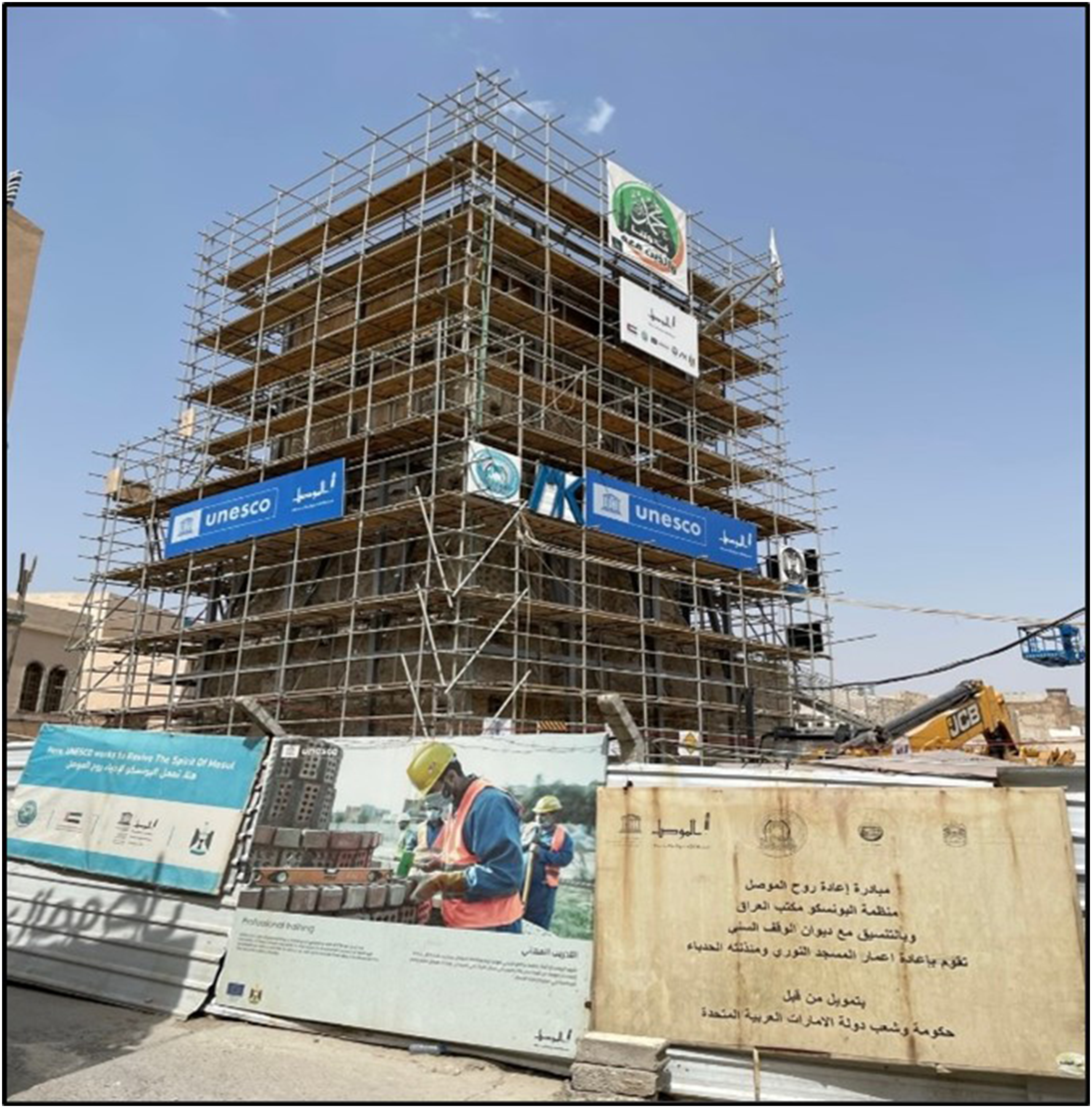
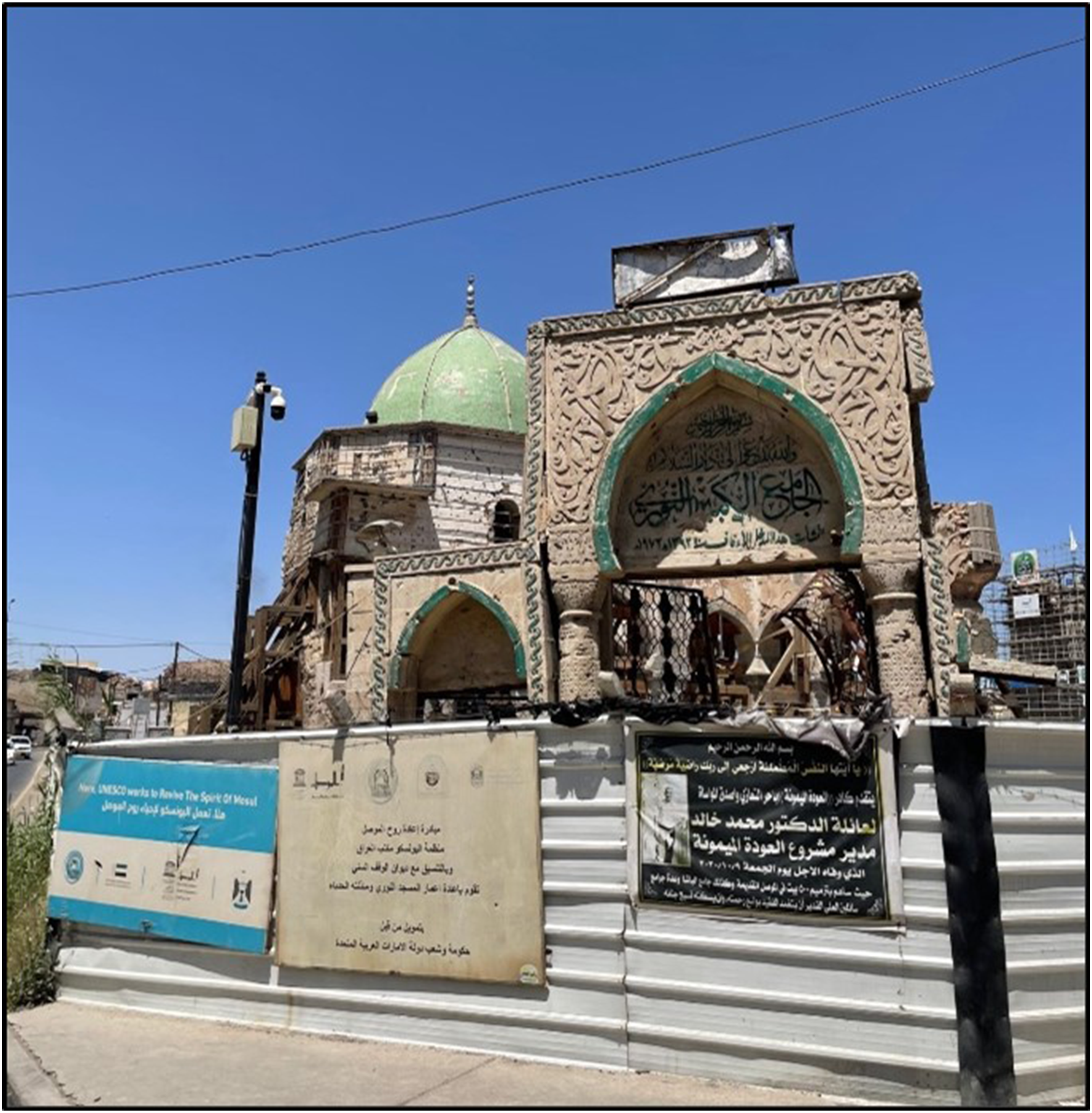
These religious sites are emblematic of Mosul’s destruction under IS and their recovery is explained by interviewees in terms of physical healing or search for belonging. As one young Christian Moslawi explains, ‘ISIS bombed every part that belongs to our identity. We are now left without an identity. We are bereft of our history’.
7
A number of Sunni Arab interviewees felt that the rehabilitation of churches and mosques could help expunge the ‘spiritual evil’ and ‘extremist virus’ spread by IS, who deliberately detonated a bomb within Nabi Younis on the most holy night of Ramadan, Laylat al-Qadr (Night of Power), and destroyed al-Nouri mosque’s al-Hadba minaret as a final act of religious desecration in June 2017. Some interviewees, particularly among the older generation of Moslawis, felt that no restoration scenario could ever restore the intimate memories, irretrievably lost with the destruction of the original religious sites: It is possible to rebuild and renovate 100 mosques like Al-Nouri Mosque. The problem is not this. When I used to be a child, I used to climb the top of al-Hadba minaret. I have so many memories in this place … We are deeply angered by those who deprive us from the collective memories and the special relationship we have with these sites.
8
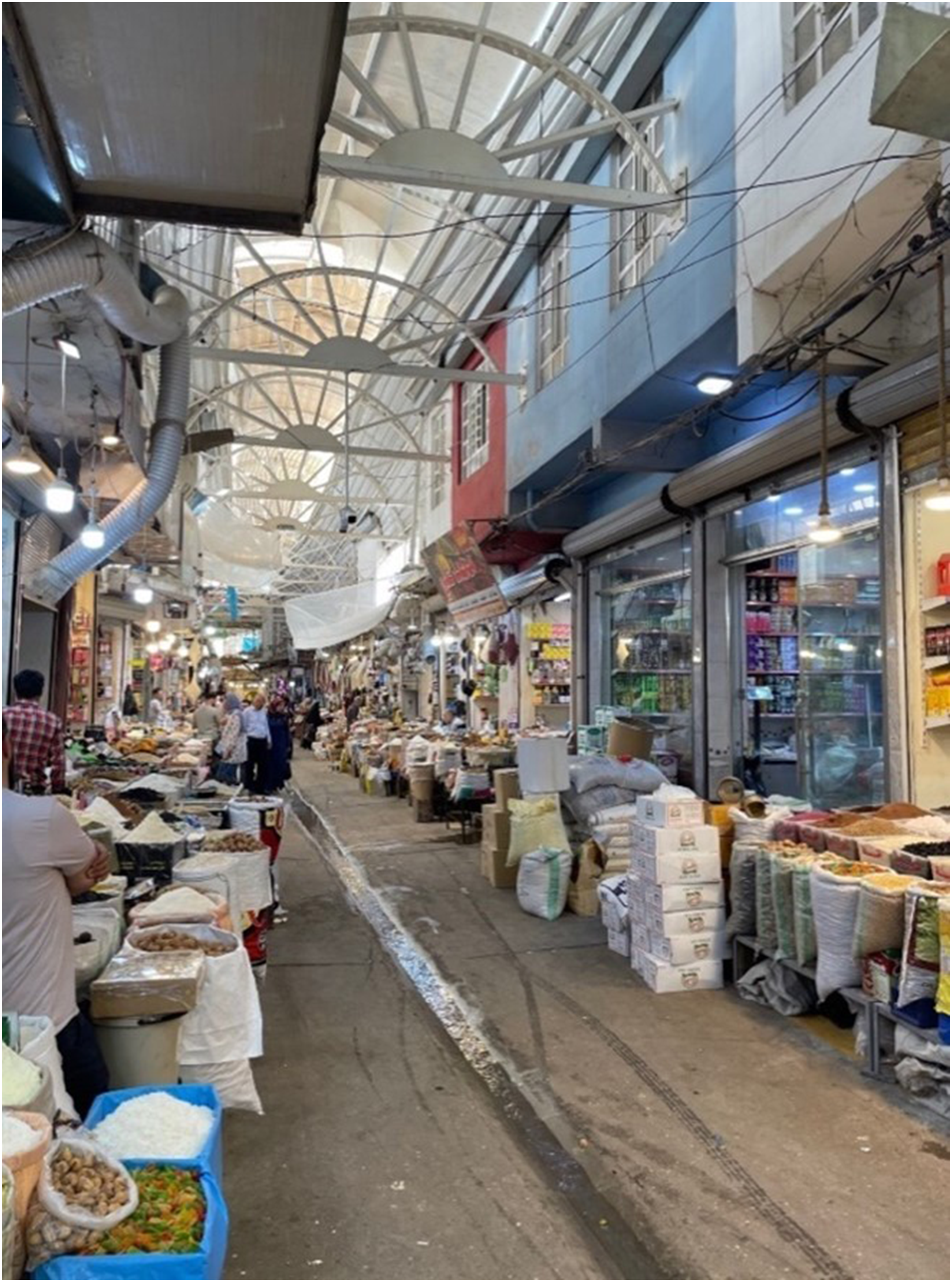
Although most interviewees blamed IS for the urbicide inflicted on the city, many also accused International Coalition forces of material destruction during the battles for Mosul’s liberation. Considering the controversial legacy of Western troops in post-2003 Iraq when it comes to their failure to prevent the looting of Iraq’s cultural landmarks in the aftermath of the US invasion, the local scepticism vis-à-vis the credibility of foreign actors comes as no surprise (Abdul-Ahad, 2023: 53). (Figures 3 and 4). Destroyed church awaiting restoration, Mosul. Photo: Ali al-Baroodi. Mosul old city souqs. Photo: Craig Larkin.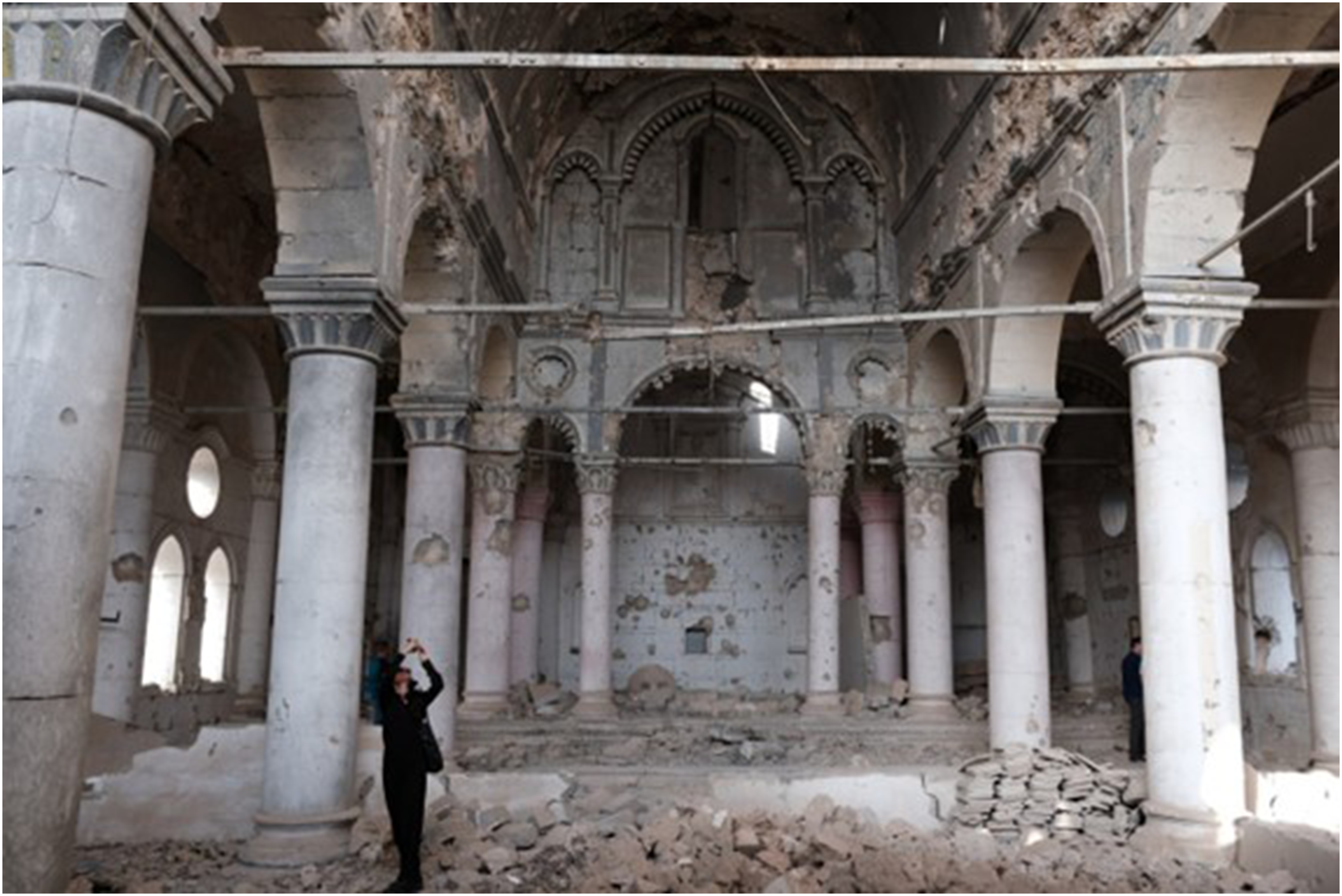
Isakhan and Meskell’s (2023) large-scale quantitative survey of Moslawi attitudes to heritage restoration confirms dichotomous local perspectives over the importance of ‘heritage authenticity’—faithful restoration to ‘the way it was before’ balanced against adaptive transformation of heritage sites into modern, useful community buildings. While 48% of the 1600 interviewees preferred that ‘the sites are restored and reconstructed into a new and more modern structure’, 43% maintained that the sites were either to be reconstructed to their pre-war condition or to the way they were when they were first built (Isakhan and Meskell, 2023: 16). These figures may suggest a greater local appetite for innovation than international heritage bodies and conservationists are willing to concede, yet there remains much ambiguity as to how citizens envision this reconstruction process.
Our interviews attest to diverging perspectives, cutting across age, gender and religion. Predictably, archaeologists valued conservatism, heritage activists favoured innovation and ordinary Moslawis desired heritage projects that create ‘historic re-connection’, while still meeting everyday needs. One archaeologist commenting on al-Nouri Mosque’s reconstruction insisted: ‘People in Mosul like what is ancient without any alteration or modification to the originality of the site’.
9
However, many Moslawis remain ambivalent, nostalgic for the pre-war version of their sacred sites, acknowledging the need for adaption and yet accepting that replicating old facades will not bring back lived experiences: Rebuilding is possible, and we can have a newer and better minaret. The issue is that the now destroyed minaret was full of life because it had soul to it, formed by the people who share memories in this special place.
10
As the prominent Mosul historian Omar Mohammed explained in an interview, the iconic optics of many symbolic heritage sites can be preserved while modernising the old structures so that they can resist future challenges such as extreme weather variations. 11
Mosul residents’ tolerance for minor modifications should not be read as a willingness to trade the familiar sights of their cherished cultural landmarks for any sort of radical architectural departure. Local suspicions persist over the funding of al-Nouri Mosque’s reconstruction by UAE ($50.4 million) and the Egyptian-awarded architectural design that some interviewees claim betrays the integrity of the site and threatens to transform al-Nouri into a ‘tourist site that is bereft of any cultural, memorial, historic, or archaeological significance to Moslawis’. 12 Other activists and community leaders warn against superficial public consultations and the lack of buy-in, particularly from excluded minorities, be they Yazidi, Shabak or Turkmen. As one activist reflects, ‘the reconstruction of a site is not about the physical building, it’s about the rehabilitation of its spirit. And its spirit comes from the people. If they are not involved, this site will have zero value’. 13
A Sh’ia Shabak religious leader lamented the loss of 7000 Shabak from Mosul, their forced expulsion to 64 towns in Eastern Nineveh valley disconnecting them from religious sites and heightening ‘Christian-Shabak struggles over services’. 14 The long-term impact of the displacement of Mosul’s minorities poses difficult questions regarding the efficacy of restoring tangible religious sites without the physical presence of the living communities. While the reconstruction of Mosul’s churches is perceived as a critical step towards reviving the city’s multicultural heritage, a majority of interviewees expressed doubts whether such measures would bring back the Christians. A Syrian Catholic priest, Father Ra’id from al-Bishara church, admitted, ‘The city needs services and infrastructure to restore its soul. After this comes the reconstruction of houses and churches’. 15 Heritage restoration can play an integrative healing function only when it is accompanied by socio-economic opportunities, security and some type of restorative justice (Barakat, 2021).
Nabi Younis: layers of complication
Controversies abound over the reconstruction of one of Mosul’s most ancient heritage sites. The Mosque of Nabi Younis sits atop a shrine of the prophet Jonah revered by Muslims, Christians and Jews; it is built upon a Nestorian Church, a Jewish synagogue and the Assyrian palace of King Esarhaddon, who ruled Nineveh in the seventh century BC. Before IS destruction, Nabi Younis drew worshippers from multiple backgrounds as well as Moslawis seeking the best views of the city and to socialise on the landscaped grounds (Nováček et al., 2021).
While many interviewees claim its reconstruction is an important milestone towards the post-conflict healing of the city’s diverse communities, heated debates surround the ongoing excavations and its stalled restoration. One local scholar cautioned against pushing for the site’s rapid reconstruction in the absence of adequate joint mechanisms to bring back its true spirit: How do you convince the Muslims that there are popular Christian or Jewish sites underneath? How do you convince the Christians that there is a mosque on the top? And how do you convince the archaeologist, that on the top of the heritage site, there are sites with contemporary value. That is a very complicated matter in Mosul and it’s not given enough time to be discussed.
16
The disputes over restoration which have delayed progress at the site underline the importance of a coherent national policy of heritage reconstruction which can accommodate conflicting sub-national preferences. Nevertheless, as one interviewee pointed out, neither UNESCO nor the Iraqi government have demonstrated initiative to support the mosque’s reconstruction, which is currently being funded by donations of Moslawis and a local charity: Many ministers came to visit the mosque and have promised us several times that reconstruction will be funded by the government, but all these promises were empty. The government purposely delayed reconstruction due to the discovery of Esarhaddon Palace.
17
The commitment of Mosul’s Arab Sunni residents to restoring their local mosque seems to confirm the findings of Isakhan and Meskell (2023: 20) that Moslawis favour the restoration of local spiritual centres over grand heritage projects or archaeological digs. This certainly applies to the ongoing restoration of multiple mosques throughout Mosul, undertaken by families, communities and Islamic waqf. It reflects the local pressure applied on Iraqi authorities to finally cede that Nabi Younis Mosque be rebuilt by Sunni Waqf authorities alongside the ongoing excavations of the Assyrian palace by international archaeologists. This reveals that Moslawis view religious sites not merely as heritage repositories but as living spaces for everyday worship, prayer, religious festivals and social gatherings. Therefore, the potential of heritage restoration to contribute to social cohesion and communal re-integration can be identified in everyday dynamic spaces, in which cultural heritage is intertwined within souqs, old neighbourhoods and heritage homes.
Grassroots Moslawi heritage sites
Souqs and bazaar
Despite a lack of government funding, Mosul’s old city souqs and the historic Saray bazaar have made an impressive comeback, largely driven by grassroots initiatives, local owners and philanthropists, such as the distinguished al-Jalili family. From jewellers’ shops to the blacksmith alley, Ali Al-Baroodi (2021) has documented the hopes of merchants and craftsmen slowly reviving their businesses. When asked about the challenges faced in rebuilding his shops, the local entrepreneur Wadhah al-Jalili explained: ‘The bridges were all down in River Tigris, and my properties are in the heart of the bazaar, and no one can reach them with lorries as they were blocked with rubble’ (Al-Baroodi, 2021). Nonetheless, Jalili decided to push ahead with reconstruction, restoring workshops and ancient khans such as Khan al-Komrk (Ali et al., 2022), while helping those struggling with the lack of funds and government support.
18
Locally led reconstruction within the souqs has shown sensitivity to heritage and cultural needs, while repurposing ‘shops for handicrafts and old Moslian professions’ and khan squares for ‘community cultural events’ (Ali et al., 2022: 15). Interviewees praised the independent restorations within some souqs, identifying them as One of the safest areas, in which Moslawis have enough power to decide what and how it is to be preserved, because they were completely rehabilitated and recovered by their landlords, by the families themselves, so they have full authority over them.
19
This cross-community solidarity, as reflected in the social dynamics of the Saray bazaar, is what native Moslawis describe as the heart and soul of their city’s past. As one local merchant recounted: I used to go to the trade centre (souq) in the old industrial area in Mosul where I witnessed the co-existence between different social groups—all sat next to each other. I used to see my dad sitting next to a Yazidi merchant selling hummus who wanted to sit in our office, next to a merchant selling wheat from al-Hamdaniya district in Nineveh, next to another merchant selling barley … This was like a university, which is a place bringing different people from different religions, ethnicities and sects together.
20
The nostalgic hope of reviving commercial pluralism will depend on reconnecting familial links and trade relationships, often between urban and rural communities. The old bazaar also has to compete with the new shopping centres in the eastern side of the city as well as Mosul’s al-Jadida neighborhood. Meanwhile, the Saffarin souq and Al Quozin souq, once a jewel of Mosul, are reportedly ‘struggling to remain open after the city’s liberation from IS as most of those who worked there were either killed or have fled the city’. 21 Therefore, attracting investors, restoring war-ravaged buildings and securing capital for those who have risked reopening workshops are steps that the Iraqi government could undertake to ensure the future of the bazaar, not just as a commercial hub but as a thriving symbol of Moslawi and Iraqi multiculturalism. As one interviewee reflected, ‘Reconciliation cannot be forced. It can only happen naturally, when we have the people communicating with each other, which is why the role of the local markets of Mosul, especially that of the old market, is fundamental’. 22
The souqs contain important heritage sites—old hammams (bath houses), mosques, khans—which according to Moslawis, ‘reaffirm and reassert Moslawi identity, ethnicity, religion and culture’. 23 Our interviews confirm the significance and emotional connection many Moslawis feel towards the souqs. Therefore, active protection of this heritage site and government investment may help restore greater confidence in the Iraqi authority’s commitment to Mosul’s revival. Lastly, in view of its contribution to the economic recovery of conflict-affected communities in the old city, the bazaar can serve as a positive example of a local-needs-driven approach to heritage restoration which can unlock synergies between international and local heritage practitioners, residents and state officials. Moreover, Mosul can draw lessons from the disastrous post-war souq renovations in Beirut by Solidere, which created exclusive, designer-driven outlets aimed at Arab Gulf tourism rather than local citizens’ needs and ended up obstructing social re-integration within the city (Hourani, 2015).
Reconstructing the Qila’yat district
Another key site, lauded by locals as carrying the DNA of the city, is Mosul’s Qila’yat district. With its historic riverside forts dating back to 1080 BC, the Qila’yat neighborhood holds symbolic value for many of the city’s residents. As a native of the district explains, ‘Rebuilding this area is reviving the civilization and culture of Mosul … The Qila’yat is home to the first mosque in the city ever built and the oldest church’. 24
The cultural significance of the Qila’yat district extends beyond its historic architecture to its emotive history. Residents tell stories of shared lives, with one interviewee arguing that Moslawi youth need to learn tolerance and co-existence not from books or Prevention of Violent Extremism (PVE) programmes, but through the restoration of plural neighbourhoods in which they ‘will witness how a mosque and church stand side-by-side. This is the tolerance and multi-culturalism that Mosul is well known for’. 25 However, the neglect of the district under the former governor Nawfal Aqoub raises suspicions among locals (Al-Baroodi, 2021). They wonder about the motivations behind such actions, suspecting an attempt to erase the city’s history. Systemic administrative negligence fuels feelings of mistrust among residents, who often believe there has been ‘a deliberate effort to prolong the war in the old city and destroy many of the city’s historical and cultural landmarks’. 26 Despite the establishment of the ‘Mosul Reconstruction Committee’, little progress has been made in rebuilding the Qila’yat area. Residents continue to live in camps or rented houses, unable to return home. A report of the Iraqi human rights observatory stressed that efforts to rebuild these areas are undermined by ‘impossible conditions, complex procedures, problems related to real estate borders, and the loss of identity documents’ (Al-Araby Al-Jadeed, 2021). Furthermore, armed parties exploit ownership rights without compensating the area’s original inhabitants.
Finally, the economic potential of the district increases the appetite of profit-driven entrepreneurs to cash in their political leverage over the formal and informal bidding process. One Moslawi activist has thus warned about the risk of corrupt officials endorsing reconstruction designs, which would be far removed from the locals’ legitimate interests: There are different bids being submitted to rebuild Qila’yat. These bids are all catastrophic because some of them want to transform the neighbourhood into a modern one with skyscrapers like Dubai, others have a vision of turning the neighbourhood into a corniche, while other bidders want to open shisha lounges in the area … If Qila’yat disappeared, Mosul as a city ends and becomes a soulless city.
27
As this powerful quote demonstrates, the Qila’yat should be rebuilt sensitively, balancing the potential for tourist growth—so residents ‘make a living by reviving the infrastructure’—against the importance of historical integrity, communal consultation and local-led expertise. The restoration of such Moslawi neighbourhoods, rather than symbolic religious sites or civic landmarks, may contribute more to resurrecting the spirit of intercommunal solidarity, as cherished by many Qila’yat residents. As one Sunni Arab resident reflects, We used to mingle with our friends and neighbors who were from different religious and ethnic groups … We lived in one united community. In addition, I want to salute my Yazidi friends. They used to come sell bulgur wheat in the area. All women used to wait for the seller to come so they can buy wheat and cook it. Cooperation and collaboration between women in the area is what makes Qila’yat unique. We coexisted with Christians and Yazidis.
28
Amid stories of shared Moslawi life, residents of the Qila’yat (now predominantly Arab Sunni) still hope that their former neighbors (Christians, Yazidis, Shabak) will return and receive compensation to rebuild their lives. The area presents a golden opportunity to restore not just the built environment of an iconic urban centre, but also to rekindle a sense of trust among conflict-affected communities that heritage reconstruction initiatives can tangibly contribute to post-war social healing. By embracing their cultural heritage and involving the people connected to the district, Mosul can rebuild not only its historic urban centre, but also its sense of identity and communal bonds.
Heritage homes
One of the most notable UNESCO achievements in Mosul has been the restoration of over 124 historic houses within the old city (Mosul Eye, 2022). Yet, even more remarkable has been the initiative to restore grassroots-led heritage/museum homes showcasing Moslawi tangible and intangible cultural heritage. Three prominent examples are the restored historic houses of the Mosul Heritage organization located in bayt al Rahim, the Baytna (Our Home) Institution for Culture, Heritage and Arts and the al-Talib home of the grassroots organization ‘Volunteer with Us’. These three initiatives have thrived through a symbiotic relationship between the activist founders and the legal owners of the houses. The legal owners have donated or rented out the buildings to be restored as heritage sites and repurposed as headquarters for organizations with a strong humanitarian mission and local grounding.
Ayoub Thanoon, founder of the Mosul Heritage project, shared how the family of the deceased owner donated the house, entrusting him with transforming it into a heritage museum. The house, which was partially destroyed during the conflict with IS, has been restored with meticulous attention to detail. It comprises multiple floors containing Moslawi traditional living spaces and an impressive heritage museum. The museum displays locally donated artifacts and antiquities from different periods of the city’s history. It includes old sewing machines, record players, newspapers and banknotes dating back to Iraq’s monarchy. The museum highlights architectural landmarks of Mosul and Nineveh, including a three-dimensional model of al-Hadba leaning minaret and images from the legendary caravan city of Hatra, which was severely damaged by IS. The main purpose of the museum is not only to preserve Mosul’s heritage but also to increase public awareness about the city’s iconic legacy. Workshops are organized to develop the skills of local activists, aiming to revitalize the tourism industry in Mosul. Ayoub proudly shared, ‘Everyone visits the museum. What shocked us was that people from Duhok are coming to visit the museum. Visitors come from all districts and towns around Mosul such as Al Hamdaniya, Baaj, Bartella, and Tel Kaif’. 29
Involving local communities in the museum’s activities also enhances these audiences’ heritage appreciation. This increased appreciation can lead to more sustainable protection of these assets, ultimately benefiting the entire community (Matthews et al., 2020: 135). Within a short span of six months, the museum has recorded 24,000 visitors, including 12,000 university students and school groups. The museum has become an attractive destination for tourists and local families, while the Mosul Heritage organization has expanded its outreach throughout the Nineveh governorate as part of the Nineveh Heritage Preservation Initiative. They organize excursions to different towns and districts, connecting communities and fostering a shared pride in the governorate’s diverse cultural heritage. This people-centred approach to heritage promotion has the potential to improve locals’ livelihood prospects while contributing to the emotional recovery and reconciliation of conflict-affected communities.
An equally inspiring local initiative is the Baytna Institution for Culture, Heritage and Arts, founded by Moslawi journalist and cultural entrepreneur Saker al-Zakariya in 2019. The institution aims to showcase the unifying power of Mosul’s rich cosmopolitan legacy. Housed in a carefully restored traditional house in the heart of Mosul’s Old City, Baytna is a place that is dedicated to Moslawi identity. The museum house is adorned with portraits of famous Moslawi artists, writers and public figures, while exhibiting vintage items and memorabilia, reminding visitors of Mosul’s glorious past as a centre of trade and cultural exchange. It hosts regular cultural events, including art exhibitions, readings and musical performances, that aim to create an atmosphere of pride, a space, in al-Zakariya’s words, in which ‘people feel proud of their city’s heritage’. Baytna aims to combat the stigma associated with the city’s violent history by reshaping the narrative and highlighting the resilience of its people. Al-Zakariya recognizes that the restoration of physical structures is not enough to heal the city’s wounds. By offering Baytna as a space where locals can reconnect with their history and rediscover their roots, he endeavours to restore a sense of dignity, identity and pride in the residents.
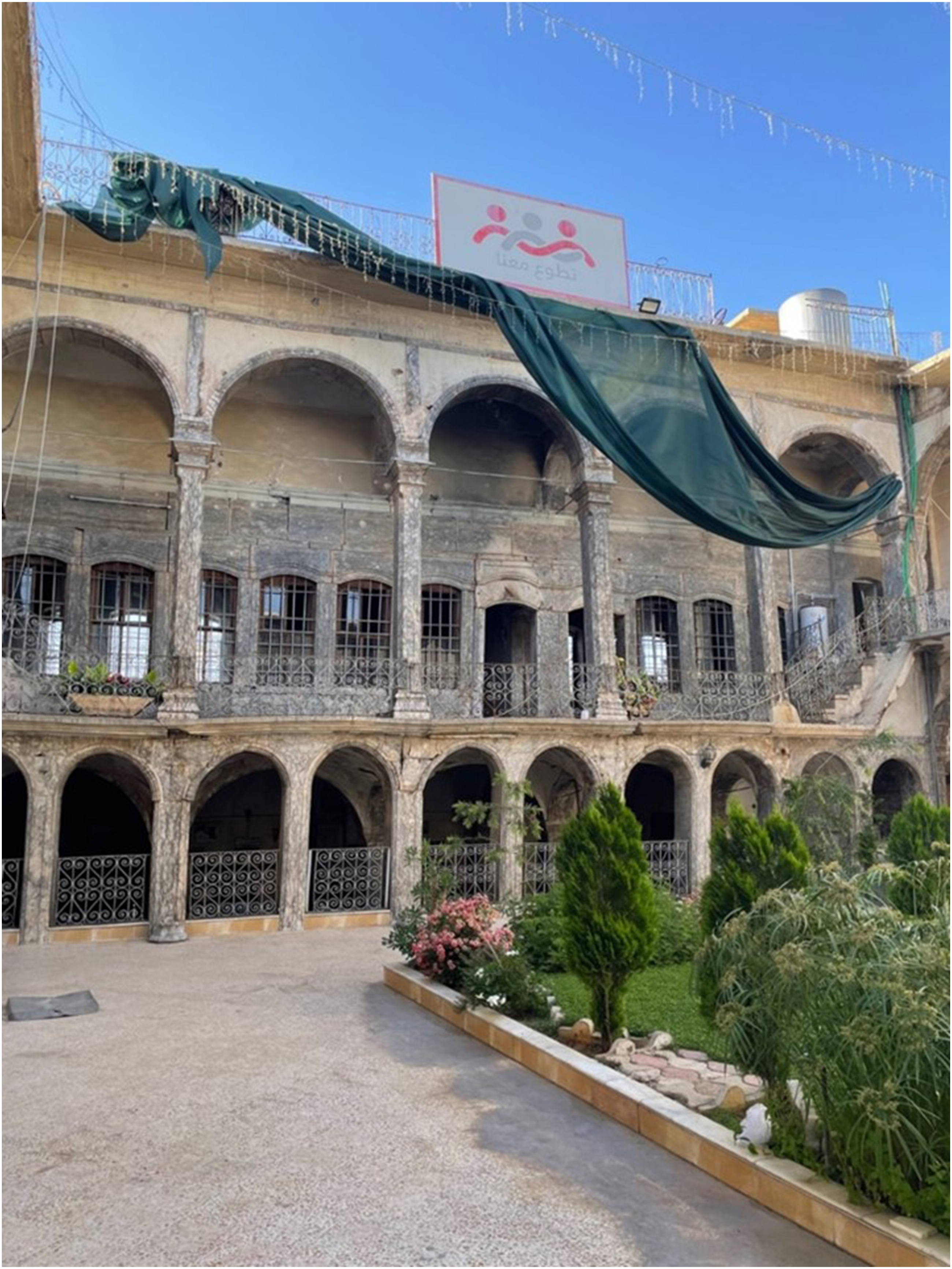
The third historic home, bayt al-Talib, which houses the grassroots organization ‘Volunteer with Us’ led by Omar Mohammed, acts as a gathering point for volunteers and activists who are passionate about preserving Mosul’s legacy. ‘Volunteer with Us’ mobilizes local youth, engaging them in various projects related to heritage, education and community development. From the rehabilitation of schools destroyed during the war with IS to working with orphans or teaching children how to build vertical gardens, the team of ‘Volunteer with Us’ seeks to tackle the grievances of multiple conflict-affected communities. Through workshops and activities, the organization encourages residents to share their stories, music and celebrations, fostering unity and understanding among different communities. Omar and his team stress that ‘cultivating an atmosphere of acceptance and love will help repair the cracks in society and revive the social fabric of Mosul’. 30 Barakat (2021: 443) similarly argues that in post-conflict settings, where socio-economic and political upheaval create uncertainty and apprehension, heritage restoration assumes a critical role in defining and reaffirming post-conflict identities: ‘it is critical to acknowledge that, from the perspective of those affected, heritage becomes more than mere tangible manifestations—as does architecture, so do historical artefacts and archival documents start to assume complex roles in forging identity’.
While these grassroots initiatives have garnered praise for their commitment to preserving Mosul’s heritage and fostering community engagement, sceptics may question their inclusivity and ability to address the city’s economic challenges. As Bădescu (2020: 133) reminds us, heritage projects may help create ‘spatial practices—uses and clusters of people around places perceived as being cosmopolitan’, but this is different from restoring cosmopolitan attitudes and cross-communal networks. Nevertheless, in post-conflict Mosul, such projects are crucial for consolidating local peacebuilding platforms and fostering innovative collaborations. These heritage hubs are less centred on the commodification and tourist-driven models that often affect large-scale projects which can lead to urban gentrification and a deepening of post-war inequalities (Meskell, 2021). Like District Six Museum in Cape Town, a community-led project to restore and remember a diverse South African neighbourhood, Moslawi heritage homes focus on the ‘reappropriation of the city which was taken from them’ (McEachern, 1998: 517). In the uncertainty of post-apartheid South Africa and post-IS Iraq, community-driven heritage projects suggest ‘the retrieval of a more desirable past provides a way into new identity’ (McEachern, 1998: 517).
Iraqi officials should build on these heritage initiatives, promoting inclusive economic development which ensures that the benefits of heritage restoration reach all segments of society. A holistic approach is needed, combining heritage preservation with measures aimed at job creation, economic growth and welfare. Empowering local actors who understand Mosul’s history and priorities is vital. The international community should provide financial assistance and capacity-building to these local heritage entrepreneurs, while respecting their autonomy and avoiding the imposition of ‘peacebuilding jargon’ (Larkin and Rudolf, 2023b).
Figures 5 and 6: Heritage homes—Baytna and ‘Volunteer with Us’. Photos: Inna Rudolf. Heritage homes—Baytna and ‘Volunteer with Us’. Photo: Inna Rudolf. Heritage homes—Baytna and ‘Volunteer with Us’. Photo: Inna Rudolf.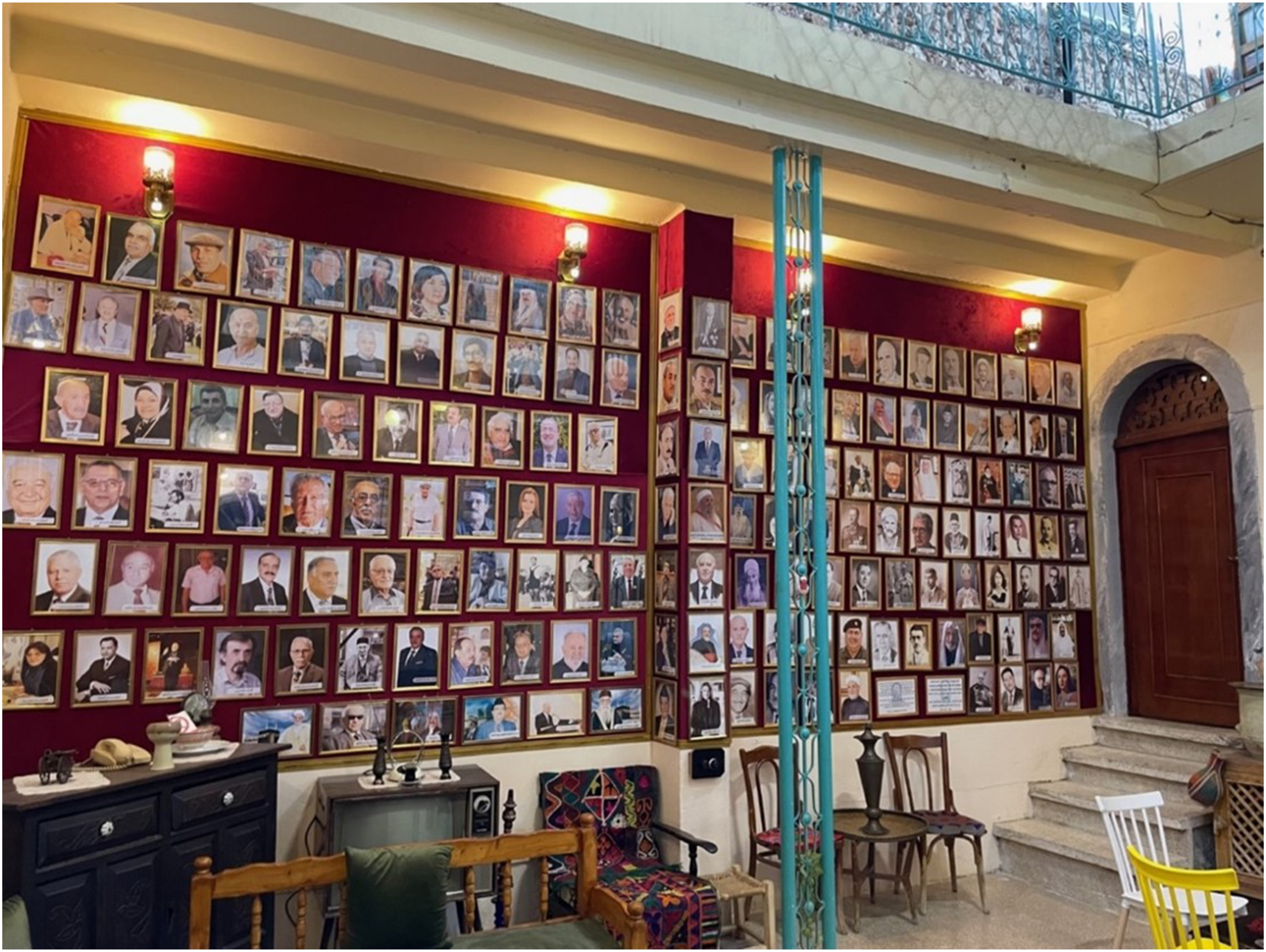
Infrastructure, then heritage
Despite the renewed public interest in heritage restoration, most Moslawi interviewees prioritise the reconstruction of urban infrastructure over heritage sites. According to Iraqi Deputy Minister of Culture Dr Nawaf Abugreif, the most pressing matter for Moslawis is the rebuilding of public facilities such as hospitals, schools, and services. The most important consideration for the people in Mosul is achieving security and stability; food; education; and only later comes the organisation of cultural, tourist and recreational activities.
31
The city’s holistic recovery hinges on connecting symbolic and living heritage with safe, viable communities. Many Moslawis are uncomfortable whenever external funding is seen as prioritizing inanimate artifacts over the needs of the living. Social cohesion, psychological healing and urban recovery may be tied more to the provision of new municipal services than to the costly restoration of old heritage sites. As one female Sunni Moslawi explained: ‘We need to build modern infrastructure. When I see a new building in Mosul, I feel positive and much better. I feel comfortable because I see that there is development in the infrastructure’. 32
The slow investment in Mosul’s infrastructure draws criticism for not aligning with the priorities of its inhabitants. Road repairs favour the movement of armed actors, while demolition orders consolidate new ownership conglomerations. The stalled re-opening of Mosul airport further reflects nefarious power dynamics and elite negotiation: There is a struggle internally and internationally, there is an agenda, which we don’t fully understand, to not execute the reconstruction of Mosul airport. … It is Mosul’s gateway to the world in terms of tourism, business … There is a deliberate delay to not reconstruct it.
33
The suspicions surrounding Mosul’s reconstruction mirror Iraq’s post-IS uncertainties. Many residential buildings in the city lie in ruins, and their owners struggle to receive adequate compensation from Iraqi authorities. The lack of tangible support for the reconstruction of people’s homes hinders the return of internally displaced persons (IDPs) and prompts locals to emigrate. With a significant portion of Mosul’s native population either deceased, missing or displaced, the meticulously restored cultural and religious landmarks of these uprooted communities run the risk of becoming museum artifacts with limited meaning to those who stay or those who have newly arrived. Heritage restoration projects conducted in contexts of violence and displacement should avoid turning the city’s cosmopolitan legacy into a static museum.
Conclusion
In conclusion, our research in Mosul affirms the potential of grassroots-led heritage projects to contribute to post-conflict recovery in Iraq. In practical terms, smaller sites and projects result in quicker delivery, more flexible approaches, local engagement and self-organization. This can help build momentum, evident in the ongoing recovery of Moslawi souqs and heritage homes. In terms of social impact, grassroots initiatives can also encourage urban pride and solidarity, erase vestiges of traumatic violence and provide spaces for communal resilience.
The Mosul case study highlights three generalisable principles of relevance to heritage restoration in other post-conflict settings. Firstly, grassroots heritage restoration that empowers local communities is far more likely to outlast and have deeper impact than externally funded, time-limited initiatives. Origins and power structures matter, and bottom-up initiatives have the potential to create networking synergies and cross-communal exchanges, in which local citizens can emotionally reconnect to their city and culture. Second, community-led projects are often a reminder that historic heritage sites must be integrated within communal living spaces; symbolic restoration of sites of religious pluralism (mosques, churches, shrines) must be accompanied by the rehabilitation of historic spaces of everyday cohabitation and co-operation. Thirdly, the nostalgic romanticised past provides an avenue for social recovery and for the revival of civic pride: a historic vantage point for residents to process their loss and suffering. Mosul’s heritage homes create both spaces to celebrate Mosul’s illustrious past but also opportunities to develop cultural awareness, heritage skills and citizen volunteerism.
This paper, however, does not seek to simply juxtapose heritage projects (externally led/grassroots-initiated) or highlight the inherent tensions between global normative heritage concepts and domestic local realities. Instead, the authors recognise the need for a more holistic heritage approach in post-conflict settings. This inevitably involves integrating heritage restoration projects within wider reconstruction plans; co-ordinating stronger heritage networks across local/state/international actors; and utilizing heritage’s potential for economic development and social recovery. Within Mosul, such an approach is possible but remains highly contingent on Iraq’s national recovery and political stability, as well as the challenges of overcoming endemic corruption. On a local level, our findings point to the importance of integrating local heritage clusters and large-scale symbolic sites; grappling with how heritage should reflect displacement and demographic shifts; and navigating the impulse to honour the past, while not neglecting traumatic pain and loss. If preservation and conservation efforts are adapted to meet the needs of conflict-affected communities, the city can heal, and its diverse heritage can help generate a shared, historically grounded identity.
Ethical statement
Ethical approval
Ethical approval was granted by SSPP Research Ethics Subcommittee at King’s College London (HR/DP-21/22-28,252).
Footnotes
Declaration of conflicting interests
The author(s) declared no potential conflicts of interest with respect to the research, authorship, and/or publication of this article.
Funding
The author(s) disclosed receipt of the following financial support for the research, authorship, and/or publication of this article: The research was funded by UK International Development from the UK government (XCEPT project); however, the views expressed do not necessarily reflect the UK government’s official policies.
