



Abstract
Lack of representation of children from nondominant cultural and linguistic backgrounds continues to be problematic in children’s literature, and especially within early literacy texts for beginning readers. One remedy is for children to tell their own stories through the language experience approach, which can then be printed into culturally relevant texts and used for beginning reading material in classrooms. To truly capture a student’s story, especially if the student is an emergent bilingual, a teacher must listen very closely and take care when adjusting the child’s story. Two Bakhtinian concepts support the careful examination of a teacher’s scribing of story in this study: chronotope, used here as the time-space sphere above the text, and revoicing, or the retelling of a child’s story that is paraphrased or altered. Findings show that gesture within the chronotope of the story is an especially generative tool for student storytelling and that teachers must reflect closely on intentional or unintentional reasons for revoicing a child’s story. Language experience approach holds possibilities for the creation of children’s culturally relevant texts. As such, it is important that teachers reflect on their language experience approach techniques so that the book remains true to the child’s story.
Keywords
When Betsy Baker learned about the Language Experience Approach (LEA) as a second grade teacher, her classroom was “revolutionized” (Baker, 2019: 359). She was seeking ways to integrate her students’ many cultures into the classroom; by taking dictation of their stories and then having them revise and publish, she found a way to embrace their “experiences, culture[s], and language[s].” LEA is a powerful tool that can help bring more culturally relevant texts into classrooms, as lack of representation of racially, economically, and culturally diverse families continues to be a struggle in children’s literature (Thomas, 2016; Cooperative Children’s Book Center, 2019). Lack of culturally relevant texts affects many children as the majority of students in the United States are from nondominant backgrounds, meaning they hold a variety of non-white racial and ethnic identities and/or speak a language beyond English at home (National Center for Education Statistics, 2019).
In the language experience approach, children dictate a story and a teacher writes it down. Yet there is little research on the gap between a child’s intended story and what a teacher writes. The final story is not always word-for-word what comes from a child’s mouth in the first telling with clarifications, filler words, and searching for ways to convey meaning. Sometimes, especially for emergent multilinguals speaking in their new language (L2), more dialogue needs to happen for a child’s story to emerge. To begin to examine that gap, a team of educators created a place-based (Comber, 2011), culturally relevant text (CRT) with one Latinx, emergent bilingual child (D.) and his family. Through this paper I analyse the discourse of the creation of the child’s book using the lens of the Bakhtinian chronotope and revoicing. My analysis of chronotope, meaning the time-space sphere where this book was created, provided a grounding for the child’s gestures and storytelling, thereby expanding his communicative repertoire in his L2 (English). Analysis of revoicing, or the repeated, paraphrased, or altered retelling of a student’s story, helped determine what moves were made by a teacher when scribing a child’s story. The analyses help tease out the child’s meaning and also help determine what the child’s final printed story will say. Reflection on these two strands will help teachers notice their own practice when supporting a young student in the creation of their own CRT: how can the lenses of chronotope and revoicing help teachers analyse their pedagogical moves as they use a language experience approach to launch a child’s story? The goal of the study is to do a deeper dive of the LEA process to (1) examine when a teacher might intentionally or unintentionally revoice a student’s story during a dictated LEA and (2) examine how student gesture in the chronotope helps to clarify a student’s desired text. Further reflection on the gap between student-told story and teacher-scribed text during LEA can help educators ensure that their scribing of the LEA book matches the child’s intention and the book’s purpose.
I begin by reviewing the literature around the language experience approach as a tool to create CRTs, LEA and young emergent multilinguals, and distilling the story in LEA. Next is further explanation the theoretical/analytical lenses of dialogism, chronotope and revoicing followed by project methods. Then I share a specific photo from a child’s book along with three excerpts of teacher/student discourse while creating text for that page. Each excerpt is analysed from the lens of both chronotope and revoicing. Finally, I discuss implications for the LEA techniques when examining the space between a child’s story and the scribed book.
Literature review
Language experience approach as a tool to create culturally relevant texts
Language experience approach (LEA) became more widely known when Russell Stauffer published in his 1970 book with the same title (second edition, 1980). Stauffer aimed to “take advantage of the wealth that children bring with them to school - linguistically, intellectually, socially, and culturally” (1980: xi). In LEA, students (1) share an experience; (2) discuss; (3) write or dictate a story about their experience; and (4) publish/read the text they created. Paired with systematic phonics instruction (International Literacy Association, 2018; Winsor, 2009), LEA is a tool that children and teachers use to create texts together for a variety of purposes, such as improving reading fluency of emergent bilinguals (Masruddin, 2016), developing culturally relevant nonfiction books (Watanabe Kganetso, 2017) or fostering emergent writing skills of preschool children (Copp et al., 2016). LEA provides a pathway for students to communicate their stories, be active agents in their own lives, and to learn others’ stories (Ghiso et al., 2019).
Culturally relevant texts (CRTs; Freeman and Freeman, 2004) are defined here as texts that reflect a student’s current life (Sims Bishop, 1990 Freeman and Freeman, 2004) and work to honour a student’s cultures and backgrounds (Paris and Alim, 2017). When examining picture books published in recent years, CRTs for nondominant populations are still not published at a similar rate of representation as CRTs for dominant racial groups (Thomas, 2016; Cooperative Children’s Book Center, 2019). More specifically, reviews of early literacy texts used to teach our youngest children to read reveal that these texts not only lack cultural relevance for many children, but are often racist (Gangi, 2008; Thomas and Dyches, 2019), sexist (Evans and Davies, 2000; Jackson, 2007) and heteronormative (Smolkin and Young, 2011). The lack of culturally relevant early literacy texts for many young students is problematic for a multitude of reasons. It is troubling from a reading development standpoint because cultural relevance is associated with increased student reading engagement (Rodriguez, 2009), more rereading at miscues (Christ et al., 2018) and improved comprehension (Christ et al., 2018; Ebe, 2010, 2012, Garth-McCullough, 2008).
When there is a gap in the availability of culturally relevant texts, student stories can fill this hole. Children can share their own stories using digital tools and platforms. Researchers and practitioners have been experimenting with children’s digital storytelling in various ways ever since the internet and then personal devices became widely accessible (e.g. Bird et al., 2018; Darvin and Norton, 2014; Rowe and Miller, 2016). Sharing stories digitally helps amplify and project student voices—especially those of nondominant students who may not see representation in books otherwise: Digital storytelling, by allowing them to share their personal histories, their stories of migration and assimilation, and the material conditions of their lived experiences, holds great potential for enabling…learners to be fully invested in their transnational identities and to claim their right to speak (Darvin and Norton, 2014: 55).
Students of all ages can claim their right to speak—or share in printed form—their stories, even those at an emergent or beginning stage of literacy, using LEA (Stauffer, 1980). LEA can be a “means of providing interesting and relevant texts for…reading and writing” (Landis et al., 2010: 580).
Some more recent examples of using LEA to create CRTs include Landis and colleagues (2010), who used LEA as a classwide approach to first write a story in Hausa, a shared student language, and then translate the story to English. Students used the story to practice oral fluency, build vocabulary, and explore written conventions of English (e.g. punctuation). Bird and colleagues (2018) innovated with a digital language experience approach (DLEA; see also Turbill, 2003 and Rowe and Miller, 2016). In this method, students discussed photos of a shared field trip with peers and then recorded and rerecorded the story they wanted for each page on an iPad; a key here was the peer discussion and rerecording until the page was how the child desired. A bilingual approach to LEA was enacted by Louie and Davis-Welton (2016), who focused on families sharing stories or folktales in either English or another home language, which students then wrote and illustrated. The school then helped students to publish and translate books so that all books were in two languages. A final example of LEA to create CRTs is from Watanabe Kganetso (2017) who worked with families to create culturally sustaining informational texts with students who were multilingual and in the emergent or beginning stages of literacy. Families were surveyed for nonfiction topics that were a part of their everyday lives (e.g. places in town, how to wash the dishes) and Watanabe Kganetso then co-wrote the early literacy books in the genre of informational texts.
Language experience approach and young emergent multilinguals
Language experience approach is a way for language learners to create stories that are relevant while developing oral speaking skills. When using LEA stories with emergent multilinguals, Jozwik and Mustian (2020) found increases in words read correct per minute and decreases in miscues that changed meaning. As described in Nessel and Dixon (2008), as emergent multilingual students discuss and describe their recent experiences, “the teacher guides them in creating a dictated account. Students offer statements that they want included, or the teacher selects statements from the ongoing conversation and suggests that these be used” (p. 2). From a reading standpoint, an LEA-created text ensures that students have story words in their oral vocabulary so that their working memory can focus on the decoding of phonics within the text. Importantly, “the flexible nature of LEA allows teachers to tailor instruction to the specific interests and needs of individual students” (Nessel and Dixon, 2008: 2), building from the unknown to the known and treating children’s lived experiences as true assets (González, Moll and Amanti, 2006) as children learn to simultaneously read, write, listen and speak in English (Winsor, 2009).
Distilling the story in LEA
For students who are still learning to read and write, a more knowledgeable other must help transfer the child’s LEA story into written form, whether that helper is a voice-to-text application, a more capable child or an adult. Sharing a dictated tale through LEA means that there is scribe who is writing the story. In the U.S. school context, the majority of students are from nondominant backgrounds while the majority of teachers identify as white and monolingual speakers of English (National Center for Education Statistics, 2019), which means that there are racialized, linguistic power considerations during the distillation of the story from the child’s mouth to print.
For students who can write, they themselves can revise their written LEA stories (Baker, 2019; Pappamihiel and Hatch Knight, 2016). For students who do not yet write stories independently, there is little research on the distillation of the dictated story to what becomes print in LEA, though there are a few example processes. Younger students can record an auditory LEA and then rerecord until they are satisfied (Bird et al., 2018). In a 1976 film from the California Department of Education, teachers were to “carefully scribe their [student’s] dictation” and “listen – really listen – without interrupting or putting words in the child’s mouth” (California Department of Education, as cited in Hoffman and Roser, 2012). For methods of revision once the story is already on paper, Vogt (2021) suggests underlining words that need to be corrected or putting a dot over words that could be replaced by key vocabulary when using LEA for shared, small group writing. When a whole class is composing a dictated LEA, the process can be even more complex. As students formulate and express their ideas, the teacher guides them in creating a dictated account. Students offer statements that they want included in the account, or the teacher selects statements from the ongoing conversation and suggests that these be used. The teacher records the students’ statements on chart paper, constructing the text while the students watch (Nessel and Dixon, 2008: 2).
Complexities abound even when capturing one student’s ideas. What parts, if any, should be omitted in the creation of a coherent text? What changes, if any, should be made to a student’s speech?
There is gap in knowledge between what a child dictates and what ends up on the dictated page in LEA, especially when the goal of a given LEA is to construct a culturally relevant text at a controlled level that the child can read. Consider an utterance from a child when dictating the story about a photo about how to care for some local geese: I thought of some more stuff they might need. They might need a little something like… um… they need to find something like hay. Do you know why, Mama? So they can lay their like eggs.
What is the distance from the child’s dictated story to the story that ends up on the page? “At times, it is difficult to know whether to overcorrect or undercorrect students’ contributions to a developing piece of dictated writing” (Landis et al., 2010: 587). Undercorrection may mean a missed teachable moment (e.g. not teaching a child went instead of go-ed could be a missed opportunity); overcorrection chips away at the child’s agency as storyteller, sending the message that they do not have the right to tell their story (Darvin and Norton, 2014).
Thus, the goal of this research is dive deeper in the LEA process to (1) examine when a teacher revoices a student’ story during a dictated LEA, whether intentionally or unintentionally, in ways that both clarify and adjust the student’s story and (2) examine how student gesture in the chronotope might help clarify a student’s desired text. Further reflection on the space between what is dictated and what is written during LEA can help educators ensure that their scribing of the LEA story matches its intended purpose. In this case, the purpose was to use LEA to create a culturally relevant book for one child that he could read and share with family members and peers.
Framework for analysis—dialogical theory
Language is dialectical and meaning is constructed in dialogic, conversational exchanges. Bakhtin’s dialogism (1981) is the theoretical basis for this work. In this sociocultural theory, discourse can be “strategically framed or reconfigured” or “blended with the new speaker’s own voice” (Maybin, 2008: 82). In the case of this project, as the story is scribed, dialogism is the basis for which the event is recreated and reshaped through the dialogue of the language experience approach. Specifically, chronotope and revoicing are two Bakhtinian characteristics of dialogism that inform the design and analysis.
Chronotope
Bakhtin defines chronotope, literally meaning time-space, as the “intrinsic interconnectedness of temporal and spatial relationships that are artistically expressed in literature” (1981: 84). The time/space connection is inherently present in all events, but the quality of interaction within and around literature is a feature that makes the chronotope distinct. Rosborough thus distinguishes the chronotope as a “critical opening for new meanings” (2016: 1) and extends the idea of chronotope to the kairotic-chronotope, or an opportune moment for learning within a unified time/space experience. Kairos is the idea of a propitious moment for action, also known as a teachable moment. Rosborough (2016) posits that for students learning a new language, gesture is a key component of the kairotic-chronotope. Morson and Emerson (1990) ground this work with their assertion that “chronotopes are not so much visibly present in activity as they are the ground for activity” (p. 369). In this study, the early literacy text that D. and I created was the grounding kairotic-chronotope for the activity of his storytelling, and gesture played an inextricable role in his tale.
Revoicing
Another Bakhtin (1981) concept I used for analysis in this discourse is revoicing, or the repeated, paraphrased, or altered retelling of a student’s story. Also known as ventriloquation or double-voicedness, revoicing is the idea that all discourse indexes past and future discourse (Maybin, 2008). In the creation of this text, there are many nested layers of revoicing: (1) in the original event, the child and family rode bikes to the park; (2) the child narrated a picture of this event to me.; (3) I revoiced his words; (4) I scribed the co-constructed narration; (5) the child’s teacher suggested adjustments to the narration; (6) I made final revisions and printed the early literacy text. The revoicing indexes past and present discourses that occurred both within the classroom context and outside of school with the child’s family. In the following transcript excerpts, I explore the revoicing specifically within the above steps two, three, and four, while touching very briefly on revoicing in steps five and six.
Methodology—mediated discourse analysis
In this project, the goal was to use LEA to create a book for a child that he could read and share with family and peers; the book was to be culturally relevant to the child and use his own story sequence, vocabulary, and linguistic structures as much as possible. Through mediated discourse analysis, I was able to examine how the story was dialogically created between teacher and student.
Context
The setting for the study is a Midwestern suburb and an elementary school that serves a student body that is 56% white, 20% Latinx, 12% African American, 8% Asian and 4% two or more races. Free and reduced rate is 36% and 22% of the students are emergent bilinguals. Students who were currently participating in a first grade daily reading support program and who identified from any racial or linguistic nondominant background(s) were eligible to participate in the project. D.’s family was the first to respond to the opportunity. D.’s family met with the research team to learn more about the project, which entailed a commitment of 2 hours outside of school for a typical family outing that the research team would join and photograph, and then two half-hour LEA sessions for D. during school. After the book creation, D.’s family would receive copies of D.’s little book to share at home and with his classroom teacher. They decided to participate, gave consent, and D. gave his assent.
Following Lewis, Enciso and Moje (2007), I work to be aware of how my positionality affects my research and interpretation. I approached this project as a former early reading interventionist for emergent bilingual children. Our research team consisted of me, D.’s teacher, and the school’s cultural liaison. I identify as white with an intermediate level of Spanish. D.’s teacher is white and does not speak Spanish; she knows D.’s family because she also taught his older sister. The district cultural liaison/interpreter is Latinx, speaks Spanish, and met the family through this project. D.’s family, having emigrated from Mexico (mother) and Guatemala (father), speaks primarily Spanish at home but the father speaks English for work. They have been a part of the school community for 5 years, since their oldest child started kindergarten.
Procedures
We set out to create a culturally relevant text (CRT; Freeman and Freeman, 2004) for this child, D. All parties (D.’s family, his teacher, the cultural liaison, and myself) met to take photographs of the family playing at their neighbourhood playground. In two thirty-minute sessions, D. and I wrote his book using the photographs and a language experience approach (LEA). I printed approximately 30 pictures from the outing to the park; of these, D. selected 12 of his favourites and glued them in a small blank book in chronological order (see Jennerjohn, 2020, for more detailed steps in the creation of the CRT). The next day, we met again and he told me the story of what was happening on each page/photograph of the book (see Appendix A for the complete text of D.’s book along with descriptions of each photograph). I wrote his dictated story. As the scribe, my teaching decisions were made in the moment knowing that the purpose of this LEA was to create a CRT that D. and his friends could read, meaning it was written around an early first grade reading level and meant for an audience outside of D.’s family as well as within. Each of these sessions was recorded with video.
I rewatched the videos to closely observe D.’s words, gestures, and my written words as I worked to understand his story. The dialogical lenses of chronotope and revoicing were emergent analysis tools as they helped me to understand (1) D.’s intended meaning (as I could best interpret) and (2) how my teaching moves adjusted the story from his oral telling to the written form, both intentionally and unintentionally. The following discourse analysis peers more closely at the creation of page three in his book, a place where he was very emotive and I was unsure of what he wanted to say. This discourse took place on Day 2 of storywriting and was 4 minutes and 12 seconds in duration. I trace his gestures through the lens of kairotic-chronotope and my mirroring and adjusting of his words through the lens of revoicing—both tools that helped clarify the meaning that D. was bringing to the story. I observed more closely to see how D. used gesture within the chronotope of the little book, how the story was repeatedly revoiced, and looked closely to notice if I could use those lenses to further glean D.’s message, while also critically watching which of his words I scribed and which I did not. The following excerpts are the analysis of the discourse between D. and myself as we co-created this specific page of his culturally relevant text.
Findings and transcript analysis
This excerpted analysis takes place during D.’s dictation for page three of his book (Figure 1). The photo on this page shows him and his sister, K., riding their bikes to the park during our photo session. The three adults far in the background are his mother, father, and teacher, M. The cultural liaison and I are taking photos. Photo of D. and K. on bikes. D. told the story of this page in the following excerpts.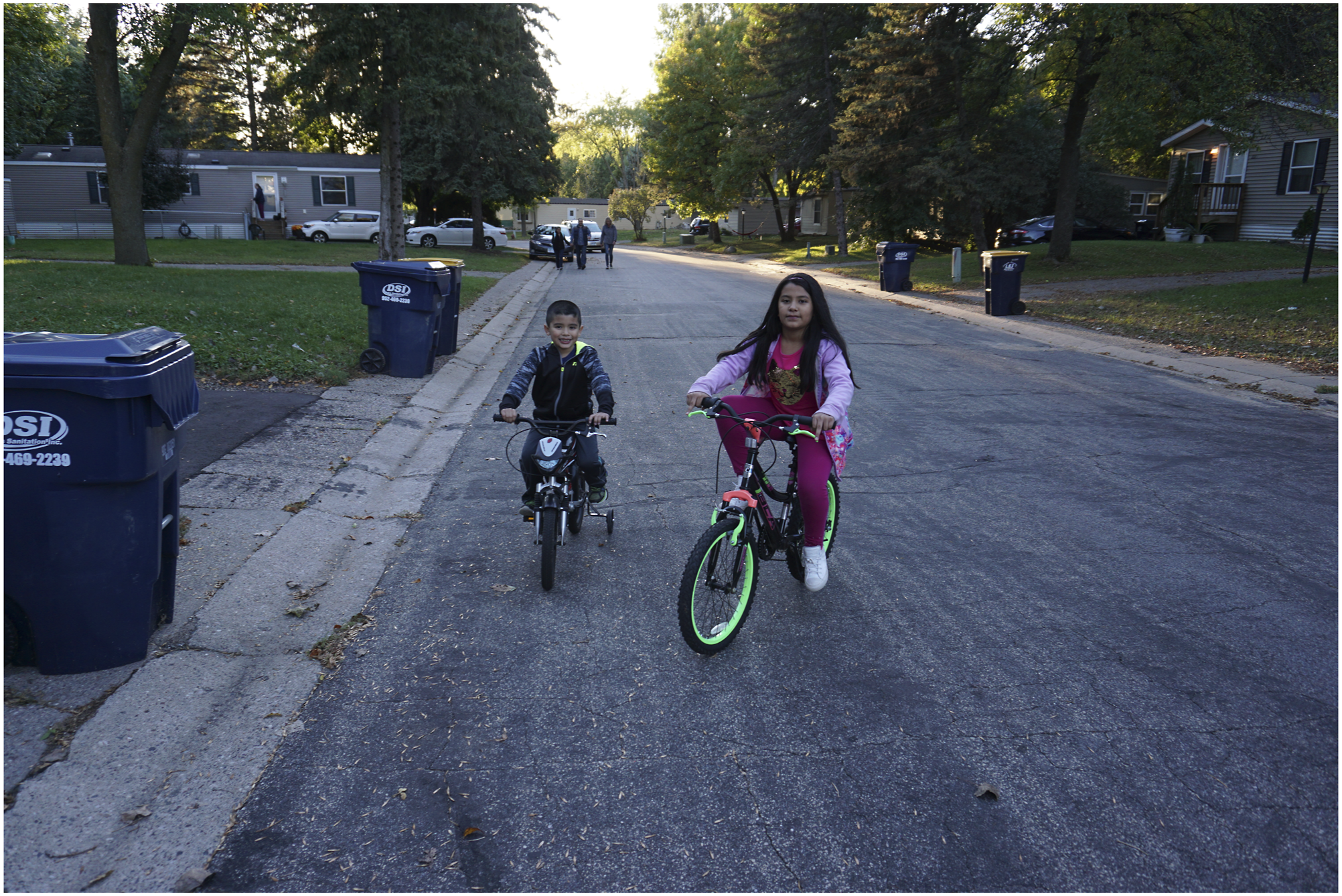
His entire dictated story for this photograph was as follows: “We go-ed on our bikes to see who was faster. And she lied because she has a nevel [sic] bike.”

Excerpt 1
D. began to tell his story when I showed him the photo in Figure 1 and prompted, “Tell me about this one.”
Kairotic-chronotope analysis of Excerpt 1
Excerpt 1. D. began the story of the photo in Figure 1.
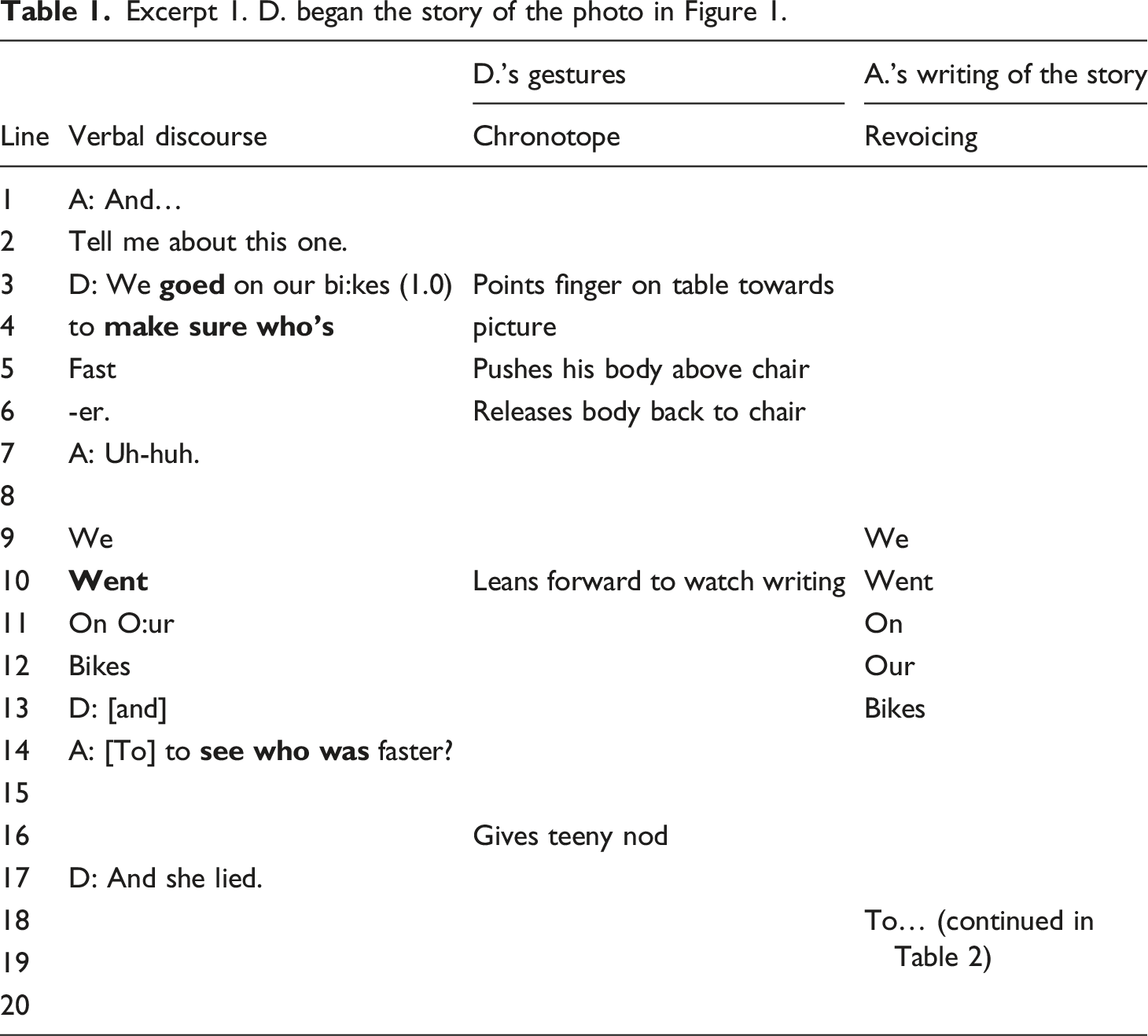
Then he continued in line 4: “To make sure who’s faster.” On the word faster, he makes a beat with his body by tipping his chair back on two legs on the syllable “fast-” and releasing his chair back on all four legs for the syllable “-er,” essentially leaning back and then forward to mimic increased speed. His gestures began smaller in Excerpt 1 as oriented himself to the kairotic-chronotope in the life above the book. His gestures expanded the space around the story as his telling became more animated in Excerpts 2 and 3 (Tables 2 and 3). D.’s initial gesture (finger on table) as he said “We go-ed on our bikes…” D. pointed to the picture of bikes as he uttered that same word. Excerpt 2. David continues his story of the photo in Figure 1 with expanded gestures. Excerpt 3. I further understood D.’s story and he continued to add details.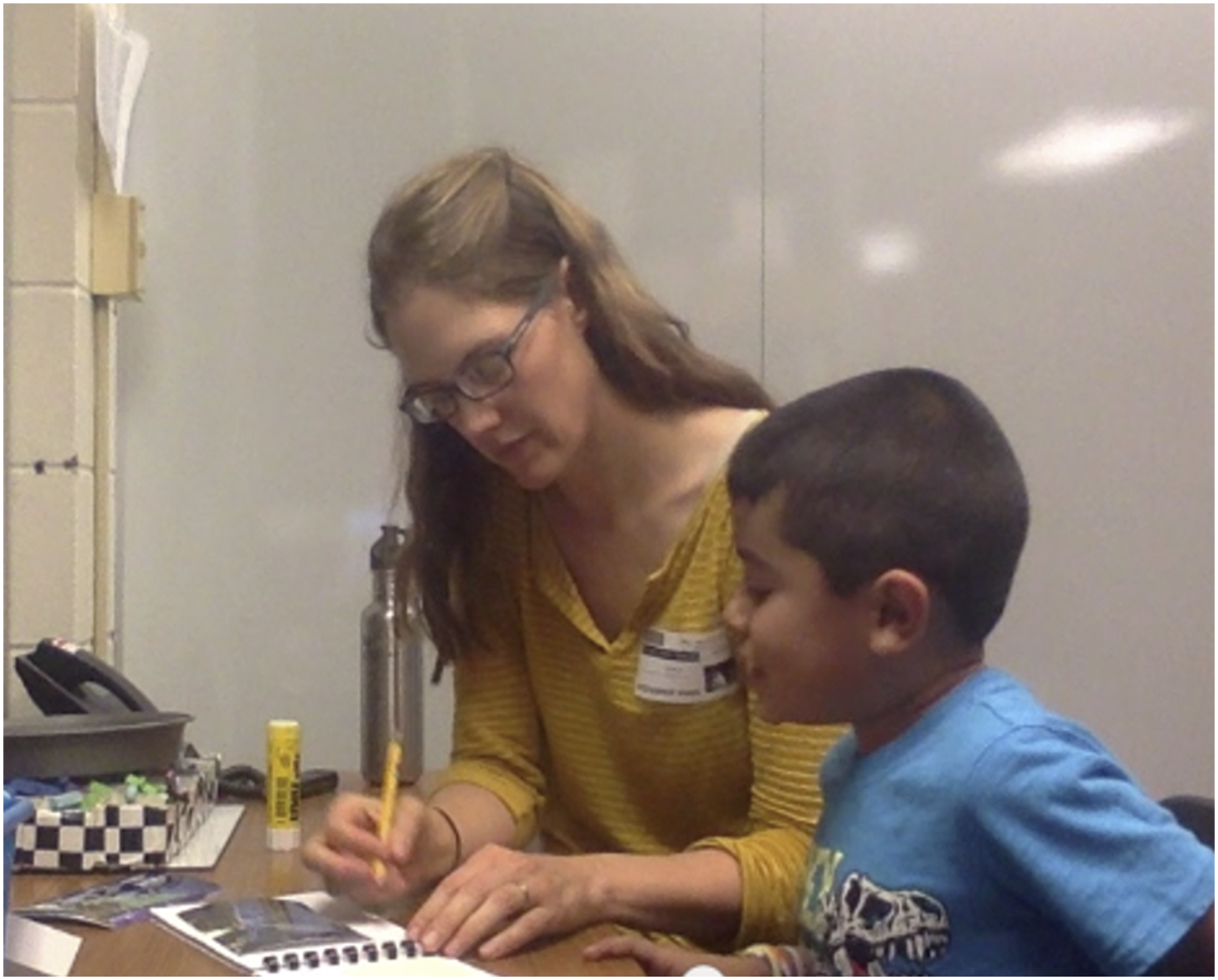
Revoicing analysis of Excerpt 1
In the first part of the sentence in Excerpt 1, “We go-ed on our bikes,” D. generalized the rule for making verbs past tense in English by adding an -ed, as he did not yet know that go has an irregular past-tense of went. I revoiced this to went as I scribed the first part of the sentence and did not give him the opportunity to affirm or deny his readiness for this irregular past-tense form by having him say it back to me. If he could have held the word went in his head, it might have been an appropriate move, as he could have been ready to uptake this commonly used verb. In the moment, I did not give this thought and almost automatically wrote went (lines 10–14). However, since this book was to be printed and shared with his class as a part of their library, it will be helpful for D. and his peers to practice the irregular, high-utility went as a past-tense of go.
D. then started to speak in line 15 to continue the sentence, but I spoke at the same time, implicitly asking him if I could write a more commonly used English phrase of “to see who was faster” instead of his original “to make sure who’s faster.” He gave a teeny, almost imperceptible nod, and I went ahead and wrote my version. He was eager to tell the next part of the story, which contained heightened sibling-rivalry emotion for him: “And she lied.” He reiterated his sister’s transgression in the start of Excerpt 2, which took place immediately after Excerpt 1.
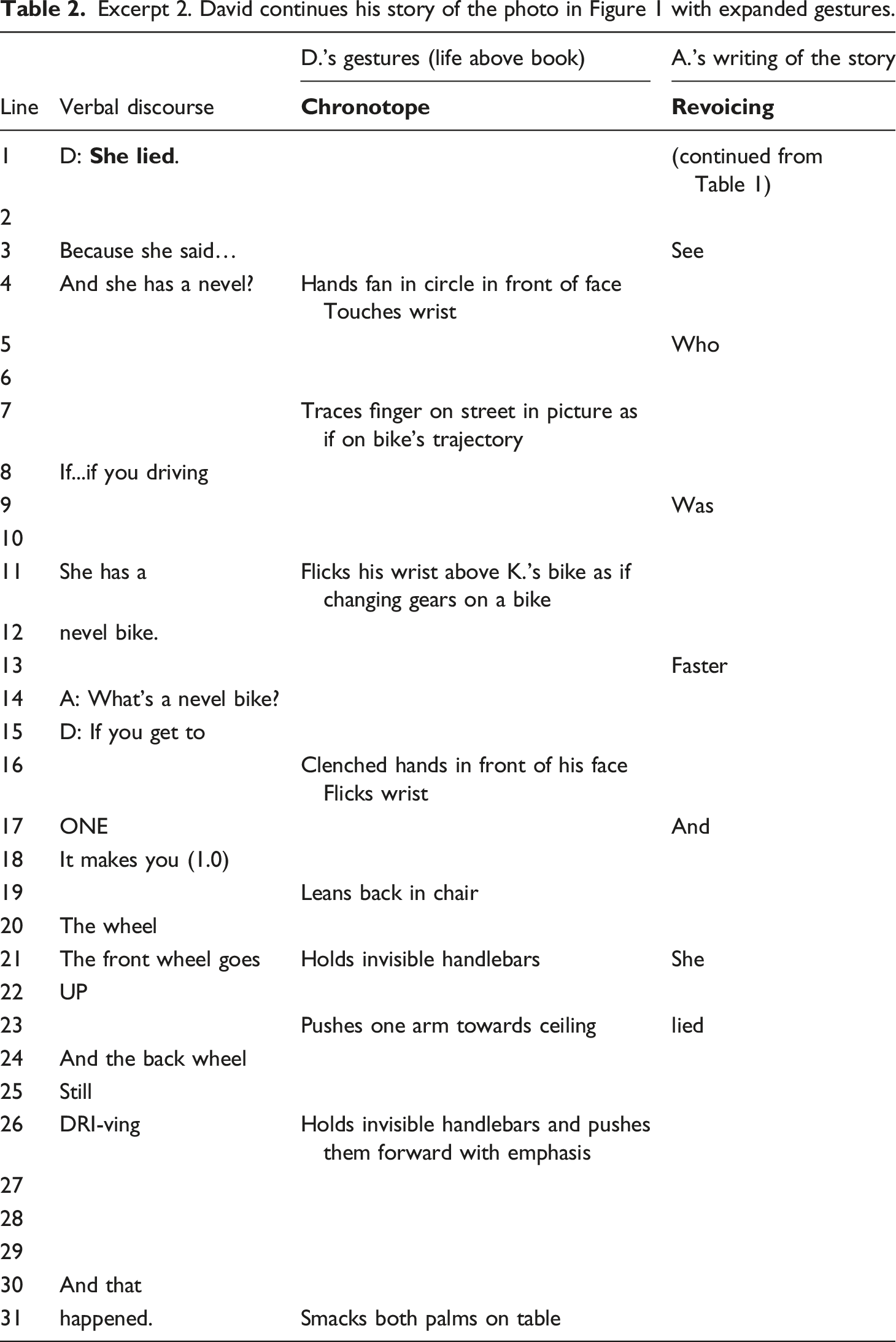
Excerpt 2
D. continued his story in Excerpt 2 as he used both gesture and verbal discourse to describe his sister’s lie and bike.
Kairotic-chronotope analysis of Excerpt 2
D.’s gestures in the life above the book became more vivid and expansive in Excerpt 2 (shown in Table 2) as he worked to explain his sister, K.’s, bike and her lie: he became more animated with heightened emotions of sibling rivalry. In line 4, his first mention of a nevel bike, he fans his hands in front of his face as he works to convey this concept to me. He pauses, then continues his explanation on line 8, “If… if you driving,” while simultaneously tracing his fingers on the road of the picture. Then he pauses, seeming to again search for words in English. In line 12 he reiterates, “She has a nevel bike.” I ask him what this is. In lines 16–31, his speech and gesture work in tandem to convey the concept. An important iconic gesture is when he flicks his wrist above K.’s pictured bike (Figure 3), seeming to change the gears, while he emphasizes, “If you get to ONE.” D.’s gesture as he said “She has a nevel bike.” D. flicked his wrist above K.’s bike as he said the word nevel, as if to change gears.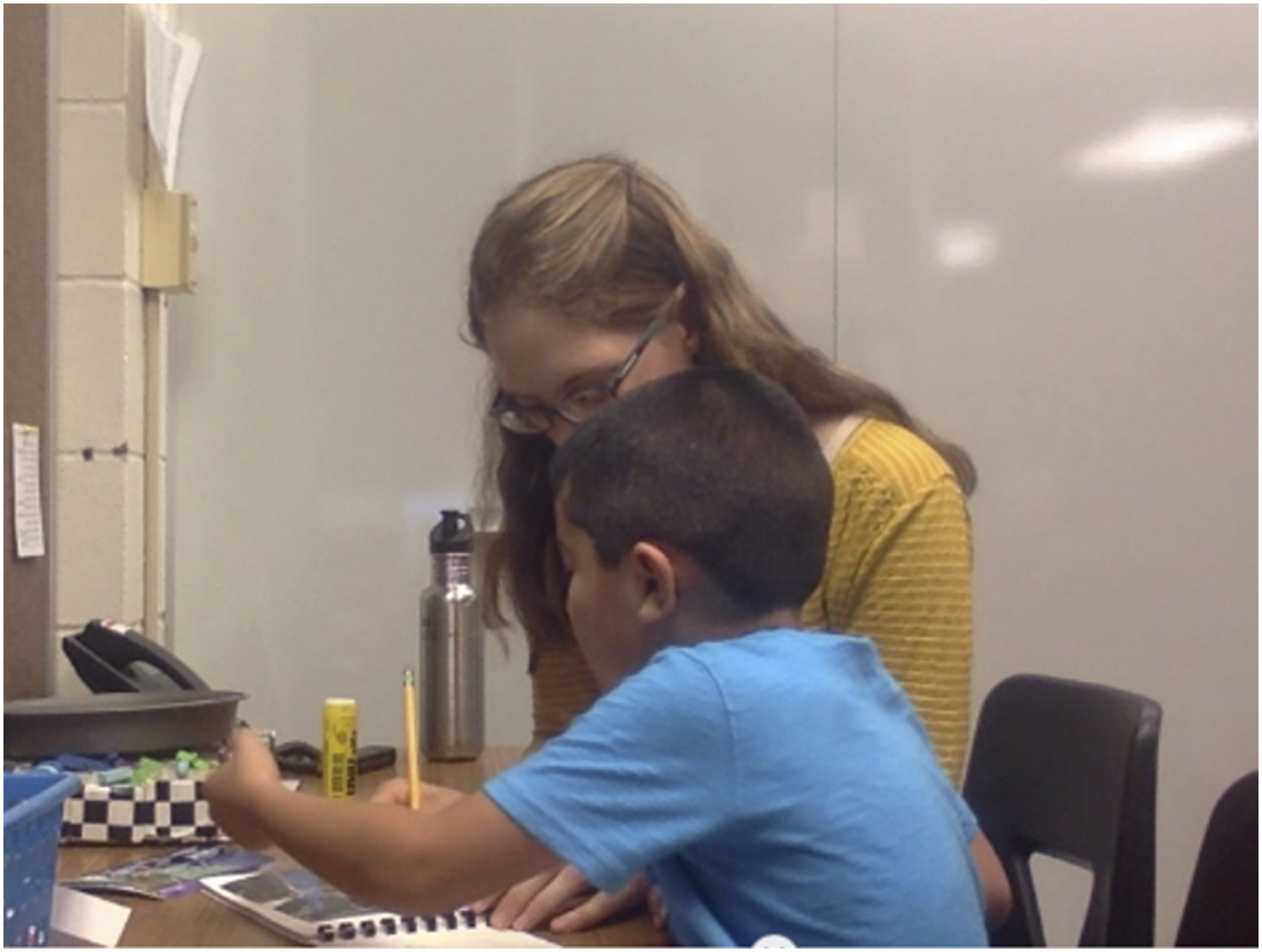
The time-space experience of the book and the life above the book allowed for a rich language/gesture unison in D.’s explanation of a nevel bike, which I believe is his meshing of Spanish nivel and English level, possibly meaning a bike with gears. This approximation (Briceño and Klein, 2019) showed his knowledge of both English and Spanish (Helman et al., 2019) within word-level code-meshing (Young, 2009). Though he seemed to also imagine, possibly from cartoons or experiences with the throttle of a motorcycle, that K.’s gears gave her the ability to do wheelies and outpace his “non-neveled” bike with unfair advantage. I did not see her perform any wheelies during the bike ride. He also insisted that K. lied, though it is unclear what she lied about. One possible explanation is that in the imagined story K. fell off her bike (i.e. lie down). I think a more likely explanation, in keeping with his ongoing insistence that his side of the story was the correct version, is that a more precise English word for lied is cheated. These ambiguities are abundant in Excerpt 2. D. is further heated by remembering this event and, because he was telling the story in English and was unconvinced that I would understand Spanish, he was telling a story without his full linguistic repertoire (Busch, 2012). Nonetheless, he emphasized the truth of his telling of the story, seeming to anticipate K.’s side of the story (which might go something like, “I beat you fair and square, D.”), by his line in 30–31: “And that happened.” He smacks both flat hands on the table for emphasis on the word “happened.”
Revoicing analysis of Excerpt 2
While there was no immediate revoicing during the language experience approach of Excerpt 2, a conversation between me and D.’s teacher later ensued about his quip, “She lied” (line 1, Excerpt 2). I believe this referenced his sister having an unfair advantage in their bike race by having gears on her bike. When I showed D.’s narration to his teacher, she replied: I like D.'s language - a couple of thoughts - on the page where it said “And she lied because she has a nevel bike.” I am a little worried about his word choice “lied.” I know it is his language but it might not come across the best to his family.
“She lied” might have been easy to remove had I not recorded and rewatched D.’s passion during this portion of the story. D. was enlivened by his perceived injusticia in the bike race, and he emphasized this by smacking his hands on the table and saying, “And that happened” in lines 30–31. Closer video analysis of gesture during this interaction allowed me to see how important that part of the story was to him.
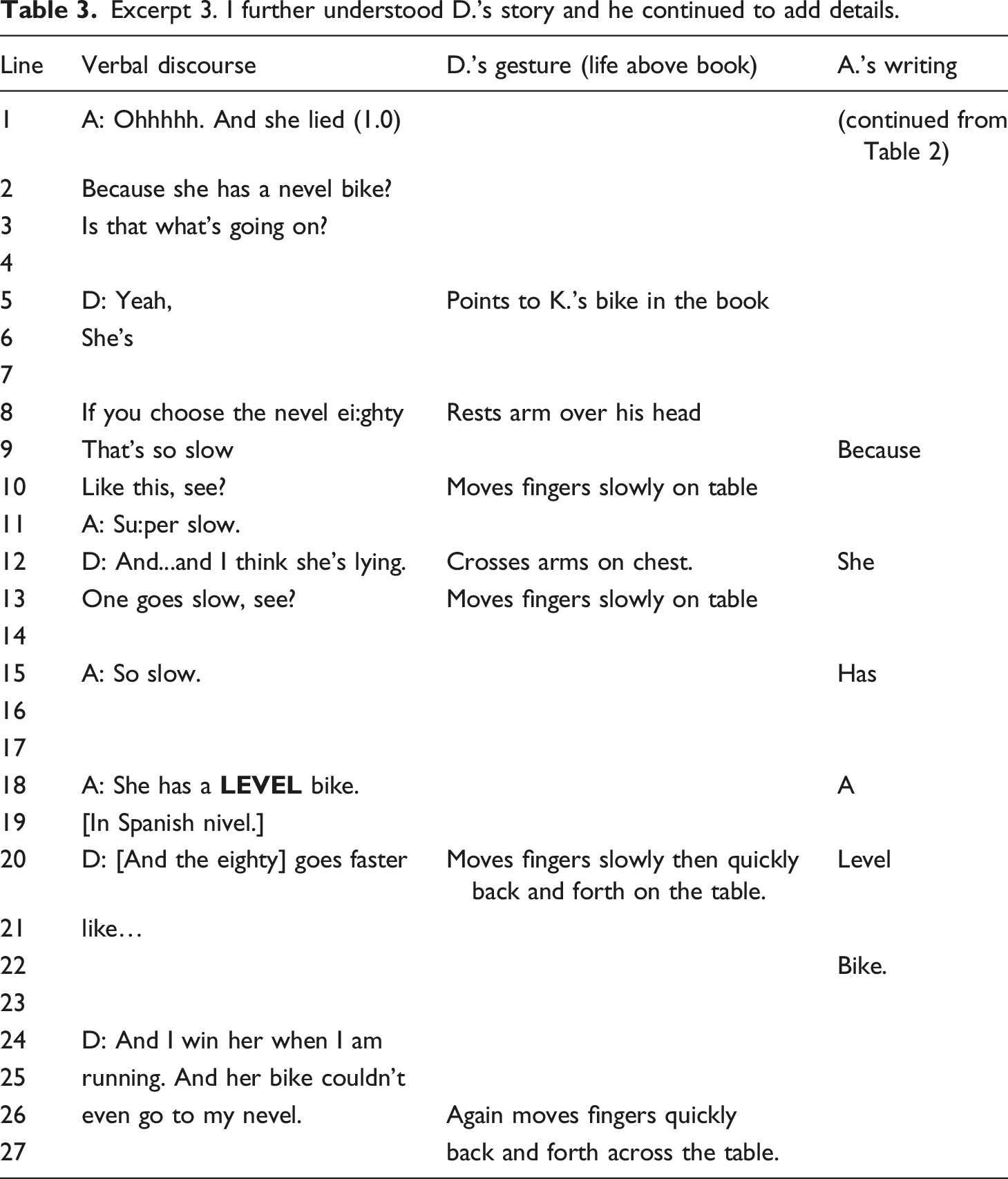
In the moment of interaction, I worked to understand his story of lying and nevel bikes by reflecting back to D., “Ohhhh. And she lied because she has a nevel bike?” in Excerpt 3, where his gesture in the kairos-chronotope became key to my understanding of his tale.
Excerpt 3
The final excerpt from this story brought increased understanding from me thanks to gestures in Excerpt 2. D. continued his impassioned telling of the story.
Kairotic-chronotope analysis of Excerpt 3
D.’s gestures in Excerpt 3 (shown in Table 3) continue to show the life above the book and even expand the boundaries of the chronotopic story to the table surrounding the book, where he “drove” his fingers like a bike moving back and forth on the road three separate times in lines 13, 20, and 26. Thanks to his gestures of changing gears in Excerpt 2, I came to the tentative understanding that he meant level bike, a mash-up of the English level and the Spanish nivel, showing that he is not two monolinguals in one body, but instead an emergent bilingual with developing linguistic resources in multiple languages (Gort, 2019).
Line 16 is key to understanding his emotions around this storytelling episode: he crossed his arms for emphasis when he again said that his sister was being untruthful in this race, “And… and I think she’s lying.” The crossing of his arms could be interpreted as his resoluteness in his position that she is lying or cheating in the race, but his hesitation in speech “and… and” shows that he is either searching for words in English or he has a sliver of doubt in this claim. Furthermore, it is still unclear what he said his sister is lying about. Is she lying about the functions of her bike? Is she lying about level one going slow and level eighty going fast? Or was he saying that K. was cheating by having more advanced bicycle equipment in their race? D. seemed to perseverate and process numbers and levels through talking, almost to himself at this point, and repeating the gesture of a bike moving back and forth on the table. This was a kairotic, tension-filled moment in both D.’s performance and the teaching implications (Figure 4). D.’s gesture as he said, “And I think she’s lying.” He crossed his arms over his chest.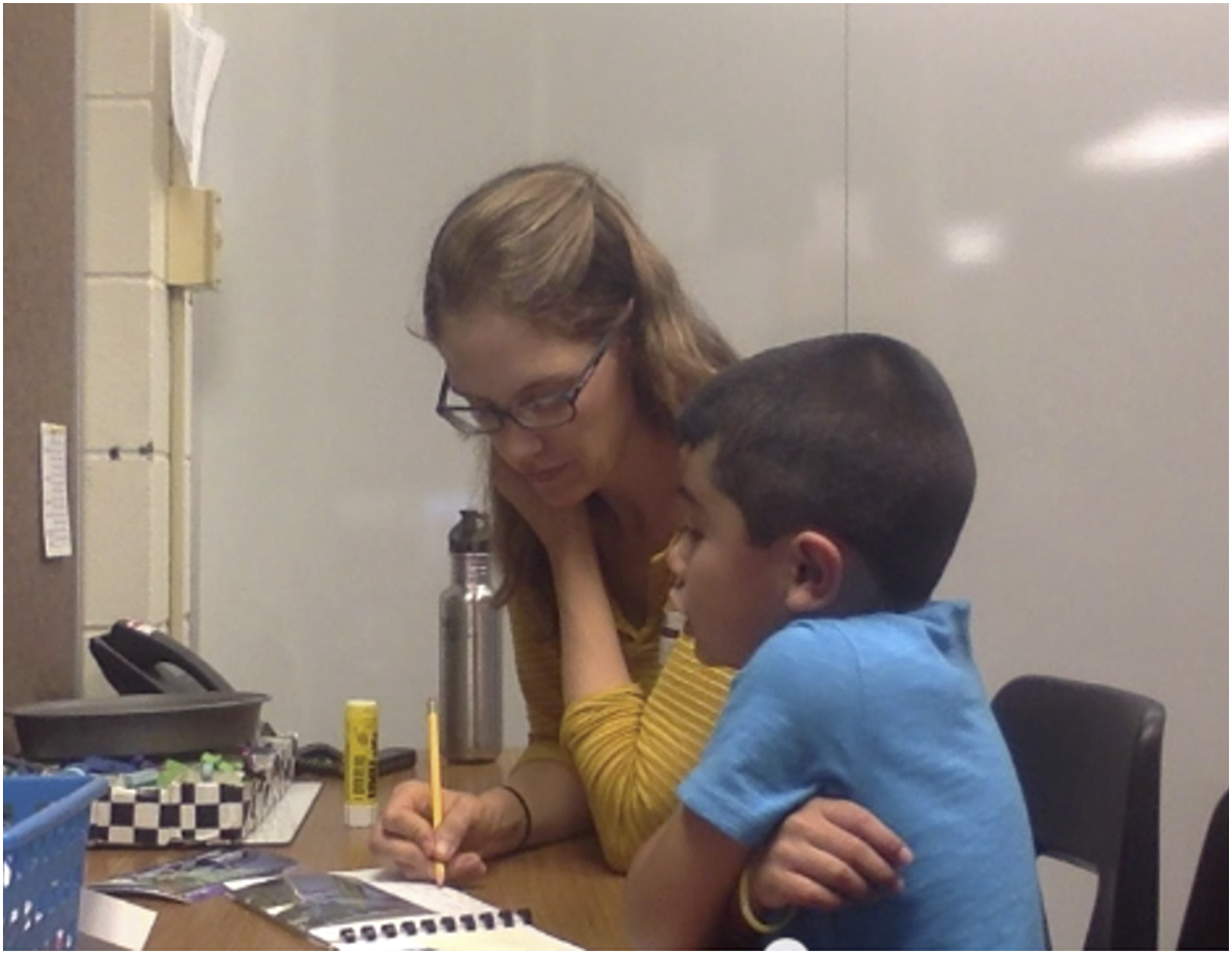
Revoicing analysis of Excerpt 3
There were two major instances of revoicing in Excerpt 3. First of all, I cut out what I saw as superfluous explanation to help his story be more succinct. Originally in Excerpt 2, D. says, “Because she said…And she has a nevel? If...if you driving...She has a nevel bike.” Note that D.’s pronunciation of nevel rhymes with level. When I revoice this in lines 1–4 in Excerpt 3, I remove the middle portion and offered him a shorter version, “Because she has a nevel bike.” In line 5, D. gave a definitive “Yeah,” agreeing with my statement, but he still went on to further explain the nevel bike and the lie with further gesturing, leading me to believe that I did not quite grasp his story. Note that the written story here was completely D.’s language with the omission of the middle part of his sentence where he was processing aloud to get to his main assertion, represented here by his quote (words that did not make the written story are crossed out): “Because...She has a nevel bike.” The purpose of shortening the sentence was to (1) make this a book that D. could read himself in the near future and (2) help edit for clarity.
Finally, in line 18, I came to the conclusion that D. meant level instead of nevel (rhymes with level), and I offer this word to him in English along with its Spanish counterpart, nivel (nee-BEHL). He talked through my lightbulb moment, showing that he was still engrossed in storytelling. He did not uptake my offered English word, level, nor did he use nivel. Instead he goes on as if he did not hear me, continuing his use of his own word, nevel. “And I win her when I am running. And her bike couldn’t even go to my nevel.”
Discussion
Bakhtinian chronotope and revoicing provide a finely-tuned view of a student/teacher dyad in the creation of an LEA text. The back and forth dialogue helps a child clarify their story through both revoicing and gesture, especially if they are using their L2. Honing in on student and teacher moves through these philosophical lenses can help inform LEA practice when determining what to write for a child’s dictation.
This is not a simple task. Even though I was present at the event to photograph D., and I have an intermediate understanding of his home language, he and I were still working with concentration to come to understanding on what he wanted to say about siblings on bicycles. There was a kairotic moment for D. to tell his story, using gesture, in a variety of words so that I could understand. There was a kairotic moment for me to ask the right clarifying questions, watch D.’s gestures within the sphere of the book, and listen closely to his language so I could write his intended message in an early reading text.
Specifically from the lens of chronotope, this project showed how a kairotic-chronotope, an opportune moment for learning within a qualitative time-space experience (Rosborough, 2016), can serve emergent bilinguals. A book with photos of a shared experience supported D. in enhanced L2 communication with gesture. Through discourse analysis, I observed D.’s joy and pride in authorship and how the kairotic-chronotope allowed him expanded expression in his L2. The chronotope lens allowed me to closely analyse D.’s gestures within the time-space sphere of the story photograph, revealing what I may have otherwise missed in D.’s communicative repertoire. Other teachers may find it helpful to play careful attention to student gesture within a time-space sphere, especially if the students are telling a story using any multimodal features (e.g. photographs, video, realia, toys). Gesture within a kairotic-chronotope is an important communication tool for young children and especially emergent multilinguals.
Revoicing can be both a helpful tool in the dialogic creation of a story—a back and forth that helps clarify the child’s meaning—and a possible tool of language oppression or monoglossia. The potential cultural/racial/linguistic distance between teacher and pupil, and possible accompanying power imbalance, also presents troublesome opportunities for revoicing. What hegemonic forces might the teacher succumb to, whether intentional or not, when revoicing the child’s story? Teachers can both harness the communicative dialogism of revoicing while also reflecting carefully if and how they adjust the child’s story.
Educators might use the following reasons to revoice in the creation of an early literacy CRT: To shorten a child’s sentences so it fits with the early literacy text genre and be accessible for emergent and beginning readers. If the book were for a read aloud, shortening sentences would be unnecessary. To help others understand the story. The teacher can suggest adjustments for clarity, but ultimately, the child should decide to make any changes or keep it as is. To take advantage of high-utility teachable moments. For example, when D. said go-ed, I offered the high-utility, irregular past tense verb of went. It will serve D. to practice reading the word went in his story to help him uptake that word.
Listening to oneself conduct an LEA with a young child can be a helpful lens on practice: at times I did not even realize I was writing my own words instead of his. The iterative revoicing process helped clarify the meaning of D.’s story; while one page was analysed in depth in this study, revoicing helped create each page within D.’s book. The back and forth between student and teacher, voicing and revoicing, are what created the text in the end.
Previous research on LEA and culturally relevant texts did not examine the space between what a child (or children) said and what the teacher wrote (e.g. Louie and Davis-Welton, 2016; Landis, 2010)—there is a “black hole” between what the child says and what a teacher writes. To simply “listen closely” and scribe exactly the child’s exact words is not realistic or likely to happen—at the least, redundancies and filler words may be deleted almost without thought by the teacher. Instead of a unidirectional story by the child, LEA presents an opportunity for dialogue so the student can spin the tale they want to tell.
Directions for future research
In this project, I analysed LEA discourse of one student. In future projects, researchers should work with multiple students and teachers to further analyse patterns of revoicing and chronotope in LEA. Further analysis of revoicing patterns across many teachers would inform professional learning needs when using LEA towards a liberatory ends. Teachers must reflect carefully that they are using LEA as a tool for students to tell their own story, and not revoicing to the extent that the story is not the child’s own.
For future analyses of LEA, I would add two steps to improve the process of scribing a child’s intended story, and I recommend that practitioners do the same. First of all, I would work to more actively support the child’s use of a home language or translanguaging (García and Kleifgen, 2019) so the child could bring their entire linguistic repertoires into classrooms and see them in texts. This is not to say that language practices not shown in print are invalid because they are not acknowledged by a Western or white gaze (see Ndimande, 2018). However, showing and sharing localized language norms in print, also known as polycentricity, can be another avenue to support emergent bilinguals as they bridge the divide between “school self” and “home self” (Lam et al., 2012; Reynolds, 2020). While I invited D. to share the story in Spanish, he did not take me up on the offer. Rowe and Miller (2016) found that mentor texts in the child’s home language were an effective tool to encourage translanguaging in a child’s LEA story, sometimes even when teachers did not speak a child’s home language.
Secondly, digital tools show promise for students to create and share their own stories with less direct support from teachers. Further research could expand on Bird et al.’s work (2018) using digital devices for students to record and rerecord their story as a revision process. Perhaps through the use of digital recorded stories, teachers could provide scaffolding to multiple students through asynchronous support. Similarly, students could be taught to use speech recognition apps (see Baker, 2019) to create their own stories and then revise as needed. A final direction for future research is how speech recognition apps could be complemented by a teacher’s careful listening and revoicing when a young child is making an oral story into a written book.
Conclusion
LEA is a powerful tool that supports students in telling their own culturally relevant stories. This is especially important when culturally relevant early reading texts are lacking. When teachers use LEA to help a student (or group of students) create a culturally relevant text, they must look closely at the space between what a child says and what is scribed on the paper. Teachers can take a closer look at their LEA practices, honing in on student gesture through chronotope to more fully understand a student’s message. Furthermore, teachers can check the revoicing of students’ stories, providing a supportive lift when helpful and writing the student’s story exactly as told more often than not. Up until now the space between a child’s oral story and scribed book has been unexamined. By taking a closer look, educators can help students create a book with the exact story they want to tell.
Footnotes
Declaration of conflicting interests
The author(s) declared no potential conflicts of interest with respect to the research, authorship, and/or publication of this article.
Funding
The author(s) received no financial support for the research, authorship, and/or publication of this article.
