



Abstract
The article shows how film can disrupt human-centred discourses about the use of video technology in qualitative research. Inspired in particular by Deleuze's film philosophy, a detailed analysis of an “ordinary” event in an early-childhood institution gestures at some of the possibilities that the manipulation of technology can offer. Filmmaking practices, such as framing, tracking, speed changes, reverse motion and use of sound, shape what counts as “data” and offer alternative modes of analysis that include more-than-human bodies. These playful techniques draw attention to how video technology can play a democratising role in qualitative research by paying more attention to the digital, the sensory and the visual and relying less on language as the mode of enquiry. Grounded in post-qualitative approaches of performativity, we indicate the radical implications of the ontological and epistemological paradigmatic shift in agency and causality when disrupting anthropocentrism in qualitative research.
The performative materiality of bodies in qualitative research: Barad and Deleuze
Jewitt (2012) differentiates between three approaches towards the use of video in qualitative research in terms of epistemology based on the question of when video becomes data. The first one regards video as ‘replica of events’, which allows video to be treated as data in the moment of recording, while the second acknowledges a ‘distortion of events’ when filming. This allows video to become data when the researcher recognises and aims to minimise the influence of video recording on site. However, both of these approaches are still grounded in a ‘desire to capture and preserve reality’ (p. 10). The third category is a reflexive approach, where video is conceptualised as a ‘re-presentation of events’ and ‘reflexive mirror’ which demands a critical reflection and integration of questions around the role of the researcher and biases involved in production and analysis. Video here ‘an emergent kind of data’ (p. 11) is in need of deeper and deeper layers of interpretation with the researcher as a (co-)constructor (with participants) of contextualised meaning. However, our approach will aim to challenge this ontological divide between data (empirical material) and analysis (interpretation) and the researcher (reflection) in qualitative research through exploring and theorising a post-qualitative cinematic analysis. The latter acknowledges that practices of representing have an effect on the objects of investigation and that as researchers we have direct access to the objects themselves (Barad, 2007: 87).
Current articles in this journal argue that the recent turn to the body (Jewitt et al., 2017) and the focus on performativity (Østern et al., 2023) in qualitative research require the use of post-qualitative methodologies. Inspired by post-structuralist, post-humanist, new materialist and more-than-human theories, “post methodologies” aim to do more justice to the visual, the sensory and the digital in qualitative research, thereby relying less on verbal methods. As Jewitt et al. (2017: 38–39) point out, ‘[d]igital technology is a fundamental part of the contemporary experience and re-imagination of the body’, referring to ‘the multiplicity, fractal and sensory character of the body and its boundaries’.
To be clear, the “post” in post-qualitative research is not about a “beyond”, nor rejection, nor an abandonment of the human in favour of handing over agency (and with it responsibility) to the other-than-human. On the contrary, inclusion of the materiality brings to the fore the significant role the human plays in knowledge production and makes researchers more aware of the ontologies they assume in their practices. Post-qualitative researchers affirm and build on qualitative researchers (e.g. phenomenological and post-structuralist) who also resist taking power-producing binaries for granted, such as subject/object, culture/nature, human/technology or human/matter. Binary opposites are social constructions that do not correspond to any actual existing polarities. At the same time, they are ‘apparatuses’ (Barad, 2007) that profoundly shape research practices. Yet, the issue is not about going beyond binaries but questioning what differentially constitutes these binaries. What are the material and discursive conditions of their production? How do they work to include and exclude, why does that matter and for whom?
Inspired by particularly Gilles Deleuze's film philosophy and Karen Barad's agential realism, we offer a detailed analysis of an “ordinary” event – in this case situated in an early-childhood institution. Despite the specificity of the example, the post-qualitative reading of a video clip gestures at some of the more general affordances of video technology by acknowledging the role of the other-than-human in qualitative and post-qualitative research.
Karen Barad: The co-emergence of matter and meaning
A significant inspiration for the post-qualitative ‘turns’ (affective, material, etc.) is the scholarship of quantum physicist and feminist philosopher Karen Barad. Matter, they claim, is ‘not mere stuff’, ‘an inanimate givenness’, nor is matter ‘in need of some supplement to put it in motion, to enliven it, to give it agency’ (Barad, 2013: 17). Barad continues eloquently: [Matter]… is not an inert canvas for the inscription of culture and meanings, a static thing without memory, history, or an inheritance to call its own. It is not simply some thereness available for the taking. A mere backdrop to what really matters. (Barad, 2013: 17)
What Barad's agential realism helps us (un)learn is that material objects, such as video cameras, are not inert things and do not exist separately (a priori) from the material-discursive conditions of the practices within which they are embedded. The hyphen between ‘material’ and ‘discursive’ indicates that ‘no priority is given to either materiality or discursivity; neither one stands outside the other’ (Barad, 2007: 177).
Barad's friend and colleague, Donna Haraway (1988: 583) urges scientists to recognise that scientific accounts of bodies and machines are always mediated by human meaning-making and that it is imperative to understand ‘how these visual systems work, technically, socially, and psychically’ (Haraway, 1988: 583). Performative accounts of knowledge production focus on how theories (including concepts) and practices 1 work as apparatuses and include and exclude. Performativity is a differential co-articulation of human and non-human agencies. Performative materiality re-conceptualises human and more-than-human bodies as lacking distinct bodily boundaries and as always already in relation before their interactions (see, e.g., Karen Barad's influential notion of intra-action) (Barad, 2003, 2007). Not ‘the thing’, but ‘the-thing-in-relation’ (the phenomenon) is ontologically prior; that is, when we use words, we signify material-discursive relationalities that are dynamic entanglements and topological reconfigurings, not discrete entities in the world (e.g. an object or a subject). In this way, performative accounts of knowledge-making practices reconfigure causality and agency.
This paradigmatic shift in ontology poses profound methodological challenges for qualitative researchers. It requires less emphasis on language and paying more attention to human and more-than-human bodily performativity and materiality. The co-emergence of matter and meaning in the making of the world produces more complex understandings and expressions of reality that include historicity and the political. Barad's critical post-humanism reworks objectivity and subjectivity in scientific research as agential responsibility and agency as embodied, worldly and intra-active (Rouse, 2004). Causality in research is reconfigured as a relation between mutually performative transindividual agents. Although situated, this kind of agency is fluid and not socially, geographically or temporally located in space or time (Barad, 2007: 470–1 ftn 45). In that sense, Barad's post-humanism is not so much ‘anti-anthropocentric’, but ‘anthropo-situated’, and disrupts linear framings of time, opening up new possibilities, not only for tracing the reading of video but also for the production of video clips as Baradian phenomena (see, e.g., Murris, 2022; Murris and Peers, 2022). Moreover, productive connections can be made between the relational ontologies of Barad's and the ontologies that underpin Deleuzés (2013a, 2013b) film philosophy.
Gilles Deleuze: A reception of images without a subject
We acknowledge how the philosophies of Karen Barad and Gilles Deleuze amplify each other, especially when diffractively reading their concepts through one another (see, e.g., Murris and Bozalek, 2019). However, because of limited space, we focus mainly on the potential of Deleuzian film philosophy for analysing how video clips are produced technically and how these insights can guide (post)qualitative researchers. In his books on cinema, Deleuze (2013a, 2013b) draws on the Soviet filmmaker DzigaVertov's film philosophy and his concept of the kino-eye. The kino-eye describes cinema's possibility to create a non-stable perspective. Unlike a human observer, it is an impersonal eye from ‘everywhere’ at the same time and ‘couples together any point whatsoever of the universe in any temporal order whatsoever’ (Vertov cited in Deleuze, 2013a: 89). Importantly, the kino-eye encompasses the whole process of filmmaking – from montage to editing, and including sound and visual manipulations. For Vertov (1984: 14–15), cinema is essentially ‘[t]he sensory exploration of the world through film’ to conduct an ‘exploration of the chaos of visual phenomena that fills space’. In Colebrook's (2002: 29) reading of Deleuze, cinema allows ‘a reception of data that is not located in a subject’. She argues that the cinematic apparatus allows a steady change of various and competing viewpoints: ‘[w]hat makes cinema cinematic is this liberation of the sequencing of images from any single observer’ to ‘the presentation of “any point whatever” ‘(Colebrook, 2002: 31).
Thus, the cinematic apparatus 2 consists not only in recording with a camera but also includes post-production, for example, editing, sound, image manipulation and screening, and can be described as the practice of producing a cinematic experience. It allows a non-stable, constantly shifting view “on” an event and is, therefore, able to disturb ritualised and habitualised ways of knowing. Hence, mobilising Deleuze's philosophy of cinema in research is beyond the idea of an increasingly detailed description of what “is” nor is it a dissection of an action into its tiniest parts, nor a more and more accurate representation of reality. A performative, cinematic analysis involves exposing technology's role in reality, not as an improved human view, but as contributing an “extra eye”. This eye is “outside” human perception and works as an active “conversation partner”.
We distinguish two different approaches to Deleuze's philosophy on cinema. 3 The first mobilises Deleuze's film philosophy as an analytical tool when analysing examples from film (Pisters, 2003; Colman, 2011; Viegas, 2019). The second approach applies Deleuze's cinematic thinking to education. Cole and Bradley (2016), for example, have developed the idea of ‘a pedagogy of cinema’. 4 Yet, these film studies focus on the analysis of existing films and visual expressions (and how analysis can support educational processes). Their scholarship is less concerned with the possibilities of how Deleuzian theories about cinema could inspire more creative research. In contrast, the main contention of this article is to adopt Deleuzian concepts to theorise the performative use of video in qualitative research and not just ‘use’ Deleuze's screen forms as a mere ‘cine-system’, that is, as an analytical tool to analyse all kinds of screen media (Colman, 2011), or as a pedagogical tool through which to study existing filmic expressions (Cole and Bradley, 2016). We are interested in practices that take into account the materiality of post-production digital interventions. Such innovative research practices highlight the researcher as a performative filmmaker during the processes and incorporate how cinematic language can be used to enrich the analysis of an everyday event in a pre-school. Hence, this article offers an alternative or additional approach to mobilise Deleuze's film philosophy. It follows recent developments in educational research that explore possibilities of creating video in research in new and unexpected ways that challenge our habitual ways of seeing and knowing. 5
Positioning a cinematic performative analysis
The idea of the researching filmmaker and the use of cinematic language to explore social and cultural events has a history in the field of visual anthropology, scientific cinema and documentary filmmaking (Hackett et al., 2015; Vannini, 2021). Filmmaking as ‘knowledge-making practice for framing, critiquing and interpreting the world’ (Aston and Odorico, 2023, p. xiii) has been debated extensively. Especially the relationship between film-makers, the filmmaking process and the research subject has been questioned since the early days of using film in ethnographic research. The lively discussion between Mead and Bateson (1977) around framing and movement of the camera, is an example of the different positions towards what is allowed and useful when documenting in ethnographic research. These issues were further challenged through the Cine verité movement led by Jean Rouch amongst others who disputed that the filmmaker must stay out of the event, and is even ‘allowed’ to provoke parts of the documented action. Rouch also encouraged making the presence of the camera visible, as well as the filmmaking processes in the final product (Henley, 1998). MacDougall (2019) also promoted dissolving the barrier between research, filmmaking and art in what he describes as empirical art. He also suggests a more collaborative approach that involves a close and long-term relationship with the participant, in his case, the community of boys boarding school (MacDougall, 2006). Our work is also inspired by Pink’s (2007, 2007b) theorisation of a multi-sensory approach to ethnography and visual anthropology to highlight often overlooked elements of an event. Additionally, current movements in the field of documentary explore how to break down the boundaries between filmmaking practice, the film as a product and the theorisation of it. One example of this is an anthology edited by Rogers et al. (2023) who give insights into the filmmaking process as knowledge-making process and process of inquiry (from the standpoint of documentary filmmakers).
However, we see our contribution not as a further development of these approaches within the tradition of ethnographic film, but rather as an exploration of how an ontological shift might mobilise different research practices when video is used in fieldwork. So, while drawing on some of the approaches mentioned above to inspire our post-qualitative cinematic performative analysis we aim to highlight a radical shift in ontology to reconceptualize this process of making both matter and meaning. We are recognising the relation to these developments in ethnographic and documentary filmmaking, however, we aim to explore how film practice and theorising, can be read diffractively with a relational ontology to reconceptualize the use of video in qualitative analysis. In our view, this is fruitful knowledge for qualitative researchers who aim to explore, amongst others, every day or seemingly mundane everyday events.
Despite some of the attempts mentioned above, there is still a wide range of research especially in education, organisational studies and psychology which use film and video, as a mode to gather data often transcripted for further data analysis. Video observation and analysis are popular research instruments in fieldwork-based research, and although there are differences within the disciplines, on the whole, video recordings are still often understood as representing reality, albeit open for epistemic contestation, interpretation and different subjective analyses (Knoblauch and Schnettler, 2012). These approaches acknowledge the filming researcher as co-constructor of the knowledge produced but with substance ontology 6 remaining intact (Jewitt, 2012). This suggests that the material-discursive conditions of the possibility of video productions are still under- researched. Post-qualitative scholarship proposes a relational ontology, whereby ‘no priority is given to either materiality or discursivity; neither one stands outside the other’ as indicated by the hyphen between material and discursive (Barad, 2007: 177). The value of Deleuze's theorising on cinema is that he focuses on how certain technological qualities of the cinematic apparatus can be used to enrich a performative, cinematic analysis of an event in research. Taking a Deleuzian perspective in cinema encourages the viewer (here: researcher) ‘to respond to the images intellectually and affectively and to consider in what respect cinema can be emancipatory’ (Cole and Bradley, 2016: 5). It moves the relationship between researcher and empirical material beyond data, representation and interpretation and opens up the possibility to treat video in research as an experience ‘producing a shock to thought, communicating vibrations to the cortex, touching the nervous and cerebral system directly’ (Deleuze, 2013b: 161). Cinema is thought-provoking, affects and transforms the viewer (Cole and Bradley, 2016: 5).
To regard the researcher as a performative filmmaker by adopting Deleuze's theories on cinema in research has been suggested by several post-qualitative researchers (MacLure et al., 2010; Rokka and Hietanen, 2018; Menning et al., 2020), who urge researchers to overcome the idea that video is lifeless raw data. We regard video in research neither as an objective, neutral methodological tool (epistemologically, ethically or politically) nor as a subjective process to select and gather liveless data for a reflexive interpretation, but as an embodied ‘watching’ 7 with the cinematic apparatus 8 (Menning et al., 2020). Elizabeth De Freitas (2015, 2016) also explores alternative ways of using video to foreground student bodies as ‘an indeterminate crystalline contraction and expansion of intensity’ (2015: 318). We have argued elsewhere that post-qualitative approaches can show how videography has decolonising potential by challenging onto-epistemic injustices in childhood institutions (for an overview, see Murris and Menning, 2019). We explore the video apparatus as an apparatus in performative research practices – a relatively new and unexplored perspective.
The analysis at the heart of this article is also inspired by educational researcher Cristina MacRae: her Deleuzian focus on the affordances of slow-motion video (2020), her practices of ‘watching as a seeing without reading’ (2021 9 ), as well as her genealogical exploration of time and movement in video-observation (2019). Coming from other disciplines, Rokka and Hietanen (2018: 116) invite us to embrace the ‘evocative power of video’ where using video in research ‘becomes a praxis’, a ‘doing’ in the sense of creating powerful and convincing affective encounters with fieldwork and the audiences of the videographic screenings. We will explore this praxis closer by presenting an analysis of a clip from a current research project on the everyday life of toddlers in an early-childhood institution. This will exemplify what we call a cinematic performative analysis of an everyday event which will make visible ‘a multiplicity of relations in a multiplicity of times’ (Colebrook, 2006: 102).
Cracking the mirror of video as representing reality
The unique potential/ability of cinema (here translated to video-based research) is based on Deleuze's (2013a, 2013b) reflections and analysis of cinema as an art form which he describes as being based on movement and time. Cinema is not understood here as consisting of images of representation but as a ‘thought-provoking encounter’ between screening and viewer where the performative creation of meaning is prioritised over the representation of meaning (Pisters, 2003: 21). In their book Pedagogy of Cinema, Cole and Bradley (2016: 12) follow Deleuze's insight that the images ‘[j]olt the viewer from pervasive or dominant modes of perception’. It is this aspect of moving images we wish to mobilise in this article. Even those committed to the post-structuralist dismantling of the humanist subject find it extremely difficult to ‘escape the “I”’ (St Pierre, 2011: 620). The challenge is to ‘get to the mirror’ and crack it by becoming aware of the (adult) “I” who does the representing – to engage fully with the material features of the discursive (MacLure, 2013). Most scientists do not realise how practices of representing are in and by themselves performative and don’t simply model. The ‘represented’ and the ‘representer’ already participate in the entangled material-discursive process of their own representation. ‘Representationalism would have us focus on what seems to be evidently given, hiding the very practices that produce the illusion of givenness’ (Barad, 2007: 360). This is how the technology masks its mediatory role as apparatus. We use video in research not to reproduce or represent but to ‘crack the mirror’, thereby promising ‘something other than affirmation of the pre-formatted or banal’ (Cole and Bradley, 2016: 7). To ‘crack the mirror’ of video as a representation of reality, we will illustrate how a cinematic praxis might unfold using a video clip of an ‘ordinary’ event in a pre-school using the cinematic elements of framing, tracking, speed alterations, reverse motion and sound.
Our analysis of a video clip will claim that technologies such as small digital video cameras and editing software can challenge the ontological assumptions of social-cultural, psychological and cognitive perspectives. This disruption of still hegemonic ideas about time and truth is of particular importance to all research, where rigid and universal ideas about development, learning and progression lead to profound injustices. Our methodological approach exemplifies the possibilities of reconfiguring video-based research practices in ways that intervene in dominant discourses of power, trouble normative methodologies and unsettle human-centred ways of using video recordings. At the same time, as mentioned above, a cinematic performative analysis is still anthropo-situated. The human researcher is entangled with the video practices that are not considered passive, observing and measuring activities simply with an improved human eye. On the contrary, human subjectivity is productive and performative in how a phenomenon materialises and how meaning is given to what is observed (Mengis et al., 2016: 5–6). Importantly, in that sense, a post-qualitative approach does more justice to the complexity of reality (Murris, 2022). A cinematic performative analysis sees the technology as enabling researchers to become aware of the humanist nature of our perceptions and engrained binary ways of thinking. This approach follows MacLure et al.’s (2010) demand to look beyond the fear that such creative use of video in research might dissolve, that is, the binaries between researcher/researched, object/subject and truth/fiction. Rokka and Hietanen (2018: 115) propose embracing video as a possibility for emergent theorising ‘by animating, attuning, evoking, disrupting, sensitizing or entangling us with affective resonances of lived-through moments and events’ instead of providing an ‘externalized statement of explanation’. This certainly resonates with a cinematic performative analysis.
Kathleen Stewart (2007: 27) proposes that exploring what she calls ‘ordinary’ moments, allows us to take a closer look at the intensities of seemingly banal everyday common experiences and foreground the affective dimensions of everyday life where a ‘world of shared banalities can be a basis of sociality’. Veronica Pacini-Ketchabaw (2013: 221) describes these situations as ‘moments that bring to light the messy, provisional and deeply corporeal ways of life’. Drawing on Stacey Alaimo's notion of transcorporeality, Jayne Osgood (2023) challenges developmental observations by offering alternative ways of ‘seeing’ from ‘down on the ground’. Our choice of the video clip “of” an ‘ordinary’ event (what Barad would call an ‘agential cut’ 10 ) involves technical manipulation that highlights cinema's potential when researching young children playing in a sand pit.
A cinematic performative analysis of an ordinary event: Children-in-the-sandpit
A vital part of cinematic performative analysis considers how the material-discursive production of moving images works – disrupting assumptions about space and time. These concepts have been contested in the field of education, which makes examining them even more pressing. Our argument shows how the visual works, how the cinematic techniques 11 are used, and why it matters to read an everyday situation differently. It makes visible the agencies and relations previously ignored or overlooked. We show how the language of cinema can be transferred to video research, and we discuss the possible implications and unexpected findings when what we call a cinematic performative analysis is conducted (access the QR code in Figure 1). We strongly advise that the reader views the piece not on a small mobile device but on a bigger screen in fullscreen mode – an affective and sensorial (cinematic) experience dependent on a certain screen size.

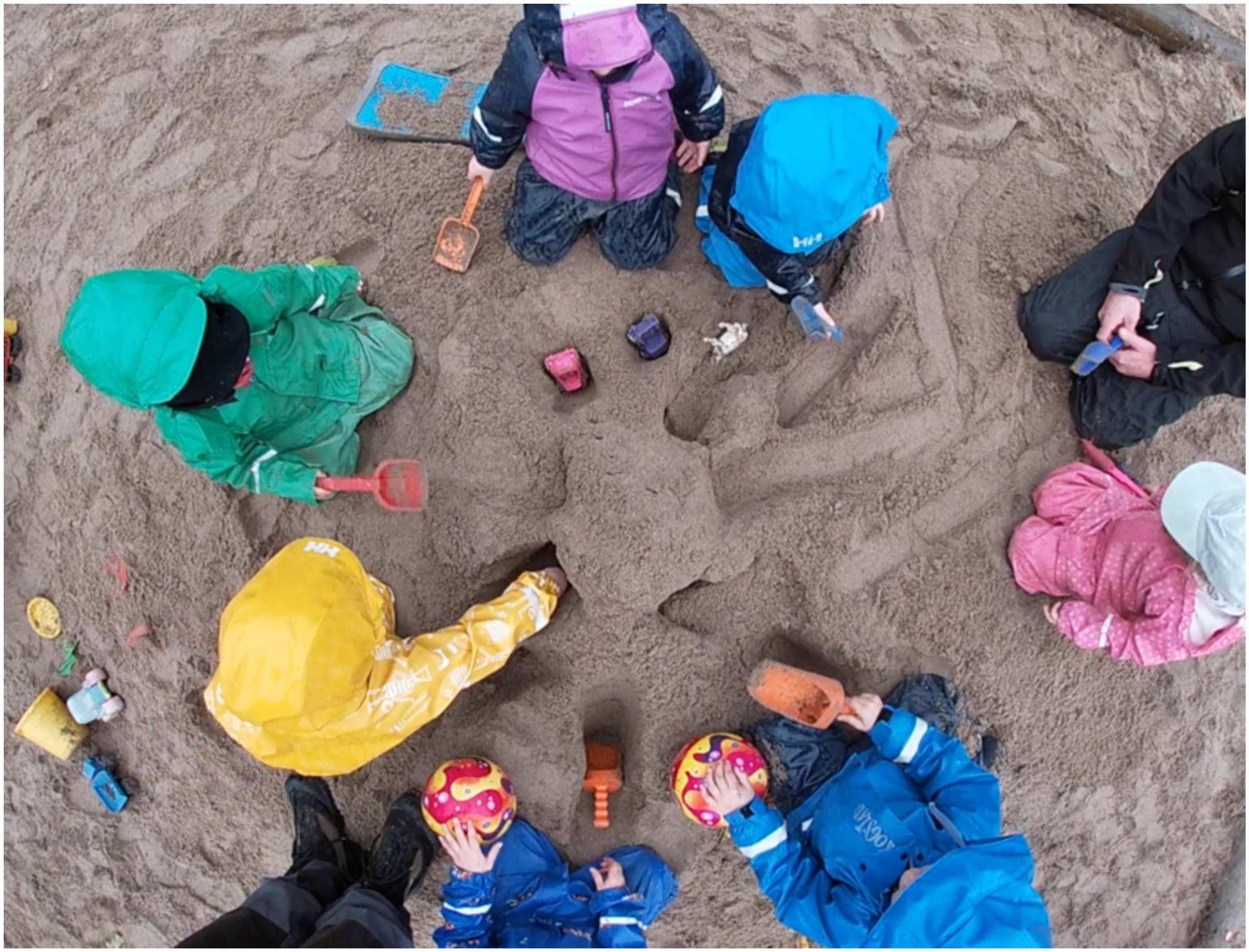
Children-in-the-sandpit: link to the video 17 : https://uia.cloud.panopto.eu/Panopto/Pages/Viewer.aspx?id = d0f84275-6417-47c5-8e42-b05e000a7b5d.
Possible entry points of disruption: Framing, tracking, speed, reverse motion and sound
Filmmaking practices such as framing, tracking, speed alterations, reverse motion and use of sound, shape what counts as “data” and offer alternative modes of analysis that include more-than-human bodies. These playful techniques show how video technology can play a democratising role in qualitative research by paying more attention to the digital, the sensory and the visual and relying less on language as the mode of enquiry (Jewitt et al., 2017). Vertov (1984) points especially to the cinematic techniques of speeding up, slowing down and tracking shots when exploring the possibility of cinema. As Deleuze (2013a: 89–90) describes, these are not trick shots but legitimate procedures to establish what he calls a ‘gaseous perception’, which ignores the ‘pseudo-contradiction between creativity (montage) and integrity (real)’. We describe how these techniques are used with the Children-in-the-Sandpit example and how the analysis challenges engrained habits of thought about time, space and matter. We argue how the cinematic techniques of unusual framing, tracking and speed alterations can create affective imagery beyond binaries (e.g. individual/group, material/human and action/reaction) and human-centred notions of observation, surveillance and representation.
Unusual framing and tracking from an ‘impersonal eye’: Making visible a multiplicity of relations
The first technique we experiment with is framing. Deleuze offers a taxonomy of images or what Colman (2011: 12) calls ‘screen forms’. He differentiates between perception-image, action-image and affection-image that are often based on framing. The perception-image gives a general overview of the space as seen by a human, often through the framing of a long shot. The action-image shows the interaction between characters and their actions, often framed through a medium shot. The affection-image focuses on an emotional experience triggered and established through a close-up.
In our example, the unusual framing starts with an affection-image. As we are tracking out, the framing changes from close-up hands, spades and sand intra-acting to a perception-image offering an overview of what is going on in the sandpit. Although close-ups are also in use, the classic affection-image with its focus on the human face is avoided. There are no close-ups of faces and eyes (e.g. showing emotions). At the beginning, attention is deliberately drawn to the faceless sand heap as a central focal point. We resist the human-centred foci on affect and the representation of action, which would tempt us to speculate about the children's experiences and inner mental states.
The camera is pointed in an unusual position/framing directly from the top, a bird's eye point of view, “unnatural” in a sense for the human eye as the viewpoint is hovering over what is happening in the sandpit. This is made possible with a handheld action camera allowing one to search for angles less familiar to the human eye. Denton (2016: 123) draws on Deleuze and combines cinematic and theoretical work and describes cinema's potential as: […] to draw out the image in such a way as to actively connect with the viewer through the uncanny experience of seeing a familiar object rendered slightly but jarringly unfamiliar. The “inhumanness” of camera position and movement in this clip – made possible through the technology – adds to an experience of the ‘ordinary’ moment as ‘jarringly unfamiliar’ making it ‘at once sensational while at the same time nonhuman’ (Denton, 2016: 123).
Qualitative video research tends to use action-images and perception-images. In educational research in a classroom, for example, this means filming with a wide lens, showing the whole situation on a tripod, which reminds us of a CCTV surveillance camera. Deleuze (2013b: 196/209) contrasts these types of imagery with ‘a cinema of the body’, and as Colman (2011: 89) puts it, ‘a body that will create thought’. Our displacement of framing (see Figure 2) draws attention to the communal (both human and non-human) elements of the ordinary event. 12
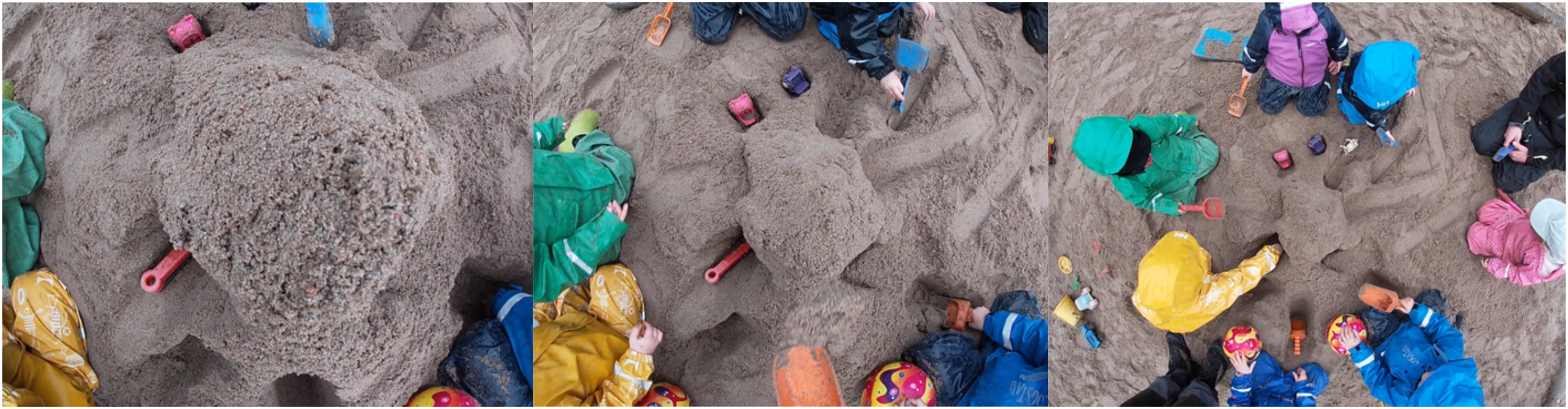
How displacement of framing draws attention to the human and non-human community.

The plastic cow figurine leaps into the child's hand.
In the following, we compare the cinematic element of tracking to montage as a technique. Montage is often described as a cinematic technique where individual images from various angles (e.g. close-up, wide lens) jump in space and time through cutting. Still, when edited together, they make a coherent whole. Instead of using montage as a technique, we mobilise tracking to disrupt human-centred notions of agency by drawing attention to the human and more-than-human multiplicity of relations in the sandpit that also generates affective responses. So how is this done?
As the camera tracks out, it shows at first only the edges of the children's bodies, focusing on the sand, the hands, the spades and the arms coming together as one non-individualised “body”. This creates a cinema of a unified body, which consists of a “faceless” meeting offering a sense of displacement and surprise. It is a complex, detailed as well as a unified and tentacular movement. Disrupting the usual gaze, tracking out provokes and makes the viewer uncertain about which movement is “best” to follow. Together with the unusual framing, tracking moves beyond the affection-image, action-image or perception-image and brings to the fore the relational phenomenon. Disrupting normal causality and individualised agency (cause → effect), the experimental technique draws attention to the flow of the movements which creates a human and more-than-human community. Moreover, deliberately tracking very slowly brings details to the attention, otherwise forgotten or ignored. This brings us to the next cinematic technique.
Speed alterations and reverse motion highlight a multiplicity of times
Deleuze (2013a) argues that cinema is not a succession of still images but movement. Movement is here understood not just as spatial mobility but as a temporal category (Deleuze, 2013a: 3). It is possible to jump across “normal” time and space continuities due to the ‘mobility of the camera and in emancipation of the viewpoint’ (Pisters, 2003: 2). As a result, cinema's potential to undertake ‘temporal explorations’ is an important quality which can be used to reconfigure video research. A cinematic performative analysis can be described as such a ‘temporal explorations’ (Pisters, 2015), that make visible alternative temporalities previously invisible or less foregrounded. Hence, we will now explore how two different kinds of techniques can disturb ideas of chronological and linear progression: slowing down and reversing motion.
The first technique is speed alteration, which in this case is slowing down the video. In the example (access the QR code/link in Figure 1), slowing down took place during recording, and additional slowing down took place during post-production. Slowing down has been a tool used in cinema and video art, for example, by video artists Bill Viola or film director Lars von Trier. Their slow-motion images do not aim to capture and map action in detail but are meant to be more meditative and contemplative. Ivanova (2016: 154–155) describes this technique as the meditation-image: From the viewer's perspective, it is experienced in a meditative mode of consciousness. In meditation, time is said to stop or slow down extremely, decentering and enriching perceptions.
Deleuze points to this contemplative power of art, which can be transferred into cinema through the time-image (Colebrook, 2006: 102). Among the time-images in Deleuze's film philosophy, there is the category of the crystal-image, a temporal exploration and direct presentation of time ‘but time which has already rolled up, rounded itself, at the same time as it was splitting’ (Deleuze, 2013b: 87). The crystal-image ‘reveals the split that time is, the split between past and present’ (Viegas, 2019: 69). Viegas (2019: 70) argues that these ‘crystalline cinematographic images lead us to the genesis of a non-chronological time, to its perpetual, never-convergent bifurcation’. So, what might we learn from this for using video in qualitative research? Slowing down as a technique plays with temporalities and disturbs ideas of representation, progression and chronological sequences when exploring material-discursive events. As Pisters (2003: 3) reading of Deleuzian film philosophy points out: (…) all images are situated on a plane of immanence where past, present, and future coexist and can be ordered in various ways, including linearly. Images are there; they do not represent some other-worldliness but constantly shape the world and its subjects.
Ideas of time and progression as chronological and in an orderly sequence based on action/reaction are still (often) central to the use of video also in qualitative studies when exploring an event. However, we argue that the cinematic apparatus used in research offers both an affective and philosophical medium to de-centre chronological time and supports exploring material- discursive events differently. In a cinematic performative analysis, slowing down makes it possible not just to imitate the time structure of an event as experienced, but its contemplative power disturbs linear time and progression. 13 In the Children-in-the-Sandpit example, a contemplative image is created from an everyday situation. The slow-motion leads to the small gestures and movements of both the material and the children allowing the viewer to meet them in a meditative mode.
Drawing on Bergson and Deleuze, Lazzaroto (2007: 96) describes video/cinema as machines that crystalise time, incorporating two elements simultaneously. On the one hand, the ability ‘to conserve the past in the present’ as well as ‘to tend towards the future, to act and create’ (Lazzarato, 2007: 96). Video artist Nam June Pike (1976) argues that video imitates not the appearance of nature but rather its time structure. However, from a Deleuzian perspective, this is not mere imitation, but cinema has the potential to shape our ideas about how events unfold timewise and even time and progression itself. This is important for cinematic performative analysis as it holds on to the notion that video is also about the past, but at the same time involves a transformative element through its ability to establish new connections and in that way shapes the future.
The second technique in the Children-in-the-Sandpit (Figure 1) is reversing the motion. Before changing its original direction in post-production, the clip started with a wide shot of the children playing with the sand. During the filming, the researcher became aware of the central focus point, a heap of sand. To trouble the human-centredness of this observation, the camera was moved down deliberately until it almost touched the sand. In other words, emergent theorising, as described by Rokka and Hietanen (2018), already started during this part of the filmmaking process. Furthermore, emergent theorising happened during post-production when the speed was altered and reversed by starting the clip with the communal non-human centred focal point. In this example, using the reversal of the motion technique has two implications. A few moments into the clip, defying the laws of gravity, sand jumps up from the ground. This “unnatural” behaviour is repeated when sand jumps into childrens’ spades, and in one instance, we notice a plastic cow figurine leaping into a child's hand (Figure 3).
As with the slowing-down technique, the dispersed movement disrupts and displaces what we see. The reversed motion animates what, for human eyes, are ‘lifeless’ objects into active agents as part of the phenomenon. The technique helps to ask the question, ‘who is playing with what?’, thereby disrupting taken-for-granted linear notions of time that are assumed as given in causality. Such intra-ventions jolt our habitual ways of seeing, but they do this subtly – on the edge of credible. They point at a timeless flow of gestures without an obvious succession of causal action/reaction. The reverse motion technique also offers us something else as researchers. The shot starts with a tracking out from the close-up. Such a beginning creates a mystery and provokes viewers to question where the situation is taking place and what is going on, carefully building up a complex assemblage of what we call ‘a community of human and nonhuman bodies’.
Visual crystalising and unifications of the temporalities and relationalities of the event
In the example, cinematic performative techniques were used to disrupt how we would usually read children's actions in qualitative research; that is, we would read their actions as proceeding with a clear, linear and progressive pattern. What happened in “real” time cannot easily be distinguished from the manipulated time of slow-motion or reversed speed. In combining the unusual framing, a slowed down tracking shot and the reversed motion creates what Deleuze (2013b) calls the crystal image. As Viegas (2019: 74) points out, this type of image ‘shows us the paradoxical, active and unsolved time of the event’ and involves a non-chronological time. It creates a visual crystalising of the durations and relations of the elements in an event, albeit simultaneously unified through the shot. According to Colebrook (2006: 18) and her reading of Deleuze, ‘philosophy only begins to think when it encounters these durations, other unfoldings of time which never take the form of a single line or development’. Transferring ideas of a visual crystallisation for temporal explorations to a cinematic analysis shows the potential of cinematic language in research. Here, we encounter different temporalities united through the cinematic piece. The role of sound in contributing to this unification or diversification will be discussed in the next section.
Sound to create an illusion of unity (or destroy it)
Although mentioned but less discussed in his first book on cinema, Deleuze suggests an analysis of the sound image itself (Deleuze, 2013a: 94). In his second book, Deleuze dedicates a section to the role of sound when describing the components of an image (Deleuze, 2013b: 240–248). In our example, Children-in-the-Sandpit, sound is separated from the image and not synchronised. Sound is not slowed down (as the image is), nor is it played backwards (as the image is).
As mentioned, ‘all images are situated on a plane of immanence where past, present, and future coexist and can be ordered in various ways, including linearly’ (Pisters, 2003: 3). We regard both sound and visuals as elements in this collective plane, where sound follows its own duration.
In the Children-in-the-Sandpit example, an illusion of a linear real-time event is created through a single soundtrack. At the same time, visual elements clearly disturb this illusion. The “aturalistic” soundtrack sets the atmosphere and provides information about the setting of the situation, which creates a documentary kind of atmosphere despite the technical manipulation of the images. This creates a sense of continuity through the soundtrack and originates a chronological but asynchronised gathering of the event, despite the visual alterations. Although never seeing children's faces, we can hear their voices, which produces a unique setting and context for the event to unfold. In contrast, in more conventional video observation, sound is synchronised and inseparable from the image to communicate what is happening “as real as possible”. In cinematic performative analysis, sound is separated from the image to ‘operate at various levels of montage against or with the image’ (Colman, 2011: 44) but as an intricate part of the analysis.
What lingers just below the threshold of (habitualised) perceptibility?
To reiterate, contrary to (ethnographic) filmmaking, where the final goal is a film – the ‘product’ – and lets the visual piece do ‘the talking’ on its own, a post-qualitative cinematic performative analysis merges moving images and a conceptual, linguistic exploration. This combines text with a (more) visual and auditory sensory experience. 14 In a sense, the analytic and creative process is fluid. It starts already on site when filming and in post-production but does not stop there as it involves a constant ‘re-turning’ (Barad, 2014). A cinematic performative analysis includes an exploratory dialogue with the film, offering suggestions about the kind of thinking enabled through and with the technology. We argue that this marks a porous demarcation line between the researching filmmaker and the cinematic researcher. 15 Both approaches use cinematic techniques and create affective relations between the visual material and the viewer. However, the first aims at film as analysis and communication of research results and final product, while the second aims at a cinematic performative analysis as part of a post-qualitative research process.
Rokka and Hietanen (2018: 115) point out that the evocative power of video is: ...to move from the logic of making an externalized statement of explanation to something that rather attempts to be part of emerging culture itself by animating, attuning, evoking, disrupting, sensitizing or entangling us with affective resonances of lived-through moments and events.
We agree that cinematic performative analysis mobilises the evocative power of video, just ‘below the threshold of perceptibility’ (MacRae, 2020), but we also argue for the affordances of the technology to trigger conceptual theorising. We now further explore what the filmic techniques have made possible theoretically.
Producing short pieces of moving imagery of an everyday assemblage provokes thought. As Stewart (2007: 27) points out, these ordinary micro moments ‘can pop up as a picture of staged perfection, as a momentary recognition, or as a sense of shock or relief at being “in” something with others’. We argue that this staged perfection becomes visible in how the event materialises in the cinematic performative cinematic analysis.
In the Children-in-the-Sandpit example, the cinematic performative analysis foregrounds the relational aspects of the situation, the group and the communal movement, which includes the role of the other-than-human (e.g. toys, spades, sand, and camera). Through the reversing and slowing down, a timeless flow of movement occurs with no apparent beginning or ending. This resembles a staged choreography without forward and backward movements. Drawing on Deleuze, MacRae and MacLure (2021: 275) calls such choreography ‘occult sociality of children’, which reminds her of the ‘watchful etiquettes of the member of a pack, rather than explicit negotiation’. The event can be read as an entangled body, with de-individualised arms and “tentacles” becoming a communal movement. Like MacRae's (2020) analysis of children's hands, our interpretation of bodily negotiations and minor gestures also renders children political.
In addition, framing the sand heap in the centre and reversing motion, which animates “dead things” and bring objects “alive”, foregrounds the materiality of the event. Our deliberate use of specific film techniques disrupts individualised human agency and reveals the children-material entanglements. Moreover, the cinematic performative analysis allows us to explore an event with a sense of ephemeral ‘timelessness’ instead of chronological linearity. It is less interested in the consecutive unilinear development of social interaction through action and reaction. It articulates an uncanny reality and arrests our ‘normal’ perception by focusing on (in)animate objects. What becomes visible through a performative cinematic analysis is ‘a multiplicity of relations’, both human and non-human, both individualised as well as communal, in a ‘multiplicity of time’ (Colebrook, 2006: 102). This post-qualitative way of reading the event profoundly questions analyses that assume unilinear causal sequences. An affective and conceptual analysis of movement, time, matter and relationality is achieved when the researcher, in addition to conceptualising, also thinks and practices like a filmmaker and unleashes ‘powers that potentially yield relations not already given’ (Colebrook, 2006: 58).
The affective power of the cinematic apparatus entails ethical responsibilities
When presenting a cinematic performative analysis at conferences and workshops, the question of the ethics of our approach has been taken up by audiences. They have probed whether an affective, performative (and hence instrumental use) of video material is ethically justifiable. Are we as researchers allowed to use these techniques deliberately to, for example, provoke an aesthetic experience, get affected by images we produce and, by cutting them together and altering them? In a sense, being situated in the performative paradigm of post-qualitative research legitimatises this. Also, we are not worried about their observation that a researcher might be too active or performative. We are more concerned about the opposite – that researchers are not being actively involved and performative enough. Actively using film techniques and altering visual images does not automatically create fresh connections nor avoid repetition. This is a problem all filmmakers face, as Colebrook (2006: 12) points out: The technology that enhances life, allowing it to be more creative, can become so habitual that it masters life, becoming rigid, stagnant and inhuman. Cinema can exacerbate the tendency to cliché, stereotype and plot, where the future is reduced to already experienced forms, and time can pass only as the repetition of the same – a series of sequels where the brain becomes lulled into easy and inactive consumption.
Hence, this use of the affective power of cinema (that can sediment or disturb) is also an ethical question. When adopting a cinematic performative analysis, we have to be acutely aware of the risk of reproducing (visual) clichés. To make the most of the revolutionary potential of technology, which lies in the possibility of rearranging the perception of images, cinema must avoid reiteration of forms and images already seen and stored (Colebrook, 2006: 13). This means that ‘ethical considerations would also have to involve questioning how a particular use of technology sediments subjectivities and particular ways of thinking and knowing’ (Menning et al., 2020: 160). Hence, in a cinematic performative analysis, the researcher is confronted with the ethical task of using the medium's exceptional qualities.
Cinematic performative analysis – thinking anew about time and relationality
In sum, a performative, cinematic analysis differs from narrative and representational approaches. It reconfigures dominant ways of thinking about human agency, time and relationality. Through the technology of the cinematic apparatus, the focus is on the flow of movement and the material-discursive elements of an event. This enables an affective and transformative analysis that is both visual and conceptual. Such a post-qualitative move demands troubling the classical separation between research on site as part of fieldwork when data is collected and the data analysis itself. In this fluid methodology, part of the analysis already happens during the fieldwork. Furthermore, when the visual piece is further developed post-production as well as in academic writing, what researchers count as ‘data’ is still in process. The affective and disruptive powers of cinematic language are animated, not only when recording in the field but also post-production and when the research is communicated in presentations and writing. This also raises the question of how to best communicate the integration of text, still and moving images (including gifs and longer clips) to maximise the potential of a performative analysis. In short, the use of film as a performative practice in qualitative research can become a thought-provoking event because it moves the viewer/reader affectively and profoundly challenges human-centred and assumed notions about agency, time and relationality.
Invitation to further reconfigure research practices with video
Thinking mainly with Deleuzian film philosophy, we trouble (Haraway, 2016) human-centred discourses about the use of video technology in qualitative research. In her analysis of the Deleuzian cine system, Colman (2011: 23) argues that ‘(i)nstead of privileging a cognitive, analytical, sociological or historic method’, Deleuze's approach allows for a more profound analysis as ‘(w)hat cinema does […] is to provide us with new questions about “reality”’ (Colman, 2011: 36). Our detailed empirical analysis of an “ordinary” event involving young children, gestures at some of the possibilities that experimenting with technology can offer qualitative researchers, disturbing and redefining ideas about time, matter and relationality.
We have shown how filmmaking techniques such as unfamiliar framing, tracking, speed changes, reverse motion and use of sound allow a ‘dehumanisation of the image, a scene where the visual can be freed from the local subject and released to yield autonomous power’ (Colebrook, 2006: 43). It becomes an active part in a relation through which the researcher is disturbed (or moved both emotionally and theoretically) by the image making technology. This use of technology can help avoid the routine use of humanist causality to explain human actions. It also disrupts unilinear ideas of progression and development with their power-producing binaries, such as subject/object, culture/nature, human/technology, child/matter. These binary opposites profoundly shape research practices but do not correspond to any actual existing polarities.
Inspired by Barad's agential realism, we have paid attention to the material-discursive elements of the Children-in-the-Sandpit cinematic piece. Rather than representing already existing relations we have visualised and theorised how a performative analysis of this visual data concentrates on the ‘emergence of relations’ (Colebrook, 2006: 44). The unique characteristic of filmmaking techniques for a cinematic performative analysis is to be able to discern multiple temporalities and relationalities. In the Children-in-the-Sandpit example at the heart of this article, unilinear and chronological temporalities that shape and dominate ideas, in this case about childhood and education, are being questioned. 16 It is an open invitation to be inspired by cinematic language and explore hitherto unused possibilities to reconfigure how video is used in qualitative research. Inherent in the medium of cinema is the ‘potential to transform the structure of perception which has dominated the history of thought’ (Colebrook, 2006: 39). Of course, as Deleuze (2013a) observes, not all films make use of this potential. And the same can be said about the use of video in qualitative research to unleash ‘the power of the cinematic apparatus’ (Colebrook, 2006: 39). Grounded in post-qualitative approaches of performativity, the radical power of cinematic performative analysis lies in transforming qualitative research practices to shift the anthropocentrism and human exceptionalism of current notions of agency and causality in qualitative research.
Footnotes
Author note
Karin Murris is also affiliated with University of Cape Town, Cape Town, South Africa.
Declaration of conflicting interests
The author(s) declared no potential conflicts of interest with respect to the research, authorship, and/or publication of this article.
Funding
The author(s) received no financial support for the research, authorship, and/or publication of this article.

Notes
Author biographies
Soern Finn Menning is an Associate Professor at the Department of Education, University of Agder, Norway. In his previous research, he explored curiosity as value-loaded notion in early childhood educational practices. He also has a background in media studies and has worked as a screenwriter for award-winning short and feature films. He currently explores combining both arenas through further developing post-qualitative and performative video methodologies in educational research.
Karin Murris (PhD) is Professor of Early Childhood Education at the University of Oulu (Finland) and Emerita Professor of Pedagogy and Philosophy, University of Cape Town (South Africa). She is a teacher educator and is grounded in academic philosophy and a postqualitative research paradigm. Her main interests are in posthumanist child studies, philosophy in education, ethics and democratic pedagogies. She is principal investigator of various projects, including “Small Matters” (2023-2027), “The Post-Qualitative Research in Higher Education Collective” (2021–2023), “Children, Technology and Play” (2019–2020) and “Decolonising Early Childhood: Critical Posthumanism in Higher Education” (2016–2019). Her books include: Karen Barad as Educator (2022), The Posthuman Child (2016) and (with Joanna Haynes) Literacies, Literature and Learning: Reading Classrooms Differently (2018) and Picturebooks, Pedagogy and Philosophy (2012). She is co-editor of the Routledge International Handbook of Philosophy for Children (2017) and editor of The Glossary (2022) and Navigating the Postqualitative, New Materialist and Critical Posthumanist Terrain Across Disciplines (2021). She is Chief Editor of the Routledge Postqualitative, New Materialist and Critical Posthumanist Research series.