




Abstract
In this article, the authors explore and contribute to producing a performative research paradigm where post-qualitative as well as artistic research might dwell and breathe. Entering a thread of discussion that started with Haseman’s A manifesto for performative research in 2006, and building on their own friction-led research processes at the edges of qualitative research, the authors plug in with performativity, non-representational theories and methodologies, post-qualitative inquiry and post approaches. A performative paradigm for post-qualitative inquiry is proposed, where knowledge is viewed as knowledge-in-becoming as the constant creation of difference through researcher entanglement with the research phenomenon and wider world. A performative paradigm produces a space for movement, (artistic) freedom, (post-qualitative) experimentation and inclusion. A performative research paradigm also offers provocations that shake long-established notions about what research is and should be. Within a performative research paradigm, learning/be(com)ing/knowing is always in-becoming – as is the performative paradigm itself.
Keywords
Let’s jump straight into it. With a performative research paradigm, we mean that the following perspectives on research are at play: Research is understood as creation. It produces something new in the world, something that was not there before, regardless of the researcher’s involvement. Therefore, research is understood as non-representational, not aspiring to represent a part of the reality that existed independently of the researcher before the research. The researcher is de-centered and in-becoming throughout the research process. The researcher is fully entangled with the research, not only as a research cognition capable of critically reflecting on their own influence on the research, but also as an affected researcher-body who needs their own sensuous body to engage, analyse and understand. The researcher-body is understood as a resource and an outcome of the research as situated knowledge. Notably, the researcher is not static in the research, but instead changes with it. The research can be produced, analysed and presented in and through several different modes and materialities for creation. Using only verbal and/or written modes of expression might reduce the meaning-making as well as the affect-producing capacities of the research. Doing research within a performative research paradigm means having a performative approach towards languaging – that is, not only using existing concepts and modes of creation, but actively languaging research phenomena in new ways. The research operates on an onto-epistemological level, where the ‘smallest unit’ is understood as relational phenomena, not separated subjects and objects. Materiality, discursivity and sociality are entangled and continuously performing one another. Also, being and knowing are in constant joint becoming and perform one another, inseparably. This also goes for the researcher, who is in material-discursive-social becoming throughout the research process. This pushes the research towards creating and studying relational phenomena and an approach towards collaboration and participation. This further highlights the research process as one of constant negotiations of entangled relations, emphasising ethical dimensions from the beginning to the end of the process.
We use the remainder of this article to unpack these performative (Haseman, 2006, 2010) and post-qualitative (St. Pierre, 2011, 2018) perspectives.
Jumping into a performative paradigmatic discussion
There has for a long time been rapid and explosive innovation in how to do qualitative and related strands of research differently (e.g. Jackson and Mazzei, 2012; St. Pierre et al., 2016; Ulmer et al., 2020), and we see an increasing amount of research using, creating and discussing what is called either post-qualitative research (e.g. Bodén and Gunnarsson, 2020; Le Grange, 2018; St. Pierre, 2019) or performative research (e.g. Arlander, 2018; Bolt, 2016; Haseman, 2006; Jamouchi, 2019; Østern et al., 2019). We understand the concepts post-qualitative and performative as seeking to produce the same shift and break away from qualitative research, though coming from different contexts. Briefly described, ideas about a performative paradigm seem to come more from artistic research, whereas ideas concerning post-qualitative research are based in a spectrum of post approaches (such as post-humanism, affect theories, feminist materialism and decolonialism) and seem more prominent in educational and social research. Both artistic research and post-qualitative research have grown out of friction with established qualitative methods, often with positivist leftovers in academia. These positivist leftovers reveal themselves in qualitative research using language such as coding, data collection and validity and the use of pre-described methods striving towards homogeneity, with the result that, as Johansson (2016: 451) writes: ‘qualitative research is not qualitative enough’. In both the performative and the post-qualitative strands, it seems that discussions commute between a paradigmatic and methodological level. We propose performative research as a paradigm that might embrace post-qualitative research within educational and social sciences, as well as in artistic research.
We sense this shift as a radical shift from qualitative research, and therefore, drawing on our previous experiences, practices and publications (Bjørkøy, 2020; Jusslin & Østern, 2020; Jusslin, 2020; Maapalo, 2019; Maapalo & Østern, 2018; Knudsen, 2017; Østern, A-L & Knudsen, 2019; Østern, 2017, 2020; Østern et al., 2019), we align with, and build on, Haseman’s proposal in 2006 of a paradigm shift from a qualitative paradigm to a performative paradigm. The time is ripe for this paradigm to step alongside the lines of accepted research paradigms. It has matured, received some age and already has a young history.
By paradigm, we understand a set of shared beliefs and agreements (temporarily) between scientists about how problems should be understood and addressed (Kuhn, 1970). In other words, we understand paradigm as a kind of grammar, a way of seeing, organising, approaching, creating and knowing. Research paradigms are dynamic and temporal, and exist in relation to societal trends and times, and therefore, from time to time, paradigms become outdated and criticised to a point where a new paradigm writes itself out through a collective effort among communities of researchers. We pick up on Arlander’s (2018: 342) comment that ‘the idea of a performative research paradigm has not been as widely discussed as one would expect, perhaps due to difficulties in distinguishing the various meanings of the performative, performativity and performance and their associations to performing arts’. We seek to clarify what would distinguish performative research from qualitative (and quantitative) research as a paradigm and what a performative paradigm could do and produce. Performative research is a paradigm that different disciplines can enter, where artistic research, as well as post-qualitative research, can thrive, and where different post approaches can be applied, depending on how a specific topic, or area of research interest, is approached and what knowledge claims are being made as an outcome.
In what follows, we introduce our backgrounds and entries into a performative research paradigm and trace the performative paradigm in relation to its manifestation. Following this, we elaborate on the concept of performativity in relation to non-representational theories and discuss post-qualitative research. We draw differentiating contours between different research paradigms to contextualise the performative paradigm and problematise what a performative paradigmatic shift might imply and produce. Ultimately, we introduce some performative provocations and look ahead with respect to what a performative research paradigm might do.
Our ongoing becoming-as-researchers
For us, writing this article means clarifying our thoughts and articulating our discoveries after several years of practical research exploration; struggling, trying to fit within the qualitative paradigm, and somehow managing to get the performative job done. We are qualitatively, some also artistically, trained researchers who find ourselves on a turbulent and rather wild wave pushing towards the shores of a performative research paradigm. Coming from a range of different fields (dance, drama/theatre, arts/crafts, education, language/literature, early childhood education and care, and music), we are teachers – some of us also artists – who today work in teacher education with Northern Europe as our geographical and cultural context (Norway, Denmark and Finland). We are also connected as previous supervisor (author 1) and doctoral students (authors 2, 3, 4 and 5). Together, we have struggled to make space for the doctoral projects to contribute with their full potential.
The need to break out of or extend the limits of the qualitative tradition accelerated as friction was creating more and more resistance from within the doctoral processes of Sofia (author 2), Kristian (author 3), Pauliina (author 4), and Ingrid (author 5), pushing and pulling Tone (author 1) as supervisor to allow, encourage and follow. The paradigmatic friction was there from the start of the doctoral processes, but it somehow was manageable and bearable up to the point of analysis of the practice materials. Entering the analytical processes of the research materials in these educational doctorates, however – which include creative dance integration to expand literacy education in primary schools (Jusslin, 2020), young people’s involvement with social media as a space for drama in education (Knudsen, 2017), primary school teachers’ woodworking teaching practices (Maapalo, 2019), and singing as performative for building adult–child relationships in early childhood education and care (Bjørkøy, 2020) – was like opening a Pandora’s box: out flew a nest of entangled philosophical and methodological problems. Once the box was opened, there was no turning back: the frictions could not be put back into the box. A paradigmatic shift in these doctoral processes was unavoidable.
In correspondence with Tone as the supervisor, during the then ongoing doctoral research processes, Sofia wrote that ‘the reality I wanted to research did not exist from before’. Through the whole research process, she came to realise and articulate how her research was non-representational in several ways. Kristian wrote ‘I AM STUCK! My data does not speak the same language as I do. I am banging my head against a wall’. In contrast, Pauliina shared the experience of ‘. . . trying some of the rigid analytical methods common in the qualitative paradigm have felt like pressing the lively, complex and multisensory experiences created in the PhD project into a heavy, but ten sizes too small, straightjacket’. Ingrid experienced friction with traditional research expectations, as she could not overlook the fact that she was very much involved as affected researcher body throughout her project. She wrote that ‘. . . affect resists clear-cut, stable and defined dimensions. Affect just happens, and affect is so performative for what happens next’.
In the article, we will elaborate further on some performative mo(ve)ments that affected our research processes in the doctoral dissertations. We experienced these doctoral processes as being friction-led in a productive way, forcing us jointly as doctoral students and supervisor to shift over to performative research and post-qualitative inquiry.
Backtracking a performative paradigm
We recognise a thread of discussion starting with Haseman (2006), who in his A manifesto for performative research suggested a performative research paradigm additional to a quantitative and qualitative one. Haseman’s thinking was further developed in 2010 (Haseman, 2010), picked up by Bolt (2008, 2016) and further elaborated by Arlander (2018). What intrigues us with this very thread of discussion is how these researchers delve into the question of performative research as a paradigm. Haseman, Bolt and Arlander all come from the field of artistic research, which had struggled to find what research on artistic terms could indicate when art schools turned into universities, a shift starting in the 1980s–1990s (Academy of Finland, 2009; Østern, 2017; Smith and Dean, 2009). Universities should be research-based and conduct research, but what then does it mean to do artistic research (ADiE Artistic Doctorates in Europe, 2017; Butt, 2017)? Much friction was created when artistic ways of working clashed with established qualitative methods, often with a positivist leftover. This struggle is still ongoing. We suggest that settling artistic research within a performative research paradigm would ease and facilitate the struggle, releasing the performative potential of artistic modes of enquiring. However, to do so, it needs to be clear what ‘performative’ means in a research paradigmatic context.
Performativity and non-representational theories and methodologies
The different backgrounds and meanings of words related to ‘performativity’, like performance and the performative, hinder a breakthrough of performative research as a paradigm, as suggested by Arlander (2018). Our understanding of performative research as a paradigm correlates well with von Hantelmann’s (2014) understanding of performativity in her article The experiential turn. von Hantelmann analyses the field of visual artworks in a way that we find transferable to the field of performative research. She writes that the misunderstanding of performative as meaning ‘performance-like’ has caused considerable confusion, because it is impossible to clearly define what a performative artwork actually is (von Hantelmann, 2014: unpaginated). The same is true for research. When replacing ‘art’ with ‘research’, and applying von Hantelmann’s words, we could say that there is no performative research because there is no non-performative research. Language philosopher Austin, who used the term ‘performative’ soon discovered this challenge.
Austin used the term in 1955 as part of his lecture series ‘How to do things with words’ 1 to point to the act-like character of language (von Hantelmann, 2014: unpaginated). He argued that, under certain conditions, utterances produce realities beyond the realm of language. However, as von Hantelmann emphasises, Austin soon understood that it was impossible to make a clear-cut distinction between a constative, reality-describing and a performative, reality-producing way of speaking. Every utterance contains both constative and performative aspects, and the same applies for artworks – and research, we might add. In line with von Hantelmann’s understanding of performativity, we argue that performative research is not limited to one specific disciplinary field, like the arts or linguistics, for example. Instead, it involves outlining a specific level of performative meaning-making that basically can exist in all research phenomena within all disciplinary and cross-disciplinary fields. It is possible to research the same phenomena within a quantitative, qualitative or performative paradigm. Each paradigm demands specific methodological orientations, creates different perspectives on what produces meaning and makes different knowledge claims as an outcome. In line with von Hantelmann (2014), adapted to the realm of research, what the notion of performativity brings into perspective is the realm of the impact that research brings about situationally – in a specific spatial and discursive context – and relationally to researcher and research and other-than-human participants. This is also in line with how the post approaches, which performative research engages with, underline the performativity of research (e.g. Barad, 2007; Braidotti, 2013; Deleuze, 1993; Deleuze and Guattari, 1987; Haraway, 1988, 1992). With a performative research paradigm, the research focus shifts from what a research phenomenon ‘is’ to what it ‘does’. This shift requires methodological innovation and experimentation, and also implies a shift from being to becoming. This is an onto-epistemological shift, which challenges researchers to seriously think about questions connected to ontology and epistemology (Barad, 2007). The basic idea implied by a performative research paradigm is recognising the inseparability of nature/culture and human/matter (Barad, 2003, 2007, 2014; DeLanda, 2005; Deleuze and Guattari, 1987; O’ Brien, 2020).
The entanglement and performativity of a performative research paradigm pushes separable and detached units like ‘subject’ and ‘object’ in traditional research design thinking into non-representational (Thrift, 2008; Vannini, 2015), fluid and relational phenomena in constant becoming. Thrift writes concerning the researcher’s task that ‘[t]hey are there to hear the world and make sure that it can speak back, just as much as they are there to produce wild ideas’ (Thrift, 2008: 18). Thrift (2008) further suggests a set of qualities for analysis, which he calls creative production. All these qualities push research into performative action and thinking, with non-representational impulses and outcomes. Here, non-representational means that performative research does not assume that it can capture and say something about the reality that existed before and non-depending of the research project, the participants and the researcher. Research and knowing do not occur at a distance, but with direct engagement with the world, which is a founding premise for a non-representational, onto-epistemological approach that blurs the boundaries between the ontological and epistemological (Barad, 2007). In other words, performative research does not attempt to represent reality, but instead to engage with it (Thrift, 2008).
Looking at a research phenomenon from a performative research paradigm, research creates realities, since there is not a detached, but an entangled relation between researcher, researcher phenomenon and the world. Ontology and epistemology cannot be separated, and the same applies to ethics. A performative research project zooms into a phenomenon of interest with a knowledge apparatus (Barad, 2003, 2007; Deleuze, 1993; Foucault, 1970) created for that very project, and makes for example a slice, or an agential cut (Barad, 2007), into the ongoing flow of the phenomenon, engaging with, producing and analysing that cut. Meanwhile, the phenomenon keeps flowing; it never stops, and certainly does not freeze because it is being researched, waiting for the researcher to finish the investigation. Instead, the phenomenon pulls the researcher with it, and the research starts to influence the phenomenon as they keep unfolding, together. They are both constitutive of and productive of one another. Therefore, research results are also understood as emerging and performative in performative research; the results create movement in the ongoing phenomena being researched. Results are performative; they create something new.
Post-qualitative research
The concept post-qualitative inquiry was invented by St. Pierre in 2010, and first used in a chapter in the fourth edition of the SAGE Handbook of Qualitative Inquiry (St. Pierre, 2011). However, she had developed her thinking-with-post-approaches, arriving at that point of articulation over more than a decade before that. In an article scrutinising her journey towards the invention of post-qualitative inquiry, St. Pierre (2014) tells about her ongoing frictions with what she calls the ‘conventional humanist qualitative methodology’. In our research, we recognise the frictions emphasised by St. Pierre, and they also resonate with the frictions felt by artistic researchers in academia. St. Pierre (2019: 3) writes that [T]he life span of that [qualitative] methodology – like any other – had reached its limits as it failed to do justice to the complexity of the world, especially after the ontological, posthuman, affective, new material, and new empirical turns that picked up speed during the late 20th and early 21st centuries when a particular description of human being – Descarte’s cogito – and being more generally, both of which poststructuralism had critiqued for decades, became increasingly problematic.
We notice that St. Pierre introduced the concept as post-qualitative inquiry, focusing on a methodological level (but without methods, as a critique of pre-described qualitative methods is at the core in post-qualitative inquiry). However, post-qualitative inquiry implies companionship with post approaches and an onto-epistemological shift, indicating a paradigmatic shift in how knowledge-creation and engagement with the world are understood. Again, we propose a performative paradigm for post-qualitative inquiry, where a central insight that the paradigm produces (or prerequisites) is that knowledge is knowledge-in-becoming as the constant creation of difference through researcher entanglement with the world. Learning/be(com)ing/knowing is performative, always in-becoming – as is the performative paradigm itself.
There is active post-qualitative research being performed across different disciplinary fields, and performativity is what we read across the research literature like, for example, Bodén and Gunnarsson (2020), Jackson (2017), Jamouci (2019), Johansson (2016), Lather and St. Pierre (2013), Lenz Taguchi and St. Pierre (2017), St. Pierre (2011, 2014, 2018, 2019), St. Pierre et al. (2016) and van der Tuin (2019). Throughout this work, there is a line of flight (Deleuze and Guattari, 1987) from the stability of being – away from the being of data, the being of the outside world, the being of methods, the being of research results as representations of the world, the being of the stable researcher, and the security and certainty that those beings grant. Instead, there is (paradigmatic) de- and reterritorialisation (Deleuze and Guattari, 1987) with the uncertainty, unpredictability and constant becoming that follow when performativity takes the lead. There is a line of post approaches like Deleuze (1993), Deleuze and Guattari (1987), Derrida (1976), Foucault (1970), Haraway (1988, 1992), Braidotti (2006, 2013) and Barad (2003, 2007, 2014), who have been central for post-qualitative inquiry as well as the breakthrough of what we sense and see as a performative research paradigm. Deleuze (1993) and Deleuze and Guattari (1987) bring about the notion of difference, which is central for a shift from qualitative to performative thinking. Based in a flat one-world ontology, with no underlying depths or cores behind what can be known, Deleuze and Guattari understand knowing and becoming as a plane of immanence that is always differentiating, always becoming, never static. Braidotti brings about the notion of nomadism (2006), which opens up for thinking of knowledge creation as ever-new spatialisations, and provides an eco-critical discussion connected to the post-human condition and subjectivity (Braidotti, 2013). Haraway (1988) situates knowledges, opens up for post-human thinking, and brings forth a critique connected to reflection and reflexivity as methodologies, whilst suggesting diffraction as an anti-essential alternative (Haraway, 1992). Barad (2007) furthers the understanding of knowledge-making as constant differentiating through discursive-material entanglements, and makes connections between the natural and social world. Diffractive analysis (Barad, 2007) means cutting-a-researchable-moment-together though a temporary cut in the ongoing performative flow of becoming, and then cutting-it-together-differently (Bjørkøy, 2020) through thinking-with-theory (Jackson and Mazzei, 2012), creating new performative insights. In developing diffractive analysis, Barad builds on Haraway’s introduction of the concept as a metaphor for critical thinking (Murri and Bozalek, 2019). Thinking-with-theory instead of, and breaking away from, using an already established (qualitative) method (Jackson and Mazzei, 2012), is central in post-qualitative inquiry. Thinking with theoretical/philosophical concepts through ‘plugging-in’ (Jackson and Mazzei, 2012) is used as an analytical approach, and concepts are put performatively to work with the research material engaged with, producing (performative) data while new (performative) knowledge is also being created and articulated.
Drawing differentiating contours between paradigms
Thinking with post approaches, a paradigmatic shift happens from being to becoming, from entities to phenomena and relations, essences to events, probabilities to possibilities, disembodiment to more-than-human bodily agential affects and intensities, and from reflexive researcher-positioning to diffractive, nomadic researcher-positioning. Plugging-in with performativity, non-representational theories and methodologies, post-qualitative inquiry and post approaches, a performative research paradigm seems rich with opportunities. Like Haseman (2006), we seek to differentiate quantitative, qualitative and performative research as paradigms in creating Figure 1. This figure slices into aspects of ontology, epistemology, researcher position, and what knowledge claims are being made. We acknowledge that a tabular visualisation can create polarising differences and effects between the paradigms. In contrast, in practice, the positions and borders between them are blurry, floating and undetermined, before an actual cutting-together-and-apart (Barad, 2014) through a specific knowledge apparatus in a specific research project is done. Additionally, we want to emphasise that what Haseman calls a quantitative paradigm perhaps more rightly should be called a positivist paradigm, which is often used for quantitative research. Much contemporary quantitative research is, however, positioned as post-positivistic. Recently, the emergence of mixing quantitative and qualitative research, in other words, using mixed methods, has increased (Creswell and Plano Clark, 2011). However, as mixed methods can be either concurrently or sequentially quantitative and qualitative (Schoonenboom and Johnson, 2017), we do not include mixed methods in the tabular visualisation, but instead acknowledge mixed methods as existing in the tension between the quantitative and qualitative paradigms. To be able to build on Haseman’s (2006) suggestion, we keep the table with quantitative, qualitative and performative as differentiating intensities, understanding that these are not without friction.
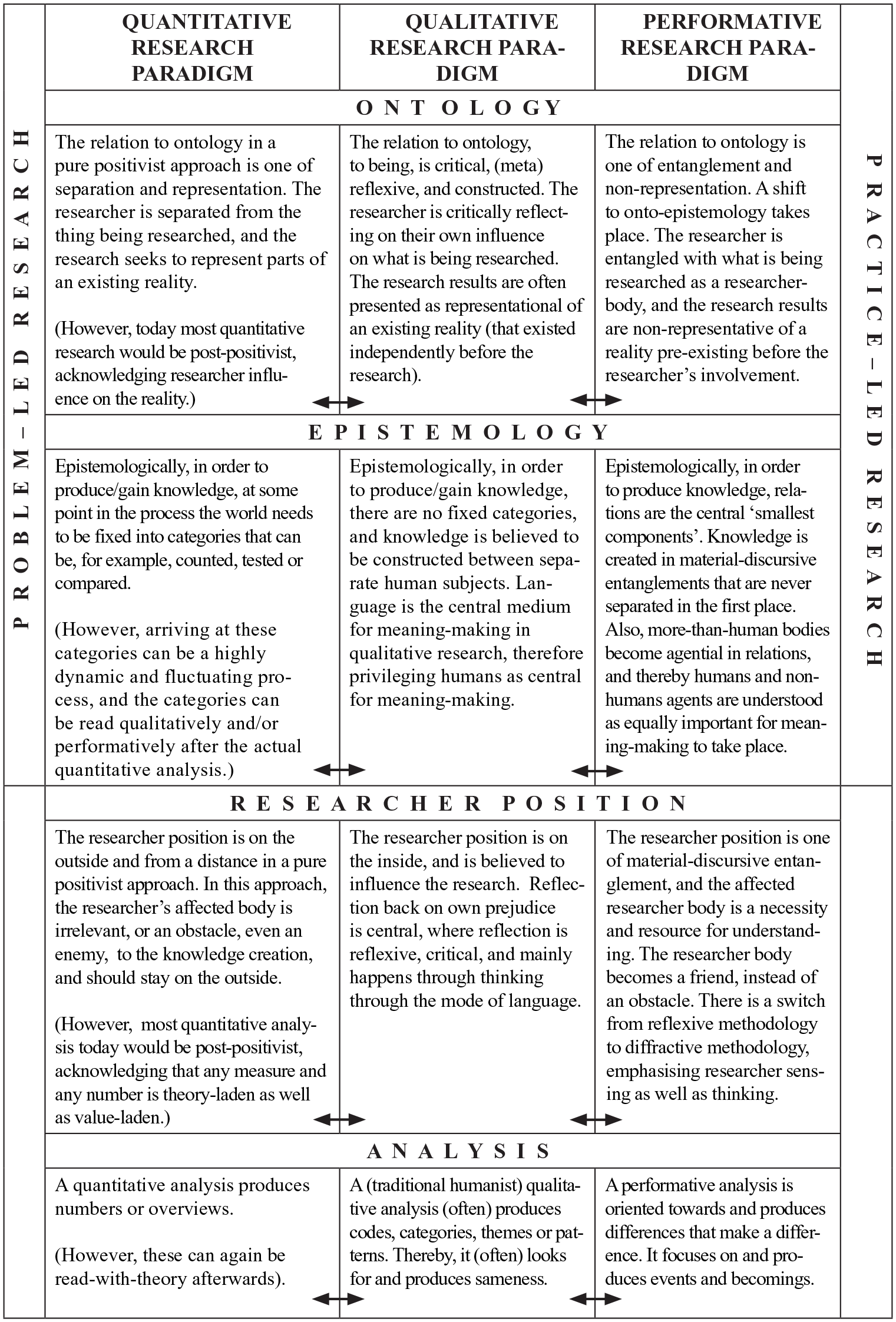
Differentiating quantitative, qualitative and performative research paradigms, acknowledging mixed methods as existing in the tension between the quantitative and the qualitative.
These descriptions are broad and general, and we acknowledge that there is depth and complexity in both quantitative and qualitative research paradigms that might be left invisible in this contextualisation. However, this visualisation is intended to highlight the differentiating aspects between the paradigms, especially in regard to how a performative paradigm emerges.
What a performative paradigmatic shift implies and produces
Having back-tracked and explored the differentiating contours between a performative and qualitative research paradigm, we find it essential to ask what a performative paradigm could be productive of. The question might not just be if there is a new paradigm, but what this becoming and emerging performative paradigm could produce. For us, what a performative paradigm can produce is especially evident in research practices; our be(com)ing performative researchers was deeply embedded in our research practices. For example, Sofia (author 2) remembered this performative event from her doctoral research process when teaching and researching poetry writing combined with creative dancing: I stood in front of the classroom, nervous about what I was about to do. I had never shared my own poetry openly before, let alone performed a dance to it. My poem was written on the white board behind me, and as the teacher started reading the poem out loud, I forgot the nervousness, I forgot the students looking at me, I escaped into the poem and felt it in my breathing, in my body, in my dancing. I improvised and let my poem give life to my movements. I felt the message I wanted to convey in the poem and how my movements enhanced that feeling in me. Suddenly, as I stopped, my attention was brought back to the classroom and to the students. I was overwhelmed with how dancing my own words, dancing my own poetry, had moved me and taken me somewhere else, somewhere not-in-the-room. Right there and then, I was a researcher, a teacher, a writer, and a dancer. I was neither one nor the other. My position as a researcher was related to all these roles. In that moment, before the students started to ask questions about my poetry dance, I realised how my researcher-body mattered and made a difference in the research, in the project and in the students’ dancing, reading, and writing processes
Ingrid (author 5) revisited how allowing an affective and artistic approach to the analytical process of understanding song interplay between kindergarten teachers and children helped her to articulate – performatively – the deep, embodied communication between adult and child that she sensed (observed): I pursue affective knowledge as a performative agent for the kindergarten teacher’s participation in the song interplay into a musical composition. To me, composing is an affective process and I use the research body’s affective capacities in exploring how the researcher is present, knows and relates to the research material. Affect registers itself as an almost inarticulate motive that connects to the tangible, emotions and knowledge before we can know. In this musical composition, I explore the affective intra-action between myself and the song interplay regarding the mood of the interplay. The choice of mood reflects a feeling I have of the interplay and how I experience the interaction as harmonious and in flow. Mood is at the same time an abstract, affective and recognizable phenomenon.
By working with it in a musical expression, it was possible for Ingrid (author 5) to analyse what creates the mood of the song interplay and at the same time what she, as a decentered researcher, intra-acts with. One of her musical expressions can be accessed through scanning the QR code in Figure 2. Performative research, then, invites newness, innovation and experimentation by stimulating renewal in practice and theory as well as in how research is carried out. A performative paradigm produces a space for movement, liberation, freedom, creativity, experimentation and inclusion. A performative paradigm produces a space where we can breathe and move, even with unexpected twists and turns, as researchers, and into which we can welcome different questions, phenomena, communities, languages and still-not-existing-research-methods and methodologies without pressing them into a (paradigmatic) jacket that does not fit and that reduces their meaning-making, affective and knowledge-producing potentials and capacities. We also experience the emerging performative paradigm as adding to the trustworthiness and rigour of our research, as a performative research paradigm allows complexity. What is ‘trustworthiness’ and ‘rigour’ in performative research, however, should not be confused with ideas of stability, representation and order that might be leftovers from a positivist approach that still has tentacles into a (traditional humanist) qualitative research paradigm. Instead, it is the fluidity, complexity and performativity of the performative research paradigm that makes performative research rigorous, solid and trustworthy.

Bjørkøy (2020) Diffractive analysis through musical composition: Mood, intonation and rhythm.
A performative research paradigm, then, ultimately produces movement. It moves from trying to stabilise knowledge towards emphasising knowledge as fluid and complex knowledge-creation; from language to languaging, from meaning to meaning-making, from text to body, affects and materialities; from subject, identity and being to relations, entanglements and becomings; and from something pre-existing to something being enacted. In this, it does not make sense to talk about development, growth or progression. All there is, are new differences, new possibilities, new creations. And as knowledge is be(com)ing created, so is the researcher, and all other units in a typical (traditional) research design. Within a performative research paradigm, then, plugging-in with performativity, non-representational theories and methodologies, post-qualitative inquiry and post approaches, research objects become research phenomena (Barad, 2007); data become alive, lively and fluid research material escaping the stabilisation that ‘data’ implies (Koro-Ljungberg et al., 2018); methods become method-less (Jackson, 2017); methodology becomes prescription-less and analysis becomes experimental (St. Pierre, 2018). Moving on, ways of producing and articulating the research process and results reject written language as the only or best way of engaging with and saying something about the phenomenon (Kuby, 2019); research participants include the researcher and more-than-human bodies involved in the phenomena (Fox and Alldred, 2015); the researcher is not distant, objective or neutral, but affected and embodied, as are all other human and more-than-human research participants (Lenz Taguchi, 2012); performative knowledge production and articulation replace the idea of representative results or findings (Zembylas, 2017); and, importantly, the researcher is not a stable or static zero point throughout the research, but changes with the emerging research process, becomes entangled and is always in-becoming (Østern, 2017). The whole research process is performative.
Performative provocations
A paradigm shift does not come easily, and not without sensations of shock, sincere provocation, frustration and resistance. This is certainly something that we as authors of this article have experienced in our research. And that resistance is also important and needed. Existing paradigms as well as emerging paradigms should be resisted; they need that in order to arrive at a temporary agreement among a community of researchers. There are several aspects that a performative paradigm shakes up, but we want to pay attention to the three aspects we experience as major provocations.
A performative paradigm shakes up and disturbs the entanglement of ontology and epistemology, pushing performative research more into a socio-material than a socio-cultural undertaking. The linguistic and cognitive meaning-making capacities of human subjects are pushed down from their uplifted privileged position to an entangled position with human and other-than-human agential bodies. Somehow, this seems to be a very provocative thought: the man-over-nature idea is so deeply rooted and has penetrated not only research, but all hegemonic ideas dominating Western society (see also Lenz Taguchi, 2012). We have noticed that the idea that the researcher is truly entangled with other-than-human bodies can be very disturbing for some. However, it is important to note that the profoundly entangled nature of a performative research paradigm in no way indicates a rejection of the human or that other-than-humans are privileged over the human (see Bodén, 2016; Jusslin, 2020). Instead, it asserts that humans are be(com)ing in relation to other-than-humans in the world, of which both humans and other-than-humans are actively part of producing. We wish to emphasise that this paradigm offers a positioning, not a belief that one must confess to.
Another aspect that a performative research paradigm deeply disturbs and provokes, is the established, long-lasting idea of the disembodied, distanced and neutral researcher. Looking at research history from positivist through qualitative to performative research, the approach to the researcher body shifts completely from being understood as insignificant, an obstacle, even an enemy to positivist research, to becoming something that qualitative researchers are critically aware of, to a resource that performative researchers need in order to research, understand and analyse. Bodies are especially important in performative research, because they have affective capacities (Vannini, 2015). The performative researcher becomes a present, sensing and relating researcher, not only someone who thinks and writes from a distant, disembodied position. However, the performative researcher position departs from a (body) phenomenological positioning, in being decentered instead of bodily centered, emphasising bodily becoming instead of bodily being, in line with thinking offered by post approaches (e.g. Barad, 2007; Deleuze and Guattari, 1987). Also, research material (‘data’) has agential forces on the researcher; the material is with the researcher, becoming-with data (Lenz Taguchi, 2012) that engages with the researcher, powering the researcher up, and resisting, for example, ways of analysing that the research material does not want to fit into. The research material is arbitrary and by no means only in the hands of the researcher. The researcher is also in the hands of the research material, often in very affected ways (Jusslin and Østern , 2020: 8). The researcher goes through pain, joy, despair, moments of flow, relief, grief and pride as the research material plays tricks with her. The research material, the process and the researcher perform on one another, constantly in-becoming.
A third aspect that a performative paradigm shakes up is the long-rooted idea that research is representative and ‘true’. We still argue that performative research is sound and trustworthy, because it seeks to keep, not flatten out, complexity. Performative research is ‘true’ because it is situated. However, ‘truth’ is never value-free, which goes for all research. There is a focus, a researcher desire (Deleuze and Guattari, 1983), a mindset, a world view, which frames and limits the truthworthiness of the (temporarily) presented truth. Regarding representationalism, within a performative research paradigm, all processes in an analysis are understood as new phenomena and new creations in the world. Therefore, performative research cannot be evaluated with, for example, criteria of credibility, transferability, dependability and confirmability (Lincoln and Guba, 1985), as they presuppose a dualistic perspective on the researcher and on what is researched (Jusslin, 2020). Generalisability is unthinkable due the emergence, unpredictability, and complexity of the research process, whereas theorisation and argumentation through thinking-with-theory is a sound way of dialoguing with existing research. Performative research, then, does not seek to represent the world, but engage with it, producing new insight and situated knowledge.
A performative paradigm as a constant boundary-making practice
Based on our experiences of frictions when conducting educational, and sometimes artistic, research, this article has presented and elaborated on what a performative research paradigm might become and produce, and what it might provoke. Performative research is constantly becoming with researchers, participants, and the whole research process. A performative paradigm can produce ethical ways of creating new, innovative and surprising perspectives within the entangled flux of life, art and research. A specific research phenomenon is sliced out in this ongoing flow, and thereby knowledge production through performative research becomes a continuous boundary-making practice. Something gets excluded and something else is included, through the specific knowledge apparatus set up for the research.
If the performative paradigmatic shift is taken seriously, it has extensive implications for how research is perceived, practiced, and evaluated. It could smooth and ease the struggle of post-qualitative as well as artistic inquiry in trying to somehow fit within the qualitative paradigm. It also liberates the researcher and ensures that it is acceptable, desirable and required to be embodied and affected, and that, as a researcher, one must not try to peel off sensory ways of communicating, understanding and engaging with a research phenomenon, or try to apply meaning-making articulations to written language only. Trying to be objective or using a distancing language that aims at generalisation will not help the meaning-making – it will instead reduce, and even ignore, the complexity of research phenomena, possibly making the knowledge outcome narrow and unfair in relation to the complex research practices and phenomena.
The performative research paradigm, as elaborated in this article, has a short history and it has moved and changed a lot during recent years, and will continue to change. We have articulated a performative research paradigm as a continuous boundary-making practice, where something gets included and something excluded. That is also true for the differentiating contours we have aimed at enacting throughout this article. When we approach the end of this article, we refuse to make a conclusion about the performative paradigm proposed. Instead, we look ahead. A conclusion could constrain a performative paradigm. Therefore, we end this article with the performative direction set towards newness, innovation and experimentation with all aspects a performative paradigm might offer. Taken together, we await witnessing and experiencing the many possible paths towards which a performative paradigm might move and develop. A performative research paradigm is neither static nor stable; it is constantly becoming in the mo(ve)ments of performativity.
Footnotes
Funding
The author(s) received no financial support for the research, authorship, and/or publication of this article.
