



Abstract
This article is concerned with the ethnomethodological principle of unique adequacy. The unique adequacy requirement of methods requires that the researcher gains ‘vulgar competency’ in the practice(s) being studied, and, in the strong version, produces findings that are findings for members. In engaging with some existing critiques of the requirement, I draw from an ongoing participant study of the work of mountain rescue with the aim of considering matters of participation, observation, analysis and competency at the worksite itself. By attending to the lived detail of the field/worksite, I make a recommendation for an attention to what I am calling unique-adequacy-in-action. Here, then, I describe how my own participation at the scene (a technical rescue training session) demonstrates my hybrid status as member/observer/analyst and how unique adequacy is an observable resource in members’ own assessments of competency. In doing so, I aim to recover the radicality of Garfinkel’s later writings and resist the treatment of the requirement as a narrow methodological stipulation.
Introduction
Drawing from an ongoing study of the practical organisation of mountain rescue work, this article contributes to discussions of ‘ethnomethodological ethnography’ (Pollner and Emerson, 2001) and the unique adequacy requirement of methods (Garfinkel, 2002; Garfinkel and Weider, 1992; henceforth UA). UA proposes a radical (re-)positioning of participation, observation and description which, in turn, has generated much debate regarding the relationship between ethnomethodology and Sociology 1 (see Lynch, 1999). Although I do not engage with those wider debates directly, in what follows, I do aim to retain the radicality of Garfinkel’s sociological attitude expressed through UA in terms of membership and participation as live and contingent matters to be described, not simply specified or claimed. The weak version of UA refers to the need for the researcher to gain a ‘vulgar competency’ in the practice or activity being observed such that they can observe and describe it as participants, or members, do (Rawls, 2002: 6–7). The strong version requires that the analyst become ‘uniquely and adequately competent to teach practitioners the production and natural accountability of the phenomenon’ (Garfinkel, 2002: 126). In what follows, I aim to respecify UA and, in doing so, rescue it from being absorbed into Sociological discourse as a straightforward methodological stipulation. Matters concerning participation and observation, competency and practice are shown to be accomplished by members in the course of their activities. Put another way, the aim of this article is to treat of UA as ‘unique-adequacy-in-action’, observable within the midst of things at the work site (Garfinkel, 2002: 101).
Speaking of qualitative research more generally, participation in fieldwork settings is rarely directly topicalised (although see Engert, 2022; Meier zu Verl, 2018). When participation is included in an analysis, the practices, contingencies, and accountable features of that work are often glossed under categories of ‘insider’ and ‘outsider’ in ‘reflexive’ treatments of cultural identities (see Berger, 2015) or lost entirely to theoretical treatments of learning, instruction, ‘socialisation’ and so on. ‘Habitus’ (among other popular Sociological concepts) looms large as an explanatory Deus ex machina. Ironically, such treatments lose the very phenomena of membership - accomplished in and through natural language competencies and competent participation in social scenes - that the ethnographer trades on in producing observations and descriptions in the first instance (Garfinkel and Sacks, 1970). Absorbing UA in to such a program limits its demands to ‘learning to do what the natives do’ and obfuscates the methodological character of the requirement as referring to members’ methods that are endogenous to, and uniquely adequate for, the order of a given scene. Activities of which these methods are constitutive are thus pre-described and intelligible, to members, ‘as either representations of or evidences-of-a-social-order ahead of Social Scientific intervention, remedy, and explanation’ (Garfinkel, 1984[1967]: 33). UA thus takes us beyond a general ethnographic sense of participating in order to be able to be empathetic or sympathetic enough to ‘take the place of the other’. Questions, however, remain. Just what does ‘vulgar competence’ mean in any actual case? How is it distinct from the ethnographic fieldworker’s position of ‘acceptable incompetence’ (Lofland, 1971)? How is a researcher expected to gain vulgar competence in the gamut of activities that make up a complex workplace? What counts as participation? What counts as an adequate description or analysis? And what counts as a finding?
The materials analysed below are drawn from video and fieldnote records of my participation as hybrid member/observer/analyst in a mountain rescue training session. The majority of the materials shown below are produced by me wearing a body-worn camera (see Pehkonen et al., 2021), the stills in Figure 1 are from a video recorded with a smartphone. I appear throughout the materials as ‘TM2’. The materials are presented following the developing conventions and grammar of ‘graphic transcripts’ (see Laurier, 2014). Speech bubbles, appear sequentially as read across each frame. Where the tails of the bubbles lead out of frame, the speaker is out of the shot of camera. Where they appear across two frames, the spoken turn overlaps the visible actions. This approach is intended to retain something of the gestalt contexture of the represented scene and avoids issues arising with traditional transcripts; particularly the single-category labelling of participants by the analyst (Watson, 1997). In this sense, the approach is well-matched to an analysis informed by membership categorisation analysis that attends to the multi-layered, kaleidoscopic, dynamic categorial landscape of a given scene (Jimenez and Smith, 2021; Watson, 2015). Lowering and handling the stretcher with guiding line (white rope, running to vehicle, bottom image).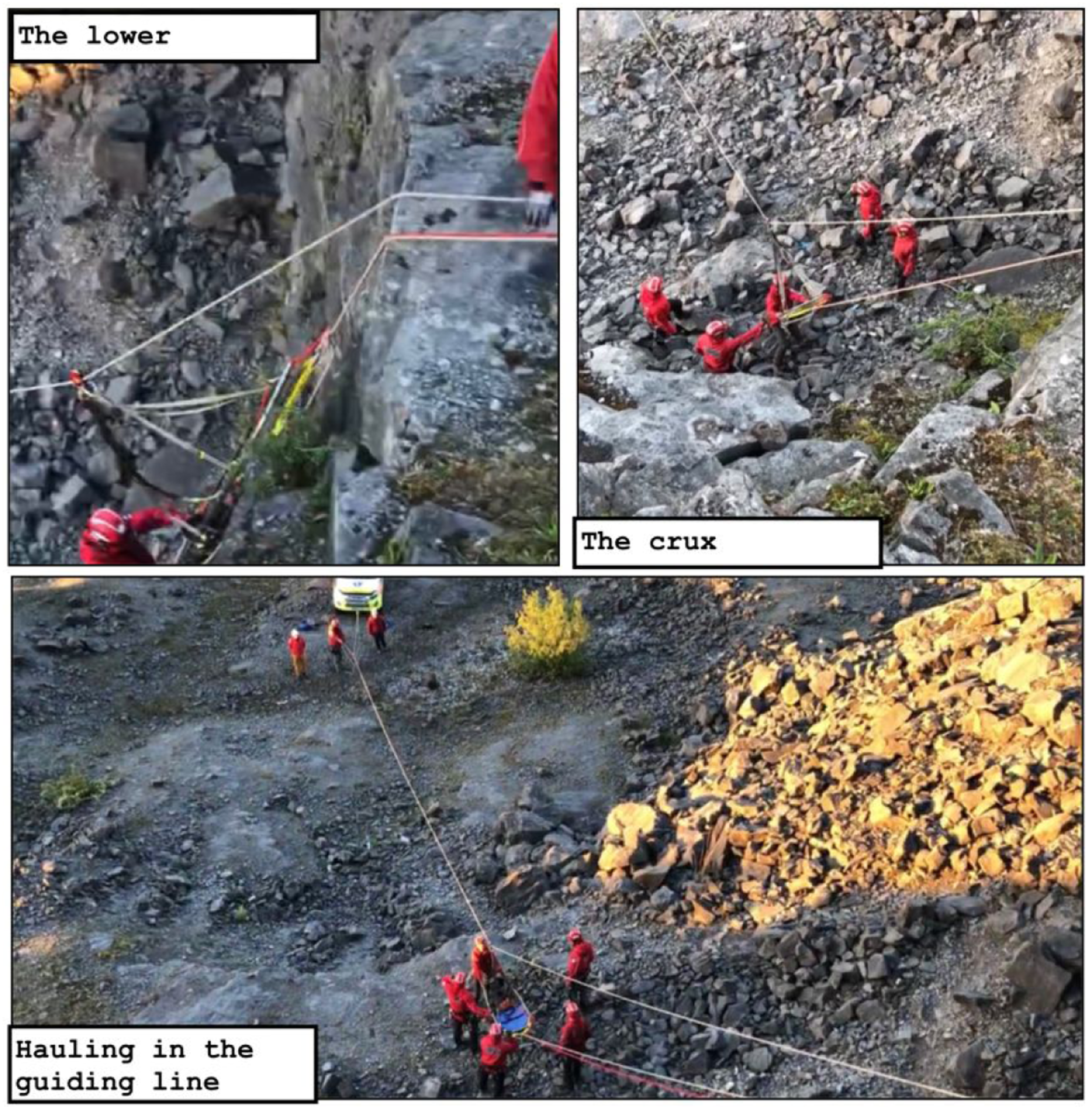
The article is formed of five further sections. In the first, I briefly discuss critical engagements with UA and point to some of the troubles raised in relation to UA and producing findings that are findings for members. The second section introduces the tutorial trouble being worked on by the mountain rescue team in the training session; namely, the organisation of communications between the team members during the operation of a new rope system for lowering a casualty on a stretcher down a vertical rock face. In this section, I describe how the tutorial problem is produced in relation to members’ concerns with categorial incumbency and (potentially) ‘bound’ actions. In this sense, members are shown to be analysts/participant observers of their own practices. The third section describes in detail the operation of the lower itself, and the emergence of a communicative order problem. Here, emergent categorisation practices, yielded by the setting, are problematised by members during their use. Here, the communication trouble is described as produced and displayed as a work object between the team members. The penultimate section describes the team’s analysis of the communication problem, their own orientation to their work site categorisation practices, and what we might see as an in-situ hybrid analysis as I participate in the discussion of the team’s communication problem. Here, we see how unique-adequacy-in-action lives in, and is displayed through, situated tasks rather than generalised workplace ‘cultures’. I conclude by offering some remarks on letting go of some of the central tropes and categorial contrivances routinely repeated in methodological recommendations for fieldwork practice and recommend further studies of the lived detail of participation in field/work sites in which ethnographic knowledge is produced.
Participant observation, ethnomethodology and unique-adequacy-in-action
Unique adequacy is a central ethnomethodological principle bound up with the development of the work studies program by Garfinkel and his students (Garfinkel, 1986; Rawls, 2008). The work studies program moved ethnomethodological studies from the domains of everyday sense-making (observed in the (in)famous ‘breaching tutorials’, e.g.) to the description of the lived detail of professions and work sites including law, physics, mathematics, martial arts and changing a truck tire (see Garfinkel, 2019[1986]; for more recent examples of ethnomethodological studies of work, Rouncefield and Tolmie, 2016). Although the recognition that these practices were underpinned by mundane practices was retained, the key thrust of the program was to identify the workplace specific methods involved in the production and recognition of a particular practice or occupation as just that work and not something else; what Garfinkel (2002) would later call the work’s ‘haecceities’. The work studies program thus stood in stark contrast to mainstream Sociological studies of work in which the practical business of the work itself – the work site’s lived phenomena – are lost in treatments that turn on accepted concepts and modes of theorising. In such studies, we learn a good deal about Sociological interests, but not much, if anything at all, about how the work in question gets done in any actual case. Importantly, we also learn how workplace specific tasks are supported by more generally available members’ methods for the organisation of talk and action, including categorisational and sequential practices; an understanding present from Garfinkel’s (1984[1967]) study of jurors’ work onwards.
UA as principle of ethnomethodological study thus expresses a consistent aspect of Garfinkel’s radical and ‘alternate’ sociology (Garfinkel and Weider, 1992); that methods for the accomplishment of the orderly character of social activities, and the methods for their observation and description, are endogenous to those activities. Such methods exist in the world, quite independent of Sociological conceptions of order and means of studying the ‘social’. Unique adequacy can thus be read as a culmination of Garfinkel’s respecification of both Schutz’s and Parsons’ treatments of social order (vom Lehn, 2014). To be clear, however, Garfinkel is not engaging in general methodological remedial work through the requirement. 2 The aim is not producing ‘better’ Social Science fieldworkers as methodological texts often set out to do. Those later writings do take on a methodological note, covering topics such as the writing of fieldnotes, the use of video, the ‘coat hanger’ form of interviewing and so on, yet UA should not be read as a narrow methodological stipulation. As already noted, the ‘methods’ in the unique adequacy requirement of methods, refers to the requirement that the methods of the ‘observed’ and the ‘observer’ – for the production, recognition and description of the orderly character of an activity – are one and the same (Garfinkel, 1984[1967]: 1). Indeed, Garfinkel (2002: e.g. 255–6) recurrently takes the reader, and the discussion of ‘method’ and UA, back to the scene. This can be read as an extension of ‘Sacks’ Gloss’; namely, that the way to address whatever conceptual, methodological or theoretical trouble you have as an analyst, is to find some ‘work gang’ whose everyday business is concerned with that trouble (Garfinkel, 2002: 182). As discussed further below, Garfinkel (2002) seems to be insisting that it is only in the midst of the lived order of the scene that the relevancy of observations, representations and findings are to be decided, and not straightforwardly as ‘read off the page’ (see also, Smith, 2020). This seems to pose troubles, or at least alternatives, for conceptions of formalisations and ‘outputs’ of ethnomethodological studies; troubles which lead me to describing unique-adequacy-in-action. First, however, a little more on what is uniquely adequate about UA.
Garfinkel’s radical respecification of order and method requires that the researcher/analyst must gain a ‘vulgar competency’ in the activity being studied such that they can produce, understand, observe and describe the activity as the members do (Rawls, 2002: 6–7). Ethnomethodologists do not, then, so much require the kinds of training provided through formal methods courses and textbooks, as the training that is received by whatever work gang they join. This is the weak version of unique adequacy and will perhaps sound familiar enough to ethnographers who set out to immerse themselves in the practice or culture being studied. Indeed, this conception can be difficult to distinguish from what most ethnographers would claim they set out to achieve; an understanding of the activities of some group or ‘culture’, achieved through participation, often with acceptance and ‘cultural awareness’, marked by a Geertz-esque access moment where the researcher finds themselves acting as the ‘natives’ do. The ethnographer thus aims to understand ‘what it is like’, experientially, to be part of some group, by ‘tuning their bodies up’ such that they gain a degree of embodied empathy and sympathy with those being studied (Goffman, 1989). To this experience are added second-order, imagined (vom Lehn, 2017), constructions of social order. The ethnographic task is often taken to be the production of a literary access to those experiences, achieved through various representative and rhetorical devices, such that they ‘ring true’ for the general reader (Lemert, 2003: xiii). Like ethnographic studies of unfamiliar settings or practices, the weak version of the unique adequacy can pose great demands upon the researcher’s time and energy in undergoing whatever the training it is that is sufficient to gain a level of competency in the setting. It is not, of course, only ethnomethodologists who become full members of the work gangs they are studying. Matt Desmond (2006), for example, became a firefighter in a very full sense, producing some interesting insights relating to the culture, rationality and ‘habitus’ of firefighters as a result. The problem, however, with such studies is the recourse to formal Sociological concepts through which to explain both the phenomena observed and the process of learning to see, do, and talk about things as the members of the scene do. To put things bluntly, the Sociological concept of ‘habitus’ is no more relevant for members’ methods of learning and participating in some work activity, than Durkheim’s conception of social order is for the crossing of a road.
It is this general ethnographic approach that Pollner and Emerson (2001) describe as being both ‘too close’ to and ‘too distant’ from the constitutive practices of the setting or group being studied. For ethnomethodologists, the focus of participation and description is not on ‘lived experience’, or producing empathy, or interpretations of what is seen and heard going on in ‘the field’. The purpose of participatory fieldwork, for ethnomethodologists, is not to gain a familiarity with the setting in a general sense, nor to engage in the elaboration or resolution of a Sociological matter. It is, instead, to become a member, such that they can do what the members do and thus be able to describe the activities from within. Which is to say the description is grounded in the local methods for the production/recognition of those activities, and, as an outcome, can not only be recognised as adequate by members, but as being relevant for their practice (Garfinkel, 2002: 176). And that is the grounds for what Garfinkel saw as an ‘analytically adequate ethnography’ which, in turn, leads us to the strong version of UA.
Grasping quite what Garfinkel was insisting upon with the strong version of UA is, let us say, tricky. It is tricky in its own right, and trickier still when read in the context of Garfinkel’s (2002), sometimes seemingly contradictory, methodological discussions (Lynch, 1993). As (Greiffenhagen and Sharrock, 2019: 257) have it: As far as we can tell, it has to do with the aspiration that an ethnomethodological study would allow the reader to not just read about the particular investigated practice, but instead provide materials for the reader to experience for her- or himself what is involved in doing the practice.
Meeting this requirement is no easy task. An ethnomethodological study proper should not only be broadly recognisable to members (in that they can see their practice being described), but should offer relevant insights, recommendations, and critiques that members recognise as grounded in their methods of accounting and instructing and so on, and, therefore, as relevant for their activities (Lindwall and Lymer, 2005; Watson, 1999). These are the ‘hybrid studies’ in which findings are findings for ethnomethodology and for the field or work site studied, not in relation to Sociological criteria. Indeed, this marks a radical turn away from the project of respecifying Sociological conceptions of social order to a direct engagement with other fields and disciplines (Greiffenhagen and Sharrock, 2019), and notably so in terms of human computer interaction (e.g. Button et al., 2015). Yet, assessing what counts as a finding for members raises a series of questions about even those studies that Garfinkel himself highlights as meeting the strong version of the requirement.
Greiffenhagen and Sharrock’s (2019) critique of Livingston’s (1986) study of mathematics and description of the working out of Gödel’s theorem, for example, highlights something of the issue at stake in this article. Livingston’s claim to UA is grounded in the explication of the hidden practical work in solving the theorem such that a general reader can follow it. The ‘lived work’, usually obscured within the textual account of the proof itself, is displayed through Livingston’s competency in doing and describing the steps of the solving such that a reader with no specific expertise could ‘replicate’ the solving of the theorem. Drawing on their own uniquely adequate competencies in ethnomethodology and mathematics, Greiffenhagen and Sharrock (2019) question the extent to which the findings are also findings in mathematics. They suggest that the solving of the proof itself is unremarkable to competent mathematicians and even the revealing of the ‘machinery’ of its working out does not produce insights for mathematicians. Indeed, Garfinkel (2002: 287) describes the exasperated remarks of mathematicians on Livingston’s committee who, watching Livingston work at the blackboard, ‘…would complain. They would say things like: “What do you want of me? What do you want me to look at? I’m looking! What’s to look at?”’. As Greiffenhagen and Sharrock (2019: 269) summarise, ‘For us, the mathematicians’ reactions show very clearly that they cannot be the intended audience of Livingston’s study. There’s literally nothing in it for them’. Whether or not Livingston’s rendering of the lived work of proof as instructable meets the strong version of UA is a matter of debate. What is significant for the current discussion is how the UA status of the study, and the competencies displayed by Livingston, are observable matters best assessed at the blackboard, by members, and not in retrospective readings of the study.
The point I am building toward is that if ethnomethodology is interested in the ‘lived workings’ of knowing and doing and competency and expertise that accomplish the haecceities of a particular work practice then, given all that has been said thus far, the assessment of UA and related findings must live outside of, and prior to, the production of a formal description at the culmination of the project. So, whilst Atkinson and Morriss (2017) are right to question just what is being talked about when ethnomethodologists talk about UA and competency, a resolution might be found not in the formal typification of competencies but, rather, in the description of the methods and moments in and through which competency is assessed at the worksite, within the temporal flow of activities. Unique-adequacy-in-action must, then, be observable ahead of formal recommendations made after the fact or in training materials or in the design of software or system; a kind of trial-and-error stage where observations and findings are tested out, live. Indeed, Garfinkel (2002: 176) speaks of how a ‘hybrid finding’ can be ‘used and administered locally as an instruction’. The local administration of the observation or instruction, and the display of the researcher/analyst’s competency in situ and in vivo is an avenue worth exploring in aiming to treat the unique adequacy requirement radically and ethnomethodologically.
Unique adequacy and members’ inquiries: The guideline experiments
Mountain rescue teams are entirely staffed by volunteers who manage full-time jobs and personal commitments. The dynamic nature of the team’s availability for any particular call-out means that each team member must be proficient in the core tasks of the teams’ work, and certainly all of the tasks involved in building and operating rope systems. Members must ‘slot in’ as required by any given situation. These are the ‘core competencies’ (in the team’s words) that all ‘hill members’ are expected to be able to demonstrate, either in training or when on call-out. These are practised and assessed on a regular basis, both formally and informally. Performance ‘on the hill’ is directly related to the safety of the individual, the team, and the casualty or missing person, and is a moral matter. Failure to demonstrate competency in, say, tying a particular knot, setting up the stretcher, or feeding the rope through a belay 3 device, is an accountable, moral, matter in relation to the category status ‘hill member’. As Jayyusi (1984: 39 [original emphasis]) observes, categories carry an understanding of ‘a corpus of expectable skills and abilities - such skills and abilities often function as the category incumbent’s credentials of incumbency. They are required and expected.’ It is also worth noting that although there are strandards and guidance issued by Mountain Rescue England and Wales, each team's practice is developed locally and, importantly, in relation to environments in which they operate. The guideline experiments replicate handling a stretcher and casualty in steep sided gorges, over difficult terrain, where the team often operate. We see some of these matters, in action, as we join the team in a technical rescue training session.
‘Technical rescue’ refers to any scenario involving movement on vertical ground or where a rope system is required to lower or raising team members and/or a stretcher down or up a crag or cliff face. The training session described below is the third in a series and takes place in a regular venue – a limestone quarry with ledges and faces of various heights that provide a setting for the building and operation of rope systems for various scenarios. The series of training sessions are for competent and relatively experienced team members. Rather than a ‘refresher’ of existing techniques, it is an experiment with a new (to the team) method of lowering the stretcher down the crag and then managing it over rough ground to where the casualty can be safely carried off by the team either to paramedics at a waiting ambulance or a helicopter evacuation point. A stretcher lower always involves two main ropes (red and white, Figure 1), running through belay devices attached to anchors, which are attached to the stretcher, to the ‘barrow boy’ (a team member assigned to accompany the stretcher in order to manage any emergent problems with the movement or casualty as it moves down the face), and to the casualty. The experiment involves adding a third rope, a ‘guiding line’ (top rope, white, Figure 1), to assist with the manoeuvring of the stretcher over difficult ground at the bottom of a crag. The guiding line is attached to the same anchor system as the main ropes but is also attached to a second anchor at the bottom (a team vehicle, in this case, Figure 1, bottom image). The guiding line runs through a pulley attached to the mid-point of the stretcher and provides a pivot-point for the stretcher in moving from vertical to horizontal (‘the crux’, Figure 1). Once the stretcher is near horizontal, pulling the guiding line taught raises the stretcher off the ground, meaning that the barrow boy (a team member, positioned at, and attached to, the foot of the stretcher to help guide it down the crag) and team do not have to fully bear the weight themselves. The main ropes are controlled by a team at the top of the crag, as is usual, and the guiding line, leading from the top of the crag to the vehicle below, is controlled by a second team whose job it is to haul in the guiding line. And therein lies the tutorial problem for the team.
In the first trialling of the system during the previous week's training, two issues were raised by participants. The first concerns the crux of the manoeuvre when the stretcher is shifting from vertical to horizontal orientation at the bottom of the crag. At this moment, the coordination between the parties is crucial as the barrow boy can end up taking the full weight of the stretcher-plus-casualty whilst trying to walk backwards over broken ground (I experienced the difficulties involved in this first-hand). The timing and efficiency of the hauling (pulling on the guiding line) of the bottom team is crucial. The new system, and the introduction of a second rope team at the bottom of the crag produces an organisational problem in relation to the communication between the team responsible for lowering the stretcher down the vertical face and the team responsible for pulling the guideline, at the right time, such that the stretcher becomes horizontal, and the barrow boy, who is in the position of judging exactly when the stretcher is at the ‘crux point’ between vertical and horizontal. In the words of the team member who raises the matter during a group discussion at the start of the training session:
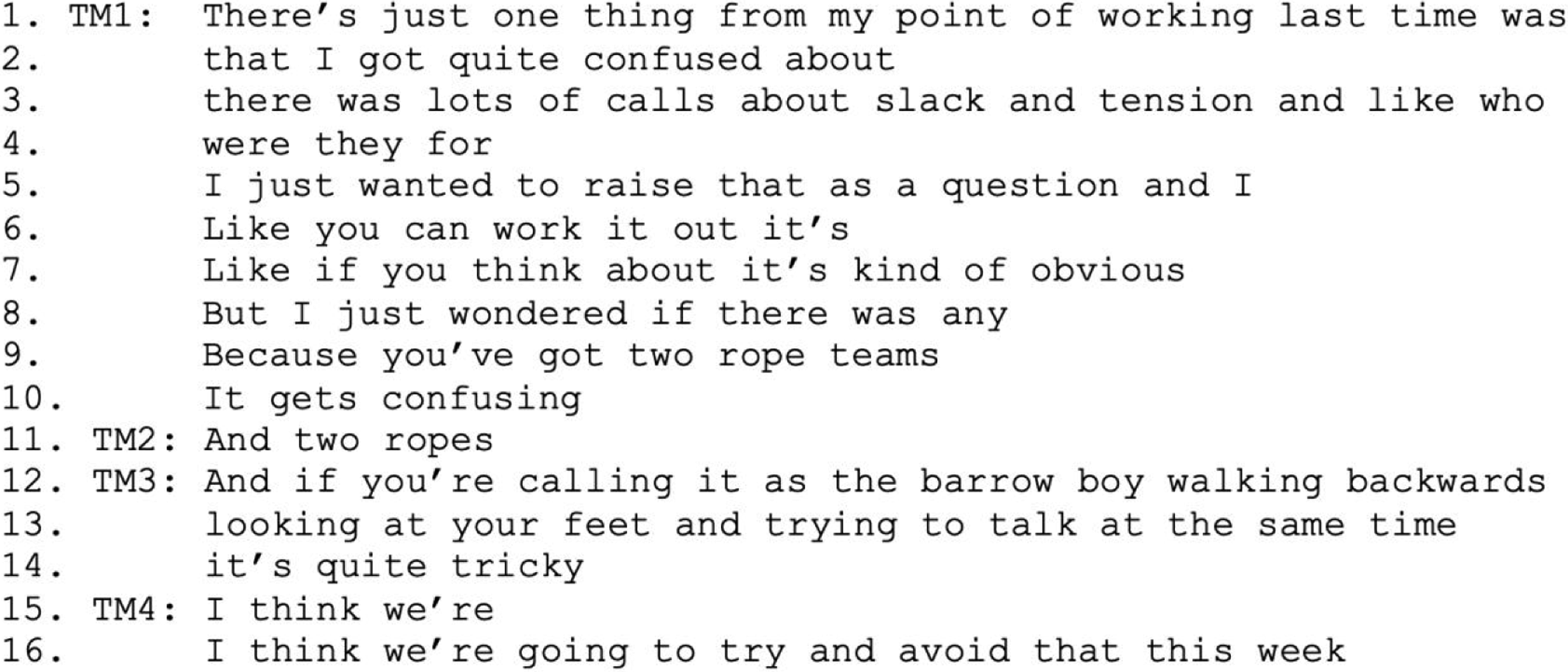
Potential methods for the ‘solution’ to the problem are embedded within the gestalt of just this occasion of the operation of the system but are, in Garfinkel’s sense, ‘immortal’ in that their existence transcends the immediate situation. Here, two members (TM1 and TM3) draw on their previous experience of participating in the stretcher lower from two specific positions. Although this may not be obvious to the reader, the initial account of the trouble (l. 1–10) is designed in relation to managing the belay device and lowering the stretcher. This is made available through the account of the difficulty of responding to the commands relating to ‘slack’ and the ‘tensioning’ of the rope, which might be confused by having two teams operating ropes at the same time (and, indeed, two ropes being operated by the team at the top of the crag as I add (l. 11)). TM1's account is significant in demonstrating an orientation to this work returned to at the end of article. TM1 recognises that things can be ‘worked out’ as you go along, yet the incomplete turn (l. 8) can be heard as raising the possibility of developing another, formalised, way of ordering the communications between the parties. This trouble is then elaborated by me (TM2) and TM3 (l. 12–14, speaking as ‘barrow boy’) from differing positions within the system. Following these elaborations, TM4, a more senior member, hints at a preferred solution to the problem of manoeuvring the stretcher raised the previous week: that the barrow boy unclips at the point where the guideline is sufficiently taking the weight of the stretcher such that it can be transported horizontally (l. 15–16; I am able to make this reading because it was previously discussed in the car park, prior to training). The issue of confusion with the calls, as reported by the team member, topicalises the issue of furnishing instructions with a specified recipient. This demonstrates the context-sensitive and constitutive character of recipient design; the instruction is an adjacency-pair, but like other workplace instructions and requests, is categorially processed in context (see Watson, 2015: 35). The previously adequate categorially-allocated flow of communication between barrow boy to edge person 5 to the belay device operators, designed to manage the difficulties of communication once visual contact is lost as the stretcher goes over the side of the crag is complicated by the presence of two rope teams. Both teams are concerned with the management of a rope and the instruction to pay out slack is insufficient for identifying the recipients of the instruction; that is, which team should pay out or take in rope. The issue is further compounded, according to the team members’ analysis, by the absence of a clear designation of who – or rather what work site category – should give the communication to pull in on the guideline haul system, and how that is to be clearly communicated.
In this setting, members are participating in an instructional activity in which they are both staff and instructed parties. They are producing and learning the instructions for the operation of the new system in-situ and in-vivo across the sessions and within the sessions, moment-by-moment. Resources for the describing of these problems are formulated through membership terms and designations that display and constitute the context of the experiment in and as the work of the mountain rescue. The communicative problem is not contrived nor imagined, nor did I specifically set out to find a site in which I could study ‘organisational communication’ as a formal concern. It is their/our problem relating to accountable and warrantable workplace methods, resolvable in and through those methods. The training session thus emerges as a perspicuous setting for those analytic interests, just as organising their own communication emerges as a relevant matter for the members involved in the accomplishment of the task. The trouble, specifically, is formulated as a categorial-sequential matter.
It can be observed being ‘worked up’ in the operation of the stretcher lower itself and members’ subsequent analysis thereof, and in which my ‘hybrid’ role becomes increasingly apparent.
Categorisational practices for organising the lower
In considering the organisation of the lower and the emergence of the shop floor problem, categories for the communication system are ‘locatively generated’ (Smith, 2021) and emergent from the use of the new rope system. Without two teams, there is no need to specify the recipients of calls relating to rope management. With the need to make explicit the recipient design of the instructions, categories for doing so are yielded by the layout of the operation in relation to the crag; again, these operative categories do not ‘belong’ to individual members at all. Following the briefing, the ‘bottom team’ sets up a pulley system attached to the front anchor points of one of the team vehicles (the pulley system multiplies the amount of force that the team pulling on the rope can generate; in this system, by a factor of five; a 5:1 system). The pulley system is itself an iteration of the previous week’s experiment where the bottom team used a 3:1 system and had found the hauling in of the guiding line to be hard work (Figure 1). The excerpts below show the moment of the initiation of the haul and the subsequent handling of the communications relating to the ‘top team’ (who, to remind the reader, are paying out rope through the belay devices) and the ‘bottom team’ who are hauling in the guiding line. I am working as a member of the ‘bottom team’ and we see the scene from the perspective of the chest mounted camera. 4
In these sequences, the ‘bottom team’ organise an anticipation of the instruction to haul in the rope. The team are oriented to the scene in relation to taking in the slack rope and the observable progress toward the crux when they must begin to pull the rope in. Lowering the stretcher generates slack in the guiding line, and the taking in of the slack is done such that when the actual command comes to haul, any effort has an immediate effect upon the guiding line, rather than removing slack. We are feeling the slack in the system, embodiedly, as well as waiting for the moment that the command will come by observing/analysing the stretcher and barrow boy nearing the crux. This work is, however, misinterpreted by the edge man/instructor who issues a command to the bottom team to stop hauling (Figure 2). This occasions an account from the team member who has been directing the taking in of the slack (Figure 2); the ‘loop’ produces additional effort to haul in, as well as slack rope producing a potential ‘shock loading’ of the system. Another member remarks that the taking in of the slack is also relevant for the projected increased weight that will be coming on to the rope as the stretcher reaches the crux, making the further adjusting of the rope accountable (Figure 2). That an account is provided can be heard as displaying a mountain rescue working ‘rule’ (that all activities involving the transportation of a casualty are done with the primary orientation to the casualty’s comfort and safety) and also acknowledges the violation of the instruction to leave the rope alone. As the lower progresses, a member of the bottom team questions why the call to haul has not come yet (Figure 2). This assessment is confirmed, by me, and occasions the direct questioning of whether the haul should begin or not to the barrow boy. The call is then issued, by the barrow boy for the haul to begin (Figure 2). Note how, here, sequence and category are mutually elaborative in terms of the issue of when commands and requests should be made, and who is to give and respond to them. The crux and starting the haul.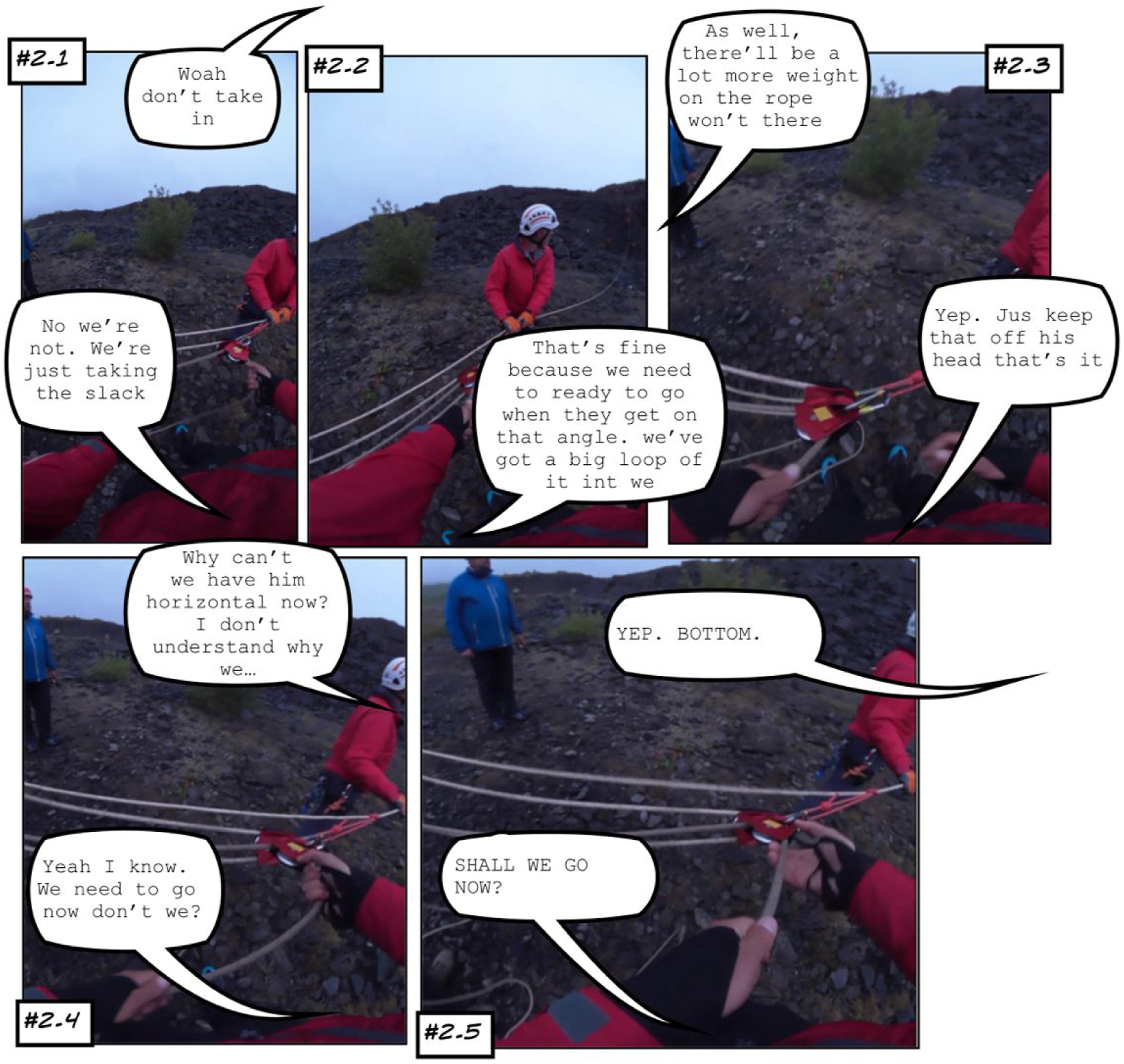
As the call is given to haul, I and the other team member on the rope turn to walk away from the top pulley such that the guiding line is pulled taught. I am still talking about the issues with the communication as we do so (Figure 3). We might see this as an in-situ ‘hybrid analysis’, and whether this is heard as being done by an analyst, observer, or member is, in this context, moot. The other team member responds but it is not picked up in the audio record. As we haul the rope taut, we reach a point near the vehicle and stop and turn back to the scene. My colleague on the rope provides an account of the stop and observation that the rope might be taut enough ‘for the minute’ (Figure 3). Hauling in the rope, analysing the communications.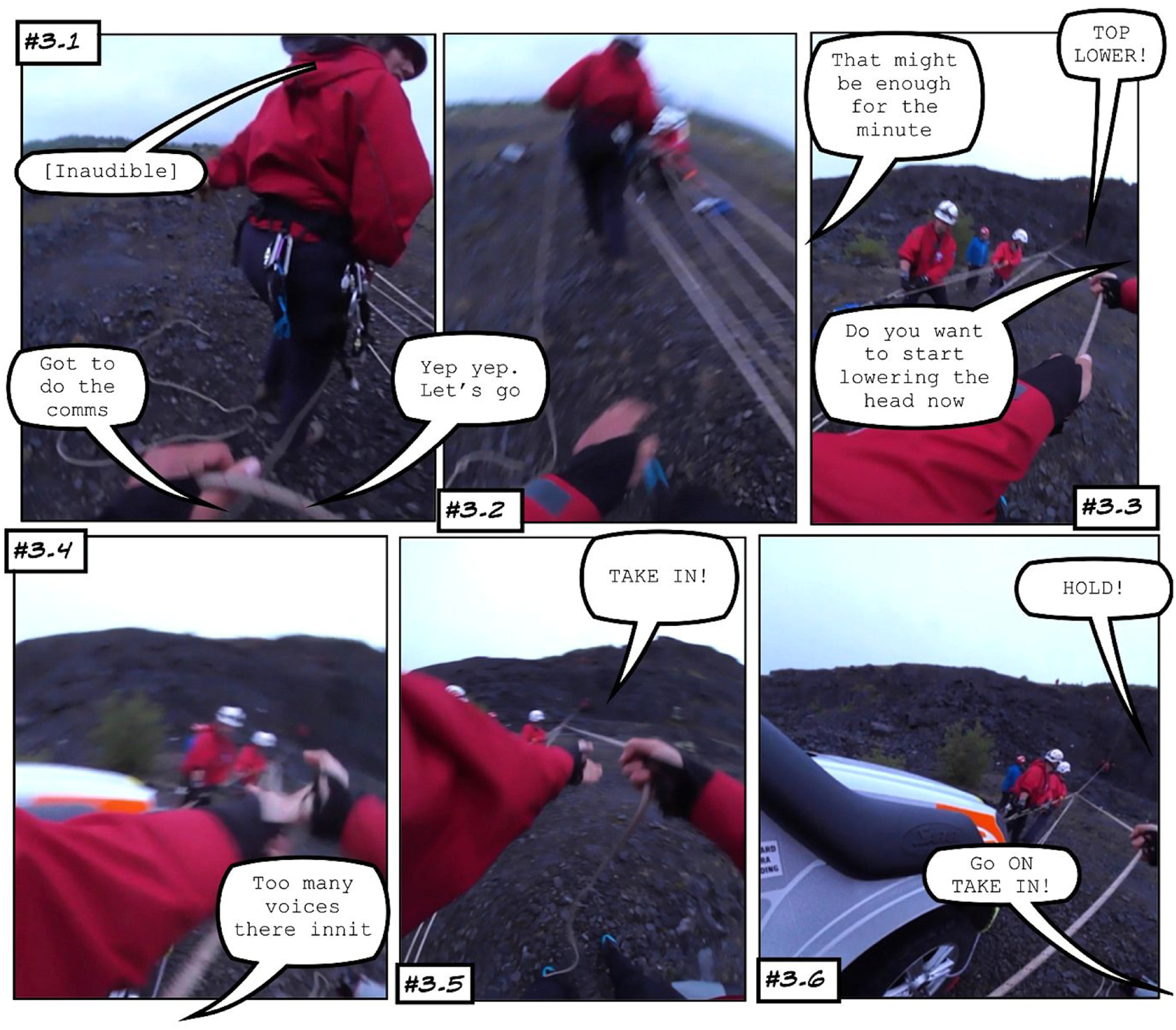
At the same time another member, just out of frame to the right, speaks directly to the barrow boy by name (removed here), about the timing of the ‘lowering the head’ (Figure 3). That a name is used suggests an incomplete or delayed activity bound to ‘barrow boy’ at that point in the action. It is after this intervention that the barrow boy issues the instruction ‘top lower’, demonstrating an understanding of how lowering the head is to be achieved within this rope system (in any casualty transportation, the head is always ‘up’ in the stretcher, and so this is heard locally as relating to the phase of bringing the stretcher vertical). As the action progresses, I assess the prior sequence. ‘Too many voices’ (Figure 3) is heard as referring to the multiple communications relating to the management of the stretcher and possibly the direct intervention. Significantly, the bottom team start hauling in the rope again before the barrow boy issues the instruction to do so. Although it is not clear (either in situ, or in the video) what occasions the restart (likely the turn regarding ‘lowering the head’), the bottom team start the work of hauling at the same time. This continues, with a member repeating the instruction to the bottom team to ‘take in’ in which is almost immediately followed by a command to ‘hold’ (Figure 3).
The instruction to ‘hold’ is repeated, and then repeated with addition of the recipient category, ‘top hold’ (Figure 4). Again, the member just out of frame makes a suggestion to the barrow boy that they ‘want the top to let out now’ which would, as before, bring the head of the stretcher down into horizontal alignment. The furnishing of a category-specific instruction occasions the questioning of the next actions for the bottom team, first by one member to the team, and then on behalf of the team by another member speaking directly to the barrow boy (Figure 4). Timing the haul.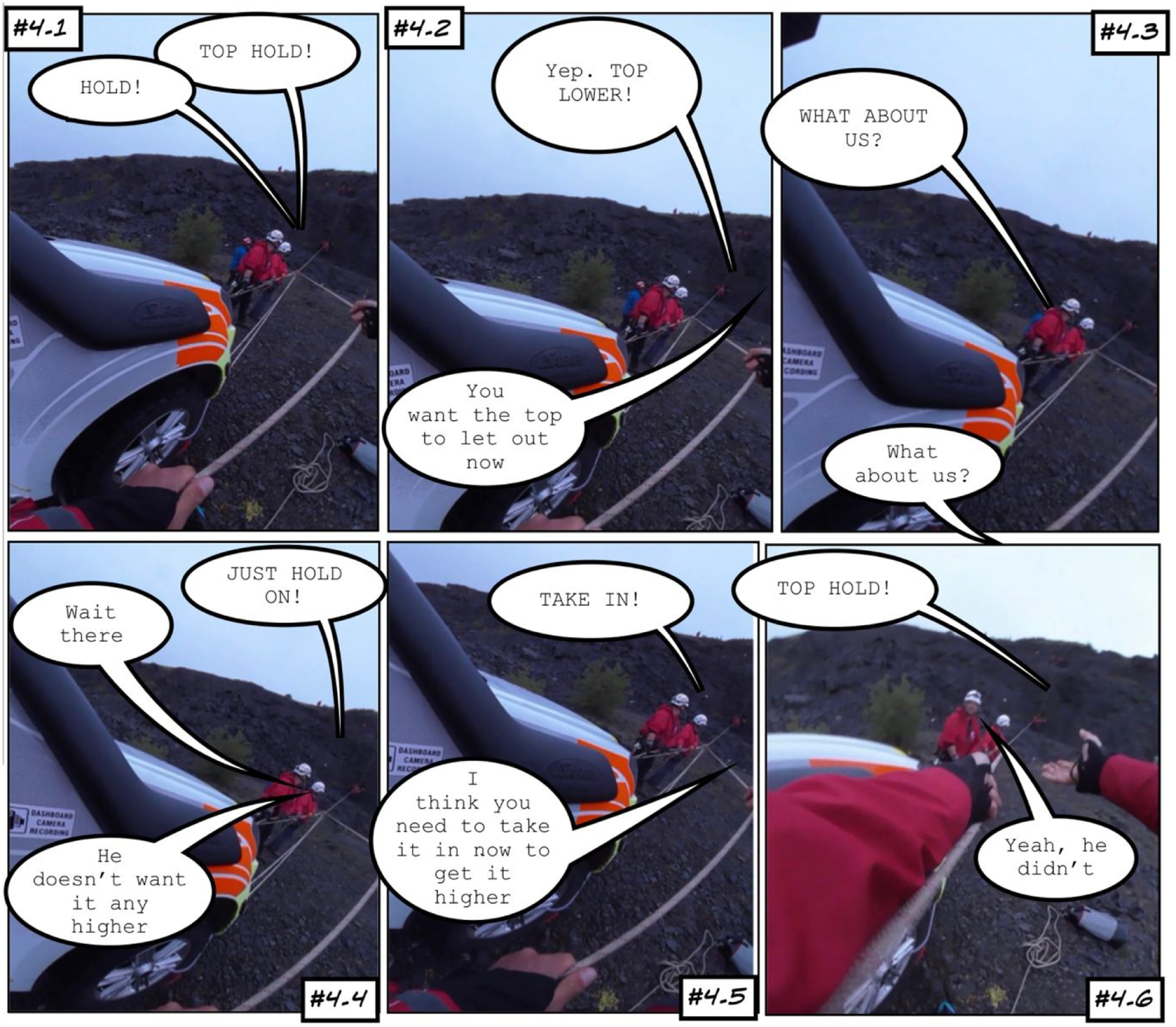
A member of the bottom team responds first saying ‘wait there’ (Figure 4). Although it is not perhaps apparent in the transcript, this is hearable as an admonishment from a more senior team member. Patience is a key factor in mountain rescue work and one way, of course, to reduce the number of voices is to keep quiet yourself; something which I am guilty of not doing here. The tension, however, comes with not acting when one thinks that something needs to be done. This is, of course, not unique to mountain rescue work and is a feature of organisational life bound up with the occasioned relevancy of hierarchy, seniority, experience, and so on. As the lower continues, the member observing to the side gives another suggestion. Although it is not clear whether the suggestion is directed to the barrow boy or the bottom team, it is responded to by the barrow boy who gives the command ‘take in!’ (Figure 4). Some further confusion arises relating to the command given to the top team which causes a pause in the hauling of the guiding line. I make an open palm gesture with my right hand, referencing the problem, and a partial account is offered in relation to the mishearing of the command (Figure 4). Here the two members involved in the raising of the matter of communication at the start of the session (myself (TM2)) and the member taking the final turn (TM3)), continually and jointly orient to the communication problem as the activity progresses. The issue of communication does not, then, just ‘emerge’ but might be said to be produced, ongoingly, as a matter of concern, through the contexted particulars (Jayyusi (1984: 36) of the scene.
In terms of formal methodology, by some measures I might be said to have taken too active a role in this scene. Rather than straightforwardly ‘participating to observe’ in order to write later (Emerson et al., 2011), I have actively contributed to the production of the problem. This makes trouble for the requirement for ‘naturally occurring data’ that is often privileged in data collection and analysis (see Speer, 2002). I would argue, however, that full participation is not to be weighed against the validity of data, but in terms of the warrantability and adequacy of the analyses that can be achieved through that participation. That requires, of course, that the participation is not air-brushed out of the final account. As stressed above, in this situation – as is quite clear in the interactions described – I am a team member, not a Sociologist, and I am participating as such. Participation itself thus becomes a perspicuous setting and a tutorial problem through which the process and practice of the unique adequacy requirement – that is my understanding of the situation, as learned from the members, such that I can produce descriptions, mis-readable as instructions, at the work site – can itself be described and analysed. This active participation, as I will show below, also occasions accounts that are not produced by my prompting as an analyst trying to ‘tease out’ data, but, rather, as would be done within the worksite itself, member to member, as unique-adequacy-in-action.
Unique-adequacy-in-action?
Following the successful lowering of the stretcher, the team analyses the performance of the task and, specifically, the three problems identified in the previous week relating to the hauling of the guideline, the work of the barrow boy when shifting from vertical to horizontal, and the system of communication between the ‘top’ and ‘bottom’ teams.
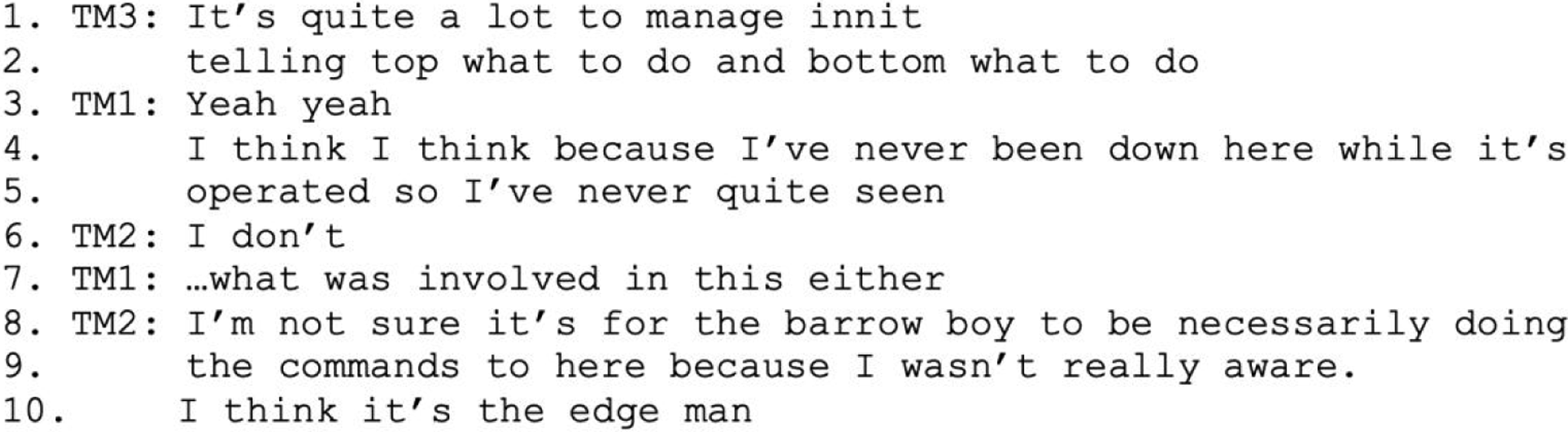
As at the start of the session, in this interrogative assessment sequence, three team members display, accomplish and make resource of their prior experience of being the barrow boy. The opening by TM3 (l. 1–2) indexes the experience from the previous week and the earlier complaint regarding communication in the new rope system. Significantly, the response from TM1 (l. 3–5, 7) might be said to raise the matter of the UA in specifying troubles with formulating instructions for the ‘bottom team’ when they had not participated in those specific tasks that are the work of the ‘bottom team’. I (TM2) then suggest that the activity of communicating to the rope teams should be ‘unbound’ from the barrow boy and perhaps ‘bound’ to the edge man instead due to what can be heard of difficulties of managing the stretcher and the communications to both rope teams (l. 8–10). The discussion relates to the negotiation of locally, category-bound activities in this running of the system, that may become institutionally category-bound, for the team, in their future operations. This is also a display of the task specific character of UA, particularly in relation to the component parts of operating the new rope system. Indeed, this is built into the organisation of the training across the three sessions, where each member will ‘rotate’ through the various roles, tasks and categories. The point, for the analysis and, more so, for members, is that it is insufficient to simply be a member in the sense of being part of the team, but that competent participation must occur at the level of the activity or task. This points to a more specific, highly specified, sense in which activities are made accountable in the sense that they are ‘observable-reportable’ and that ‘people can see them for what they are and tell each other about them’ (Sharrock and Anderson, 1982: 56). Unique-adequacy-in-action is at the heart of the matter.
At the end of the session, as the team are packing away the ‘crag kit’ – a highly specific activity in itself; everything has its right place, such that everyone and anyone should be able to retrieve an item, quickly, when asked – the matter of the communication system is raised by the senior team member leading the exercise. An account of the shop floor problem is provided, without prompting, to the two team members (myself (TM2) and TM3) who had raised it across the training session:
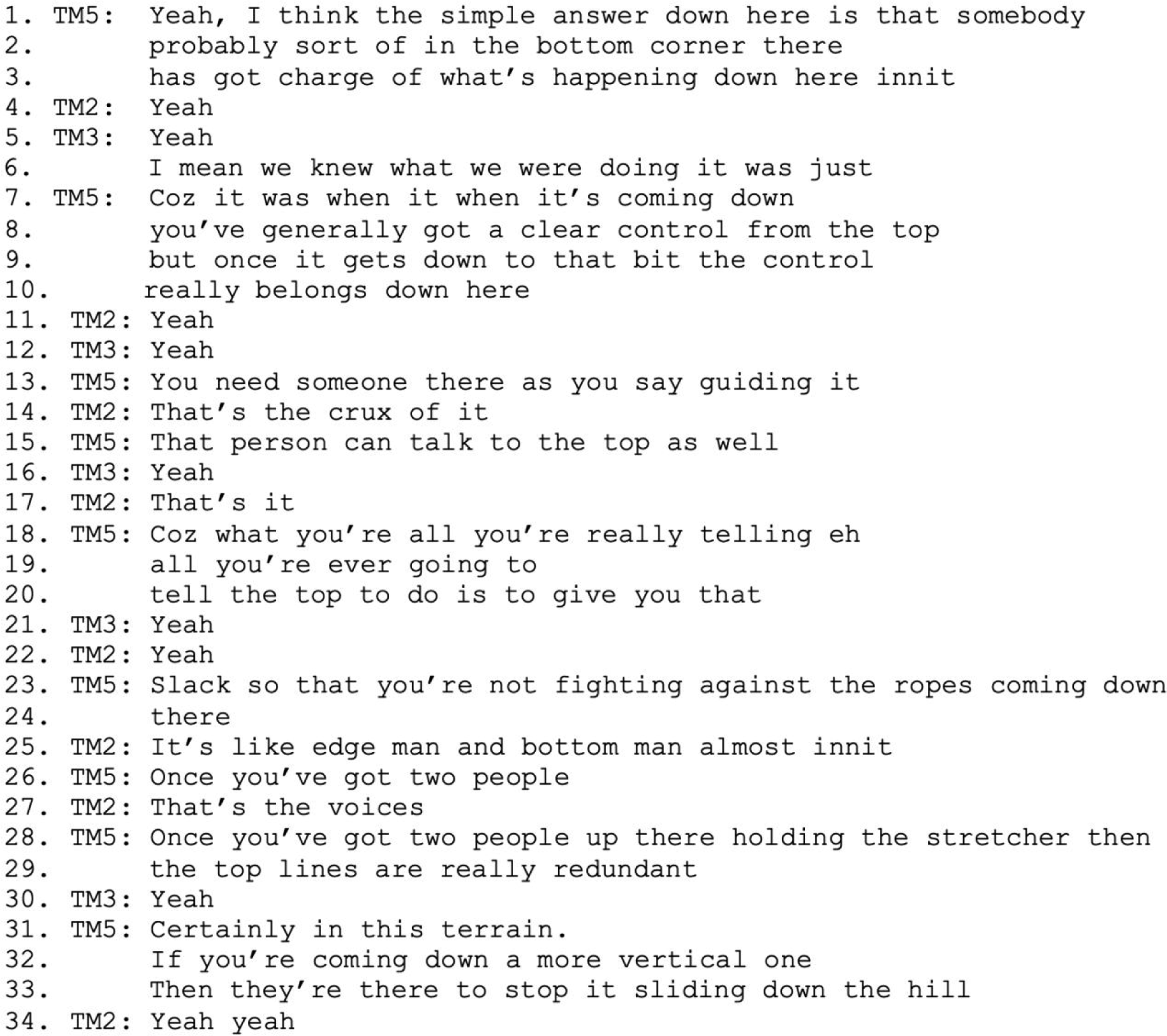
Here, then, the account provided as a first turn accomplishes the shop floor problem in relation to the environment and the local, indexical, spatial formulations of ‘down here’. The account orients to the trouble raised by us during the session; namely, that there are difficulties with the formulation and receipt of instructions in this particular rope system. Note that the formulation of the account relating to switching of ‘control’ to ‘down here’ (l. 7–10), positions TM5 spatially and in terms of perspective with the two members (TM2 and TM3) and the ‘bottom team’. Line 13 and 14 demonstrate a close alignment of perspective between TM5 and me and TM3. The account goes on to specify a justification for the switching of control of communications from ‘up there’ to ‘down here’, which is itself tied to the physical operation of the rope system. That is, that once the crux is reached and has been passed, then the ‘top team’ become redundant as the top ropes are no longer taking any of the load of the stretcher. Thus, the understanding of the adequacy of the communication system is displayed in and through the understanding of the operation of the rope system; a point that the account from TM5 reinforces, displaying incumbency as ‘technical instructor’ as well as more a generally categorial status of ‘senior team member’, through providing extended accounts and having them listened to. As the account continues, I (TM2) contribute various agreement tokens and displays of understanding relating to the explanation; for instance, the turn on line 27 (‘that’s the voices’) indexes the prior observation of ‘too many voices’ (Figure 3). On line 25, I offer a formalisation of TM5’s solution in terms of proposing a categorial addition to the communication ‘machinery’, that is ‘bottom man’. It is an inelegant categorisation, but the import is that it displays a member’s understanding of, and orientation to, the elements of the local categorisation device assembled for the managing of the stretcher lower for another next first time, and as such, demonstrably ‘belongs’ to that device. This is a ‘hybrid suggestion’ made, I would suggest, as both team member and analyst in the very midst of things, offering a ‘new’ category and object for potential objectivation (Liberman, 2018) in terms of a future ‘bound-activity’ for the team.
What I do not have recorded, is the final debrief of the training session and I reproduce it here from fieldnotes. As is standard practice for all call-outs and training sessions, the team leader gathers the present members and asks for observations and learnings from the point of view of participants. In this instance, I recounted the conversations we had had as ‘bottom team’ and the final conversation with TM5, again making the ‘hybrid suggestion’ for the formal designation of a ‘bottom man’ to manage the communications at the foot of the crag. That my recommendation was heard as a member’s suggestion was clear in the way it was responded to: the team leader simply nodded and remarked that ‘well, as long as we’re making the communications clear, we should be able to manage as we go along’. What to make of this remark?
Again, returning to the matter of UA, the remark can be understood, locally, not as a dismissal of the suggestion as such, but as an orientation to an overarching organisation of mountain rescue and, specifically, in terms of work site allocation alluded to above. The trouble with potential formalisations is precisely that they are formal and prescriptive. There are standard operational procedures in mountain rescue work, but the real matter of competency and, indeed, the ‘test’ of unique adequacy, is not to be able to follow fixed procedures, but to be able to adapt procedures and methods to fluid situations. There is, also, the sense that the formalisation of the communication structure for the new rope system might be more trouble than it is worth. The upshot, then, is that the team – myself included, of course – are to trust in their own worksite competencies, part of which is the unique adequacy of their local methods for organising communications at the work site, without the need, in this instance, for formalisations of procedure. And that might be ‘what we have learned’ through the tutorial problem of the guiding line.
Conclusion
This article has described ‘unique-adequacy-in-action’ and has located questions of membership, competency, participation and adequacy at the worksite. This, I suggest, is one way to treat the UA requirement ethnomethodologically and might, in the context of the mainstreaming of radical ethnomethodological principles, rescue it from absorption into general discussions of fieldwork practice. The analysis of actual participation in a worksite also provides for specificity in relation to discussions of ‘vulgar competency’. UA can be observed in-situ, as displayed in and through specific tasks, and provides a resource for members’ and analysts’ assessments. Team members display and accomplish their incumbency and membership as team members in and through practical tasks. They do not accomplish these tasks as individuals, or straightforwardly because they happen to be members in some bureaucratic sense. Membership and UA, lives in, is displayed through, and is assessed in specific workplace tasks and activities, not in workplace rosters or ‘cultures’. The unique adequacy of methods, then, is a necessarily ongoingly accomplished, observable/describable, accountable matter. What I have not had room to fully elaborate on here is that UA at the work site might well be accomplished, at least in part, via an array of categorisational practices, embedded within and constitutive of the sequential order of a given task. In terms of the strong version of the requirement, I do not intend this article to be mis-readable, at the worksite, as instructions as to the handling of the stretcher and guideline. That said, I trust that both my hybrid analyses at the scene and the descriptions offered above are treatable by members as adequate and that I have provided some sort of ‘helpful therapy’ to the team in thinking about their own practices and ‘team-ness' (Greiffenhagen and Sharrock, 2019).
In terms of participation in field sites more generally, the topicalising of this kind of full participation demonstrates the value in recovering, rather than submerging, instructional and pedagogic aspects of fieldwork. This does not, as demonstrated above, mean putting the ethnographer’s ‘experience’ at the centre of the stage, but, rather, attending to practices through which competent, adequate, participation gets done. Often the ethnographer writes themselves out of the scene entirely, acting, as the trope goes, as human ‘data collection instrument’. On the other hand, where the focus of the ethnography is on participation and ‘becoming’, theoretical glosses – for example, the feeling of ‘habitus growing inside you’ (Desmond, 2006) – are enrolled to stand in for the detail of the actual interactions and instructional sequences with participants, in actual work site activities. Behind this discussion, and in the context of formal methodology, is the concern of being too close, of ‘going native’ in the course of full participation. Wacquant (2011: 88) advises that the fieldworker should ‘go native, but come back a sociologist’. Yet much is likely lost in that return. Avoiding reifying categories such as ‘participant’ and ‘observer’ and ‘analyst’ outside of the lived situations in which they are, or are not relevant, might be a step too far for many reading this article. As is perhaps feared by those with a stake in the maintenance of professional methods, letting go of the notion of ‘distance’ and ‘being too close’ might well bring the whole house down. Still, attending not only to what ‘the natives do’, but the possibility of observation and ethnographic accounts as grounded in the lived detail of our own engagements, trials and errors, and displays of competency and knowledge might yet provide a fruitful avenue toward retaining a more radical sense of the unique adequacy requirement of methods as living, in the midst of things, at the worksite.
Footnotes
Acknowledgements
I would like to thank the members of the CEEIT research group for the consistently insightful discussions, both generally and in specific relation to this article. I would also like to thank the members of the Central Beacons Mountain Rescue Team for their support, patience, and all that they do. I would particularly like to thank Peter Spearing for taking the time to read and comment on a draft version of this paper.
Declaration of conflicting interests
The author(s) declared no potential conflicts of interest with respect to the research, authorship, and/or publication of this article.
Funding
The author(s) received no financial support for the research, authorship, and/or publication of this article.
