



Abstract
In this paper, I question how a researcher might fulfil the unique adequacy requirement when studying novices in a setting in which the researcher is already a member. Since novices by definition lack the expected competencies in a setting, having unique adequacy for novice methods may appear oxymoronic. However, this paper suggests that unique adequacy requires enacting specific ways of ‘seeing’ as part of accomplishing local order; once one is competent, it becomes difficult to enact incompetent action in a locally adequate way, suggesting one can actually lose unique adequacy. Furthermore, as any given situated involves a multifaceted set of competencies, exactly which or whose competencies are relevant is both an analysts’ and members’ issue to solve. With reference to examples, I discuss how analysts and members delimit the ‘provinces of meaning’ in the process of finding what is locally adequate.
Keywords
Introduction
In ethnomethodology, the unique adequacy requirement outlines what is necessary to create a good ethnomethodological description of local order(s). Researchers learn the embodied and lived competencies that any member of a setting or activity might be expected to have. The researcher’s competence should be recognizable in situ as the relevant competence by any other member, and that competence should allow the researcher to accurately (more precisely, adequately) account for the local order(s) in their analysis. The aim is not solely to gain familiarity or access, as has historically been prioritized in ethnography (Amit, 2000; Horowitz, 1986) – it is not what Lynch (1993: 274) called a ‘strong participant observation requirement’ – but instead to be able to recognize and be recognized as undertaking the local methods for enacting local order. To give an example pertinent to this paper, when rock climbing, moving one’s hand towards the safety equipment in a preparatory way to anticipate needing to catch a falling climber is not only a local skill to have, or a requirement for being a good partner, or a performance of safety code – but doing so will be seen as a method for anticipating a fall, and thus judging the climber as insufficiently steady. Or, potentially signalling that one is ‘jumpy’ and overly anxious about having to catch a potential falling climber. While ethnography may aim for topical relevance, contextualized understanding and reflexive positioning of the researcher, unique adequacy requires ethnomethodologists to moreover understand the methods by which relevance, context and social relations are achieved (Pollner and Emerson, 2007).
The competence called for by the unique adequacy requirement is often accomplished via participant observation and apprenticeship. Ethnomethodology as a discipline is known for researchers undertaking especially extensive training in order to fulfil the unique adequacy requirement (Lynch, 1993: 274), but what if one is interested in studying how novices do something in a setting? For the purposes of this paper, I suggest defining novice action as some behaviour or activity that is treated by members as evidence of a lack of knowledge, skill or familiarity with local accountabilities, and which does not arise from malice, teasing, play, feints, etc. If, for instance, one is interested in how novices to a ‘domain’ begin their sense-making journey in that domain (Anderson and Sharrock, 2017: 16 define domain as an analytically-construed finite province of meaning, more colloquially, a setting such as a profession), one might feel called to fulfil the unique adequacy requirement not for the domain, but for specifically novices to that domain. However, this turns the prototypical question of how to become uniquely adequate on its head, as the usual trajectory is novice-to-competent-member. In this paper, I question how the multiple memberships of a researcher and participant, and thus their interwoven, existing adequacies, produce moments wherein what counts as adequate becomes contestable. Memberships and competencies actively foreground certain local understandings of action, and as a result, it can be difficult for an already-competent, member researcher to display unique adequacy for novices in the setting in question, and how they (mis)apply competencies from other memberships, it can be difficult to ‘see’ their perspective when one’s own novice journey is long behind them. This is, unsurprisingly, not only a researcher problem but a member problem as well. After reviewing fundamentals of the unique adequacy requirement and discussing its relation to familiarity and distance in ethnography, I will draw on examples from my own research in which multiple potentially relevant competencies are contested to analyze how members delimit what is uniquely adequate, and reflect how these instances might inform my further efforts at fulfilling the unique adequacy requirement.
What is unique adequacy
The unique adequacy requirement (henceforth UAR) is a stipulation for conducting ethnomethodology, laid out by Garfinkel in his programmatic statements on the discipline (Garfinkel, 1996, 2002: 175–176; see also Garfinkel and Wieder, 1992). The formulation of UAR has been described as ‘convoluted’ (Lynch, 1999: 218) and ‘ambiguous’ (Pollner, 2012: 41), and Garfinkel furthermore differentiated between a ‘strong’ and ‘weak’ version of UAR, which has resulted in several different readings across studies. Some authors distinguish between simply ‘becom[ing] familiar with activities’ versus more strongly being ‘adequately trained and master[ing] a particular discipline’ (Izumi, 2014: 397), while others have differentiated between familiarity with the field activities and the application of strict ethnomethodological indifference in analysis (Atkinson and Morriss, 2017; Wakefield, 2000). Still others define the weak version as vulgar competence in the field, and the strong version as a matter of presenting the analysis as uniquely adequate instructed actions (Greiffenhagen and Sharrock, 2019; Ikeya, 2020; Rooke and Kagioglou, 2007; vom Lehn, 2014: 107). Further interpretations exist, often focussing on the concept as a whole being to do with having the same competencies as members (Arminen, 2008; Ayaß, 2020; Crabtree et al., 2012; Lehtinen, 2009; ten Have, 2013).
Following vom Lehn (2014: 107) and Ikeya (2020), I will separate the ‘methodological’ UAR and the ‘presentational’ UAR. These do not necessarily map straightforwardly onto the strong and weak senses, but are meant to capture the range of procedural concerns for ethnomethodologists who are attempting to enact or apply the UAR. The methodological UAR refers to a researcher’s competence in a setting as acquired and enacted during interactions with members (i.e. during ethnographic fieldwork), and the degree to which their descriptions of an instance would be recognized or treated as competent by members. The presentational UAR refers to how the research findings are delivered, namely the degree to which they would be recognized as instructed actions, and also how well they permit readers to experience their own appreciation of members’ work in the setting described. A clear example includes Bjelić and Lynch (1991) (re)demonstration of what prisms reveal about the nature of light, which the reader can only adequately understand if they use a prism at home and co-experience the phenomena with the text. As vom Lehn (2014: 106) explains, researchers can only make sense of members’ activities when they become participants in an embodied, lived sense; the presentational UAR suggests this extends to readers (Ikeya, 2020). In this paper, I focus on the methodological UAR, that which is involved in enacting and recognizing UA in situ more so than presenting an understanding of that UA to a reader, though the two are inevitably intertwined.
Most readings highlight that UAR can be considered a ‘prerequisite’ (Lindwall and Lymer, 2005: 394) for research, a ‘benchmark’ (Atkinson and Morriss, 2017: 325) or a ‘guide’ (Rooke and Kagioglou, 2007: 981) for how much immersion is required. UAR is described as insisted upon by Garfinkel (Smith, 2020: 43), and the only way local practices become accessible (Pollner and Emerson, 2007: 123; ten Have, 2004: 130). In short, UAR is widely treated as necessary and even as a methodological precondition, although Rawls (2002: 6) states that it is an ‘ideal’. This resonates with long-standing ethnographic stipulations for ethnographers to act as a professional learner of local orders (Narayan, 1993).
To practically enact UAR, however, is more complicated. The components or skills that constitute competency are highly variable even within a setting (Atkinson and Morriss, 2017), and it is for the researcher to decide with each study precisely for whose competency one should have unique adequacy (Jenkings, 2018). As Atkinson and Morriss (2017) show, not even non-researcher members necessarily have competency in all the local roles (in their case, the diverse jobs in a theatre production), so having unique adequacy means being situated as some plausible local member. Jenkings (2018) demonstrates that one need not even be situated as the professional member; for instance, studying the military in a uniquely adequate way does not necessarily entail being competent as a military person, as everyday citizens also have uniquely adequacy with respect to military events. Whose UA we take to be the relevant UA to ‘have’ to fulfil UAR is not given, but revealing of how we as researchers are ‘analytically constru[ing] [the] finite provinces of meaning’ (Anderson and Sharrock, 2017: 16) that constitute settings or domains. As I will attempt to show in this paper, this is a members’ problem as well, which leaves space for the relevant competencies to be contested (both their relevance and their competentness).
What this means for the researcher is that they are able to fulfil UAR insofar as they are treated as being uniquely adequate as some member – not just a member, but as some particular member with all the concomitant, multiple and overlapping competencies and categories. As Jenkings (2018: 52–53) puts it, ‘The research sites of our empirical data collection can thus be seen as the coming together of our embodied institutional and personal “biographies” in the form of competencies at sites of our data collection whatever the method’. Note that ‘biographies’ in quotation marks is meant to indicate that the term is a metaphor for a person’s lifetime of collected competencies as they are constituted in situ. As Smith (2020: 43) reports, competencies from other prior memberships can interfere with seeing local order: ‘I found myself with a particular and curious sort of blindness that seemed to emerge from a conflict between my knowledge of rope work as a climber being attemptedly ported to the viewing of mountain rescue rope systems’. Smith, a competent rock climber but novice mountain rescuer, found that the former sense-making competency had to be unlearned, lest it inappositely frame how he saw local phenomenon in the latter setting. In this paper, I aim to investigate this point further, with particular reference to novices, the recognizably not-yet-competent participants in a setting. Already-competent researchers and members can enact blindnesses when accomplishing the local order.
Ethnography as developing competencies
The ethnographic tradition historically assumed that the setting under study was ‘exotic’ relative to the ethnographer’s experiences (Amit, 2000), and that ethnographers took a stranger-to-insider trajectory during fieldwork. ‘Ethnography at home’ or ‘native’, where ethnographers produce scholarship informed by their existing membership(s), has met with extensive suspicion, for instance, of failure to address taken-for-granted aspects of the setting under study (Labaree, 2002; Taylor, 2011; Van Ginkel, 1994). Counter to these arguments, many ethnographers have pointed out that ‘native-ness’ is dynamic, contingent and multifaceted (e.g. Jackson Jr, 2004; Kohl and McCutcheon, 2015; Narayan, 1993), not an idealized, pure background ‘authorizing carte blanche status in the field’ (Jacobs-Huey, 2002: 793). EM has this moment-by-moment organization of membership baked into its core; its entire understanding of human meaning making is premised on such active work by participants, and so EM comes from a very different conceptual starting point. While EM has a wide variety of techniques for making the familiar strange, such as breaching experiments (Garfinkel, 1967) and unusual apparatuses for transforming senses (Garfinkel, 2002), which some authors argue fights familiarity (e.g. Delamont et al., 2010; Morriss, 2016), it also rejects the possibility and applicability of objectivity and distance (Caronia, 2018). The quality of description is not found in objectivity, but in its adequacy as a possible situated, instructed action.
Methods for accomplishing UAR have certainly included the stranger-to-insider trajectory, or, more suitable for EM’s focus on competencies, the novice-to-member trajectory: from becoming a lawyer (Burns, 2005), to a mathematician (Livingston, 1986), to an expert in truck wheel safety (Baccus, 1986), but perhaps most clearly illustrated in Sudnow’s (1983, 1993) detailed descriptions of his development of skill in jazz piano and video gaming. Ethnomethodologists have highlighted that this process provides a source of naturally unfolding breaching experiments (Sharrock and Anderson, 1982), and encourages actively discovering the sense behind a local order (Livingston, 2008: 101). As Downey et al. (2015: 185–186) write, ‘Our errors and misunderstandings in the field, like those of all novices, bring into action local corrective mechanisms’. The local corrections of researcher novices in the field are not only useful for revealing habitual, taken-for-granted orders, but also, ‘Teachers are called upon, not to explain or interpret what they usually do, but to put their pedagogical expertise to work directly on the researcher’ (Downey et al., 2015: 191). Observations novice participants also provide perspicuous instances revealing the local order, especially in instructed action (e.g. Evans and Lindwall, 2020; Lynch and Jordan, 1995; Nishizaka, 2014; Pentimalli and Rémery, 2020).
However, some researchers draw on membership in settings or domains that were available to them before research began, for instance studies in nursing (Wakefield, 2000), disability (Robillard, 1996), again mathematics (Greiffenhagen and Sharrock, 2019) and religion (Lehtinen, 2009). In being recognizably members from the outset, different paths of investigation are available and necessary to these projects. To illustrate this difference, compare the studies of fly-fishing from Laurier and Brown (2004) and Lynch (2013). 1 The former write as novice fly fishermen, and the latter as an avowedly serious hobbyist fly fisherman. As Lynch (2013: 94) notes, ‘Whereas for Laurier and Brown, “seeing fish” is a contextually specific instance of socially organized “seeing”, for me it is an occasional, often subordinate and sometimes irrelevant, aspect of fly fishing’. I suggest that in describing the seeing as ‘often subordinate and sometimes irrelevant’, Lynch is marking a related observation to Smith’s (2020) ‘blindnesses’, especially since Smith’s blindnesses come not just of noviceness but of other competencies ‘ported’ into a different domain. Such complications in seeing show that it is not just familiarity/exoticness that affect the availability of orders. The details of a scene are not invisible to either novices or experts; instead, as Smith argues for novices, the details are unavailable for description, while for competent members, as Lynch argues, the details are often irrelevant. The orders at hand do not just happen to be not seen, but are made not seen in the work that creates novices and members. What this means for UAR is that, in enacting UA, competent membership, a researcher may necessarily be delimiting other orders as irrelevant or unseeable. If a researcher is aiming to study novices, and to fulfil UAR for the novice participants, an already-competent, already-member researcher may find they cannot simultaneously have UAR and be a member, as this would be contradictory. In the next sections, I will take up this difficulty as both a members’ and researcher issue, examining moments where a participant’s competency and its relevance is contested by members. Finally, I will reflect on the way these cases highlight difficulties in fulfilling UAR.
Contested relevance and contested competence
I will first discuss an example wherein a participant’s noviceness itself is contested, that is, where participants debated what was the appropriate procedure for moving forward and who was informed as to that correctness. Methodologically, I am questioning what would count as UA for a researcher when the participants themselves do not always agree about who the expert is. The situated (re)production of competence results in shifting adequacies. We typically privilege the institutional, professional or domain-representative expertise as the relevant competency for fulfilling UAR, but there can be good reason to reflect on instances where other competencies arise and contest the dominance of the domain-specific competence.
The case occurred at a Member of Parliament’s constituency office (or ‘surgery’). For the project in which this case was recorded, I visited with three constituency offices in the UK and Canada, and recorded interactions with constituents at one. Fieldwork consisted of interviews and spending time at the office observing activities. I also visited a constituency office as a constituent early on in the process, to experience what it was like for constituents to attend (as many reported never having visited before). The exact purpose of a constituency office is (in)famously broad, according to both academic literature (Korris, 2011; Rawlings, 1990) and opinion pieces from members (Gay, 2005). The everyday work of the constituency office is less to campaign for re-election, and more to mediate between constituents and bureaucratic agencies, especially with cases that do not fit into the typical processes, and signposting cases to other more specialized agencies (Alexander and Hofstetter, 2021). The offices deal with a huge variety of situations, from neighbour disputes to immigration, from problems with the local council to child custody and from parking to political complaints (Hofstetter and Stokoe, 2018). Unlike certain other service provision settings (e.g. Raymond and Zimmerman, 2007), the MPs and caseworkers do not follow a script or standardized interactional sequence through which the constituents are guided – the constituents 2 are simply invited to state why they have come, and the MP and caseworkers undertake to find possible avenues for assistance. The ostensible benefit to the MP is to increase their popularity in the area (a ‘personal vote’, see e.g. Gay, 2005) and gain insight into citizen issues that might be relevant to parliament (Bowler, 2010).
As many constituents have never visited their constituency office before, and as they are often bringing cases involving situations they have never been in before, the constituents are novices in navigating the services they might receive. In the case below, a constituent has come to whistle blow about a fraudulent law firm that has been leading him on for many years. He has been told he must make the official complaint to the original firm, and they will manage matters from that point (this is indeed the process according to the MP and that will ultimately be used). Understandably, he is sceptical of leaving the matter with the fraudulent firm (see L33–34), and has come to the constituency office to have them take over. As it will turn out, the constituency office can only assist him in the whistleblowing by helping him formulate his complaint to this firm. This misunderstanding about both the whistleblowing process and the remit of the constituency office leads to intersubjectivity difficulties, wherein the constituent and MP both claim to know the process, but disagree on procedure. This extract from a recording of the meeting between the Member of Parliament (MP), his caseworker (CW) and the constituent (C) begins after the constituent has given a detailed story of how he came to be misled by the firm. The transcript begins from the point that the MP begins to formulate the constituent’s problem as one that can be aided by the constituency office; the problem is undergoing transformation into an actionable case.
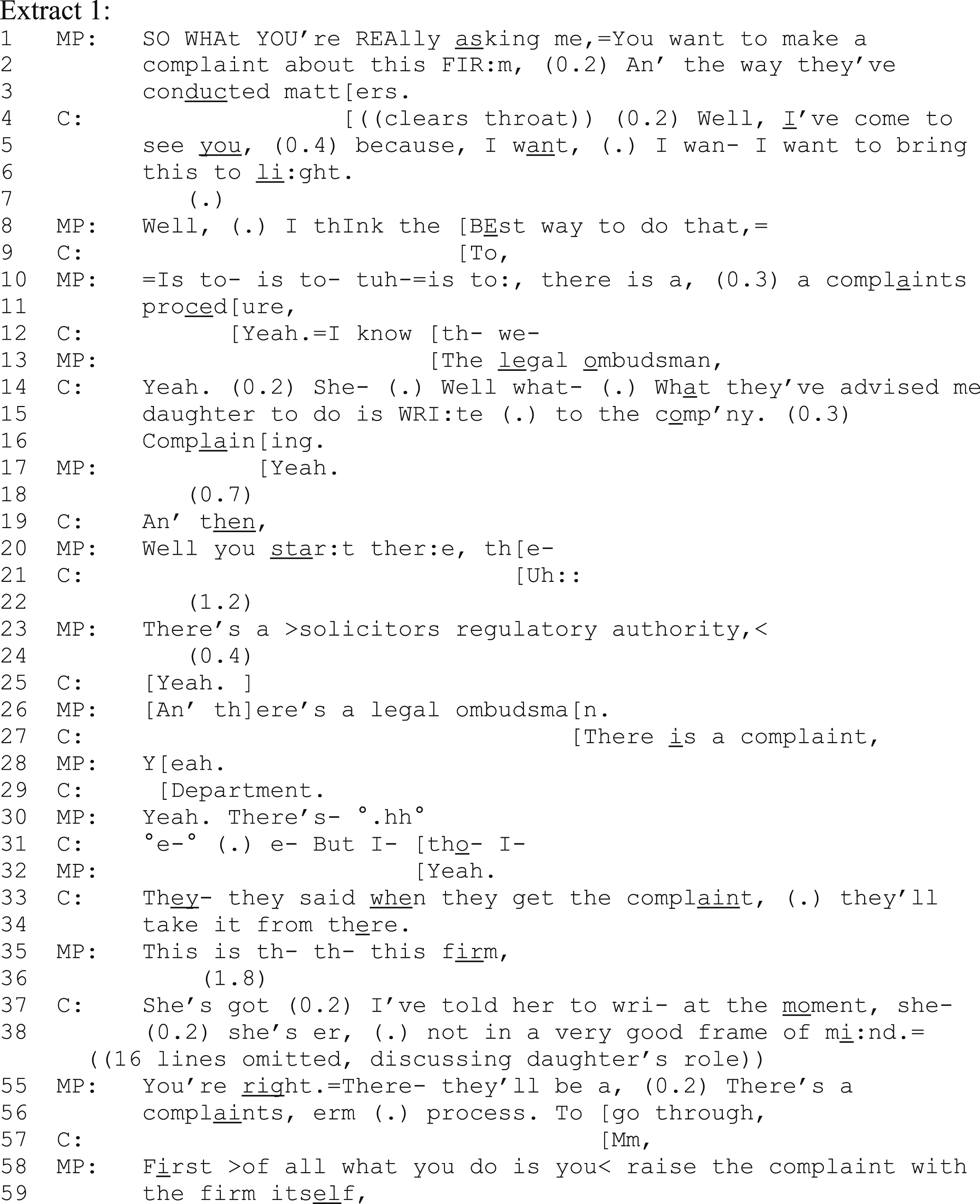
From line 1, the MP formulates the case as an institution-suitable kind of case (Raymond and Zimmerman, 2007) (‘what you’re really asking me…’). Simultaneously, the MP’s competence concerning how such cases are dealt with, becomes relevant. However, the constituent responds with further reformulation (‘well I’ve come to see you…’ L4–6), resisting the MP’s version, and reclaiming his action as one of whistleblowing rather than bringing a grievance.
Both the MP and the constituent treat the other as having to be informed about aspects of the complaint. The MP presents the solution to the constituent’s problem as standard in practice, though novel to the constituent, introducing it as a complaints procedure that would be relevant for this case (L10–11). However, the constituent presents the situation as though he knows the procedure, and as though it is this procedure itself that is part of his problem. He responds initially to the informing about the complaints procedure with ‘I know’ (L12), before reformulating the MP’s technical terminology (L23, 26) about the procedure as ‘There is a complaint department’ (L27–29). This reformulation sweeps the MP’s display of professional competency aside, treating the terms as sufficiently known and moreover not especially relevant for the constituent’s problem. In other words, the constituent claims to already know of this solution, and points out its inherent flaw: that the law firm would simply ‘take it from there’ (L33–34), that is, the fraudulent law firm will have every opportunity to fail to address the complaint, alter the nature of the complaint and further act in a fraudulent manner. By this reasoning, the complaints process is not a solution at all. The constituent treats the MP as having to be informed about this obvious upshot.
For the MP’s part, this is not obvious (in part, because the MP knows about further procedures to prevent exactly such an issue). The MP initiates repair (L35), initiating confirmation of who exactly will ‘take it from there’. The repair never gets resolved, however. When the MP reintroduces the process shortly after, he allows that the constituent is correct, that there is a process, but then uses that acknowledgement to launch an explanation (starting L58, not repeated in full here) – that is, the MP now instructs the constituent. This instruction both corrects the constituent’s information about the procedure, as well as guides the constituent as to what the constituency office ultimately will treat as actionable (instructing on the methods of the office). Under this analysis, the constituent is instructed towards adequacy concerning his actions at the office.
It can be tempting to simply state that this is a straightforward case of an uninformed ‘client’ facing an institutional ‘expert’ – a common asymmetry (e.g. Pilnick and Dingwall, 2011). The constituent is the novice, and under the methodological UAR, the MP is the one displaying the vulgar competence that an ethnographer should be learning. However, the constituent is also engaging in ‘sussing out’: he is actively making sense of the institution, its remit, and the ‘actionability’ of his case, and continually updating the design of his explanations accordingly. This includes resisting the characterization of his case as a complaint (L4–6), demonstrating his understanding of the relevance of the terms ‘legal ombudsman’ and ‘solicitors’ regulatory authority’ as the ‘complaint department’ (L27–29), as well as highlighting the seeming conflict of interest of the law firm handling its own complaints. However, not only is the constituent the expert on their own case, nor evidently entirely uninformed about the procedure, they are additionally engaged in ‘feeling out’ what the institution’s remit is and the actionability of his case. He continually updates the design of his case description in ways that resist being treated as either a complainer (L4–6) or a novice (L12, 27, 29). There is skill involved in moulding what assistance is offered. A researcher thus does not only need UAR concerning the constituency office staff procedures, but also concerning what constituents do, and how they contribute to what action is taken on their case. My experience of visiting a constituency office with a problem helped inform this analysis. As a visitor, one is continually ‘feeling out’ what the constituency office is willing to do in assisting your case. Constituents do not simply hope for help, but actively participate in making the right help occur and indicating what would be acceptable. In this sense, even constituents that are new to the office setting bring their competencies as everyday citizens and as mundane seekers of help to bear on the process. However, for a researcher attempting to fulfil UAR, the unfinished and contested nature of what is being treated as the UA action means that it is not clear whose competency the researcher should be able to (re)produce. Neither party is novice, neither is expert, and the procedure they are to follow is being determined as they go; another MP or caseworker would not necessarily make sense of this case in the same way.
Yet, it is traditionally the MP’s competency that would be considered relevant for UAR. We might ask why we tend to analytically construe the province of meaning (as Anderson and Sharrock, 2017 have it) as first and foremost based on the competence of the MP. One reason is that the MP’s instruction is the ‘ultimate’ (sequentially) version that stands; the instructions concerning the procedure and what the office can do are eventually tacitly accepted by the constituent and they form the basis of the actions the participants take. The constituent is helped in complaining about the fraudulent firm, rather than leaving the whistleblowing with the MP. The other is that when the MP formulates the constituent’s problem into an institutionally actionable one, the MP analytically construes what the relevant province of meaning should be and thus what is uniquely adequate. Making sense of the constituent’s actions as inadequate or novice simultaneously organizes the local order as a domain different from the constituent’s original organization. To understand the constituent’s problem as a complaint and/or request for assistance (rather than as the whistleblowing itself) is to treat the alternate as unavailable. In this way, the ‘blindness’ is part of the constitution of the domain and adequacy itself. I will explore this further with the next example.
Instruction delimits relevant competencies and UA
In the following case, a relatively novice climber is instructed both on a mistake made in handling the belay equipment and on some interactional inadequacies surrounding the equipment issue. The less experienced climber brings other orders to bear on the local events (both his competency as a physiotherapist and his general competency in ‘accounting for novice mistakes’) and these are treated as inapposite (including, ironically, the accounting).
Pat is climbing, and Ben is the belayer, meaning that Ben manages the rope such that Pat will not hit the ground, but has sufficient rope to keep climbing (an overly taught rope would prevent Pat from moving up the rock face). They are using a device that automatically locks the rope (a GriGri) when weight is loaded on it; if a climber falls, the device locks and the climber does not fall far. However, the lock must be released before the climber can move, as the rope would otherwise be stuck in place, and literally pull the climber back down (after all, if the rope length is fixed, the climber would have to literally lift the belayer off the ground to continue). In many circumstances, as the climber begins to climb, the weight is gently removed from the device, and it unlocks on its own. However, when the rope is especially tight, the climber has no slack left with which to pull his weight (through the rope tugging) off the device, so as the climber keeps trying to climb, the rope just gets tighter and pulls harder on the lock. Ben must actively press on the device to unlock it, which he fails to do at the right timing (L15–27). The transcript starts while Pat is shaking the tension out of his arms, resting in his harness, with the GriGri device loaded with his weight (and thus locked).
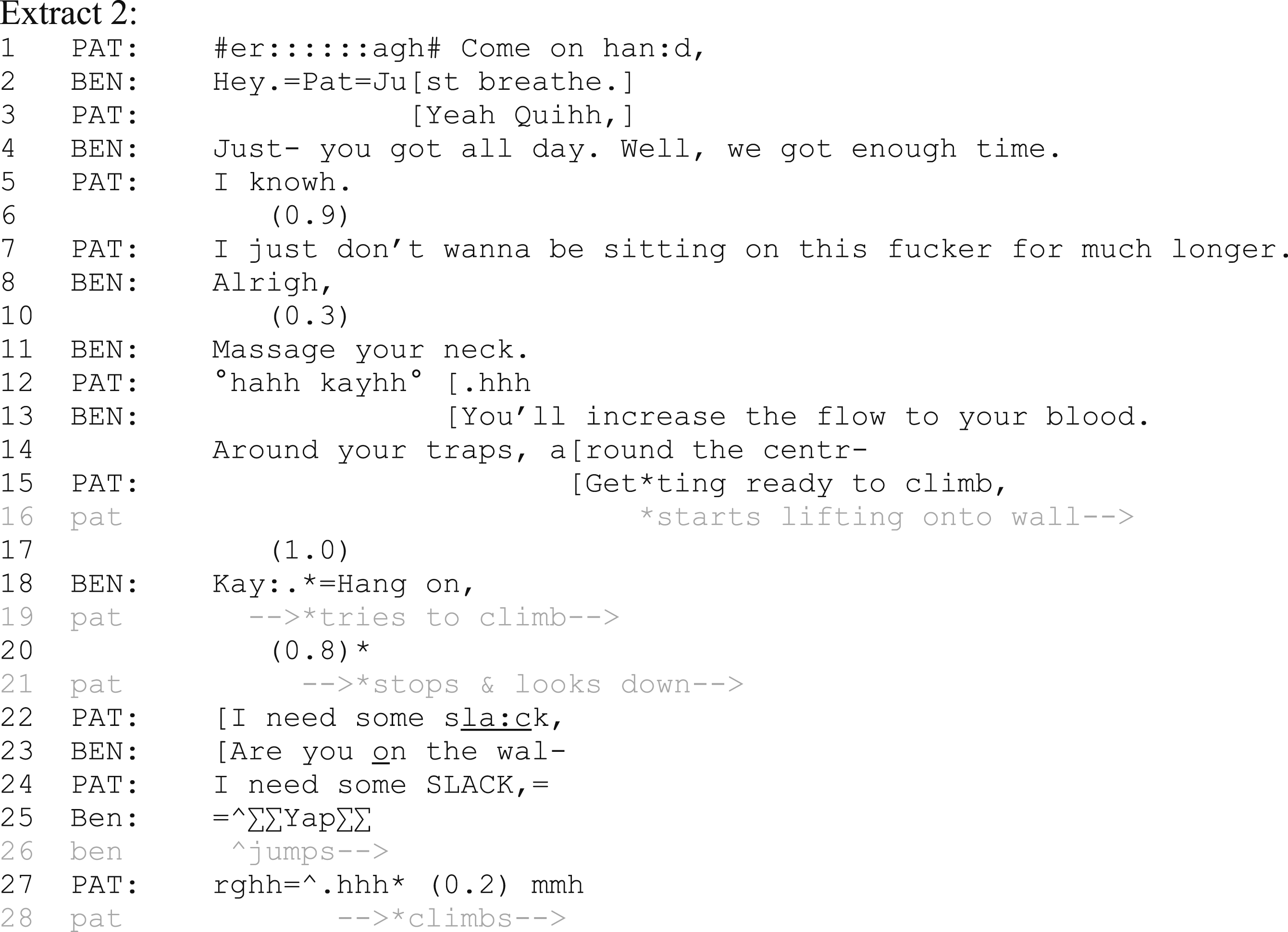
As described above, the rope is too tight for Pat’s motions to release the lock, and so Pat cannot advance. He calls down that he needs some slack (L22), but Ben does not provide it. Pat repeats statement louder, while Ben fights to unlock the device. Once Ben says ‘Yap’ (in a quality of voice thick with strain), Pat simply waits for the device to be released. This is because the confirmation demonstrates the belayer is actively responding to the climber’s needs, which is the adequate response for this situation.
More problematic (as will be shown in Pat’s instruction, below) are Ben’s verbal contributions. First, more minorly, Ben ‘ports’ his competence as a physiotherapist and begins to make suggestions that would ease Pat’s muscle fatigue. Ben is, in fact, Pat’s physiotherapist, and familiar with Pat’s difficulties. In treating Pat’s complaint about his hand (L1) as something needing treatment while on the rock wall, Ben seems to make relevant a physiotherapy perspective, and suggests massaging the muscles (L11, 13–14). However, Pat interjacently overlaps (i.e. interrupts, Jefferson, 1986) Ben’s talk, treating it as inapposite for this moment. Pat projects that he will climb imminently, a cue for Ben to prepare himself and the belay equipment. Instead, Ben says ‘hang on’ (L18), the second inapposite verbal event. Climbers are not supposed to ‘hang on’ except in serious situations of equipment difficulty or perceived danger. Belayers respond to climbers’ actions rapidly and should anticipate their needs. In fact, by announcing that he will climb (L15), Pat even orients towards the possibility that Ben is not ready and/or not able to anticipate the climbing, as more competent climbers can project climbing from bodily movements, and verbal notifications are often dropped. Pats announcement seems designed to reorient Ben from the physiotherapy tangent back to the climbing situation.
Pat further instructs Ben on the inappositeness of the ‘hang on’ once the climb has finished and he is being lowered to the ground. The term ‘take’ refers to taking in slack in the rope, and both in response to ‘take’ and ‘climbing’, Ben has said variations on ‘hang on’.
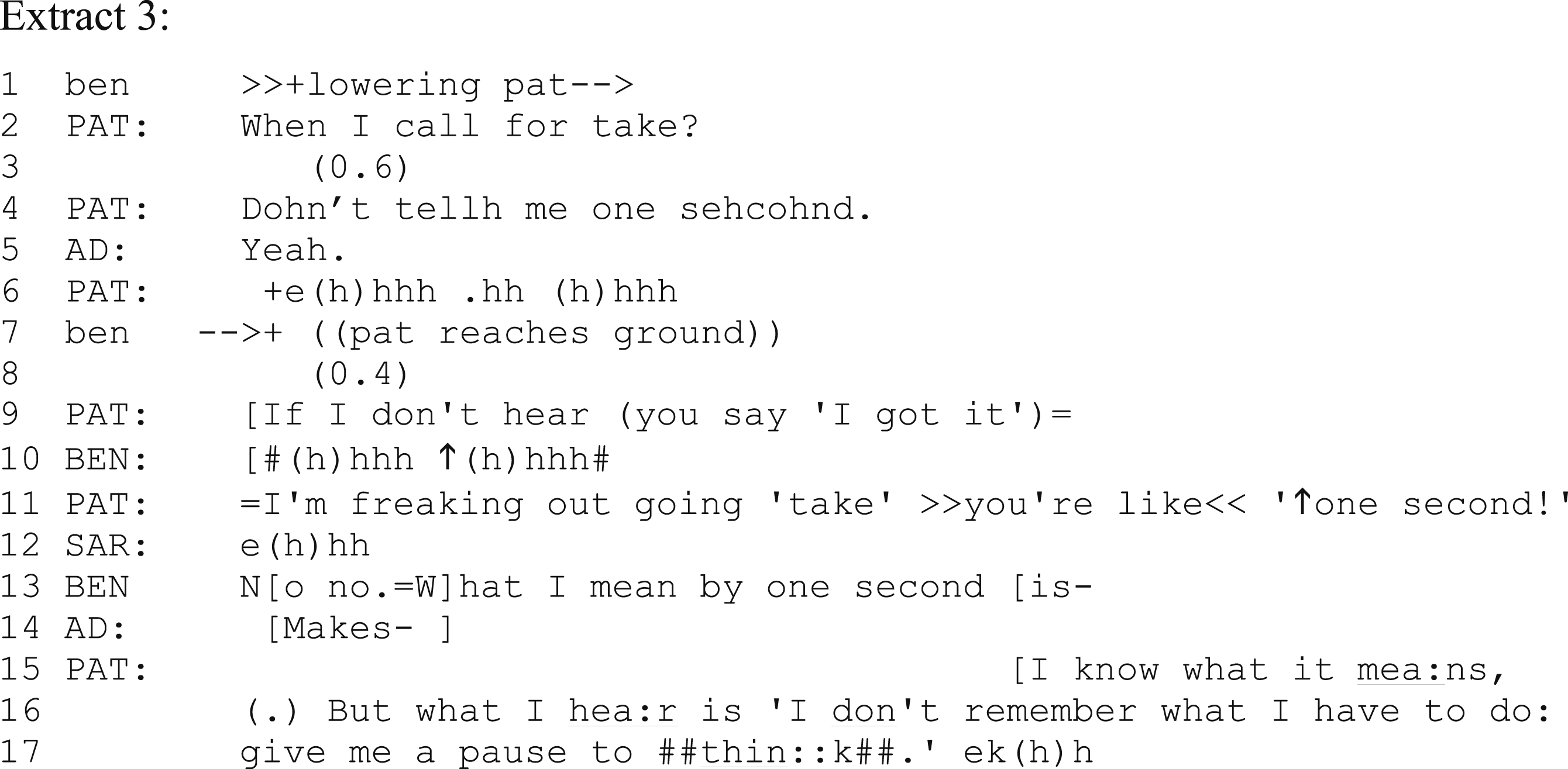
Pat instructs Ben as to the inappositeness of saying ‘one second’, explaining that it causes him to ‘freak out’ (L11) and makes him concerned Ben does not know what to do (L16–17). Trust in one’s belayer is important in order to climb well, as it helps one feel secure that they can push their body without risking life and limb. Pat’s instruction corrects Ben’s action and explains the consequences of what happened. It also situates Pat as not accepting the alternate competences that Ben has drawn on as relevant – the competence Ben displays as a physiotherapist, or as a novice that is self-aware and accounting for their own mistakes. Ben cannot port the competence he has in being a ‘good’ novice; he cannot account for his delay as a novice normally would because the doing of the account itself is treated as inapposite. 3 The correction does not go without contestation, as Ben attempts to account for his action (L13). Before we find out exactly how Ben would have accounted for his ‘one second’ accounts, Pat cuts him off (L15–17) and states that even if Pat knows what Ben means, it is irrelevant because the ‘one second’ comments imply Ben does not know what he is doing. Pat allows for no alternative to what would be locally adequate.
Nevertheless, there is a challenge for fulfilling UAR: seeing the competencies that Ben attempts to port to the climbing setting is not easy for an already-competent researcher. I have been a climber for 10 years, and have climbed with these climbers often before. While it is easy for me to diagnose Ben’s difficulties and discuss how Ben is accountable for the practices he does, it is actually difficult for me to physically reproduce the actions that Ben does here. It is not only difficult in the sense of a breaching experiment feeling awkward, but the actual embodied practices involved in using the GriGri device are so habitual that it is difficult to do otherwise, especially in situ with a climber on the rock wall. This is a state that is actively strived for from the first moments of rope climbing – newcomers are (usually) required to practice repeated motions in order to reduce their ability to make mistakes, because such mistakes are very dangerous. Some climbers have even informed me that, when signing up to a new gym, they were tested on their skills, but then asked to demonstrate the incorrect positions as well. They found this so physically difficult that they initially failed the entry test, even though they could verbally describe the mistakes.
Garfinkel argued it is important to preserve the phenomenal details of bodies encountering the world – that the bodies are what and where the skills are (see e.g. Garfinkel, 2002: 210). If the best way to achieve and demonstrate the methodological UAR is through embodied practice and lived experience, we must consider what embodied senses we also lose. If an ethnographer, through developing competence, loses the ability to reproduce, or even empathize with, an embodied phenomenon, do they lose UA, at least for the noviceness? Furthermore, even if I could, with effort, produce the same locking problem, I absolutely could not do so and have it be accountable as a novice in situ – I would inevitably be treated as doing it as a joke (in poor taste), a lapse in attention, or a research activity, not as a novice. The reproduction would then not be a uniquely adequate one in the least, but an ironicized performance, and one that would undermine trust in me as both a researcher and a climbing partner. In order to produce membership, I must foreground only the domain-specific adequacies, and make accountable other possible competencies. In this way, to fulfil UAR is also to choose blindness towards other orders. This is not to say that those other orders are invisible – they are clearly available to be corrected – but that we must set ourselves in relation to them as part of displaying adequacy.
Discussion
What the above cases remind us is that members delimit the finiteness of the domain live, organizing what competencies are relevant and how members are categorized with respect to those competencies as each action arises. The sense-making of action(s) as uniquely adequate is a post-hoc ratification of what we are doing and who is doing it. In the moment, that which counts as uniquely adequate is contestable. In calling for UAR as a ‘pre-requisite’ (Lindwall and Lymer, 2005), we should remember that adequacy remains a live issue for participants, and that our own actions even as competent members, or becoming-competent participants, are subject to other participants’ sense-making about the adequacy and relevance of those actions (see also Evans and Fitzgerald, 2017; Macbeth, 2012; Rauniomaa et al., 2018). The basis on which participants resolve contested relevancies seems to become, post-hoc, what the order always was and what the actions were uniquely adequate as. Members thus actively analyze their local contexts or ‘provinces of meaning’ (Anderson and Sharrock, 2017), and in treating specific competencies as the adequate ones, delimit the domain. Ethnomethodologists also do this work when deciding what the adequate province of meaning or domain is for their study, and we should reflect on whether and how these analyses align with participant ones. It may be productive to consider what orders are excluded from what we and/or members treat as locally adequate. For instance, Rawls and Duck (2020) point to the double consciousness required of Black Americans, and lacking in White Americans, in navigating the dominant White order. The blindness of the latter to what order is being foregrounded helps to perpetuate that order.
We may, at times, be constrained to fulfilling UAR from a particular perspective. As Jenkings (2018) suggested, practicality, as well as biography, and other circumstances may make UA description of certain competencies inaccessible. Our lifetime of competencies and locally achieved memberships can make it difficult to fulfil UAR in some circumstances. For instance, in the rock climbing case above, my body’s habits and relations between the climbers and myself as a researcher, made it impossible to enact a novice action in a uniquely adequate way. Doing uniquely adequate action does being a member, but a very specific member, with richly detailed relations. It is not positionality, but a methodological pathway for documenting the kind of anti-essentializing positionality that modern ethnographic writing has called for (Ghaffar-Kucher, 2015; Khawaja and Mørck, 2009; Narayan, 1993), what Abu-Lughod (1991) called the ‘ethnography of the particular’. All membering is done for a next first time, and it is in reciprocal relation with what is uniquely adequate.
Rather than seeing this as a problem, UAR calls on us to be reflexive and creative. 4 Lynch (1993: 301) has suggested that to fulfil UAR is actually to devise Wittgensteinian language games that make the phenomenon perspicuous. However, can transformations of competent, taken-for-granted order, such as using inverted glasses or breaching experiments (Garfinkel, 1967), still fulfil UAR, as these practices could not stand as unique adequate in situ? When competent member researchers undertake these games, we change our relations with participants, as we can no longer be taken to be doing the locally adequate action. Instead, our researching becomes evident. Hence why instructed action from participant to participant has been the ideal moment to document. To act as an incompetent climber in a locally adequate way, for instance, might require undertaking training in a new area of the sport (e.g. ice climbing), bringing a newbie (or child) or (as I experienced while writing) returning to climbing after injury. As the instances in this paper should show, the competencies that such an undertaking would require and reveal are partial, overlapping, relational and contestable. Each of these, however, involve re-beginning climbing in some fashion, underlining the everlasting usefulness that noviceness brings to revealing local order. It is less that we must be strange to our field in order to ‘see’ it, and more that strangeness provides one kind of account for making order explicit. In pursuing research in fields where one is already competent, and seeking to document locally adequate, situated action, it is perhaps these accounts that we should seek.
Footnotes
Acknowledgements
Thank you to Yaël Kreplak for amazing support and editorial steering, to Clemens Eisenmann for detailed consideration and feedback, and to the generous and careful comments of two anonymous reviewers. Thank you also to conversations with Phil Hutchinson, Neil Jenkings, Christian Greiffenhagen, Mathias Broth, Philippe Sormani and Saul Albert for conversations that helped point me in the right direction on this topic. Similarly, many of the connections in this apper could not have been made without discussions with the EMCA4RJ group, especially Francesca Williamson, Natasha Srikant, and Edward Reynolds, even if they were not directly about this paper. Thank you to Leelo Keevallik for her wonderfully helpful comments and discussions. Finally, a thank you to my mother, Mary Hofstetter, who took care of my newborn child while I wrote revisions for this paper, and understanding my need to work and figure out my thoughts when ostensibly visiting her.
Declaration of conflicting interests
The author(s) declared no potential conflicts of interest with respect to the research, authorship, and/or publication of this article.
Funding
The author(s) disclosed receipt of the following financial support for the research, authorship, and/or publication of this article: This work was supported by the Vetenskapsrådet [2016-00827].
