



Abstract
Based on the authors’ ethnographies in the fields of taiji, ballet, and yoga, this article outlines and reflects the theoretical and empirical scope of what we mean by “ethnomethodological ethnography.” Ethnomethodology and Conversation Analysis (EM/CA) have been juxtaposed and pit against various forms of ethnography and vice versa—for example, by criticizing various theoretical underpinnings of ethnographies, viewing EM/CA as a very limited micro-sociological research method, or by critiquing (auto-)ethnography as egocentric, self-absorbed, and ill-equipped to account for the detail and sequential organization of natural occurring actions and circumstances. Contrary to such deliberations, we highlight their common interest in putting empirical social phenomena first. In getting access to and describing what social phenomena consist of, members’ competencies and detailed analysis of recorded data mutually elaborate each other. In this sense, they are potentially not only mutually inclusive but, as we shall argue, the entire field of EM/CA studies depends to some degree on actually doing ethnography. Based on our own ethnographic research, we will then zoom in on the case of taiji practice to highlight the relevance of autoethnography and evaluate how ethnographic reflections of self and body constitute and may foster “uniquely adequate” qualitative research. Ultimately, the aim is to explicate how EM/CA research policies differ from textbook oriented instructions and are better considered as praxeological respecifications of doing ethnomethodological ethnography in particular cases.
Keywords
Introduction: Two studies in the making
Over a decade ago, one of the authors of this article set out to interrogate the theory of modernity. In light of studying contemporary spirituality in yoga, he aimed to question secularization and uncover the veil of late capitalistic tensions between self-care and -optimization. This research agenda quickly changed, when he encountered ethnographic fieldwork and ethnomethodology, thus, seeing an opportunity to take the spiritual world of yoga practitioners more seriously, that is, to ask instead how spirituality is actually recognizable and accountable in social practices for practitioners (Eisenmann, 2022). The other author, with a biographic background in ballet, embarked almost at the same time on an autoethnographic journey into the world of embodied movements. Not only did he ethnographically revisit his ballet school but he also started to learn a new way of moving in taiji, 1 and argued with and against (Wittgenstein, 1922: 90) that it might not be language (alone) that defines and potentially expands the limits of our worlds, but perhaps even primarily the limits of our movements in their socially embodied practice(s) (Mitchell, 2023fc).
When we first met—a year or so into our projects—the first author held an impassioned speech in a conference discussion detailing the inadequacy of (auto-)ethnography and descriptions that, although useful as background knowledge for the analysis of audio and video recordings, cannot account for the details of social organization in concerted activities—a discussion that can partly be traced back to Bergmann’s (1985) emphasis on the fleetingness of temporal organization of social activities vis-à-vis Hirschauer’s (2007) counterargument for ethnographic writing when considering the “silence” of social practices. Although technically registered data of instructions and discourse were crucial in both of our studies, they were of less utility when aiming to analyze recordings of practitioners who, for example, are sitting silently with their eyes closed in meditation. Our dispute notwithstanding, only a few weeks later, inspired by the presentation and description of the “standing pole” in taiji practice—an example that similarly consists of “just” standing for around 20 minutes—the first author also started to write his first autoethnographic observation in yoga practice. This provided an additional way to gain access to some of the less apparent and externally unobservable practices of spirituality. At the time, he had very carefully bracketed out his own personal background of studying yoga in India (some years earlier), concerned with a methodological (more or less) controlled analysis of his later ethnographic participation and “data collection” during a yoga teacher training program in Germany. When finalizing the study, the ethnographic relevance of this background for an ethnomethodological study had, however, found its way into analysis and the forefront of the book’s introduction (Eisenmann, 2022).
After this first contact, we started to meet more regularly to discuss the ephemeral and seemingly opaque nature of our research objects. Often we would leave verbal discourse, get up from dinner tables or desks and begin instructing and correcting each other, mutually accomplishing an embodied position in order to convey, interrogate, and make a point about the practice in question. Engaging in a practice oneself allows for a different awareness of the practical challenges that are actually involved. These practical challenges are also made visible and inspectable in instructed actions in teaching and learning situations that became a perspicuous setting for both of us to develop arguments about the practical, embodied, and social aspects of spirituality and internal movements (Eisenmann and Mitchell, 2022fc). Instead of trying to answer how to explicate these phenomena ourselves, we redirected the question to describing in detail how practitioners try to grasp, evaluate, and instruct these barely observable and ephemeral aspects of the practice and how they are also accomplished in everyday interaction. Being in contact with a fellow researcher who shares a practical and also a different understanding of the complexity, detail, and contingencies of embodied ways of being-in-the-world—and who also takes the case-specific praxeological (ethno-)theories and philosophies seriously—has been tremendously helpful in discussing data and reconsidering arguments. One takeaway of this experience then would be that dual-ethnography seems at least to be a worthwhile consideration for doing ethnographic research that allows to question and expand the positionalities and subjective experiences of each individual ethnographer and provides an additional opportunity to scrutinize how practical work can be made accountable to each other (e. g., “not like that, like this…”).
Alongside similarities regarding the troublesome observability of embodied practices and despite significant differences in our methodological starting points and respective research fields, we found commonalities in the practices of our phenomena as well as in the crucial sociological questions they posed. Investigating moving bodies or movement systems and allegedly subjective states of spiritual consciousness are not traditional topics of sociological analysis. In this sense, Sudnow (1978) already criticized that in studies on music and jazz the making of music together and the embodied practice of playing the piano themselves usually disappear from consideration. Liberman (1999: 55) went even further with regard to some of our research practices, stating that “the very topic of meditation can turn social scientists green in the face, to the point that there is a professional pressure to ignore it as a phenomenon.” Both of us were therefore unable to rely on a clear-cut analytical apparatus or case-specific proven methods to guide us. Therefore, in first presentations of our work, we mainly reported on shortcomings, both with regard to practical adequacy in the field, but also back in sociology.
One issue that we were apprehensive about and struggled with was how to “do justice” to our cases. This went along with being cautious about how not to move too fast in categorizing specific practices, barely escaping the risk of reification of everyday and sociological assumptions and concepts. Due to scientific formalizations, one runs the risk of missing important issues at hand: the situational requirements, practical skills, and embodied knowledge of professional work (...). It is not uncommon for scientists to confront practitioners with a certain epistemological arrogance, while the latter can only shake their heads at the clueless observers who apply all kinds of categories to their work from the outside. (Bergmann, 2005: 646)
However, when it came to gaining access to the details and “depth” of our practices from within, this was an undertaking that often could only be described as feeling that there is “something more,” out of reach of the sociological reasoning and writing to which we would ultimately have to resort. Having now concluded these two studies, there have of course been many takeaways, perhaps most importantly also that some research questions can be too ambitious to begin with and that there simply are limits of sociological analysis. In hindsight, the theoretical, methodological, and practical issues we faced were ultimately instructive with regard to the concrete practices in our cases and our dissatisfaction with some of sociology’s core concepts and methods. Personal shortcomings notwithstanding, we can now look at some of these issues as very specific features of our research questions and phenomena. Simultaneously, our particular cases were also perspicuous settings to empirically investigate more general and crucial methodological concerns that this article attempts to sketch out as “ethnomethodology ethnography.”
What does it entail to take minute, taken-for-granted and hardly visible phenomena seriously, that furthermore are seemingly occult, opaque, or subjective? How can access be gained to such phenomena and how can they be described adequately? How is recorded data related to ethnographic observation and what role do researchers’ bodies and selves play? There are good reasons to find difficulties with handbook-oriented research designs that are required to be explicated in research proposals and expositions, but for many research questions and phenomena simply cannot be formalized in the first place. In the first section of this article, we will attempt to clarify why and how this is arguably the case and address these broader methodological concerns by explicating the radical shift in ethnomethodological ethnography. By reconsidering the triadic interplay of theory, method, and phenomena, we will re-specify the relationship of (auto-)ethnography and ethnomethodology.
The second section will investigate these questions by following the phenomena from the empirical vantage point of doing taiji. This section is furthermore concerned with yet another methodological instructive commonality of our cases. Both of us investigated practices that at their core deal with establishing new and alternate embodied ways of moving in the world that are considered self-transformative practices. By exploring the passing problems and self-transformation of one of the author’s transition from ballet to taiji, we will reflect and investigate the ways in which the bodies and selves of the participants and researchers are foundationally involved and fundamentally changed. While much methodological literature in EM/CA has been concerned with doing audiovisual analysis of recorded data (Mondada, 2006; Sormani, 2016; Meier zu Verl and Tuma, 2021), we will focus on some less considered and highly controversial autoethnographic aspects that also resonate with and complement what an ethnomethodological ethnography could be in each particular case.
Re-positioning (Auto-)Ethnography and ethnomethodology: What does it entail to put the phenomenon first?
Ethnomethodology as an asymmetrical alternate
Whether at the outset or at the end of a study, when aiming to specify a research perspective, write a methodological reflection or situate one’s sociological findings, it is to a certain degree necessary to orient and navigate within the field of sociology. Garfinkel (2002: 114), however, positioned ethnomethodology not as a rival, corrective, additive, or complementary perspective, but as an “asymmetrical alternate.” This alternate does not question the multi-paradigmatic variety of sociological approaches per se, but fundamentally shifts the epistemological perspective to ask and study in detail just how their respective findings and perspectives are possible in the first place. Or as Hester and Francis (2007: 6) state: “Where conventional social science takes for granted the availability of the activities it describes, ethnomethodology seeks to examine their ‘possibility’.” While Garfinkel’s (1988) critique of the entire “worldwide social science movement” perhaps overstates the case, we will argue in the following that revisiting and clarifying what an ethnomethodological “alternate” may be will not only allow to specify and position ethnography differently, but also open an array of crucial questions of how to gain access to and describe social phenomena.
One instructive way of explicating what such an alternate consists of is found in Gestalt psychology’s ambiguous and bi-stable drawings, such as the Necker Cube, Rubin’s Vase, or the famous Duck-rabbit (Figure 1). One can either see the rabbit or the duck, one may (learn to) switch (very quickly) between them, but it is not possible to have their “details” both ways, as Garfinkel (2022: 122) explicates in one of his lectures in 1980: If you’re seeing it as the duck, that means then that in the in-courseness of elucidating as a coherent ensemble of features, the duck can’t be pursued simultaneously with elucidating as the in-courseness of the ensemble of features of the rabbit. You can think of ‘rabbit’ but can’t see it. The attempt then to elaborate one thing while preserving as well the in-courseness of the other (...) – what happens is that the one will explode the other one; (...) [W]hat I’m talking about is not seeing it in a glance but paying attention to the just-how it is composed (...). (Garfinkel, 2022: 122). Duck-rabbit. Source: From 23 October 1892, issue of Fliegende Blätter (http://diglit.ub.uni-heidelberg.de/diglit/fb97/0147?sid=8af6d821538a1926abf44c9a95c4_0951&zoomlevel=2). Public domain.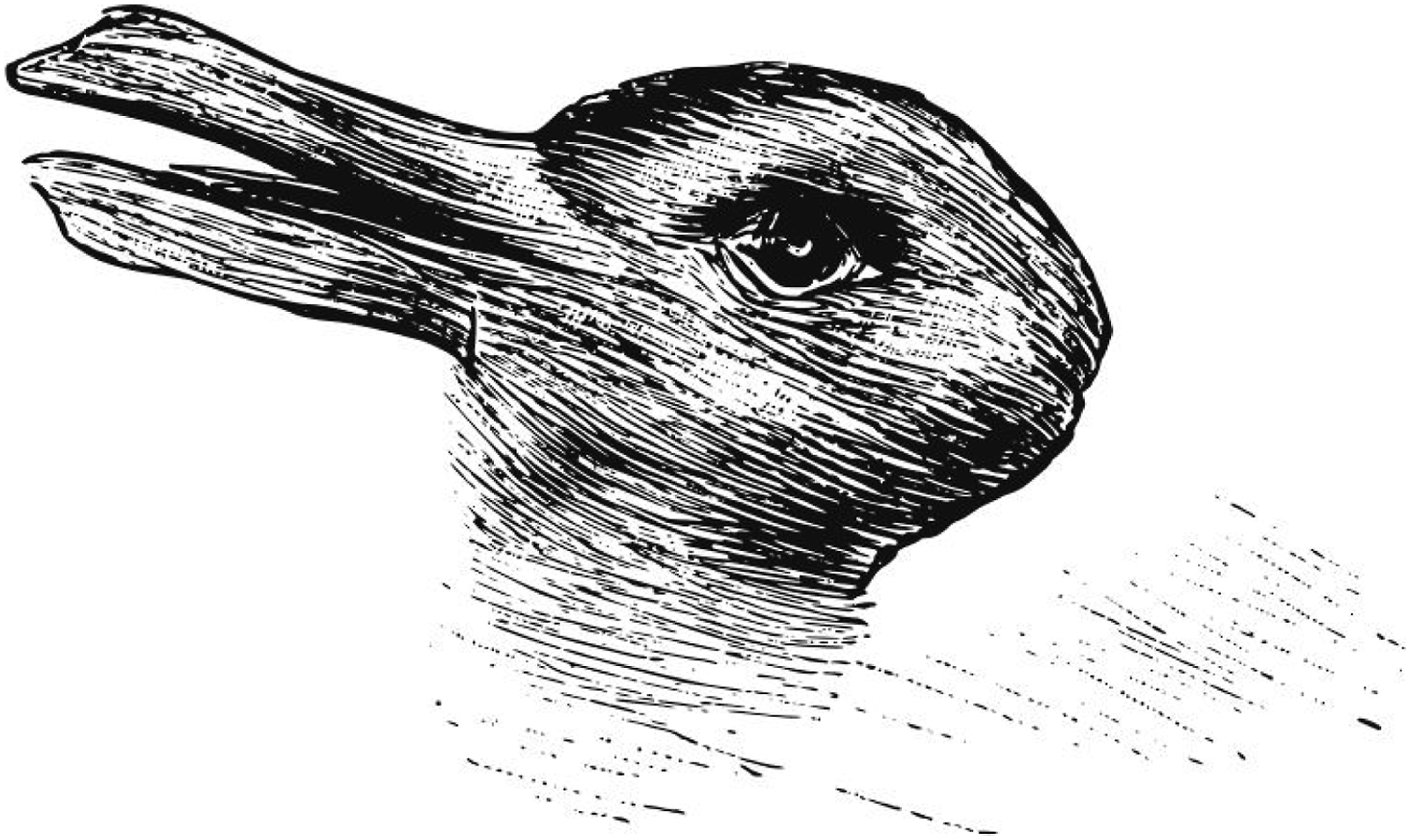
In following Gurwitsch (1964), the question of “just-how” the perception of the duck or rabbit “ensemble” is alternately achieved, does not depend on extraneous, internal or external features, such as categories or learned schemata, but is inspectable and observable in the actual given display. In contrast to asking how sense data is interpreted and organized in minds, categories, or concepts, Gurwitsch (1964) views perception as already (more or less) organized and thus as an “autochthonous achievement.” Garfinkel (2021) highlights this crucial consideration by speaking of an “endogenous achievement,” but transposes Gestalt-themes from such drawings and from the phenomenology of perception, into an “accomplishment” within the midst of everyday life: the complex ways of highly coordinated social practices. A Gestalt or, extending the argument with Merleau-Ponty (1962), a “phenomenal field” is thus a practical accomplishment formed in retro- and prospective organization, embodied orientation and work within the world that is performed in concert with the recognizable actions of others (Eisenmann and Lynch, 2021; Lynch and Eisenmann, 2022; Meyer, 2022).
With regard to the alternate, Garfinkel’s central concern is that the work of theoretical and analytical definitions and formalized methodological procedures (partially) predetermines beforehand what actually can become the object of observation. The social world, like the sense data of perception for Gurwitsch, is already recognizably organized and socially ordered by its members. In contrast, “formal analysis,” as Garfinkel identifies what he also calls “Parsons’ Plenum,” views social order as the result of analytical work of the sociologist, that is, “of administering the policies and methods of formal, constructive analysis.” (Garfinkel, 1988: 108). While such procedures may explicate and establish the “rabbit-ness,” they will however lose the “details” of “duck-ness” and, thus, the phenomenon that ethnomethodology is interested in. That is, to account for the endogenous social order that is recognizably produced, in situ and in vivo, and accomplished in social interactions.
One of the early examples Garfinkel (2019 [1943]) used to make this argument stems from his research for the army (from 1942–1946) at Gulf Port Field. New recruits at the time had limited prior knowledge and, in the context of war, materials were sparse and time of the essence. While previous training followed a more “tried and true” textbook approach, in these specific circumstances the generals adopted a more practical “learning-by-doing approach” to expedite the process, operating hands-on with models and mock-ups, since there was a lack of aircrafts and tanks at the army base. However, this did not lead the recruits—unlike the sociologists Garfinkel critiques—to get the idea of trying to stubbornly adapt the real aircraft to their previously used mock-ups and models. The specific context of army training offered a perspicuous setting for the analysis of methods and analytical concepts in ethnomethodology, insofar as: “theoretical models in sociology be held accountable to actual details of social actions the same way mockups were for army recruits” (Rawls and Lynch, 2019: 3).
It is of importance that Garfinkel uses an empirical case to make the argument. Models and mock-ups, or categories and theories for that matter, are not only potentially problematic for sociological reasoning, they are part and parcel of the way members orient within the social world. In this sense, the case of the army also shows how teaching and learning can be differently conceptualized and practically instructed depending on the particular context, for example, via textbooks or mock-ups. The question about alternates then also entails, not only how the two sides of the coin, rabbit and duck, differ but also how they are co-constitutively related in achieving a duck–rabbit or a Janus face (Garfinkel, 2002: 103).
One could of course take Schutz’s (1953) position that social observers are already dealing with a meaningful and interpreted world of common sense and therefore have to offer second-order descriptions. Indeed, Garfinkel took much inspiration in Schutz’s work and, when sending him his yet unpublished “Notes on the Sociological Attitude” (Garfinkel, 1951), was also encouraged by Schutz, who replied in a letter (Schutz, 1953: 3), that: “If you say that the study of the methodological decisions upon which the actual practice of sociologists [is] based [is] practically unknown territory you have my full approval and I hope you will be one of the explorers of this undiscovered treasure island.” 2 But, similar to the way Garfinkel praxeologically respecified Gurwitsch’s use of Gestalt phenomena, he also transformed Schutz’s approach by zeroing in on the first-order phenomena for the discovery of the yet “unknown territory.” Thus, radically shifting the differentiation of first- and second-order phenomena, as well as the triadic relationship of theory, method, and phenomenon into the practical everyday world of professional and lay sociological reasoning.
Positioning ethnography and ethnomethodology
When ethnomethodology and conversation analysis (EM/CA) as well as ethnography are situated within the multi-paradigmatic field, the canon, of doing sociology, Garfinkel’s asymmetrical insistence is oftentimes lost. Instead, epistemological foundations, range, and limited validities of perspectives and further differentiation are instilled, for example, explicating different theoretical informed ways of doing ethnography, or specifying the step-wise methodical procedure of data collection and analysis, such as for multi-modal video-analysis. EM/CA and ethnography are then to be seen as specific methodological perspectives, tools, or methods and their application can be evaluated for their specific merits and blind spots. The practical job of social researchers, then, would be to find an adequate fit of theories and methods that apply to the particular social phenomena and research question. Out of the toolbox, one may choose, when, for example, making an argument about social structures or organizations, a different set of tools than one would employ when interested in individual choices and behaviors within smaller groups, such as in a family. Instead of endless and unfruitful quarrels between schools, it opens an avenue for further specialization, mutual recognition, or correction as well as complementary perspectives and mixed-method approaches.
Such a view offers many advantages, especially when considering a pluralistic and diverse social world. However, with the two-faced nature of the coin in question, the alternate insistence of Garfinkel pertains to the issue that such an orientation can only become sensible in regard to the details and particularities of achieving recognizable social objects in the first place. Praxeologically specifying ethnography and ethnomethodology in such a way ultimately does not lose the potential benefits and necessity of a pluralistic perspective on social research, but can only provide them as a result of the research in each case. Instead of explicating clear-cut analytical considerations and methodological procedures, both ethnomethodology and ethnography highlight as their core principle to follow the “phenomena.” That is, instead of specifying what relevant social phenomena are or could be, researchers are called to go out into “the wild,” the world, the street, the shopfloor, respective organizations, families, etc. and observe what people are actually doing, to find out in the midst of practical actions and the vicissitudes of everyday life: “What the hell is going on here?” (Geertz, 1973). Or as Wittgenstein (1953: Aphorism 66) emphasizes: “To repeat: Don’t think, but look!” Similarly, also for Garfinkel (1964 cf. Rawls et al., 2020) “looking” is not a private matter, but can be already seen as “the act of sociological theorizing.” The theorist is to “look” and “see” with a view to explicating how members assemble the witnessable and seeable orderliness of the social world, that is, how actors, in their everyday affairs, do “seeing,” “looking,” “observing,” “searching for,” “listening,” etc. as practical activities (Garfinkel, 2006: 108; cf. also Coulter and Parsons, 1990).
This credo, its clear drive notwithstanding, produces further conundrums and can often seem rather unspecific and unhelpful when in the first stages of starting out to design and do social research. The practical job of the ethnographer is then to reiterate by specifying in each case: How is ethnographic observation sensibly achieved in this context? How does one identify these particular “social phenomena” and what does sociological looking’s work consist of? How does one account for the adequacy of descriptions and findings? And so on.
Therefore, since the beginning of ethnography in social and cultural anthropology, and especially with the “crisis of representation” and “writing culture debate” (Clifford and Marcus, 1986), much analytical concern and empirical reflection tackles these central methodological concerns in ethnography. Autoethnography, participatory-, polyphonic-, postmodern-, feminist-, carnal-, postcolonial-, and sensory-ethnography, to mention just a few of them, are concerned with re-positioning and reflecting the ways of actually doing and accounting for ethnographic fieldwork (e.g., Ellis, 2004; Coffey, 1999; Pink, 2009; Wacquant, 2014). Although much more could be said and learned from these reflections, in the second section, we will consider autoethnography especially and the role of the researcher’s body and self.
It could be argued that much of what has been critiqued in the field of ethnography and social anthropology by reflecting the embodied and social positionality of researchers and reconsidering the adequacy of descriptions and representation over the last decades can be seen as a crucial starting point for Garfinkel’s (1967) conception of ethnomethodology. Already in the aforementioned paper on the “sociological attitude,” Garfinkel (1951) highlighted the “problem of the observer as part of the field of observation” and the “problem of ethnocentrism of the investigator.” Although many of Garfinkel’s arguments have been highly influential in qualitative methodology and there have been discussions about the “complex ways” that ethnomethodology and ethnography are interrelated (e.g. ten Have, 2004), an “ethnomethodological ethnography” was never canonized in handbooks or proposed as a general research approach (but see, Meier zu Verl, 2018; Meyer, 2015; Eisenmann, 2022). Even within the field of EM/CA, despite the fact that many early and highly influential studies were ethnographies (e.g., Liberman, 2004; Livingston, 1986; Lynch, 1985; Sudnow, 1978; Wieder, 1969), its notion has partly been lost (cf. Pollner and Emerson, 2001).
As we have argued, and reiterating the tenet of putting the phenomena first, there are good reasons that challenge the explication of such procedures and methods. These reasons are highly condensed—especially in Garfinkel, 2002; Garfinkel and Wieder, 1992) later writings—in EM research policies, some would argue convolutedly so (cf. Greiffenhagen and Sharrock, 2019; Ikeya, 2020). In contrast to the multifaceted research maxims, ideals, and step-wise procedures of methodological handbooks, that tackle how to observe, get access, identify, collect data, analyze, and describe social phenomena, Garfinkel introduced “ethnomethodological indifference” and “the unique adequacy requirement of method” (UARM) that we will consider in the following sections to further specify the relation of ethnomethodology and ethnography as ethnomethodological ethnography.
Ethnomethodological indifference and the problematic observability of embodied practices
Garfinkel’s notion of indifference is often misunderstood in regard to other research maxims that advocate—for the purpose of following the phenomenon—a position of some kind of induced naïveté or ignorance. The idea behind such a position is to hold back and bracket one’s own background, assumptions, everyday knowledge, and practical reasoning. Inspired by the phenomenological notion of epoché, one is to disengage from one’s practical involvement in everyday practices in the social world, in order to find a position for more “controlled” observation of what phenomena “really” are. However helpful such recommendations may seem for taking an alternate road to avoid reifying one’s own assumptions, for allowing oneself to be empirically surprised, or for reaching some degree of objectivity, such a perspective can be rather misleading and does not account for how social phenomena are constituted in the midst of concerted activities of everyday life. On the contrary, Garfinkel (2021) points out that there is no special time-out, no Archimedean point of reference, and no transcendental observer. To some degree, all sociologists are part of and participate in the world that they investigate and need to rely on everyday sociological reasoning. They are as such not independent of the particularities of participants and researchers’ being in the world. To clarify, ethnomethodological indifference is concerned with being indifferent to the policies and methods of “generic representational theorizing” (Garfinkel, 2002: 108).
Contrary to using naïveté, a central challenge for doing ethnomethodological ethnography is found in the issue that the social practices people use and mutually engage in to achieve their day-to-day life are largely taken for granted. The social world, complicated as it may be, appears to be routinely out there, ready to hand, to be identified and/or categorized. But, the concerted embodied work of achieving social facts is not readily available, neither for the participants nor as topics for detailed ethnographic observation and consideration. They are easily missed, and as Garfinkel (1967) argues, ordinarily uninteresting, seen-but-unnoticed, and seemingly unproblematic. It is therefore one approach to search for perspicuous situations in which social processes become visible, that is, in which members are explicating members’ methods, for instance, in learning and teaching situations or faux pas. Another focus is on situations that involve “trouble” that in its various forms can make participants more aware of the practices they are engaging in. It is for such an awareness that Garfinkel (2002) introduced tutorial problems and breaches—that is, teaching exercises in the classroom, such as “inverted lenses,” “occasioned maps,” or clapping to a metronome—to disturb, problematize, and make observable the seemingly unproblematic, socially organized embodied work that is involved in even the most mundane activities (Garfinkel, 2002, cf. Eisenmann and Rawls, 2023fc).
The unique adequacy requirement of methods
In the center of previous discussions about the “unique adequacy requirement of methods” (UARM) stands the oftentimes problematized “high bar” of competency that is required for fulfilling UARM (cf. Ikeya, 2020; Lynch, 1997; Garfinkel, 2022)—an issue we will also consider in view of our case studies in the following section. In regard to such competencies, Garfinkel and Wieder (1992) distinguished UARM in two versions. The weak version requires that researchers be “vulgarly competent” in the practices they are investigating, while the strong version ultimately aims toward what Garfinkel calls “hybrid studies” that require researchers to be professionally proficient in order to contribute not only to sociology, but potentially also to the research fields in question. However, the main thrust of the argument is concerned with methods, which at times seems to be glossed over or taken out of focus.
Unique adequacy raises the question of competency and enskillment of researchers because of its concern with members’ methods. This entails a re-specification or even “hybridization” of methodological questions within the actual and specific, “unique,” research fields: How members of society and members of specific fields, practices, and groups already identify, observe, and recognize social objects in their everyday work. It is the aforementioned radical shift that grounds research policies and questions of coherence, adequacy, and validity, not (only) in professional sociological research practices, but in practical actions and lay sociological reasoning, where descriptions have a “praxeological validity.” It is such a parallelization of “lay and professional sociological” with which Garfinkel (1967: ii) opens his Studies in Ethnomethodology, and argues to take sociological reasoning not only as an oftentimes un-reflected “resource” but also as a “topic” of sociological inquiry (Garfinkel, 1967: 31).
In this light, following the phenomena—or putting them first—re-specifies sociological investigations in the concrete and actual social practices within which social phenomena are accountably achieved in everyday life. Thus, UARM in ethnomethodological ethnography can only be considered as a constitutive part of social phenomena themselves, just as descriptions can be seen as part and parcel of what they describe (Garfinkel and Sacks, 1970). The “strong version” thus entails “that the methods for investigating a research field should be a component of that field itself, that is, e.g., that the observation of a field should incorporate the observational procedures practiced in that field itself.” (Bergmann, 2005: 645 own transl.)
“Hybrid Studies” in Garfinkel's (2002: 126) dictum, might only perhaps be promising a “big prize” that entails the question of how a study is received or useful in the field of study (cf. Greiffenhagen and Sharrock, 2019; Ikeya, 2020). But the main concern of adequacy is founded upon (more or less) hybridization between “members’ methods” and “research methods,” in such a way that descriptions gain praxeological validity, that is, in that they are practically recognizable and instructable for and by the practitioners in question. Unique adequacy, and ethnomethodological ethnography for that matter, can only be specified in regard to and as result of the specific case and practices at hand. Accordingly, it is prudent to also ask for which cases and studies and to what extent Garfinkel’s research maxims seem reasonable and productive and for which they do not. Policies of ethnomethodology also have to be reflected on the basis of the empirical phenomenon in question and should by no means be seen as an end in themselves. Or as Garfinkel (1992: 14) highlights also in regard to his own shibboleths: “Use those details that he offers, and go searching to find the cases he’s talking about.” 3
Autoethnography and ethnomethodology
After painting the picture of what we mean by ethnomethodological ethnography in broader brush strokes, we will now turn our attention to one specific issue for which our studies provide perspicuous settings, namely, just how the bodies and selves of researches become topical in purportedly self-transformative fields and embodied ways of moving. More specifically, in the case of taiji with a balletic background, we will consider the issue of how much “auto” can be useful for an ethnomethodological ethnography that clearly is steeped in the biography and embodied involvement of the author and, thus, poses the question of how ethnomethodology and autoethnography go together and what insights can be gained in such an approach. While fine-grained distinctions and clarifications of their use and usefulness are called for, we argue that all ethnomethodological studies depend on autoethnography to some degree.
A common denominator of these approaches is that the body of the researcher constitutes a vital piece of “equipment” in the field (Amann and Hirschauer, 1997: 25), especially when taking the slogan of “becoming the phenomenon” (Mehan and Wood, 1975) seriously. As ten Have (2004: 130) points out, following this slogan could be interpreted as demanding even more homology with the field under study than ethnography would demand, making “the old anthropological sin of ‘going native’ […] a required virtue.” Indeed, as he infers, this can lead to issues both for reader and researcher alike. For readers who are not experts of the field, descriptions can be too obscure, while for researchers ten Have also refers to Lynch’s (1997: 275) comments on the issue that taking unique adequacy to its extreme consequence, for example, becoming a broker to study financial markets, could be tantamount to “a one-way journey out of sociology.”
Similarly, autoethnography has become somewhat of a hot button issue, ridiculed in the media as an extension of “selfie culture” with the portmanteau “mesearch” 4 and seemingly hyperbolic warnings within social sciences of the risks of hurling “ourselves into the abyss of subjectivity (as the slippery genre of ‘auto-ethnography does)” (Wacquant, 2014: 10). However, these controversies also led to not unconvincing responses from a major proponent of the method, Carolyn Ellis (cited in Pickles, 2017), that it is “narcissistic to leave out your own experience and to act all-knowing, as though you can stand apart, and that you are not subject to the same forces as those you write about […]”.
Debates within autoethnography revolve around the prominence of the self and theoretical saturation (Anderson, 2006; Atkinson, 2006; Ellis and Bochner, 2006). Ultimately, the great differentiator is seen in the issue of how much theory an ethnography should strive for (Anderson’s “analytic autoethnography” vs. Ellis’ “evocative ethnography”) but there is nevertheless much common ground: first, that self-relations in the field are the generative principle of all ethnography; second, that both positions warn against elevating “the autobiographical to such a degree that the ethnographer becomes more memorable than the ethnography, the self more absorbing than other social actors” (Anderson, 2006: 402.) or, in Ellis’s (2004: 34) words, against making a description “overly self-indulgent without being sufficiently self-aware or self-critical […]. When that happens, what gets written is not that useful to anybody, not even yourself.”
In light of ethnomethodological ethnography, these are moot points without a case at hand that cannot be resolved with theoretical choices a priori, as Sharrock and Anderson (1982: 120) even argue that “the search for a theory of ethnography is simply mistaken.” Therefore, in the following section, we will consider examples in which it could be said that “the self” of the researcher in the study of ballet and taiji practice became vitally informative, ultimately making the case that, in a hybridization of autoethnography and ethnomethodology, it could be prudent to consider “just who” it is doing the research at hand.
How “Self” can happen when studying ballet and taiji practice
When studying ballet and taiji practice in lesson settings, there are myriad ways in which the researcher’s self can slip in and attempt to get in the spotlight, to use the parlance of one of the fields. In the way this study was designed, this was certainly to be expected, as “I,” that is, in the following, the author who self-identifies as the ballet and taiji researcher, had a different biographical relationship with each of these ways of moving. Whereas, one could say the competence for unique adequacy was safely acquired in ballet with vocational training since the age of 11 and an—albeit brief—career in professional dance, in taiji it seemed to be more the typical narrative for ethnography of a “novice” learning for the purposes of the study. When researching in a field that one’s own biography was once so anchored in, especially when observing lessons in the boarding school that one was trained in at a formative age, there are many events crossing over and overlapping between “ballet past” and “sociology present” that feel personally meaningful. Here, however, we would like to consider some “weightier” overlaps and crossovers of practices that the study design entailed and that are instructive for reflection of self-relations, what it means to be “competent” or a “novice” in a field and, thus, pivotal in understanding what is going on.
Novice, but not a tabula rasa: “The self” as knowing how and skills
Transitions from ballet to taiji, two socially organized ways of moving albeit for very different purposes, made salient the role played by knowing how (Ryle, 2002 [1949]) as “dispositions” or “skills” for ethnographic fieldwork. Like “enabling resources” (Meier zu Verl and Tuma, 2021) that inform “professional vision” (Goodwin, 1994) in the field and in data analysis, as Alkemeyer (2022) points out, there can, however, also be a “dark side” of “biographical baggage” leading to blind spots in one’s observation (cf. Fleck, 1980). Somewhat akin to a golf handicap then, ethnographers are more or less capable of observing certain things. The lower their number is, the more dispositions and skills they bring to the table in homology with the more experienced practitioners, but also the more they can potentially overlook in contrast to “novices.” 5
In regard to taiji, due to my specific balletic background, I had a head start in some respects, while there were also bumps in the road making me overall a bit of a methodologically productive misfit. The head start as an initial “fit” pertained, simply put, to being able to learn movements quickly. Whereas most beginners were plagued with trying to remember sequences of movements that are tied together in a complex choreography called a “form,” “picking up” movements quickly is a skill highly valued in dance studies in which movements are demonstrated at a comparatively breakneck speed, leaving proprioceptive stragglers by the wayside of auditions as “too slow” for professional work. Therefore, learning forms “as movement sequences” did not present a particular problem, leading me to guzzle down the main form and then a few weapons forms, that is, sword, saber, and long staff, within the first two years (2010–2012) of taiji training. Thus, my situation was not unlike that of Mr. Data, an android in an episode of Star Trek, who is able to skip much of the preliminary work of a dance class, the lion share of which comprises step-for-step procedures, jumping directly to the “final lesson.” 6
Thus, the practical gear one brings to the table as an ethnographer matters greatly for the possible foci and relevancies of one’s study. For instance, while reading the ethnography of a colleague on ballet, I was surprised by how much analytical weight is given to “knowing the order” of movements being taught in the format of “exercises” in ballet lessons (cf. Müller, 2016: 113). My bafflement can be quickly deciphered when the drill I experienced at boarding school, being required to learn the ballet exercises de jour on the basis of minimal movements of our “old school” teacher, who had no problem with making true his threat: “If you get the exercise wrong again, you’ll all be sent out!” Thanks to such threats of embarrassment my “low handicap” was inerasably instilled, but also limiting a certain kind of understanding for those sociologists lay and professional continuously struggling with “preliminary steps.”
Therefore, my proprioceptive boost initially allowed for greater practical homology, but also closed other things off that required reflection. On the other side of the coin then, there is also an important “mis-fit” regarding taiji practice. Looking back to Mr. Data’s dance lesson, he has similar problems when he is required to dance and coordinate with a partner. Learning body movements quickly does not necessarily account for the details of mutually recognizable practices in the work of co-operative accomplishments. In my case, a first clue that the sky may not be the limit for an ex-dancer in taiji was to be found early on upon discovering that there was a pejorative word for people who learn multiple forms. These miscreants are known as “form collectors,” “promiscuous” form learners who never enter into an at least semi-monogamous relationship with a sequence of steps but always move on to the next. Later on, frustration with my progress started creeping in and the proprioceptive credit that my practical gear entailed seemed almost exhausted. I had to face the fact that taiji practice in a balletically informed manner would no longer be “sensible.”
Whereas in ballet practice, comparing how one’s movements looked vis-à-vis others was a good indicator of how one is doing—executed, for example, by quick glances at others easily facilitated by omnipresent studio mirrors—in these taiji lessons, the aesthetic of one’s movements seemed to not be the leading currency. As predicted by a taiji teacher, observing with regard to my “passing problems,” transitioning from ballet to taiji: [A]nyone who is good at picking up movement and postures is able to copy anyone else to a certain degree and get the physical movement correct most of the time. A good ballet dancer for instance can look quite good at the main Taiji [...] forms ... well sort of. However, to the trained eye, it is only a representation of physical movement with nothing real happening at all. (Montaigue, 2006)
As I would later come to understand, pupil–teacher and pupil–pupil interactions are the perspicuous settings for making accountable the detailed work of “doing careful taiji practice” (see next section). But my passing problems even began at such “basic actions” (Danto, 2006) as “bending” with one’s upper body.
Illustrative of this is a brief movement sequence, that is, in taiji a “posture,” called “Taking Oblique Position” depicted below. Before discussing the posture, some expectation management is perhaps in order. When viewing the illustrations below, readers are presented first with the challenge of missing professional vision—a problem that is shared by the presentation of any unfamiliar data. Moreover, what we are attempting to render is doubly elusive in that “internal movements” are supposed to be just that, internal, and how they exactly intertwine with “external movements” of one’s body, that is, that which the pictures primarily exhibit, is what is at issue in taiji lessons, disputed between different taiji teachers and styles, and the point of the decades of taiji practice one is expected to invest before glimpsing any form of expertise. Therefore, it would contradict central tenets of taiji to consider photographic depictions as self-evident. The illustrations here then are only part of the story to be used in conjunction with what the text is describing. But even so, to take taiji seriously entails considering just how the internal eludes its textual, verbal, and visual rendering. 7
Returning to “Taking Oblique Postion” and the passing problems of basic actions, this posture is repeated multiple times in the basic form of Chen style taiji called laojia yilu (“old frame first form”) that consists of 75 “postures.” Put simply, the movement sequence consists of rotating one’s body from the “center” to a slanting angle as if one were ducking under an attack and then turning one’s body into the attacker to block them.
Figures 2 and 3 depict two different performances of this posture, standing in the position in (a), then turning the waist slightly to the right (b), continuing the turn further and switching the hand position (c), then shifting the weight from more on the right to more on the left leg, while initiating tilt or “bend” of the upper body (d) as the titular “oblique position” (e), before finally straightening up (f). Between the figures lie seven years of taiji practice, that is, thousands of repetitions accompanied by observations of my expert teacher both demonstrating and explicating the posture, multiple hands-on corrections, being led through the movements, and—never enough—attempts at practicing it on my own. All this time and effort notwithstanding, I still never felt like I was doing it “right.” It was only in 2019 that my ethnographic notes—which in their written accompaniment of the learning process also do double duty as a kind of training diary—signal a turning point of getting a glimpse of what the work of doing “Taking Oblique Position” was meant to entail. Part of getting there involved overwriting what I had thus far come to understand and pre-reflexively do when I was “bending” with my upper body. Due to the drill of ballet, I seemed to have the default setting of bending too far, perhaps an old habit of reaffirming one’s suppleness and demonstrating readiness to teachers and choreographers. Thus, in 2012, I bend my knees more (2d), signaling more physical commitment to the oblique cause, and then bend more with the upper body while losing alignment of the hands and head (2e). The contrast to Figure 3 is, of course, only minimal and for the untrained eye hardly visible. As a taiji practitioner, I am not necessarily happy with Figure 3, but there are recognizable differences which indicate some “success.” For instance, rather than bending my legs desperately wishing to feel like I am doing something (3c)—leg-bending was a similarly troublesome albeit larger passing problem—it suffices in 3d to set up the bend more carefully. Whereas, my alignment in 2e is suboptimal in pursuit of a good slanted angle—my right hand is waving around and my left is too low—in 3e, I have finally discovered the correct position of the right hand next to my face and my left arm forms a curve mirroring the position of my left leg. When doing this posture in the latter manner, part of my internal dialog still wants to let me know that it is “too easy” or “not extreme enough,” whereas another part feels a little bit happier after breaking through some of the “balletic extremism” in movement and concentrating on what is important in taiji, for example, “moving from the center,” keeping arms, legs, and upper body highly coordinated and connected. Moreover, the practical challenges of this particular passing problem were the precondition for being able to explicate this respecification of what it means to “bend” one’s upper body in the first place. “Taking oblique position” in 2012. “Taking oblique position” in 2019.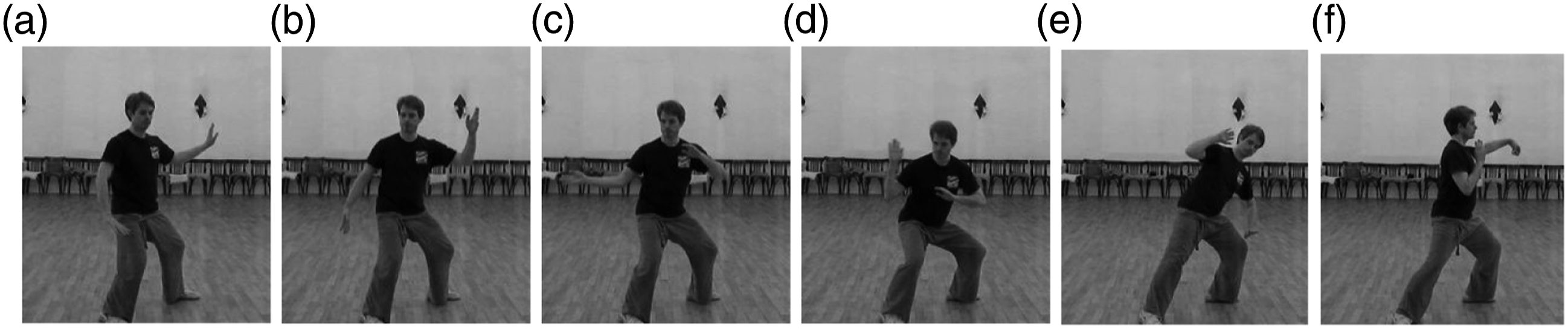

Key to accessing these passing problems is finding the ways in which they become recognizable and observable in situ and in vivo. That is, via interaction with others, be they teachers, fellow participants, or other “reflective artifacts” such as mirrors and cameras. Even after years of participating in taiji lessons, it was impossible to get away from the label of being an ex-dancer in the eyes of the other participants. For instance, receiving a correction in a posture upon which my teacher seemed pleased, noting: “If you want to know how it should look, look over at Robert. That’s great!” I did not even have a moment to blush before another older pupil piped up in his usually wry fashion, “Will you give us all ballet classes then?” making everyone laugh, but also making clear to me that my skill in finding positions quickly was considered strange. Worse, however, was that I seemed to exude a dancerly quality from my pores even though I had not practiced for years. At one point, thinking I was finally starting to fit in, a fellow pupil informed me that she would always look over to me in lessons and find that I was “dancing.”
Worse still, even seemingly innocuous activities could trigger old balletic ways. For instance, while practicing alone in the evening of a training camp (Figure 4), I happened to catch myself on camera attempting to strike a taiji pose (4a) but upon looking to my left where the wall was fitted with a mirror (4b), I suddenly puff my chest up and raise my head (4c), as if the mirror gaze triggered my balletic way of standing, negating my efforts to not “come up into my chest.” The “mirror incident.”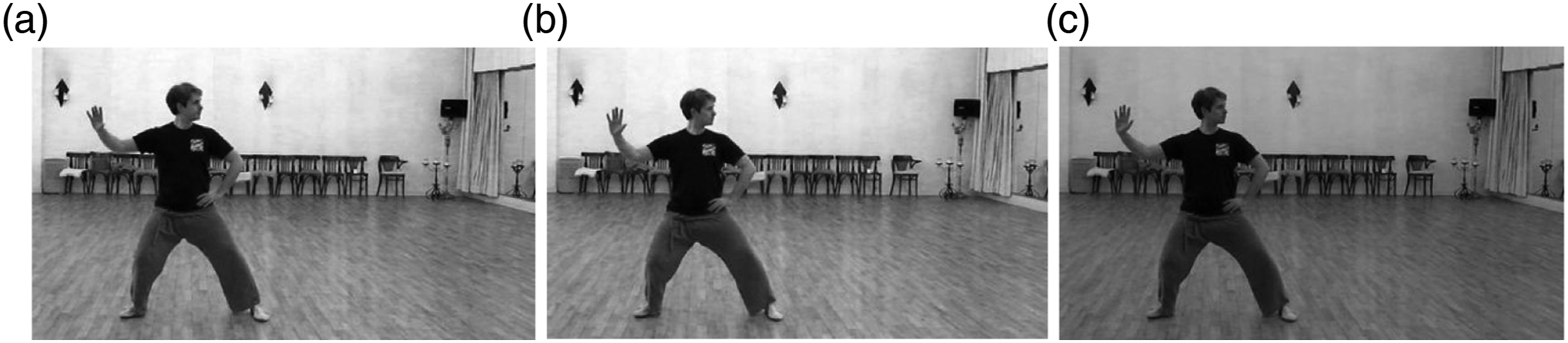
This sort of code-switching, to use the linguistic analogue of switching between languages (cf. Poplack, 1980), has never felt even, as if ballet and taiji were on equal footing. Instead, I would always have to fight to “reprogram” myself to make a different way of moving “natural” to me. Ballet is “my body’s” native language which it does not seem to want to give up on, leaving me a strange practical amalgam of being a balletic relic attempting taiji lesson practice.
Making transparent this status of being a “strange practical amalgam”—and how it is co-constituted in the diverse social situations and interactions in and around fieldwork—questions simplified views of members’ and ethnographers’ as potential “novices.” Instead, it shows the relevance of specifying how particular body- and self-relations are instructive and of relevance for the case at hand, for professional and lay sociologists alike, that is, doing taiji, but also doing ethnography. As Coffey (1999: 20) also argues in Ethnographic Self: The reality of fieldwork and the nature of estrangement is far more complex than many accounts suggest. Straightforward readings of standard methodological texts imply a position of ethnographer-as-stranger, progressing towards a familiarity and eventual enlightenment, while simultaneously achieving a professional and personal distance. Such conventional accounts are at best pedagogical simplifications and do not afford satisfactory accounts of research experiences.
Without reflecting one’s specific “mis-fit” or handicap for the practice at hand, naïvely assuming novice status, would be to completely misrepresent one’s self-relation to the field which is no mere private matter, but co-constitutive in what is going on. Also, the traditional bifurcation of “going native” and “coming home” as an ethnographic method (cf. Amann and Hirschauer, 1997: 28)—although useful in emphasizing both homology with participants and analytical rigor—underestimates with regard to such studies that they “can actually be about becoming a different self over the course of and beyond the fieldwork” (Coffey, 1999: 28).
Furthermore, what the phrase “a different self” in the above quote and the usage of “I” in the descriptions of taiji practice gloss over is “the fragmentation, negotiation and reconstruction of the self during fieldwork” (Coffey, 1999: 36), or rather selves. Although much of our language and narratives do good work in reifying and stabilizing a constant self, transitioning between ballet, taiji, and sociology can only be understood by considering not only “just how,” but also “just who” it is participating in the practice at hand. Similar to the analytical rigor that “just-thisness” (Garfinkel, 2002: 99) suggests, just-whoness here implies how ballet and taiji practices as well as practices of their ethnographic description act as prisms of (de)fragmentation of self, co-constituting “who” it is doing a certain thing at a specific time. Vis-à-vis self-relations in the field, the other side of the just-whoness coin is the work of “staying sociologist.” Depending on just who is doing a study, the push or pull of certain fields will vary, changing the work of their sociological analysis. For instance, it makes a difference that simply walking into a ballet studio triggers a strict balletic gaze on my part, locating all the faults in my appearance I can find. Or, experiencing “carnal joy” (Wacquant, 2004: 4) when one fits like a “fish in water” in a given practice, such as in my case suddenly having teaching duties thrust upon me in a ballet class, slipping seamlessly between observer to teacher, makes a difference in how one observes the practice and the work one needs to do in order to return “oneself” to the world of sociology.
Confessions of a push over
Descriptions pertaining to taiji so far may have focused on just who was doing it in the sense that the solo practice of the form was at the forefront. However, it would not only give the wrong impression but also be entirely fallacious to overlook the importance of partner exercises in taiji. To situate these exercises in taiji lessons, in any type of martial art that professes some kind of effectiveness in bodily combative interaction the true test is not performing movements alone, but using them on and with another human being in one’s direct vicinity. Although the martial element is not necessarily at the center of many taiji lessons, interacting with partners attempting to push one another off one’s center of gravity, often known as “push hands” or “pushing hands” from the Chinese tui shou, is seen as the ultimate test of one’s skills. As a handbook by the current Chen style grandmaster explains: Training of the Pushing Hands (tui shou) and practising Taijiquan (the forms) cannot be separated from each other. Whatever shortcuts or simplifications we might have allowed ourselves during form training will emerge as a weak point in Pushing Hands. (Chen, 2012 [2006]: 263)
Therefore, both as taiji practitioner and ethnographer alike, I would be remiss to leave out partner exercises—even though I personally was never particularly enthused by them. Toward the end of fieldwork, enough rapport had been achieved to be able to film a sequence with an advanced pupil, Sven, and my teacher of the past years, Frank. Unlike many push-hands exercises that involve some movement, the exercise here called ‘structure pushing’ involves standing in a wide stance opposite one another, placing one hand on the partner/opponent’s chest and another on their arm and vice versa. The idea then is to push until someone “loses their structure,” handily signified by them losing balance, although one need not engage in theatrics and fly against the wall or fall over—simply stepping backwards suffices.
It was to my slight chagrin that Sven volunteered as I had pushed against him a few times before and knew that it felt like pushing against a wall to the point that he would pity me as the obviously more advanced student and give me some pointers. After positioning ourselves (Figure 5) Frank then gives us the start signal: “Okay push a few times!” (5a) Within one second, I am visibly pushed backwards; after two seconds I hop slightly backwards (5b–c), signaling that I had given up the fight. Immediately we set up for round two. This time, it takes three seconds before I have to take a step backwards. Seemingly wanting to see this disaster in partner exercises a third time, Frank instructed us to go again and we immediately embark on round three. This time, I try to not give up quite so easily, cling on a bit more, tilting my body (5d) until I have to take a step, or rather, jump backwards to avoid falling over (5e). “Structure pushing.”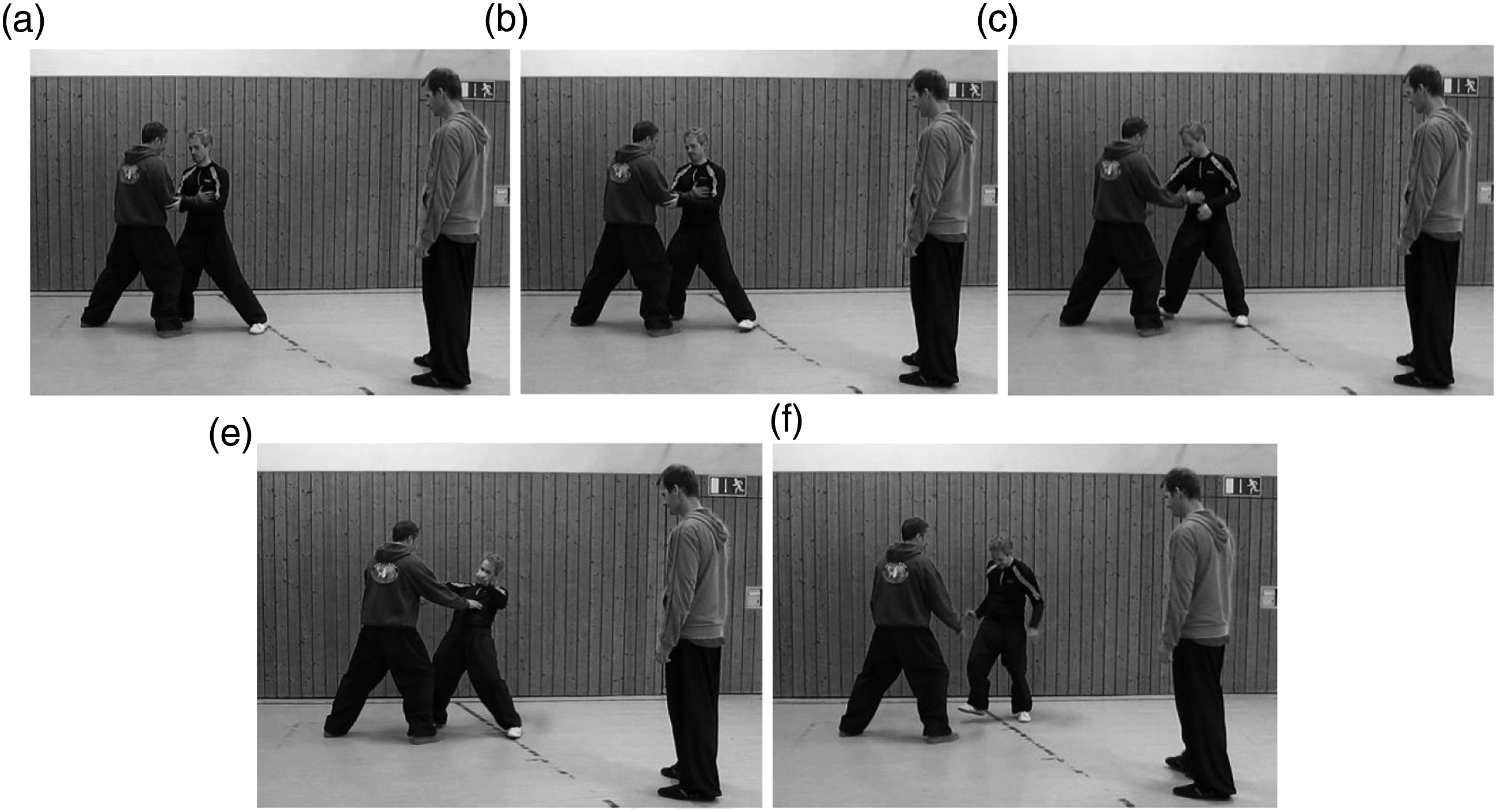
At this juncture, Frank initiates a correction with the aim of bringing me into a position so that “I” would gain better structure and succeed in vaulting the insurmountable Sven/wall. This type of intense “hands-on” correction, in the literal sense of the word, is typical in lessons of Chen style taiji. A fellow transitioner between dance and taiji notes in her “Diary of Chen Taiji Practice” that she was “shocked” (Kinthissa, 2009: 16) by the intensity of the correction which she characterizes as a “guiding touch, feather light yet focused and insistent [directing] student’s movement along courses which cannot easily be discovered” (Kinthissa, 2009: 31). Hands-on corrections in partner exercises.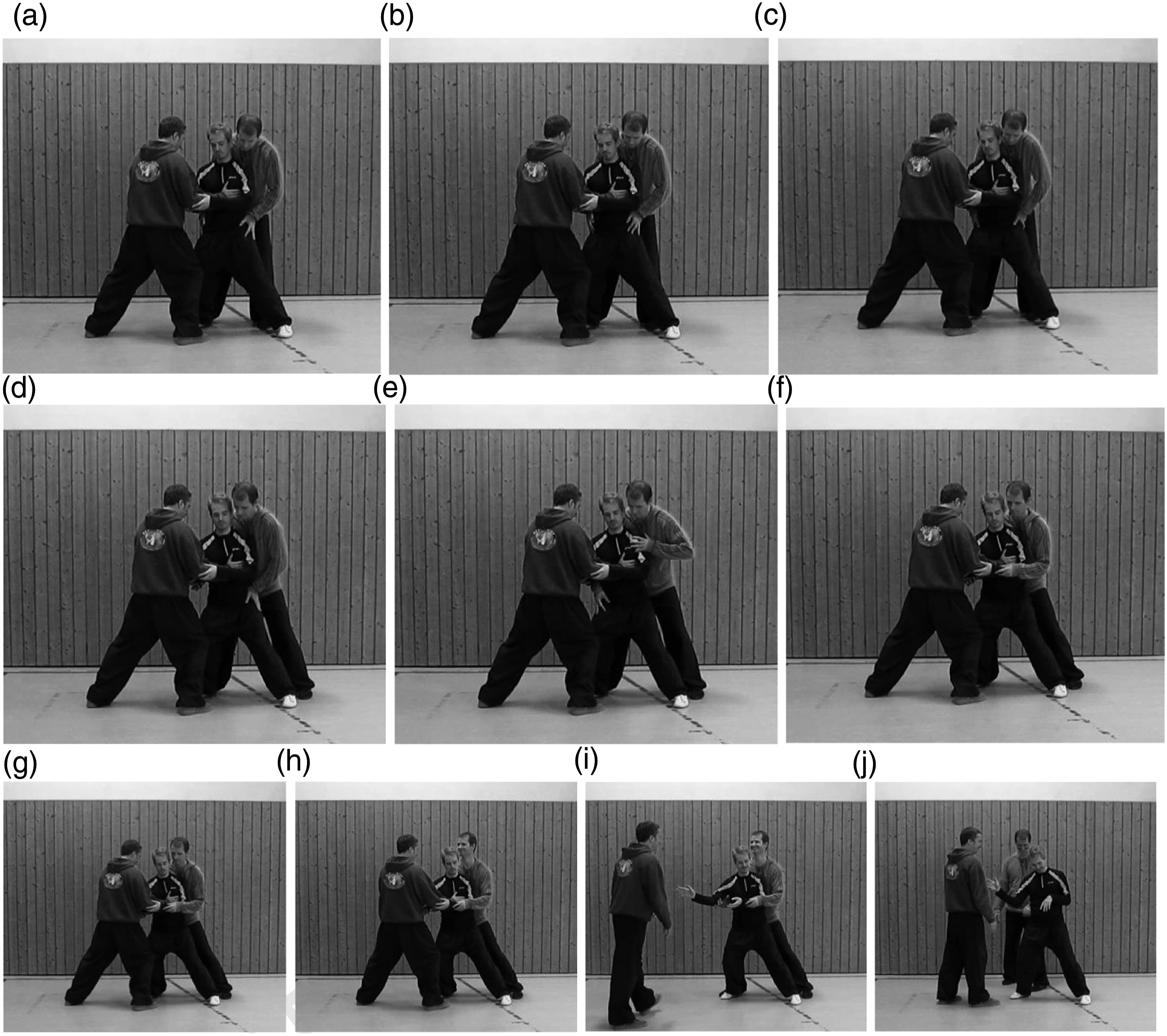
After having three iterations for analysis (Figure 6), Frank moves to a familiar corrective position behind me, splaying his fingers on my hips and adjusting their rotation (6a). Readjusting his hands and closing his fingers, Frank then begins to “compress” me into my legs, also noticing pressure between Sven and me and asking us not to push, as his work was not yet done (6b). Then he starts to manipulate the position of my hips more drastically, tilting them on an angle in preparation for the push (6c). He then repeatedly switches his hand grip while holding me in place with his upper body, doing last minute adjustments to misalignments that pop up due to the preceding corrections, as if I were a drawer that were almost too full, but in which one wishes to place one final item (6d–e). At around this point, I slowly begin to morph into a “different structure,” my upper body forming a line with my left leg. After finally readjusting my hand on Sven’s elbow (6f)—Sven has been waiting patiently all this time—Frank announces, “Okay!” (6g). To say that “I” then begin to push is obviously a gross overestimation of my agency in the situation: With Frank holding my overall alignment in place with his upper body and steering me with his hands on my arms, I am more akin to a self-aware vehicle being driven. And drive we do, dissolving Sven’s defenses (6h), until he can no longer hold his position, upon which Frank looks up to him and grins over my head (6i). First, I emit a short laugh, leading into laughter of all three of us at the “wonder” we had just co-created (6j). Wryly, Frank asks me, while I shake my head in slight disbelief at how “easy” the immovable object called Sven had suddenly felt, “Better?”
To my dismay, Frank’s post-correction explications (Figure 7) , using both verbal and bodily demonstrations, felt like they were all things I “knew.” My “main error” was that upon feeling pressure I would “lean against it” (7a). He continued, “What you need is, straighten up and relax your body” (7b), moving his weight over to his right leg, adding “and then you sink into your legs, that’s how simple it is!” (7c). This indeed all sounded so simple and familiar, making complete taijistic sense, but it nevertheless still seemed so difficult to put into practice when it was “just me” in charge of what my body was doing. Post-Pushing explications.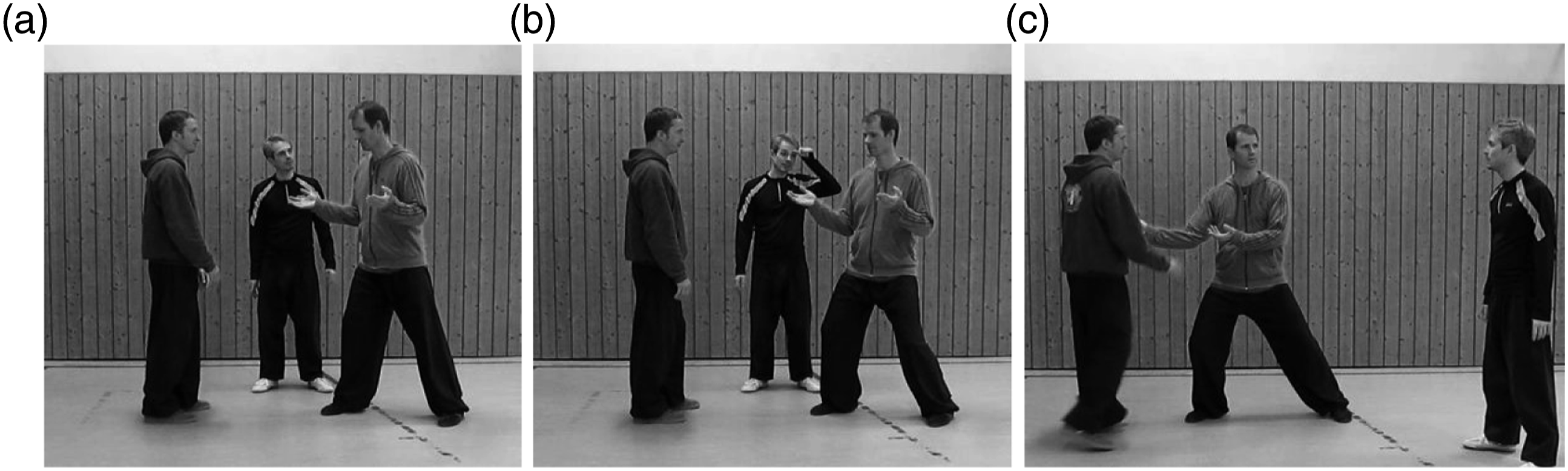
Conclusion
Looking for the limits of his body and its movements, the taiji researching author of this paper obviously found them in the partner exercises. And, although his teacher may be correct that he may just be “missing several years of taiji training,” for the study of taiji, these exercises are triply instructive, elucidating broader points. First, in the logic of the field, they provide a crucible for practitioners to estimate their skills, get feedback, and find ways to improve, while at the same time upholding the whole “discursive cosmos” of what makes good taiji, that is, also making ephemeral concepts, such as the life energy qi, practically instructable and recognizable. Second, they offer an example in which one can literally see the social construction of a way of moving as an intercorporeal hands-on three-person effort. Third, partner exercises provide a choke point though which an autoethnographer also has to go, finding an abrupt and possibly unfavorable reflection of “just who” these exercises deem them to be, for example, an “incompetent push-hands partner,” someone with “ballet-specific passing problems” or “ethnographic-specific descriptive trouble.” Due to such a threefold relevance of the partner exercises, partaking in and ethnographically describing them can be seen as one particular embodied way of hybridization with the field at hand: requiring and engendering the reflection of how the “just who” vis-à-vis and in members’ methods is not only an oftentimes tacit resource but, depending on the case at hand, can also be a relevant topic for investigation and description.
Embarking on topicalizing the “auto” can entail a greater or lesser degree of fragmentation of and within the various “selves”—for example, “biographically,” as “practitioner,” “novice or expert,” “member of society,” and “researcher”—making clear the interplay of selves and practice being co-constituted and described as they are fractured and reflected through the prism of social actions. This also has ethical benefits as it increases the transparency of the study, allowing for readers to question the researcher’s interpretation of events by planting “a healthy seed of doubt” (Andrew, 2017: 40) in their authorial and practical authority. Such an open-ended interpretation of the world is more in line with a less theory-laden research approach that is amenable to the nuances of practice which are “only discoverable [and] not imaginable” (Garfinkel, 2002: 96). Similar to the use of registered data and transcripts, it leaves some of the discovery to readers, subsequent practitioners, and researchers, be they different or “the same” people. In the praxeological validity of hybrid studies, this point reaches its ultimate expression, as such descriptions are to be readable as pedagogies or followable instructions at the worksite in question, be it in a professional field or in a setting of everyday life.
Teaching and learning situations in highly elaborate movement systems, such as in taiji, yoga or ballet, are perspicuous settings for such forms of embodied self-involvement, making observable how teachers and practitioners practically deal with, attempt to grasp, try to communicate, mutually exhibit, and validate or correct “embodied affairs” that are considered to be both difficult to instruct and realize in practice. Analogously, sociological observers face the issue of easily missing the phenomena when describing the socially organized work of oftentimes barely perceptible, seemingly uneventful or rather “strange” practices such as people standing still for 20 minutes or pushing at each other’s chests. In contrast to the Gestalt switch of the duck–rabbit that is readily and bluntly available in its display, considering the minute details in the figures of taiji practice above requires training and work that render phenomena for novice or expert practitioners in different degrees of accountability. Engaging in such work that aims at alternate ways of moving, perceiving, and being in the world, practitioners experience troubles that can also make them aware of how their everyday embodied orientation and perception is highly organized in the first place—making our cases also a perspicuous setting for an awareness of social practices.
Garfinkel' (2002) tutorial problems also aimed for such an awareness of the taken-for-granted nature of socially organized embodied work that we have described in the passing problems from ballet to taiji. Similarly, Garfinkel observed what he called “natural troublemakers” who, standing outside—or between different sets of taken-for-granted ways—of being in the world, have to become “practical methodologists,” such as passing sex in the case of Agnes (Garfinkel, 1967). Turowetz and Rawls (2021) point out how marginalized groups, for example, African Americans, people of Jewish descent, people with disabilities or ascribed mental disorders, can, through their constant experience of trouble, develop such a heightened awareness that Du Bois (2015 [1903]) described as “double consciousness” (cf. also Rawls and Duck, 2020). When considering the researcher, a similar awareness of the details and contingencies of the “seen but unnoticed” local order is required, when working out procedures for documenting those practices and their order properties in detail. Although video recordings and transcripts allow crucial access to the sequential organization of such embodied interaction, their analysis also depends on lay and professional sociological reasoning.
In this sense, the problem of reifying the social world as if it consisted of identifiable selves, objects, categories, or concepts is not only a potential problem and hindrance for doing sociology but also a constitutive feature of everyday orientation in the world. Moving beyond the assumptions of everyday reasoning in ethnomethodological ethnography therefore requires a fundamental empirical reorientation that investigates the concerted practices within which various forms of sociological reasoning, and social objects for that matter, are accomplished. This calls for the described shifts in perspective, orientation to detail, and awareness of how even the most mundane activities—for example, “doing ‘being ordinary'” (Sacks, 1984)—can be seen as social achievements.
Closing with the case of the authors of this paper, there has been yet another level of fragmentation present that was partially glossed over for the purposes of this text. Following the commonalities in the practices and their methodological challenges, what “we” have put forward as ethnomethodological ethnography, taking the details of each case and the uniqueness of requisite methods seriously, it is, however, clear that we both necessarily also embarked on different journeys. The differences in the movement systems we studied, but also in our respective sociological approaches—such as the emphasis and use of ethnomethodology and autoethnography—ultimately make the case for specifying the unique adequacy requirement of method for each specific study that involves the “just who” of particular researchers. But for now, we shall part ways.
Footnotes
Declaration of conflicting interests
The author(s) declared no potential conflicts of interest with respect to the research, authorship, and/or publication of this article.
Funding
The author(s) disclosed receipt of the following financial support for the research, authorship, and/or publication of this article: Partly funded by the Deutsche Forschungsgemeinschaft (DFG, German Research Foundation) – Project-ID 262513311 – SFB 1187, Collaborative Research Centre: “Media of Cooperation”.
