




Abstract
This article contributes to and extends critical scholarship on the philosophy and practical application of creative methods. I suggest that claims commonly made regarding the ‘potential’ of creative methods can be (re)organised as claims relating to (1) epistemology, (2) embodiment and (3) empowering participants. I evaluate these claims through the contextual lens of a research project on ‘non-sexualities’ wherein I incorporated a creative element (creative notebooks) into the research design. Through analysis of research artefacts and observations of the research process, I reflect upon how the notebooks were particularly good for ‘getting at’ embodiment and had a clear epistemological value in facilitating expressions of complexity, contradictions and ambiguities. However, I also discuss my scepticism with regard to claims made about the empowering potential of creative methods, as the notebooks potentially worked to reproduce certain power dynamics rather than eliminate them. I argue that class in particular needs to be given more attention in critical accounts of creative methods.
Keywords
This article contributes to ongoing debates over the affordances and limitations of creative methods. Debates around creative methods have become increasingly nuanced over the past decade or so, as celebratory accounts of their potentialities have been augmented by critical scholarship interrogating both the philosophical and practical aspects of such methods (Mannay, 2015). I contribute to this scholarship by using my recent research on ‘non-sexualities’ – which employed a creative notebook element – as a lens through which to explore claims commonly made about creative methods. Synthesised, these are: (1) they can produce epistemologically unique data; (2) they are particularly good for researching embodiment and (3) they can contribute to the destabilising of the hierarchical research relationship and thus can be more empowering for participants.
I present this article as a journey through the research process, consciously drawing upon a tradition of feminist methodological reflexivity (Stanley, 1990) as I discuss how my own decision to use creative methods was influenced by these narratives. Through reflecting on how participants responded to the creative element of my research, and on the kinds of data that emerged from this method, I discuss how these expectations were borne out as the research progressed. In particular, I argue for the value of creative methods in ‘getting at’ embodiment and for facilitating expressions of complexity and contradiction in what we might consider a kind of epistemological queering, but question some of the claims made about the empowering nature of creative methods. Indeed, I introduce a critique of creative methods as potentially exclusionary for some participants, since they value particular kinds of ‘reflexivity’ and ‘creativity’, which I argue, are socially constructed and unequally distributed resources, with particular classed resonances. This point has been under-explored in the existing literature, and so this article represents a contribution in thinking through how our methods might (re)make class.
The article also introduces readers to the specific method of ‘creative notebooks’. Mindful of Wiles et al.’s (2011) argument that those writing about creative methods tend to overstate their innovativeness, I do not claim that this is a new method. Rather, it is an adaptation (Wiles et al., 2011) that allowed me to incorporate multiple creative methods (such as drawings, collages, diaries, photography, mapping and video, all of which have seen extensive previous usage) into my research in a way that was (intended to be) more flexible and inclusive for participants.
The article is structured as follows. I begin by introducing some scholarship around creative methods, focusing on the three key claims above (epistemology, embodiment and empowerment). I then give an introduction to the research, explaining its context, and how I used the creative notebooks. The second half of the article then holds up each of these three claims for scrutiny, drawing on examples from my data, and on my reflexive observations of using this particular creative modality. I conclude by offering some points for consideration for those interested in utilising creative notebooks and creative methods more generally.
The potential of creative methods
Creative methods have been used in sociology, anthropology, education and communication studies since the birth of these disciplines (Mannay, 2015). However, it is only in the past 20 years or so that they have reached a more mainstream academic audience, and projects using creative methods have multiplied. In 2009, Mason and Davies observed a ‘crescendo of enthusiasm for visual methods’ (588). A decade later, it seems the crescendo has not yet abated: key textbooks and handbooks have been published in the intervening years such as those by Kara (2015) and Mannay (2015), and researchers continue to explore different ways of researching and writing creatively, such as the recent increased interest in zine-making (Bagelman and Bagelman, 2016) and letter writing (Carroll, 2015).
The popularity of creative methods can be understood when considering the reasons researchers give for utilising them in their studies. Pain (2012), in a review of the literature, found that these reasons could be broadly categorised as either relating to (1) the enrichment of data, particularly in the sense that creative methods allow people to express themselves as fully as possible, and/or (2) the relationship between participants and researchers, in the sense that this relationship is made more equal, collaborative and participatory. Others, such as Rose (2014: 30), locate the popularity of creative methods in ‘the concern for embodiment, the sensory and the affective’ that has increasingly characterised theoretical positions in the social sciences over the past few years, with creative methods understood as particularly well-placed to research these. I suggest that these claims might be usefully (re)organised under three key headings: (1) epistemology (relating to the nature of the data produced); (2) embodiment (this is arguably a subset of epistemology in that it relates to the best means of ‘getting at’ a particular kind of knowledge, but is nevertheless significant enough to warrant a claim of its own); and (3) empowerment, relating to the relational aspect of research. I now discuss each of these claims in more detail.
Epistemology
In discourses around creative methods, ‘traditional’ qualitative methods such as interviews and focus groups are often conceptualised as lacking in some key epistemological regard. This is usually related to their dependence on speech and language, which is seen as restrictive: for example, Mannay (2010: 98) writes of the ‘linearity of the verbal narrative’ and Buckingham (2009: 633) speaks of the ‘rationalistic and logocentric tendencies of verbal approaches’. In contrast, creative methods are seen as more able to account for the complexities of experience, identity and the social world, given their own multi-dimensional and polymorphous nature. Galman (2009: 200) suggests that creative methods can move us beyond the ‘single-dimensioned clarity’ of prose/speech and allow for ‘multiple – even contradictory interpretations to occur simultaneously’.
These claims are often particularly visible when researching the ‘non-normative’ – that is, identities, experiences and relationships that do not necessarily fit with expected societal norms. If telling one’s story is already restricted by the discursive constraints of the interview (Plummer, 1995), how much more must this be the case for participants who have identities and experiences that do not accord with commonly available forms of discourse? For example, when interviewing bisexual participants, Bowes-Catton et al. (2011: 257) argue that ‘the structural constraints of discourse forced participants to locate their accounts of sexual subjectivity within the very binary paradigm they so vehemently rejected’. In contrast, the authors discuss how using creative methods such as photo diaries, Lego and plasticine modelling allowed participants to ‘break out’ of these dominant discourses and to express themselves in different ways. Similarly, Barker et al. (2012) suggest this might also be the case for people in non-monogamous or polyamorous relationships. An illustrative example shows how one non-monogamous participant was able to use drawing to convey how they felt ‘the opposite of jealousy’ when their partner spent time with another partner. This was not something that could be easily expressed through language, given dominant discourses of monogamy, fidelity and intimacy.
Embodiment
As an extension of the above, creative methods are argued to be particularly good at generating data and knowledge around embodiment (what it feels like to be in a particular body) as well as the affective, sensory and haptic elements of being a person emplaced in the world. This is often explained through the idea of ‘viscerality’ – creative methods are figured as being able to capture something raw and immediate about experience, which is lost or diminished when narrated in the interview setting (Madge, 2018). This is often related to a desire to get ‘beyond discourse’ in some way – to go beyond the ways people discursively construct themselves and the social world and instead tap into the materiality of experience (Brown et al., 2011). This may be through the use of visual materials in the interview setting in order to elicit embodied memories and feelings (e.g. Orr and Phoenix, 2015) or it may bypass verbality together by using the creation of art as a direct expression of embodiment (e.g. Gillies et al., 2005). Indeed, the connection between embodiment and creative methods is so strong that methods such as drawing, collages, photography and video-making are increasingly being described as ‘embodied methodologies’ (see Vacchelli, 2018). Vacchelli argues that not only do creative methods mirror bodily experience in that they are ‘non-linear, unstructured and pre-conscious’ (2018: 176), but ‘because [they] involve[. . .] ‘making’ as opposed to just ‘thinking’ [they] can be understood as a more bodily practice if compared with answering researchers’ questions or telling stories about one’s life experiences’ (176, my emphasis).
Empowerment
It is often argued that because creative methods are participant led (rather than guided by the assumptions and preconceptions of the researcher), they can potentially disrupt the researcher–researched hierarchy and provide participants with a greater deal of empowerment in the research encounter (Del Busso, 2011). Creative methods are seen to afford the participant a greater degree of autonomy and agency beyond simply responding to the researcher’s questions. For anyone committed to challenging the positivistic and objectifying research paradigm where research is ‘done’ ‘on’ people, this is undoubtedly an attractive prospect.
The empowering potential of creative methods is cited as particularly useful when researching with marginalised groups, for example, with homeless women (Walsh et al., 2010) or with asylum seekers (O’Neill et al., 2019) or when researching with those who have been disempowered by more traditional research paradigms, such as children and young people (Capello, 2005). Indeed, there is a close association of creative methods with participatory research paradigms (research that involves participants as co-researchers, with varying levels of ownership over the research, and often with an explicit commitment to enacting social change). While participatory research does not necessarily involve creative methods (and, indeed creative methods are usually not participatory in this specific sense of participants ‘co-owning’ the research), creative methods are still seen as particularly conducive to this kind of radically democratising approach (Mannay, 2015). These kinds of claims, and the ones above, heavily influenced my decision to introduce a creative element into my doctoral research, which I will now go on to describe in more detail.
Research context
I conducted doctoral research on ‘non-sexualities’ from 2013 to 2017. By ‘non-sexualities’, I am referring to identities, practices and behaviours that denote some kind of ‘lack’, absence or refusal with regard to sexuality. This includes asexuality (where there is a lack of sexual attraction or sexual desire) and celibacy and sexual abstinence (where sexual activity is abstained from or is at least absent in a marked way from people’s lives). 1 In particular, I was interested in exploring the gendered dimensions of non-sexualities, since sexual activity, agency and desire remain central to our understandings of masculinity and femininity (Gupta, 2018). I wanted to know how not having sex or not experiencing sexual attraction affects how one might ‘do’ gender (West and Zimmerman, 1987; see Cuthbert, 2019 for a substantive discussion).
In practical terms, I addressed these questions by using a combination of semi-structured interviews and creative notebooks. I conducted semi-structured interviews with 33 participants who identified as asexual and/or considered themselves to be celibate or abstinent. Interviews were chosen as a means of allowing participants to talk in-depth about their experiences and identities. The interviews explored personal histories of sex, intimacy and relationships; how participants understood their sexual subjectivities; interactions and encounters with others (such as when ‘coming out’, or negotiating a new relationship, or finding community); and how they saw gender mattering (or not) in their lives. I read participants’ accounts through a gendered lens: not only was I interested in what participants directly and explicitly said about gender, but also in how gender might have played a part in structuring the kinds of experiences participants had, in how certain gendered subject positions were being claimed and in how gender was being ‘done’ in the interview setting itself.
However, as earnestly stated in my research proposal written at the very start of my PhD: Interviews will facilitate engagement with the narratives and discourses drawn on by participants, but visual and arts-based methods can reveal social phenomena as embodied experience in a way that narrative techniques alone cannot. . .Given too that our society is characterised by ‘compulsory sexuality’ where to be human is to be sexual, interviews - constrained as they are by available discourses - may not be able to capture what it is like not to experience sexual attraction. . .This creative strategy also has a potential for more participatory, collaborative research, which is consistent with the feminist ethics of research in which the study will be grounded.
I therefore decided to introduce creative notebooks into the project as an additional method. I now provide a brief interlude to explain exactly what notebooks are.
What are notebooks?
The notebook was imagined as a combination of several of the mediums I had seen deployed in other studies, such as drawing (Kearney and Hyle, 2004), diaries (Meth, 2003), collage-making (Gerstenblatt, 2013) and photo elicitation (Capello, 2005). I drew particular inspiration from Thomson and Holland’s (2005) ‘memory books’, which functioned as a kind of diary-cum-scrapbook that participants used to ‘document’ themselves and their lives over the course of a number of weeks, and which was intended to provide insight into the kinds of resources that young people drew upon in order to make sense of themselves. The combination of mediums was intended to make the method as inclusive as possible. I did not want the method to be reliant on any one kind of literacy or technology, but instead be flexible enough to accommodate different preferences, perceived ‘abilities’ or skills’, as well as the different time commitments of participants.
I introduced the notebooks at the end of each interview, where participants could decide if they wanted to continue their involvement in the project. I explained that the notebook would be a chance to record and reflect upon their thoughts, feelings and experiences regarding gender and sexuality in a way that was different from the interview: namely, they could take the notebooks away with them and could fill them in privately over the course of 4–6 weeks, without the pressures of face-to-face interaction. I provided participants with paper notebooks (and prepaid envelopes to return them to me), but also gave them the choice of keeping a notebook digitally. I suggested this could be done through using curation software like Evernote, cloud storage, or making a blog, but really they could use any platform that allowed for the storage, curation and sharing of multiple media sources.
I issued participants with a notebook information sheet, which explained that they could use whatever medium they liked to express themselves, listing writing, diary-keeping, drawing, doodling, collage-making, video-making, photography and links to online content as possible (although not exhaustive) options. I also included a number of prompts that participants could directly respond to. These prompts differed to those questions asked in the interview, since they often had a temporal aspect (such as ‘Do you feel masculine or feminine right now? Ask yourself this question for a few days and record your responses’) or participants to ‘show’ something (such as ‘Show how being in different spaces makes you feel’) and were generally broader and more reflective (such as ‘How do you think you present yourself to the world?’).
In the end, 12 participants completed and returned their notebooks. I met with these participants for a follow-up interview to go through the notebooks and talk about the content. Six participants chose to use the paper notebook; one participant used the paper notebook along with Pinterest (an online ‘pin board’); three participants used cloud storage to send me a curation of files; one participant posted me a collection of old leaflets on which they had written on the backs; and one participant gave me a zine they had created, and a CD they had made with their band (not specifically for the project).
Evaluating creative notebooks
In the second part of the article, I will discuss how my understandings and assumptions about creative methods shifted as the research progressed. Mirroring my above discussion, I will examine each ‘claim’ in turn (epistemology, embodiment and empowerment), through grounded reference to my own research.
Epistemologically different?
The question of whether the data to emerge from the notebooks was epistemologically different is a difficult one to answer definitively. Much depends on one’s definition of what makes something epistemologically different. A large amount of the data that emerged from the notebooks was still centred around words and language, as many participants chose writing as their primary expressive medium. In many ways, this was an extension of the ‘logocentric’ interview data – albeit written rather than verbally expressed, and without my immediate presence as an interlocuter. Even non-linguistic data, such as drawings, could also be viewed as logocentric or discursive. As in Gillies et al.’s (2005: 207) experience, much of the visual materials produced by participants ‘seemed to communicate familiar conceptual and/or language based categories. . .through visual symbolism’. For example, one participant drew an asexual flag in the process of being erased with an eraser, to communicate the symbolic erasure of asexuality in many aspects of life (Figure 1). This metonymic image relies on a familiar linguistic play between the literal and the symbolic and draws on broader discourses of marginalised genders and sexualities being invisible or incomprehensible to mainstream understandings. Thus, this image cannot be said to go ‘beyond discourse’ in the ways imagined by some advocates of visual and creative methods. 2 In addition, all images were ultimately appended with expository commentary in the follow-up interview, as I asked participants to describe, explain and clarify their thoughts on the creation and inclusion of notebook material – an act meant to destabilise my interpretive authority as a researcher, but one that required participants to essentially draw on language in order to do so. Any presentation of the data in academic forums also requires some sort of ‘translation’ into the academic lingua franca as there remains little room for expressions of knowledge outwith (predominantly written) language.
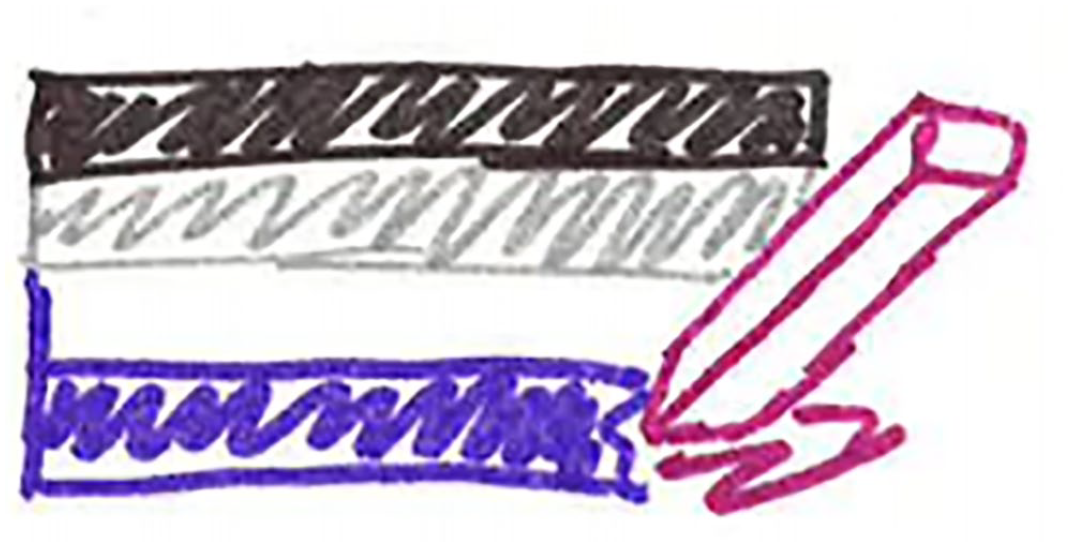
Image from Frankie’s notebook.
Yet it is also true that notebooks facilitated a different quality to the words and language that came from the notebooks as compared to those from the interviews. For example, some participants recalled in-depth memories, ruminated for pages on one topic or noted experiences and thoughts as they occurred on an everyday basis. In this sense, the data that were created were very similar to that found in diary research (Kenten, 2010), but also research using email interviews (James, 2016) and other forms of reflective writing prompts, such as in the Mass Observation Project (Sheridan, 1993).
The free-form nature of the notebook also did seem to allow for the expression of more complexity and multidimensionality in a way that did not necessarily emerge in the interviews. This tended to be when participants used the literal spatial dimensions of the page in front of them to complicate and disrupt more linear narratives. For example, Adeline (Figure 2), whose experiences of sexual abstinence and low sexual desire were caught up with her embodied experiences of weight loss and gain, produced a diagram comprised of writing, drawings and arrows to answer the question ‘why did I become thin?’. The different lines of the diagram express (ostensibly) contradictory responses: a desire to escape the male gaze (‘to stop men from looking at me/to protect myself from male violence by de-sexing myself’), but also a desire to be seen by and desired by men ‘“to please men by having the ideal body’). Both were true at the same time. However, in the interview, Adeline had presented a much more unified narrative centred around the first response. That is not to say that this multidimensionality could not have been expressed in the interview, but rather that the interview, and its social context – meeting a researcher face-to-face for the first time, norms around presenting a coherent narrative – did not necessarily provide space that felt conducive to expressing that complexity. Similarly, Blair (Figure 3) used the physical space of the notebook to trace the path of their thoughts around them identifying as transgender. The thoughts progress, but also double-back on themselves, and there are multiple times when Blair disrupts and complicates the story being told. Blair uses different colours, different sizes of text, arrows, dotted lines, symbols and movement around the page to express the complexity and non-linearity of their feelings. Thus, the notebooks (and perhaps creative methods more generally) allows for what we might consider a kind of epistemological queering, in that stories are permitted (literal) space to sprawl, to move and to defy easy categorisation. There is less onus for ‘one true version’ of a story to be presented, and instead multiple realities can sit side-by-side without need to smooth away any frictions. This emerged as a significant strength to this particular method. Alongside this, the notebooks were also very useful for generating a kind of visceral bodily ‘knowing’, as I now discuss.
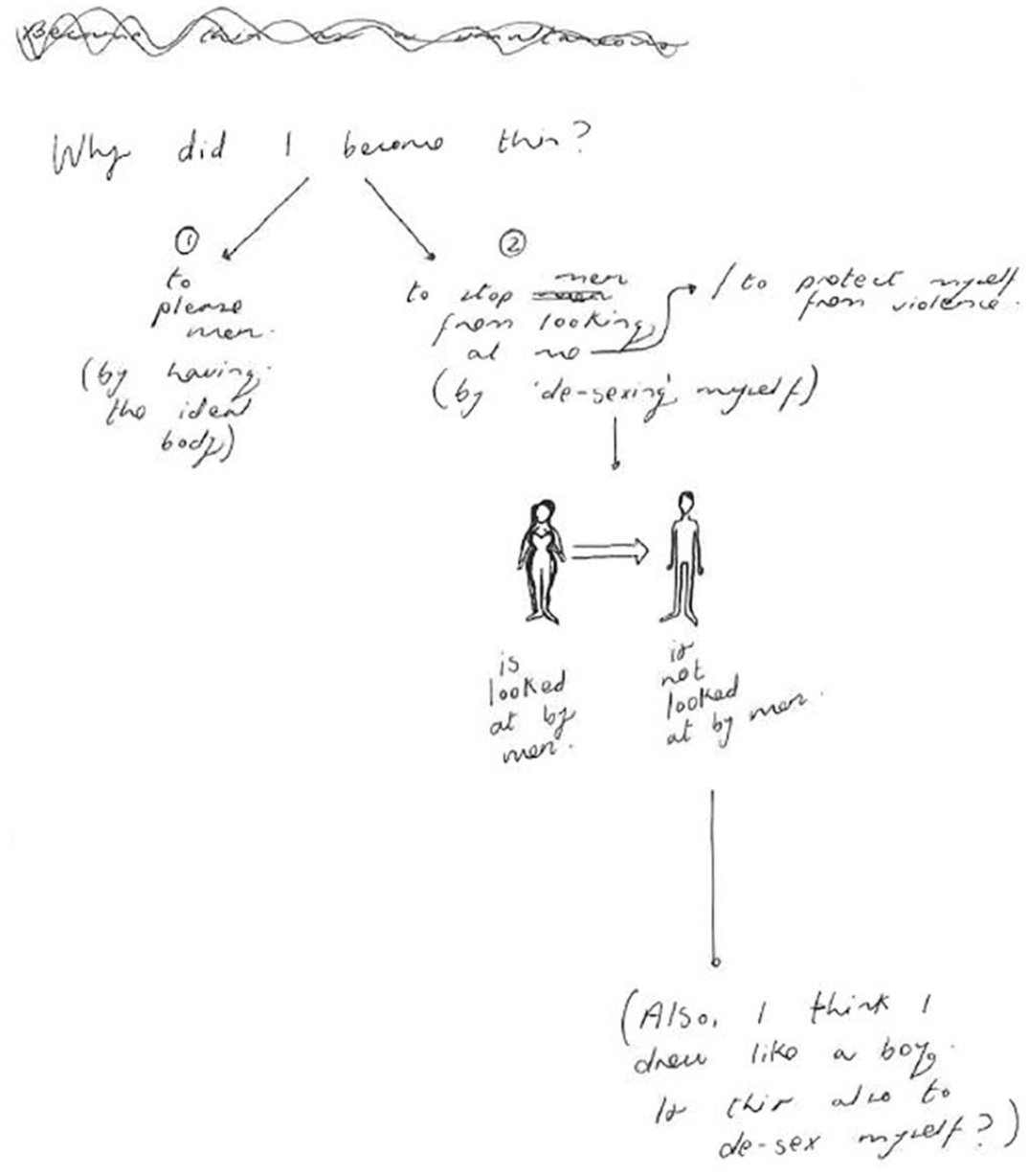
Image from Adeline’s notebook.
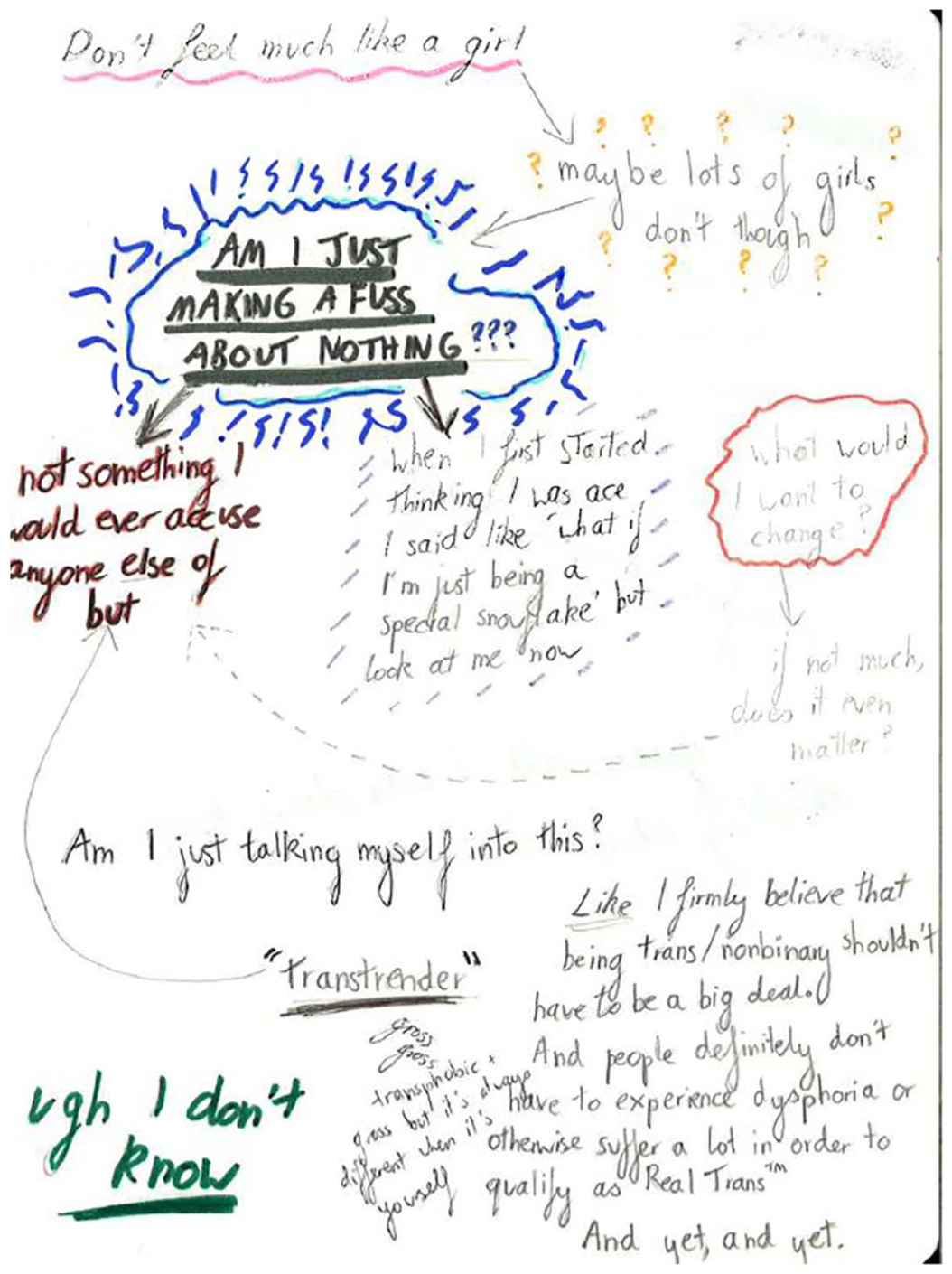
Image from Blair’s notebook.
Getting at embodiment?
The visual data from the notebooks (i.e. drawings, collages) proved particularly useful for ‘getting at’ embodied or sensory feeling. Some of the drawings and collages induced a kind of empathetic bodily ‘knowing’ in me as the researcher – a knowledge that was visceral and immanent (and so may well be considered epistemologically different). For example, Frankie’s drawing (Figure 4) gives an immediate feeling of the ‘weight’ of identifying as asexual. A sole figure at the centre of the drawing is being boxed in by the comments and assumptions of others. The specific comments themselves become less important than the cumulative and encircling effect that they have. Here the words themselves become the drawing, and arguably have more of an impact this way than they might have by being recounted as separate individual utterances in the interview. Likewise, another participant, Kai, could have talked in the interview about the sensory bombardment of sexualised imagery they see everywhere they look, 3 but in creating a collage (Figure 5), where the pages are covered edge-to-edge in images, and layered atop each other, the experience is communicated much more affectively. We are, for a moment, in Kai’s shoes, as we are forced to see and look at the imagery before us. In doing so, we gain an understanding of the sexualised ‘scopic regime’ through which ‘visual representations are part of social dynamics of valuing, pitying, othering, celebrating and stigmatising’ (McLaughin and Coleman-Fountain, 2019: 378).
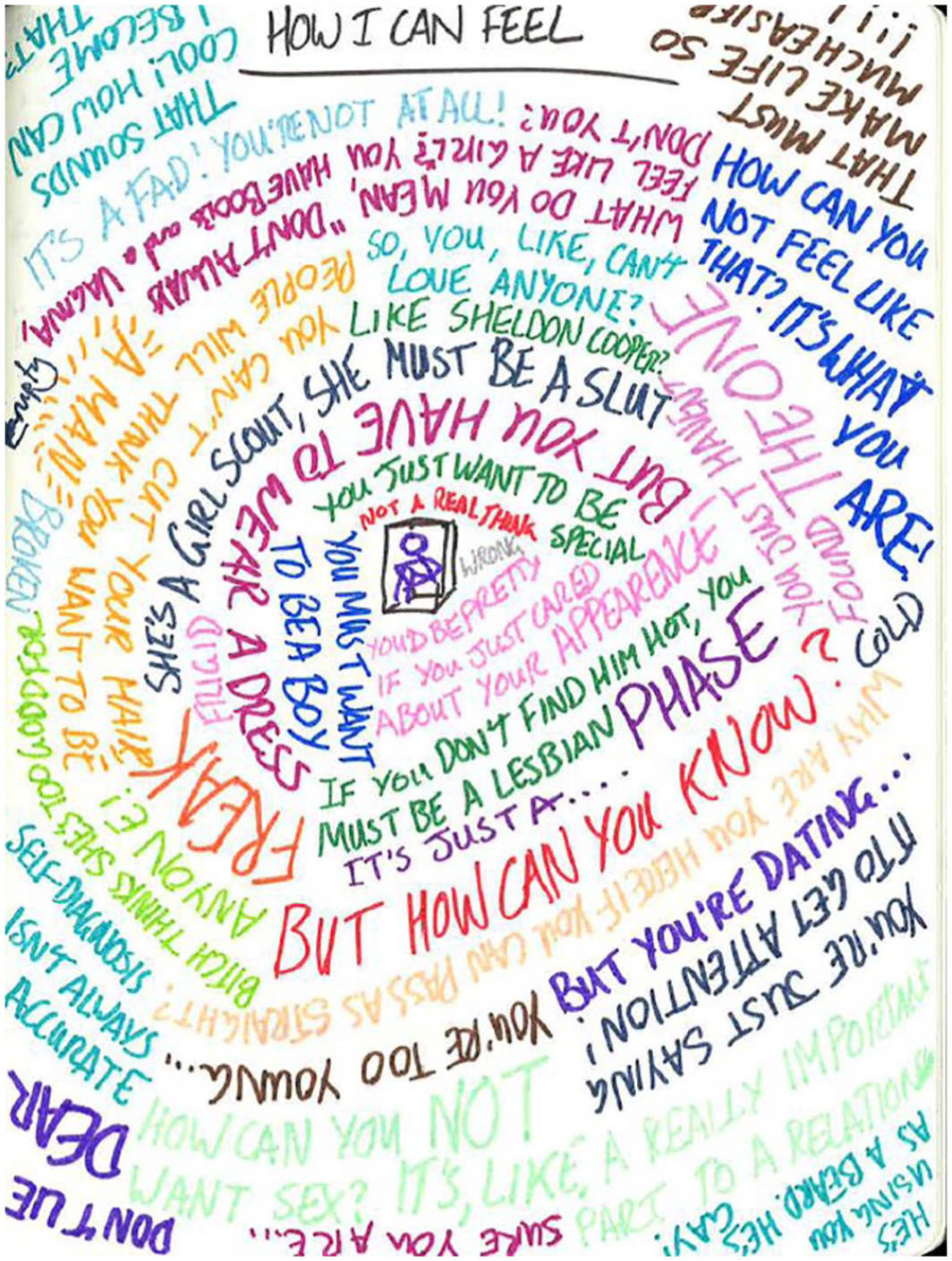
Image from Frankie’s notebook.

Image from Kai’s notebook.
In the case of Pippa (Figure 6), annotated diagrams give a sense of where she situates herself in terms of both gender and sexuality. To express these subject positions through words alone in an interview would again be possible but possibly convoluted and lengthy; the diagrams instead elicit an immediate comprehension because we can ‘see’ exactly what Pippa means. They are also useful in provoking a reflexive response in the viewer as they implicitly ask a question of our own situatedness – where would we position ourselves? In both Kai’s and Pippa’s cases, connections of empathic understanding are generated between participant, researcher and reader, facilitated by the immediacy and immanence of the visual format.
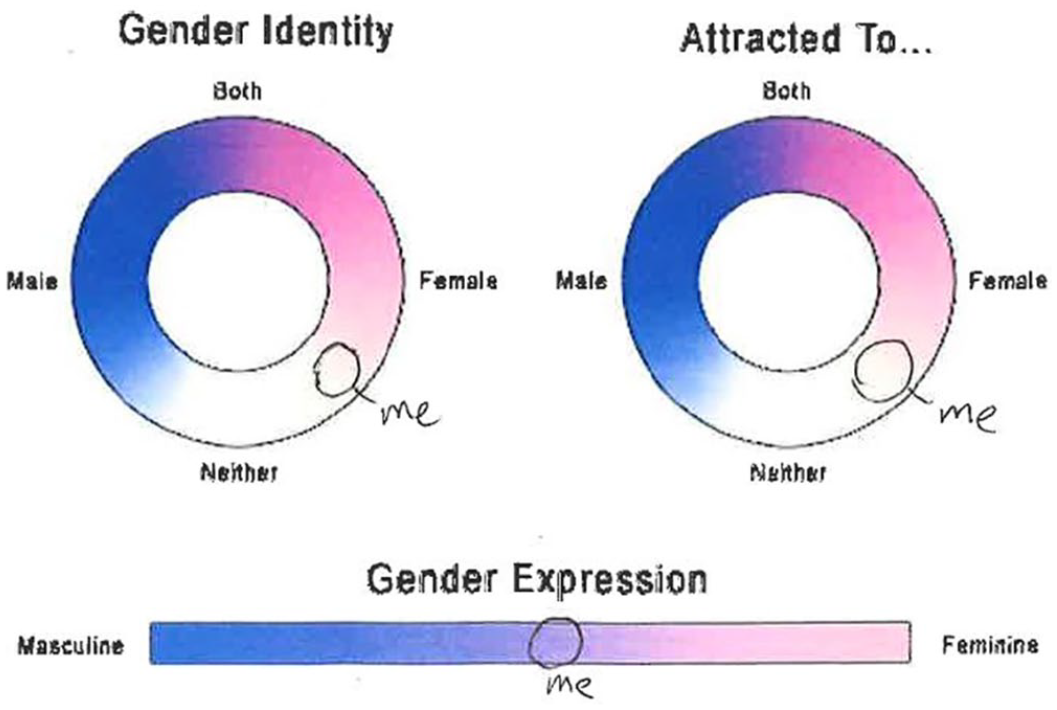
Image from Pippa’s notebook.
The expression of sensory and bodily feeling also came through in some of the written notebook material. For example, Jeffrey wrote about how he conceptualised his (unwanted) sexual feelings in terms of a Cartesian mind/body split, and how his male body often felt like it was betraying him: I am made aware of the ‘beast’ that whether I like it or not is there, deep down inside me. Just because I (and I am my intellect and my higher finer emotions) find the very idea of sex repellent doesn’t mean my body is incapable of functioning as a male body should do. . . My monster from the id, my primal beast within, goes rampaging about in the world of my dreams, causing havoc in the ‘pyjama area’. Or at least it used to. I’ve pretty much got it under control nowadays by no longer sleeping in a bed. If I sleep in a bed, if I get all comfortable and snug, that’s when The Beast strikes. So I sleep propped up in a chair. My sleep is fitful, and that probably contributes to my general irritability but it’s a price worth paying I think.
From this, we get a sense of the phenomenological discomfort Jeffrey feels in his gendered and sexed body, and the lengths he takes to alleviate this. We can feel the bodily effort it takes in keeping the beast from the door, as sleeplessness and pain gnaws at the edges of Jeffrey’s narrative/consciousness. Such vivid literary renderings were not present in any of the interview data. Thus, the presence of embodiment in the notebooks was facilitated not only through format (i.e. visuality) but also through time and space: the asynchronicity of the notebook allowed such close and intimate stories about the body to emerge.
This is not to imply that more traditional methods such as interviewing, focus groups and participant observation are ‘bloodless’. It is an important reminder that not only do we generate data about embodiment, but that data also come through embodiment, and here it behoves researchers to think through the ways in which interviews or focus groups or ethnographic experiences are always-already embodied encounters (Chadwick, 2017; Ellingson, 2017). Bodies of participants and researchers are ‘implicated as sites of knowledge production’ (Ellingson, 2006: 299) as, for example, gendered, racialised and classed embodiments may generate multiple vectors of (dis)identification, serving to simultaneously open up particular possibilities of meaning-making, whilst closing down others. Chadwick (2017) has also suggested some methods – such as poetic transcribing – to capture embodiment in qualitative data such as interview transcripts where ‘fleshy voices’ may not always be heard at first. Thus, attuning oneself in different ways to ‘traditional’ research encounters to see the embodiment already there is also an important consideration.
Empowering?
There were some participants for whom the notebook was clearly more empowering. An interview with one participant lasted less than 30 minutes, and in my notes written immediately afterwards, I lamented anxiously over how stilted it felt, and how my various attempts at questioning and probing had fallen flat. Yet, when this participant returned their notebook to me, it was full of long, complex and rich narratives and reflections that had not been present in the interview. In this case, it felt like the notebook afforded this participant a better means of participating in the research, removed from the stressful and expectant face-to-face interview setting. For this participant, it allowed them ‘to find the most suitable way of telling their story’ (McDonnell et al., 2017: 533).
However, I want to reflect on the ways in which the notebook had particular classed resonances. All but one of the participants who completed the notebook could be reasonably considered middle-class, based on various markers of economic, social and cultural capital that emerged in our interactions. There were a number of middle-class participants who of course also declined to participate, but it seems relevant that only one working-class participant took me up on the offer to take part. There is much literature on creative and arts-based methods being used successfully in research with working class and poor communities and individuals, but I would like to pause and think about how methods themselves might be classed, or how they might reproduce class.
Skeggs’ (2004) work on class and reflexivity is particularly relevant here. Rather than a necessary condition of post/late modernity as suggested by some sociologists, Skeggs (2004) traces the reflexive authoring of the self as part of the historical formation of bourgeois moral personhood, and argues that today, the ‘narrativization of one’s experience is a [classed, gendered and racialized] resource’ (126). Being [able to be] reflexive is, Skeggs argues, about seeing oneself as ‘having a self worth knowing, a voice worth hearing’ (2004: 133). Not only does class facilitate this kind of reflexive narrativization, but class is made and re-made in these acts themselves, as actors present themselves as particular kinds of competent, rational and knowing subjects (Allan, 2012). In her work on reality television with Thumin and Wood (Skeggs et al., 2008), Skeggs relates this specifically to the methods of social science, asking us to consider what assumptions around reflexivity, voice and worth inhere in our methodological choices. The researchers note how their middle-class participants easily and readily produced the reflexive authority required by the interview (and which is typically valued as ‘data’) – and how their working-class participants, in contrast, could or did not. However, in the ‘affective and immanent’ methodology of ‘viewing sessions’ where participants were recorded watching and responding to television and to each other, the working-class participants drew on an entirely different kind of ‘moral authority’ – a kind of knowing that was not the same reflexive articulation as expressed by middle-class interview participants, but one with equal epistemic value. As such, the authors warn that ‘research methods prefigure the mobilization of class capitals’ (Skeggs et al., 2008: 6) and methods can ‘reproduce what is in fact a demonstration of unequal access to cultural resources’ (21).
Whilst Skeggs and colleagues are suggesting that interviews might privilege more middle-class forms of subjectivity, I extend this to argue that such processes are even more likely to be at play within creative methods. Arguably, these methods require even more of the reflexivity and narrativization of the self that we see in the interview, as participants are less guided by the immediate interlocutions of the researcher. In thinking through the demographic profile of the participants who took part in the notebook element of my research, for the middle-class participants I suggest that being asked to be reflexive in the way prefigured by creative methods is part of a middle-class habitus, and the event of someone seeking and valuing their voices is not unusual or strange. ‘Creativity’ may also be seen in a way similar to reflexivity: who ‘gets’ to be creative, or is interpellated as ‘creative’ or ‘artistic’, is heavily structured along classed lines (e.g. Allen and Hollingworth, 2013; O’Brien and Oakley, 2015). In much of the methods literature, a commonly reported experience is of participants feeling insecure or unconfident about their ‘creative’ abilities, but whether or not this has classed parameters is rarely discussed. As Negus and Pickering (2004: 118) write, class alongside gender has ‘defined the denials and limits of creativity. . .they can be internalized as part of who people believe they are or are able to become’. It may be useful then for researchers to think about the distribution of ‘creativity’ and ‘reflexivity’ as a social resource, rather than something that inheres in individuals and to which all (potential) participants have equal access to, and how the ways in which we deploy methods might unintentionally reify these inequalities.
It is also not clear that the follow-up interview in which the participant and I talked through the notebook did anything to destabilize the researcher–researched hierarchy. These interviews were envisaged as (an attempt at) co-interpretation in line with the democratising ethos of the notebook. Yet in practice, they simply provided opportunities for clarification and further exposition regarding the notebook material rather than ever amounting to a collaborative interpretation. There are some possible explanations for this. Ultimately, the material was being produced for the purposes of my PhD research, and I had the final say over how it was (re)presented, so the power differentials were inherent (Stacey, 1988). This may be inevitable in all but the ‘purest’ of participatory action research. But, I also got the sense, from some participants, that my attempts to involve them in the process were going against their expectations about how research is supposed to go, in that they ‘give’ me information, and I do the analysis. Some participants also seemed genuinely comfortable with this – one participant even told me that they couldn’t wait to read my PhD because they were intrigued by what my interpretation of their notebook would be. This is, of course, no argument at all against ‘participatory’ research, but an important reminder that we must not assume that participation in the research process (in the form of interpretation and analysis of data) is desirable for all participants.
Conclusion
This article has identified and interrogated three broad claims commonly made about creative and arts-based methods: that they can generate an epistemologically different kind of data, that they are particularly good for researching embodiment and that they can be empowering for participants. These three claims influenced my decision to integrate a creative element (what I termed ‘creative notebooks’, incorporating a number of commonly used creative/visual modalities) into my research. Critically reflecting on the process of using – and the resultant data from – the creative notebooks, I have highlighted how these claims were ultimately borne out through my particular research context, discussing both affordances and tensions. Some of these affordances and tensions may of course be related to the specific parameters of the research and characteristics of the participants; yet I maintain there is enough here to make some broader comments about the use of creative notebooks and creative methods more generally.
The exploration of embodiment and the expression of complexity, contradictions and ambiguities afforded or facilitated by the notebooks emerged as a key strength, and as the claims from the methodological scholarship that were most tangibly borne out. The use of the physical space of the notebook page, the immediacy and immanence of visual materials, and the weaving together of different elements created an affect/effect that was unlike any of the data generated by the interviews, allowing for a more visceral and intuitive understanding of participants’ (embodied) life worlds. I suggested that we may think of this in terms of an epistemological queering, where stories and accounts may be given (literal) space to unfurl and spread and transgress the boundaries of either/or.
Conversely, I remain more dubious about the empowering potential (in terms of inclusiveness or democratising effect) of creative methods. Undoubtedly, the notebooks provided a better means for some participants to tell their stories. But in the context of my research, whether or not the notebooks were ‘empowering’ may well have been dependent on participants already being empowered with particular class privilege. The fact that all but one of the notebook participants were middle-class led me to reflect on the classed implications of creative methods. Creative methods, perhaps more so than interviews, require ‘reflexivity’ and ‘creativity’ of participants. A sociological perspective asks that we see these not as inherent qualities of individuals (i.e. something that middle-class people possess and working-class people lack), but rather as unequally distributed social resources that allow particular voices and subjectivities to be seen as worthier than others. Creative methods may reflect particular middle-class ways of ‘knowing’ and of expressing that knowledge and may thus be understood as an extension of the usual solicitation of middle-class voices. This is a novel point that is largely absent from existing methodological scholarship and one that would benefit from more sustained analysis and discussion. Expressed more positively, this may also mean that notebooks and creative methods are particularly well-suited for exploring the contours of middle-class-ness – and particularly the performativity thereof.
Like the ambiguities afforded expression by the notebooks, there is therefore no ‘one story’ – good or bad – about creative methods to neatly wrap up this conclusion. I end instead by offering some points for consideration for researchers considering using creative methods, and notebooks in particular. Notebooks are, overall, an excellent method for combining different expressive modalities, as evidenced by the diversity of material showcased in this article. Where one is not sure, for example, whether or not collage-making, diary-writing or drawing would be the best creative modality to deploy in the context of a particular topic, the use of notebooks allows room for all of these and more, and is, crucially, guided by the participant. Yet, researchers should also be aware that many participants may opt for modalities that privilege words and language, if given a choice. Even if they do not, creative artefacts may be ‘rendered discursive’ in their telling – for example, if researchers conduct follow-up co-interpretative interviews with participants which may be viewed as an important part of an anti-hierarchical ethos, or when researchers come to use these artefacts in academic scholarship. The epistemological context in which creative materials ultimately will end up – between the covers of a bound PhD thesis, in the confines of an academic journal where, for example, images might be given an equivalent word count – is something to bear in mind. It is not simply the epistemological status of the data that should be considered, but what can reasonably be done with it. To this end, researchers considering using notebooks or creative methods might, if possible, carve out additional and alternative epistemological spaces, such as exhibiting or showcasing the materials virtually or in person, where different kinds of engagements might be generated.
Of course, whether or not the potential ‘discursive fate’ of some creative materials is a problem requires some soul-searching on behalf of the researcher. Using creative materials asks – or should ask – us some tricky questions about ontology and epistemology, which is a key strength of this method. Thinking – and perhaps journaling – reflectively on questions such as ‘do I think there is a pre- or extra-discursive realm (and can it be accessed)?’ and ‘what exactly is this data?’ is a key part of the process of using creative methods that is perhaps often not emphasised enough but is essential if they are to be used in a meaningful way. It is also highly likely that there will be no clear answers to these questions, which can be uncomfortable and frustrating, but I suggest that even the asking itself begets rigour.
Finally, I would also caution researchers not to think of creative methods as an easy or guaranteed way to ‘democratise’ research – indeed, as I have already highlighted, they may do the opposite in reproducing particular classed dynamics. How to negotiate this is, of course, much trickier. It may be the case that creative methods conducted in group settings could mitigate some of the tensions around ‘creativity’ and ‘reflexivity’ if there is a sense of it being more of a communal endeavour, or as an activity that lasts only an hour or so, rather than something to dwell upon for weeks or longer. The use of particular methods – such as Lego or plasticine modelling, or collage-making – where there is less emphasis on creating something from scratch but rather on working with existing materials or have associations with childhood games rather than ‘art’, may also be something to consider. Of course, what may be gained here in terms of inclusiveness will mean losses, too – for example, losing what is afforded through aysnchronicity. Creative methods may also be more inclusive if they are embedded as part of broader participatory research structures where participants are much more involved through every stage of the research and use the results of the research for effecting some kind of social change or action. This way, creative methods may be framed in less individualising ways that put onus (even unintentionally) on one individual’s creative output. Finding a way through these tensions is important as creative methods offer us undoubtedly powerful and rich tools in our methodological arsenals and are therefore tools we should be constantly seeking to interrogate, refine and improve.
Footnotes
Disclosure
The author declared no potential conflicts of interest with respect to the research, authorship, and/or publication of this article.
Funding
The author(s) disclosed receipt of the following financial support for the research, authorship, and/or publication of this article: This work was supported by an Economic and Social Research Council +3 doctoral studentship (ES/ J500136/1) held at the University of Glasgow.
