



Abstract
In this article, we remember experiences of our participation in an artistic event for youth of African descent in a Norwegian city to reflect on the potential of arts-based methods for exploring migrant and diasporic youth identities. Reflecting on the process of curating an event titled Afrikanske Dager in Drammen (African days in Drammen) involving young Africans in a Norwegian city, we demonstrate the methodological potential photography making, exhibition and dance performance. We show how processes of collaborative photography making provide spaces for participants to negotiate and think through identity and self-representation. We tease out the potential of dance choreography and performance as avenues for participants to embody and retell old histories from the archive of African presence in Norway. We discuss how the event making process was the site of unstable hierarchies where roles and positions constantly changed and highlight the power relations involved in the collaborative production of knowledge from artistic practice.
Introduction
In this article we revisit our memories of a past cultural event that we collaborated in to highlight the potential of arts-based methods for exploring African migrant and diasporic youth identities. It is based on reflections developed in the aftermath of a cultural event in Drammen, a port and river city in Norway that the authors participated in organizing. The event titled Afrikanske Dager in Drammen (African days in Drammen) aimed to provide youth of African origin a platform for displaying their identities through artistic expression in the form of a photo exhibition, a dance performance, and a rap and slam poetry concert. The event generated a series of aural, oral and visual cultural artefacts and experiences all worthy of attention, from a methodological point of view, but however, our focus in this article is on the production of dance performance and the photo exhibition.
We chose to revisit this event that took place in 2014 because it was our first experience with closely engaging with artistic techniques, and collaboration between academic research and artistic practice. By ‘we’, we mean the first author, Henry Mainsah, an academic researcher in media and design based in a Norwegian university. He participated in curating the event as a research consultant. In the years after the event, he has increasingly integrated artistic techniques, methods and collaborations in his research. ‘We’ also refers to the second author, Nicole Rafiki, a woman of African descent, who was the creator, owner and director of the event. At the time of the event, she was in the same age group as the other participants and a novice in the world of art. She has since developed a career as a visual artist. Prolonged dialogue and reflection in the years after the event culminated in this article, which is an experiment in extending the trajectory of collaboration from the conception and making of an event to writing about it.
We chose to remember this event because although not part of an academic research, it provides a fruitful avenue for imagining a methodological framework for cross-disciplinary collaboration between academic research and artistic practice. This article aims to 1) explore the kinds of methodological affordances for performative visual and embodied inquiry that might emerge during the curation of creative events, and b) to examine how different power dynamics might play out in processes of creative co-production. We reflect on and demonstrate the methodological potential of photography making, exhibiting, and dance performance. We show how processes of collaborative photography making provide spaces for participants to negotiate and think through identity and self-representation. We examine the potential of dance choreography and performance as avenues for participants to embody and retell old histories from the archive of African presence in Norway. We discuss how the event making process was the site of unstable power relations where roles and positions constantly changed. It demonstrates possibilities for participants to work as co-researchers to explore personal and collective identities through creative and innovative visual and sensory methods.
The article draws its inspiration from Puwar and Sharma’s (2012) suggestion for researchers to explore practices of curating - that involves cross-disciplinary collaborations and engaging in creative practices such as drama, event, visual genres, exhibitions, and choreography - as a way of developing inventive methodologies for conducting social research. Puwar and Sharma’s approach to ‘curating sociology’ involved collaboration with artists and engaging non-academic audiences, underlining ‘a methodological commitment to collaborative knowledge production for creative public intervention and engagement’ (Puwar & Sharma, 2012: 43).
Arts-based research methods
The use of curating as a form of inquiry is a practice that falls within the umbrella term arts-based research (ABR). ABR covers a variety of artistic approaches to generating, interpreting and presenting research, such as theatre, collage, painting, music, photography, poetry, narrative writing and dance (Barone & Eisner, 2012; Leavy, 2015).
Arts-based methods that researchers have used to engage with migrants include photography and filmmaking (Gatta, 2019; Puwar, 2012; Stavropoulou, 2019), cartographic storytelling (Musiol, 2020), drawing (Bagnoli, 2009; Guruge et al., 2015), body-map storytelling (Gastaldo et al., 2012), participatory poetry (Norton and Sliep, 2019) and collage making (Vacchelli, 2018). Scholars have demonstrated the ability of theatre and performance to engage desensitized audiences, tell stories about migration, confront the bodies of performers with the bodies of spectators, and transform nameless migrants into individual agents with memories, histories and identities (Mcneal et al., 2020). Participatory theatre and walking methods might constitute a convivial practice challenging prevalent racist discourses on migrant families, through building creative groups to express and publicly share their lived experiences (Kaptani et al., 2021)
Researchers recognize the ability of poetry, for example, to engage and challenge audiences in affective ways to reflect on the human experience (Prendergast, 2009). Poetry can serve as a means of analysing and generating different ways of knowing social worlds. Producing and sharing poetic representations helps researchers become more attuned to the experiences of others and to oneself (Sparkes et al., 2003). Visual arts-based methods such as photo elicitation and photo-voice, for example, can provide a medium for articulating people’s visions and voices, recognize their expertise, and enable them to become advocates for their community (Harper, 2002; Wang, 1999). These tools serve to adapt and mobilize the tenets of creative arts to address research questions in holistic and engaged ways (Leavy, 2015), positing forms of research that blend theoria (knowing), praxis (doing) and poesis (making) (Irwin, 2004).
Arts-based methods can serve to underline the importance of ‘narrative and storytelling, of emotion and feeling, and of the transformative power of visual and textual languages’ (Jeffery et al., 2019: 6) as a knowledge base for revealing how representations are deeply entangled in the experience of migration and border crossing. Artistic methodological practices serve as processes of discovery by offering migrants spaces to ‘review, revise, and reconstitute the often-scattered shards of memory, culture and identity’ (Ahmed, 2011: 11) that represent the migrant experience. Arts-based methods can also provide avenues for migrants to make themselves visible in urban landscapes (McAllister (2011)
Langué (2019) has called for a widening of the borders of curatorial practice within the context of migration in order to fully capture the ways in which geographies of mobility and heterogeneous ideas of globalization overlap. Cultural theorist Stuart Hall, in an interview with Mark Alizart (Alizart, 2005) for the event Africa Remix at Centre Pompidou articulates this vividly when describing his interest in collaborating with Black British artists: ‘…I go to the art of these young artists with this broken double experience of migration, dislocation, translation, hybridization, you know, all of those experiences ... something about the way in which these forces disorganize and reorganize our visual experience, and I can’t get that from any other source but from art. So, I experience the contemporary arts … the arts in its wider sense as giving the access we cannot get in another way to the cultural subconscious of the new subjects...I hear those voices in art, in music, in literature, in poetry, in dance. I hear those voices which cannot yet realise themselves in the lives of collective social subjects.’
It is precisely within the displaced languages of artistic forms such as dance and poetry that we see possibilities for enriching both research methodologies and critical artistic practice for exploring migrant youth identities. In this regard, arts-based methods might enable us to produce the kinds of knowledge that is ‘generative rather than propositional and based on assumptions that reflect the multidimensional, complex, dynamic, inter-subjective and contextual nature of human experience’ (Cole and Knowles, 2011: 124). By doing so, we envisage creative ways ‘to illuminate something about the social world, sensitively portray people and their circumstances, develop new insights about the relationships between our sociohistorical environments and our lives, or disrupt dominant narratives and challenge biases’ (Leavy 2015:17).
Bishop (2012) highlights collectivity and collaboration as two key features of contemporary art and exhibition-making practices. These practices also involve other participatory forms of ‘relational aesthetics’ (Bourriaud, 2002) that artists and social scientists draw on in their work characterized by a high level of intersubjectivity, encounter, togetherness, conviviality and sociability (Bachelet and Jeffery, 2019).
Within the framework of participatory research, creative and arts-based methods and techniques raise issues of power, hierarchy, and the location of knowledge (Brown, 2021). Creative and arts-based methods offer possibilities for challenging hierarchies and reducing power differentials between participants and researchers. However, as Brown (2021) argues, the employment of arts-based methods does not automatically translate into a participatory and egalitarian research process, highlighting the difficulties in ensuring and guaranteeing genuine participatory processes within creative and arts-based research projects. Awareness and reflexivity over how power shifts depending on the positionality of the researcher in relation to the participating communities is important. Equally important are questions about the power of decision making during the process, whose voices are privileged and heard, and how power is exerted in the construction of knowledge (Muhammad et al., 2015)
The participants
The event on which this article is based, kicked off with a panel discussion and a photo exhibition, followed by a dance performance performed by a choreographer accompanied by a spoken word artist. The afternoon program featured a series of workshops on dance and on creative writing by professional songwriters. The event ended with an evening concert featuring reggae, hip hop, rhythm and blues, and spoken word artists.
The Afrikanske Dager event came into being through a creative and collaborative process involving youth of African descent from the Norwegian city of Drammen and surrounding regions. As participants they took up a variety of roles as, curators, managers, publicists, researchers, community activists, photographers, photo models, dance choreographers and poets.
The production of the photo exhibition was developed through a series of preparatory workshops and photo shoots involving six female and two male young participants. The dance performance involved two participants, a poet and a choreographer. According to the original plan, the poet and choreographer were to develop a dance choreography together with a group of youth and train them to perform it through workshops. However, due to practical reasons this plan did not come to fruition, so they had to carry out the whole process themselves.
Participants in the dance and photo exhibition were recruited among youth from Drammen and Oslo through personal networks and a snowballing method. The participants were aged between 16 and 25 years old and were at the time active in local cultural organizations. To oversee the preparations leading to the event, a planning team was set up comprised of participants from the photo exhibition and dance production groups, including Nicole.
Revisiting memories
To generate the reflections that form the basis of this article we have drawn on debrief sessions and discussions with the participants and our own memories of what we observed. We engaged in memory work (Haug, 1992), a methodological approach based on the active practice of remembering that takes an enquiring attitude towards the past and the activity of its (re)construction. Memory work does not assume the transparency and authenticity of what is remembered, but rather sees memory as material for interpretation to be interrogated and mined for its meanings and possibilities (Kuhn, 2010).
Later in the article we discuss the issue of authorship and why the other participants did not feature in the writing of this article. This article took several years to write. It involved numerous meetings in different venues such as cafés, libraries, offices, as well as numerous email exchanges. During these meetings, we have over the years discussed our experiences and observations from the event. We have revisited details of what happened in the different meetings and workshops with participants during the planning of the event. During this process of remembering, we have revisited archived photos of the preparatory activities, social media accounts we used for planning the event, and photos and a video from the day of the event. In this regard, these different visual traces the cultural artifacts that served us as both ‘repositories of memory’ and as ‘aids to remembering a personal or a shared past’ (Kuhn, 2010).
We have given each other writing prompts. We have each written individual descriptive accounts of the event, and our reflections on these. During different iterations we have met to discuss the text and to merge our respective forms of expertise to fit the genre of an academic journal article. We have tried to curate the text so that it portrays a common unified voice, but at the same time retaining a quality of multi-vocality.
Affordances
In this part of the article, our discussion focuses on the process of preparing for the photography exhibition and the dance performance segments of the Afrikanske Dager event to illustrate a series of curatorial and artistic practices that demonstrated the methodological potential of embodied performance, collaborative image making and exhibiting.
Performing with the camera
A photo exhibition is often the culmination of a process preceding it that involves background research, which informs the selection of themes, working with models, scenes, poses, photo shoots, editing images, selecting images and methods of presentation.
The photo production process started with a series of workshop sessions facilitated by a professional photographer where participants learnt technical and artistic skills. After that they were to develop a theme and develop photos that would feature in the exhibition. The process of photographic production leading to the exhibition provided a rich space for creativity, reflection and negotiation about identity performance.
Images documenting photography workshops and photoshoot sessions that we browsed through show participants trying on different types of dress attires and trying out different types of poses in front of the camera. Other participants were shown standing behind the camera taking pictures. During the workshop sessions they engaged in brainstorming and consulted archives. Sources consulted included, for example, British-Nigerian artist Yinka Shonibare, who in his work, creates life-size sculptural figures meticulously positioned and dressed in vibrant wax cloth patterns made up into European 18th-century dresses. Shonibare uses his work to articulate a post-colonial critique of the meaning of cultural and national definitions by making cultural signifiers of national and racial identity complex and difficult to read.
Among the images discussed during the brainstorming segment of one of the workshops, but which were not shown in the final exhibition, were a series of portraiture-styled photographs taken by Nicole. The images were originally meant to be used as publicity material for the event. The images featured black African models wearing Norwegian traditional costumes, and white Norwegian models wearing traditional African attire. The idea was to reflect cultural exchange and to suggest that national dress symbols could be used fluidly. Could a white Norwegian boy freely embody sartorial symbols of African identity in the same manner as a black Kenyan girl could wear her natural hair (afro) and appropriate a symbol of Norwegian tradition by posing for the camera wearing a Bunad? Such images serve as useful prompts for critical reflection about clothing, representation and cultural appropriation within societies shaped by racist and colonial legacies.
Bachelet and Jeffery (2019) point out that it is important, in collaborative arts-based projects involving image production, to pay attention to photographic or filmmaking processes because they might generate insights concerning how participants decide what to capture and how they negotiate such decisions in a group setting. The images put on display and the ones used for marketing the event embodied a wide variety of subjectivities, perceptions, interpretations and performances of identity. The process of producing these images involved prolonged contentious negotiation among the participants. From our engagement both as active participants and as observers in the process of developing the exhibition, we could discern how performing the photographic act creates a space for a reflexive, embodied, and relational engagement that may activate new questions, thoughts, and ways of seeing our identities. In this regard, Coats (2014) suggests that we consider the camera as a ‘nomadic weapon’ that invites the image-maker to engage in an ‘activity of thinking’ through which she can begin to see aspects of the self and the community through a new prism.
Picturing selves
The pictures that ended up in the final photo exhibition on the day of the event were evidence of a significant departure from the initial idea envisaged at the beginning of the project.
One of the images depicted a girl with her back turned away from the camera wearing a patterned dress made of Dutch wax with the back open. Another photo showed a female model with features, which according to the participants represented people whom a certain segment of the Norwegian public commonly associates with Islam and wear the Hijab. By staging the image to depict a young woman with a seemingly carefree attitude literally ‘letting her hair loose’, the participants wanted to challenge mainstream representation of the identities of a category of women regularly talked about in stereotypical terms.
In another image, we see a white female model with drawings of parts of the face on her hands and her fingers partly concealing her face, but spread apart to reveal an eye staring into the camera. The image, according to the participants, depicted a person figuratively speaking, wearing a mask to hide their identity and personality. The model in the picture places her hand with drawings of an eye, half a pair of lips in a manner that suggests that there is a second face on the juxtaposed on the model’s face, but which at the same time harmonizes and somewhat completes the face of the model.
The remaining images showed models dressed in different attire representing a variety of sartorial styles common within youth culture: the sporty/cool, the girly/pretty and the rebel. They represent different ethnicities and cultural backgrounds but share a common belonging to youth culture.
We join Seko and Van Katwyk (2016) to suggest that such artful representations create an open space for dialogue between artists and researchers, readers/perceivers and research participants wherein all participants can bring together a range of perceptions, emotions and experiences to co-construct situated understandings.
Seeing selves in the show
Commenting on an artistic project’s exhibition in London, Les Back underlines how meaningful it is for the subjects of photography to be present ‘to see themselves in the show’ (Back 2004: 138). Back suggests that being present to see and tell other visitors about their photos allows subjects to be ‘annoyingly human’ (Back, 2004: 138), and to feel acknowledged and taken seriously.
Back’s observation helped us make sense of the feeling of pride that some of the participants of Afrikanske Dager who were present at the exhibition expressed afterwards. One of the pictures taken to document the exhibition opening captured two female participants whose pictures hung on the wall standing beside the mayor of Drammen, smiling as they stared at the pictures on the wall. We later found out that they were explaining the meaning of the pictures and their aesthetic choices. In the video of the event, one of the participants who posed as a model in one of the pictures when asked about her experience of participating said: ‘It helped us see that this was something young people themselves could do. We came up with our own ideas and presented them in the exhibition’. Henry recalled that sometime during the exhibition opening someone suddenly recognized one of the male models present in the photos and asked: ‘Is that you?’ ‘Yes’, the boy answered, nodding shyly.
Commenting on their collaborative arts-based research project with migrants in Morocco, Bachelet and Jeffery (2019) suggest that the exhibition of collaboratively produced photography represents an extension of a continuous process of performative meaning making from the picture making process into the exhibition space. The Afrikanske Dager exhibition opening provided a space where visitors could hold the gaze of the participants being presented on-screen and simultaneously engage with participants physically present to answer questions. In a situation in which the participants perceived and were perceived, they performed mutually conditional roles as both actors and spectators. Our observation of the interactions between the subjects of the exhibition, the participants, and the visitors, enabled us to experience the role of viewing in an exhibition, and to attest to the photographic event as constituting of an infinite series of encounters that always remain unfinished Azoulay (2012) – quoted in Bachelet and Jeffery (2019).
Choreographing histories with poetry and dance
The dance performance took place at the children’s literature wing on the ground floor of the library building. Two female performers both dressed in black, walked onto the stage with black curtains in the background faced the group of people that made up the audience, who stood in an intimate semi-circle around the stage. One of performers wore a brown striped piece of cloth around her waist, and the other a matching headscarf, of the same fabric tied around her waist. The performer with the headscarf played the role of poet while the performer wearing the waistcloth was the dancer. The performers both moved to the rhythm of spoken word (Figure 1). Photo from the dance performance at the Afrikanske Dager event.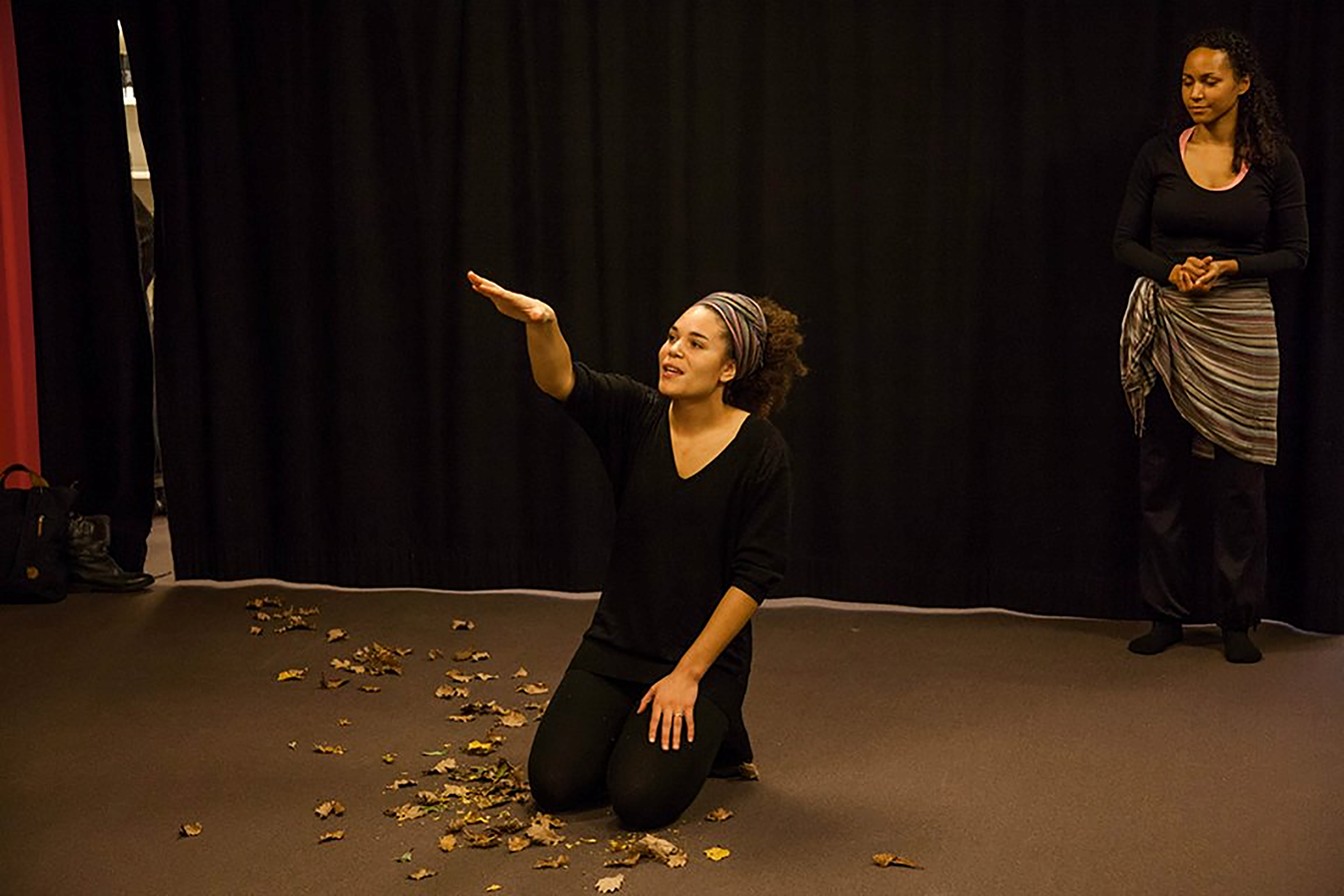
They performed a 15-minute-long piece merging dance movements and flowing to the rhythm of verse. The performance was based on the story of Kola Mangoli, who lived in Oslo (which at that time was named Kristiania) in the late 19th century. Kola was born in Liberia in 1880 and came to Kristiania on a ship with the Norwegian consul as a 13-year-old girl. She described herself as a princess abducted by a foreigner. She attended a technical school for girls and later worked as a maid. She was hospitalized for alcoholism and died on first of February1920. She was 40 years old. This story originated from a book on the history of African presence in Norway over the last four centuries titled Afrikanere I Norge gjennom 400 år (400 Years of Black Norway) (Falahat and Cisse, 2011).
In the process of reading through the book, the story of Kola Mangoli particularly gained the attention of the choreographers. She was one of the only few female persons in the book. Kola’s tragic story moved them. The performance aimed to portray and problematize the trope of the ‘exotic African’ child. The archived records of Kola Mangoli evoke the colonial era and its associated exoticized gaze on the African body.
The story of Kola Mangoli that featured Afrikanere I Norge gjennom 400 år was the result of several years of research by one of the authors, Yacoub Cissé at the National Archives of Norway, the institution responsible for preserving archive material from Norwegian state institutions. This work was part of a long line of efforts by artists, activists and scholars in Norway to make visible the prior encounters between Norway and people of African descent. The dance performance represented a desire to give visibility and voice to the lived histories of Africans throughout the last two centuries, through dance and poetry, using material from archives.
The attempt to convey the stories of people of African descent happens in a context where the dominant national narrative has been one of innocence and distancing from European histories of colonialism and racism (Gullestad, 2002, 2004). Revisiting, retelling and re-enacting these previous historical encounters (Johnson, 2015) through dance serves as a means of challenging the colonial amnesia that obscures the connections between the history of the Anglo European colonial enterprise, the necropolitics (Mbembe, 2003) of forced displacement and the presence of the descendants of colonized subjects in the metropole.
To create the choreography based on the story of Kola Mangoli, the dance duo sought to identify the emotional essence of her and her story and encode this into dance movements drawing on influences from classical African, contemporary Jazz and other dance traditions. Underlying their choreography was a desire to project different emotional states of mind to the audience through the body of the performer portraying feelings viscerally. The movements were composed to project the audience back in time to give a sense of how it could feel as a child 1880 seized from her home, living in a strange new land. Equally important was the desire to convey how it might feel to embody the exoticized ‘other’. The performers wanted to connect historical narrative with their own personal experiences as women of colour in Norway. They wanted to create a connection between how we saw girls and women of African descent in the past with how we see them in current times.
This performative approach through dance re-enactments constitutes an active (rather than reactive) and generative (rather than imitative) approach to ‘historical material’ (Burt, 2003: 39). In the exchange between the choreographers and the audience, historical narrative is reinscribed with new meaning as if to say, ‘I know you know this work, but what happens if we look at it from this point of view’ (Burt, 2003: 36).
Embodied ways of knowing
The performance invites reflection on the methodological potential of dance as an embodied way of knowing. In this regard, Lisiak (2016) suggests that innovative visual and digital methods for sharing knowledge provide new ways of challenging anti-immigration discourse. These methods mobilize affective understandings from the public by exposing personal stories that are embodied and using techniques of personal identification. From a methodological standpoint, it is interesting to examine the way the performers used their bodies both as a medium of learning and telling. This involves what Awam Amkpa describes as ‘training the body of the performer to be aware of the methodology of acquiring a text, situating a text in its moral landscape, and deconstructing the text deliberately’ (Amkpa, 2010: 84). Amkpa perceives such a process as part of an ‘aesthetic of fragmentation’ (2010: 84), where the act of fragmentation involves deconstructing archetypes and stereotypes.
When we think back about the experience of witnessing how the Afrikanske Dager performers created a symphonic dialogue through body gestures and words, it leads us to reflect on the potential of using the body through dance to learn, feel and communicate narratives. We draw on this as inspiration to imagine forms of qualitative inquiry ‘not only of the body, in the sense of the object, but also from the body, that is, deploying the body as a tool of inquiry and a vector of knowledge’ (Wacquant, 2004: viii).
The two performers used their bodies and words to perform a symbolic connection with the figure of a young African girl in a faraway past. Their performance can be connected to a rich tradition in Afro-Diasporic dance where in-motion black and brown dancing bodies draw from their fragmented experiences of displacement, dislocation, marginality and hybridity, to say and do something that cannot be otherwise said or revealed (Roberts, 2013). According to Rosemarie Roberts, the dancer, in the performance of her craft can create a trigger point to capture and unleash unsaid and unspoken meanings before they are obscured behind the invisible landscape of symbols, signs and utterances. This ties in well with her description of how gestures, postures and movements performed by Black and Brown bodies in hip hop dance, and the way in which the body gestures to speech, can serve as a call to action to produce cultural, historical and subversive knowledges (Roberts, 2013). Beyond words that black and brown dancing bodies say in action, and produce in motion in public spaces, they circulate the excess through which cultural and historical knowledges are embodied and made legible, creating possibilities for critical insights.
Henry who worked as an academic researcher on issues related to youth, migration and diasporic identities found the methodological potential of performing dance particularly interesting. As collaborators in the process of developing the performance, we had closely observed and appreciated the emotional labour and artistic skill that it took for the two choreographers in trying to imagine, embody and convey the essence of the life of this person, Kola Mangoli, who lived over a century ago.
He saw connections between the movement of the two performers similar research techniques articulated as part of embodied methodologies (Chadwick, 2017) in the social sciences. In this regard, Henry imagined how it could feel as a researcher, to study and embody a subject through body gestures similar to the way dancers do. He wondered what it could mean if he were to leave the safe distance of familiar researcher roles such as interviewer or observer in order to fully engage his body as an instrument, a source of knowledge. He thought about the participants that he had interviewed in previous research projects about their immigrant experience and issues of identity. He questioned what stories their bodies could tell through gestures postures and movement.
The ability of the performers to capture the attention of the audience with their bodily movements was a particularly appealing prospect. In confronting the body of the dancer with the bodies of spectators in the immediacy of the live performance, performers can transform nameless migrants into individual agents with personal stories, memories and identities (McNeal et al. 2020). Nicole’s main interest, while reflecting on the meaning and potential of dance and poetry performance, was in the ways these forms engage in ‘the process of telling’ (Becker, 2007).
Participation and power
In the following sections we discuss a series of dynamics concerning the positionality of different actors. We examine the forms of privilege embedded in identity positions among persons who occupy roles such as participant, researcher and project leader. We also discuss levels of power sharing in decision making processes, and power dynamics involved in the construction, writing and representation, of knowledge.
Negotiating perspectives roles and positions
The process of curating the event highlighted the shifting and unequal nature of power relations between the participants, including the article’s authors. As project leader and coordinator, Nicole sought to establish a non-competitive, non-intimidating and non-hierarchical spirit of collaboration where members of the planning team were encouraged to take responsibility and initiative. The process was organized in such a way that participants in the different artistic components of the event had a significant level of autonomy.
This was particularly the case with the groups responsible for the photo exhibition and the dance performance. While Nicole, as main coordinator initially sought to frame discussions on the overall direction of the photo exhibition, decisions about specific issues were arrived at through dialogue among the participants. As a result, the focus of the photo exhibition changed along the way. In the proposal for funding to finance the event, the theme of the photo exhibition was meant to be about African youth’s family histories within a post-colonial context. However, it was ultimately up to the participants to decide on the theme of the photo exhibition. They ended up deciding not to focus on family histories but rather on youth culture-inspired identity expressions. They wanted to signal their attachment to different youth popular cultures as part of their identities. As leader of the project, Nicole feared this choice would not convey the type of significant political message that she had originally envisaged when initiating the project.
Collaboration was also contingent on the type of expertise that participants possessed. Thus, the choreographer and poet, for example, had a considerable level of control in developing the dance routine and performance. This was a domain where the other participants had little expertise and therefore exerted limited influence. It was a learning experience where the rest of the group were able to observe in proximity, the making of the choreography and how they enacted stories of historic figures of African descent in artistic form.
There were times where Nicole, for example, switched roles from coordinator to participant during some of the photography sessions, learning the skills of the photographer and the mechanics of the photo shoot. Moreover, the dialogic nature of the photography sessions ensured mutual learning. The participants learned from the professional expertise of the facilitators. In return, the facilitators and the planning team saw themselves as learners of the personal histories, ideas and visions of the participants.
During this whole process we have been able to reflect over how the power dynamics between us have changed from the time we were participating the preparation of the event to the moment where we are working together to co-author a journal article. During the period leading up to the event, Nicole was the leader and project coordinator, while Henry held mainly in consultative role, with the same level of power as all the other members of the planning committee. During the production process Henry’s, academic research competence was of relatively marginal importance compared to skills such as photography, dance, poetry, modelling, event organizing and curating.
As Muhammad et al. (2015) point out, and as we will see in the next section, one instance where academic power and privilege can become omnipresent in co-creation projects is during the writing and representing of research knowledge, as academics are highly trained within this discursive field. For Nicole to participate in this article as a co-author, Henry first had to introduce her to the nature, form of a journal article on methods, and gave her prompts for writing text for the article. In this co-produced text, Henry occupied the powerful position of ‘author in charge’ (Down and Hughes, 2009: 83), although Nicole had editorial inputs into the article. Henry was responsible for developing the analysis, putting in literature references and ensuring that the text’s structure follows academic norms.
Writing and unequal relations in knowledge making
The writing of this article was motivated by the desire to pursue the collaborative ethos that underlined of the process that led to the Afrikanske Dager I Drammen event, through a process of co-writing. We originally set out to enact the practice of ‘working with rather than on participants’ (Sinha and Back, 2014: 475) throughout the cycle of the project, including the writing up of research. The aim was originally to ‘let’ research subjects speak for themselves, ‘allow’ them to claim their own space, and to ‘give’ them voice on the printed page (Down & Hughes, 2009: 83). The wish was to involve all the people that worked and featured in the event as co-authors in this article, but they expressed little interest in doing so. A genuinely participatory process would have implied that participants in the event feature as co-authors. However, this was not manifested in the writing of this article given that many of the main protagonists did not take part.
During debriefing discussions in the aftermath of the event, many participants expressed excitement and pride in taking part. They were pleased with the outputs that they generated during the event and how they had represented their views, experiences and aesthetic choices. However, when Henry proposed the idea, they all turned down the opportunity to participate in the writing of a journal article. They expressed little motivation for co-authoring an academic text and did not seem to perceive any benefit in contributing to a text written in an alienating academic genre. The participant’s reaction served as a good illustration of how the discursive form and context of academic writing can deter meaningful participation in research for young people (Fox, 2013).
Our experience has led us to question the value of using academic publications as a venue of collaborative knowledge production and dissemination with youth and community partners. Compared to this article, the event provided a more appropriate venue for conveying the voices of the participants. We concur with Bain and Payne (2016: 331), who argue that the process of legitimizing knowledge production in collaborative projects can engender ‘accelerating dynamics of de-participation and exclusion that can erode the progressive, inclusive politics of feminist participatory methodologies’.
Tentative spaces
The exhibition enabled the participants to appropriate and re-configure the library space where the photographs hung, to watch themselves on display, and to socialize among the images. By making them the creators and subjects of the photo exhibition at a public venue, the hope was to motivate the participants to use creative cultural expression as a way of participating in public life.
However, the space in the library where the photos hung was not a designated gallery. It was an en-route site of sorts where library visitors coming and going passed by. The photo exhibition was on display only for a month at the Drammen library. Later that year, the pictures were also exhibited during 2 months at the Antirasistisk Senter (The Norwegian Centre against Racism) in Oslo. Besides this, the only traces that remained of the participants’ artistic expressions in public space were pictures and videos posted on social media.
McSweeney and Stewart (2017: 146) argue that one main weakness of co-creation and community artistic projects is that impact is limited and that outputs ‘are usually exhibited (if at all) as temporary displays – on the sidelines, that margins, rather than the “heart”’ of curatorial institutions.
In a video, one of the panellists from the debate session that kicked off the event, a young female singer, rapper and songwriter, said the following when asked about her impressions: ‘We had a debate about identity, about who we are. This is about finding yourself. It is important that we have such debates, not only during Afrikanske Dager, but also amongst ourselves. Who are we? Who am i? … Most of all because I want to learn more. I want to learn more about myself. I want to learn more about others. I want all of us to come together again. We Africans should meet more and more often to learn from each other, to exchange views.’
Conclusion
We observe that there is a growing interest and demand for creative methodological practices and collaboration between creative practice and qualitative research. We suggest that one way of addressing this is to draw methodological inspiration from the creative techniques and collaborative practices associated with curating artistic events.
In this article we have used our reflections from a past artistic event to explore the potential of collaborative photography, exhibiting and dance performance as research methods. We have discussed how the processes of shooting, selecting and exhibiting of photographs with participants both in front and behind the camera opens up a space for negotiation and reflection about identity and self-representation. We have explored the methodological possibilities of engaging with the body in dance performance as a way of attuning to and conveying material from the historical archive. We have interrogated the messiness and unstable power positions that participants in collaborative artistic processes are called upon to negotiate.
Employing arts-based methods in the exploration of youth and migrant identities is hardly a new endeavour (Barone and Eisner, 2012; De Leeuw and Rydin, 2007; Gatta, 2019). However, this paper offers a methodological contribution from a situated northern European context regarding how to unpack the role of affordances, aesthetics and formal qualities of arts practices, in collaborative knowledge production. We make visible the types of insights that tangible, embodied and sensory aspects of artistic methods can convey about identities, histories and lived experience.
The article is also a response to Sinha and Back’s (2014) argument in this journal a few years ago, for ‘making methods more sociable’ in qualitative research, and for devising methods that are participatory and dialogic (2014: 475). Artistic practices of curating are suitable ‘because they are committed both to achieving transformative ways of producing knowledge and creating a kind of public around a problem composed of researchers, participants and audiences’ (Sinha & Back, 2014: 485). While this might make social science researchers more vulnerable, it might open an interesting space where different actors in the research context accept to navigate different roles – or be ‘othered’. It might constitute a rich space for sharing knowledge, expertise, skills, experiences, strengths and weaknesses.
We have used the context of an event to offer reflections on issues of power and positionality, politics of knowledge production, and spaces for minority youth representation in artistic inquiry. We offer these as contribution to participatory research practice so that ‘the plurality of perspectives that can be documented and debated will further enrich our understanding of participatory research’ (Lennette et al. 2019: 175).
Footnotes
Declaration of conflicting interests
The author(s) declared no potential conflicts of interest with respect to the research, authorship, and/or publication of this article.
Funding
The author(s) received no financial support for the research, authorship, and/or publication of this article.
