



Abstract
Summary
This article explores children's learning experiences from taking part in an educational intervention about social services in school. Data were collected from six group interviews with 27 children after they had participated in lessons about social services. Following a narrative evaluation approach, the analysis focuses on the narratives of change that are made visible through the children's shared reflections about their learning experiences.
Findings
In their narratives of change, the children presented the educational intervention as meaningful for them because it increased their knowledge about social services as a possible support function for children and families. Some of the children related their previous more negative perceptions of social services to a collective story building on the idea that social services take children away from their families. Through the educational intervention, this collective story changed in part into another collective story building on the idea that social services help children and families to improve their relationships.
Applications
The study shows that an educational intervention about social services in school has the potential to increase children's knowledge about social services and to influence in a positive direction the collective stories that shape public perceptions of social work. Although such changes in collective stories can be expected to benefit social work practice, welfare professionals must be careful to promote opportunities for children to share experiences of social services that challenge, as well as align with, any of these collective stories.
Keywords
Introduction
Children's rights to equal information and equal opportunities for protection and support are clearly defined in the UN Convention on the Rights of the Child, which is incorporated in Swedish national law since 2020. A governmental investigation for a new social services law in Sweden (SOU 2020:47), also strengthens social services’ responsibility for creating accessibility and carrying out preventive social work. The child welfare system in Sweden is primarily family-oriented with a focus on family support rather than child protection, something that is further strengthened in SOU 2020:47, which for example includes proposals that social services should offer more low-threshold interventions without means testing, so-called service interventions. A new regulation also states that children from the age of 12 can receive certain types of support from child welfare services without parental consent (Socialstyrelsen, 2023). An important means of enabling these ambitions is to ensure that social services’ target groups know what support is available and how individuals can benefit from it. Research shows that access to information on rights and available support may help children in need to better understand and put their own experiences into words (Jones et al., 2017; Vincent & Daniel, 2004), and awareness about issues such as abuse and neglect in combination with knowledge of available support may be important to encourage children and young people to seek help (Aadnanes & Gulbrandsen, 2018; Jones et al., 2017). Thus, disseminating such information to children may contribute to enabling children's access to early support.
In Sweden, cooperation between schools and social services is well-developed and school is generally considered to be an important arena for preventive social work (Backlund et al., 2017). School staff are obligated by law (SFS 2001:453) to report to social services any concern that a child might be at risk. However, although the number of referrals of children to social services in Sweden is high, research shows that many children with self-rated severe exposure to maltreatment are not referred (Kalin et al., 2022). This article is part of a larger research project following a local initiative in a Swedish municipality to introduce an educational intervention about social services in public schools, with the ambition to strengthen children's knowledge of these services and thereby support their own ability to seek help. The intervention consisted of structured teaching material which was to be used for introducing lessons about social services in school. Building on group interviews with participating children, this article focuses on the children's own experiences from taking part in this intervention (the lessons about social services) and their views on what changes in their perceptions about the social services that the intervention has brought. Of course, access to help and support not only depends on the possibilities for children to get in contact with social services but also on the quality of the help and support offered. Previous research has pointed to shortcomings within the child welfare services in areas such as children's participation and the matching of interventions with children's own problem definitions (Heimer et al., 2018; van Bijleveld et al., 2015). Hence, although the educational intervention focuses primarily on children's knowledge and perceptions of social services, it is important to recognize that the ambition to improve children's access to help and support also depends on the ability of social services to respond to the needs of those who approach them.
There is a lack of research about children and young people's general perceptions of and access to information about social services. However, a study investigating children's calls to a national helpline in Scotland (Vincent & Daniel 2004) showed that children who had previous contact with the child protection services expected them to not react strongly enough if a child would disclose experiences of abuse or neglect to them, whereas children with no previous contact instead expected them to overreact to such disclosures. Research on children who are already in contact with social services shows that they often lack information about the kind of help that may be available to them and about their rights in relation to their situation (Cossar et al., 2016; van Bijleveld et al., 2015). Studies on public (adult) perceptions about social work in a broader perspective show that many have a positive view of social work, for example, that the work being done is compassionate and helpful (Kagan, 2016; Stanisforth et al., 2014), but also that public trust in social workers is considerably lower than that in other welfare professions (Kagan, 2016; Nilsson & Landstedt, 2022). Levels of trust in social workers seem to vary between groups and in a recent study from Sweden, a low sense of trust was specifically associated both with lower education and lower income and with being related to a service user (Nilsson & Landstedt, 2022). Furthermore, research about public perceptions shows a lack of general understanding about the breadth of social work practice, which for many people is specifically associated with child protection and child welfare (Kagan, 2016; Stanisforth et al., 2014, 2022). In line with this, Edmondson and King (2016) show that the representation of social work in film and TV tends to be overly simplistic and primarily focusing on child protection and the removal of children from their families. Thus, although most of these studies focus on a broad definition of social work, results suggest that public perception of social work is often associated with social services and particularly child welfare and child protection services. As such, it also provides an important background to the current study which focuses specifically on children's perceptions of social services.
A previous evaluation study in the current research project, based primarily on a survey of 460 children (Spånberger Weitz & Hagström, 2022), suggests that perceptions about social services among children may be similar to adults perceptions of social work; of the children who had some knowledge about social services prior to participating in the educational intervention, many of them expressed a somewhat positive view although their knowledge was mostly limited to viewing social services as providers of support on matters related to family adversity. The same study also showed that after participating in lessons about social services, the children's knowledge had increased and their attitudes towards social services were more positive. Many also expressed that learning about social services in school was important for them, and some explicitly pointed out that their previous perceptions about social services had changed as a result of these lessons. In another study from the same research project (Spånberger Weitz, 2022) professionals in school and social services confirmed this picture of change in the children's perceptions and discussed the possible consequences thereof in terms of both the benefit of children becoming more aware of the support that social services can provide and the risk that social services may not be able to fulfill the expectations for support that this entails.
In this article, the children's own experiences of change in their perceptions about social services are examined in more detail through a narrative analysis of change (Baú, 2016). The aim of this study is to explore children's learning experiences from taking part in an educational intervention about social services in school, with a specific focus on changes in their perceptions about the social services. The following questions have guided the analysis: How do the children describe changes in their perceptions about the social services and what importance is attributed to the educational intervention for these changes? How do the children make sense of these changes in relation to their lives? Which public and personal perceptions about social services are made visible in the children's narratives of change?
The study contributes knowledge about children's perceptions of social services and about how these perceptions are shaped. Furthermore, it contributes knowledge about how learning experiences can be contextualized and attributed meaning through narrative as well as methodological knowledge about how these processes can be explored.
A narrative approach to evaluation studies
This study follows a narrative approach to evaluation (Baú, 2016; Costantino & Greene, 2003; Silvén Hagström, 2021), focusing on children's experiences of change after having participated in a locally developed educational intervention about social services. The study draws on the narrative evaluation method developed by Baú (2016), which specifically focuses on participants’ narratives of change and is described as particularly suitable for assessing the impact of small-scale and community-based interventions. An important aspect of this method is that it focuses not only on the participants’ explicit experiences of the intervention but also on contextual aspects of their narrations that are related to these experiences. Baú (2016) refers to the concept of narrative macrostrategies, which are used as analytical tools to identify, within the participants’ narratives, both their experiences of the actual impact of the intervention that is being studied, their personal life experiences related to the phenomenon that the intervention addresses, and the cultural and biographical contexts in which these life experiences are shaped.
An important analytical framework in this study is to explore what collective beliefs about social services are expressed in the children's talk and how the children relate to these beliefs in their shared reflections on their own learning. McKenzie-Mohr and Lafrance (2017) argue that stories that are widely circulated in culture can achieve a form of master status and thereby wield more power than other stories in a given context. Such master narratives, or collective stories, function as a form of shared interpretive frameworks through which we experience the world (Andrews, 2002; Baú, 2016; Michelson, 2022; Spånberger Weitz, 2011). Counter-narratives, on the other hand, are stories people tell to resist master narratives (Andrews, 2002). McKenzie-Mohr and Lafrance (2017) define the activity of counter-storying as a form of narrative resistance and argue that allowing counter-narratives to be told and heard may be seen as an important emancipatory practice. However, it is important to acknowledge that even though master narratives are often associated with hegemonic discourses and counter-narratives are often associated with emancipatory practices, master narratives do not per se uphold hegemonic systems nor do counter-narratives per se work towards liberation and emancipation (McKenzie-Mohr & Lafrance, 2017).
Methods and material
The intervention: A local attempt to raise awareness about social services
This article is part of a research project that is following the development and implementation of a local intervention intended to enhance children's rights to information about and access to social services. The idea originated from a local council for care experienced youths, who expressed concern both about the lack of information about social services available for children and about the prevalence of negative attitudes towards social services among children, which according to them had contributed to delaying their own involvement with social services and thus had prevented them from getting the help and support they needed at an early stage. A collaboration with a pilot school was initiated to find solutions on how children's knowledge about social services could be improved. This resulted in the co-creation of an educational intervention, consisting of a structured teaching material to be used for conducting lessons about social services in primary and secondary schools within the municipality. Young people with their own experience of contact with social services were employed part-time to contribute with their expertise and to participate both in the developing and the implementation of the educational intervention. The teaching material included information (both text and film) primarily about child welfare services (including, for example, information on how a child may get in contact with or be referred to these services, under which circumstances these services may intervene, and what interventions and support that are provided, such as family treatment, youth counselling or foster care). However, other aspects of personal social services, such as the possibility for families in poverty to receive social assistance, were also covered. It also included suggestions for different learning activities to be carried out in classroom, adapted for different age groups. Participating schools were provided with a module for implementation, including both individual and collegial preparation, but each school was given the flexibility to organize teaching in a way that best suited them. Teaching was carried out mainly by civics teachers in 1-3 lessons. If requested, classes were also visited by social workers or youth employees from the social services. In total, teaching was carried out in seven schools with approximately 500 children from the age of 7 to 16.
School context and participants
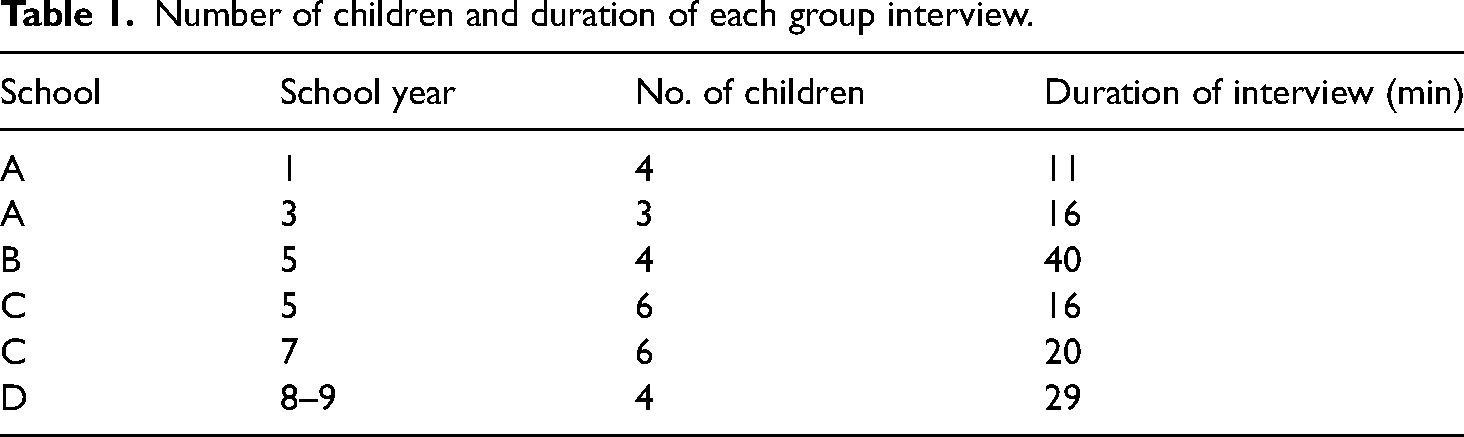
The municipality in question is in a metropolitan area in Sweden with broad socioeconomic variation among its residents. There are 16 municipal primary and/or secondary schools for children aged 6–16 years. The study includes schools from socioeconomically more disadvantaged areas and more advantaged areas. Seven schools agreed to implement the educational intervention, and four also agreed to arrange group interviews with children. One of these school (school B), was located in a particularly socioeconomically disadvantaged area. Teachers in charge of conducting the lessons were asked to invite their pupils to participate in a group interview. In total, 27 children, 7–16 years of age, participated in six group interviews (Table 1).
Number of children and duration of each group interview.
Group interviews
The interviews were conducted by a researcher together with the process leader for the educational intervention within 6 months after its completion. Both the researcher and the process leader had extensive experience in interviewing children from research and clinical practice respectively. The interviews were guided by three overarching themes and the children were instructed to talk freely around these themes to encourage an open discussion that was supplemented with follow-up questions by the interviewers. The children were first asked to reflect on a fictious story about two siblings living in family adversity (see Spånberger Weitz, 2023 for an in-depth analysis of the children's talk about help-seeking based on their reflections on this story). They were then asked to reflect on their perceptions about social services and thereafter to share their thoughts about the lessons in which they had participated and to reflect on what they had learned from them. Hence, data from the group interviews cover a variety of perspectives on the children's learning experiences related to social services.
Data analysis
The study focuses on perceived changes in children's perceptions about social services after the introduction of an educational intervention about social services in school. In line with Baú (2016), the analysis explores both what the children explicitly identify and express as change, and the changes that appear implicitly through their extended narratives about cultural and personal experiences that relate to their perceptions about social services throughout their lives. To be able to explore both explicit and implicit experiences of change, every step of the analysis has been guided by the following questions.
(1) Where does the intervention bring change? The first question explores how participants describe the everyday practices in which the change they experienced has happened. This part of the analysis is two-fold and provides a picture of the contexts in which the changes take place. First, it is guided towards the children's previous perceptions about social services as these are retrospectively narrated by them. Second, it is guided towards their reflections on which contexts and in what ways these previous perceptions were shaped. (2) What changes does the intervention bring? The second question explores what the children tell about their explicit experiences of change and in what ways they relate these changes to the educational intervention. The analysis evolves primarily around reflections on changes in children's perceptions about social services. However, to get a fuller picture of how these changes are integrated within the children's knowledge framework, the analysis also includes a broader exploration of the children's current reflections on social services and about help-seeking in relation to social disadvantages. (3) How is change perceived? The third question focuses on the children's perceived meaningfulness of the intervention. How do the children perceive the experiences of change? What meaning do they ascribe to these changes and to their participation in the educational intervention? The focus is also expanded to include not only the meaning of change that has already happened but also of expected change that may follow.
Following the principles of thematic narrative analysis (Riessman, 2008), the transcripts of each group interview were first analysed separately, guided by the three questions, to create a coherent narrative of change for each interview unit. All group interviews were then analysed together, comparing the where's, what's and how's of each interview to explore similarities and differences within the children's narratives of change. In this process, three different narratives of change were found: (N1) learning experiences as gaining new knowledge (in three interviews), (N2) learning experiences as having one's previous knowledge overthrown (in one interview), and (N3) learning experiences as broadening and nuancing previous knowledge (in two interviews).
All three narratives centre around a comparison between the children's description of their former and their current perceptions of social services. They each form an arc of changed perceptions over time. Three group interviews, where each narrative was specifically salient, were selected for further analysis to explore these narratives of change in more detail. Transcripts from the selected interviews were re-read with a focus on how each narrative of change was shaped through the children's shared reflections on their learning experiences.
Findings
N1: learning experiences as gaining new knowledge
In some group interviews, the children claimed that they had not heard of social services before. Others said that they recognized the word but had no real clue as to what it represented. These points of departure form one of the overarching narratives of change (N1), where this initially vague perception of what social services are was transformed into a more clearly defined perception of social services as an agency that is helpful in providing support for children and families. This narrative is represented by year 5 in school C but was also predominant in the groups with younger children (years 1 and 3 in school A). The following quotes illustrate the core of this narrative. Child 5 (C5): I didn’t even know what social services was at first. C4: I didn’t know if you could… first when I heard about social services, I thought of S.O.S, you know, emergency… C1: Alarm, yada, yada… C4: But now I know what it's called. I didn’t know that you could phone them if you’re having a hard time or if the family is having a hard time. But now I know that and more about social services. C3: Before I had no [idea]. I had heard about social services, but I hardly knew what it was, only that it was something where you could talk to someone, but I didn’t know that you could get help. And that's like good to know if something would happen like to a friend or someone in your family.
The excerpt starts with the children's shared reflections about their earlier perceptions of social services. Here, the children jointly engage in telling the story about how when they first heard of social services, they associated it with S.O.S. emergency calls (social services in Sweden is often referred to as “Soc”). This is an illustration of their previous vague or, for some of them, non-existent perceptions about the work of social services. In other parts of the interview, this lack of previous knowledge is also represented through the children's reflections on possible strategies for help-seeking when living in family adversity, where they argue that before participating in the lessons about social services, the only possible help-seeking strategies they were aware of were talking to a person they trusted or calling the helpline of a well-known child rights organization in Sweden (BRIS).
The excerpt continues with the children's descriptions of what they learned through the lessons about social services, which they contrast with their previous lack of knowledge in this area. This illustrates the children's reflections on what changes the intervention has brought, and more specifically what their newfound knowledge consists of. They specifically emphasize that social services can provide help for families. This was elaborated in other parts of the interview where the children mainly talked about social services being able to talk to family members to improve family relations or to change dysfunctional parenting behaviours. However, some also expressed knowledge of specific interventions that social services may provide to families or directly to children, and they did express knowledge of the fact that children may also be moved from their family.
In conclusion, one of the children expressed that this newfound knowledge is important to them, given that someone close to them might at some point find themselves in a situation where they need help. This statement indicates that the child saw a benefit from this knowledge in relation to their own life. Later in the interview, these perceived benefits were further elaborated when the children reflected on why they appreciated the lessons about social services, as illustrated in the following excerpt. C6: It's good to know about this because if something happens to your family, it's good to be able to call them [social services]. […] C3: I thought it was good because we don’t know if there's anyone who has a parent who feels like that or if you feel like that yourself or if someone in your class gets hit by their parent. You don’t know that. And so I think it's a very good initiative to teach children how they can get help and make things better.
N2: learning experiences as having one's previous knowledge overthrown
In one group interview, year 5 in school B, the children described their initial perception of social services as an agency that tears families apart, which through their participation in the intervention, was transformed into a perception of social services as an agency that is helpful and provides support for children and families. This forms the core of the second narrative of change (N2), illustrated in the following quotes. Interviewer (I): What do you think about when you hear social services? C1: That it's something that might help, like, children and such, that's what I think of. C2: The parents too. C3: When I first heard it, I thought it was, like, something mean, something like that. C2: First you think like this, that they take children. C3: Yeah. That’ what I first thought. C4: Yeah, a bit like that too. C3: And then when we were taught about social services, we learned a lot about how… C2: We learned that they help children and parents.
The children's descriptions of their current perceptions of social services are in this excerpt also clearly contrasted with their previous perceptions, where social services were depicted as a mean agency that takes children away from their families. Furthermore, this change between past and present perceptions is attributed explicitly to the teaching about social services that the children received. The quotes thus illustrate both what change the intervention has brought (newfound knowledge about and perceptions of social services) and where the intervention brought change (in relation to former negative perceptions about social services). This is further elaborated in the following quote where a child responds to a question about where their previous thoughts about the social services came from. C3: I got [my thoughts about] social services from my parents, because when I was little, I always used to bounce this ball at my house, so they said like, that social services would take me or something like that. That's why, that's where I got it.
During the interview, the children continuously returned to the contrasting comparison between their past and present perceptions about social services and how the lessons played an important role in bringing about this change. Throughout these reflections, the idea that social services take children away from their families, central to their previous perception, was presented as a form of common knowledge within their community. The children described that this idea was brought up in class when the lessons about social services were first introduced and that it had also been presented to them before from people in their vicinity. Thus, the perception that social services take children away from their families is depicted as a form of collective story (Baú, 2016) within the social context of their everyday lives, and their changed perception about social services came about as a fundamental shift in their understanding of the function of social services in society.
N3: learning experiences as broadening and nuancing of previous knowledge
The third narrative of change (N3) has a similar starting point as N2. Here, the children described a previous perception of social services as an agency that primarily destroys families and takes away children. Much as in N2, this perception was also described to have been transformed, through the educational intervention, into a perception that social services primarily help children and families to function better together. Although similar to N2, the change in perceptions presented in N3 is not quite as dramatic as to overturn the children's previous knowledge. Rather, the educational intervention seems to have broadened their understanding of various types of help and support that social services may provide and to have brought about a more positive view of social services’ efforts to help although the children retained some doubts about their ability to always succeed in this pursuit. This narrative was predominant among the older groups of children (year 7 in school C and year 8–9 in school D). The core of this narrative is presented in the following excerpt from year 7 in school C. C4: Well, I didn’t know much about social services before […]. C3: I only knew that you could go there if something is wrong, but I didn’t know any details about what they do. C1: And I thought that you [social services] only placed families, like only in foster homes and such. C2: Yeah, I thought so too. C1: And so, I didn’t exactly have the greatest … I didn’t think that you [social services] were this good. C2: […] the only thing I’ve heard is that they [social services] make things worse for many people. That's all I’ve heard. And then you come here and it's different. C1: And now, it's been very instructive, because I’ve gained a new view. I think everyone has gained a new view.
The excerpt concludes with one of the children expressing that they find their new knowledge about social services to be useful and that their perception about social services has changed into something new. These statements relate to the question of how the children perceived the intervention and the change that it brought. Throughout the interview, the children continued to present their perceptions about social services as having changed significantly, and they stated that they now had a much more positive perception than before.
During the interview, the children also elaborated further what this new knowledge consisted of, for example, a variety of different situations where social services can provide support for children and families (such as family violence, substance abuse, poverty), and that social services can provide help both in serious events of abuse and in less dramatic situations where a child or a parent needs some help or support in their lives. However, when describing their current perception, the children, even though they presented a predominantly positive view of social services as an agency that is trying their best to help, also presented ambivalence in their confidence about whether social services always succeed in helping, as illustrated by the following excerpt from a passage where the children reflect on what they have heard about other people's negative experiences of social services. C3: Well, there are good and bad thoughts about the social services, but the good ones outweigh, but … C1: And I think that you [social services] only have good thoughts. You just want to help, and I think that's what can sometimes be misunderstood as well. It's passed on to people [the negative experiences], and it's misunderstood.
The children's experiences’ of how they perceived the intervention and what the change that the intervention brought meant to them is also further explored in other parts of the interview. As in the introductory quotes, the children continually described their broadened knowledge about social services to be useful. In the following quote, one of the children relates a previous lack of knowledge about the possibility of receiving help from social services to their own experience of trying to support a friend in need. This quote is from a part of the interview where the children were asked to reflect on a fictious story about two siblings living in a troublesome home situation. C3: So, for example, if I was friends with them, I probably would’ve taken on a lot of responsibility, because, like I’ve had friends who’ve had a hard time and then I’ve taken on a lot of responsibility that I should try and help them. So, I probably would have done the same in this case too. I wouldn’t have thought there is anywhere else you could turn to.
Discussion
In this article, a narrative evaluation approach has been used to explore children's learning experiences from taking part in an educational intervention about social services in school. The focus is on the children's narratives of change (Baú, 2016) and, more specifically, their shared reflections on what changes in their perceptions about the social services that their participation in the educational intervention has brought about.
Through the analysis, three different narratives of change emerged. All three narratives start from a position where the children described they had little or no knowledge about social services. However, for the children who did express some previous knowledge, their earlier perceptions of social services were depicted as predominantly negative. In the children's shared reflections, these negative perceptions were related to a collective story (cf. Baú, 2016) within their communities that circled around the idea that social services first and foremost take children away from their families. The children referred to this collective story as a form of common knowledge among their peers and family members, and it was used as a form of shared interpretive framework (Mc Kenzie-Mohr & Lafrance, 2017) through which the children made sense of their learning experiences and their change of perceptions. This collective story may also be viewed in light of previous research showing that public perceptions about social work is often associated with child welfare and child protection (Spånberger Weitz, 2022; Stanisforth et al., 2014, 2022). Furthermore, it corresponds with fictional representations of social work that has been showed in film and TV, where the role of social workers are primarily portrayed as connected to child protection and the separation of children from their parents (Edmondson & King, 2016) and with social workers own experiences of how the public perceives them and their profession (Stanisforth et al., 2022).
The depiction of a collective story related to negative perceptions of social services was more predominant among the older children, whereas the younger children more often described not having heard much about social services before. However, the children from B-school may be seen as an exception. These children depicted a collective story about social services that seemed even more anchored in their community than what was depicted in group interviews with older children. Building on previous research which shows that low income and low education is associated with a low sense of trust in social services (Nilsson & Landstedt, 2022), this depiction of a widespread negative perception of social services in their community might possibly be related to the location of B-school in a particularly socioeconomic disadvantaged area. This points to a potential ethical challenge in the intervention's endeavour to promote change in children's perceptions of social services, as it may introduce a dissonance between the perceptions held by participating schoolchildren and those held by their family and neighbourhood. A previous study in the same research project showed that this concern was also shared by social workers in the child welfare unit, who described a potential challenge in responding to children and parents with widely differing views (Spånberger Weitz, 2022).
Forming a new collective story
In all three narratives of change, whether they started with no clear perception of social services or with a predominantly negative one, they all ended up with a current perception of social services as (primarily) helpful and supportive towards children and families in difficult life situations. In all group interviews, the children explicitly referred to this change of perceptions as a consequence of their participation in the lessons about social services. Hence, the educational intervention to some extent managed to create a new collective story about social services as being predominantly helpful and supportive in improving family relationships. For some of the children, this new collective story about social services as a family support organization was merely perceived as an increase in knowledge. For others, it formed a distinct counter-narrative (cf. Andrews, 2002) to their perceptions of the more dominant collective story within their communities—that of social services as an organization that tears families apart.
Mc Kenzie-Mohr and Lafrance (2017) argue that the activity of counter-storying may be viewed as narrative resistance to dominant discourses. In this sense, the educational intervention may in part be understood as an emancipating practice that, for example, provides children with new insights about available support and a greater trust in society's support functions to promote their ability of help-seeking. On the other hand, the perception of social services as a support organization not only appears as a counter-narrative but also as a new collective story which in this context can be viewed as a hegemonic narrative, deriving as it is from social services and the position of power that these services hold. It is important here to acknowledge that some of the children (primarily in N3) still gave voice to some doubt about the ability of social services to always succeed in their ambition to help, and they referred to stories they had been told from other young people about negative experiences of having social services interfering with their life. In the context of a new collective story about social services as do-gooders, the children's voicing of these contrasting stories may also be viewed as another form of counter-storying. This can be related to a study about public trust of social workers within the Swedish social services (Nilsson & Landstedt, 2022), which shows that people who are closely related to service users more often have a lower sense of trust. Other studies show that children with their own experiences of contact with social services often report a lack of participation in decisions affecting their lives (van Bijleveld et al., 2015) or a sense that the social services don’t react strongly enough when it comes to their attention that a child is being maltreated (Vincent & Daniel, 2004). Such results point to the importance of continuously working not only to improve the public perception of social services but also to improve how social work within these services is carried out in practice. In their article on how public perceptions about social work can be improved, Stanisforth et al. (2022, p. 254) conclude that ‘(a) critical element in being perceived to do one's job well is, in fact, to do one's job well’. Developing the work of social services to better respond to children's presumably higher expectations has also been highlighted as a key challenge in the ongoing development work that the educational intervention is part of, as emphasized in particular by involved social workers and youth employees (Spånberger Weitz, 2022). The analysis of children's own reflections on their learning experiences in this article further highlight the importance that social services, in their endeavour to improve children's perceptions of their work, also recognize and acknowledge children's varying counter-storying, both in opposition to a collective story about social services as family destroyers and to a collective story about social services as family saviours.
Limitations of the study
The article presents a small-scale study, focusing on children's perceptions of social services and their experiences of change in these perceptions after participation in an educational intervention. The study provides no information about how children with their own experiences of family adversity made sense of the educational intervention in relation to their specific life situation. Individual interviews incorporating more of each child's personal life experiences might have given more in-depth knowledge about these issues. Building on previous research that suggests that access to information about rights and about available support may increase the probability that children in need will seek help (Aadnanes & Gulbrandsen, 2018; Jones et al., 2017), these issues need to be further explored in the future research. However, the group interviews did shed light on children's more general perceptions about social services, on their shared sense-making around changes in these perceptions, and on the collective stories about social services that became visible through their shared reflections.
Conclusion and implications
The article contributes knowledge about children's perceptions of social services and about how these perceptions are shaped. It also contributes knowledge about narrative evaluation methods as a tool for evaluating end-users contextualized learning experiences from participating in small-scale interventions. The narrative evaluation approach has been fruitful for exploring both the experiences of change from participating in a specific intervention and the perceived meaning of these changes in relation to the participants’ lives. Previous research has pointed out the importance of children having access to information about available help and support from society (cf. Jones et al., 2017). This study shows that an educational intervention about social services can contribute to increased knowledge among children about what help is available, and that the children themselves perceive this knowledge to be meaningful for them. Furthermore, the results suggest that such an intervention may hold the power to promote counter-storying that brings about change in collective stories about social services in society. Here, however, some thought should be given to the position of these new collective stories to avoid a situation where one dominant narrative is being replaced by another. This requires both school and social work professionals to be perceptive of narratives about a variation of different experiences from contact with social services and to nurture an emancipatory practice where counter-storying and narrative resistance, in relation to any collective story, are encouraged and acknowledged. Furthermore, if steps are taken to improve children's perceptions of social services, a similar emphasis needs to be placed on improving the ability within social services to adequately meet children's expectations.
Footnotes
Ethical Approval
Ethical approval for this project was given by the Regional Ethical Vetting Board in Stockholm [ref number 2018/2279-31/5]. All participants took part on the basis of informed consent, including the consent of legal guardians for participants <15 years of age. All interviews were recorded and transcribed verbatim, and all data have been anonymized. All interviews were held during a regular school day and coordinated by a teacher who was known to the children and was able to follow up after the interview on any feelings and concerns that participation in the interview might raise.
Funding
The author disclosed receipt of the following financial support for the research, authorship, and/or publication of this article: This work was supported by The Swedish Council for Research on Health, Welfare and Working Life—FORTE, grant no. 2018-01354.
Declarations of conflict of interests
The author confirms that there is no conflict of interest.
Acknowledgements
The author would like to thank the teachers from the participating schools for the opportunity to hold group interviews with their pupils and Maja Hagström for her support in conducting these interviews. I am particularly grateful to the children for sharing their thoughts and reflections.
