



Abstract
Summary
Whereas some studies have addressed the conditions and practices required to infuse critical notions into the organizational context of public social services, there is a paucity of knowledge on what a critical public service can look like in actual practice. This article explores the possibility of applying critical theory and practice at the organizational level of public social services. It focuses on one social services department in Israel that underwent a six-year process of learning and implementing the Poverty-Aware Paradigm.
Findings
Based on an in-depth case study that combines ethnographic and participatory methods, we outline how critical ideas are translated to four organizational principles: developing a critical learning culture, acknowledging services users’ knowledge and skills, leading a critical discourse in the community, and poverty-proofing services and allocating resources to tackle poverty. Each of these principles is presented with derivative organizational practices and a detailed account of their implementation.
Applications
By broadening the framing of critical practice as an individual, street-level endeavor, the findings offer policymakers and public social services professionals an organizational model that mitigates the negative consequences of current neoliberal and managerial policies around the world.
Keywords
In recent years, there has been an increase in scholarly writing on the implementation of critical practice in public social services. Most of it relates to the challenges of applying critical practices within services that are governed by neoliberal and managerialist approaches (Brodkin, 2011; Gray et al., 2015; Timor-Shlevin, 2021), while the organizational practices of public social services, that are pivotal in the effort to develop critical services, have been overlooked (Ramsundarsingh & Shier, 2017).
This article aims to bridge this research gap by exploring the organizational characteristics of one social services department (SSD) in Israel that underwent a six-year process of implementing a critical social work approach—the Poverty-Aware Paradigm (PAP) (Krumer-Nevo, 2016, 2020)—and identifies itself as a critical poverty-aware SSD. This SSD constitutes a unique site for a case study because its local leadership has explicitly declared its aspiration to develop a critical service and the Ministry of Welfare and Social Services has been willing to support this change. Using a mix of ethnographic methods and participatory inquiry, this case study documents and conceptualizes the organizational practices involved in this process.
Critical practice in public social services
The scholarly writing on the implementation of critical practices within public social services involves two interconnected premises. The first is that public social services are dominated by neoliberal and New Public Management (NPM) notions that have far-reaching negative influences on both service users and care workers (Garrett, 2019; Schram & Silverman, 2012). The second is that implementing critical practices within public social services requires professionals to detach themselves from their colleagues (Weinberg & Banks, 2019) and work “below the radar” of the hegemonic organizations in which they operate (Prior & Barnes, 2011).
The manifestations of neoliberal and NPM notions in public social services are evident in a reduction in material support from the state and an increase in caseloads, bureaucratic duties, and performance audits (Featherstone et al., 2014; Garrett, 2019). These contribute to the deskilling and flattening of care professions (Baines, 2004; Benjamin, 2016) and the shift from relationship-based practices to regulatory and punitive services (Cummins, 2018; Hingley-Jones & Ruch, 2016).
Documentation of critical practice that does manage to exist under these conditions reveals that often it is a subversive practice of individual, street-level professionals whose actions put them in danger of moral distress, isolation, condemnation (Attrash-Najjar & Strier, 2020; Fine & Teram, 2013), and fear regarding their professional futures (Weinberg & Banks, 2019).
Few studies have attempted to outline the application of critical practice at the organizational level, (e.g., Barnoff, 2011; Donner & Miller, 2006; Ramsundarsingh & Shier, 2017). With one exception (Strier & Binyamin, 2010, 2014), these studies do not relate to public social services, but rather to nongovernmental agencies or grassroots community organizations. Within these studies, we identified four main organizational practices that are rooted in critical theory: politicizing practice through critical reflection and organizational learning; engaging in social action; developing democratic structures and promoting service users’ participation; and recognizing and promoting diversity and multiculturalism.
The first organizational practice—politicizing practice through critical reflection and organizational learning—highlights the fact that engaging in critical practice requires organizations to imbue all levels of practice with a structural and critical analysis of society and of social problems (Chammas, 2021; Karabanow, 2004; Strier & Binyamin, 2014). The most prevalent way to do this is to provide spaces in which professionals can critically reflect on both the influences of power inequalities and their practices (Fook, 2004; Hughes & Wearing, 2016).
The second practice—engaging in social action—builds upon the structural analysis of social injustice, and entails social services focusing interventions not solely on individuals, but on the social level as well (Barnoff, 2011; Feldman et al., 2016). Thus, activism, advocacy, and policy practice are considered important components of those services (Boucher, 2018; Mosley, 2012).
The third organizational practice—developing democratic structures and promoting service users’ participation—directs critical social services to reject tokenistic participation strategies and construct service user involvement as more than a consultation exercise in favor of encouraging service users’ autonomy and participatory decision-making (Carr, 2007; Fargion, 2018; Muurinen, 2019; Strier and Binyamin, 2010).
Last, scholars point to the importance of recognizing and promoting diversity and multiculturalism. A critical definition of diversity involves the reconfiguration of power and privilege and a commitment to the reduction of racism, sexism, and other forms of oppression within the organization (Donner & Miller, 2006). Thus, ensuring diversity means including multiple voices, ideas, and perspectives in every aspect of an agency's work (Barnoff, 2011; Strier & Binyamin, 2010).
While these conceptualizations are invaluable for the development of critical practice in public social services, accounts of their practical manifestation in everyday organizational practice are scarce. Therefore, based on a case study on the organizational implementation of PAP in one Israeli SSD, this article aims to explore the everyday manifestation of critical practice at the organizational level of a public social service.
To achieve this aim, we address the following research questions: (a) How do the SSD staff members and service users describe and conceptualize the organizational practices implemented in the department? (b) How, if at all, are critical principles manifested at the organizational level of the department's practice?
PAP and the Israeli context
The PAP was developed in Israel to counter the rise of neoliberal ideology and the changes it has engendered in social policy and the social work profession. The paradigm, which includes theoretical, ethical, and practical premises, has been widely adopted by the Ministry of Welfare and Social Services and is currently being implemented in special programs in more than half of the SSDs in Israel (Krumer-Nevo, 2022). It redefines poverty as a violation of human rights and the role of social work as a political profession (Krumer-Nevo, 2016, 2020). Based on critical poverty knowledge and critical and anti-oppressive social work practice, the PAP frames poverty as a violation of rights that is manifested in material hardship, limited social opportunities, and a lack of symbolic capital, including the right to dignity. According to the PAP, professionals should build their practice upon the recognition of the everyday resistance of people to their predicament. This recognition enables a critical interpretation that views the behavior of service users from within the context of their struggle against poverty. As an intervention method, the PAP offers an array of rights-based and relationship-based practices that work against injustice in the realms of both redistribution and recognition (Krumer-Nevo, 2020).
In 2015, the Ministry of Welfare and Social Services in Israel adopted the PAP as a guiding model for social workers in municipal SSDs (for a description of this process at the policy level, see Timor-Shlevin, 2021). As a first step, the Ministry developed five programs that were implemented nationwide. Evaluations of these programs indicate an essential change in social workers’ perceptions of their relationships with service users and of their practices. The PAP has helped social workers to reach out to families previously beyond their reach (Ben-Rabi, 2019), improved both the incomes of families that participated in the programs and their exercising of rights (Leibovitch et al., 2019), and increased service users satisfaction with the social work treatment they received in the SSDs involved (Brand-Levi et al., 2021).
One of the SSDs that implemented the first PAP program—MAPA—was Yeruham, a small, rural municipality in southern Israel with a population of approximately 10,000 people. It is ranked in the third lowest of ten quintiles in both the socioeconomic index—the rating of local authorities by the population's socioeconomic level—and the periphery index—the rating of local authorities in terms of proximity to economic activity in Israel (CBS, 2015, 2020). The SSD in Yeruham consists of a manager, two team directors, and 22 social workers who work with families, communities, youth, disabled people, people with substance abuse problems, and senior citizens.
The MAPA program commenced operation in Yeruham in 2015 as a pilot. It started with six family social workers and one team director, who underwent PAP training and received ongoing PAP supervision to work with 15 families from their caseloads according to the PAP principles.
Shortly after the program started, the department managers expressed their desire to expand the impact of the program by including all the SSD's social workers. To do so, they undertook an ongoing process of providing PAP training and supervision to the entire staff. Moreover, they began to develop unique forms of practice and organizational actions that were intentionally based on the PAP's concepts. In the last two years, the department has been defined by its staff and the Ministry as a poverty-aware department. The state-level funding and support for the development of a critical practice alongside the local management's decisive commitment to embrace and implement this approach make the SSD in Yeruham a unique case.
Method
To address the research questions, which include both descriptive and explanatory aspects, we employed an in-depth qualitative case study approach (Yin, 2003) that consisted of ethnographic observations (Shah, 2017) and participatory inquiry (Heron & Reason, 1997) workshops. The study was approved by the Ben-Gurion University of the Negev ethics committee (#1847-1). All the SSD social workers and service users who were involved in the observations signed a consent form. Names and other identifying details were changed to protect participant's privacy.
The first phase of data collection included 70 h of ethnographic observations of the regular activities of the SSD, including community events, neighborhood community work meetings, staff meetings, committee meetings, meetings with service users, and meetings of social workers with professionals from other services in the municipality, such as schools and health clinics. The observations that were done by the second author, took place during February and March 2020, and due to the outbreak of the COVID-19 virus, some were conducted by virtual means. While the observations were conducted, the three authors analyzed them.
The second phase of the study—the participatory inquiry—was developed alongside the data analysis. This phase included three cooperative one-day workshops with the participation of the entire SSD staff and 10 service users. The aim of the workshops was to give the participants the opportunity to describe the SSD's practice and reflect on it. Moreover, it enabled the participants to be involved in the analysis of the data and the conceptualization of the findings, whose trustworthiness it strengthened.
The three workshops were identically structured. In the first session, the research team presented a topic that arose from the data analysis; in the second all the participants discussed the chosen topic in groups, and in the third, everyone gathered to reflect and draw conclusions. The first workshop focused on the principles of the SSD's practice; the second on the question “What is success for you?,” and the third on the parameters of success. On the fourth day, all the participants, including the mayor and senior representatives of the Ministry, celebrated the publication of a booklet written by the research team about the SSD's practice. The workshops took place from March 2020 to March 2021.
Findings
The data analysis indicates service users’ positive experience of their relationship with the SSD. They described close, supportive, and positive relationships with social workers. Interestingly, they attributed their experience not solely to individual social workers but to the department as an organization. They described feeling understood, seen, and empowered: “Every time I enter the department, I leave it feeling that they were interested in me and cared for me. And all the workers have this quality” (Dana, service user). Moreover, they differentiated their experience in Yeruham from other social services they had encountered in the past: “What's special in this department is that you are enveloped with love. I don't feel like I’m going to a welfare department. They are all like my older sisters” (Ronit, service user).
Mirroring the service users’ experiences, the social workers also described the SSD as a unique place with distinct features. They focused on the organizational commitment and aspiration to develop close relationships with service users and stand by them: I had changed workplaces several times and had begun to think that social work was not for me until I arrived here and was able to do a different kind of social work. What is different here is the relationship, the closeness, the ability not to judge others and to work with service users on their own goals. (Eynat, social worker)
The fact that both service users and social workers contrasted their experiences at the SSD with their experiences with other social services and referred to the SSD as a unique entity implies that specific organizational practices prompt these positive experiences. As shown in Table 1, the data analysis pointed to four overarching organizational practices. Each one of them is translated into specific practices that reflect the PAP:
The organizational practices.
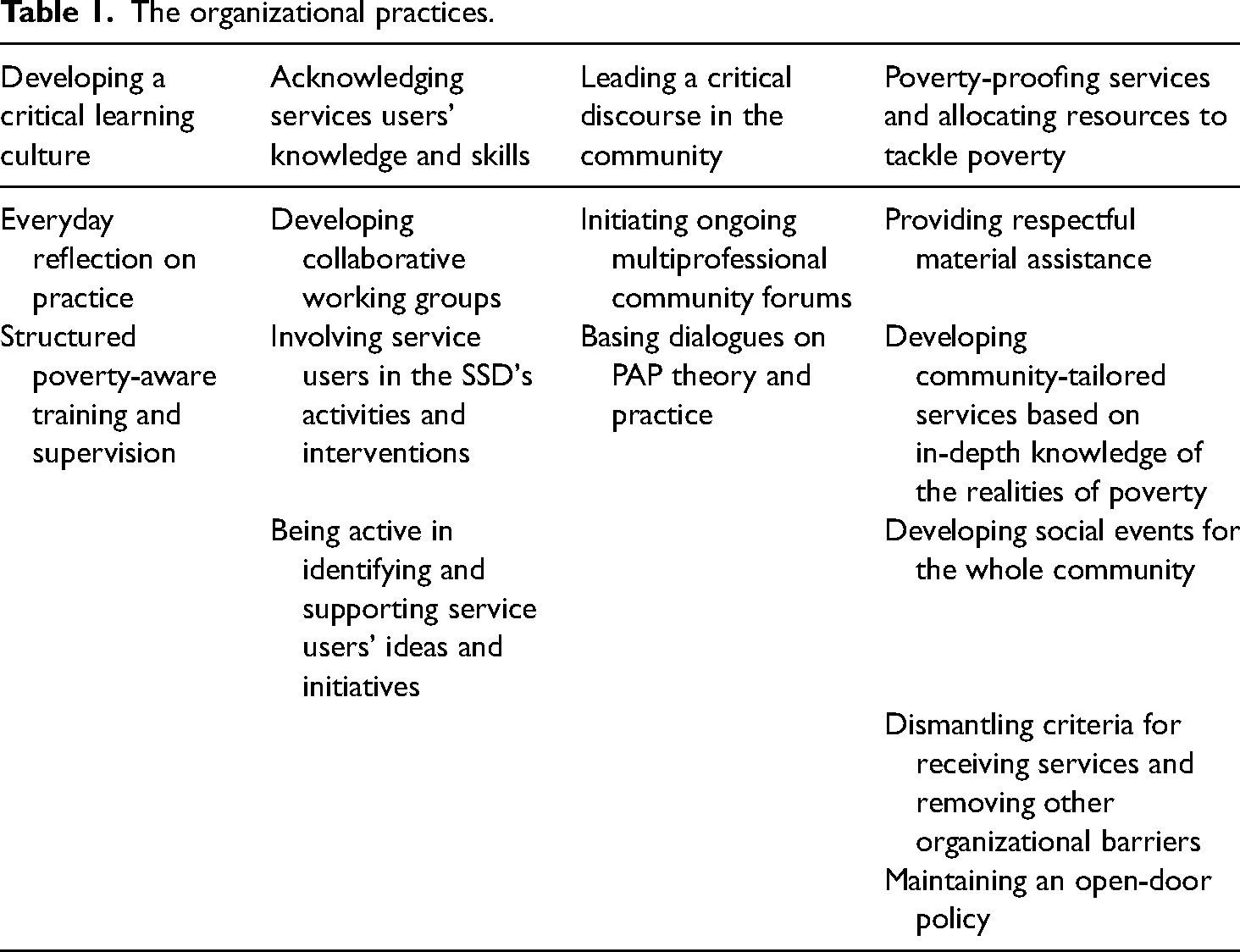
As will be shown, some of these organizational practices require significant resources in terms of budget and caseload that are seldom available in SSDs in Israel. These resources were received in three main ways: first, the SSD has a declared policy of embracing as many national pilot programs as possible. The implementation of such programs opens multiple vacancies in the department as well as adds material resources. Importantly, all the vacancies in the SSD are filled, in stark contrast to the situation in Israeli social services that are currently in crisis due to their failure to recruit social workers (Arazi et al., 2020). Second, the SSD developed a special collaboration with a local charity that assists in providing material support for families in need. Lastly, Yeruham's mayor is very supportive and committed to the SSD, and tends to approve additional funding for specific projects.
Developing a critical learning culture
Much of the SSD's practice stems from the staff's stable and coherent critical perspective. The data analysis indicated that all staff members, including the administrative workers, perceive the department as a poverty-aware service and see the PAP as an overarching frame of reference for all the work done there: “Our department has an agenda, a specific direction. This is our success as a department” (Neta, social worker). This professional stance was linked by social workers to the transformative process they had undergone since the introduction of the PAP to the SSD: “I used to be very patronizing when I was younger, and the moment I stopped, a change took place” (Tali, social worker). The consensus regarding the department's value-based professional agenda is a unique finding in the context of the public social services in Israel, whose staff members tend to describe them as having “eclectic” agendas or as mere followers of social policy determined by policymakers.
The identity of the SSD as an organization with a systemic critical learning culture was established by means of two organizational mechanisms: everyday reflection on practice and structured poverty-aware training and supervision.
Everyday reflection on practice
The workers described how their everyday practices received close professional attention and evolved into critical discussions with colleagues daily. For example, after a service user was verbally aggressive toward one of the workers, the entire staff conducted several discussions regarding the optimal response. These discussions, which focused on the needs of both the workers and the service user, as well as on the analysis of the incident in terms of power relations, enabled the staff to avoid an automatic response (reporting to the police) and develop one tailored to the specific situation: We gave [the incident] an interpretation that was a bit different. We understood that the service user had experienced the social worker as disrespectful and patronizing and then responded without thinking. So, we didn't immediately say, “Let's go to the police”. We had heated arguments among ourselves, but ultimately succeeded in speaking with the service user, to take responsibility for our own actions and to tell her that her behaviour was unacceptable. (Nirit, social worker)
Such discussions took place both in informal settings such as ad hoc meetings and everyday conversations and in structured settings such as regular staff supervision meetings.
A unique space for reflective discussions is the “Picture of the Week,” an email message sent by the team director to all staff members at the end of each week that describes the week's significant incidents. These email messages grant recognition to the social workers’ daily work, which is often unrecognized. Moreover, they prompt reflective discussions both online and in person. For example, one of these e-mails described a child protection conference that was exceptionally long (four hours). Writing about it as a “picture,” the team director explored the advantages (e.g., in-depth discussions with the family) and disadvantages (e.g., difficulty reaching a decision) of conducting such a long conference, sparking a meaningful discussion among the staff.
Structured poverty-aware training and supervision
The entire staff, including the administrative workers, received PAP training that ranged from a minimum of four study days for some workers to a three-month course for others. The fact that all the workers underwent this training enabled them to share a common professional language. In addition to this training, the SSD's managers encouraged workers to enrich their professional knowledge, and at the time of the study, one-third of them were attending weekly post-graduate courses. The SSD's manager explained: “When the municipality's HR department asks me why all my workers have a study day, I tell her 'We want good, professional workers and for that, we need them to be well educated and satisfied with their development'" (David, SSD manager).
Beyond these special training and education frameworks, all the staff members received biweekly group supervision from an external senior poverty-aware social worker. In addition, the social workers received individual supervision from their team director. Workers described these supervision sessions as safe spaces for learning and considering alternatives for practice, and not as regulatory sessions.
Acknowledging services users’ knowledge and skills
The data pointed to the staff's strong commitment to service users’ participation in service planning, implementation, and decision-making and to the development of collaborative relationships. Based on the premise that service users’ knowledge and skills are essential not only for the development of good practice but also for their experience within the service, the staff takes a proactive role in creating spaces and practices that will ensure services users’ participation and collaboration in the SSD's practice.
We found three systemic practices that bolster service users’ knowledge and skills and support participation: the development of collaborative working groups; the presence of service users in the SSD's activities and interventions; and the active identification and support of service users’ ideas and initiatives.
The development of collaborative working groups
These groups, which are mainly established around a specific event but also around ongoing tasks, involve social workers, service users, and other stakeholders (e.g., representatives from the local authority and volunteers) related to the groups’ tasks. Examples of ad hoc teams are the Purim carnival team, the organizing team of a tribute event for children with special needs and their families, and the COVID-19 task force team that coordinated all the volunteer resources and activities in the community. Examples of ongoing groups are a group of parents—including services users—who patrol the municipal parks with the aim of supporting at-risk youth, and a joint group of social workers and service users that initiates and holds a variety of community events. Recently, a new joint group of social workers and beauty professionals, some of whom are service users, established an action team for identifying and addressing domestic abuse in the community. The team's aim is to reflect on the ways in which beauty professionals can contribute to the identification of cases of domestic abuse and responses to them. The relationships within these groups, which usually include a WhatsApp messaging group, are informal and reciprocal and challenge the power imbalance between social workers and service users.
The presence of service users in the SSD's activities and interventions
We found that from the staff's point of view, service users are necessary partners for the department's development and operation. Accordingly, service users take part in meetings with policymakers and workshops initiated by the department. They also participated in the workshops that were part of this study. Moreover, service users attend staff meetings as lived-experience experts. For example, one service user delivered a lecture to the SSD staff on how to pay off debts and another gave a talk on the skills needed to help women who are suffering from domestic abuse. Two other service users led and facilitated two staff meetings that focused on improving conditions in one of the poorest neighborhoods in the municipality.
The active identification and support of service users’ ideas and initiatives
We found that when service users propose an idea or suggest an activity, the workers perceive themselves not as executors of the idea, but rather as supportive partners. The combination of the staff's social capital—connections, professional authority, and acquaintance with the town's systems and resources—and the close relationships with service users and familiarity with their capabilities enable social workers to support valuable connections between service users and the community. For example, Ronit, a service user, described how she developed a school meal project called A Sandwich for Every Child. In one of the regular meetings with my social worker, she said “Your kids are fine, what about you? What do you want to do in life?” During this conversation, I had this idea of a project of making sandwiches for everybody who needs them. Immediately she contacted the school and the team director at the SSD, and we started. I have a monthly budget from the SSD. Without them, it wouldn't have happened. (Ronit, service user)
With the exception of some basic funding, this project, which began in collaboration with the department, currently operates without the department's support. Thus, a new service was established, Ronit shifted from the position of a service user to the role of community activist, and the whole community benefited from her abilities.
Leading a critical discourse in the community
The staff does not limit its critical agenda to the SSD's work with service users but endeavors to influence other professionals’ understanding of service users and their practices through two mechanisms: initiating multiprofessional forums in the community and basing dialogues on PAP theory and practice.
Initiating ongoing multiprofessional forums in the community
The SSD created several permanent steering committees with other services in the community. For example, regular biweekly consultation meetings are held with each school and preschool team in the municipality. At these meetings, the school staff consults about families and children (not necessarily service users of the department) with whom they are having difficulties, and the SSD staff takes the lead in consulting them using a poverty-aware professional discourse. The workers described how their knowledge and deep understanding of the PAP enabled them to conceptualize and ground their practice in a way that fosters dialogue and collaboration while positioning them as valued professionals.
Basing dialogues on PAP theory and practice
The data pointed to the frequent and explicit use of the concepts of poverty-aware social work in dialogues with other services. For example, in a joint steering group with one of the schools, when the school staff voiced their antagonism toward a mother who posted a complaint against the school on the mayor's Facebook page, the social worker framed the mother's action as an active effort to care for her children. In another instance, a local authority representative complained to the staff that the department's service users had developed a “culture of entitlement” regarding social services. In response, the social worker explained in an everyday manner that the SSD perceives poverty as a violation of human rights and then suggested viewing the service user's demanding stance as an active act of self-advocacy. This new framing opened a fruitful discussion. In another instance, the social workers described how they refused the school's request to hold a joint meeting about a pupil without his parents being present: The school invited the parents to meetings in the mornings. They didn't arrive, and in response, the school decided to meet without them. We told them we don't meet without the parents. We organized a new meeting at 17:00 and both parents arrived, although the school said there was no chance that they would come. (Moshe, social worker)
Another example was seen at a meeting with the local health center's baby unit. The nurses consulted on the issue of mandatory reporting when they suspect a child is suffering from parental maltreatment. The SSD staff highlighted the ethical commitment to making the parents full partners in these encounters and the practical ways in which to do so.
The respectful, relationship-based nature of the conversations with other professionals, alongside the ability of the SSD staff to connect theoretical notions with everyday situations and dilemmas, enable the educational staff, nurses, and other professionals in the community to reflect on their practices and enhance their awareness of issues of power that are embedded in them.
Poverty-proofing services and the allocation of resources to tackle poverty
The National Anti-Poverty Strategy (1999, p. 13) defines poverty-proofing as a detailed analysis and examination of policies and practices “in relation to the likely impact that they will have or have had on poverty and on inequalities” (National Anti-Poverty Strategy, 1999, p. 13). Our data indicated five organizational practices that aimed to actively respond to poverty and mitigate its negative ramifications: providing material assistance; developing community-tailored services based on deep knowledge of the realities of poverty; developing social events for the whole community; dismantling criteria for receiving services and removing other organizational barriers; and maintaining an open-door policy.
Providing material assistance
We found that PAP's principle of linking between the material reality of poverty and experiences of shame and othering underlies the department's policy regarding the perception of material assistance and the kind of material assistance provided: In the past when we talked about material assistance the social workers would say, “Why do we need to help them? It's their responsibility”. There was a disconnection between us and the service users. Today, it's different. (Tania, social worker)
Indeed, the data pointed to the staff's sensitivity to the level and quality of services that people in poverty receive in the community. Accordingly, they expressed a commitment to providing services with the highest standard of material assistance. For example, at Purim (a Jewish holiday during which children wear costumes), the department purchased new costumes in advance and held a community fair to sell them at a reduced price. In another instance, during the COVID-19 lockdown, instead of raising funds for second-hand toys, the department insisted on buying new toys for children.
Developing community-tailored services based on deep knowledge of the realities of poverty
The poverty-aware approach is also manifested in the development of innovative services that are tailored to the multidimensional needs of service users and respond to them in an accessible and appropriate way. Some of these services were invented in the SSD and do not exist in any other SSD in Israel. For example, the SSD was aware of the difficulty service users face when they receive donations of furniture but are unable to pay for moving them. In response, the SSD developed a moving service based on volunteers, including a social worker, students, high school pupils, and a service user: One of our workers has a car to which a trailer can be attached, and there is a community of students here with a car trailer. And one of our service users is a handyman. We connected them in a WhatsApp group with high school pupils who volunteer to carry and move the furniture, and they are happy to do a move any time we need them to. (Tamar, social worker)
Another innovative service, the “Debtless City Committee” was developed as a response to the acute needs of service users who are coping with over-indebtedness (Krumer-Nevo et al., 2017). This ad hoc committee consists of the family, the family's social worker, a community social worker, a senior social worker, a representative of a local charity, and a lawyer. The committee's aim is to collaboratively examine the debt problem and the possible pathways to dealing with it. The committee is a friendly and supportive space, and its members agree that their aim is to focus on the solutions for settling debt without blaming the family. At one of the committee's meetings that we documented, the social worker referred to the family saying: “We are all here because debts are exhausting and dealing with them is very threatening. Perhaps together we will be able to accompany you in this process and make it a bit easier”. (Gili, social worker)
Developing social events for the whole community
Whereas welfare departments are usually perceived as providing services for specific vulnerable populations, the department's staff expressed a universal approach and a professional commitment to the city's wider community. By positioning the SSD as a service with universal elements, the sense of shame frequently experienced by those who receive help from social services can be reduced. Thus, the SSD organizes special social events, for example, the Purim carnival, a back-to-school fair, and community picnics for the wider community. By targeting the whole community, the SSD promotes inclusion and resists the marking of service users as a special group. More importantly, it enables service users to attend and benefit from the SSD's resources without feeling ashamed or singled out: Hundreds of people attend this event, people who aren't service users. Even service users who don't want to be recognized as service users come to it! That's because the event is not associated with welfare. Our logos are everywhere, but people come because it's good for them and their children. (Gali, social worker)
Dismantling criteria for receiving services and removing other organizational barriers
The SSD staff members define themselves as providers of services for all, with no conditions and no restrictions to specific aspects of people's lives. Two reasons make this self-definition unique in the Israeli context: First, it violates a formal Ministry regulation that conditions the provision of any material assistance upon it being part of a wider intervention plan (Israel Ministry of Welfare and Social Service, 2018; The Social Workers Ordinance No. 1.4.2); Second, on the background of their limited resources, SSDs usually aim to reduce their responsibilities and refer service users to other services and organizations.
This approach is manifested in not limiting the length of the treatment offered and the number of programs or types of intervention provided to each service user. As one service user put it, “When I need them, they help. It's not as though if they helped me in the past I don't deserve their help now” (Miri, service user). Moreover, service users do not have to convince the social workers that they deserve assistance. On the contrary, the staff members described their obligation and proactive efforts to find the right path to establishing a working relationship with service users.
While shaming and labeling concepts such as “untreatable,” “uncooperative,” or “lack of readiness for a therapeutic process” are prominent in the professional discourse as justifications for ending interventions, the SSD staff emphasized their insistence on not using these concepts: There is no such a thing as “we didn't succeed in reaching out to the family”. We always say, “we didn't succeed in this way; we’ll try another way”. Very rarely do we say, “we tried everything and didn't succeed”. In such cases, we’ll let it go for a while, and then we’ll find a new way that we haven't tried before. (Irit, social worker)
Maintaining an open-door policy
In Israel, SSDs usually have six reception hours a week during which service users can meet their social workers without arranging a meeting in advance. When they arrive, they will often face various protective measures for safeguarding social workers, for example, a guard at the entrance or an access control system not accessible to service users. By offering so few reception hours and establishing concrete barriers to entering the facility, the SSD becomes a site that exacerbates experiences of personal exposure, humiliation, and stigma (Lavee, 2017). The SSD in Yeruham, on the other hand, has an “open-door policy” that reflects both a practical approach—the door is literally open during most working hours—and an organizational approach—service users are always invited to approach the SSD and meet their social workers. Most service users come to prearranged meetings, and those who come without having an arranged meeting are always seen by one of the social workers, who provides an immediate response and schedules a later meeting for them.
Discussion
This study aimed to explore organizational practices that support and promote critical practice within public social services. Whereas some studies have addressed the conditions and practices required to infuse critical notions into the organizational context of public social services (Aronson & Smith, 2011; Timor-Shlevin, 2021), until now there has been a paucity of knowledge on what a critical public service can look like in actual practice. The unique development of the SSD in Yeruham as a poverty-aware SSD enables us to pinpoint four organizational practices that promote and enable critical practice within public social services: developing a critical learning culture; acknowledging service users’ knowledge and skills; leading a critical discourse in the community; and allocating resources to poverty-proofing services. The first two, which were prominent in Yeruham, resemble practices previously discussed in the literature on anti-oppressive social work (Barnoff, 2011; Strier & Binyamin, 2010, 2014). They focus on the politicization of practice through critical reflection and organizational learning as well as the promotion of service users’ participation.
The next two—leading a critical discourse in the community and allocating resources to poverty-proofing services—are unique. The way in which the Yeruham SSD staff expands the development of critical discourse to the whole community through regular professional meetings with schools and health clinics is an interesting version of engagement in social action. In a critical context, social action is often attributed to different forms of social activism (Florell, 2021), yet it is mainly attributed to political acts of public protest and campaigning for structural changes (Ross, 2011). In Yeruham, this form of activism was not mentioned by any of the social workers. Instead, the staff led a critical discourse that focused on changing the relationships between professionals and service users in the community. One might argue that this abandonment of a demand for structural changes and the adoption of a softened version of social activism is the only possible route for a public service that is funded and regulated by the state. In this sense, the study highlights the boundaries of a critical public service (Strier & Binyamin, 2014).
Nevertheless, it is worth pointing out the possibilities through which a critical SSD can lead to change in the community. In line with Baines’s (2011, p. 80) claim that there are “many ways to undertake social action and organizing, and many ways to incorporate activism into everyday frontline practice,” the systematic and professionally coherent dialogues between the staff and other services in the community enable the staff to implement different forms of local-level policy practice (Gal & Weiss-Gal, 2015). By influencing both the ways in which specific service users are perceived and contributing to other professionals’ understanding of poverty as a social injustice issue, the staff influence actual policies within the community (e.g., the mandatory report process at the local health center's baby unit). In this sense, the SSD plays a pivotal role in the development of a political climate that acknowledges poverty as a violation of human rights and resists the Othering of people living in poverty. Furthermore, the SSD's managerial team has been active in presenting its work in wider circles of SSD's managers, advocating and inspiring other stakeholders to follow them.
The fourth principle, poverty-proofing services and allocating resources to tackle poverty, was found in our study to be a significant organizational principle. Although poverty has been always a major issue in critical thinking and activism, the practice that confronts poverty as an everyday lived experience of service users has not been developed. Numerous studies point to the negative, unhelpful, and oppressive experiences people in poverty encounter in their interactions with public social services (Gupta et al., 2018; Lavee, 2017), while the actual economic, social, and relational symbolic aspects of poverty have been often ignored by social services (Makaros & Weiss-Gal, 2014). Morris and colleagues (2018, 370) claim that “poverty is the wallpaper of [social work] practice: too big to tackle and too familiar to notice.” Nonetheless, our findings shed light on how poverty-proofing the organization influences the design and implementation of the services provided by an SSD. Following the identification and recognition of the various dimensions of poverty, including material deprivation, the SSD allocates resources to address its many ramifications in everyday life.
Moreover, the findings indicate that the social and symbolic dimensions of poverty are also addressed. For example, the staff's acknowledgment of the lack of accessible social and cultural events for service users alongside the shaming effect of being labeled as welfare service users led to the development of social events for the whole community that blur us–them distinctions. Similarly, acknowledging the symbolic and practical barriers to receiving services influenced service eligibility procedures and criteria as well as the policy regarding reception hours.
One principle that receives much attention in critical social work, especially in the anti-oppressive literature (Barnoff, 2011), is the recognition and promotion of diversity and multiculturalism. This principle was not strongly evident in our data. This fact could be explained by the relative ethnic homogeneity of the community, which consists mainly of two major ethnic groups, and its small size, which fosters personal connections between the residents.
The limitations of the study
The study has several limitations. First, despite the fact that the service users and workers reported positive experiences with the SSD, it is not possible to conclude that there is a cause-and-effect relationship between specific characteristics of the SSD and these experiences. Similarly, the study cannot point to the outcomes or efficiency of the SSD's interventions. The exploration of these dimensions of the SSD's practice requires further research. Second, because the study focuses on the description and conceptualization of organizational principles and practices, it does not address the challenges that face the staff when they implement these practices. Moreover, the very positive accounts of the staff and the service users led to an emphasis on the positive and successful features of the case study. While an analysis of the data that focuses on the tensions and challenges of implementing the PAP is surely possible, it is beyond the scope of this article. Third, the study does not shed sufficient light on the conditions that enabled the SSD to develop as a critical service. Thus, although public social services in Israel are dominated by an NPM ideology (Timor-Shlevin & Benjamin, 2020), Yeruham reflects how the PAP succeeded, at least to some extent, in challenging this domination and creating pockets of critical practice. Timor-Shlevin (2021) and Krumer-Nevo (2022) provide a partial description of these conditions. Last, the sample of service users is relatively small and, given the importance of their point of view, further research on their experience of the SSD is necessary.
Conclusion
The contribution of our study lies in its detailed description of the ways in which the concepts and notions of critical and poverty-aware social work can be translated into everyday organizational practices. The study suggests a new critical principle—poverty-proofing services and allocating resources to tackle poverty. With regard to principles already described in the literature, it suggests how critical notions, for example, critical reflection, are implemented by means of formal and informal practices. In addition, our study offers new interpretations of critical principles that make them relevant to public social services. By making these principles visible, we hope to enrich the critical vocabulary of policymakers and professionals in public social services.
Footnotes
Ethics
The study was approved by the Ben-Gurion University of the Negev ethics committee (#1847-1).
Funding
The authors disclosed receipt of the following financial support for the research, authorship, and/or publication of this article: This project has received funding from the European Union’s Horizon 2020 research and innovation programme under the Marie Skłodowska-Curie grant agreement 890262 (grant number 890262 – PCPPP).
