



Abstract
Summary
Recovery from stress is essential for employees’ well-being, even more so in jobs where high stress is inevitable. The purpose of this study was to examine the influence of achievement goal orientation on recovery from stress (i.e. need for recovery and vigour) over several years. We followed a sample of social workers in the Netherlands (N = 238) across four years, with three measurement points (T1–T3). Data were analysed with latent growth curve modelling.
Findings
Results showed that need for recovery and vigour were fairly stable over time and therefore we could not examine the effects of achievement goal orientation on change in vigour and need for recovery over time. However, level of mastery goal orientation (mastery-approach and mastery-avoidance goal orientation) at T1 was positively related to the initial level of vigour at T1, even after controlling for job autonomy and workload. Our results indicate that mastery goal orientation is relevant for employees to feel energetic and vital in a job with high stress.
Practical implications
Our results showed that organizations can prevent depletion among social workers by ensuring an acceptable workload, while vigour can be enhanced by selecting employees with high mastery goal orientation. Organizations can also contribute to the vitality of social workers by stimulating and fostering mastery goal orientation.
The negative impact of the increasing pressure accompanying the demands of modern working life is widely recognized and is seen more and more as an urgent problem all over the world (International Labour Organization, 2018). The Sixth European Working Conditions Survey revealed that in Europe, many workers experience high work demands, with 25% indicating that their health was negatively affected by their work (Eurofound, 2017). Job stress is caused by different factors, such as work pressure and emotional demands, organizational factors (e.g. role conflict) and personal factors (e.g. work–family conflict) (Cooper & Dewe, 2004). Social workers are no exception; they can experience considerable job stress, which negatively impacts their well-being (e.g. Lloyd et al., 2002; Travis et al., 2015). Some sources of stress (such as emotional demands) are more typical of social workers, but the general rule that stress occurs when job demands exceed the job resources also applies to social work (Stevens et al., 2019). Social workers are an important and substantial part of the workforce; in 2015, 209,000 employees (i.e. 2.5%) in the Dutch workforce were social workers, who therefore make up one of the larger professional groups in the Netherlands (Central Bureau for Statistics, 2018).
When it comes to coping effectively with job stress, recovery from stress seems to play a vital role (Geurts & Sonnentag, 2006). Recovery from stress enables individuals to replenish their depleted resources. Previous research (e.g. Sonnentag et al., 2008; Van Hooff et al., 2011) has used several indicators (e.g. fatigue, vigour, need for recovery, sleep quality and affective states) to measure recovery from stress. One of those indicators, the need for recovery, refers to the desire to be relieved from exposure to stressors at the end of the workday in order to replenish resources. Need for recovery has been linked to negative health consequences, such as psychosomatic complaints (Sluiter, 1999). In addition, insufficient recovery from stress, as indicated by high need for recovery, plays a crucial role in the development of burnout (Sluiter, 1999; Toker & Melamed, 2017). Sufficient recovery from stress will lessen the negative consequences of job stress. However, the absence of negative consequences of stress, such as exhaustion, does not necessarily imply that employees are functioning well in their jobs. For example, a social worker who is not dedicated to his work and consequently does not feel stress will not be regarded as a well-functioning social worker, while an engaged social worker will have a greater chance of functioning well. Work engagement has been widely studied and has been characterized by different dimensions such as vigour, dedication, and absorption (Maslach et al., 2001). Vigour, feeling energetic during a workday, is an important indicator of recovery from stress (Geurts, 2014). Hence, one can assume that a social worker who recovers well from stress is not only not exhausted at the end of the workday but also feels energetic during the workday, even under high demands. In this study, need for recovery and vigour will be used to measure recovery from work stress (Sluiter, 1999; Sonnentag & Niessen, 2008).
A well-designed job enables employees to recover well, by providing, among other things, job autonomy, acceptable workload, social support and sufficient variety in tasks (Geurts, 2014). Unfortunately, prolonged exposure to high job demands (e.g. clients who are experiencing a crisis) cannot be ruled out for social workers. In other words, for social workers, job stress is inevitable. When stress is unavoidable, the question of who can recover better from stress becomes more relevant. Consequently, more insight into what personal factors (e.g. personality) contribute to sufficient recovery from stress is needed to understand how to reduce the negative impact of stress. Moreover, although there is evidence that recovery from job stress differs between persons, the influence of personal characteristics on the recovery process is under-researched (Geurts, 2014).
One personality characteristic that is related to recovery from job stress is achievement goal orientation (AGO) (Sonnentag, 2003). Sonnentag reported that recovery on a daily basis was influenced by an employee’s AGO; mastery goal orientation was positively related to daily recovery. If personal characteristics, such as one’s AGO, are indeed related to the recovery process (i.e. need for recovery and vigour), this would offer concrete opportunities, such as training and selection of employees, to promote the recovery process. As a result, burnout among employees might be prevented and work engagement enhanced. The aim of our study is twofold. First, we examine the influence of social workers’ AGO on their recovery from stress by looking at two indicators of recovery from stress (need for recovery and vigour) over a period of four years, with three measurement points. Second, we aim to gain more insight into the recovery process in jobs where high stress is inevitable, such as in social work.
AGO and the recovery from job stress process
According to AGO theory (Dweck & Leggett, 1988; Elliot & McGregor, 2001), the type of achievement goals people pursue influence their motivation and well-being. The two best-known achievement goal types stem from definitions of competence: mastery goals are aimed at developing one’s competence and performance goals are aimed at validating one’s competence (e.g. by receiving positive evaluations).
The initial distinction between mastery and performance goal orientation was extended by Elliot and McGregor (2001), who added a valence dimension distinguishing between approach and avoidance goals. This addition resulted in a 2 × 2 goal orientation framework: (1) mastery-approach (Map) goals, where the focus is on improvement of one’s competence and gaining mastery of a task, (2) mastery-avoidance (Mav) goals, in which the focus is on avoiding incompetency and preventing the loss of mastery of a task, (3) performance-approach (Pap) goals, where the focus is on showing one’s competence and receiving positive evaluations and (4) performance-avoidance (Pav) goals, where the focus is on avoiding showing incompetence (see Figure 1). AGO has been conceptualized as both a trait and a state, with the trait having a moderate degree of stability over time (Payne et al., 2007).
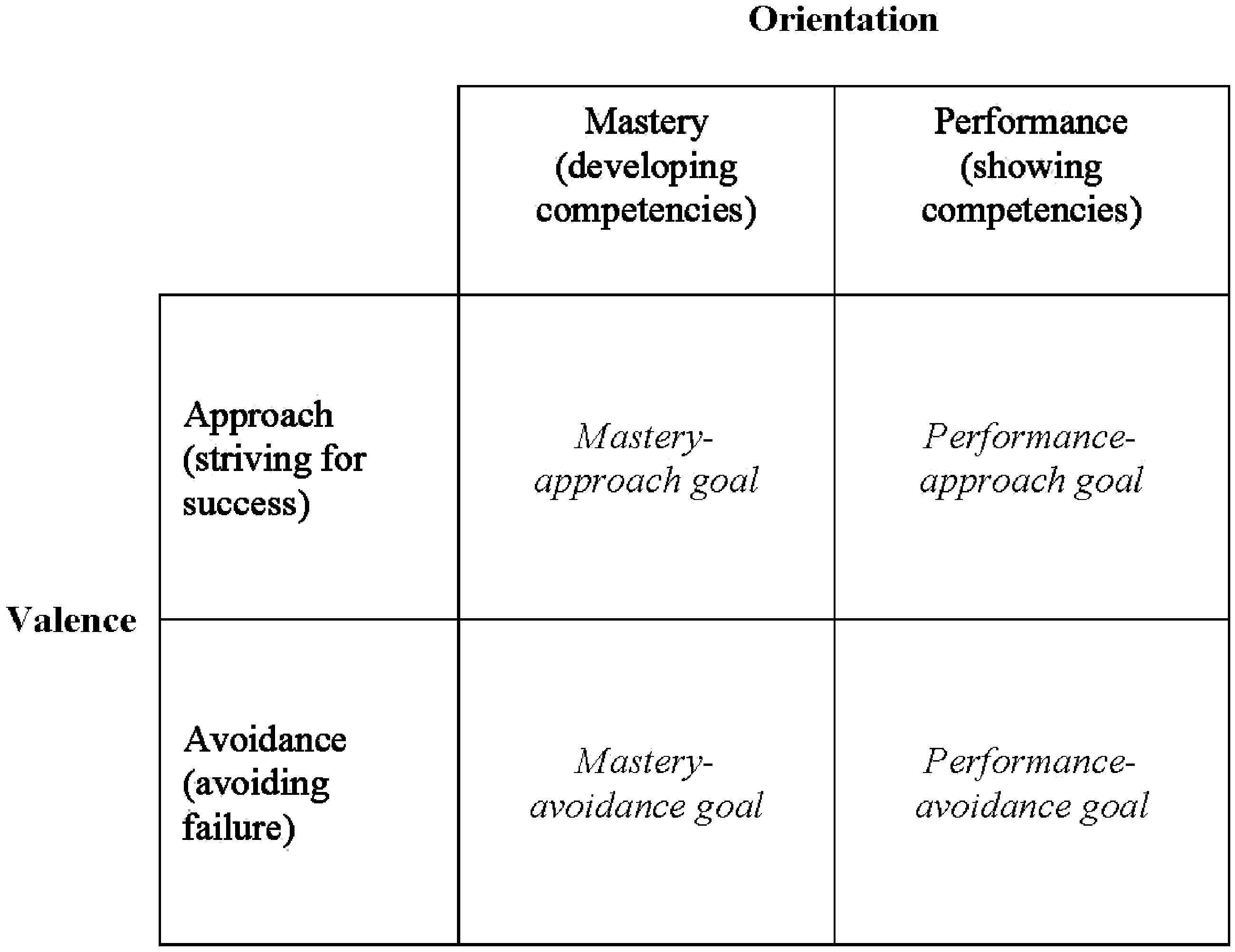
The 2 × 2 achievement goal model.
AGO has proven to be a valid predictor of motivation, performance, well-being and engagement across different domains (education, work and sports), and across different occupations (e.g. Payne et al., 2007; Van Yperen et al., 2014; Vandewalle et al., 2019). Despite the differences between social work and other occupations, we therefore assume that AGO is also a valid predictor of differences in aspects of well-being (e.g. the recovery process) in the social work domain.
The relationship between achievement goals and the recovery process from work has rarely been studied. An exception is a study demonstrating that higher Map goal orientation contributed to work engagement, while higher Pav goal orientation hampered work engagement (Bakker et al., 2018). Furthermore, Sonnentag (2003) reported a positive relation between Map goal orientation and both daily recovery and daily engagement. The studies by Bakker et al. (2018) and Sonnentag (2003) covered a relatively short period of time (i.e. one to five weeks). However, Geurts (2014) argued that more studies should look at the recovery process over the long term. Both vigour and need for recovery are stable person characteristics over longer periods. For instance, over a period of two years, intraclass correlations ranging from 0.68 to 0.80 were reported for need for recovery in a stable work environment (De Croon et al., 2006). For vigour, an intraclass correlation of 0.61 was reported, even over a period of seven years (Seppälä et al., 2015). Therefore, based on the previously mentioned studies, we expect that AGO will predict vigour and need for recovery over a longer period of time (i.e. four years). In particular, we expect that Map goal orientation will have a positive effect on the recovery process over time (i.e. lower need for recovery and higher vigour) and Pav goal orientation a negative effect (higher need for recovery and lower vigour). Because of a lack of prior research, we cannot formulate hypotheses about the effects of Mav and Pap goal orientations on vigour and need for recovery. However, we will include them in our analyses to explore possible relations.
Among social workers, workload and job autonomy play an important role in the development of stress (e.g. McFadden et al., 2018). To determine the unique effect of AGO on vigour and need for recovery and on their development over time, we controlled for the effect of workload and job autonomy on vigour and need for recovery.
Method
Participants and procedure
All employees (N = 238) of an organization in the Netherlands that provides guardianship for youngsters were asked to participate in what is known as a vitality check, in 2012 (T1), 2014 (T2) and 2016 (T3). The vitality check addressed multiple topics about how employees experience different aspects of their job, such as cooperation with their colleagues and supervisor, perceived workload, need for recovery, variety in their tasks and task enjoyment. It involved completion of an online questionnaire. After its completion, the employees were individually informed about their own results in an online report. All employees were invited by email to complete the questionnaire, with the confidentiality of their results and report guaranteed. Completion of the questionnaire indicated their informed consent. After three weeks, the employees who had not completed the questionnaire received a reminder. The results for all employees were analysed (anonymously) on a team level and presented in a report to the management of the organization. The procedures and questionnaire were identical at T1, T2 and T3.
Vitality in the workplace had high priority for the management of the organization. For this reason, the management encouraged participation in the vitality check. Employees were also notified that they would immediately receive online feedback about their vitality scores after completing the questionnaire. This procedure resulted in a high response rate in 2012; 91.2% of 238 employees completed the questionnaire, resulting in a final sample of 217 employees (156 females, 61 males). At T1, the mean age was 45.1 years (SD = 10.37) and the mean hours worked per week was 32.06 (SD = 4.50); respondents, on average, worked 2.66 (SD = 2.05) hours of overtime per week. Almost all respondents had completed higher vocational training or a higher level of education.
Measures
Achievement goal orientation
The AGO scale developed by Baranik et al. (2007) was used, which measures: (1) Map goal orientation (four items; α ranging from .89 at T1 to .91 at T3), for example, “I enjoy challenging and difficult tasks in which I’ll learn new skills”; (2) Pap goal orientation (four items; α ranging from .80 at T1 to .86 at T3), for example, “I enjoy it when others are aware of how well I am doing”; (3) Pav goal orientation (four items; α ranging from .79 at T1 to .85 at T3), for example, “Avoiding a display of low ability is more important to me than learning a new skill”, and Mav goal orientation (four items; α ranging from .71 at T3 to .81 at T1), for example, “I just hope I am able to maintain enough skills so I am competent”. Items were scored on a five-point scale, ranging from 1 = strongly disagree to 5 = strongly agree. Thus, a higher score means a higher level of each type of goal orientation.
Test-retest correlations over a two-year period ranged from 0.45 (Mav) to 0.59 (Pav), and over a four-year period the values ranged from 0.32 (Mav) to 0.56 (Map). These values were all statistically significant.
Vigour, need for recovery, perceived workload and job autonomy
Vigour, need for recovery and the time-varying covariates (TVCs) of perceived workload and job autonomy were measured with the Questionnaire on the Experience and Evaluation of Work (QEEW; Van Veldhoven et al., 2002). Item responses were on a four-point Likert-type scale (1 = always, 4 = never). We reversed the scores, so that a high score indicates high vigour, high need for recovery, high workload and high job autonomy.
Need for recovery was measured with six items (α ranging from .84 at T2 to .86 at T3); a sample item is “Because of my job, at the end of the workday I feel rather exhausted”. Vigour was measured with five items (α ranging from .79 at T2 to .82 at T1); a sample item is “I am very energetic at work”. Job autonomy was measured with four items (α ranging from .77 at T2 to .84 at T3); a sample item is “Can you decide on your own how your work is carried out?”. Perceived workload was measured with six items (α ranging from .87 at T2 to .88 at T3); a sample item is “Do you have too much work to do?”. Test-retest correlations over a two-year period ranged from 0.54 (need for recovery) to 0.60 (vigour) and over a four-year period the values ranged from 0.27 (need for recovery) to 0.49 (job autonomy). These values were all statistically significant.
Data attrition
The sample of employees who had completed the T1 questionnaire was followed up on during the next four years, with additional measurement points in 2014 (T2) and 2016 (T3). At T2, 188 of the T1 participants (86.6% of the T1 sample) were still employed at the organization, of which 140 employees (74.5% of those from T1 remaining at T2) participated in the follow-up questionnaire. At T3, 181 employees (83.4% of the T1 sample) were still employed in the organization, of which 133 employees (73.4% of those from T1 remaining at T3) participated in the last questionnaire.
Longitudinal studies are typically confronted with dropout (i.e. attrition), resulting in missing data that can bias the results of a study. To determine whether attrition possibly affected the outcome variables, we performed several analyses. First, we created a dummy variable to classify respondents into four groups: Group 1 (n = 48) consisted of respondents who only participated at T1, Group 2 (n = 35) consisted of respondents who participated at T1 and T2, Group 3 (n = 105) consisted of respondents who participated at T1, T2 and T3 and Group 4 (n = 49) consisted of respondents who participated at T1 and T3.
Second, we performed a one-way ANOVA to examine whether these groups differed on age, sex, educational level, hours worked and hours worked overtime. Only age was significantly higher in Group 1 (M = 49.39, SD = 10.45) as compared to Group 2 (M = 41.86, SD = 10.42), Group 3 (M = 44.92, SD = 9.28) and Group 4 (M = 40.38, SD = 9.52). This difference can be partly be explained by employees reaching retirement age. However, after removing four employees older than 63 years from the T1 sample, age was still significantly higher in Group 1. Therefore, we kept the four employees in the sample.
Finally, we examined possible difference between the four groups on the study variables (i.e. vigour and need for recovery) at T1. Only need for recovery at T1 was significantly different across the groups. Group 3 (M = 1.65, SD = .42) scored significantly lower on need for recovery than Group 1 (M = 1.94, SD = .51) and Group 2 (M = 1.91, SD = .52). Thus, participants who completed the questionnaires at all three time points (i.e. Group 3) scored lower on need for recovery at T1. This implies that participants with a high need for recovery dropped out more often at T2 and T3, which will most likely bias our results. There is a growing consensus that multiple imputation is particularly suited for handling missing data in longitudinal studies (Asendorpf et al., 2014). We followed the recommendations of Asendorpf et al. in our analyses and created 100 imputed datasets, based on the scale scores, with the R package ‘mice’ (Buuren & Groothuis-Oudshoorn, 2011), which were used for the further analyses in Mplus (Muthén & Muthén, 2017) and MplusAutomation (Hallquist & Wiley, 2018); for more information on handling of missing data, see online Appendix A.
Statistical analyses
Latent growth curve modelling (LGCM) is suitable to analyse whether and to what degree changes occur in longitudinal data (Curran et al., 2010). LGCM enables researchers also to examine the form of change over time (e.g. linear or quadratic). Individual growth trajectories are described by their intercept (i.e. initial level of trajectory) and slope (i.e. change of trajectory). The intercept and slope predict the outcome variables at the different time-points. The outcome can be controlled for TVCs. LGCM can also be extended with variables that predict the intercept and slope. We used vigour or need for recovery as the outcome at T1, T2 and T3; the four goal orientations to predict the intercept and slope at T1, T2 and T3, and job autonomy or workload as TVC (see Figure 2).
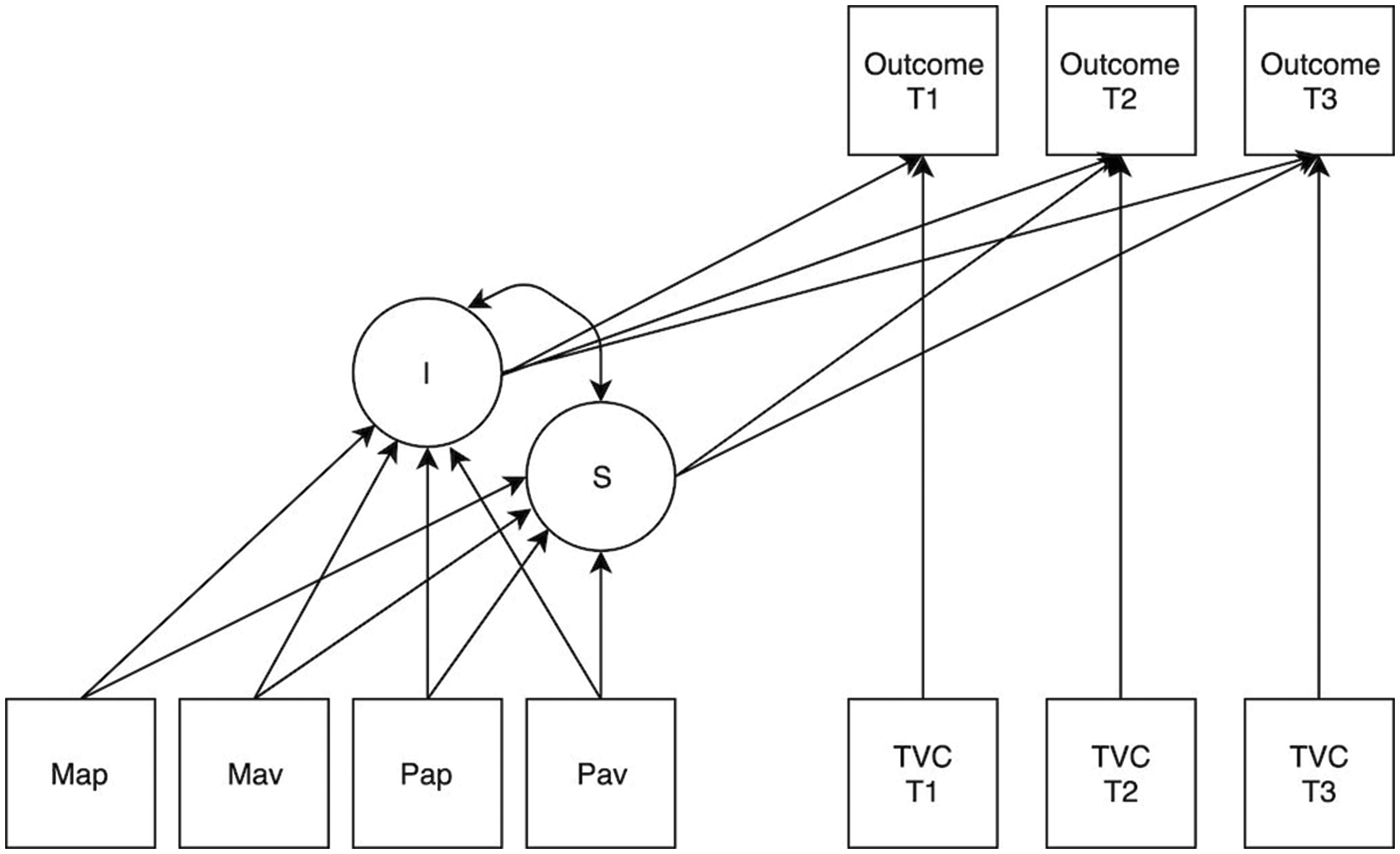
Latent growth curve model with time-varying covariates. I: intercept factor; S: slope factor; Map: mastery-approach; Mav: mastery-avoidance; Pap: performance-approach; Pav: performance-avoidance; Outcome T1, T2 and T3: vigour or need for recovery at T1, T2 and T3; TVC (time-varying covariate) T1, T2 and T3: workload or job autonomy at T1, T2 and T3.
Measurement invariance
A prerequisite for LGCM is that the measurement of the outcome variable is invariant across time. To test for longitudinal measurement invariance, we used a dataset with the items from the scales for the outcome variables (i.e. vigour and need for recovery). We created 100 imputed datasets that were subsequently analysed.
Little (2013) states that a comparative fit index (CFI) difference of .01 or less between the less (configural variance; only factor structure across time is the same) and most strict model (strict variance; factor structure, loadings and error variance are the same across time) is tenable to establish measurement invariance. The CFI difference between the configural and strict variance models was less than .01 for both vigour and need for recovery. More details are available upon request.
Results
Univariate latent growth models
We tested univariate latent growth models that only describe the trajectory of vigour and need for recovery as outcome variables. We report the following fit statistics: CFI, Tucker–Lewis index (TLI), standardized root mean square residual (SRMR) and root mean square error of approximation (RMSEA). Fit indices above a value of .95 for the maximum likelihood-based indices (TLI, CFI), a value lower than .08 for SRMR and a value lower than .06 for RMSEA are recommended (Hu & Bentler, 1999). To compare the fit of the models, we used the Akaike information criterion (AIC). The AIC indicates which model has the least loss of information. For smaller samples, a corrected version (AICc) of the AIC is recommended, for which rules of thumb are available. The difference in the AICc values between models is denoted as Δ. Compared to the best model (lowest AICc), models with Δ values close to 0 have strong empirical support. Models with Δ values in the range of 4–7 have considerably less support, while models with Δ values in the margin (about 9–14) have relatively little support (Anderson, 2008).
Vigour
The model fit statistics indicated an excellent fit (χ2 = 0.226, df = 1, p = 0.63, CFI = 1.00, RMSEA = 0.000, SRMR = 0.011). The intercept factor (MINTERCEPT = 2.89, z = 90.547, p < .001) in the model was significant, while the slope factor (MSLOPE = 0.02, z = 0.885, p = 0.38) was not. The absence of a significant slope implies that vigour across four years was stable and that on average the trajectories did not change. There was significant variability in the initial level of vigour scores (VarINTERCEPT = 0.12, z = 3.921, p < .001). Thus, while vigour was stable over time, people differed significantly among each other in vigour at T1.
Need for recovery
The model fit statistics indicated an excellent fit (χ2 = 0.053, df = 1, p = 0.82, CFI = 1.00, RMSEA = 0.000, SRMR = 0.004). The intercept factor (MINTERCEPT = 1.77, z = 52.876, p < .001) in the model was significant, while the slope factor (MSLOPE = 0.02, z = 0.979, p = 0.33) was not. This implies that need for recovery across four years was also fairly stable and that on average the trajectories did not change. However, there was significant variability between the slope factors (VarSLOPE = 0.01, z = 2.221, p < .03), indicating that the individual trajectories differed significantly in their steepness. There also was significant variability in the initial need for recovery scores (VarINTERCEPT = 0.18, z = 4.322, p < .001), indicating significant individual differences in levels of need for recovery at T1.
Latent growth curve models with AGO
The lack of significant slope factors for both vigour and need for recovery made it impossible to detect effects of AGO on changes in these over time. Therefore, we were only able to determine the effect of AGO on employees’ initial levels of vigour and need for recovery; to do this, the univariate models were extended with the four AGOs as predictors of the intercept and slope factors.
Vigour
The model fit statistics indicated an excellent fit (χ2 = 4.371, df = 5, p = 0.50, CFI = 1.00, RMSEA = 0.000, SRMR = 0.022). Only Map and Mav goal orientations significantly predicted the intercept factor (βMap = 0.21, p < 0.05; βMav = 0.19, p < 0.05). We used the AIC to assess the difference in fit between the univariate model and the model with AGO (AICcUNI = 710.73; AICcAGO = 706.85). The Δ value of 3.9 indicated a better fit for the model including AGO.
Need for recovery
The model fit statistics indicated an excellent fit (χ2 = 5.112, df = 5, p = 0.40, CFI = 1.00, RMSEA = 0.010, SRMR = 0.026). Only Mav significantly predicted the intercept factor (βMav = −0.21, p < 0.05). The AIC scores (AICcUNI = 860.33; AICcAGO = 860.45) of both models, with a Δ value of 0.1, indicated both models fitted the data equally well. In other words, the model with AGO is more complicated, but did not lead to loss of more information. However, according to the principle of parsimony a simpler model is always preferable (Burnham & Anderson, 2002).
Latent growth curve models with AGO, job demands and resources
To determine the unique effect of AGO on vigour and need for recovery, the models were extended with perceived workload or job autonomy as TVCs. First, we extended the univariate models and then the models with AGO.
Vigour and perceived workload
The model fit statistics indicated an excellent fit (χ2 = 5.236, df = 7, p = 0.63, CFI = 1.00, RMSEA = 0.00, SRMR = 0.05). Perceived workload at T1 predicted vigour at T1 and T2 significantly (βWorklT1 = –0.21, p < 0.05). The model with perceived workload had a better fit: AICcUNI = 710.73; AICcWORKL = 699.99. The Δ value of 10.7 indicated that adding perceived workload improved the model.
Vigour, AGO and perceived workload
The model fit statistics indicated an excellent fit (χ2 = 8.066, df = 11, p = 0.71, CFI = 1.00, RMSEA = 0.000, SRMR = 0.031). Both Map and Mav significantly predicted the intercept factor (βMap = 0.21, p < 0.05; βMav = 0.19, p < 0.05). The model with both AGO and perceived workload had a better fit: AICcWORKL= 699.99; AICcWORKL&AGO = 697.49. The Δ value of 2.5 indicated that adding AGO improved the model.
Vigour and job autonomy
The model fit statistics indicated an excellent fit (χ2 = 6.571, df = 7, p = 0.47, CFI = 1.00, RMSEA = 0.00, SRMR = 0.07). Vigour at T1, T2 and T3 was significantly predicted by job autonomy at T1, T2 and T3 (βAutT1 = 0.20, p < 0.01; βAutT3 = 0.19, p < 0.05). The lower AIC score of the model with job autonomy convincingly indicated a better fit (Δ value = 19.8; AICcUNI = 710.73, AICcAUT = 690.89).
Vigour, AGO and job autonomy
The model fit statistics indicated an excellent fit (χ2 = 11.597, df = 11, p = 0.40, CFI = 0.99, RMSEA = 0.016, SRMR = 0.042). Mav significantly predicted the intercept factor (βMav = 0.21, p < 0.05), while Map had a marginally significant effect (βMap = 0.17, p < 0.10). The model with AGO and job autonomy had a better fit (Δ value = 1.3; AICcAUT = 690.89, AICcAUT&AGO = 689.59).
Need for recovery and perceived workload
The model fit statistics indicated an excellent fit (χ2 = 6.803, df = 7, p = 0.45, CFI = 1.00, RMSEA = 0.000, SRMR = 0.063). Need for recovery at T1, T2 and T3 was significantly predicted by perceived workload at T1, T2 and T3 (βWorklT1 = 0.40, p < 0.001; βWorklT3 = 0.35, p < 0.001). Extending the model with perceived workload convincingly (Δ value: 85.7) improved the fit: AICcUNI = 860.33; AICcWORKL = 774.66.
Need for recovery, AGO and perceived workload
The model fit statistics indicated an excellent fit (χ2 = 10.919, df = 11, p = 0.45, CFI = 1.00, RMSEA = 0.000, SRMR = 0.041). Only Mav significantly predicted the intercept factor (βMav = –0.23, p < 0.05). The model with only perceived workload had a slightly better fit (Δ value: 0.3). Thus, adding AGO resulted in a poorer fit: AICcWORKL = 774.66; AICcWORKL&AGO = 774.94.
Need for recovery and job autonomy
The model fit statistics indicated an excellent fit (χ2 = 7.914, df = 7, p = 0.34, CFI = 0.98, RMSEA = 0.025, SRMR = 0.045). Need for recovery was significantly predicted by job autonomy only at T2 (βAutT2 = –0.13, p < 0.05). Extending the model with job autonomy (Δ value = 6.3) improved the fit: AICUNI = 860.33; AICAUT = 854.04.
Need for recovery, AGO and job autonomy
The model fit statistics indicated an excellent fit (χ2 = 14.669, df = 11, p = 0.20, CFI = 0.95, RMSEA = 0.039, SRMR = 0.036). Only Mav significantly predicted the intercept factor (βMav = –0.22, p < 0.05). The model with both AGO and job autonomy had a comparable fit to the model with only job autonomy (Δ value = 0.6): AICcAUT = 854.04; AICcAUT&AGO = 854.98. The model with AGO explained more variance, but due to three non-significant predictors is less parsimonious than the model with only job autonomy as a TVC.
Overview of results
The results of the different models are summarized in Tables 1 and 2. For all models, based on AICc, the addition of AGO led to a comparable (i.e. need for recovery) or even better fit (i.e. vigour). It should be noted that AICc only ranks models; when all models are badly fitting, it only ranks models from worse to worst. The variance explained by the model (R2) is a better indicator of the quality of the model (Anderson, 2008). Over all the models for vigour, the model with job autonomy as a TVC and AGO had the lowest AICc value. In this model, 12% of the variance in the intercept factor was explained by AGO (R2 = 0.12, p = 0.08). In the model with only AGO as a predictor, 12% of the variance in the intercept factor was also explained (R2 = 0.12, p < 0.05). These results indicated that the models for vigour with AGO were good, as reflected in the significant and substantial explained variance. For need for recovery, the model with perceived workload as a TVC and AGO had the lowest AICc value (among the models with AGO); 7% of the variance in the intercept factor was explained by AGO (R2 = 0.07), but this was not significant (p = 0.23). These results indicated that the models for need for recovery with AGO were poor, because the variables in the model did not significantly explain the variance in need for recovery.
Fit statistics: LGCM vigour.
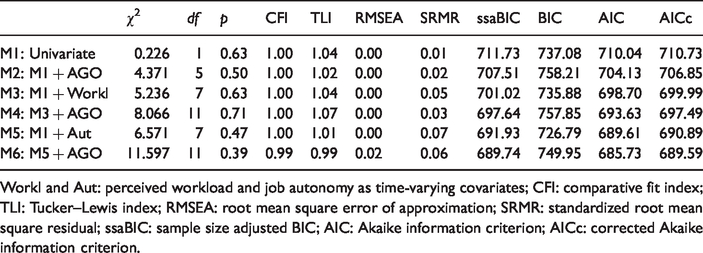
Workl and Aut: perceived workload and job autonomy as time-varying covariates; CFI: comparative fit index; TLI: Tucker–Lewis index; RMSEA: root mean square error of approximation; SRMR: standardized root mean square residual; ssaBIC: sample size adjusted BIC; AIC: Akaike information criterion; AICc: corrected Akaike information criterion.
Fit statistics: LGCM need for recovery.
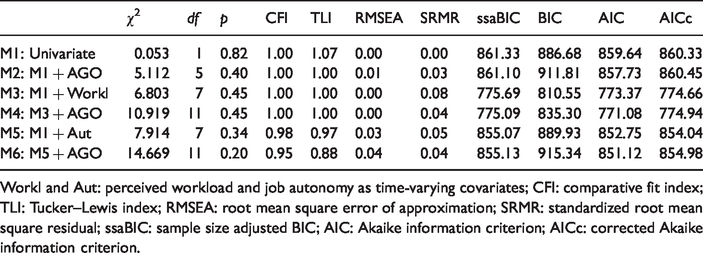
Workl and Aut: perceived workload and job autonomy as time-varying covariates; CFI: comparative fit index; TLI: Tucker–Lewis index; RMSEA: root mean square error of approximation; SRMR: standardized root mean square residual; ssaBIC: sample size adjusted BIC; AIC: Akaike information criterion; AICc: corrected Akaike information criterion.
Finally, the lack of significant slopes for both vigour and need for recovery, as described earlier, indicated that in our study there were no significant changes in the average individual trajectories over time for these variables. Consequently, no effects of AGO on the development over time of vigour and need for recovery could be detected. Nonetheless, the initial levels of vigour were related to Map and Mav goal orientations and those of need for recovery to Mav goal orientation. However, the R2 of need for recovery was not significant. In sum, Map and Mav goal orientations contribute to predicting vigour in employees but there is no support for a significant effect of AGO on the need for recovery.
Discussion
The objective of the present study was to examine the long-term relationship between AGO and recovery from stress (i.e. vigour and need for recovery), in a high-stress job. To this end, we used data from a sample of social workers, and looked at the influence of AGO on the recovery process over several years. More specifically, we expected that higher Map goal orientation over time would result in lower need for recovery and higher vigour, whereas higher Pav goal orientation would result in higher need for recovery and lower vigour.
We used LGCM to detect changes over a period of four years, with three measurement points. LGCM estimates trajectories of a variable over time; the intercept describes the initial level of the trajectories and the slope describes the changes in the trajectories. LGCM can also be extended with predictors of the intercept and the slope. To determine the effect of AGO on the initial level of and changes in the trajectories, we entered AGO as a predictor of the intercept and slope.
Overall, there were no significant changes (i.e. slope factors) in both vigour and need for recovery over time. This result is in line with other studies (e.g. De Croon et al., 2006; Seppälä et al., 2015), which showed that both vigour and need for recovery are fairly stable over time. Consequently, we could not examine the effects of AGO on change in vigour and need for recovery over time. A possible explanation for the lack of findings could be an attrition effect. In our study, social workers with a higher need for recovery at T1 were less likely to participate at T2 or T3. Although a multiple imputation procedure was used to correct for an attrition effect, we cannot rule out a bias effect. However, the means and standard deviations of vigour and need for recovery were similar at the different measurement points. Therefore, attrition is less likely an explanation for our findings.
Another explanation for the stability in vigour and need for recovery might be that the working environment was fairly stable over time. Therefore, we additionally analysed the trajectories of two important indicators of job demands and resources (i.e. perceived workload and job autonomy) and they were indeed also stable over time. So, it might be that in a stable work environment, recovery from stress shows a stable pattern over time, while in a more dynamic environment, recovery from stress would show more variability over time. In addition, stability over time does not mean that need for recovery and vigour are unchangeable or do not fluctuate on a daily level. Sonnentag (2003), for example, found that Map goal orientation at the daily level was related to engagement and recovery at the daily level.
Therefore, to gain more insight into what contributes to recovery from stress by social workers, future research is needed in which social workers are monitored on a daily level (for instance, by means of diary studies). With this kind of research, antecedents and consequences of stress recovery can be measured and AGO can then be added as a state (versus a trait) variable. An example of an item evaluating AGO as a state is “Today I focused on developing my skills at work”. Measuring AGO on a daily level has the advantages that any filter effects of one’s memory are minimized and that the measurements can be related to concrete events (for instance, a crisis at work) (Kahneman & Krueger, 2006). Despite the lack of findings for change over time, the initial levels of both vigour and need for recovery differed significantly between employees. Moreover, these differences were related to employees’ AGO. As expected, a higher Map goal orientation was related to more vigour at T1. In LGCM, the measurement points can be controlled for relevant variables, which are labelled as TVCs. We created models that controlled for an important job demand, namely, perceived workload, and an important job resource, namely, job autonomy. After controlling for perceived workload, Map goal orientation still predicted the initial level of vigour significantly, while after controlling for job autonomy this effect became marginally significant. The latter was caused by the presence of predictors, Pap and Pav, that did not contribute to the model. An additional analysis showed that in a more parsimonious model with only Map and Mav as predictors, Map still significantly predicted the initial level of vigour even after controlling for job autonomy. Thus, Map goal orientation is related to vigour independent of the experienced job autonomy, and therefore might be considered as an important personal resource. In other words, vigour can be partly explained by the degree of job autonomy, but a unique part of the variance can be explained by the levels of mastery goal orientation (both Map and Mav). Hence, besides creating job autonomy, fostering mastery goal orientations in employees could contribute to their feeling more energetic during the workday.
Contrary to our expectations, Pav goal orientation was not related to vigour. It is hard to find an explanation why vigour is not related to employees’ Pav goal orientation. Apparently, the previously found negative effects of Pav goal orientation on engagement in a working environment (e.g. Bakker et al., 2018) were not supported by the data in our study. It might be that Pav goal orientation was less maladaptive in this particular professional field (i.e. youth guardians). It is known that the effects of goal orientation on performance differ across domains (work, sports and education) (Van Yperen et al., 2014). Similarly, the effects of goal orientation on aspects of well-being (such as recovery from stress) could vary across the different work areas within social work. Thus, in addition to research that monitors social workers’ recovery from stress on a daily level, more research across different work areas in social work is needed to examine whether in some work areas (e.g. youth guardianship) a focus on avoiding mistakes is less maladaptive than in other work areas (e.g. residential youth care).
The remarkable finding that Mav goal orientation was positively related to vigour might be explained by the age of the participants in our study (M = 45.12, SD = 10.37). More recent studies have reported positive effects of Mav goal orientation on positive affect (e.g. more task enjoyment) for older adults (Senko & Freund, 2015). In addition, an orientation toward prevention of loss is negatively associated with well-being in younger adults, while in older adults, orientation toward maintenance is positively associated with well-being (Ebner et al., 2006). So, at an older age, Mav goal orientation might be related to feeling energetic during the workday; a prevention-based focus on competencies (not lagging behind and staying up to date in my job) would contribute to feeling more energetic for older employees. However, more research is needed to replicate these effects of Mav goal orientation. Moreover, these positive effects of Mav goal orientation might also vary across different work areas.
For need for recovery, although we found that employees with a high level of Mav goal orientation had lower need for recovery, both Map and Pav goal orientation were unrelated to need for recovery. Despite the strong association between vigour and need for recovery (r = –.51, p < .01, T1), their relation with AGO proved not to be similar. A possible explanation for the lack of a relationship between AGO and need for recovery, while there was a relationship with vigour, could be that vigour is more dependent on motivational processes. The effect of AGO on motivation is known and extensively researched (Payne et al., 2007). Feeling energetic at one’s work (i.e. vigour) depends on one’s energy level, but also the motivation to use the available energy resources, while need for recovery is more a logical consequence of being exposed to high demands. To illustrate this, one can imagine that a social worker who has a hard time recovering well after work (i.e. high need for recovery) will have more difficulty feeling energetic the next workday. In such a case, putting energy into his work is determined by not only his fatigue but also his willingness to do so. In other words, vigour may be regarded as an outcome of motivational processes, while need for recovery may be seen as an outcome of a strain process (Schaufeli et al., 2009). Our study showed that mastery goal orientation (i.e. Map and Mav goal orientations) cannot prevent depletion, but is related to vitality. Similarly, Van Yperen and Janssen (2002) found that job demands resulted in fatigue regardless of goal orientation. However, for individuals whose performance goal orientation was stronger than their mastery goal orientation, fatigue was also accompanied with dissatisfaction.
Due to the lack of change over the long term in vigour and need for recovery, we could not demonstrate an influence of AGO over the long term. The relationship between AGO and the process of recovery from stress is probably even more complex than we could show with this study. One can imagine that AGO and the recovery process have a reciprocal relationship, in such a way that vital (i.e. well-recovered) employees will be focused more on developing competencies and that the focus on developing competencies will result in more vitality. More longitudinal studies with different time spans are needed to demonstrate a possible reciprocal relationship between AGO and vitality. This kind of research could also address whether AGO and recovery from stress are related constructs or whether they are clearly independent of each other. Based on our findings, in which vigour and recovery were fairly stable, we expect that research in which recovery from stress is monitored daily over a period of several weeks would be the most fruitful. First, this kind of research will likely involve more variability and can provide more insight into related events that influence recovery from stress. Second, such a research design enables researchers to determine to what extent the relationship between AGO and recovery from stress is reciprocal.
Practical implications
The findings have implications for both social workers and the organizations in which they work. Social workers are confronted with inevitable stress in their job, which makes it highly relevant to ask which workers can recover well from stress. Our study showed that employees with high mastery goal orientation (both Map and Mav) felt more energetic during the workday despite their workload. Therefore, mastery goal orientation can be used as an indicator whether someone is suited for a job in which high stress is inevitable. Thus, organizations can prevent depletion (i.e. high need for recovery) by ensuring an acceptable workload, while vigour can be enhanced by selecting employees with high mastery goal orientation.
Organizations can also contribute to the vitality of their workers by stimulating and fostering mastery goal orientation (see also Dragoni, 2005). Promoting mastery goals has been proven to be effective, even for employees with high performance goal orientation (Latham et al., 2016). Moreover, it has been demonstrated that Map goal orientation can be promoted among adults (e.g. Noordzij et al., 2013) and that leaders can promote Map goal orientation in their employees by promoting a Map goal structured work environment (e.g. O’Keefe et al., 2013).
Finally, our study showed that the positive relation between mastery goal orientation (both Map and Mav) and vigour is also independent of job autonomy. Thus, mastery goal orientation can be viewed as an important personal resource for feeling more energetic during the workday.
Limitations
A possible limitation of the present study is that the results rely on self-report measures. Self-report measures raise the concern of common method variance (Podsakoff et al., 2003). However, the scales are well validated and are based on extensive empirical evidence (e.g. Van Veldhoven et al., 2002; Van Yperen et al., 2014). Another limitation is that the study suffered from data attrition, which might influence the results. Multiple imputation is, however, considered appropriate to minimize the effects of data attrition (Asendorpf et al., 2014) (for an explanation of handling missing data in our study, see online Appendix A).
Conclusion
Because no changes over time in vigour and need for recovery were found, a possible relation with AGO over the long term could not be demonstrated. Employees’ AGO did not significantly predict their level of need for recovery. However, mastery goal orientation proved to be a unique and important predictor of how energetic the employee felt during the workday. Therefore, mastery goal orientation can be regarded as an important factor in relation to vitality in a high-stress job. Organizations may consider using this knowledge by selecting social workers with high mastery goal orientation and by fostering mastery goal orientation, as a personal resource, among their employees. Thus, mastery goal orientation could provide a concrete avenue for positively influencing the well-being of social workers and also provide a solution for the stress they frequently experience.
Supplemental Material
JSW911350 Supplemental Material - Supplemental material for Social workers and recovery from stress
Supplemental material, JSW911350 Supplemental Material for Social workers and recovery from stress by Arjan van Dam, Gera Noordzij and Marise Born in Journal of Social Work
Footnotes
Authors' Note
Marise Born is also affiliated to North-West University South Africa Optentia and Faculty of Economic and Management Sciences.
Ethics
At the time this research was conducted, in the Netherlands no ethical approval was needed for this kind of research.
Funding
The authors received no financial support for the research, authorship, and/or publication of this article.
Acknowledgements
We would like to thank all employees who participated in this research for their time and effort.

Supplemental Material
Supplemental material for this article is available online.
References
Supplementary Material
Please find the following supplemental material available below.
For Open Access articles published under a Creative Commons License, all supplemental material carries the same license as the article it is associated with.
For non-Open Access articles published, all supplemental material carries a non-exclusive license, and permission requests for re-use of supplemental material or any part of supplemental material shall be sent directly to the copyright owner as specified in the copyright notice associated with the article.
