




Abstract
Entrepreneurship research as a field is going through a transformational phase along its growth trajectory, with its practical relevance being put under the spotlight, triggered by the rapid changes in markets and the external environment. While it originated as a practice-based field a few decades ago, it has grown distant from real life in recent years due to several factors. Extant literature on the research-practice gap has been rather prescriptive or focused on one part of the problem only. This led to scholarly calls for more theory-building and inclusive approach in addressing it. This note proposes a processual model to theorize practicality as a field of inquiry. The model is formed of four phases that reflect the normative process of scientific research and highlight the shared responsibility of academia and industry. The antecedents of each phase are discussed and potential measures to resolve them are proposed, guided by literature and real-life examples.
Keywords
Introduction
Entrepreneurship is relatively a new field within management research that was shaped originally through a practice-oriented approach, investigating real-life phenomena, some 50 years ago (Wiklund et al., 2019). Its theoretical and methodological rigor, and the depth and breadth of publications have progressed rapidly since the turn of the century, establishing itself as a legitimate scholarly discipline (Combs et al., 2021; McMullen et al., 2021).
In recent years, however, concerns related to its relevance and impact on practice are increasingly being discussed and debated in academic circles (Chen et al., 2023; Kevill et al., 2021; Shepherd, 2015). The relevance conundrum was further discerned throughout recent COVID, geopolitical and climate crisis, the accelerated digitalization, and the rise of AI (Marx and Klotz, 2023; Ratten, 2023; Sharma et al., 2022; Winkler et al., 2023). This led to mounting calls from inside and outside academia to prioritize the practicality topic, with a growing number of publications discussing it (e.g. Hernandez and Haack, 2023; Wiklund et al., 2019). The majority of those scholarly discussions, however, followed a prescriptive approach in addressing the problem (Bartunek and Rynes, 2014; Kieser et al., 2015), with fewer studies investigating a confined instance empirically (e.g. Baldridge et al., 2004). However, the problem of relevance is multifaceted and thus requires a holistic approach in examining and solving it. Moreover, the inconclusiveness of the academic debate, so far, might create ambivalence among practitioners toward the practical utility of our research. Hence, to advance our scholarly efforts on this topic, a more systematic and theory-building approach is required that recognizes it as a distinctive field of inquiry (Kieser et al., 2015).
The relevance discussion is not limited to the research-industry conduit but incorporates policymaking as well (Hernandez and Haack, 2023). It extends beyond research to the wider academia, with dissonance in entrepreneurship education objectives between educators and ecosystem agents often cited (e.g. Decker-Lange et al., 2021; Hammoda, 2023). It is also not specific to our field but apparently a pressing issue in other management subdisciplines as well such as accounting (Jansen, 2018) and marketing (Gummesson, 2014).
Building bridges between practice and research is crucial to ensure the continuity of entrepreneurship research growth trajectory. There is a need to adjuvant its well-established theoretical and methodological rigorousness with impact driven outputs that are more aligned with and inclusive of practitioners and policymakers’ perspectives (Wiklund et al., 2019). In this note, building on Kieser et al. (2015) review, I take a step towards theorizing “practicality” as a field of inquiry. I posit that the scholarly efforts in this domain should follow a holistic processual model rather than a prescriptive approach or a solitary juncture. I herein conceptualize this model and provide examples to demonstrate the relevance and effectuation of its different phases.
A processual model for bridging the research-practice gap
The proposed model aims at operationalizing the practicality discussions through a frame-setting perspective (see Figure 1). It starts with scoping and problematization of the phenomenon and encompasses the theoretical and methodological choices of the researcher, the publication and communication of results, and their adoption and impact assessment. The explanatory note highlights the collaborative nature of the boundary spanning activities, not being reliant entirely on academic efforts. The solutions presented herein are intended to demonstrate the art of the possible rather than prescribing “dos and don’ts.”
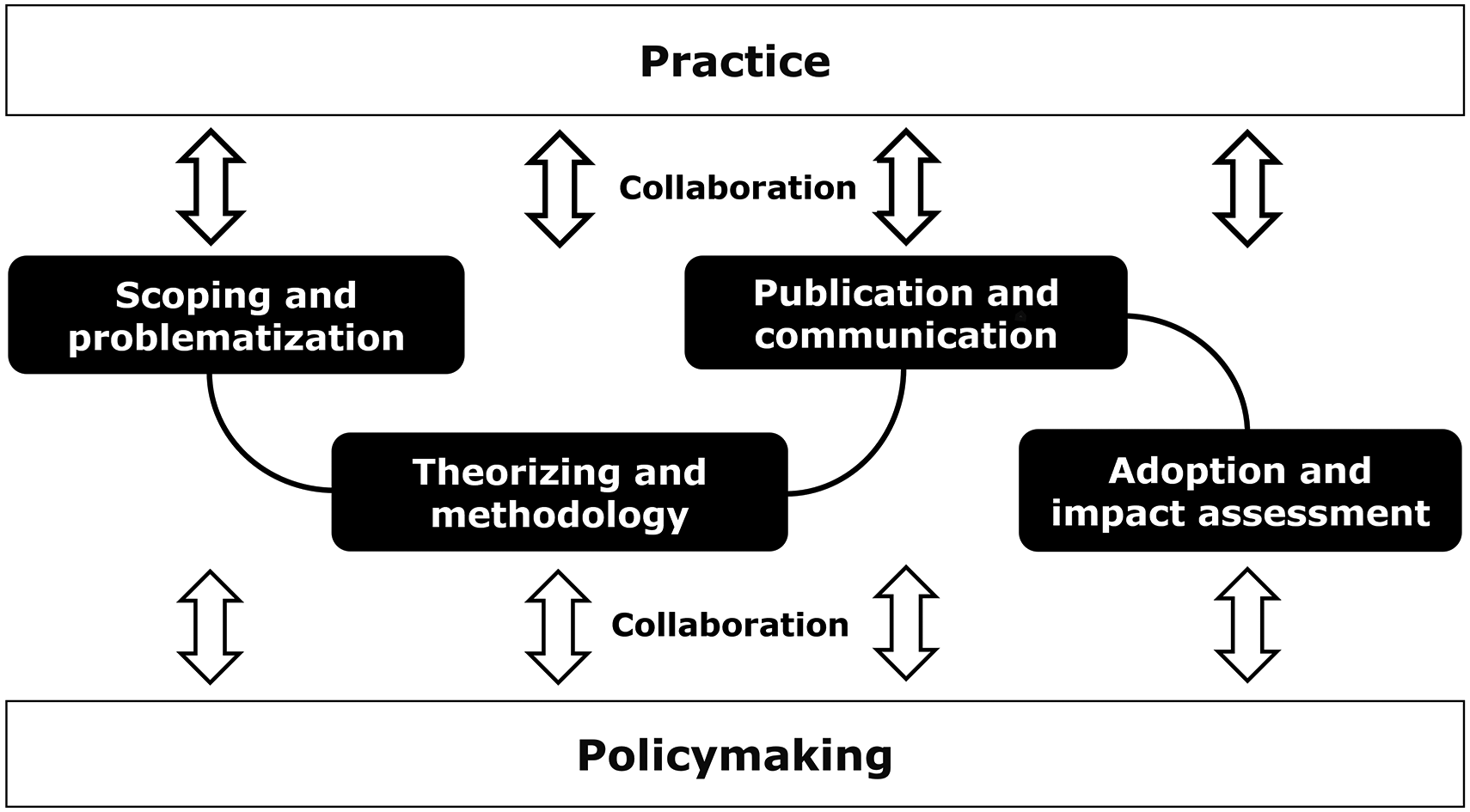
Processual model to conceptualize the practicality gap.
Scoping and problematization
The entrepreneurial phenomena reflect and impact a plethora of economic and social dimensions and are enacted by multitude of discrete groups. This diversity is insufficiently represented in extant research (Bakker and McMullen, 2023; Zahra and Wright, 2016). Examples of these underrepresented categories include contenpreneurship (Johnson et al., 2022), artificial intelligence and advanced technology (Winkler et al., 2023), wellbeing and affective aspects (Stirzaker et al., 2023), veterans (Heinz et al., 2017), informal entrepreneurship (Bruton et al., 2021), ethnic minorities (Korede et al., 2023), and gender (Brahem and Boussema, 2023; Brush et al., 2020).
These limitations could be attributed to scholars not taking due notice of emerging and less “visible” forms of entrepreneurship (Welter et al., 2017), such as autopreneurship or intrapreneurship, as these are typically harder to approach and analyze using available theories and methods. However, “If research impact is the solution to problems of practice, research cannot be separated from the problem it can potentially solve” (Chen et al., 2023: 233). Hence, problematizing a research phenomenon should become a collaborative process that involves those who experience it (Chen et al., 2023; Kieser et al., 2015), with researchers immersing themselves in those contemporary instances to develop closer and better understanding of them (Ferreira et al., 2019).
It is also important to direct our scholarly consciousness to new topics, groups, and regions that did not receive due attention (Ratten, 2023). Entrepreneurship scholars must embrace the multitude of contexts, activities, and perspectives through a more inclusive view of what constitutes entrepreneurship at its different levels (Nambisan et al., 2019; Welter et al., 2017).
Investigating those hard-to-reach phenomena could be achieved by incorporating professionals operating at the edges of industry, community, and government exchanges in academic research, as early as the problematization stage. These hybrid researcher teams are typically more capable of engaging closely with the phenomena and provide contextually relevant accounts. Another approach is Shepherd et al. (2021) “me-search,” whereby researchers invoke a self-reflective approach to problematization by regurgitating their own personal experiences. This implies applying “less popular”’ theoretical and methodological lenses to illuminate the intricacies of those unorthodox entrepreneurial occurrences and deduce impactful contributions.
Theorizing and methodology
Entrepreneurship research is often characterized and criticized for prioritizing theoretical and methodological soundness, guided by top journals expectations. This rendered our publications sometimes “difficult to digest” by the same population that our research should inform, i.e. entrepreneurs, managers, and policymakers (Hernandez and Haack, 2023; Wiklund et al., 2019). Additionally, our domain features a predominance of certain constructs and methods such as entrepreneurial intentions, theory of planned behavior, and quantitative studies (Brinkerink, 2023), that sometimes impede its epistemological and ontological expansion (Anderson et al., 2019; Shepherd and Williams, 2023).
This is especially perceived when scholars try to explore an idiosyncratic or emerging phenomenon, which cannot always be analyzed or explained through a validated tool or an established theory (2024Thompson et al., 2020; Tiwasing et al., 2023). Hence, entrepreneurship scholars need to continue developing and experimenting with new and existing theories and methods. For example, adopting socially representative qualitative approaches is argued to better inform researchers about the experiences of entrepreneurs (Galloway et al., 2015; Hlady-Rispal et al., 2021). Some of those unconventional methods that entrepreneurship researchers attempted include autoethnography (e.g. Fisher et al., 2020), drawing and images (e.g. Clarke and Holt, 2019), and process tracing (e.g. Ruzzene et al., 2022).
Relevance-seeking researchers should not also be occupied with the generalizability of their theoretical contributions but rather provide contextualized examples that build theory in an incremental fashion. Herein, the field is witnessing a growing interest in theoretical concepts that can aid researchers in investigating the intricacies of the daily lives of the entrepreneurs, such as entrepreneurship as practice (Thompson et al., 2020) and entrepreneurship as a process (Moroz and Hindle, 2012). Moreover, some of the most widely applied theories emerged this way. Everett Rogers developed the diffusion of innovation theory among corn maze farmers while Sarasvathy (2001) deduced effectuation from the interactions of experienced entrepreneurs. Both theories were further developed, adapted, and adopted across a multitude of settings. Publishers, editors, and reviewers have some role to play as well in guiding those experiments through the review process and allowing them to see the light. Thereof, our scholarly output would become more representative of realistic entrepreneurial occurrences and communicate them through apropos theories and methods.
Publications and communication
The scholarly discussions in our field, as in others, prime researchers, especially young ones, to target highly ranked journals (e.g. Fayolle and Wright, 2014), despite several studies showing that innovative research often breathes life through lower ranked journals (e.g. Rafols et al., 2012). In all cases, academic journals have low permeability and the research published there rarely reaches or benefits practitioners directly, as they are often “closed off” to outsiders (Hernandez and Haack, 2023; Razmdoost, 2023). It is indeed true that despite a plenitude of models and frameworks appearing in entrepreneurship literature over the last two decades, little was adopted by entrepreneurs and small companies (Shepherd and Williams, 2023; Wiklund et al., 2019).
Researchers are central to amplifying their research exposure. Firstly, they should aim to guide entrepreneurship policy and practice with their work. Furthermore, their research should be made available through a variety of outlets, beyond the ranked journals realm, and in more transferrable forms such as industry symposia and magazines, or podcasts (see Entrepreneurship & Regional Development Journal). Herein, scholars can utilize purposefully designed AI services and tools (see Matter of Facts and Scholarcy) or involve industry experts to accelerate those initiatives.
On the other hand, academic journals and publishers need to raise researchers’ attention and give more leeway to practice-oriented publications such as the Academy of Management Discoveries (Bamberger, 2018). Additionally, they could widen their subscribers’ base to include more stakeholders’ groups. A good example is the recently announced partnership between the Academy of Management Insights and the New York Times Licensing group to distribute its articles among business subscribers. Moreover, inviting industry experts to contribute to academic functions and research processes such as problematization, teaching, and reviewing, will probably improve the relevance of our work and facilitate their adoption of our research outputs.
Adoption and impact assessment
Although a growing number of entrepreneurial firms are innovative and knowledge-intensive (Fischer et al., 2022), they seldom utilize academic research. Bikard and Marx (2020) found that only (0.03) of scientific articles are mentioned in industry patents. Herein, some academics and journals have exerted commendable efforts to improve scholarly impact (see Entrepreneur & Innovation Exchange (EIX), as well as Hernandez and Haack, 2023; Haley et al., 2022 in AMR and AMLE, respectively). Still, an orchestrated effort is required. Research funding organizations should promote more collaborative projects (see Erasmus + Education-Enterprise Collaboration), that prioritize broader impact (see National Science Foundation Broader Impact). Publishers are expected to play a role as well by accelerating their adoption of tools that assess appliedness, such as the Journal Commercial Impact Factor which measures paper to patent citations and online exposure and mention, such as Almetrics.
Collaboration
The research-practice gap is a complex problem given the varying political, cultural, and structural differences between involved stakeholders. While literature focused on the academic failings (see literature on entrepreneurial university and technology transfer), seldom has it discussed the role of industry in bridging the gap by, for example, incorporating scientific results and methods into their process, i.e. “academic firm” (Bikard and Marx, 2020; Etzkowitz, 2004). Indeed, institutional convergence is required to build shared spaces for cultural and knowledge exchanges, and collaborative innovation. Professional organizations can take part as well in bringing stakeholders together through their boundary spanning activities (see USASBE).
Despite the institutionalization of the problem in literature, Williams (2002) argue that individuals have a crucial role in bridging the practicality gap. Researchers can use their social skills to build networks among industry circles (Bjerregaard, 2010) and incorporate stakeholders’ perspectives in their research (Hammoda, 2023). Additionally, mutual residencies can prove useful for scholars to consult companies and policymakers and experience their problems, while managers and policymakers get to learn scientific approaches to conducting their affairs (Hernandez and Haack, 2023). Moreover, highlighting the temporal dimension of collaborations, Van de Ven and Johnson (2006) argue that a model of engaged scholarship between scholars and practitioners, should extend throughout the entire research process.
Conclusion
The proposed model re-orients the discussion on the practicality gap through an inclusive view of its antecedents and predeterminants, following a theory-building approach that heralds this topic as a separate field of inquiry. The four phases of the model were aligned with the normative process of conducting scientific research, to make it more familiar to scholars. The model also highlights the collaborative responsibility of institutions and individuals in academia, industry, and government in addressing this gap.
I argue that by internalizing those premises, scholars can improve the practicality and applicability of entrepreneurship research. It does not come without its challenges though. While, re-orienting the literary discourse might seem an affordable theoretical exercise, changing strongly held assumptions of the different stakeholders can prove arduous. I hence urge scholars in the different subfields of entrepreneurship and management to test, experiment with, and adjust the proposed model through further theoretical inquiries and empirical investigations. Thus, not falling into the trap of wishful thinking which Kieser et al. (2015) criticized in mainstream practicality literature. It is a journey we cannot avoid if we wish for entrepreneurship research to regain its status as the linchpin of policies and practices.
Footnotes
Declaration of conflicting interests
The author declared no potential conflicts of interest with respect to the research, authorship, and/or publication of this article.
Funding
The author received no financial support for the research, authorship, and/or publication of this article.
