



Abstract
Most scholarly impact measures focus exclusively on an essential but single group of stakeholders: other researchers. However, business research aims to benefit not only other researchers (i.e., internal) but also additional (i.e., external) stakeholders. Accordingly, we offer an expanded multidimensional and multistakeholder conceptualization of scholarly impact that includes the following dimensions and their stakeholders: (1) personal (i.e., individual researchers), (2) theory and research (i.e., other researchers), (3) educational (i.e., students, parent institutions, and university community), (4) organizational (i.e., practitioners including managers, consultants, and industry), (5) societal (i.e., media, policymakers, governments, and nongovernmental organizations), and (6) global (i.e., international institutions). We also describe scholarly impact measures across these dimensions and stakeholders. Then, we extend the capacity, opportunity, and relevant exchanges (CORE) performance model to describe the construct of scholarly impact performance (SIP) and provide actionable recommendations that individuals and organizations can implement to enhance SIP across institutional contexts (i.e., research-intensive, teaching-oriented, and those in emerging countries). In sum, we offer a broader conceptualization of scholarly impact, measures, and recommendations for incentivizing and enhancing SIP.
Keywords
Compare a stone dropped into a pond to an ocean wave: the former slightly disrupts the water’s surface, with ripples emanating outward until their energy dissipates. An ocean wave, by contrast, can reach great heights, cross oceans, and reshape a shoreline. A wave is an apt metaphor for scholarly impact, shaping and being shaped by interactions with the environment and other waves. At every level, researchers aspire to produce resonant and enduring work that expands the bounds of inquiry, opens new doors, and improves lives. We must know who we impact and how it matters to various beneficiaries, including other researchers, students, organizations, communities, and society. Clearly, there is a need for basic research without direct or obvious application. However, when research does not consider who it impacts and how, it may not do much beyond pleasing the intellectual curiosity of its authors. Such efforts are like stones skipped across a pond: sources of fleeting ripples bounded and diminished by the shore. In an age of Grand Challenges, we cannot afford to waste energy and precious organizational resources skipping stones (Podsakoff et al., 2018; Rosenthal, 1994). We must aspire to conduct research that generates waves.
Scholarly impact is not limited to individual scholars. At the organizational level, universities are increasingly accountable for justifying the cost and quantifying the benefits of the research they produce (Beltran et al., 2024). Specifically, university accreditation and reputation are grounded in research impact, which drives organizational relationships and fundraising efforts. As a field, relevant and impactful business research is vital to its long-term credibility and sustainability (Trieschmann et al., 2000). Indeed, pressure to maintain ties to practice and to bridge the research-practice (aka “science-practice”) gap is perennial (Banks et al., 2021). In addition, it would not be hyperbole to reiterate that the Grand Challenges of our time require research that informs policy and has a global impact in mind (Aguinis et al., 2016). However, to achieve the lofty goal of enhancing scholarly impact, we first must be able to define and measure it.
Typical conceptualization of scholarly impact: citations
Scholarly impact has been conceptualized and measured primarily through citations (Aguinis et al., 2012). Citations are helpful because they reflect the number of times a single article, a collection in a journal, a researcher’s consolidated body of work, the collected works of a group of faculty (e.g., Department), or institution are noted in other scholarly publications. Citation variants such as the i10 (i.e., how many publications have been cited at least 10 times) and h-indices (i.e., h publications have been cited at least h times each) refine basic citation counts to index how many of an author’s works have at least a specified baseline of citations.
Gathering citation data using web-based platforms such as Google Scholar, Web of Science, and Scopus is straightforward. However, citation counts and count-derived indices focus exclusively on impact within the academic community. They are helpful because they reflect a dialogue among researchers. Although necessary, they are insufficient to define and measure impact, given the need to define scholarly impact more broadly. Even when citation count is refined into an index measure (e.g., h-index), the data only reflect the extent to which other researchers pay attention to our research. While citation measures are appropriate and necessary for quantifying researchers’ impact on other researchers, they provide no information on whether external stakeholders have noticed the research.
Expanding the conceptualization of scholarly impact
Aguinis et al. (2014, 2021) noted that a multidimensional and multistakeholder model is needed to capture scholarly impact inside and outside academia adequately. Our article builds upon but goes beyond their conceptualization by offering the expanded model as shown in Figure 1, which includes dimensions in bold type and stakeholders in italics.
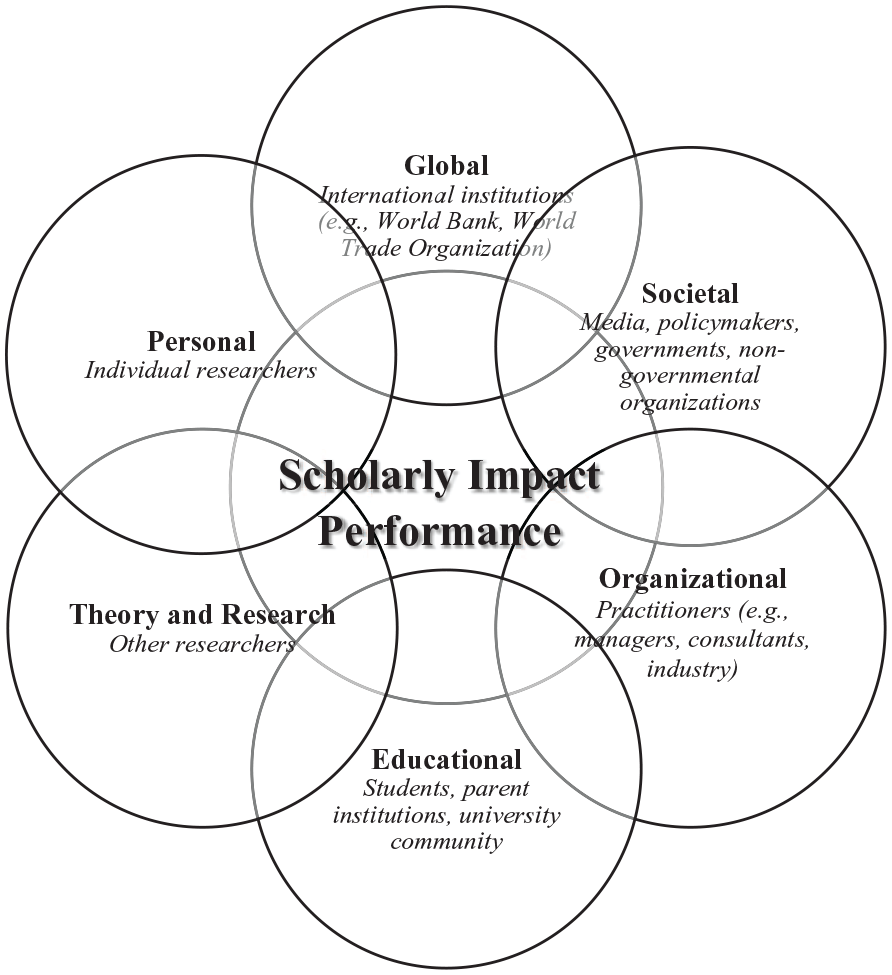
A multidimensional and multistakeholder model of scholarly impact performance (SIP) (dimensions in bold type and stakeholders in italics).
Our model is fundamentally based on stakeholder engagement and stakeholder theory. For example, Bridoux and Stoelhorst (2016) explained that joint value creation (e.g., scholarly impact) involves multiple stakeholders contributing to a collective outcome. Accordingly, universities that display behaviors aligned with communal or equitable values can foster cooperative relationships, whereas self-interested behavior often shifts stakeholders toward transactional, market-oriented models. Relatedly, Mitchell et al. (1997) highlighted the dynamic nature of stakeholder relationships such that stakeholders can gain or lose attributes over time, transitioning between classes. This emphasizes the need for managers to reassess stakeholder salience continuously. Based on conceptual and empirical work on stakeholder theory, our model fosters joint value creation through collaboration such that multiple stakeholders (e.g., faculty, students, industry, and society) collaborate to generate useful knowledge. Also, our model relies on a dynamic and ongoing assessment of scholarly impact because, just as stakeholder relationships are dynamic, the relevance and impact of scholarly work can change over time. To ensure ongoing relevance, universities should continuously evaluate the significance of their research in light of evolving societal and industry needs.
Our model includes the following improvements compared with Aguinis et al.’s (2014, 2021). First, our focus is SIP instead of scholarly impact. SIP involves behaviors and results directly related to scholarly impact (Aguinis, 2023). So, SIP entails shifting from an abstract scholarly impact construct to one that gives agency to those aiming to create impact: researchers and their institutions. Moreover, shifting the emphasis from scholarly impact to SIP allows us to focus on performance: The actions that those interested in and responsible for producing impact need to carry out to enhance impact. In other words, a shift to performance (i.e., scholarly impact performance) allows us to offer actionable recommendations for improving it. Conceptually, we focus on the microfoundations of scholarly impact by looking “under the hood” and improving our understanding of who is producing impact and how to enhance it (Felin & Foss, 2005).
Second, we expanded and refined the dimensions of scholarly impact to reflect a broader range of stakeholders and beneficiaries. From the microlevel to the macrolevel, dimensions and associated beneficiaries and stakeholders include personal (i.e., individual researchers), theory and research (i.e., other researchers), educational (i.e., students, parent institutions, and university community), organizational (i.e., practitioners including managers, consultants, and industry), societal (i.e., media, policymakers, governments, and nongovernmental organizations), and global (i.e., international institutions such as the World Bank, European Investment Bank, World Trade Organization, World Economic Forum, and World Resources Institute).
Third, our conceptualization of SIP is cumulative but unweighted. In other words, the dimensions and their stakeholders are not mutually exclusive. So, the larger the dimensions and stakeholders that are positively impacted by our scholarship, the better. In addition, the model shown in Figure 1 is flexible in that the decision to weigh impact across the various stakeholders is dictated by individual and university strategic considerations, resources, and values. For example, given its strategic goals, a university may want to give more weight to two or three dimensions (e.g., students and other researchers). In contrast, another may give more weight to others (e.g., students and societal). Similarly, depending on their goals, researchers may want to prioritize some of the dimensions and stakeholders at a particular time in their careers.
Finally, the dimensions and stakeholders shown in Figure 1 are not orthogonal. They are interconnected and positively influence each other. For example, enhancing the educational impact dimension by giving students relevant skills that improve their employability means they are more likely to be successful in their careers. This success will likely result in their engagement with their alma mater, enhancing organizational impact (i.e., practitioners such as managers, consultants, and industry). Similar synergies will likely occur among the other dimensions and stakeholders as shown in Figure 1.
Tools to assess scholarly impact more broadly
Recent technological advancements provide valuable tools to assess impact based on our expanded conceptualization. As summarized in the highly selected set of measures in Table 1, these tools encompass a range of scholarly impact stakeholders and dimensions. They are increasing in contextual detail, transparency, and accessibility.
Illustrative scholarly impact measures.
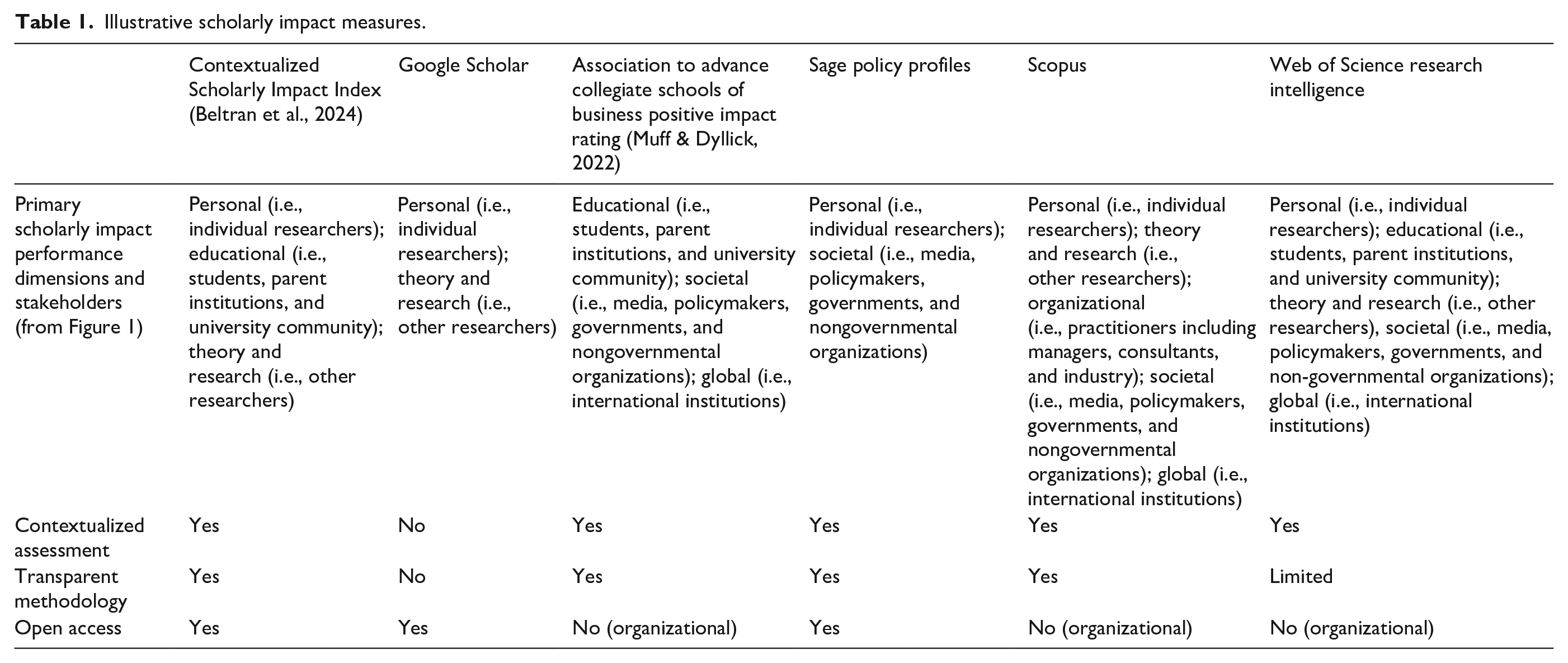
Referring to Table 1, Beltran et al. (2024) developed and offered open access to the Contextualized Scholarly Impact Index (CSII), a comprehensive and transparent measure of management scholarly impact at the individual researcher, research team, and university levels of analysis. The Association to Advance Collegiate Schools of Business (AACSB) offers a student-led survey tool called the Positive Impact Rating to measure the social impact of business schools and their graduates (Muff & Dyllick, 2022). Sage policy profiles identify the number of times a researcher’s work is cited in policy documents internationally, and the number of times the policy documents were subsequently cited (Sage, 2024). In addition to traditional citation counts, Scopus (2024) maps researchers’ work against sustainable development goals, captures the percentage of publications that a researcher co-authors with researchers in other countries, and displays academic/corporate collaborations. The measures summarized in Table 1 can be combined with more traditional citation-based measures (e.g., Google Scholar and Web of Science) aimed at assessing impact exclusively on theory and research.
Next, we describe actionable recommendations for enhancing SIP by focusing on actions by the agents of impact: researchers and organizations (i.e., mainly universities and business schools, but also professional organizations).
Using the capacity, opportunity, and relevant exchanges model to enhance SIP
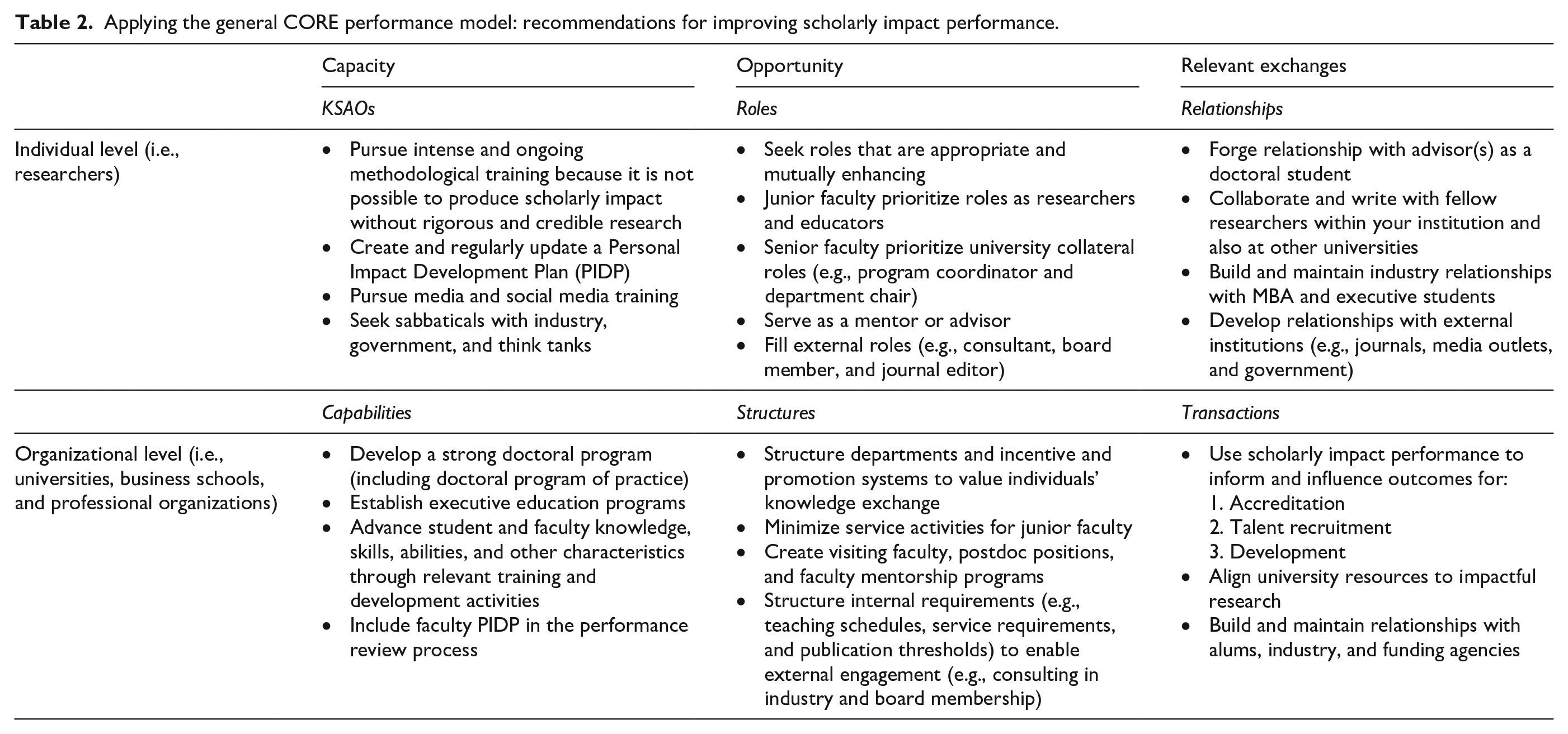
There is no shortage of research on performance in the field of management (Aguinis, 2023). Specifically, the capacity, opportunity, and relevant exchanges (CORE) performance model by Marshall et al. (2024) was derived from a review of 239 unique theories and encompasses three meta-theoretical constructs that determine performance: (1) capacity (i.e., individual-level knowledge, skills, abilities, and other characteristics [KSAOs] and organizational-level capabilities), (2) opportunity (i.e., individual-level roles and organizational-level structures), and (3) relevant exchanges (i.e., individual-level relationships and organizational-level transactions). By applying this meta-theoretical model to the specific construct of SIP, we describe how individuals and institutions can enhance SIP intentionally. In other words, we use an established and general theory on performance to improve our understanding of how to improve a specific type: SIP.
As in the CORE model, we discuss improving impact performance from the perspectives of two main SIP agents: individuals (e.g., researchers) and organizations (e.g., business schools, universities, and professional organizations). In some cases, as mentioned earlier, actions are likely to enhance SIP across more than one dimension and stakeholder group. For example, disseminating research results using social media will likely enhance SIP on multiple stakeholders simultaneously (McCarthy & Bogers, 2023). Similarly, interventions aimed at enhancing SIP at the individual level of analysis (e.g., updating a senior researcher’s methodological toolkit) are likely to enhance SIP at the organizational level of analysis (i.e., improving the quality of doctoral education)—and vice versa. Accordingly, to minimize repeating the same action across multiple dimensions, we minimized such entries to a primary one with the implicit understanding that they will also improve SIP regarding other dimensions and stakeholders. Table 2 summarizes the material that follows.
Applying the general CORE performance model: recommendations for improving scholarly impact performance.
Capacity
Capacity refers to how much or how well individuals and institutions can perform, specifically regarding scholarly impact. It is both current and future-focused in that the features that describe individual and organizational capacity also predict their capacity for future SIP (Marshall et al., 2024).
Individual knowledge, skills, abilities, and other characteristics
Researchers’ KSAOs comprise their capacity for SIP. By developing their KSAOs, individuals can improve their capacity over time (Marshall et al., 2024). The first step in building necessary SIP KSAOs is to learn how to conduct high-quality, rigorous, and credible research (Aguinis, 2025). SIP is not possible without conducting high-quality research first.
Additional recommendations for improving KSAOs include skills that enhance an individual’s ability to access and communicate with stakeholders beyond their academic community. Again, this starts with pursuing strong methodological training but also requires frequently revisiting and retooling one’s methodological knowledge and skills (Aguinis et al., 2021). A valuable tool is the Personal Impact Development Plan (PIDP), which allows researchers to map the development of needed KSAOs and resources to do so over time (Aguinis & Gabriel, 2022). Once established, regularly revisiting one’s PIDP can serve as a checklist for achieving impact goals, particularly when compared to other impact measures like those listed in Table 1 (Aguinis & Gabriel, 2022).
Over time, a mid- or late-career researcher may pursue broader opportunities to engage with stakeholders outside the academic sphere (Tung et al., 2018). These opportunities also allow for the development of SIP KSAOs. For example, social media is a common personal and professional networking tool, but it also can empower framing, investigating, disseminating, and assessing new research for greater “academic openness” and scholarly impact (McCarthy & Bogers, 2023). So, pursuing media and social media training may help to enhance communication skills with wider audiences in print, television, and web-based journalism and on social media platforms. Sabbaticals in industry, government, and think tanks also provide opportunities to develop new KSAOs needed to enhance SIP.
Organizational capabilities
Universities are pivotal in capacity development. For example, a solid doctoral program (including doctoral programs of practice) is essential for the long-term sustainability of the field and to produce research that benefits multiple stakeholders (Banerjee & Morley, 2013). From the university’s reputation to the strength of alum networks, a doctoral program grounded in robust methodological training and research practice is vital to building and maintaining the organizational capabilities needed for SIP (Aguinis et al., 2021). Also, establishing executive education programs is a valuable feature of capability development because it allows faculty teaching in those programs to stay current regarding organizational practices and challenges.
Universities, business schools, and professional organizations are also the primary enablers of individual researcher development. For example, they offer relevant training and development opportunities to advance students’ and faculty’s KSAOs. Also, universities can offer faculty and doctoral students opportunities to engage with external stakeholders (e.g., members of the Board of Advisors and alums) and include a PIDP in the performance review process (Aguinis et al., 2021). Institutions must also align these efforts with strategic impact priorities and communicate them within their current and prospective faculty and student communities.
Opportunity
Opportunity affects SIP because it is “a social situation wherein knowledge sharing can occur between individuals based on agentic functions” (Marshall et al., 2024, p. 10). Next, we discuss recommendations for improving opportunities at the individual and organizational levels.
Individual roles
Opportunity is characterized by individuals’ socially constructed roles in a given environment (Marshall et al., 2024). Researchers simultaneously fill multiple roles that evolve and change throughout an academic career. Aligning individual opportunity with SIP requires filling these roles appropriately and seeking ways to enhance them mutually.
For instance, a junior faculty member’s primary roles usually include educator and researcher. For a more senior faculty member, these might include university roles such as leading a significant program and taking on administrative positions (e.g., department chair; appointment, tenure, and review committee member). Also, senior faculty members engage in mentorship and advisor roles that should also focus on enhancing SIP for their mentees. Opportunities to fill external roles like visiting faculty, consultant, popular press author, board member, and journal editor also emerge throughout an academic career, providing further opportunities to enhance SIP (Haenlein & Jack, 2024). Selecting these roles carefully, at the right time, and in balance with internal roles is critical and also facilitated by a well-articulated PIDP (Aguinis & Gabriel, 2022).
Organizational structures
Organizational structures are the mechanisms by which knowledge is passed to inform decision-making (Marshall et al., 2024). Institutions are responsible for creating and maintaining structures that enhance individuals’ knowledge exchange. To enhance structures that improve SIP, universities can design their academic departments and incentive and promotion systems to attach value to this exchange. For instance, minimizing service activities for junior faculty allows them to allocate more time and opportunities to enhance their impact on the theory and research dimension (i.e., other researchers as the targeted stakeholder group). Similarly, executive education, visiting faculty and postdoc positions, and faculty mentorship programs are all examples of organizational structures to expand knowledge exchange and improve SIP. The structure of internal requirements can also lend itself to external engagement. Faculty consulting in industry, serving on boards, and editing academic journals all provide opportunities to enhance the university’s reputation and impact. Teaching schedules, departmental service requirements, and publication thresholds can be structured to accommodate these multiple opportunities.
Relevant exchanges
Relevant exchanges are interactions between two entities for a performance-related purpose (Marshall et al., 2024). Like opportunity and capacity, relevant exchanges apply to both the individual and organizational levels of analysis. So, as described next, several types of relevant exchanges can contribute to enhancing SIP.
Individual relationships
Relationships define relevant exchanges at the individual level and are a key component of SIP (Marshall et al., 2024). Interpersonal relationships are a cornerstone of research development and publication, starting with the relationship forged between doctoral students and their advisors (Aguinis et al., 1996). Scholars collaborate and write with fellow researchers within their parent institutions (e.g., university, business school, and research institute) and other universities. The bonds forged among scholars within specific streams of research also link their students and previous co-authors. To improve SIP, scholars can pursue the relationships that challenge, extend, and evolve their work to target as many dimensions and stakeholders as shown in Figure 1 as possible.
However, relationships must extend beyond academia to achieve multidimensional and multistakeholder impact. Building and maintaining relationships with MBA and executive education students provides connections to practitioners and industry (Aguinis et al., 2022). Individuals can also build virtual relationships to drive SIP through their presence on networking platforms like LinkedIn (Dauenhauer, 2020; McCarthy & Bogers, 2023). Relationships between individuals and external institutions are also significant. A researcher’s connections to academic and practitioner journals, media outlets, think tanks, and government and international institutions enhance and advance SIP.
Organizational transactions
For institutions, relevant exchanges are defined by transactions (i.e., the exchanges that shape the acquisition and distribution of resources and delivery of services; Marshall et al., 2024). Organizational transactions are key to SIP because they include accreditation, talent recruitment, and development. To operate, universities must meet the performance criteria of their accreditors. For instance, AACSB accreditation includes consideration of the school’s scholarship and societal impact (Muff & Dyllick, 2022). Interactions with prospective undergraduate and graduate students rely on the university’s impact-driven reputation. Also, recruitment of high-caliber faculty similarly depends upon this reputation (Verhaegen, 2005).
The alignment of university resources against priorities directs the progress of research. Scholars must compete for and justify the funds and personnel resources needed to pursue their research, and how the university allocates these resources is a critical determinant of impact performance, both at the organizational and individual levels (Aguinis et al., 2021). Impactful research also influences the quality of relationships universities build with alums, industry, and funding agencies, and maintaining these connections establishes an impact performance feedback loop.
Applications across institutional contexts
Universities vary in their missions and strategic objectives (e.g., more or less emphasis on research, undergraduate vs. graduate education); the composition of their faculty, staff, and student bodies (e.g., the relative proportion of research vs. teaching-oriented faculty, full-time vs. part-time students); and resource availability and budget models (e.g., public vs. private institutions). For example, many universities in Latin America and emerging countries elsewhere lack robust incentives for research (Aguinis et al., 2020). Specifically, resources such as reduced teaching loads, funding for research assistants, and financial support for faculty are limited. As a result, many faculty often focus on teaching and consulting instead of research. As another example, business schools in emerging countries offer fewer international research collaborations due to limited exposure and networking opportunities. Consequently, many studies are published in local or regional journals that are unavailable in English, restricting global accessibility.
Table 3 includes illustrations of how the CORE model can enhance SIP across three types of universities: research-intensive, teaching-oriented, and those in emerging countries. These are just some illustrations; specific interventions can and should be tailored to the local context. The examples in Table 3 will help university leaders and researchers visualize the wide range of interventions and actions available to enhance SIP given specific strategic goals, context, and resource constraints.
Illustrative interventions to enhance scholarly impact performance across three types of universities.
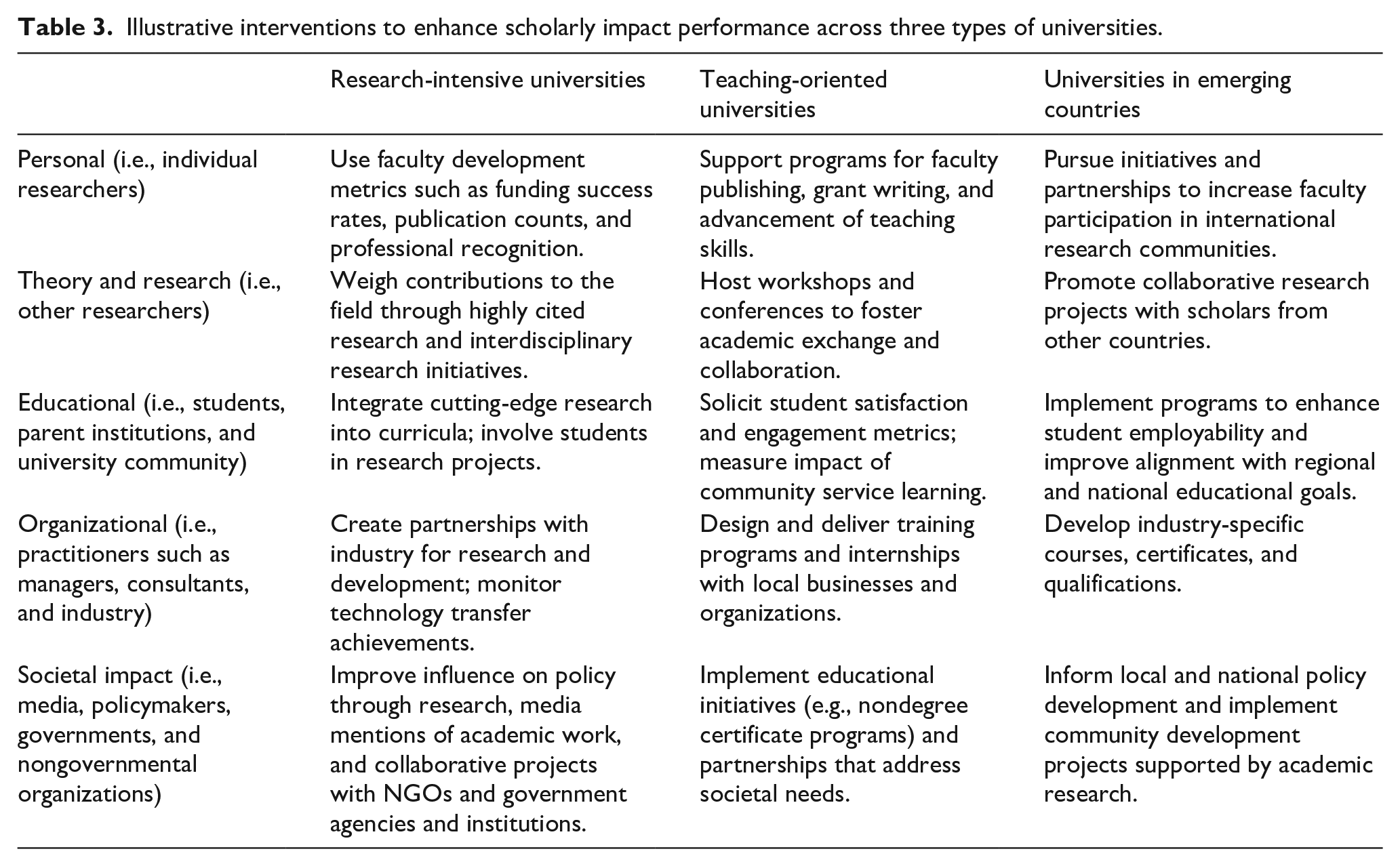
Finally, regarding the need to consider contextual issues when assessing and enhancing SIP, Table 3 also shows potential challenges in adopting our model. For example, resource constraints will limit a university’s ability to implement specific actions. Future research can address the extent to which specific interventions that are more or less resource-intensive can achieve their intended goals.
Conclusion
We offered an expanded model of scholarly impact performance (SIP) targeting the following dimensions (see Figure 1): personal, theory and research, educational, organizational, societal, and global. These dimensions involve different stakeholders (i.e., beneficiaries) of our scholarly work: individual researchers; other researchers; students, parent institutions, and university community; practitioners including managers, consultants, and industry; media, policymakers, governments, and nongovernmental organizations; and international institutions. Adopting this multidimensional and multistakeholder approach to defining and measuring scholarly impact encourages consideration of the needs and interests of internal and external stakeholders and beneficiaries. Moreover, we applied the general CORE performance model to the specific domain of SIP. Doing so allowed us to focus on the agents interested in and responsible for producing scholarly impact: researchers and their institutions (e.g., universities, business schools, and professional organizations). Shifting from a general “scholarly impact” to an agentic “SIP” construct allowed us to provide specific and actionable recommendations that the agents who produce impact can use to enhance SIP (see Table 2). These recommendations are theory-based and directly derived from the CORE performance model with its three meta-theoretical constructs of (1) capacity (i.e., individual-level KSAOs and organizational-level capabilities), (2) opportunity (i.e., individual-level roles and organizational-level structures), and (3) relevant exchanges (i.e., individual-level relationships and organizational-level transactions). We also provided examples of specific interventions to enhance scholarly impact depending on a university’s context (e.g., research-intensive, teaching-oriented, and those in emerging countries) (see Table 3). Combining a theory-based multistakeholder and multidimensional model of SIP with a plurality of impact measures can inspire scholarly impact like a mighty ocean wave that spans great distances, reaches stunning heights, and transforms the domains it encounters.
Footnotes
Acknowledgements
The authors thank Business Research Quarterly Editor J. Alberto Aragon-Correa and two anonymous reviewers for their highly constructive feedback, which allowed us to improve our article substantially.
Declaration of conflicting interests
The author(s) declared no potential conflicts of interest with respect to the research, authorship, and/or publication of this article.
Funding
The author(s) received no financial support for the research, authorship, and/or publication of this article.
Informed consent
There are no human participants in this article, and informed consent is not required.
