



Abstract
This paper explores embeddedness in small firms from a foundational perspective and how these foundations effect resource dependency and business decision-making. Building on debates in firms embeddedness and its role in addressing questions of resource-limitation, the paper positions embeddedness as outcome of a value-set occurring within an organisation directly affecting resource decisions. Using case studies of six creative industries small and micro firms, it argues foundational embeddedness influences firm-based practices and relationships over conventional business logics. Certain flexibilities in this foundational embeddedness can be seen, responding to external challenges through formation of esoteric relations and iterative systems. The extent of this flexibility is however limited by the entrepreneurs’ willingness to compromise individual values. Foundational embeddedness is thus a necessary consideration in understanding entrepreneurial decision-making.
Keywords
Introduction
This paper considers the role of embeddedness in small firm decision-making, proposing the need to view this from a foundational perspective. Embeddedness has become a critical consideration for such ventures, enabling firms to maximise potential externalities through their orientation, capability, or behaviour (Salder et al., 2020; Somsing and Belbaly, 2017; Wiklund and Shepherd, 2005) and thus embed within a wider set of favourable networks and relationships (Baum et al., 2000; Burt, 2000). Such relationships are however multi-layered (Kloosterman, 2010; Scott, 2006). Firms exist in multiple evolving industrial networks, practices and spaces, and their parallel geographic, social and cultural influences (Bell and Jayne, 2009; Brannon et al., 2013; Cooke and Morgan, 1998; Hall and Soskice, 2001; Salder and Bryson, 2019; Welter et al., 2018). Embeddedness therefore provides a framework for understanding the development and adaptation of business processes – and firms - via a dependency on embedded relationships and related context-dependent resources.
Embeddedness is however not solely a question of business networks. Firms are also shaped by social relations (Alsos et al., 2014; Johnson and Hoopes, 2003). Important here are the foundational values embedded in firms around which operational practices and development strategies are adapted (Hueso et al., 2020). This foundational embeddedness is an important factor in the entrepreneurial process for several types of organisation. Social enterprises, environmental businesses, and creative firms can be rooted in values around which business logics are framed and managed (Biberhofer et al., 2019; Defourny and Nyssens, 2017; Mietzner and Kamprath, 2013; Purnomo and Kristiansen, 2018). The business logic does not always take primacy, as personal, emotional, and aesthetic values also shape decisions and underwrite the organisational ethos (Biberhofer et al., 2019; Defourny and Nyssens, 2017; Hill, 2020; Salder, 2021). As a result, such businesses are foundationally embedded in multiple, often conflicting objectives of which their entrepreneurial practice, and thus other forms of embeddedness, are mindful.
One set of enterprises where foundational embeddedness is particularly prominent is the creative sector. Creative industries (CI) often link practitioner values of creative freedom and artistic integrity with business success (Mietzner and Kamprath, 2013; Purnomo and Kristiansen, 2018). As a key growth sector, CI have seen increasing pressure to adopt and conform with orthodox business logics (Harvey, 2016; Salder, 2021). At the heart of the CI however is a form of production requiring high levels of intensity (Bettiol and Sedita, 2011; O’Connor, 2007) and an environment where processes are iterative and resources limited (Leadbeater, 2000). Dependency embeddedness rooted in networks and wider resource availability is thus critical. Its application however is framed by a foundational embeddedness integral to these firms, particularly where aesthetic value compensates issues of low pay and security (Mietzner and Kamprath, 2013; Purnomo and Kristiansen, 2018).
This paper provides an analysis of the occurrence and form of foundational embeddedness active within small creative firms, addressing the question of how key dependencies within the organisation are developed consistent with their foundational values. It argues foundational embeddedness shapes resource-based dependencies utilised in managing and maintaining an organisation, with implications for business decision-making. It undertakes this analysis through case studies of six creative firms operating in the arts-based subsector, specifically the contemporary performing arts. Through these case studies, the paper documents dependencies developed to maintain their foundational embeddedness and the effects the relationship between dependency and foundational embeddedness has in shaping the firms’ practice and priorities.
Embeddedness: A foundational approach
Firm-based embeddedness plays a critical role in an organisation's ability to adapt and respond to challenges. Embeddedness however has tended to be researched and framed from the perspective of a resource or input which firms leverage to their advantage via social relations and networks (Baum et al., 2000; Burt, 2000). Less attention within these debates has focussed on embeddedness in another form; that of the values around which firms develop identities and shape strategic or operational responses (Hueso et al., 2020). This paper argues that resource-based, dependency embeddedness and its utilisation are thus rooted in the value-based context of individual firms.
This section proposes the concept of firm embeddedness from the perspective of a value-set, exploring forms of value-based – or foundational - embeddedness. It argues this foundational embeddedness is critical in shaping the nature, and setting the limits, of an organisation's dependency embeddedness – its resource utilisation - and thus how these resources are deployed in developing business practice and reconciling business logics.
Defining foundational embeddedness
Research on embeddedness has to date been posited as contributing toward greater understanding of the role context plays within the entrepreneurial process (Welter et al., 2019). Such research tends to focus on embeddedness within networks or firm-based relations (Baum et al., 2000; Burt, 2000), providing firms access to critical resource in addressing challenges of external environments and adapting demand. Discussion on embeddedness thus tends to be framed by positioning it within a broader, firm-based toolkit assessing development options. As a determinant of business decision-making, embeddedness is here a dependency insofar as it relates to a firms’ capabilities in compensating internal resource limitations through applying and integrating resource outside of the firm (Salder et al., 2020; Somsing and Belbaly, 2017).
This dependency embeddedness provides critical insight into core deficiencies or requirements in firm-based practice. It however falls short of considering key questions of context integral to the entrepreneurial decision-making process, addressed principally through consideration of overlapping operational, often socio-spatial contexts (Cooke and Morgan, 1998; Hall and Soskice, 2001; Scott, 2006). Dependency embeddedness provides a partial picture of the embedding dynamics for entrepreneurs and firms. Embeddedness occurs as a result of the nature, depth and extent of relations within a firm's environment (Dacin et al., 1999; Jack and Anderson, 2002), yet both manifestation and rationale for this embedding tend here to be positioned singularly within business logics (Alsos et al., 2014). Less emphasis is placed on the social relations and interests potentially shaping these decisions, despite embeddedness being theorised predominantly as a social process (Granovetter, 1985) which extends beyond and outside the firm and its activities (Alsos et al., 2014; Drakopoulou Dodd et al., 2018).
Embeddedness, as a result, is often presented as the outcome of a rational process rather than involving imprecise and subjective decisions. The limitations of this interpretation have been discussed in several studies. Johnson and Hoopes (2003) outline the challenges to managerial cognition through forms of bounded rationality, emphasising organisational constraints in information access, retention, and processing. Such limitations lead to the occurrence of obsolescent logics within firm practices (Florence, 1953), socialisation processes forming institutions and through these both cognitive and emotional attachments which are difficult to break (Leaptrott, 2005). For both Brannon et al. (2013) and Smith et al. (2021), this socialisation forms distinctive environments where normative systems such as traditions frame economic rationality and behaviour. For Salder and Bryson (2019), this adaptive embeddedness stimulates a conflict between function and attachment, the latter shaping decision-making processes to create novel systems compensating sub-optimal operational conditions. Critical logics behind firm-based embeddedness here occur through the personal sunk costs - financial and emotional - of key decision makers and the integration or prioritisation of these non-business considerations within the context of the firm (Alsos et al., 2014; Johnson and Hoopes, 2003; Salder and Bryson, 2019). Embeddedness therefore occurs not singularly as a resource-based dependency through which firms compensate capacity limitations. In addition it can be recognised as a value-based foundation shaping through forms of socialisation how firms function and operate.
Foundational embeddedness itself occurs in several forms linked to the flexibility of a value-set. For example, in some firms foundational embeddedness can be evolutionary and emerges through processes of adaptation in resource utilisation. Certain dependency factors for the firm progress from being simply a resource to become integral to their practice, via traditions (Brannon et al., 2013), culture (Cooke and Morgan, 1998) and place- or firm-based heritage (Aaltonen et al., 2015; Billing and Bryson, 2019; Welter et al., 2018). Dependency embeddedness – critical foundations for the formative practice of firm activity - can therefore transition into a foundational embeddedness which firms seek to retain as a key element of their core business proposition.
Foundational embeddedness however goes beyond configurations offering competitive advantage. In certain industrial or business contexts, regulatory frameworks or legal barriers shape practices and therefore resource requirements (Billing and Bryson, 2019; Kloosterman, 2010). Place-based attachment represents a foundational embeddedness around which entrepreneurs willingly develop practices to protect lifestyle preferences. Manufacturing firms in such locations, for example, pursue new development models and innovative practices rather than conforming to standardised industry methods incompatible with locational preferences (Hamdouch and Depret, 2013; Kourtit et al., 2012; Mayer and Knox, 2010). In-migrant entrepreneurs in rural locations utilise their broader, imported networks to underwrite lifestyle choices (Kalantaridis and Bika, 2006).
Additionally, certain sub-sets of firms hold a value-set at inception integral to both business objective and value proposition. In family businesses, economic logics are shaped as much by family issues and interests as business objectives. Firm survival strategies are here founded in those for households and their related lifestyle choices and management of relationships (Alrubaishi et al., 2021; Alsos et al., 2014;). Social and environmental enterprises pursue market income and develop entrepreneurial tendencies to achieve core baseline objectives around reinvestment and amelioration (Biberhofer et al., 2019; Defourny and Nyssens, 2017). In the creative industries, sectoral demands for flexibility (Leadbeater, 2000) and creative intensity (Bettiol and Sedita, 2011) are founded upon consistency with practitioner values of creative freedom and artistic integrity (Mietzner and Kamprath, 2013; Purnomo and Kristiansen, 2018).
Foundational embeddedness is thus a concept worth further analysis. Alongside its explanatory scope considering key questions of firm decision making and business planning, foundational embeddedness illustrates potential influence for forms of dependency embeddedness emerging within an organisation. This can be identified in two distinct forms; first through the evolution and regulation of dependency, prioritising certain factors integral to the businesses proposition, and second within an entrepreneur's core values for which compromise may negatively affect an organisational identity. Both types have a distinct effect on firm-based strategies to the challenges of their business environment.
Foundational effects on dependency embeddedness
Debates on embeddedness have focussed on broadening an understanding of the esoteric nature of operational context for entrepreneurs (Kloosterman, 2010; Scott, 2006). These contexts in turn result in similarly esoteric responses through application of network and resource to reconcile context with conventional business logics, in effect the former determining the latter (Gaddefors and Anderson, 2017). Context is here however not singularly about the manifestation of business networks, but broader decision-making processes which shape these networks via a foundational embeddedness rooted in individual value sets and aesthetic interests (Greenman, 2013; Jones et al., 2019).
This represents an important distinction in viewing embeddedness as foundational. Here, objectives of maintaining foundational aspects of the organisation reshape business processes and logics. For instance, entrepreneurs in rural environments and secondary centres see their emotional embeddedness and sunk costs stimulate the development of dynamic social relations. As a result, they are able to borrow resource from external sources through urban production spillovers (Phelps et al., 2001) and variegated, industry-based relations (Kalantaridis and Bika, 2006; Salder and Bryson, 2019). Research on family businesses found fluid enterprise development strategies dependent on the changing configuration and capabilities of household members and their identification of opportunity (Alrubaishi et al., 2021; Alsos et al., 2014). Examples in the creative sector illustrate emotional embeddedness of industry objectives encourages commitment amongst practitioners despite poor pay and security (Leadbeater, 2000) whilst simultaneously challenging broader entrepreneurial conventions (Hill, 2020; Lampel and Germain, 2016; Poettschacher, 2005; Salder, 2021). In such contexts, obligations, expectations, and value systems limit certain forms of relationship development (Uzzi, 1997); the social capital created by close relationships and foundational embeddedness can bypass dependence on more conventional forms of capital or resource (Kloosterman, 2010).
It is thus important to consider the dynamic between foundational and dependency embeddedness. Within conventional business logics, firms will adapt their practices in pursuit of optimal performance; this includes selective processes of embedding through resources and networks which underwrite such optimisation. This paper argues that viewed from a foundational embeddedness perspective, rather than the objective of embedding processes, such business logics themselves become an object to reconfigure and reinterpret in maintaining core objectives - personal or aesthetic - embedded within the firm.
This paper explores foundational embeddedness and its dynamic relationship with dependency embeddedness in the context of the creative industries (CI). It argues this foundational embeddedness shapes resource-based dependencies utilised in managing and maintaining an organisation, with implications for business decision-making processes but also objectives. To this extent the paper addresses the question of how key organisational dependencies are shaped by foundational values. The analysis specifically focuses on the arts-based subset of the CI, an interesting case for three key reasons. First, the CI has been posited as an important context for business research due to its organic growth (NESTA, 2016) and its role as a hub for new forms of business practice (Hill, 2020; Lampel and Germain, 2016; Poettschacher, 2005). Second, is the strong foundational embeddedness of arts-based entrepreneurs, with commitment to highly resource-intensive forms of original content creation integral to achieving business-related value proposition and individual aesthetic objectives (O’Connor, 2007). Finally, is the ongoing formalisation or professionalisation of the CI imparted through an evolving funding structure and broadening set of outcome requirements from key sponsors, situating business logics more prevalently within their considerations (Harvey, 2016; Jennings et al., 2017; Salder, 2021).
Methodology
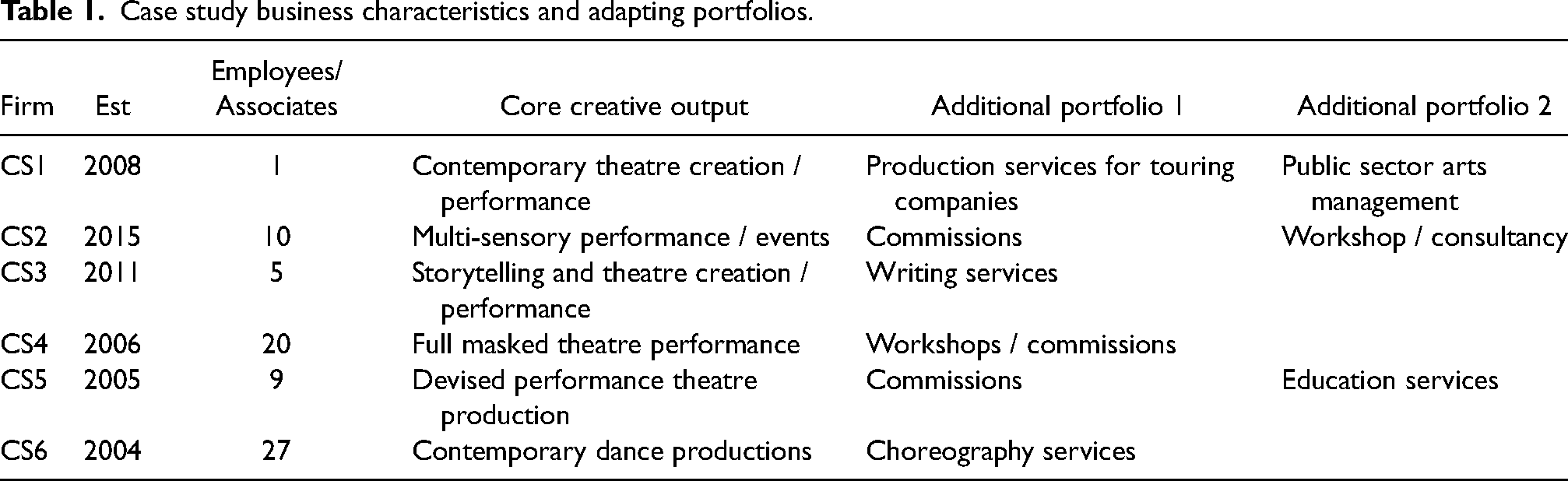
The analysis uses case studies to explore embeddedness within the CI. A total of six separate creative organisations based in the English West Midlands were interviewed. Each of these organisations is in the contemporary performing arts industry, developing, promoting, and performing original theatrical or performance work (Table 1). Active for varying periods, each is a small or micro firm with few full-time personnel, although this number is supplemented by the use of project-based associates. Each enterprise operates in a comparative context, involving resource intensive processes and long lead-in times for developing new content and material, high dependence on narrow funding and finance streams, limited resource availability and capabilities within the organisation, and low returns in terms of financial reward and security. Selection of the subjects was conducted through a call for participants in online arts media and networks. From responses, selection was made on the basis of organisations with a primary commitment to creative content in contemporary performance.
Case study business characteristics and adapting portfolios.
The case studies involved one semi-structured interview of the creative and operational lead within each enterprise; due to the nature of the organisations this ranged from formal Artistic Directors to sole employees with no formal title. Interviews were based around the application of a novel SME diagnostic, an approach developed to provide greater sensitivity to the context of enterprise development (Gilman and Salder, 2021) through application of a more engaged research process (Trehan et al., 2018) and embracing principles of multi-determinants in enterprise development (Salder et al., 2020; Weinzimmer, 2000). The diagnostic covers key areas of practice critical to the SME development process – classified as characteristics, external relation, performance and planning, added value, and knowledge and resource management - and ensured a systematic and inductive process was employed for each subject interview. Each interview was conducted face-to-face and lasted for around two hours.
Analysis of the interview data identified forms of embeddedness within the organisations, framed as either foundational (value-based) or dependency (resource-based). Interview data was then further examined to unpick interactions between these forms of dependency, and the extent of their dynamism in responding to the operational and environmental challenges faced by each organisation in maintaining creative objectives whilst navigating business demands and logics.
Findings
The case study organisations are presented in Table 1, outlining the (anonymised) organisation, core creative objective, and other characteristics. The table also illustrates forms of adaptation the company and the creatives within the company have taken in progressing their creative practice and balancing this alongside the challenges of accommodating business demands. Each case is presented below in more detail.
Case 1: CS1
CS1 is a theatre-maker and creative producer, the practice established in 2008. Its founding objective has been creating and performing contemporary theatre productions, with particular interest in small / solo audience or site-specific performance. In developing creative work, the company is progressing long-term plans in both original content creation and in collaborative opportunities. Developing projects and partnerships and acquiring funding has however proved a slow process due to the prolonged nature of developing collaborations, identifying appropriate collaborators and skillsets, and forming wider partnerships and relationships with sponsors and funders.
These challenges are compounded by the company's additional activities and income from production services for other theatre and creative arts companies and contract management for public sector arts development projects. Such activities provide critical income streams during the protracted original content development process. They also help the company build complementary relationships with potentially important partners, particularly around added-value social and economic expectations which have become an integral element of arts activities. Demand for supplemental production and project management services have seen this side of the business grow. Resource for the progression of the creative work aspect of the company has however become increasingly scarce, resultant of “growing capacity and time issues and conflicting work commitments”.
Case 2: CS2
Active since 2015, CS2 specialise in the design and performance of food and multi-sensory dining events. These events include theatrical performance but are based around the creation of novel recipes or meal combinations and modes of dining as part of this experience. The practice is linked to creative dining experiences, “a growing market which a number of restaurants are moving into, especially in London”, and extending this idea to include original performance work and practice, a “bespoke…product which separates it from what is happening in restaurants”.
The principal focus of the company is original content creation, independently devised and then presented through opportunities within the arts and experience marketplaces. The company also delivers specialist commissions and undertakes workshops or consultations for arts professionals and related industries. Both aspects of the performance element of the business – commissioned and non-commissioned – require significant research and development involving collaboration with a wider network of performers, arts technicians, and food and drink specialists including chefs, mixologists and molecular gastronomists. This level of resource intensity is increased when developing commissions, the scale of project and size of event ranging from 10 people to over 270 thus requiring higher levels of investment and greater reliance on sub-contracting. Such issues are not assisted by the company's dependence on arts funding and limited business know-how, CS2 struggling “with how to monetize the practice” and progress to “using a business lexicon”.
Case 3: CS3
CS3 write and perform story-telling pieces focussing at present on the small venue and the rural and community theatre circuits. The company has been generating income since 2011 and has been fully funded through creative content since 2013. To support this, the company depends upon three key sources of income for its sole product; Arts Council England grants, commissions, and artist bursaries.
Performance and the development of new shows remains an important part of the business. Demands for professionalising the practice since 2013 have however illustrated the need for some diversification. Here, the particular focus has been building up the writing element of the business, working with other artists and community groups “collaboratively…to create bespoke pieces for different venues using different materials and ideas”. This aspect is to some extent a result of the company being work-based over objective-based, responding to piecemeal creative interests or paid opportunities. Additionally, this piecemeal approach provides a critical income resource to supplement the limited income potential of their small-scale performance focus.
Case 4: CS4
CS4 is a theatre company specialising in full masked theatre performance. The company was formed in 2006 as a result of a personal relocation to the West Midlands, and has since become a recognised regional specialist. Producing and performing original theatre work is the main focus of the company, performing in mid-sized UK arts venues and expanding international touring activity. Additionally, their work promotes full masked theatre – a highly specialist art form - to a wider audience regionally through performances on rural touring networks and in schools.
Whilst creative output is pivotal to the company's work, it is also heavily rooted in social research and associated issues. This includes their development and touring of a piece about dementia, which has helped diversify income streams, securing bookings from non-arts organisations such as the NHS, and products, developing complementary workshops related to dementia care. Such a strategy has not been without its costs however, the esoteric nature of performances leading to some “closed doors with venues due to the abstract nature of the product”.
Case 5: CS5
CS5 is a theatre company specialising in devised (non-scripted) work. Starting life in 2005, the initial entity was a collective rather than a business, only developing into the latter through a growing series of funded activities and opportunities. The contemporary nature of their performance style saw the company evolve through performing in non-traditional venues such as disused industrial sites, resourcing work through “found or bartered relationships”, and supplementing these activities via arts-based educational services. The company formalised its status in 2013.
The company primarily works on independent devised pieces and on commissions. As the company has improved its profile and reputation, additional income opportunities have emerged in the field of education, each of the three Artistic Directors working with external organisations in an individual capacity. This has a direct effect on the development of new performance work, the company facing challenges in striking a balance given limited resource between capitalising on existing work, diversifying their income and services, and developing new material alongside pursuing individual opportunities. This is particularly pertinent considering the preferred devised mode of practice and the “way the company works (through a) slow development process”.
Case 6: CS6
CS6 is a contemporary dance company formed in 2002 through the Artistic Directors move from performance into choreography. Initially the company mixed content creation with teaching, but since touring their first full length work in 2007 has produced and toured a full-length performance every two years. Income from the touring work is supplemented by small scale performances and commissions. The company's income comes through a variety of grants and other forms of fundraising, including donations.
In the process of developing performance work, the research undertaken has allowed the company to acquire specific resources which can be applied to non-arts settings. As a result, relationships have been developed with organisations such as the British Army. Rather than representing a form of diversification into workshops or consultancy focussed on social issues, these relationships have contributed toward further development of material such as site-specific pieces and expansion of the company's performance portfolio.
Value foundations and the development of related dependencies
Across the case studies, pivotal to each firm is a cultural value-set which underlines their activities and value propositions (Mietzner and Kamprath, 2013; Purnomo and Kristiansen, 2018). This is embedded to the extent that, in terms of art form or mode of performance, the founding values of the company predate any specific proof of concept that a market exists for their performance product. Business case logics for small or solo audience performance, one-off site-specific productions, masked theatre, or multi-sensory dining experiences would likely illustrate key deficiencies in the business model; each company was thus “developing a product no-one yet knows they want” (CS3), shaped around aesthetic values or conceptual objectives over market research.
Framed by this embedded cultural value-set, company objectives of original content creation shape a set of core dependencies insofar as the specific product of each organisation requires specialised forms of support and inputs presenting limited options in the development process. These dependencies occur around a relatively narrow infrastructure designed to support the contemporary arts. The foundational embeddedness of each firm reinforces the limited scope of organisational resource dependency. Here, early-stage content development relies heavily on the patronage of state-based funding agencies, with “dependency on high levels of funding or grant support from Arts Council England or local authorities” (CS4) alongside support from arts venues and universities.
Alongside this run two additional forms of dependency. The first is the ongoing expansion of networks as a process of acquiring specialist knowledge and skills for original work, developing their structural embeddedness (Granovetter, 1985). Along with the recruitment or contracting of specialist performers and technicians for developing and performing productions, selected art forms, topics, or concepts for these productions see companies work with a wide portfolio of collaborators (Kloosterman, 2010). Participants had recently worked with a diverse portfolio including psychologists, neuroscientists, morticians, documentary makers, and gastronomists.
The second dependency is the ongoing expansion of company portfolios. In the process of developing, touring and performing productions, each company enhances their portfolio of skills and capabilities. Here, two elements are important. First, the complexities of producing such shows, and management of processes from booking and promotion to on-the-road logistics, allow company personnel to develop certain general industry experience. The result is a wider personal skills base and industry network. Such capabilities can be recycled into an additional resource - and therefore service provision - for the company to commercialise. Second, in the process of developing productions, companies are “exchanging ideas, knowledge and expertise – a ‘creative exchange’ model” (CS4). These specialisms, artistic and subject-specific, create a further diversification opportunity which companies utilise by “combining experience and performance with training and development as a commercial product” (CS6). Formulation of such products is seen as essential not only from the basis of building a more resilient company capable of supporting the resource-intensive creative process but also tapping into a narrowing stream of public subsidy, maximising input from funding agencies through addressing a complex three-tiered objective of cultural contribution, social impact, and business sustainability (Harvey, 2016; Jennings et al., 2017; Salder, 2021). The progression of such practices and accommodation of new skills, capabilities, and thus products and portfolios, sees each enterprise undertake a process of adaptation, from “moving into writing instead of (reliance on) simply devised approaches” (CS5) to “practice of ‘extracting’ shows from larger pieces” (CS3). Such adaptation is rooted in a core set of foundational organisational values but implements methods of capturing ancillary value from the initial creative process which maximise potential demand from the broader arts ecosystem on which they depend.
Adapting dependencies lead to flexible foundations
The value-set foundations of each creative company provide a rigid context limiting certain activities and decisions in favour of “maintaining…the ‘cultural ethos’ and way we want to make work” (CS5). Whilst integral to the core objectives of the company, some flexibility occurs here as new capabilities are developed and evolving forms of demand identified. Adaptation of the resources or dependencies within the company, as shaped by the demands faced in developing both creative content and a creative enterprise, affect the cultural baseline on which the business was founded.
This transition is illustrated as each company has extended its portfolio of products and services (see Table 1). Resource intensity faced in developing original productions is to some extent replicated in the touring or dissemination of this work. At early stage, and in relation to the experimental practice of certain companies, the need for an extended or diversified portfolio is integral in providing supplemental income streams underwriting the risks associated with original content creation.
This diversification similarly influences resource allocation within the company. Across the case studies the issue of funding and remuneration was common. Barriers to development focussed on the “limited finances and investment” (CS2) available in a sector where “funding has declined and the arts is no longer seen as a priority” (CS4) alongside the pressures of a bidding model where “failed funding bids required three months planning and two weeks straight work” (CS6). Practitioners are thus often developing work without being paid or in an environment requiring them to perpetually deliver more with fewer resources (Leadbeater, 2000). Supplemental income through production, project management, or consultancy work provides in principle an important foil for companies. In reality, the ‘more-for-less’ ethos extends into these supplemental activities, production and project management work offering low fees and demanding expectations (Mietzner and Kamprath, 2013; Purnomo and Kristiansen, 2018). The trade-off here becomes the income-based risk of forgoing contracted work offering guaranteed - although short-term - income against the content-based risk of skewing the company away from original creative work and to some extent reconfiguring its core objective.
At its most extreme, such as in the case of CS1, this sees the company make a significant shift toward service provider. Opportunity, linked to a growing reputation in arts production and project management achieved via its extended networks, offers critical compensation. This however sees “demand for services has grown, but (in) an unstable and uncertain sector”. Growing challenges in providing these services leads to additional resource constraint, the company facing significant reductions in time available to focus on creative output.
Such creative dimensions remain critical as part of a portfolio development process where this transition is less significant. In the case of CS4 and CS6, both companies hold aspirations to further formalise their status as core creative organisations through specific Arts Council designation. This objective is contingent to not only creative output but the embedding of tangential social objectives within the core offer of the company (Defourny and Nyssens, 2017; Kloosterman, 2010). As a result, diversification of products and services and subsequent adaptation of the company is required to manage this effectively, from “developing products which fit with specific identified niches such as care training” (CS4) to questions of restructuring and governance which see “part of the company positioned for attracting investment from trusts and foundations whilst (accessing) touring benefits from tax credits” (CS6).
Emerging forms of dependency embeddedness and the practicalities of managing an enterprise thus serve to reshape the foundational values and embeddedness of a company; that is, the core proposition of its formation. The extent to which this is an enhancement, expansion, or reconfiguration varies between organisation. In all cases this marks a transition from the single content creation objective to broader activities adhering to the embedded value-set of cultural enterprise and contribution toward an arts ecosystem. Whilst the foundational embeddedness of the company is therefore flexible, and shaped by its emerging and evolving dependencies, there are limits to the extent these can be refined and thus limitations to the influence of orthodox business logics and practices.
Reconciling foundational embeddedness with business logics
In developing their companies, each case study illustrates the ability to embed themselves within key networks and resources they depend upon for progressing original content (Baum et al., 2000; Burt, 2000) and to adapt their foundational company objective for flexibility in portfolio and income streams (Alsos et al., 2014). There are however limits to this migration from initial organisational objectives (Leaptrott, 2005). Underpinned by a foundational value-set of cultural entrepreneurship superseding demands for more business-focussed entrepreneurship, companies are presented with a difficult balancing act between maintaining a legitimate and sustainable business and separating the company from its founding – and the practitioners own personal – value-set.
Response to these challenges is seen in incremental solutions rather than novel or innovative business model adaptations. Perhaps most significant is how companies are incorporated. Those companies at more advanced stages of development had incorporated the organisation in a form consistent with core objectives and dependencies. For CS4 and CS5, each formalised as a Community Interest Company. This status offered the benefit of a commitment to delivering certain social outputs, providing legitimacy and credibility with core sponsors and thus reconfiguring foundational embeddedness to underpin an embedded dependency. In particular, this decision aided development of certain educational aspects of their portfolio. Additionally, it allowed recruitment of a Board which could be utilised as a further extension of their artistic and business network (Kloosterman, 2010).
Alongside this, local market limitations for certain forms of service or specialist productions saw companies expand their networks and look to opportunities in a broader and more diverse geography (Kalantaridis and Bika, 2006), from seeking to “foster relations with the corporate and business sector” (CS2) to setting targets for “continued international touring from four or five dates (a year) to twenty” (CS4). An element here is recognising the importance of wider touring to increase company profile and potential audience; the contemporary nature of many productions meant markets – and therefore demand - are widely rather than densely distributed.
Additional to this was tapping into tangential demand, specialist products or production services bypassing localised and regional markets to find opportunities in line with the companies’ value-set. This was a preferred option to sectoral diversification within localised markets such as corporate events or commissions which certain capabilities developed within the companies may have enabled. Here, the compromise to core products or portfolio was considered too detached from company ethos, alongside being opportunities practitioners may not find appealing (Mietzner and Kamprath, 2013; Purnomo and Kristiansen, 2018).
At its most extreme, demands to conform with business logics created a notable tension between practitioners and their company. Maintaining the company as a going concern, meeting commitments for tangential services, and pursuing creative interests was for some difficult to negotiate. In the case of CS5, “managing the marriage of collaborators and their changing personal (artistic) interests” proved too complex with the organisation not providing the platform through which the creative aspirations of its Artistic Directors could be progressed.
Discussion
Embeddedness is a key resource in the portfolio of entrepreneurs and enterprises, forming a set of critical dependencies for firm practice and development (Baum et al., 2000; Burt, 2000). At the same time, embeddedness occurs as a foundational value-set determined by social relations, with implications for the decisions taken by firms in response to external challenges and market adaptations (Alsos et al., 2014; Johnson and Hoopes, 2003). This paper argues the influence of this foundational embeddedness is significant, limiting the flexibility of firms and shaping the relations and dependencies they adopt as part of their development and adaptation process (Brannon et al., 2013; Leaptrott, 2005).
Preceding research has articulated the importance of context in determining embeddedness (Welter et al., 2019), the occurrence of multi-layered forms of embeddedness (Kloosterman, 2010; Scott, 2006), and the dynamic nature of its interaction (Salder et al., 2020; Somsing and Belbaly, 2017; WIklund and Shepherd, 2005). These multiple contexts however also include several value-based relations material to determining practices within the firm (Hueso et al., 2020). Embeddedness is therefore as much an agent to the evolving relations of firm practice as an outcome, with degrees of flexibility dependent on the extent of these embedded values.
Analysis of the case studies illustrates the influence this foundational embeddedness exerts on enterprise development and decision-making. Here, three aspects are of particular importance. First, the value-set embedded within the enterprise exerts a strong effect in the development of relations resulting in specific forms of dependency and broader organisational development or survival strategies (Alsos et al., 2014; Kalantaridis and Bika, 2006). Some evolution of this value-set is however evident. As firms extend their resources in response to the challenges of both original content creation and sustainable business practice, the form of these dependencies has a material effect on their value-set. As a result, firms broaden portfolios and diversify practice through enhanced capabilities gained via their core activities (Alsos et al., 2014; Drakopoulou Dodd et al., 2018). The distinct networks and esoteric (entrepreneurial) relations demanded by a rigid form of foundational embeddedness counterintuitively contribute toward its flexibility as firms adapt.
Secondly, this flexibility is resultant of a set of tangential core values embedded within each enterprise. Whilst integral to the original content creation ethos - each company to some extent commencing development of new productions from a low, conceptual base - more broadly these firms have required access of esoteric concatenations of specialist knowledge and expertise from both within and outside their traditional networks (Brannon et al., 2013). These networks embrace both specialist technical expertise and specific business or organisation management experience. The result sees not only highly differentiated products but a set of enterprises with distinctive forms and levels of experience, through which they develop their own model of diversification (Hamdouch and Depret, 2013; Kourtit et al., 2012; Mayer and Knox, 2010; Salder and Bryson, 2019). Foundational embeddedness thus acts as a catalyst for forging new dependencies and stimulating unique forms of organisational adaptation.
Finally, the influence of the firms’ value-set encourages the reinterpretation of certain business logics with further effects on objectives and practice. To this extent, the firm is a medium through which the entrepreneur seeks to achieve an anterior set of objectives (Biberhofer et al., 2019; Defourny and Nyssens, 2017; Leaptrott, 2005; Mietzner and Kamprath, 2013; Poettschacher, 2005; Purnomo and Kristiansen, 2018). These objectives have certain levels of natural flexibility and are capable of adaptation as the activities of the firm develop and thus create new opportunities (Alsos et al., 2014; Kloosterman, 2010). Alignment is however not a constant. Beyond these limits, the adaptation of circumstances is for the entrepreneur of greater importance than the survival of the firm as they seek the optimum medium through which to further their primary objectives, in this case their creative practice.
These findings illustrate a key challenge in understanding entrepreneurship and enterprise development. Whilst embeddedness has been widely discussed and explored in terms of research in these fields, the incorporation of social and network-based relations here has focussed fundamentally on firm-level objectives and interactions without due consideration of those value-based objectives underpinning the enterprise (Alsos et al., 2014; Drakopoulou Dodd et al., 2018). With increased interest in these fields as a panacea for various economic and social challenges within Western economies, failure to accommodate entrepreneur-level values as a component in the enterprise development process, and its role in understanding how development and adaptation occur within organisations, illustrates a notable shortcoming. This paper contributes toward addressing this gap through positioning the key concept of embeddedness – a core component in the entrepreneurial process – as occurring in a foundational as well as a dependency form. The former here shapes the manifestation of dependencies and the forms of adaptation which a firm can and will implement.
Findings from this analysis raise some important questions for further research on embeddedness in entrepreneurship. Increased attention to the subject of context in the entrepreneurial process has led to a broadening of our understanding of enterprise development and how social relations underwrite this through the formation of varied and esoteric entrepreneurial approaches (Baum et al., 2000; Burt, 2000). There is however further need in this analysis to incorporate context not just from a dependency perspective, but as a set of values socially and emotionally embedded in the entrepreneur, and in turn to position entrepreneurs themselves as decision-makers driven not singularly by business objectives but a complex concatenation of influences.
Conclusion
Entrepreneurship and the enterprise development process depend heavily on firms embedding themselves within a complex environment involving layered contexts and shaping forms of adaptation and, perhaps more significantly, decision-making. This paper argues a key aspect of this embeddedness occurs through a form of foundational embeddedness, a value-set which steers the portfolio of resources utilised in responding to external challenges and market adaptations Using case studies from the CI, it explores the question of how organisational dependencies are shaped by embedded values of the entrepreneur and proposes this foundational embeddedness plays a critical role in influencing a firms’ ability to develop further networks and relations integral to its development (Alsos et al., 2014; Drakopoulou Dodd et al., 2018).
Through the analysis, it makes three further contributions. First, it argues value-sets are integral in shaping practices (Alrubaishi et al., 2021; Alsos et al., 2014; Kalantaridis and Bika, 2006; Leaptrott, 2005), but can also encourage and display flexibility allowing for portfolio development. Second, this flexibility contributes toward the development of highly individualised entrepreneurial practices and forms of enterprise adaptation (Hamdouch and Depret, 2013; Kourtit et al., 2012; Mayer and Knox, 2010; Salder and Bryson, 2019). Finally, in such contexts a clear separation exists between the enterprise and the entrepreneur, the former a medium for achieving entrepreneurial goals easily sacrificed if alignment cannot be achieved.
These findings pose significant questions for theory and practice. In terms of research, ongoing separation of foundational considerations from the entrepreneurial decision-making process result in partial understandings of embeddedness which could be enhanced by conceptualising it using a foundational lens. This means moving beyond the principal focus of firm-based networks and relations in much research on embeddedness, and greater consideration of the entrepreneur's personal and emotional context. Such an approach could be applied and would provide useful insight through broader use in the creative sector. Similarly, analysis of other contemporary sectors, historic or traditional industries, and enterprises in remote or resource-limited environments would enhance understanding of how foundational embeddedness influences decision-making and dependencies in different forms of organisation. Such analysis would also address the limitations of this study in terms of sample size and its focus on a highly specific sectoral segment. It also has scope as an approach to progress public policy and support for small businesses, data here particularly pertinent with continued and escalating discussion around issues of place- and sector-based performance variation
Footnotes
Acknowledgements
The author would like to acknowledge the support of the participating case studies for their time during conducting this research. A version of this paper was presented at the British Academy of Management Conference 2020.
Declaration of conflicting interests
The author(s) declared no potential conflicts of interest with respect to the research, authorship, and/or publication of this article.
Funding
The author(s) disclosed receipt of the following financial support for the research, authorship, and/or publication of this article: This work was supported by The Culture Capital Exchange, (grant number National Academics and Creatives Exchange grant).
