



Abstract
This study critically explores the potential negative impacts of social media for entrepreneurship, and acknowledges online interactions as a part of the social dynamics surrounding entrepreneurship. The study departs from theories on entrepreneurship as a context-dependent social process and uses Granovetter’s concept of ties as a theoretical lens. To develop an understanding of the social aspects of entrepreneurship, this study employs qualitative methods of inquiry and combines a netnographic approach with ethnography. This study illustrates the need to include interactions on social media platforms as a part of the social context for entrepreneurs, and introduces the concept of intrusive ties for explaining how individuals online can, forcibly, make themselves part of the entrepreneurial process.
Introduction
We live in a time when social life is played out both in physical locations and on online platforms, such as Facebook. In its present form, the Internet has had an effect on ‘every aspect of organized human life’ and can be considered a phenomenon that touches all facets of society (Fish et al., 2011). Social media is essential for entrepreneurship and organisations, providing numerous benefits (Briones et al., 2011; Campbell et al., 2014; Lovejoy et al., 2012; Nah and Saxton, 2013; Olanrewaju et al., 2020). At the same time, we are seeing a rise in activism on social media targeting businesses. As such, this paper explores the case of a small rural rabbit meat business, which first benefits from being present on social media, but then suffers negative effects when animal rights activists engage online and locally, intending to stop the production at the farm. This case is theoretically interesting in that it enhances understanding of how social media matters to small businesses (Olanrewaju et al., 2020) and how social media interactions can affect the dynamics in a local place (Breek et al., 2018).
In recent years, there has been a substantial increase in studies taking a contextualised view of entrepreneurship, providing a variety of different perspectives (Chalmers and Shaw, 2017; Welter, 2011; Welter et al., 2019). In particular, entrepreneurship has been studied from a social perspective (e.g., Greve and Salaff, 2003; Jack and Anderson, 2002). In the twenty-first century, social media platforms increasingly form a part of people's social and professional lives (de Reuver et al., 2018). Social media platforms like Facebook have changed how people interact and coordinate, and have offered new ways of networking (de Reuver et al., 2018). Social media has been stated to be especially important for entrepreneurs with regard to the benefits it offers them (Olanrewaju et al., 2020), and research has found positive effects of social media usage for organisations (Briones et al., 2011; Campbell et al., 2014; Lovejoy et al., 2012; Nah and Saxton, 2013).
However, in recent times, there has also been an increase in activism targeting businesses via social media. Dürnberger (2019) has reported on the experiences of livestock farmers exposed to hate speech through their use of Facebook, and Coleman et al. (2022) have shown how individuals use social media to discuss and spread false information about livestock producers. The case presented in this paper concerns a Swedish farmer, one of many who have been intimidated by animal rights groups in the form of threats, harassment, and other criminal acts both in place and on social media (Ceccato et al., 2021). Threats made over the Internet are a recurring problem among Swedish farmers (Ceccato et al., 2021), but little remains known about how this affects entrepreneurship and the surrounding social context.
Although the positive aspects of social media usage are well represented within several strands of research, studies on entrepreneurship and context have little to say about the negative aspects of social media or its role in entrepreneurship. Consequently, the research question informing this project is as follows: How do the negative aspects of social media matter to the entrepreneurial process? This study explores social media as a part of the social context in which entrepreneurship is developed. The concept of ‘intrusive ties’ is introduced as a way of describing how social media interactions can lead to destructive outcomes for firms when digital activists embed themselves in the social context of entrepreneurship.
The study is structured as follows: In section two, the theoretical framework is presented. This includes an overview of entrepreneurship as a context-dependent social process and Granovetter's concept of ties as a framework for discussing relations. In addition, the role of social media is discussed. In the ‘Methods’ section, the research process is described, including methodological foundations and assumptions. The ‘Findings’ section presents the case: An account of an entrepreneur (a rabbit farmer) who was subject to a campaign of harassment by an animal rights group. Finally, the ‘When social media backfires’ section offers a discussion of how the negative aspects of social media matter to the entrepreneurial process, with a summary of the findings, focusing on the two key themes: Intrusive ties and social media as a part of the social context.
Theoretical framework
A social perspective on entrepreneurship
For this study, the social aspects of entrepreneurship are particularly interesting. The study departs from entrepreneurship as a social process (Korsgaard and Anderson, 2011). As such, it refers to both how entrepreneurship is situated socially and how it is enacted socially (James et al., 2022). A social perspective views the social as more than just a background to or enabler of entrepreneurship, but rather as the product of the social context, enacted by relations in a social milieu (Korsgaard and Anderson, 2011).
Entrepreneurship is viewed as created in engagement with a context, as a series of intertwined moments (Fletcher and Selden, 2016), and it is the people and resources, their spatial and temporal location, and their presence and absence which constitute entrepreneurship (Stam, 2016). In entrepreneurship theory, contexts have been described as interactive: individuals are said to create and engage in their context, a process referred to as the ‘doing of context’ (Baker and Welter, 2020). Therefore, context is not exogenously brought into the entrepreneurial process by researchers, but is an integral part of the process itself (Steyaert, 2016). Entrepreneurship consists of relations that are created in interaction with the context and, according to Granovetter (1973), the quality of those relationships is determined by the strength of the ties within a network.
Granovetter (1973) differentiates between strong and weak ties and shows how the diversity, homogeneity, and heterogeneity of these ties affect individuals’ behaviours. Strong ties are characterised by frequent interactions (Granovetter, 1973). Granovetter's hypothesis of strong and weak ties has been used in entrepreneurship research as a means to discuss the relation between the strength of ties and the types of resources accessible (Jenssen and Koenig, 2002). The concept of ties has also been used as a way of discussing how entrepreneurs receive support (Jack et al., 2004), how start-ups are formed (Klyver et al., 2012), and how social networks are important at different stages of business formation (Klyver and Hindle, 2007). Nordstrom et al. (2020) used Granovetter (1985) to study entrepreneurs and their actions – entrepreneuring – as embedded in society. If Granovetter (1973) emphasises that social relations consist of strong and weak ties, embeddedness refers to the degree to which these relations are embedded within larger social institutions and structures (Jack and Anderson, 2002).
The degree of embeddedness, which is dependent upon the extent of individuals’ ties, provides entrepreneurs with opportunities as well as boundaries for action (Jack and Anderson, 2002). Embeddedness has become an umbrella concept by which to understand interactions between entrepreneurs, individuals, and contexts (Wigren-Kristofersen et al., 2019). Thus, by acknowledging how ties are formed, it is possible to explore further how entrepreneurship is created and how individuals become embedded in different contexts.
Entrepreneurship scholars have provided important insights into the role of social context for the realisation of entrepreneurship (e.g., Casson and Giusta, 2007; Greve and Salaff, 2003; Jack and Anderson, 2002), and research has shown how ties shape individuals’ behaviours (Granovetter, 1973) in the process of becoming embedded (McKeever et al., 2015). However, such studies remain narrow in focus, dealing only with the social as it relates to physical place, while contemporary individuals use social media. There remain several aspects of social media usage and its implications for entrepreneurship about which relatively little is known. The next section focuses on unpacking the role of social media in this process.
The role of social media
Many entrepreneurs benefit from social media (Bowen and Morris, 2019; Olanrewaju et al., 2020). Research shows that social media has changed how entrepreneurs carry out their activities in various areas, including marketing (e.g., Brink, 2017; Bulearca and Bulearca, 2010; Hensel and Deis, 2010; Jones et al., 2015; Michaelidou et al., 2011), business networking (Smith et al., 2017), information search (e.g., Fernandes et al., 2016; Kuhn et al., 2016; Quinton and Wilson, 2016), crowdfunding (e.g., Datta et al., 2019; Fietkiewicz et al., 2018; Roedenbeck and Lieb, 2018), stakeholder management (Morris and James, 2017), education (Cornelisse et al., 2011; Lekhanya, 2013), and sales (Dias and Franco, 2018). Additionally, more consumers are becoming engaged in the production of goods and services: The field of digital food activism has grown in recent years and has been emphasised as a novel form of consumer activism and food governance (Schneider et al., 2018). As information control online becomes fundamental to the design of food markets, the line between advocacy, advertising, and food provision blurs (Lezaun, 2018). Digital food activism is an example of the fact that entrepreneurship is affected by social media engagement, but to discuss how it is affected, one needs to go deeper.
As more businesses adopt social media as a part of their activities, online interactions thus become a part of the reality within which they act. Crick and Chaudhry (2010) show that transnational entrepreneurs can benefit from being embedded in both a physical and a virtual context in terms of having access to resources in their country of origin. Pearce and Artemesia (2010) argue that what we do online become a part of our perceived reality and something we need to relate to when it comes to what we do in the physical world.
For a long time, social situations were based on physical co-presence, but tying the conceptualisation of social situations to shared spatial (physical) situations becomes problematic when the conditions for social interaction change (Eriksson, 2016). Zhao (2006) states that individuals’ social situations cannot be limited to situations of physical co-presence, as technological advancements have opened up new ways of connecting and interacting. Thus, this study considers the nexus between online and local social interactions to be a new social ‘zone’ and, more importantly, explores it as a part of the social context in which entrepreneurship is enacted and where ties can be created. Individuals increasingly participate in social situations that do not involve traditional face-to-face interaction (Zhao, 2006). It is therefore important to consider both online and local social interactions in order to reach a better understanding of the (singular) social reality of contemporary entrepreneurs.
Summary
In this article, entrepreneurship is viewed as a social process, which takes place in context. By taking a contextual perspective (Baker and Welter, 2020), this study strives to create an understanding of how entrepreneurship is developing with regard to the dimensions of context. For this purpose, the study uses Granovetter's (1973) concept of weak and strong ties to discuss the relations, and the concept of embeddedness (Jack and Anderson, 2002) to discuss how social relations relate to context. As Eriksson (2016) points out, in the past, social situations were conceptualised in terms of physical co-presence, but when conditions for social interaction change due to advances in digital communication, tying them to shared spatial (physical) situations becomes problematic. Therefore, both online and local interactions are important for understanding the context and entrepreneurship as a whole. Before presenting the analysis of the case study, first, the research methods used are discussed.
Methods
In order to address the research question informing this study, a qualitative approach was adopted, using the steps of ethnography (Johnstone, 2007) and an investigative netnographic approach (Kozinets, 2019). Netnography is a systematised, qualitative research method for online ethnography, consisting of several different research practices (Kozinets, 2019). ‘Netnography’ represents not only the actual data collection, but rather a set of research tools related to data collection, data analysis, and data interpretation (Kozinets, 2019) for understanding online social interaction.
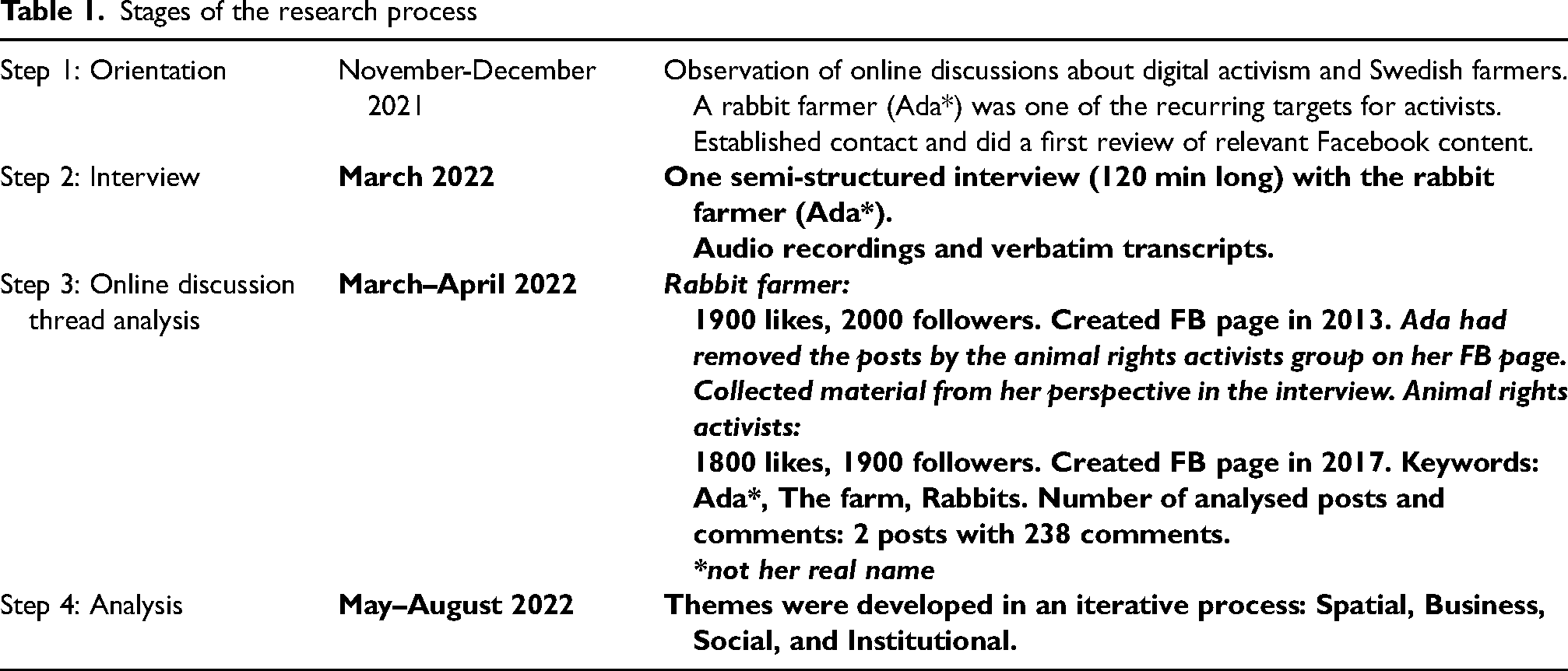
The research design was conducted in four steps (see Table 1). Stage 1: Orientation involved non-participant online observation of media outlets. This helped in selecting an entrepreneur – a rabbit farmer – to establish contact with. The Twitter and Facebook pages and newspaper articles connected to the farmer were observed. Stage 2 included an interview with the entrepreneur at her farm, to create an understanding of the process and the place. Stage 3: Analysis of online discussion threads involved a more systematic sampling approach and deep analysis of the animal rights activist group. To examine engagement patterns in more depth, elements of netnography were used (Kozinets, 2019). For collecting and analysing data concerning social processes, such an approach is appropriate, since it enables insights into critical sociocultural patterns (Kozinets, 2019). Stage 4 included a thematic analysis to develop an understanding of the process. The steps are presented in more detail below.
Stages of the research process
Case selection
In Sweden, animal rights groups have increasingly engaged in threats, harassment, and other criminal acts directed at farmers, both in place and on social media (Ceccato et al., 2021). Threats made over the Internet are a recurring problem among Swedish farmers (Ceccato et al., 2021). This study dives deep into a single case and explores in detail how such interactions influence entrepreneurship. Using a single case study allows us to question old theoretical relationships and explore new perspectives, in line with Eisenhardt (1989). For this reason, the case of a rabbit farmer in Sweden, Ada (not her real name), was selected. Ada felt that this was an important subject for research, and gave her consent to continue the research.
Collection
In Stage 1, the rabbit farmer's potential contribution to the research was assessed. Following ethical guidelines, Ada was emailed regarding the project and its research objectives and subsequently gave the researcher permission to observe online discussions on Facebook and to interview her. Based on the insights gained from Stage 1, topics for the semi-structured interview (Leavy, 2020) were developed. The interview lasted for 120 min and was recorded and transcribed verbatim. After the interview, Ada showed the researcher around the farm, which enabled an understanding of the local place, in line with Johnstone (2007).
The animal rights activist group is an open group on Facebook where members post anonymously under the pseudonym that is associated with the group's name. This study involved reviewing relevant posts without compromising privacy and allowing for efficient data collection (Kozinets, 2019). It is the content of the discussions that is of interest to this study, rather than the individuals concerned. In stage 3, the NCapture plugin for NVivo was used, which allowed for downloading the posts with comments and reactions, but without revealing the identities of the users involved.
Analysis
In Stage 4, an interpretation of the material was constructed by moving between the transcribed interview and the Facebook posts, in a process of creating descriptive labels of the content. NVivo aided in strategically systematising the material, which contributed to the thematic analysis sequentially. In moving between the different types of material, an understanding of the complete set of materials was developed (Saldaña, 2015). Four themes were developed concerning how the negative aspects of social media matter to the entrepreneurial process: spatial influence, influence on business, social influence, and institutional influence. The themes were systematically developed through an iterative process of studying theory and revisiting the empirical material. Interpretations were developed concerning how social media can be seen to influence entrepreneurship.
This study thus contributes to the literature on entrepreneurship and context. The aforementioned steps allowed for diving into a single case study to discuss the phenomenon of digital activism concerning often locally embedded rural entrepreneurship. The selected method allowed for taking a closer look at relationships and explaining how individuals make sense of their world. This is important in order to achieve understanding(s) of the context(s) of the studied phenomenon (Welter, 2011). Often, studies on entrepreneurship have adopted a place-based approach, whereas the steps used in this study made it possible to interpret both online and local interactions together as one reality in which entrepreneurship was developed.
Findings
The players
When the rabbit farmer Ada was a child, she used to pass through a local rural area on the school bus. She already knew then that she wanted to live and work in that specific place: ‘… and I thought this was the most beautiful place on earth’ (Ada). She had no background in farming, but she was always drawn towards that kind of lifestyle: ‘I don’t know where it comes from. My parents have never been interested in animals or agriculture, and I always have been’ (Ada).
Ada had always dreamt of having animals, so when she moved to the farm, she started buying rabbits and chickens to meet her own household needs. Soon after that, she expanded to sheep, dogs, and cats. However, she had no experience with hunting or slaughter. She expanded her knowledge of animal husbandry through educational sessions with her neighbours. She attended courses on how to slaughter chickens, rabbits, and even sheep, and her interest and confidence grew. During her first 6 years on the farm, she had another job in town, but after she met her partner and they had their first child, she wanted to be on the farm full-time and be able to be with her family and their friends. Soon, she started working full-time on the farm and developed local sales networks for her small-scale production. Her business is rooted in an understanding of rabbit meat and small-scale meat production as an environmentally conscious means of food production.
Ada is a well-known person in the local community, as well as among animal producers in Sweden. Her mother-in-law lives down the road from the farm and several of her closest friends live nearby: ‘It was a bit like coming home when I moved here. The neighbours came by to say hello, introduce themselves and tell me where they lived, and so on. That's probably how it is in the countryside … you always need each other’ (Ada). The neighbours continued to teach her about keeping animals and they all helped each other to improve at what they were doing.
The activists belong to a locally based animal rights group, which was founded in 2017. Their main activities and meetings take place in a larger near-by located city. The group consists of roughly 1800 members and their main goal is to set all animals free. They believe that Ada's friends and family, as well as allies of Ada's, are a part of the problem: ‘All of you who defend her are contributing to murder and should be in jail’ (Facebook user). The activists believe that current legislation is too weak on meat producers and constantly petition the regional legislative body to act.
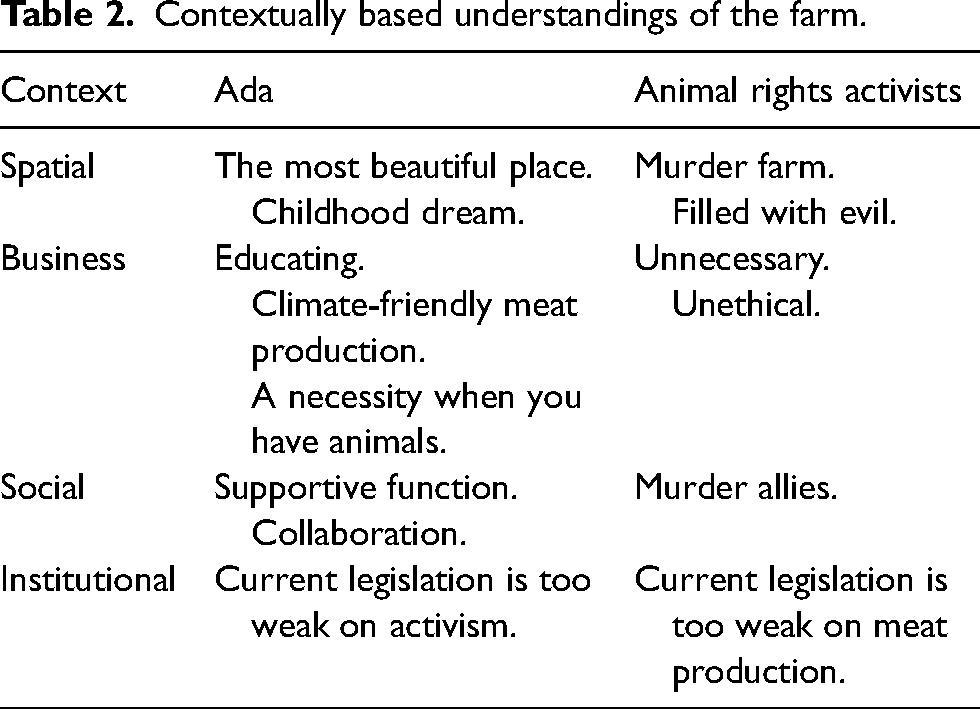
Table 2 illustrates the different understandings of context in this case. We can see that the animal rights activists view all aspects associated with the rabbit farm as problematic, while for Ada it has connotations of sustainability, a good social network, and the realisation of a childhood dream.
Contextually based understandings of the farm.
The process
In the summer of 2018, Ada attended an agricultural fair to display her products. During the morning, a flood of messages and comments poured into Ada's private and business Facebook pages. Ada became stressed, as she was unable to deal with the volume of messages while working at the fair. Over 100 people posted negative comments to her company's Facebook page and sent direct messages to her during the first night of July. The comments included the words ‘killer’ and ‘torturer’. In order to be able to focus on her work, Ada decided to temporarily shut down her Facebook page in light of the overwhelming number of messages and comments she had received.
Later in July, however, activists came to her farm. One morning, she was in the garden working with the animals as usual when the dogs started barking, and she looked around. She saw no one, so she continued with her work. But as she walked to the farm entrance, she saw two heads peeking out from behind her car. She called out ‘Hello?’ and the people disappeared down the road. Only a few moments later, 15 people appeared in front of the house, carrying posters and signs bearing the words ‘Killer! You should be in jail”. “I was so scared that when I tried to call the police, I just shook. I could barely press the numbers on the phone. And I just cried and cried. It was surreal’ (Ada).
The group of animal rights activists live-streamed the event on Facebook and one person went around the farm taking pictures. ‘They went into the farm because I didn’t have any gates or anything, so they went all the way in. They just stood there and said nothing. I came out and told them that they had to leave, but then they just stood there with a sneer and said nothing. They just stood there with their signs. It was so awful’ (Ada).
The police arrived, and Ada wrote a post on her private Facebook profile saying that she needed help and company. Friends came and stayed with her during the hours when the activists were on the farm. Ada also has a friend and neighbour who is part of the care group of the Federation of Swedish Farmers, who came as soon as she heard what was happening. ‘It is just so scary when you are alone and a whole group of people comes, and their purpose for being there is to do you harm’ (Ada).
After several hours, the police managed to disperse the activists. Ada's neighbour was also a contributing factor: They had parked their vehicles in her garden, and she was infuriated. She stormed out and screamed at them to leave: ‘She's about 80 now, from Finland, so … you know, she's not a person you want to mess with’ (Ada).
The second time Ada noticed animal rights activists on her farm, she called the police straight away. However, the group of activists went into the farm to take pictures and live-stream their presence on Facebook. She told them to leave but they were persistent: “They just stood there with a grin and said, ‘I feel so much evil here’ and I just thought – Christ, why do you come here?’. However, it was raining that day, and the activists left quickly after the police arrived.
Activists came to the farm again while Ada was away attending a course. ‘I went down to the basement and the taps were running and they had opened the freezers. Both our company freezer and our private freezer. There were also stickers on the driveway and our building. And they had opened the door to our farm shop … So it was obvious that they had been there, and that was probably scarier than anything else’ (Ada). After that, she had security cameras and alarms installed on the farm. Before these events, Ada had been used to leaving the door open and leaving her keys in her car, because ‘No one is out here anyway – it's just me and my neighbours’ (Ada), but she has since become more cautious.
Ada saw it as problematic to continue with her sales via social media and started to sell directly to restaurants and wholesalers instead. Previously, she had relied on small-scale sales directly to customers and used social media as a communication and sales platform. But with the recent developments, she found she could not cope with the harassment and threats that came about as a result of her social media activity.
Later in the autumn, Ada was walking around the farm with her family when they saw something in their parking spot. It was a Molotov cocktail, and the car was scratched and marked with the symbol of a Swedish animal rights activist group.
‘During the worst times during 2018, we [the family] slept in the living room. At Christmas, we sat in the bed in the living room and opened the Christmas presents. It was unreal. We told our child that we couldn’t sleep upstairs because there were wasps in the bedroom. But I think she understood [what was going on] anyway …’ (Ada).
Ada and her family were under secret identities and used protected phone numbers. Her daughter was especially affected, and also became the target of threats: ‘She has had a very hard time going to school, I have been with her at school a lot in the whole four and fifth grade. She only attended a few days a week, a few hours. It's shitty. And she doesn’t dare to take the school bus in case someone should come and take her’ (Ada). Both Ada and her family are discussed among the activists: ‘Her child has a rabbit as a pet, but eats the other rabbits? Is she mental?’ (FB user); ‘Insane animal torturers!’ (FB user). Activists have also made direct threats towards Ada's daughter, with one of them saying that they were going to kill her on her way to school. Activists have not only contacted Ada herself, but have also called her friends and family members and sent threatening letters to them.
Figure 1 presents an overview of the actions that took place during 2018. Ada and the activists are each presented both in the local and online parts of the timeline and the practices (i.e., the actions).
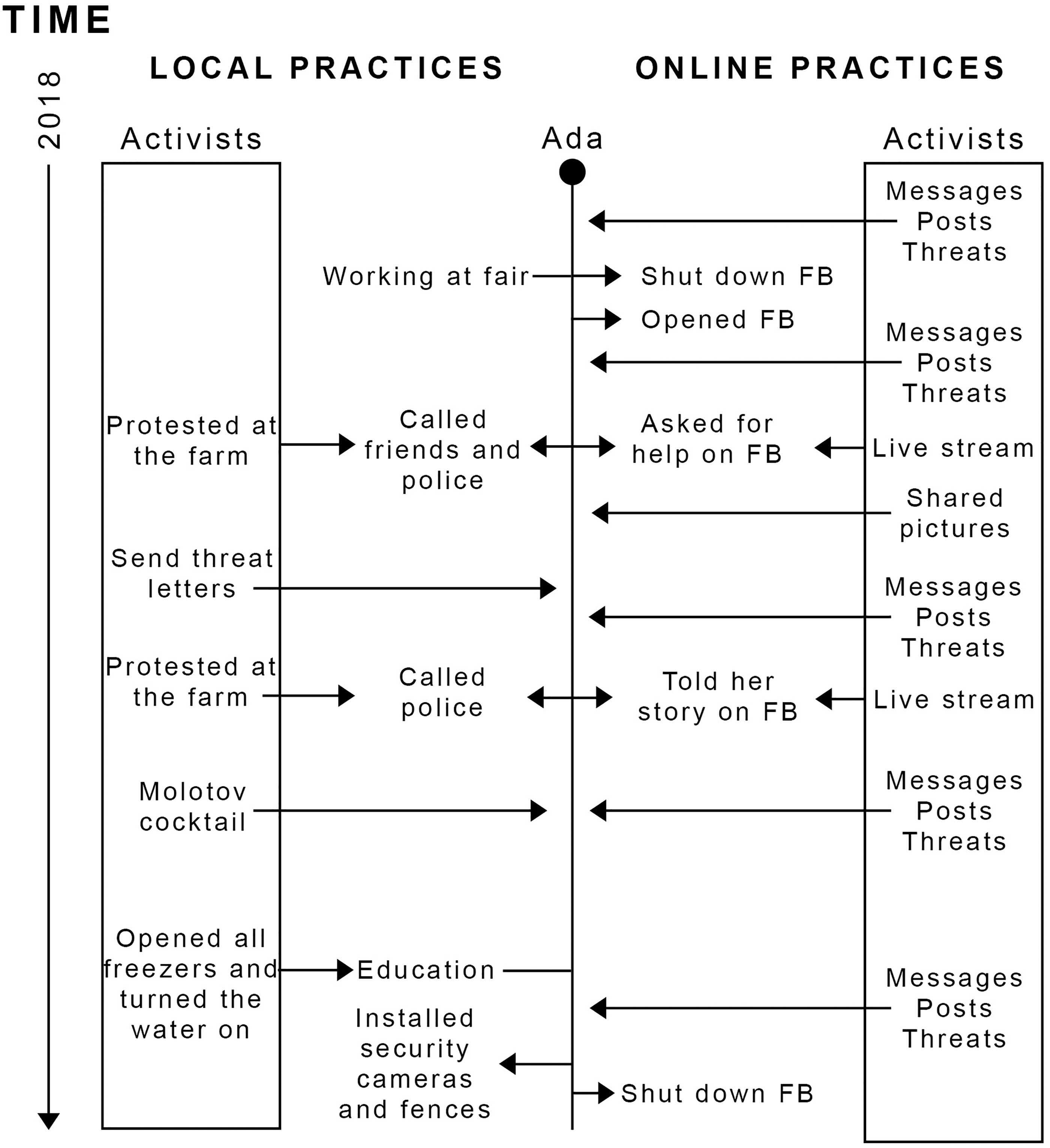
Ada's and the activists’ local and online practices in 2018.
The outcomes
From the process described above, several outcomes resulted. Table 3 presents the local outcomes for both Ada and the activists. Ada developed the local setting to increase its security with camera surveillance, more cattle surrounding the farm, and fences. She also changed how she sold her products: From selling directly to consumers, she developed into selling business-to-business instead and developed contacts with restaurants. The activists, for their part, were able to develop marketing and communication material based on their actions on the farm. They also left their mark on the farm with stickers and damage to the inventory. Another outcome for the activists was that some were sentenced in court for their actions.
Local outcomes.
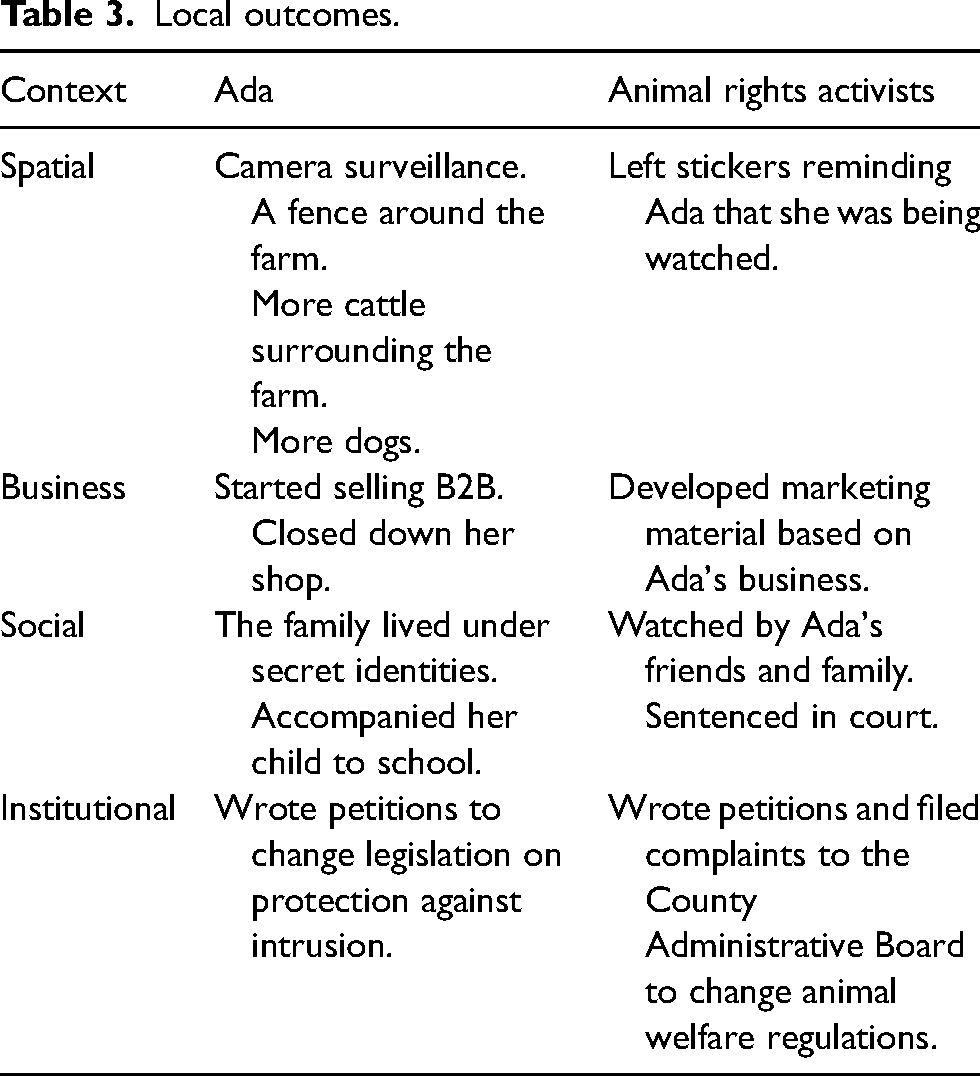
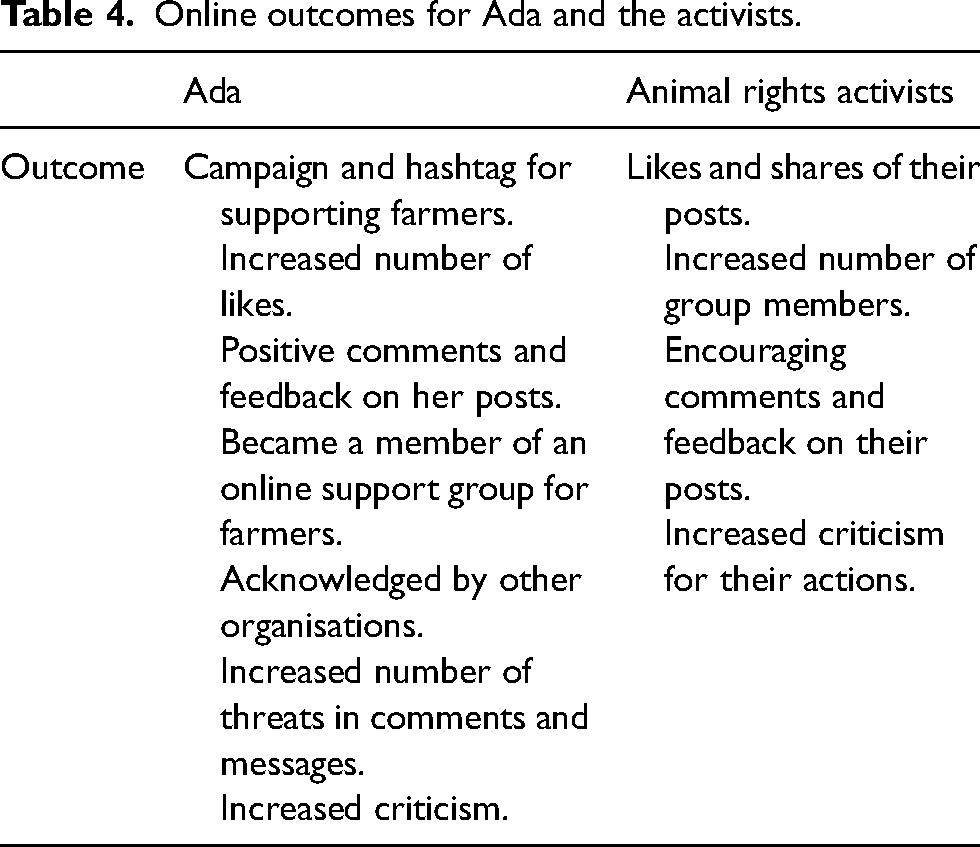
Table 4 presents the online outcomes from the actions discussed in the previous section. Ada started an online campaign with the aim to support Swedish farmers and take a stance against the activists’ behaviours. She also found a support group online, where she could share her experiences with other farmers in the same situation. The activists received increased visibility and attracted more people to their group, as well as encouraging comments and feedback on their posts. Both sides had to deal with increased criticism of their activities.
Online outcomes for Ada and the activists.
When social media backfires
By following a social perspective on entrepreneurship (e.g., Korsgaard and Anderson, 2011) and viewing entrepreneurship as created in engagement with a context (Fletcher and Selden, 2016), this study set out to explore how the negative aspects of social media matter to the entrepreneurial process. The case described above has shown how a social media platform enabled coordinated attacks on Ada's business, both on- and offline, by animal rights activists, and also how individuals online can affect the spatial, business, social, and institutional contexts surrounding the entrepreneur.
The case demonstrates the relationship between local and online contexts and how this influences entrepreneurship. Social media interactions are part of the spatial immediacy and activists share the social space with entrepreneurs. In this new social zone, participants can interact in (almost) real time while their physical bodies are in very different locations. This is similar to physical co-presence (Zhao, 2006), but differs from it in that activists can be located anywhere and still communicate. This results in the continuous presence of ties – social relations – which form the social context.
The concept of intrusive ties highlights the profound impact that social media can have on the social landscape of entrepreneurship. This impact extends to the potential erosion of boundaries between personal and professional domains. The activism does not always take place in physical proximity to the target, but the memories and constant reminders of the activists’ presence in the form of online threats will affect entrepreneurs regarding how they act. Therefore, there is a need to understand ties, both online and local, in order to understand the context in which entrepreneurship develops. Thus, this study adds to the discussion of entrepreneurship and context.
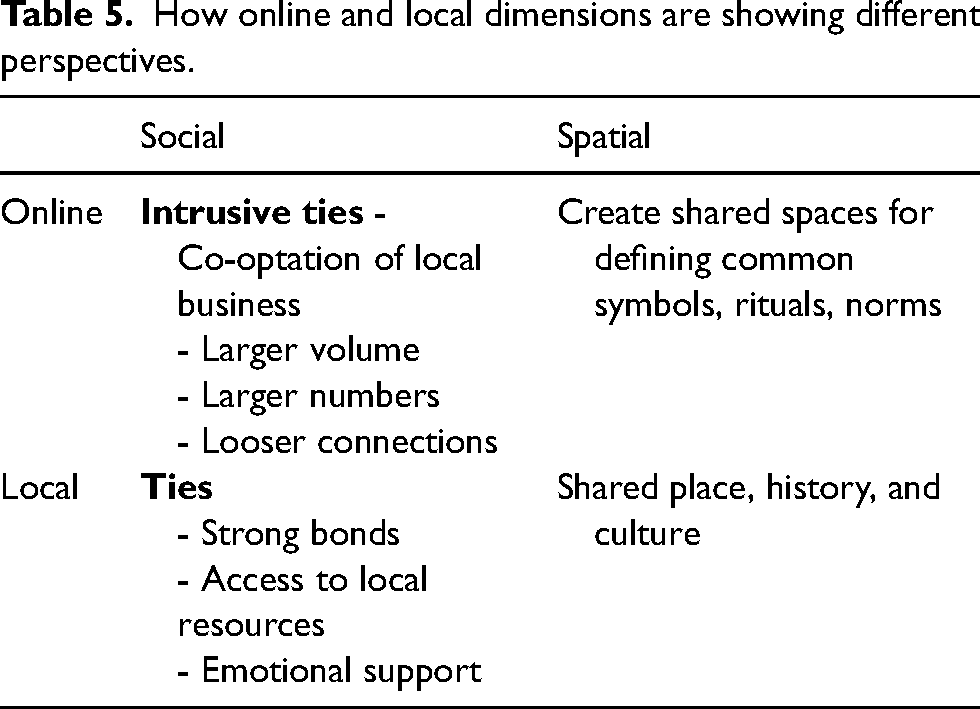
Table 5 shows the differences between online/local spatial and social contexts. There is an ongoing process of intrusive relationship formation online by the activist, who repeatedly interact with Ada to affect her actions. Online interactions become an integral part of the perceived reality, something entrepreneurs must relate to when it comes to their physical actions, as described in the interview with Ada and pointed out by Pearce and Artemesia (2010).
How online and local dimensions are showing different perspectives.
Next, two themes are presented which are of importance for understanding how social media influences entrepreneurship.
Intrusive ties
Korsgaard et al. (2022) state that context embodies norms, resources, and structures that entrepreneurs learn to use and adhere to. However, as shown in the case presented here, relations on social media are neither homogeneous nor something you necessarily choose yourself. Social media enables individuals to make contact with entrepreneurs, regardless of their physical location or whether they have a mutual standpoint on the question of their business. It enables individuals to make contact with people on a larger scale compared with offline activities, and messages, comments, or threats come in much larger quantities, while the receiver is still one business owner. The business owner in the case experienced the constant presence of other people in the venture development, by the combination of in-place activism with a steady flow of messages online. Even though these interactions do not constitute close, personal, or special relationships, they are a form of (unwanted) weak ties (Granovetter, 1973), which have been stated as important for the process of embedding (Jack, 2005). Weak ties allow for bridging different social groups and connecting individuals to new resources and opportunities that are not available within their immediate social circles (Granovetter, 1973). As such, weak ties on social media have the potential to amplify the social context for entrepreneurs. When individuals engage in social media and interact online, these interactions shape the social context. By leveraging the extended reach of weak ties, entrepreneurs can gain visibility, and attract a wider audience, but as shown in this study, this visibility and wider audience can be used to do harm.
Recalling that social relations consist of strong and weak ties (Granovetter, 1973) and embeddedness refers to the degree to which these social relations are embedded within larger social institutions and structures (context) (Jack and Anderson, 2002), through the large volume of online interactions in combination with place-based actions, the animal rights activists are creating intrusive ties to the entrepreneur and engaging in a process of embedding themselves in the entrepreneurship. In this way, the ties to the entrepreneur create a blurred line between the private and business spheres. The threats and hatred are directed at Ada as a person, while their content concerns her actions within her business. The activists embed themselves in the farmer's private social sphere, which affects her private life to a high degree, and consequently, the ways in which she develops the entrepreneurship. This is an example of intrusive ties, where individuals interact at a high frequency but without mutual consent to the interaction.
The case demonstrates different types of embedding processes. As Cunningham and Barclay (2020) have shown, embeddedness is manifested in the entrepreneurial process of companies, thus, through an examination of the context in which they operate, we can learn more about their development. In this case, digital activists are engaging in social interactions online inside their closed groups, while creating bonds through the use of social media. The ‘online’ is also persistent in the sense that it is always ‘there’, and the user's activities thus become part of the world and other users’ experiences of it (Pearce and Artemesia, 2010). Individuals are embedded in their environments to a degree that depends on the nature, depth, and extent of their interaction with those environments (Jack and Anderson, 2002). These environments are now partially online, and many activists have substantial online social bonds, where norms and structures are being developed. In this case, digital activists engaged in social actions online, which affected how the entrepreneur experienced her context and consequently, her actions offline.
Another embedding process can be seen in the case of the business owner herself. She is highly embedded in the local community both in terms of history, relationships, and formal bonds. In addition to this, both Ada and her family are embedded emotionally in the business to a high degree and they live and work in the same physical location. In this study, the entrepreneur engaged in online social interactions by building her community online and using the available online resources to her advantage for her business.
Social media as a part of the social context
The digital activists engaged in online and local activism against one small business owner. The connections created are social, recurring, and persistent over time. When digital activists send messages and receive replies, it is the start of an interaction. Digital activism is characterised by the extent and volume of actions (Schneider et al., 2018); there is a constant flow of users online who connect with the farmer in several ways. This is how intrusive ties are shaped in the dynamic between digital activists and small business owner.
Figure 2 shows how the business owner is located in the nexus of the online and local spheres, which together make up the socio-spatial context. The arrows represent interactions between the individual and the social media users on the one hand and the local community on the other. The online and local dimensions together make up the socio-spatial context and a new social zone, which is an important part of the social context. Being locally embedded in a social structure has been shown to enhance businesses’ performance and create opportunities (Jack and Anderson, 2002), while in the case above, embedding in the online context created the opposite result. The concept of ‘intrusive ties’ can help explain what happens when social media backfires and creates problems for small business owners.
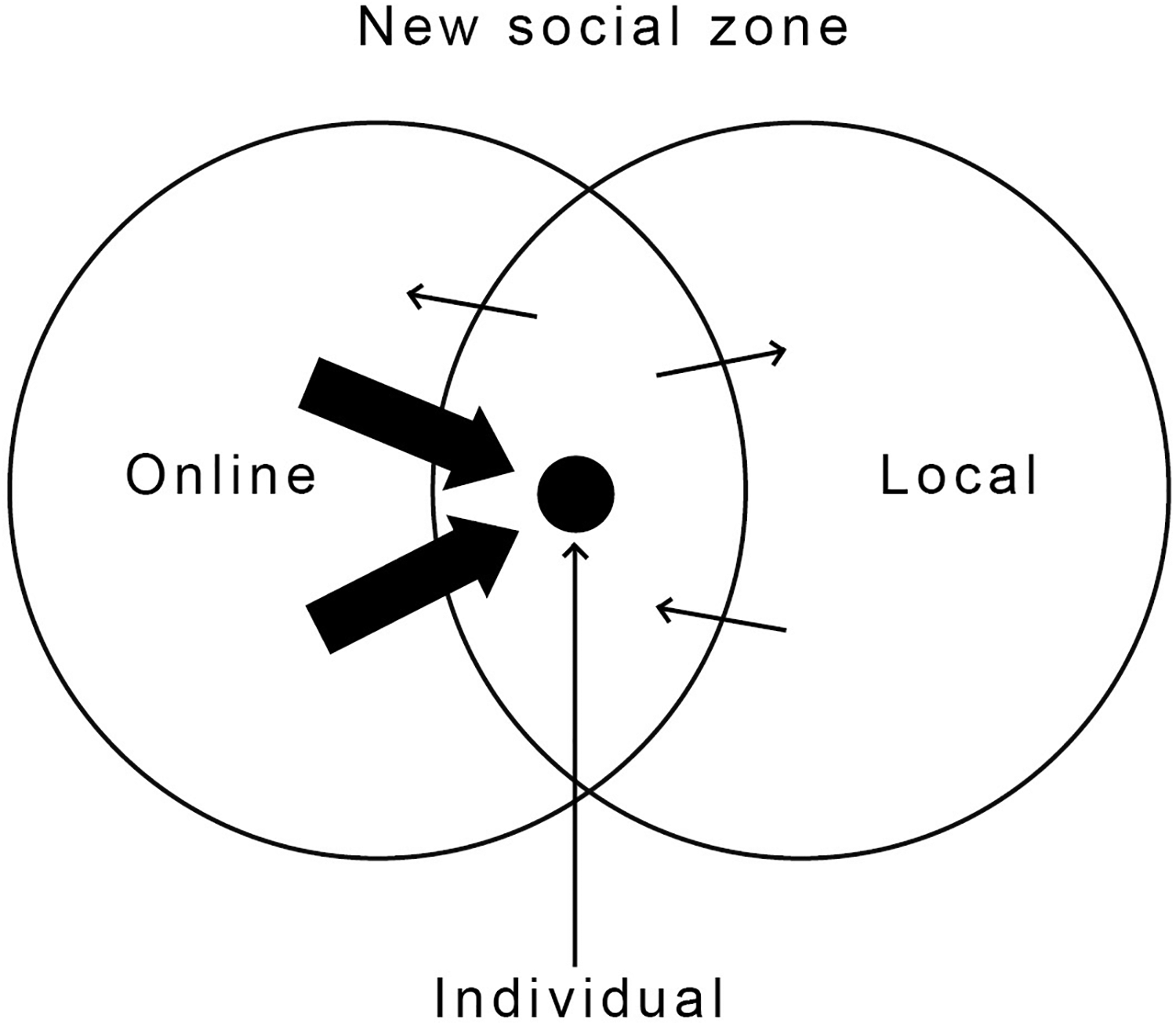
The new social zone as the nexus between online and local interactions.
This study demonstrates the magnitude of online versus local interactions. It is easy to organise attacks online in large volumes (bold arrows), while the receiver of such attacks is bound locally by local relationships or the place in which they act.
During the years of being a target of digital activism, Ada has developed an understanding of who these individuals are, including their names and where they live. Digital activism in this case has resulted in intrusive ties, as a form of very weak, involuntary ties, and part of the entrepreneur's context. This is something Ada takes into account when developing her business, although she wishes that she did not need to do so. The choices she makes will affect the surrounding context and her ties with other individuals.
In line with Welter (2011), the social context was formed by the digital activists’ actions both online and locally, and the entrepreneur's actions and relations formed the entrepreneurship. Ada had numerous individuals supporting her, from an online campaign and viral hashtag to closed support groups of farmers who had had similar experiences, while at the same time, she experienced a constant threat. To different degrees, entrepreneurs are embedded or disembedded in contexts (Jack and Anderson, 2002), and consequentially, the context in which Ada interacts creates the environment in which she operates, in line with Baker and Welter (2020).
The case illustrates a dynamic relationship between the perceptions, actions, and settings of the individuals involved. The farmer experienced a disabling context, and this influenced her actions, leading her to change her distribution channel (as one example). The development of informal institutions surrounding the farmer influenced both the collective and the farmer's perceptions of entrepreneurial opportunities; this is a dynamic process of entrepreneurship between perceived challenges and opportunities.
Social media has been stated to be especially important for entrepreneurs concerning the benefits (Olanrewaju et al., 2020), but the risks are seldom discussed in the same manner. However, social media is a force that can be used to either positive or negative effects. This study illustrates how it can backfire when activists online become part of the social context of entrepreneurship through the creation of intrusive ties.
Conclusions
This case illustrates the negative role that social media can play in entrepreneurship. ‘When social media backfires’ refers to a mechanism by which activists online can become part of the social context of entrepreneurship through the creation of intrusive ties. Online as well as physical interactions are included in the analysis in order to develop an understanding of entrepreneurship as a context-dependent social process, using the case of a Swedish farmer and an animal rights group as a case study. As a means of defining context as more than just a physical reality, this study discusses how access to the entrepreneur through social media creates social connections and influences the social reality upon which the entrepreneur acts and develops the entrepreneurship. The concept of ‘intrusive ties’ is presented as a way of describing how digital activists can embed themselves in the social process related to entrepreneurship and how this forms the social context.
The socio-spatial context must include both online and local interactions in order to fully understand local processes of change: the social reality of contemporary entrepreneurship is both online and local, and this expands the notion of the importance of social context for entrepreneurship.
Future research can prioritise examining the difficulties associated with the convergence of the private and business domains, particularly emphasising the heightened repercussions that arise when these intertwined relationships are affected by individuals outside of the business. Such work could include investigating the impact of overlapping private and business spheres on the work-life balance of individuals, particularly in industries like farming where personal and professional boundaries can blur. This could involve examining the psychological, social, and health implications of managing multiple roles simultaneously.
Footnotes
Declaration of conflicting interests
The author declared no potential conflicts of interest with respect to the research, authorship, and/or publication of this article.
Funding
The author received no financial support for the research, authorship, and/or publication of this article.
