



Abstract
Traditional research methodologies often fall short of capturing the nuances and real-time digital interactions that shape the entrepreneurship process. This stands in contrast with the growing effect that digitalization and the internet have on entrepreneurship. Here, netnography stands out as a valuable method for exploring the dynamics of entrepreneurship within online communities and digital environments. In this research note, we use a published netnographic case study to demonstrate that netnography bridges the gap between academic exploration and the rapidly evolving digital realities of entrepreneurship. We propose a framework for utilizing netnography in the study of entrepreneurial processes, highlighting its potential to enhance our understanding of how these processes unfold in contemporary society. Netnography offers unique advantages, including the ability to capture real-time insights into the dynamic social contexts shaping entrepreneurship, and enabling researchers to transcend temporal and geographical limitations.
Netnography in entrepreneurship research
Netnography, rooted in the fusion of ethnography and the internet, presents an opportunity to study social processes online (Kozinets, 2019). Contemporary social science studies show an increased use of netnography, although the range of entrepreneurship-related research is relatively limited. In the field of entrepreneurship, netnography has been applied to study psychological empowerment (Chakraborty and Biswal, 2012), embeddedness in entrepreneurship (Jonsson, 2023), or how individuals learn through co-participation online (Vershinina et al., 2022). Elenurm (2024) uses netnography to explore “opportunities”, while Gregori and Holzmann (2022) use it to examine how value is constituted in entrepreneurial practices. Netnography has also been used for investigating digital nomads as entrepreneurs (Yu et al., 2024).
The method, as such, is used to “examine patterns of community engagement in more depth” (Vershinina et al., 2022, p. 747), or for “probing and analysing of cultures and communities that are emerging through computer-mediated communications” (Chakraborty and Biswal, 2012, p. 722). Arguments for using netnography include the quality, i.e., breadth or depth (Vershinina et al., 2022) and accessibility of data (Chakraborty and Biswal, 2012; Gregori and Holzmann, 2022), as well as an understanding that much of our contemporary social lives play out on social media (Elenurm, 2024). Social media, in this sense, serves as a valuable reservoir of information regarding social interactions, offering detailed, authentic data sourced from the contexts in which these interactions take place (Kozinets, 2019). As the method is “grounded in deep appreciation of the context of people's everyday life” (Kozinets, 2019, p. 15), it is then especially useful to explore how entrepreneurship is influenced by the broader social, cultural, and historical contexts in which it takes place (Baker and Welter, 2020; Jack and Anderson, 2002; Johannisson, 2011; Roos, 2021). Especially when it comes to contextualising the situated realities (Welter et al., 2019) of digital entrepreneurs and the emerging digital landscape (Sussan and Acs, 2017). We will now continue with explaining what netnography is and how we can use it.
Introducing netnography as a method
Although online ethnography 1 has increased as a method, netnography is the most “common label to indicate the ethnography of online spaces” (Paoli and D’Auria 2021, p. 255). One of the key strengths of netnography lies in its ability to show the formation and impact of social interactions within online communities (Kozinets, 2019). Differences in terminology of online ethnography can sometimes suggest variations in how this digital research approach is conceptualized. Netnography, however, is specifically designed to study online communities and is conceived as an entirely online approach (Paoli and D’Auria, 2021). It is a systematized qualitative research method for doing online ethnography, consisting of data collection, data analysis and data interpretation for understanding online social interaction (Kozinets, 2019). One of the strengths of netnography is its systematic research approach, enabling researchers to conduct online ethnography rigorously. The method utilizes archival, co-created, and field note data, emphasizing the capture of multifaceted online representations. The benefits of netnography are the identity transformation in the online environment, asserting that online expression can reveal more about individuals than it obscures (Kozinets, 2018).
Netnography places strong emphasis on the meaning of online interactions within digital communities to understand the social processes online. As such, we can observe how people talk to each other, the language they use, and the topics that are being prioritised. The tone, the humour or the emotional language can also be used to understand the social bonds and culture within an online community. In netnography, we study this to see how groups foster cohesion, allowing us to develop an understanding of the community's collective practices.
Netnography is conducted through six key steps (Kozinets, 2019): (1) Initiation, (2) Investigation, (3) Immersion, (4) Interaction, (5) Integration and (6) Incarnation. This is summarised in Figure 1. In the first step, we want to find our research focus and ways forward. Steps 2–4 can be used separately or together as data collection. These different areas have separate sub-groups, which the netnographic researcher can combine in various ways, depending on the chosen research design. Step five includes analysis and interpretation of the online representations. Step six includes the presentation of the material.
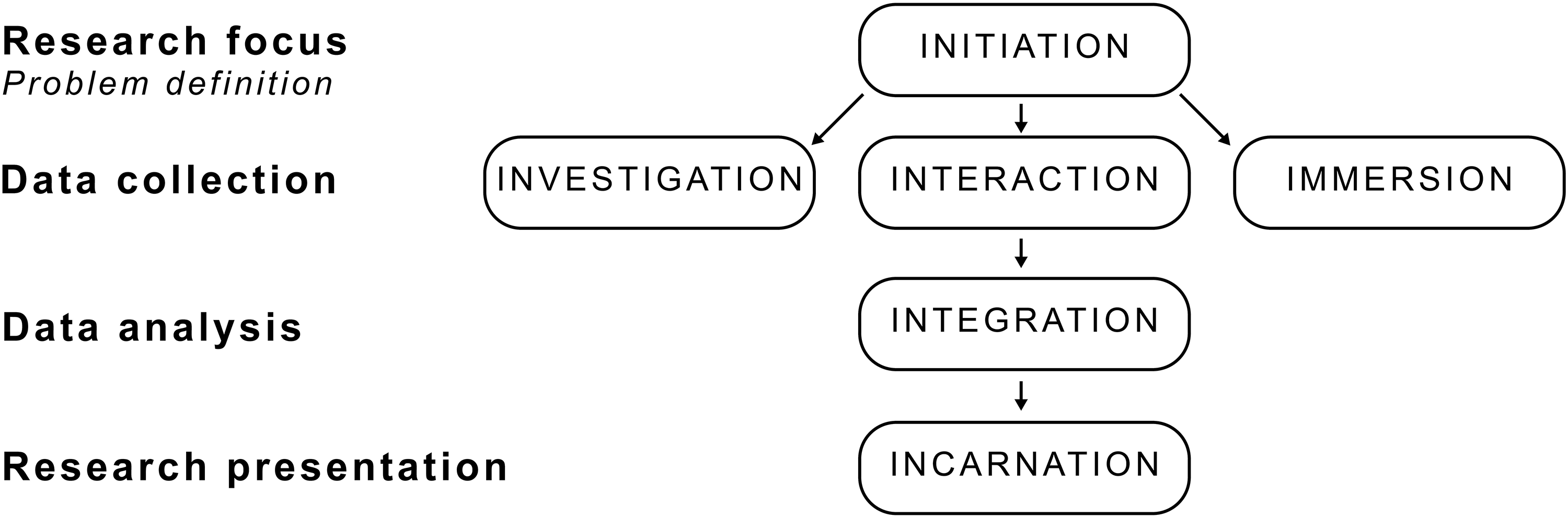
Six steps in netnography, as presented by Kozinets (2019).
The six steps in a netnographic research study
To present a framework for conducting netnographic research, we use the method in Jonsson (2023) as a case to discuss. In the article, Jonsson (2023) shows how negative facets of social media influence the entrepreneurial process. Through the case of coordinated online and offline attacks faced by Ada's business at the hands of animal rights activists, Jonsson highlights the profound impact of social media on entrepreneurial endeavours. We will now discuss the steps of netnography in the article.
(1) Initiation comprised online observation of various media outlets. This process facilitated the identification of an entrepreneur, Ada, who is a rabbit farmer, for case selection. The Twitter and Facebook pages, along with newspaper articles associated with the farmer, were examined. Subsequently, contact was established, and an initial review of pertinent Facebook content was conducted. Netnography provided for an in-depth exploration of the subject (i.e., how the social context matters for entrepreneurship development), enabling identification of a suitable case. In this step, it was possible to select public groups shared under public conditions, thereby eliminating the need for a specialized ethical procedure while ensuring the protection of the rights and privacy of those involved in digital spaces (Tuikka et al., 2017).
Jonsson (2023) followed an investigative approach (2) where she reviewed the online discussion threads of the animal rights activist group and the business’ Facebook page. When we have an investigative approach, we can select a topic in a forum, follow a hashtag or select a Facebook group that will constitute our narrowing down of the field. This involved exploring social media posts and engagement where Ada's name was used to search for the posts about the business in the Animal rights activists’ Facebook group. Using the NCapture plugin for NVivo then allowed for downloading the posts with comments and reactions as text, but without revealing the identities of the users involved. This was conducted to explore the interactions between Ada and the surrounding social groups (i.e., activists, supporters, family, friends etc.). The strength of this step lies in the ability to “travel back in time” and revisit past discussions, allowing the researcher to observe not only what was said but also how it was communicated in its original context. This retrospective analysis provides valuable insights into the dynamics and development of conversations, enabling a deeper understanding of the interactions and the language used at the time. The data collection also involved a qualitative research interview with the entrepreneur at her farm, to create an understanding of how the online discussions affected Ada's entrepreneurial process and the place. The focus in netnography often revolves around discussions, or processes observed online which is of value for understanding the entrepreneurial process. The individuals as such are not always of interest, where the content (i.e., the discussion) is valuable to use, rather than the individuals themselves and thus we can ensure the privacy of individuals (Golder et al., 2017). Similarly, not all topics are of interest but may still be captured. This serves as a challenge to uphold ethics since it is difficult to ensure that for example personal information (e.g., statements about religion or political views) are not collected as bycatch.
The investigative process is one of three processes of collecting data in a netnography. The other two are immersive (3) and interactive (4). The immersive collecting (3) focuses on and use a netnographer's immersion journal (similar to field notes). With this method, the researcher focuses on descriptive or informal data and the method is best described as the online equivalent to a field study. The researcher actively participates in discussions, observes interactions between community members, and takes detailed notes on their experiences, observations, and any insights gained during their immersion. For instance, they might document how certain communities organize themselves, the language they use, the topics that generate the most discussion, and the norms and behaviours that emerge within these online spaces. Because of this, it requires careful ethical consideration, attention to bias, and sensitivity to both the participants and the data being collected. Researchers must balance immersion with ethical responsibility and legal obligations to protect the communities they are studying.
The interactive data operation (4) usually includes online interviewing, commenting in a forum query, posting public questions, direct messaging, or digital diary by using mobile ethnography. Researchers can conduct online interviews, participate in forums, post queries on social media, send direct messages for deeper insights, and encourage participants to maintain digital diaries. The traces that emerge due to the interactive approach contain traces of the researcher as well and are similar to interviews, surveys, or other question-based methods. The three data collection processes presented above can be used separately or together, to create an understanding of the phenomenon in focus (Kozinets, 2019).
Integrating (5) encompass the interplay between data fragments and developing insights, as well as the interaction between individual components and comprehensive contexts. Given the inherent complexities of analysis and interpretation, the integration process often requires revisiting both the research field and relevant literature for refinement and clarification. As such, by combining the data collections, Jonsson (2023) performed a thematic analysis through pattern coding (Saldaña, 2015) to develop an understanding of the social context in Ada's entrepreneurial process. Engaging in netnography, it allows for a comprehensive, in-depth exploration of complex social phenomena, as contemporary social life is played out both online and in place. This approach enhances the richness of the research findings, leading to a discussion that is grounded in both empirical data and theoretical frameworks. In Ada's entrepreneurial process, such integration enables the researcher to discuss the context-specific factors that shaped her process, offering a more complete understanding than only conducting an ethnographic study.
Finally, incarnation (6), involves embodying a concept, idea, or process in a tangible form to effectively communicate the netnographic findings (Kozinets, 2019). For Jonsson (2023), the process resulted in a journal article focusing on introducing the concept of intrusive ties, nuancing the positive view on the internet that has been associated with netnography and entrepreneurship.
Learnings about the entrepreneurship process through netnography
Netnography holds significant promise for contributing to theory building within entrepreneurship by elucidating the intricate dynamics in contexts. By acknowledging the social processes that take place online (Sussan and Acs, 2017), we can (with this method) elaborate a contextualized understanding of entrepreneurship (Welter et al., 2019). From the case study, interviews and online data were combined to better understand the interaction between online and offline social processes in entrepreneurship. By examining the social interactions within digital platforms, netnography provides researchers with insights into the entrepreneurial process by enabling us to include online social practices in our material. The method enables the observation of real-time interactions, offering an understanding of how online engagements influence entrepreneurial activities. This real-time aspect is particularly beneficial as it captures nuances and developments that traditional research methodologies may overlook. With solely an interview study of Ada and the activists, Jonsson (2023) would not have captured the extent of the formation of ties online, nor would it have gained the retrospective real-time insights affecting the entrepreneurship process. The collectiveness of the activists would have been lost. As such, by integrating netnographic exploration with a contextual view of entrepreneurship, researchers can gain insights into the everyday lives of individuals and their contributions to an entrepreneurship process.
Furthermore, netnography's global reach facilitates the study of online ties that transcend geographical boundaries. This global perspective is essential for understanding entrepreneurship in diverse contexts and shedding light on collaborative processes, idea generation, and problem-solving within digital spaces. Collecting experiences from approximately 1900 activists through interviews would not have been feasible due to enormous geographical distances, time consumption, and the volume of data. By bridging the gap between academic inquiry and the rapidly evolving digital landscape, netnography offers fresh perspectives on the social structures and shared meanings that underpin entrepreneurial endeavours. The online traces serve as valuable data points in understanding the social realities and contextual factors that shape entrepreneurial activities.
While netnography is essential for answering questions related to a community's collective practices, nuances, and cultural expressions, it has its limitations. We are humble in acknowledging that netnography cannot answer all our questions in entrepreneurship. The success factor in the work by Jonsson (2023) is the use of both interviews and netnography, using the different methods’ strengths together. This is not to say that netnography cannot stand on its own, but its limitations become evident when it comes to follow-up questions and clarifying the meaning of statements, as can be done in an interview. We also acknowledge that this method raises ethical concerns, including the handling of personal information and respecting the privacy of individuals online. To foster a more ethically aware process, scholars should ensure a clear focus on entrepreneurship and not individuals as such, hence letting the bycatch remain unexamined.
As we show in this research note we argue that netnography can be used to further understand common theoretical themes in entrepreneurship. These are for example embeddedness as with Jonsson (2023), opportunities as with Elenurm (2024), or value creation as with Gregori and Holzmann (2022). We urge researchers to think about what else we can learn about common theoretical themes through using a netnographic method.
Conclusion
Academia needs to develop qualitative methods to further and better understand how people are interacting in modern-day society (Elenurm, 2024), as people increasingly interact on social media. This is also important for entrepreneurship research, as an increasing number of businesses, organizations, and entrepreneurs operate in digital environments. Moreover, entrepreneurial processes not only emerge from digital environments (Nambisan, 2017) but are also deeply intertwined with them (Yu et al., 2024). Netnography helps entrepreneurship researchers to further and better understand how the entrepreneurship process unfolds in contemporary society.
In this paper, we offer arguments for netnography's efficacy in understanding contemporary entrepreneurship. First, it offers real-time insights into the evolving social contexts of entrepreneurship, capturing online interactions critical for understanding intrusive ties and the influence of digital platforms on entrepreneurs’ social reality. Secondly, netnography allows the researcher to act as a time traveller and study a phenomenon across geographical boundaries, offering fresh perspectives on entrepreneurship, bridging the gap between academic inquiry and the evolving digital landscape.
Footnotes
Funding
The authors received no financial support for the research, authorship, and/or publication of this article.
Declaration of conflicting interests
The authors declared no potential conflicts of interest with respect to the research, authorship, and/or publication of this article.
