




Abstract
Drawing on institutional and upper echelons theories, this study delves into the underexplored intersection of gender, context, and innovation performance among women entrepreneurs in Ecuador. Based on a sample of 45 women entrepreneurs, the study employs a fuzzy-set qualitative comparative analysis (fsQCA) and identifies six distinct paths to innovation performance. Contrary to initial expectations, our research findings substantiate that both institutional and social factors play a key role in fostering innovation in women-led firms in Ecuador. This innovation is facilitated by establishing close and frequent interpersonal connections, as well as by the age of the female entrepreneurs. Conversely, certain individual variables traditionally associated with innovation, such as education level or prior experience, manifest only sporadically. Our research enriches the discourse in gender and innovation studies by employing a multilevel approach and provides valuable insights into female entrepreneurial leadership’s contribution to advancing developing economies.
Introduction
Innovation performance is an organization’s ability to innovate and generate value through new ideas, processes, products, or services (Sharma, 2019). Innovation is a crucial element of business sustainability and a source of significant competitive advantage in today’s rapidly changing business environments (Zeb & Ihsan, 2020). It is also the cornerstone of entrepreneurial activities, especially for small and medium-sized firms (SMEs) (Rashid & Ratten, 2020). Despite the undeniable significance of entrepreneurship and innovation to global economies and societies, a noticeable gap exists in research exploring the intersection between innovation and gender (Brush et al., 2022). In fact, research on the entrepreneur and innovator has traditionally emphasized men’s contributions to innovation, inadvertently reducing the depth of gender discourse. This limited attention to gender dynamics (Madison et al., 2022) results in incomplete understanding of women’s contributions to innovation (Foss & Henry, 2016). Research on women’s entrepreneurship has, however, seen significant progress, including studies on women’s role, challenges, and contributions to economic growth (Bauweraerts et al., 2022; Bullough et al., 2022; Zastempowski & Cyfert, 2021). Furthermore, that studies that analyze women’s entrepreneurship often compare the roles of women and men in entrepreneurship (Belz et al., 2022; Lerner & Malach-Pines, 2011; Phipps et al., 2015) and examine the motivations and characteristics of women entrepreneurs (Bouguerra, 2015; Carter et al., 2012), as well as the challenges they face in acquiring and mobilizing resources (Liñán et al., 2020). Other studies have explored how context has influenced women entrepreneurs (Baker & Welter, 2018; Welter, 2011; Zahra et al., 2014) and how they establish their networks and navigate entrepreneurial ecosystems (Covin et al., 2016; McAdam et al., 2019; Su et al., 2015). Nevertheless, research in the field of female entrepreneurship has scarcely explored innovation or innovative enterprises among women entrepreneurs, and there is a gap that remains unaddressed across diverse theoretical frameworks and empirical methodologies (Brush et al., 2022). Some studies have confirmed that women entrepreneurs have an impact on innovation. For instance, Bauweraerts et al. (2022) have analyzed the role of family female directors in family-owned SMEs’ innovation initiatives and Madison et al. (2022) have confirmed the positive influence of women on SME innovation. Our study seeks to expand on this existing research by enhancing our understanding of the determinants that drive innovation performance in women-owned businesses operating in disadvantaged contexts.
The context of Ecuador is highly relevant to research on gender and innovation because it offers a unique perspective on the complex issue of gender inequality that permeates all aspects of society. Moreover, Ecuador stands out globally for its high rates of female entrepreneurship, which surpasses that of men, but women still significantly trail men in innovation (Elam et al., 2019). This spatial context presents a valuable opportunity to discover how to support and empower women entrepreneurs (Welter, 2011). While Ecuador has made notable progress in acknowledging human rights and striving for equality without discrimination, gender inequality remains a significant obstacle in the country. Women continue to face high rates of unemployment, excessive domestic and care responsibilities, and various types of violence (Consejo Nacional para la Igualdad de Género, 2022). The prevailing organizational structure characterized by labor segregation restricts women’s opportunities to gain prior experience in some sectors typically dominated by men (Greene & Brush, 2004). Women’s limited opportunities to gain managerial experience in business thus hinder their capacity to promote innovation performance in their new enterprises (Saavedra & Camarena, 2015). In Ecuador, a significant gender gap persists in the field of business leadership (Herrera, 2023), making entrepreneurship one of the primary avenues for women to gain experience in managerial positions. By establishing businesses that support their families and communities, Ecuadorian women entrepreneurs are not only contributing to the economic growth of the country but also gaining valuable experience in leadership positions.
Our study draws on institutional theory (North, 1997; Urban, 2016) and upper echelons theory (Hambrick, 2007; Hambrick & Mason, 1984). Institutional theory highlights that organizations are influenced by established social norms, laws, and cultural rules (North, 1990; Urban, 2016), which impact innovative performance. Institutional factors may limit women entrepreneurs’ innovation performance. Recent studies indicate that countries with institutional constraints such as weak laws, ineffective markets, and political volatility (Estrin et al., 2019; Foo et al., 2020) can hinder the development of innovation in women-owned businesses. Societal norms also play a significant role in defining gender roles and influencing perceptions of what constitute suitable professions for women. In some cases, cultural values and gender biases impose frequent restrictions on women’s participation in innovative entrepreneurial activities (Brush et al., 2009; Gimenez-Jimenez et al., 2022).
Upper echelons theory (Hambrick, 2007; Hambrick & Mason, 1984) posits that personal backgrounds and leaders’ individual characteristics play a pivotal role in how leaders interpret their environment and shape strategic decisions within an organization. This theory suggests that leaders’ demographic characteristics can serve as proxies for their models of knowledge and decision-making (Ruiz-Jiménez & Fuentes-Fuentes, 2016). Some studies have also shown that entrepreneur’s characteristics—such as age, education, and experience—are crucial elements for promoting innovation (Alsos et al., 2013; Hausmann et al., 2005). Considering these perspectives, we suggest that women entrepreneurs’ demographic characteristics significantly influence innovation performance and their interpretations of opportunities and challenges in their organizational context. Some recent research also indicates that our understanding of women and innovation is incomplete without considering the context in which women are embedded (Madison et al., 2022). The main goal of this study is thus to provide insights into the following question: How do the institutional context, social context, networking, and the demographic characteristics of women entrepreneurs influence innovation performance? To answer this question, we examine a sample of 45 women entrepreneurs from Ecuador and conduct a qualitative comparative analysis using a fuzzy-sets technique (fsQCA). This methodology bridges the gap between qualitative and quantitative approaches by helping to identify in quantitative samples the different causal configurations of independent variables that explain an outcome—in our case, innovation performance (Fiss, 2011; Ragin, 2008). We find six paths to gaining innovation performance, including strong institutional context, social context, the presence of formal and informal networks, and the age of women entrepreneurs.
Our study contributes to the scant literature on gender, innovation, and entrepreneurship in three ways. First, we respond to the call by Brush et al. (2022) to advance gender innovation research by adopting a multilevel approach in line with recent studies (Bauweraerts et al., 2022; Madison et al., 2022; Seigner et al., 2022). More specifically, we contribute to this debate by providing empirical evidence of the effects of institutional context, social context (macro-level), networking (meso-level), and demographic characteristics of women entrepreneurs (micro-level) on innovation performance. Second, we contribute to the entrepreneurship literature (Bullough et al., 2022; Peake & Eddleston, 2021; Strawser et al., 2021) by analyzing the innovation performance of women entrepreneurs in developing countries. Our methodology enables the exploration of novel insights into the synergistic mechanisms that elucidate innovation outcomes in a spatial context with significant constraints for women. Although Ecuador’s socioeconomic and institutional background presents a less than conducive environment for women’s professional progress, we find that women leverage their network connections to spearhead entrepreneurial initiatives and introduce innovation in their respective firms. Third, we contribute to institutional theory and upper echelons theory by providing insights into the interaction of formal and informal institutions with individual activity (Cordero & Pulido, 2020; Urbano et al., 2019). The convergence of upper echelons and institutional theory provides a framework to analyze how the demographic characteristics of women entrepreneurs, in conjunction with the broader institutional and social context, collectively shape the innovation in their firms.
Theoretical framework and hypotheses
Institutional theory indicates how institutions and their evolution impact organizations’ performance, both in the short and the long term (North, 1997). This theory is rooted in the core premise that stakeholders pursue their interests while operating within the confines of organizational constraints (Urban, 2016) and delves into both formal and informal aspects of institutional context. Formal elements include the legal framework, tax policies, contract enforcement (North, 1997), and other regulatory matters, such as share costs and business incentives, all of which directly impact an organization’s performance (Welter & Smallbone, 2008). Informal elements manifest as patterns of behavior specific to a culture or acquired through social interactions within a community (Urban, 2016).
Institutional context—which encompasses the foundational rules governing society, including political, social, and legal regulations that underpin economic organization, production, and distribution (North, 1997; Scott, 1995)—thus varies significantly from one country to another. This variation highlights the importance of studying the institutional environment as a vital reference point for analyzing business strategies and comparing their performance (Pearson et al., 2010; Wright et al., 2005). In addition, informal factors such as societal norms that shape gender roles—specifically, cultural values and gender biases (Gimenez-Jimenez et al., 2022; Roomi & Parrott, 2008)—are important aspects of social context (Welter, 2011). They study how women entrepreneurs deal with gender roles and family issues such as motherhood and work–family balance (Chávez-Rivera et al., 2021), as well as relationships with parents, friends, and colleagues to build networks. It becomes even more crucial to understand this institutional context in the case of Ecuador. The country’s unique political, social, and legal landscape shapes the opportunities and challenges faced by businesses and entrepreneurs. For instance, the economic slowdown attributed to rising insecurity, political uncertainty, and climatic disasters in recent years has added an extra layer of complexity to the institutional framework within which businesses operate.
Complementing institutional theory, Hambrick and Mason’s (1984) upper echelons theory underscores the influence of executives’ experiences, values, and personalities on business decision-making. This theory posits that the characteristics of the management team significantly impact strategic choices, as CEOs interpret challenging situations through the lens of their training and experiences in the external environment. These interpretations, in turn, influence decision-making processes, affecting company performance. The CEO’s view of reality—based on their system of values, goals, and emotions—is shaped by various factors, including education, preferences, age, experiences, and profession (Bekos & Chari, 2023; Delgado-García & De La Fuente-Sabaté, 2009). Numerous studies underscore the substantial impact of management team characteristics on strategic decision-making and business results (Hambrick & Mason, 1984; Nielsen & Nielsen, 2013; Ruiz-Jiménez & Fuentes-Fuentes, 2016). The management team’s characteristics reflect the organizational resources made available and the management’s capacity to leverage varied viewpoints in interpreting the prevailing resource environment (Senyard et al., 2014). Demographic traits are believed to substantially impact women entrepreneurs’ innovation ability and perceptions of opportunities and challenges within their organizational setting (Robson & Obeng, 2008). Recent research emphasizes the need for a comprehensive understanding of women and innovation by examining the specific context in which women operate (Kellermanns et al., 2023; Madison et al., 2022).
Institutional theory not only sheds light on institutions’ impact on organizational performance but also offers a valuable framework for analyzing business creation, particularly rules and norms that can either positively or negatively influence economic development (Díaz et al., 2005). This theoretical perspective underscores the role of formal and informal elements within the institutional context, such as legal frameworks and cultural behaviors, in shaping entrepreneurial endeavors. The synergy between upper echelons theory and institutional theory creates a nuanced perspective that enhances our understanding of women’s entrepreneurship. This intersection provides rich terrain in which to explore the complexities of women’s entrepreneurial characteristics in the broader institutional and social context. It opens promising avenues for future research to delve deeper into the interplay of executive characteristics, institutional factors, and their combined influence on innovative performance. This integrative approach provides a holistic framework to uncover the multifaceted dynamics that contribute to or constrain women’s entrepreneurial initiatives.
Our research model thus considers the macro-, meso-, and micro-levels to analyze women entrepreneurs’ innovation performance. The macro-level refers to the factors of institutional context and social context that act as facilitators or inhibitors of women entrepreneurs’ innovation performance. The meso-level refers to the influence of networking on innovation performance and examines how relationships with parents, friends, colleagues, and broader professional networks contribute to innovation performance. Finally, the micro-level explores the significance of demographic characteristics specific to women entrepreneurs, including factors such as age, education, and professional background, to reveal how these individual traits impact innovation performance (Figure 1). By examining these multifaceted dimensions, our model seeks to provide a comprehensive understanding of the intricate dynamics that contribute to innovation performance in contexts that are constraining for women entrepreneurs.
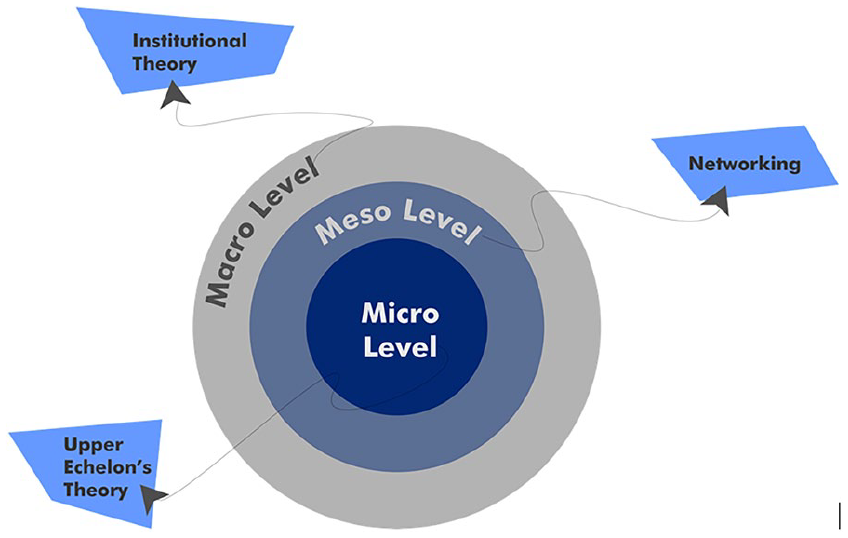
Research model.
Institutional and social context with innovation performance (macro-level)
An enabling environment comprising institutions that can provide political and economic stability, security, and resource access is a crucial prerequisite for the success of the business sector (Bosma et al., 2012). It also fosters a more conducive atmosphere for innovation, as both formal and informal institutions influence entrepreneurs’ propensity to engage in productive and innovative endeavors (Baumol, 1990). These institutions can be broadly categorized into regulatory, normative, and cognitive dimensions (Kostova, 1997; North, 1997). Regulatory institutions are tasked with formulating, establishing, and enforcing laws in individual communities or nations (Urban, 2016). Prior research indicates that regulatory institutions wield significant influence over the inception, growth, and innovation of new enterprises (Khanna & Palepu, 2010; Luiz & Charalambous, 2009). Given the regulatory constraints encountered by emerging and small firms in various developing economies, many such firms are compelled to adopt more open approaches to innovation due to their limited resources and sensitivity to institutional regulatory pressures (Lichtenthaler, 2008).
In the realm of women’s entrepreneurship, institutional factors can pose significant constraints on innovation performance. For instance, in certain countries (including Ecuador), the requirement for spousal signatures on personal bank loans has forced some women entrepreneurs to start their businesses with constrained financial resources. This limitation often diminishes the potential for innovative growth. Another challenge stems from societal masculinization, where male entrepreneurs are seen as more credible than their female counterparts, limiting the managerial capacities of women in business. Unequal access to loans, financial institutions, and business education further impedes the progress of ventures led by women entrepreneurs, eroding their confidence in decision-making (Rashid & Ratten, 2020) and improving their innovative performance.
Normative institutions, represented by trade and professional associations, establish business regulations, while cognitive institutions shape cultural opinions and attitudes toward innovation (Krueger, 2000; Urban, 2016). Cultural influences play a vital role in perpetuating stereotypes that associate innovation with masculinity. These influences affect women’s choices in creating businesses, especially in sectors where women have been culturally confined. In developing economies, institutional factors—including legal vulnerabilities, fragile frameworks, and political instability—significantly shape innovation initiatives and strategic decisions for emerging businesses (Autio et al., 2014; Boschma & Capone, 2015). Risks associated with investing in innovation in such environments arise from operational complexities, including challenges in securing commercial agreements and influencing the reputation of market partners where standards are not universally embraced.
In conclusion, institutions wield substantial influence over the research and development investment in innovation by women’s entrepreneurship. Effective government policies, rule of law, and quality regulations positively impact innovation, encouraging women in developed countries to create innovative companies and pursue careers in science and technology. Conversely, corruption and political instability hinder innovation investment in developing markets like Ecuador, complicating women entrepreneurs’ access to external resources and limiting possibilities for innovation performance due to scarcity of investors in unstable markets.
Social context, in contrast, includes informal factors of institutional theory. It is associated with home, family, friends, and society (Steyaert & Katz, 2004; Welter, 2011). Prior research has highlighted the significance of social connections as essential pathways for sharing knowledge and resources, ultimately exerting a positive impact on the generation of innovation (Tsai & Ghoshal, 1998). Activities related to social interactions play a pivotal role in establishing, nurturing, and fostering environments conducive to knowledge exchange (Hansen, 1999).
It is important to recognize, however, that social contexts can lead to different scenarios for men and women. Traits such as strength, assertiveness, and a strong drive toward achievement have often been associated with men, whereas qualities such as affection, modesty, and expressiveness have traditionally been linked to women (Hofstede & McCrae, 2004). These associations have sometimes limited perception of entrepreneurial qualities primarily to men. Yet in Latin American countries, women have frequently turned to entrepreneurship to escape poverty (Minniti & Arenius, 2003). In essence, developing innovative and creative businesses has become a pathway to subsistence in increasingly competitive markets. Nonetheless, the prevailing social environment presents a series of stereotype-based obstacles to women who attempt to innovate in these contexts (Alsos et al., 2013). In the context of Ecuador, social roles and cultural values can reduce women’s ability to gain knowledge and experience that enable them to achieve innovative performance in their business.
Pettersson and Lindberg (2013) believe innovation should be democratized so as not to take for granted that innovation comes from men alone and women’s innovation is ignored. The dominance of traditional masculine norms and gender stereotypes in the social context can hinder access to resources, leading to insufficient support from the wider business community. In conclusion, our research reveals that Ecuador’s social context is characterized by strong masculine orientation, with established gender roles that restrict the potential for entrepreneurial growth. Women thus face limited opportunities to achieve innovation performance in their businesses.
Based on the foregoing sections, we establish Hypothesis 1.
Networking and innovation performance (meso-level)
Diversity in networks plays a significant role in facilitating collaborative innovation and knowledge exchange. Recent research proposes viewing network diversity as variations in organizational attributes, such as culture and background, which influence how knowledge circulates in the network (Xie et al., 2016). By engaging in external networking activities with industry partners, individuals can become aware of emerging technologies potentially relevant to their organizations (Covin et al., 2016). Researchers like Sullivan and Marvel (2011) have explored the positive correlation between networking and innovation, arguing that, as entrepreneurs increase reliance on their networks, the innovativeness of their company’s products or services also tends to grow. The study by Eggers et al. (2014) focused on radical innovation in SMEs and discovered that the highest levels of innovation are attained by firms involved in networks with industry partners who promote efficient resource utilization and strategic orientations that reinforce networking.
Previous research has compared the significance of contact networks’ size and strength (Reagans & McEvily, 2003), giving more weight to the size and breadth of the network (Ahuja & Lampert, 2001). Other scholars have demonstrated that strong relationships foster continuous exchange of ideas, leading to technological innovations (Fernández-Mesa et al., 2012). In other words, frequent idea exchanges can compensate for the information obtained from a larger, more challenging-to-manage network. Comprehensive examination of the strength of relationships with network members is thus essential, a conclusion that aligns with Reagans and McEvily (2003), who argued that a network’s strength encompasses both frequency of communication with its members and emotional closeness with contacts within the network (Ruiz-Arroyo et al., 2015).
Closeness and frequency of relationships with network members
A knowledge-sharing bond, together with a bond of friendship, could result in innovative performance (Leenders & Dolfsma, 2016). Reciprocity arises from frequency of communication with network members (Leenders & Dolfsma, 2016). The image of the lone inventor does not reflect reality; behind each inventor are numerous people who helped them create. Moon (2014) reminds us that a solitary James Watt is credited for his contribution the invention of the steam engine, but closer inspection shows evidence of connections that he and his partner Boulton had with inventors, scientists, and even institutions. A network that frequently maintains open channels of communication thus works efficiently because it constantly strengthens and positively influences innovation performance in women-owned businesses. This conclusion is consistent with the diffusion of innovation theory developed by Gabriel Tarde in 1890, which states that innovation can be achieved and diffused by strengthening bonds between network members (Anwar & Ali Shah, 2020). In the case of women entrepreneurs, frequency of relationships to the network has enabled them access human, material, and financial resources (Manello et al., 2020). Thus, in countries like Ecuador, the volume of information transmitted within a network is associated with the quantity of moments shared, typically among friends, colleagues, or family members.
Strong bonds involve close, intensive interactions that can generate mutual trust, collective identity, and social unity. They also promote participation in collaborative activities (Reagans & Zuckerman, 2001). A strong bond formed by closeness and a high level of trust, dependence, and interaction thus results in greater flow of communication and knowledge (Xie et al., 2016), contributing positively to creativity development and thus innovation. For women entrepreneurs, network closeness offers moral support and strength for making business decisions. We can thus assert that a closer-knit network implies deeper interactions, which in the case of women can result in a greater exchange of information and knowledge, ultimately leading to enhanced innovative performance in their businesses.
Furthermore, networking has been a determining factor for most women entrepreneurs who innovate in their businesses (Manello et al., 2020). In a study on innovative Latin American women entrepreneurs, Aidis (2016) highlights the case of a woman entrepreneur who was on the verge of closing her business until she found support from formal training networks that helped her meet other women entrepreneurs. In Ecuador, women maintain very close ties within their social environment, as most of them live with their extended families. A significant portion of their entrepreneurial orientation is thus linked to role models, as they share experiences, challenges, and expectations that could potentially promote innovative performance in their businesses.
This situation led the woman entrepreneur to recognize the importance of building bridges among women to support one another. As social network theory argues, belonging to a network and maintaining a close relationship with its members directly influences the organization’s performance and the adoption of business strategies that promote innovation (Anwar & Ali Shah, 2020). We thus believe that a close-knit network can provide knowledge, skills, and expertise to enhance businesses’ innovative performance. We thus posit Hypothesis 2:
Personal characteristics of the CEO and innovation performance (micro-level)
According to upper echelons theory, the demographic characteristics of company CEOs have a direct influence on their performance. For Kautonen et al. (2014) and Parker (2009), one of the most influential characteristics of small firms’ innovation performance is the entrepreneur’s age (De Koning & Gelderblom, 2006; Rouvinen, 2002). The accumulation of knowledge and experience that comes with age positively affects innovation (Ingram & Baum, 1997). Idris (2008) concluded that the most innovative women entrepreneurs are over 40 years of age because at this age they have at least a university education and previous experience. Women entrepreneurs’ age is thus related to the experience gained and the knowledge accumulated, and these factors have a positive effect on innovation performance.
Following Robson and Obeng (2008), degree of innovation is relative to the entrepreneur’s education level, and a direct relationship exists between entrepreneurs with a higher education level and the company’s progress in innovation (Hausmann, 2017). This is the case because education level provides information about an entrepreneur’s knowledge, skill base, and values (Navarro-García et al., 2022). In this context, it is crucial to consider the government’s interest in fostering education in entrepreneurial innovation. Research on innovation in developing countries suggests that investment in education is positively associated with higher levels of innovation, as indicated by Romijn and Albaladejo (2002).
In the case of Latin American women entrepreneurs, a good education is a crucial element for consolidating startups and ensuring maximum utilization of opportunities. Ecuador’s secondary school curriculum includes a subject on entrepreneurship and innovation. The government thus stresses entrepreneurship education for young people, with a concurrent focus on fostering innovation. The entrepreneur-manager’s education level is a positive determinant, promoting higher levels of innovation performance in a new company (Levenburg et al., 2006).
Previous experience or knowledge is a concept rooted in Ausubel’s theory of “meaningful learning” (Ausubel, 1983), which asserts that prior experience is connected to new information and builds on an individual’s existing knowledge and concepts in a specific domain (Ausubel, 1983). Our study understands this concept as the depth of knowledge and practical experience that an entrepreneur has acquired and can apply in a new business venture. Moreover, recent studies suggest that having women in leadership roles within companies promotes innovation processes (Sierra-Morán et al., 2021). The knowledge acquired by women entrepreneurs, whether at personal or organizational level, thus plays a pivotal role in enabling their businesses to attain innovative performance. Greater levels of experience correlate with improved understanding of the business environment, which in turn supports informed decision-making and fosters innovation (Priede-Bergamini et al., 2019). In sum, demographic factors—such as age, education background, and prior experience—positively influence innovative performance, leading us to propose Hypothesis 3, as follows:
Methodology
Sample and data
The study population is composed of women entrepreneurs from the AWE Dream Builder Program (https://www.ccq.edu.ec/awe) and Red Mujer Emprendedora del Ecuador. These two are the most representative formal programs in Ecuador because the government has no programs aimed at women entrepreneurs. Both programs bring together women entrepreneurs from different economic sectors (e.g., commerce, various services, production, food and beverages, health, education, professional services, and information and communication technologies, among others). A total of 250 questionnaires were emailed to women entrepreneurs who were active in these programs at the time of the research (December 2019 and April 2020); the digital survey was conducted using SurveyMonkey. After several reminders, a total of 50 questionnaires were returned, of which only 45 were deemed valid due to missing data in five questionnaires. The response rate was 20%, which is considered within the acceptable range of 17% to 20% (Sheehan & McMillan, 1999).
Our sample thus consisted of women entrepreneurs from various economic sectors. Most of them had businesses in the service sector in the category of professional and other services (29%), followed by the food and beverage sector (22%) and the commercial sector (16%). It is important to note that only 11% of the participants are involved in science and technological fields, such as health (7%) and information and communication technologies (4%). Furthermore, 18% of SMEs have one to five employees, 29% have six to 10, 40% have 11 to 15 employees, and only 13% have more than 15 employees. These are women entrepreneurs with recently created SMEs, an average of 5 years of existence, and returning profits of about US$8,000. It is also important to mention demographic characteristics such as age (62% are 40 years old or older), education level (45% have a university degree and 24% a postgraduate degree), and having approximately 5 years of experience in the economic sector of their business.
Measurements
Dependent variable (outcome condition)
Innovative performance
This study’s measure of innovative performance derives from studies by Bharadwaj and Menon (2000). The scale is based on the key criteria for innovation widely used in studies of innovation, such as Bommer and Jalajas (2002). These criteria refer to the frequency with which a company shows innovative performance in areas such as marketing, research and development, distribution, and new product development. Responses were recorded on a Likert-type scale from 1 to 7, on which participants indicated how often they innovated in the areas specified (1 = not frequently and 7 = very frequently). Their responses enable us to understand the reality of innovative performance in companies.
Independent variables (predictor conditions)
Institutional context
We used some questions selected from Noguera (2012) related to support programs for women entrepreneurs; from Global Entrepreneurship Monitor (2018), related of access to credit, government policies to support entrepreneurship and the entrepreneurship education, and to measure the perception of equality of conditions of business creation we use a question previously used by GEM Mujer Chile (Mandakovic et al., 2017). Respondents were asked to respond to the various items on a Likert-type scale ranging from 1 to 7 (1 = strongly disagree and 7 = strongly agree) to provide information on the entrepreneur’s relationship of the entrepreneur to her institutional environment.
Social context
To evaluate the social context, we used questions from the study Noguera (2012), specifically selecting questions that measured the positive attitude of family and friends when a woman entrepreneur decides to start out, the support of family and friends and the importance of family, friends, and community to establish the new business. We also include a question, who points out that being an entrepreneur is a socially accepted professional alternative in their context from GEM Mujer Chile (Mandakovic et al., 2017). Respondents were asked to respond to the items presented on a Likert-type scale ranging from 1 to 7 (1 = strongly disagree or less important and 7 = strongly agree or more important).
Frequency of network relationships
This variable was measured with the scale adapted from Reagans and McEvily (2003) and subsequently used by Ruiz-Arroyo et al. (2015) and Canavati et al. (2021). This scale measures frequency with respect to seven types of contacts: (1) family, (2) friends and social acquaintances, (3) entrepreneurs/executives/business associations, (4) clients, (5) private investors/capital firms/financial entities, (6) universities/business schools, and (7) others. To determine the frequency of the relationship, respondents were asked to answer the following question: “On average, how often do you communicate with each group?” This question was to be answered on a Likert-type scale where 1 signified infrequently and 7 frequently.
Closeness of the network relationships
This variable was also measured with the scale adapted from Reagans and McEvily (2003) and later used by Ruiz-Arroyo et al. (2015) and Diánez-González and Camelo-Ordaz (2019). To determine the level of closeness to the previously listed network of contacts, we asked respondents to indicate on a Likert-type scale ranging from 1 to 7 (1 = distant and 7 = very close) to define how they would rate their relationship to each of the categories.
Demographic variables
Open-ended questions were framed to determine the demographic variables, age, and previous experience, which were subsequently categorized. We asked the participants’ age because this variable has been used in previous studies measuring the innovation context that attributes importance to the entrepreneur’s personal characteristics (Priede-Bergamini et al., 2019). We established age ranges and assigned a code to each range: A value of 1 was assigned to the age range below 20 years, 2 to 21–29, 3 to 30–39, 4 to 40–49, and 5 to 50–59. We used the previous experience variable employed by Istanbuli (2016)—an open-ended question whose answers were categorized into the following ranges: Category 1: lack of previous experience, Category 2: 1–5 years, Category 3: 6–10 years, Category 4: 11–15 years, Category 5: 15–20 years, Category 6: 21–25 years, and Category 7 more than 25 years. For the variable education level, we used the three-item scale employed by Dzisi (2008): high school, university diploma, and postgraduate (master’s, doctorate, etc.), coded as 1, 2, and 3, respectively. Table 1 presents the correlations, means, and standard deviations obtained for all study variables.
Descriptive statistics.
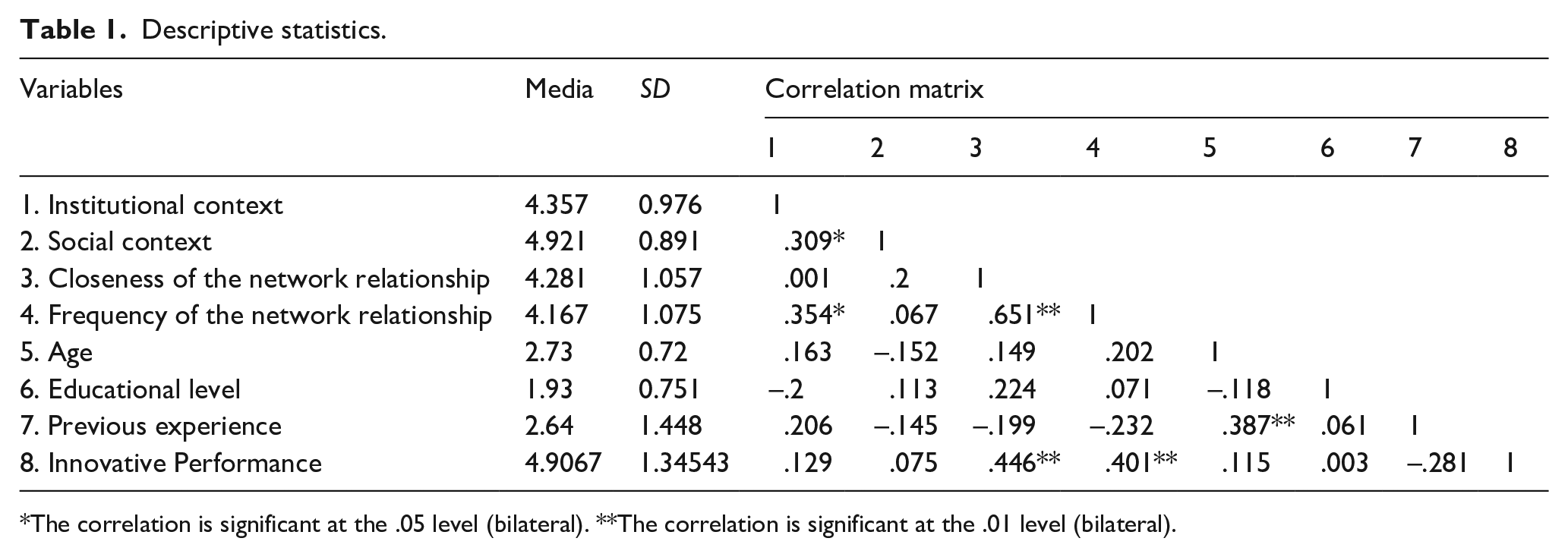
The correlation is significant at the .05 level (bilateral). **The correlation is significant at the .01 level (bilateral).
Analysis and results
The study hypotheses were tested using fsQCA, a methodology designed to bridge the gap between qualitative (case-oriented) and quantitative (variable-oriented) approaches in social science research (Berg-Schlosser et al., 2009; Kumar et al., 2022; Ragin, 2008; Woodside & Zhang, 2012). We choose this methodology to identify combinations of factors influencing the innovation performance of women-led firms, as it is especially adept at assessing both quantity and intricacy of alternative paths leading to a desired outcome (Lou et al., 2022; Ragin, 2008), in our case, innovation performance. Several studies stress the advantages of fsQCA in analyzing low sample size data and its ability to provide valuable insights in research. Trueb (2013) demonstrates the usefulness of fsQCA in integrating qualitative and quantitative data for index creation, especially in small to medium-N research in the social sciences.
Grounded in set theory, this technique employs combinatorial logic and Boolean algebra to develop causal claims through analysis of supersets and subsets (Huarng & Roig-Tierno, 2016; Lou et al., 2022; Ragin, 2008). Each case is represented as combinations of conditions, including independent variables, factors, and antecedents, which may be deemed necessary or sufficient to produce a particular outcome (dependent variable) (Ragin, 2008).
This method has become very popular in recent years, with a growing trend in its use in management research (Cheng et al., 2013; Kumar et al., 2022; Misangyi et al., 2017; Xie et al., 2016) due to its recognized potential to analyze phenomena resulting from complex causality. According to Covin et al. (2016), fsQCA enables identification of complex combinations of antecedent conditions, leading to specific outcomes that enable the researcher to overcome some of the limitations that can arise with the application of regression-based analytical techniques (Skarmeas et al., 2014). In sum, FsQCA distinguishes itself from classical statistical techniques through its use of set-theoretical connections rather than correlational ones, calibration in lieu of measurement, configurational conditions as opposed to independent variables, and a focus on causal complexity analysis rather than net effects analysis (Kumar et al., 2022; Ragin, 2008). In traditional regression and other variable-oriented methods, each independent variable is maintained at its average level across the study data to isolate its independent effect. These approaches conceal potential interactions between factors, however, that collectively influence the ultimate outcome (Kane et al., 2014). FsQCA, in contrast, enables us to overcome this limitation by identifying diverse combinations of conditions that are collectively necessary for producing a specific outcome. The ensuing section outlines the process of calibrating the data into crisp sets and fuzzy sets.
Transforming data into fuzzy sets
The fsQCA program employs fuzzy set theory to identify conditions that may be either necessary or sufficient to produce a given outcome (Ragin, 2009). Fuzzy sets are sets whose elements possess degrees of belonging, ranging from 0 (indicating non-membership) to 1 (indicating full membership) (Ragin, 2008). In the transformation of traditional variables into fuzzy membership scores, researchers use core set theoretical principles for calibration (Ragin, 2008), defining values for an interval-scale variable that correspond to three qualitative breakpoints that structure a fuzzy set (Woodside, 2013).
The first breakpoint is the threshold for full membership (fuzzy score = 0.95), the second is the threshold for full non-membership (fuzzy score = 0.05), and the third is the crossover point (fuzzy score = 0.5). Our study used a Likert-type scale from 1 to 7 to measure institutional context, social context, network closeness, and relationship frequency variables. The value 7 corresponds to full membership, 4 to the cross-over point, and 1 to full non-membership.
The demographic variables (age, educational level, and previous experience), coded as explained above, were transformed into fuzzy sets, as follows: For the age variable, composed of five categories, we established the original value of 5 for a total membership, 2.5 for the crossover point, and 1 for total non-membership. As to the variable previous experience, with categories from 1 to 7, the value of 7 corresponded to total membership, 3.5 to the crossover point, and 1 to total non-membership. For education level, represented in three categories, the value of 3.0 was established for total membership, 2 for the crossover point, and 1 for total non-membership.
After calibrating the study data, we constructed the truth table, as follows. We used the truth table function of fsQCA to produce various combinations of conditions (institutional context, social context, network closeness, and relationship frequency variables) that prove sufficient for a specific outcome—innovation performance—to manifest (Ragin, 2008). This process identifies all conceivable combinations of causal conditions, whether necessary (antecedents and independent variables) or sufficient (Ragin, 2008), for the occurrence of the outcome (dependent variable). The truth table scrutinizes the causal conditions contributing to the outcome in each case (Ragin, 2008). Initially, the truth table comprises two k rows, where “k” denotes the number of causal conditions (Ragin, 2009). After generating the initial truth table, we selected relevant combinations by applying a consistency threshold of 0.80 and eliminating irrelevant cases (Schneider & Wagemann, 2012). FsQCA offers six potential solutions. The first, or complex solution, employs exclusively logical remainders consistent with the theoretical framework and omits any irrelevant factors.
Representation of the results
The Quine–McCluskey algorithm implemented in the standard analysis procedure in the fs/QCA software package gave a complex solution, a parsimonious solution, and an intermediate solution for each analysis. The intermediate solution was chosen, according to Schneider and Wagemann (2010), who argue that intermediate solutions are superior to complex and parsimonious solutions because they do not allow the necessary conditions to be eliminated. Table 2 presents the fsQCA results for innovation performance. Following Ragin (2008) and Fiss (2007), we use simple notations in which a black circle denotes the presence of a condition and a white circle the absence or negation of a condition. Blanks in a solution indicate unimportant conditions, that is, a situation in which a condition has little effect on the dependent variable.
Configurations to achieve innovation performance.
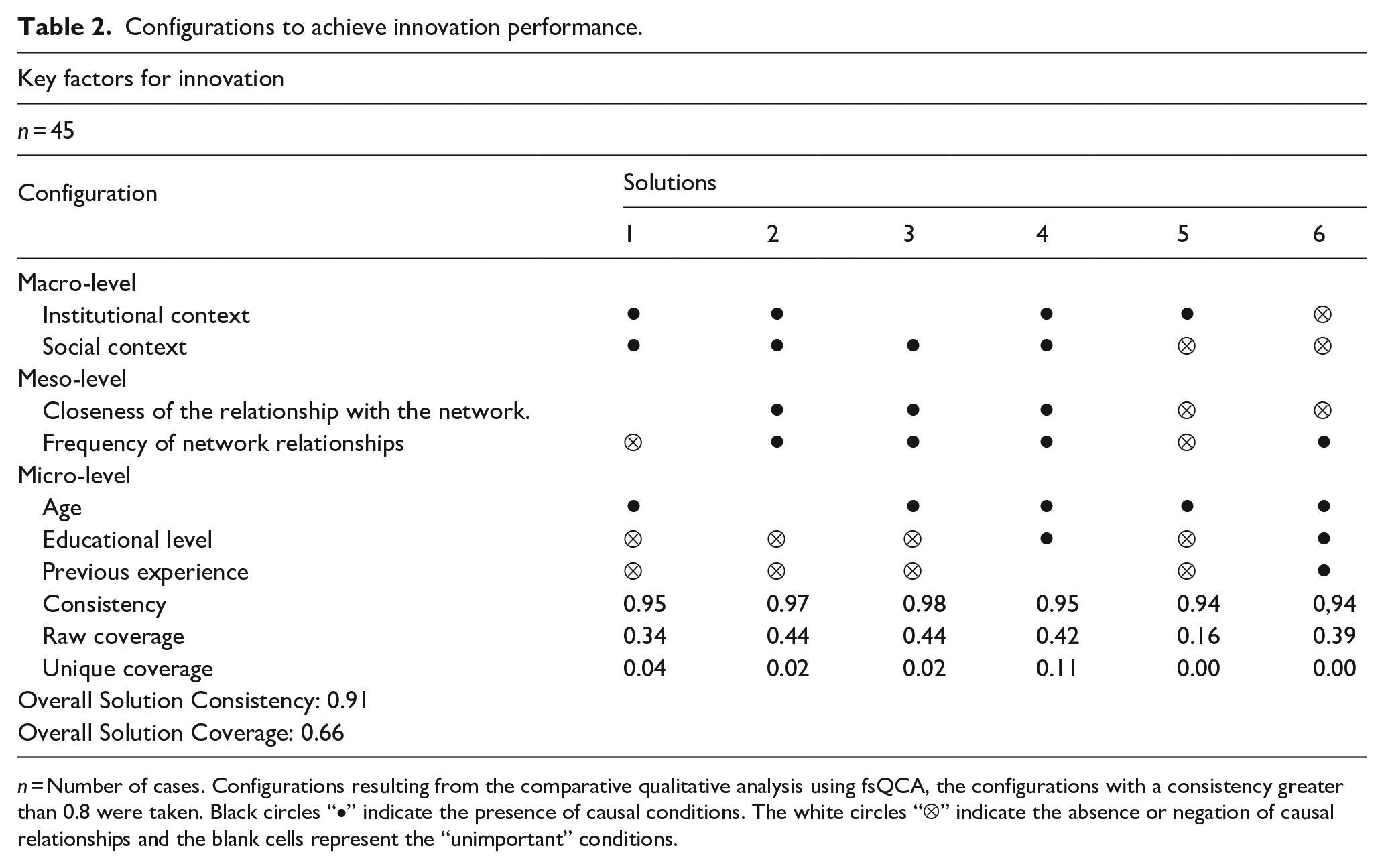
n = Number of cases. Configurations resulting from the comparative qualitative analysis using fsQCA, the configurations with a consistency greater than 0.8 were taken. Black circles “•” indicate the presence of causal conditions. The white circles “⊗” indicate the absence or negation of causal relationships and the blank cells represent the “unimportant” conditions.
Our analysis yielded six combinations for achieving innovation performance in companies created by women. Table 2 summarizes our six solutions. Consistent with previous fsQCA studies, these solutions can be interpreted as alternative “instructions” or pathways associated with the outcome. Indices were used to capture the strength of these independent variables (institutional context, social context, network proximity, and network relationships) and were contrasted with variables on the entrepreneur’s personal characteristics (age, previous experience, and education level) and on the dependent variable (innovation performance).
The consistency index (consistency) describes the extent to which the cases support sufficient conditions for the outcome and acts as a measure of significance in multivariate techniques. Raw coverage assesses how much of the outcome is explained by each configuration (Woodside, 2013). Unique coverage measures specifically the proportion of memberships in the results that are explained only by a single configuration (Ragin, 2008). Table 2 shows all consistency values exceeding 0.75, which is the minimum accepted value, indicating that these configurations are sufficient conditions conducive to innovation. The overall solution coverage values are above 80%, indicating that these configurations explain a large part of the result. For women-led firms, we found six solutions (Solutions 1 to 6, Table 2) present in 66% of all firms in the sample:
Solution 1 requires a combination of institutional context, social context, age, and the absence of frequency of relationships with the network, education level, and previous experience (institutional context * social context * ~ frequency of relationships * age * ~ educational level * ~ previous experience). The closeness of relationships with the network represents the so-called “not important” condition, a condition whose presence or absence does not affect the outcome.
Solution 2 requires the combination of institutional context, social context, network closeness, network relationship frequency, and absence of education level and previous experience (institutional context * social context * closeness * frequency * ~ educational level * ~ previous experience); for this solution, age is not important.
Solution 3 requires a combination of social context, network relationship closeness, network relationship frequency and age, and absence of education level and previous experience (social context * network closeness * relationship frequency * age * ~ educational level * ~ previous experience), with a coverage level of 44%, for this solution. Institutional context is a “not important” condition for the outcome.
Solution 4, the presence of social context, institutional context, network proximity, frequency of relationship with the network, age, and education level (institutional context * social context * network proximity * relationship frequency * age * educational level) are required, leaving aside previous experience as a condition that does not affect or benefit the outcome. Solution 4 is the closest to the research model, with a consistency level of 95% and a coverage level of 42%.
Solution 5 requires the presence of institutional context and age as a condition and the absence of social context, network proximity, frequency of relationships with the network and educational level (institutional context * ~social context * ~ network proximity * ~ relationship frequency * age * ~ educational level * ~previous experience). Solution 5 thus requires at least a good institutional context and women entrepreneurs’ characteristics such as the age needed to achieve innovation.
Solution 6, on the contrary, requires the presence of network relationship frequency, age, educational level, and previous experience, and the absence of institutional context, social context, relationship closeness (~institutional context * ~ social context * ~ network closeness * relationship frequency * age * educational level * previous experience). In this combination, all model variables are again present, but the context factors are absent conditions except frequency of the relationship to the network, and demographic characteristics are noted, such as age, education level, and previous experience of women entrepreneurs innovating in companies.
Solutions 1 and 5 thus generate value by highlighting the significance of the institutional and social context in women-led companies (macro-level) while diminishing the impact of demographic characteristics, except for age (micro-level). Solution 2 amplifies the value of both macro-level (institutional and social context) and meso-level (closeness and frequency of relationships). Solution 6, in contrast, emphasizes the importance of demographic characteristics (micro-level) as well as frequency of network relationships (meso-level). Finally, Solutions 3 and 4 include factors at the macro-, meso-, and micro-levels. Contrary to the proposed assumption, the results suggest that the data obtained do not provide sufficient evidence to validate Hypothesis 1. This is so because institutional context and social context are present in four out of the six solutions (1, 2, 4, 5, and 1, 2, 3, 4, respectively). These data reveal that the institutional and social contexts are not necessarily detrimental to the innovation performance of women-owned firms in countries that suffer from adverse conditions for women, such as Ecuador. Next, we support Hypothesis 2, as frequency and closeness of the relationship within the network were confirmed as important factors achieving innovative performance among Ecuadorian women entrepreneurs. This result is evident in the solutions observed (2, 3, 4, 6, and 2, 3, 4, respectively). Finally, our results (see Table 2) indicate that Hypothesis 3 is partially confirmed. While age is a factor in five out of the six solutions identified (1, 3, 4, 5, 6), education level and prior experience are only present in Solutions 4 and 6, respectively. The significant influence of personal characteristics on innovation performance thus lies in the age of the female entrepreneur in this context.
Discussion and conclusion
Women entrepreneurs in Ecuador face significant challenges when it comes to innovation performance. Despite their higher rates of entrepreneurship compared with men, their levels of innovation remain disproportionately lower. This study explores multilevel factors, ranging from institutional and social context to networking dynamics and demographic characteristics that influence innovation performance. By delving into these multifaceted elements, we sought a profound understanding of the conditions that empower women entrepreneurs to innovate, even in the face of substantial obstacles. It is essential to note that gender inequality is prevalent in Ecuador, and women face numerous barriers in different areas. The workplace, education, politics, and health care are some fields where women have limited opportunities due to various factors. Gender-based violence is also a significant concern and further compounds the challenges faced by women in the country. Despite these obstacles, many women in Ecuador start their businesses, often at higher rates than men and women entrepreneurs in other countries (Elam et al., 2019). This trend is due to women’s pressing need to support themselves and their families. Our study offers insights into how women entrepreneurs can overcome these challenges and innovate in a country where gender inequality is widespread.
Against this specific background, our study generates interesting findings. First, our research shows that institutional context for women entrepreneurs can lead to increased innovation performance. While previous research (Autio et al., 2014; Boschma & Capone, 2015) highlighted institutional context as a constraining element for innovation in developing countries, our findings introduce a nuanced perspective. Contrary to prior expectations, our study indicates that the institutional context of Ecuador can be a catalyst for innovation performance among women entrepreneurs. One reason for this positive influence is that the regulatory constraints in several developing economy countries may force many to adopt more open approaches to innovation, due to their limited resources and sensitivity to institutional regulatory pressures (Lichtenthaler, 2008). In this regard, Aidis (2016) noted that, in such a competitive environment as Latin America, women entrepreneurs should seek to create innovative products and services to make a living. Furthermore, this research underlines the importance of women entrepreneurs’ participation in business support programs to boost their businesses and innovation strategies. By providing them with better training opportunities and access to resources, women entrepreneurs can overcome institutional restrictions effectively. Based on our research, it is evident that the institutional context alone is not sufficient to enhance the innovative performance of women-owned businesses. It is also necessary to consider other crucial factors such as the social context and age of women entrepreneurs (at macro- and micro-levels); frequency and closeness of social networks (macro- and meso-levels), and the combination of all these factors (at macro-, meso-, and micro-levels) to improve the innovation performance of their firms.
Second, the research findings reveal that social context can be a positive factor in women entrepreneurs’ innovative performance. In social contexts where women are compelled to start entrepreneurial activities to contribute to family and child support and have a strong connection with the family (as is the case in Ecuador), instrumental support from family members and partners could serve as an incentive to improve their innovation outcomes. The work of Welsh et al. (2018) confirms that female entrepreneurs in less developed countries, such as Morocco, benefit more from the economic support of family members than from emotional support, and that this benefit helps them to enhance their business results. This finding could explain how social and family support in entrepreneurial activities in Ecuador not only enhances their businesses but also facilitates innovation. These results can also be analyzed in terms of the women CEOs’ family role, which led them to create innovative products or services as a solution to their daily life problems and needs (Chávez-Rivera et al., 2021). Social context alone is not a sufficient condition for innovation performance to be achieved. Such achievement requires the support of strengthened contact networks and institutional context (macro- and meso-levels), as well as specific personal characteristics of the women entrepreneur, such as age and educational level (macro-, meso-, and micro-level).
Third, our finding shows that closeness and frequency of the contact networks are a causal factor of innovation performance. This result is consistent with existing literature arguing that strong ties with network members trigger a constant exchange of ideas potentially reflected in innovations (Fernández-Mesa et al., 2012). Furthermore, Xie et al. (2016) indicate that the strong bond created by closeness of network members aids in knowledge exchange, which has a positive influence on development of creativity and, consequently, innovation performance. For women entrepreneurs, closeness of network members is often invisible as a form of support and goes beyond the advice and information that serve to innovate by also complementing each support network (Aidis, 2016). According to Madison et al. (2022), women are recognized for using their social competences more effectively, which enables them adeptly to acquire a wide range of information from their external context. This information can help them design products and services that meet market expectations and improve their innovative performance. The CEO of a new company who feels close to the members of the network will feel a higher level of confidence, which will enable her to risk increasingly disruptive innovation processes. Our results are thus consistent with the literature presented above, which observes that companies with a strong network of contacts are in a better position to access new ideas and better identify opportunities for development and innovation (Anwar & Ali Shah, 2020; Kijkuit & van den Ende, 2007).
Furthermore, our results show that, although the closeness and frequency of networking are important conditions for achieving innovation performance, they require at least one favorable institutional context to encourage formal contact networks and a social context that lends legitimacy to networking (macro- and meso-levels). All these findings involve demographic issues, such as CEO’s age, education level, and previous experience (meso- and micro-levels), which enable her to adapt to business environments that foster innovation performance.
Finally, the woman entrepreneur’s age is a condition to improve innovative performance. Several authors assert an inverse relationship between age and innovation capacity (Priede-Bergamini et al., 2019). Other studies, such as Idris (2008), in contrast, argue that women over 40 are more inclined to innovation. Age on its own does not, however, stand as a decisive factor for innovation performance. Its impact becomes notable only in the presence of a supportive institutional and social context (at macro- and micro-levels), particularly when coupled with close and frequent networking (across macro-, meso-, and micro-levels). Age further comes into play when operating synergistically with other individual attributes, such as education background and previous experience, and when paired with regular networking efforts (meso- and micro-levels).
Interestingly, the influence of education and prior experience on innovation performance is relatively modest. This finding does not align with the idea that human capital plays a crucial role in identifying and nurturing new and innovative firms (Colombo & Grilli, 2005; Unger et al., 2011).
Theoretical and practical contributions
Our research contributes to the intersection of literature on gender, innovation, and entrepreneurship in several ways. First, in response to the call by Brush et al. (2022) to advance gender and innovation research through a multilevel approach, we establish conceptual and empirical connections that explain the effects of institutional context, social context (macro-level), networking (meso-level), and demographic characteristics of women entrepreneurs (micro-level) on innovation performance. Our findings confirm that the innovative performance of new companies founded by women in Ecuador is influenced by the interconnection of policies, social support, resources, and networks with family and close contacts that women leverage at a specific age. More than education or prior experience, the knowledge acquired through age is an invaluable multifaceted asset that shapes women entrepreneurs’ understanding of the world and ability to navigate life’s challenges. The age of the entrepreneur has been associated with a greater trend toward innovation, and we observe that the older the person, the greater the amount of knowledge and previous experience they possess (Kautonen et al., 2014; Parker, 2009; Priede-Bergamini et al., 2019).
Second, we contribute to the entrepreneurship literature by building on recent works (Peake & Eddleston, 2021; Strawser et al., 2021) to deepen knowledge of women entrepreneurs’ innovation performance. Despite the heightened interest in women entrepreneurs in the entrepreneurship literature (Bauweraerts et al., 2022; Bullough et al., 2022; Zastempowski & Cyfert, 2021), most studies lack specific focus on the innovative aspects of women entrepreneurs (Alsos et al., 2016; Anwar & Ali Shah, 2020; Brush et al., 2022). Our study offers a distinctive approach in concentrating on the innovation performance of SMEs created by women in Ecuador, thus providing valuable insights into women’s entrepreneurship in developing economies. Our study reveals a relatively unexplored reality that elucidates the dynamics of Ecuador’s market. In this context, incremental innovation emerges as a viable strategy for differentiation amid intense competition, especially in businesses characterized by low entry barriers—a category that constitutes the majority of Ecuadorian enterprises. Our study contributes to understanding the phenomenon of innovation in women entrepreneurs. As we continue to explore the multifaceted aspects of women’s innovation, we gain valuable insights into how diversity and inclusion can drive progress and shape the future of industries worldwide.
Our study also helps to understand the phenomenon of innovation in companies managed by women. Much of the research on innovation has focused on identifying high-tech breakthroughs by men in some generally masculinized industries (Foss & Henry, 2016; McAdam, 2013), leaving aside women’s important contributions to innovation, especially in terms of processes, distribution channels, and marketing, where companies led by women are noted for their CEOs’ great sensitivity to understanding market needs, because they have a much fresher and more empathetic vision. As to our study’s empirical contributions, very few studies link the context of women’s entrepreneurship to innovation or use fsQCA as an appropriate research approach to studying the configurations of both social and institutional context (Zahra & Wright, 2011), as well as the CEO’s personal characteristics (age, educational level, previous experience) (Arenius & Minniti, 2005; Hambrick, 2007; Priede-Bergamini et al., 2019) and influence on the innovative performance of new ventures.
Third, our research contributes to institutional theory by shedding light on how formal and informal institutions interact with the individual level (Cordero & Pulido, 2020; Urbano et al., 2019). In Ecuador, institutions shape entrepreneurship, and women entrepreneurs simultaneously navigate the context constraints, playing an essential role in the country’s economic sustainability. Institutional theory provides a valuable framework for analyzing firm creation in the context of rules and norms that can either positively or negatively influence its development (Díaz et al., 2005). The intersection between upper echelons entrepreneurial theory and institutional theory provides a unique opportunity to understand how women entrepreneurs’ demographic characteristics, in conjunction with the broader institutional and social context, collaboratively shape the innovation dynamics in new firms. This integrated perspective enhances our comprehension of the intricate relationship between individual characteristics and institutional influences in the innovative performance of women-led enterprises in challenging contexts. This study demonstrates that government policies and social support for women entrepreneurs influence the quality of entrepreneurship. They do not, however, fully leverage women’s human capital to narrow the innovation gap compared with male entrepreneurship.
Finally, we conclude this study by emphasizing the practical implication of our research, which supports the configuration of public and private policies committed to strengthening the institutional context by creating support programs, training, and grants for seed capital. More specifically, such policies will guide young women toward careers in science and technology to make innovation no longer basic but increasingly specialized, gradually moving women’s business away from the traditional sectors in which they have been pigeonholed. We also hope that our research will contribute to recognizing the importance of social context as a source of support for women entrepreneurs and promoting the establishment of formal contact networks with global exchange of information and knowledge to facilitate more disruptive innovation processes.
Limitations and future research
Our study is subject to several limitations that require future research. The first limitation involves the analytical approach of fsQCA in identifying combinations of conditions that are logically sufficient for an outcome, leaving room for alternative paths not captured by our solutions. The second limitation relates to the sample component, as our research covered research on women entrepreneurs who were members of a formal network that offered them training. Although we only had 45 cases, analysis of nonresponse bias showed us that the number was sufficient. We believe, however, that we could with more resources extend this study to a sample of women who are not part of formal networks to compare their different perspectives.
Third, as the literature review revealed a gap in the research on gender and innovation in Latin America, future research could analyze a broader context with a sample of Central and South American countries. Finally, we believe it is important for future studies to include more contextual variables to measure the impact of spatial and business context on innovation.
Footnotes
Declaration of conflicting interests
The author(s) declared no potential conflicts of interest with respect to the research, authorship, and/or publication of this article.
Funding
The author(s) disclosed receipt of the following financial support for the research, authorship, and/or publication of this article: The authors acknowledge the financial support from the COMPSOS Project (PID2020-117313RB-I00) funded by MCIN/AEI/ 10.13039/501100011033; the SOSTEMPRE Project (B-SEJ-682-UGR20) funded by Consejería de Universidad, Investigación e Innovación (Junta de Andalucía) Programa Operativo FEDER Andalucía 2014-2020, and the research support program from the Faculty of Economics and Business Administration, University of Granada (Spain).