




Abstract
Circular entrepreneurship is becoming a new, promising reality, in the manner of needed radical paradigmatic change in the era of Anthropocene. Circular entrepreneurs intend to create social and environmental value while they build financially viable businesses. They are embedded in multiple institutionalised value systems that they are expected to adhere to. Those institutionalised systems provide circular entrepreneurs with different, in many cases, contradictory norms, values and guiding principles. Substantial amount of research has been done to date to examine the impact of institutions on entrepreneurial endeavours. And yet, research lacks sufficient insights into how circular entrepreneurs engage with the institutional structures in designing business models on a financially feasible ground while creating social and environmental value. To address this, this paper investigates how circular entrepreneurs respond to the value systems of surrounding institutions in business modelling and how two fundamental aspects of embeddedness, namely resource integration and value cocreation, are achieved within a circular business model that is coherent in itself and with the entrepreneur's ambitions. Both the institutional context and the institutional logics surrounding entrepreneurs are examined to comprehend the surrounding institutional systems more in-depth and extensively. By analysing a longitudinal in-depth case study, this article aims to develop better insights into circular business modelling and underlying mechanisms of embeddedness. The case is a born-circular small cidermaker in Cornwall (UK), namely Wasted Apple. The findings show that the circular entrepreneur is surrounded by dominant normative institutions forming the principles of business model design. circular entrepreneurs mark fidelity to the institutional norms to obtain a range of microcompetencies and to manage integrated hybrid tensions within the value creation system. And therefore, a circular business model is a more holistic and inclusive structure as compared to a typical conventional linear business model. And yet, paradoxically embeddedness facilitates business survival but hinders strategic business planning as well as business profitability and growth.
Introduction
Entrepreneurship has been in the spotlight as a solution to ecological and social problems (Gregori et al., 2019; Urban 2019). How entrepreneurs create value beyond economic profit still remains an area needs to be explored in-depth (Gregori et al., 2019). Circular entrepreneurship literature asserts that multiple value creation could be achieved through business model (BM) innovation (Cullen and De Angelis, 2021). The innovative BM design is dynamic in its nature with the ability of value cocreation in different institutional settings. And therefore, circular business models (CBMs) correspond to the quest for innovativeness in business modelling. In relation to this, research on how circular entrepreneurs (CENs) develop their ventures, and respectively their BMs, that is coherent in itself and with the entrepreneur's aspirations, (e.g. Gregori et al., 2019; Teece, 2010; Vaskelainen and Münzel, 2018; Zott et al., 2011), how CENs design BMs to manage hybrid tensions (Cherrier et al., 2018; George and Bock, 2011; Stubbs, 2017) and to cocreate value with stakeholders (Edvardsson et al., 2014) is still in its infancy and further inquiries are needed. In this vein, circular economy (CE) research has started acknowledging the embeddedness of CENs within multiple institutional logics (Gregori et al., 2019). And therefore, this study further adopts the perspectives of BM design, institutional theory and institutional logics to answer the research questions of ‘How does the CEN engage with the surrounding institutions in business model design for multiple value cocreation on a financially feasible foundation?’. In the effort to answer the question in an elaborative way, a case study of Wasted Apple (WA) is drawn upon. WA is a Cornish start-up producing apple juice and apple cider from local apples that would be otherwise wasted. Todeschini et al. (2017) argue that born sustainable start-ups have received limited attention in the literature so far. The case study is a pertinent example of a born circular start-up, which provides the opportunity to fill this relevant research gap.
The remaining parts of this article are structured as it follows. The literature review begins with reviewing the institutional theory, institutions and institutional logics. Then the principles underlying CE thinking, circular BMs and circular entrepreneurship are highlighted. Next, methodology is explained. Subsequently, an argument is developed around the research question based on the findings.
The institutional theory and institutions
Institutional theory explains how entrepreneurial behaviour is compliant, repetitive, and socially defined and why, within an industry sector, entrepreneurs present similar behavioural patterns and responses to outside stimuli (DiMaggio and Powell, 1983; Meyer and Rowan, 1977; Ahlstrom and Bruton, 2002; Aldrich and Fiol, 2007). Entrepreneurial activities are both facilitated and hindered by the institutions in the environment that they are embedded within (Bruton and Ahlstrom, 2003; Scott, 2007; Visser, 2018). From the business modelling perspective, institutions enable or constraint resource acquisition and resultantly value creation especially in service systems (Vargo and Lusch, 2011). In a service system, property rights are not transferred to the customer entirely, but they are either retained with the entrepreneur or distributed between the customer and the entrepreneur (Hockerts and Weaver, 2002). A service system is a step in the transformation from a linear to a circular BM (Aboulamer, 2018: 766). The system requires a much longer interaction between entrepreneurs and customers (Frenken, 2017), and therefore, it facilitates creating value collaboratively for improving the consumer life value. In a CBM, as a service system, that is configurations of actors, resources, and technology designed to enable creating value cocreation (Spohrer et al., 2007).
In designing CBMs, institutions become prerequisites for value cocreation (Edvardsson et al., 2014: 293). Institutions are characterised as the humanly devised constraints (North, 1990: 3) that shape human interaction and govern interpersonal relations (North, 1990: 70) through regulative or normative constraints (Bruton et al., 2010). Together they define the incentive structure of societies and specifically economies (North, 1990: 88) and reduce the uncertainty of human interaction and, thus, the costs of collaboration (Furubotn and Richter, 2008: 17). This effect occurs, as institutions provide mutual expectations regarding the behaviour of the actors involved in social interactions and determine the objectives of actors but also the ways in which they should be achieved (Edvardsson et al., 2014: 296). Actors perceive an internal commitment toward norms, values and social expectations to behave in a specific way (Stephan et al., 2015). This study adopts the institutions perspective to discuss the cost of embeddedness for CENs in the wider economy ecosystem.
The institutional logics perspective
A core premise of the institutional logics perspective is that the interests, identities, values, and assumptions of individuals and organizations are embedded within prevailing institutional logics (Thornton et al., 2012; Friedl and Alford, 1991: 248). Societies are formed by multiple core institutional logics each has its own values, beliefs, norms and guiding principles (DiMaggio, 1988; DiMaggio and Powell, 1983). Thornton et al. (2012) identifies six institutional logics, namely the market, the corporation, the professions, the state, the family and religions. The multiplex and interconnected structure of the institutional logics can potentially lead to contradictions and tensions for entrepreneurs embedded in multiple institutional logics (Gregori et al., 2019: 3). Kantola and Järvinen (2012: 270) state that the concept of institutional logics helps to explain connections that create a sense of common purpose and unity within an entrepreneurial field. The institutional logics perspective helps us to understand the way in which a CEN engages with different dominant institutional logics in business modelling (Vaskelainen and Münzel, 2018: 274). In consequence, the institutional logic perspective explains how the roles, activities and interactions of actors are shaped throughout the value cocreation processes within a circular business context (Brehmer et al., 2018).
CE, CBM and circular entrepreneurship
The CE manages stocks of manufactured assets, such as infrastructure, buildings, vehicles, equipment and consumer goods, to maintain their value and utility as high as possible for as long as possible; and stocks of resources at their highest purity and value (Stahel, 2019: 6). Three are the main principles through which CE thinking can be synthesised: preserve and enhance natural capital, optimise resource yields and foster system effectiveness (EMF, McKinsey and SUN, 2015). These principles rule the ‘biological’ and ‘technical’ cycles within which materials and products flow in a CE (Pels and Kidd, 2015) to increase the costumer life value (Aboulamer, 2018: 768).
A BM can be defined as the rationale of how an organization creates, delivers and captures value (Osterwalder and Pigneur, 2010: 14) that introduces the sum of the decisions and activities performed by the entrepreneur and the stakeholders (Masaro, 2016). A BM has the core elements of value proposition (what value is offered and to whom), value creation (how value is created), value exchange/delivery (how value is exchanged/delivered) and value capture (how value is captured) in a coherent whole (Richardson, 2008). BM innovation is promoted as a key to shifting toward a CE as linear BMs are cradle-to-grave and resources invariably end up as waste (Geissdoerfer et al., 2018; Nussholz, 2017; Oghazi and Mostaghel, 2018). CE thinking and its inherent value proposition to firms emphasise business opportunities (Pollard et al., 2016) to be seized by new BMs or the transformation of existing ones is required (Pieroni et al., 2019; Ranta et al., 2018). Therefore, the study of the BM is crucial to understand how value can be created and captured in a CE and to build a convincing business case (Ranta et al., 2018). Schaltegger et al. (2016: 267) propose that ‘a business model for sustainability helps describing, analysing, managing, and communicating (i) a company's sustainable value proposition to its customers, and all other stakeholders, (ii) how it creates and delivers this value, (iii) and how it captures economic value (Zucchella and Urban, 2019) while maintaining or regenerating natural, social, and economic capital beyond its organizational boundaries’.
A CBM is a business model in which the conceptual logic for value creation is based on utilizing economic value retained in products after use in the production of new offerings (Linder and Williander, 2017: 183). A CBM is cradle-to-cradle and has the same goals as sustainable and closed-loop BMs (Morioka et al., 2017; Oghazi and Mostaghel, 2018: 3). Encouraged by the need to unify and integrate different approaches in order to facilitate understanding of practical implementation of CBMs, Lüdeke-Freund et al. (2019) propose six CBM patterns which have the potential to support closed-loop materials strategies. Particularly, these are: repair and maintenance; reuse and redistribution; refurbishment and remanufacturing; recycling; cascading and repurposing, and organic feedstock BM patterns. The first four patterns pertain to the ‘technical cycle’ as they support resource longevity and productivity via materials recovery strategies like reusing, repairing, maintenance, refurbishing, remanufacturing and recycling. Cascading and repurposing, and organic feedstock BMs patterns refer to the ‘biological cycle’ and they focus on retaining the value of biological materials (Lüdeke-Freund et al., 2019). For this to happen it is necessary to recover the biological nutrients contained in used products and waste. Once their embedded value is fully recovered and hence cascading is no longer economically and technically viable, biological nutrients are suitable for biomass conversion, that is, they are used for energy or soil restoration purposes via anaerobic digestion and composting (Lüdeke-Freund et al., 2019). In a circular BM, firms can design their products for longer life, and given their resources, they can service customers better than any other intermediary, hence guaranteeing a higher level of interaction with customers and eventually retaining them for a longer time period (Aboulamer, 2018).
WA is an example of organic feedstock BM pattern whose circular ethos is grounded on diverting perfectly good apples from disposal. Using locally grown apples from orchard owners who are unable to pick or use all of their crop, WA offers locally crafted, 100% natural apple juice and dry apple cider.
A CEN is defined as an agent who promotes change and exploits opportunities, with the purpose to do business according to the principles of the CE concept (Pascucci and Daalderop, 2016: 10). Currently, the institutions in society are aligned with the linear economy. CENs engage in opportunities that the CE concept poses, destroy the current linear system and build the CE system through BM innovation. They aim to create social and environmental value in the new CE ecosystem (EMF, 2020). Therefore, sustainable, social and institutional entrepreneurs are CENs when they pursue their efforts according to the principles of the CE (Lüdeke-Freund et al., 2017). Pascucci and Daalderop (2016) argue that CENs are always sustainable and institutional entrepreneurs whilst they are sometimes social entrepreneurs. And yet, social and sustainable entrepreneurs are not CENs when they are aligned with the principles of the linear economy.
Methodology
This study rests upon a qualitative, in-depth case study analysis to fully explore the phenomenon (Stake, 1995; Yin, 2014). In this vein, a longitudinal single case study design is employed which allows for a detailed investigation into the matter at hand and embracing the contextual conditions (Yin, 2013). Single case studies have been successfully used in CBMs literature (e.g. Bundgaard and Huulgaard, 2019; Ünal et al., 2019) and for studying institutional logics (Cherrier et al., 2018; Dalpiaz et al., 2016; Gregori et al., 2019). The case study methodology was chosen because of the contemporary nature of the phenomenon under investigation, for the exploratory characteristic of the research and to gain an in-depth, contextual understanding (Yin, 2014). WA was chosen because it was a pertinent example to generate insights into the phenomenon of the research interest A best practice was used, exemplary case study, to maximise the results obtainable from the research.
Data collection relied on primary and secondary data. Primary data were collected through semi-structured interviews with the founder of WA throughout an ongoing dialogue with him over a period of eighteen months. Additionally, informal talks with various stakeholders of WA were performed. The main informant was chosen to maximise both the richness of the data and so the chances that the interview questions could have been addressed (Creswell, 2012), and saturation. Data collection followed recommendations from case study research (Yin, 2013) and included semi-structured and open interviews with the founder as well as institutions and people close to the business, that is, a venture capital company, an EU Funded circular business support scheme in Cornwall, apple orchard owners. Additionally, archival data such as business plans, newspaper articles, website information, and other online media, that is, a documentary, WA promotional videos on You Tube were parts of the data stock. An overview of the data sources is provided in Table 1.
Data sources.
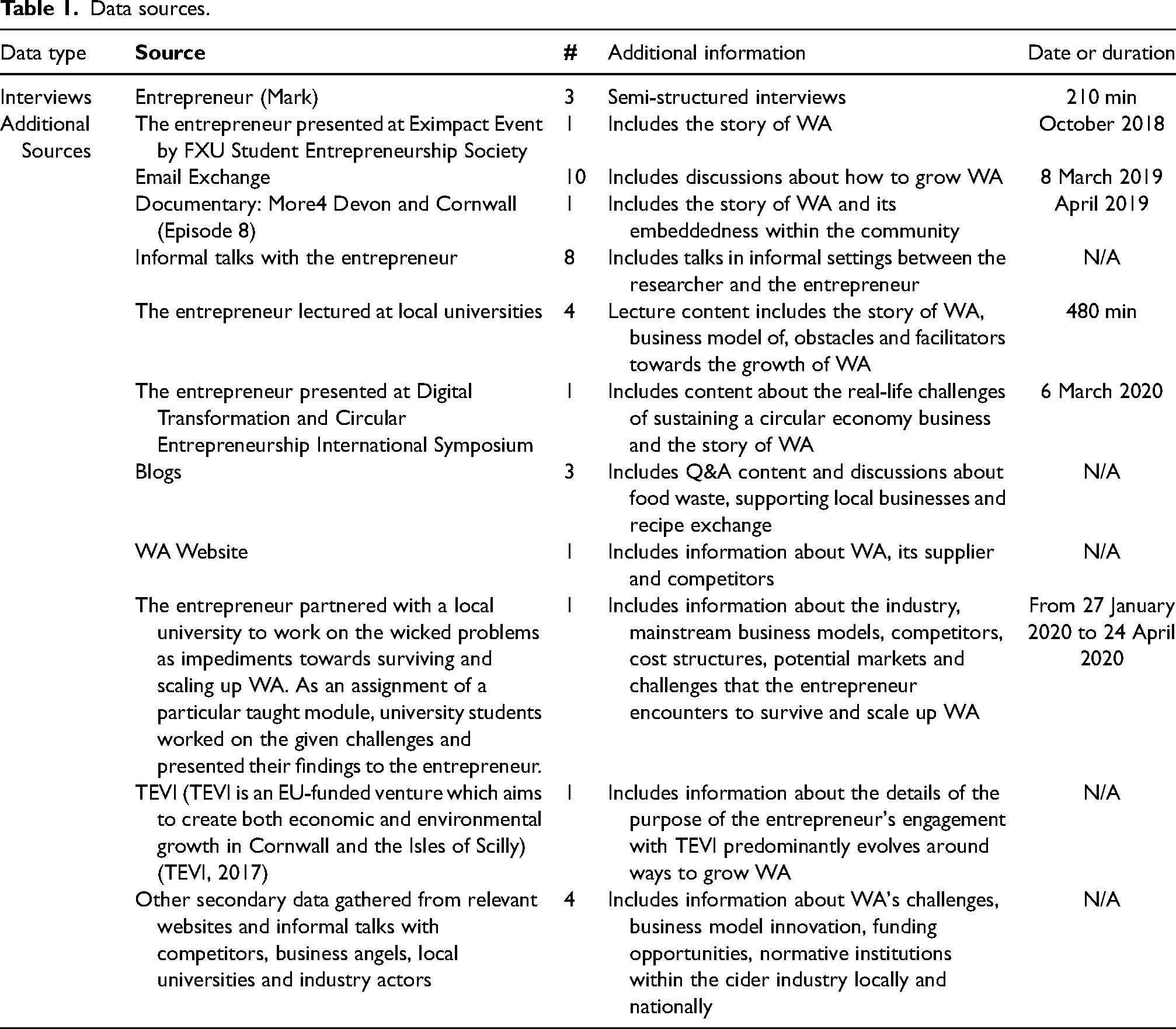
The interviews were undertaken in between April 2019 and May 2020, they lasted 210 min. The data collection process was executed in accordance with the interview protocol and the research ethics principles of the academic authority. The interviews were conducted face-to-face and online. The questions were derived from the CE, BMs and institutional theory literature, particularly they encompassed: (a) business modelling process, (b) value proposition, creation, delivery and capture (c) engagement with the institutional context and logics. The interviews were digitally recorded and transcribed verbatim with the use of a software and the content checked through for accuracy firstly by the author and then by an external academic. To mitigate the risk of biased interviews and reporting, primary data were complemented by the use of secondary data as explained in Table 1. The triangulation of different data sources followed the steps suggested by Tellis (1997). Accordingly, the author first analysed independently the transcribed interviews and secondary data to check for inconsistency and areas requiring further refining or explanation. Then the same data set was reviewed by another researcher and then the analysis was confronted with each other to give consistency to the interpretation of the phenomenon under investigation. The accepted data were once more triangulated. The collected data were analysed qualitatively using narrative analysis (Langley, 1999) and thereby avoiding data fragmentation in order to preserve the integrity of the data.
Findings
A circular-born Cornish cider business: wasted apple
WA was established in Cornwall in 2015 by Mark to stop a waste. Small independent cidermakers (SICM hereafter) seen as community businesses and their strong ties with the community is a fundamental characteristic of the brand identity. Similarly, Mark was promoting the WA brand as “truly Cornish” that had the Product of Cornwall Certificate granted by the county council. Mark was using the traditional manual cidermaking methods which was a slow and labour-intensive process. WA was a member of the small independent cidermakers association (SICA).
The institutional context of the small independent cidermakers industry
Small cidermakers like WA, with the production volume that is less than 7000 L or 12,000 pints a year, contribute to more than 70% of UK cider production (Cideruk, 2021). The UK is the largest worldwide producer and consumer of cider with 39% global market share (Cideruk, 2021). Apple cider is the most popular product (Carling, 2021). About 45% of all the apples grown in the UK are used for cidermaking (Real Cider, 2021).
SICA is a powerful normative institution for SICM in the UK. SICA's county-based donor scheme aims to regulate the competition among SICA members and to support the survival of individual micro and small cidermakers. Additionally, SICA offers a National Quality Mark for cider to guarantee consumers that the cider is made with a minimum of 90% fermented fresh juice in the finished cider whilst the legal requirement for juice in cider today is only 35%. SICA offers the Sustainability Award and the Quality Mark Award to promote the distinctive qualities of their cider to bring SICM a competitive advantage in the wider cider market.
The vast majority of SICM were offering similar value propositions. The founder of Kniveton Cider, Kev, explained their distinctive product qualities in a nutshell: We believe that cider should be made from fresh juice, not from concentrate. We are the first association of cidermakers [SICA] to offer a National Quality Mark of there being at least 90 percent fresh apple juice in ciders. This translates into the highest quality drinks with a fascinating range and depth of flavours. (Interview excerpt) We don’t spray our apples as we don’t want nasties going into our cider. Ugly fruit and small bruises are not a problem. Anything you think is good enough to eat, is good enough for cider. (Interview excerpt)
BM design
Value proposition
Being entrepreneurial in the value proposition means to be innovative in terms of the offer to the customers but also to redefine existing customers/markets or identify new customers/markets (Andersén et al., 2014). WA was offering a 100% natural, dry apple cider, locally crafted using locally grown apples that would have otherwise ended up as waste. The main target customers were traditional cider drinkers but also younger drinkers, who particularly enjoyed the fruity cider syrups that the company was producing and that could have been mixed up into the cider to obtain a much sweeter drink.
I have taken something that would have just gone into the ground and rot and I’ve turned it into a product that people are actually really enjoying (…). I guess the main thing that I think I’m offering is something which is truly Cornish. It's truly a craft. And it is as natural as you can possibly get (…). I produce a product where I could take you certainly to the orchard if not the tree that the apples came from there in that bottle. Now for me that's a really powerful proposition if you want to support your local economy and you want to know where your food comes from (…). (Interview excerpt)
Mark encapsulated the value proposition to the supplier ecosystem.
Apple picking and cider making has long been a community activity. (…) a lot of people still get involved in providing, picking, pressing and of course drinking the end product (…) As well as the satisfaction of knowing that your donated apples are being used, we will give [apple donors]some of our cider in return for [their] support. As a rough rule of thumb, we give them 2 bottles of our bottle-conditioned Cider (dry and or medium dry) for every 25–30 kg sackful of apples they donate, up to 36 bottles. They will also be given our discount card which will allow them to purchase any of our products from us at a discounted price throughout the year. (Interview excerpt)
Microspecialised competencies can be transformed into complex value propositions with market potential which was the case with WA. For example, the apple donation scheme, which was an institutional norm in the SICM context, was contributing towards reducing manufacturing costs. The SICA Quality Mark was the guarantee of the highest quality of cider that mass cidermakers could not challenge or compete against
Value creation
WA's value creation model was based on transforming a waste into a resource with the collective effort from the stakeholders. The supplier was also the customer and they integrated their resources within WA with the expectation of getting an appropriate return (Edvardsson et al., 2014; Eggertsson, 1990). Apples were coming from donors locally and local volunteers were helping with apple picking. The product was distributed locally with a narrow radius and sold directly by the company or by post Customers could also pick up the cider at the company location. The entire manufacturing process had a very low environmental impact. CO2 emissions and food miles were kept to a minimum. This was achieved by doing almost every step of the production process manually on-site. WA also was using cardboard made from 70% recycled materials to store bottles and reusable branded tote bags to sell combination packs of ciders. The bottles were not reused as Mark could not sterilise them sufficiently. Efforts were in place to moderate the demand for mechanical power and the only waste that was produced was apple pulp, which was going to composting. Nonetheless, partnership with research institutions were in place to find an alternative use for this by-product and Mark was willing to explore opportunities for further reducing the environmental footprint of WA production/products.
There are a few things that I want to get better at. One is the water that's used for the press that comes from the mains (…). What I want to do is find a way of recycling that water so that each time the press runs it's basically using the same water recirculated round rather than taking fresh water from the mains. (Interview excerpt)
Mark was working on a BM innovation through designing a new customer channel structure to reduce packaging waste which has not been experimented in the SICM context yet.
The other area that I’m looking at which I’m literally just exploring now – I’m actually getting quite a lot of growing interest in it - is whether I can supply cider in bigger containers for zero waste shops and refill shops, where you take your own container and you fill it with whatever it might be. And what I want to do is work with them to put cider in that shop so that I can actually take it from my big tanks, I can take it to their premises in a tank fill up, and then people can pour it into their own containers and then that is zero waste. (Interview excerpt)
WA supply chain was rather simple. Suppliers were amongst the customer base. For donated apples, suppliers were receiving cider and given a discount card. There was no formal contract between Mark and his suppliers. Who would collect apples or how apples or cider bottles would be delivered were determined through instant and casual communications in an effectual manner. For Mark, this “informality” was a part of the community spirit, cocreating together for a good purpose.
Firms can be entrepreneurial in the resources and capabilities they develop, which in addition to risk taking, innovativeness and proactivity requires also perseverance (Andersén et al., 2014). This was the case of the company under investigation. WA had developed a capability to create commercial, environmental and social value through entrepreneurship. These ranged from the preservation of natural capital and advantages to the local community of suppliers (e.g. preventing wasps causing problems to orchards trees), to the building of local, social capital (WA benefitted from a community of volunteers that help pick, press and produce our hand-crafted cider) and to inspiring the local community to take initiative to reduce wastefulness.
There are bee communities who really encourage the sustainability of bees and they love what I’m doing because in fact I’m preserving a habitat for bees. So, what an orchard that might have gone to ruin or actually be cut down. (Interview excerpt)
What I found is that when I’m giving people some cider or apple juice for their apples, they really start caring about their apple trees. Suddenly they’re actually: hey! I’ve got something which is really great. It is not only do I enjoy the blossom in the springtime, but I enjoy some cider later on that's made from my apples. This is fantastic. So, they then want to look after the trees, and they say: look how can I make sure they’re pruned properly, and I can take care of the grass and everything that's around them and what should I do? (Interview excerpt)
People who give me their apples are real supporters as well because they love what's happening, so they really encourage it and they ask other people and say: have you got some apples that you might want to give? If they see them going to waste. (Interview excerpt)
We do have people who really enjoy helping us with bottling and other things like that. It's just something that's completely different that they enjoy doing. I mean it's amazing to me how much people enjoy. And it's a very traditional thing of course to go into an orchard and go picking apples and to know that's been done for centuries, so to bring some of that back. (Interview excerpt)
Value capture
The value capture dimension of the BM refers to its costs and revenues streams. WA did not incur in any cost for its apples or for labourforce thanks to the participation of volunteers, family members, friends and orchard owners. The biggest costs were represented by the bottles and the bottle labels. Turning to revenues, the pricing of the product can be a highly entrepreneurial activity (Andersén et al., 2014). Entrepreneurial pricing is pricing that is market-based, risk-assumptive, proactive, and flexible (Schindehutte and Morris, 2001: 43). WA cider responded to these characteristics as the price was similar or higher to other mass manufacturers but not quite as cheap. It was a premium price reflecting the unique value proposition.
There's a little premium on buying something that is very handcrafted and it's very local. (Interview excerpt)
The institutional logics identified in WA
The Entrepreneur’ Habitus: The preconditions of Mark's circular entrepreneurial intentions had been founded in an eco-friendly and food self-sufficient local community where he lived within for a couple of years from the age of 16 years old. They were using locally sourced ingredients and travelling across the community to buy ingredients from local growers and farmers. Mark had developed a sense of ‘Where does this food come from?’ and an understanding of a food supply chain.
The Family: WA was a family business. The family logic had a real power over Mark's business decisions. Although the family members had marked fidelity to the business, the unity of family was taking the priority. Towards the end of 2019, Mark decided to close WA down due to his family's pressure to spend more time together. Hack-Polay et al. (2020) posit that due to binding social ties, the family comes first and the business second, family embeddedness in family businesses can shift from being a strategic resource to a challenge towards business survival and growth. A local community interest company offered a business partnership which eventually reduced Mark's workload and saved WA from being shut down for good.
The Community: The embeddedness of WA was a source of its unique strengths, distinctive microcompetencies as well as powerful impediments towards business growth. WA's positive impact on the community was a facilitator of gaining legitimacy and community support. Surviving WA together with volunteers, apple donors and SICA had become a community activity. This collective action had created a solid foundation for value cocreation and resource integration. Relationships with suppliers were built upon normative institutions such as mutual trust and honesty with no lawful contract regulating the supply chain.
The Commercial Market: Although Mark was willing to prioritise ‘profit’ over social and environmental impact, the surrounding institutional ecosystem was not supporting this. WA could not afford changing the CBM into a more linear form and lose its integrated resources came in through its circular and community business identity. SICA was not allowing WA to accept cross-county apple donations either. Scaling up WA was a challenge within its institutional context. Mark's response to this challenge was to scale out through product diversification. He was making cider syrups from strawberry and rhubarb that would have otherwise ended up as waste. To meet the expectations of the commercial market logics, though, Mark had adopted the premium pricing strategy.
The Environment: The manifestation of Mark's compliance with the environmental logics was evident in the BM design. Mark was using wasted fruits only, was adopting heavily labour-intensive and slow traditional cidermaking methods, was using cardboards made from 70 percent recycled materials and reusable branded tote bags. WA was produced on-site and delivered locally. WA was giving apple orchard owners a purpose to protect their trees which might have otherwise been cut down. By doing so, he was creating a collective community movement towards protecting the homes of pollinating animals such as bumblebees, moths, wasps and other insects.
Discussion and conclusion
This paper investigates how CENs respond to the value systems of surrounding institutions in the business modelling process and how two fundamental aspects of embeddedness, namely resource integration and value cocreation, are achieved within a circular BM that is coherent in itself and with the entrepreneur's ambitions. Both the institutional context and the institutional logics surrounding the entrepreneur are examined to comprehend the surrounding institutional systems more in-depth and extensively.
WA is a pertinent* example of a circular business built on the principles of social, sustainable and institutional entrepreneurship. The case study shows that understanding a BM innovation in the CE context requires a broader perspective to be adopted to include the institutions that the circular entrepreneur is embedded within. The embeddedness makes the BM expands the business operations and value creation over the layers of institutions e.g. the local community, SICM and apple donors. The BM is transformed into a foundation for collective action and a more holistic process for value cocreation that all involving parties contribute to through integrating their resources within the WA processes. The supply chain is rather simple and the gap between the manufacturer and the customer is minimised and even closed for the apple donors segment. Resource ownership is complicated and regulative mechanisms are informal. The regulative institutions are partly replaced with normative institutions, such as mutual trust, honesty and loyalty. The social norms form the supply chain dynamics, and therefore the community logics are exclusive. Consequently there is a significant level of uncertainty nested in the CBM. This uncertainty is an impediment towards strategic planning and business growth unless the ‘circularity’ is taken out of the equation.
The entrepreneur wants to grow his business and its profitability which causes him experiencing difficulties with managing the integrated (Davies and Doherty, 2019) hybrid tensions. The entrepreneur is in engagement with local universities to develop strategies to achieve a sustainable business growth on the ground of the CE principles. This collaboration qualifies the entrepreneur to consider another scaling option, namely scaling out instead of scaling up, to mitigate the integrated hybrid tensions and to achieve sustainable business growth.
SICA is the most dominant normative institution in the SICM context. SICA regulates the competition among its members, creates a foundation for its members to develop microcompetencies, helps SICM to transform the context-dependent microcompetencies into macrocompetencies at the wider market and provides tools to make the microcompetencies more visible to the customer. For example: SICA offers a range of quality and locality certificates. SICA forces its members to adopt the long-lived and well-rooted indigenous traditions of cidermaking. It plays a crucial role in producing guiding principles to avert its members to be entrapped in a mission drift, namely focusing purely on their self-interests or on profitability (Ebrahim et al., 2014). SICA can be positioned in an overlapped area between the community logic and commercial market logic. Some norms developed around regulating the competition among SICM contradict with the mainstream market logics. For example, SICA does not allow cross-county apple donation or forces its members to promote each other on social media.
A challenge for the entrepreneur is to protect its eco-oriented value proposition to secure the longevity of resource integration (Vargo, 2008). On that basis, the BM transforms customer efforts, skills, and knowledge into unique competitive advantages. WA has become a platform for voluntary resource integration to create wider impact collectively. This collaboration enables the entrepreneur to form an innovative but also informal supply chain structure, though, the structure increases uncertainty around the entrepreneur and hinders long-term strategic business planning.
As compared to a conventional linear BM, the CBM of WA demonstrates a more holistic and inclusive structure. This structure works like a mechanism to transmit the entrepreneur's decision making power across the stakeholders. The interconnectedness of stakeholders provokes both key stakeholders and externalities, such as bee communities, to influence the business processes significantly. And therefore, the entrepreneur's span of control, power and influence over the business is narrowed. The entrepreneur has a mere influence on the supply chain and the whole business process goes beyond the limits of WA and ripples over the community.
In relation to the delivery of multiple forms of value, the CBM design affects the salience of hybrid tensions, increases the ability to capture triple-bottom-line value and reduces the risk of a mission drift. However, albeit the challenge of achieving financial sustainability is low through adopting a premium pricing strategy, the challenge of growing the business is high. The CBM structure and its founding principles restrain scaling up the business evidently.
Implications
CE Promotes high value material cycles alongside more traditional recycling and develops systems approaches to the cooperation of producers, consumers and other societal actors in sustainable development work (Korhonen et al., 2018: 547). Due to the multiple benefits that could be earned from the implementation of the CE concept, that is, enhanced economic, environmental and social sustainability such as for instance reduced materials price and supply volatility, mitigation of climate change and, innovation, growth and employment prospects (EMF, McKinsey and SUN, 2015; Esposito et al., 2018), the CE is at the heart of several national and transnational policies as well as being explored by pioneer corporate players and academic enquiry. Businesses invest in and move towards sustainability albeit the transition has been slow to embrace it. In the long term industries do not have other choice but to transit towards CE in order to survive (Oghazi and Mostaghel, 2018). As a means for seizing a circular advantage, CBMs have gathered the interest of corporate leaders and, consequently, businesses of different sizes and across diverse sectors are experimenting with their implementation (Jones and Comfort, 2017; Mayer et al., 2018). Concurrently, academic enquiries on the subject are surfacing in the CE literature (e.g. Linder and Williander, 2017). Frameworks from academic and practitioners’ sources have been developed to suggest options for developing CBMs. This study significantly contributes to CE research in numerous ways. It follows the call for more in-depth investigations of entrepreneurs’ actions in adopting the core principles of CE in business modelling under a range of institutional tensions (De Clercq and Voronov, 2011; Stubbs, 2017; York et al., 2016). It highlights the institutions engaged with and challenges encountered in the process of CBM design and implementation, which are rather unexplored in the CBM literature (Broekhuizen et al., 2018; Sousa-Zomer et al., 2018).
Circular entrepreneurship, that is, ‘the discovery, creation and exploitation of profitable opportunities with a circular economy approach’ (Diacono, 2017: 39), is just about emerging in the CE literature (Veleva and Bodkin, 2018; Zamfir et al., 2017) and the number of empirical investigations on how CE principles are implemented through innovative BMs is limited (Fraccascia et al., 2019). The CE opens up the way for a wealth of entrepreneurial opportunities and entrepreneurs are crucially important for implementing innovative BMs (Veleva and Bodkin, 2018). By empirically investigating the phenomena, this paper sheds a light on CBM design as a dynamic and interrelated process within its institutional context and unpacks the hybrid tensions stemming from multiple value creation and embeddedness. It also reveals evidences to the fundamental differences between a traditional linear BM and a CBM and acknowledges the holistic and inclusive structure of a CBM. The findings add to the BM literature and generate an example of how to develop integrated CBMs. The ultimate aim of CBMs is to improve the quality of human life by including the environment and society as stakeholders and by considering their interests as equal to other stakeholders (Thornton et al., 2012). This paper improves our insights into how this could be achieved through BM design and innovation aligned with the principles of CE.
This study's approach to CBMs allows for an in-depth portrayal of BM design and complex trade-offs of BM design and configurations. Davies and Chambers (2018) claim that within CBMs, there is a manifestation of tensions stemming from the creation of environmental, social, and economic value. The study holds practical implications for potential CENs as well as public actors and business startup support organisations. For potential CENs, the findings give a warning of the repercussions of embeddedness, the holistic and inclusive structure of a CBM toward strategic business planning, sustainable business growth and profitability. Since multiple institutional logics are at play within the CE context, potential tensions and their future effects on business requires an attention by CENs. The findings reveal a number of validated methods and resources to mitigate the integrated hybrid tensions. In this vein, due to the multiple value cocreation aspect of a CBM and entrepreneurs’ changing ambitions about value prioritisation, BM design and innovation becomes not a static but a highly dynamic and continuous process.
CENs identify and exploit opportunities through entrepreneurial endeavours on the basis of the principles of the CE concept. In order to empower and support circular businesses to transform them from micro-scale non-profit initiatives to profitable businesses, rethinking business incubators is of crucial importance and an inevitable necessity. Policy makers can use this case study to evaluate and detect possible gaps in regulative institutions to create awareness of the complexity of surviving a circular enterprise and to facilitate circular businesses to be able to take more active part in competition with mass manufacturers.
Most of the empirical studies on sustainable entrepreneurship and CE is based on large corporations (Ünal et al., 2019; Zamfir et al., 2017). Furthermore, most of the CBMs literature tend to be ‘static’ in nature, focussing on the forms these BMs can take (Frishammar and Parida, 2019) revealing little in terms of the processes behind their implementation let alone their associated entrepreneurial activities. By contrast, this research concentrates on a small company and takes a dynamic perspective.
Limitations and future research
This study has certain limitations. A longitudinal single case study design was utilised to follow current calls for a more in-depth analysis of circular business modelling (Andersén et al., 2014; Foss and Saebi, 2017; Fraccascia et al., 2019). The WA case has some distinct characteristics in its CBM design. Nevertheless, the model can still be adopted by potential CENs in different industry and country contexts. The data were collected after business startup, when WA was in its fifth year of survival, which might cause some historical aspects of business modelling are not sufficiently examined in narratives. To compensate this, an archival research was conducted. In the archival research, the scope was extended to the SICM context.
Cunningham and Barclay (2020) advocate that accompanying the embeddedness of entrepreneurs with the local community, there is a need for entrepreneurs to collectively educate consumers on their products to stimulate growth in the Brewing Industry. Future research can approach to CENs from the consumers’ perspective.
Future work can focus on developing strategies for circular businesses to scale up and improve profitability. Also, there is a need to further investigate the circular entrepreneur's engagement with institutions context in business modelling within different institutional contexts. This study adopted the abductive approach (Dubois and Gadde, 2002) to investigate the CBM design process. Future research can implement the principles of deductive or inductive approaches to test the assumptions of this case study research.
Footnotes
Declaration of conflicting interests
The authors declared no potential conflicts of interest with respect to the research, authorship, and/or publication of this article.
Funding
The authors received no financial support for the research, authorship and/or publication of this article.

Supplemental material
Supplemental material for this article is available online.