




Abstract
In the agricultural sector, the Law of Jante—a Scandinavian form of cultural intolerance towards standing out, being different and overachieving (akin to the Tall Poppy Syndrome and The nail that sticks out gets hammered down culture found in other countries)—may play an important role by influencing when entrepreneurship is an acceptable strategic choice to adversity. Based on a three group, between-subjects experiment of 122 Swedish university students studying agricultural and rural management, we tested whether the advice our participants gave to a fictitious farmer to pursue entrepreneurial activity depended on information regarding the farmer's motivation to pursue entrepreneurship (experimental treatments included motivation scenarios based on necessity vs. opportunity driven vs. control). Moreover, we test whether entrepreneurial advice is moderated by the participants own “Jante-ness”. Unexpectedly, we found that our participants did not adapt the entrepreneurship advice they give to the situational context, nor does Jante play a moderating role; instead we found that Jante had a significant and negative main effect on the entrepreneurial advice given. This finding suggests that Jante is still very much alive and may play an important role in explaining relatively low rates of innovation and entrepreneurship in (Swedish) agriculture.
Introduction
Structural changes in Western agriculture have seen the average farm size increase and the number of farms decrease. This has led to rationalization, or a rapid decline in midsized, often family-farms that are too small to compete on costs and too large or commoditized to compete in niche markets (Kirschenmann et al., 2008). In light of these trends, agricultural entrepreneurship can be seen as a means to improve farmer livelihoods and contribute to economic growth (De Lauwere, 2005; Dias et al., 2019). For example, in Europe, teaching farmers’ entrepreneurial skills and instilling a stronger entrepreneurial orientation has been suggested as a way to counter problems of rationalization and structural change (Mikko Vesala et al., 2007). In fact, the European Union has spent billions of Euros promoting entrepreneurship in rural communities (EC, 2012). Despite these efforts, there are indications from the community innovation survey that entrepreneurial activity in the form of product and service innovation is still significantly lower in the agricultural sector than societal averages (see e.g. Estadistica, 2020; Klaesson et al., 2019).
Entrepreneurial activity is one of a range of options available to farmers who are searching for improved performance. Scholars have known for some time that context affects the rate and type of entrepreneurship (Welter, 2011) and one particularly salient aspect is the social context. For example, individuals surrounded by family and friends who actively encourage entrepreneurship are more likely to pursue entrepreneurial activity (Davidsson and Honig, 2003; Elfring et al., 2021). However, social norms and social cohesion may cause farmers to be informally bound by traditions (i.e. cultural rules) that span generations, locking them into acceptable ways of doing things. While farmers have been shown to place their own boundaries on acceptable opportunities in agriculture (i.e. the concept Room for Manoeuvre by Methorst et al. (2017)), cultural norms may make these informal rules more rigid. This may result in an opportunity set that is focussed on production/production flexibility or stability, as was shown by McLeay et al. (1996). Since entrepreneurship tends to be about newness, incumbent firms operating within cultures characterized by strong cultural cohesion and social embeddedness could have inhibitory effects on entrepreneurial intentions and behaviour (McElwee, 2006).
While social capital and cultural ties have been shown to increase performance of firms (Elfring et al., 2021; Pérez-Luño et al., 2011), high levels of social cohesion and strong ties to one's community may also inhibit decision autonomy and new business creation (Klyver and Arenius, 2020; Li et al., 2013). As Fromhold-Eisebith (2004: p. 752) states: “Social capital additionally creates obligations and expectations among the actors belonging to a group. It implements social norms, often constraints of activity, and changes structures of competition.” One culture that has been used in the past to describe Scandinavians and is believed to inhibit entrepreneurship is “Jante”. Jante, or “The Law of Jante” is an informal code of conduct that rewards conformity to the group and punishes individual achievement (Cappelen and Dahlberg, 2018; Smith et al., 2003). While some argue that Jante no longer has the social control it once had on entrepreneurs (Hayton et al., 2002), there is evidence in some sections of society and under certain conditions, such as in governing acceptable ways of turning profits among farmers that it still exerts influence (Stenholm and Hytti, 2014). Similar cultures to Jante are found around the world. For example, in New Zealand there is “Tall Poppy Syndrome” that has been used to explain why entrepreneurs risk ostracization for high achievements and actively manage impressions of their success by “staying under the radar”, not telling others they owned a business, and concealing their wealth (Kirkwood, 2007). In Jante type cultures it may be the case that, for instance, farmers are less likely to pursue more ambitious and innovative growth options when they are seen as illegitimate within local customs (Capelleras et al., 2019). In addition, it may be that what is seen as legitimate in terms of opportunity seeking depends on if the entrepreneurial activity is being pursued out of necessity or due to the identification and response to a perceived opportunity for profit (Hechavarria and Reynolds, 2009).
The purpose of this article is to examine how adherence to Jante affects the nature of advice given to farmers. Using a randomized three-group, between-subjects experimental design and a sample of 122 agricultural students, we test whether the level of Jante-ness affects the entrepreneurial advice given. In our experimental design, we also examine whether Jante-ness moderates the relationship between entrepreneurial motivation (due to necessity vs. opportunity vs. no information) and acceptance of entrepreneurship (as measured by entrepreneurial advice).
This paper contributes to the literature in several ways. Prior work has suggested that within the agricultural context, there may be a desire for farmers to encourage others in their network to adhere to cultural norms (Bourdieu, 1985). This is important for agriculture as it has been shown that in the context of farming, social capital is an instrumental asset (Lin et al., 2001) that includes being able to borrow equipment or asking a neighbour for technical advice in planting, while also being a source for new ideas through the connection to local institutions (Micheels and Nolan, 2016). While Jante and similar cultural constraints have been explored in previous entrepreneurship studies, they have either been qualitative in nature, which limited the generalizability of findings (Borch et al., 2008), or were done in contexts outside of agriculture where Jante did not show an effect, thereby limiting the relevance of findings for the agricultural sector (Davidsson and Wiklund, 1997).
Our findings show that, across all treatment scenarios, differences in motivation on the part of the entrepreneur do not influence the nature of advice given by the participants in the study. In addition, we do not find any interaction effects between the type of motivation and level of Jante on the advice given. Perhaps unexpectedly, our results show that Rural and Agricultural Management students were in favour of giving entrepreneurial advice under all scenarios, however, this advice significantly declined as their level of Jante-ness increased. In particular, our results show that as the Jante-ness of the students increased, their advice in the areas of innovation, new types of production and product diversification decreased.
Theory and Hypothesis Development
Necessity versus opportunity based entrepreneurship
Entrepreneurship is often characterized by “activity in new markets, process and or products” (Ahmad and Seymour, 2008: 12); entrepreneurship occurs through these activities when new value offerings are created that drive the market process (Davidsson, 2004; Kirzner, 1973). The field of entrepreneurship is (among other things) interested in opportunity exploitation and understanding “why opportunities for the creation of goods and services come into existence” (Shane and Venkataraman, 2000: 218). Answers to this fundamental question are highly dependent on context (Hytti et al., 2018; Welter, 2011; Welter et al., 2019).
Entrepreneurship scholars distinguish between two types of motivations that promote entrepreneurship: necessity-based and opportunity-driven (Dencker et al., 2019). In this framework, necessity-based entrepreneurship is characterized by entrepreneurs starting new firms due to a lack of employment alternatives and survival. Conversely, opportunity-based entrepreneurship stems from the imagination and judgment of the entrepreneur who sees an opportunity that could be exploited. Although, this frame is generally applied to understand start-up activities, we suggest the framework is also applicable when trying to understand how entrepreneurial activities in existing business are motivated. Indeed, Hunter et al. (2021) discovered that necessity driven entrepreneurship also occurs when current business owners fear imminent failure: as the fear of failure in the current business increases, intentions towards entrepreneurial activity increases significantly. Similarly, opportunity-based entrepreneurship could also be a diversification strategy for firms that have available managerial and financial resources on which to draw upon in the search for growth (Levinthal and March, 1993; Morris et al., 2017; Penrose, 1959).
In the agricultural context, the motivation to engage entrepreneurial activity is not only about growth and profit maximization—it is also about survival, stewardship and achieving personal goals (Fitz-Koch et al., 2017). Investigating entrepreneurial motivations (ability, necessity, opportunity) in Swedish SMEs, Davidsson (1991) found that need was the best predictor of growth. Davidsson (1991) reasoned that growth stops in current firms when owners become “satiated” and therefore lacked the motivation to continue growth. This is similar to the ideas of Levinthal and March (1993) where search for new opportunities only occurs when performance falls below some threshold. Consequently, motivation is an important antecedent of (continued) entrepreneurial activity in the agricultural context and, whether based on necessity or opportunity, it explains why some, but not other opportunities come into existence. The findings by Davidsson (1991) may also suggest that, at least in the context of Swedish SMEs, the reasons to engage in entrepreneurial activity have more to do with necessity or needs than it does with profit maximization and growth. If true, this is surprising as the narrative surrounding entrepreneurship is stories of entrepreneurs who took risks to become richer and create new economic activity—this is in stark contrast to the picture of a satisficing entrepreneur who engages in entrepreneurship only to survive, pass on their business to the next generation, or earn just enough to be happy. Speculating further, there are at least two complimentary explanations for why necessity rather than opportunity should motivate entrepreneurship. Risk aversion would explain why once the entrepreneur's needs are met, the motivation to continue taking entrepreneurial risks subside; conversely, for current business owners, the motivation to start new entrepreneurial activity may be related to loss aversion and driven more by need or necessity (e.g. earn enough to survive) than it will be driven by opportunity (e.g. earn more than enough to survive). Based on this we hypothesize that: When an individual's motivation to engage in entrepreneurial activity is based on necessity, advice givers will be more likely to promote entrepreneurial activity than if the motivation was based on opportunity (H1a) or when no information about motivation is given (H1b).
However, explaining differences in entrepreneurial motivation leaves much to be desired when examined in context. Without context, we must assume that loss and risk aversion are equally distributed in the population. Within context, we can explore and control for cultural elements that may influence how individuals view risk and loss and under what motivational conditions they are acceptable. In the next section, we introduce The Law of Jante and theorize how it influences engagement in entrepreneurial activity.
The Law of Jante and when motivation to become an entrepreneur is acceptable
The Law of Jante (Jante) refers to a widespread Nordic (Denmark, Sweden, Norway, Finland and Iceland) mentality that “one should never try to be more, try to be different, or consider oneself more valuable than other people (Cappelen and Dahlberg, 2018: 419). Robinowitz and Carr (2011) view Jante as a “cultural millstone” in Scandinavia that subtly enforces prescriptions and proscriptions (Scott, 2016: 16) for moderation and humility in behaviour (Kaminsky, 2007; Scott, 2016: 16). In writing about Jante for the first time, Sandemose (1934) laid out ten laws of Jante that included You’re not to think you are anything special; You’re not to imagine yourself better than we are; You’re not to think you know more than we do and You’re not to think you are more important than we are. Although Sandemose (1934) was writing a satirical book about the Danish town of Jante (where everyone knew everyone), he later explained that Jante was not restricted to any town or country.
The law of Jante is considered a mindset that is passed down by generations where each generation acts as agents through socialization (Ahlness, 2014). Looking into Norwegian literature, Ahlness (2014) found that children are exposed to the Jante mindset early on through children's books where Janteness is conveyed as anti-individualistic (Ahlness, 2014) as opposed to loyalty towards a community (Rahm et al., 2019). Björklund (2018) found that the Jante mindset affects how farm entrepreneurs avoid sharing their success stories with other farmers. In this respect Jante may negatively affect social capital by suppressing information and stifling opportunity recognition (Lin et al., 2001). The mindset of Jante is also present in the Swedish and Finnish educational system where adherence may lead to reputational advantages and expressive actions that improve life satisfaction (Lund, 2020). However, Wolfensberger (2015) argues that it inhibits gifted students from excelling.
Researchers have noticed similarities to Jante in other cultures: Australians and New Zealanders’ have the Tall Poppy Syndrome and some Asian cultures revere the proverb “The nail that sticks out gets hammered down” (Klyver et al., 2011; Klyver and Bager, 2012). The Tall Poppy Syndrome refers to conspicuously successful individuals whose distinction attracts envy and hostility and who need to be cut down to size (Mouly and Sankaran, 2000). Similarly, the nail that gets hammered down may be used as a metaphor to remind individuals that the success of the collective is what matters, while individual success will be punished (Grossman and Taylor, 1995). This fits with previous research showing that deviating from the group and its prevailing norms can undermine group cohesion and be perceived as violating group identity (Klyver et al., 2011; Portes, 1998). The common denominator across these cultures seems to be a negative (perceived) social consequence that awaits individuals who do things differently, stand out from the group, or try to be better than the group.
As we defined earlier, entrepreneurship is about newness through innovation, diversification and product development. Because newness implies being different, it would seem that entrepreneurship runs afoul of cultures where Jante is deeply embedded—arguably even more so when cultural norms shun individual success. It is through this lens that the findings by Davidsson (1991) showing that SMEs are more motivated by need than opportunity begin to take on new meaning. In New Zealand, there is evidence that entrepreneurs purposefully stay under the radar and avoid telling people about their business and success to avoid a negative public reaction—even limiting their growth to avoid attention (Kirkwood, 2007). In Sweden, one study found that equality (egalitarianism) predicted entrepreneurial intentions (Theis, 2014). Although there is a paucity of studies specifically looking at correlations between Jante and entrepreneurship, the current literature suggests that the relationship is negative.
Entrepreneurial advice
Social relationships are an important source of entrepreneurial advice and motivation. In the Middle East, Bastian and Tucci (2017) found that entrepreneurs draw on advice during all stages of the venture—however advice is most relied upon during the pre-startup phase (e.g. idea generation and opportunity recognition). Using a large Swedish sample, Davidsson and Honig (2003) found social capital “to be (a) very strong” predictor of engaging in nascent entrepreneurship and that receiving active encouragement from family and friends is an important element of this dynamic (p. 302). Cooke and Wills (1999) note that embeddedness is an important component of social capital, and as such may play an important role in the relationship between social capital and innovative activities. Citing the work of Granovetter (1985), Cooke and Wills (1999) suggest that strong ties can inhibit economic development. Particularly within cultures where ‘sticking out’ is viewed unfavourably, strong ties to local communities or to local customs may lead to fewer entrepreneurial activities that are less innovative than might otherwise be observed. While valuable in some aspects, these strong personal ties to networks and customs may give the firm less room to manoeuver in terms of entrepreneurial activity, unless the individual explores a wider network where advice givers are not bound by local customs (Klyver and Arenius, 2020; Methorst et al., 2017).
While it has been argued that rural firms have less access to high-quality business advice compared to their urban counterparts due to lacking competition (Martin et al., 2013), there is little in the way of evidence to draw upon regarding whether the advice they receive from advisory services is ignored. We assume therefore that advice from family, friends, and advisors is an important influence on decisions to engage in entrepreneurial activity (Sanchez-Famoso et al., 2019). With this assumption made, we offer our final hypothesis which builds on hypothesis 1a and 1b (conceptual model, Figure 1): When an individual is motivated to engage in entrepreneurship for reasons other than necessity, greater levels of Jante in the advice giver will moderate (negatively) the entrepreneurial advice given (H2).
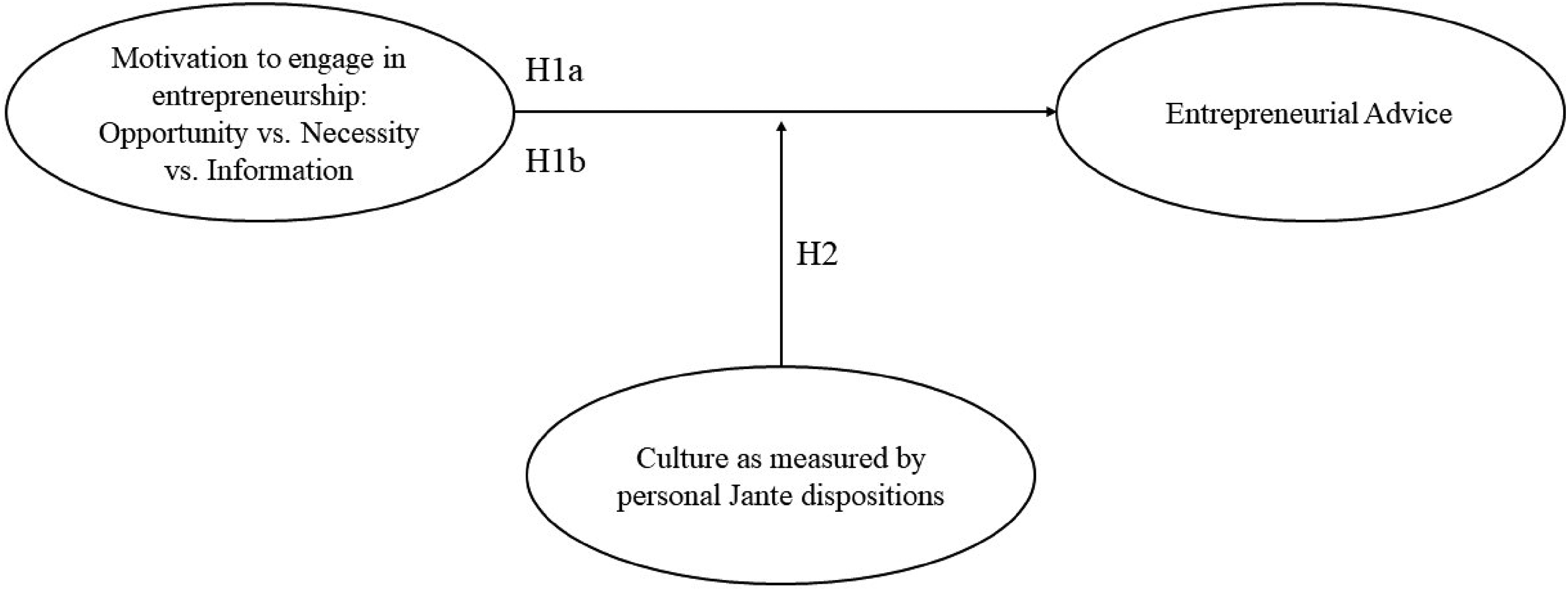
Conceptual model showing the relationship between entrepreneurial motivation and entrepreneurial advice while moderated by the advice givers’ Jante-ness.
Methods
Participants
The participants for this study were all students at the Swedish University of Agricultural Sciences studying BSc Agricultural and Rural Management (in Swedish Lantmästare). The programme is a three-year, multidisciplinary programme that includes courses in production management, natural science (e.g. chemistry and biology) and business administration (e.g. marketing, accounting, finance, and strategy). Roughly half of the students in this programme are from southern parts of Sweden. Cohort size each year is around 50, therefore approximately 150 Farm Management students are in the programme at any particular time. The minimum requirement to study in this programme is at least two years’ experience working on or with a farm. As a result, students tend to be a couple of years older than the typical university student. Most of them come from the countryside, having grown up on a farm and attended high schools related to farm studies. All of the students in the programme have Swedish as their first language and with only a few exceptions, all of them identify as being ethnic Swedish. Upon completion of their degree in farm management, these students have typically either returned to work on their family farm, or gone into positions as farm advisors, sales representatives, or working with governmental organizations. Taken together, the cohort of students that participated in this study have had considerable exposure to Swedish agriculture and arguably are very similar regarding cultural values related to farming and agriculture.
Procedure
A three-group, randomized, between subjects experimental design was used to test the hypotheses in this study. To begin, all participants were required to read the following scenario:
Last year Johan took over the family farm from his parents, becoming the fourth generation to work the farm. Over the years, the farm, more or less, produced and sold the same products—mostly cereals and grains. The size of the farm has remained unchanged over the years ranging from 0 to 2 employees excluding family.
Following this information, each of the three groups received different information regarding Johan's motivation for pursuing innovation as follows (see italic text for differences in group treatments):
Johan is not satisfied with the farm's development
Group 1, necessity entrepreneurship: Profitability the last years has been worse than his competitors.
Group 2, opportunity entrepreneurship: Profitability the last years has been better than his competitors.
Group 3, no information given about profitability being better or worse than the competition. Johan is not happy with that and wishes to increase profitability. Johan has decided to risk everything by investing the family savings in an innovative product that he believes will increase profitability.
The different information given to the three groups acted as our treatment (independent) variable. Following the scenarios, participants were asked to finish reading the survey and to answer all questions.
Measures
As described in the previous section, entrepreneurial motivation was operationalized through the experimental treatment which gave information that Johan was motivated by either necessity, opportunity, or no information (control group). Immediately following the scenario, students were asked “What should Johan do in his situation?”, followed by ten strategic alternatives measured on a five-point Likert scale with “Totally Disagree” and “Totally Agree” as end points. The ten alternatives were based on McElwee’s (2006) farm change strategy framework and can be found in the first column of Table 1. Using principal component analysis (PCA), we explored the factor structure of the 10 items used to operationalize McElwee’s (2006) farm change strategy framework and found four “distinct” components with an eigenvalue greater than 1. With varimax rotation and side-loadings of < 0.30 suppressed, the items loaded relatively clearly onto their expected components that we labelled as “Give up advice” (component 1), “Entrepreneurial Advice” (component 2), “Production Advice” (component 3) and “Economize Advice” (component 4).
PCA rotated component matrix using McElwee’s (2006) strategic management options.
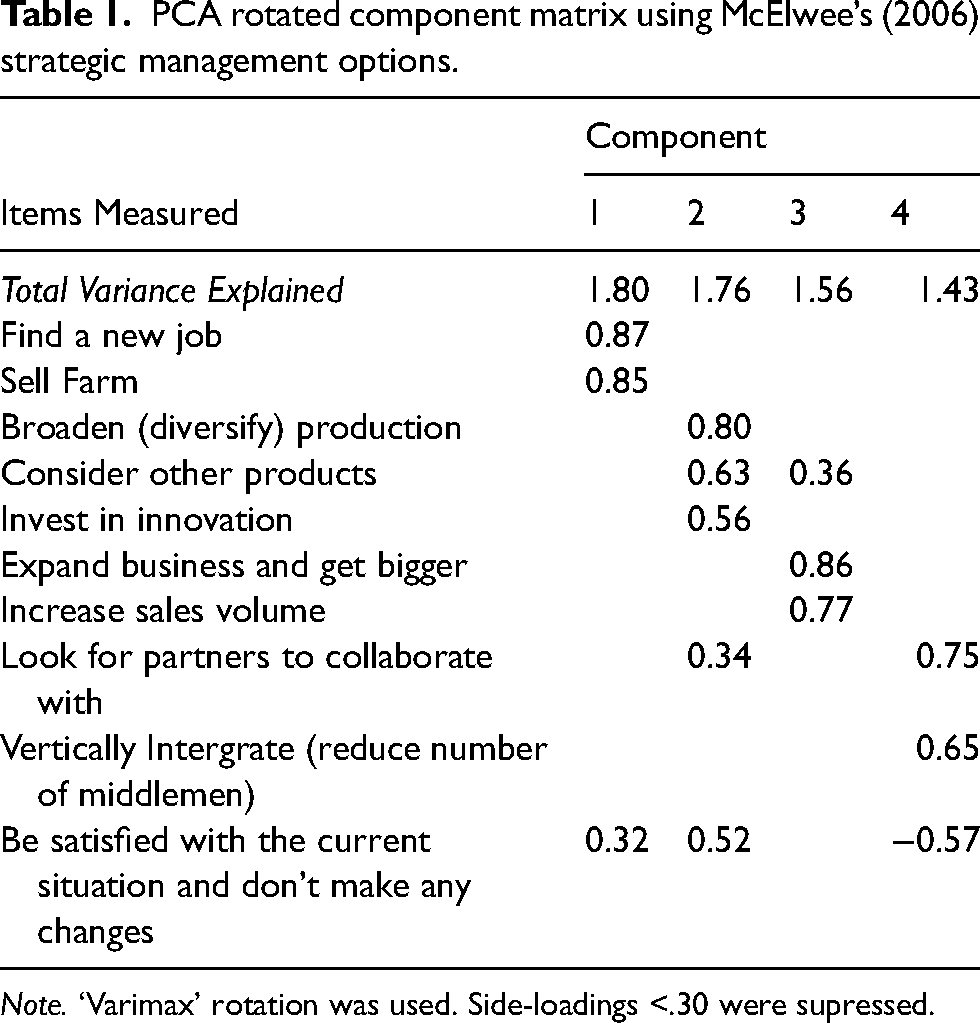
Note. ‘Varimax’ rotation was used. Side-loadings <.30 were supressed.
Since the dependent variable (DV) of interest for this study was entrepreneurial advice (and not advice related to the other strategic choices), we followed up the PCA with a reliability analysis on the three items that loaded strongest on component 2 (i.e. Entrepreneurial Advice). The three items demonstrated acceptable reliability (McDonald's ω = .615) and were combined by calculating their statistical mean to create the scale Entrepreneurial Advice (see Table 2).
Operationalization of measures and experimental treatments included in the models tested.
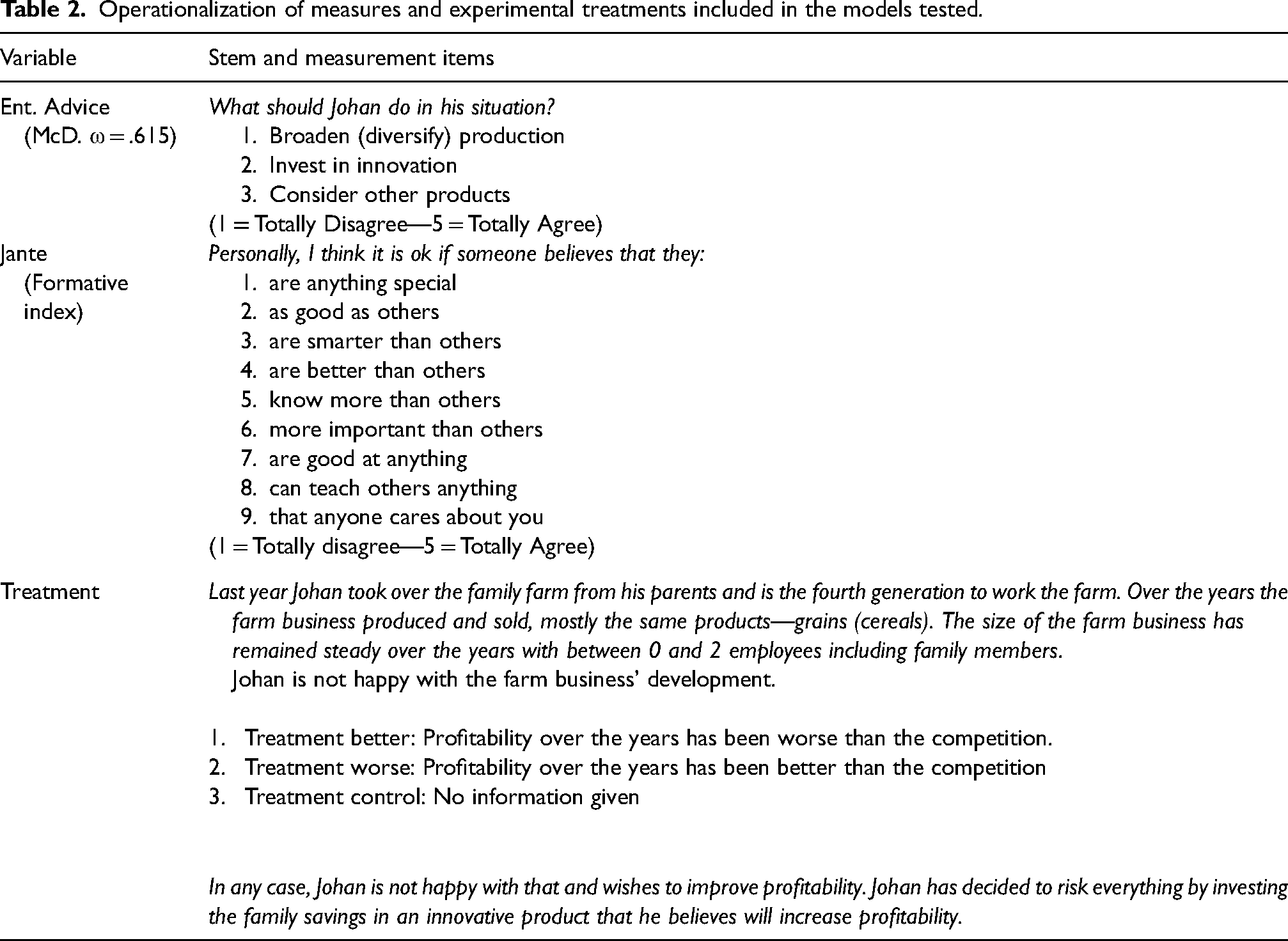
The next set of questions captured Jante by asking participants: “Personally, I think it is ok if someone believes that they” followed by 9 Jante-statements (see Table 2). These items were also measured using a five-point Likert scale with end points 1 = Totally disagree; and 5 = Totally agree. Following the recommendation of Cappelen and Dahlberg (2018), we treat Jante as a formative construct and combine all items using the statistical mean to create the formative construct we refer to as “Jante”. The coding of our Jante items meant that strongly agreeing with Jante in the survey implied a low Jante disposition. For this reason, we reverse coded the items when developing our scale.
Finally, previous research has found that farmers become less innovative with age (Diederen et al., 2003) and gender differences related to things like fear of failure could impact the entrepreneurial advice given. (Cañizares and García, 2010). Consequently, we control for gender by asking participants to tick a box indicating if they are “male”, “female” or “other”. Age was captured by asking participants to state their actual age.
Statistical analysis
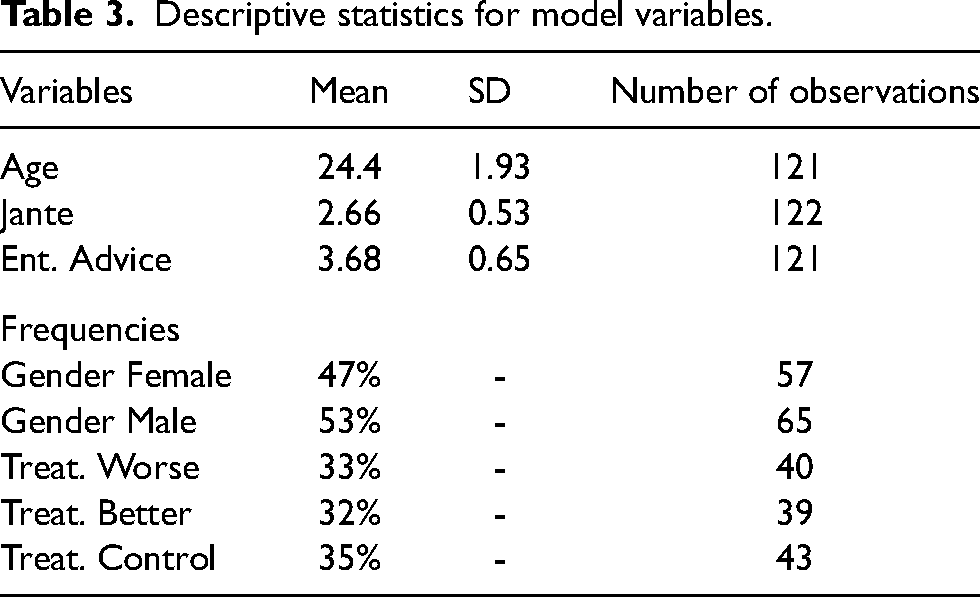
All data for the analysis was first entered into SPSS and we used PCA to identify factor structure and reliability analyses to reduce dimensionality and create reliable scales. Following this, we analyzed the descriptive statistics (Table 3). A univariate General Linear Model (GLM) was used to analyze Entrepreneurial Advice as our DV; the fixed factor was the experimental group (independent variable or IV) and Jante (IV), age, and gender were added to the model as covariates. To test our hypotheses, we first ran an interaction model where the DV and all IVs were included, along with the interaction effect experimental group treatment*Jante. This was followed up with main effects models presented in the next section.
Descriptive statistics for model variables.
Results
In total, 122 farm management students participated in the experiment. They averaged 24 years of age and among them, 47% were female and 53% male. Random assignment to treatment group resulted in a near even split between groups (Table 3). Our first hypothesis states that: When an individual's motivation to engage in entrepreneurial activity is based on necessity, advice givers will be more likely to promote entrepreneurial activity than if the motivation was based on opportunity (H1a) or when no information about motivation is given (H1b). We followed this up with a second hypothesis that states: When an individual is motivated to engage in entrepreneurship for reasons other than necessity, greater levels of Jante in the advice giver will moderate (negatively) the entrepreneurial advice given (H2).
Starting with H2, we develop a moderation model in SPSS using univariate GLM. We used Jante (reverse coded) as a moderating variable between the treatment variables (necessity entrepreneurship vs. opportunity entrepreneurship vs. control) and Entrepreneurial Advice. Before interpreting the main results of H2, we confirmed that none of the main assumptions needed to run a model in GLM, such as Homogeneity of Residual Variances (Levene's p = 0.79) or Normality of residuals (Shapiro-Wilk p > 0.05) were violated.
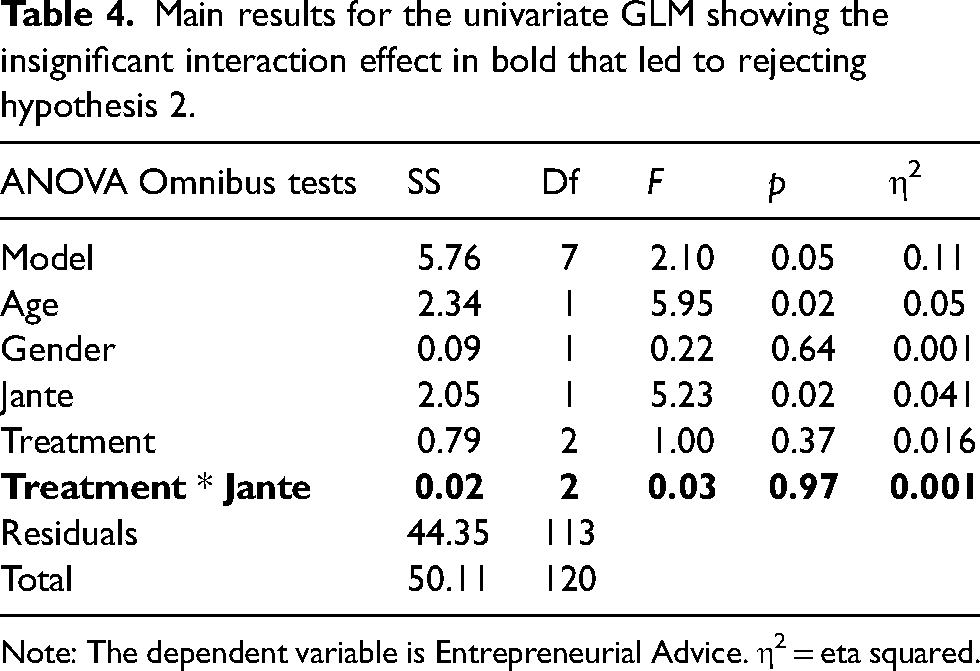
Proceeding to the main results of this hypothesis test (see bolded text in Table 4), no interaction effect (moderation) for treatment*Jante was found: F (2, 120) = .03, p = 0.97. Based on this result, we reject H2. Hypothesis H1 predicted that entrepreneurial motivation would have a negative effect on Entrepreneurial Advice in some scenarios. Namely, when a person seeking advice is motivated to engage in entrepreneurship because of necessity, entrepreneurial advice will be more likely than if the motivation was related to opportunity (H1a) or no information (H1b). Hypothesis H1 predicted that entrepreneurial motivation would have a negative effect on Entrepreneurial Advice in some scenarios. Namely, when a person seeking advice is motivated to engage in entrepreneurship because of necessity, entrepreneurial advice will be more likely than if the motivation was related to opportunity (H1a) or no information (H1b).
Main results for the univariate GLM showing the insignificant interaction effect in bold that led to rejecting hypothesis 2.
Note: The dependent variable is Entrepreneurial Advice. η2 = eta squared.
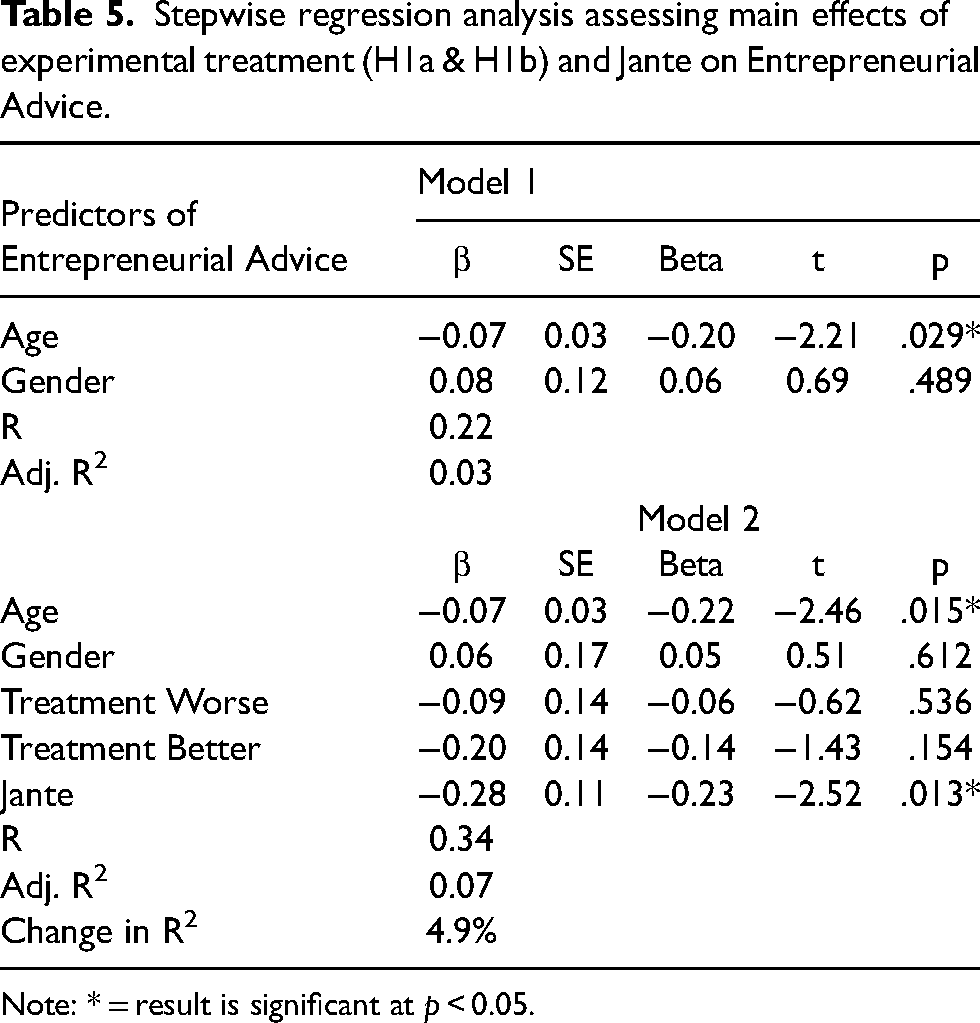
To test this hypothesis, we used hierarchical multiple regression with variables added stepwise. In Model 1, (see Table 5) the controls age and gender were added. Age had a significant (p = 0.029) and negative main effect on Entrepreneurial Advice, while Gender was not significant at p = 0.489. The adjusted R square for model 1 is.03 with age capturing most of the variance. In model 2 (also Table 5) we add two of our three treatment variables as dichotomous variables and Jante (reverse coded). However, while entrepreneurial advice was lower when the individual seeking advice was motivated by opportunity entrepreneurship, as compared to necessity entrepreneurship, or the control as predicted by H1a and H1b, the differences were not-significant (p = 0.536 and p = 0.154) As a result, we reject hypothesis H1a and H1b.
Stepwise regression analysis assessing main effects of experimental treatment (H1a & H1b) and Jante on Entrepreneurial Advice.
Note: * = result is significant at p < 0.05.
Unexpectedly, we found a negative and significant main effect for Jante on entrepreneurial advice in model 2 (p = 0.013). The more Jante our participant was, the less likely it was that they gave entrepreneurial advice. The scatter plot in Figure 2 (below) shows that as the Jante-ness of the advice giver increases, Entrepreneurial Advice tends to decrease. The effect size of Jante relative to the other variables in model 2 is the largest (Beta = −0.23) followed by age, which was also significant (p = 0.015) and had a similar effect size (Beta = −0.22). The Adjusted R square for model two is.07 and the unique contribution of Jante is greater than the other variables in the model to change in R square is 4.9% (see Table 5).
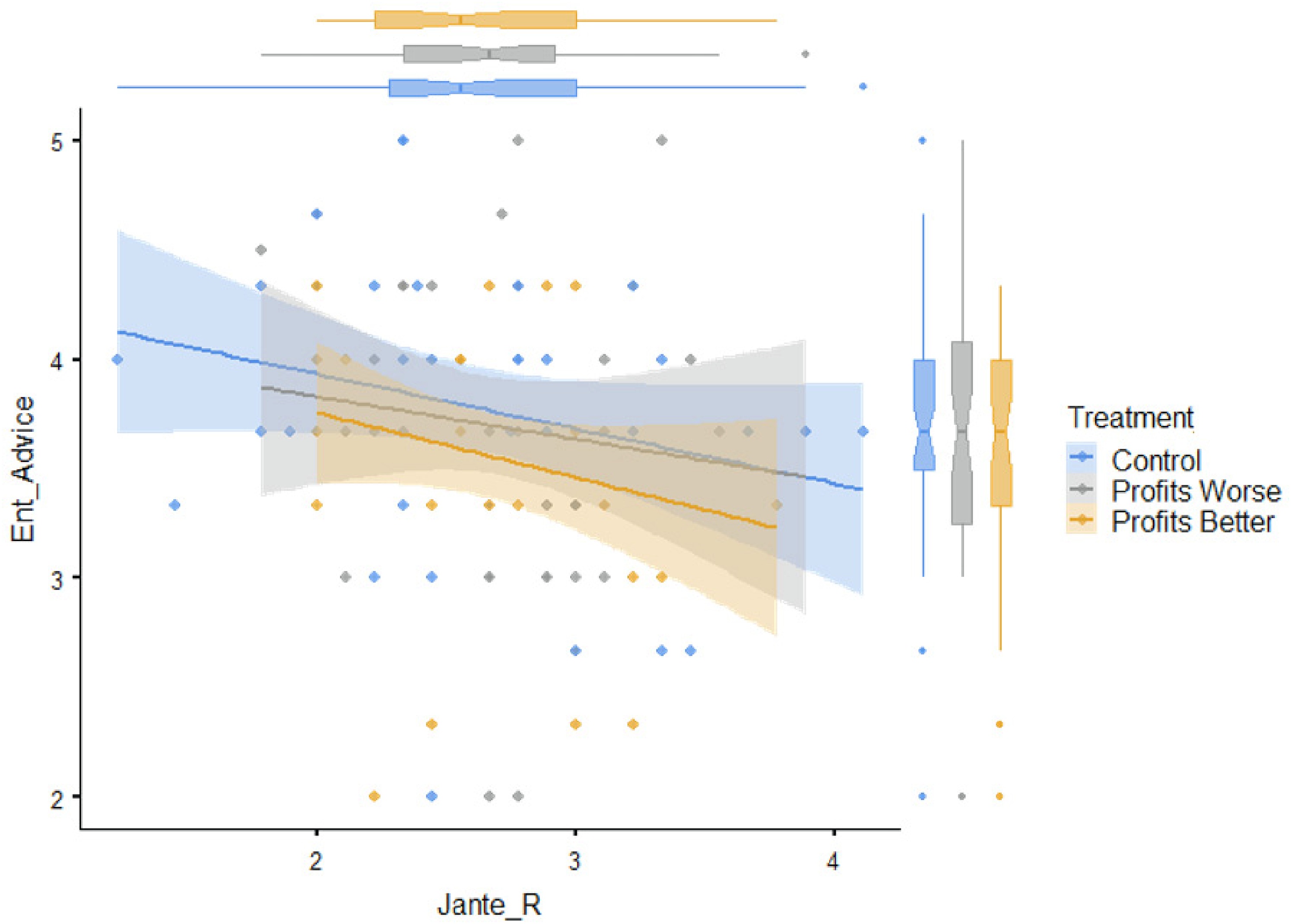
Scatter plot showing the relationship between Jante and Entrepreneurial Advice sorted by experimental treatment (profits worse is the necessity entrepreneurship condition while profits better is the opportunity entrepreneurship condition).
Discussion and conclusion
In this study we designed an experiment to test whether the advice provided by Agricultural and Rural Management students relating to the pursuit of entrepreneurial activity differed depending on the underlying motivations of the receiver of advice to engage in entrepreneurship. We theorized that the advice given would be moderated by how “Jante” the individual giving advice is. We found that differences in the underlying reasons for engaging in entrepreneurship did not significantly change the entrepreneurial advice given. It did not matter in our treatment scenarios if the farmer seeking advice was motivated to engage in entrepreneurship due to necessity (i.e. because profitability was worse than competitors over time) or opportunity (i.e. profitability was better than competitors over time). Moreover, when investigating whether Jante and our treatment scenarios interacted, we did not find an effect. This suggests that the Jante culture does not make exceptions for those who have a “good excuse” to be entrepreneurial.
Surprisingly, the Rural and Agricultural Management students tended to be positive overall towards giving entrepreneurial advice under all scenarios, however, this advice significantly declined the more Jante they were. Instead of using information about past profitability and motivation to inform others on whether to pursue entrepreneurship, Jante-ness was better predictor of the advice provided. As the Jante-ness of the students increased, they tended to offer less advice on pursuing entrepreneurial activities such as innovation, new types of production and product diversification.
We believe that these findings are important for three reasons. First, the results extend findings of Cooke and Wills (1999) by showing that cultural ties, characterized by Jante-ness, may lead to fewer entrepreneurial activities—at least in an agricultural context. While Jante and similar cultural constraints have been explored in previous entrepreneurship studies, they have either been qualitative in nature—limiting the generalizability of findings (Borch et al., 2008)—or were done in contexts outside of agriculture where Jante did not show an effect and had limited relevance for the agricultural sector (Davidsson and Wiklund, 1997).
This finding contributes to knowledge on why farmers differ in their strategic decision-making as culturally biased or even culturally embedded professional advice may inhibit perceived room for maneuvering (Methorst et al., 2017). This opens up opportunities for entrepreneurship scholars to isolate the influence of Jante (or similar phenomenon such as The Tall Poppy Syndrome) in sectors outside of agriculture and to capture its inhibitory effects indirectly through advice given to others.
Second, it is widely known that the agricultural sector tends to lag behind other sectors when it comes to entrepreneurial activities such as innovation and diversification (Pindado and Sánchez, 2017). If similar cultures to Jante exist in other agricultural contexts or countries, our findings may help to explain why entrepreneurship is less frequently adopted. We submit that entrepreneurial tolerance and the cultural aspects that constrain it are important for understanding why certain forms of entrepreneurship are pursued or avoided in different contexts (Shane and Venkataraman, 2000).
Third, our findings are a reminder to advisors to reflect on their cultural biases when advising clients, friends, and family to pursue entrepreneurship. Within the Swedish agricultural context, advisors who are deeply embedded in the agricultural community may unwittingly encourage others in their network of relationships to adhere to cultural norms (Bourdieu, 1985). If these norms are related to Janteness, they may deter entrepreneurial advice. A greater level of introspection may help them provide more nuanced advice related to the situation rather than their cultural prejudices. Policy makers wanting to increase farm entrepreneurship may find it helpful to provide farmers with advisors from outside of their typical peer groups. This may help to enhance creativity and innovation by enhancing cognitive frames and “counteracting bounded rationality” (Bajaba et al., 2021).
Finally, for farmers weighing the strategic decision of engaging in entrepreneurship, this study suggests that others, especially “Jante” individuals may hold it against them. From a social capital perspective, ignoring embedded norms (e.g. the rules of Jante) may generate greater entrepreneurial activity and improved economic outcomes, but result in sanctions by the community. Coleman (1988) refers to losing family, religious and community ties as examples that lower social, physical, mental and life satisfaction returns (Lin et al., 2001). We encourage future research to explore these sanctions/outcomes in the context of Jante to see how they influence farm entrepreneurship decision making.
This study did have several limitations that reduced the generalizability of the findings. The data are based on a homogenous sample of Agricultural and Rural Management students and therefore, the results cannot be generalized to other groups. It may be the case that our students are more open to external ideas since leaving their home community than farmers who have not. In fact, they were more positive as a group towards entrepreneurship than we expected. Nevertheless, there was enough Jante variation within this group to establish a negative effect on entrepreneurial advice. This is encouraging for our results since we would expect more robust effects to be found in “real world” farming communities. The decision to sample these students was done to maximize the internal validity of our findings, however this came at the expense of external validity. Moreover, the experiments were ill equipped to capture the complexity of real-world scenarios where for example, the degree of opportunity or necessity is important, as are social — psychological factors, which we did not consider in this study. This said, we argue that our results contribute to theoretical generalizability, even if statistical generalizability is low (Mook, 1983). In operationalizing McElwee’s (2006) farm development strategies and using a subset of them to capture Entrepreneurial Advice, we missed an opportunity to capture a fuller range of entrepreneurial activity that we believe would also have increased the validity of our DV.
Now that we have established Jante may affect entrepreneurial decision-making, we encourage future researchers to explore other contexts in which cultural intolerance towards entrepreneurship may exist
Footnotes
Declaration of conflicting interests
The author(s) declared no potential conflicts of interest with respect to the research, authorship, and/or publication of this article.
Funding
The author(s) disclosed receipt of the following financial support for the research, authorship, and/or publication of this article: This work was supported by the Kamprad Family Foundation (grant number 20160186).
