




Abstract
This teaching case focuses on the relationship between entrepreneurs, their ventures and the broader context—the innovation and entrepreneurship ecosystem (I&EE)—in which entrepreneurial activity occurs. Building on secondary data and informal conversations with industry experts, the case recounts the story of Rocket Lab, an aerospace manufacturer and launch service provider founded in 2006 in New Zealand. The case elaborates on how unique contextual conditions in combination with the founder's vision and skills enabled Rocket Lab to become a dominant force in the space sector, even though the firm was founded in a country with virtually no history in spacefaring and highlights that Rocket Lab's emergence constituted the foundation of a burgeoning space industry in New Zealand. In doing so, the case sensitises students to the importance of self-reinforcing and mutually interdependent relationships in well-functioning I&EEs and the role policymakers play in this context. At the same time, it allows a critical discussion of I&EEs, particularly if they are dominated by a small number of anchor firms.
Keywords
Key learning outcomes
This case study:
sensitises students to the ‘systemic’ nature of innovation and entrepreneurial ecosystems (I&EEs) allows students to identify factors and actors (and their interdependencies) that support innovation and entrepreneurship introduces a distinction between top-down and bottom-up dynamics in I&EEs and the role policymakers play from each perspective provides an opportunity to reflect critically on the role of anchor firms in I&EEs
Introduction
Rocket Lab, an aerospace manufacturer and launch service provider (LSP), was founded in New Zealand (NZ) in 2006. Since then, the firm has grown dramatically, with 237% year-on-year revenue growth and the establishment of a second launch site in the United States (Rocket Lab, 2021). The case of Rocket Lab is remarkable for two reasons. First, it was founded in a country with no established space industry. Second, Rocket Lab's success is fundamentally related to the NZ innovation and entrepreneurship ecosystem (I&EE). For instance, a range of actors and factors—from local skills in building racing yachts out of composite materials to tailored policy support—were of fundamental importance for Rocket Lab's growth. Moreover, the firm triggered the emergence of a burgeoning space industry in NZ. A range of space startups have been founded by former Rocket Lab employees, and Rocket Lab's founder, Peter Beck, takes an active role in supporting and mentoring them. Besides, established firms have become involved in the space industry and universities have set up tailored programs. Remarkably, NZ is one of the few countries where a commercially driven space economy has grown relatively organically. As the NZ Prime Minister's Chief Science Advisor notes, the rapid evolution of “New Zealand's ‘space ecosystem’ [relied on a] particularly collaborative and agile approach” (Gerrard, 2019). As such, Rocket Lab's success and relevance are inherently related to ‘contextual’ aspects that foster innovation and entrepreneurship.
The importance of context for understanding entrepreneurship and innovation
Entrepreneurship is concerned with “how, by whom, and with what effects opportunities to create future goods and services are discovered, evaluated and exploited” (Shane and Venkataraman, 2000: 218). This definition suggests that entrepreneurship is a multi-level phenomenon. On the one hand, individual (e.g., personal traits) and organizational (e.g., resources or strategies) aspects influence by whom, how and with what effect opportunities are discovered, evaluated and exploited. On the other hand, entrepreneurial activity is shaped by, and affects, the broader social and economic context that surrounds startups. Increasingly, literature is using the term “innovation and entrepreneurship ecosystem” (I&EE) to refer to such contextual factors that foster innovation and entrepreneurship in a region (Alvedalen and Boschma, 2017; Malecki, 2018). Most research has focused on identifying ‘constitutive elements’ that characterize well-functioning I&EEs (Roundy and Bayer, 2019). For example, Spigel (2017) distinguishes between material (e.g., policies and governmental support that encourage entrepreneurship), social (e.g., the presence of mentors and role models for entrepreneurs or availably of investment capital and skilled workers) and cultural (e.g., cultural norms that value risk-taking, innovation and entrepreneurship) attributes that support the establishment and growth of innovation-based ventures (see Figure 1).
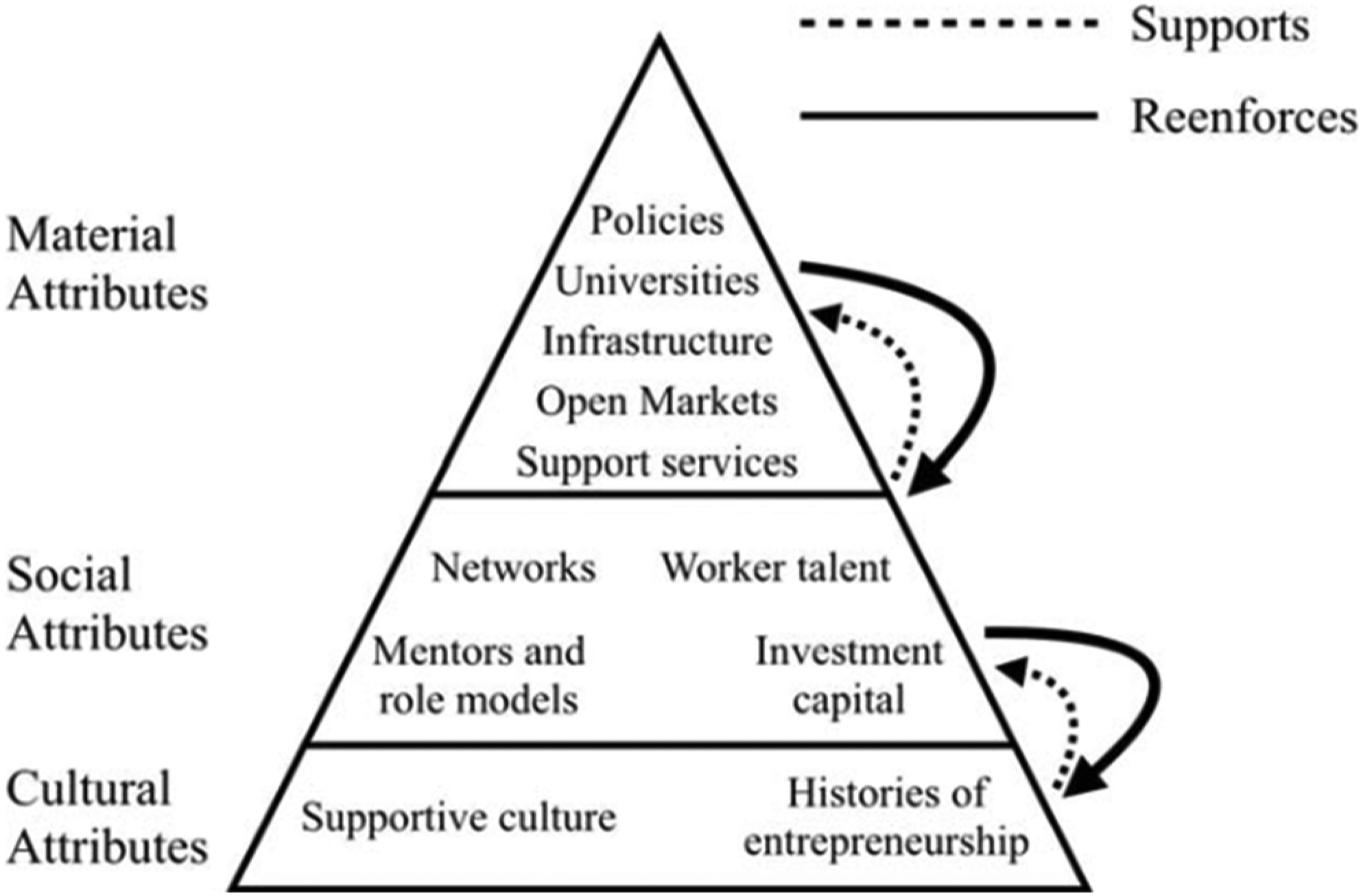
The ecosystem triangle.
Research on I&EEs can be distinguished between ‘top-down’ and ‘bottom-up’ perspectives (Spigel, 2018; Thompson et al., 2018). From a top-down view, researchers are mainly interested in identifying the central building blocks of I&EEs to explain the nature and magnitude of entrepreneurship in a region (Thompson et al., 2018). This stream of research highlights the importance of actors (e.g., new ventures, mature firms, government, investors and support organizations) and factors (e.g., infrastructure, public policy and local culture) and their influence on innovation and entrepreneurship (Spigel, 2020). However, Malecki (2018: 5), among others, argues that I&EE scholars have “largely focused on the essential ingredients, while largely ignoring the processes or ‘recipes’ for their combination into a sustainable milieu with entrepreneurial vitality”. Indeed, Ritala and Almpanopoulou (2017: 39) remind us that the prefix ‘eco’ in the term I&EE fundamentally relates to “the interdependency among different actors, and to the co-evolution that binds them together over time.” This highlights the importance of bottom-up processes in terms of the “self-reinforcing relationships between various attributes that reproduce and transform the ecosystem over time” (Spigel and Vinodrai, 2020: 602).
Bottom-up dynamics and the importance of anchor firms
A bottom-up perspective on I&EE shifts attention away from identifying actors and factors toward a better understanding of how interactions, interdependencies and collaborations between them influence and transform the broader I&EE (Spigel, 2018; Thompson et al., 2018). These dynamics are visible in the reinforcing and supporting arrows in Figure 1. For example, favorable policies and well-funded universities generate a skilled workforce and make investment capital available. These, in turn, support the creation of successful entrepreneurial ventures that further reinforce and strengthen other elements such as cultural values (Spigel, 2017).
Key to such bottom-up dynamics are large, often multinational, employers with significant capital as well as technological and organizational skills that are commonly referred to as anchor firms (Agrawal and Cockburn, 2003; see also Malecki, 2018 and Spigel and Vinodrai, 2020). Anchor firms are important facilitators of relational dynamics that facilitate I&EE growth. First, they attract highly skilled workers to the region and create demand for products and services that can be exploited by the local business community. Second, anchor firm employees gain unique insights into market opportunities that can form the basis for new ventures. Third, anchor firms form an important pool of knowledge, skills and resources that further an I&EE's growth. For example, some set up corporate accelerators and training programs or provide informal mentoring to support other ventures. Fourth, anchor firms have an influence on the regional entrepreneurial culture and their founders can act as role models for potential entrepreneurs. Finally, anchor firms often have a degree of political power that can be used to lobby for legislative changes (Spigel and Vinodrai, 2020).
Anchor firms that hold a dominant position within an I&EE can have a significant effect on the trajectory of that I&EE. For example, Spigel and Vinodrai (2020) show the I&EE in Waterloo (Canada) encountered a shock after a dominant anchor firm, Blackberry, ran into economic trouble. At the same time, the withdrawal or demise of anchor firms can also exert a positive impact on an I&EE (Spigel and Vinodrai, 2020; Stam, 2007). In addition, the practices, priorities and business model of anchor firms have been shown to “have a profound effect on the business culture of their home region” (Spigel, 2020: 65). While this impact is typically portrayed in a positive light (e.g., acceptance of entrepreneurship), there are downsides (see Roundy and Bayer, 2019). For instance, as I&EEs mature, so-called “sub-ecosystems” (Malecki, 2018: 7) emerge around dominant anchor firms and the industries, technologies or areas of interest areas that they represent. These dynamics can support certain kinds of entrepreneurship but create barriers for others. For instance, Korber et al. (2022) show that NZ's history in agriculture created significant challenges for female-led and deep-tech founders that fell outside the stereotypical view of who is a ‘legitimate’ or ‘mainstream’ entrepreneur.
Many of these theoretical dynamics are visible in the case of Rocket Lab, an American aerospace manufacturer and LSP founded in NZ in 2006.
Case study narrative
As of 31.12.2022, Rocket Lab has conducted 31 commercial space launches and deployed 151 satellites and demonstrated sales growth rates of over 100% year on year (Rocket Lab, 2021, 2023). The investment portal Seeking Alpha ranks Rocket Lab as second in the ‘new space race’, behind Elon Musk's SpaceX but ahead of competitors such as Jeff Bezos's Blue Origin or Richard Branson's Virgin Orbit (Dolen, 2022). This is an impressive achievement, given that Rocket Lab was founded by a self-taught rocket enthusiast from a remote town on NZ's South Island, in a country with virtually no history in spacefaring.
The Rocket Man: Peter Beck
Peter Beck, the founder and CEO of Rocket Lab, grew up in Invercargill (population: 25,000), the southernmost and westernmost city in NZ, and one of the southernmost cities in the world. Inspired by a family background in science and engineering, Beck always knew that he wanted to build rockets. He spent his teenage years honing his engineering skills in the workshop behind his home, reportedly putting a turbocharger in a Mini, building bicycles from aluminum and experimenting with water-powered engines (Walsh, 2008). Given how few relevant opportunities were in NZ, it seemed unlikely that Beck would ever end up working in rocketry. Indeed, counselors at Beck's high school reportedly told him in no uncertain terms how unrealistic his aspirations were and encouraged him to take up a job at the local aluminum smelter (Beck, 2019). Instead of following this advice, or going to university, Beck left school at 17 years to start a tool-making apprenticeship at the manufacturing firm Fisher & Paykel (Walsh, 2008). But for him, this was just a stepping stone to further pursue his long-term aspiration: “I started off doing a trade in toolmaking, but for me, it was always about the rocket … the trade gave me the hand skills to build what I needed to build” (Baker, 2018).
While at Fisher and Paykel, Beck took advantage of the firm's facilities to create various rocket-powered vehicles—including a bike, a scooter and a pair of rollerblades. In 2001, Beck went on to work for Industrial Research Limited (IRL), a governmental research institute that later merged into Callaghan Innovation. During his time there, Beck worked on various projects related to smart materials, superconductors and composite materials (Bradley, 2017b; Walsh, 2008).
Revolutionizing rocket manufacturing
In 2006, Beck left Callaghan Innovation and founded Rocket Lab to pursue his vision of democratizing space by slashing the cost of rocket launches and providing more flexible services than established LSPs could (Baker, 2018). In essence, Rocket Lab's value proposition is to provide quick and small launches that are customized to the needs of the customer (see Foust, 2022 and Rocket Lab, 2022). Other LSPs, such as Space X, can carry more payload (revenue-producing cargo) and offer a lower price per kilogram; however, many of their customers are ‘secondary’, meaning they are beholden to the destinations (e.g., the altitude) and timing of primary customers. By providing launches of smaller payloads that are tailored to customer needs, Rocket Lab is expected to capitalize on the trend toward miniaturized satellites (CubeSats and nanosatellites) and mega-constellations (groups of satellites that work together). Also, Rocket Lab has increasingly diversified into areas such as satellite components. This is part of a vertical integration strategy that aims to allow the firm to deliver comprehensive space solutions that span spacecraft manufacturing, satellite subsystems, flight software, ground operations and launch services.
To deliver its value position, Rocket Lab leverages technological advances and insights Peter Beck gained during his career. For instance, the Electron rocket is made of composite material (carbon fiber) to minimize weight and powered by a partly 3D printed engine. To cater for increasing demands and keep costs down, Rocket Lab relies on a custom-designed robotic manufacturing system that can produce the carbon composite components of the Electron rocket (see Figure 2) in just 12 hours, a process that used to take more than 400 hours (Foust, 2019). By 2022, Rocket Lab had launched 149 satellites into space, sent NASA's CAPSTONE spacecraft on its way to the Moon's orbit and caught an Electron booster in mid-air with a helicopter—a key step toward making the rocket reusable (Rocket Lab, 2022, 2023). In addition, Rocket Lab invests heavily in research and development (Foust, 2022). In 2021, Rocket Lab unveiled plans for its Neutron rocket, an advanced 8-ton payload class launch vehicle tailored for mega-constellation deployment, interplanetary missions and human spaceflight (Rocket Lab, 2022).
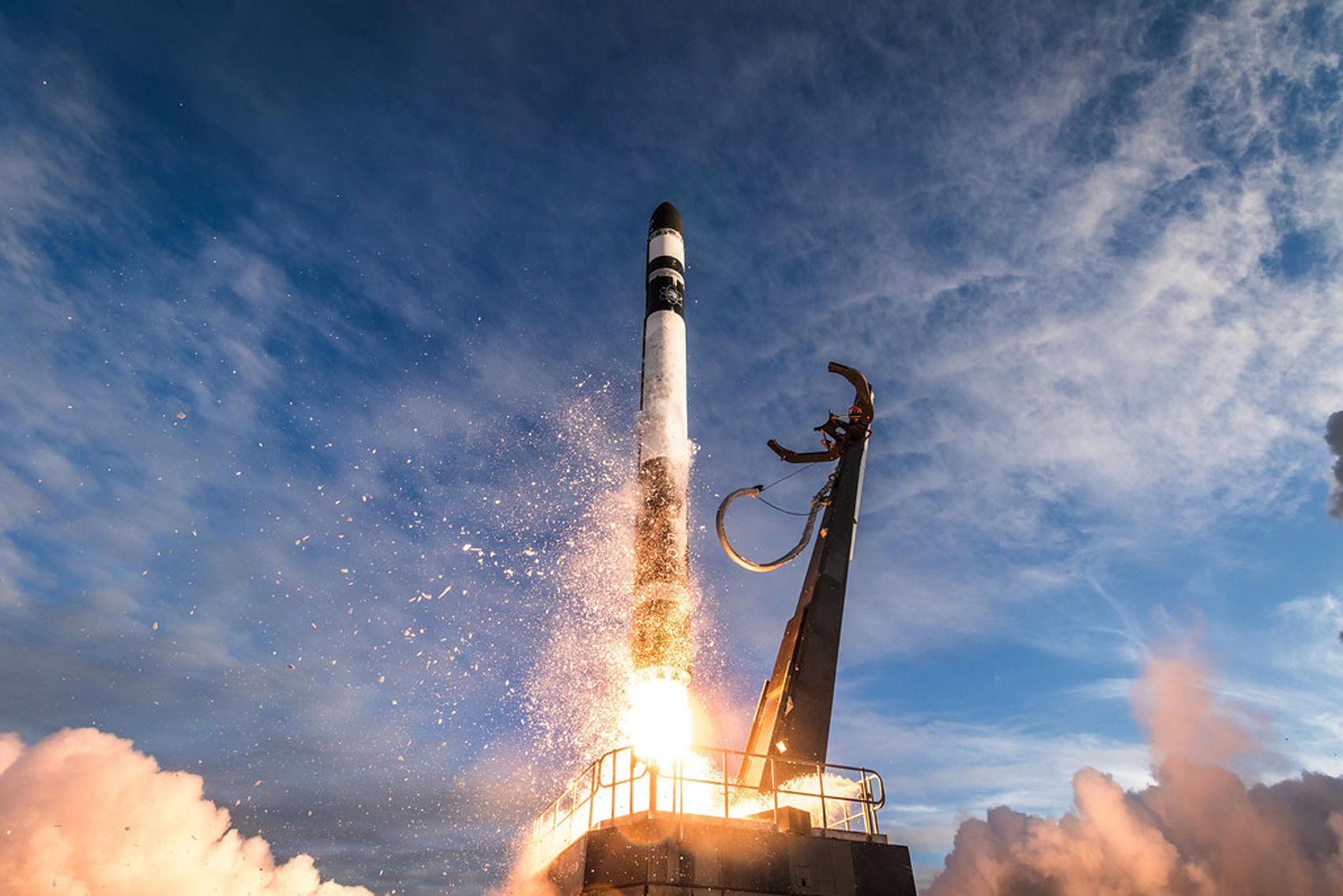
Rocket Lab Electron by NASA Kennedy (2017). CC Licence.
Leveraging local resources and capabilities
While Peter Beck's drive, vision and engineering aptitude are undoubtedly a key force behind Rocket Lab's success, the firm and its founder also proved to be capable of leveraging facilitative conditions and support that existed locally. In general, NZ is said to be a good place for entrepreneurs. For example, the country is ranked as a top economy in the world for ease of doing business. Also, social and political stability, relatively low taxes and wages, low levels of corruption, a skilled workforce and a high living quality make the country an attractive option for start-ups (World Bank, 2020). Furthermore, NZ's culture—often described with the term ‘Number 8 wire mentality’—values inventive and entrepreneurial thinking. For instance, Frederick and Monsen (2011) point out that the national culture in NZ emphasizes individual over collective responsibility in managing one's own life and encourages creativity, innovativeness and entrepreneurial risk-taking.
More specific to space activities, NZ's remote location proved beneficial: the clear sky and distance from most major aeroplane and shipping routes enable frequent rocket launches (MBIE, 2020). Despite all of this, NZ was by no means an ‘obvious’ choice for founding an LSP. The absence of governmental-led space programs in combination with an economy that is dominated by low- and medium-tech companies (often operating in the primary sector) meant that few local customers existed for the services that Rocket Lab sought to offer (OECD, 2022). In addition, the country's small population of around 5.1 million, its geographic isolation (around 12,500 km from the US and around 19,000 km from Central Europe) and the absence of investors who fund deep-tech startups constituted barriers to accessing relevant skills and resources and customers (informal conversation, industry expert, August 2021).
As such, finding investors who were willing to contribute large amounts of funding without any certainty as to whether, or when, they would see returns constituted a key barrier for Peter Beck (Baker, 2018). Indeed, it took Rocket Lab 12 years until its first commercial mission launched (Bradley, 2017b). And although Rocket Lab's sales are steadily increasing, the firm amassed US$203 million in losses between 2013 and 2021 (Burrell, 2022). Fortunately, Beck was not only technically versed but also a skilled communicator. As Sir Stephen Tindall, one of the wealthiest New Zealanders and seed investor in Rocket Lab, noted, “Peter Beck had the knack of making the language of rocket science understandable for most people—most importantly investors” (Bradley, 2017b). Initially, Beck secured investment from Mark Rocket, a local intranet entrepreneur and rocket enthusiast who had sold one of his ventures. Additionally, the NZ Foundation for Research, Science and Technology awarded Rocket Lab NZ$99,000 for research and development.
Rocket Lab used these investments to rent a space at Level Two (now Outset Ventures), a shared technology development space in Auckland, where the firm designed and developed its first rocket, the Ātea-1 (Walsh, 2008). Beck was also able to convince Sir Michael Fay, an NZ banker and investor, to grant Rocket Lab access to his private island, Great Mercury Island. From there, the firm conducted its first successful launch in 2009 and became the first private company in the southern hemisphere to reach space (Bradley, 2017b). Demonstrating the feasibility of its technology allowed Rocket Lab to gather larger amounts of funding from institutional investors, such as Sir Stephen Tindal and his K1W1 investment fund, the NZ government and, increasingly, overseas investors such as Silicon Valley–based Khosla Ventures and Lockheed Martin (Crunchbase, 2023).
Rocket Lab also faced the challenge of accessing skilled labor and know-how, although some isolated pockets of expertise existed. One was the University of Canterbury's (UC's) rocketry club, a student-led club that competes in international rocketeer competitions. Rocket Lab collaborated with the club and many of its students later become employees. A less obvious source of talent originated via NZ's rich history of boatbuilding. For instance, high-performance racing yachts, such as those that compete in the America's Cup (see Figure 3), are made of composite materials (e.g., carbon fiber). In turn, firms working in this sector proved to be a rich pool of talent and expertise that Rocket Lab could access for manufacturing their composite-based Electron rocket. A 2017 article suggested that about one-third of Rocket Lab's composite teams had worked for NZ's America's Cup team (Bradley, 2017a).
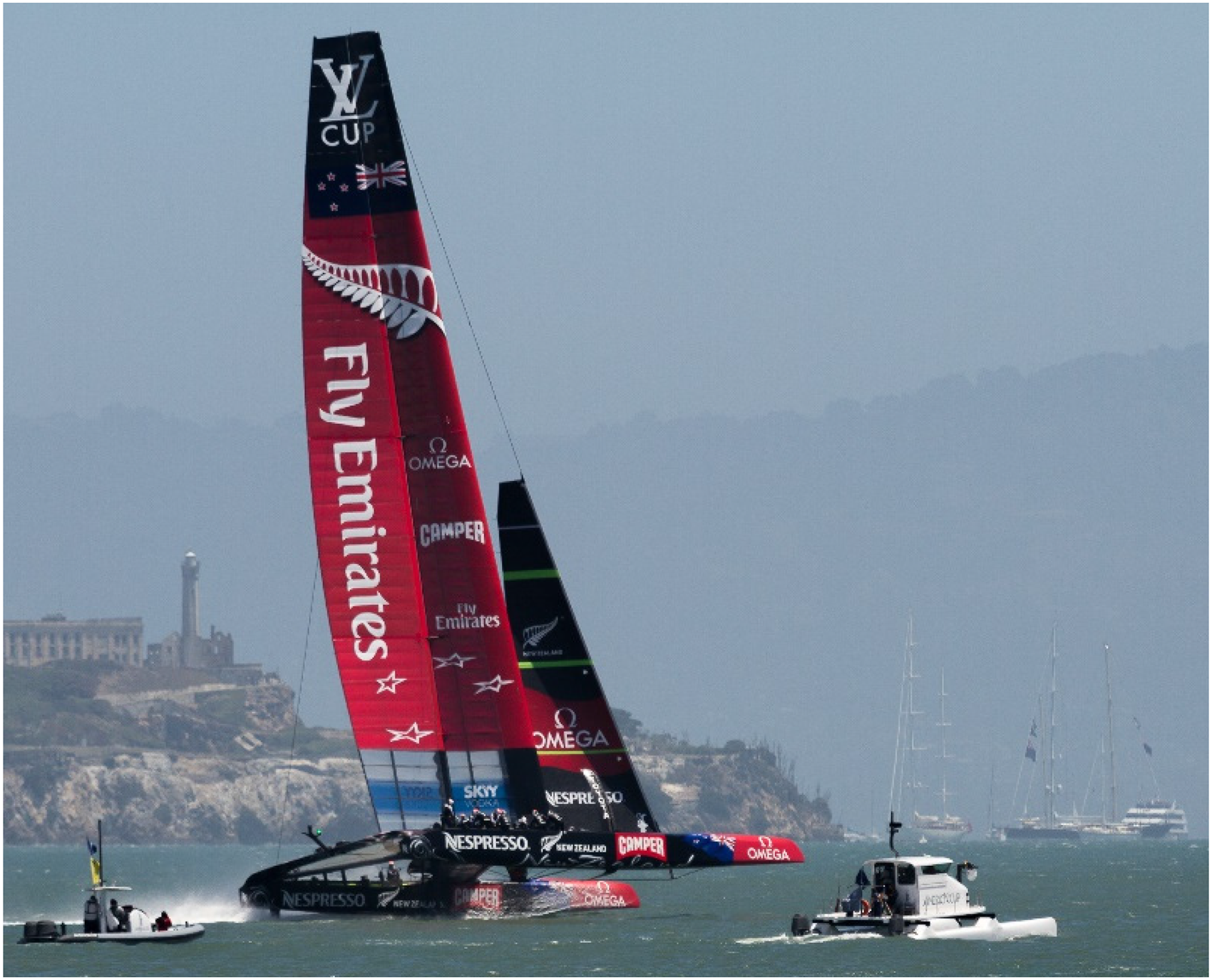
Team NZ. Picture by Schulenburg (2013). CC Licence.
A third key barrier Rocket Lab faced related to regulatory issues. As Peter Beck said: “If you can put a satellite into orbit, you can use that rocket for doing significantly nasty things” (Beck, 2019). In turn, LSPs must satisfy a plethora of regulatory and legislative requirements: securing launch licenses, obtaining authorization to use specific radiofrequency spectrums or meeting requirements from insurance providers. In addition, major LSPs typically service governmental clients that have very strict requirements (e.g., security clearances). Regulatory compliance is even more complicated for firms such as Rocket Lab. To service overseas customers, the firm not only has to comply with local but also with foreign regulations, international treaties and issues related to the import and export of sensitive technology (see, e.g., NASA, 2023). In turn, Beck noted that regulatory compliance in the space sector requires as much work as building the rocket itself (Beck, 2019).
Fortunately, Rocket Lab could rely on the support of local policymakers and regulators (see Joyce, 2016 and MBIE, 2020). In mid-2016, the NZ government and the US signed a Technological Safeguards Agreement that allowed NZ commercial entities to import, use and manage launch and satellite technologies from the US. In September 2016, the NZ government permitted Rocket Lab to obtain a license from the US Federal Aviation Authority that enabled Rocket Lab to launch from NZ before comprehensive local regulations were put in place. Finally, the NZ Outer Space and High-altitude Activities Act came into force in December 2017. Importantly, the Act allows foreign licenses and permits to satisfy some of the NZ requirements and enables Rocket Lab to use US licenses to launch from NZ.
3,2,1—blast off for a new industry
Although Rocket Lab continues to retain an NZ presence, access to funding and customers in the US lured the firm abroad (see Mcilraith, 2022 and Rocket Lab, 2022). As early as 2010, US government entities began awarding contracts to Rocket Lab and the firm entered a relationship to supply components to the American firm Lockheed Martin. In 2013, Rocket Lab moved its registration to the US and set up its main office in California. By 2017, most of the firm's financiers were reportedly American. In 2020, Rocket Lab announced the construction of a new facility in Long Beach, California, that will house its corporate headquarters, larger production facilities and a mission control center. In 2022, Rocket Lab expects the first launch from its newest site on Wallops Island, Virginia, which will preliminary be used to launch small satellites operated by the US government. This is not to say Rocket Lab has abandoned NZ altogether. Recently, the firm has expanded into a new 24,000 + sq/ft research and development facility in Auckland and is expected to create more than 110 new hi-tech jobs in NZ in 2022 alone.
Perhaps more importantly, Rocket Lab continues to exert a far-reaching impact on space-related activities in NZ. Indeed, Rocket Lab's emergence has led to excitement regarding opportunities in the local space industry and fuelled impressive growth therein. For instance, a significant number of ‘new space’ 1 startups were founded, many by former Rocket Lab staff. Case in point: Avinash Rao and Malcolm Snowdon, two of Rocket Lab's earliest employees and alumni of UC rocketeer club, founded Argo Navis, a commercial supplier of upper-stage rocket engines. Similarly, the spaceplane and satellite thrusters firm Dawn Aerospace was founded by Stefan Powell, a former propulsion intern at Rocket Lab. Likewise, Mark Rocket, one of Rocket Lab's earliest investors, established Kea Aerospace, which is developing unmanned aircraft that can continuously fly in the stratosphere (Figure 4).
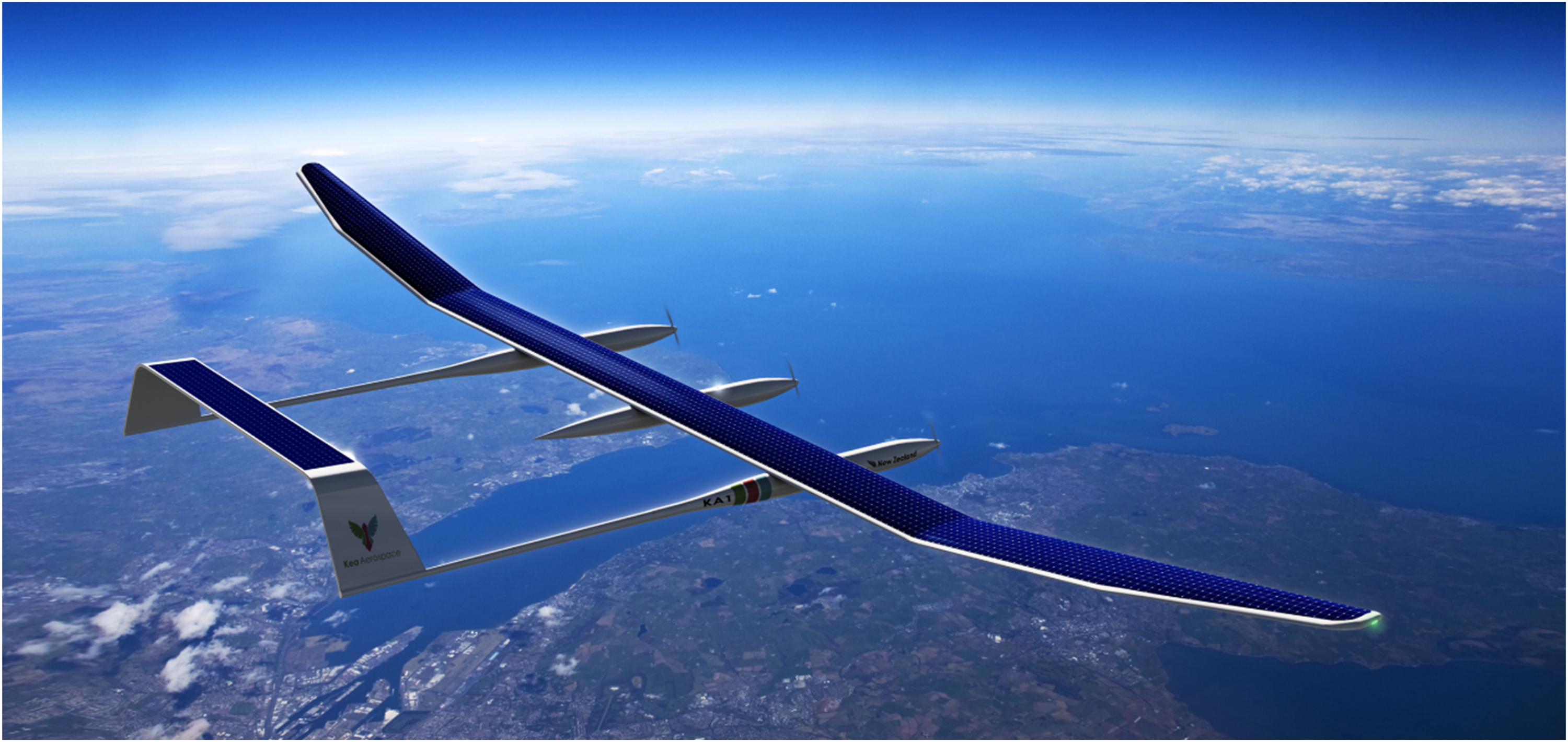
Solar-powered stratospheric aircraft. Picture by Kea Aerospace.
Many of these new startups benefit from Rocket Lab's presence and success in some way. For instance, they supply the firm or can recruit staff who have gained significant technical skills and market insights when working at Rocket Lab. Also, Rocket Lab CEO Peter Beck proactively supports local entrepreneurs. He sits on the investment committee of Outset Ventures (the deep-tech incubator that housed Rocket Lab for 6 years), where he is helping to guide financial resources into deep-tech startups. Further, Rocket Lab's success has created awareness of the need for space-related education. In response, The University of Auckland started to offer a Master of Aerospace degree and appointed Peter Beck as an Adjunct Professor. The University of Auckland also houses the Auckland Programme for Space Systems (APSS), where teams of undergrad students design CubeSat missions, and established Te Pūnaha Ātea, a multidisciplinary center of expertise in space science and engineering. These investments have fuelled further entrepreneurial activity. For instance, three APSS alumni founded Astrix Aeronautics, a startup that develops power-efficient solar arrays for satellites. The firm is located at Outset Ventures, where it has access to equipment that Rocket Lab left behind after its residency there ended. Astrix has received NZ$500,000 in early-stage funding from Outset Ventures and Peter Beck mentors the founders and sits on Astrix's board. Recently, Astrix launched a demonstration CubeSat through one of Rocket Lab's Electrons and has begun to raise NZ$7 million for developing its technology (Astrix, 2021).
Besides new space firms, several established firms are expanding into the space industry and benefitting either directly from Rocket Lab or indirectly from the increased space activity in NZ (informal conversation, industry expert, August 2021). One notable example is Zenith Tecnica, an additive manufacturing firm located in Auckland. In 2016, Zenith Tecnica started supplying components to Maxar, a space technology company headquartered in Westminster, Colorado. Notably, Maxar cooperates with the NZ government via the Innovative Partnerships Programme (IPP) to explore opportunities for collaboration across a range of space and technology domains. Also, additive manufacturing firms such as RAM3D in Tauranga and Fi Innovations in Invercargill describe themselves as servicing aerospace clients. Many composites manufacturers have likewise pivoted to space, often to supply Rocket Lab. Recent estimates suggest that the firm consumes approximately one-third of composites industry production in NZ. Finally, professional services that provide expertise and support for space-related ventures have begun to emerge. For instance, the Bank of NZ (BNZ) has initiated Project Scale Up, a financing mechanism to support related ventures. Also, law firms are increasingly offering services related to air and space law and specialist consulting businesses have been established.
As Rocket Lab's reputation has grown, so too has the NZ government's support for the local space I&EE (see MBIE, 2020, 2021 and others). One high-profile example of this is the Catalyst Program, through which the government provides funding for mostly pre-commercial research into space technologies. Although the program aids various tech areas, space has prominently featured in recent years. The IPP also supports the space industry, by encouraging foreign firms to work in NZ. As part of the IPP, LeoLabs, an American firm focused on monitoring space debris, has set up a network of phased-array radars in Central Otago (South Island) that enable high-resolution data on objects in the lower earth orbit, including objects as small as 2 cm in diameter (Figure 5). Also, in 2016, the NZ government set up the NZ Space Agency, which is charged with space policy, regulation and business development and engagement programs with other national space agencies, potential investors and entrepreneurs and other government regulators.
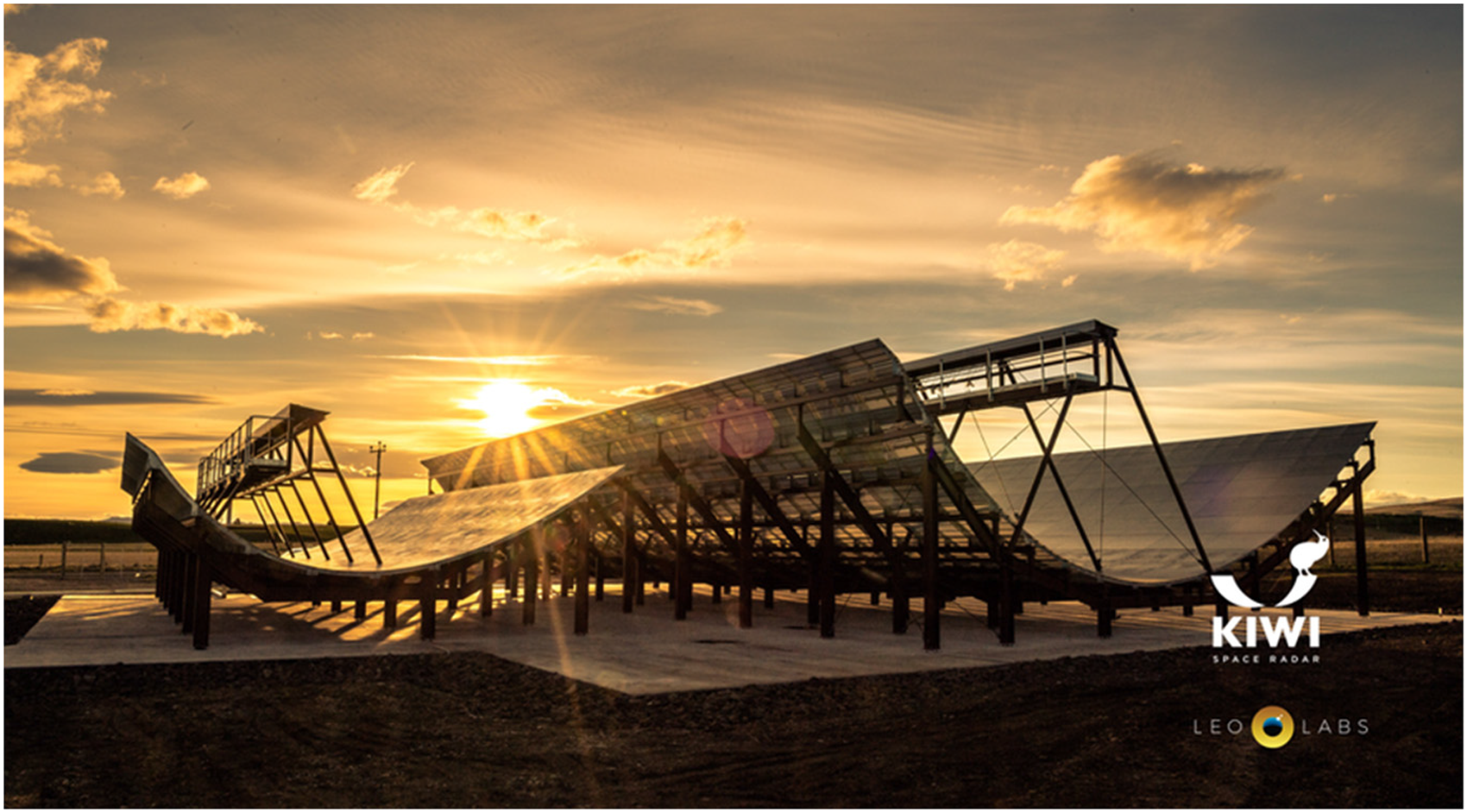
LeoLabs radards in New Zealand. Picture by LeoLabs.
Increasingly, many of the above-mentioned organizations have joined forces to explore ambitious space-related projects. A high-profile example is MethaneSAT, a space mission to deploy a satellite that monitors methane emissions on earth (MBIE, 2021). The satellite was built and will be used by the Environmental Defense Fund, a US-based nonprofit environmental advocacy group. The MBIE (Ministry of Business, Innovation and Employment) has committed NZ$26 million to support the project. The satellite was launched on a Rocket Lab Electron and Rocket Lab currently houses MethaneSAT's mission control, but this will be transitioned to the University of Auckland's Te Pūnaha Ātea—Space Institute. In addition, formal and informal groups that support collaboration and knowledge sharing are being established. For instance, Aerospace Christchurch has been set up as an industry body that offers mentoring and networking events. The initiative's president is Mark Rocket, the former seed investor and co-director of Rocket Lab and founder of Kea Aerospace. As a result, the NZ space industry has seen dramatic growth rates. A November 2019 report that the MBIE commissioned from Deloitte shows the NZ space sector was worth NZ$1.69 billion in 2018–2019 and supported 12,000 jobs (MBIE, 2019).
Dark clouds in space?
Despite ever-increasing activity and impressive growth rates, several issues may potentially stymy Rocket Lab's growth and, relatedly, the development of NZ's space industry (informal conversation, industry experts, August 2021).
First, even though the university system has introduced space-related qualifications, it is questionable whether the supply of talent will match demand. This is not unlike the case in other NZ industries that suffer from ‘brain drain’—a phenomenon that refers to the net outflow of highly skilled people who leave NZ for better job opportunities, higher salaries or lower costs of living. Also, some observers have noted the lack of skill diversity in the space sector. While the industry attracts graduates with science, engineering and technology backgrounds, the sector seems to be lacking space-specific business or legal expertise. Second, Rocket Lab arguably plays a role in stymying the growth of the overall I&EE by attracting all the local talent. One only need look at the LinkedIn profiles of Rocket Lab employees in NZ to understand that the firm is drawing employees from other firms that are actively or potentially seeking to work in the space industry. This competition-stymying effect is paradoxical, given that Rocket Lab is fuelling the growth of suppliers. Also, some observers note that Rocket Lab's success has led to a focus on activities in the ‘upstream’ part of the space industry; in particular, launch services, spacecraft, subsystems and components manufacturing. In contrast, awareness about, and interest in, opportunities in the so-called ‘space downstream segment’ remain somewhat limited. In essence, these refer to applications that are based on space technology such as the utilization of satellite data. Notably, internationally, the downstream sector accounts for the largest share of the space economy and is lauded for its potential to make a positive socio-ecological impact (Moranta, 2022). Another issue is the lack of local financing options for NZ-based ventures. Some experts question whether NZ offers enough venture capital for startups; in particular, the large amounts needed to scale ventures once they move beyond the seed stage. Similarly, NZ's space industry and Rocket Lab suffer from geographical distance to large customers.
This points to a key issue that may hinder the development of the local space industry. In search of talent, finance and customers, sooner or later space companies are likely to leave NZ. This is a common source of angst among economic policymakers and media in NZ. For instance, when LanzaTech, another high-profile NZ startup, relocated its operations to the US in 2014, local newspapers were quick to point out that it had received around NZ$14 million in NZ taxpayer funding since it was founded in 2005 (see Keall, 2022). This begs the question of whether, and how, NZ can become more attractive for space (and other) ventures who seek to scale. These challenges are likely to amplify in the future as NZ's role as a ‘space power’ in the region used to be unique but is unlikely to remain so. The clearest challenger to NZ's status is Australia, which is beginning to develop a host of sovereign space capabilities. With its larger market size and more active defense posturing, Australia may become a more attractive hub for space-related jobs, investments and entrepreneurial activity (informal conversation, industry experts, August 2023). Also, space seems to attract the attention and aspirations of policymakers around the world. Several EU countries, India, China and others have announced new programs to support new space activity. This begs the question of whether, and how, NZ can benefit from the head start it obtained in the wake of Rocket Lab's pioneering efforts.
Questions
Taking a top-down view on I&EE, identify the key attributes that explain the emergence of Rocket Lab and NZ's space industry. From such a perspective, what can policymakers do to support the development of a well-functioning I&EE?
Taking a bottom-up view on I&EE, what are the key mechanisms that explain the emergence of the trajectory of NZ's space industry? From such a perspective, what can policymakers do to support the development of a well-functioning I&EE?
What are the key challenges and risks for NZ's space I&EE? Ground your analysis in related theory.
How can policymakers and other I&EE actors (e.g., regional development agencies or universities) address the risks and challenges identified in Question 3?
Teaching note
Synopsis of the case
The case recounts the story of Rocket Lab, an aerospace manufacturer and LSP founded in 2006. The case begins by introducing Rocket Lab's founder, Peter Beck, who was able to realize his childhood dream of working with rockets despite being born in a country with no established space industry. While the case touches on entrepreneurial phenomena at the individual level (e.g., Beck's upbringing, interests and career) and at the firm level (e.g., Rocket Lab's value proposition), the emphasis is on the broader context, the NZ I&EE. The NZ I&EE was not only crucial for Rocket Lab's success but, conversely, also significantly shaped by the firm's actions. For instance, former Rocket Lab employees founded space-related startups, universities started to offer degrees in aerospace engineering, established firms began to supply the space sector and the government implemented tailored support mechanisms. Although the case reads like a success story, it hints at challenges and questions the sustainability of the ‘space boom’ that is happening in NZ.
Teaching objectives and target audience
The key objective of the case is to introduce students to a context-sensitive view of entrepreneurship and innovation and is suitable for under- and post-graduate courses. In particular, the case highlights the fundamentally ‘systemic’ nature of context and the interactions and interconnections between constitutive elements. To illustrate these dynamics, the case centers on the importance of anchor firms for shaping I&EEs. At the same time, the case seeks to introduce a more critical view of I&EEs, especially when most activities center around a few dominant actors.
Teaching approach and strategy
Consistent with the interpretive and dialectic nature of case teaching, the questions are deliberately broad and will evoke a range of responses. Our suggested teaching strategy moves from aspects that might be perceived as ‘obvious’ to a deeper exploration of underlining dynamics. From our case teaching experience, this approach will maintain a high level of energy in the class and stimulate critical thinking and deeper learning because of the ‘Aha!’ effect it generates. To introduce the case, the concept of I&EE can be explored through a brief discussion on how different elements (e.g., animals, plants and humans) in natural ecosystems depend on each other to survive and thrive.
Analysis and conclusions
The case is more suitable for an in-class discussion where the lecturer can challenge students to go beyond surface-level explanations. This is reflected in the sample answers, which move from basic aspects to less obvious ones.
Question 1: On a top-down view of I&EEs
A ‘top-down’ view of I&EE seeks to identify necessary conditions or attributes that support high-growth entrepreneurship. Students should be encouraged to use a mapping tool, potentially in combination with a collaborative platform such as Miro (www.miro.com). One option, a revised version of Spigel's (2017) triangle, is depicted in Appendix I. Students are to list a wide range of ‘building blocks’ that supported Rocket Lab. Although this exercise might seem trivial, it will encourage a close engagement with the case. From a policy perspective, students should be able to articulate that a top-down view on I&EEs would mainly suggest that policymakers need to ‘strengthen’ the identified attributes: implementing laws and regulations that favour entrepreneurship and innovation, making grants and venture capital available and establishing incubators and accelerators. However, more astute students should quickly recognize that the identified attributes were at best facilitative and that it was by no means ‘inevitable’ that a space industry emerged within NZ. This aspect can be combined with a nuanced discussion on the potential downfalls of top-down policy interventions and examples of ‘weak’ I&EEs, where policy support did not create the envisioned impact.
Question 2: A bottom-up view of I&EEs
A bottom-up view focuses on the processes and practices individual entrepreneurs employ within a region and how these contribute to the overall effectiveness of an I&EE. This perspective (see Appendix II) emphasizes on how I&EE attributes are influenced by Rocket Lab. The most important ones are perhaps the creation of customer demand (e.g., for composites), tailored space policy, development of skills and expertise and the launch of multiple space-related startups. In contrast to the attributes identified in Question 1, these aspects are more space-specific and reflect the emergence of a sub-ecosystem around specific technologies, industries and interests. This discussion can also be linked to the importance of anchor firms in well-functioning I&EEs. Although Rocket Lab, as an anchor firm, is at the center of the emerging sub-ecosystem, students should also be able to identify the “self-reinforcing relationships between various attributes that reproduce and transform the ecosystem over time” (Spigel and Vinodrai, 2020: 602). For instance, spin-offs created by Rocket Lab employees created new demands, new skills and more potential mentors or role models. From a policymaker's perspective, Question 2 highlights the importance of fostering relationships between elements rather than top-down interventions. A range of options are feasible (and hinted at in the case): supporting formal and informal communities (e.g., Aerospace Christchurch) with a particular focus on diversity, ringfencing some governmental funding for collaborative projects, supporting private–public partnerships (e.g., the MethaneSAT mission), shifting support from startups and including established firms or making governmental space data available for free so downstream services can emerge.
Question 3: On the key challenges and risks for the NZ space industry
The case already touches on some key challenges in the industry (e.g., lack of funding, lack of skills and talent, lack of local customers and geographic isolation). More nuanced challenges can be identified through a closer engagement with the theory, especially related to the role of anchor firms. As visible in Appendix II, Rocket Lab is very much at the center of the I&EE. On the one hand, that raises the question of whether the industry can keep growing if Rocket Lab shifts its operations to the US. More importantly, Rocket Lab's dominant role might evoke a focus on certain kinds of space activity: highly visible, high-profile projects such as Kea Aerospace. Conversely, it can be argued that this draws attention away from other types of space activity; namely, downstream services. The case also suggests that the industry is very much STEM-dominated, which raises the question of whether the I&EE inadvertently excludes founders and talent that do not fit within ‘stereotypical’ assumptions in the sector.
Question 4: On how key challenges and risks can be addressed
How this question is answered depends on the challenges identified in Question 3. Perhaps the most obvious answer is that policymakers can address some aspects through intervention mechanisms: funding education, establishing investment funds, buying services and products or implementing policy incentives (e.g., tax credits). Given the firm's dominant role in the local I&EE, a potentially more interesting discussion relates to how the government can ensure that Rocket Lab stays in NZ. To stimulate discussion, the lecturer could bring up examples of local startups who received significant support from policymakers but nevertheless relocated their operations. Some students might quickly start discussing how regulatory hurdles or payback requirements may deter Rocket Lab from moving to the US. Building on this, the lecturer could play devil's advocate and ask whether there is any chance that Rocket Lab will realize its full potential if it remains in NZ and if it is indeed undesirable that firms leave once they reach a certain size. Ultimately, overseas markets will always have a larger customer base and more finance options and it is hard to see how Rocket Lab could continue to grow without relocating much of its operations. More importantly, research shows that the relocation of big firms can have a positive impact; for example, if employees do not follow their employers but stay behind and found their own startups. A third aspect that is worth discussing is how the industry could become more ‘inclusive’; for example, via specific funding for female-led startups or space-related courses at non-STEM faculties.
Footnotes
Declaration of conflicting interests
The authors declared no potential conflicts of interest with respect to the research, authorship, and/or publication of this article.
Funding
The authors received no financial support for the research, authorship, and/or publication of this article.

Notes
APPENDIX I
APPENDIX II