



Abstract
This letter analyzes coalition patterns among right-wing groups in the European Parliament, exploring the conditions that lead these groups to unite on policy. Using voting records from 2019 to 2024 and Legislative Observatory data, we identify three coalition types: Grand Right (all right-leaning groups), Far Right (excluding the center-right European People’s Party), and Center Right+ (including at least one far-right group). The potential for right-wing unity is substantial, particularly on EU Integration, climate, security, and cultural issues. For 2024–2029, two possibilities for right coalitions emerge: the European People’s Party allies with the far-right on cultural, climate, and security issues, challenging the European Parliament’s progressive stance, or the far-right joins the center-right on economic issues, normalizing right-wing influence in EU policymaking.
Introduction
In the June 2024 European Parliament (EP) elections, political forces on the right gained strength (Mudde, 2024). The total number of seats increased by 17, from 703 to 720. The center-right European People’s Party (EPP) captured over half this increase, raising its seats by 9 to 188. To its right, the European Conservatives and Reformists (ECR) gained the same number of seats, totaling 78. Further right, the Identity and Democracy group (ID), now rebranded as Patriots for Europe (PfE), expanded from 49 to 84 seats. Meanwhile, the number of non-attached members decreased, and a new far-right group, Europe of Sovereign Nations (ESN), formed as the new parliament convened in July 2024. 1
The previous EP was characterized by a grand coalition of the center-left and center-right, with the liberal Renew group as kingmaker. In the new parliament, the center-right EPP holds the median Member of the European Parliament (MEP). 2 However, Mudde (2024: 122) argues that this numerical strength is unlikely to translate into policy. Nevertheless, coalitions may form on specific issues or through issue linkage. This letter examines coalition patterns 3 of the center-right and far-right in the previous EP and demonstrates significant potential for right majorities.
We identify topics for potential right coalition formation in the current EP by analyzing voting behavior from the previous legislative term (2019–2024). Specifically, we calculate the share of votes where three types of right coalitions diverged from other members of the grand coalition, including the center-left S&D and liberal Renew groups. We classify right coalitions into three types: (a) Grand Right, uniting the center-right and far-right; (b) Far Right, uniting far-right groups but excluding the center-right EPP; and (c) Center Right+, uniting the center-right with at least one additional far-right group. We link roll-call votes to subject codes from the Legislative Observatory, offering a more fine-grained classification of policy areas than prior large-N studies of the EP (see, for example, Börzel et al., 2023).
The Grand Right coalition is the only realistic coalition requiring far-right participation that could form a majority in the EP on certain topics. This coalition was rare in the previous term but could form in two ways: either the center-right joins the Far Right coalition, or all far-right groups join the Center Right+ coalition. We show the most likely scenario for a Grand Right coalition is the EPP aligning with far-right groups on cultural, security, or climate issues. The second most likely scenario is far-right groups uniting with the EPP on economic issues.
Topics and coalition potential
Coalition formation in the EP has traditionally followed a left-right dimension, with a secondary anti-/pro-integration dimension (Hix et al., 2003, 2005). Recent studies suggest a partial rotation of the policy space (Bleumenau and Lauderdale, 2018), with the national dimension gaining importance (Cencig and Sabani, 2017) or collapsing into a pro-/anti-EU dimension (Buzogány and Cetkovic, 2021), reflecting growing domestic competition over EU politics (Hobolt and Rodon, 2020; Vachudova, 2021). Central to this account are wedge issues—issues that divide mainstream parties internally and split their electorates (De Vries and Hobolt, 2020; Riker, 1986). Wedge issues have divided the center-right and far-right. Far-right groups have neither been cohesive nor decisive (Brack and Marié, 2024; Börzel et al., 2023). The cordon sanitaire has also limited far-right influence until 2024 (Axelsen, 2024; Finnsdottir, 2024). However, until now, a right coalition including the far-right could not form a winning majority—this changed with the 2024 elections. 4
In the EP, national delegations organize into supranational party groups, amplifying internal frictions on wedge issues. Börzel et al. (2023) show that Euroskeptics diverged from the Europhile mainstream on cultural, distributive, and constituent issues. European Integration garners mainstream support but faces opposition from far-left and far-right parties alike (Brack, 2015). Van der Brug and Fennema (2007) attribute the success of right parties in Europe to their anti-immigration stance. Kantola and Lombardo (2021) show how the right increasingly contests the mainstream on gender equality. Based on MEP vote justifications, Forchtner and Lubarda (2022) show the right often views climate change more negatively, emphasizing economic consequences. Similarly, Dickson and Hobolt (2024) find environmental politics has become a key mobilization issue for West European right parties (see also Yazar and Haarstad, 2023).
Foreign and security policy, especially the war in Ukraine and sanctions against Russia, divides the right, with the ECR often aligning with the EPP and center-left against parts of the ESN and non-attached members (De Candia and Bressanelli, 2024; Fagerholm, 2024; Hooghe et al., 2024; Mudde, 2024; Wondreys, 2023). While less common, the ECR may also find itself isolated on other votes (for an analysis of ECR voting behavior see De Candia and Bressanelli, 2024).
Right-coalitions and coalition potential
Our data links roll-call votes from the 9th EP term (2019–2024) with Legislative Observatory data assigning subject codes to reports and resolutions. Data were collected from the EP minutes and Legislative Observatory websites. We identify three right-coalition types: Grand Right, Far Right, and Center Right+. The Grand Right coalition includes all right-leaning EP parties, from the European People’s Party (EPP) to the far-right groups: European Conservatives and Reformists (ECR), Patriots for Europe (PfE), and Europe of Sovereign Nations (ESN). The Far Right excludes the EPP, while Center Right+ includes the EPP with at least one other right-wing group but not all.
We use current EP party group labels. Both the PfE and ESN were formed after the 2024 elections, with the ID group no longer existing. MEPs are assigned based on national party affiliations; for instance, Alternative for Germany members, formerly of the ID group, are coded as ESN members.
Votes where all party groups voted the same way or lacked Legislative Observatory links or subject codes were excluded, leaving 14,465 votes for analysis. 5
Table 1 shows the share of votes for each right-coalition type. In
Right coalitions across vote types.
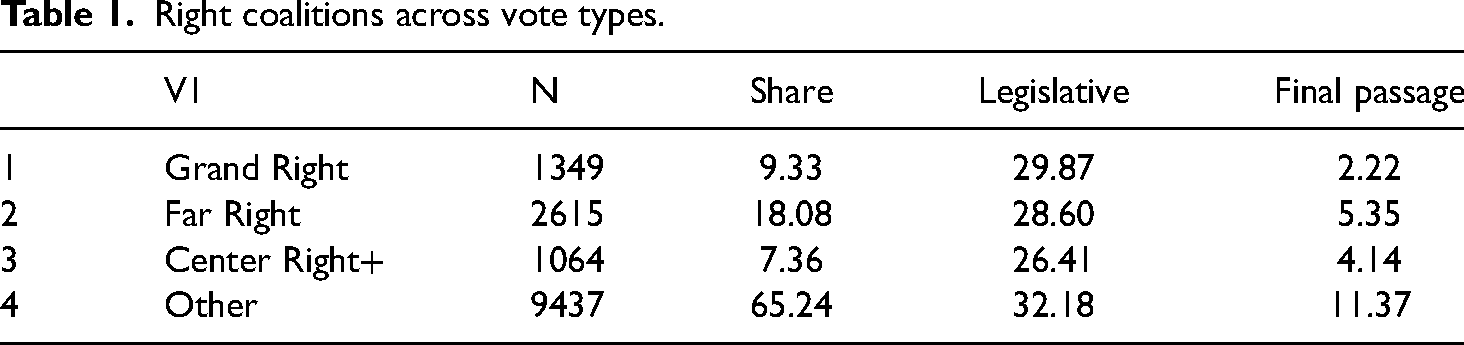
A Far Right coalition formed in
We distinguish between legislative and non-legislative votes, as well as final passage votes and part votes (amendments). Legislative votes have greater policy implications, while non-legislative votes often address salient topics, shaping perceptions of the EU. Final passage votes attract more attention (Brack and Marié, 2024), but key changes are often made in more conflictual amendments. A focus on whole votes would suggest symbolic opposition over policy influence.
Our results show the share of legislative votes in right coalitions is similar to other coalition types. However, the share of right coalition votes on final passage votes is lower. We interpret this as evidence that the right seeks to influence policy rather than prioritize symbolic opposition.
In summary, all right groups agreed on 9% of votes, forming potential majorities in the 2024–2029 term. For another 18%, a Far Right coalition could command majorities if the EPP joins. For 7%, a Center Right+ coalition could secure majorities if far-right groups align with the EPP. Together, the right has coalition potential for about a third of the votes.
Next, we explore topics associated with the Grand Right, Far Right, and Center Right+ coalitions.
Right-coalitions across topics
For votes with a right coalition, we extract subject codes from the Legislative Observatory. We count the total votes on each topic and calculate the share involving a right coalition, adjusting for the frequency of votes on each topic in the European Parliament.
Table 2 ranks topics by the share of votes with a right coalition for each coalition type. Since the coalitions are mutually exclusive, summing the shares across coalitions highlights the topics with the highest overall potential for right coalition formation, shown in the column labeled Total %. The top five topics in each category are highlighted in bold.
Topics that unite the right.
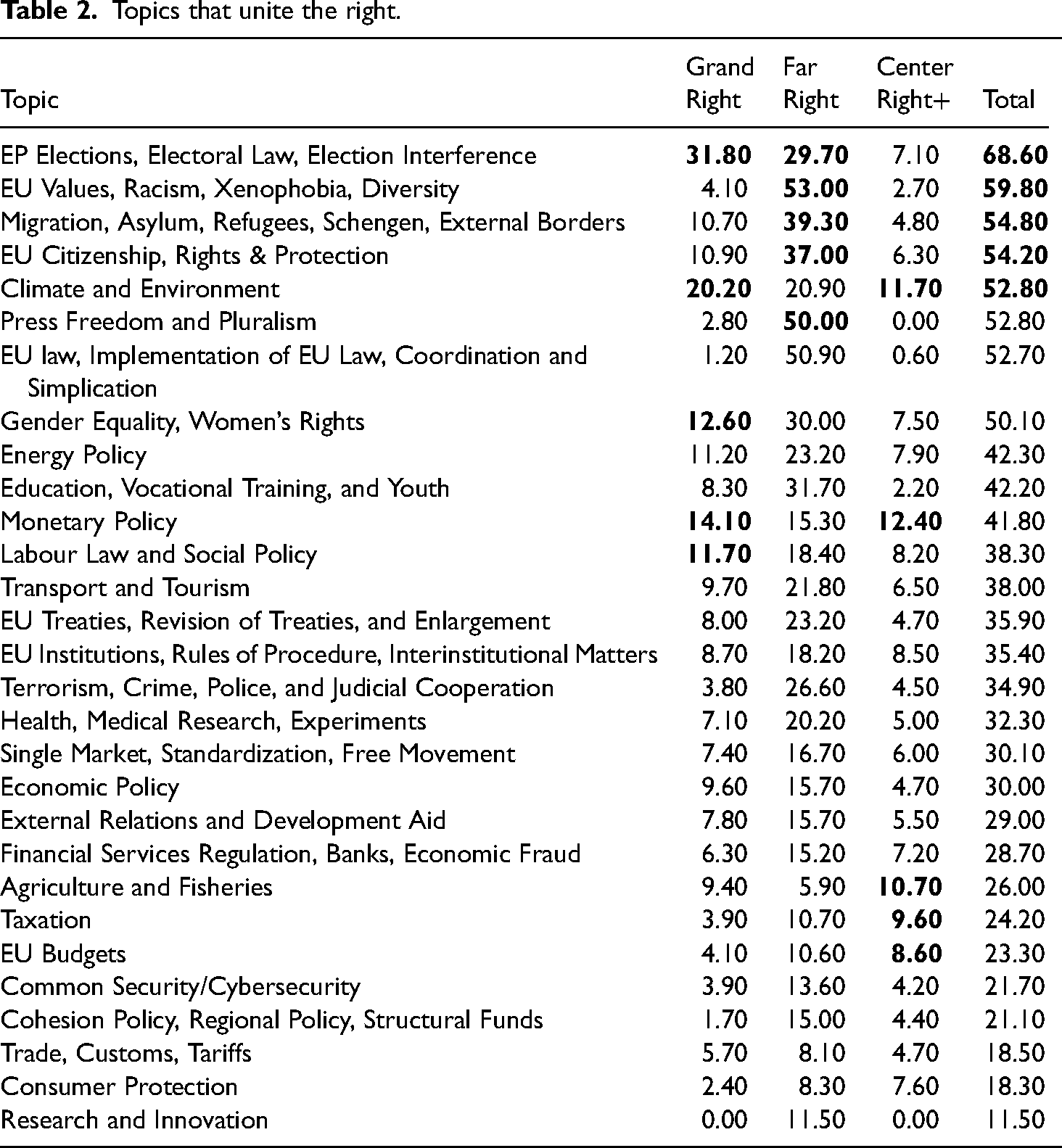
In the Grand Right coalition, there would already be a right majority in EP 10. Topics include a mix of EU integration issues like ‘‘Elections’’ and ‘‘Climate & Environment’’; economic topics such as ‘‘Monetary Policy’’ and ‘‘Labour Law & Social Policy’’; and cultural issues like ‘‘Gender Equality’’ and ‘‘Migration.’’ The Far Right coalition focuses on EU integration, classic right-wing issues like ‘‘Gender Equality’’ and ‘‘Migration,’’ and the new right-wing topic of ‘‘Climate & Environment.’’ The Center Right+ coalition emphasizes economic policies, with topics like ‘‘Monetary Policy,’’ ‘‘EU Budgets,’’ and ‘‘Agriculture & Fisheries.’’ Overall, the topics with the highest potential to unite the right are ‘‘EP Elections, Electoral Law, Election Interference’’ (69% of votes involving a right coalition), ‘‘EU Values, Racism, Xenophobia, Diversity’’ (60%), ‘‘Migration, Asylum, Refugees, Schengen, External Borders’’ (55%), ‘‘EU Citizenship, Rights and Protection’’ (54%), and ‘‘Climate and Environment’’ (53%).
In summary, the right already holds a majority on several votes concerning EU Integration, Climate and Environment, Gender Equality, Migration, and some security and economically right-leaning issues. This potential could grow further if the center-right EPP aligns more frequently with the Far Right on security, cultural, and wedge issues like Climate and Environment, Gender Equality, and Migration. Additionally, on economic topics the Far Right could join the EPP. The coalition potential is substantial, especially because majorities are formed on an issue-by-issue basis, facilitating linkages across topics.
Discussion
In this letter, we linked plenary voting records with topic classifications from the Legislative Observatory to identify topics that unite the right in the European Parliament. We distinguished three types of right coalitions: Grand Right, Far Right, and Center Right+. The Grand Right coalition includes all right political groups, highlighting topics where the right already commands a majority in the 2024–2029 EP. The Far Right coalition excludes the EPP, while the Center Right+ coalition includes the EPP and at least one other right-wing group, but not all. These coalitions show the potential for expanding the right majority further.
The Grand Right coalition formed in 9% of votes, particularly on EU Integration and Climate and Environment. The Far Right coalition formed in 18%, focusing on EU Integration, Security, Climate and Environment, Migration, and Gender Equality. The Center Right+ coalition formed in 7%, emphasizing economic issues such as Monetary Policy, EU Budgets, Agriculture, and the Single Market. Topics most likely to unite the right overall include: (a) ‘‘EP Elections, Electoral Law, Election Interference,’’ (b) ‘‘EU Values, Racism, Xenophobia, Diversity,’’ (c) ‘‘Migration, Asylum, Refugees, Schengen, External Borders,’’ (d) ‘‘EU Citizenship, Rights and Protection,’’ and (e) ‘‘Climate and Environment.’’
Following the 2024 elections, the right has significant potential to influence EU policy, which could expand further if the EPP aligns with the far right on security, climate, or cultural issues, or if the far right supports the EPP on economic matters. This potential is particularly pronounced because majorities are formed on an issue-by-issue basis, facilitating linkages across topics. The EPP’s decisions will shape the policy direction of the new parliament. If the EPP shifts to the right on climate and culture, the progressive stance that the European Parliament has maintained on these matters may diminish. Conversely, if the EPP consolidates right-wing groups on economic issues, the normalization of the right in European politics will be complete.
Supplemental Material
sj-pdf-1-eup-10.1177_14651165251341573 - Supplemental material for What unites the right in the European Parliament?
Supplemental material, sj-pdf-1-eup-10.1177_14651165251341573 for What unites the right in the European Parliament? by Philipp Broniecki and Bjørn Høyland in European Union Politics
Supplemental Material
sj-zip-2-eup-10.1177_14651165251341573 - Supplemental material for What unites the right in the European Parliament?
Supplemental material, sj-zip-2-eup-10.1177_14651165251341573 for What unites the right in the European Parliament? by Philipp Broniecki and Bjørn Høyland in European Union Politics
Supplemental Material
sj-zip-3-eup-10.1177_14651165251341573 - Supplemental material for What unites the right in the European Parliament?
Supplemental material, sj-zip-3-eup-10.1177_14651165251341573 for What unites the right in the European Parliament? by Philipp Broniecki and Bjørn Høyland in European Union Politics
Footnotes
Acknowledgements
The authors would like to thank the editor and two anonymous reviewers for helpful comments and suggestions.
Declaration of conflicting interests
The authors declared no potential conflicts of interest with respect to the research, authorship, and/or publication of this article.
Funding
The authors disclosed receipt of the following financial support for the research, authorship, and/or publication of this article: The research was funded by the Research Council of Norway, grant 301021.

Data availability statement
The replication files will make our code publicly accessible without limitations (Broniecki, 2025).
Supplemental material
Supplementary material is available online.
Notes
References
Supplementary Material
Please find the following supplemental material available below.
For Open Access articles published under a Creative Commons License, all supplemental material carries the same license as the article it is associated with.
For non-Open Access articles published, all supplemental material carries a non-exclusive license, and permission requests for re-use of supplemental material or any part of supplemental material shall be sent directly to the copyright owner as specified in the copyright notice associated with the article.
