



Abstract
The Ukrainian crisis has significantly shifted public opinion against Russia and Putin, placing politicians with prior Russian ties in a precarious situation. This paper tracks how parties that had some affinity to Putin have pivoted after the outbreak of war. Through computational text analysis of a decade of Facebook posts from 11 European radical right parties, we investigate their stance evolution towards Russia and their strategic management of public sentiment and Russian relationships. The results show that most radical right parties, after the invasion, neither tried to remain pro-Russia nor focussed their attention on shifting their prior position. Instead, they engaged in blurring the issue, diverting attention away from the war and using the events in Ukraine to assert their anti-EU positions.
Introduction
The full-fledged Russian invasion of Ukraine that started in February 2022 was a watershed moment for European politics, as it presented European states with stark dilemmas. For the European governments, it created a problem, as they had to choose a political path that balanced their willingness to stand in solidarity with the invaded Ukraine and the necessity to guarantee the maintenance of energy sufficiency in the coming months, as Russia turned off the gas flows towards Europe in response to its helping stance towards Ukraine. Concurrently, they had to think about the potential political cost of any increases in energy prices but also the one of not appearing to stand sufficiently close to Ukraine as most of the European public was swept by a feeling of solidarity towards the ravaged country to their east. In successive opinion polls, the European public was very favourable and sympathetic towards the plight of Ukrainians while becoming increasingly hostile towards Russia and its autocratic leader, Vladimir Putin (Moise and Wang, 2025; Thomson et al., 2023).
This created, however, an additional dilemma for parties in Europe which had invested in cordial relationships with the Russian regime. Infamously, Marine Le Pen had to withdraw her electoral leaflets that included a photograph of her with Putin in order to appease the French public which had turned fervently against the Russian regime. The same applied to other parties in Europe, particularly from the radical right family that had, in the past, cultivated their relationship with the Russian leader, such as the Lega in Italy or the FPO in Austria (Polyakova, 2014; Umland, 2017). In this artcile, we study the evolution of the position of those parties vis-à-vis Russia over time to see how they addressed the turn of the tide of public opinion and how they managed their ties with Russia. Our main argument is that the invasion necessitated a response from the radical right parties, to curtail the potential damage caused by the close ties to the Russian regime. As such, we should expect two outcomes: A drop in the frequency of talking about Russia and a position shift on Putin and Russia away from overt support. We generally believe there were four types of reactions to the Ukraine invasion, namely cutting ties to Russia (i.e., shifting position), remaining silent, changing or blurring the topic or finally remaining defensive of Putin’s regime and war.
To explore this potential position shift, we selected 11 radical right parties based on the following factors. First, we found qualitative evidence, namely media reports, supporting their ties to the Kremlin to varying degrees. Their links to Russia included the taking of loans, official visits to Moscow and open praise of the Russian leadership. Second, we also tracked their statements about Putin and all of them, again to a varying but considerable degree, expressed positive evaluations of Vladimir Putin as an archetype of conservative authoritarianism that could potentially served as an ideological and political role model.
This study examines the shifts in position and salience regarding Russia and Putin through a combination of computational text analysis and qualitative narrative. The analysis focuses on Facebook posts from the official accounts of the parties and their leaders. To assess the prominence of Russia-related issues, the frequency of posts mentioning Russia is counted, while we also track the sentiment towards Russia in those posts that contain references to it, by utilising Large Language Models (LLMs) to assess whether the reference is in a positive or negative direction.
The extent to which there has been a shift is different for each party, also depending on its prior stance. Some parties were more active than others on the topic and we find that there have been mixed reactions to the invasion, with some turning away from Putin’s Russia faster than others. We believe the degree of change might clarify a major question of the affinity between the radical right and Putin. Specifically, whether their congruence was strategic or principled, i.e., whether those parties supported Putin mainly to portray themselves as having strong allies in the international scene and hold it as an example of a country where their ideological peers were in power or whether their affinity to the Russian leader authentically stemmed from shared principles and conservative worldviews. If the former rather than the latter, we should expect strategically behaving parties to abandon Putin faster and harder, or at least to avoid the topic more, as this might be causing damage to their electoral fortunes.
Additionally, we examine shifts in the generally Eurosceptic outlook of those parties. The war, if their revulsion towards Russia’s invasion was genuine, might have provided a chance to make a Europhile turn, based on the issue of security and common defence. Instead though, they might have followed a reverse logic, using the invasion as a pretext to accuse the EU of mismanagement of the common response and once more assert that their Euroscepticism is vindicated. Finally, they could take the side of Russia overtly and accuse the EU of its hostile chance towards what they might consider a justly aggrieved superpower. As we believe the position towards the EU, a staple of radical right preferences, might have been affected greatly by the Russian invasion, we also track it here and juxtapose it to the parties’ stance towards Russia.
In this article, we explore how European radical right parties, many of which have had historically positive relations with Russia, responded to the invasion of Ukraine. We expect that these parties would adapt their stance on Russia, given the war’s impact on public opinion across Europe. Using computational text analysis of Facebook posts from 11 radical right parties, supplemented by a qualitative analysis, we examine how their rhetoric evolved. Our findings reveal a nuanced response: While some parties distanced themselves from Russia, others avoided direct confrontation by shifting the narrative to issues such as energy security and Euroscepticism, thereby strategically mitigating potential political fallout.
European radical right parties and Russia
Extensive research has been conducted on the relationships between Russia or Putin and radical right parties (Polyakova, 2014; Snegovaya, 2022; Umland, 2017). According to several studies (Braghiroli, 2015; Braghiroli and Makarychev, 2016), numerous European radical right parties are intellectually and ideologically captivated by Putin’s Russia. This affectionate relationship has been extensively pushed by Russia during the past several years. In 2015, for instance, the Kremlin organised a conference in St. Petersburg under the name of the Putin-supporting All-Russian Political Party ‘Rodina’, inviting numerous representatives of European radical right parties (Oliker, 2017). In 2020, Russian Foreign Minister Sergei Lavrov greeted a delegation from the German radical right party AfD led by its co-leader Tino Chrupalla invited by the Russian State Duma. There are also many accusations, which are difficult to confirm, that Russia has supplied financial support to a number of radical right parties, including the Lega of Italy, the National Rally of France, and the Jobbik of Hungary (Orenstein and Kelemen, 2017).
Besides the connection between the radical right and Russia, the link between the Kremlin and the European radical left has also been investigated. Russia has depended on communist-era connections to win over the radical left parties in Europe (Sakwa, 2021). It appears that radical left parties in Europe are receptive to Putin’s rhetoric of “sovereignty and functional anti-fascism” (Braghiroli and Makarychev, 2016). Therefore, pro-Russia parties in Europe can be found on both the left and right sides of the ideological spectrum (Onderco, 2019). However, the connection between the radical right and Russia is relatively stronger vis-à-vis the radical left. For example, suspicious social media accounts with Russian links were more prominent on the conservative side and less active on the liberal side during the 2016 US presidential election (Golovchenko et al., 2020).
Why did the radical right parties in Europe and Russia become bedfellows? Existing research provides various explanations, ranging from ideological congruence to pure pragmatism. First, a strand of research holds that Putin’s regime, rather than being non-ideological, has a particular ideology that is substantively comparable to that of European radical right parties. Proponents of this approach contend that the ideological affinity between radical right parties in Europe and Putin’s Russia is founded on their shared adherence to one or more versions of right-wing ideology. Both radical right parties and Putin’s regime oppose the principles of liberal democracy, western capitalism and the EU’s cosmopolitan profile (Havlík and Kluknavská, 2023; Ivaldi and Zankina, 2023). In other words, radical right parties might be regarded collectively as anti-system parties. These parties uphold nationalism, national independence, and traditional values (Sommer, 2008). According to Lewis (2020), the majority of Russia’s political elite, rather than lacking ideology, shares anti-liberal and counter-revolutionary tenets that form a coherent worldview. Some researchers explicitly connect Putin’s Russia to previous and contemporary right-wing ideologies, tracing the government’s intellectual origins to the neo-Eurasianism of Aleksandr Dugin and his predecessors (Bassin et al., 2015) and in the entire spectrum of the Russian far right’s ideological tendencies (Kolstø and Blakkisrud, 2016).
While some researchers argue that Putin’s regime is nothing less than fascism (Snegovaya, 2017), others regard Putin’s political leaning as modern conservatism which holds that the future outlook of Russia must rest on the elements of tradition, patriotism and sovereignty (Chebankova, 2016). Even in this milder version, the clearly right-wing culturally conservative character of Putin’s ideology is readily obvious. Russia sees itself as the last defender of traditional family values, patriotic ideals, and religious beliefs and the only nation capable of halting the moral meltdown caused by the moral decline of European countries, precipitated to a large degree by the EU (Bluhm and Varga, 2020). This viewpoint coincides with that of radical right parties that have embraced these traditionalist and conservative concepts and disseminated them across Europe and in opposition to Europe. European radical right parties have sided with Putin in the rekindled culture war between Western social liberalism and traditional conservatism.
Moving away from left-right ideological congruence explanations, other scholars focus on explanations that are based on pragmatism. It is commonly acknowledged that Russia’s current foreign policy is constantly anti-US and increasingly aimed at weakening European integration (Nitoiu, 2017). Anti-Americanism and Euroscepticism are highly evident aspects of the political position of a number of European radical right parties (Rohrschneider and Whitefield, 2016). Putin’s Russia utilises these views by openly questioning the benefits of being within the European Union, NATO, and the transatlantic block. At the same time, it propagates narratives on related topics, such as Europe’s demise or the manipulation and exploitation of EU member countries by corrupt elites in Brussels (Rebegea, 2019). Due to radical right parties’ resistance against European integration, these parties consider Russia a role model for a genuinely independent nation with absolute control over sovereignty that may help counteract America and Europe’s control over their nation, assisting them in distancing themselves from the European-Atlantic block (Klapsis, 2015). Their Euroscepticism is bolstered by Putin’s narratives, which emphasises the significance of national sovereignty, national identity, and pride, leading to a generally negative stance towards the European Union. In contrast to the EU, Russia is portrayed as a geopolitical alternative that challenges the EU’s hegemony.
This alone might provide a sufficient basis for the political affinity between Russia and radical right parties, especially with regard to opinions toward Russia (Gressel, 2017; Orenstein and Kelemen, 2017). If Euroscepticism is the primary cause for these parties’ liking for Russia, the relationship is founded on, instead of ideological similarity, political calculations. Put differently, Putin’s Russia and European radical right parties pragmatically use each other, which “translates Russia’s policies into a trans-ideological repertoire of different discourses that differently resonate among the groups of Russia sympathisers” (Braghiroli and Makarychev, 2016).
The radical right’s response to Russia’s invasion
As we noted, the ideological underpinnings of radical right parties often align with the conservative and authoritarian tendencies epitomised by Russia’s political landscape. However, the full-fledged invasion of Ukraine by Russia has unfolded as a significant international crisis, posing a critical juncture for these parties in the face of shifting geopolitical narratives and public sentiment.
Historically, the steadiness in political party positions is anchored in enduring core values and constrained programmatic flexibility (Hooghe and Marks, 2018). This stability is arguably heightened in parties at the political spectrum’s fringes, which are more responsive to their supporter base than to the median voter’s stance shifts (Ezrow et al., 2011). In the realm of foreign policy, party position stability is notably pronounced, sculpted by geographical, historical, and alliance factors like EU and NATO affiliations. Unlike the more contentious domains of economic and social policies, foreign and security policies are often crafted on broad national consensus (Raunio and Wagner, 2020).
Nonetheless, external crises have historically nudged parties to reevaluate their stances, akin to how Green parties in Europe revisited their opposition to military interventions during the 1990s (Brunstetter and Brunstetter, 2011). The Russian invasion of Ukraine arguably presents a similar crisis-inflection point, potentially catalysing a reevaluation of radical right parties’ affinity towards Russia. The ‘rally around the flag’ phenomenon could render parties opposing mainstream policies more visible in the media landscape. Concurrently, the broad support for Ukraine across the EU and its member states, both at institutional and public levels (Moise and Wang, 2025), underscores a mainstream narrative that radical right parties might find challenging to oppose openly.
As entities progressively vying for votes and political office (Akkerman et al., 2016), European radical right parties face a precarious balance. Aligning with a regime increasingly perceived negatively and isolated in the Western milieu post-invasion could incur electoral costs. This dynamic, juxtaposed with the gravitation of substantial segments of extreme political spectra towards mainstream political narratives, posits a plausible scenario where radical right parties might temper their affinity towards Russia to resonate more with mainstream rhetoric.
H1: On average, the positive stance of radical right parties towards Russia will register a decline post-invasion.
While we posit a plausible decline in the positive stance towards Russia among radical right parties post-invasion, the anticipated dip may not plummet into outright aversion. As argued in the previous section, the underpinnings of this moderation can be traced to the enduring ideological congruence and the pragmatic liaisons historically fostered with Russia, encompassing shared anti-liberal democratic ethos, anti-EU sentiments, and opposition to perceived Western hegemony. Moreover, the potential electoral ramifications, especially within constituencies harbouring pro-Russia inclinations, act as a bulwark against an abrupt reversal of stance. Additionally, the symbiotic relationship, wherein Russia and these parties pragmatically leverage each other’s positions in the larger geopolitical chessboard, further militates against a precipitous sentiment nosedive.
Such intricacies necessitate a nuanced analysis of how these parties manoeuvred the discursive landscape after the Ukraine crisis, especially when a hitherto low-salience pro-Russia stance suddenly vaulted into a glaring spotlight. The conundrum stems from an exigency to align with the prevailing anti-Russia sentiment without alienating core pro-Russia constituencies or negating past affiliations. Hence, our interest is also in finding how parties of the radical right handle discursively a difficult position they are found in, when a previously low-salience and pro-Russia position they had taken became untenable. Literature suggests that parties ensnared in such unpopular positions often resort to a variety of tactical discourses to obfuscate (Rovny, 2013), shift their stance, or deflect the discourse altogether (Green-Pedersen and Mortensen, 2015), even employing rhetorical mechanisms to recast the issue in a favourable light (Riker, 1986).
Therefore, we postulate that a medley of the aforestated tactics would be at play. Initially, an overarching evasion of the issue might be attempted. Yet, in contexts where outright avoidance is unfeasible - such as during the French electoral campaign - the tactic might transmute into “blurring” the core issue, veering the discourse towards ancillary yet resonant themes like energy security and pricing.
Given the pervasive disapproval surrounding Russia’s offensive, the likelihood of these parties staunchly upholding their pro-Russia narrative appears dim. The untenability of such a stance in the current political climate propels our hypothesis that neither a complete volte-face–implying a tacit admission of previous misjudgements–nor a steadfast adherence to the pro-Russia narrative–risking public opprobrium–would predominantly manifest. Instead, a more ambivalent discourse is anticipated, meticulously intertwining condemnation of the invasion with advocacy for popularly endorsed stances, such as calls for national government interventions towards peace.
Furthermore, as we shall see, a “rhetoric of perversity” (Hirschman, 1991) has emerged, not overtly contesting support for Ukraine, but critiquing European involvement and sanctions as exacerbating the plight of European populaces rather than imperilling the Russian regime. This nuanced narrative would endeavour to assuage public indignation over the invasion while subtly upholding elements of their prior pro-Russia stance. Consequently, to avoid political backlash for their prior pro-Russia stance and cautiously align with public opinion condemning the invasion, we expect the following behaviour from radical right parties:
H2: The bulwark of radical right parties adopt a strategic discourse encompassing blurring, avoidance, and topic-switching in their communication regarding the Ukraine crisis.
Furthermore, the full-scale Russian invasion of Ukraine contributed to the Europeanisation of the political discourse of European political parties (Sojka et al., 2025). The discursive arena surrounding the Ukraine crisis presents a fertile ground for radical right parties not only to navigate their stance vis-à-vis Russia but also to articulate and accentuate their anti-EU stance. The EU’s response to the crisis, marked by its solidarity with Ukraine and the imposition of sanctions on Russia, is bound to stir the discourse within the radical right factions given their historically anchored Euroscepticism (Mudde, 2007).
The strategic manoeuvring of discourses by radical right parties, particularly during crises, is well documented. Pirro and Van Kessel (2017) show that radical right parties tactically adjust their discourses in response to exigent situations. Historical retrospection also unveils a pattern of hardened Eurosceptic discourses by radical right parties amid the euro and refugee crises (Braun et al., 2019; Rohrschneider and Whitefield, 2016). In crisis, not only do these exigencies potentially amplify the political clout and electoral allure of radical right parties, but such parties also play active roles in framing the crisis narrative. Within the EU’s framework, the strategic prowess of radical right entrepreneurs is pivotal in mobilising citizen apprehensions towards EU integration (Hooghe and Marks, 2009).
Given the interplay of these dynamics, the Ukraine crisis emerges as a conducive backdrop for radical right parties to accentuate their anti-EU narratives. By navigating the discursive waters of the crisis, these parties could potentially exploit the scenario to highlight perceived EU inadequacies, thereby reinforcing their Eurosceptic positions.
H3: On average, the stance of radical right parties towards the EU declines both post-invasion (H3a) and when discussing Russia (H3b).
Data and methods
We have, therefore, selected 11 parties of the radical right family who had some affinity to Putin’s regime to study more closely in the period between January 2013 to September 2023 covering the period of the first Russian incursion in Crimea and the full-scale invasion of Ukraine at the end of the winter of 2022. We chose this period because this was the first time that important sanctions were imposed on Russia by the European Union, and the first voices of dissent to this policy were pioneered by some of the selected parties.
In terms of parties, we study the Italian Lega, the French National Rally (RN), the German AfD, the Austrian FPO, the Czech SPD, the Dutch PVV, the Belgian Vlaams Belang (VB), the Hungarian Fidesz, the Greek Solution, the Polish Confederation, and the Spanish Vox. We have tried to include parties that are representative of all territories in Europe, including north-western, southern and central-eastern Europe. We have additionally chosen radical right parties that differ from each other based on their profile: some that are more focussed on Islam and migration, such as the German AfD and the French RN and others which have a wider conservative stance, such as the Czech SPD and the Italian Lega. The common thread among all parties is a strong identitarian agenda that targets immigrants and refugees as a major problem in modern European societies. Otherwise, they differ in their degree of conservatism, with some being more progressive in social issues, such as gender and religious issues, while others are more generally conservative. Our sample is restricted to those specific parties despite the fact that there were other candidates, in an effort to study the parties in the biggest European countries that have some links to Russia while maintaining a sample that was representative. Parties from the Baltic and Scandinavia are not included either, as the national history of those countries meant that they have a more negative stance towards Russia, unlike their counterparts in the rest of Europe that do not border with their Eastern neighbour. In the Online appendix, the list of parties studied, their officials examined, the time period they held official rank in their party are presented analytically.
We decide to collect and analyse these parties’ communication on Facebook. Similar to how press releases or campaign speeches are frequently used to investigate political parties’ rhetoric (e.g. Grimmer et al., 2012), posts on social media platforms by parties and politicians can also be a useful source of data for understanding their intention, aim, opinion and political communication in general (e.g. Barberá and Steinert-Threlkeld, 2020; Stier et al., 2017). Our choice to delve into Facebook as a medium of analysis is underpinned by its pivotal stature in the social media world. Political parties engage in large-scale campaigning and voter mobilisation on Facebook (Bossetta, 2018), and ascendancy of this platform as a political theatre has garnered broad recognition (Zhuravskaya et al., 2020). With its growing relevance to campaign strategies, Facebook has become a favoured arena for both political parties, especially populist ones, and their audiences in most contexts (Larsson, 2022).
We utilise a novel dataset of Facebook posts by the 11 European radical right parties between January 2013 to late-September 2023. Choosing this period of study allows us to cover the two important events, i.e., the annexation of Crimea in February 2014 and the Russian invasion of Ukraine in February 2022, as well as the years in between. Covering both events is important to our study because our aim is to trace their narrative on Russia over the years and detect whether there are shifts in their standing regarding Russian actions. For each political party that we study, we collect the Facebook posts made by the party’s official account and the officials of the party (see the supplementary material).
Once we determined our cases, we proceeded as follows: First, we scrapped all Facebook posts 1 made by the parties from 2013 to 2023, giving us 36,9543 posts in total. Second, we use Russia-related keywords (both English ones and equivalents in domestic languages) 2 to identify posts that are discussing Russia or Russia’s actions or the conflict, resulting in 9,400 Russia-related posts over the decade. Similarly, we use EU related keywords to identify those mentioning the EU or its related entities, resulting in 23,280 posts mentioning the EU.
In order to measure the stance towards Russia or the EU in the posts, we employ LLMs with zero-shot learning to classify the stance towards the targets (Russia and the EU) in the posts into negative stance, neutral stance and positive stance. 3 Among the pronounced merits of employing LLMs is their potential to supplant manual annotation endeavours, especially pertinent in navigating political content (Ziems et al., 2024). By capitalising on the learning power of LLMs, we are poised to adeptly discern elements such as toxicity, political bias, sentiment, and hate speech encapsulated within text. LLMs herald significant superiority over traditional natural language processing (NLP) algorithms. While erstwhile NLP algorithms might exhibit exemplary performance in designated tasks, they often falter when confronted with tasks necessitating a grasp of context. For instance, an LLM is poised to eclipse separate Named Entity Recognition and Sentiment Analysis algorithms when it comes to pinpoint targets in a social media post along with the sentiment directed towards them (Linegar et al., 2023). Also, traditional sentiment analysis can misinterpret the actual stance by conflating the overall emotional tone with specific opinions on a subject (Bestvater and Monroe, 2023). LLMs are hence particularly useful in our case, as we want to measure the stance towards a target rather than the general sentiment of a post.
However, this quantitative analysis of stance shift allows for the illustration of discursive sentiment trends but fails to fully capture the underlying meanings, emphasis, and interpretations of textual data. For this reason, in the second step, a qualitative discourse analysis (Lynggaard, 2019), is conducted to decipher the discursive strategies used by the parties. The aim of this second exercise is to interpret how the various aspects related to an issue or a viewpoint on Russia evolved (or not) over time or, in other words, we try to qualitatively figure out how the narrative evolved over the years and how they strategically manoeuvred in their discourse. To perform this, we have read all 9400 Facebook posts that pertained to Russia and the Ukraine invasion for each party and then selected characteristic posts from each leader where they articulate more clearly some of the points they repeat most frequently and intensely in their overall discourse.
Results
The evolution of radical right’s communication
Figure 1 presents the chronological evolution of Facebook posts on Russia and the EU of the 11 parties combined during the years from 2013 to September 2023, with the panel above for Russia and the panel below for the EU. It shows two indicators – (a) the weekly share of posts on Russia and the EU and (b) the weekly average sentiment towards them. The bar chart reports the weekly share of posts on Russia or the EU, and the colour of the bar describes the average sentiment, ranging from positive (red) to negative (blue). The dashed vertical lines marked the date of Russia’s offences, i.e., February 2014 and February 2022. As the panel above shows, on average, Russia is not a focal topic for these parties before the full invasion in 2022, since the share of posts on Russia is relatively low before the invasion, only reaching 10% after the annexation of Crimea. However, there parties posted a lot about Russia and the conflict right after the full invasion, resulting in a share of roughly 30% all parties combined. In contrast, the EU is relatively more topical across the years, as can be seen from the lower panel. We see an increase in the share of posts on the EU after the annexation of Crimea as well an increase after Russia’s full invasion, though to a lesser extent. EU-related posts seem to be following Brexit developments, with the big peak at the referendum time, similar to the pattern of how radical parties communicated about Brexit on Twitter (Miro et al., 2024).
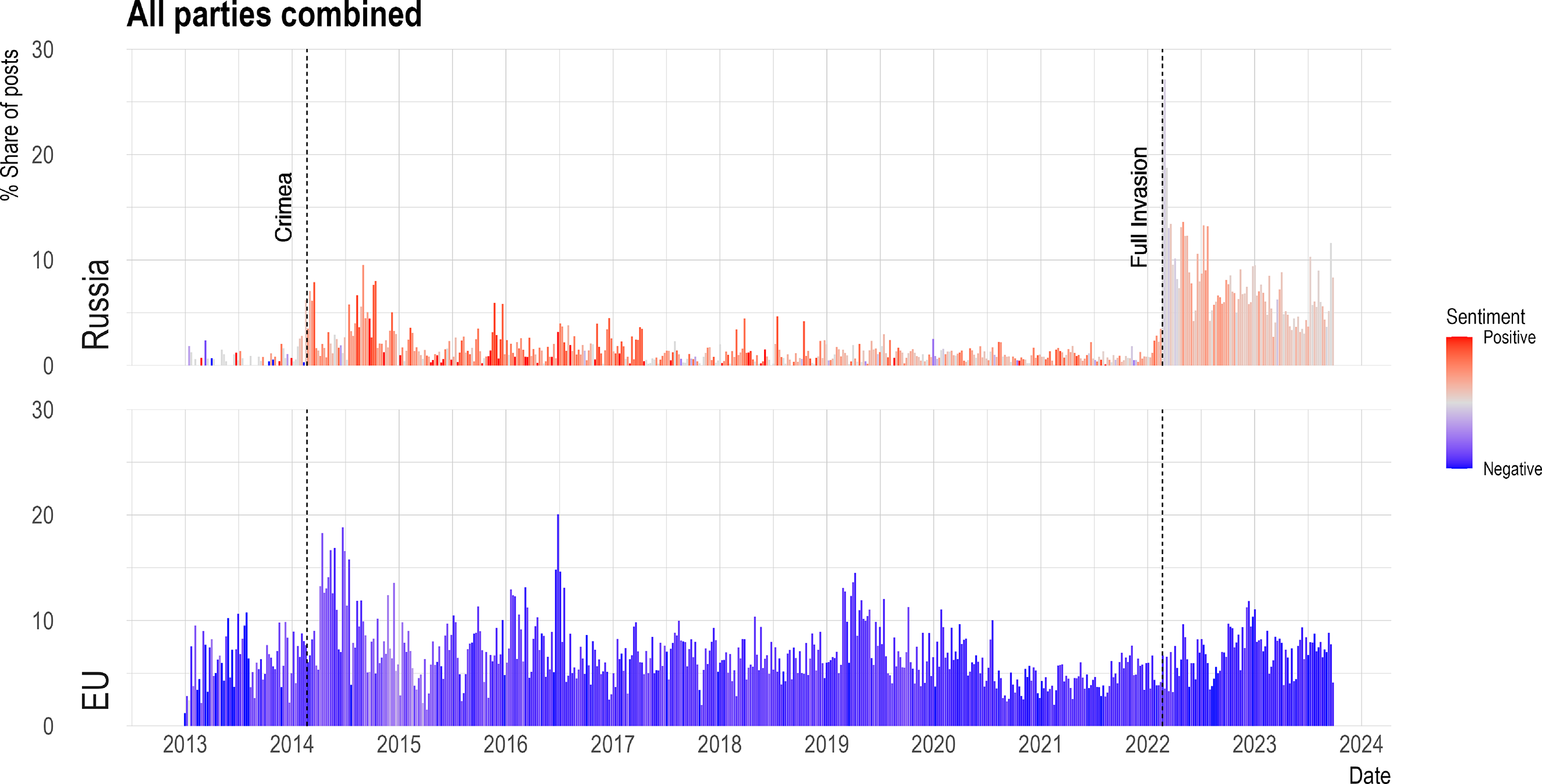
Salience and stance from 2013 to 2023.
Regarding the stance towards Russia, while the average sentiment fluctuated a bit before the full invasion in 2022, it was in general leaning towards the positive side, indicating the affinity of theses parties with Russia. However, after Russia’s full invasion in 2022, we see a drop in the average sentiment, but the dip did not plummet into becoming outright negative. Also, it seems there was a slight increase of the sentiment towards Russia as time goes after the war broke out. Overall, the upper panel of Figure 1 descriptively confirms our H1. In stark contrast to the stance towards Russia, the average sentiment towards the EU of these parties has been categorically negative throughout the years without much fluctuation. In addition, we see a decrease, though not to a large extent, in the average sentiment towards the EU after February 2022. This is as expected, since the radical right parties typically are Eurosceptic.
We also see differences between the 11 parties. The development of Facebook posts for each party are reported in the Online appendix. Some parties talk more about Russia than others, e.g. the Czech SPD and the German AfD. SPD and AfD reached roughly 50% after the invasion, while for other parties only 20% of their posts at most concerned. We also can see cross-time and party variation. For the RN of France, the share of Russia-related posts initially peaked in late 2014 when the RN stirred controversy for taking significant loans from Russia. After this incident, the number of posts quickly dwindled and remained at a low level until Russia’s invasion in 2022. For the Lega, the posts on Russia clustered in late 2016 when Andrei Karlov, the Russian Ambassador to Turkey, got assassinated. Then the Lega scaled up its Facebook activity on Russia again after the invasion took place. When it comes to the AfD, it posted most frequently on Russia in late 2020 when the AfD parliamentary group was invited to visit Moscow. Then, after the invasion broke out in 2022, the AfD started actively talking about Russia again. Lastly, for other parties, such as VB and Vox, posts on Russia mainly appear after the invasion in 2022. Overall, most of the parties’ attention to Russia prior to the war was mostly in relation to either Russia’s participation in the Syrian war, the Russian sanctions or visits of their leaders to Moscow in order to cultivate relationships with the Kremlin leadership.
The shift in Russia and EU stances
To rigorously show how their stance towards Russia and the EU changed after the war, we calculate the average predicted sentiment for each party before and after the invasion, constructed from a logistic regression model interacting party and period dummies. It essentially describes the average sentiment of the 11 parties by period. Figure 2 displays the results. The top of the figure shows the sentiment towards Russia. We see some parties change their position after the war in 2022, such as RN, PVV, Lega, Vox, AfD and VB (to a lesser extent), while others did not manifest a dip in the sentiment towards Russia. However, even among the parties who distanced themselves from Russia, the drop in sentiment is not large, except for the Spanish Vox 4 . Similarly, regarding the sentiment towards the EU, most radical right parties exhibit a further decline in their already low stance, with the exception of a slight increase observed for the Lega.
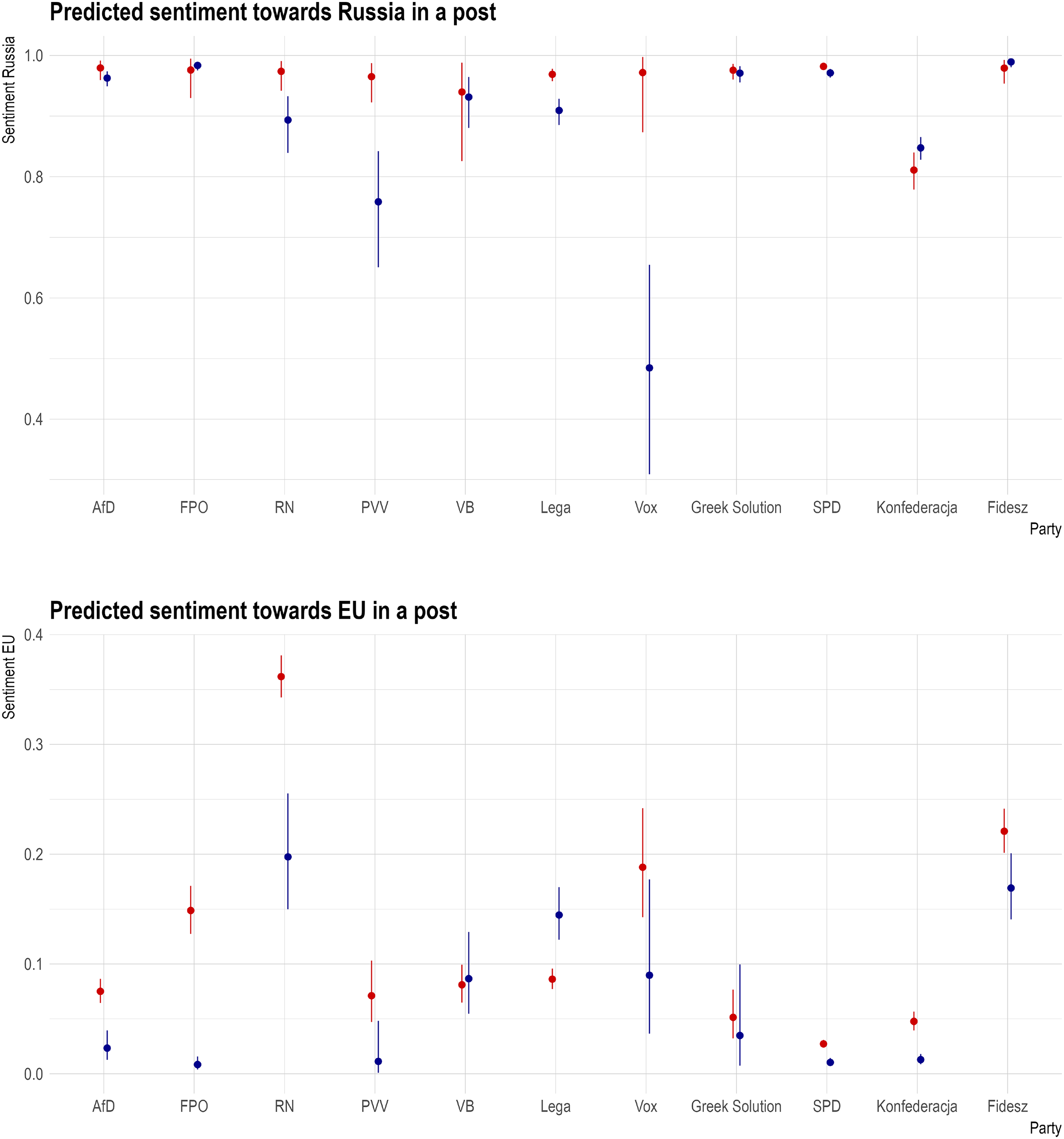
Sentiment towards Russia and the EU by party and period.
To further test our hypotheses, we resort to regression analysis at the post level accounting for the nested structure of our data, i.e. posts nested within parties and points in time 5 . We use sentiment towards the target in a post as the dependent variable 6 . For our predictors, we include a dummy war variable that indicates the period before/after Russia’s invasion in 2022. Second, we include a dummy variable indicating whether the party is in government or in opposition when the post is made. Incumbent parties, under scrutiny from global counterparts, prioritise international repute unlike opposition parties that critique governmental policies (Lewis, 2017). They are expected to be reliable allies, aligning on core issues like upholding democratic values. Conversely, opposition parties with no immediate governmental aspirations freely express views. Hence, parties in government are likely to align with the EU’s stance and express rejection to Russian aggression, contrasting with opposition parties. We also include variables that represent problem pressure which might have a positive effect on radical rights’ sentiment towards Russia but a negative impact on their sentiment towards the EU. Specifically, we use the number of Ukrainian refugees per thousand population and gas price to represent problem pressure. Radical right parties often position themselves against the mainstream and may challenge the prevailing narrative that holds Russia responsible for the refugee crisis or high energy prices. At the same time, they might use populist tactics to redirect blame towards the EU or other actors, suggesting that an end to hostilities would be beneficial for the national interest. We also include two dummies on whether the post was made during an election period (within a month before the election): one for the national general election and one for the European Parliament. We expect that during election periods radical right parties might take a tougher stance on foreign policy issues to appeal to voters who are critical of Russia, especially if there’s a widespread perception that Russia is engaging in aggressive actions. For the model with EU sentiment as the dependent variable, we also include a dummy variable indicating whether the post mentions Russia or not to test our H3. All continuous variables are rescaled from 0 to 1.
Figure 3 plots the coefficients from the model with sentiment towards Russia as the outcome variable. 7 We see that the post-invasion period significantly dampens the sentiment towards Russia. Posts after the invasion are more likely to be negative towards Russia compared to prior period, by about six per cent. This suggests a negative shift in narrative possibly due to the geopolitical tensions and the invasion’s repercussions, challenging the parties’ previous stances or rhetoric towards Russia. This provides support for H1. However, the size of the effect is quite small. As expected, problem pressure variables show either no effect or positive effect on the sentiment towards Russia, confirming that radical right parties did not blame Russia in their social media communication for increasing problem pressure. We do not find substantial effects for incumbent status and election period.
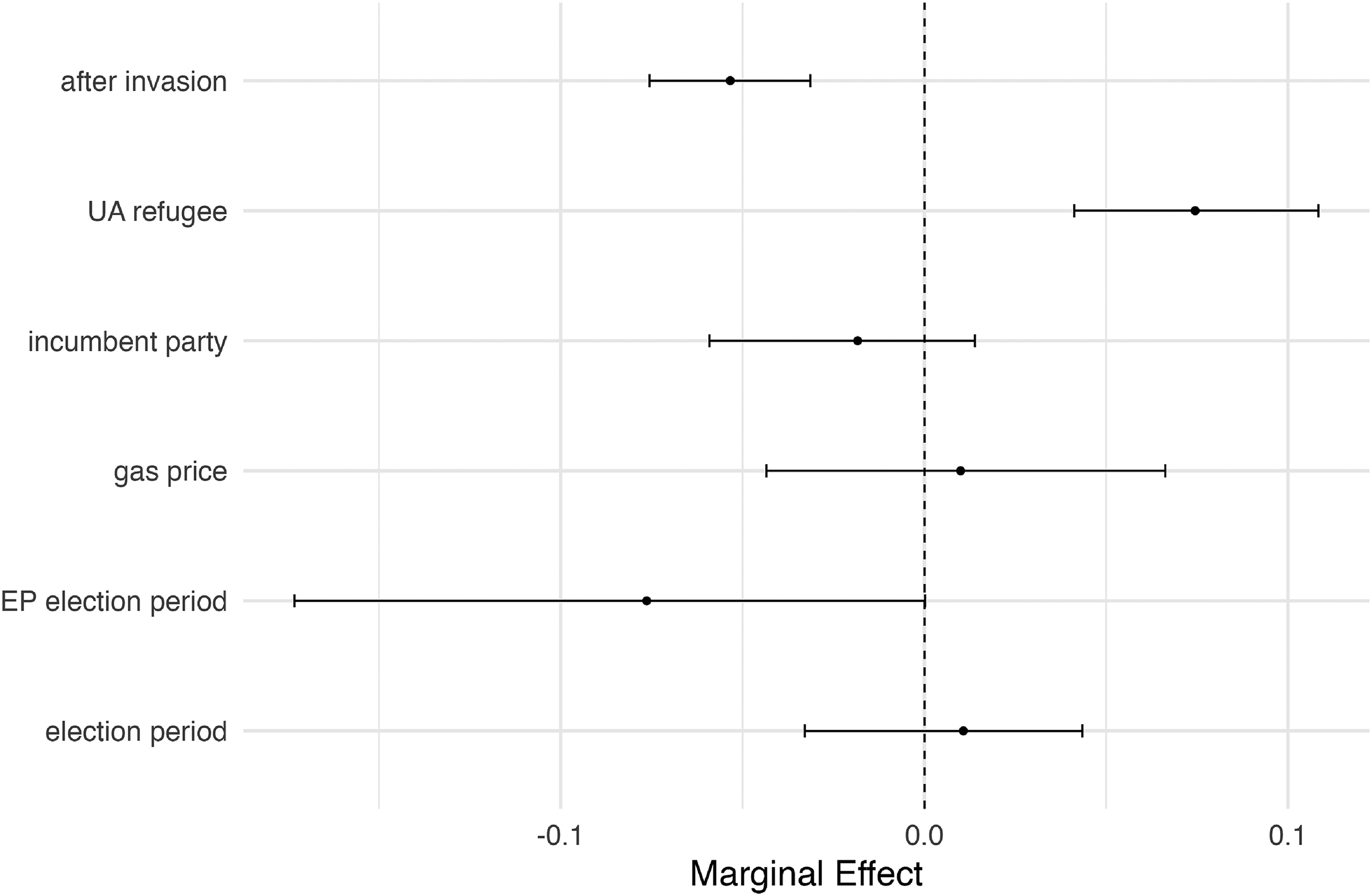
Determinants of sentiment towards Russia.
In examining the determinants of European radical right parties’ sentiment towards the EU, we see from Figure 4 that, mentioning Russia in a post inversely correlates with EU sentiment, suggesting that the act of referencing Russia is associated with a slight downturn in EU sentiment. Posts mentioning Russia are more likely to be negative towards the EU, by about two per cent. This may reflect an underlying scepticism or critique of the EU’s handling of Russian affairs, or perhaps the invocation of Russia serves as a rhetorical tool to discuss EU-related grievances. This confirms our H3b, though the substantive impact is quite small. This might be due to floor effects, i.e. the sentiment towards the EU of these parties are already extremely low. Post-invasion period, as expected, has a significant negative effect as well, indicating that following the invasion, there is a discernible drop in EU sentiment, by about six per cent more likely to be negative, among the radical right, which confirms our H3a. Being an incumbent party significantly correlates with positive sentiment towards the EU, suggesting that responsibility for governance tempers anti-EU rhetoric, possibly due to the pragmatic considerations of being in power. Both election period variables have positive effect on EU sentiment, reflecting strategic positioning to appeal to a broader electorate or the influence of campaign dynamics that bring EU issues to the forefront in a more positive light. One indicator for problem pressure, Ukrainian refugee influx, has a significant negative impact on EU sentiment. This suggests that heightened concerns around migration issues are associated with a more critical stance towards the EU among the radical right parties.
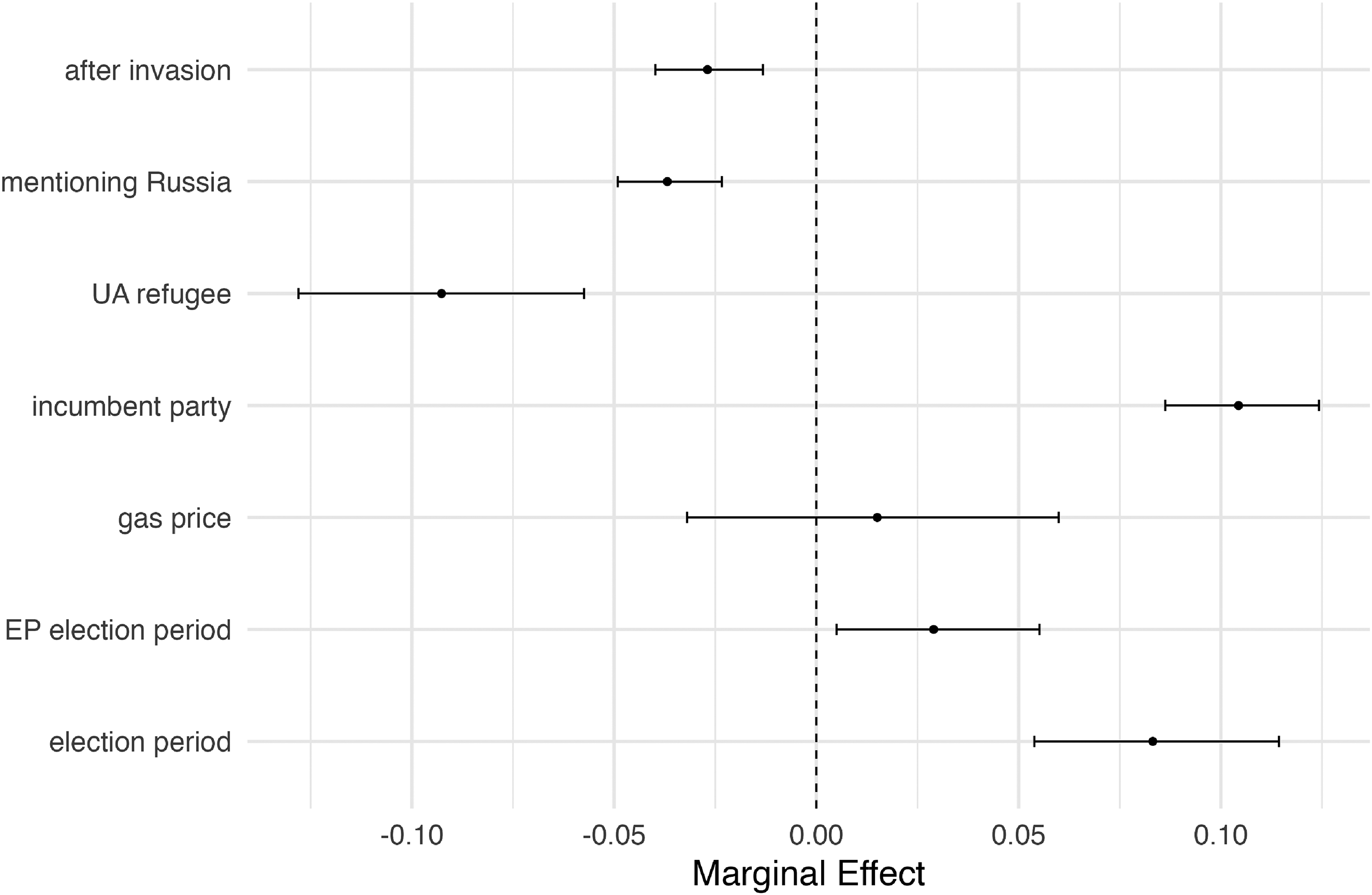
Determinants of sentiment towards the EU.
Interestingly, when we replace mentioning Russia with Russia sentiment as the predictor, we do not find a significant negative effect of the sentiment towards Russia on EU sentiment (see the Online appendix). Therefore, in the discourse of European radical right parties, the strategic mention of Russia appears less about the sentiment held towards the country and more about leveraging Russia as a rhetorical device to challenge the EU. Our findings suggest that irrespective of their actual stance on Russia, these parties invoke Russia in their communications as a means to articulate their critique of the EU. This strategic mentioning points to a sophisticated use of international actors in the radical right’s narrative toolkit, where the mere invocation of Russia serves as a proxy to advance their political agenda.
Qualitative narrative
In order to flesh out the strategies used by the radical right parties in their communication, we qualitatively go through all the posts and trace the main rhetorical devices deployed by radical right parties. As we noted in H2, we expect these parties to engage in avoidance, blurring and topic-switching on the issue. Whereas avoidance is best studied in terms of what was not said and hence the frequency with which the invasion is (or is not) mentioned, blurring and topic-switching can be traced in their posts. While the two strategies are conceptually close, we can still separate them. Blurring in our analysis refers to utterances where the speaker blurs the position, for example in the case when they assume a vague position or one with several caveats, rendering their stance less clear. Topic switching in the context of social media is not altogether straightforward either, as the poster chooses to post and is not forced to evade an inconvenient question by changing topic. We still believe we can demonstrate examples of topic switching though, defined as posts talking about the war, but emphasising dimensions and aspects which are not relevant to the conflict itself. A rhetorical device falling under this rubric would be whataboutism, for example, when the speaker switches the topic from the invasion itself to similar actions of other countries that could be used to present the invasion as a regrettable but common superpower practice.
We proceed to study the posts in more detail, providing quotations and specific examples (detailed in the Online appendix) showcasing the parties’ stance on Russia before and after the war to further illustrate the trends and main ways they approached the issue and tried to confront the increasingly negative public opinion on their prior stance.
Before the full invasion
As we saw in Figure 1, there is a clear separation of sentiment before and after the war for the parties we study in this paper. Before the war, the main strategy is the sort of blurring discussed above. Any time Ukraine is mentioned, many of those parties change the discussion instead to focus on the perversity of sanctions. While they regret Ukraine’s position, they nevertheless temper their stance by noting that sanctions are in any case working in perverse ways, and they would be best dropped. As the Czech SPD notes (Post 7), all of Europe would freeze if the Russians turned off the gas tap. Similarly, the AfD condemned sanctions as ‘damaging the Saxon economy and politically pointless’, whereas Salvini emphasised that the sanctions were ‘true madness’ that caused a ‘loss of 688 million euros to Veneto alone’. The RN in France sang to the same tune, noting that sanctions were catastrophic for French agriculture, and a similar argument was articulated by the Hungarian Prime Minister Orban (Post 8).
The second rhetorical device of topic-switching is more evident in posts that try to change the discussion from the war in Ukraine to wider geostrategic themes. In some instances, the opposition to Russia is framed as an example of misguided attachment to US interests which do not align with European ones necessarily, as the latter require more geostrategic ‘flexibility’. In a paradigmatic example, Orban is quoted in 2014 as favouring a ‘balanced’ diplomatic approach that keeps Russia and the US at equal distance (Post 1). The Czech SPD and Polish Confederation also echoed this sentiment, emphasising national sovereignty and the drawbacks of aligning too closely with either the US or Russia, as shown by Post 2 and 3. In other cases, this approach is embedded in the specific context of a country. In Austria for example, the country’s neutrality tradition in diplomacy is invoked right before the invasion (Post 4) by the FPO to justify equi-distance between the US coalition and Russia.
A second type of topic-switching is focussing the spotlight on the wider global scene and Russia’s role in it, arguing that missteps in Ukraine should be weighed against other Russian actions, against Islamists in particular. This common trend in the posts of European radical right parties is the functioning of Russia as a bulwark against Islamists, whom they perceive as their prime rivals in the geopolitical and cultural sphere. As they note repeatedly, Russia’s intervention in Syria has worked to bolster the Assad regime and consequently fight the Islamic State, rendering Russia, in their eyes, an ally in this international clash of cultures. The RN highlighted, when it visited Moscow, that talks with President Putin were centred on ‘Islamist terrorism’. The Lega paid multiple times homage to the dead Russian pilots in Syria, shot down by Turkish planes, and to the Russian ambassador killed by an Islamist in Ankara, challenging the EU and the Italian government on its anti-Russian stance (Post 5). Other parties, such as the PVV, reinforced this view by highlighting Russia’s role in combating Islamist terrorism (Post 6).
After the full invasion
After the Ukrainian operation was commenced by the Russian regime, those parties took divergent paths. The elements of geopolitical flexibility, anti-Islamist allegiance and the rhetoric on perverse sanctions existed prior to the war for all parties that spoke about Russia. But, after the war started, they chose somewhat different strategies and discourses to address the situation on the ground, unified only by focussing on a similar trope of blurring as before, talking mostly about gas and energy prices.
We identified four possible positions for the previously Russophile parties to take in the wake of the war in Ukraine: The first is silence, i.e., ignoring the issue and avoiding it altogether. Secondly, parties could be ‘blurring’ their position on the issue, avoiding taking a stance about the war itself or topic switching, talking about side-issues emerging from the war or about other similar situations that were not in the limelight. A third possible position or strategy is to shift position entirely and unequivocally condemn the Russian invasion, while the fourth option is the exact opposite, i.e., standing their ground and defending their Russian links.
Among our parties, the Czech SPD is the closest but not perfect example of the latter stance, being the most unrepentant one, and while it did condemn the invasion, it proudly asserted that it was the only party that did not participate in the ‘standing ovation’ for Ukraine in the Czech parliament, insisting instead that it simply wants peace rather than to take sides or support Ukraine. It refused to vote for any disbursement of arms to Ukraine and focussed on negotiation and peace mediation as the way forward for Europe. Peculiarly for a former Soviet ally and an Eastern European country, the SPD appears to be the friendliest to Putin’s regime. Rather than talk about the war, the party has chosen to switch topics and emphasise instead its campaign against Ukrainian immigrants, who it repeatedly describes as ‘uneducated and greedy’, accruing benefits at the expense of Czech citizens (Post 9). The Polish Confederation party also toes the same line, characteristically accusing the government of allowing refugees extorting social security (Post 10). Being hostile towards Ukrainian refugees and blurring the issue, supporting Ukraine on the one side, but advocating vaguely for ‘peace’ as its ultimate objective rather than warmongering that might get Poland involved in unfortunate adventures, Confederation also outright criticised the EU for ‘attacking and milking Poland’ (Post 11). Compared to all the other parties in our sample, the selected excerpts of those parties reveal their hostility towards Ukrainian refugees and military support for Ukraine and comprise the most extreme example of topic-switching and blurring, to the point where they appear as the most consistent in their rhetoric before and after the invasion and the ones closest to Putin post-invasion.
Almost all other parties, initially at least, offer a minimal token condemnation of the war. After the first few weeks though, the main tactic of the remaining parties regresses to topic shifting and blurring. Characteristically, the Austrian FPO shifts returns to its prewar musings about Austrian neutrality, prioritising equi-distance from all major powers in the global diplomatic scene. Last in the camp of parties that seemed to be closer to their pre-war stance was Greek Solution, which emphasised abstaining from directly supporting Ukraine and sharing the blame for the war with NATO, which ‘had no business expanding to the borders of Russia’. Concurrently, they change topics, drawing parallels between the inaction of the EU over Turkish warmongering and their hastiness to help Ukraine, deploring the hypocrisy of Europeans.
On the other side, there were several parties instead that signalled their initial U-turn more vocally and strongly condemned Russia’s attack on Ukraine. The AfD, one of the most Russophile parties prior to the war, came out forcefully against the invasion, but soon thereafter asked for Germany to remain neutral in this ‘tragic conflict’. While Chrupalla, a prominent AfD executive, travelled to Moscow at the invitation of the Russian government, as recently as June 2021, Alice Weidel immediately declared that the Russian attacks ‘cannot be justified’ on the day of the war’s initiation, while the party demanded that ‘Russia must immediately stop hostilities and withdraw its troops from Ukraine’. However, following this initial turnaround, the party then blurred the issue by focussing on the need for peaceful mediation as a way to avoid the economic and energy costs from taking sides and scoffed at the prospect of sending arms to Ukraine. By August 2022 the party had reverted completely to its focus on the economic costs of the war and complained about them (Post 12).
The French, Dutch and Belgian parties followed a similar pathway. They proceeded with a stronger or weaker condemnation of the war initially but then went on to ‘blur’ the issue by focussing on the need for the EU to mediate for a peaceful transition and denigrating the cost of sanctions. PVV pivoted immediately to declaring that while the events were regrettable, this ‘is not our war’ and that Dutch households should not pay the price of Rutte’s ‘warmongering’. PVV focussed mostly on the costs of energy, while both PVV and the VB prioritised taking in Ukrainian refugees, which really needed asylum, in opposition to ‘undeserving’ refugees hailing from African and Middle Eastern countries that needed to be expelled. The RN followed the same recipe, even if it initially was stronger in its condemnation of the war. What unites those parties in general is therefore the switching topics from the war itself to their ‘owned’ issue of migration. Apart from this avoidance tactic, these parties can be characterised as also somewhat silent, as they have the lowest number of posts post-war compared to their peers. The RN even tried to use its ‘humanitarian’ and nuanced stance on Ukrainian refugees in an election year to distinguish itself from its rival party led by Zemmour which rallied against all and any migration.
The Italian Lega was, to a large extent, in agreement with the RN and prioritised the same concerns. Helping refugees, mediating for peace and avoiding getting involved in the conflict by sending arms are constant themes evoked by the party, even as it stood with Ukraine and even praised Zelensky’s appearance in the Italian parliament. As hinted by the fact that it’s the party with a positive EU sentiment swing, the Lega called for more actions from the EU rather than criticising it and maintained an ambiguous stance regarding sanctions, accepting their usefulness but also bringing up the theme that in reality they are hurting European peoples more than Russia, who can find alternative channels for its products (Post 14).
Concurrently, the Lega also drummed up support for the idea, despite their former pro-Russia stance, that it was eventually the EU’s and Germany’s responsibility that European countries were so dependent on Russian gas. The Lega, PVV and other parties blame the EU for being unprepared for the prospect of a war, both in terms of defence but also energy supply and security. The Lega stressed that no measures were taken by the EU to counter Russian energy dependency, and now the sanctions were, in effect, harmful to the Italian people mostly. Fidesz mostly followed along the same lines: an initial condemnation of the war, but then also a desire to stay out of it, engage in negotiations to find a peaceful solution and abstain from any arm peddling towards Ukraine, while hosting as many as possible of its refugees and installing sanctions that would not however cripple the Hungarian economy. The only party that dutifully remains silent on the issue and was silent before it was Vox. After initially condemning “Putin’s arrogance advances”, the Spanish radical right never talked about the war itself other than as a side-issue fuelling its Euroscepticism. In addition to condemning Russia, it also used the opportunity to showcase criticism towards “the failure and irresponsibility of the European Commission” (Post 13).
To sum up, based on this detailed narrative, we find evidence for our H2. We identified avoidance, blurring and topic-switching as the main rhetorical tactics of right parties in the wake of the war. The first was to avoid the issue altogether, which was arguably the case for Vox and North-Western European radical right parties. The second stance was to blur and attempt to frame the issue as something different. There were two aspects to this, the first of which was “blurring”, i.e., an effort to temper their position, presenting all sides as culpable for the war and focus the attention on making peace efforts rather than comment on the invasion itself, which was treated more as an unfortunate event in which cooler heads did not prevail. The Lega, Fidesz and other Eastern European parties were especially persistent in making this point, but all parties followed this tactic to a degree. The second aspect of this strategy was topic-switching, which was the common denominator among all parties, as they tried to shift attention instead to rising gas prices due to perverse sanctions, as detailed in our narrative. Fewer parties attempted to divert attention towards the third issue noted, that of migration, and there we saw a divergence between hostile parties (SPD, Confederation) towards Ukraine’s refugees and friendly ones (Fidesz, RN, Lega, etc.).
Conclusion
What can we conclude about the approach of radical right parties to the war in Ukraine? We asked the question of how they dealt with an unpopular, Russophile position in the event of the Russian invasion that turned European public opinion hostile towards the Putin regime. To answer it, we examined the communication strategies on Facebook used by 11 European radical right parties in response to Russia’s invasion of Ukraine in 2022. Our quantitative analysis of Facebook posts revealed several key findings. First, we found partial support for H1 – while the sentiment towards Russia registered a decline after the invasion among most radical right parties, the drop was relatively small rather than a major negative shift. Second, our results show that these parties relied on blurring, avoidance, and topic switching in their communications about the Ukraine crisis, as evidenced through the predominance of economic and refugee-related concerns in post-invasion social media content. Furthermore, the sentiment towards the EU also declined post-invasion, including when Russia was mentioned in posts, indicating the strategic use of Russia to articulate anti-EU positions.
The qualitative narrative analysis provided additional insights into the specific rhetorical tactics used. We identified four possible strategies they could follow and saw that the parties of the radical right, with the possible exception of the Czech SPD, the Polish Confederation and the Greek solution, neither tried to remain pro-Russia nor focussed their attention, apart from the very beginning of the war, on shifting their prior position. Instead, they engaged in an effort to blur the issue and divert attention away from the war; as we saw, their favourite topic became the rising gas prices caused by the perverse sanctions imposed by the EU. Additionally, they used the events in Ukraine to argue for their anti-EU positions, blaming Germany and the EU for the loss of national sovereignty and a perverse energy market that strengthened dependence on Russian gas rather than champion self-sufficiency and sovereignty in energy issues. The partial shift in position, wherever that took place, came also with pleas for taking action to bring about peace and negotiations rather than ask directly for military or other non-humanitarian support to Ukraine.
Our study complements Moise et al. (2025), which identifies migration as the most salient issue for Europeans during the Ukraine crisis. This alignment between the strategic shift of radical right parties towards migration and the salience of migration in public opinion underscores the importance of understanding how party rhetoric and public preferences converge during crises. While radical right parties downplayed their stance on the war, they emphasised issues like migration and energy security, which Moise et al. (2025) show are at the forefront of public concern. This demonstrates how these parties might strategically shift discourse to align with the most pressing issues for their constituents.
Overall, the radical right has not paid a major price in electoral terms for its stance in Ukraine. We argue that this was arguably a product, apart from the potentially low salience of the issue in the electoral calculus of voters, of their successful discursive displacement of the focus of the issue from the war itself and their support and links to Putin, to the issues of energy security and gas prices, as well as the incorporation of their position of Russian into their wider “populist” narrative, once more framing the issue as one where elite decisions for sanctions are in effect harming the European peoples.
Our study has made several contributions to the scholarly understanding of European radical right parties’ responses to international crises, specifically through the lens of the Russian invasion of Ukraine. Our findings extend the work on political alignment or divergence within European party families during crises (Malang and Ohliger, 2023; Van der Brug et al., 2022), and specifically on party stance on the current war in Ukraine (Hooghe et al., 2024). We have demonstrated that radical right parties do not react monolithically to international events but instead display a spectrum of strategies influenced by national contexts and individual party ideologies. This nuanced approach adds depth to the “constraining dissensus” argument (Hooghe and Marks, 2009), showing how internal party dynamics can significantly impact broader political cohesion within the EU.
The strategic variability among radical right parties highlighted in our study also provides crucial insights into the EU’s fragmented response to Russia. This fragmentation reflects the theoretical propositions by Kelemen and McNamara (2021), who suggest that external threats should create greater unity among both elites and the public. Our research empirically challenges this theory by showcasing how different radical right parties within the EU have responded to the crisis in Ukraine, which complicates the EU’s ability to form a united front in its foreign policy towards Russia.
From a policy perspective, understanding these internal dynamics is vital for developing coherent EU policies towards crises like the Ukrainian conflict. Our study suggests that the EU might need to consider the varied stances of its constituent political factions to forge effective and unified foreign policy strategies. Furthermore, the varied reactions among these parties to the Ukrainian crisis reflect broader tensions within the EU regarding its stance toward Russia. Our analysis suggests that the inconsistent and sometimes contradictory positions of these parties could pose challenges to the EU’s ability to present a unified front in foreign policy matters. This is particularly relevant as the EU navigates its relations with Russia and seeks to support Ukraine amidst ongoing conflict.
Lastly, as Europe continues to deal with the ramifications of the war in Ukraine, the insights from our study highlight the importance of considering internal political dynamics when assessing Europe’s international actions. By closely examining the rhetoric and positioning of radical right parties, we gain a clearer view of the potential obstacles and opportunities for consensus-building within the EU. This research opens several avenues for further investigation. Future studies could explore the specific impacts of party rhetoric on public opinion in EU countries or examine the long-term effects of such rhetoric on EU-Russia relations. Additionally, comparative analyses with other party families could illuminate whether the strategies we have identified are unique to the radical right or are indicative of broader trends in European politics.
Supplemental Material
sj-pdf-1-eup-10.1177_14651165251321802 - Supplemental material for What happened to Putin’s friends? The radical right’s reaction to the Russian invasion on social media
Supplemental material, sj-pdf-1-eup-10.1177_14651165251321802 for What happened to Putin’s friends? The radical right’s reaction to the Russian invasion on social media by Chendi Wang and Argyrios Altiparmakis in European Union Politics
Supplemental Material
sj-zip-2-eup-10.1177_14651165251321802 - Supplemental material for What happened to Putin’s friends? The radical right’s reaction to the Russian invasion on social media
Supplemental material, sj-zip-2-eup-10.1177_14651165251321802 for What happened to Putin’s friends? The radical right’s reaction to the Russian invasion on social media by Chendi Wang and Argyrios Altiparmakis in European Union Politics
Supplemental Material
sj-pdf-3-eup-10.1177_14651165251321802 - Supplemental material for What happened to Putin’s friends? The radical right’s reaction to the Russian invasion on social media
Supplemental material, sj-pdf-3-eup-10.1177_14651165251321802 for What happened to Putin’s friends? The radical right’s reaction to the Russian invasion on social media by Chendi Wang and Argyrios Altiparmakis in European Union Politics
Footnotes
Acknowledgements
We would like to thank Aleksandra Sojka and all of the participants to the workshop on The Politics of European Integration after the Russian Invasion of Ukraine at the European University Institute, for their valuable comments. Likewise, we are grateful to Rebecca Kittel and all of the participants to the Workshop on Public Policy, Conflict, and Political Rhetoric at the European University Institute, for their valuable comments. We also appreciate Natalia Lamberova for her valuable comments at PolMeth 2024 and the entirety of the SOLID-ERC team for their comments, and contributions to the data collection. Finally, we extend our gratitude to our two reviewers for very constructive feedback.
Author contributions
The authors contributed equally to the article.
Declaration of conflicting interests
The authors declared no potential conflicts of interest with respect to the research, authorship, and/or publication of this article.
Funding
The authors disclosed receipt of the following financial support for the research, authorship, and/or publication of this article: This work was supported by the European Research Council under the Synergy Grant number 810356 (ERC_SYG_2018), in the scope of the project SOLID – Policy Crisis and Crisis Politics, Sovereignty, Solidarity and Identity in the EU post-2008 and by the Dutch Ministry of Education, Culture and Science (OCW) under the Starter Grant, in the scope of the project NEST - Navigating the Storm: European Political Contestation in Geopolitical Transformation.

Data availability
The data and replication code are available as part of the Supplementary Material at the DOI of the article.
Supplemental material
Supplemental material for this article is available online.
1.
We used CrowdTangle API of Meta to access Facebook posts.
2.
The keyword that we used can be found in the Online appendix.
3.
We rely on OpenAI’s API to utilise the latest GPT-4 model. We set the temperature to 0 to reduce randomness in the annotation output and obtain more deterministic results. Overall, we obtained good performance validated by human annotation. Exact prompt used for classification and validation results is reported in the Online material. We acknowledge that the proprietary nature of GPT used in this study means detailed insights into their processing and error margins are not publicly accessible. This opacity necessitates a prudent approach in interpreting findings from LLM analyses. Where possible, results from LLMs should be cross-validated with other methods to bolster the robustness of the conclusions drawn.
4.
It is to be noted that Vox made only a few posts post-invasion though.
5.
We use Bayesian multilevel logistic regression models with posts at the lower level and party and date at the upper level.
6.
Given the skewed distribution of our dependent variables, we collapse the three-category sentiment into a binary variable, with 0 representing negative and 1 representing non-negative.
7.
Full regression results can be found in the Online appendix. Regression Discontinuity (RD) with days since invasion as the running variable is also employed to estimate the change in sentiment. We found even an stronger impact of the invasion on sentiment towards Russia (see the Online appendix).
References
Supplementary Material
Please find the following supplemental material available below.
For Open Access articles published under a Creative Commons License, all supplemental material carries the same license as the article it is associated with.
For non-Open Access articles published, all supplemental material carries a non-exclusive license, and permission requests for re-use of supplemental material or any part of supplemental material shall be sent directly to the copyright owner as specified in the copyright notice associated with the article.
