




Abstract
Why do supporters of radical right parties in Central and Eastern Europe hold economically left-wing policy preferences? In this article, the author argues that this can be explained by welfare chauvinism. First, in ethnically heterogeneous societies, minority groups provide a plausible scapegoat for the grievances emphasized by radical right parties. Therefore, the majority population is sensitive to shifts in the status quo which accrue from policy changes that give minorities greater benefits. Support for redistribution will therefore be lower in more ethnically diverse countries. The salience of shifts in the ethnic group hierarchy also means that objective economic insecurity is less likely to intersect with redistributive preferences. Second, radical right supporters will prefer welfare policies that restrict eligibility to the majority population. This allows radical right parties to combine leftist economic policies with more authoritarian values. The empirical results confirm these expectations. This research contributes to our understanding of the attitudinal bases of radical right party support in Central and Eastern Europe.
Previous research has shown that supporters of radical right parties (RRPs) in Central and Eastern Europe (CEE) are more likely to favour greater redistribution. 1 This is in contrast to the evidence from West European democracies which shows that radical right supporters are less likely to hold preferences for greater redistribution. 2 How can these differences be explained?
One potential explanation lies in the supply of parties and the policy positions that they adopt. In Western Europe, RRPs have generally been positioned on the right of the economic policy spectrum, although in recent years they have drifted towards the centre. 3 Social democrats continue to dominate the left, adopting interventionist economic platforms. 4 In CEE, party competition over economic policy is quite different. Tavits and Letki 5 argue that due to the specific context of the postcommunist political landscape, leftist parties were better placed to constrain social spending than rightist parties. 6 In response, right-wing populist parties adopted interventionist positions on economic policy to compete directly with the left. 7
While Tavits and Letki 8 have addressed the supply-side of party competition in CEE, in this article, I contribute to existing research by offering a demand-side explanation of redistributive politics and party competition. Drawing on prior scholarship, I test the hypothesis that preferences for redistribution among RRP supporters are conditioned by welfare chauvinism. Welfare chauvinism is the belief that access to full range of social benefits and services in a country should be restricted to the majority population, as defined by either their nationality or their ethnicity. 9 In most West European countries, the focus is usually on restricting the welfare rights of immigrants. In Eastern Europe, the emphasis until recently has been on restricting the rights of internal minorities. This has changed since around 2015 as a result of the European migration crisis which was exploited by some political actors in Eastern Europe as immigration became politicized in the region.
Following research by Buštíková 10 I argue that pro-redistribution preferences are more likely to be associated with identification with RRPs in countries where there are significant ethnic minorities present. In more ethnically fractionalized countries, minorities provide a plausible scapegoat for the grievances emphasized by RRPs. 11 As a result, the majority population is sensitive to shifts in the status quo which accrue from policy changes that give minorities greater benefits. 12 Redistributive policies are used by the radical right in a chauvinistic fashion to provide benefits for the titular majority. 13
The salience of shifts in the ethnic group hierarchy also means that objective economic insecurity is less likely to intersect with redistributive preferences. The existing literature suggests that RRPs appeal to the economically disadvantaged. 14 It may therefore be expected that economically insecure individuals will identify with the radical right in CEE if they also favour greater redistribution given that such individuals will likely benefit from redistributive policies. However, due to the primacy of concerns about shifts in the ethnic group hierarchy, individual preferences on economic issues are related to how these change the balance between the minority and majority populations rather than objective concerns about poverty or economic insecurity. 15
Since 2015, welfare chauvinism has also been linked to anti-immigrant sentiment in Eastern Europe. While the region has not experienced large rises in immigration, politicians have exploited increases in immigration into other European Union (EU) countries to portray migrants as a potential threat to both culture and security. This is also underpinned by a concern with emigration of large numbers of the working-age population from Eastern Europe to Western Europe. 16 Due to the increased politicization of immigration, I also examine whether chauvinistic welfare preferences towards migrants are an indicator of RRP support.
I test these arguments using data from nine waves of the European Social Survey (ESS) covering the period from 2002 to 2018. The results show that pro-redistribution preferences are an indicator of RRP support in the most ethnically homogeneous societies in Eastern Europe but not in the most diverse. This provides support for the argument that redistributive preferences and support for RRPs are conditioned by concern with the distribution of welfare benefits. The results also show that individuals who hold pro-redistribution preferences and more restrictive views on welfare entitlements for immigrants are more likely to support RRPs. Taken together, these results indicate that welfare chauvinism is a key component of the demand side of radical right politics in CEE.
Redistribution, Welfare Chauvinism, and RRP Support
The literature concerning the radical right in CEE has tended to focus on the aggregate electoral performance of the parties rather than the individual-level policy preferences and attitudes of their supporters. 17 There are, however, some studies that address the demand side of the radical right in CEE. Pytlas 18 has examined RRP support in Hungary, Poland, and Slovakia, although he does not address economic policy preferences. Both Allen 19 and Stanley 20 have included economic preferences in models of radical right or right-wing populist party support, each finding that leftist attitudes are associated with support for RRPs. This is in contrast to research on Western Europe where RRP supporters tend to oppose redistribution, which may seem counterintuitive as many of those supporters are economically insecure or blue-collar workers who would benefit from redistributive policies. 21 But for radical right supporters in Western Europe, economic concerns are usually de-prioritized in favour of more salient issues, in particular, immigration. 22
Why RRP voters hold leftist economic preferences in CEE is still a matter of debate. It could be argued that parties are using economic grievances to mobilize the so-called “losers” of democratization. 23 Alternatively, RRPs may be engaging in interest aggregation of disparate groups of economic leftists and cultural traditionalists, sometimes augmented by appeals to religion. 24 However, previous research points to another potential explanation, namely, welfare chauvinism. 25
Prior studies of chauvinistic preferences for redistribution have yielded relatively consistent results. This research demonstrates that ethnic heterogeneity and the presence of migrant communities reduce support for redistribution and welfare benefits. 26 Luttmer 27 shows that support for redistribution declines when members of an ethnic out-group are perceived as welfare recipients. Gilens 28 also finds that racial stereotypes about black people reduces support for welfare spending. In Europe, welfare chauvinism has focussed on immigration rather more than ethnicity. Studies by Eger 29 and Dahlberg et al. 30 have shown that in Sweden, higher levels of immigration at the local level can reduce support for redistribution among individuals. Cross-national comparative studies have also found similar results, demonstrating that support for redistribution is lower in countries that are ethnically heterogeneous and in which the immigrant population is higher. 31 Others have found that chauvinistic welfare attitudes towards immigrants are found among individuals who hold different conceptions of national identity. 32 Welfare chauvinism is also associated more with benefits that are distributed on the principle of need rather than equity or equality, with social insurance-based benefits eliciting lower levels of chauvinism. 33 Furthermore, recent research has shown that the way in which the impact of immigration on the economy is framed can change support for welfare spending. Frames that indicate immigrants receive more from the welfare state than they pay in via taxes reduce overall support for welfare spending. 34
Research has shown that RRPs have been adept at harnessing welfare chauvinism in Western Europe. Ennser-Jedenastik 35 analysed manifestos of RRPs to show that they make fewer chauvinistic claims in countries where welfare is insurance-based. Further research has examined the welfare preferences of radical right supporters. Attewell 36 has shown that individuals who have more negative perceptions of the deservingness of welfare recipients are more likely to support the radical right. Similarly, recent research has demonstrated that RRP supporters are more likely to favour welfare programmes that benefit those seen as most deserving, such as the elderly, as well as programmes with strict conditionality with a particular emphasis on workfare. 37 Busemeyer et al. interpret this as RRP supporters favouring a particularistic-authoritarian conception of the welfare state.
Research on the welfare preferences of radical right supporters in CEE has largely been absent beyond the studies previously noted, which found that many hold pro-redistribution attitudes. However, conditions in CEE suggest that welfare chauvinism could be an important influence on support for the radical right. Research has shown that the presence of ethnic minorities has a significant effect on political competition in CEE. Buštíková 38 has argued that at the party level, mainstream parties have courted ethnic minority groups and ethnic parties, often with targeted transfers for minority groups. On one level, this is logical as ethnic parties in CEE are usually ideologically liberal and prefer inclusive conceptualizations of the state that extend greater rights to minorities. 39 However, RRPs can exploit the benefits received by minority groups. Targeted transfers to minority groups can lead to shifts in the ethnic group hierarchy as ethnic minorities secure material advances relative to the titular majority. In the difficult economic environments of CEE countries, RRPs are able to use ethnic minorities as plausible scapegoats to galvanize resentment among their supporters. 40 Existing research has shown that where ethnic minorities have made either perceived or real gains relative to the titular majority, RRPs have enjoyed greater success. 41
The perception that ethnic minorities benefit disproportionately from the welfare state is likely to lead to less support for redistribution among radical right supporters in more heterogeneous societies. Where minority groups hold citizenship rights, it is difficult to overtly restrict access to welfare services, and therefore, radical right supporters will prefer less redistribution overall. The inverse is also likely to be true: where recipients of welfare are more likely to be members of the titular majority, as is the case in more homogeneous societies, radical right supporters will be more likely to favour redistribution.
Although radical right politics has generally concentrated on grievances against internal minorities in CEE, in more recent years, anti-immigrant sentiment has played an increasingly significant role. Inward migration to CEE countries remains comparatively low, particularly compared with Western Europe. However, the 2015 migration crisis in Europe has been exploited by RRPs in CEE as part of their illiberalizing agenda. 42 Parties and politicians have played on fears of weakening national identity, high levels of outward migration by the working-age population, and cultural difference with Western European states which have viewed immigration as part of the solution to the problem of ageing populations. 43 This has allowed populist politicians in CEE to portray immigration as a threat to both culture and security.
When it comes to welfare policy, RRPs in CEE have adopted a distinctly chauvinistic tone. Cinpoeş and Norocel 44 analysed the manifestos and public statements of RRPs in Poland, Hungary, and Romania, demonstrating that all had adopted language that denigrated migrants, presenting them as an economic burden and security threat. RRPs have also sought to advance greater conditionality and limits on welfare benefits in an attempt to restrict access, such as the workfare policies of Fidesz and Jobbik in Hungary, which limited unemployment benefit to three months. 45 In Poland and Hungary, populist governments have sought to implement family-oriented welfare policies, partly as a solution to demographic decline. 46
While RRPs in Western Europe have recently shifted towards a more chauvinistic pro-welfare position, 47 it has long been common for the radical right to combine left-wing economic policies with more authoritarian values in CEE. 48 Various explanations for this have been suggested, including that this combination of leftist authoritarianism appeals to the “losers of democratization.” 49 Tavits and Letki 50 argue that it is an opportunistic strategy by RRPs, which have moved into the ideological space that was vacated by the mainstream left in CEE. They state that during the initial period of economic and democratic reform, left-wing parties undertook an enforced programme of austerity which has subsequently undermined their claims to be parties of welfare. What is clear from previous research is that positions that are traditionally considered to be economically left-wing are not the sole dominion of leftist parties in CEE. The configuration of the ideological space in the region readily allows RRPs to combine redistributive economic profiles with more authoritarian values.
Because of the distinct nature of the political space in CEE, combined with the exploitation of the migrant crisis, we should expect that RRP supporters will be more likely to favour greater restrictions on immigrants’ access to welfare services. In the context of immigration, this implies greater employment or citizenship requirements. This gives us the following hypotheses:
Data and Methods
I test these hypotheses using the ESS cumulative dataset. This covers nine waves biannually from 2002 to 2018. The ESS contains an expansive set of political and attitudinal variables, together with socio-demographic indicators that are consistent across waves, which is not always the case with other survey datasets. The ESS has also been used by several previous studies of individual-level determinants of party support. 51 Crucially, the ESS contains a module on welfare attitudes which was included in both the fourth and eighth waves of the survey. This module contains a direct measure of welfare chauvinism that is used to test hypotheses 2 and 3.
The final dataset for this research covers ten CEE countries: Bulgaria, Croatia, Czech Republic, Estonia, Hungary, Latvia, Lithuania, Poland, Slovakia, and Slovenia. Romania is not included in the ESS cumulative dataset due to missing design and post-stratification weights during the waves in which they participated. The dataset that is used to test hypotheses 2 and 3 does not contain Bulgaria or Croatia as neither country participated in either wave 4 or 8 of the ESS. The full list of CEE countries that participated in each wave can be found in Table S2 of the online appendix.
Dependent Variable
The dependent variable is an individual’s party identification. This is measured using the survey item which asks respondents, “Is there a particular political party you feel closer to than all other parties?” Those who answer “yes” are then asked to name the party. The party choice of respondents is coded into party families for purposes of cross-national comparison. I use this item rather than the question which asks respondents who they voted for at the last election as the timing of the fieldwork for the surveys means that the time that has passed since the last election can be quite long in some instances. This may affect a respondent’s recall or their willingness to report their choice of party if they, for example, voted for a government that subsequently became unpopular. Furthermore, given the instability of CEE party systems, parties that competed at a previous election may no longer exist at the time of the survey. Using recalled vote also results in significant data loss, reducing the sample size by approximately 20 percent. 52
The ParlGov 53 dataset, Manifesto Project, 54 and Chapel Hill Expert Survey 55 were initially consulted to classify parties into families. Research by Pop-Eleches, 56 Pytlas, 57 and Stanley 58 was also used to build a comprehensive classification of RRPs in CEE. The full list of parties and families can be found in Table S3 of the online appendix.
Independent Variables
Three independent variables are used to test the hypotheses. First, individual-level preferences for redistribution are measured by the survey item that asks respondents the extent to which they agree with the following statement: “the government should take measures to reduce differences in income levels.” Respondents have five possible answers ranging from 1 (agree strongly) to 5 (disagree strongly). 59 Both this item and its near equivalent from the International Social Survey Programme (ISSP) have been used extensively to examine preferences for redistribution. 60 I recode the variable into a binary indicator in which disagree strongly, disagree, and neither agree nor disagree are coded 0 and agree and agree strongly are coded 1. As Rueda 61 argues, when the level of support for redistribution is high, as it is in CEE (see Figure 1), it is appropriate to interpret “neither agree nor disagree” as a less overt expression of opposition to redistribution. In Table S4 of the online appendix, I re-estimate the main results of this research maintaining an ordinal coding. The results remain substantively the same.
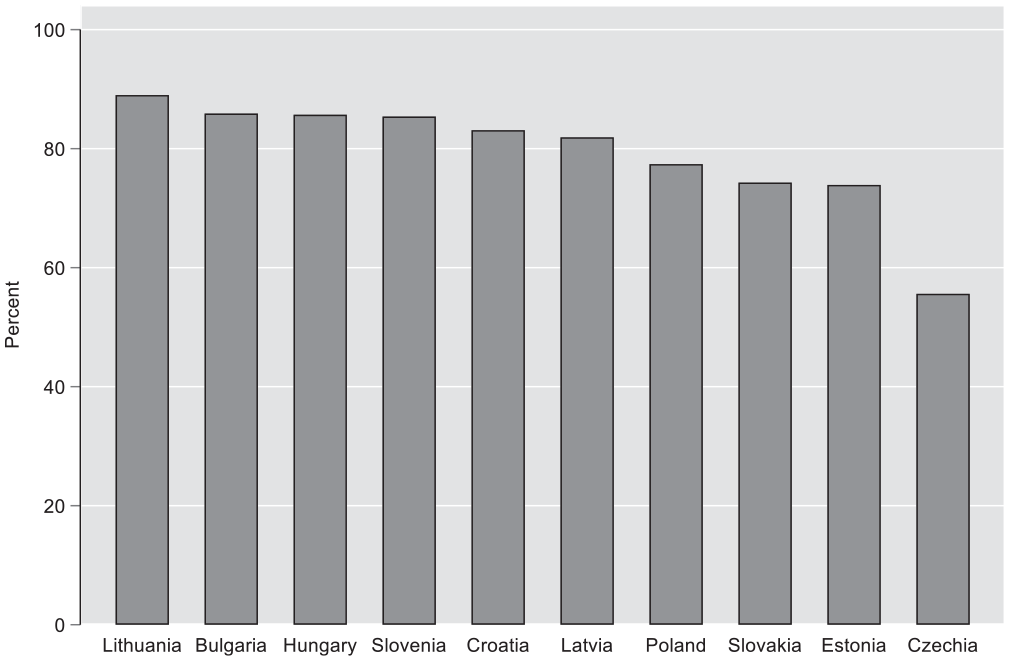
Proportion of population who support greater redistribution in Central and Eastern Europe
The second independent variable is used to test the conditional relationship between preferences for redistribution, ethnic heterogeneity, and identification with the radical right. Ethnic diversity is operationalized using the ethnic fractionalization measure devised by Alesina et al., 62 which is the likelihood that any two randomly selected individuals from a population belong to different ethnic groups. This is a country-level indicator obtained from the Quality of Governance dataset. 63 Higher values indicate greater heterogeneity. It should be noted that there are considerable differences between countries with respect to ethnic fractionalization. Countries such as Poland and Hungary, where minorities make up less than 10 percent of the population, are extremely homogeneous. According to the ethnic fractionalization measure used in this research, the probability that two people are from different ethnic groups is just 0.12 in Poland and 0.15 in Hungary. This compares to the most heterogeneous countries, Estonia and Latvia, where those probabilities rise to 0.51 and 0.59, respectively. Both Estonia and Latvia contain large Russian minorities, a legacy of their history as part of the Soviet Union.
The third independent variable is an indicator of welfare chauvinism. I use the question which asks “when should immigrants obtain rights to social benefits/services?” Respondents can answer: (1) “immediately on arrival,” (2) “after a year, whether or not they have worked,” (3) “after having worked and paid taxes for a year,” (4) “once they become a citizen,” and (5) “they should never get the same rights.” The final category—that immigrants should never get the same rights—represents a clear indication of chauvinistic attitudes. I follow Reeskens and van Oorschot 64 and combine the first two categories as these both represent unconditional stances towards access to benefits.
I include a battery of control variables that have been shown to be associated with support for RRPs. Younger voters are assumed to be more receptive to the radical right as they are less likely to have ties to traditional parties. 65 I therefore control for age and add a squared term to account for any non-linearity in the effect of age. Gender is also included in the models as previous research has shown that men are more likely to favour the radical right. 66 As RRPs are usually associated with anti-immigrant policies, I include a measure of respondents’ attitudes towards immigrants. 67 Individuals with higher levels of education and those in higher status occupations are targeted by other parties such as social democrats and the New Left, whereas less educated individuals and those in lower status occupations are more likely to identify with the radical right. 68 I therefore add controls for education and occupation. Education is measured using the ESS harmonized version of the International Standard Classification of Education (EISCED), with higher scores denoting a higher level of education. Occupational status is measured using Oesch’s 69 classification based on ISCO-88. Previous research has shown that religious individuals in CEE are also more likely to identify with the radical right due to the politicization of religion by RRPs. 70 I measure religiosity using the survey item which asks, “Regardless of whether you belong to a particular religion, how religious would you say you are?” Responses range from 0 to 11, with higher values indicating an individual is more religious. I also control for an individual’s membership of a trade union. Union members are generally more likely to hold leftist economic preferences but are also usually affiliated with left-wing parties rather than the radical right. The effect of this variable in CEE is therefore uncertain. Individuals who are presently or have previously been members of a union are coded 1 and all others coded 0. I add two variables that consider the economic insecurity of individuals. Similar to previous studies of support for RRPs, I operationalize this as using a respondent’s income and employment status.71,72
Finally, to take into account the national context within which redistributive and welfare preferences may be formed, I include an indicator of inequality. The level of inequality may influence an individual’s support for redistribution 73 and identification with RRPs. As inequality is likely to foster economic grievances, it is expected that higher inequality leads to greater identification with the radical right in CEE. Inequality is measured by the Gini coefficient and is taken from the United Nations (UN) World Income Inequality Database. 74 Descriptive statistics for all variables can be found in Table S1 of the online appendix.
Results
To test my hypotheses, two sets of models are specified. First, to examine the conditional effect of ethnic heterogeneity and redistribution on radical right support, I use a multilevel logit model of the full ESS cumulative dataset. This is a similar strategy to previous studies that have examined support for RRPs. 75 The model contains fixed effects and a random intercept for country-years. Fixed effects for survey rounds are included to capture shocks that are common to all countries and respondents, such as the economic crisis that occurred during 2008–2009. Individuals are nested into country-years similar to Burgoon 76 and Solt, 77 to take into account the volatility of CEE party systems which varies by country and can change significantly from one election to the next. 78 Clustering the data by country-years also increases the number of upper-level units to 57, which will provide more reliable estimates of the cross-level interaction that is used to test hypothesis 1. 79
Second, to examine the conditional effect of welfare chauvinism on redistributive preferences and support for the radical right, I use logit models with robust standard errors clustered by country. As the welfare module in the ESS only covers two survey rounds, there are too few upper-level units to provide reliable estimates of the macro-level variables. Furthermore, the independent variables in these models are both individual-level. The sample for these modules is inevitably smaller (16,605) than that used for the multilevel models.
Figure 1 shows the extent of support for redistribution across CEE. Clearly, populations in all countries are overwhelmingly in favour of greater redistribution, with support ranging from 89 percent in Lithuania to 56 percent in Czechia. Majority support for redistribution is common across both Western and Eastern Europe, but it is generally higher in CEE. 80 Why this is the case is debatable. It may be that the economic insecurity brought about by economic reform in the 1990s made individuals more likely to support social safety nets provided by the state. Pop-Eleches and Tucker 81 argue that it is likely to be a result of the communist legacy. Their research shows that individuals who lived through communism, particularly as adults, are more likely to favour greater welfare provision, which is perhaps unsurprising given that communist welfare states were expansive and often used to legitimize the authoritarian regime. Such widespread support for redistribution may also have implications for how parties combine such policies with cross-cutting values in the platforms, an issue that will be discussed further in this article.
Table 1 shows the results of the statistical models. Turning first to the multilevel models that use the full ESS dataset, model 1 shows that respondents who hold pro-redistribution preferences are significantly more likely to support RRPs in CEE. Model 1 also shows that the coefficient for ethnic fractionalization is both negative and statistically significant, indicating that respondents are more likely to identify with RRPs in countries that are ethnically more homogeneous. Model 2 contains a direct test of hypothesis 1 with an interaction term for redistributive preferences and ethnic fractionalization. The interaction is both negative and statistically significant, thus providing initial support for hypothesis 1: individuals with pro-redistribution preferences are more likely to identify with RRPs in ethnically homogeneous societies in CEE.
Redistribution and Support for Radical Right Parties
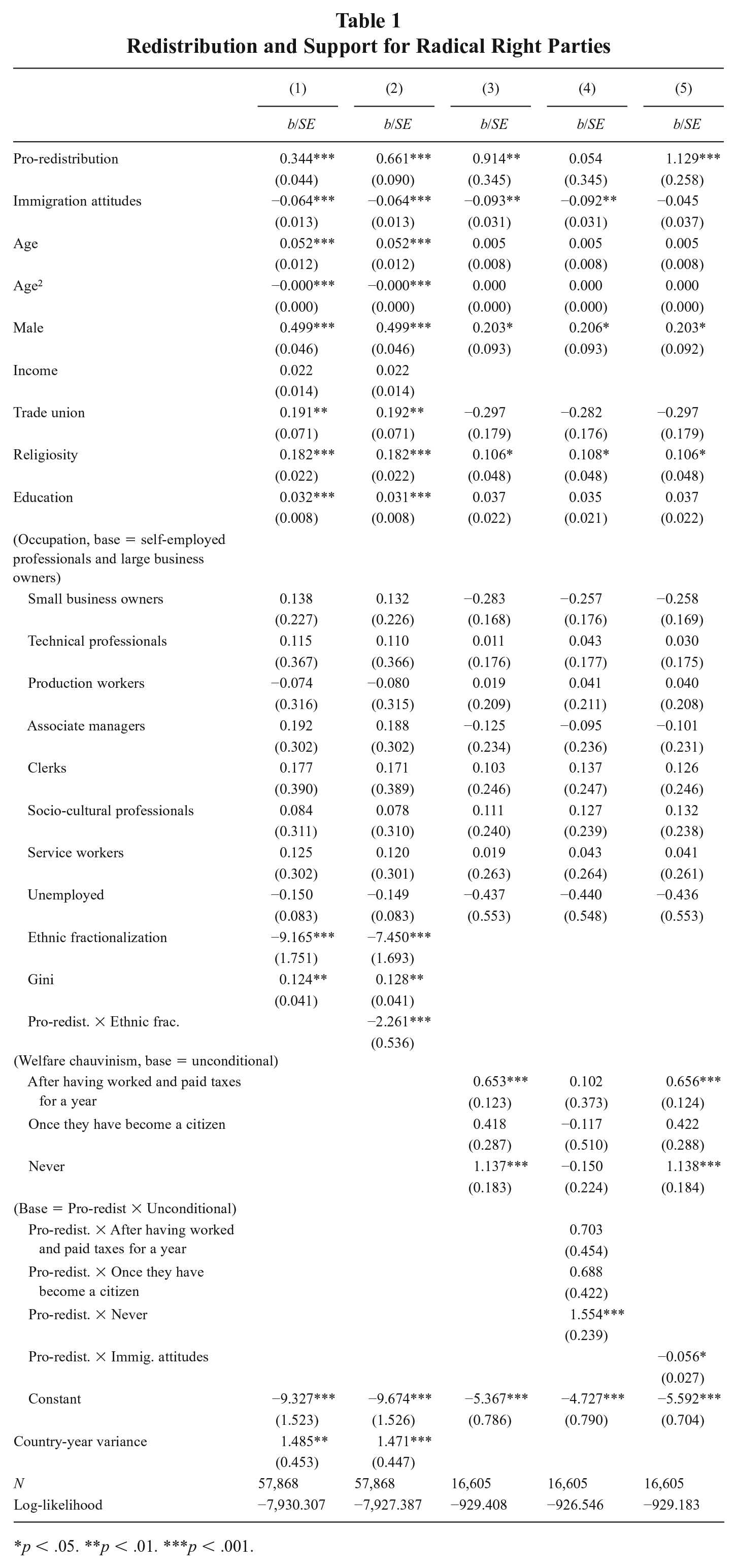
p < .05. **p < .01. ***p < .001.
Figure 2 illustrates the result in greater detail. It shows the marginal effect of pro-redistribution preferences at different levels of ethnic fractionalization. At the lowest levels of ethnic fractionalization, where the probability that two people are from different ethnic groups is around 0.1, pro-redistribution attitudes increase the probability that an individual will identify with the radical right by 4 percentage points. The marginal effect of pro-redistribution attitudes declines to just over 0.5 percentage points when ethnic fractionalization reaches just under 0.25. At higher levels of ethnic fractionalization, redistribution ceases to be a significant indicator of support for the radical right. These results provide support for hypothesis 1.
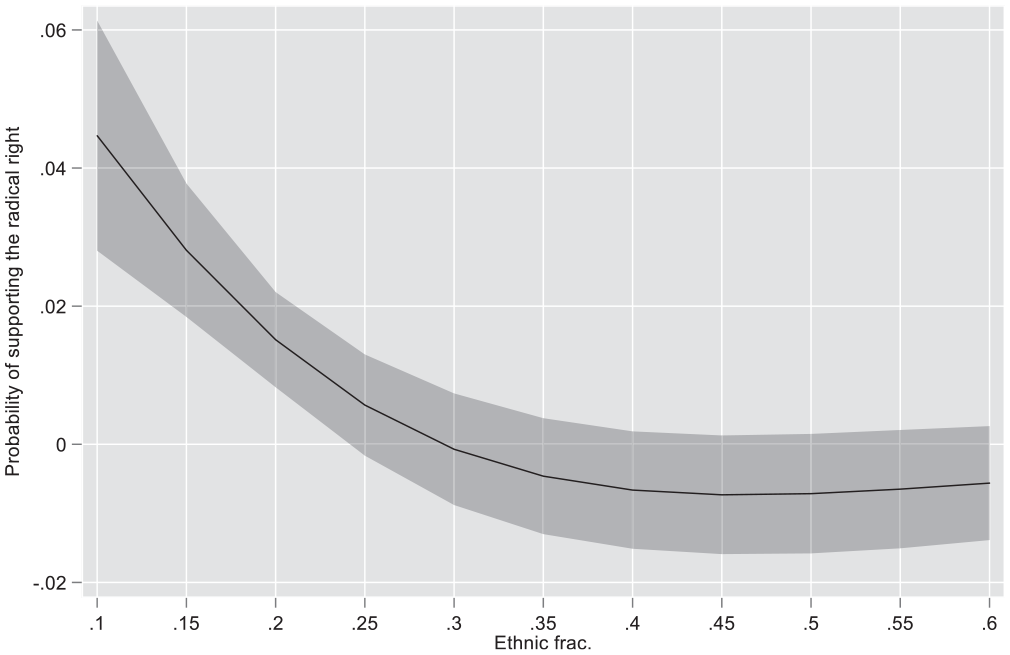
The marginal effect of support for redistribution on the probability of identification with the radical right, conditional on the level of ethnic fractionalization
Models 3 and 4 assess the effect of welfare chauvinism on RRP support in CEE. 82 I argue that RRP supporters will favour restrictions on migrants’ access to welfare services partially as result of the structure of ideological competition in the region, but also because the 2015 migrant crisis allowed RRPs to politicize the issue and increase its salience with voters. Overall, there is little support for granting immigrants unconditional access to welfare benefits among the sample (9 percent). Around equal proportions—38 percent—state that migrants should be given access to welfare after working for a year or once they become a citizen. Fourteen percent of respondents subscribed to the most chauvinistic position, stating that migrants should never be entitled to welfare.
The results of model 3 show that individuals who believe that migrants should be entitled to benefits after working for a year, and those that think migrants should never be entitled to welfare, are significantly more likely to identify with RRPs. This indicates that welfare chauvinism is a significant predictor of identification with RRPs in CEE, thus providing support for hypothesis 1. I extend this argument in model 4 that examines the interaction of welfare chauvinism and preferences for redistribution. The results demonstrate that individuals who hold pro-redistribution policy beliefs together with chauvinistic welfare preferences are more likely to support RRPs. As Figure 3 illustrates, individuals holding this constellation of preferences have a 10 percent increased probability of supporting the radical right. By comparison, individuals who favour redistribution and giving migrants unconditional access to welfare have a 0.02 percent increased probability of supporting RRPs.
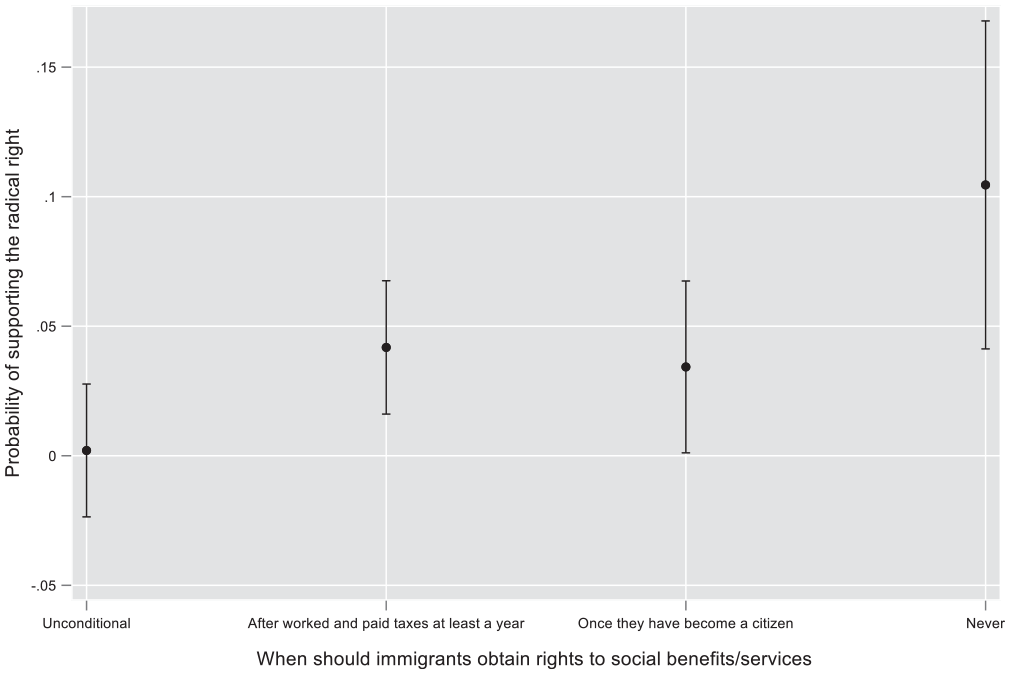
The marginal effect of support for redistribution on the probability of identification with the radical right, conditional on beliefs about welfare conditionality
To test the robustness of this result, I interacted redistributive preferences with an individual’s general attitudes towards immigrants in model 5 of Table 1. RRPs across Europe are defined by their hostility to immigrants, and given the pro-redistribution attitudes of RRP supporters in CEE, it would be expected that there is a relationship between economically left-wing preferences and anti-immigrant sentiment in the region. The results support this expectation. Figure 4 illustrates the interaction of redistributive preferences and attitudes towards immigrants. There is a 7 percent increased probability of supporting RRPs among those who favour redistribution and hold the most hostile attitudes towards immigrants, compared with 2 percent among those who hold pro-redistribution preferences and have the most sympathetic views of immigrants. However, it should be noted that even those who hold pro-redistribution preferences and have moderate views on immigrants are still more likely to support RRPs, even though the probability is lower. This may be indicative of the perceived salience of immigration as an issue in CEE. While RRPs have sought to promote the threat of immigration in the region, actual numbers of migrants still remain comparatively low. Examining the ESS data shows that respondents from survey rounds prior to the migrant crisis and the politicization of immigration averaged a score of 4.8 on the immigration attitudes variable. In the two survey rounds that followed the migrant crisis, this shifted to 4.5—a move to greater hostility towards immigrants. While this is not a dramatic shift, it does indicate that immigration could become increasingly important as an issue to mobilize support for RRPs in CEE.
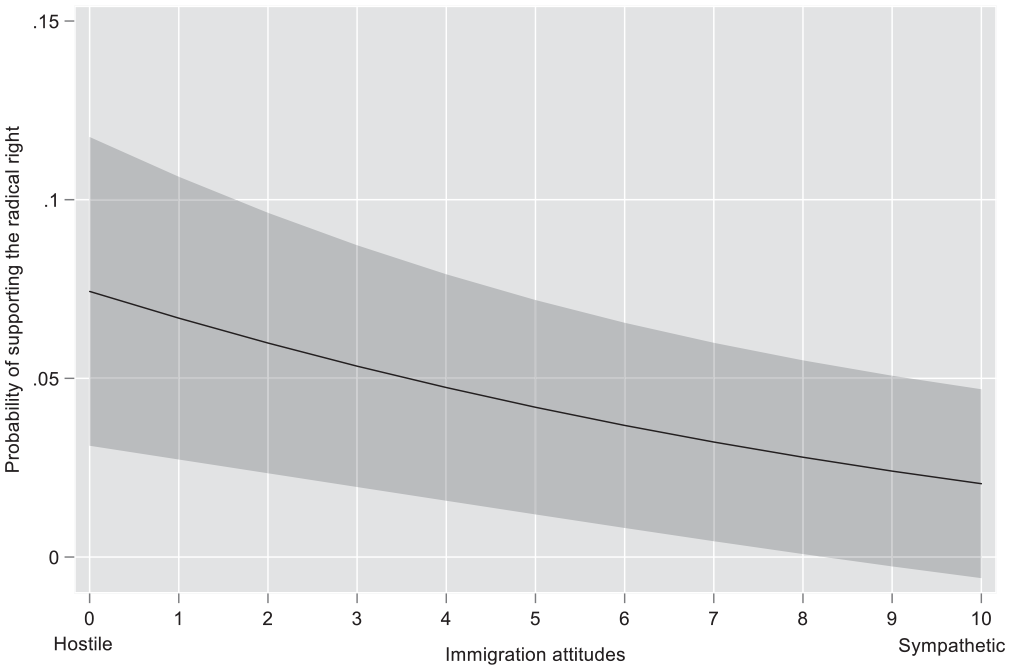
The marginal effect of support for redistribution on the probability of identification with the radical right, conditional on immigration attitudes
As previously noted, this combination of anti-immigrant and economically leftist policy preferences should not be surprising in the context of CEE. In Western Europe, pro-redistribution preferences tend to be combined with more liberal social attitudes. However, in CEE, the structure of ideological competition has been quite different since the onset of democratization. 83 A commitment to redistribution was seen as part of the opposition to the mainstream in the first decade of democratic politics in the region, in part as an appeal to those that were left economically vulnerable by the transition. 84 As the mainstream parties were largely committed to welfare retrenchment and more liberal values, economically leftist and authoritarian social values represented a programme that opposed the mainstream. In more recent years, RRPs have linked welfare policy to immigration in an effort to increase conditionality on access to benefits and services. 85 This represents an expansion of the scope of prior campaigns that were focussed more on minority groups; those groups remain targets for RRP animosity, but now the perceived economic and cultural threat from migrants has also become politically salient. In countries such as Poland and Hungary, welfare has also been linked to pro-natalist policies. In that respect, redistribution and welfare appear to be means to achieve other goals rather than ends in themselves for RRPs in CEE.
Some of the results for the control variables are worth noting. As in previous research, men are more likely to favour the radical right than women, 86 but age does not have a significant effect in the models in Table 1. Across all models, religious individuals are more likely to identify with the radical right in CEE, which confirms findings of previous research. 87 As may be expected based on prior research, individuals with more hostile attitudes towards immigrants are more likely to identify with RRPs in all models. 88 This is also consistent with the results of hypotheses 2 and 3. In the multilevel models, it is noteworthy that higher levels of inequality are correlated with support for RRPs. It is also interesting that indicators of economic status have no relationship with support for RRPs in any of these models in Table 1. The coefficients for employment status, occupation, and income are all insignificant, suggesting that RRP support is not related to economic anxiety in CEE. This contrasts with findings from some of the previous research on RRPs in Western Europe. 89 One explanation for this has been offered by Buštíková, 90 who argued that that economic grievances are linked to how these alter the status quo, potentially in favour of minority groups rather than objective economic insecurity.
Discussion and Conclusion
The results of this research demonstrate the extent to which RRPs in CEE are able to mobilize support from individuals who hold economically left-wing policy preferences. While RRPs in Western Europe have moved away from hard-line right-wing positions on the economy in recent years, 91 welfarism has been a more consistent and prominent feature of RRP discourse in CEE for the past three decades. There are several explanations for why RRPs have been able to adopt such policy positions in the region. Some emphasize the opportunity created by mainstream parties of both the left and right adopting orthodox liberal economic policy positions, 92 whereas others point to the experience of communism and its expansive social safety nets. 93 In this article, I argued that welfare chauvinism allowed RRPs to combine pro-redistribution economic positions with the more authoritarian attitudes towards minorities that are ubiquitous among such parties.
Welfare chauvinism has taken two forms in CEE: hostility towards minority groups, and post-2015, hostility towards immigrants. First, it is generally accepted in the literature that demand for redistribution is lower in more diverse societies. 94 The results of this research show that individuals in CEE who hold leftist economic preferences are more likely to identify with RRPs in ethnically homogeneous societies. In countries where welfare beneficiaries are more likely to be part of the majority ethnic group, support for redistribution is significantly higher than in more heterogeneous societies. Previous research has shown that mainstream parties have used targeted transfers to appeal to minority groups in CEE. 95 In turn, RRPs have used this to fuel perceptions of change in the ethnic group hierarchy and so increase resentment of minority groups. 96 The perception that minorities benefit disproportionately from welfare is therefore more likely to lead to opposition to redistributive policies in more diverse societies, and therefore, left-wing economic policies are not as strongly associated with support for RRPs in those countries.
Second, since the European migrant crisis, immigration has become a more salient political issue in CEE. CEE countries are not large-scale recipients of inward migration; however, the migrant crisis allowed RRPs to portray immigration as a pressing threat to national culture and security. This has engendered a discourse around welfare policy based on deservingness in the region. This is not unfamiliar, studies of welfare chauvinism in Western Europe have demonstrated that RRPs have sought to infuse welfare policy with greater conditionality, and among individuals, attitudes towards welfare are more positive when recipients are perceived as more deserving. 97 In CEE, RRPs have adopted a more chauvinistic tone on welfare policy while also introducing greater conditions and limits on some benefits. 98 This article demonstrates that more restrictive attitudes towards welfare eligibility are associated with support for RRPs in CEE. Individuals who believe that immigrants should never be allowed to access welfare are significantly more likely to support RRPs. Further results show that those who hold both pro-redistribution preferences and the most restrictive positions on welfare eligibility are more likely to support RRPs than those who hold pro-redistribution preferences but do not believe in any welfare conditionality. The robustness of this result is supported by the finding that individuals with more general anti-immigrant attitudes and preferences for greater redistribution are also more likely to support RRPs.
Taken together, the results of this research demonstrate that RRPs can coherently combine left-wing economic positions with social policies informed by authoritarian values without cross-pressuring their supporters. In the first wave of studies on the populist radical right in Western Europe, this combination of policy positions would have left RRP supporters conflicted between their values and material interests, 99 but this is not the case in CEE. Consequently, the structure of party competition in the region can appear distinct, with RRPs often situated to the left of social democratic parties on the economic dimension. 100
A further implication of this research relates to the economic anxiety explanation of RRP support. In CEE, the primacy of ethnic group competition can obscure perceptions of economic insecurity. Previous studies of Western Europe have found some evidence that economically insecure individuals are more likely to support the radical right. 101 But in CEE, economic insecurity is evaluated in relational terms with a particular emphasis on how economic changes alter the ethnic group hierarchy. 102 Therefore, objective indicators of economic insecurity are less likely to be related to identification with the radical right even among those who prefer redistribution. This argument is borne out in the analysis which shows that no indicators of objective economic insecurity are correlated with RRP support.
The results of this research show that under certain conditions, RRPs can successfully combine left-wing economic platforms with an authoritarian and traditionalist social policy outlook. As a result, the radical right have been able to compete directly with social democratic parties in CEE without de-emphasizing the economic dimension as RRPs have had to in Western Europe. 103 This has likely contributed to the significant weakness of social democratic parties across CEE where they have been in electoral decline for much of the past decade. 104 It is also notable that one of the few social democratic parties that has been successful in CEE is Smer, which consciously courted nationalist individuals with a “patriotic” agenda that was combined with a left-wing economic platform. 105
Some of the theoretical mechanisms outlined in this research are likely to be specific to CEE as they rely on the presence of a significant and mobilized minority. In Western Europe, ethnic group politics is only salient in a few countries. However, in both Western and Eastern Europe, immigration is proving to be a salient political issue around which RRPs can build a welfare chauvinist discourse, allowing them to align their policy platforms with economic interests of their voters. Combined with the electoral decline of social democratic parties in Western Europe over the last few decades, RRPs may in future have an opportunity to challenge social democrats on the left of the economic policy space.
While this research has examined the bases of identification with the radical right in CEE, there are still questions that remain to be answered. Given the conditional relationship between ethnic fractionalization, economic preferences, and identification with the radical right, is there evidence that redistributive policies targeted at minority groups increase support for RRPs? Buštíková 106 has shown that RRPs perform better at the polls following an increase in support for ethno-liberal parties, but that is quite separate from policy outcomes. It is also important to consider whether RRPs benefit from implementing chauvinistic welfare policies or whether they are punished for failing to do so. An important avenue for future research is, therefore, examining the relationship between redistributive outcomes and party support in CEE.
Supplemental Material
sj-docx-1-eep-10.1177_08883254221079797 – Supplemental material for Preferences for Redistribution, Welfare Chauvinism, and Radical Right Party Support in Central and Eastern Europe
Supplemental material, sj-docx-1-eep-10.1177_08883254221079797 for Preferences for Redistribution, Welfare Chauvinism, and Radical Right Party Support in Central and Eastern Europe by Lee Savage in East European Politics & Societies and Cultures
Footnotes

Supplemental Material
Supplemental material for this article is available online.
Notes
Supplementary Material
Please find the following supplemental material available below.
For Open Access articles published under a Creative Commons License, all supplemental material carries the same license as the article it is associated with.
For non-Open Access articles published, all supplemental material carries a non-exclusive license, and permission requests for re-use of supplemental material or any part of supplemental material shall be sent directly to the copyright owner as specified in the copyright notice associated with the article.
