




Abstract
The Court of Justice of the European Union’s rulings significantly influence the European Union’s single market, the trajectory of European integration, and the efficacy of the rule of law in Europe. However, due to the Court of Justice’s practice of delivering decisions per curiam without publicly available votes, the impact of individual judges’ biases on case outcomes remains largely unknown. This article explores whether the Court of Justice’s judges are biased towards their appointing member states. I provide evidence across multiple datasets that when a judge receives an observation (amici curiae brief) from their appointing member state, the judge’s panel is more likely to rule in favor of the member state’s position. This result holds irrespective of whether a judge is serving as the rapporteur (judgment-writer).
Introduction and theory
International courts are a defining feature of modern global politics, with the Court of Justice of the European Union (CJEU) perhaps paramount among them. Adjudicating disputes for the world’s largest single market, the CJEU impacts the development and application of European Union (EU) law in policy areas ranging from agriculture to the tenets of liberal democracy. Yet, because the Court issues its decisions per curiam with no identifying votes, dissents, or concurrences, little is known about how individual judges affect its decision-making (e.g. Cheruvu, 2019; Malecki, 2012; Wijtvliet and Dyevre, 2021), and even less is known about how factors external to the court may affect individual judges (e.g. Cheruvu, 2024).
In this article, I explore whether CJEU judges are biased towards their appointing member states. As empirical evidence demonstrates in other international contexts with public votes (e.g. Posner and De Figueiredo, 2005; Stiansen, 2022; Voeten, 2008), judges tend to favor their appointing member states’ preferences in cases. Given each EU member state appoints one judge to the CJEU for a six-year renewable term, and member states cannot block one another’s nominees, member states can theoretically appoint judges that are willing to advocate for their interests on the Court. One way member states express their preferences over case outcomes is by sending observations (amici curiae briefs) (e.g. Dederke and Naurin, 2018). Scholars provide evidence that the CJEU takes them into account when making decisions, as they may be particularly informative regarding the probability of legislative override (e.g. Carrubba et al., 2008; Cheruvu and Krehbiel, 2022; Larsson and Naurin, 2016; Ovádek, 2021), the impact a ruling may have on national judiciaries seeking to apply EU law in a similar issue area domestically (e.g. Schroeder, 2023), and the presence of domestic veto points that may hinder legislative implementation of judicial decisions (e.g. Blauberger and Martinsen, 2020; Martinsen, 2015).
If judges do have a bias towards their appointing member states, they should be more likely to vote—during the private deliberations with their panel—in favor of the party their appointing member state expresses support for in an observation. While judges’ individual votes are not available for analysis, as long as judges receiving observations from their appointing member state are pivotal on their panels at least some of the time (e.g. Lauderdale and Clark, 2012; Wijtvliet and Dyevre, 2021), these biases should affect case outcomes. Considering that panels of three to five judges hear the vast majority of cases at the CJEU (e.g. Fjelstul, 2023), a judge may often be pivotal. I argue, thus, that viewing case outcomes on average tending towards judges’ appointing member states’ expressed preferences in observations provides evidence of judge bias affecting a panel’s decision-making process. H1: When the panel judges’ appointing member states support a particular party to win a case in their observations, a panel is more likely to rule in favor of that party.
Furthermore, an institutional feature of the CJEU that may allow a judge’s bias towards their member state to influence case outcomes is the assignment of the judge-rapporteur (JR), or the judgment-writer for the case. The CJEU’s president assigns the JR immediately after a case arrives at the Court. JRs are at a substantial advantage relative to other panel judges in affecting the outcome of a case for two reasons: (1) the Court tasks the JR with independently collecting information on the case, providing the JR an informational advantage relative to other panel judges (e.g. Kelemen, 2017), and (2) the JR drafts a preliminary judgment before any deliberations occur with their panel. Scholars, thus, argue that JRs wield disproportionate influence at the CJEU. Zhang et al. (2018: 146) explain that, “even though conceptually each judge in the chamber is entitled to the same voting power, in reality their influence may vary depending on [whether they are the JR] in any given case. This group dynamic may, therefore, influence judicial voting.” Furthermore, given the high workload at the CJEU (e.g. Fjelstul et al., 2023), “The pressure of time often prompts judges to defer to the rapporteur’s opinion. In these circumstances the other members of the panel are less likely to conduct their own research. So, in most cases the rapporteur’s opinion becomes the opinion of the court, and s/he is also the author of the judgment” (Kelemen, 2017: 43). Therefore, when the JR receives an observation from their appointing member state, they should be in a superior position to steer a case’s outcome towards the preferences of their appointing member state. H2: When the JR’s appointing member state sends an observation favoring a particular party to win a case, a panel is more likely to rule in favor of that party.
Data
To test my hypotheses across multiple data collection efforts, I use data from both Carrubba and Gabel (2015) and the IUROPA CJEU database (Brekke et al., 2023; Larsson et al., 2022).
Carrubba and gabel (2015) data
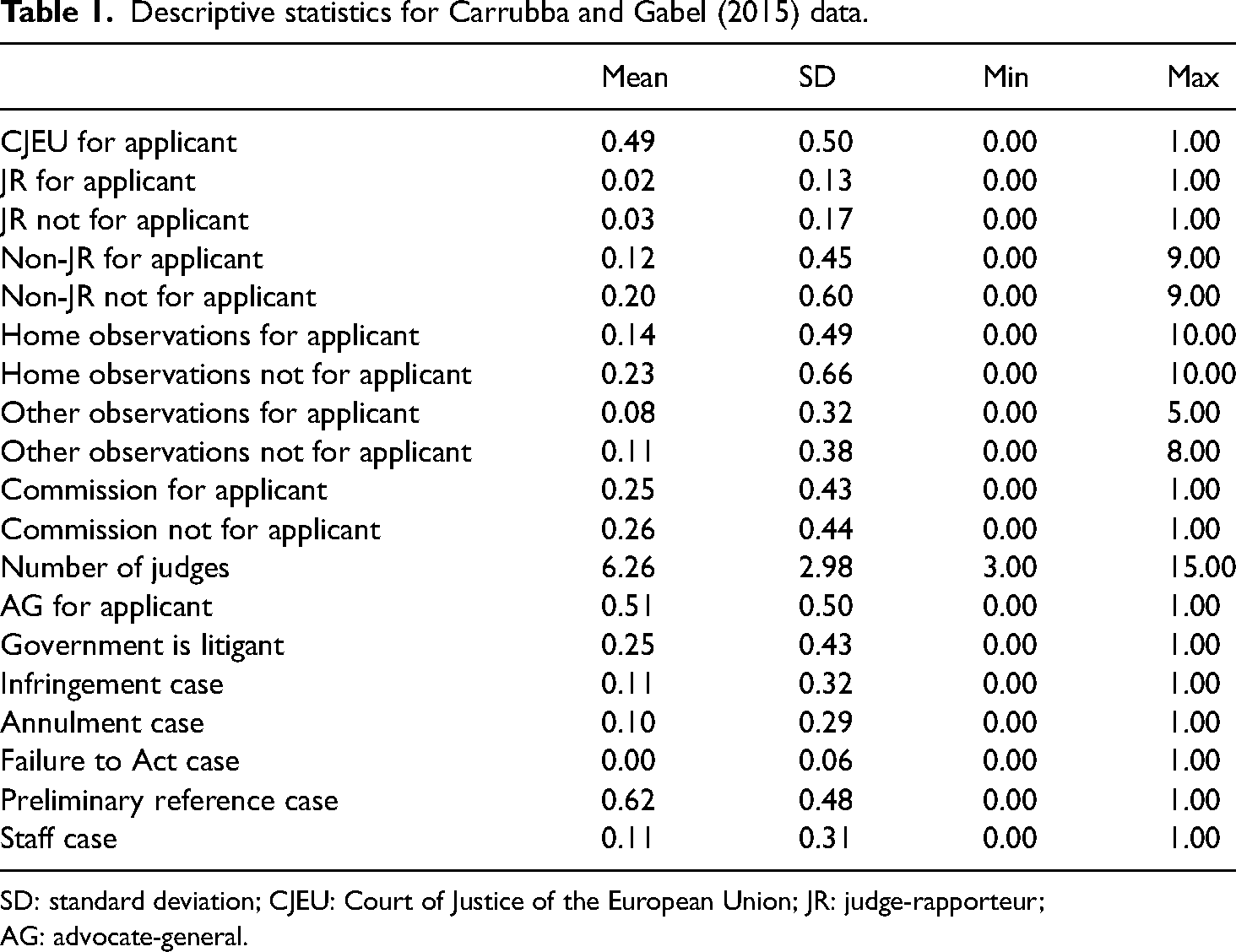
These data cover every judgment the Court issued from 1960 to 1994 (3719 cases), and are further sub-divided into within-case legal issues (5434), which serve as the unit of analysis. The primary dependent variable is CJEU for Applicant, which takes the value of 0 when the Court ruled against the applicant’s position in the legal issue and the value of 1 when the Court rules in favor of the applicant’s position. Importantly, these data indicate for each member state whether they submitted an observation favoring the applicant, 1 defendant, or did not submit an observation at all.
Combining these data with IUROPA data on panel composition (Brekke et al., 2023), I then create the variables Home Observations for Applicant—taking positive values if a member state submitted an observation in favor of the applicant to a panel that includes the judge they appointed to the Court—and Home Observations not for Applicant—taking positive values if a member state submitted an observation not favoring the position of the applicant. For example, the panel consisting of judges Gulmann (Denmark), Moitinho de Almeida (Portugal), and Puissochet (France) heard the case Dorsch Consult Ingenieurgesellschaft mbH v. Bundesbaugesellschaft Berlin mbH (CELEX number 61993CJ0446). Portugal submitted an observation favoring the position of the defendant to the panel in this case specifically regarding the legal issue (as these data describe) “Is article 4(2)(c) invalid?” Since Portugal submitted this observation not favoring the applicant’s position to a panel including the judge they appointed to the Court (Moitinho de Almeida), Home Observations not for Applicant takes the value of 1 for this legal issue.
These data also include a number of variables for each legal issue that I use as controls. First, I control for whether a government is a litigant in the case, as Carrubba et al. (2008) provide evidence that member states’ observations are more influential in the Court’s decision-making when a government is a litigant. Second, I include controls for whether the case is a preliminary reference (e.g. Cheruvu and Krehbiel, 2024; Krehbiel and Cheruvu, 2022), infringement (e.g. Cheruvu, 2022; Cheruvu and Fjelstul, 2021; Fjelstul and Carrubba, 2018), failure to act, annulment, or staff case, as this distinction may be relevant since the Court, for example, tends to overwhelmingly rule in favor of the Commission in infringement cases (e.g. Castro-Montero et al., 2018). Third, given previous research finds that the European Commission has a substantial influence on the Court’s decisions (e.g. Stone Sweet and Brunell, 1998), I control for (1) whether the Commission is a party to the case and (2) whether the Commission submitted an observation favoring the applicant or the defendant. Fourth, I control for the number of judges hearing a case, as it is an indicator for case salience (e.g. Kelemen, 2012). Fifth, I control for the advocate-general’s (AG’s) position on each legal issue, as scholars find that AG opinions are strongly correlated with the CJEU’s decision-making (e.g. Larsson and Naurin, 2016). Given the AG’s opinion is causally subsequent to the independent variables of interest—in other words, the AG issues their opinion after member states send their observations to the CJEU (e.g. Frankenreiter, 2017)—I present model specifications both with and without the AG’s opinion, as including it leads to more conservative estimates.
Lastly, I control for all observations member states submitted for a given legal issue (not) favoring the applicant (Other Observations for Applicant, Other Observations not for Applicant) excluding observations already included in the statistical model through the Home Observations (not) for applicant variable. For example, the panel consisting of judges Bahlmann (Germany), Due (Denmark), and Schockweiler (Luxembourg) heard the case Trans Tirreno Express SpA v. Ufficio provinciale IVA (CELEX number 61984CJ0283), which only concerned a single legal issue. Germany submitted an observation in favor of the applicant, France submitted an observation in favor of the defendant, and Italy submitted an observation in favor of the defendant for this case. Since Germany submitted an observation in favor of the applicant to a panel including the judge it appointed to the Court, Home Observations for Applicant takes the value of 1. Additionally, since Italy and France submitted observations favoring the defendant, Other Observations not for Applicant takes the value of 2. Including this control helps account for the threat of legislative override potentially affecting the decision-making of the Court (e.g. Larsson and Naurin, 2016).
IUROPA CJEU database
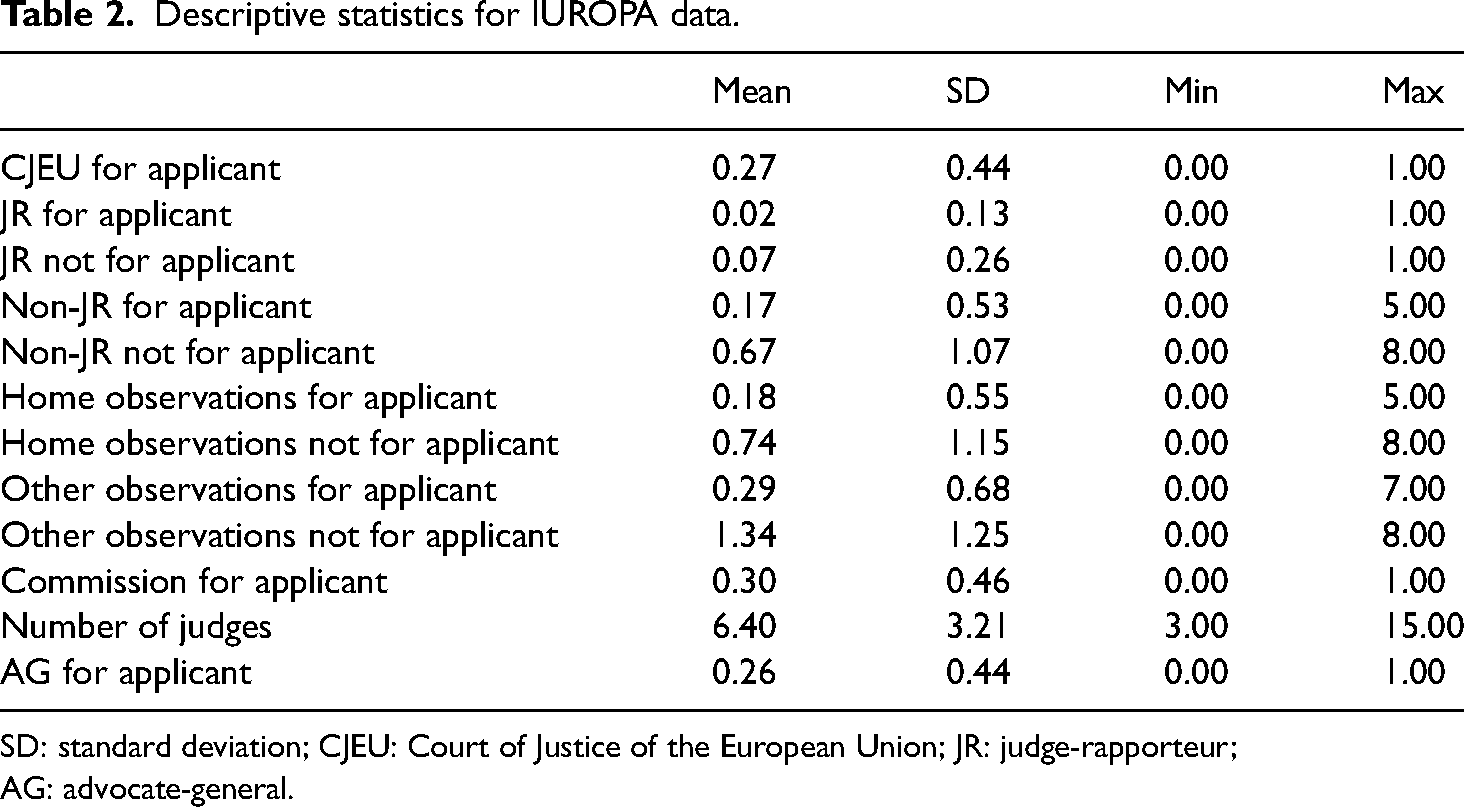
The issues and positions component of the IUROPA CJEU database (Larsson et al., 2022) covers preliminary reference cases from 1995 to 2011. Similarly to the Carrubba and Gabel (2015) data, it divides cases into legal issues and codes the positions of the CJEU, the parties to a case, member states, and EU institutions for each issue. To ensure comparability across these two datasets, I code all positions relative to the applicant’s position. I use the same coding procedure as I described previously for Home Observations (not) for Applicant, and Other Observations (not) for Applicant. Importantly, on some legal issues, actors may have multiple positions. As such, all variables that indicate agreement with the applicant (CJEU for Applicant, Home Observations for Applicant, Other Observations for Applicant) take the value of 1 only if their expressed positions are exactly identical to the applicant’s position. If the actors have any other positions in addition to those in which they agree with the applicant, it is not coded as agreement. In other words, any difference between the applicant’s positions and the actor’s positions is coded as the actor not favoring the applicant on the particular issue.
These data also include additional policy area controls that I utilize in my analysis. It codes whether a legal issue deals with derogations to violations of free movement (About Derogation), whether the legal issue deals with direct effect (About Direct Effect), whether the legal issue deals with the interpretation of validity of EU law (About Validity), and the primary and secondary areas of national law that the legal issue affects (National Law Primary, National Law Secondary). Across these policy areas within these data, coders expressed uncertainty on some legal issues as to whether it dealt with the given policy area. As such, I include these variables in my analysis as ordinal variables with the “No” category as the baseline. I include National Law Primary and National Law Secondary as fixed effects in these model specifications to capture variation across different combinations of national issue areas. Lastly, the Commission expressed a position on every issue in these data—meaning that the variable Commission for Applicant fully encompasses the Commission’s positions—whereas, in the Carrubba and Gabel (2015) data, the Commission is at times a party to the case through the infringement procedure and, thus, requires a separate variable for Commission not for Applicant.
Empirical approach (H1)
I estimate a series of linear probability models to test my hypothesis. Formally, the ordinary least-square (OLS) model for my analysis where i indexes the legal issue is:

Empirical approach (H2)
H2 argues that a panel is more likely to rule in favor of a party when the JR’s appointing member state sends an observation favoring the party. To analyze this hypothesis, I separate the Home Observations (not) for Applicant variable into two variables: JR (not) for applicant and Non-JR (not) for Applicant. For example, in the Carrubba and Gabel (2015) dataset, the panel consisting of judges Grévisse (France, JR), Moitinho de Almeida (Portugal), Zuleeg (Germany) heard the case Heinz Schumacher v Hauptzollamt Frankfurt am Main-Ost (CELEX number 61987CJ0215) that consisted of a single legal issue. France submitted an observation in favor of the applicant, and Germany submitted an observation in favor of the defendant. Since France submitted an observation in favor of the applicant to a panel that contained the judge it appointed to the Court and their judge is the JR, JR for Applicant takes a value of 1. Similarly, since Germany submitted an observation in favor of the defendant to the panel and its judge was not the JR, Non-JR not for Applicant takes a value of 1.
I estimate a series of linear probability models to test H2. Formally, the OLS model for my analysis where i indexes the legal issue is

Descriptive statistics for Carrubba and Gabel (2015) data.
SD: standard deviation; CJEU: Court of Justice of the European Union; JR: judge-rapporteur; AG: advocate-general.
Descriptive statistics for IUROPA data.
SD: standard deviation; CJEU: Court of Justice of the European Union; JR: judge-rapporteur; AG: advocate-general.
Results
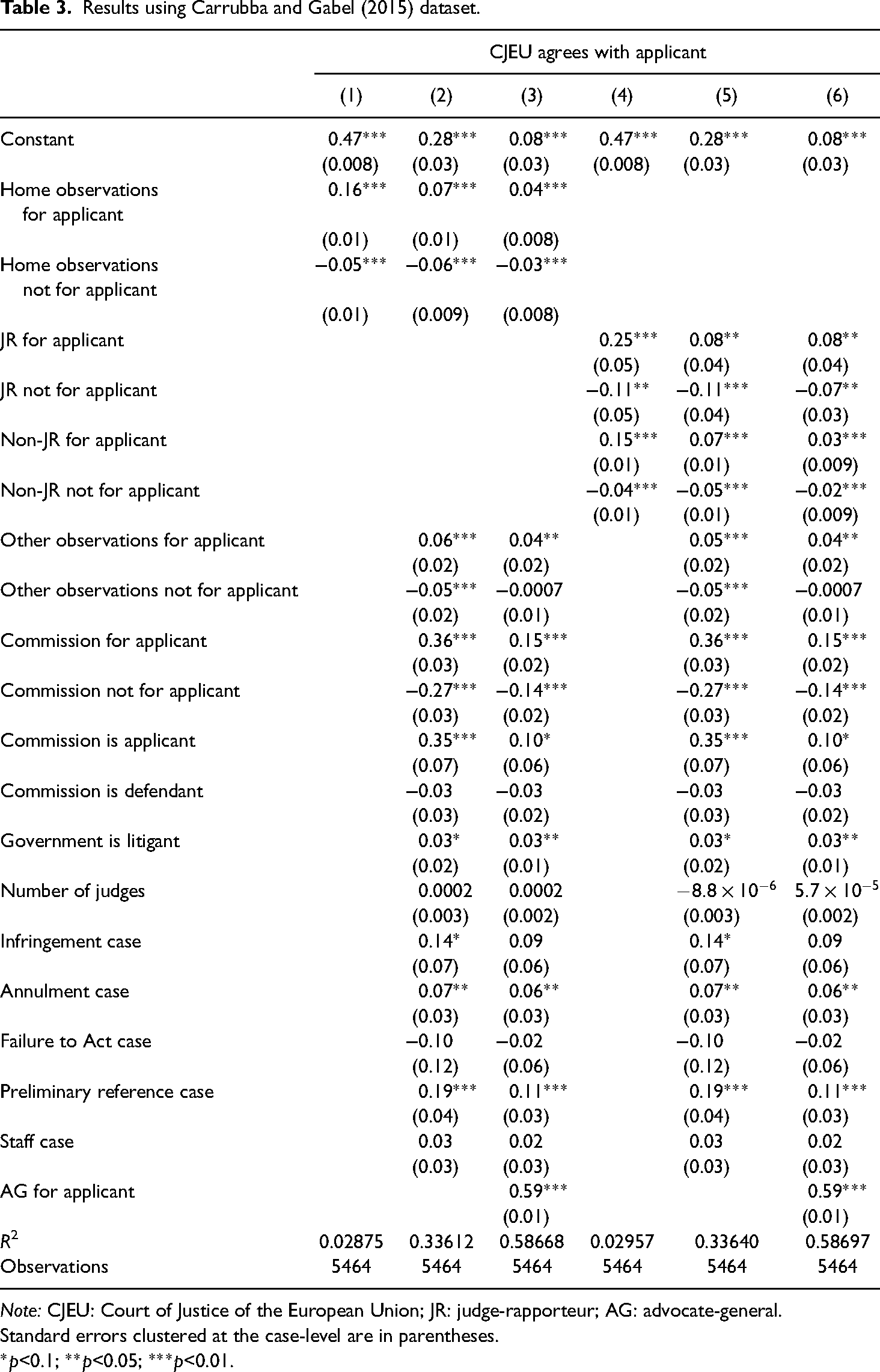
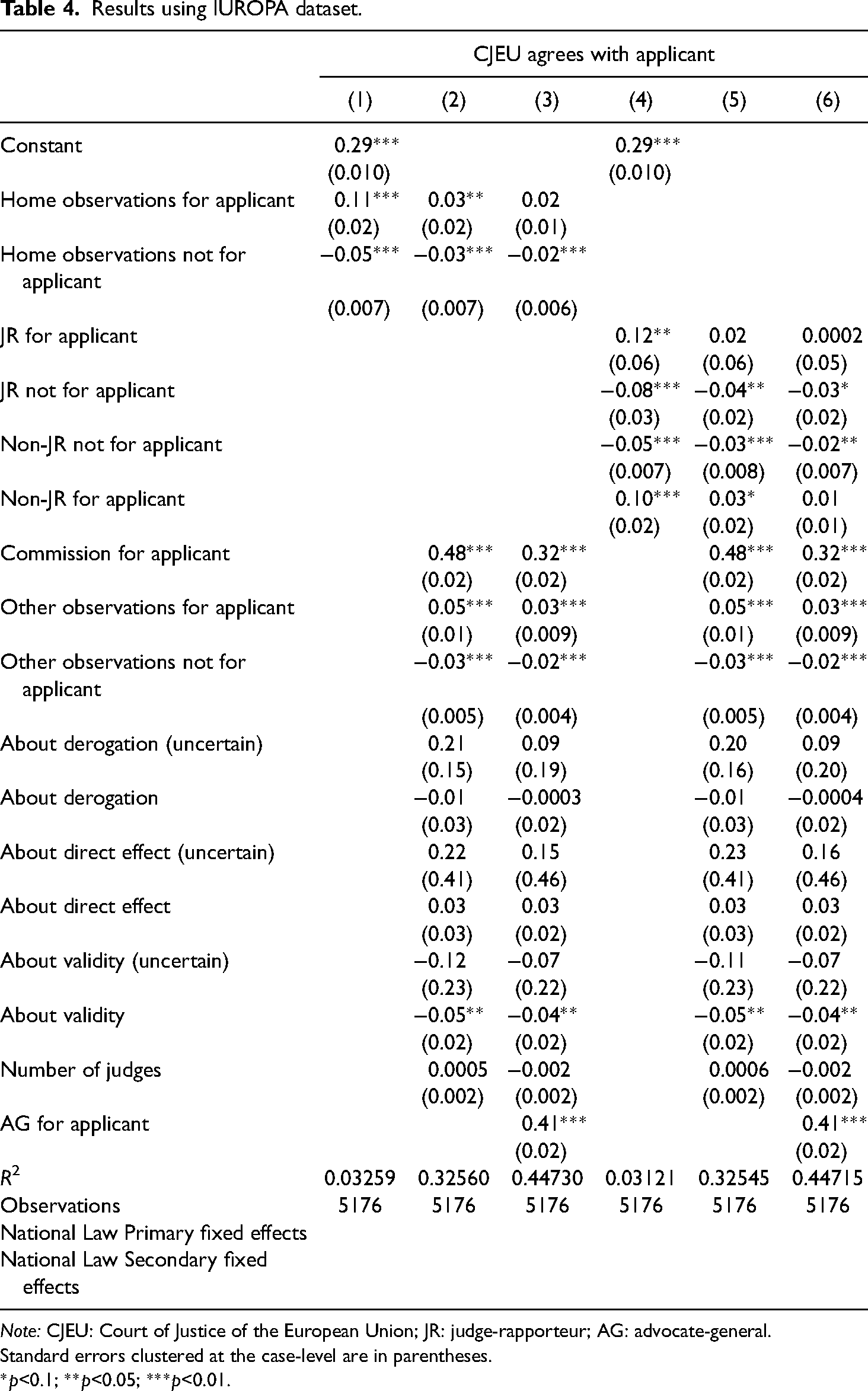
Table 3 presents the results for the Carrubba and Gabel (2015) dataset and Table 4 displays the findings for the IUROPA dataset. Models 1–3 across both tables display the results for H1. Across both datasets and all models, Home Observations not for Applicant is negative and statistically significant. Similarly, Home Observations for Applicant is positive and statistically significant, with the exception of model 3 using the IUROPA dataset and including the AG control. As mentioned previously, the AG control may attenuate the estimate because it is causally subsequent to the independent variables of interest, making model 3 a conservative estimate.
Results using Carrubba and Gabel (2015) dataset.
Note: CJEU: Court of Justice of the European Union; JR: judge-rapporteur; AG: advocate-general.
Standard errors clustered at the case-level are in parentheses.
*p<0.1; **p<0.05; ***p<0.01.
Results using IUROPA dataset.
Note: CJEU: Court of Justice of the European Union; JR: judge-rapporteur; AG: advocate-general.
Standard errors clustered at the case-level are in parentheses.
*p<0.1; **p<0.05; ***p<0.01.
Models 4–6 across both tables provide the results for H2. The coefficient for JR not for Applicant is negative and statistically significant across all model specifications. Additionally, the coefficient for JR for Applicant is positive and statistically significant across all model specifications in the Carrubba and Gabel (2015) dataset, and is positive across all model specifications, but only statistically significant in model 4, for the IUROPA dataset. Notably, with the exception of model 6 for the IUROPA dataset including the AG control, the coefficients for Non-JR for Applicant are positive and statistically significant, and the coefficients for Non-JR not for Applicant are negative and statistically significant, providing evidence that judges who are not serving as the JR may influence legal issue outcomes (e.g. Wijtvliet and Dyevre, 2021). For robustness, I also demonstrate that these results hold under a logit specification in the Online appendix. Nonetheless, these results should be interpreted with caution for the IUROPA data with national law fixed-effects given the incidental parameters problem that fixed-effects causes in logit specifications, as well as the removal of fixed-effects in instances of limited variation in the dependent variable (e.g. Beck, 2020).
Importantly, as demonstrated in models 2, 3, 5, and 6, the magnitude of the primary independent variables decreases substantially upon the inclusion of relevant controls. Supplementing findings in other studies (e.g. Stone Sweet and Brunell, 1998), the CJEU is more likely to side with the Commission when it submits an observation in a case or when it is the applicant in a case, such as in infringement proceedings (e.g. Castro-Montero et al., 2018; Fjelstul and Carrubba, 2018). Furthermore, observations from other member states are also strongly correlated with the CJEU’s decision-making, complementing existing scholarship (e.g. Carrubba et al., 2008; Larsson and Naurin, 2016). Taken together, while these results are indicative of an appointing member state bias among its judges, it is one among a series of internal (e.g. Cheruvu, 2024; Malecki, 2012) and external factors (e.g. Caldeira and Gibson, 1995; Cheruvu, 2023; Cheruvu et al., 2025; Krehbiel, 2021; Krehbiel and Cheruvu, 2021) that affect the CJEU’s decision-making.
Mechanisms and discussion
Given the CJEU’s decision-making has a substantial impact on the interpretation and application of EU law as well as the pace of European integration, understanding the factors that affect its collegial decision-making process provide insight regarding its rulings. This article argues and provides evidence that member states are influencing case outcomes at the CJEU when they submit observations to panels that include the judges they appointed to the court. Nonetheless, it is unable to precisely denote how member states are influencing judges. Below I speculate on three potential mechanisms and conclude with the implications of my findings for CJEU decision-making.
First, since judges have six year terms and must have their member state governments reappoint them—or potentially may have a desire to serve on a domestic high court—judges have incentives to be responsive to their appointing government’s preferences. Indeed, a substantial scholarship across a wide variety of contexts demonstrates that judges are sensitive to career concerns (e.g. Canes-Wrone et al., 2014; Helmke, 2005; Ramseyer and Rasmusen, 2003). Given the CJEU issues judgments per curiam, however, it is possible that the institution sufficiently shields judges from facing retaliation for adverse decisions against their member state’s preferences (e.g. Dunoff and Pollack, 2017). For example, Cheruvu (2024) provides evidence that JRs at the CJEU do not change their decision-making when their appointing government turns over.
A second potential mechanism, thus, is that governments are appointing judges that are ideologically similar to them. Scholars provide plenty of evidence across contexts that governments appoint ideological allies (e.g. Bonica and Sen, 2017; Garoupa et al., 2021; Tiede, 2020). It is possible, as a result, that the correlations between member states’ observations and their judges’ panels’ decision-making is simply an artifact of their ideological alignment. Nonetheless, one potential alternative expectation of this mechanism would be that member state observations should not be more correlated with outcomes relative to cases without member state observations. That is, irrespective of whether their government sends an observation, a judge that is ideologically aligned would already know their government’s preferences for a case’s outcome. Therefore, a judge in cases with and without an observation from their government would issue similar rulings.
A third potential mechanism is that judges do not always know their government’s preferred outcome for a case. Judges must adjudicate issue areas in which they necessarily may not have expertise and may not know the long term impacts of their decisions (e.g. Staton and Vanberg, 2008). As such, they may be unaware as to which constituencies within their own member state have a stake in a given case’s outcome and rely on different types of heuristics to inform their decision-making (e.g. Xu, 2020). As scholarship on amici curiae briefs argues (e.g. Box-Steffensmeier et al., 2013), when applied to the EU context, member state observations provide information to judges. Judges, naturally, may place higher weight on information from their own governments than others when making decisions. Disentangling these mechanisms would substantially contribute to the scholarship on CJEU decision-making.
As the CJEU increasingly hears cases in smaller panels of three judges to increase its efficiency amid workload pressures, leading to the inconsistent application of EU law (e.g. Fjelstul, 2023), this article’s findings suggest that member state bias may be increasingly relevant in deciding case outcomes, as a judge is more likely to be pivotal in deciding the outcome of a case in a panel of three relative to a larger panel. Nonetheless, the CJEU has taken steps to mitigate such bias by, for example, introducing a merit commission to evaluate the quality of judges. Scholars also provide evidence that the Court’s president may strategically allocate cases in an attempt to prevent such bias (e.g. Hermansen, 2020), that the Court hears politically salient cases in larger chambers, and that the Court acts strategically—with particular consideration to the probability of compliance—in cases heard by larger panels (e.g. Cheruvu and Krehbiel, 2022). The CJEU, thus, appears to be making a choice to allow such bias to affect outcomes in less salient cases with smaller panels as a means to increase efficiency, while maintaining more institutional control over the outcomes of cases that have broader implications for the development of EU law.
Supplemental Material
sj-pdf-1-eup-10.1177_14651165251320841 - Supplemental material for Are European Court of Justice judges biased towards their member states?
Supplemental material, sj-pdf-1-eup-10.1177_14651165251320841 for Are European Court of Justice judges biased towards their member states? by Sivaram Cheruvu in European Union Politics
Supplemental Material
sj-zip-2-eup-10.1177_14651165251320841 - Supplemental material for Are European Court of Justice judges biased towards their member states?
Supplemental material, sj-zip-2-eup-10.1177_14651165251320841 for Are European Court of Justice judges biased towards their member states? by Sivaram Cheruvu in European Union Politics
Footnotes
Acknowledgements
I thank Cliff Carrubba, Jeff Staton, Zac Peskowitz, Jen Gandhi, Tom Clark, Lee Walker, Curtis Bram, Lauren Santoro, participants in the Emory Law and Politics discussion group, the Emory Graduate Comparative Politics Workshop, ECPR Standing Group on Law and Courts Webinar Series, the Berkeley European Politics Working Group, the 2021 Southern Political Science Association Conference, the UT Dallas Political Science Working Paper Series, editor Gerald Schneider, and three anonymous reviewers for the helpful comments and feedback.
Funding
The author received no financial support for the research, authorship, and/or publication of this article.

Data availability statement
The data and replication code are available as part of the supplementary material.
Supplemental material
Supplemental material for this article is available online.
References
Supplementary Material
Please find the following supplemental material available below.
For Open Access articles published under a Creative Commons License, all supplemental material carries the same license as the article it is associated with.
For non-Open Access articles published, all supplemental material carries a non-exclusive license, and permission requests for re-use of supplemental material or any part of supplemental material shall be sent directly to the copyright owner as specified in the copyright notice associated with the article.
