



Abstract
The Russian invasion of Ukraine is testing bonds of energy solidarity in Europe as domestic and territorial conflicts can undermine unity and swift political action. To examine the magnitude of these divisions on the demand side, we use a factorial survey experiment in seven EU countries. On the one hand, the external security threat should push European unity further. On the other hand, the asymmetry of the crisis could fuel both between-country divisions, given differences in energy dependence and geopolitical context, and within-country divisions, across political groups, reducing the potential for common policy. Our results show that while there is a wide consensus on energy sanctions between countries (except Hungary), within countries there is a greater potential for conflict along identarian, partisan, and economic lines.
Introduction
The 2022 Russian invasion of Ukraine is not only challenging the European security order that was established after 1989, but it is also severely testing the bonds of energy solidarity in Europe. The preferences of European domestic electorates are a key part of this process as they can constrain or enable domestic and European policymaking. On the one hand, the external security threat should push European unity further and rally them not only around their national flag, but also the European one (Nicoli et al., 2024; Truchlewski et al., 2023) and produce a Europeanization of domestic public discourses (Sojka et al., 2025). This unified front of citizens is consequential for European Union (EU) “bonding” (Ferrera, 2005) and can ease the constrain on policymakers who in turn can craft common policies. On the other hand, the energy threat induced by the crisis is being experienced asymmetrically both between member states (given differences in energy dependence and geopolitical context), and within member states (due to various individual preferences and vulnerabilities). This asymmetric problem pressure can exacerbate domestic conflicts and can thus undermine common EU decision-making and bonding (Ferrara and Kriesi, 2021). Given this tension and the constraints that domestic politics can create for national governments and intergovernmental bargaining, our article seeks to map territorial and functional conflicts (Caramani, 2015) on the demand-side when it comes to European solidarity with energy sanctions and with sharing energy costs.
Inquiring into the demand-side support for European solidarity with energy sanctions and with sharing energy costs is important for several reasons. First, as office holders are reliant on their voters’ support, national preference formation plays an important role for EU level coalition formation. It is therefore important to understand the degree to which citizens of various EU countries converge on their views on energy independence. Convergence on the demand-side would provide a strong enabling factor by creating a permissive policymaking environment. This point is best illustrated by the post-functionalist literature using a multi-level governance approach to European integration (Hooghe and Marks, 2009). This literature argues that domestic politics are tightly coupled with European outcomes, as public opinion and domestic political conflicts shape governmental incentives which in turn impact intergovernmental bargaining at the EU level. The fact that in the EU supranational policymaking is embedded in domestic public opinion is exacerbated by the need for consensus and unanimity in EU foreign policy. This is a crucial problem in the international political economy of cooperation (De Vries et al., 2021): mass publics can question international cooperation especially if driven by domestic opposition or, in our case, Eurosceptic political forces. Consequently, mass publics can either stabilize or destabilize efforts for international cooperation.
Second, starting from the observation that the EU polity has a multi-level structure, political conflict lines are being drawn both territorially, between member states, and domestically, along functional lines, within member states (Caramani, 2015; Kriesi et al., 2024). Territorially, all EU states would arguably be better off if they became energy independent from Russia. However, given the asymmetric dependence on Russian energy, and the unequal costs that countries must bear, a collective action problem emerges: voters in each country might be incentivized to want to keep energy flows and have the other member states pay. Within each member state, depending on their ideological preferences and level of attachment to the EU, publics might be divided on their support for European solidarity with energy sanctions. Assessing the nature and level of divisions within European publics is important for understanding what the most likely case for frictions and opposition is.
Third, from a more general theoretical perspective, it is important to understand how this external security threat might affect European polity-formation. The Russian invasion of Ukraine comes on the heels of a crisis-full two decades that severely tested the European public's solidarity. While the press is always bemoaning the EU for slow and divergent responses that hinge on domestic state capacity, it is not at all clear that in every crisis Europeans want to see centralized capacity-building and burden-sharing. Some crises activate asymmetric capabilities of member states or their asymmetric fragility and thus create heterogenous preferences for common solutions (Ferrara and Kriesi, 2021). We argue that the energy crisis in light of the invasion of Ukraine is such a case given the various levels of energy (in-)dependence that EU member states have. The asymmetry of the energy crisis can, however, be counterbalanced by solidarity among EU states. Solidarity is more likely to manifest for crises which come externally, for which countries cannot be given direct blame, and which are seen as potentially threatening to the whole European polity. Arguably, the Russian invasion of Ukraine is a good case in point for such an external threat in which no member state is to blame. For these reasons perhaps, the Russian invasion of Ukraine has sparked a unifying effect on European publics regarding satisfaction with the crisis response, at least in the initial phase of the war (Nicoli et al., 2024; Truchlewski et al., 2023).
Given these implications, our article contributes to the larger empirical literature on European solidarity that has flourished in recent years and focused on solidarity during pandemics, refugee crises, and national bankruptcies or climate change – to name but a few examples (Bauhr and Charron, 2021; Bechtel et al., 2014; Bremer and Genschel, 2020; Gerhards et al., 2019; Katsanidou et al., 2021; Oana and Truchlewski, 2023). So far, the invasion and energy scenarios have not been considered (though for an exception, see Moise et al., 2025). Given the theoretical discussion on the consequential effects on EU bonding that an external threat of war is expected to have (Kelemen and McNamara, 2022), we inquire into the potential for unity and/or conflict on the demand side in what regards attitudes towards the transnational sharing of energy costs. Departing from the status quo of the conflict in July 2022 as our baseline for comparison, we ask whether the potential escalation of the armed conflict has an impact on existing attitudes towards energy sanctions and their cost management at the EU level or national level. Would the external threat and its potential escalation spur a wave of continental solidarity and a demand for European capacity building and risk-sharing mechanisms, similar to the COVID-19 crisis (Ferrera, 2023; Oana and Truchlewski, 2023)? Or would such a response be more akin to the Eurozone or Refugee crises, where publics were highly divided and countries opted for limited coalitions, conflicts and a botched European response?
To tackle these questions, the article proceeds as follows. The first section presents our hypotheses regarding public support for energy sanctions. Generally, we expect an escalation of the conflict to be conducive to stronger support for a common European response. However, we expect territorial and functional heterogeneity in this support and in preferences for how an eventual burden-sharing is implemented (at the individual consumer/business level, at the national level with a costly increase of taxes, or at the European level with some degree of redistribution). We employ a factorial vignette experiment that helps us gauge support for different scenarios that match a potentially changing reality on the ground and shed light on preferences for energy solidarity using realistic counterfactuals. We find disagreement within countries, and unity between them. That is, on the territorial level, there is a wide consensus on energy sanctions, with the notable exception of Hungary. Within countries, identity, ideology, and political affiliations cause divergent preferences which may prove problematic in the long run.
Public opinion in the multi-level EU polity and European energy solidarity
The post-functionalist literature (Hooghe and Marks, 2009) stresses that politics at the national level and EU level are by no means independent, with domestic preference formation and European level bargaining often occurring simultaneously, especially in moments of crises. Given that the effects of the Russian invasion of Ukraine are unfolding rapidly, potential conflict lines are also emerging at the domestic and European levels simultaneously (Crespy and Schmidt, 2014) with national policymakers being caught between two lines of conflict. First, at the domestic level, policymakers need to be responsive to their respective national publics to avoid political instability, increase their chances for re-election, and avoid rising opposition forces. The domestic public's reaction to potential or enacted policy becomes crucial as is it not only capable of restricting the room for maneuver that policymakers have at home, but also the possible transnational coalitions that they enter at the EU level. Given this, while establishing the direction of causality between elite cueing and public preferences goes beyond the scope of this article (though previous research shows mixed evidence, with some studies proposing a dual-process model in which party elites both respond and shape public views, see for example Steenbergen et al., 2007), we argue that studying the demand-side aspect of energy solidarity is important given its potential constraining effects on policymaking. Second, at the EU level, policymakers navigate a horizontal conflict structured around territorial lines, between member states, at the level of which transnational coalition formation, driven by the specific interests of the member states, becomes crucial. This was, for instance, at least partially the case in the Euro Area crisis, where Northern “Saints” opposed Southern “Sinners” (Matthijs and McNamara, 2015) and in the Refugee crisis, where territorial conflict lines were drawn between East and West and “frontline” and “recipient” states. One of the objectives of this article is to shed light on which of these simultaneous divisions within the EU polity is likely to undermine consensus: the domestic or the territorial one?
Using these two lines of conflict as the starting point for studying the demand-side aspect of energy solidarity, we formulate three sets of hypotheses based on factors corresponding to the general expectations about average preferences for energy sanctions, and expectations for possible division lines at the two levels. At the general level, we examine the effect of a potential Russian escalation of the war on average preferences for energy sanctions. At the territorial level, that is, between member states, we consider how the (a)symmetry of the cost of EU's response and different geopolitical positions and relations to Russia can drive divisions between European countries in terms of both public preferences for sanctions and burden-sharing (costs distributed at the individual, national, European level). At the domestic level, within member states, we investigate the potential for conflict along cosmopolitan-nationalistic lines, political affiliations, and economic vulnerabilities to determine the extent to which publics align in their support of European sanctions.
The baseline: Russian threat to the European polity
The literature on external crises and support for reactive policies is large but its main message can be boiled down to the prediction that the greater the external threat, the greater the support for common policies, and the greater the solidarity for absorbing the costs of a given policy.
The literature on state formation suggests that common, symmetric external threats will lead to policy responses that tend to socialize burden-sharing (“bonding” in the vocabulary of Rokkan, 1974; Bartolini, 2005; and Ferrera, 2005) and centralize capacity-building (“binding”). Perhaps the clearest and most intuitive formulation of this argument is Charles Tilly bon mot that “states make wars and wars make state” (Tilly, 1985, 1990). The same logic of war applies to common, symmetric external shocks (Freudlsperger and Schimmelfennig, 2022): the COVID crisis was quickly seen as an existential issue for the European Union, for if a common solidarity tool was not found then, a serious backlash could have driven Italy out of the Union (Baccaro et al., 2021). By contrast, in the case of the refugee crisis and the Eurozone crisis, the polity threatening effect was undermined by the heterogeneity of domestic conditions making a common solution hard to find.
Waning off Russian energy can serve two purposes for the European polity. The first is to achieve energy independence. Given that Russia uses energy as a foreign policy instrument and has repeatedly stopped energy flows to achieve political gains, energy independence can provide EU countries with energy stability as well as a greater ability to conduct an independent foreign policy. The second purpose is that of sanctions, i.e., punishing Russia for its belligerent behavior and weakening its ability to attack Ukraine or any other state. Both objectives are medium-to-long-term. In the meantime, the costs of halting energy flows are immediate. Therefore, in order to bear these costs, the benefits need to become clearer. Both benefits (energy independence, and sanctions) become greater the greater the threat posed by Russia. When Europeans (wrongly) believed that the Kremlin would not go further than taking Crimea and parts of Donbas (i.e., low threat), they were happy to keep pumping money into the coffers of the Kremlin in exchange for cheap energy. H1a: Higher threat intensity compared to the status quo in July 2022, such as Russia intensifying its attack on Ukraine or extending the war to a non-EU country, will increase the support for phasing out as well as immediately halting energy imports.
The sanctions mechanism becomes even more relevant if we contemplate Russia extending the war to an EU country. In that case Russia would be directly threatening the EU polity, which should further motivate EU citizens to accept high costs in order to weaken Russia. We would expect high solidarity among all EU citizens irrespective of how the costs are distributed and irrespective of energy dependence. In addition, an empathy and identity mechanism is expected to be at play, as an attack on an EU country should feel closer to an attack on the respondents’ country, compared to Russia attacking Ukraine or a non-EU country. Note that most EU countries are also members of NATO, as is our target country in the experiment (Lithuania). This may also affect respondents’ views on energy sanctions given the commitments their governments have to Article 5 of the NATO treaty. However, Article 5 does not imply that EU's economic policy in the energy domain should automatically follow and be applied homogenously across member states. In other words, while the immediate impact of escalation would be military, here we investigate its implications for the economic preferences of European publics. We explicitly ask respondents to rate the latter. Furthermore, we also include Finland as non-NATO member (at the time of the survey – Finland joined NATO in April 2023, having applied in May 2022), not bound by Article 5, in our sample, as a further check on our hypothesis on European energy solidarity. H1b: An extension of the war to an EU country will drastically increase the support for immediately halting energy imports, irrespective of how costs are distributed.
Finally, if energy sanctions are to be taken, we also inquire into the preferred ways for mitigating their costs either at the national level or through the transnational sharing of energy costs. While generally it is hard to draw specific hypotheses on whether individuals on average (at the baseline level) prefer national or European level solutions, especially given the between and within country heterogeneity discussed in the next two sub-sections, we do argue that solutions that weigh less heavily and immediately on the individual consumer, such as burden-sharing at the national or at the European level, are likely to be more supported as people might prefer to defer or socialize the costs of the crisis as an implicit political exchange: support for sanctions in exchange for socialized burden-sharing at the national or EU level through tax and debt. H1c: In general, support for national or European solutions will be higher than for individual/firm-based solutions because respondents prefer to defer or socialize the cost of a crisis.
Territorial conflict lines: Asymmetry in energy dependence and geopolitics
Symmetric and asymmetric crises create different political incentive structures in EU politics (Ferrara and Kriesi 2021), and here we explore how this may affect the demand side of EU policymaking in crafting sanctions. While the asymmetry of the effects of a crisis has been studied in various forms, we know less about the asymmetric effects of the EU's symmetric response (blanket sanctions with differential effects on member states). Along these lines, we expect two types of factors to determine cross-country differences in terms of preferences for energy sanctions. The first is asymmetry in energy dependence and therefore in the costs to the policy. The second is the different geopolitical positions and relation with Russia. We discuss each in turn.
Energy sanctions are likely to have asymmetric effects due to two reasons. First, the asymmetry of sanctions depends on the energy mix of a country. For instance, Hungary's share of gas in the energy mix is quite high in Europe (more than 50%, above all other sampled countries), and it relies 100% on Russia to provide this gas (see Figure 1 1 ). Italy and Poland by contrast import less than half of their gas from Russia. Finland also imports all its gas from Russia, but for ideological reasons could have different preferences from Hungary. Some countries are much less dependent on gas due to their energy mix which privileges other sources like nuclear energy (e.g., France). Second, countries may have different fiscal capacity to cope with the sanctions and higher energy prices: roughly, the lower public debt is, the more a country can use its budget to cushion the energy blow. Some countries have high debt and have therefore little fiscal leeway to help their citizens out: Greece and Italy are cases in point (debts above 150% of GDP), as opposed to Poland and Denmark. These countries have similar exposures to Russian gas imports but different public debt. Consequently, these different energy and fiscal profiles yield different fragility profiles: some countries with high energy dependence and high public debt are very fragile (Figure 1).
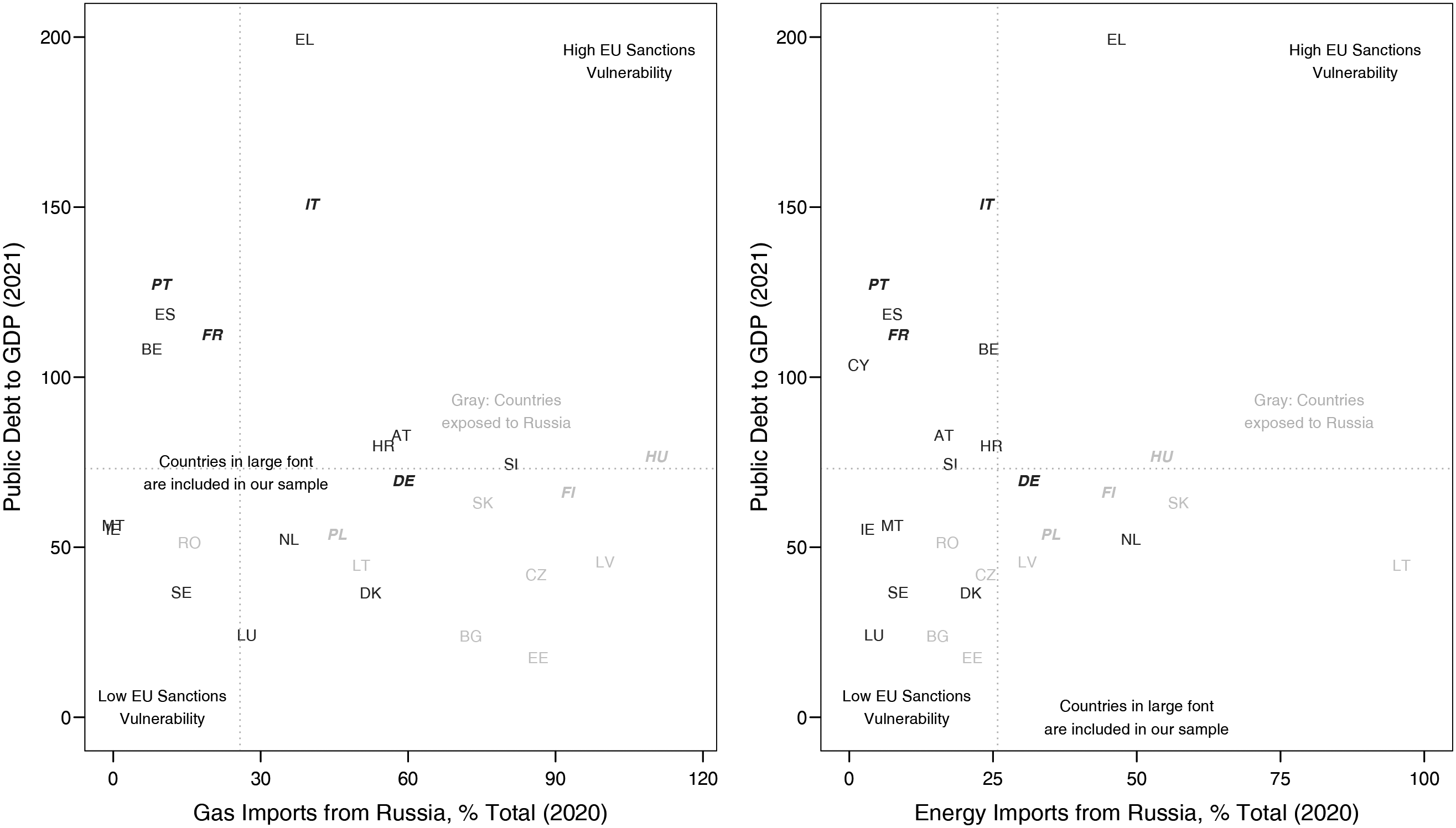
Public debt to GDP and Russian energy dependence across the EU.
In line with this, when analyzing potential conflict lines between EU member states in terms of their preferences for sanctions we expect heterogeneity in energy dependence to play a role. Furthermore, in addition to general preferences for sanctions, we expect this heterogeneity to also have implications for the level of burden-sharing proposed by the EU. In previous crises, the literature has already shown that the type of solidarity instruments proposed by the EU shapes the response by respondents. The literature has provided some detailed results on what kind of support European instruments can generate. For instance, budgetary instruments to mitigate economic shocks are more supported when they have some conditionality embedded in them (e.g., help in exchange of debt reduction or pre-commitment to spend the money on some specific policy fields like healthcare) but support falls when there is too much conditionality (e.g., fines in case of non-compliance). Likewise, helping poorer countries is generally seen as acceptable especially if financed through progressive taxes rather than flat taxes (Beetsma et al., 2022; Bremer et al., 2021). While we do not go to such lengths of specificity, we still argue that the choice of how energy costs are to be shared is likely to be a function of the effects that sanctions are expected to have in each country.
Finally, while this important heterogeneity in terms of energy dependence means that finding consensus for energy sanctions is difficult, we do expect it to be partially mitigated by how threatening the actions of Russia are for the countries in our sample – namely by their geopolitical position and relations with Russia. Therefore, we expect countries that are closer to the conflict zone and have been threatened by Russia (i.e., Finland and Poland) to show higher support for sanctions irrespective of their energy dependence. By contrast, we expect this effect to be attenuated in less proximate countries in Western and Southern Europe. Finally, with regards to geopolitics, Hungary constitutes a special case as the effect of its energy dependence on opposing sanctions is expected to be further exacerbated by its close relation to Russia, visible in Orbán's pro-Putin stance.
Given the small number of member states included in our study (seven countries), we do not have the means to study all these relations via systematic statistical tests. Nevertheless, the countries covered in our study do include a significant degree of heterogeneity in terms of their energy dependence, geopolitical position and relations to Russia which does allow us to at least hypothesize about the possible reasons between any empirically observed divisions between their average positions. H2a: Respondents from countries with high energy dependence from Russia are less likely to support sanctions than those in countries with low energy dependence, but more in favor of distributing costs at the EU level. H2b: Respondents from countries that are more proximate to the conflict zone and have been threatened by Russia are more likely to support sanctions than less proximate countries or countries with good geopolitical relations to Russia.
Domestic conflict lines: Identity, political affiliations, and economic vulnerability
Focusing on the factors driving domestic, within-country conflicts, we expect these to have both political and socioeconomic bases. While it goes beyond the scope of this article to examine the degree to which such political and socioeconomic divisions align, the distinction between the two is important. Insofar as preference divisions are mainly economic, they can be potentially dealt with in a more direct fashion by policymakers through various cost management strategies, than when these divisions are structured along identitarian or ideological lines.
First, we draw on the literature on political cleavages arguing that the European integration process (and more largely globalization) has given rise to conflict opposing cosmopolitans-universalists with stronger EU identities to communitarians-nationalists defending national sovereignty (De Vries, 2018; De Wilde et al., 2019; Kriesi et al., 2006). While it is beyond the scope of the article to substantiate discussions on this new cleavage and how it aligns with the ideological left-right dimension and party affiliations, we do expect that such a divide to be consequential for how solidaristic citizens are in the face of EU level energy sanctions and in favor of burden-sharing at the EU level. This is in line with previous research linking stronger European identities to pro-solidaristic and pro-redistribution views within the EU (Kuhn and Kamm, 2019). H3a: Respondents with a strong EU identity and supporting further EU integration are more likely to be in favor of halting or phasing out energy imports, and in favor of distributing the costs of energy sanctions at the EU level.
Second, looking at the left-right dimension, not only are there strong affinities in Western Europe between the communitarians-nationalists and the right (Marks et al., 2006), but Russia also has a particular proximity with the European right and the far right. Given this, all else equal, we expect people from the right to be skeptical of sanctions. Going further, regarding party affiliations, the preferences of the ‘losers of globalization’ in Europe have been mainly articulated by the new challenger parties. In particular, the far-right populist parties in Europe have previously expressed pro-Putin and pro-Russia views. In the context of the Russian invasion itself, previous research at the party-level finds a strong effect of ideology on support for Ukraine with those parties employing a populist rhetoric and European Union skepticism being most against support for Ukraine (Hooghe et al., 2024). Others show that these parties also engaged in strategies of blurring their stance on Ukraine support or using the events in Ukraine to assert their anti-EU positions (Wang and Altiparmakis, 2025). In line with these findings, on the demand-side we also expect the voters of these parties to be more likely against stopping energy imports. H3b: Respondents who identify as right-wing or who vote for populist parties are more likely to be against halting imports.
Third, beyond political attitudes, we also expect respondents’ view on sanctions to be motivated by economic reasoning given the high costs of energy transition. Therefore, all else equal, we expect individuals with higher perceived economic vulnerability to rising energy costs (i.e., those who believe that such costs might affect their livelihood) to be less in favor of sanctions. H3c: Individuals with higher economic vulnerability to rising energy costs are more likely to be in favor of halting or phasing out energy imports.
Data and empirical strategy
The data for this study was collected as part of a survey conducted in seven EU countries (Germany, France, Italy, Portugal, Poland, Hungary, and Finland 2 ) in the framework of SOLID ERC Synergy research project. 3 Interviews were administered in July 2022 on national samples obtained using a quota design based on gender, age, macro-area of residence (NUTS-1), and education. The total sample size for the survey was 12,371, with national sample sizes varying between 1024 and 2084. The timing of our survey in July 2022 when there were already massive sanctions on Russia and already higher energy prices implied that the topic of our vignette experiment was highly salient in European's citizens minds and that the scenarios considered within the factorial design where realistic, rather than hypothetical as energy sanctions were already under way in many of the countries in our study. While the option of not phasing out of Russian energy was no longer a reality in most of the countries, we still considered this a viable option in our scenarios as citizens might disagree with already adopted policy and might also see Hungary's route to limiting sanctions as an example. Finally, the countries included in our sample also provide for a wide amount of heterogeneity in terms of reliance on Russian gas, political discourse related to sanctions, centrality in the EU, and geopolitical location that allows us to map preferences in a wide range of contexts.
To analyse preferences for the speed of transitioning away from Russian energy and the level of European burden-sharing under varying potential scenarios of the conflict intensity, we fielded a factorial vignette experiment. In comparison to classic survey experiments, a factorial design allows estimating the causal effects of multiple treatment components, rather than a single treatment, and assess several causal hypotheses simultaneously. All in all, this form of survey experiment was ideal for our purposes as it enabled us to examine respondents’ evaluations of various hypothetical scenarios (so-called vignettes) in which combinations of factors/characteristics were varied randomly.
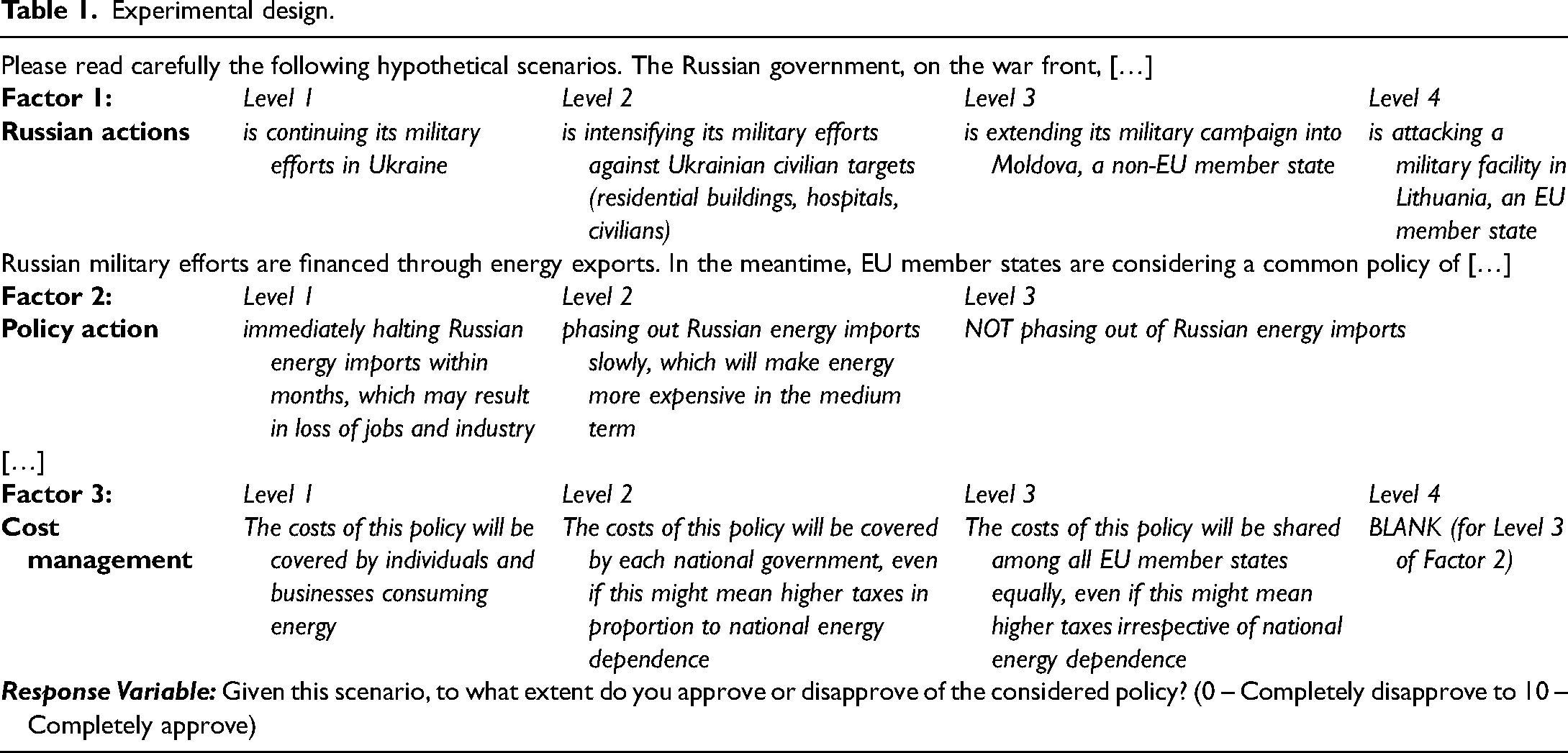
In our vignette experiment each survey respondent was presented with two policy scenarios in which various combinations of three factors were assigned. Factor 1 addressed the Russian actions and the level of threat they represent in as a realistic manner as possible. Russian actions could stay constant (military efforts in Ukraine continue), could escalate and thus raise the saliency of the war, could spill-over into other, non-EU countries (Moldova), or into a European country (e.g., attacking a facility in Lithuania seems realistic given that this state separates Belarus from Kaliningrad. The Suwałki Gap – the shortest land route between Belarus and Kaliningrad – is one of NATO's weak points in the East). At this point we explicitly prime respondents to think of Lithuania's EU membership (rather than NATO membership), and to think of an EU reaction to Factor 1. Factor 2 captured the reaction to the Russian military efforts in Factor 1, ranging from immediately halting reliance on Russian gas which implies immediate and long-term costs for Europe, to a progressive option of phasing out, to no sanctions at all. For the sake of simplicity, our analysis does not consider the fact that Russia can act on its own and reduce energy exports. While this is what is happening on the ground, our substantive empirical objective is to assess evaluations of European agency in the most empirically tractable way. Finally, Factor 3 addressed how the costs resulting from the action taken in Factor 2 are organized: i.e., costs can be covered by individuals and firms, national governments with tax increases proportional to energy dependence, or shared across EU states with equal national tax increases (i.e., not dependent on energy dependence). Respondents had to evaluate the scenarios resulting from these combinations of factors on an 11-point scale. Table 1 presents this experimental design, while the Online appendix presents the descriptive statistics of our three factors demonstrating scenario balance across respondents.
Experimental design.
We also note here that while Factor 2 – support for energy sanctions does not directly imply coordination or risk-sharing at the EU level, we aim to capture this with Factor 3 on the distribution of costs. In particular, the option of sharing energy costs transnationally, at the EU level would imply novel forms of risk-sharing which are not to be taken for granted given existing competences. Furthermore, it is again Factor 3 that speaks most clearly to solidarity since this would imply a transnational risk-sharing mechanism. We chose to present the option of sharing costs equally rather than according to energy needs or fiscal capacity for two reasons. First, to be sustainable in the long-term solidarity would need to happen behind a veil of ignorance because it is a repeated game rather than a one-off. It is not always the net contributors of EU public goods helping net beneficiaries of EU public goods as this would create commitment problems. Second, both energy needs and fiscal capacity are bound to affect preferences for risk-sharing mechanisms, but as these vary independently it would be difficult to choose a risk-sharing mechanism that would favour or please everyone. Instead, we choose to explore heterogeneity between public preferences in different member states, precisely for the reason that these preferences would vary, as an equal risk-sharing mechanism would not favour everyone equally in the short term.
Analytically, our main goal is to estimate what characteristic of a scenario increases or decreases the appeal of that scenario when varied independently, but also the interactions between attributes. Since we repeated measurements across respondents (two vignettes per respondent), the empirical strategy we adopt relies on linear mixed-effect models with a random intercept for respondent and country fixed effects. In the following section we present the results of our main model and of the interaction, but also of conditional effects on respondents’ characteristics. As guided by our theoretical framework, we include measures of European identity, views on European integration, ideology, vote choice, and economic vulnerability to the cost of energy prices. The full text of these questions together with their operationalization and the descriptive statistics are presented in the Online appendix.
Results
Baseline support for energy sanctions
We start with the baseline results of our factors to understand whether there is broad support for sanctions across our seven EU countries. Recall that we hypothesize that the greater the intensity of Russia's threat, the greater the support for energy sanctions (H1a) and that this support will be maximized if Russia attacks an EU member like Lithuania (H1b). Figure 2 presents the average rating respondents gave to each of our factor combinations. Factor 1 (Russian actions) is presented on the x-axis of each box, Factor 2 (policy option) is presented as the separate boxes, and Factor 3 (cost management) is presented in the various shapes in the plots. The most striking difference in means we can observe is related to Factor 2, as we can see that the policy option of “not phasing out” is generally much less preferred than the other two policy options irrespective of Russian actions. While the absolute average value on the support dependent variable hoovers around the middle of the scale, the large difference in support as compared to the no sanctions scenario (not phasing out) indicates that on average Europeans do rally behind energy sanctions, irrespective of the scenario within which they are adopted. Moving to the two policy options (immediately halting and phasing out) that imply costs, we can see that the differences between the two are less striking and generally vary according to Russian actions. In particular, we can notice that the option of immediately halting Russian gas is generally the preferred one on average across respondents mostly if Russia were to extend military action to an EU member (which gives some credence to H1a and H1b). Finally, in terms of cost bearing, we can see that with some minor exceptions, having individual consumers and business bear the cost of Russian sanctions (denoted by the triangle shape in the plot) is the least preferred option by our respondents, compared to national or European solutions (in line with H1c).
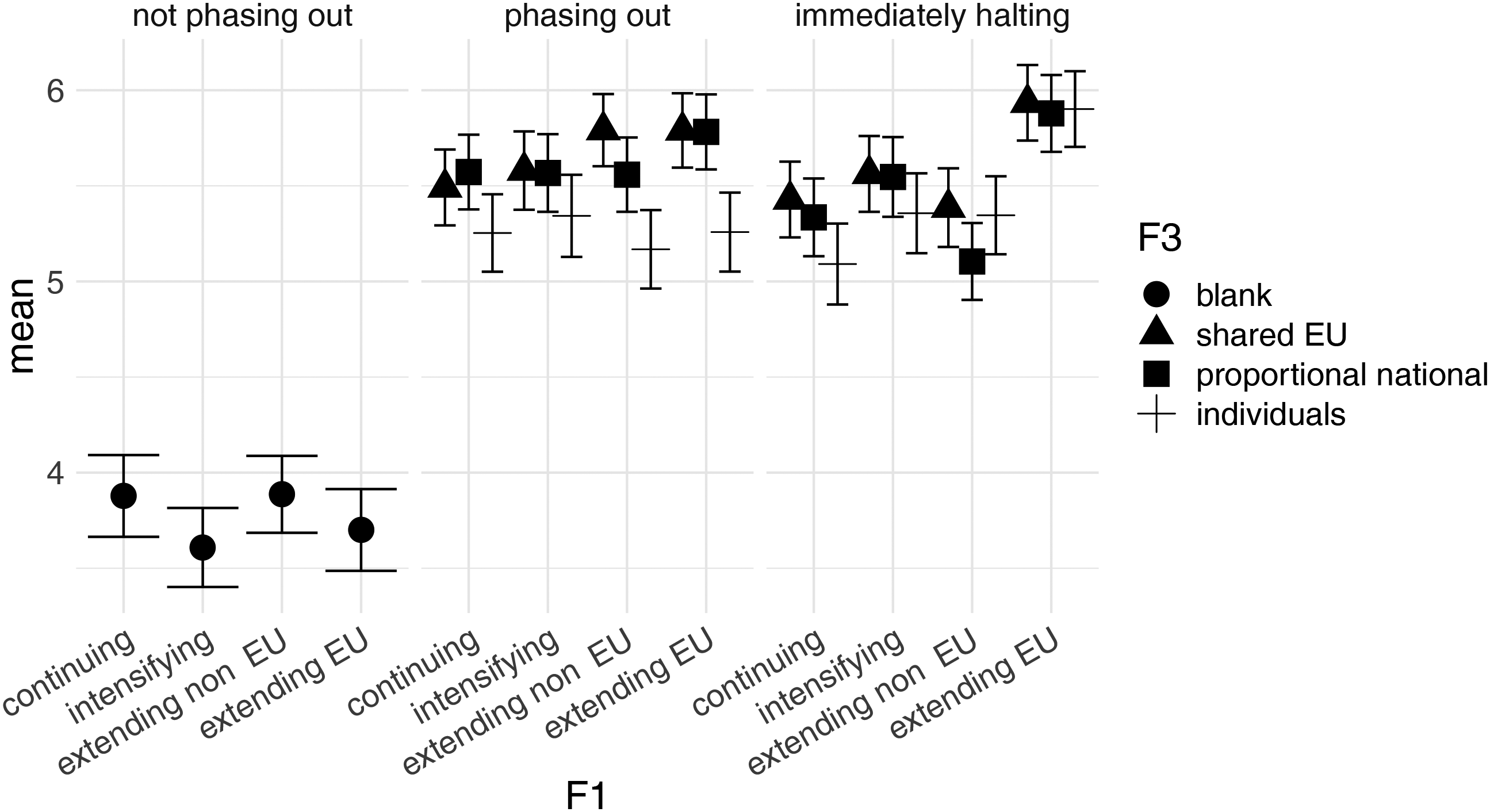
Average rating of each factor combination.
The results of our main model are presented in Figure 3. We can see that respondents usually rate sanctioning policies significantly higher when Russian actions extend to the EU as compared to continuing its current course of action (the baseline is denoted by the vertical line in the plot). When it comes to which kind of sanctioning policies should be adopted, there appears to be no significant difference between phasing out and immediately halting, but both options are significantly preferred to the not phasing out option (the baseline) with a large effect size of more than 1.5 points on average on our 11-point scale (again, hypotheses H1a and H1b seem to be confirmed). Finally, regarding cost management, respondents prefer solutions organized at either the national or the European level (with no significant difference between the two), rather than individuals or businesses bearing the cost (the baseline), which is evidence for H1c.
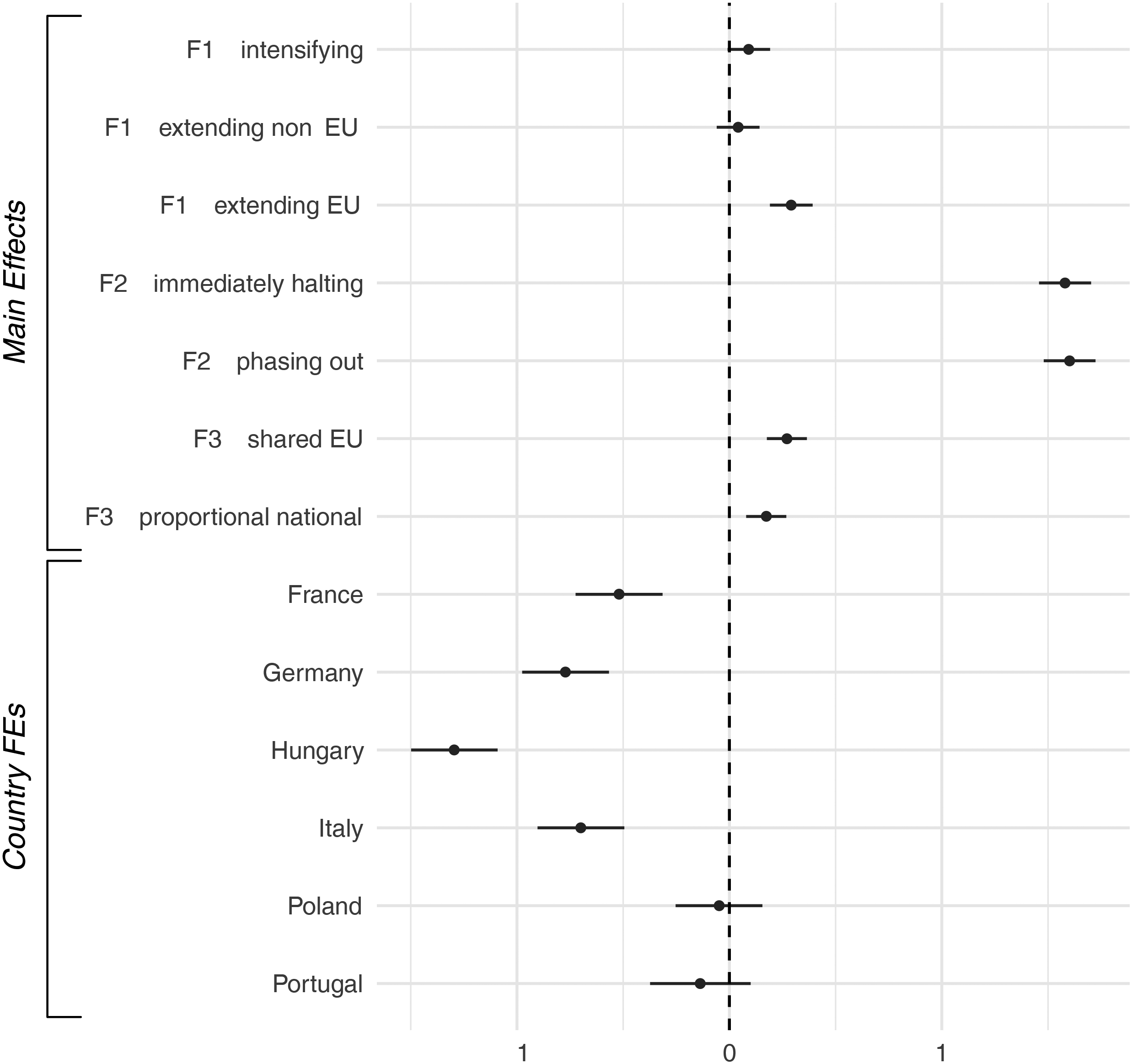
Main effect sizes of all factors on scenario rating (linear mixed-effects model with a random intercept for respondents and country FEs).
We also explore significant interaction effects between our factors using simple main effects. In Figure 4 presenting the simple main effect of Factor 1 at each level of Factor 2 we can see that both Russia intensifying its attack on Ukraine and extending this to an EU member state significantly increase the preference for immediately halting dependence on Russian energy (and also significantly decrease preferences for not phasing out) as compared to the status quo. Surprisingly, Russia extending its attack on a non-EU member appears to not be perceived differently than the status quo in terms of whether and which level of energy sanctions are preferable. When it comes to the moderate policy of phasing out, respondents see no difference between most scenarios of Russian action, apart from extending to an EU member states which makes this policy more preferable. This provides mixed support for our hypothesis H1a stating that threat increases preference for sanctions, as the intensifying option has this expected effect, but extending to a non-EU country does not. In line with H1b, extending the war to an EU country does drastically increase preferences for immediately halting Russian energy imports. The Online appendix reports this effect by country. We see that respondents in non-NATO member Finland show similar effect sizes to other countries. We consider this to be evidence for an EU-component of the effect of escalation, especially as NATO military commitments do not automatically imply economic commitments on part of the EU which we explicitly ask respondents to rate. Finally, H1c is also confirmed: support for burden-sharing at the national or European levels is greater than at the individual level, suggesting that there is some willingness to socialize the cost of sanctions.
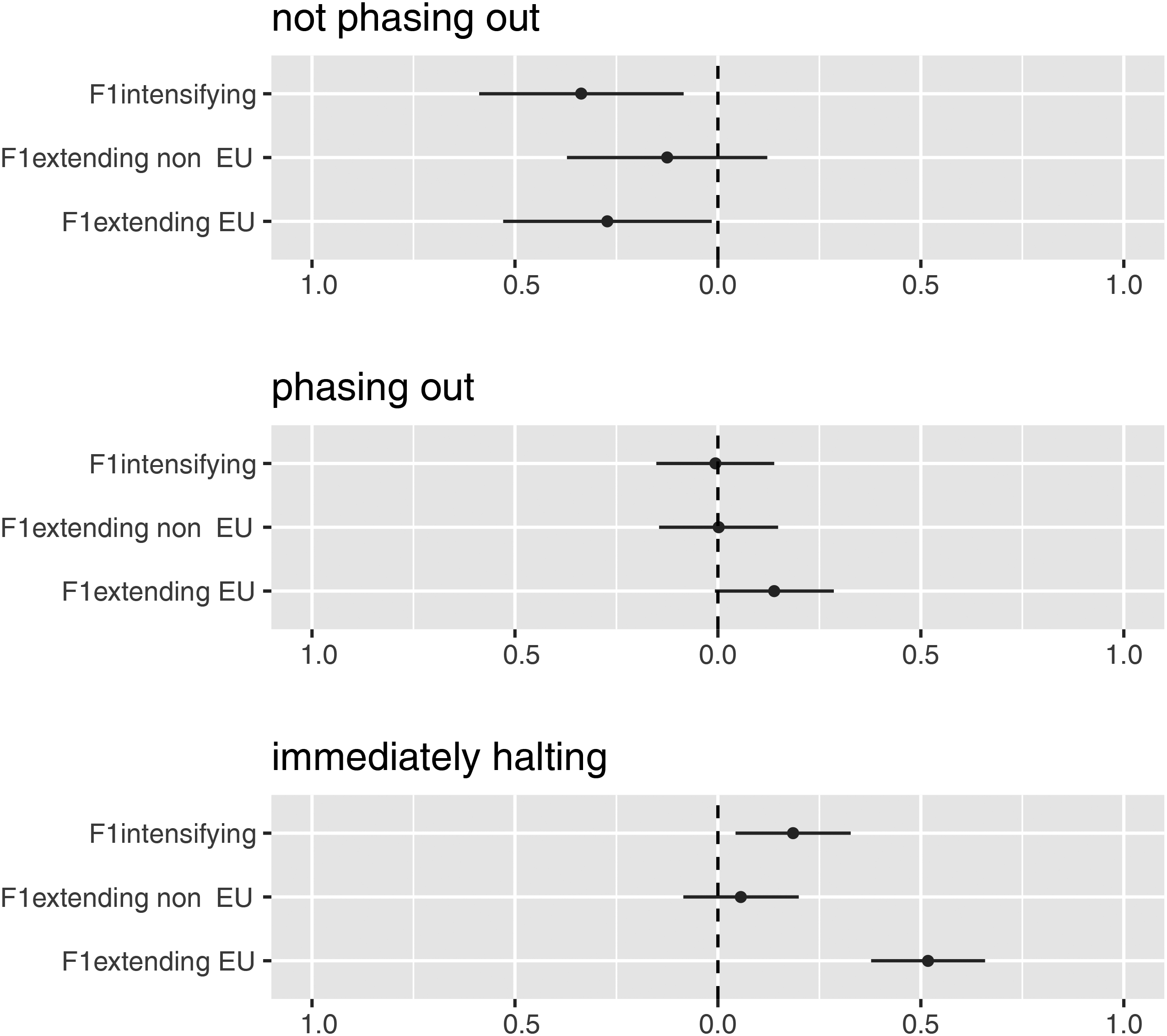
Effect of F1 on scenario rating (baseline for F1 – status quo) by levels of F2 (model with a random intercept for respondents and country FEs).
Territorial conflict lines
In addition to the main effects and interaction effects between the factors in our design, we also explore below several conditional effects between respondents’ characteristics that were outlined as relevant in out theoretical framework and these factors. To begin with, at the EU level, there is a significant interaction effect between the respondents’ country and Factors 2 and 3 which we explore in Figure 5. Remember that we expect countries which have high energy dependence on Russia (see Figure 2: Hungary, Finland, Germany, Poland, and Italy) to show less support for energy sanctions. Likewise, these countries will also prefer burden-sharing to happen at the EU level to spread the cost of the energy sanctions. Finally, geopolitics matter: countries which have a historical experience with Russian invasions will be more prone to support sanctions (Finland, Poland, Hungary) while countries with political ties to Russia will generally oppose them (Hungary). This means that our predictions can go in different directions. For instance, regarding Hungary, we expect that its historical experience with Russia would imply that it should favor sanctions, but energy dependence and strong current ties to Russia suggest Hungarians will oppose sanctions. Conversely, Portugal is far from Russia, not dependent at all energetically and its political ties to Russia are quite weak comparatively: therefore, on the one hand, we should expect Portugal not to be afraid of sanctions (low dependence), but also be more indifferent given its geography. It is of course impossible to disentangle these factors with our data, and we therefore need to rely on triangulation with qualitative case knowledge to interpret the results.
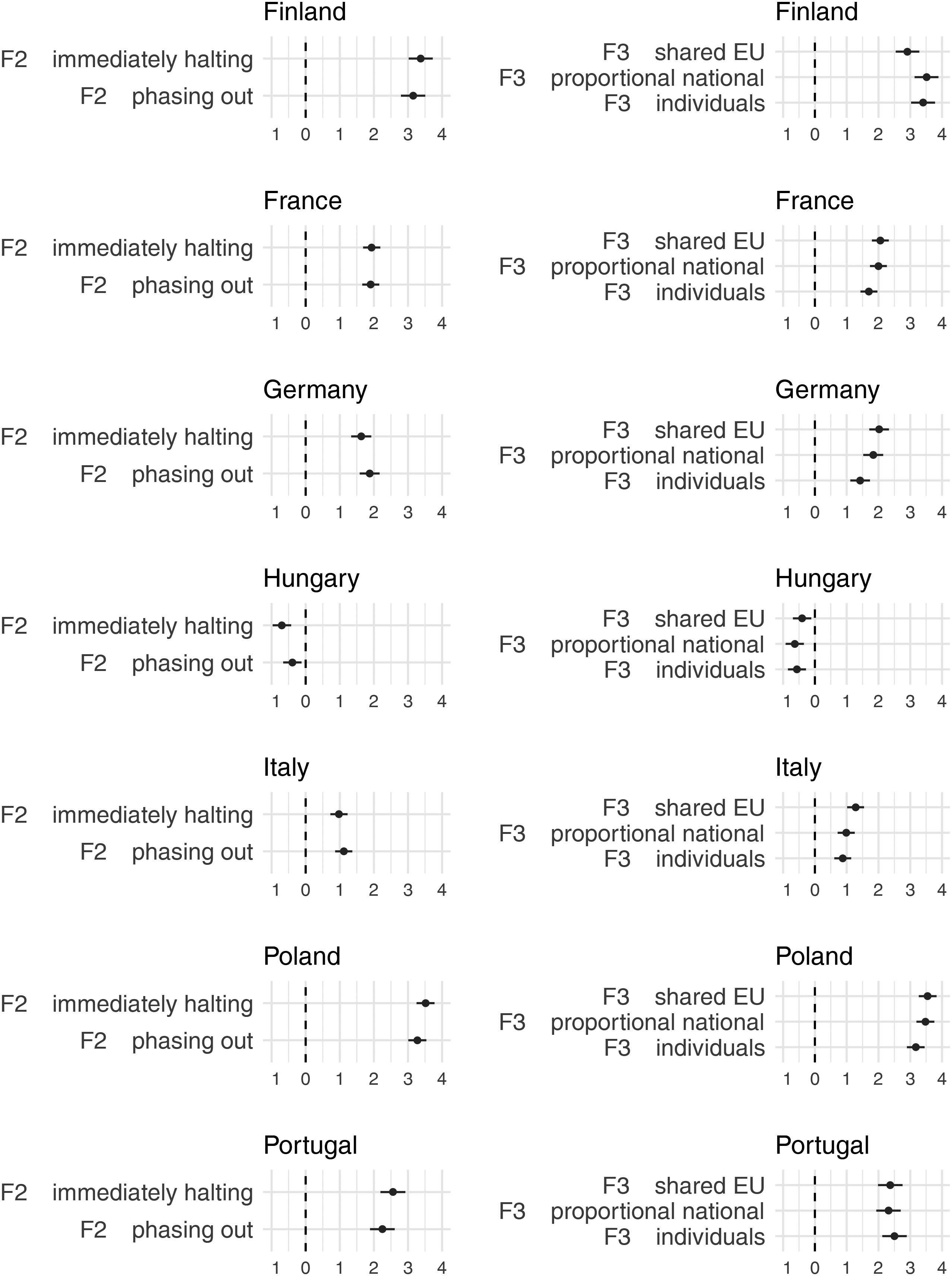
Effect of F2 (baseline – not phasing out) and F3 (baseline – not phasing out) on scenario rating by country with a random intercept for respondents.
Indeed, we find that Hungary is the most striking example in terms of both policy option and cost management as it is the only country in our sample in which respondents significantly prefer not phasing out compared to any sanctions. This is unsurprising given Orbán's government affinity to Russia and anti-sanctions discourse, but also its special context as a landlocked country with a populist government that is heavily dependent on pipelines that run westwards. We explore below the effects of cost perception and populist party voting to strengthen our explanation of the Hungarian deviant case, but also to explore the potential for domestic conflict in the multilevel polity. Except for Hungary, respondents in all countries significantly prefer imposing sanctions, whether gradual or immediate, to not phasing out. Support for sanctions is highest in Poland and Finland and – surprisingly – Portugal. It may be that for Portuguese respondents it is simply easy to be in favor of sanctions given the relatively lower cost they would have to bear. In terms of cost management, support for a European solution is always highest but by a small margin compared to the national solution (apart from Finland where there is a clear preference for a national solution). These results are somewhat optimistic regarding the potential for territorial conflict within the EU. Respondents in countries with a heterogenous energy (in-)dependence, as well as in countries with different proximity to the conflict and geopolitical relations with Russia seem to all agree on sanctions to a wide extent.
Domestic conflict lines
Finally, we move to our hypotheses on domestic conflict lines. We theorize that domestic conflict lines can stem from identitarian, political, or economic reasons. Our reasoning is that decreasing potential conflicts along identitarian and ideological dimensions can be difficult, whereas taming economic conflicts around economic costs of sanctions is easier. First, we expect respondents with a stronger European identity to be more supportive of European sanctions, which also applies to people who support European integration, and to be more supportive of burden-sharing at the EU level (H3). Second, we expect people who self-position on the right of the political spectrum and those who would vote for populists to be against sanctions (H3b). Third and finally, people who are more vulnerable economically to the energy cost of sanctions are also more likely to oppose them (H3c).
What do our data show? First, the respondent's identity (see Figure 6(a)) has significant effects on preferences for sanctions. Generally, respondents reporting to have any sort of European identity (the bottom three graphs on the left-hand side) significantly prefer sanctions of both the immediate or phasing out kind to no sanctions. Moreover, as respondents’ European identity is stronger and listed first, support for immediately halting Russian energy dependence increases. In terms of cost management, the differences in identity are less pronounced and are being driven primarily by the blank option of not phasing out, though respondents with a strong EU identity do report on average an increased preference for sharing cost at the EU level. Beyond identity, we obtain similar effects with regards to views on European integration (see Online appendix), as the more one thinks EU integration should be pushed further, the more one would support sanctions. The results are less pronounced in what regards cost management solutions, as the more one thinks EU integration should be pushed further, the more one would prefer a shared-EU solution (as the effect sizes are slightly more spread in what regards the EU shared solution in comparison to the other two), but to a very limited extent. This again underscores that while respondents’ solidarity is not necessarily channeled through their preference for shared EU costs, it is still channeled through their preference for sanctions also seen above in the wide country homogeneity. Nevertheless, if at the upper level of the multi-level polity we see wide agreement over sanctions, at the domestic level this agreement is strongly moderated by respondents’ identities and views on the EU, indicating a potential for domestic conflict which might constrain policymakers’ room for maneuver. Taking European identity and preferences for European integration together, we thus find strong evidence for hypothesis H3.
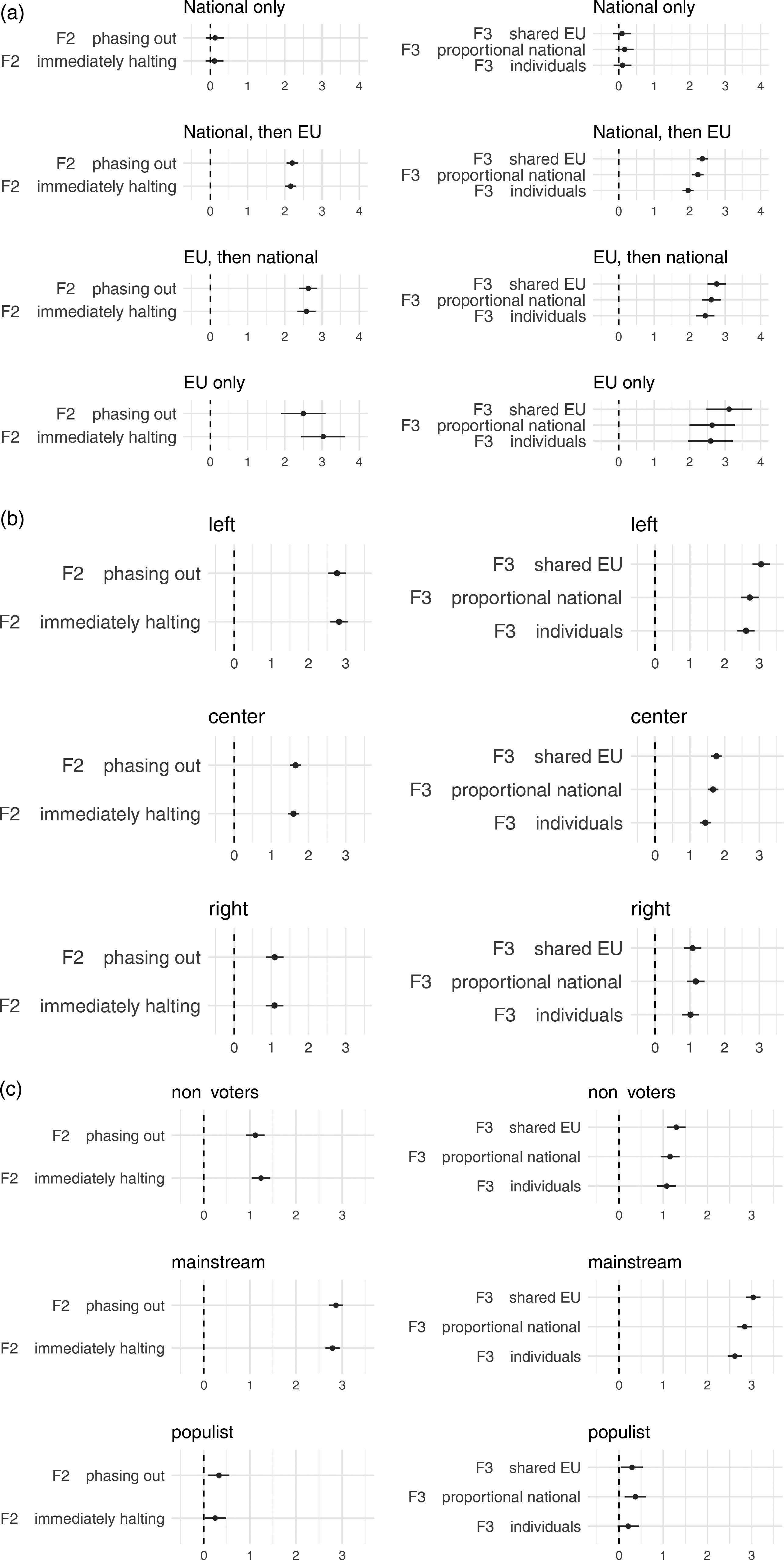
Effect of F2 (baseline – not phasing out) and F3 (baseline – not phasing out) on scenario rating by identity, ideology, and vote choice (model with a random intercept for respondents and country FEs). (a) By respondent's identity, (b) By respondent's ideology, (c) By vote choice.
Second, moving on to the hypotheses on political preferences, Figure 6(b) presents the effects of Factors 2 and 3 by the ideological grouping of the respondents in our survey. While respondents across the ideological spectrum seem to favor sanctions, they do so to very different extents. In this regard, ideological self-placement seems to matter to a great extent as both those who self-place on the right and on the center appear to prefer sanctions significantly less than those who self-place on the left. Moreover, there are no statistically significant differences between the center and the right in what regards these preferences. This could be one source of domestic political frictions if general support for sanctions decreases in the future as a possible coalition between the center and the right might be able to constrain governments in terms of stopping sanctions and create costs at the EU level. In terms of cost management, the center and the right mostly align in their preferences, though with a wider difference in what regards shared EU solutions which are more preferred by the center (though significantly less so than by the left). To some extent, this is evidence for our hypothesis H3b.
Beyond an ideological divide, respondents in our survey are also highly divided across party affiliation lines (categorized into three groups: non-voters, voters of mainstream parties, and voters of populist parties). Looking at the left-hand side of Figure 6(c), we can see that while all categories of voters prefer sanctions over not phasing out, the size of the effects varies greatly between them. Expectedly, mainstream party voters appear to be the biggest supporters of sanctions, as in this group sanctions obtain a 3 points higher rating on our 11-point rating scale compared to the option of not phasing out. By contrast, this support drops to around 1 point in the case of non-voters and becomes negligible in the case of populist voters. Confirming our hypothesis H3b, these results again underscore the potential for domestic conflict regarding energy sanctions that can be politicized by populist parties who could rally the non-voters category, where preference for sanctions is weak. In regards to cost-bearing options, we can see that again the EU solidaristic solution of sharing costs is highly supported only in the case of mainstream parties, where this solution obtains significantly higher ratings than both the not phasing out option and the individual option, and slightly higher ratings than the proportional national solution (though not statistically significant). By contrast, non-voters and populist voters do not seem to differentiate much between cost bearing solutions.
Thirdly and finally, we also explore the effect of perceived vulnerability to energy price increases in the Online appendix. Perceived energy price vulnerability appears to clearly push respondents towards not wanting to adopt sanctions irrespective of Russia's actions, indicating that the identity, ideological, and political affiliation divides observed above might be substantiated on a socioeconomic basis.
Where do our three sets of hypotheses on domestic conflict leave us (H3a-c)? We find moderate to strong evidence for all of them, be it the identitarian hypothesis, the ideological and political affiliation hypothesis, or the economic one. There are several interpretations of these results. Pessimists will underline that identitarian and ideological conflict lines are pronounced and that there is, thus, a strong potential for domestic conflicts. On top of that comes the economic logic which could exacerbate domestic conflicts. Optimists will stress that people who are likely to feel the cost of sanctions (the economic conflict line) may also be more likely to vote for populist parties while people who vote for mainstream parties tend to be more well-off. As a result, dampening the economic cost of the energy sanctions could limit domestic conflicts. It is beyond the scope of our article to analyze the degree to which partisan lines are rooted into socioeconomic divides, but we see that as an invitation for further research.
Conclusions
Our article contributes to the larger empirical literature on European solidarity in crises (Bechtel et al., 2014; Bremer and Genschel, 2020; Gerhards et al., 2019; Katsanidou et al., 2021; Oana and Truchlewski, 2023) by inquiring into the potential for unity and/or conflict on the demand side in what regards preferences for risk-sharing related to energy costs. The case of energy sanctions and the potential for energy burden-sharing is important to consider especially given the theoretical expectations on the consequential effects on EU bonding that an external threat of war is expected to have (Kelemen and McNamara, 2022) on the one hand, but also the potential for conflict that the asymmetric problem pressure of the crisis can induce (Ferrara and Kriesi, 2021) on the other hand. We, thus, ask: how strong is the public basis for energy sanctions on Russia and EU energy solidarity in the wake of its invasion of Ukraine? This question is crucial for understanding the potential conflict lines that may emerge at the transnational and domestic levels in the EU. Exploiting a survey experiment fielded in July 2022 our results encourage a cautiously optimistic outlook for our baseline results and territorial conflict lines, and slightly less optimistic results for domestic conflict lines where we identify some potential for frictions.
Concerning the baseline results, we find strong support for energy sanctions on Russia: in general, any sanctions – whether immediate or gradual – are always preferred to no action, no matter what scenario is proposed to respondents. If Russia intensifies and extends its military actions, immediate energy sanctions are preferred. Regarding European burden-sharing, respondents always prefer national or European solutions (with no strong preference for either) to individual cost bearing.
Given this baseline, do we see major territorial conflict lines at the EU level, with for instance respondents from Eastern member states being much more hawkish than their Western counterparts? The answer is negative. In general, respondents in all countries support sanctions except for the Hungarians: they are the only respondents who prefer no sanctions at all. For historical reasons this may seem surprising. It is much less so if one considers Hungary's more current political developments (populism, proximity of Orbán's regime to Putin's Russia, and energy dependence). Support for sanctions is highest in Finland, Poland, and Portugal. Respondents in countries that supported a diplomatic solution to the conflict and were reluctant to arm Ukraine (France and Germany) score quite high in their support for sanctions. We observe that the lowest but still positive support for sanction is in Italy: given this country's bifurcation to the right, this could trigger stronger conflict lines if Italian politicians align with Hungary once the cost of the energy crisis start to really bite.
While territorial conflict lines seem to be relatively muted, we do see some potential for activating domestic conflict lines along three axes. First, identity can play a major role in supporting sanction. Along the lines of a cosmopolitan-nationalistic cleavage, we observe that respondents with a European identity strongly support sanctions. By contrast, respondents with only a national identity are very lukewarm on sanctions, no matter what the burden sharing mechanism is. These strong divisions in terms of identity mirror the results obtained by Moise et al. (2025) and Moise and Wang (2025) for other policy domains. Second, preferences for European integration reveal similar results: people who really oppose further European integration are also positioning themselves negatively on sanctions. The left-right dimension also reveals potential conflict lines that may be activated as the conflict in Ukraine progresses: those who self-place on the right (and center) support sanctions much less than those on the left. On top of these, vulnerability to energy price increases also dampens support for sanctions. This raises the obvious question: given that these are the main predictors for voting for the populist right, do people who vote for these parties actually oppose sanctions? Given the links between Russia and these parties in Europe, this is a crucial question. We find that populist voters support sanctions much less than people who vote for mainstream parties.
Our cautiously optimistic outlook is therefore based on the lack of strong transnational territorial conflict lines and weak (in the sense of no strong opposition to sanctions) but potentially activable domestic conflict lines. There is therefore solid European support for energy sanctions on Russia. Obviously, the reality on the ground of the Russian invasion of Ukraine is changing fast and it is therefore hard to extrapolate beyond our data. The results presented here show a baseline of attitudes captured in July 2022, in the initial phases of conflict, characterized by a highly volatile and uncertain environment. Some implications emerge, however, from our results. First, the asymmetry of the crisis induced by the Russian invasion of Ukraine and the relatively low competences of the EU in the energy domain did not translate into a constraining dissensus at the territorial level: this is not a case of “bad” crisis, contrary to theoretical hypotheses put forward in the literature (Ferrara and Kriesi, 2021). This suggests that there are other crisis dimensions such as the existential threat to a polity that should also be accounted for. Second, and more importantly, contrary to other crises like COVID-19, we do not find an overwhelming demand for a European safety net mechanism in the early phases of the invasion: as long as the costs of European sanctions are borne at the national or European level – but not individual – there should be no problem. The lack of demand for European solutions and the potential for domestic conflict suggest that the current efforts of the European Commission to find a common solution to the energy crisis could face resistance from national governments and their publics (unless, as our data suggests, Russia dramatically escalates its actions).
Supplemental Material
sj-docx-1-eup-10.1177_14651165251318955 - Supplemental material for Demand-side constraints on European solidarity for energy sanctions: Experimental evidence from seven EU countries
Supplemental material, sj-docx-1-eup-10.1177_14651165251318955 for Demand-side constraints on European solidarity for energy sanctions: Experimental evidence from seven EU countries by Ioana-Elena Oana, Alexandru D Moise and Zbigniew Truchlewski in European Union Politics
Supplemental Material
sj-zip-2-eup-10.1177_14651165251318955 - Supplemental material for Demand-side constraints on European solidarity for energy sanctions: Experimental evidence from seven EU countries
Supplemental material, sj-zip-2-eup-10.1177_14651165251318955 for Demand-side constraints on European solidarity for energy sanctions: Experimental evidence from seven EU countries by Ioana-Elena Oana, Alexandru D Moise and Zbigniew Truchlewski in European Union Politics
Footnotes
Acknowledgements
We would like to thank our colleagues in the SOLID project as well as the reviewers of the manuscript for all their comments and suggestions on earlier drafts.
Funding
The authors disclosed receipt of the following financial support for the research, authorship, and/or publication of this article: This study was supported by the SOLID research project (‘Policy Crisis and Crisis Politics, Sovereignty, Solidarity and Identity in the EU Post-2008’) financed by the ERC Synergy Grant Agreement 810356 (ERC-2018-SYG).

Data availability statement
Replication material is available online, attached to this article.
Supplemental material
Supplemental material for this article is available online.
Notes
References
Supplementary Material
Please find the following supplemental material available below.
For Open Access articles published under a Creative Commons License, all supplemental material carries the same license as the article it is associated with.
For non-Open Access articles published, all supplemental material carries a non-exclusive license, and permission requests for re-use of supplemental material or any part of supplemental material shall be sent directly to the copyright owner as specified in the copyright notice associated with the article.
