



Abstract
The Russian invasion of Ukraine, with its implications for European security, has intensified the need to understand European public opinion on potential conflict strategies. This study delves into the formation of these opinions, focusing on utilitarian factors like economic interests and threat perception, and ideological elements such as political orientation, national identity and perceptions of Russia and Ukraine. Utilising a two-wave panel survey from five European Union (EU) countries, our findings underscore that ideological factors, especially trust in Russia and Ukraine are paramount in shaping support for escalation or de-escalation. Economic concerns, threat perceptions, right-wing ideologies and strong national identities also play significant roles. This research not only illuminates European sentiment on the war in Ukraine but also enriches broader discussions on the determinants of public opinion in international conflicts.
Keywords
Introduction
In the wake of the Russian invasion of Ukraine, Europe stands on the precipice of a major political and humanitarian crisis. The choices that European nations make could significantly shape the geopolitical landscape for years to come. The war’s ramifications on the geopolitical stage have inevitably elicited varied responses from Europeans, particularly in terms of how they perceive the conflict and what policies they support to address it. A notable phenomenon has been the persistent public support in Europe, raising a significant question: Why do many individuals continue to support Ukraine despite the economic costs and without a direct military invasion from Russia? This enduring support raises critical questions about the underlying factors that influence public attitudes toward the conflict and the associated policy measures. So how do Europeans themselves perceive the conflict? What factors influence their attitudes towards de-escalation or escalation strategies? This paper seeks to delve into these critical questions to unravel the underlying determinants of public opinion on this pressing matter, by focusing on the relative importance of utilitarian and ideological factors.
The importance of the Russian war in Ukraine to Europe cannot be overstated, given its implications for European security, geopolitical interests and the broader international order. The crisis has triggered deep-seated fears of a broader conflict that could potentially destabilise the region and draw in global powers. Moreover, the conflict has resulted in a humanitarian crisis, with millions of Ukrainians displaced, a devastating loss of life, and significant economic and infrastructure destruction. Ukraine is critically dependent on support from the European Union (EU) and US in order to continue its war effort. Western leaders therefore have immense leverage to influence Ukraine’s strategy in the war. They are in turn accountable to their domestic electorates, who may become increasingly fatigued by the costs of the conflict and may demand, as an increasing share of the Republican electorate does in the US, limiting funding for Ukraine and sanctions on Russia. As such, understanding European public attitudes towards the conflict and the policy options to address it is crucial for informing policy debates and decision-making processes in Europe. Attitudes towards the war have been shown to be crucial in determining views on refugee policy (Moise et al., 2024), as well as energy policy (Oana et al., 2025), policy areas which may see further European integration. Understanding what determines attitudes towards the war is therefore a crucial step in understanding the trajectory of the European polity.
Previous research has predominantly focused on governmental and party responses, with works such as by Hooghe et al. (2024) examining how ideological factors, like populism and EU skepticism, influence political party stances on the Russian invasion of Ukraine. However, the direct impact on individual-level support has not been thoroughly examined. Therefore, this article aims to examine public opinion of the current war between Ukraine and Russia by utilising an original two-wave (July and December 2022) 1 panel survey in France, Germany, Hungary, Italy and Poland. We first describe public opinion at the national level and concentrate on four major issues in the context of the war: whether Ukraine should sacrifice territory for peace, whether the EU and US should concede to Russia’s nuclear threat, whether European countries should oppose NATO’s expansion to Finland and Sweden and whether sending military support to Ukraine does more than good. Second, we focus on two major sets of factors that influence public opinion: (a) utilitarian considerations: economic interest and threat perception; and (b) ideological considerations: trust in Russia and Ukraine, political ideology and European identity.
Our findings first show that citizens across the five countries, on average, did not become more favourable towards de-escalation strategies as the war goes on, except for the issue of NATO expansion. On the contrary, in most countries, people became less willing to appease Russia in the later wave (December compared to July 2022). This shows that Europeans, on average, continued to support Ukraine in spite of the hardship brought by the war. The main determinants of attitudes towards the war remain ideological, compared to utilitarian considerations. Trust in Russia and Ukraine, which on average remained stable during our two waves, is most important for determining attitudes to appeasement. We further find that individuals on the left, compared to right-wingers, are more in favour of escalation strategies and less likely to yield to Russia. We show that there is a gradual increase in support for appeasement as one moves from the extreme left, towards the centre, with support for appeasement highest for the far right. This pattern differ for Poland, where the far-right is supportive of Ukraine, and Italy, where the far left is less so. Those with stronger European identity are also less likely to appease Russia. Utilitarian considerations have an overall lower, but still significant impact. Individuals who experienced more economic hardship are more likely to favour de-escalation policies. Moreover, higher levels of perceived threat drive people towards conceding to Russia.
By focusing on the public opinion of the current war between Ukraine and Russia, this examination firstly offers valuable insights into the dynamics of public opinion formation in the context of international conflicts, enriching our understanding of the relationship between individual attitudes and broader political and societal trends. Also, by examining both the roles of utilitarian and ideological considerations, it not only adds a new dimension to our understanding of conflict resolution and decision-making but also aligns with theories of economic voting and public attitudes towards policies (e.g. Bechtel et al., 2014; Sears and Funk, 1991). At the same time, this article extends the current literature by exploring how deeper ideological beliefs might underpin public opinions about the current war, going beyond pure economic self-interest and proximate security concerns. Moreover, by investigating the influence of threat perception, it engages with a rich body of literature on risk assessments and human behaviour, adding valuable empirical evidence from the context of an ongoing international conflict. In addition, with the emphasis on the impact of partisanship and ideology on attitudes towards international conflicts, this study also taps into the discussion of how domestic partisan politics could influence foreign policy (Wagner et al., 2021) and how left and right-wing orientations can differently shape public responses to international crises. This three-pronged approach not only helps us to better understand the specific case of the Russo-Ukrainian War but also contributes to broader theoretical discussions on the factors that shape public attitudes towards international conflicts.
Theoretical considerations
What factors affect Europeans’ attitudes towards war and peace? Moreover, what factors are likely to affect public opinion on the ongoing war in Ukraine? While the latter circumstance is novel, the existing body of literature on public stances towards wars and disputes can offer a basis for discerning how various factors might shape Europeans’ attitudes towards the Ukrainian conflict. Although extant literature may not directly pertain to the current war in Ukraine, the theoretical and empirical insights proffered by these works contribute to elucidating the potential ramifications of individual-level factors on attitudes towards territorial concessions, military aid and the overall conflict in Ukraine. For example, Gelpi et al. (2005) and Gelpi et al. (2009) posited that public support for military operations is contingent upon perceived human costs of war, encompassing casualties and fatalities. Despite their work not directly scrutinising the current war in Ukraine which does not involve direct casualties and fatalities in European countries, it accentuates the significance of individual-level perception in shaping public opinion vis-à-vis international conflicts.
Two sets of factors have so far been emphasised in the existing literature: utilitarian concerns (comprising economic and threat perceptions) and ideogological orientation. First, economic concerns have been long shown affecting public attitudes towards conflicts. One mechanism behind this relationship is the self-interest hypothesis, which posits that individuals tend to favour policies that maximise their economic well-being (Scheve and Slaughter, 2001). In the context of the war in Ukraine, those who perceive potential economic gains or losses due to the conflict or its resolution may be more inclined to adopt policy preferences that align with their economic interests. For instance, Europeans who rely on trade or energy ties with Russia might be more inclined to support territorial concessions to Russia to ensure financial stability and safeguard their living standard.
Besides egotropic concerns, sociotropic concern also plays a role in shaping public attitudes towards conflicts. According to this perspective, individuals are concerned about the overall economic well-being of their country, and they may support policies that they believe will benefit the national economy as a whole. Mansfield and Mutz (2009) delved into the roles of not only economic self-interest but also national economic concerns in shaping individual support for free trade policies. In the case of the war in Ukraine, Europeans who perceive the conflict as economically detrimental to their country may be more likely to support policy options that mitigate the economic impact, such as reducing military aid or advocating for territorial concessions as a means to achieve peace and restore economic stability.
The third mechanism underlying the relationship between economic interests and public attitudes towards conflicts is the perceived economic consequences of military spending. Military aid can have significant economic implications, including direct costs and opportunity costs associated with reallocating resources from other public goods (Smith, 1977). Europeans who are concerned with the economic implications of military spending and perceive the costs of military aid as burdensome on their national economies might be more likely to support reducing military aid or question potential benefits of sending weapons to Ukraine.
Theoretically, the existing literature implies that economic costs can influence public attitudes towards international conflicts. In the context of the ongoing war in Ukraine, individuals who experience increased economic costs due to the conflict may be more likely to develop negative attitudes towards the war. This could manifest in the form of reduced support for military operations or an increased demand for diplomatic solutions. We expect this effect to be stronger for our wave 3 (December 2022) compared to wave 2 (July 2022). Energy needs are higher in the winter, therefore respondents are likely to weigh this factor more in months when they have higher expenses for heating.
H1: Europeans with greater economic and financial interests in the resolution of the Russo-Ukrainian War are more likely to support making concessions to Russia and reduce military aid to Ukraine, more so in December compared to July 2022. (Utilitarian-Economic)
Second, attitudes to the current war in Ukraine are likely to be affected by another utilitarian concern which is one’s threat perception. The literature has long shown that public attitudes towards conflicts are influenced by risk assessments. Research concerning hazards encompassing the possibility of bodily injury, including natural catastrophes, hostile confrontations and terrorist attacks, yield compelling evidence that threats heighten an individual’s sense of vulnerability and encourage actions aimed at reducing potential risk (Browne and Hoyt, 2000; Huddy et al., 2002; Merolla and Zechmeister, 2019; Sattler et al., 2000). Not only does threat instigate safeguarding actions, but it also fosters endorsement of policies designed for protection. Research conducted thus far has established a discernible connection between national peril and backing for both national and EU-level security policies (Herrmann et al., 1999; Huddy et al., 2005; Irondelle et al., 2015).
The mechanism underlying the relationship between threat perception and public attitudes towards conflicts is rooted in individuals’ cognitive processes and emotional responses to perceived threats. For example, Herrmann et al. (1999) argue that public support for war is influenced by the interaction between individual cognitive predispositions and contextual factors, such as perceived threats. The premise of this mechanism goes back to the human instinct for self-preservation and the desire for a sense of security. As argued by Maslow (1943), individuals prioritise their personal safety needs, which include protection from threats and harm. In line with this argument, the spiral model of fear (Lerner and Keltner, 2000) posits that individuals experiencing threat will adopt cautious and risk-averse strategies to minimise potential harm associated with the perceived threat. This model emphasises the role of emotions, particularly fear, in shaping people’s judgements and decision-making processes. In the case of the Russo-Ukrainian War, Europeans who perceive a high level of threat might be more inclined to favour de-escalation strategies, such as territorial concessions or reducing military aid, out of fear and a desire to prevent further harm to their personal safety and their country’s security. This preference for de-escalation could be driven by a desire to avoid the negative consequences associated with conflict escalation, including increased refugee influx, economic suffering, and potential retaliation from Russia. Over the course of the war, we expect perceptions of threat to go down, given that refugee flows stabilised between July and December, and there were no major escalations beyond Ukraine. We therefore expect the effect of threat to be lower in wave 3 than in wave 2.
H2a: Europeans who perceive a higher level of threat from the Russo-Ukrainian War will be more likely to favour de-escalation, such as territorial concessions to Russia and reducing military aid to Ukraine, in particular closer to the start of the conflict. (Utalitarian – Threat)
Alternatively, a high level of perceived threat could also lead the public into a confrontational direction. According to the prospect theory (Kahneman and Tversky, 1979), individuals make decisions based on the potential gains and losses they perceive, rather than the final outcomes. People are generally risk-averse when facing potential gains and risk-seeking when facing potential losses. In the context of international conflicts, individuals might perceive a high threat level as a potential loss for their country, leading them to be more risk-seeking in their pursuit of strategies and favour more aggressive actions to protect their interests. This could translate into a preference for escalation, such as not conceding to Russia and sending military support to Ukraine, in order to protect their interests and avoid further negative outcomes.
In addition, the idea of deterrence may also contribute to the escalation effect of threat perception. Deterrence theory argues that demonstrating a credible threat can prevent adversaries from pursuing further aggressive actions (Morgan, 2003). Therefore, Europeans who perceive a high level of threat may support sending more military aid to Ukraine as a way to deter further Russian aggression, thereby maintaining regional stability and preventing the conflict from escalating further. Therefore, it is possible that threat perception may lead to Europeans favouring more confrontational policies rather than conceding to Russia. Furthermore, threats can amplify the intra-group bias (Tajfel and Turner, 2004) which refers to the tendency of individuals to favour their own group and view it more positively than other groups. This concept can be extended to the idea of a shared identity or common interests among nations, which may lead people to be more supportive of those countries perceived to share similar values, political systems, or geopolitical interests.
In the context of the Russo-Ukrainian War, European countries may perceive themselves as sharing common interests with Ukraine, such as promoting democracy, maintaining regional stability, and countering Russian influence in Eastern Europe. Furthermore, the EU has been engaging with Ukraine through the Eastern Partnership programme, which aims to build a common area of shared values of democracy, prosperity, stability, and increased political association and economic integration between the EU and its Eastern European partners, including Ukraine. This engagement and cooperation can strengthen the perceived common interests and shared identity between European countries and Ukraine. This perception of shared interests can foster a sense of solidarity with Ukraine and may lead Europeans to be more supportive of policies aimed at aiding Ukraine and countering Russian aggression. Hence, individuals who perceive a high level of threat may identify more strongly with their in-group, whether it be their nation or a larger geopolitical alliance such as the EU. This identification with the in-group can lead to increased support for aggressive policies or military aid to protect the interests of the in-group (Ukraine) against perceived out-group (Russia) threats (Brewer, 1999). So, when Europeans perceive a threat from Russian actions in Ukraine, which could potentially endanger regional stability, European security, or shared values such as democracy, this threat perception heightens Europeans’ awareness of the shared identity and common interests they have with Ukraine, leading to an increased in-group bias in favour of Ukraine. The amplified in-group bias, combined with the perceived threat, can result in Europeans becoming more supportive of sending military support to aid Ukraine and counter Russian aggression. Similarly to H2a, our expectation that threat perceptions lower with time lead us to expect that any escalation effect of threat will also be stronger in July compared to December 2022. We hence hypothesise:
H2b: Europeans who perceive a higher level of threat from the Russo-Ukrainian War will be more likely to favour escalation, such as increasing military aid to Ukraine, in particular closer to the start of the conflict.
In addition to utilitarian concerns (economic and threat), we also expect ideological leanings to influence their attitudes towards the ongoing war. We look in turn at political ideology, European identity, and trust in the belligerent sides. Using the American case, Holsti (2004) challenges the Almond-Lippmann consensus, which posits that public opinion on foreign affairs is volatile, incoherent, and largely irrelevant for policy-making, by examining the role of political ideology and partisanship in shaping public opinion on American foreign policy. Many have demonstrated that conservatives have different views from liberals on domestic issues as well as on foreign policy preferences (Bartels, 1994; Nincic and Ramos, 2010), such as peace and war (Bizumic et al., 2013; Van der Linden et al., 2017). In addition, existing studies reveal consistent differences between parties across the ideological spectrum on fundamental issues of security policies and defence (e.g. Verbeek and Zaslove, 2015; Wagner et al., 2017). European parties on the right frequently demonstrate a stronger inclination toward increased military spending and engagement in military actions, exhibiting a more hawkish stance compared to their left-leaning counterparts (Budge et al., 2001; Wagner et al., 2017). This ideological discrepancy at the party level bears considerable significance for the examination of individuals’ attitudes regarding international conflicts. A wealth of evidence underscores the role of partisanship in providing cues that individuals employ when forming opinions on intricate matters (Berinsky, 2019; Kam, 2005). Consequently, these cues propel voters to endorse their party’s position (Petersen et al., 2013). Hence, it is reasonable to posit that perspectives on foreign affairs may indeed constitute an integral component of an individual’s ideology.
These theoretical insights can be applied to the context of the Russo-Ukrainian War by considering how partisanship and ideology may affect Europeans’ attitudes towards (de-)escalation policy options. Right-wing individuals are generally hawkish, prioritising national security and defence, and they often view military power as a means of maintaining stability and deterring potential threats (Heskin and Power, 1994; Lau et al., 1978) Consequently, right-wing individuals might be more likely to support escalation strategies in the context of the Russo-Ukrainian War, such as sending weapons and military aid to Ukraine or adopting a tougher stance against Russia, even under nuclear war threat. This is in line with the arguments that conservatives are more likely to support the use of force in international conflicts when national interests are involved (Herrmann et al., 1999; Schuster and Maier, 2006). On the other hand, left-wing individuals often prioritise diplomacy, and international cooperation. Moreover, left-wing individuals might also be concerned about the potential for military escalation to exacerbate the conflict and cause harm to civilians in the context of their broader commitment to internationalism and human rights. Consequently, they may be more inclined to support diplomatic solutions and conflict resolution through negotiations and refrain from using force other than in strict self-defence (Jentleson, 1992).
Moreover, the radical left in European politics is driven by fundamentally different principles, prominently featuring anti-imperialism and a commitment to international solidarity. These ideologies manifest in cautious approaches to international conflicts, where diplomatic and non-violent strategies are preferred over military engagements. The radical left’s skepticism towards Western militarism-often seen in their critical stance on NATO’s actions-underscores their broader ideological commitment to reducing military conflicts worldwide (Mudde and Kaltwasser, 2013; Noury and Roland, 2020; Zulianello and Larsen, 2024). For example, in Italy, there is a prevalent anti-NATO and anti-US sentiment among radical left groups, reflecting a broader skepticism towards military alliances (Fabbrini, 2002). Their approach is not merely a rejection of militarism but also an expression of their support for international laws and norms that promote peace and cooperation between states. This ideological stance encourages policies that aim to resolve conflicts through dialogue and legal frameworks, reflecting a deep-rooted belief in the power of internationalism to foster global peace and justice. In the context of the Russo-Ukrainian War, left-wing individuals, especially those on the far-left, might be more likely to support deescalation strategies, such as territorial concessions or reducing military aid to Ukraine. This is consistent with the findings of scholars like Huddy et al. (2007), who show that left-wing liberals are less likely to favour military actions to international conflicts.
H3a: Europeans with left-wing ideological orientation, especially those on the far-left, will be more likely to favour de-escalation, such as territorial concessions to Russia and reducing military aid to Ukraine. (Ideological – Left/Right)
However, at the same time, right-wing individuals tend to be more nationalist and focused on their own country’s interests. For example, Wang and Moise (2023) find that right-wingers, especially those on the far right, prefer to a greater degree national military capacity empowerment compared to a European-level army, in the face of the war in Ukraine. This national-interest-first orientation may lead them to be more cautious about intervening in conflicts that do not directly engage their own country. In this context, right-wing individuals might be more inclined to support de-escalation strategies, such as territorial concessions and reducing military aid to Ukraine. This perspective aligns with their prioritisation of national interests and concerns about the potential costs and risks associated with military intervention.
Additionally, some right-wing parties, especially far-right ones, in Europe have been showing pro-Russia sentiments or adopting a more sympathetic view of Russia’s aggressive actions (Polyakova, 2014; Snegovaya, 2022; Wang and Altiparmakis, 2025). This could be attributed to various factors, such as shared conservative values and opposition to liberal internationalism. Radical right parties find common ground with Russian authoritarianism, which they perceive as a bastion defending conservative values against what they see as a liberal and decadent West (Havlík and Kluknavská, 2023). This admiration for Putin’s regime is often rooted in shared nativism and authoritarian values, aligning more illiberal political agendas across borders (Ivaldi and Zankina, 2023). Furthermore, Russia’s strategy to foster divisions within the West includes providing financial and other forms of support to radical right parties across various European countries. For these parties, Moscow acts not only as a political ally but also as an ideological inspiration, influencing their policies and stances in international affairs.
In this context, right-wing individuals, especially those on the far-right may be more likely to support de-escalation strategies as a means of protecting their own national interests and preserving a more favourable relationship with Russia. However, the radical right’s stance on international alliances and adversaries can significantly vary by country due to historical, and geopolitical factors. For instance, in Poland, the radical right exhibits a strong anti-Russia stance, driven by historical animosities and ongoing security concerns, leading to robust support for NATO and a proactive defence policy against perceived Russian aggressions. Therefore, right-leaning individuals in Poland may resist de-escalation for fear of compromising sovereignty.
On the contrary, left-wing individuals tend to be more supportive of multilateralism and egalitarianism that expresses itself in the protection of human rights where these are endangered. Rathbun (2004, 2007) presents compelling evidence of marked disparities between left and right parties in their conceptualisation of national interests, particularly concerning support for military intervention. He discovers that left and right partisanship are connected to fundamental values such as “community” and “hierarchy”, respectively and that “community” is linked to heightened support for humanitarian military intervention, while “hierarchy” corresponds with the strategic deployment of force to protect military or economic assets. Moreover, based on the analysis of French, German, and British governments during the Balkan wars, he reveals that left parties in all three nations ultimately endorsed the utilisation of force for humanitarian purposes. Conversely, right parties regarded humanitarian intervention as extraneous to their conception of national interest. This orientation may lead people on the left to be more inclined to support escalation strategies in the Russo-Ukrainian War, as they may perceive Russian aggression as a threat to “community” values and principles of human right protection.
H3b: Europeans with right-wing ideological orientation, especially those on the far-right, will be more likely to favour de-escalation, such as territorial concessions to Russia and reducing military aid to Ukraine.
Following a parallel logic, we argue that identity is also a fundamental aspect of individuals’ political orientations and can significantly shape their attitudes towards international conflicts. In the context of the war in Ukraine, individuals who primarily identify with their national identity may prioritise national interests and be more inclined towards appeasement and de-escalation. This is consistent with the argument that right-wing individuals and those emphasising national identity tend to prioritise their own country’s interests over broader international considerations. For example, nationalist sentiments and a focus on national sovereignty may lead individuals to favour non-intervention and territorial concessions to avoid potential risks and costs associated with military involvement. Simply put, more nationalist respondents should be in favour of ending the war in order to end what they perceive as costly policies, such as aid to Ukraine and Sanctions on Russia.
On the other hand, individuals who have both national and European identities or solely European identity may have a broader perspective that encompasses both national and European interests. Their attitudes towards the conflict are influenced by the interplay between these identities and their perceived alignment with the goals and values of the European project. Research on European identity and attitudes towards European integration has shown that individuals with a stronger European identity are more likely to support supranational institutions and cooperation (Hooghe et al., 2002). Applied to the context of the current war in Ukraine, those with a stronger European identity may exhibit a greater inclination towards assertive strategies that aim to protect European values and interests. One possible channel is direct: individuals who identify more with the EU are likely to support EU policy on Ukraine and be sympathetic to Ukrainians, who aspire to join the EU and share EU values. A second channel is indirect, through the influence of elites. Since European elites are broadly united in aiding Ukraine and not offering concessions to Russia, individuals with a stronger EU identity are more likely to trust those elites, as well as be persuaded by them to maintain current policies.
H4: Individuals who have an exclusively national identity will be more likely to favour de-escalation strategies, such as territorial concessions and reduced military aid to Ukraine, as they prioritise national interests and security. (Ideological – Identity) H5: Europeans who trust Ukraine and distrust Russia are more likely to be against de-escalation and appeasement strategies (Ideological – Trust)
Lastly, we consider the role of views on the belligerent sides. Who one perceives to be morally responsible for the war, guilty of war crimes, and in general trustworthy, is strongly linked to views on the war as a whole, and in particular its possible resolution. Most importantly, anyone favouring an appeasement strategy towards Russia needs to believe that Russia is a trustworthy partner, who would keep to any de-escalation proposal offered by Ukraine and the West. Secondly, continuing to support Ukraine implies important financial and military transfers to the country. Continuing such transfers relies on trust (in Ukraine) that funds are used properly and that military equipment is used responsibly. Finally, trust in the belligerent sides likely captures other attitudes towards the war, which should influence the war’s resolution. If one believes the war to be unjust, she should be less likely to support conceding Ukrainian territory in order to end it. Previous literature has shown that attitudes towards the war, and its belligerent sides, strongly impacts Europeans’ views on immigration (Moise et al., 2024).
We expect H5 to also vary according to national contexts. Specifically, we expect the effect of trust to be higher in countries where trust in Russia and Ukraine is highly polarised. Thus, in Hungary, where the government has polarised support for Ukraine by criticising the Ukrainian government and blocking aid, trusting Ukraine should have a stronger effect against appeasement. Conversely, in Poland, whose government took the toughest anti-Russia stance, the effect of trust in Russia should be stronger, for the minority of Poles who still trust Russia.
Data and context
Data was collected as part of a three panel survey 2 conducted in five EU countries (Germany, France, Italy, Poland, Hungary) with considerable heterogeneity regarding their geopolitical positioning, in the framework of the SOLID-ERC research project. Interviews were administered in March (hereafter called wave 1), July 2022 (hereafter, wave 2), and December 2022 (hereafter, wave 3) on national samples obtained using a quota design based on gender, age, macro-area of residence (NUTS-1), and education. For this study, we use waves 2 and 3, which have a sample size of approximately 30,000 individuals. The questions we are interested in are found only in these two latter waves, in July and December 2022. We focus only on the panel respondents, leaving us with a sample size of about 15,000 individuals.
The timing of our surveys comes at two crucial moments for the Russian invasion of Ukraine. Wave 2 was conducted in July 2022, a period of relative calm in the conflict which had appeared frozen since spring when Ukrainians pushed Russian forces out the capital and the battle shifted to the South and East of the country. The months after the survey saw the successful Ukrainian counter-offensive which brought them large gains of land and demonstrated the utility of Western-provided weapons. Wave 3 was conducted in December 2022 in another period of relative calm in the conflict. The most salient issues at the time were related to energy price hikes and inflation in Europe. Energy policy was at the forefront of EU decision-making. Context has important implications for the temporal dynamics of our analysis. On the one hand, the rising energy costs felt during the winter of 2022 may have shifted Europeans’ focus to the costs of the war. On the other hand, in the aftermath of the successful Ukrainian counteroffensive in the fall of 2022, respondents in December might defer to ideological considerations and be less likely to support concessions, given Ukraine’s successes.
National-level differences
Figure 1 shows our main variables of interest which are repeated across the two waves. We asked respondents the level of their agreement with various statements regarding the future of the war. 3 As we do in the analysis, we re-scale our original 0–10 variable to a 0 to 1 scale. On the top left panel we see the average agreement with the statement that Ukraine should give up some of its territory in order to end the conflict. On the top right, we see average agreement with the statement that the EU and the US should deescalate the conflict due to Russia’s nuclear threat. On the bottom left we see agreement with the statement that NATO should not enlarge to include Finland and Sweden, which at the time were undergoing the process of NATO accession, in order to quell Russia’s security concerns. Finally, on the bottom right we see agreement with the statement that sending weapons to Ukraine does more harm than good.
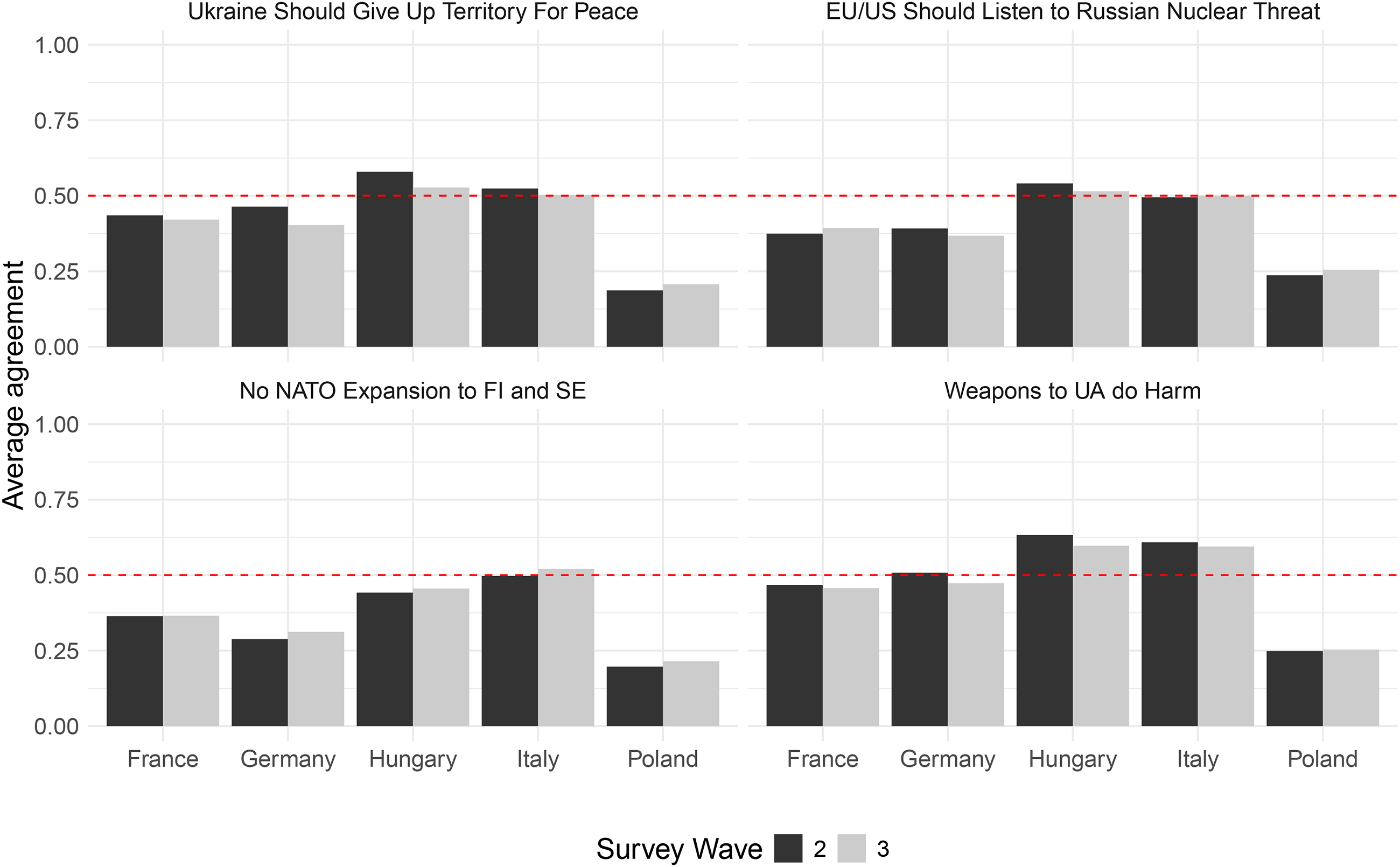
Outcome variables – country differences.
All four statements can be read as different facets of deescalation and concession to Russia. Indeed, we see similar trends across countries. We place a horizontal red dashed line at 0.5, denoting majority agreement with the statements. Several patterns stand out. The first is that on average, respondents in our sample still greatly favour supporting Ukraine and not deescalating the conflict by offering concessions to the belligerent side. The main exceptions are Hungary, and to a lesser extent, Italy, with respondents in Poland being most opposed to concessions. Secondly, we notice a small decrease between the waves on the share who think that Ukraine should give up territory, or that weapons do more harm than good. This might reflect the changing military situation given the territorial gains the Ukrainians made in the late summer and early fall of 2022, with the help of Western weapons.
We next look at broad national differences in our main explanatory variables. Figure 2 plots average agreement on the re-scaled variables (0 to 1), with a line at 0.5 indicating a majority who agree. On the top left we see the share who trust Ukraine in each country, while on the top right we see the share who trust Russia. We see that only in Poland there is a majority who trust Ukraine, with the lowest level of trust in Hungary. Indeed, in Hungary there is a similar level of trust in Russia, whereas for all other countries trust in Russia is considerably lower, an extreme minority view. Views are relatively stable, on average, between July and December 2022.
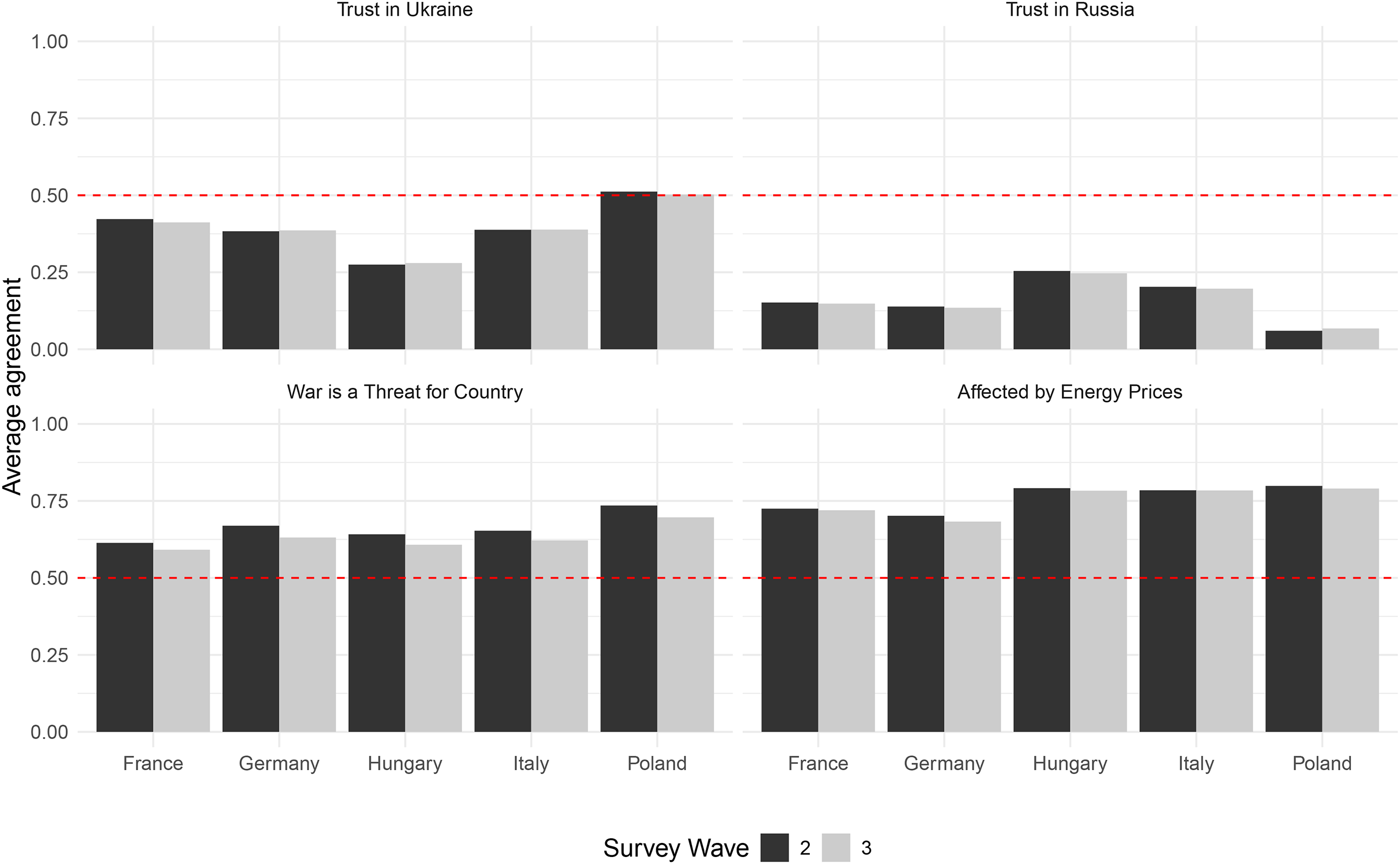
Explanatory variables – country differences.
On the bottom panel we see the share who agree with two statements that form our main explanatory variables of interest. On the bottom left we see agreement with the statement that the war in Ukraine is a threat for the safety and stability of the respondent’s country. This is one of four threat variables that we use to form a factor for the analysis, together with threat perception for the EU, the respondent’s personal safety, and the safety of those they know personally. 4 We see a relatively high share of those who perceive the war as a threat to their country, with a small decrease from July to December. Lastly, on the bottom right we see the share who consider that rising energy prices are affecting their standard of living. Again we see that the overwhelming majority of respondents feel that their standard of living was affected by energy prices.
Models and operationalisation
In our dataset, we have repeated respondents across two waves. We employ panel linear 5 models in order to account for the lack of independence in observations and model variation within individuals and, later, between individuals. To model within-individual variation across time, we use an individual fixed-effects model (within estimator), in which we include our main variables of interest which are likely to vary within individuals and across time: economic vulnerability, threat and trust in Russia and Ukraine. While individual fixed effects account for all variation and confounding across individuals, we include a number of controls for factors which may vary across time within-individual: salience, measured by whether the war, is considered the most important problem, trust in government and trust in the EU.
In order to test our hypotheses about ideology and identity, which is unlikely to vary across time, we use a between estimator. 6 In order to isolate the between-individual variation, we remove the individual fixed effect, and include country fixed effects in the model of between estimator. We include ideology and identity, in addition to our previous predictors. We also control for income, in addition to previous controls.
Results
Fixed effects model
We first use a fixed effects model in order to explain the within-individual change from December to July 2022. We include only those factors which could have plausibly changed between the two waves, thus excluding ideology and identity which are assumed to be more stable.
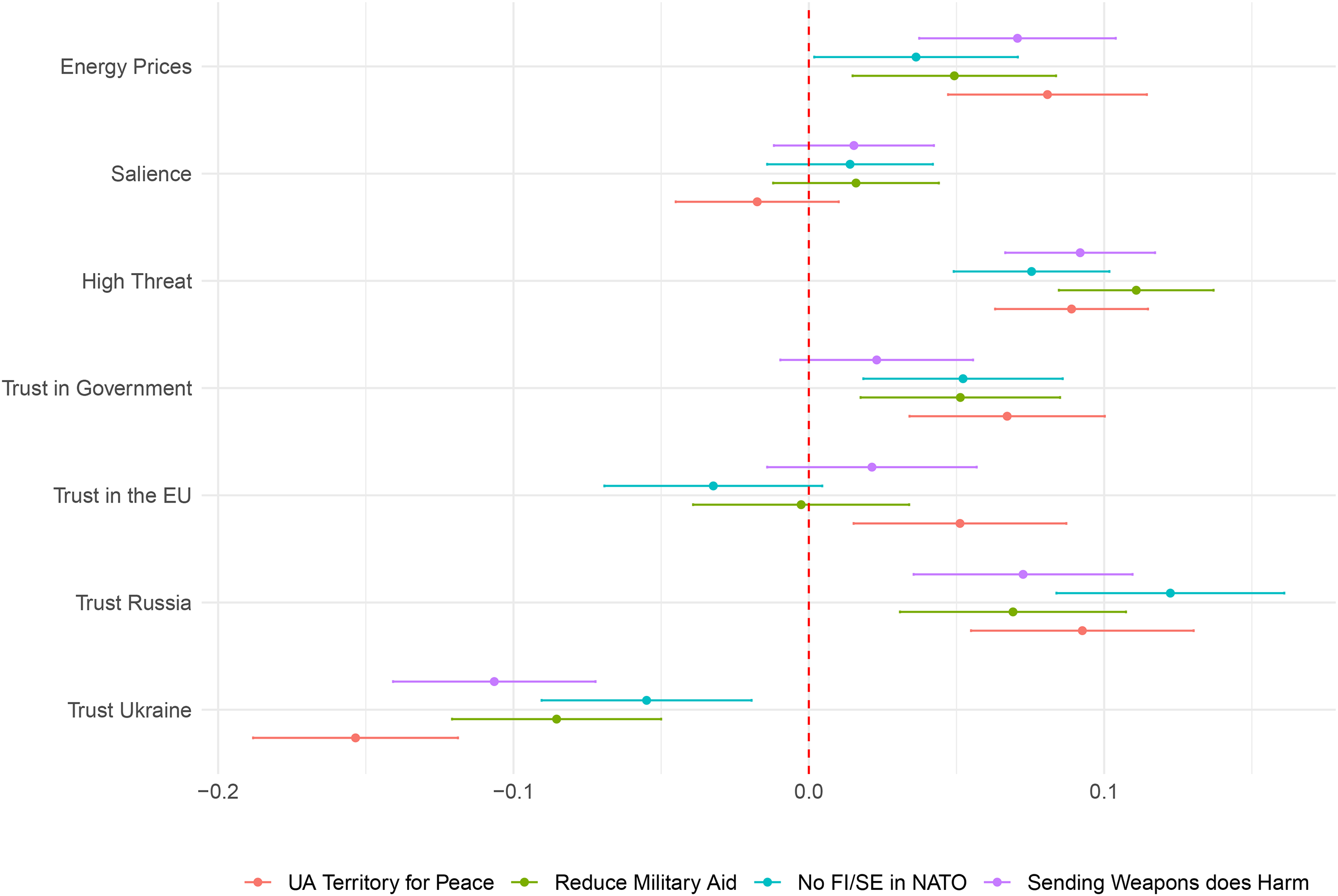
Figure 3 plots the coefficients from the models for all four outcome variables. 7 The full models can be seen in Online appendix. All variables are scaled 0 to 1, and thus all effects can be considered maximal effects across the full range of the independent variables. We see that changing perceptions on energy prices affecting standards of living are positively related to changes in views on all four outcomes. This provides support for H1. Importantly, effects are higher for the two outcome variables more directly related to the war’s resolution, Ukraine giving up territory for peace, and sending weapons. The effects are smaller for reducing military aid due to nuclear threats, and not expanding NATO. The maximal effects on giving up territory for peace is about an 8% change in the view. As expected, results reported in Online appendix show that the effect of energy prices is higher in the second wave, likely due to its higher salience in the winter of 2022. 8 Supporting this interpretation, other factors do not show a differential effect by wave (See the supplementary material).
Fixed effects model.
We see stronger effects for threat perception on all four outcomes, with the strongest for reducing military aid due to nuclear threats. The maximal effect is about an 11% change in this view across the two waves. This provides support for hypothesis H2a over H2b. European citizens who increase their threat perception of the conflict are more likely to favour de-escalation. Conversely, those with a decreased threat perception are associated with a decrease in de-escalation and appeasement. Given that threat perception has decreased overall, it is likely that this factor is partly responsible for the increase in support for Ukraine. Despite expectations, the effect of threat is relatively uniform across countries and time (see the Online appendix). Thus, while threat decreased, its explanatory power did not shift between waves.
Finally, we note that some of the strongest effects come from our two trust variables, in Ukraine and Russia. Change in trust in Russia has similar effects across our appeasement variables, with the strongest affect for not expanding NATO. This suggests that trust in Russia comes at the expense of trusting NATO, thus likely changing the perceptions among respondents for who is responsible for the conflict. Secondly, higher trust in Russia implies that those respondents believe Russia to be a stable partner in the region, therefore making NATO expansion unnecessary. Conversely, trust in Ukraine has the weakest effect for not expanding NATO, among the outcomes. NATO expansion is therefore more a matter of the potential Russian threat, and less so a matter of aiding Ukraine. We see an effect almost twice the size for reducing military aid and believing that weapons do more harm than good. As expected, respondents believe that military equipment should be given when they trust the receiver, which is likely connected to issues of corruption and the possibility of escalation on Russian territory. Finally, we see the strongest effect for giving up Ukrainian territory in order to achieve peace. Fundamentally, the issue of territory is one of legitimacy for respondents. Those who trust Ukraine are more likely to support Ukrainian territorial integrity even at the cost of prolonging the war. We thus find robust support for H5.
We also find some support for our country heterogeneity expectations. We hypothesised that trust in Russia and Ukraine should be stronger in countries that politicise the conflict more. Results reported in Online appendix demonstrate shows that the effect of trust in Russia is stronger for Poland, where only a minority still trusts Russia. We also show that trust in Ukraine has a stronger negative effect in Hungary, where Orbán heavily politicised support for Ukraine. Hungarian supporters of Ukraine therefore take a more extreme position compared to other respondents.
Between estimator
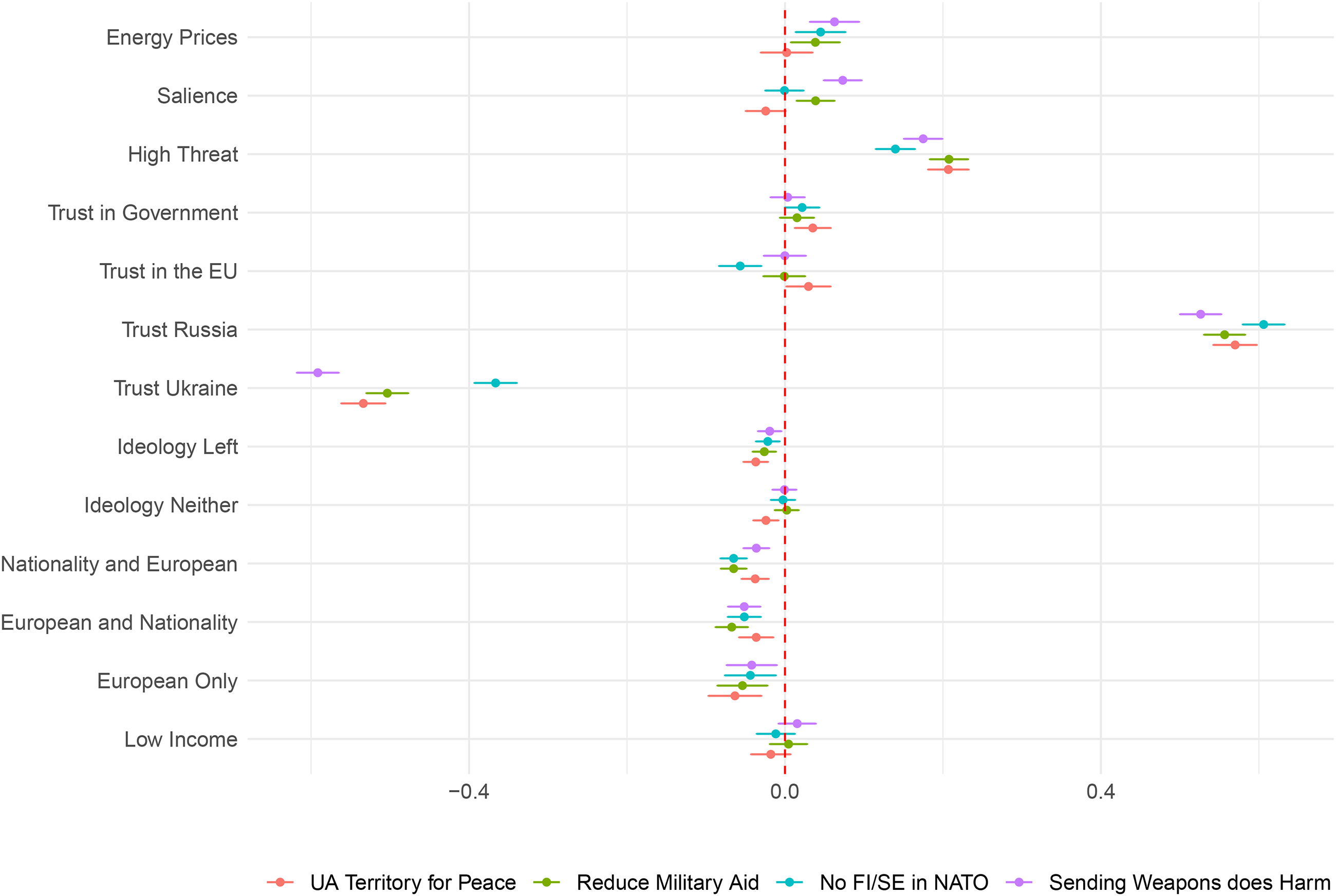
In order to capture the between-respondent variation and look at our time invariant variables (ideology and identity), we now turn to a between estimator. Figure 4 plots the coefficients from the model, with the full models available in the supplementary material. All models contain country and wave fixed effects (not shown in the figure).
Between estimator.
We note that the effects for energy prices and threat perception remain the same across individuals, with a higher magnitude for threat perception. The maximal effect of threat perception is associated with a 17% increase in agreement that the EU and US should reduce military aid in response to Russian nuclear threats. We thus find further support for H1 and H2a.
We also find support for H3b over H3a. Left-wing individuals are more likely to be against de-escalation and appeasement of Russia, compared to right-wing individuals and those who state no clear view, although the effect size is quite small. 9 We also look at individual identity. Compared to those who see themselves primarily defined by their national identity, those who see themselves as having both national and European identity, European and national, or only European, are less likely to favour de-escalation and appeasement. This offers support for H4. Both ideology and identity point to the fact that in this conflict the main dimension of disagreement domestically is between national interest and European and Ukrainian solidarity. Right-wing individuals and those who identify primarily with their national identity favour appeasement and de-escalation in the war. These results are consistent with the role of energy prices and threat. Self-interest, both egotropic and sociotropic, is associated with less solidarity with EU geopolitical efforts and support for Ukraine.
We find further evidence for the national-interest mechanism when we further break down the effect of ideology by splitting our respondents into six groups from our 11-point left-right scale: far-left (0–1), center-left (2–4), center (5), center-right (6–8), far right (9–10) and those who refuse to answer. Figure 5 plots the predicted agreement for whether Ukraine should give up territory for peace. Results are similar across other dependent variables. We see a gradual increase in agreement as respondents move to the right, with the far-right showing the highest level of agreement with the statement, and the only one passing the 0.5 threshold. Interestingly, the far-left seems as supportive of Ukraine as the center-left.
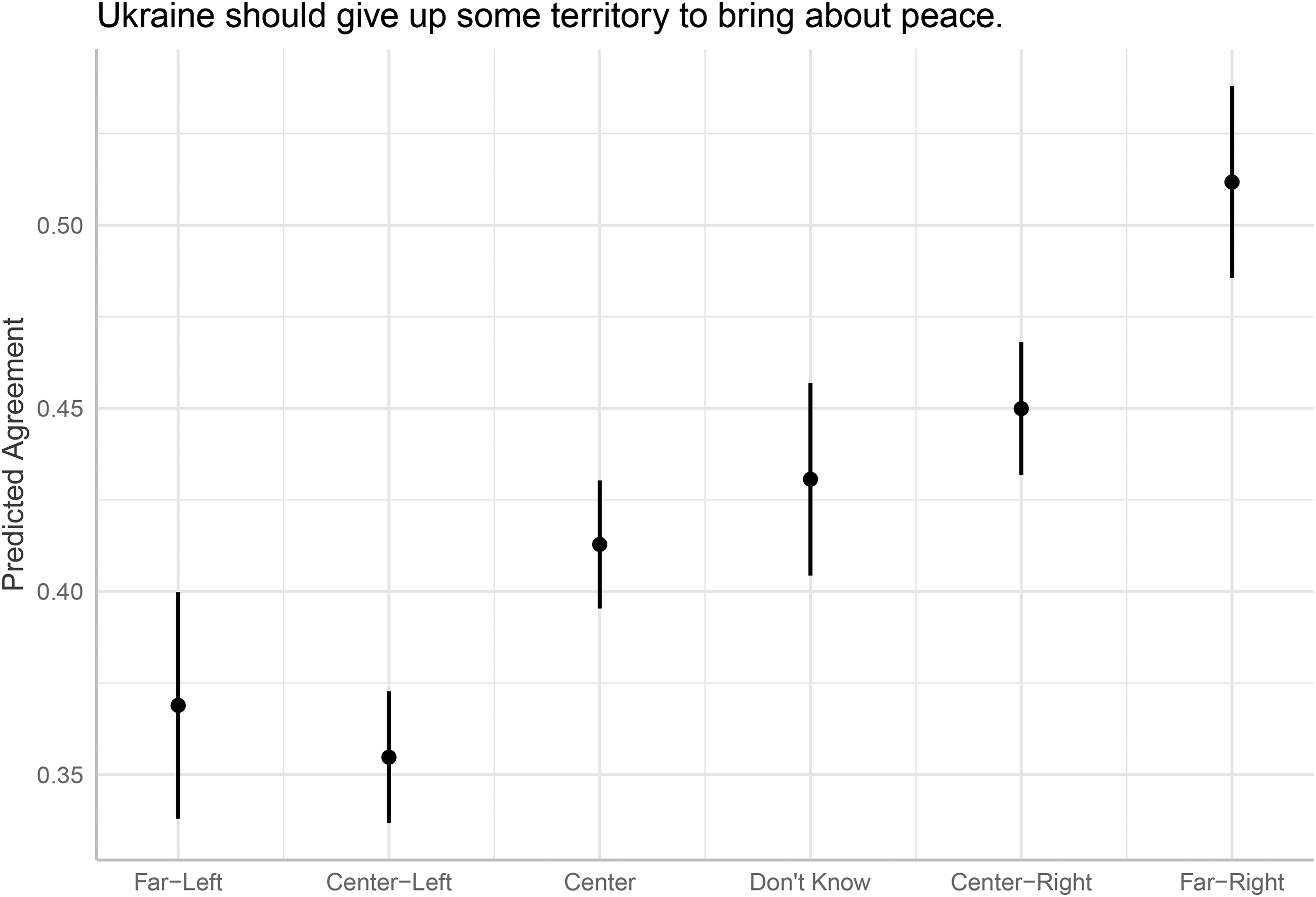
Effects of ideology.
Breaking down the effect by country, in Figure 6, further supports the national interest interpretation. The Polish far right shows the opposite effect as other countries, with the right-wing and far-right being less in favour of de-escalation. This is likely due to the heavily pro-Ukrainian stance of the right-wing Polish government, but also to the fact that right-wingers may perceive de-escalation to go against national interests, due to Poland’s proximity to the conflict and its antagonism to Russia. Hungary, whose far-right government is anti-EU and anti-Ukrainian, shows the strongest effect of the center-right and far-right on appeasement. We also see that the Italian far-left stands apart from far-left respondents in other countries, in favouring de-escalation and appeasement. This is likely due to the specific history of the far-left in Italy, where the communist party and its successors have a long-standing tradition of pacifism and anti-Americanism.
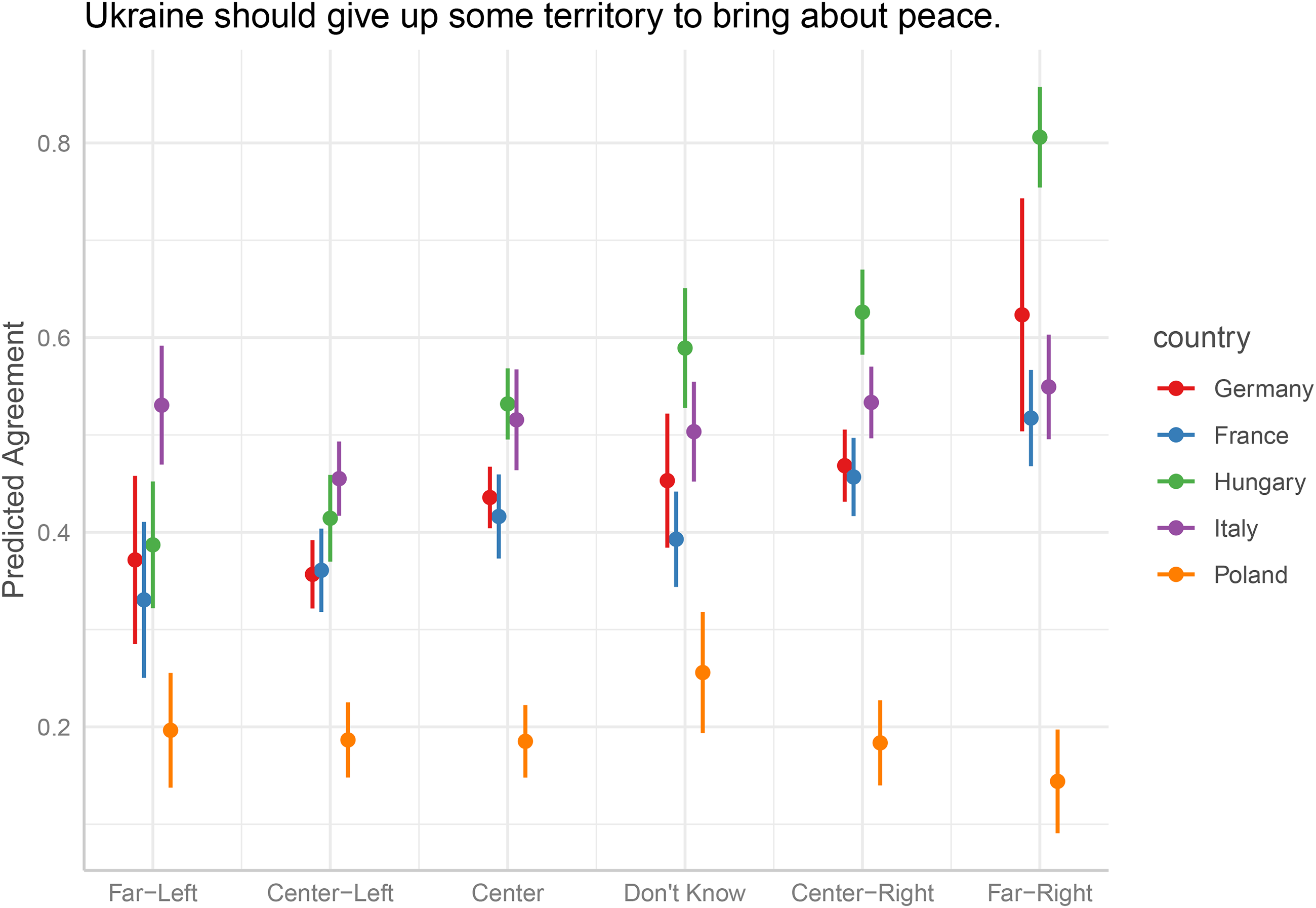
Effects of ideology by country.
Conclusion
This article set out to understand the changing dynamics of public support for Ukraine and the EU’s foreign policy regarding the conflict. Specifically, we focused on support for several strategies of de-escalation and Russian appeasement. Understanding whether European citizens support these types of policies is vital in order to understand the EU and member state response to the conflict. European unity and continued solidarity and aid to Ukraine are predicated on public acceptance of the costs of such policies, be they (perceived) increased risk or (felt) economic pain resulting from higher energy prices. Importantly, it is not only utilitarian costs that drive these attitudes, but more so ideological leanings, in particular views on the war and, to a lesser degree, political ideology and identity. Given that the sustained war effort by Ukraine is completely dependent on Western, and increasingly specifically European, military aid, the degree to which domestic public in EU countries support such policies may determine the outcome of the war. Understanding why support might increase or decrease can inform EU and member state governments’ domestic policies in order to maintain this support. In addition, we have argued that support for Ukraine, and the EU’s foreign policy towards it, is deeply related to support for specific policies, such as energy sanctions or military aid. Our findings therefore complement the policy-specific findings of Oana et al. (2025) and Moise et al. (2025), by showing how support for Ukraine varies across time. The consistency of support across time lends credence to the idea support for EU policies is robust on the demand side. The fact that support comes from ideology more than material considerations further suggests that such attitudes are deep-rooted and unlikely erode drastically. Evidence from stances of political parties supports that ideology is more important than threat when it comes to attitudes towards Ukraine (Hooghe et al., 2024).
Digging deeper into ideological factors, we show that one’s trust in either of the two sides is the strongest predictor for their views. Trust captures a host of attitudes towards the two countries, including who they believe is morally responsible for the war, who is justified in claiming certain territories, and whether the two actors can be trusted in negotiations. Likewise, those who are primarily concerned about their national interest, as measured by right-wing ideology and national-centric identity, are also more likely to support appeasement and de-escalation. This being said, Europeans are also sensitive to the utilitarian dimension, namely the costs of the war. Those who show increased sensitivity to energy prices and increased threat perception are more likely to support de-escalation and appeasement. Our analysis suggests that the EU and member states can work to mitigate these costs by focusing on the solidaristic elements of citizens’ identities. This is corroborated by Oana et al. (2025) who show that sharing the costs of energy sanctions at the EU level increases public support. They also corroborate the finding that economic vulnerability decreases support, which further strengthens the case for compensatory solidaristic EU policies.
Our study makes substantial contributions to the existing literature on public opinion in international conflicts by focusing on the current war in Ukraine. We expand on utilitarian concerns by integrating ideological factors, which our findings suggest play a more significant role than previously understood. This refinement is critical as it challenges and extends theoretical models of economic self-interest in the context of international crises, thereby contributing to a more nuanced understanding of conflict-related public opinion (Gelpi et al., 2009).
Overall, support for Ukraine and EU policy regarding the war remains high. We see a small decrease in support for the most directly relevant appeasement policies, giving up Ukrainian territory and withholding weapons. Figure 7 shows additional descriptive evidence for this overall support. It shows the share of those agreeing that several policies should be increased. We see broad support for Ukrainian refugees and humanitarian aid across all countries, corroborating findings by Moise et al. (2025). With the exception of Hungary, we see majority support in all countries for long-term aid to Ukraine and sanctions against Russia. The most contentious policy, sending military aid, still has majority or close to majority support in most countries, except Hungary and Italy.
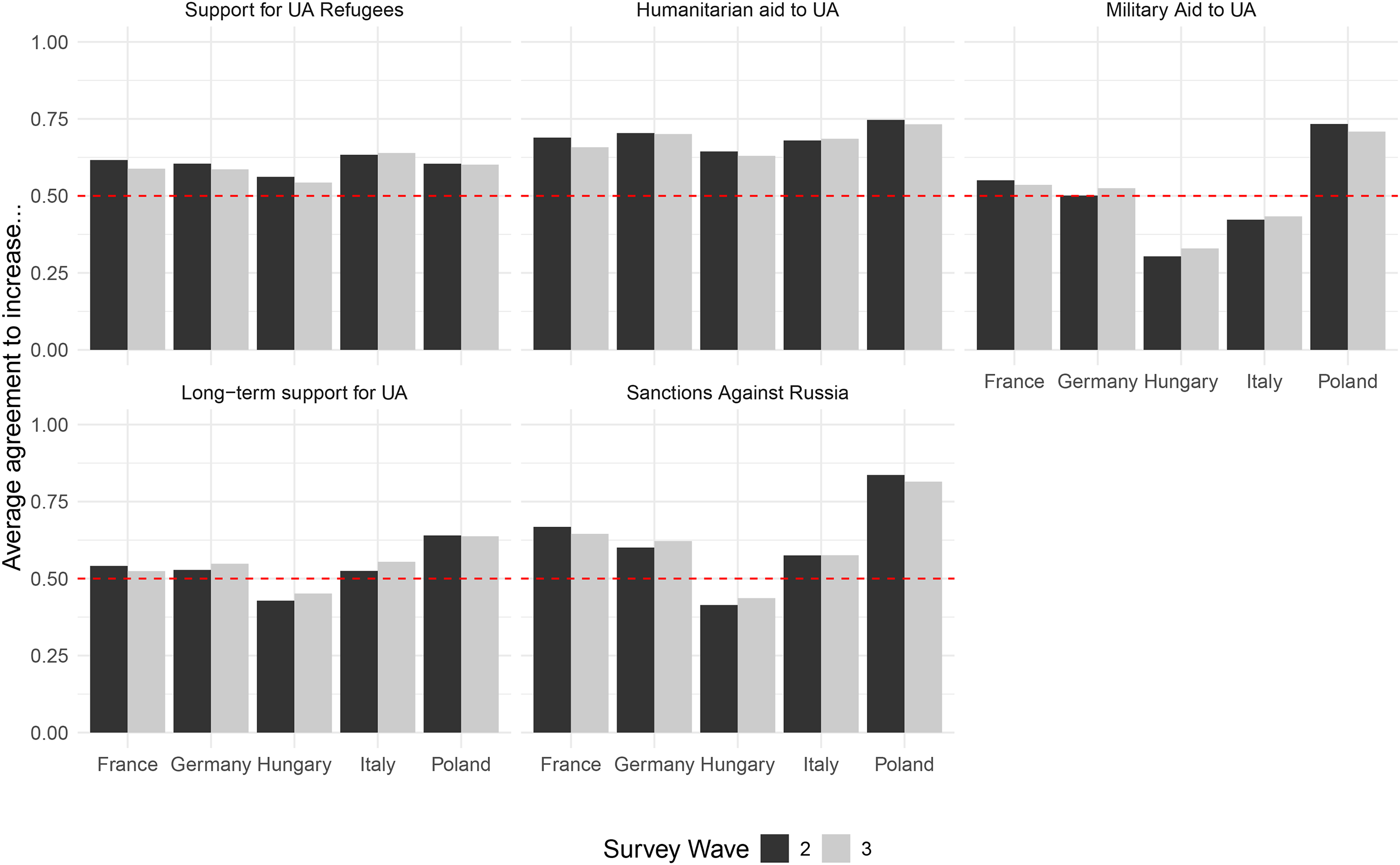
Country differences in Ukraine policy views – both waves.
The insights provided by this study are important for policymakers and academics alike. They underscore the need for policy approaches that consider public ideological orientations alongside economic factors, which could lead to more broadly supported and effective international policies (Herrmann et al., 1999). Academically, our findings invite further exploration into the comparative impacts of ideological versus economic drivers across different conflicts and contexts, opening up new avenues for research. Moreover, as Hooghe et al. (2024) suggest, the ongoing dynamics of the war and the political landscape will continue to test the resilience of public opinion and party stances. Our study supports this view and calls for ongoing research to monitor how these opinions might evolve as the geopolitical situation changes, especially in response to key events such as national elections or significant developments in the conflict.
Supplemental Material
sj-pdf-1-eup-10.1177_14651165251320837 - Supplemental material for Appeasement or solidarity? Uncovering the drivers of European public opinion on the EU’s foreign policy
Supplemental material, sj-pdf-1-eup-10.1177_14651165251320837 for Appeasement or solidarity? Uncovering the drivers of European public opinion on the EU’s foreign policy by Alexandru D Moise and Chendi Wang in European Union Politics
Supplemental Material
sj-zip-2-eup-10.1177_14651165251320837 - Supplemental material for Appeasement or solidarity? Uncovering the drivers of European public opinion on the EU’s foreign policy
Supplemental material, sj-zip-2-eup-10.1177_14651165251320837 for Appeasement or solidarity? Uncovering the drivers of European public opinion on the EU’s foreign policy by Alexandru D Moise and Chendi Wang in European Union Politics
Footnotes
Acknowledgements
The authors would like to thank Lauren Leek and all of the participants to the workshop on The Politics of European Integration after the Russian Invasion of Ukraine at the European University Institute, for their valuable comments and the entirety of the SOLID-ERC team for their comments, and contributions to the data collection.
Author contributions
The authors contributed equally to the article.
Declaration of conflicting interests
The authors declared no potential conflicts of interest with respect to the research, authorship, and/or publication of this article.
Funding
The authors disclosed receipt of the following financial support for the research, authorship, and/or publication of this article: This work was supported by the European Research Council under the Synergy Grant number 810356 (ERC_SYG_2018), in the scope of the project SOLID – Policy Crisis and Crisis Politics, Sovereignty, Solidarity and Identity in the EU post-2008 and by the Dutch Ministry of Education, Culture and Science (OCW) under the Starter Grant, in the scope of the project NEST – Navigating the Storm: European Political Contestation in Geopolitical Transformation.
Data availability statement
The data and replication code are available as part of the Supplementary Material at the DOI of the article.
Supplemental material
Supplemental material for this article is available online.
1.
The first wave coincides with the study presented in Oana et al. (2025), while the second coincides with the study presented in  .
.
2.
The surveys were conducted via CAWI methodology using the YouGov proprietary panel in all countries to recruit participants.
3.
Exact wording of the questions can be found in Online appendix.
4.
These four items form a consistent factor with strong loadings. Loadings can be found in the supplementary material.
5.
We treat our 11-point Likert scale dependent variables as continuous and used OLS for ease of presenting results. For robustness Online appendix shows the same analysis using ordered logit model of the variables. The results are substantially identical.
6.
The between estimator uses only cross-sectional variation by averaging the responses of each individual across time, thus isolating between-individual variation.
7.
Given that we have four dependent variables, it is possible that the effect of unobservable factors is different across the dependent variables, resulting in correlated error terms. In order to account for this, we run a SUR (seemingly unrelated regressions) model. Online appendix reports the results, which demonstrate the robustness of our original results.
8.
Results reported in Online appendix shows no significant difference by country.
9.
Online appendix shows that individuals of different ideology also do not respond differently to threat.
References
Supplementary Material
Please find the following supplemental material available below.
For Open Access articles published under a Creative Commons License, all supplemental material carries the same license as the article it is associated with.
For non-Open Access articles published, all supplemental material carries a non-exclusive license, and permission requests for re-use of supplemental material or any part of supplemental material shall be sent directly to the copyright owner as specified in the copyright notice associated with the article.
