



Abstract
Although polarisation risks breaking up the European family, such conflicts paired with transnational challenges can also raise awareness of the need for more European Union (EU) cohesion. In order to approach the hitherto underspecified concept, this article connects the recent literature on social cohesion with research on various facets of public EU support – integration preferences, identity, voting behaviour, and solidarity. Building on survey data from 10 EU countries taken at the end of 2020, a latent class analysis identifies two distinct groups of preferences for EU cohesion: its friends and its foes. EU cohesion can be achieved by highlighting personal advantages of European integration and by stressing joint approaches to crises, civic education, and democratic processes.
Introduction: Towards a cohesion of EU society?
The scholarly literature indicates that we currently live in times of increasing politicization in Europe. This has been shown via higher levels of salience of key European issues as well as through a greater degree of polarisation regarding the future path of European integration (see e.g. Hutter et al., 2016). The sleeping giant (Van der Eijk and Franklin, 2004) is awake and shaping European politics. Yet, the future implications of such a polarisation are less easy to discern. Although the inherent nature of polarisation is certainly divisive and could even ‘dis-integrate’ European society, it also opens up wider public debates over key political issues at stake. This in turn could raise public awareness of the major challenges Europe currently faces (Braun and Schäfer, 2021) and is even strengthened by the circumstance that only transnational decision-making under the EU umbrella can appropriately deal with these global challenges (for a similar argument in the context of the COVID-19 pandemic, see Luo, 2021 as well as Schneider et al., 2021). From the financial, the so-called refugee, the COVID-19 and climate crises to the current war in Ukraine, nation states cannot tackle these challenges alone and in isolation from each other. As a consequence, the EU is constantly gaining more power and becoming more integrated over the course of these crises.
Increasing polarisation over key European policies together with the recent and ongoing multiple crises experienced in Europe could thus function as natural catalysts for convergence beyond merely economic and political integration. Put differently, ‘turning a vice into a virtue, and vice versa, for political purposes, it could be claimed that the increased politicization also lends itself to be discussed in terms of its benefits’ (Oleart and Haapala, 2022: 2). Accordingly, we argue that the EU finds itself – in the event that disintegration is not the future path – on the way towards a European ‘community of communities’ (Risse, 2010). 1 Such a European community requires a particular form of public backing: one that addresses the societal level.
Although previous research has revealed the multi-dimensional flavour of attitudes towards the EU (see e.g. Boomgaarden et al., 2011; de Vreese et al., 2019; Goldberg et al., 2021a, 2021b; Toshkov and Krouwel, 2022; van den Hogen et al. 2022a, 2022b), the dimensions of the latter predominantly concentrate on the political face of the coin while neglecting the societal one. Whereas a mere economic and political union required only a form of public support which was directed towards the economic and political systems pertaining in the current incarnation of the EU, an adapted, more all-encompassing conceptualisation of public support is now increasingly being sought.
To bridge this research gap, we introduce a novel notion adapting the sociological concept of social cohesion to the EU's multi-level landscape. Within this literature, cohesion can best be described as a ‘sticking together’ within predefined communities (Dragolov et al., 2016). We study the broader idea of preferences for EU cohesion via two different components: political aspects (those relating to political attitudes and political behaviour) as well as societal components (regarding transnational solidarity and common identity). Moreover, we map these indicators not only separately, but combine them by means of ‘latent class analysis’ (LCA) which enables us to finally identify who holds the union together. In addition, we explore the characteristics of citizens who express high or low preferences for EU cohesion.
With the ultimate aim of examining citizens’ preferences for EU cohesion, our article is structured as follows. In a first step we synthesise a new conceptual framework that will enable us to investigate in more detail public preferences for EU cohesion. This conceptual framework is based on the rich theoretical and empirical scholarly work on different aspects of public backing for the EU – namely identity with, support for, and solidarity in the EU – on the one hand and social cohesion on the other. In a second step, we empirically study different types of individual-level EU cohesion in a pre-selected group of EU member states. Our main research questions can be formulated as follows: Are European citizens generally in favour of EU cohesion? Do individual-level preferences for cohesion differ between EU member states? And what determines such preferences for EU cohesion?
We seek to answer these questions by analysing data contained in the Everyday Life in Germany and Europe 2020 survey (Katsanidou et al., 2021) with responses from citizens of 10 EU member states. The findings of this article suggest that preferences for EU cohesion are generally present yet unevenly distributed across the different member states. When taking a more European perspective, however, we can discern two opposing groups within the EU's citizenry: the friends and foes of EU cohesion. This societal divide depends to a large degree on particular individual-level characteristics. The latter are composed of utilitarian considerations, the perception of global threats and relate to an interest in and satisfaction with democratic politics. Accordingly, this study contributes to our understanding of a union of citizens by systematically examining a key contour of the European social landscape, namely EU cohesion. Our findings speak to the current theoretical and empirical debate about the present state of the EU and allow for a more nuanced assessment of the future direction of the community.
Public backing for the ‘moving target’ of European integration
To fully understand why we need to build a new concept that will help us study public backing for the EU – namely, citizens’ preferences for EU cohesion – we first step back from the current debate and recall the overall history of public support for European integration. Taking such a historical perspective in terms of EU integration is extremely useful for our approach as it clarifies that the object of our research interest – the EU and more specifically European integration – is a ‘moving target’ that needs to be constantly calibrated in order to effectively investigate the public's backing for it: ‘The European Union is a moving target, not just because it evokes quite rapidly changing levels of support, but because the essential nature of the beast has been transformed from a market-making to a polity-making process‘ (Marks, 2004: 258).
From a historical perspective, the project of European integration had its starting point after the end of World War II with the founding of the European Coal and Steel Community in 1951. Starting with six nations, the community developed into an increasingly interconnected union over the years, which in 1992 became the EU and which now comprises 27 member states. During this time, the community has taken a series of steps on the road to integration such as the formation of a common market, economic redistribution programmes, a single currency, and common crisis policies. These policies did not go unnoticed by the EU public and at the latest after the end of the purportedly ‘permissive consensus’ (Lindberg and Scheingold, 1970), ‘[p]ublic attitudes […] shape and constrain the process of European integration’ (Gabel, 1998: 333). Hence, over time a number of different yet complementary concepts have been advanced in the literature to address the idea of public backing for EU integration.
Support for the EU's political system, conceived in earlier efforts as a unidimensional concept (Eichenberg and Dalton, 2007; Lindberg and Scheingold, 1970) and in later studies as a multi-dimensional one (Boomgaarden et al., 2011; de Vreese et al., 2019; de Vries, 2018), the attachment to Europe (Risse, 2005) and, more recently, genuine manifestations of aversion to European integration have all gained scholarly attention (Nicoli and Reinl, 2020; Treib, 2014; van Spanje and de Vreese, 2014). However, together with the ‘constraining dissensus’ (Hooghe and Marks, 2009) phase of European integration following the Maastricht Treaty and with the more recent period of multiple crises, it has become evident that a different perspective on public support is required to examine public preferences more appropriately. The onset of the European sovereign debt crisis in late 2009, the migration pressures in 2015/2016 as well as the COVID-19 pandemic raised demands for EU-wide solidarity-based policies. In academic research and everyday politics, solidarity became a popular term during the EU's ‘polycrisis’ (Zeitlin et al., 2019). Until today, backing for EU solidarity policies has been investigated in the context of various socio-political levels and for a broad range of crises (Gerhards et al., 2019; Katsanidou et al., 2022; Reinl and Giebler, 2021; Wallaschek, 2020).
We can thus state that, in light of the expansion of the EU and its areas of responsibility as well as the existence of multiple crises affecting Europe and Europeans, citizens’ preferences towards the EU have become multifaceted and can no longer be reflected by single indicators. Moreover, to fully comprehend not only the political system, but also the EU's social aspects, a more societal concept is required. These considerations can be traced back to a concept put forward by Deutsch (1953) nearly 70 years ago, which has been summarized by Neumann (1956: 178) as the ‘feeling of community, co-operation, cultural independence, and agreement on ends and means.’ In the earlier periods of European integration, such a transnational societal concept of public backing was less relevant, however. As mentioned above, public support was in the past more or less characterised by a ‘permissive consensus’ (Lindberg and Scheingold, 1970). Since the end of this phase, capturing this societal aspect has become if anything even more vital. The EU has attained a level of integration that makes it essential to foster a transnational backing by the citizenry if to address effectively the myriad of European challenges. While in pre-polycrisis times, the concept of transnational social trust (Klingemann and Weldon, 2013) seemed a promising way to examine this idea empirically, nowadays the idea of transnational solidarity appears just as necessary to help us pin down the transnational societal aspect of public backing in Europe.
Accordingly, we can summarise that even multi-dimensional approaches are not (or no longer) sufficiently informative to help us comprehensively map the idea of public support for the current shape of the EU. Such approaches (e.g. Boomgaarden et al., 2011; de Vreese et al., 2019) predominately consider – in line with Easton's (1975) theoretical framework – the different components of political systems as they currently appear as well as specific types of public support, both diffuse and specific, for these systems. In contrast, we argue that what is required is a transnational and more citizen-oriented perspective in addition to this latter, traditional approach to political support. To take this more encompassing approach to public backing for the EU, we will turn next to our conceptualisation of EU cohesion, as this seems to be the most fruitful way to capture the idea of public backing for the current state of the EU.
Conceptualising citizens’ preferences for EU cohesion
The ultimate goal of this article is to study the broader idea of public backing for the current (and ideally also the future) state of the EU, including transnational societal components suitable for grasping the European challenges of our times. Combining conventional measures of political support for the EU (European attitudes and EU identity) together with specific European actions (European voting behaviour) and the idea of transnational (European) solidarity, we term our concept citizens’ preferences for EU cohesion. This concept has been inspired by the readings of early works of Deutsch (1953), who emphasises feelings of community as well as the level of cooperation within the European community, but also by an article from Inglehart and Rabier (1978) highlighting the idea of European solidarity in times before the recent and current series of crises. Whereas in phases of permissive consensus and periods not marked by seemingly constant European crises, a concept that went beyond mere political support for the EU was unnecessary, or even inapplicable, we are now convinced that the time for such an idea is ripe. We consider preferences for EU cohesion as an encompassing and timely concept for studying public backing for European integration that takes into account transnational and societal factors. Put bluntly, social cohesion at the EU level can be defined as European ‘societies’ willingness to cooperate with one another’ (Janning, 2018: 3) – and the following remarks serve to illuminate the concept in greater detail.
This idea of EU cohesion is largely inspired by the sociological literature on social cohesion. Social cohesion thus serves as the major starting point for our concept of preferences for EU cohesion. It is both a multi-dimensional and a multi-level phenomenon (Dragolov et al., 2016; Rajulton et al., 2007). Moreover, it is closely related to other notions like social capital, social and political trust, and solidarity – all of which are typically used to describe aspects of the foundations and workings of a society. ‘The roots of the concept of social cohesion can be traced in the works of historians, philosophers, sociologists, and economists. They were all concerned with the idea of holding society together “as one” and fostering social cooperation. This is very much in line with the present-day understanding of cohesion; it literally means “sticking together”’ (Dragolov et al., 2016: 93).
Although the term has lately become a catchword for politicians and researchers, it has one major deficiency: ‘social cohesion remains a largely ill-defined term’ (Chan et al., 2006). However, based on an overview of the research literature, Chan et al. (2006: 289 − 290) have suggested that a definition of social cohesion ought to be attempted only when four measurable criteria are simultaneously met. People in a society are said to stick together when they: (1) can trust and cooperate with their fellow members; (2) share a common identity and a sense of belonging to their society; (3) evince a set of attitudes; and (4) manifest a respective behaviour. Table 1 shows how this set of general indicators for social cohesion can be adapted to the European framework for our approach to finally conceptualising EU cohesion.
Conceptualising EU cohesion.
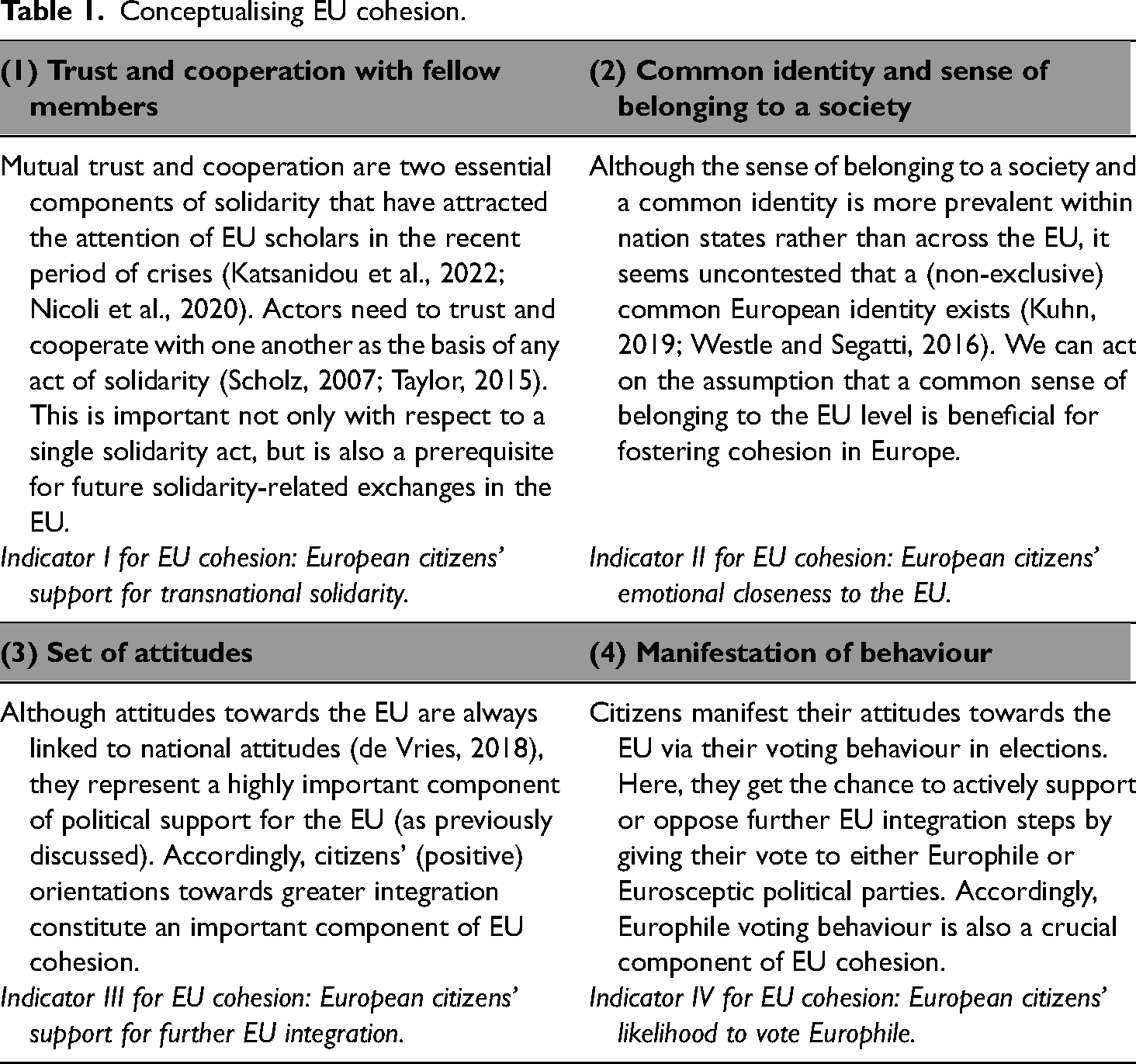
Drawing on this set of four indicators, we are now well equipped with a conceptual framework to investigate individual-level preferences for EU cohesion. In the next step, we outline how we empirically operationalise and analyse the multifaceted concept described here.
Research design
Four steps of analysis
The empirical analysis will gradually approach the responses to our overarching research questions: Are European citizens in favour of cohesion in the EU? Do individual-level preferences for cohesion differ between EU member states? And what determines such preferences for EU cohesion?
The individual analysis steps should be considered as complementing each other in a way that paints a more comprehensive picture of public support for EU cohesion. The empirical part of our article is separated into four major stages of analysis: in a first step, we map each of the indicators for EU cohesion. Secondly, we examine the patterns of individual-level preferences for EU cohesion. Drawing on the method of LCA, we classify individuals into subgroups with particular profiles of preferences about EU cohesion. We decided to opt for LCA instead of confirmatory factor analysis (CFA) as ‘social cohesion consists of interrelated components and cannot be captured as such using one single index’ (Dickes and Valentova, 2013: 836). In the case of LCA, citizens are grouped ‘based on the patterns of item responses’ (Wang and Wang, 2012: 291). The goal is thus to identify groups of people with different characteristics rather than – as in the case of CFA – to combine several measurement indicators into a single composite index. With these first two steps of analysis, we address the first research question posed – whether people in the EU are generally in favour of cohesion. Third, we check whether the latent classes identified are also present in each country in the analysis or whether we can uncover substantial differences across countries. This analytical step reflects upon the second research question we have formulated – whether individual preferences for cohesion differ among nations in the EU. A country-specific investigation is suitable for at least two reasons. Primarily (and rather technically), each of the indicators might have different manifestations in different countries. Secondly, is that we know from previous studies that country-specific patterns are highly prevalent in the study of both political support for the EU (Braun, 2021; de Vries, 2018, Reinl and Evans, 2021) and favouring cross-nation risk-sharing (Reinl and Giebler, 2021; Vasilopoulou and Talving, 2020), so these patterns need to be interpreted considering particular situations in the EU member state. In a fourth step, we seek to explain these clusters of preferences concerning EU cohesion through its main determinants and thus contribute to addressing our third research question.
Data
To measure preferences for EU cohesion and to identify related indicators at the individual level, we need a database that reflects public opinion in a variety of EU states. The public opinion survey Everyday Life in Germany and Europe 2020 (Solikris) (Katsanidou et al., 2021) meets these criteria perfectly. The data set is an ideal fit for our research purpose as it covers all four relevant indicators jointly representing individual-level EU cohesion. This is a peculiarity, since other publicly available survey data, such as the Eurobarometer, European Election Study or the European Social Survey, rarely ask about readiness to show transnational solidarity. In addition, even if this is the case occasionally, it is particularly difficult to depict this measurement at the same time as the other three cohesion criteria (Reinl, 2020). The online survey was conducted by the field research institute Respondi and is based on a quota sample for the characteristics of gender, age, and school diploma. The data collection took place in 11 EU member states – Austria, France, Germany, Greece, Hungary, Italy, the Netherlands, Poland, Spain, Sweden, and the United Kingdom – between October and December 2020. With 1000 respondents per country, the database provides a convenient sample size. As the United Kingdom left the EU at the beginning of 2020, public opinion on EU cohesion in Britain is no longer relevant to our research purpose; we have therefore excluded all British respondents from our analysis sample. Consequently, our data set represents countries from all parts of the EU which, in addition to varying economic strengths, also differ in the duration of their EU membership. Moreover, the interviews were conducted at a time when EU solidarity was politically a hot topic. Only a few months earlier, the EU had agreed on the so far largest EU budget and launched the NextGenerationEU fund. This means that public awareness of EU cooperation and especially EU-level solidarity policies are expected to have been much higher than at other points in time. Given that our concept measurement does not reflect time-dependent trends and that all countries in the analysis sample are affected by this EU-wide agreement as well as by the COVID-19 pandemic, we do not, however, expect the timing of this survey to significantly distort our results.
Measuring EU cohesion
Drawing on the Solikris data, we measure citizens’ EU cohesion via its four indicators (see Table 1) as follows:
Support for transnational solidarity (‘In order to better protect EU member states against financial crises in the future, a fund should be established to enable states to receive direct financial aid in financial emergencies. This fund should be financed by a newly introduced Europe-wide tax’
2
); Emotional closeness to the EU (‘How close do you feel to the European Union?’
3
); Support for further EU integration (‘Some people say that European integration should be taken further. Others say that it has already gone too far. What is your opinion?’); Europhile voting (‘There are a number of political parties in [COUNTRY]. Each of them would like to get your vote. For each of the following parties, please use the scale to indicate how likely it is that you would ever vote for this party’
4
).
In order to run a LCA, which needs categorical variables, we dichotomise all relevant variables.
5
As it uses four indicators, our analysis meets the minimum required number of variables (Weller et al., 2020).
Empirical findings
Are European citizens in favour of cohesion in the EU?
Different dimensions of citizens’ preferences for EU cohesion. Figure 1 presents participants’ responses on the items by country. For all four indicators, we find significant between-country differences. With regard to the solidarity aspect – Figure 1(a) – preferences are stronger in eastern and southern EU member countries. Hence, those countries that are more in favour of risk-sharing in future EU-wide crises are the ones with weaker national economies and would thus presumably benefit from such prospective risk-sharing. What is more, respondents in Spain and Poland emotionally feel closest to the EU – Figure 1(b) – compared to all other states in the survey, and (along with Greece and Italy) also favour further EU integration – Figure 1(c). This is an interesting finding, as it holds likewise for countries with shorter and longer EU histories, and these nations also show different levels of public support for Eurosceptic parties. Whereas Spain, for example, has been a member of the EU since 1985 and has a populace that tends to express very weak Eurosceptic tendencies, Poland has only been part of the community since 2004 and the country's ruling PiS party is avowedly Eurosceptic. Another picture emerges with respect to Europhile voting behaviour – Figure 1(d). People would be more likely to vote Europhile in Germany and Greece, whereas this is much less likely in the Netherlands and Sweden. These differences can be attributed neither to the length of EU membership nor to national economic performance, type of welfare state or share of EU subsidies received. The election of strongly Eurosceptic parties thus seems to have various origins, which are not clearly discernible from a macro-level perspective. Accordingly, the fourth dimension of EU cohesion – that of active EU support – represents a different component compared to the three attitudinal indicators presented before.
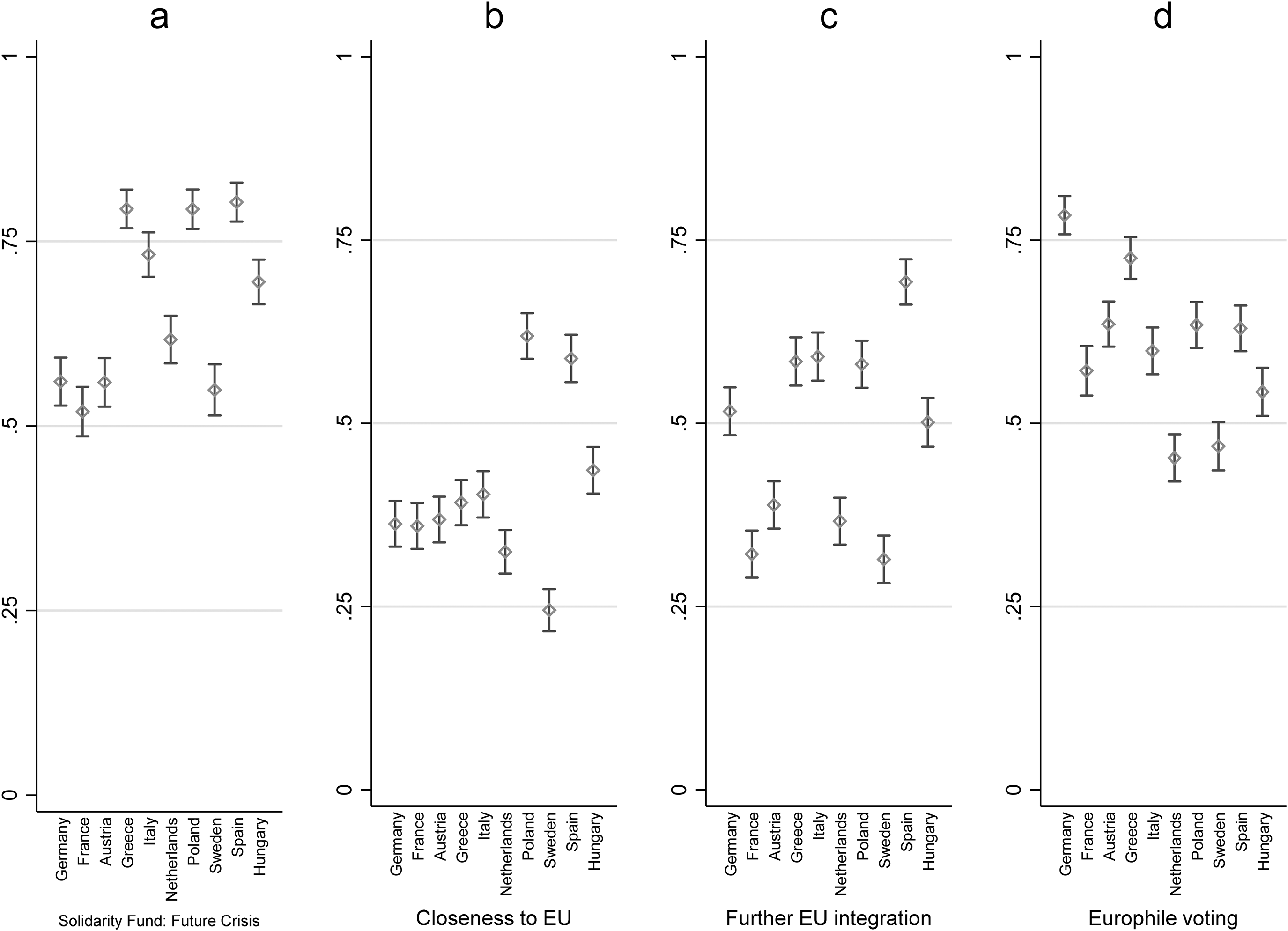
Four dimensions of citizens
To sum up, we argue that agreement on the four dimensions differs between countries as well as between indicators. Although all indicators measure some aspect of multi-dimensional support for the EU community and EU integration, they do not seem to be congruent. Consequently, in the subsequent step of analysis, we combine for the first time these individual dimensions to measure more comprehensively European citizens’ endorsement of EU cohesion.
Latent classes of citizens’ preferences for EU cohesion. The LCA was first introduced by Lazarsfeld (1950) to detect underlying typologies in his field of research and was described as follows: ‘[LCA] analysis is a very simple one: some of the parameters of a postulated statistical model differ across unobserved subgroups. These subgroups form the categories of a categorical latent variable’ (Vermunt and Magidson, 2004: 549). The LCA identifies two distinct types of EU cohesion (see Figure 2) 6 . The attempt to identify three classes or more failed because, in the case of three or more classes, these can no longer be significantly distinguished from one another. Moreover, the two-class model features the best BIC value compared to the one-class and three-class models. The first identified class (bottom line) is characterised by a below-average willingness to embrace transnational solidarity, low attachment to the EU, a rejection of further EU integration and a weaker leaning towards Europhile voting behaviour (but on average still above 0.5). Class 2, in contrast (upper line), shows on average a strong approval of EU solidarity, feels strongly connected to the EU, is in favour of further EU integration and tends to vote Europhile. When the two classes are compared, it is noticeable that they differ particularly with regard to EU attachment and support for further integration, whereas the differences in transnational solidarity and especially voting behaviour are less pronounced.
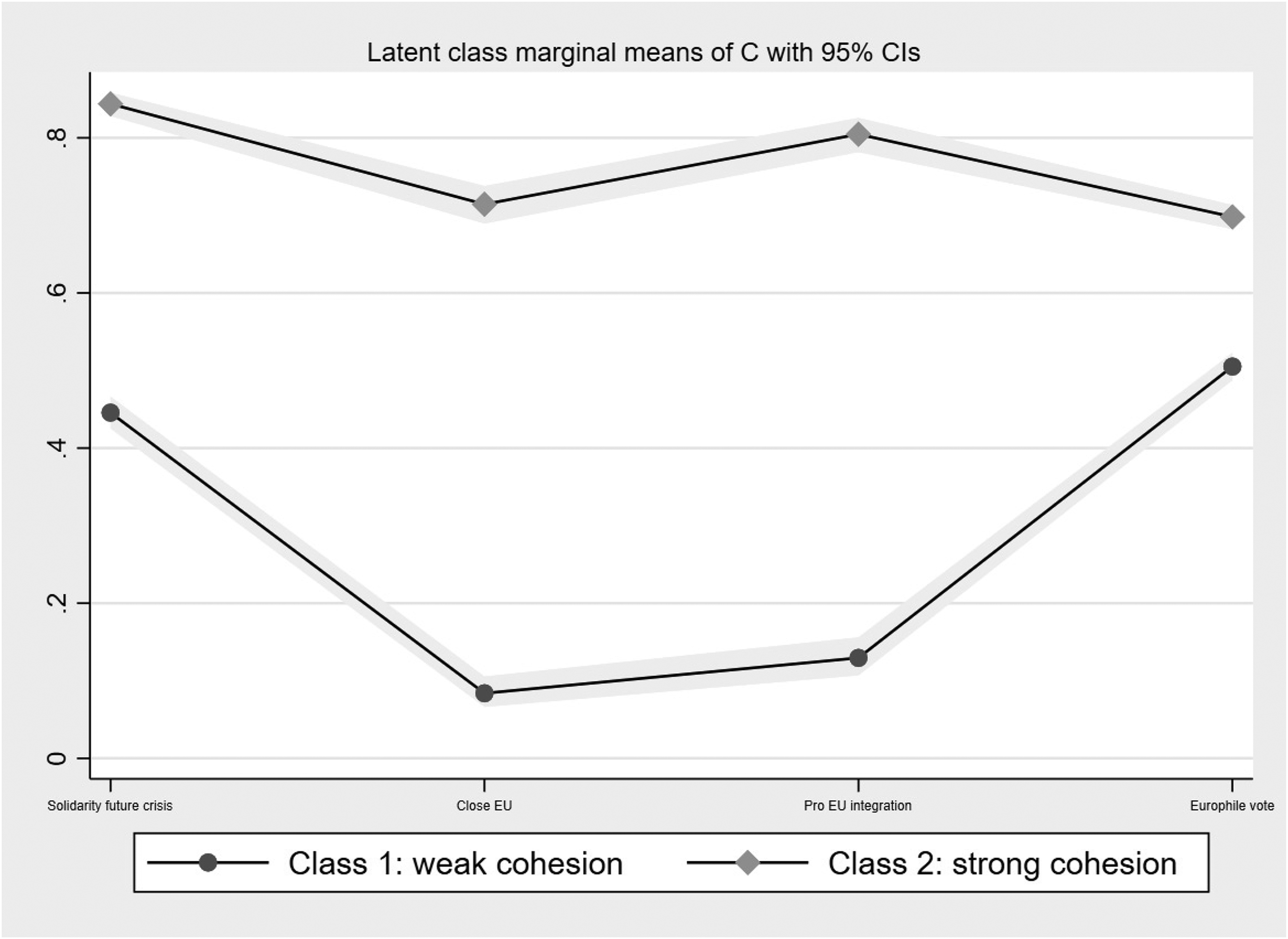
Latent classes of EU cohesion.
Our results are particularly interesting because we observe that there is no simple rejection or approval of the EU, but instead there are different facets that citizens distinguish between. Some aspects are more threatening to EU cohesion – identity and further integration – than others. Hence, the latter ‘traditional’ measurements of attitudinal EU support seem to be more divisive for EU cohesion than the voting choices expressed or event-driven preferences for European solidarity. One reason for this might be that preferences for and attachment to EU integration reflect a ‘purer’ and more stable EU assessment than voting behaviour, which may also depend on a range of individual, national and international circumstances. The same applies to the question relating to an EU-wide solidarity fund. Again, other considerations could interfere here, such as personal or national cost–benefit calculations. However, as described in detail, EU cohesion is more than mere support for the political system of the EU or the attachment to the Union. It also involves transnational societal aspects like the desire for cooperation with other Europeans. This is why the four indicators in combination are highly relevant for the subsequent steps of analysis. Next, we examine whether these two distinct groups can also be identified for the individual countries in the sample.
Country-specific reflections on latent classes. Similar to Figure 2, Figure 3 also shows the two identified types of EU cohesion, but reports the results separately by country. This analysis step suggests that the two types of EU cohesion are by no means equally evident in all countries. We only find two significantly different types of EU cohesion preferences for Germany, France, Austria, Italy, and Poland. Consequently, the two identified groups are only distinct for half of our countries. For all other states, at least one out of four indicators does not differ significantly between the groups.
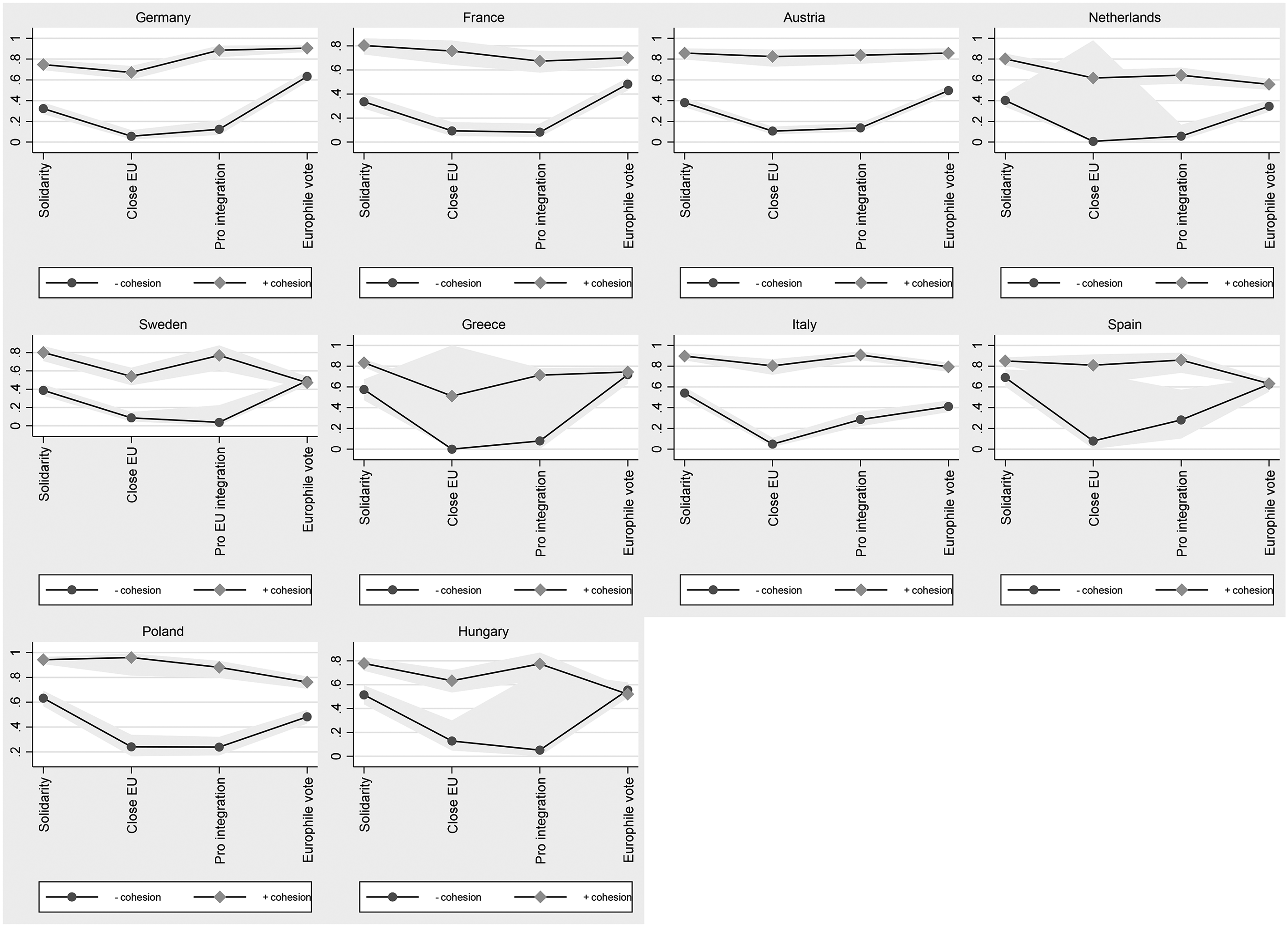
Latent classes of EU cohesion, by country.
In Greece and Spain, this even applies to all four indicators. With an eye on the Netherlands, respondents’ expressed identification with the EU seems to be the only outlier. This may perhaps be due to the generally more rational cost–benefit considerations Dutch people have in mind with regard to the European integration project. In contrast, there is a marked overlap in Hungary and Sweden between the two groups in terms of their respondents’ Europhile voting choice. This suggests that there may also be other determinants governing electoral decisions that deviate from merely supporting the EU.
The two types of preference expressed for EU cohesion seem to be particularly visible in western EU countries (with the exception of the Netherlands) and Italy, another longstanding EU member state. In contrast, Greece and Spain, for which the two types are not identifiable, stand out from other EU countries in that they were hit hard by the economic turmoil of the euro crisis and were also recipients of bailout packages. Hungary also received state aid during the euro crisis, albeit to a lesser extent. Even though the countries of eastern Europe and especially Poland and Hungary are often referred to in the same breath in western European media outlets, their populations seem to be taking different paths with regard to EU cohesion preferences. The Polish depiction in Figure 3 strongly resembles the pattern of western EU members.
What underlies preferences for EU cohesion?
In the next step, we are interested in exploring the characteristics of these identified classes of EU cohesion. To this end, we take an exploratory approach and map the positioning of the two classes against the backdrop of a set of indicators often used in past research on EU support, Eurosceptic voting, EU identity or EU solidarity.
One strand of the literature puts forward utilitarian arguments, which suggest that people's socioeconomic positions (e.g. education, occupation and income) reflect whether they see themselves as winners or losers of European integration, with those who think of themselves as winners tending to be more supportive of the EU (e.g. Anderson and Kaltenthaler, 1996; Anderson and Reichert, 1995; Gabel, 1998; Gabel and Palmer, 1995). Moreover, societal involvement at the level of the EU is more common for educated and prosperous people from higher social classes – the so-called winners of globalisation, elsewhere termed socio-cultural workers (Helbling and Jungkunz, 2020; Kriesi et al., 2008). Accordingly, these utilitarian considerations might apply as well to the broader concept of preferences for EU cohesion.
In contrast, more identity-based literature suggests that it is not only utilitarian arguments that could account for EU support, but also scenarios of perceived threat, such as the ‘fear of, or hostility toward, other cultures’ (McLaren, 2002). Such general hostility towards other cultures is one of the main characteristics of right-wing parties and their voters. Fearing other cultures and advocating right-wing rationales are expected to be also related to the idea of EU cohesion, whereby the fear of threats to one's ‘own’ culture could fuel tendencies that would disintegrate societies rather than build more cohesive ones. Perceived threats that not only refer to an expressed hostility towards other cultures, but more global threats that challenge all peoples, cultures and countries similarly, might instead give rise to cooperative rather than antagonistic orientations. The pandemic is a perfect testing ground for such an assumption (Schneider et al., 2021: 2).
In addition to economic and cultural explanations of EU support and the literature on EU identity, the empirical research suggests a number of other potentially influential factors. These are in particular linked to more general political orientations, such as internal efficacy, political interest, and information (Hooghe and Marks, 2004; McLaren, 2006; Ray, 2006), as well as to satisfaction with national politics as a cue for EU support (Anderson, 1998; Armingeon and Ceka, 2013). EU support – and we assume that this is even more true for the broader concept of preferences for EU cohesion – is positively linked to satisfaction with politics in general, since individuals do not always make clear distinctions between different strata of the multi-level system, simply transferring their satisfaction with national politics to the European level of politics. We also know from previous research that the more deeply politically interested and informed individuals are, the more they are likely to participate in political activity (Delli Carpini and Keeter, 2000). This is also expected to have a positive impact on those people in terms of their preferences for EU cohesion.
To address the utilitarian argument, we draw on respondents’ education and household income. Identity-based considerations are covered by the classic left–right question (on a scale of 0 to 10). 7 The concern about global crises is empirically operationalised by asking how worried the respondent is with regard to the global problems of COVID-19 and an economic downturn (on a scale of 1 to 5). The indicators of individual satisfaction with national democracy (scale 1–5) and political interest (scale 1–4) are directly asked in the questionnaire. 8
Figure 4 shows that the two classes are significantly different for all the characteristics presented. 9 Accordingly, EU cohesion is stronger among individuals who perceive themselves as gaining greater benefit from the EU – put differently, among those who can be considered the winners of European integration. But a favourable response to the idea of EU cohesion is also more marked among individuals who fear more global problems and perceive the EU as playing a potentially useful role in addressing these challenges. Finally, more general political features, which are supposedly anchored mostly at the level of the national political system, are also relevant: Those who see themselves as more on the left of the political spectrum, who are more satisfied with democracy and more politically engaged, express stronger support for EU cohesion. 10
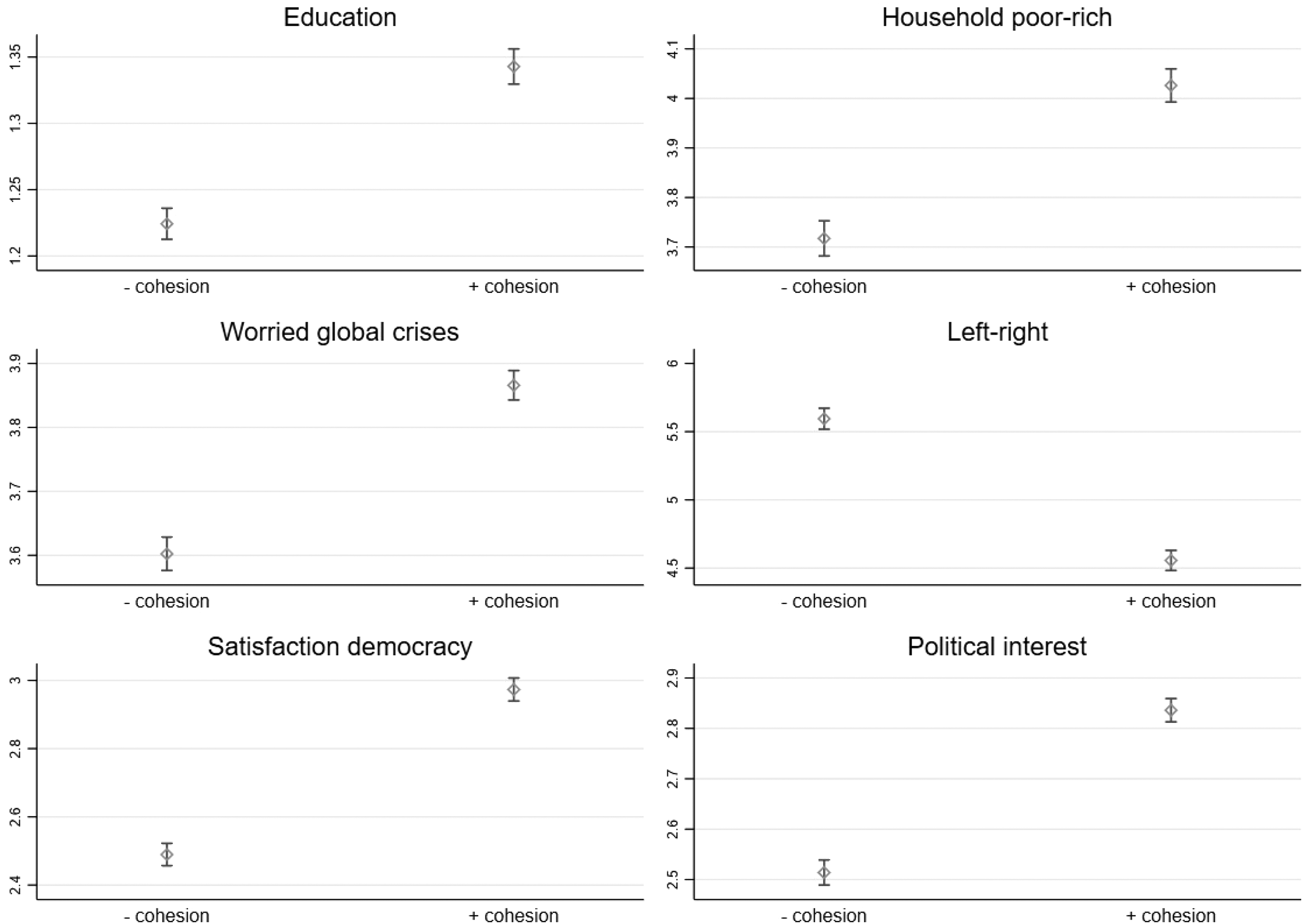
Characteristics of identified latent classes.
Discussion
In times of consolidation of Euroscepticism (Treib, 2021) and the EU polycrisis (Zeitlin et al., 2019), public backing for the EU arguably plays a more crucial role than ever before in the history of the EU. However, scholarly work to date still draws on conceptualisations and measurements of public backing for the EU that are rooted in traditional approaches of political system support. Going beyond a mere economic and political union nowadays, the EU increasingly involves redistributive elements. This requires not only political support, but also more transnational societal features of public backing. Adding to the question of how we can appropriately conceptualise public support for the current and future state of the EU, we developed a measurement for the notion of EU cohesion. In doing so, we take into account the multi-dimensional aspect of the phenomenon of support for the EU and for the first time bring together previous approaches – on EU solidarity, EU identity, EU integration preferences and pro-EU voting behaviour. Our approach is thus an effective tool for gaining a better grip on public backing for the EU in times of further integration as well as growing opposition to the EU. To sum up, we can draw three key conclusions from our study.
First, in carrying out LCA on brand-new survey data (collected in winter 2020), we investigated whether and to what extent distinct types of preference for EU cohesion can be identified and what characteristics these classes exhibit. In short, two classes of EU cohesion can be identified: friends and foes of this phenomenon. Particularly, the transnational and the behavioural components of our indicator for EU cohesion are less divisive in nature than the traditional indicators of support for this particular political system. We argue that supporters and opponents of EU cohesion differ mainly in terms of their sense of EU identity and their preferences for further or lesser EU integration. In contrast, they differ less in their Europhile voting and not so much in terms of solidarity – that is, agreeing that risk-sharing in times of crisis is beneficial. It is precisely this solidarity aspect that could also be relevant in future and for subsequent crisis scenarios, and it is important for the sustainability of the community to work towards policies that encourage a sense of community under these conditions. Further research on public backing of the EU should take these findings into account to conceive more innovative conceptualisations of public EU backing that go beyond the approach of using exclusively political support.
Second, we have dealt with the characteristics of our groups of respondents with high/low expressed levels of EU cohesion. Our findings suggest that one particular group of European citizens clearly holds the EU together and would be in favour of more cohesion in this era when the EU is facing a host of challenges. This group experiences a personal benefit from the EU and is worried about global crises, while also locating themselves on the political left and expressing a general interest in politics and relative satisfaction with the current state of political affairs. In contrast, the anti-cohesion group is characterised by a lower social class, less political interest and more dissatisfaction with democracy. Accordingly, the transnational–national divide (Jackson and Jolly, 2021) is certainly an important determinant, though we should not ignore or downplay other individual-level characteristics and attitudes such as political interest, satisfaction with democracy and the fear of current and potential global crises.
Finally, the latter finding allows us to formulate some pertinent policy recommendations. In order to convince opponents of the need for public backing for the EU, politicians in member states (not to mention those in Brussels and Strasbourg) might envisage a set of different scenarios. To foster their individual preferences for more EU cohesion, European citizens need to be made aware or to be informed – ideally via group-specific measures – about the benefits they enjoy as EU citizens. This would go some way towards addressing the utilitarian argument. Moreover, political actors should invest time and energy in explaining to European citizens how effectively the EU as a global power ought to be able to address current global crises (most immediately, the COVID-19 pandemic) and future threats (climate change). Lastly, political actors need to find appropriate ways to increase political interest and satisfaction with our current democratic system, which would both enhance EU cohesion. This could be reached through more visible political campaigning that promotes the achievements of the EU for different groups of citizens as well as by increasing funding for Europe-wide civic education.
Supplemental Material
sj-dta-1-eup-10.1177_14651165221138000 - Supplemental material for Who holds the union together? Citizens’ preferences for European Union cohesion in challenging times
Supplemental material, sj-dta-1-eup-10.1177_14651165221138000 for Who holds the union together? Citizens’ preferences for European Union cohesion in challenging times by Ann-Kathrin Reinl and Daniela Braun in European Union Politics
Supplemental Material
sj-pdf-2-eup-10.1177_14651165221138000 - Supplemental material for Who holds the union together? Citizens’ preferences for European Union cohesion in challenging times
Supplemental material, sj-pdf-2-eup-10.1177_14651165221138000 for Who holds the union together? Citizens’ preferences for European Union cohesion in challenging times by Ann-Kathrin Reinl and Daniela Braun in European Union Politics
Supplemental Material
sj-do-3-eup-10.1177_14651165221138000 - Supplemental material for Who holds the union together? Citizens’ preferences for European Union cohesion in challenging times
Supplemental material, sj-do-3-eup-10.1177_14651165221138000 for Who holds the union together? Citizens’ preferences for European Union cohesion in challenging times by Ann-Kathrin Reinl and Daniela Braun in European Union Politics
Footnotes
Acknowledgements
The authors thank the anonymous reviewers for their very helpful suggestions and criticisms. Moreover, we are grateful to the participants of the research seminar at the chair of Comparative Political Science at LMU Munich as well as the discussion by Hanspeter Kriesi at the Geschwister Scholl Institute ‘Mittelbau Workshop 2021’. Finally, we thank the entire ProConEU project team as well as all participants and discussants (Gary Marks and Marco Lisi) of the 2022 EUSA and CES panels ‘Friends and foes of European integration in turbulent times’ for their useful comments on previous versions of this article. We remain fully responsible for the contents of the article.
Funding
The authors received funding from the German Federal Ministry of Education and Research (Grant Agreement: 01UG2104A, ProConEU) for the research, presentation, and publication of this article.

Supplemental material
Supplemental material for this article is available online.
Notes
References
Supplementary Material
Please find the following supplemental material available below.
For Open Access articles published under a Creative Commons License, all supplemental material carries the same license as the article it is associated with.
For non-Open Access articles published, all supplemental material carries a non-exclusive license, and permission requests for re-use of supplemental material or any part of supplemental material shall be sent directly to the copyright owner as specified in the copyright notice associated with the article.
