




Abstract
This study examines public preferences for two forms of differentiated integration (DI): opt-outs and multi-speed EU. Due to the low salience of DI in domestic politics, we suggest that people use ideological benchmarks when forming opinions about DI mostly relating to their general predispositions towards the EU. While pro-EU citizens are more in favor of DI in the form of multiple speeds as this might pose a solution to overcome gridlock, Euroskeptic citizens display more support for opt-outs as a means to accommodate concerns about national identity and control. These differences are in turn accentuated by people’s left-right ideology. We test our hypotheses using public opinion data from the Eurobarometer between 2004 and 2018 and complete it with novel survey data. Our results suggest that while support for DI has increased in recent years, DI preferences largely coincide with ideological predispositions. Our findings indicate that rather than overcoming preference heterogeneity within the EU, DI might entrench existing fault lines.
Introduction
As European Union (EU or Union) member states have become more interconnected over the last decades, their political, economic and social trajectories have grown further apart. Northern and southern member states disagree over how to share the economic burden and regain competitiveness, while governments between East and West disagree over democracy and human rights. As citizens’ experiences with the EU diverged, different people came to want different things from the Union. In various member states, national government leaders today face considerable opposition to European solutions from citizens who have grown distrustful of the EU – the “Euroskeptics”. The even deeper problem is that Euroskeptics in North and South or East and West have sharply different views about how to move forward with the European project (De Vries, 2018). In other words, considerable heterogeneity exists between and within member states in terms of preferred policy directions, including both the scope and speed of EU integration policies (Gabel, 1998; Hooghe and Marks, 2005; Kuhn, 2015; Nicoli, 2019). Hence, the EU needs to reconcile radically different views about the appropriate scope and depth of integration that exist both across and within member states. At the same time, it needs to secure and revive public support for the European project to make its future sustainable.
Various scholars have argued that differentiated integration (DI) may be a viable solution to accommodate the heterogeneity in preferences (Bellamy and Kröer, 2017). DI is a key part of the EU’s political and legal framework (Gänzle et al., 2019). The Eurozone and Schengen Area are just two important examples of DI. When it comes to decisions on DI, the public is also often involved. Telling examples are the referendums on opt-outs held in Ireland and Denmark (Hobolt, 2009). Yet, with the exception of a few recent studies (Leuffen et al., 2020; Telle et al., 2022), we know little about public support for DI (see also Schimmelfennig et al., 2023). This is surprising given the importance that is generally attached to DI as a solution to the growing heterogeneity between and within EU member states. However, it can only be a solution when DI aligns with the preferences of at least a majority of EU citizens. Building on a classical insight from the EU support literature that people are generally less informed about and interested in EU politics and rely on benchmarks to make up for these informational shortfalls (Anderson, 1998; De Vries, 2018; Kritzinger, 2003; Sànchez-Cuenca, 2003), we suggest that people use their general ideological predispositions to form opinions about DI. Due to the fact that DI is not highly salient in domestic politics (Telle et al., 2022), we argue that people make up for a lack of knowledge about DI by extrapolating from their general ideological predispositions. These ideological predispositions are more readily retrievable in their minds and serve as benchmarks to determine how to reason about DI (Anderson, 1998; De Vries, 2018; Kritzinger, 2003; Sànchez-Cuenca, 2003).
While focusing on public preferences for two forms of DI, multi-speed EU and opt-outs, we theoretically argue and empirically substantiate that pro-EU citizens are more in favor of DI based on multiple speeds because this form of DI can be seen as a solution to overcome gridlock. From this viewpoint, DI is a way to move European integration forward and aligns with their pro-EU ideological predisposition. Euroskeptic citizens, however, display more support for opt-outs because this form of DI can be seen as a means to safeguard national sovereignty and ameliorate concerns about national identity. An opt-out is a way to mediate concerns about a potential loss of national control and coincides with the more negative stance towards the European project of Euroskeptics. Given that we argue that ideological predispositions serve as benchmarks for people’s DI preferences, we also expect people’s left-right ideology to play an important role. Specifically, we predict that the difference in DI preferences among pro-EU citizens (being in favor of multi-speed EU) and Euroskeptics (being more in favor of opt-outs), is more accentuated for those who self-identify as right-wing. This, we suggest, is because of existing ideological tensions within the right. For those on the right, European integration as an economic project fits a commitment to trade and market liberalism, but at the same time the EU as a political project might be in tension with a deep allegiance to the nation state and national community (Marks and Wilson, 2000). These tensions come to the fore when those who identify as right-wing need to evaluate the different forms of DI.
We examine these hypotheses by relying on public opinion data from the Eurobarometer between 2004 and 2018 and novel survey data from 2020. These data sources allow us to capture public opinion towards the two forms of DI we are interested in, multi-speed EU and opt-outs. Our empirical evidence suggests that while pro-EU citizens are more in favor of DI in the form of multiple speeds, Euroskeptic citizens display more support for opt-outs, and these differences are particularly pronounced among those on the right of the political spectrum. Our findings that existing ideological predispositions shape people’s DI preferences cast some doubt on the notion that DI could overcome preference heterogeneity within the EU, rather it could entrench existing disagreements about how to move further in the EU.
Public preferences for DI
One of the important conclusions from the vast amount of work on public preferences towards the EU is that a large preference heterogeneity exists within the EU both across and between member states (see for example Gabel, 1998; Hooghe and Marks, 2005; Hobolt and De Vries, 2016). Citizens within and across member states disagree on the scope of EU policy, e.g. on economic burden sharing or democracy, and on the speed by which such policies should be implemented, if at all (De Vries, 2018; Nicoli, 2019). This heterogeneity complicates EU decision-making and is one of the reasons why modifications to the EU’s Treaty base have stalled in recent decades (De Vries et al., 2021; Hooghe and Marks, 2009). To accommodate such heterogeneity, various scholars have pointed towards DI as a solution (Bellamy and Kröer, 2017; Schimmelfennig et al., 2015). They see DI as suitable alternative in particular for citizens and member states that oppose the EU’s intrusion into core state power (Winzen, 2016). At the same time, the European Commission has actively promoted and facilitated instances for DI in a series of White Papers (White Paper on the Future of Europe, 2017). As a result, DI has become a core feature of the EU’s primary and secondary law (Schimmelfennig et al., 2015; Schimmelfennig and Winzen, 2020), which particularly allows for forms of enhanced cooperation and occasional opt-outs.
The literature on DI and its drivers highlights an important role for polarized individual-level preferences, because they may further constrain collective integration efforts. From this viewpoint, polarized opinion presents an impetus for DI. While a rich body of literature on public opinion towards European integration highlights the importance of material interests, territorial identification, as well as ideological and other national cues (see for an overview, Hobolt and De Vries, 2016; Hooghe and Marks, 2005), our understanding of citizens’ support for DI is far more limited (exceptions are Hix et al., 2023; Leuffen et al., 2020; Telle et al., 2022; Vergioglou and Hegewald, 2023). This is unfortunate as the utility and legitimacy of DI will at least in part hinge on citizens’ support. In their pioneering work, Leuffen et al. (2020) map the regional differences in public support for a multi-speed Europe between 2011 and 2017, demonstrating that a clear divide exists between the North and the South, with Northern member states being more in favour of DI. According to the authors, Southern member states perceive DI as a divisive and discriminatory issue of economic governance with negative consequences for European solidarity, while the Northern member states perceive it as an autonomy enhancing instrument. Moreover, they examine individual-level differences in support for DI by focusing specifically on the role of liberal economic attitudes. Citizens with a preference for equality are less likely to support DI, while those holding liberal-conservative views tend to be more positive towards DI.
Notwithstanding the importance of this pioneering work, scholars focusing on the general approval or disapproval of EU membership and European unification have challenged a one-dimensional approach to explore multifaceted opinions towards the EU (Boomgaarden et al., 2011; De Vries, 2018; Leruth, 2015). Unpacking support for European integration may help us understand the demand for DI (see also Schuessler et al., 2023). While existing empirical work focuses on one particular conception of DI, namely the idea of a ‘multi-speed EU’, questions remain about citizens’ preferences for other types of DI, which could display different spatial and temporal variation inside and beyond the EU (see also Telle et al., 2022). We build on the notion of the multi-dimensional nature of people’s EU preferences (Boomgaarden et al., 2011; De Vries, 2018) to examine two types of DI preferences: ‘opt-outs’ and ‘multi-speed EU’. These relate to the two most important legal mechanisms, opt-outs and enhanced cooperation, through which differentiation can be achieved (De Witte, 2018, 2019). When it comes to opt-outs, we can distinguish between voluntary and discriminatory opt-outs from EU rules (Schimmelfennig and Winzen, 2014). Voluntary opt-outs are usually the result of a member state’s policy preference and usually occur in the context of EU treaty change (deepening integration), while discriminatory opt-outs are associated with the lacking capacity of a member state to implement a common rule that might occur in the context of EU enlargements (widening integration). While such exceptions from common rules are an important aspect of DI, opt-outs neglect differentiation stemming from a demand for more integration, which can be the result of ‘enhanced cooperation’. Enhanced cooperation is a treaty instrument which allows member states to pursue deeper integration within limited ‘avant-garde’ groups, usually requiring the consent of the non-participating member states (Stubb, 1996).
Analytically, opt-outs and enhanced cooperation are similar as in both cases there are some member states which want more integration than others. However, we argue that the two forms of DI differ with regard to their perceived purpose and nature. While opt-outs accommodate exceptions from a broad agreement on more integration, by contrast, enhanced cooperation allows some member states to do more than others. In this perspective, opt-outs are associated with resistance to more integration, while enhanced cooperation (and thus multi-speed EU) is linked to a commitment to more integration. Consequently, while the two forms are analytically similar, we expect that people perceive them as serving different purposes and, therefore, assess them differently.
The problem is, however, that ordinary people might often lack detailed information about the EU (Karp et al., 2003). This is especially the case for DI, which is largely part of an European elite discourse (Telle et al., 2022). A strand of literature on EU support suggests that people are generally either less interested in or informed about EU politics (compared to national politics) and make up for these informational shortfalls through benchmarks (Anderson, 1998; De Vries, 2018; Kritzinger, 2003; Sànchez-Cuenca, 2003). In its simplest version, the argument is that support for integration depends on national political factors as citizens overall lack knowledge about the EU, and thus rely on national political proxies about which they have more information. Even if people have information about the EU, informed preference formation is only likely in terms of a specific salient EU policy or general perception about more or less integration. Ordinary people are unlikely to have detailed information about such a complex topic as DI.
Against this backdrop, we argue that people use ideological benchmarks when evaluating DI, mainly their general predispositions when it comes to the EU and left-right ideology. Existing models of political competition at the national level assume a two-dimensional space consisting of the classical left-right dimension and a second dimension that includes a variety of issues, for instance, European integration (see for example Hooghe and Marks, 2009; Kriesi et al., 2006). Specifically, we expect that pro-EU citizens are more in favor of DI based on multiple speeds because this form of DI can be seen as a solution to overcome gridlock. Perceived in this way, DI is a way to move European integration forward which maps on to their pro-EU ideological predisposition. Euroskeptic citizens on the other hand display more support for opt-outs because this form of DI can be seen as a means to safeguard national sovereignty. An opt-out is a way to mediate concerns about a loss of national sovereignty or national control which coincides with the more negative stance towards the European project of Euroskeptics. While discussions about DI are rather complex and far removed from the lives of ordinary people, to proxy more complex preferences, people use their general predisposition towards the EU, more or less favorable, which has become an important part of political ideology and voting behavior at the national level (De Vries, 2018). Existing research suggests that Euroskepticism is not only driven by economic motives, but often also coincides with fears about the preservation of national identity and the sovereignty of the nation state (for an overview see Hobolt and De Vries, 2016; Hooghe and Marks, 2005). Hence, we expect that among Euroskeptics, opt-outs will be relatively popular as it allows them to pick an EU ‘a la carte’. Opt-outs accommodate exceptions from a broad agreement on more integration and thus could be a means to safeguard national sovereignty or concerns about national identity. On the other hand, we expect enhanced cooperation as a means to create a multi-speed EU to be less popular among Euroskeptics and much more popular among pro-EU citizens. This is because multi-speed Europe can be a mean to overcome gridlock and therefore be a second-best solution to generally more integration. Hence, we expect people to differ in terms of their support for opt-outs and multi-speed based on their general views about European integration.
H1: EU support is positively related to support for DI in the form of multi-speed integration.
H2: EU support is negatively related to support for DI in the form of opt-outs.
Given that we argue that ideological predispositions frame people’s DI preferences, we also expect that people’s left-right ideology plays an important role. Specifically, we claim that the difference in DI support on the basis of people’s EU predispositions, i.e. pro-EU citizens being in favor of multi-speed EU and Euroskeptics being more in favor of opt-outs, is more accentuated for those that self-identify as right-wing. This is because of existing ideological tensions, stemming from existing divisions within conservatives and liberals, related to issues concerning national community within the right more generally (Marks and Wilson, 2000). For the right, the EU as a form of economic integration might fit their commitment to market and trade liberalism, but the EU as a form of political integration is at least partially in tension with an allegiance to the national community and a skepticism towards excessive supranational policy coordination (Marks and Wilson, 2000). These tensions have come to the fore for many right-wing political parties that have an ambiguous relationship to the EU and have been challenged by radical right populist parties in recent decades that are much more clearly opposed to the EU due to concerns about national identity and a loss of control (see for example Hooghe and Marks, 2009; Marks and Wilson, 2000; Marks et al., 2006). While existing research also suggests that there are divisions on the left, these are shown to be less associated to the national community concerns which we expect to underline support for different forms of DI. On the left, the tensions primarily relate to disagreements about the degree to which the EU is a solution to dealing with inequality or exacerbates it through the single market that benefits multinational companies disproportionately (De Vries and Edwards, 2009; Marks et al., 2006). Hence, we hypothesize that the differences between pro-EU citizens being more in favor of DI in the form of multiple speeds and Euroskeptic citizens being more supportive of opt-outs should be particularly pronounced among those who identify as being on the right of the political spectrum.
H3: Left-right ideology moderates the relationship between EU support and support for DI, with differences between Euroskeptic and pro-EU citizens in DI support being larger on the right side of the political spectrum.
Data and methods
We now turn to the data and methods used to test our expectations. In a first step, we present descriptive evidence about public preferences for DI over time and across countries. In the second step, we pay special attention to how ideological predispositions map onto DI preferences. For our empirical analysis, we require public opinion data on citizens’ DI preferences. At the time of writing, the availability of data on DI preferences is relatively limited (but see Schuessler et al., 2023). We combine two datasets, including various waves of the Eurobarometer (EB) collected between 2004 and 2018 and novel YouGov survey data from 2020 on public preferences for DI. 1 The Eurobarometer dataset is commissioned by the European Commission. For our analyses, we focus specifically on the EU-27. The YouGov survey was commissioned by the European University Institute (EUI) and was fielded in fourteen countries: Denmark, Finland, France, Germany, Greece, Hungary, Italy, Lithuania, Netherlands, Poland, Romania, Spain, Sweden, and the UK. For our analyses, we exclude the UK due to Brexit, because we do not focus on external differentiation in this study (but see Hix et al., 2023: for interesting insights on this topic). For more information on the YouGov survey, including the sample, please see the Online appendix.
Dependent variables
To measure public preference for multi-speed EU, we rely on a binary measure within the Eurobarometer survey on the respondent’s stance on a two-speed Europe. Respondents are asked ‘As regards to the idea of a “two speed Europe”, which of the following comes closest to your personal preference? Those countries which are ready to intensify the development of a common European policy in certain important areas…Should do so without having to wait for others’ (coded as 1), or ‘Should wait until all MS of the EU are ready for this’ (coded as 0). 2 This question was not consistently asked in the Standard EB survey, leaving some gaps in our time-series. It should be noted that the wording of this question strongly suggests a temporary divergence between countries, with member states arriving at the same end point at different times. As such, it might be biased towards the views of more pro-EU respondents.
The YouGov survey also contains a item on public preference for multi-speed EU, asking whether some member states should be allowed to move forward, with answers categories ranging from ‘strongly disagree’ (coded as 1) to ‘strongly agree’ (coded as 5). 3 The YouGov survey is particularly valuable as it allows us to also capture public preference for another form of DI: Opt-outs. Respondents were asked whether they agreed with the following statement ‘Member states should be allowed to opt-out of specific areas of European integration’. 4 Answers were coded on a scale from 1 to 5. Because this question suggests that opt-outs are rather permanent, it can be seen to constitute an alternative form of DI compared to multiple-speed integration. 5
Independent variables
At the individual level, we include two key variables to capture people’s ideological predispositions which we argued act as benchmarks for people to form DI preferences. We first of all include EU support in our models, operationalized using the Eurobarometer question on whether respondents think their country’s EU membership is a good or a bad thing (or neither). For the YouGov data, we use respondents’ remain or leave preference on the question ‘if there was a referendum on membership of the EU, how would you vote?’. 6 Second, we include left-right ideology in our models, using the respondent’s self-placement on a scale from 1 to 10 (Eurobarometer) and 1 to 7 (YouGov). 7
In addition, we include a set of variables that have proven important for understanding EU preferences and thus can also capture variation in public preferences towards opt-outs and multi-speed integration (Hobolt and De Vries, 2016). Following the utilitarian approach to EU support (Gabel, 1998), we also include education, income, and employment in our models. From the Eurobarometer data, we use years of education and a respondent’s occupational status (with 0 referring to having an occupation, studying or being retired, 1 referring to being unemployed). Unfortunately, there is currently no education measure in the YouGov data, but we include the perceived security of one’s personal financial situation. Lastly, for both data sources, we also control for age and gender. 8 For more details on the variable descriptions, please see the Online appendix.
Methods
Due to the fact that we are working with various dependent variables from different data sources, we employ a variety of analytical methods. To study preferences for DI across time and countries using the Eurobarometer, we employ multilevel regression models (both linear and logistic) with time and country fixed effects in some cases. Whenever logistic regression is used, we present predictive margins. These indicate the mean level of support for DI and their standard errors for a given value of general EU support. Moreover, we present the complete logistic regression table with odd ratios in the Online appendix, as well as a coefficient plot of the average marginal effects. For the analyses on YouGov data, we employ multilevel linear regression with country fixed effects. For this study, we are particularly interested in the individual level and therefore try to hold cross-country variation constant using fixed effects. We report the regression results below, as well as a graphical presentation of the interaction effect with the predicted margins.
Results
Descriptive analyses
Before turning to the examination of our core hypotheses, we present various graphs to get a sense of the trends in DI support across groups of EU supporters, across time and countries. For our analyses, we are particularly interested in how DI preferences are structured by people’s ideological predispositions. Therefore, we first map support for opt-outs and multi-speed integration across groups of EU supporters by relying on recent data from the YouGov survey. To categorize citizens in groups of EU supports, we use a question on how the respondent would vote on a referendum on EU membership, which closely relates to positive and negative views on EU membership. Figure 1 presents the distributions of various type of EU supporters on respondents’ agreement with the statement ‘EU MS should be allowed to integrate at multiple speeds’. What these distributions tell us is that among those who prefer to remain a member of the EU, the largest group either agrees (41.9%) or strongly agrees (11.7%) that multi-speed integration should be possible. Those who would vote to ‘leave’ the EU in 2020 are less supportive of multi-speed integration, with the largest group (39.4%) expressing a neutral position. Similarly, amongst those who would not vote or who do not know what they would vote, the largest group expressed that they neither agreed nor disagreed with countries integrating at multiple speed (but these categories include only 4.2% and 9% of our sample respectively). Overall, it appears that pro-EU citizens are more supportive of DI (in the form of a multi-speed EU).
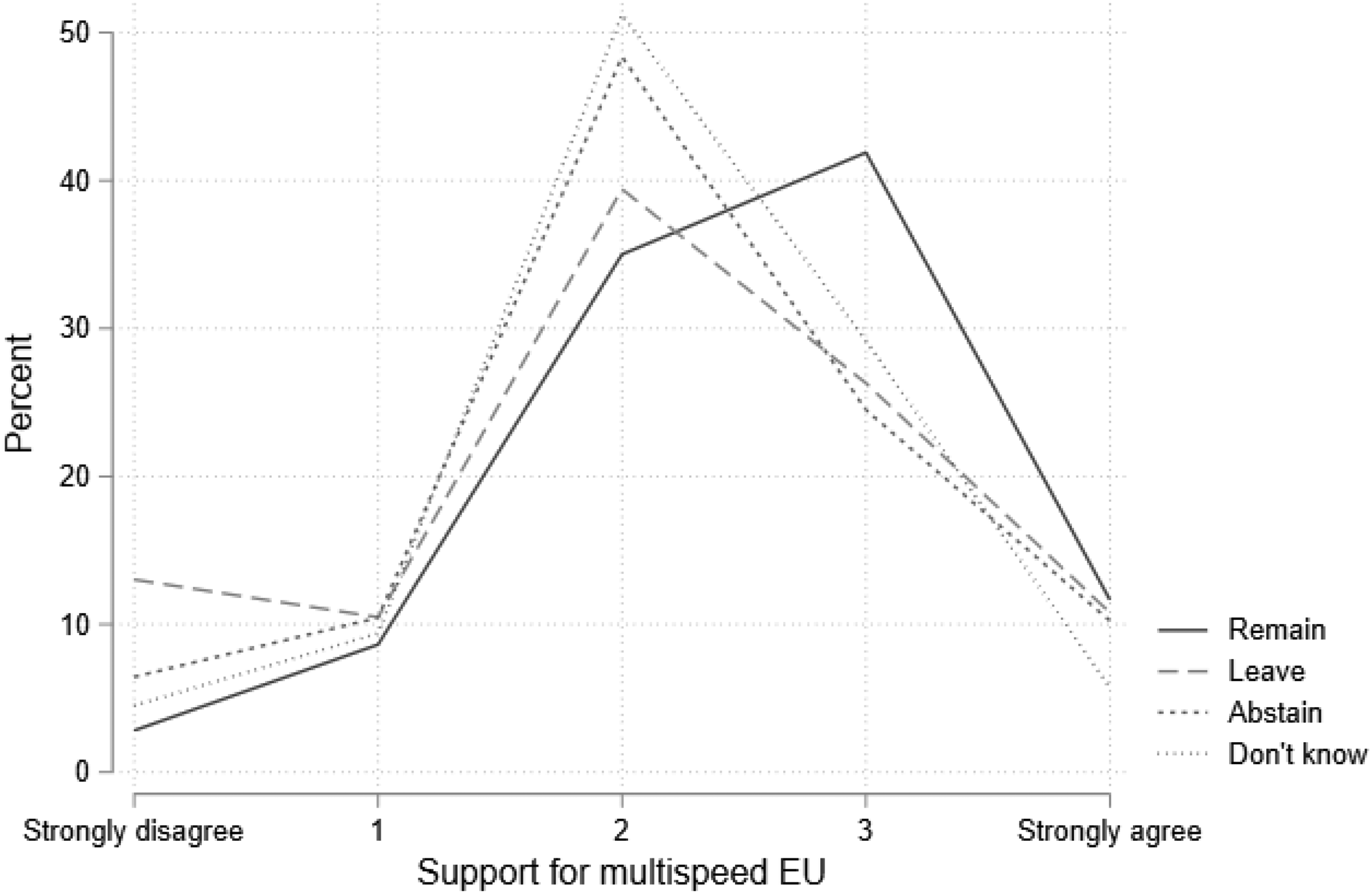
Preferences for multi-speed EU by EU referendum voter (% of type of EU support).
Respondents were also asked about their preference for a second form of DI, namely opt-outs. We again mapped these DI preferences across different types of EU supporters (see Figure 2) finding that citizens who would vote ‘leave’ are more supportive of opt-outs with 27% agreeing and 26.9% strongly agreeing that countries should be granted opt-outs. In fact, only 19% of those who are negatively positioned towards their country’s EU membership are against opt-outs. Alternatively, those who would vote ‘remain’ are more divided on the topic, with a large group in favor of opt-outs (40.8%), but also a substantial neutral (29.7%) and opposing group (29.5%). Among those who would abstain or who do not know what they would vote on an EU referendum, the largest group is neutral on granting MS opt-outs from EU legislation (41% and 40% respectively), although they appear to be somewhat leaning towards support with 40% agreeing or strongly agreeing in both groups (bear in mind that these are only small groups).
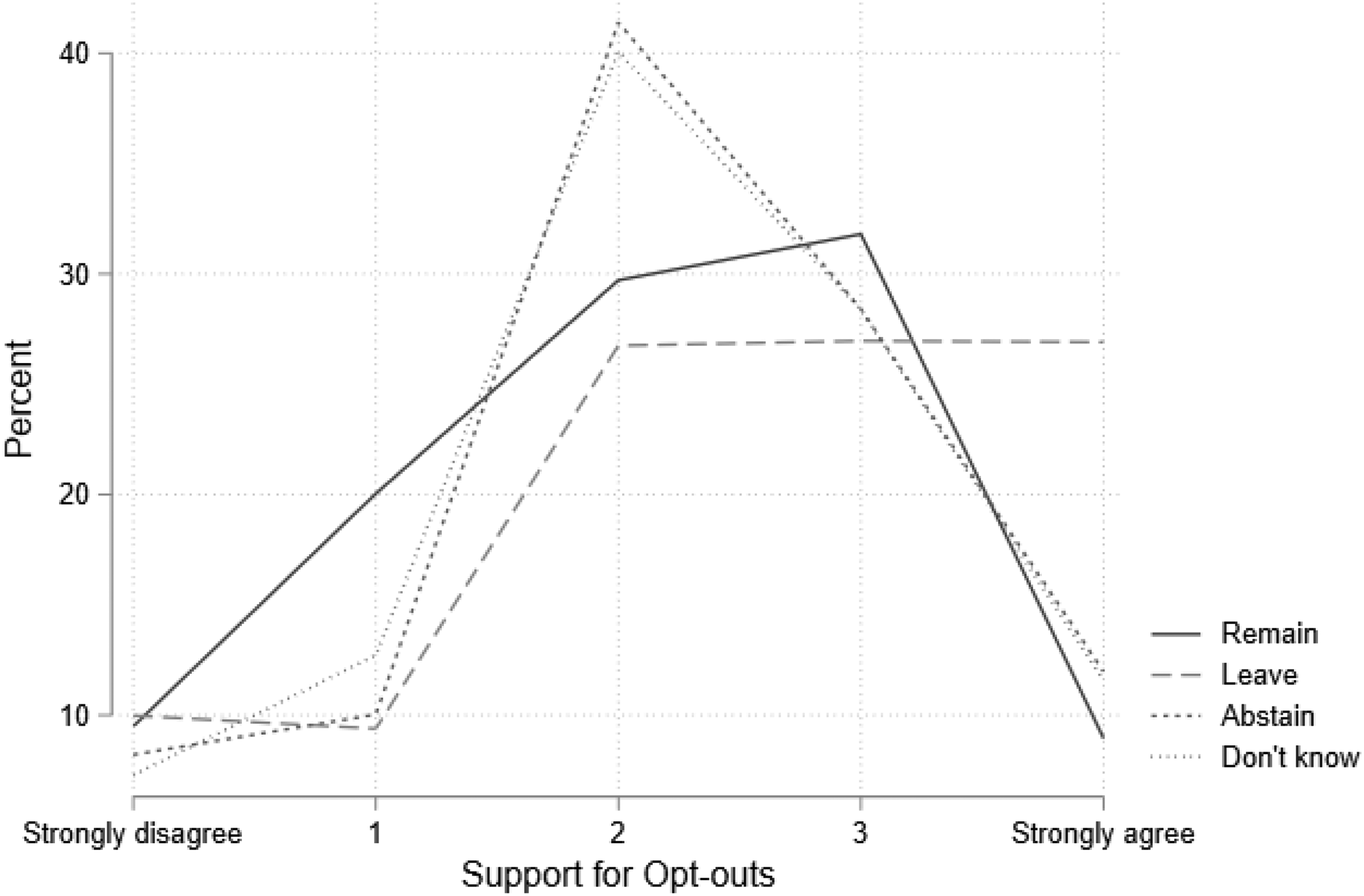
Preferences for opt-outs by EU referendum voter (% of type of EU support). Source: YouGov 2020. Note: Data is weighted.
DI preferences and EU support across time
The YouGov survey containing the DI items was unfortunately only fielded in 2020. To get a sense of how these differences in DI support across types of EU supporters developed over time, we therefore rely on the Eurobarometer data. This survey only contains a question on support for two-speed integration, while EU support is captured by an item on whether the EU is moving in the right direction. Recent work by Telle et al. (2022) has demonstrated that public support for DI, when measured as support for two-speed integration, has become more crystallised over time, with more people expressing a preference and general support slowly rising (cf. Leruth, 2019; Leuffen et al., 2020). These general trends, however, mask differences across ideological groups. We model support for a multi-speed EU among more Euroskeptic and more pro EU segments of the population between 2004 and 2018, while controlling for other individual level and country level characteristics. To do so, we ran a multilevel logistic regression with country fixed effects and time dummies for the binary measure of support for a two-speed EU, while controlling for age, education, employment and left-right ideology (see the Online appendix for the results, including a presentation of the Average Marginal Effects of EU support per year). 9 We interacted our time variables with citizens’ preferences for two-speed EU to understand how differences in DI preferences of EU supporters developed over time.
The results are visualized in Figure 3, which shows the predictive margins, i.e. the mean level of DI support and the standard error of this mean for a given value of EU support in each year. Across time, citizens who are more positive about the EU are also more likely to favour a multiple speed Europe, in comparison to more Euroskeptic or neutral citizens. Interestingly, at the start of this century, particularly those who were indifferent about their country’s EU membership were least supportive of multi-speed integration. Over time, we however observe that differences between these three groups decrease, as the preferences of Euroskeptic and more pro-European citizens more closely align post-Brexit in 2017 and 2018 and EU ambivalent citizens develop more positive attitudes vis-a-vis a two-speed EU. Moreover, the gradual increase in public support for multi-speed integration demonstrated in recent publications seems to be predominantly driven by EU ambivalent citizens and more Euroskeptic citizens becoming less hostile towards the idea of some countries intensifying their cooperation while others wait, rather than pro-EU citizens becoming even more supportive.
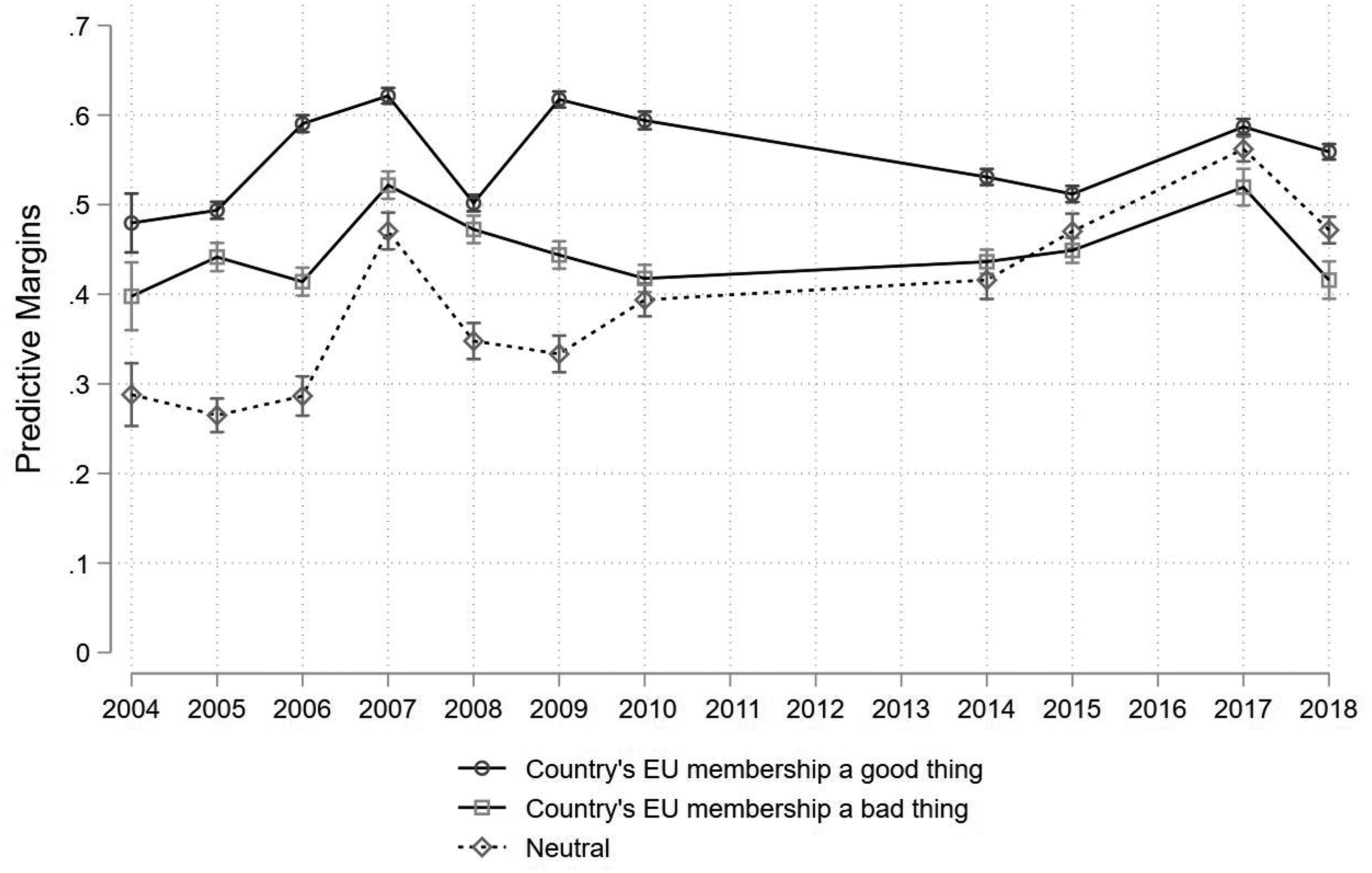
Preferences for multi-speed EU of EU supporters across time (predicted margins). Source: Eurobarometer, EU-27. Note: Data is weighted.
DI preferences and EU support across countries
The figures thus far may mask important country differences. Hence, in the last part of the descriptive analysis, we compare EU supporters and Euroskeptics across countries in their preferences for opt-outs and multi-speed integration in 2020. We thereby complement existing regional analyses (cf. Leruth, 2019; Leuffen et al., 2020; Winzen, 2016) by focusing specifically on differences between EU supporters within countries when it comes to both a multi-speed Europe and opt-outs in 2020. EU support is again measured using the EU referendum question and for the sake of simplicity, we focus particularly on ‘remain’ and ‘leave’ supporters.
First, Figure 4 visualizes the gaps in public support for multi-speed Europe within EU member states while the countries are ordered on their mean level of DI support. What becomes evident is that particular large differences exist in preferences among EU supporters and Euroskeptics in Sweden, France, Denmark, and to a certain degree the Netherlands and Finland. Here, support for a multiple speed EU is much lower among Euroskeptics, compared to more pro-EU citizens. Interestingly, these also concern the countries where EU support on average is lowest (cf. Winzen, 2016). Based on existing evidence, Sweden can be classified as an ‘exit sceptic’ (both policy and regime support is low), while France, the Netherlands, Germany and Finland are considered ‘regime sceptics’ (regime support is high, but policy support is low) (De Vries, 2018). In other words, large differences exist in DI preferences among citizens of more Euroskeptic countries.
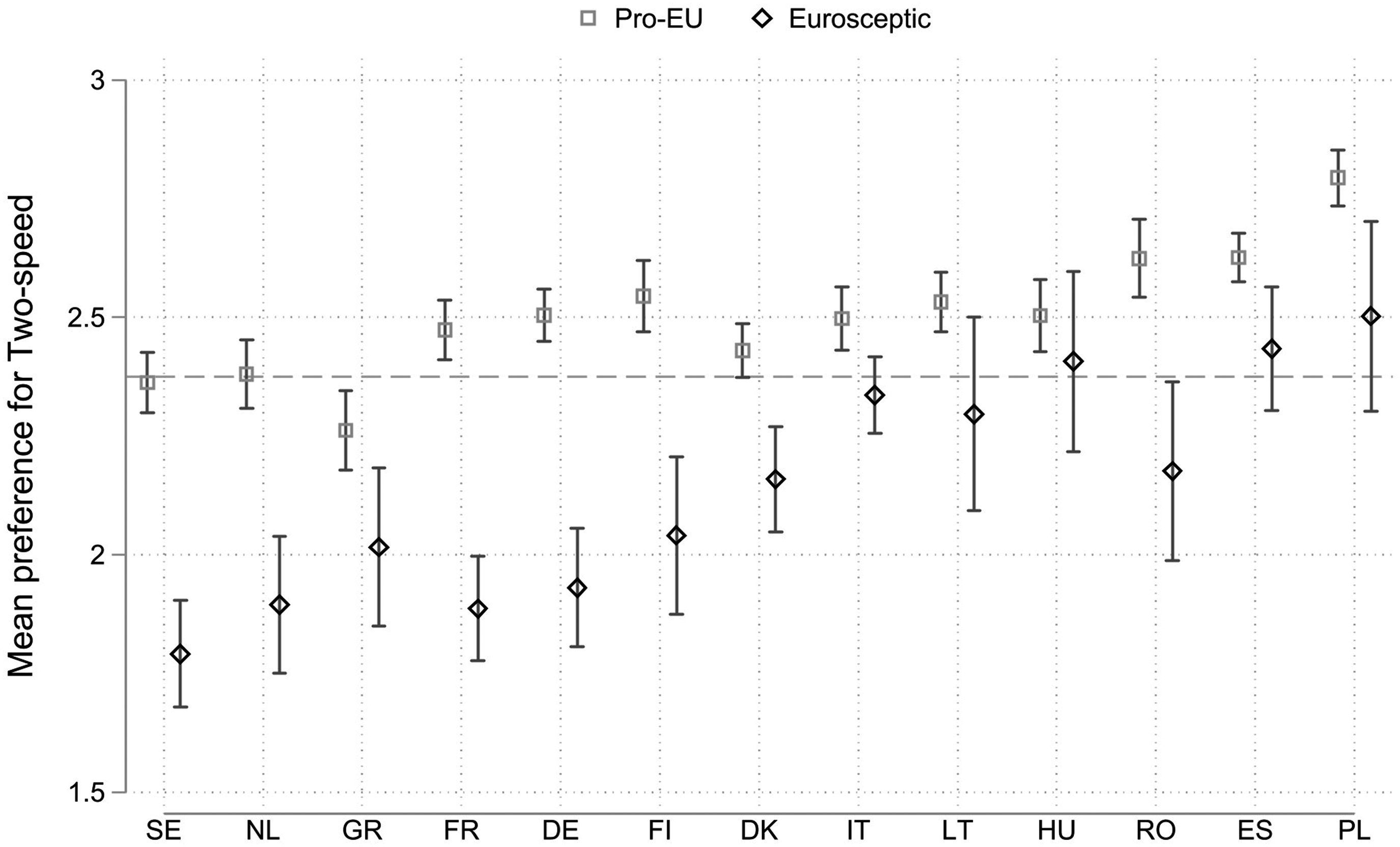
Preferences for multi-speed EU by EU support and country. Source: YouGov 2020. Note: Countries ordered on mean levels of support for two-speed integration. Data is weighted. Dashed line is EU average.
More generally, we do not find the clear North-South divide in DI support demonstrated by Leuffen et al. (2020). In 2020, Northern member states are not necessarily more in favor of a multi-speed Europe. These divergent findings could be driven by measurement differences or by recent developments. Our question wording to capture support for multi-speed integration is not identical to the one from the Eurobarometer (employed by Leuffen et al., 2020), and we also have a different selection of countries. However, in Figure 4, regardless of one’s categorisation of countries, it appears that there is less homogeneity among the Southern countries in their support for multi-speed integration, with relatively low levels of support in Greece and France, and higher levels of support in Italy and Spain. On the contrary, Eastern countries express the most support for DI, while Northern countries report moderate to weak support. Alternatively, times might also have changed since the publication of Leuffen et al. (2020). The authors focus on the years 2011 to 2017 while our analysis is based on data from 2020. Whereas their results show clear fluctuations in DI support over time for each country-category, it could well be the case that the North-South divide in DI support is no longer as evident. In particular, this could be driven by a gradual decline in public support in Greece and France.
Next, we move to differences in support for opt-outs by EU predispositions across countries. Figure 5 demonstrates that the distance between pro-EU and Euroskeptic citizens is relatively stable across countries. Although very small differences between the two groups can be observed in Spain, the Netherlands, Greece and Romania. Again, we do not find a North-South divide in support for opt-outs, except that the Danish are most supportive of opt-outs (cf. Leruth, 2019). We do see Eastern and Central European member states being somewhat more supportive of opt-outs, but overall, a clear pattern in support for opt-outs cannot be distilled on the country level on the basis of these descriptive figures.
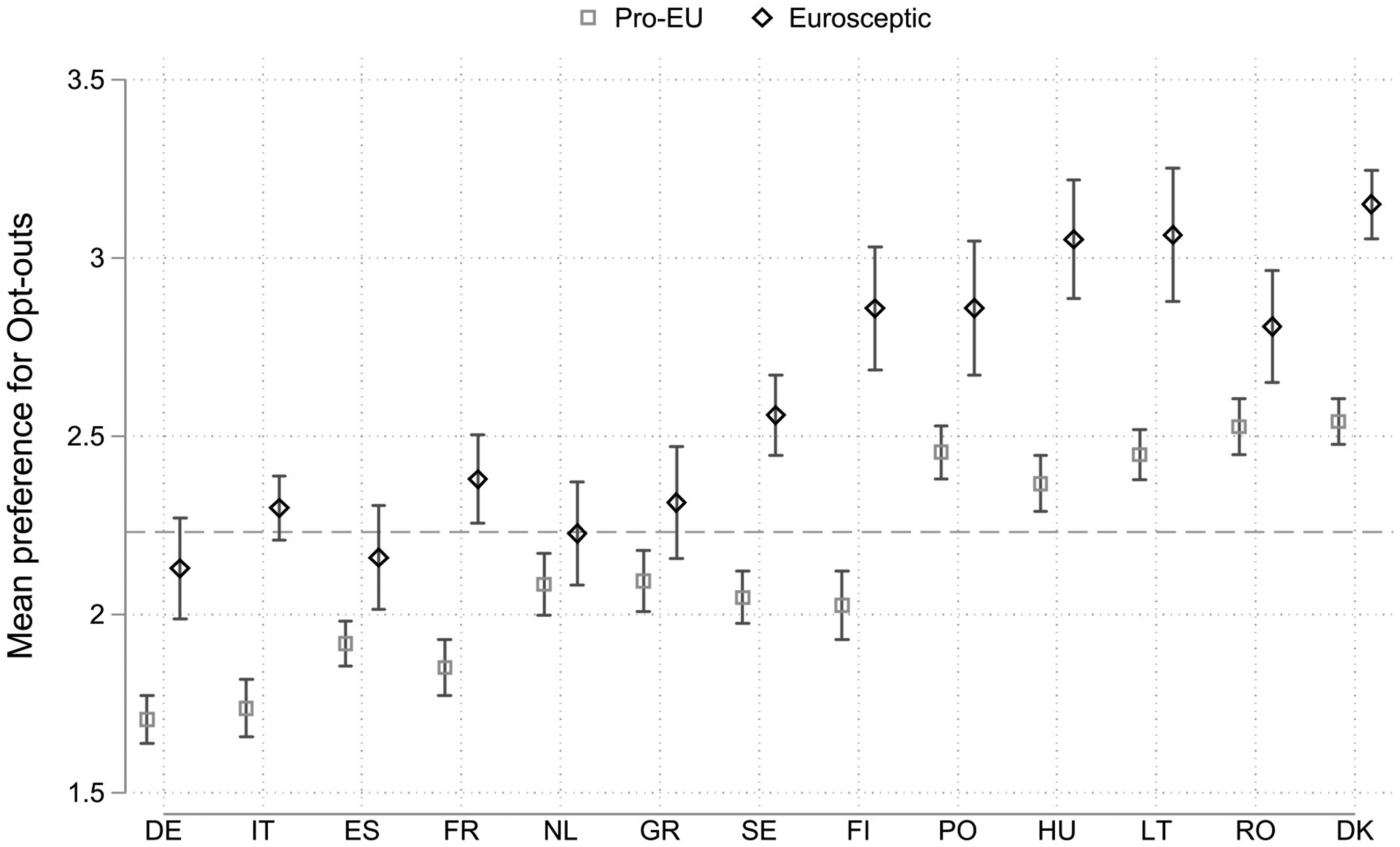
Preferences for opt-outs per EU supporter per country.
Taken together, the descriptive analyses illustrate that support for DI significantly differs across pro-EU and Euroskeptic citizens. Allowing some member states to intensify their cooperation without having to wait for others is typically more popular among citizens with positive views of the EU. Citizens with Euroskeptic views are typically more divided on the topic of multi-speed integration. Interestingly, we find that ambivalent citizens (those who thing EU membership is neither a good or a bad thing) were clearly against differentiation through enhanced cooperation of some countries. However, over time, the difference between the three camps of EU supporters has decreased, with multi-speed integration growing in popularity among both the ambivalent citizens and more Euroskeptic citizens. Pro-EU citizens remain more supportive of the idea of multi-speed EU, while ambivalent and Euroskeptic citizens have recently taken more neutral positions. That said, significant variation between countries exists when it comes to the divergence between EU supporters in the perceived desirability of multi-speed EU, especially within more Euroskeptic countries.
Determinants of DI preferences
In the next step of our analysis, we seek to understand how support for various forms of DI are related to ideological predispositions, notably about the EU and left-right ideology. Starting with support for a multi-speed EU, Table 1 presents the results from a multilevel regression with country fixed effects. We regress a respondents’ agreement with the statement that EU member states should be allowed to integrate at multiple speeds on both their left-right ideological self placement, their hypothetical vote on an EU referendum as well as their gender, age, and financial situation. 10 Among the control variables, we find that age and financial uncertainty are significantly related to DI preferences. Older and financially uncertain individuals are less supportive of some EU member states moving forward while others wait. Moving to our ideological variables, in line with our hypotheses, Table 1 shows that EU support is significantly related to DI preferences with more Euroskeptic citizens being less in favour of a two-speed EU (in line with H1). Moreover, left-right ideology is also associated with support for a two-speed EU. Right-wing citizens are less in favour of a multi-speed Europe.
Multilevel regression support for multi-speed EU.
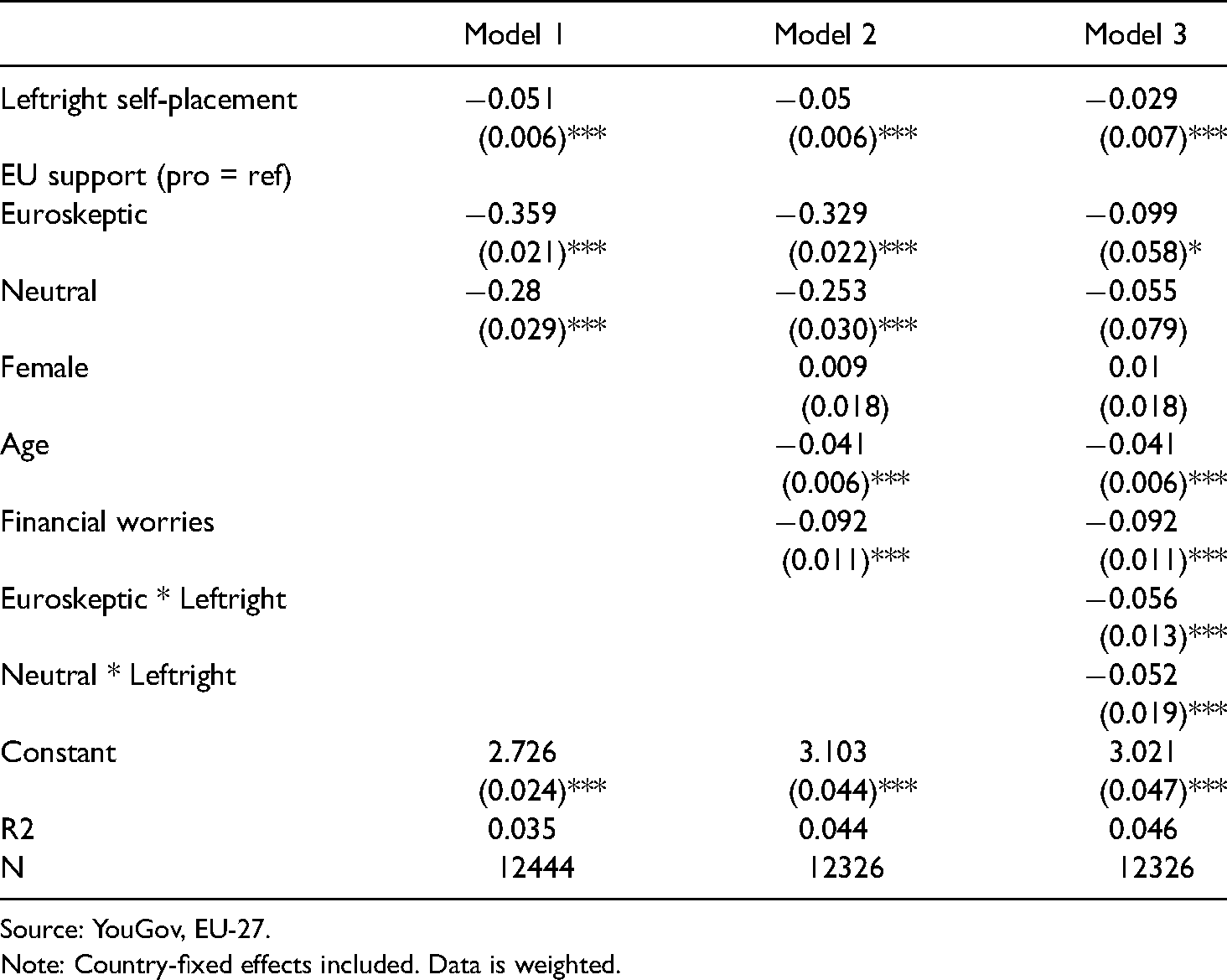
Source: YouGov, EU-27. Note: Country-fixed effects included. Data is weighted.
In model 3 (Table 1), following H3, we examine how these two ideological variables interact. We find a significant and negative interaction, meaning that the role of left-right ideology differs based on respondents’ EU support. We visualize these interaction effects in Figure 6 (a), which shows that at the (very) left-side both pro-EU and Euroskeptic citizens are positively oriented towards a two-speed Europe, with differences between the two camps being relatively small. On the (very) right-side, however, the two camps greatly diverge, with pro-EU citizens being more supportive of multi-speed integration, while both Euroskeptic and EU ambivalent citizens are less supportive.
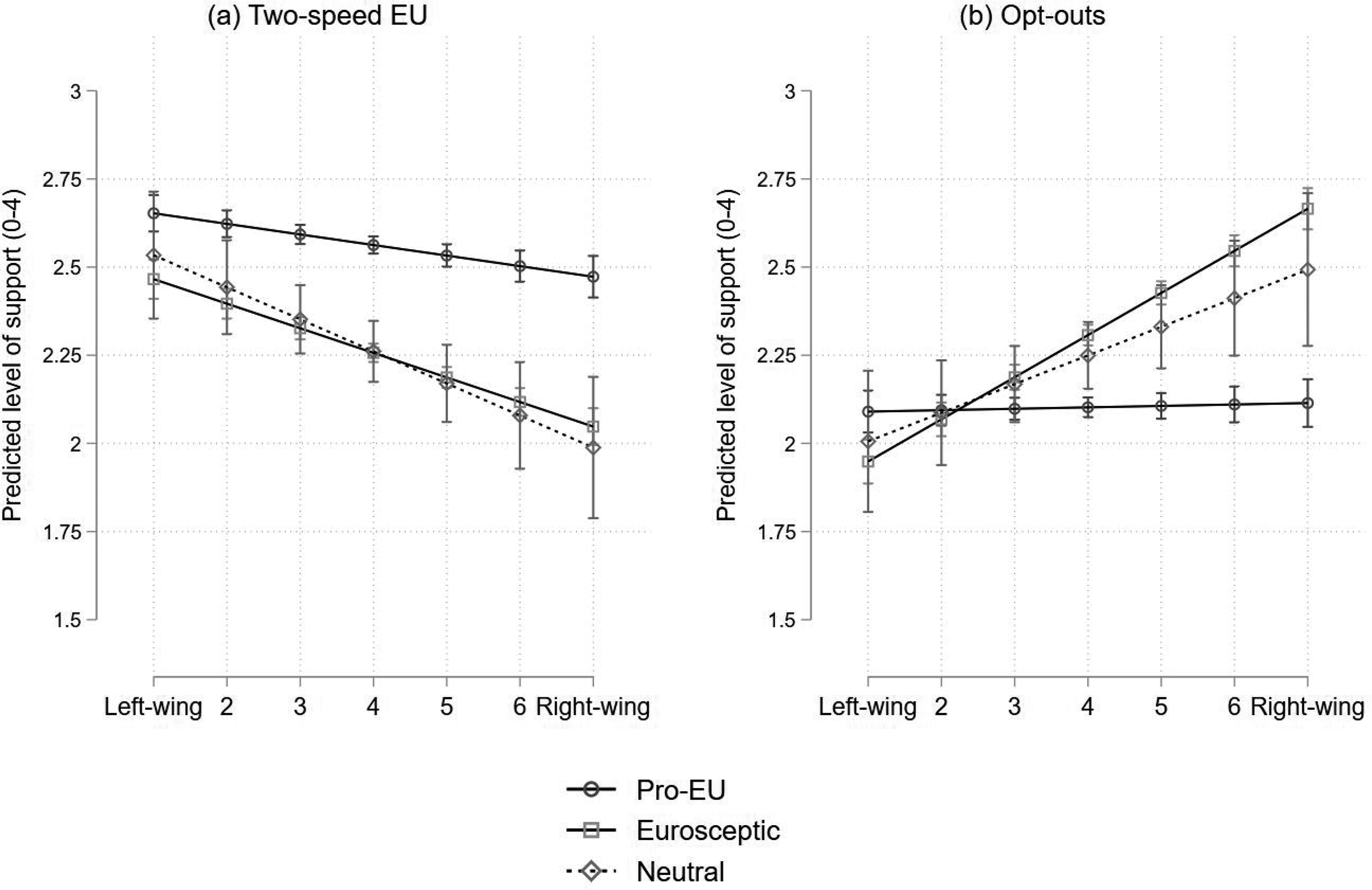
Determinants of support for two-speed EU and opt-outs. Source: YouGov, EU-27. Country-fixed effects. Note: Data is weighted.
Table 2 looks at the second type of DI preferences, support for opt-outs. Similar to the descriptive analyses, we find that Euroskeptic citizens are more in favour of opt-outs (in line with H2). Left-right ideology also plays an important role. Generally, right-wing citizens are more in favour of opt-outs. Again, the interaction effect between EU support and left-right ideology in model 6 (Table 2) confirms that the effect of ideology differs based on a respondent’s level of EU support. As shown in Figure 6 (b), opt-outs are particularly popular among right-wing Euroskeptics, while a multiple-speed Europe is particularly popular among left-wing pro-EU citizens (in line with H3). There thus appears to be a clear divide between EU supporters in the form of differentiated integration they prefer, and this divide is accentuated by left-right ideology.
Multilevel regression support for opt-outs.
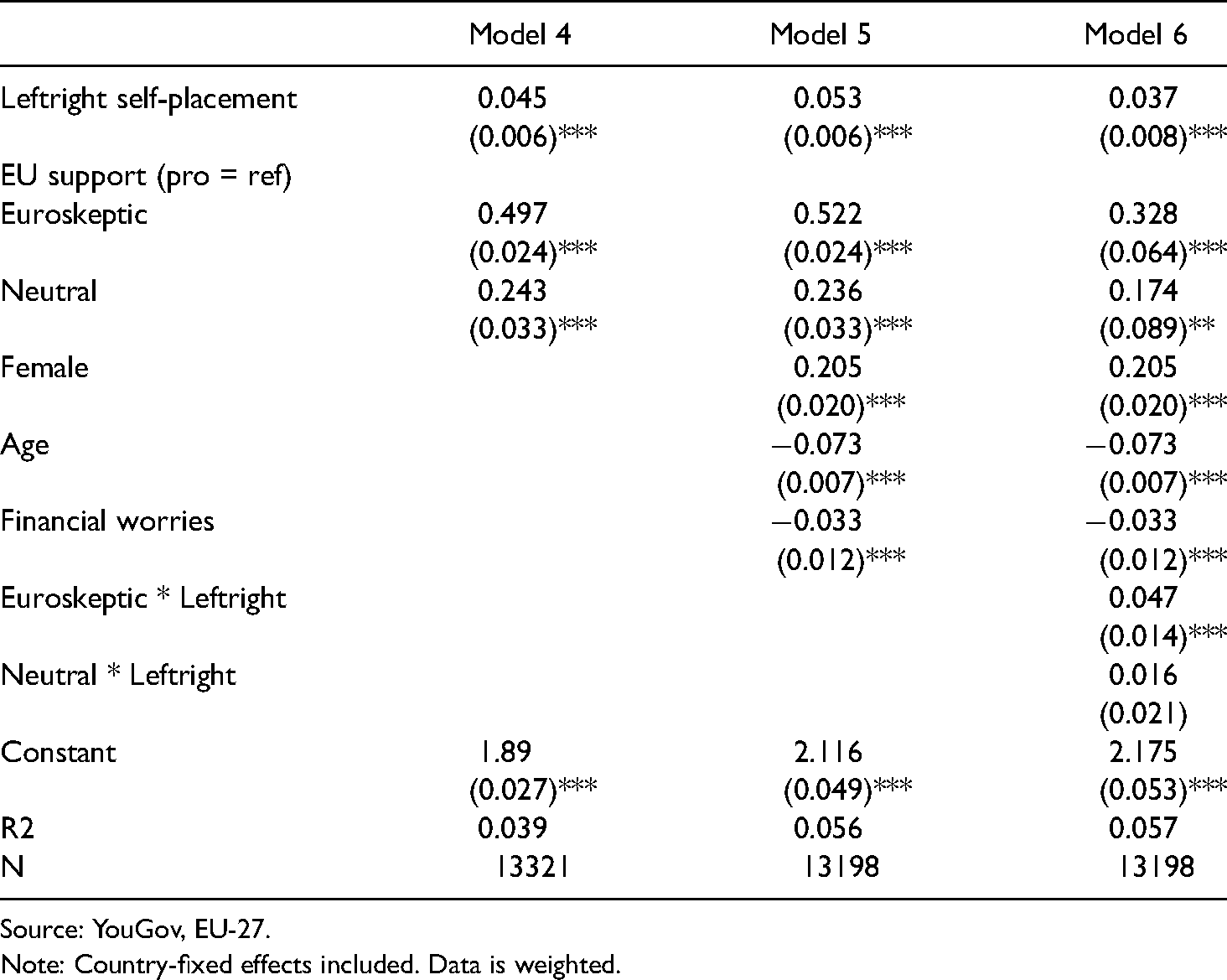
Source: YouGov, EU-27. Note: Country-fixed effects included. Data is weighted.
Discussion and conclusion
In this article, we have examined a largely unexplored topic within the study of EU public opinion, namely the multi-dimensional nature of public preferences for DI. While the theoretical literature on DI is quite established, empirical work thus far focuses primarily on aggregate level of support for DI (with a few recent exceptions, cf. Leuffen et al., 2020). What is more, existing work on DI preferences does not examine support for different types of differentiation. Hence, we currently lack a complete insight into individual-level variation in support for different forms of DI and into the drivers of such variation. Providing these insights is crucial as DI is generally seen as a means to deal with increasing heterogeneity within the EU. Yet, the extent to which DI provides a way to deal with heterogeneity will crucially depend on how citizens view different forms of DI. Moreover, there is not only heterogeneity between member states, but also within member states. Hence, it is not unimaginable that different forms of DI might foster a differentiated response among citizens. Our results suggests that this is indeed the case.
We report three main findings. First, the increase in public support for DI demonstrated in recent work by Telle et al. (2022) and Leuffen et al. (2020) appears to be driven by EU ambivalent citizens and more Euroskeptic citizens becoming less hostile towards the idea of some countries intensifying their cooperation while others wait. In the post-Brexit era, the differences between various types of EU supporters in terms of their DI preferences have somewhat decreased. This is particularly true for member states with generally high levels of EU support, while pro-EU and Euroskeptic citizens remain clearly divided on the desirability of a multi-speed Europe in more Euroskeptic countries. Second, we demonstrate the importance of considering multiple forms of DI when studying public support for DI. The observed patterns of support for opt-outs differ from those for a multi-speed EU. Opt-outs are typically more popular among Euroskeptics, while more pro-EU citizens (but also those with ambivalent viewpoints) do not express a clear like or dislike for this form of DI. As such, we provide an important contribution to the literature which has focused exclusively on citizens’ preferences for a multi-speed EU. Third, we find that in addition to general EU support, left-right ideology structures support different types of DI. Right-leaning citizens who evaluate the EU negatively are much less supportive of multi-speed EU, while left-leaning Euroskeptics do seem to consider it a viable option. For right-wing Euroskeptics, opt-outs are more popular, while this is somewhat less so for right-wing pro-EU citizens. Overall the largest differences in DI between pro-EU and Euroskeptics are found on the right. Right-wing Euroskeptic citizens are the most supportive of opt-outs.
These findings entail some important reflections for the study and practice of DI. A key reflection is that public support for DI is highly contingent on existing ideological predispositions, thus it is essential to take this into account when studying DI preferences (see also Leuffen et al., 2020). Public support for DI is shaped by the substance and form of DI policies on the one hand, and how these relate to people’s existing views about politics on the other. Our findings lead us to four important avenues for future research on DI. First, data on different forms of DI, here multi-speed EU and opt-outs, are crucial for understanding public preferences for DI. Hence, it would be fruitful to also explore public support for other forms of DI, such as internal and external DI. Second, the evidence presented in this study is observational in nature; in a follow-up study it would be good to explore ways in which one could randomize aspects of people’s ideological predispositions. While ideological predispositions do not easily lend themselves to randomization, perhaps differences in priming various ideological aspects (EU vs left-right) might be a useful way forward. Third, large variation exists among countries when it comes to support for DI. Interestingly, however, this does not appear to be clearly structured along the classic North-South divide. Further research should examine more carefully when and why different demoi favor differentiation in EU. Finally, although DI is often presented as a means to deal with preference heterogeneity, our results provide some reason for caution. We find that pro-EU and Euroskeptic citizens within member states differ tremendously in terms of their preferences towards DI, and that left-right ideology accentuates this difference. In future work, it seems especially important to study the differences in public preferences for DI in reference to core state powers. We would expect that core state powers are an important touchstone of dissent between more Euroskeptic and pro-EU segments of the population when it comes to DI and spark off existing differences between more left-leaning and right-leaning citizens. Our findings thus far suggest that rather than overcoming preference heterogeneity within the EU, differentiated integration and the different mechanisms for achieving it might reinvigorate existing conflict lines.
Supplemental Material
sj-pdf-1-eup-10.1177_14651165221133671 - Supplemental material for A blessing and a curse? Examining public preferences for differentiated integration
Supplemental material, sj-pdf-1-eup-10.1177_14651165221133671 for A blessing and a curse? Examining public preferences for differentiated integration by Lisanne De Blok and Catherine E. De Vries in European Union Politics
Footnotes
Acknowledgements
We would like to thank the two anonymous reviewers at European Union Politics for their helpful comments and suggestions. In addition, we are grateful for all the comments and feedback we received from the panel participants at the various presentations of (versions of) this article at the InDivEU conference 2020, the ACES conference 2020, the ECPR Joint Sessions 2020, EPSA Conference 2021 and the ECPR General Conference 2021. In particular, we would like to thank Frank Schimmelfenning, Dirk Leuffen, Jonathan Slapin, Fabian Habersack and Ioannis Vergioglou for their detailed comments which really helped us to improve the paper.
Funding
Work on this article was supported by the European Union’s Horizon 2020 Research and Innovation Programme under Grant Agreement No 822304 (InDivEU).

Supplemental material
Supplemental material for this article is available online.
Notes
References
Supplementary Material
Please find the following supplemental material available below.
For Open Access articles published under a Creative Commons License, all supplemental material carries the same license as the article it is associated with.
For non-Open Access articles published, all supplemental material carries a non-exclusive license, and permission requests for re-use of supplemental material or any part of supplemental material shall be sent directly to the copyright owner as specified in the copyright notice associated with the article.
