



Abstract
Extensive research explores women's entry into parliament and their political influence. However, reasons for women leaving, particularly in the European Parliament context, remain unclear. This study investigates departure patterns of women European parliamentarians from 2009 to 2019, investigating the role of politicians themselves, national parties, and voters. The study finds less gender differences in parliamentarians’ exit than expected, highlighting national parties’ pivotal role in a women-friendly European setting and the importance of the mediating power of the electoral system. Contrary to expectations, national parties do not disadvantage women during re-selection. Women experience higher re-election probabilities, influenced by parties’ strategies and voter preferences. Also, those women who want to progress to the national political level from the EP are not less likely to succeed in their post-parliamentary career. I conclude that electoral institutions, along with their interaction with political actors, influence women's career paths.
Introduction
The principle of gender equality has long been a core value of the European Union (EU). European Commission President Ursula Von Der Leyen reinforced this commitment by implementing extensive measures for a ‘Union of Equality’. Despite the European Parliament (EP) being regarded as a relatively women-friendly parliament, researchers have noted that it fails to achieve full gender equality (Kantola, 2010).
Extensive research on women's political careers in the EU has focused on studying women's recruitment to and representation in the EP (e.g. Fortin-Rittberger and Rittberger, 2015; Luhiste, 2015). However, we know little about the conditions under which Members of the EP (MEPs) exit the legislature and how gender differences affect these terminations and their career progression.
Thus, this paper explores why women leave the EP. Furthermore, it assesses the role of the principal actors involved: the parliamentarian, national party and voter. A political career is shaped by the interaction and combination of individual political ambitions and structural, institutional and individual opportunities (see Borchert, 2011). This research assesses whether and how these opportunities are gendered and how the different actors shape the chances for women in this crucial career step.
With its numerous MEPs from various countries and electoral systems, the EP is an ideal case for this study. Its diversity offers a broad range of structural and institutional opportunities. Understanding the gendered nature of parliamentary exit is interesting for the EU, as the EP has been praised as a relatively women-friendly parliament. Additionally, its multilevel structure creates interdependencies across political levels, influencing the career trajectories of MEPs.
This paper makes four critical theoretical contributions and one empirical contribution. The question of how gender differences influence the exits and career progression of parliamentarians is of crucial importance when studying the representation of women and the role of political parties and party systems. Both topics – the exit from one parliament and career progression (in another parliament) – are intricately connected and can only be understood in combination. First, classifying the reasons for exit from the EP and combining them with an analysis of post-parliamentary career progression in the national parliaments improves our understanding of political careers by highlighting the interdependency of career phases. Second, instead of focusing on one actor, the paper analyses all three principal actors that determine career decisions: MEPs, parties and voters. This study demonstrates that career decisions cannot be fully understood by focusing on one actor alone, emphasising the need to consider how multiple actors influence career trajectories through anticipatory behaviour and interactions.
This paper contributes empirically by collecting and analysing a unique dataset of political careers of MEPs, containing personal, biographical, electoral and other information on all MEPs between July 2009 and July 2019. Using these data, the paper provides an innovative description and statistical analysis of MEPs’ reasons for leaving, highlighting gender differences.
The findings reveal several critical differences between the exit of men and women, all pointing towards the critical role of national parties as essential gatekeepers in the comparatively women-friendly European environment. First, the results of the study challenge the initial expectations by indicating that national parties do not disadvantage women MEPs during reselection, potentially suggesting a more supportive environment for women in the EP than the national political arenas. Second, national parties play a significant role in shaping gendered MEP career trajectories, with women experiencing higher re-election probabilities than their male colleagues. This trend is due to parties’ strategic list placement decisions as well as voter preference. The effect of closed-list electoral systems on women MEPs’ exit patterns underscores the role of electoral institutions in moderating national party influence. Women from closed-list electoral systems that hand more power to the national parties when reselecting MEPs are less likely to return to the EP and more likely to be deselected, whereas MEPs from open-list systems are at an advantage compared to men. Third, the study reveals that for women with progressive ambition, using the EP as a stepping stone to the national parliament offers the same chances as men in the same group. Finally, MEPs from parties with voluntary gender quotas, particularly men in left-wing parties, encounter difficulties in re-election, emphasising the influence of party policies on the reselection process.
This paper provides a third theoretical contribution to existing knowledge on gender representation in politics (e.g.Caul, 1999; Crowder-Meyer, 2013; Wängnerud, 2009) by emphasising the critical role of national parties as gatekeepers in reselection and career progression. The paper adds nuance to the existing theories regarding party influence in political career by painting a more positive picture of the role of parties in the political careers of women compared to previous studies in regional and national contexts (e.g. Elomäki and Ahrens, 2022; Vanlangenakker et al., 2013). This paper highlights that parties do not systematically disadvantage women in reselection, suggesting a more women-friendly environment in the EP than in national political arenas.
Finally, the study contributes to the literature on political careers in the EU (e.g. Dodeigne et al., 2024; Marzi and Verzichelli, 2023; Scarrow, 1997) and on the effect of electoral systems on career paths (e.g. Høyland et al., 2019). This research reveals how different electoral systems, particularly closed-list systems, can disadvantage women MEPs, affecting their chances of reselection. This finding reveals how institutional structures can moderate party influence and affect gendered exit patterns (see Kunovich and Paxton, 2005, on the interaction of electoral institutions, parties and representation).
The parliamentary exit and post-parliamentary careers of women: Actors and opportunities
This paper employs Feminist Institutionalism to explain gender differences in why MEPs leave the EP, examining the relationship between political institutions and gender (Krook and Mackay, 2011; Mackay et al., 2010). Feminist Institutionalist approaches conceptualise gender, or the perceived and socially constructed differences between men and women, as ‘a constitutive element of [all] social relations’ (Mackay et al., 2010: 580). Therefore, gender is understood as a defining feature of social interactions as well as every political institution, both formal and informal.
Based on the conceptualisation by Borchert (2011), a mixture of structural opportunities and individual ambition determines political careers. However, a person's career opportunities and individual ambitions depend on gender. This article aims to demonstrate how gendered the exit of parliamentarians from the EP is and whether women are equally likely to progress to the national parliament after their exit.
This study of multilevel and EU political careers builds on Schlesinger's (1966: 10) classic distinction between discrete, static and progressive career types. Research has pointed towards an increase in the European political class over time, whereas the share of MEPs who have used the EP as a stepping stone to progress their careers at the national political level slightly decreased (Dodeigne et al., 2024; Marzi and Verzichelli, 2023). This finding indicates a static career ambition of MEPs or an increase in the attractiveness of political careers at the European level.
Parliamentary exit is broadly defined as leaving the same parliament and not being part of the parliament in the following legislature. This exit is inherently linked to the career paths of parliamentarians after leaving. Whether and how much effort MEPs expend to stay in the EP depends, among other factors, on their opportunities. The MEPs might return to the EP if re-elected, but if MEPs exit the EP, it could be because they were deselected, meaning they did not get renominated for a list position or district. The placement of incumbent MEPs on low, electorally insecure list positions is considered deselection in this paper. If MEPs are renominated, they could be de-elected, referring to the possibility of not being elected by voters. All three career events are proof of MEPs’ static political ambition.
A post-parliamentary career is a professional career or occupation an MEP engages in after exiting the EP. 1 If MEPs leave the EP, they can take different post-EP paths (see Figure 1). First, MEPs could be elected to a political position at the EU or international level, national political level or regional or local level. Second, MEPs could move to the private sector (e.g. taking a position as a board member of a company) or an administrative position, such as a state secretary. Third, MEPs could end their careers entirely due to reaching the retirement age or for health reasons.
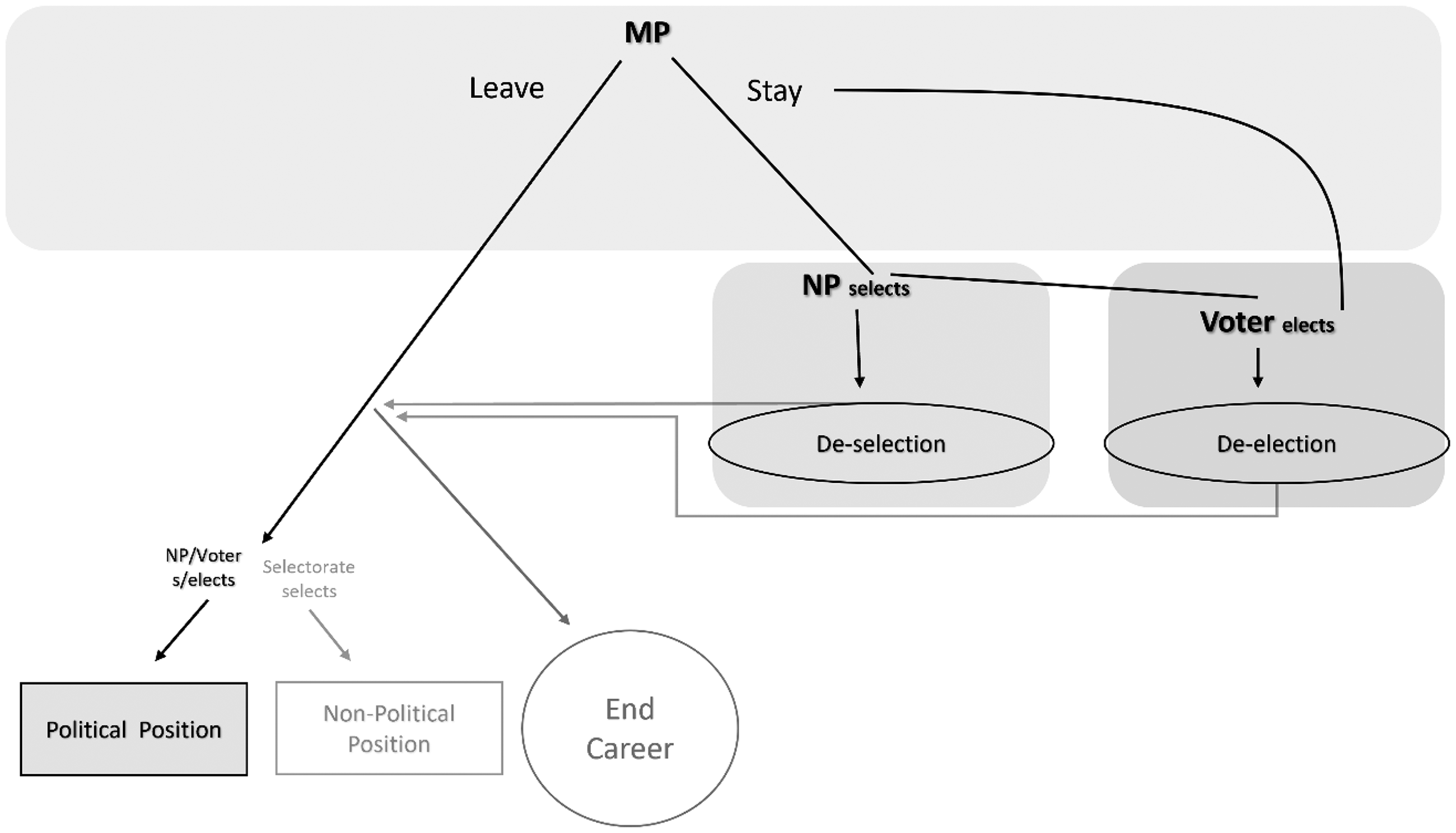
Parliamentary exit and post-parliamentary career: All decisions and actors.
However, while all three possible post-parliamentary career options would be interesting to study, this article focuses on the continuation of the MEPs’ careers at the national political level. This study conceptualises a post-parliamentary career that captures the idea that politicians are motivated to progress in their careers. Additionally, this definition assumes that being a national parliament or executive member is higher in the preference ranking than being an MEP. 2 This notion is common in the literature (see Scarrow, 1997) and rests upon the idea that the EP is a second-order parliament in the perception of voters and parties, which is why European elections are inherently about national issues (Reiff and Schmitt, 1980).
The post-parliamentary career path is not an independent next step that follows parliamentary exit. The exit and the subsequent career steps are connected and mutually conditional. Being politically ambitious, MEPs know their career opportunities and can foresee their chances for each option. Hence, if a women MEP is signalled to have a low chance of obtaining a promising list position for national or regional parliamentary elections, she might try to remain in the EP. The experience in the EP, status as an incumbent and type of exit, might in turn affect the chance of being successful afterwards. If an MEP is unsuccessful in being re-elected into the EP, even when running on a promising list position, that might be a reason for the national party not to select the person for a top position in national elections for a post-EP career.
Applying Feminist Institutionalist ideas to the study of political careers, this paper distinguishes three critical actors to study their influence on gendered careers: the voters, the (national) parties that shape opportunities and the individual MEP. To understand why women MEPs leave the EP, we must comprehend how the party and voter (in European elections) formally and informally affect MEPs’ careers, the role of the MEP's gender and the interaction between these three actors and between the actors and political institutions or structures.
Figure 1 illustrates all relevant political actors determining parliamentary exit and post-parliamentary careers: the MEP herself, the national party and the voter in EU elections. The MEP careers are multilevel; thus, domestic actors also affect MEP careers. Beyond the three European-level actors (MEP, national party and voters in European elections) focused on in this paper, national, regional and local parties select candidates for office at the respective political level and are therefore influential actors. Moreover, private and administrative selectorates (e.g. company boards) and the family and friends of the MEP are critical actors influencing their political careers. While acknowledging the importance and influence of these additional actors (Figure 1), it should be noted that these actors (e.g. regional parties or company boards) are discussed at a theoretical level but not empirically studied here. 3 This paper focuses on post-parliamentary careers in the national parliament, leaving a detailed analysis of other post-parliamentary career paths for future studies.
Next to the involved actors, Figure 1 maps the possible decisions each actor can make and demonstrates how these decisions are theoretically related. A full analysis of the actors and decisions that are transparent in Figure 1 exceeds the scope of this paper.
Why do women leave the EP?
Before analysing why MEPs leave the EP, a fundamental question arises: Do women exit the EP at the same rate as their male counterparts? Parliamentary turnover has been extensively studied in national and regional parliaments (Darcy and Choike, 1986; Kerby and Blidook, 2011; Thomas and Bodet, 2013; Vanlangenakker et al., 2013). 4 Research indicates a bias against women returning to national parliaments (e.g. Darcy and Choike, 1986; Thomas and Bodet, 2013). This bias could stem from disadvantages in the selectorate (see Vanlangenakker et al., 2013) or electoral systems disadvantageous to women (Gouglas et al., 2025; Matland and Studlar, 2004). However, the extent to which these findings apply to the EP remains unclear.
The reverse outcome could be expected even if similar biases exist in European elections. As a supranational parliament, the EP is known to be more woman-friendly than many national parliaments. Given this knowledge and anticipating challenges in being selected at the national or regional level, women might exert extra effort to remain in the EP. These opposing effects on gender-based turnover could balance each other. Therefore, based on previous studies finding no significant differences in turnover based on gender (Kerby and Blidook, 2011), the first hypothesis is as follows: H1: There is no gender difference concerning the overall probability of remaining in the EP (turnover).
Individual MEP: Should I stay, or should I go?
Parliamentarians are the central actors determining their political careers. Regarding parliamentary exit, MEPs decide whether to leave parliament. This decision is driven by individual political ambition, shaped by a combination of individual and structural institutional factors. When making any career decision, parliamentarians strategically anticipate the decisions of other actors (e.g. the national party). Moreover, parliamentarians are well informed about their chances of reselection, election prospects and the likelihood of obtaining a prestigious position (e.g. in national politics).
Extensive literature has analysed political ambitions since the 1960s (Schlesinger, 1966) and has primarily focused on the United States (Carroll, 1985; Fulton et al., 2006; Palmer and Simon, 2003; Sapiro, 1982). A few decades later, the field has turned towards other European national parliaments (Galais et al., 2016; Palmer and Simon, 2013), focusing on the political ambitions of women (Fox and Lawless, 2014; Fulton et al., 2006; Galais et al., 2016; Kazee, 1994; Lawless and Fox, 2010). However, most research on ambition and most women-specific studies have focused on candidates entering politics (Fox and Lawless, 2014; Kazee, 1994; Lawless and Fox, 2010) or on stepping up to parliament from party positions (e.g. Sapiro, 1982) or local councils (e.g. Palmer and Simon, 2013). This study contributes by providing more detailed insight into the ambitions of elected politicians and political careers in the EU.
Previous studies have revealed that political career ambitions depend on individual and structural factors. Individual characteristics have been found to matter: factors such as age, political experience (e.g. Meserve et al., 2009; Palmer and Simon, 2003), family roles, presence and age of children, as well as the political careers of husbands of women in politics (Frech and Kopsch, 2024; Frech et al., 2025; Palmer and Simon, 2003; Sapiro, 1982), along with structural factors related to national parties (e.g. size or government participation), impact MEPs’ career ambitions (Meserve et al., 2009). Additionally, national-level political institutions, such as the electoral system, are significant for political career ambitions on the supranational level (Meserve et al., 2009). Many of these determinants differ by gender; for example, family roles affect women's political ambitions more than men's (Sapiro, 1982). Parties and their structures, ideologies and candidate selection processes are gendered as well (Caul, 1999). Moreover, different national electoral systems offer varying chances for women to be (re)elected (Matland and Studlar, 1996), and societal values, such as gender-related culture, affect the political ambitions of women (Galais et al., 2016).
National party: Making her leave?
Serving as influential gatekeepers, political parties significantly influence the recruitment and trajectories of parliamentarians (Claessen et al., 2021; Luhiste, 2015). By determining whether MEPs can rerun and placing them in specific positions on electoral lists (in proportional representation systems), national parties wield power to either ‘make or break’ political careers (Vanlangenakker et al., 2013: 65). Previous research on candidate selection by and within parties has revealed that the nomination and selection procedures affect women's chances of being selected (Fortin-Rittberger and Rittberger, 2015; Hazan and Rahat, 2010). For example, Fortin-Rittberger and Rittberger (2015) demonstrated that the inclusiveness of the initial selectorate affects the chances of women being placed on party lists for European elections. Although the mechanisms for reselecting incumbents might differ slightly from new candidates, these analyses indicate that the identity of the party selectorate might be decisive for women.
However, these pivotal gatekeepers (the selectorate or national/subnational party leadership) are predominantly male. This male dominance has been considered disadvantageous for women and their reselection (Norris, 1997; Vanlangenakker et al., 2013). When idealised by party leaders, the archetypal political candidate is often characterised by male attributes (e.g. assertiveness or strong-willed), perpetuating gender bias in parliamentary recruitment (Bjarnegard, 2013; Kenny, 2013). This gender bias in political parties exists in various contexts and countries (e.g. Bjarnegard, 2013; Crowder-Meyer, 2013; Niven, 1998; Rudman and Goodwin, 2004), a phenomenon explained by the concept of ‘homosocial capital’ (Bjarnegard, 2013; Connell and Messerschmidt, 2005). Bjarnegard (2013) argued that people gain social capital and ties by interacting with groups they consider similar to themselves, leading men to prefer interactions with men and reinforcing a more robust homosocial network. 5
Building on these insights into homosocial capital in political parties, gender bias in national political recruitment and recognising that women often have weaker personal networks even in their party (e.g. Lyness and Thompson, 2000; Verge and Claveria, 2018), women are likelier than their male counterparts to face challenges in securing renomination. H2a: Women are more likely to leave the EP because they failed renomination than men.
The described psychological mechanisms and weaker networks likely exist in every national party. However, parties differ regarding their attitudes towards gender equality, resulting in formal rules (e.g. gender quotas) to secure the equal representation of women. Differences in attitudes towards gender equality also result in informal selection criteria for women, gendered interactions and parliamentary work (for the EP, see Kantola and Rolandsen Agustín, 2019). Hence, not all parties are created equal regarding the chances they provide for women's reselection. Because the selectorate of parties more to the left tends to have more gender-egalitarian attitudes (Kantola and Rolandsen Agustín, 2019), the disadvantage of women in reselection depends on the left-right position of the party. H2b: The disadvantage of women in renomination should decrease the further left the party is on a political left-right spectrum.
Voting her out? Voters
All MEPs enjoy a significant incumbency advantage when seeking re-election because voters tend to know them from previous elections. Studies of gender differences find no significant difference in legislative turnover (Kerby and Blidook, 2011; Palmer and Simon, 2005) and a similar incumbency advantage for men and women (e.g. Smrek 2020). Comparative evidence finds women and men to be ‘more similar than equal’ regarding re-election (Gouglas et al., 2025).
However, few studies on the incumbency advantage and turnover distinguish between reselection (the role of the party) and re-election (the role of the voter; e.g. Palmer and Simon, 2005). This study is interested in re-election when disentangling the influence of the two actors; hence, the question of whether voters have a gender bias regarding incumbents. Research has indicated that a candidate's sex does not influence press coverage or voters’ attitudes towards them (e.g. Hayes and Lawless, 2015). In addition, further studies have not found evidence for the negative evaluation of women candidates (Niven, 1998) or even a small advantage of women among voters (Black and Erickson, 2003).
6
Following this previous evidence, once a candidate secures a place on the list or is chosen as a candidate, no gender disparities are expected in the likelihood of not being re-elected into the EP and being selected for the national parliament. H3: Women and men in the EP are equally likely to be de-elected (by the voters) once they are on a list or running in a district.
Progressing to the national level?
If MEPs have progressive ambition and use the EP as a ‘stepping stone’ to their national political careers, the national party plays a pivotal role in determining their chances of securing national political offices. The same arguments related to women's weaker personal networks (Lyness and Thompson, 2000) and the concept of homosocial capital apply. When selecting candidates, women might be perceived as less qualified, and men could be favoured due to their potential to enhance the homosocial capital of the selectorate.
7
Women MEPs are expected to face more significant challenges in securing high-level national political positions than their male counterparts, considering these factors, along with women's limited information networks and fewer political resources (Annesley and Gains, 2010; Claessen et al., 2021). Consequently, the following relationship is hypothesised between gender and national offices. H4: Women are less likely to leave the EP for national political office than men.
Apart from the expected gender differences in parliamentary exit, several other factors are expected to affect various outcomes. Seniority in the EP and having had powerful positions or offices in the EP are considered. Moreover, prestige in the EP matters for incumbents’ electoral success (see Fulton, 2012). Hence, both variables are likely to positively affect returning to the EP (and negatively affect deselection and de-election). Similar influences and expectations apply to activities (speeches and written reports) inside the EP. More active and visible MEPs should be more likely to return to the EP. The EP activities are not expected to be related to success in the national arena because of the limited visibility of these activities to the national selectorate.
Furthermore, MEPs who entered parliament later as replacements are expected to differ from their colleagues who entered the EP at the start of the term. Although less experienced, replacement MEPs should have an incumbency advantage, possibly even more robust than their colleagues, because the parties have a greater incentive to reselect.
Electoral institutions matter for parliamentary turnover (see Gouglas et al., 2025). The effect of closed-list electoral systems that assign more power to national parties is controlled for in this study. Because national parties in a closed-list system compose their lists to attract votes, MEPs from these countries should be more likely to return to the EP and less likely to be deselected or de-elected. However, if national parties are more likely to deselect women, as hypothesised above, their increased power in closed-list systems should affect women and men differently. Women from closed-list electoral systems are expected to be less likely to return to the EP and more likely to be deselected and de-elected. They should also be less likely to obtain a safe list place at re-election.
Finally, gender quotas affect the election and re-election of women into national parliaments (e.g. Schwindt-Bayer, 2005) but are not found to affect women's chances to be reselected for the EP (see Hermansen, 2025) or turnover. This study follows Gouglas et al. (2025), arguing that gender quotas, forcing the party to select more women, should positively affect remaining in the EP and negatively affect deselection, particularly for women. I distinguish between two types of quotas – voluntary quotas and legislative quotas – because it could make a difference (e.g. in terms of quota execution) whether the national party introduced the party voluntarily or whether the quota was prescribed by national legislation or not.
Data and method
This study analyses why women leave the EP by studying all MEPs (including replacements) between July 2009 and July 2019 (seventh and eighth legislative period). The unit of analysis is a MEP-term dyad. The first step is analysing whether a gender gap exists in reasons for parliamentary exit. For this analysis, all official MEPs in the studied timeframe were assessed and relied on electoral and list data for European elections from the COMPELDA dataset (Däubler et al., 2022) to determine list placement and re-election of MEPs. This study disregards MEPs who died or left the EP because of Brexit. Of the 1662 MEP terms currently in the analysis, about 35.9% are women and 64.1% are men.
In analysing career progression to the national level, the dataset is restricted to only MEPs who left the EP before the end of the term. This choice ensures that the analysed MEPs have a progressive ambition to reach the national parliament and are not just changing to the national parliament because they failed to be re-elected to the EP. This study employs a newly collected dataset containing the biographies of all MEPs who left the EP between July 2009 and July 2019. The biographical information was collected using a detailed analysis of official curriculum vitae, parliamentarian websites, online databases and press reports. As soon as this article is published, the datasets generated during or analysed during the current study will be available as replication material on the journal website.
The first dependent variable measures whether an MEP returns to the EP. 8 Deselection is measured as not being nominated for any list position or district for the following European election. However, capturing deselection is complicated. The MEPs might foresee deselection and not run at all. This option (as discussed above) is not entirely captured in this paper. Furthermore, an MEP can be deselected by placing him/her on a low list position, where they are unlikely to be re-elected. This case particularly holds for the closed-list electoral system, where voters cannot vote for candidates but only for parties. In measuring the safety of list positions, this work assumes that national parties observe forecasts closely, particularly in the run-up to an election, and can anticipate which list position is likely to be elected.
The variable safe seat captures whether the position an MEP runs on for re-election is equal to or better (smaller) than the number of seats elected from the same national party in the same district in the election at stake. 9 An MEP faced de-election if he or she ran again for another term in the EP but did not get elected.
The experience as a national parliamentarian (or national executive) is captured with the variable national post-parliamentary position. Gender; more precisely, sex is the primary independent variable in this paper. The variable female (whether the MEP is female) was coded based on the first name and depending on how the person is commonly referenced. This coding does not take trans identities and people of a third sex into account, capturing sex instead of gender. Information on publicly known trans MEPs (very few) was collected to check the validity of this measurement. While the paper generally pertains to gender (i.e. women and men), it speaks of sex (i.e. female and male) when referring to the variable (measurement).
Several further control variables of interest were collected and coded: age at exit, MEP seniority (measured in total months) (Dodeigne et al., 2024) and offices held (committee chairs, Members of the Parliamentary Bureau and conference of presidents). The variable left-right position was applied using the measure from the ParlGov Dataset to control whether the chances of women differ depending on the left-right position of the national party (Döring et al., 2023). The MEPs from Germany, France, Spain, Portugal, Romania and Hungary were coded as coming from countries with closed-list proportional representation systems. The variable Legislated quota captures MEPs elected from countries with a legislated gender quota at the time of election. The variable Voluntary quota pertains to MEPs from parties with voluntary, party-based gender quotas. The data were partially collected by the author and completed with data from Dodeigne et al. (2024) and Aldrich and Daniel (2024). The variables speeches and reports capture how active MEPs are in plenary and legislative work (and contain counts per MEP and term).
Political careers in and involving the EP differ from careers in other multilevel settings in their ambition and structure. Nevertheless, parliamentary exit in the EP is analysed because it provides unique advantages. Although all MEPs maintain their political activities and offices in the same parliament, they are re-elected or reselected in different electoral systems and come from societies with different gender roles. The descriptive analysis of exit reasons and statistical analysis (multilevel probit analysis) testing the hypotheses regarding the differences between the exit of women and men MEPs provides a clear assessment of women's departure from EP.
Gender and parliamentary exit
In analysing women's departure from the EP, this study describes gender differences in the reasons for leaving the EP. Table 1 summarises the percentages of men or women at different career steps. Of all MEPs, about 40% return to the EP after the next election. There is no significant difference between men and women in parliament (dyads). About 60% of all MEPs leave the EP; however, only a minority of them (11.4% of all MEPs) leave before the end of the term. Almost 40% of MEPs (MEP dyads) do not appear on an election list or as a district candidate, and about 26% are not re-elected. Although women are more likely to be deselected than men, they are less likely to lose re-election. These differences are not statistically significant and require further analyses. A descriptive analysis reveals that about every tenth (8.5%) MEP heads towards a political career at the national level after leaving the EP.
Why MEPs leave the EP by gender (% of same-gender MEPs).
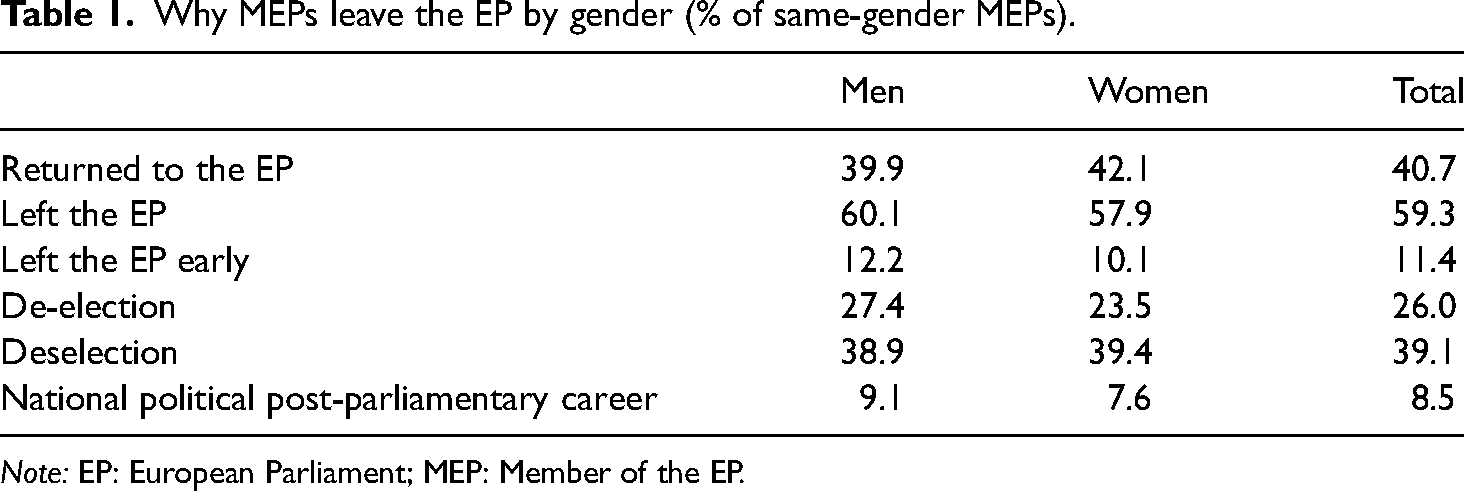
Note: EP: European Parliament; MEP: Member of the EP.
This study analyses why women MEPs leave parliament and whether they progress to the national level afterwards. Each career option is analysed separately using multivariate probit-regression. The effect of being a woman on the exit from the EP and post-EP career is expected to vary depending on the dominant gender role in the country of the MEP. Therefore, I allow the intercepts to vary at the country level. Table 2 summarises the results. Each model (M1–M6) evaluates the effect of gender on one career step or outcome, starting with analysing why MEPs leave the EP from the viewpoint of the individual MEP. No gender difference in turnover is expected (H1).
Gender and the reasons for exit from the EP.
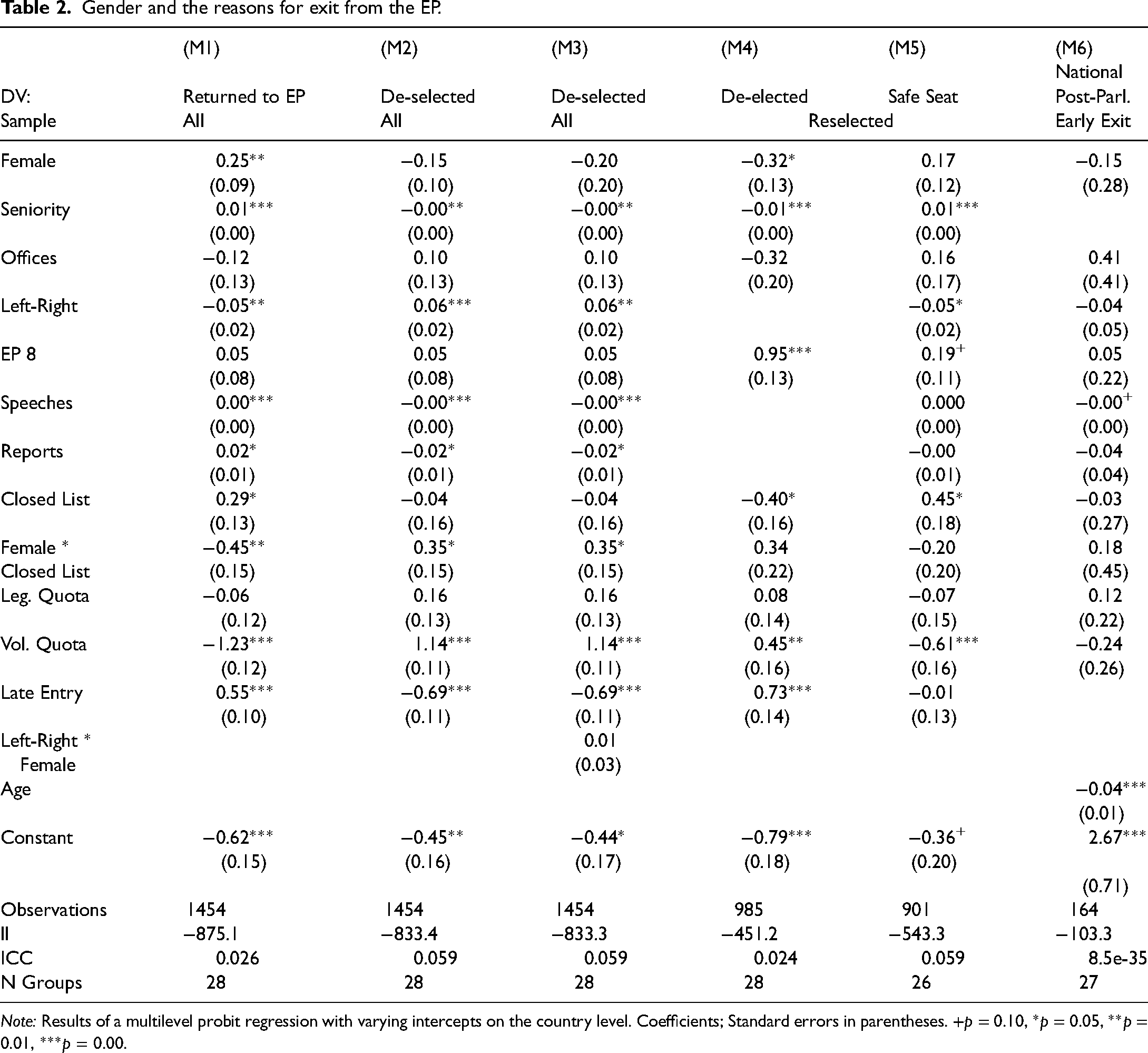
Note: Results of a multilevel probit regression with varying intercepts on the country level. Coefficients; Standard errors in parentheses. +p = 0.10, *p = 0.05, **p = 0.01, ***p = 0.00.
The results in model 1 (M1) do not confirm H1, at least when considering the effects of various electoral systems. Women MEPs in closed-list systems are significantly less likely than other MEPs to return to the EP after the term, whereas women in open-list systems are more likely to return. Disregarding the specific influence that electoral systems have on women, the effect of gender becomes small and statistically insignificant (see Online appendix). This study separates those who aimed to remain in the EP and were successful from those who left to obtain a more comprehensive understanding of the mechanism at play and the responsible agent in the subsequent analysis.
Unlike the expectation in H2a, on average, national parties do not disadvantage women MEPs when reselecting incumbents. According to M2 (see Online appendix), women are not significantly more likely to be deselected by the national party. However, the results reveal (M2) that the power assigned to different actors by the electoral system is decisive. Women MEPs from closed-list systems, that assign the national parties more power in candidate selection, are more likely to be deselected than their colleagues, partially confirming the hypothesis and supporting previous studies (e.g. Vanlangenakker et al., 2013) that found regional parliamentarians to be disadvantaged at deselection. Moreover, M3 reveals a difference between left and right parties: the more left (smaller values) a national party's ideological standpoint, the less likely the party deselects an MEP. However, this effect is not specific to women, as expected in H2b. This null finding could be explained by the EP being different from the national arena and being a generally more women-friendly place. With the European elections being considered second-order elections (Reif et al., 1997), national parties might attach less importance to candidate selection than when choosing candidates for the national arena, which could lead national parties to prioritise senior or incumbent candidates but not necessarily male candidates when reselecting candidates.
Unexpectedly, men and women MEPs are not equally likely to leave the EP because they were de-elected (see H3). For example, M4 (and Online appendix) reveals a sizeable and statistically significant effect of gender on de-election. Women MEPs have a 3.5% lower risk of being de-elected once on the list than men (women 23.7% and men 27.2%). Figure 2 illustrates the predictive margins.
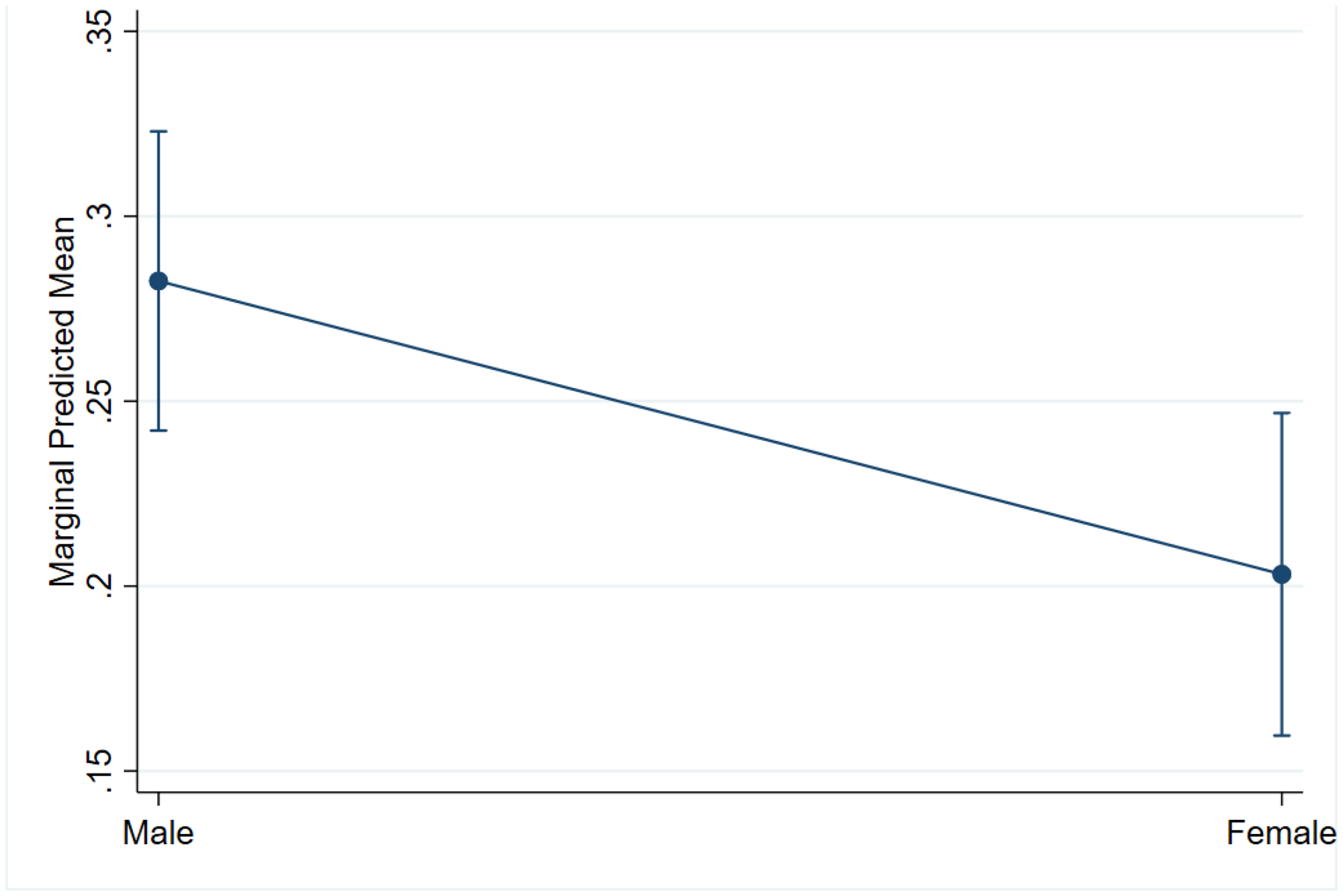
Predictive margins of de-election by gender with 95% confidence intervals.
Two potential explanations exist for this finding. Either voters are more likely to vote for women incumbents in European elections or national parties place women in better list positions. Moreover, M5 reveals that women MEPs have a slightly higher probability of being placed on a safe seat (list place), but this difference is not statistically significant. If voters played a prominent role, a larger effect should occur in open-list systems. Open-list electoral systems allow voters to vote for specific candidates, whereas they vote only for parties in closed-list systems. The Online appendix presents an analysis of de-election for MEPs from open-list (and single transferable vote) systems, confirming the same (slightly smaller negative effects) results as in M4. Hence, the results cannot confirm H3 and provide some indications that the advantage of women in re-election might partially be due to strategic party decisions and a preference of voters for women incumbents.
The expected gender difference (H4) concerning the career progression to the national level after exiting the EP is not supported by the results (see Online appendix). Women MEPs who leave the EP early are equally likely to have a national political career as men. In interpreting this result, we must note that this result pertains only to a small group of progressively ambitious MEPs. Within the specific group that plans to leave the EP for the national arena, women seem not to differ from men. The analysis of MEPs leaving the EP before the end of the term (see Online appendix) also indicates no gender differences.
This study controls for several factors. According to the analyses, age and seniority in the EP matters for careers. More experienced MEPs are more likely to return to the EP, are less likely to be deselected or de-elected, and, when running for re-election, have a higher probability of gaining a safe seat. Progressing to the national political arena seems slightly more accessible for younger MEPs. These findings confirm previous findings about career paths in the EU (e.g. Daniel, 2015; Marzi and Verzichelli, 2023), suggesting that MEPs who have a progressive ambition to continue their careers on the national level have shorter stays at the EP because it serves as a stepping stone for them. The MEPs who stay longer in the EP tend to strive for European careers. High levels of activity in the EP positively influence the likelihood of returning to the EP and contribute to the prospects of re-election or reselection.
More broadly, women's political careers can be influenced by the attitudes of political parties and societies towards gender equality, with more conservative attitudes posing a challenge to women. The MEPs from more right-wing parties are significantly less likely to return to the EP and more likely to be deselected and de-elected (see M1–M3), confirming the expectations. The effect for women from more right-wing parties is similarly positive but not statistically significant, indicating that the finding could be but is not necessarily related to gender attitudes. An additional analysis (see Online appendix) controls for geographical regions (East/Central EU, Northern, Southern and Western EU) as a rough measure of the societies’ gender attitudes. The results reveal no significant differences between regions.
The electoral system affects women's exit from the EP, confirming previous studies (e.g. Matland and Studlar, 1996). Women from EU member states with closed-list electoral systems are significantly less likely to be part of the next EP and more likely to be deselected (see M1 to M3). Without controlling for the interaction between electoral systems and gender (see Online appendix), the results indicate that MEPs from closed-list countries are significantly less likely to be de-elected because they tend to be positioned at better list placements. This finding confirms the crucial role of national parties and highlights that this power of the party is moderated by electoral institutions.
Gender quotas play a crucial role in the selection of women into parliament and may influence the re-election prospects of incumbent women MEPs. This study builds on previous research (Schwindt-Bayer, 2005) by distinguishing between voluntary, party-based quotas and legislated national-level quotas to analyse the effect of gender quotas on MEP exits and post-parliamentary careers. Notably, only voluntary quotas significantly influence parliamentary exits: MEPs from parties with voluntary quotas, regardless of gender, face more difficulty securing reselection and re-election. Voluntary quota MEPs are significantly less likely to return to the EP and obtain a safe seat for re-election. Checking whether this effect is driven by gender (see Online appendix), we observe that these disadvantages in getting re-elected and reselected are not driven by gendered effects of quotas. Moreover, like women MEPs, MEPs entering the EP as a replacement during the legislative period are more likely to return to the EP for another period and are more likely to be reselected by their parties but less likely to be re-elected once they run compared to MEPs who entered the EP at the election.
Conclusion
This study analysed the reasons behind women leaving the EP. This exploration provided valuable insight into the role of the actors involved and intricate interplay of individual MEPs, national parties and voters in shaping women's exits from parliamentary roles. Understanding these gender-specific patterns is crucial, as career opportunities significantly influence political behaviours and representation in parliament.
Beyond being a powerful legislative body, the EP is a stepping stone for national political careers, contributing to our understanding of multilevel political trajectories. Through an integrated analysis involving MEPs, national parties and voters, this study revealed fewer gender disparities than expected in the exit from the EP.
Nonetheless, the results reveal that the existence of gender differences depends on the electoral system, which distributes power among the actors. This study employed a new dataset containing personal, biographical and electoral list data on all MEPs who left the EP between 2009 and 2019. The findings illustrate a less negative view of women's career opportunities and chances than expected and indicate the pivotal role of national parties and electoral systems. Whether national parties disadvantage women during the reselection process for the EP depends upon the electoral system: women from parties in closed-list systems, where parties have more influence over candidate selection, are less likely to return to the EP and are disadvantaged at candidate selection. Open-list systems make it easier for women to be reselected.
Furthermore, a significant gender disparity exists in the likelihood of MEPs leaving the EP due to de-election. Women are less likely to leave the EP for this reason. Further in-depth analyses suggest that several factors, such as parties’ strategic decisions and voter preferences for women incumbents, may influence the likelihood of re-election for men and women MEPs. This paper indicates that the EP may be a good place for women when it comes to remaining, particularly for women from areas with open-list electoral systems.
Regarding the MEPs aiming to progress to the national political level, the results do not detect significant differences between men and women. This study underscored the significance of an agency–institution interaction in understanding gender dynamics in political careers, aligning with findings in other studies (see Alayrac et al., 2025). The MEPs from parties with voluntary gender quotas face challenges in being re-elected and reselected. This finding highlights the influence of party policies and ideologies on the reselection process, particularly in left-wing parties that prioritise gender equality. Additionally, closed-list electoral systems uniquely affect the exit patterns of women MEPs, highlighting the moderation of national party influence by electoral institutions.
Although this paper marks a crucial step in understanding women's exits from the EP and their post-EP careers, it has limitations. While analysing the main actors involved in MEP departures (MEPs, voters and parties), this article did not study all relevant actors (e.g. the private sector company boards potentially hiring MEPs). Future research should provide a more complete understanding of actors and influences, particularly regarding the post-parliamentary career options of MEPs. Furthermore, the explanation of the effect of some control variables (e.g. gender differences in political behaviour) is left to future studies.
Another limitation is related to measurement. The analysed actors, most notably the MEPs, can anticipate the behaviour of the other actors and adapt their behaviours and ambitions. For example, women MEPs might anticipate their deselection by the national party and search for a private sector job before the election. This interaction of actors and anticipation happens for several actors but can hardly be measured. Future research should disentangle the actors’ career decisions from the influence of other actors. Finally, the political careers and career opportunities of women and the turnover of parliamentarians in general change over time (see Kerby and Blidook, 2011). This article only applies data from 2009 to 2019; therefore, the results apply only to this recent period. Future research should analyse the changes over time (see Gouglas et al., 2025).
In conclusion, this study explains the complexities of women's exits from the EP and can identify their challenges in this career step (see Frech, 2025). Examining the roles of MEPs, national parties and voters offers a deeper understanding of the gendered dynamics in parliamentary exits and careers. National parties emerge as critical gatekeepers for women, representing an advantage (under favourable circumstances) rather than a challenge for women's careers. The insight that women MEPs tend to stay in the EP, opting for a European political career (while and because the national arena is still dominated by men), highlights how the political careers of men interconnect at various political levels (European, national and regional) differently than the political careers of women do (see also Fortin-Rittberger, 2025).
Furthermore, the study highlights the importance of electoral institutions as mediating factors influencing each actor's powers. Closed-list electoral systems emerge as a challenge for women's departure from the EP, a finding confirmed by Gouglas et al. (2025). This study underscores the need for continued research and targeted policy interventions to foster gender equality in political representation and career opportunities.
Supplemental Material
sj-docx-1-eup-10.1177_14651165241300273 - Supplemental material for Gendered exits: The role of parliamentarians, parties and voters in women's departure from the European Parliament
Supplemental material, sj-docx-1-eup-10.1177_14651165241300273 for Gendered exits: The role of parliamentarians, parties and voters in women's departure from the European Parliament by Elena Frech in European Union Politics
Supplemental Material
sj-zip-4-eup-10.1177_14651165241300273 - Supplemental material for Gendered exits: The role of parliamentarians, parties and voters in women's departure from the European Parliament
Supplemental material, sj-zip-4-eup-10.1177_14651165241300273 for Gendered exits: The role of parliamentarians, parties and voters in women's departure from the European Parliament by Elena Frech in European Union Politics
Footnotes
Acknowledgements
The author would like to thank the participants of the EUropean Careers Workshop in Bamberg (May 2023), the members of the BAGSS Colloquium and the discussants and panel members at several international conferences for their valuable comments. Gratitude is also extended for the research assistance provided by Bernhard Fockel, Jakob Hirn and Florian Schreiner as well as to the editor Gerald Schneider and the excellent team at European Union Politics for their support. The author is grateful to Däubler, Chiru and Hermansen (2022) for providing the 2019 electoral list data.
Funding
The author(s) disclosed receipt of the following financial support for the research, authorship, and/or publication of this article: The author was supported financially by the University of Bamberg (Germany) for the research, authorship, and/or publication of this article.

Data availability statement
All data generated or analyzed during this study are included in this published article [and its replication material among the supplementary information files].
Supplemental material
Supplemental material for this article is available online.
Notes
References
Supplementary Material
Please find the following supplemental material available below.
For Open Access articles published under a Creative Commons License, all supplemental material carries the same license as the article it is associated with.
For non-Open Access articles published, all supplemental material carries a non-exclusive license, and permission requests for re-use of supplemental material or any part of supplemental material shall be sent directly to the copyright owner as specified in the copyright notice associated with the article.
