




Abstract
In this article, we analyze how European Union Politics has evolved over the last 25 years. Our analysis demonstrates that the goals the editorial team has pursued over this quarter century have only partly been reached. While the journal has helped to consolidate EU studies as a field of research in its own rights, several problems of representation persist in the journal and the social sciences in general. We identify besides the well-known gender gap that especially authors from the (European) South and East continue to be underrepresented in submitted and published articles. While less represented and successful at the submission stage, our results show that female scholars are more likely than male author teams to publish high-impact articles. Our findings indicate that studies of political behavior, broadly conceived, and articles using quantitative methods are well-represented. The article concludes with some remarks on how the journal might help to further professionalize the study of the EU in the coming years.
Introduction
When European Union Politics was established a quarter of a century ago as a new outlet, its founding editors pursued the goal of transforming the study of the European Union (EU). Noticing ‘a cross-disciplinary convergence towards a unifying approach’, they hoped to establish with the new journal ‘a truly international voice’ that ‘concentrates on the most advanced and methodologically sophisticated research papers on any aspect of the EU from specialists from all over the globe’ (Schneider et al., 2000: 6).
Unsurprisingly, this ambition found some opposition in heterodox circles. One scholar criticized the assertion by the editors that EUP has contributed to ‘the progressive turn towards “normal” science in the study of regional integration and EU policy-making’ (Schneider et al., 2002: 5). According to Manners (2007: 90), such claims are ‘monstrous’ and ‘only lead to tighter straightjackets.’ Although the call for theoretical rigor and systematic research designs was welcomed broadly and is embraced by a seemingly ever-growing group of scholars, EU research remains dominated by scholars from Western Europe, especially Germany, the Netherlands, and the UK. Furthermore, the gender gap that persists at EUP (Bettecken et al., 2022; Hagemann, 2022), and the social sciences in general (Dion et al., 2018; Stockemer, 2022; Teele and Thelen, 2017), remains a matter of concern.
In this article, we assess what the journal has achieved and what not over the first quarter century of its existence. Extracting information from all EUP articles published between 2000 and 2023, our results show how the substantive and methodological contributions have changed over time. After studying key features of the publications in the first 24 volumes of EUP in a topic model, we track the most cited articles to identify influential papers and intersect relevant attributes, such as regional affiliations, gender, topics, fields, and methods. We find that empirical analyses based on standard or more advanced observational designs are by far the most commonly used approach, but that experimental approaches are gaining ground at EUP. Our findings demonstrate that the study of political behavior, broadly conceived, and articles relying on quantitative methods constitute the largest share of EUP articles. While less represented and successful at the submission stage, our results show that women are more likely than men to publish high-impact articles but also that mixed authors teams do not have an advantage.
In the following, we start presenting descriptive information on the authors of submitted articles and we differentiate between accepted and rejected submissions by gender and regional affiliation. Then, we examine the citation record of published articles, the methods that were used, and the topics covered. This allows us to trace the substantive focus of EUP articles and methodological differences across gender, time, and regions. The article concludes with some remarks on how the editors try to address the identified representational challenges.
Launching a journal and academic careers
While the first issue of EUP was published in March 2000, the journal entered the Web of Science (WoS) in 2003 only. The metrics provided by WoS allow us to uncover whether the journal has lived up to its ambition of advancing impactful research since then. The journal has reached from its WoS inception until November 2023 an H-index of 66, which means that 66 articles have been cited at least 66 times. It is reassuring, and in line with the vision of the editors, that several of the top-ranked articles were among the first successful submissions of scholars who were starting out their academic careers. This is for instance the case if we only consider the single-authored and WoS-indexed publications with more than 100 citations for the early-career publications by De Vries (2007), Klüver (2009, 2011), Kritzinger (2003), Mahoney (2004), McElroy (2006) and Rovny (2012). This list suggests that EUP has been among the lunching boards for a considerable number of successful academic careers, especially of female scholars.
In its first 25 years, the journal has published 604 research articles and 50 forum pieces in 24 volumes and 94 issues. The page budget allocated to a volume has increased steadily over time, and the journal will move to an open page budget in 2024 to create more flexibility to publish high-quality research. Unlike other outlets, EUP has only sporadically published special issues as they can fortify intergenerational (Conlon et al., 2006) as well as gender inequalities (Formanowicz et al., 2023) and reinforce the under-representation of scholars from the Global South (Ekdale et al., 2022). 1 Moreover, it has actively increased the number of open access publications in recent years.
The journal has published 13 special issues, roughly one in every second volume so far. Substantively, the special issues at EUP have covered a broad number of topics, with a growing number of issues that fall under the broad labels of ‘political behavior’ and ‘political communication’. The behavioral and quantitative focus manifests also when we consider the topics and core aspects of the research designs of EUP articles from 2000 to 2023.
Figure 1 shows the number of submissions to EUP by gender and region of the corresponding author between 2007 and 2019 for submissions with complete information (1997 out of 2258) on the Manuscript Central platform (for further details on this dataset see Bettecken et al., 2022). We observe that the acceptance and rejection rate is fairly even for submissions from scholars affiliated with Western European universities. Academics from other regions, conversely, are less successful. The rejection rate is particularly high for submissions from Southern, Central, and Eastern Europe; this lack of success affects predominantly male scholars. Differentiating between desk rejections and unsuccessful ‘Revise&Resubmit’ (R&R) decisions, we observe that the share of rejected submissions from Southern Europe (5%) is entirely composed of desk rejections in the female subsample. In comparison, rejected submissions from Western European authors mostly occur after the first review stage, especially for male scholars (for more details, see the Online appendix).
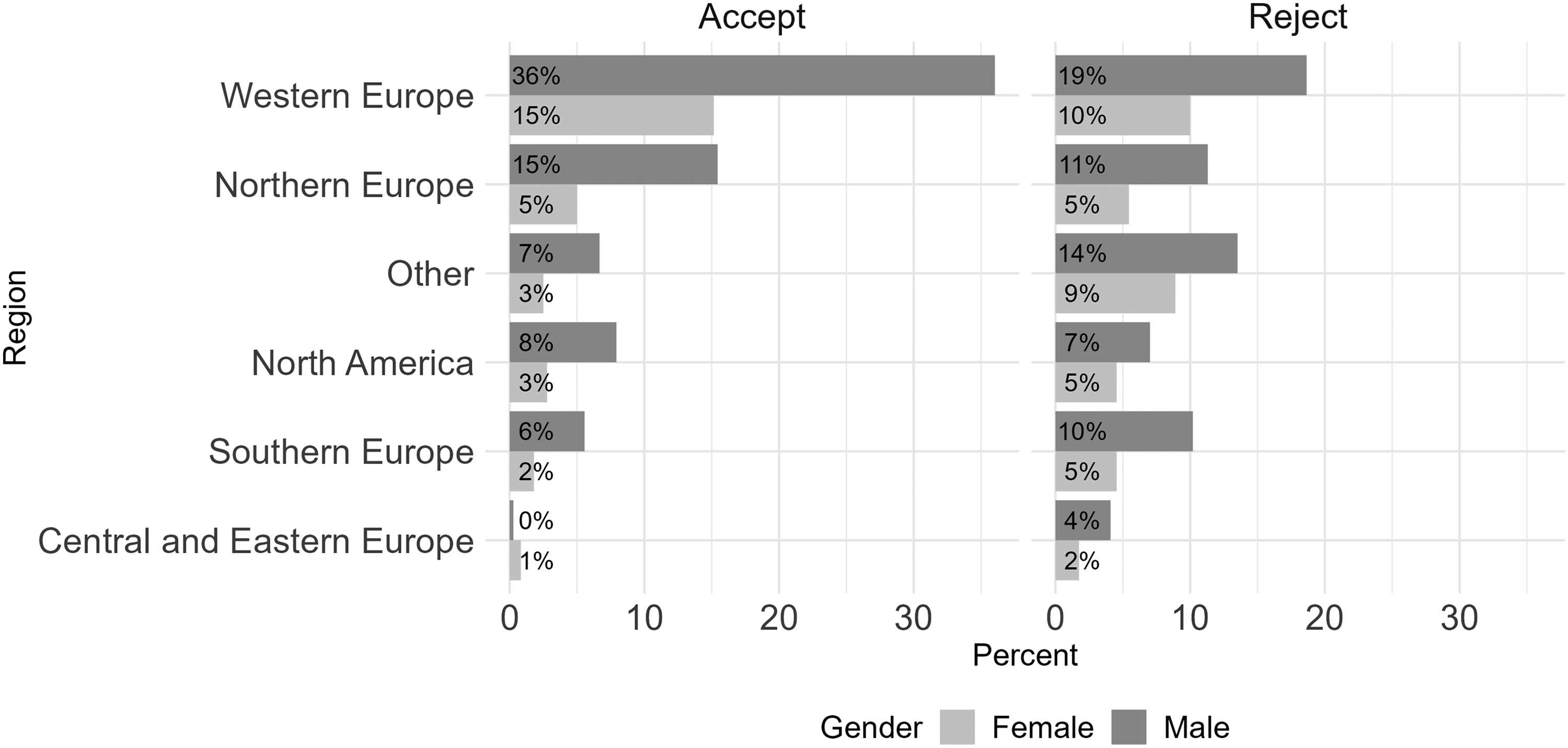
Percentage share of accepted and rejected manuscripts by gender and region of origin (2007 to 2019).
Disaggregating authors’ affiliations at the country level, we find considerable clusters in the geographic distribution of submissions and publications (for a complete list, see Online appendix). Most articles were submitted by corresponding authors with an affiliation to a German university or research institute (265), followed by academics working at Dutch (230), United States (228), and British (214) institutions. Authors of published articles are similarly spread geographically, with Germany, the United States, and the Netherlands filling the top positions. 2 Submissions from scholars with Austrian, Belgian, Danish, Italian, Norwegian, Spanish, and Swiss affiliations are also numerous whereas the number of submissions from France, one of the founding countries of the EU, is lower than that of Turkey. Yet, it should be noted that French submissions were more successful than their Turkish counterparts. While American academics contributed frequently to the journal in the early 2000s, Western European scholars have increased their share of publications over time.
The lower number of female publications reinforces the finding of Bettecken et al. (2022) that a considerable gender gap at EUP exists. The number of articles including female scholars has been increasing over the years, yet the disturbing disparity persists. We observe that the gender gap manifests itself already at the submission stage where less than one third of the submissions were authored by female scholars. In total, female authors have submitted only 744 compared to 1514 articles by male authors between January 2007 and December 2019. This gender gap is consistent across countries and regions. In the available sample, female scholars have faced, on average, higher rejection rates relative to authors identified as males: 72% of the accepted articles were submitted by male corresponding authors (28% by female) whereas the percentage share of rejected articles is comparatively lower for this group of submitters (65% for male and 35% for female authors). Among the published EUP articles, articles with female single authors or teams only constitute 13% of all authorship compositions compared to 60% single male and 26% mixed gender author teams. However, females have significantly increased leadership in co-authored projects, with the number of first-authorships especially growing after 2010. We also observe an increasing number of mixed-gender publications. Differentiating between first, second, and third authors, female scholars have been increasingly publishing, for example, as third-authors in EUP – effectively closing the gender gap at least in this position.
To explore these trends more systematically, we examine the identified gaps in representing certain European regions and research by female authors more systematically. Our statistical analysis focuses particularly on the factors that increase the chance of becoming an author at EUP. A considerable number of studies have shown that investment in higher education is a key determinant for the success of university systems (e.g., Pietrucha, 2018). We accordingly contrast the effect that spending on tertiary education has in comparison to gender and the scholars’ region of institutional affiliation. The analysis is executed for all articles submitted to EUP from January 2007 to December 2019 for which we possess complete information on the key variables of interest. The baseline categories for the representational variables are submissions by female corresponding authors and submissions from countries outside the EU, United States, or Canada (labeled ‘other’). The first explanatory variable is based on data from the World Development Indicators (WDI) (World Bank, 2023) and measures government spending (current, capital and transfers) per student in tertiary education, expressed as a percentage of gross domestic product (GDP) per capita. We match this aggregate information with the country in which the academic institution of the corresponding author is situated and include year-fixed effects in the final model.
The results of the logit regressions reported in Table 1 confirm for all model specifications that investing into higher education increases the chance of becoming an author at EUP. The evidence for the representational variables, by contrast, is mixed. We find first a significant difference in the acceptance or rejection decision depending on the gender of authors (columns 1 and 2, Table 1). Male authors have a significantly higher chance of becoming an EUP author than female ones: more specifically, the odds for males of submitting an article that will be accepted are 32% higher than the odds for females. Yet, this effect is not statistically significant when we include the interaction term between gender and regional affiliation. This suggests that the former effect might be related to geographical factors and driven by male scholars based in Central and Eastern Europe.
Logit regressions of the influence of higher education spending, gender, and regional affiliation on the chance of acceptance of EUP submissions (2007 to 2019).
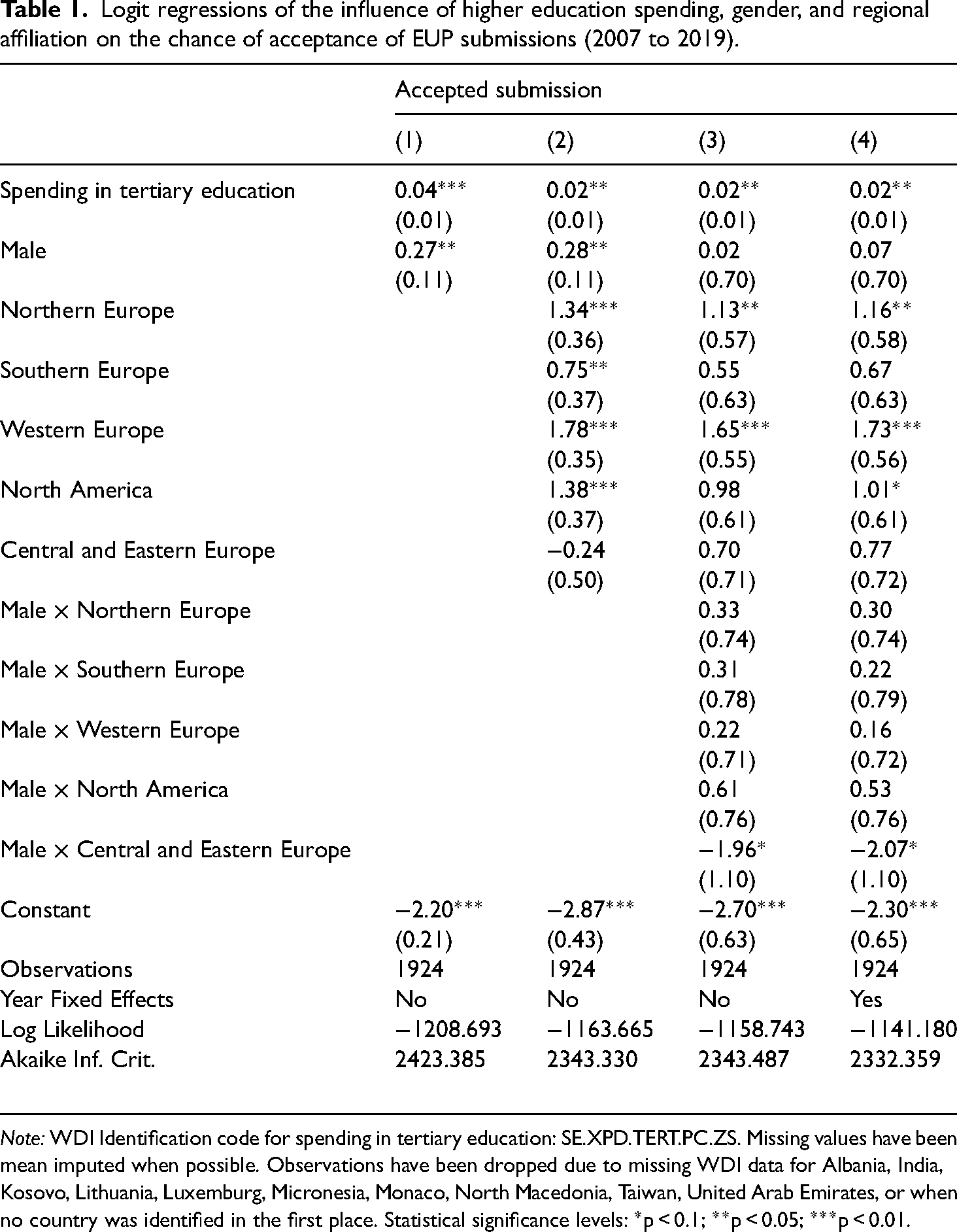
Note: WDI Identification code for spending in tertiary education: SE.XPD.TERT.PC.ZS. Missing values have been mean imputed when possible. Observations have been dropped due to missing WDI data for Albania, India, Kosovo, Lithuania, Luxemburg, Micronesia, Monaco, North Macedonia, Taiwan, United Arab Emirates, or when no country was identified in the first place. Statistical significance levels: *p < 0.1; **p < 0.05; ***p < 0.01.
We also find evidence that the place of origin of the submission matters for the odds of being accepted for publication. The dummy variables controlling for submissions from Western Europe, North America, and Northern Europe have large, positive and statistically significant coefficients. Our findings (column 4, Table 1) indicate that the odds of being accepted are approximately three times higher for Northern European submissions compared to the reference category, ceteris paribus. For Western European submissions, the odds of being accepted for publication in EUP are ceteris paribus more than five times higher compared to the baseline. The higher acceptance rates indicate that university systems that invest in their students and faculty perform better. It would be interesting to examine more broadly whether an internal European brain drain has contributed to these trends. The number of European Research Council grantees from Southern, Central, and Eastern Europe affiliated with British, Dutch, or Scandinavian universities suggests that scholars with a high potential can only exploit their potential in a competitive and well-funded academic environment (see Schneider, 2014).
Disciplinary focus, topics, and methods
We use topic models to analyze the substantive, disciplinary and methodological focus of the articles that were published between 2000 and 2023. This modeling approach faces the tradeoff that the inclusion of a larger number of topics improves the quality of the estimation, but compromises its interpretability. To address this tension, we conduct a topic analysis with a large number of topics and then summarize similar topics in broader categories. It needs to be noted that such aggregations are based on subjective judgements. To check the robustness of our approach, we employed a variety of categorizations for topics for which the categorization may be contentious. The results remain similar.
If we divide the disciplinary focus broadly into three analytical categories, we find that the field with the largest number of EUP article is political behavior (48%), followed by and policy studies (28%), and institutional analyses (24%) (for more details, see the Online appendix). To establish the area of application, we sort the topics into substantive categories. We group the 25 topics into five categories: ‘Economic policies and crises’ (20%), ‘Interest representation and institutions’ (19%), ‘Preferences and public opinion’ (27%), ‘Immigration policy and attitudes’ (11%), and ‘European integration and compliance’ (22%). The results show that EUP caters to a variety of different research fields, providing a comprehensive and encompassing view of the EU from a social science and, in particular, political science perspective.
An analysis of the content over the years shows that readers continue to find a stable mixture of content in EUP. Overall, studies investigating ‘Preferences and public opinion’ through conventional survey analyses or survey experiments constitute the largest group. Articles on European integration and disintegration or compliance with EU law, as well as European institutions and interest representation, closely follow in the ranking. We also observe a considerable number of examinations of the Eurozone crisis as well as on immigration. Overall, a peak in ‘European integration and compliance’ topics can be seen both in the early days of EUP and shortly before the 2004 EU enlargement and in the 2010s. ‘Immigration policy and attitudes’, on the other hand, have been losing visibility in EUP in the same time frame. The same is observed for studies of interest representation and examinations of EU institutions.
Looking at the variation of topics covered across regional affiliations, we observe that the content published in EUP is fairly evenly distributed. Because many articles accepted at the journal are authored by teams, we consider for team publications the origin of the group rather than the affiliation of individuals. This means that author teams in which all authors are based within the same region are marked as this region. Teams with members from different regions within Europe are coded as mixed European teams. Lastly, teams that include authors from both within and outside of Europe fall in the category of mixed international teams.
There is no noticeable difference in category types between authors that are associated with European institutions and those that are not. Authors based inside and outside of Europe contribute most frequently articles that investigate preferences and public or elite attitudes and opinion. Northern American scholars publish comparatively more in the institutional field. Scholars with European affiliations have published more frequently on economic policies and crises, relatively speaking, while authors from other continents were more interested in the general analysis of European integration and compliance issues during the time of observation. No major differences in the substantive foci could be observed for male and female authors.
We additionally examine the methodological approach of the EUP authors, extracting information from the abstracts, keywords, and, if necessary, the papers themselves. Four broad categories were established - quantitative (81%), qualitative (3%), formal theory (12%), and mixed methods (4%). We find that in the category of quantitative methods, the authors rely on a broad range of techniques. The portfolio ranges from methods appropriate for the analysis of time series over instrumental variable designs to the straightforward approaches that are frequently found in experimental studies. Specifically, 59% of quantitative articles use various regression techniques, 23% analyze surveys, and 7% examine text data. The second largest category after quantitative methods encompasses 72 articles in which the authors rely on game theory or other formal approaches, including agent-based modeling. Mixed-methods approaches that include for instance case studies or synthetic control methods dominate in 22 articles, and 16 articles rely on qualitative methods such as process tracing or descriptive approaches. Overall, survey-based studies and experiments have been increasingly published over the years while the share of articles using other methods has remained relatively stable. As before, we do not see strong regional variation in the employed methods nor differences in the empirical approach if we differentiate between female and male single authors as well as the various author team compositions.
What determines the impact of EUP articles? A citation analysis
Studies have established that authors from prestigious institutions receive more citations (Medoff, 2006) and that female scholars suffer not only from a representation gap in academia but also from a citation gap (Maliniak et al., 2013). This might, however, not be the case at EUP. As noted earlier, a considerable number of female authors have used EUP as a springboard for launching their careers through the publication of early impactful articles. If we compare the mean number of citations that the articles received we see some tentative support for a reversed citation gender gap. As reported in the Online appendix, the mean citation count is 29.9 for female articles, 27.7 for male and 25.7 for mixed-authored articles. The median citation count is 14 for all categories. The empirical analysis conducted for the period from 2003 to 2022 allows us to test whether this difference translates into a robust finding. The sample that is examined includes 73 articles authored by female authors compared to 340 articles written by male scholars and 152 by mixed author teams. This sample is representative of the full sample in its main attributes, such as the topics and fields distribution. Summary statistics are reported in the Online appendix. The event count models examine whether gender or other factors influence the number of citations that an article has received.
Table 2 reports the results of the negative binomial models for the factors that potentially influence the number of citations articles published in EUP have received on WoS. We examine the effect of gender (reference category ‘female’), methods (reference category ‘quantitative’), disciplinary fields of research (columns 1 and 2, reference category ‘institutional’ analyses), topics (columns 3 and 4, reference category ‘Immigration policy and attitudes’), and spending in tertiary education (measured as the percentage share of GDP invested per student). The regressions include controls for regional- and year-fixed effects. Focusing on the statistically significant results, submissions by males are less frequently cited compared to the reference category of articles authored by females, either as single authors or as a female team of contributors. For articles authored by males, the expected log incident rate is approximately 0.41 units lower compared to females (column 4, Table 2). In practical terms, if a female-authored article receives a certain number of citations, a comparable male-authored article is expected to have about 33% fewer citations, assuming that all other factors are held constant. For articles with mixed author teams, the coefficient is not statistically significant. The statistically significant negative coefficient for non-quantitative research designs implies that, under ceteris paribus conditions, these articles have approximately 40% fewer citations than articles employing a quantitative design (column 4, Table 2).
Negative binomial analysis of the number of citations for EUP articles (2003 to 2022).
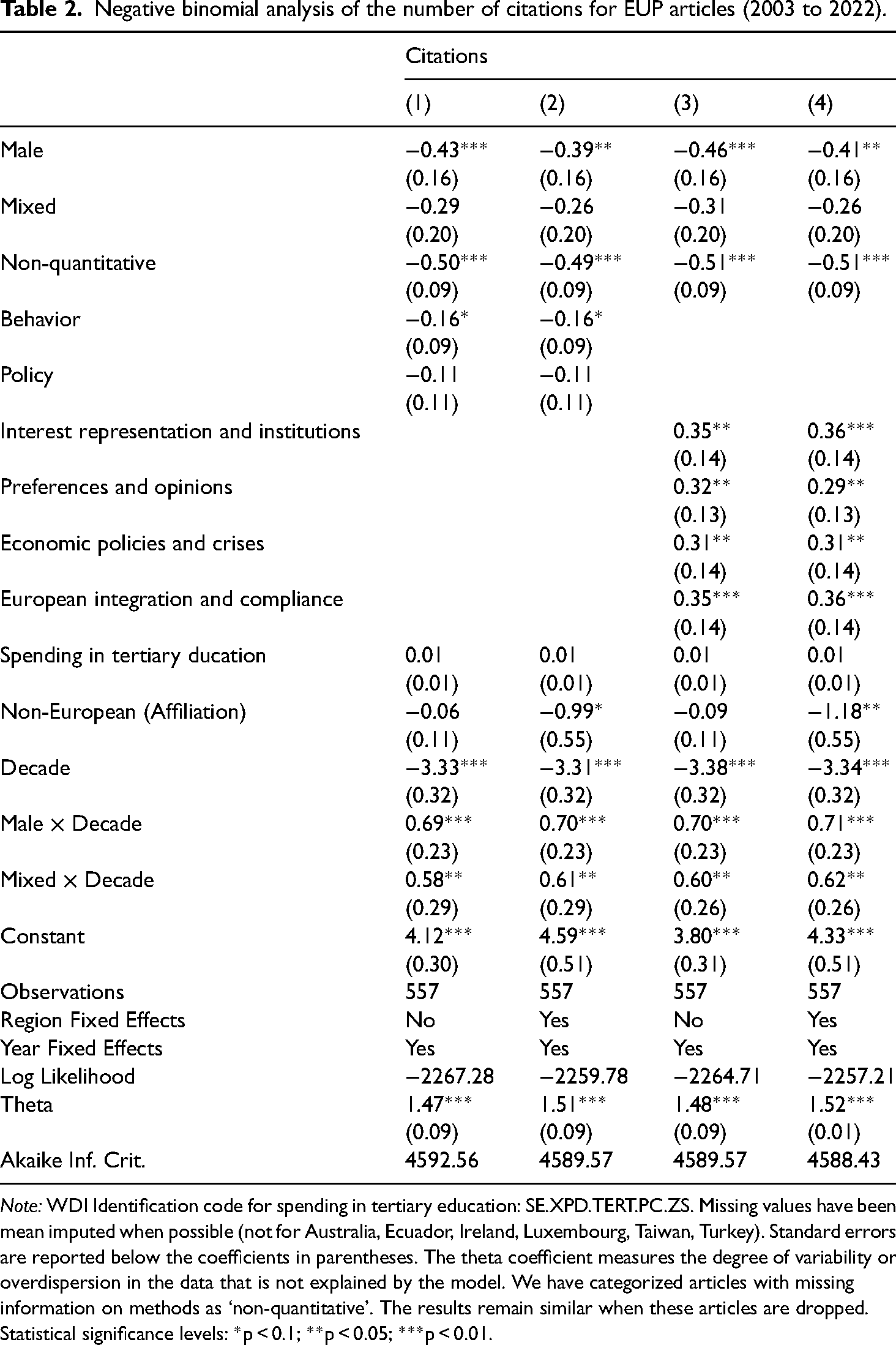
Note: WDI Identification code for spending in tertiary education: SE.XPD.TERT.PC.ZS. Missing values have been mean imputed when possible (not for Australia, Ecuador, Ireland, Luxembourg, Taiwan, Turkey). Standard errors are reported below the coefficients in parentheses. The theta coefficient measures the degree of variability or overdispersion in the data that is not explained by the model. We have categorized articles with missing information on methods as ‘non-quantitative’. The results remain similar when these articles are dropped. Statistical significance levels: *p < 0.1; **p < 0.05; ***p < 0.01.
The content and topic of the articles also matter for the citation counts. Articles that fall into the largest category political behavior have a smaller impact, on average, compared to the reference category of institutional analyses and policy studies. All topics receive more citations, ceteris paribus, compared to the baseline of articles dealing with immigration issues. The largest effects are found for articles that fall into two areas of research in political behavior - ‘Interest representation and institutions’ and ‘Preferences and public opinion’.
The results also indicate that the region in which the author has the primary affiliation plays a role in citation counts. Articles from authors based outside of Europe are less likely to be cited compared to contributions from scholars based at European institutions. Articles submitted by authors (teams) affiliated with institutions have 0.60 times less citations, ceteris paribus (column 4, Table 2). The coefficient for spending on higher education, measured as per-student investment as percentage of GDP, is not statistically significant. While investment in higher education pays off with regard to the chance to have articles accepted for publication, increased spending does not affect the quantitative impact of these examinations. The variable ‘Decade’ has a significant negative effect, indicating that articles published in later decades are more likely to receive fewer citations. The positive and significant interaction terms indicate that articles with male and mixed teams of authors have been increasing their citation count in the more recent decade. This could signify that the reversed female citation gap that we observe for EUP might close again and that the reported effect might be a temporary phenomenon.
Conclusion
The analysis of the first 24 volumes of European Union Politics offers several key insights. First, we confirm that EUP suffers from a considerable gender gap with regard to the number of submitted and accepted articles (Bettecken et al., 2022). Second, authors based in Central, Eastern, or Southern Europe have a lower chance of being accepted for publication. Third, female scholars are more likely to be cited than males, in contrast to the finding by Maliniak et al. (2013) who identified a gender citation gap. However, the reversed gender citation gap identified in this article might be a consequence of the journal’s success in attracting contributions by a number of prolific female scholars for which the EUP publications were one of the early milestones in their impressive academic careers. Fourth, articles by scholars based in Europe receive a larger number of citations than the pieces by contributors based at non-European institutions. This development might reflect a certain inward-orientation of the discipline, but also stands for the growing emancipation and professionalization of European political science. Fifth, articles published in EUP adopt mainly a quantitative design and can frequently be attributed to the broad field of political behavior.
The journal has, in our view, lived up to the ambition of solidifying the role of sophisticated theory-driven research on the EU. This main achievement comes, however, at the price of considerable problems of representation. A key consequence of the gender gap and other imbalances is that the scholarly community continues to pursue a conservative research agenda and risks overlooking key social and political challenges that require intensive scientific scrutiny. These imbalances are, of course, not unique to this particular journal. They reflect inequities in European and global academia where increased funding in higher education makes a crucial difference in making students and scholars academically more successful, but where the different attention paid to academic excellence furthers the representational gaps.
The editors of EUP are concerned about the representational gaps at EUP and in the wider discipline. They will continue with their efforts to attract exciting research especially by junior scholars, irrespective of their affiliation. At international conferences, they will offer guidance to students from less privileged institutions on how to transform good research ideas into exciting and up-to-date research designs. A further measure is that the EUP editors require editors of special issues to address the representational gaps directly. To address the representational citations gaps, authors of accepted articles are also required to refrain from ‘strategic ways’ of discussing the extant literature and to reference the true state of the art in their contributions.
The journal was an early pioneer in adopting firm replication requirements already in the very first volume of its existence. EUP will continue in its mission to replicate all reported estimations although the long-term financing of these efforts is not secured. To increase the transparency of qualitative research, authors are also required to report extensively on how they gathered their empirical evidence. The editors will, however, refrain from asking authors to conduct extensive robustness checks. Requiring additional tests that are distant to the main query does not only prolong the publication process. Such self-immunization also offers the chance to overly defensive authors to shield their findings and ideas from scientific discussion. However, the journal actively solicits in a new initiative the publication of registered reports and thus studies where the theoretical expectations and the research design are preregistered before the empirical research is conducted. We are sure that these and other innovations will make the journal an exciting venue in the coming years.
Supplemental Material
sj-r-1-eup-10.1177_14651165231217699 - Supplemental material for Mission partly accomplished: European Union Politics at 25
Supplemental material, sj-r-1-eup-10.1177_14651165231217699 for Mission partly accomplished: European Union Politics at 25 by Alessia Invernizzi, Ann-Cathrin Klöckner and Gerald Schneider in European Union Politics
Supplemental Material
sj-csv-2-eup-10.1177_14651165231217699 - Supplemental material for Mission partly accomplished: European Union Politics at 25
Supplemental material, sj-csv-2-eup-10.1177_14651165231217699 for Mission partly accomplished: European Union Politics at 25 by Alessia Invernizzi, Ann-Cathrin Klöckner and Gerald Schneider in European Union Politics
Supplemental Material
sj-xlsx-3-eup-10.1177_14651165231217699 - Supplemental material for Mission partly accomplished: European Union Politics at 25
Supplemental material, sj-xlsx-3-eup-10.1177_14651165231217699 for Mission partly accomplished: European Union Politics at 25 by Alessia Invernizzi, Ann-Cathrin Klöckner and Gerald Schneider in European Union Politics
Supplemental Material
sj-docx-4-eup-10.1177_14651165231217699 - Supplemental material for Mission partly accomplished: European Union Politics at 25
Supplemental material, sj-docx-4-eup-10.1177_14651165231217699 for Mission partly accomplished: European Union Politics at 25 by Alessia Invernizzi, Ann-Cathrin Klöckner and Gerald Schneider in European Union Politics
Supplemental Material
sj-html-8-eup-10.1177_14651165231217699 - Supplemental material for Mission partly accomplished: European Union Politics at 25
Supplemental material, sj-html-8-eup-10.1177_14651165231217699 for Mission partly accomplished: European Union Politics at 25 by Alessia Invernizzi, Ann-Cathrin Klöckner and Gerald Schneider in European Union Politics
Supplemental Material
sj-html-9-eup-10.1177_14651165231217699 - Supplemental material for Mission partly accomplished: European Union Politics at 25
Supplemental material, sj-html-9-eup-10.1177_14651165231217699 for Mission partly accomplished: European Union Politics at 25 by Alessia Invernizzi, Ann-Cathrin Klöckner and Gerald Schneider in European Union Politics
Footnotes
Acknowledgments
We would like to thank the associate editors of EUP for their support and comments.
Author contributions
The authors contributed equally to the article.
Funding
The authors received no financial support for the research, authorship, and/or publication of this article.

Supplemental material
Supplemental material for this article is available online.
Notes
References
Supplementary Material
Please find the following supplemental material available below.
For Open Access articles published under a Creative Commons License, all supplemental material carries the same license as the article it is associated with.
For non-Open Access articles published, all supplemental material carries a non-exclusive license, and permission requests for re-use of supplemental material or any part of supplemental material shall be sent directly to the copyright owner as specified in the copyright notice associated with the article.
