



Abstract
Why, despite increased female support, do social democratic parties (SDPs) in most Western European countries face electoral decline? To study this puzzle, we harness a well-documented regularity: diminishing support for SDPs by manual workers and their increased support for the far right. We contend that this trend is intensified in contexts where the economic positions of SDPs align with market-oriented policies or converge with those of the far right. Additionally, as men are disproportionately represented among manual workers, this shift contributes to the reversal of the gender gap in support for SDPs. Drawing on public opinion data from 18 countries spanning half a century, along with labor and party economic position data, our findings substantiate this argument.
Introduction
Abundant evidence shows that diminishing support for social democratic parties (SDPs) across Europe is commonplace (e.g. Bandau, 2023; Benedetto et al., 2020; Rennwald and Pontusson, 2021). Yet it is also established that women have been drifting toward SDPs. While at present women in Western democracies support progressive policies and vote for SDPs at higher rates than men (‘the modern gender gap’), five decades ago, the gender gap in voting was in the opposite direction (e.g. Box-Steffensmeier et al., 2004; Dassonneville, 2021; Inglehart and Norris, 2000; Iversen and Rosenbluth, 2006; Manza and Brooks, 1998; Shorrocks, 2018). Men were the ones to support SDPs at higher rates, while women disproportionately supported conservative parties (‘the traditional gender gap’). A secular trend led to the narrowing of the traditional gap and in most countries to its reversal in the 1990s or the aughts of the 21st century. This trend has been documented in both cross-national analyses (e.g. Giger, 2009) and single-case studies (e.g. Hudde, 2023).
Why, despite increased female support, do SDPs in most Western European countries face electoral decline? And how are these trends contingent on the positions taken by parties themselves? We investigate the tension between the drift of women toward SDPs and the decline in support for them in the context of European multiparty systems. In particular, we harness the well-established finding that manual workers withdrew their support for SDPs, utilize it to formulate a gendered analysis of occupational realignment of the vote, and analyze how party positions condition such realignment.
First, consistent with past findings, we hold that being occupationally vulnerable to immigration and trade, manual workers, a category in which men are overrepresented, have withdrawn their support for SDPs. We observe that at the same time, they have increased their support for the far right, which presents itself as a guardian of otherwise unmet interests of workers. The withdrawal is reflected in a reversal of the gender gap in support for SDPs. Second, we argue that these trends are contingent on economic positions taken by SDPs and far right parties (FRPs), as well as the degree to which manual sectors are dominated by men: we hypothesize that the change is increased when SDPs adapt market-oriented policies or converge along with the far right to centrist economic positions.
We utilize public opinion data in 18 democracies over a 50-year period (the Eurobarometer between 1970 and 2002, and European Social Survey (ESS) between 2002 and 2020), along with labor data about skills relevant for different jobs and party placement data (the Chapel Hill Expert Survey) and find support for our argument: manual workers, most of whom are men, have withdrawn their support for SDPs, a decline that is reflected in the reversal of the gender gap in support for SDPs. Furthermore, manual workers show up in large numbers to support FRPs. Importantly, we do not find realignment of support of manual workers for other party families. Examining the latter time period, we find that the magnitude of these trends is contingent on economic positions taken by SDPs and FRPs: in contexts with high male domination of manual sectors, a moderately large shift in the economic position taken by SDPs toward the center is associated with a decline of 8.2 percentage points in the gender gap in support for it. Overall, our findings demonstrate a strong link between support for social democratic and FRP families, revealing an intricate party ecosystem where both party families vie for the support of manual workers. The link, we demonstrate, is contingent on economic positions taken by both party families.
The contribution of our study is twofold. First, we draw on a repeatedly demonstrated observation regarding increased support for the far right by workers and bring it to bear on a puzzle related to the support level and the gender gap in support for SDPs. The realignment of the vote along occupational and gender lines sheds light on the changing composition of the economic center-left and speaks to recent debates in the literature about groups that have withdrawn their support for it. The analysis of the contingency of these processes on party positions enables us to provide notable evidence of the capacity of political parties to shape these processes of realignment and to contribute to our understanding of the relationship between labor market structure and the party system. Second, notwithstanding cross-national studies (Studlar et al., 1998) spanning half a century and 18 countries, to the best of our knowledge, our analysis of this topic is the most extensive in scope undertaken to date.
The paper proceeds as follows. The next section reviews accounts of changes in support for SDPs as well as for FRPs. The following section develops our hypotheses. The empirical analysis is conducted in two steps. After presenting the data, we set the stage for establishing long-term trends in party support among manual workers. The following section examines our hypotheses on a subset of the data and demonstrates how these trends are contingent on economic positions taken by SDPs and FRPs. The final section concludes.
Shifts in voter support in multiparty systems
Our paper speaks to a growing debate about the relationship between the decline in support for SDPs and the rise in support for FRPs. The longstanding side in the debate maintains that male manual workers, the core constituency of SDPs in the past, shifted their support to the far right, mainly because of economic concerns (Betz, 1994; Coffé, 2018; Morgan and Lee, 2018; Oesch, 2008; Oesch and Rennwald, 2018; Rydgren, 2013). A recent challenge to this side takes issue with the claim of a transition of working-class voters from SDPs to FRPs (Abou-Chadi et al., 2021; Häusermann et al., 2021). Instead, it contends that (a) SDPs have lost voters mainly to Green and mainstream right parties; and (b) FRPs, for their part, enjoy growing support of both newly mobilized voters and former supporters of a variety of parties.
We reconcile the two narratives. Manual jobs are the type of jobs most threatened by globalization and competition with immigrants. We hold that overrepresented among manual workers, men have withdrawn their support for SDPs (this is consistent with Benedetto et al.'s (2020) findings of a reduced propensity of manual workers to vote for SDPs). Furthermore, male manual workers have significantly increased their support for FRPs, with no comparable increase in support for other party families during the same period. We contend that when SDPs adopt more market-oriented stances or converge economically with FRPs, male domination of manual sectors is not associated with greater support for SDPs among men than among women.
While our argument is consistent with that of the former camp of scholars, it is not specifically in tension with the latter camp. First, we do not argue that the movements we identify—the withdrawal of support for SDPs by male manual workers and the increased support for FRPs—are the only movements in the field. Rather, we show that they are significant and systematic, and particularly pertain to long-term trends in support for SDPs, as well as the realignment of the gender gap in support for SDPs. Second, our goal is not to map out all sources of the growth in support for FRPs (we touch on this point immediately below), and hence our argument is not in tension with findings regarding the diverse sources of support for FRPs.
Political scientists have extensively studied the rise of the far right and its growing acceptance. One set of explanations relies on cultural factors such as symbols, values, and identity as predictors of support for FRPs in general and anti-immigrant sentiments in particular (for a review, see Noury and Roland (2020)). These explanations invoke concepts such as national identity (Sides and Citrin, 2007), cultural sentiments (Hainmueller and Hopkins, 2014), and traditional values (Inglehart and Norris, 2017) that propel segments of the population to support the far right. Another set of explanations emphasizes interest-based considerations of native workers. These explanations invoke worker skill level (Scheve and Slaughter, 2001, though see Hainmueller et al., 2015 for different results), the place of one's sector in a changing economy (Dancygier and Donnelly, 2013), one's exit options and skill transferability (Pardos-Prado and Xena, 2019) as proxies for economic hardship and labor market insecurity. Ortega and Polavieja (2012) find that the degree of manual skill dexterity required in a native worker's occupation is positively correlated with anti-immigrant sentiments, and holding a job that requires high human capital is positively correlated with pro-immigrant attitudes (see also Polavieja, 2016). According to some within this strand of research, anti-immigrant sentiments promoted by FRPs are framed to appeal to those who have lost out due to globalization, usually native blue-collar male workers whose jobs have been put at risk by the influx of immigrant workers (Givens, 2005; Jackman and Volpert, 1996).
Cultural and structural explanations notwithstanding, the support rate for FRPs varies by gender. Analyses of support for the far right have found that it enjoys the support of men more than that of women (Akkerman and Hagelund, 2007; Coffé, 2018; Givens, 2005; Harteveld and Ivarsflaten, 2018; Van Der Brug and Fennema, 2007). Studies offer different accounts for this regularity, spanning from the hierarchical and usually male-dominated structure of FRPs (Kitschelt and McGann, 1997), through the antifeminist agenda promoted by them (Campbell and Erzeel, 2018), to the claim that women possess a stronger need to control prejudice, which in turn hinders their tendency to support FRPs (Harteveld and Ivarsflaten, 2018). Relatedly, Harteveld et al. (2019) show that women are less likely than men to vote for small, extreme, or socially stigmatized parties. Lastly, the ethics of caring, including sympathy for the disadvantaged catalyzed by feminist consciousness (Conover, 1988), may pull women away from FRPs.
While we do not prescribe to one particular explanation for the greater support for FRPs among men than among women, this established regularity in itself is fully consistent with our argument about the process underlying the electoral decline of SDPs. In the next section, we develop our argument about changes in support for SDPs and elaborate on how we see the linkage between the two.
Skill and occupational vulnerability
Students of political economy have highlighted the importance of identifying the advantaged and disadvantaged in the labor market. Depending on the focus, studies differ in both the aspects of one's disadvantage they identify and their operationalization. One such example is Rueda’s (2005) conceptualization, which focuses on material hardship due to individuals’ current labor market status, and defines outsiders as those who are either unemployed or hold low-salary jobs. Another is Häusermann and Schwander (2011), which conceptualize outsiderness as belonging to an occupational group that has above-average rates of unemployment.
Inspired by this framework and adapting it to the question at hand, we focus on occupational vulnerability of workers to immigration and trade in particular. Individuals working in sectors that require manual rather than communication skills are vulnerable to both competition with immigrant workers who possess manual skills and offshoring of their jobs due to trade. Language and communication skills, on the other hand, often serve as a security fence for native workers and present a labor-market barrier for immigrants. 1 We can thus think of manual skills as indicators of occupational uncertainty in times of rapid globalization and heightened trade and immigration, whereby the more (less) manual (communication) skill dexterity one's job requires, the more occupationally vulnerable one is. 2
We classify workers by the skill dexterity required in the sector they work in and hence, we contend, the potential threat to their livelihood posed by immigration or trade. Manual workers might look for ways to offset that risk by supporting a party that explicitly promotes anti-immigrant rhetoric, opposes trade, and presents itself as a defender against these ‘external’ threats. This approach allows us to capture a worker's vulnerability in the face of current and potential future shocks to the labor market. This logic resonates with recent work on the importance of economic risk in shaping policy preferences and political behavior (Rehm, 2016). In particular, we expect that individuals working in sectors that require high manual skill dexterity are more likely to support FRPs compared to the general population. Our next step contextualizes this expectation, specifying how positions of parties interact with labor market characteristics to affect the gender gap in support for SDPs.
Political parties and labor markets
We contend that support for SDPs among manual workers depends on the political context, and given that more men than women work in manual jobs, this is of particular relevance for men and in turn affects the gender gap in support for SDPs. We focus on two mediating factors: economic positions taken by SDPs as well as FRPs, and gender segregation in the labor market.
We contend that, when SDPs take decidedly leftist positions, more manual workers tend to support it. Conversely, where SDPs take centrist policy positions, manual workers may be less inclined to stay loyal, perceiving the party as not being the ultimate guardian of their interests (see Karreth et al. (2013) for a discussion of the electoral long-term effects of SDPs taking centrist positions). This will be observed where the far right, employing the rhetoric of ‘own people first’, is a viable alternative for voters, but not otherwise.
In conjunction with changes in policies pursued by SDPs that may serve as push factors for some of their constituencies, FRPs may play a role in pulling voters in their direction. While many FRPs pursue anti-immigrant rhetoric, they vary in their economic policies, with some endorsing laissez-faire policies and others advocating state intervention (Mudde, 2007). Those endorsing redistribution tend to win the support of pro-welfare nativists, a group of voters often rooted in the working class. Correspondingly, upper middle-class voters (measured in subjective terms) tend to support FRPs that hold pro-market economic positions (Harteveld, 2016). Over time, and in response to evolving political preferences in postindustrial societies, FRPs’ programmatic appeal shifted toward the center on economic issues (De Lange, 2007; Kitschelt, 2004). We therefore expect the combination of positions of the two parties to play a role in encouraging or discouraging voters to shift their support. When both SDPs and FRPs take distinctly different positions, voters are less likely to shift their support. When their respective positions are closer together, however, the combination of push and pull factors might make it more likely for manual workers to shift their support.
Overall, then, we hold that there is an interactive effect of party economic positions and gender segregation in the labor market.
And while this relationship will be pronounced in the presence of the far right as a viable alternative, it will not be observed in the absence of it. Furthermore,
In the next section, we empirically examine these hypotheses.
Empirical strategy: gender and occupation
The study of large drifts in voter behavior in a multiparty system over time poses obvious challenges: many potential drifts may take place simultaneously, making it difficult to empirically isolate the realignment of a particular group. Several single-country multiwave panel surveys (e.g. BES, GLES, LISS, SHP, etc.) allow for targeted analysis of individual voters over time. Yet, despite the advantage of panel data, given that our argument draws on cross-country variation in social democratic and FRP positions and the structure of the labor market, we opt for more comprehensive cross-country data.
Our empirical analysis is two-pronged. We begin with a broad-brush analysis, in which we examine the role of the gender gap in voting trends in general and in voting trends among manual workers in particular. We focus on SDPs and FRPs, and follow with an analysis of other party families. We also highlight gender segregation in the manual labor market, which enables a nuanced analysis of voting trends through both gender and occupation lenses. The following section tests our hypotheses, analyzing how economic positions taken by SDPs and FRPs condition the trends established.
Data and measurement
Consistent with previous studies, we define the gender gap as the proportion of men supporting a particular party family minus the proportion of women who do so. 4 The following questions about electoral choice are taken for the analysis of the Eurobarometer and ESS data, respectively: ‘If there were a general election tomorrow, which party would you support?’, and ‘Which party did you vote for in the last election?’. We categorize parties to party families by drawing on ParlGov (Döring and Manow, 2016) up to 1999 and the Chapel Hill Expert Survey (Bakker et al., 2014a) from 2000 onward. 5 While we focus on two party families—SDPs and FRPs—our analyses also address the Radical Left, Liberal, Conservative, and Christian Democratic party families.
Gender gaps
A preliminary first step toward analyzing the link between the changing gender gap and occupational realignment is a descriptive examination of the gender gap in support for SDPs (in the presence and absence of the FRPs) and for FRPs. Figure 1 displays the two gender gaps (panels (a) and (b), respectively), drawing on the Eurobarometer and the ESS. On the vertical axis is the gap for the relevant party family (men minus women) and on the horizontal axis our 50-year period, based on the two surveys. In panel (a), cases (country/years) are split into those in which FRPs did not acquire a seat in parliament (dotted line) and those in which they acquired at least a single seat (solid line). This admittedly crude dichotomization presents a clear descriptive difference in support for SDPs between the two sets of cases. In contexts where FRPs are strong enough to gain seats in parliament, the gender gap in support for SDPs is smaller (‘more modern’) and it flips signs earlier (though notice the temporary greater uncertainty around 2000). In other words, in contexts where the far right gained seats in parliament, fewer men (or more women) supported SDPs compared to cases where it did not. Figure 1(b) presents the gender gap for FRPs in the same timeframe. Here, too, notwithstanding the modest decline at the end of the period, consistent with past findings (e.g. Allen and Goodman, 2021), the aggregate trend reflected in the data indicates a clear pattern where men are consistently more likely to support FRPs than women. 6
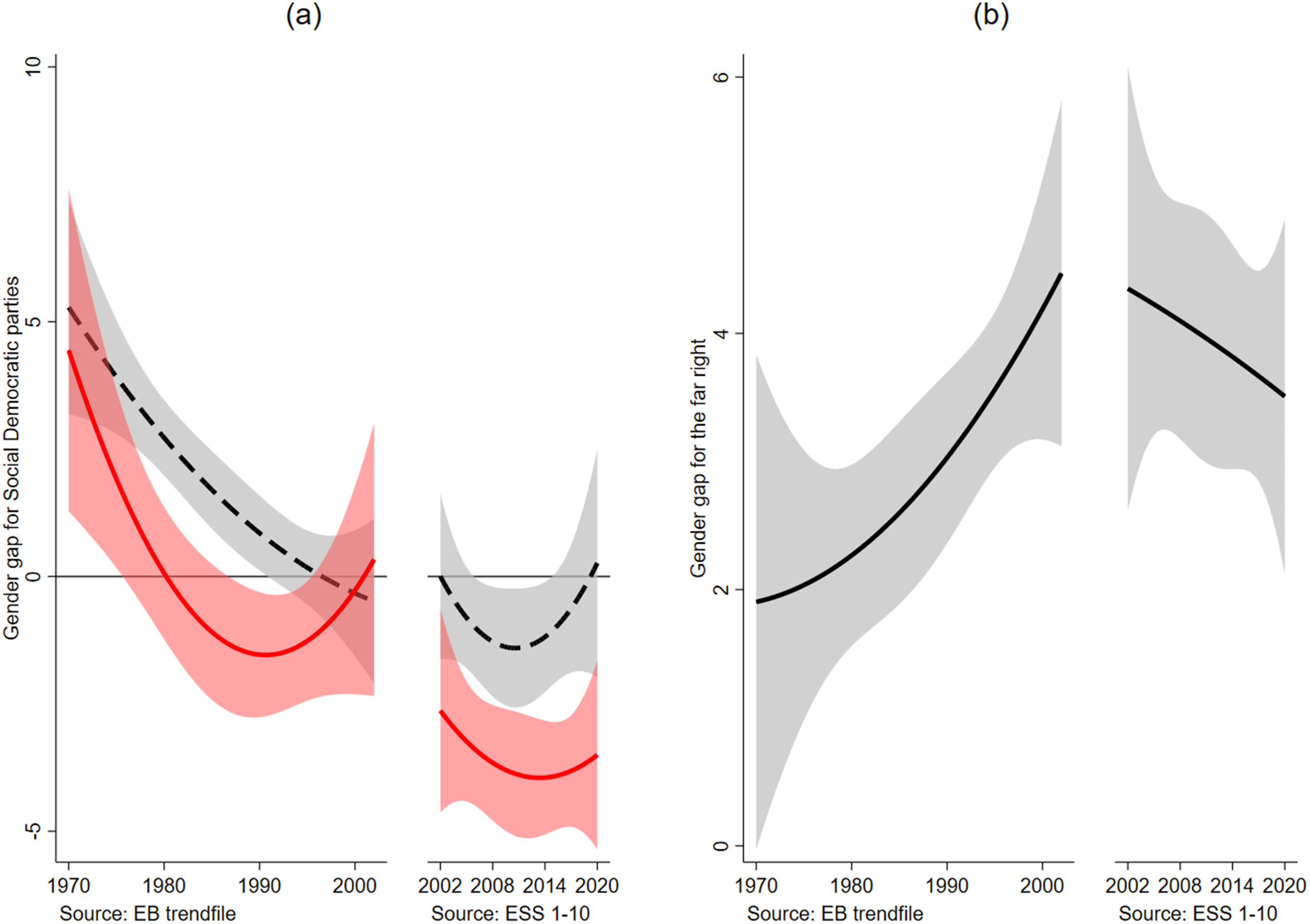
The gender gap in support for SDPs and (b) FRPs: 1970 to 2020. Notes: Trendline is a polynomial regression of the gender gap on year, weighted by country. See the Online appendix for more information about party classifications and a detailed figure, presenting the gender gap for every country/year. Data sources: Eurobarometer survey (1970 to 2002) and ESS (2002 to 2020). Figure 1(a): In solid line are country/years where FRPs attained at least a single parliamentary seat, in dotted line are county/years where FRPs did not make it to parliament.
These merely descriptive empirical pieces suggest that there is possibly a link between the gender gap in support for SDPs and FRPs. We next turn to identify manual workers and scrutinize these gaps, honing in on this occupational group.
Manual workers: Support for SDPs and FRPs
To identify manual workers, we append to the data for each respondent the degree to which their job requires manual and communication skill dexterity. The two are measured in terms of percentiles: the score indicates the percentile of the sector in the economy in terms of use of the relevant skill such that a high number indicates that workers in the sector use the skill with greater intensity compared to others (see the Online appendix for sources and construction of these variables). Not surprisingly, the two are strongly and negatively correlated: the more a sector requires communication skills, the less it requires manual skills (r = -0.99).
Table 1 presents the nine sectors as defined by the International Labor Organization according to the International Standard Classification of Occupations (ISCO) along with examples of occupations and their percentiles on manual and communication skills. At the bottom end of the list are the three most manual sectors: elementary occupations, immediately followed by craft workers and plant and machine operators and assemblers. In the analysis below, we refer to workers in these three sectors as manual workers (the next sector in terms of use of manual skills is services, which substantially differs from these three). 7 The average fraction of manual workers per country/year is 26% on average and varies from 13% (Switzerland 2018) to 52% (Portugal 2006).
Sectors by skill dexterity and gender.
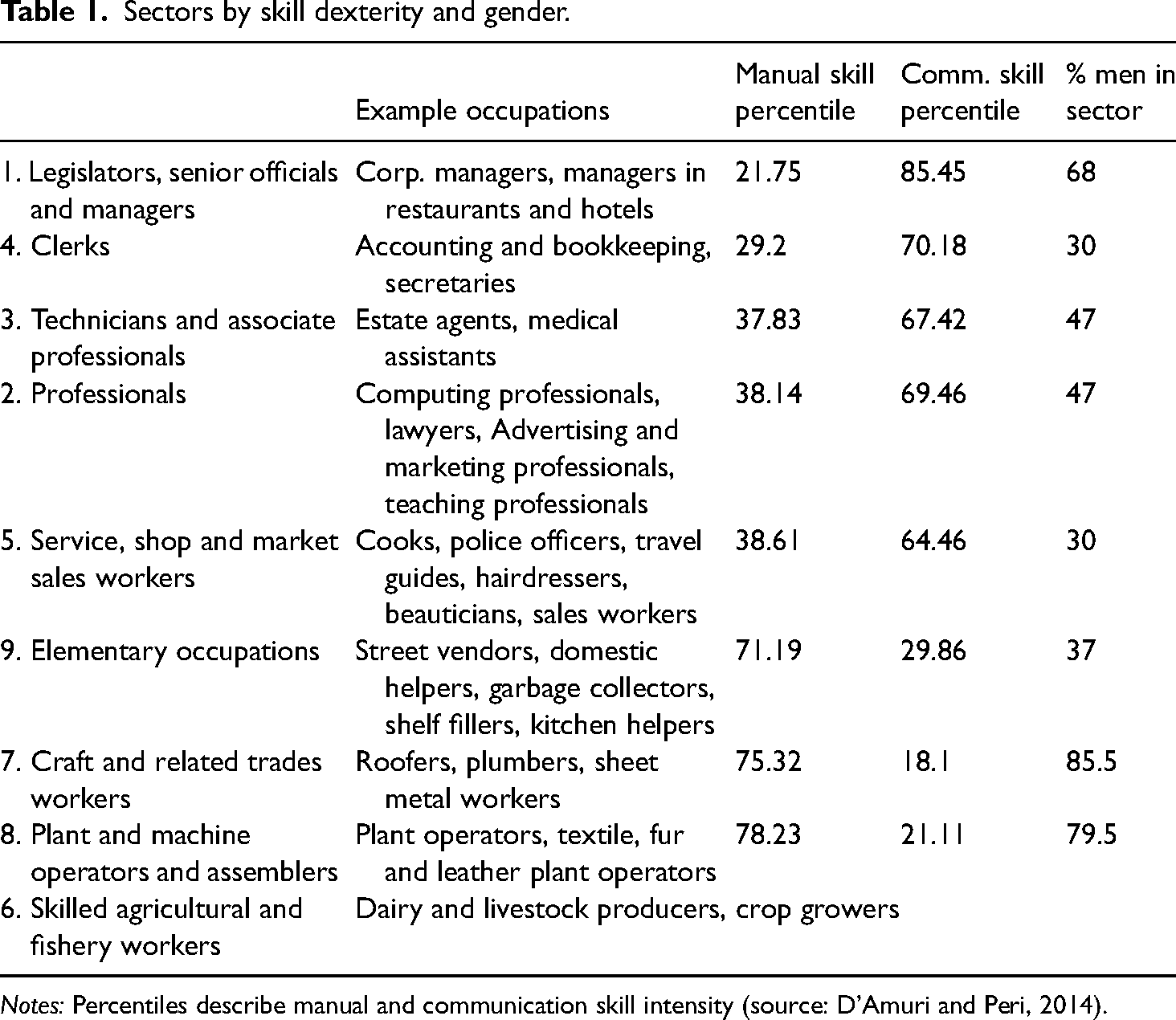
Notes: Percentiles describe manual and communication skill intensity (source: D’Amuri and Peri, 2014).
The last column of the table presents the share of male workers in each sector, and hence provides information about gender segregation in the labor market within each sector. The table shows three sector groups that exhibit sharp segregation by gender. The first is senior officials and managers (sector 1). This communication-intensive sector is heavily dominated by men. The second are sectors 4 and 5: clerks and service workers. These sectors, too, rely on communication skills but are heavily dominated by women. The third are sectors 7, 8, and 9: crafts, machine and plant operators, and elementary occupations. These sectors are the most manual: the first two are distinctly male-dominated while the last is female-dominated (mostly due to domestic helpers). Overall, though, the three manual sectors combined are male-dominated: 68% of those working in manual sectors during the 2002 to 2020 period are men.
Gender-based segregation in the manual sectors has implications for our argument regarding the link between occupational vulnerability and the vote. Our argument pertains to all manual workers, irrespective of gender. However, since more women than men are occupied in communication-based sectors and more men than women are occupied in manual sectors, on average, their occupational interests push them in different directions. Fewer women than men have an interest in withdrawing their support for SDPs or in supporting FRPs on occupational grounds.
Figure 2 (panels (a) and (b)) presents rates of support for SDPs and FRPs over time among women (dashed) and men (solid line) working in manual jobs. 8 As a reference point, the figure also presents the respective vote share among the general population (dotted). Panel (a) shows that support for SDPs declines at a steeper rate among manual workers than among the general population. Panel (b) displays an analogous analysis for the far right, and demonstrates an increase in support over time among women and men holding manual jobs at rates slightly higher than those of the general population.
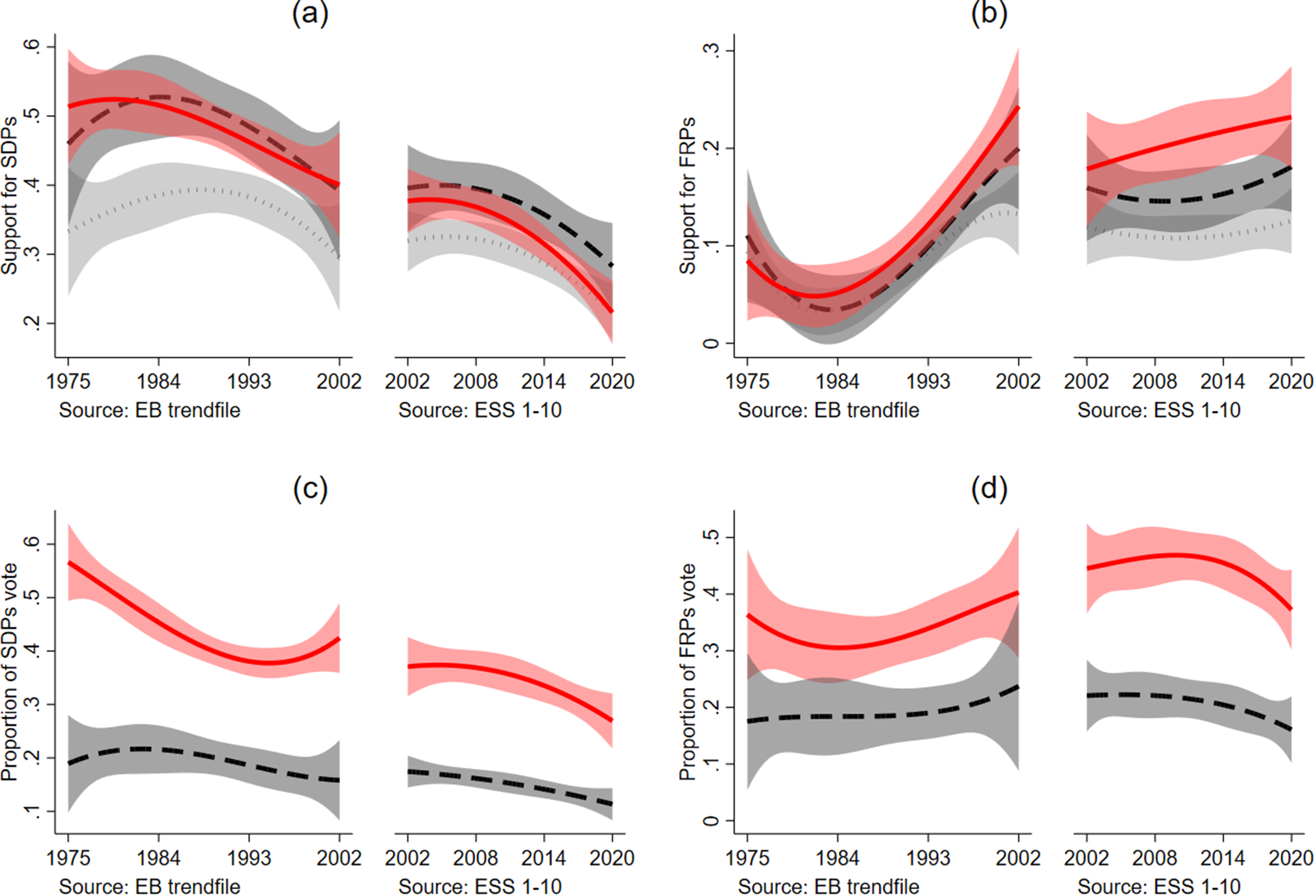
Support for SDPs and the far right: Manual workers and others. Notes: Rate of support for SDPs (a) and the far right (b) among men holding manual jobs (solid line), women holding manual jobs (dashed), as well as the general population (dotted). Panels (c) and (d) display male (solid line) and female (dotted line) manual workers’ share among supporters of SDPs and FRPs, respectively. Italy is excluded from panels (a) and (c) as the largest left-wing party is classified as Radical Left. For a detailed figure including scattered data points for country-years, see the Online appendix. 10
To complement the picture, panels (c) and (d) of the figure present the proportion of men holding a manual job (solid line) and that of women holding similar jobs (dashed line) among SDP and far right supporters, respectively. Corresponding with the fact that more men are occupied in manual jobs compared to women (37% compared to 25% in the Eurobarometer data, and 35% compared to 16% in the ESS data), panel (c) demonstrates that the former are a larger subconstituency among supporters of SDPs compared to the latter. Consistent with our expectation about the link between manual skill and the drift to the far right, it shows that the share of men holding manual jobs among SDP supporters declines over time.
One might argue that the fact that manual workers comprise a smaller portion of the social democratic electorate is simply an artifact of the declining share of manual workers in the general population in advanced industrialized democracies due to technological changes and global economic forces (Gingrich and Häusermann, 2015; Kitschelt and Rehm, 2023). Panel (d) refutes this argument. It shows that while the share of men working in manual jobs among supporters of SDPs declines, there is no decline in the share of men working in manual jobs among supporters of the far right, suggesting that the trend observed in support for SDPs is not merely a product of the decline of this segment of the population but rather an occupational and gender-based realignment of vote choice.
Overall, the above analysis suggests a possible link between the change in the gender gap in support for SDPs and that for FRPs, and highlights the potential role of manual skill in that change. The greater tendency of manual workers to support FRPs, combined with the fact that more men than women occupy manual jobs, contribute to the higher rate of support for FRPs among men than among women.
Increased support for other party families?
Although our focus is on the electoral links between SDPs and FRPs, given the plethora of parties in the systems we study, one might wonder whether manual workers have found a political home in other party families. Figure 3 presents changes in rates of support of men and women holding manual jobs for five party families: the Radical Left, Conservatives, Christian Democrats, Liberals, and Greens. We juxtapose these trends with those of the general population. We begin our analysis with the party family that offers a different solution to workers’ interests: the Radical Left. Figure 3 shows no systematic change over time in the support for the Radical Left among male manual workers (solid line) compared to the general population (dotted). We next examine trends for both the Conservatives and the Christian Democrats, the two key mainstream right party families. Our analysis of the Conservatives suggests that manual workers supported them at lower rates compared to the general population during the earlier part of the sample period. We find no difference in support for Christian Democrats among manual workers compared to the general population. Support rates for the Liberal party among manual workers exhibit a somewhat unclear picture, being lower and higher than those of the general population at different times, although the thick confidence intervals make it harder to draw an inference in this case. Lastly, although more female than male manual workers have rallied around Green parties, the trends show no different direction in the ebbs and flows of their support compared to the general population.
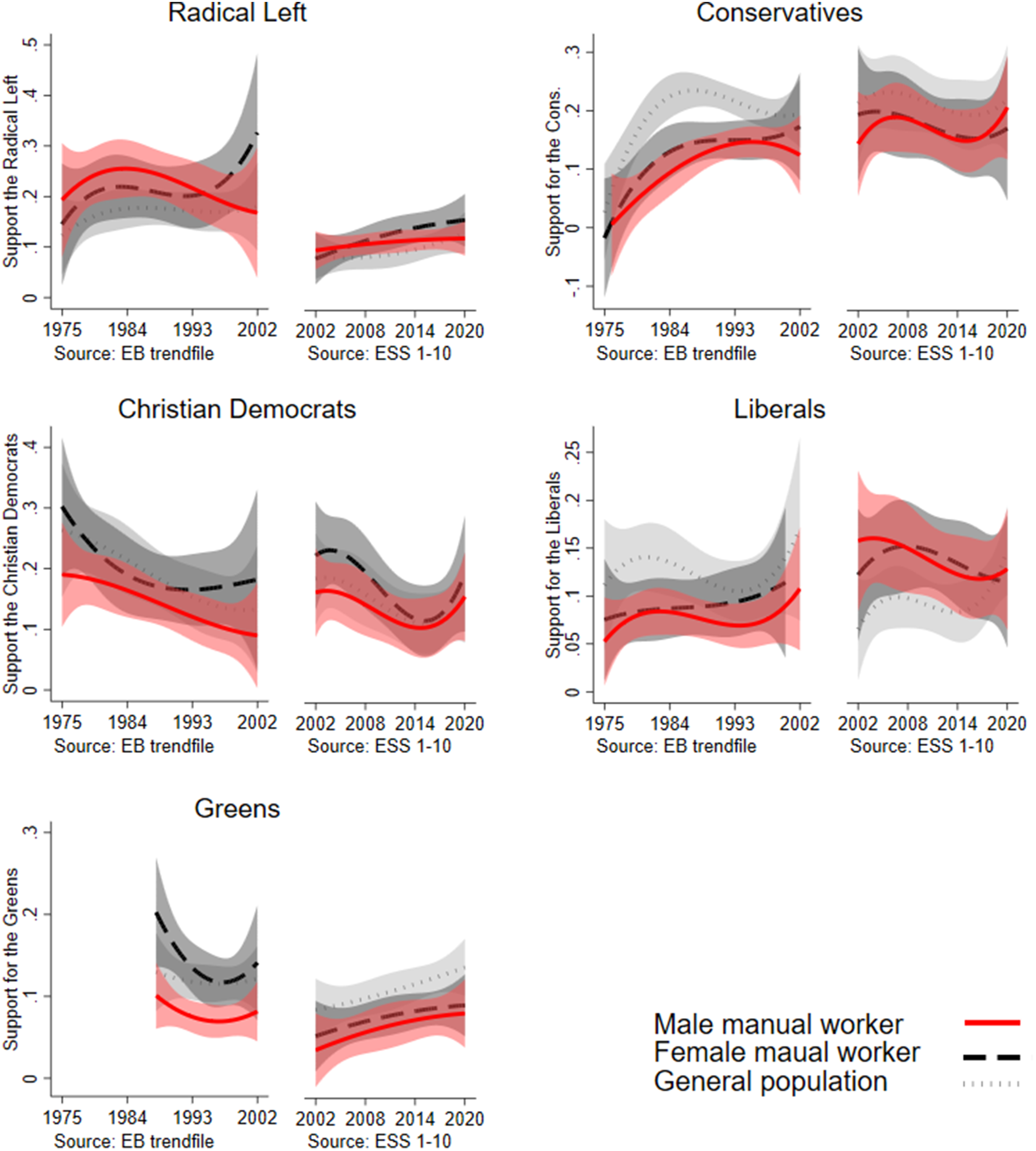
Support for other party families. Notes: Rate of support for the Radical Left, Conservatives, Christian Democrats, Liberals, and Green party families among men holding manual jobs (solid line), women holding manual jobs (dashed), as well as the general population (dotted). 11
Our interpretation of manual skills as a proxy for occupational vulnerability vis-à-vis immigration and trade is bolstered by two additional analyses. First, we utilize a two-round ESS module on labor-market competition (2004 and 2010) that measures subjective job insecurity. In it, respondents were asked how difficult it would be for their employer to replace them and whether they perceived their job to be secure. We find that by both measures, perceived occupational vulnerability is higher among manual workers than among nonmanual workers (two-sided t-tests; p = .02 and p < .0001). Second, we examine economically motivated anti-immigrant attitudes of manual workers compared to nonmanual workers. Our analysis finds that manual workers are more inclined to hold anti-immigrant sentiments compared to nonmanual workers. Compared to their nonmanual counterparts, manual workers agree with the statement that immigrants are bad for the economy and disapprove of the acceptance of immigrants from poorer countries outside Europe at higher rates (two-tailed t-test: p < 0.001 on both items).
Taken together, our findings provide support for our argument of occupational realignment: workers whose livelihood depends on occupations requiring manual skills and are thus particularly vulnerable to competition with immigrants or trade, most of whom are men, realigned their support away from SDPs. Simultaneously, we observe an increase in the support of male manual workers for FRPs but not for other party families. The next section complements this analysis from a different angle: it analyzes how such realignment corresponds to SDPs’ and FRPs’ economic and other policy positions.
Party positions and the gender gap
Are the trends established above contingent on the economic positions taken by SDPs and FRPs? And if so, how? Recall that our first hypothesis linked the gender gap in support for SDPs to their economic positions. In particular, it predicted that when SDPs take centrist policy positions, then the larger the share of men compared to women that occupy jobs in immigration-vulnerable sectors, the smaller the share of men compared to women that support these SDPs.
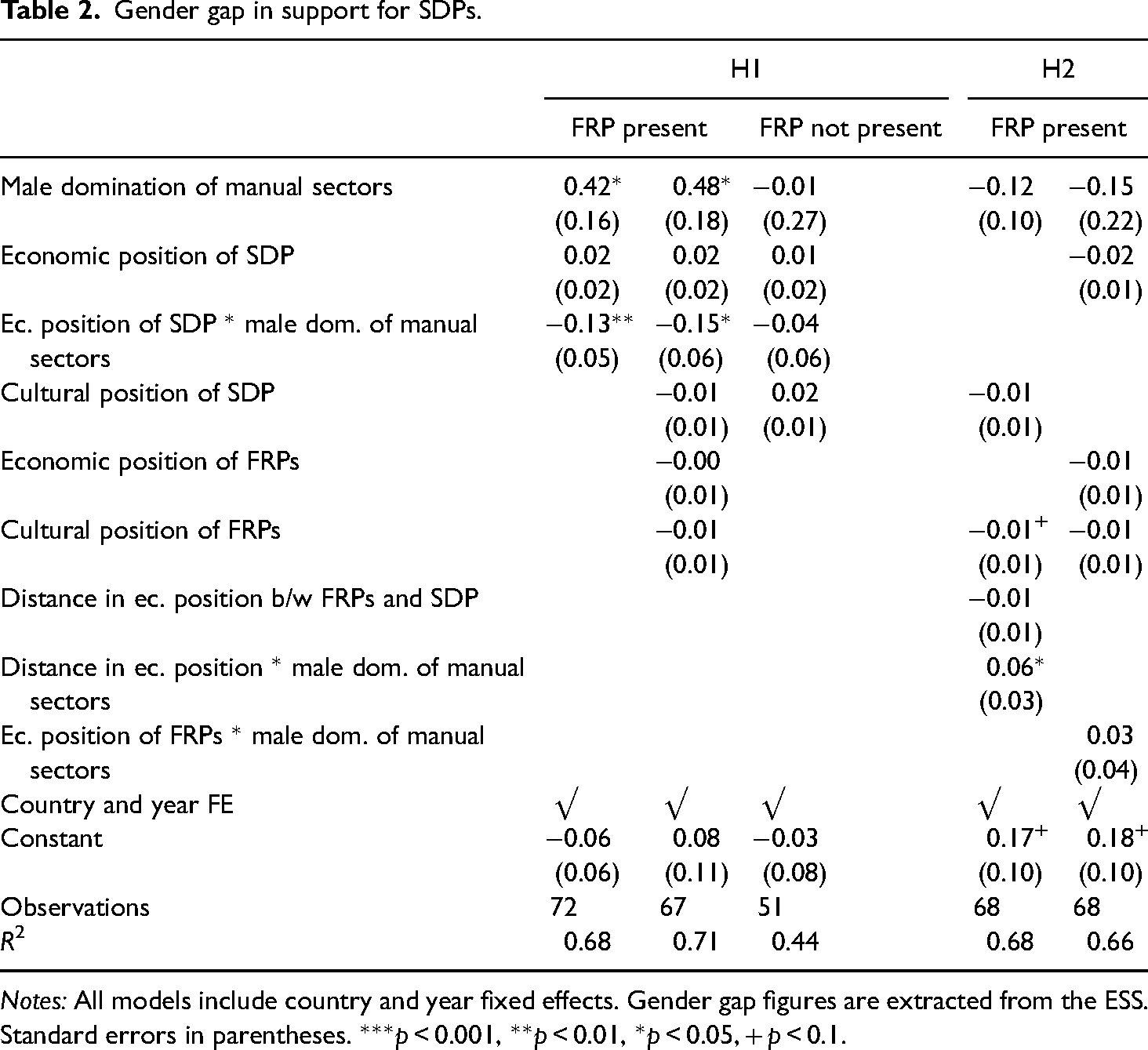
To test this hypothesis, we estimate the gender gap in support for SDPs as a function of the economic positions taken by SDPs in the elections preceding the survey, gender segregation in the manual sectors (both measured as described above), as well as their interaction. Importantly, our analysis also includes the positions of both SDPs and FRPs along the cultural dimension (Hall and Evans, 2022; Kitschelt, 1994). This allows us, among other things, to capture cross-pressures on low-education/low-income voters (Kitschelt and Rehm, 2023). Lastly, we include in the analysis the economic position of FRPs and country and year fixed effects. Results of this estimation are reported in Model 2 in Table 2 (Model 1 is similar, albeit without the controls).
Gender gap in support for SDPs.
Notes: All models include country and year fixed effects. Gender gap figures are extracted from the ESS. Standard errors in parentheses. ***p < 0.001, **p < 0.01, *p < 0.05, + p < 0.1.
Based on the reported coefficients, Figure 4a presents substantive effects: the marginal effect of gender segregation in the manual sectors on the gender gap in support for SDPs (on the vertical axis), modified by the economic position of the largest SDP in the election preceding the survey (on the horizontal axis). All other variables are held constant at their respective mean. Although the confidence interval around our prediction is not narrow, the direction of our results is clear. Where SDPs take a traditional social democratic position (on the left side of the figure), greater male domination of the manual labor market translates to a larger gender gap in support for SDPs with high likelihood. This positive correlation implies that where more men compared to women work in manual jobs, more men compared to women support SDPs. As we move to the right on the horizontal axis and SDPs adopt more market-oriented positions, this relationship fades away: greater occupational vulnerability among men does not translate to greater support for SDPs among men compared to women, and even reduces it. The magnitude of the effect is substantial. Given high male domination of manual sectors (one standard deviation above the mean), a shift in the economic position of SDPs toward the center from one standard deviation below the mean to one standard deviation above it is associated with a decline of 8.2 percentage points in the gender gap in support for SDPs.
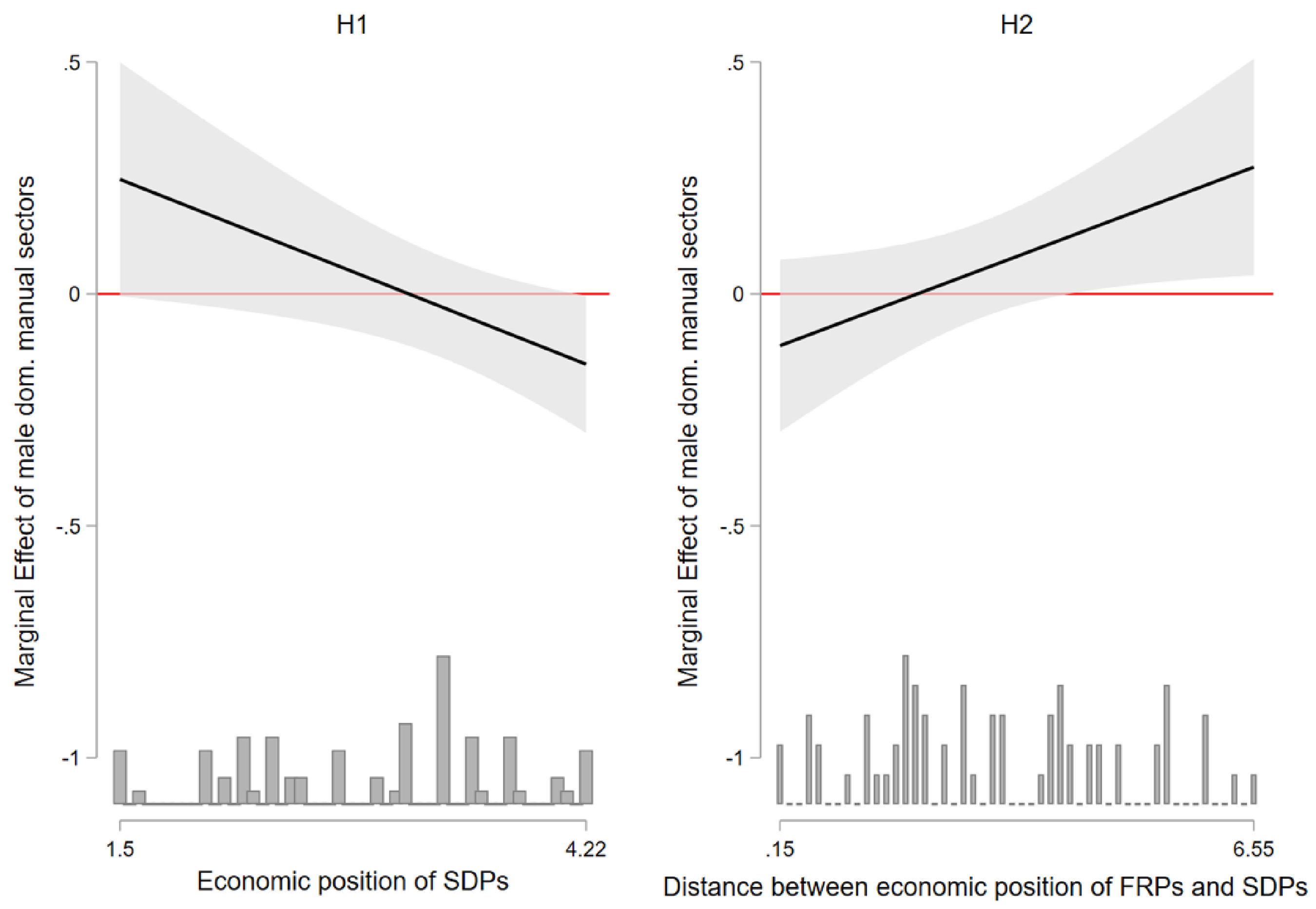
Estimated effect of labor market segregation on the gender gap. Notes: 95% confidence intervals are marked. Results are based on the estimation reported in Table 2, Models 2 (H1) and 5 (H2).
Note that consistent with our expectation, when the far right is not a viable alternative for voters (Model 3), neither the economic position of SDPs nor gender segregation in the manual labor market are correlated with the gender gap in support for SDPs. Overall, then, our first hypothesis finds support in the data.
We turn to our second hypothesis, in which push and pull factors are combined. As a reminder, our expectation was that when the economic positions taken by SDPs and FRPs are clearly distinct, then the greater the share of men compared to women that work in immigration-vulnerable sectors, the greater the share of men compared to women that support SDPs. However, as the economic positions taken by the two party families converge, workers are likely to shift their support and thus cases where more men work in immigration-vulnerable sectors will be associated with fewer men compared to women supporting SDPs.
To test this hypothesis, we repeat the above exercise in which the gender gap in support for SDPs is a dependent variable, except that this time labor market segregation is moderated by the economic distance between the SDPs and the FRPs. Here, too, we include the party positions along the cultural dimension as a control variable, as well as country and year fixed effects. Model 4 in Table 2 reports the raw result of this estimation, based on which Figure 4b presents the substantive effects, this time with the economic distance between the two parties on the horizontal axis. The effect is as predicted. Let us begin with the right-hand side of the figure. When the economic positions taken by SDPs and FRPs are significantly apart, a larger share of men compared to women working in manual sectors is associated with a larger share of men compared to women supporting the left. As we move leftward and SDPs and FRPs converge toward each other's economic policy, greater occupational vulnerability of men does not translate to greater support for SDPs among men compared to women.
To address substantial country variations, we reran the analysis excluding southern European countries (Spain, Italy, Portugal, and Greece), as well as the UK, France, and Ireland. 9 Our results, reported in the Online appendix, hold in the former, yet they lose statistical significance in the latter (although coefficients are in the expected direction). Finally, to complete the picture, we examined the pull factor alone. Analogous to Model 3, Model 5 examines the effect of male domination in the manual labor market as modified by the economic position taken by FRPs. Neither the constitutive terms nor the interaction is statistically significant.
In sum, these results regarding the relationship between the economic positions taken by SDPs and FRPs and the gender gap for the SDPs support our argument about the capacity of political parties to shape processes of occupational realignment. When SDPs or both SDPs and FRPs moderate their economic positions such that they shift toward the center, FRPs successfully present themselves as a substitute for the SDPs in guarding the unmet interests of occupationally vulnerable manual workers. Yet, when SDPs maintain their traditional leftist economic positions or distinctly differ from FRPs, they can retain their traditional constituency of manual workers and halt, to an extent, processes of occupational realignment.
Conclusion
What explains the decline in electoral success of SDPs in spite of the increased support for them among women over the past five decades? This study shows that voting behavior of manual workers—most of whom are men—reconciles the tension between the two trends and explains the reversal of the gender gap in support for SDPs. Importantly, the reversal of the gender gap in support for SDPs is most evident in cases where SDPs moderate their economic positions and in those where SDPs and FRPs converge toward each other's economic position.
Our study opens the door to exciting new research avenues. We highlight three extensions here. The first extension has to do with party positions. In our analysis, we contextualized manual workers’ realignment of the vote using a well-established, albeit quite general, indicator of party economic position. While the left–right economic scale offers a helpful heuristic for party economic positions, one might seek to refine the measurement of economic position, as recent research goes beyond the unidimensional scale of more or less public spending. Parties differ in their emphasis: some focus on income and others on human capital (Beramendi et al., 2015), some on benefits directed at insiders and others on benefits directed at outsiders, some on redistribution and others on social insurance (Häusermann, 2018). A more nuanced analysis would take into consideration the different aspects of socioeconomic policies pursued by different parties, and examine how they affect occupationally vulnerable workers.
The second extension has to do with occupational vulnerability. In our analysis, we point at communication as a key barrier to integration of immigrants and assume that occupations that require communication skill dexterity are harder for immigrants to penetrate. Although communication skill dexterity is a good proxy for the challenge of integration, the degree to which language serves as a barrier for immigrants may vary. Due to historical or cultural ties and colonial history, some relevant host languages are widely spoken in some countries of origin, while others are not. Additionally, similarity varies across languages, making some easier to get command of than others, depending on one's language of origin. Thus, a possible extension of our analysis might entail a more nuanced classification of languages required and those spoken by groups of immigrants in different countries.
Lastly, future research could break down our pooled analysis into groups of countries based on divergent labor market structures, regional differences, and aspects of institutional context. Such analysis would examine the relationships unpacked in this study under different contexts such as Southern vs. Northern European, or different welfare regimes. Given the considerable variations among countries, such unpacking would further shed light on the mechanisms underlying the relationships analyzed in this study.
Supplemental Material
sj-docx-1-eup-10.1177_14651165241257785 - Supplemental material for Party positions and the changing gender gap(s) in voting
Supplemental material, sj-docx-1-eup-10.1177_14651165241257785 for Party positions and the changing gender gap(s) in voting by Orit Kedar, Odelia Oshri and Lotem Halevy in European Union Politics
Supplemental Material
sj-zip-2-eup-10.1177_14651165241257785 - Supplemental material for Party positions and the changing gender gap(s) in voting
Supplemental material, sj-zip-2-eup-10.1177_14651165241257785 for Party positions and the changing gender gap(s) in voting by Orit Kedar, Odelia Oshri and Lotem Halevy in European Union Politics
Footnotes
Acknowledgments
For helpful comments, the authors thank Antonis Ellinas, Alexandra Cirone, Amanda Clayton, Jean-François Daoust, Alper Sukru Gencer, Noam Gidron, Peter Hall, Torben Iversen, Francesca Jensenius, Marc Meredith, Thomas Meyer, Shoham Shenhav, and Dawn Teele.
Declaration of conflicting interest
The author(s) declared no potential conflicts of interest with respect to the research, authorship, and/or publication of this article.
Funding
The author(s) disclosed receipt of the following financial support for the research, authorship, and/or publication of this article: Kedar gratefully acknowledges the support of the Israeli Science Foundation, grant 1523/20. Halevy thanks the Deutsche Forschungsgemeinschaft under Germany‘s Excellence Strategy—EXC-2035/1–390681379.

Data Availability Statement
The data that support the findings of this study are available at: https://dataverse.harvard.edu/dataset.xhtml?persistentId=doi:10.7910/DVN/6TU1AX.
Supplemental material
Supplemental material for this article is available online.
Notes
References
Supplementary Material
Please find the following supplemental material available below.
For Open Access articles published under a Creative Commons License, all supplemental material carries the same license as the article it is associated with.
For non-Open Access articles published, all supplemental material carries a non-exclusive license, and permission requests for re-use of supplemental material or any part of supplemental material shall be sent directly to the copyright owner as specified in the copyright notice associated with the article.
