




Abstract
Studies have sought to explain variation in protection recognition rates between EU member states with, however, limited explanatory power. Surprisingly, few have contemplated the role of the administration, despite it being at the centre of the process through which asylum claims are examined. We posit that recognition rates are significantly affected by administrative capacity, although the administration's action may be mitigated by political factors. Our findings show that administrative effectiveness and experience in asylum matters yield higher recognition rates. We show that government preferences and the overall political context affect protection recognition, too. Importantly, we also find that the mechanisms at play are different if we consider the different forms of protection.
Introduction
As the international refugee protection system stands today, recognition rates for protection statuses varies a great deal from country to country, even in an integrated space such as the European Union (EU). This is so despite the fact that all EU member states are using the same definition provided by the 1951 United Nations’ Convention on the Status of Refugees (henceforth Geneva Convention). Put bluntly, two asylum seekers fleeing persecution from the same country may end up in a very different situation if refuge is sought in country A or in country B, thus casting shadows on the ability of the international protection apparatus to protect those who flee persecution. A wealth of studies has looked into various potential explanations, ranging from economics to politics, with however limited explanatory power (Toshkov, 2014). Surprisingly, only a handful of studies have considered the characteristics of the administration, despite it being at the centre of the process through which claims are examined (Hamlin, 2014; Sicakkan, 2008a). The body of evidence is even thinner if we consider the research that has looked into it in a comparative manner.
This article aims to fill this gap. Namely, we posit that recognition rates are, in part, determined by the features of a given administration, which are in turn mitigated by political factors. These features concern the capacity of state administrations in refugee matters. More precisely, we hypothesize that a more effective administration, and one that has a solid prior experience in asylum matters, is more likely insulated from political pressures (Hamlin, 2014) and thus more capable of evaluating asylum claims on the basis of their merits. Because the evaluation of asylum applications takes place in the legal-administrative machinery of the state, we consider that this is the first place where one should look to explain variation in recognition rates.
In this article, we posit that administrative capacity leads to higher recognition rates where the conditions in countries of origin warrants it. We investigate this hypothesis by comparing recognition of protection in the EU28 in the period 2000 − 2018. Because not all protection statuses are equal, we distinguish recognition for the refugee status and recognition for other protection statuses. The current refugee status stems from the application of the same international norm – the Geneva Convention – in all signatory states. It is also the most generous type of status towards its beneficiaries if we consider the length of stay it gives right to or the lenient conditions for family reunion and acquisition of citizenship it provides for (Sicakkan, 2008a) 1 . Conversely, other protection statuses are more flexible, both in terms of procedures for their granting and in terms of rights they give access to; not least because they are defined at national level, with all the room for discretion and legal changes it might imply 2 . Nevertheless, administrative capacity is unlikely to explain variation in recognition of international protection by itself. In a context marked by rising scepticism towards migration in general, and towards asylum seekers in particular, the process through which one becomes a refugee is inevitably politically charged. Even more so with the domination of the security paradigm in migration policies since the 1990s (Huysmans and Squire, 2010), which tends to conflate international protection with protecting the borders.
Therefore, we set out to evaluate the role administrative capacity plays in explaining variation in recognition rates, in the face of situational and political changes. We draw evidence from the application of quantitative methods and find that administrative capacity matters, although not necessarily in the way we anticipated. Where the situation in origin countries warrants it, an effective administration that has significant experience in asylum matters will display higher refugee recognition rates. However, where the situation in origin countries is comparable, higher capacity tends to decrease refugee recognition rates, thus suggesting greater stringency in the examination of asylum claims. Differently, we also show that government preferences affect recognition of protection, although more so for statuses other than the refugee one. For the refugee status, government preferences only seem to matter where the administration is underdeveloped. In sum, we find that administrative capacity has an effect that mitigates the influence of political factors on recognition rates. Importantly, we also show that the mechanisms at play are different when we consider refugee status or other protection statuses.
What do we already know about the variation in recognition rates?
The variation in protection recognition rates across countries has puzzled a number of researchers. To illustrate the phenomenon, Figure 1 presents the mean recognition rates for both types of status and their standard deviation across EU28 countries for Syrian and Eritrean asylum seekers over the period 2000 − 2018. As is clear from the figure, there is variation over time, and across countries of destination and origin.
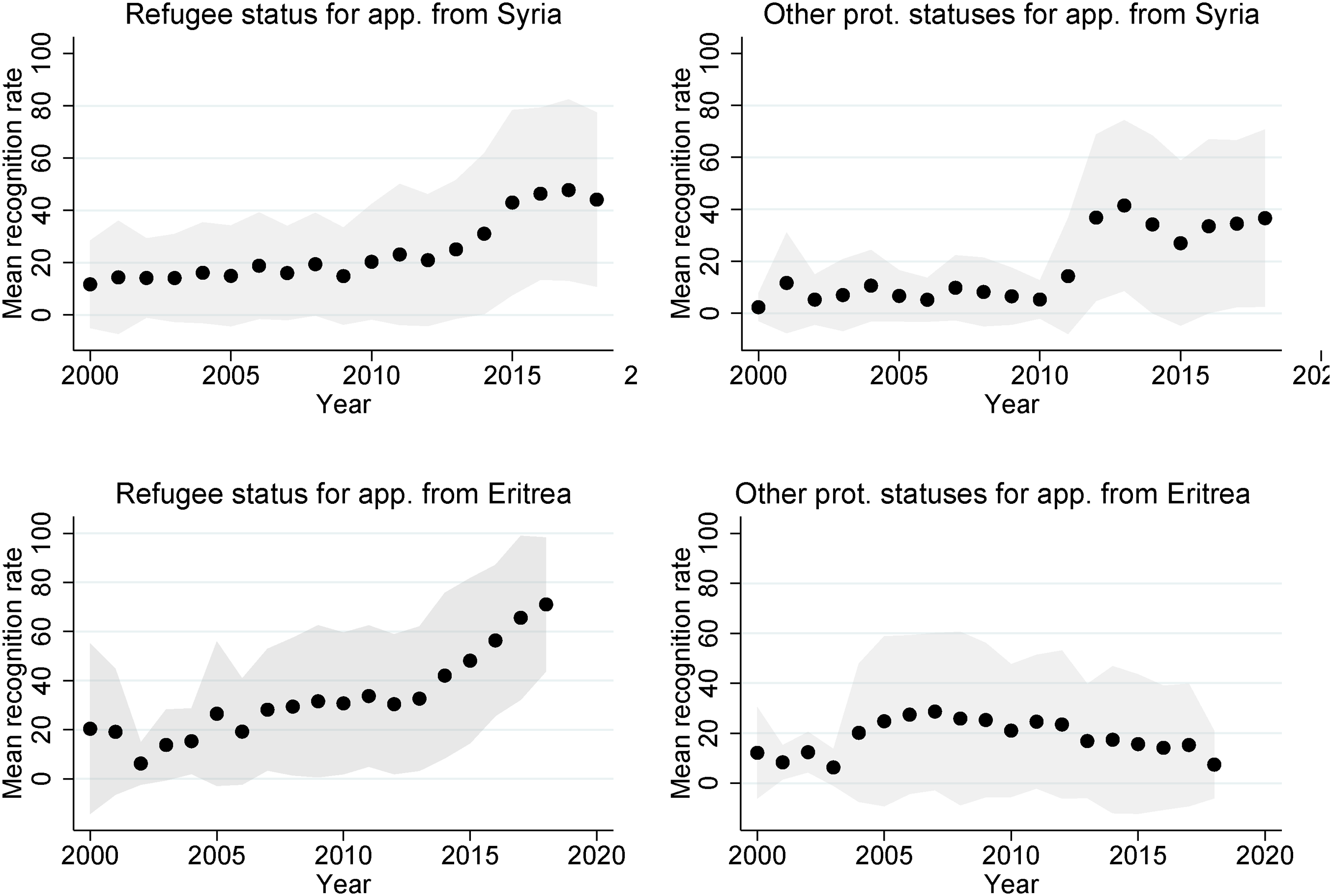
Variation in protection recognition rate for Syrians and Eritreans in the EU28, 2000–2018, refugee recognition and other statuses recognition (mean and standard deviation).
Explaining said variation has mobilized a significant amount of scholarship over the past two decades. This strand of research stems from Holzer et al.'s (2000) early findings highlighting the limited explanatory power of asylum seekers’ individual features. More recently, Gundacker et al. (2021) have shed light on the extra-legal factors driving individual asylum decisions, notably insisting on the discretion of decision-makers. These studies have concluded that the individual characteristics of the asylum seekers and the situation in their country of origin only explain some of the variation between different areas. Therefore, a sizable share of the variation in recognition of international protection is due to factors that fall outside the merits of individual claims. Scholars tested different hypotheses to explain the residual variation in recognition of international protection, with, however, little agreement on what actually accounts for it.
The research agenda that developed based on Holzer et al.'s (2000) work can be divided in two moments that correspond to two different approaches: a focus on receiving countries first; and a dyadic approach that combines receiving and origin countries explanations later. Early studies of variation in recognition rates essentially focused on explanations at the destination country level and considered recognition rates by aggregating all origin countries in a single percentage. Holzer and Schneider (2002) investigated the role of political factors, such as government's position and success of far-right parties in elections, without finding evidence of their importance. Vink and Meijerink (2003) were more interested in convergence of recognition rates between EU countries than in explaining variation. While they presented evidence of some level of convergence with caution, their study contributed to outlining the importance of factors that fall outside individual claims and inside the political realm. These studies presented little evidence to build on, something which can be attributed to methodological choices. Focusing on destination country factors, their analysis relied on aggregated recognition rates which, consequently, omitted factors connected to countries of origin. Yet, the original purpose of international protection is that of protecting people from persecution when their country of origin is unwilling or unable to safeguard their lives.
In a second moment, research on recognition rates started to consider characteristics of the country of origin through a dyadic approach that disaggregated recognition rates by countries of origin and destination. Neumayer's (2005) work is the first one of the kind: he compares explanations relating to both origin (political oppression, human rights violations, interstate violent conflict, genocide and politicide) and destination countries. Even when accounting for sending countries’ features, he finds that considerable unexplained variation from one destination country to another persists. Analysing data for 14 EU member states, Norway and Switzerland from 1980 to 1999, Neumayer (2005) shows that recognition rates for full refugee status depends on factors outside the merits of the asylum claims. Namely, origin-specific past asylum seeker numbers and unemployment rate in destination countries are negatively associated with the recognition of the refugee status. Building on previous research that has highlighted the effect of protection claims on recognition rates (Holzer et al., 2000; Neumayer, 2005; Vink and Meijerink, 2003) and the effect of recognition rates on the number of applications (Neumayer, 2004), Toshkov (2014) proposes to investigate the dynamic and two-way process between asylum applications and recognition: higher recognition rates may spur further applications and more applicants may lead to lesser recognition rates. The author finds evidence of a relationship in statistical terms, but the magnitude of the reported effects is limited in substantive terms, even when economic and political factors are controlled for.
In a different manner, Avdan (2014) explores the role of the migration-security nexus and considers the effect of transnational terrorism on recognition rates. She posits that asylum seekers from countries that are sources of transnational terrorism are less likely to be granted protection but finds no evidence thereof. Instead, she finds that “policy tightening in Europe does not discriminate against origin countries that export terrorism even when such attacks involve victims of recipient states” (Avdan, 2014: 465). Differently, terrorist violence within origin countries seems to increase recognition rates, a finding in line with the intentions of the Geneva Convention.
Interestingly, only a handful of studies has looked into the legal-administrative systems on which asylum decisions rest. Yet, determining who is entitled to protection and who is not is an eminently legal-administrative process through which a variety of situations are translated into a binary outcome: either protection is granted or it is not (Caestecker and Moore, 2010; Hathaway, 1991; Triandafyllidou, 2016). To put it differently, asylum seekers are recognized as refugees through the positive outcome of the administrative process aimed to determine their need for protection due to well-founded fear of persecution in their country of origin. Resultantly, even though recognition of the refugee status derives from the interpretation of the same international law, it is by no means a straightforward process, and one that may generate variation from place to place. This phenomenon finds evidence in Hatton's (2021) study of the effect of EU asylum policy on recognition rates. He shows that, if the implementation of the Common European Asylum System has contributed to increasing recognition rates, large differences remain between destination countries. In a different manner, Sicakkan (2008a) demonstrates that institutional arrangements for Refugee Status Determination matter. Comparing EU15 member states, Norway and Switzerland over the period 1990 − 1999, he shows that the concentration of decision-making in the hands of the state (as opposed to sharing the decision power with other actors such as the United Nations High Commissioner for Refugees, UNHCR) is conducive of lower recognition rates. Relatedly, Hamlin (2014) compares Canada, Australia and the USA and finds that the insulation of the administrative decision-making body from political pressures leads to more generous, and more stable over time, recognition rates. While Hatton's work points to the effect of EU directives on recognition, the two latter contributions emphasise the importance of the administrative process leading to recognition on the one hand, and stress the potential effect of political decision-making or pressure on the outcome on the other hand.
The role of the administration and the political context in which it is embedded
We propose an explanatory model that accounts for the capacity of states’ administrative machinery while contemplating the influence of the political context in which the administration is embedded. We thus consider the recognition of protection status as being affected by both ability and will to protect. As explained in the introduction, we examine recognition for the full refugee status – the most standardized one, stemming from international law – and recognition of other, nationally defined, protection statuses separately. While other studies have considered, on the one hand, recognition for the full status and, on the other hand, recognition for refugee status together with other statuses (in what we could call an overall protection rate; Neumayer, 2005; Sicakkan, 2008b), our research question requires that we distinguish them more clearly. Nationally defined statuses likely guarantee less rights than Convention status (ECRE, 2017), and the rules according to which they are attributed likely leave more room to government preferences or administrative discretion 3 .
Given the foregoing and assuming the eminently legal-administrative nature of protection recognition, the capacity of a given administration to process asylum claims becomes decisive. We define administrative capacity as being made of two crucial components: the administration's effectiveness and its prior experience in asylum matters. Effectiveness relates to the quality of policy-making, from policy design to implementation. An effective administration is also insulated from political pressures (Hendrix, 2010; Rothstein and Teorell, 2012). Whereas effectiveness is about general administrative capacity, prior experience is specifically connected to asylum matters and concerns the extent to which an administration is likely to avail of a dense set of rules to go about its tasks.
In the Weberian tradition, modern administration is characterized by a sizeable bureaucracy that carries out its activities under procedurally correct legal enactments, and the legitimacy of the rules rests on legal authority (Weber, 2013). Furthermore, under the success and spread of New Public Management in Europe in the 1990s (Pollitt and Bouckaert, 2011), a trend that has also touched Central and Eastern European countries through EU pre-accession agreements (Sigma, 2009), the Weberian notions of impartiality, legality and neutrality of the administration were supplemented with systems for the evaluation of civil servants’ competence and effectiveness. Resultantly, a competent administration avails itself of a dense set of rules, which guarantees procedural certainty, accountability, and predictability. Its staff consists of transparently selected and trained professionals who act in depoliticized ways in their function as civil servants. These imply a requirement for effectiveness, which encompasses rule-abidance and independence of the administration. The EU additionally endorsed these as guiding principles for the creation of a European Administrative Space (Sigma, 1999). Our hypothesis is therefore that, at higher levels of effectiveness, the evaluations of asylum claims duly appreciate the risk incurred by the claimants in their countries of origin. Accordingly, higher effectiveness would translate in higher recognition rates, provided that the situation in origin countries leads to well-founded fear of persecution.
As to experience with asylum matters, the full range of tasks the administration is to complete covers a wide array of domains, not all of which bear the same relevance from one country to another. Because all EU member states (old and new) had ratified the Geneva Convention by the mid-1990s, they had to have a minimum set of rules in place to process applications and abide by their non-refoulement duty. In addition, most EU member states had to implement the EU Directives ensuing from the Common European Asylum System over the period under scrutiny. However, not all countries have experienced functional pressure to develop comprehensive regulatory frameworks on the matter. Therefore, the more asylum seekers a member state has received in the past, the more likely its administration has built expertise on the matter. This translates in a higher likelihood for the administration to avail of a specific set of primary (constitutional and legislative), but also secondary (implementation decrees, regulations, circulars) and jurisdictional (case law) provisions which limit the discretion of civil servants (Zaun, 2017). Consequently, while administrations which have not had prior experience managing asylum flows may have laws “on paper” (notably due to transposition of international or European law), administrations which have had significant experience handling asylum claims are characterized by a rich, “closed-mesh” (Zaun, 2017: 28) set of norms on the matter. This is especially true where the administration is effective and capable of transforming experience into rules. Where previous experience is high, therefore, countries of origin characteristics are duly taken into consideration and outcomes of refugee status determination tend to be more positive where people's rights are more likely to be violated.
H1: The higher the administration's effectiveness, the more asylum claims are examined on the basis of their merits, which translates in higher recognition rates in cases in which rights are more likely to be violated in origin countries.
H2: The higher the administration's previous experience in asylum matters, the more asylum claims are examined on the basis of their merits, which translates in higher recognition rates in cases in which rights are more likely to be violated in origin countries.
H3: The combined effect of high prior experience and high administrative effectiveness is associated with claims examined on the basis of their merits, which translates in higher recognition rates in cases in which rights are more likely to be violated in origin countries.
The administration's logic of action may, however, be contrasted by the political colors of the government in office, which may attempt to exert pressures on the administration to achieve further control on immigration 4 . As Schedler (2003) argues, administration and politics are moved by two different rationalities: while civil servants’ activities are likely motivated by the fulfilment of tasks in a spirit of legality and legitimacy, politics is driven by the formation of majorities and the winning of positions through elections (Schedler and Eicher, 2013). With the domination of the security paradigm in migration policies since the 1990s (Huysmans and Squire, 2010), asylum has increasingly shifted from a humanitarian matter to an immigration issue (Morris, 2002), thus conflating protection with border control. Consequently, government preferences are likely to matter: negative positions on the issue likely lead to lower recognition of protection needs, especially where the administration is weakly insulated from political pressures (a point also raised in Hamlin, 2014) and where the set of rules governing administrative practice tends to be sparse. Beyond questions of a given government's position on a specific issue, how much that issue is important for the parties in office likely affects the outcome of procedures (Laver, 2001). We therefore control for saliency of the issue. We also control for the overall political context by considering the percentage of votes for far-right parties and policy supply of migration policy (i.e., the position on migration of all the parties in competition in national elections).
H4: The more negative or positive the position of government towards migration, the more recognition of protection varies in concordance with said position.
H5: The higher administrative effectiveness, the less government's position affects recognition rates.
Data, operationalization and method
Empirical strategy
We test our hypotheses on protection recognition rates in destination country d, for asylum claims coming from country of origin o, in year t. The structure of the data imposes that we account for the violation of the assumption relating to independent and identically distributed random variables. We thus estimate models with fixed effects at both destination and origin country levels. Our starting equation is as follows:

Because our dependent variables (percentages) are bounded up and down and highly positively skewed (see the Online appendix for graphic representation), the assumptions of linear regression (notably homoskedasticity of the residuals and linearity of the relationship) are not verified and the estimates produced via equation (1) are biased, especially at the tails, which are of prime importance. To account for the distribution of our dependent variables, we resort to generalized linear models (GLM) with a logarithmic link function. This approach has been little employed in previous research on the topic despite it being more appropriate for the data at hand as it better accounts for the zero-inflated distribution of the dependent variables (the Online appendix discusses the issue at length; see also Motta, 2019). The model that best fits our data – thus producing accurate estimates – is the linear negative binomial, also called NB1 (Hilbe, 2011; see the Online appendix for model fit and robustness tests). We therefore maintain the structure of equation (1) but substitute the linear model with the following form:

Data and operationalization
In the lines that follow, we succinctly present our variables. More details are available in the Online appendix. Our dependent variables, the recognition rates, are taken from the UNHCR's population data, which provides information on the decisions taken in a year. On that basis we calculate two recognition rates: one for refugee status and another one for other statuses. Following common practice, we consider recognition rates as being the percentage of positive outcomes (protection is granted) out of the total number of decisions in a year (see inter alia Neumayer, 2005; Sicakkan, 2008b; Toshkov, 2014). Because the information compiled by UNHCR comes from different countries, which follow different rules and practices regarding data collection, and different protection policies, the calculation of recognition rates merges together decisions taken at different levels (first and last instance, reopened cases, etc.) but excludes decisions that clearly fall outside the scope of the administration (for instance judicial decisions). Such aggregation may be problematic where decision instances cannot be clearly identified, which may affect the precision of our results. This is however the most comprehensive source of information. Note also that the use of destination country fixed effects accounts for the specificities of national protection regimes.
Regarding our independent variables, we test our hypotheses with different variables aimed at capturing the effect of capacity and politics. We measure the concept of capacity in two ways. Firstly, we use the World Bank Governance Indicator on government effectiveness (Kaufman and Kraay, 2019), which relates to the overall quality of public services and is the best fit for the first component in our definition of administrative capacity. It conveys information on the quality of the policymaking process, from policy design to implementation, a necessary condition for the administration to function. It is also a proxy for civil servants’ rule-abidance attitudes and independence from political pressure, and thus the predictability of their behaviour. The World Bank's indicator is a composite, broad and diverse indicator (Van de Walle, 2005) and is thus not perfect. It is however the most comprehensive indicator of administrative capacity for our study (see the Online appendix for a discussion).
Regarding previous experience to asylum matters, we follow Zaun (2017) but adapt her approach to our study, which includes a larger set of countries over a longer time span. We therefore proceed in two steps. First, we create a baseline indicator that combines the mean of the stocks of refugees and asylum seekers over the years 1990 − 2000 with the mean of the flows (in number of asylum applications) in the same period. To produce comparable values, both items are standardized by the destination country's population before being multiplied. The indicator is then rescaled to ease interpretation (see the Online appendix for more detail). Second, because our analysis considers 18 years of asylum processing, we increment the baseline indicator's value with the relative percentage of asylum applications received in a member state out of the total applications lodged in the EU. In this manner, countries that received few applications in the decade prior to our study's timespan (and therefore would display low experience), and more applications over the years after, have their experience re-evaluated and augmented. This provides a dynamic indicator of experience with values of a similar range between the decade prior and subsequent ones. Figure 2 displays the distribution of our two capacity variables by country, in ascending order of cumulative experience. We provide a detailed explanation of the variable's construction and further illustration of its distribution in the Online appendix.
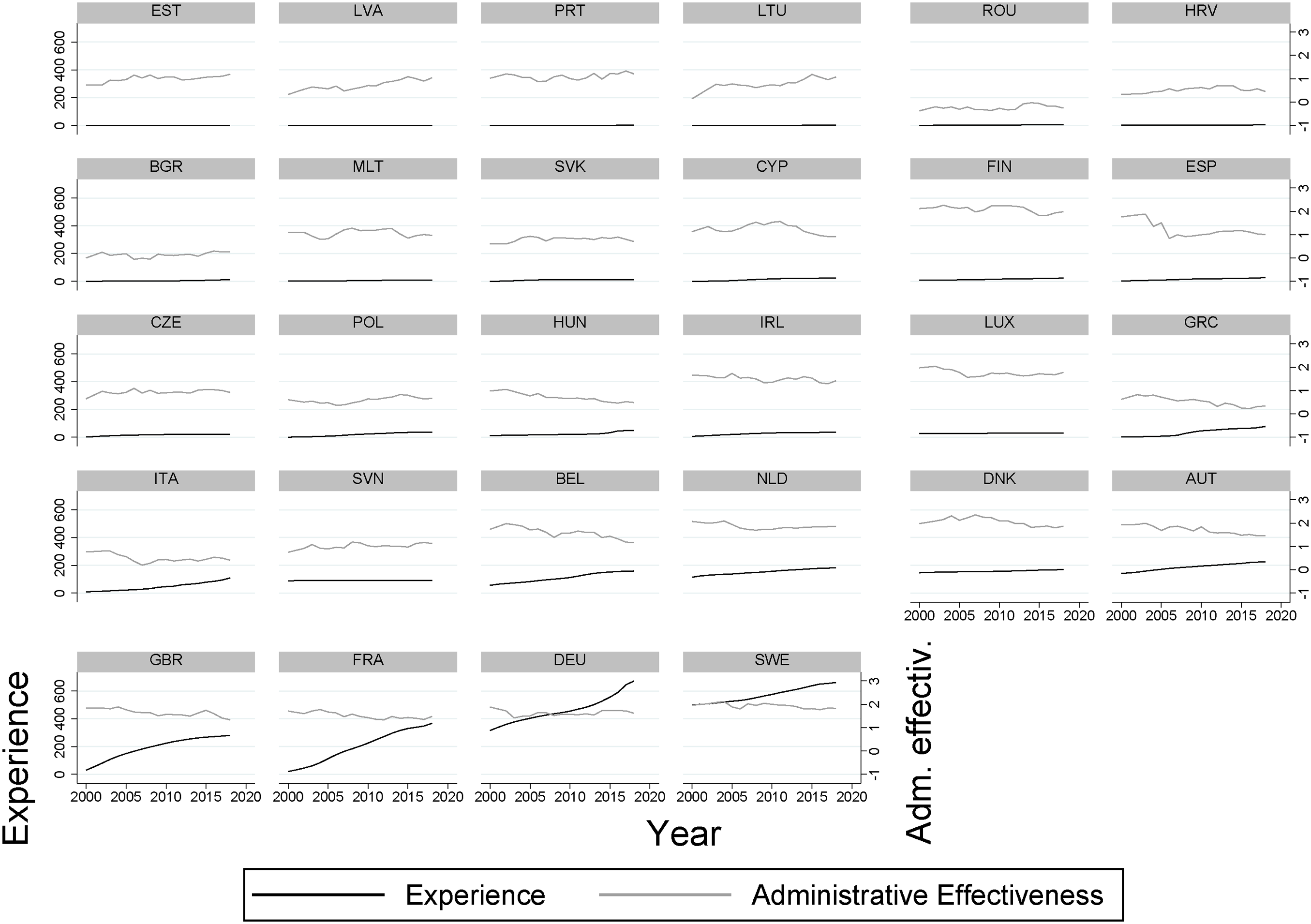
Distribution of prior experience in asylum matters (left axis) and administrative effectiveness (right axis) in the EU28 over time.
As for the effect of politics, we derive our variables from the Comparative Manifesto Project data (CMP), which codes all the sentences of party manifestos along a range of policy issues. Firstly, we test the effect of positions on migration of the coalitions in government. We start from single parties’ positions on issues related to migration and aggregate them for coalition preferences by weighting their respective importance in the lower chamber. As for the issues relating to migration, we follow Alonso and Da Fonseca (2011) and proxy position on migration through positions on multiculturalism and positions towards minority groups. Position on migration is then determined as the difference between the percentage of positive and negative statements; thus, negative values reflect restrictive positions on migration and vice versa. We also test the effect of salience of migration issues for the political parties in the governing coalition, as operationalized in Alonso and Da Fonseca (2011). The Online appendix provides extensive explanation and information on alternative calculations, notably compared with that used by Toshkov (2014). We also account for dissensus within coalition, as it can affect government's ability to weigh on asylum decision processes. We thus consider the standard deviation (population formula) of the respective positions of the parties in coalition. Additionally, we control for the success of far-right parties in the elections. Far-right and anti-migration preferences are different in essence: whilst far-right refers to a general positioning on the left-right political spectrum (Camus and Lebourg, 2017), anti-migration refers to a policy-specific preference that may cut across the left-right dimension. That being stated, the difference in theory between the two denominations is counterbalanced by a strong overlap in practice: anti-migration parties tend to be those placed at the far right of the political spectrum (van Spanje, 2011). Parties are classified as far-right in accordance with The PopuList dataset (Rooduijn et al., 2019; see the Online appendix for more detail). In order to account for potential cohort effects; i.e., situational or time-dependent changes in party positions, we compute a proxy for supply of positions on migration. Namely, supply is the mean of all parties’ position on migration in a given election. It tells us what sort of policies are available for the voters to choose from. Finally, we control for the ability of government to enforce its position with a dummy variable on whether it is backed by a majority in the lower chamber or not.
Regarding control variables, one set pertains to destination countries and another to countries of origin. Our destination country variables comprise socio-economic controls that capture cross-country and time heterogeneity and that may affect countries’ overall attitudes towards migration and asylum. GDP per capita, growth and unemployment encapsulate macro-economic differences; and old-age dependency ratio reflects differences in terms of ageing labour force and possible pressure on welfare policies. We also include a series of migration pressure controls. The total number of applications lodged in the previous year and over the past three years respectively capture the pressure on the administration to process asylum claims and the potential will to curb pull-factors 5 . Percentage of foreign nationals living in the country aims to capture the size of so-called outgroup, which may affect overall attitudes to migration. We include a dummy variable to indicate the years marked by the so-called “refugee crisis” and the increase of asylum flows. Following Hatton (2021), we also account for transposition of the EU Qualification and Procedure Directives (both original and recast directives) via a set of dummy variables.
Origin country controls are demographic, economic, and political. Namely, we consider life expectancy, population density, unemployment rate and GDP per capita for the socio-economic features that may act as “push-factors”. For the political characteristics, we account for political rights and civil liberties (Freedom House data), human rights violations (Political Terror Scale data), intensity of (enduring) conflicts through the number of casualties in a year and over the last five years (Uppsala Conflict Data Program data on georeferenced events) and asylum pressure (total number of asylum application lodged in the EU in a year from a given country; UNHCR data). Following Neumayer (2005), we also add the number of asylum claims for an origin-destination dyad over the previous two years.
Note that all the variables that could be standardized by origin or destination country population were standardized in order to make the values more comparable and reduce the probability of having outliers (see detail and references in the Online appendix).
Empirical results
Table 1 reports the results of six models and Table 2 reproduces six additional models with interaction terms. For ease of reading, we only display the coefficients of interest. The full list of coefficients is provided in the Online appendix. Recall that the coefficients are semi-elasticities and are thus to be read as multiplicative factors: values below one have a negative effect on the dependent variable; values above one have a positive effect. Before discussing our hypotheses, it is important to highlight the effect of specific origin country characteristics – those that echo the humanitarian goals of protection – on recognition rates. Notwithstanding their positive effects, the recognition of refugee and other statuses follow a different pattern. The former is primarily granted in cases of violation of political rights and civil liberties ( + 12.6%), and violation of human rights ( + 13.5%). Differently, other statuses are more often granted in cases of human rights violation ( + 13.7%). The effect of these variables shall be kept in mind throughout this section and is reflected in our analyses.
Selected regression results, exponentiated coefficients on EU28, 2000 − 2018.
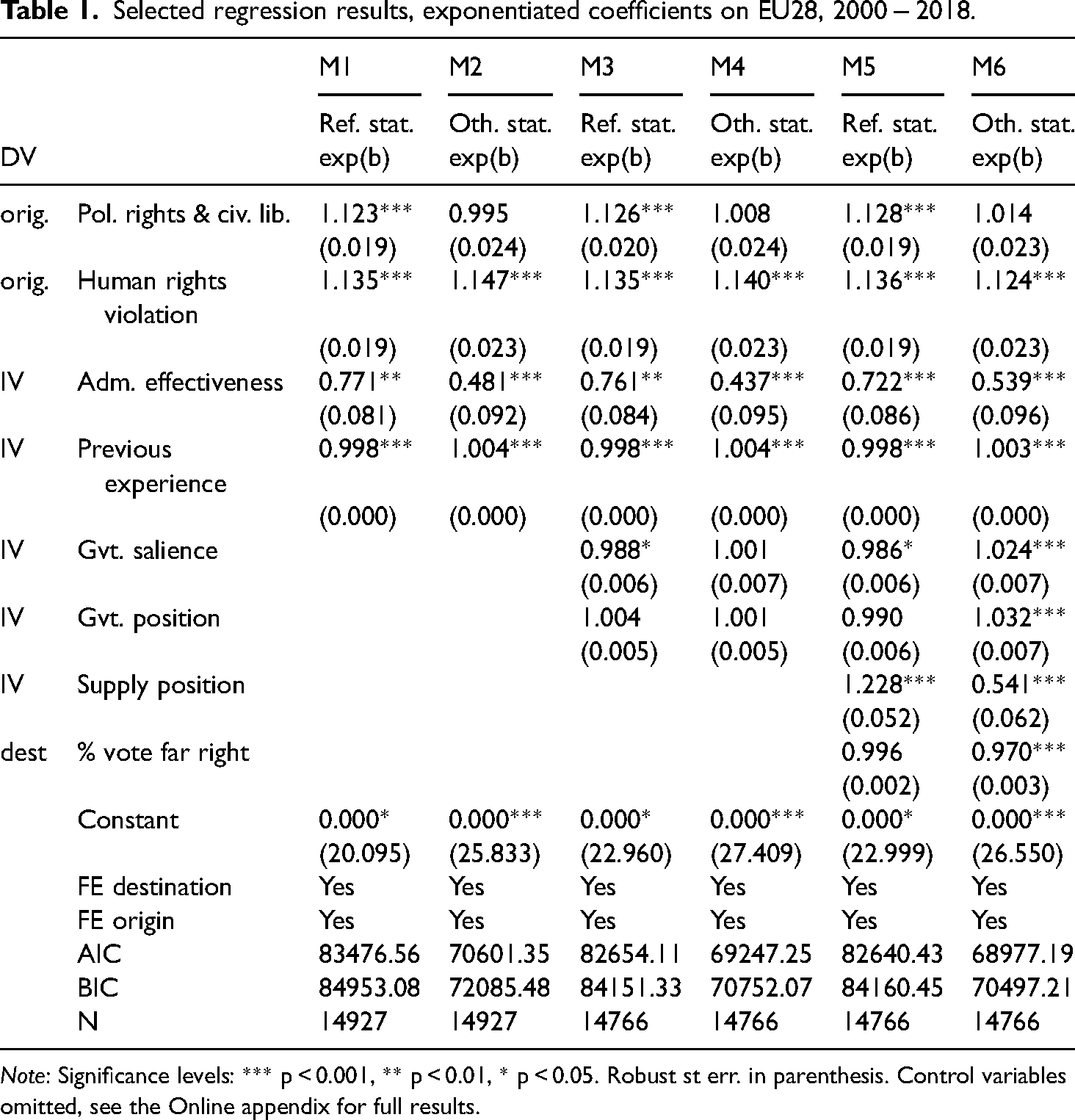
Note: Significance levels: *** p < 0.001, ** p < 0.01, * p < 0.05. Robust st err. in parenthesis. Control variables omitted, see the Online appendix for full results.
Selected regression results, exponentiated coefficients on EU28, 2000–2018, interaction effects.
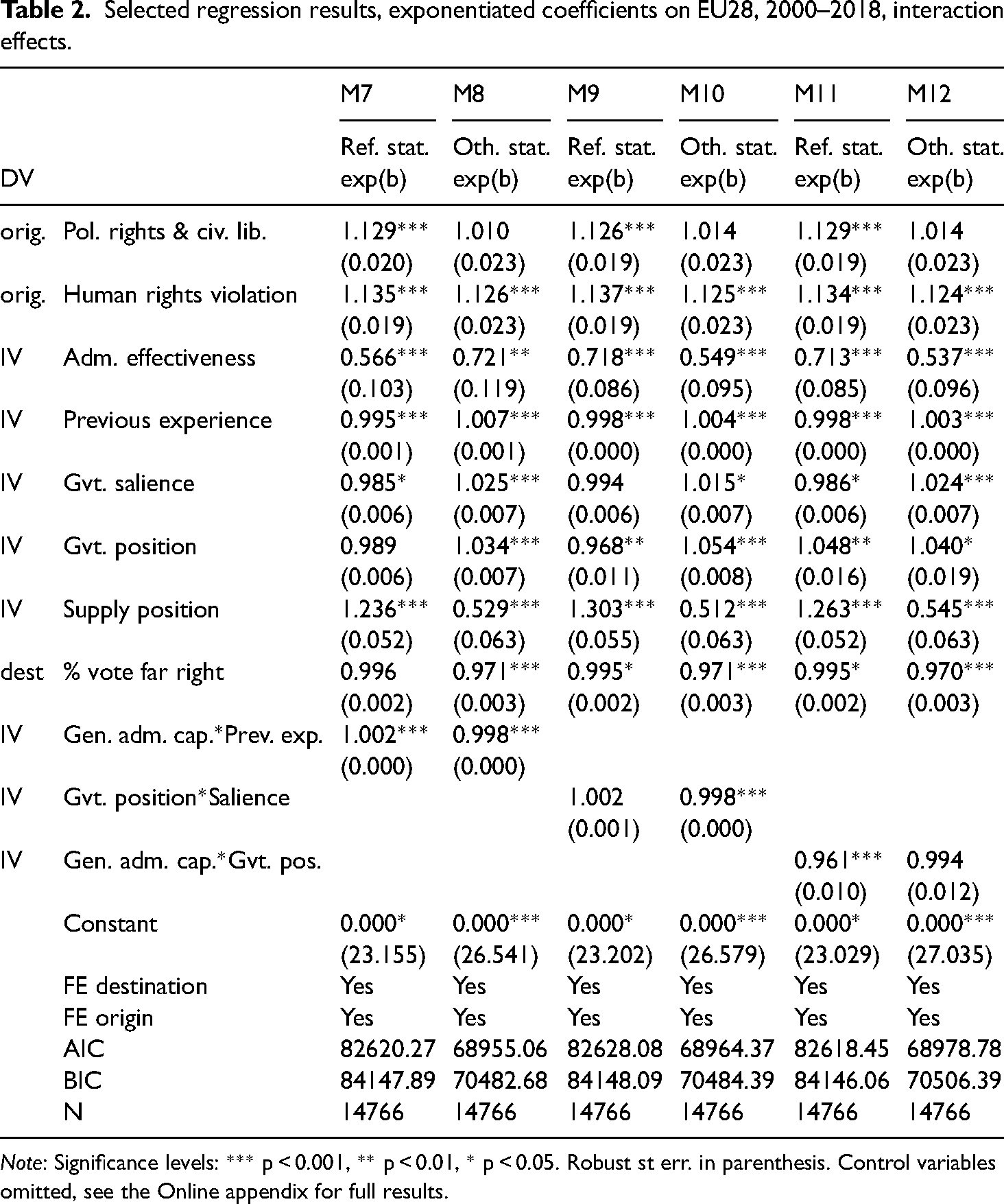
Note: Significance levels: *** p < 0.001, ** p < 0.01, * p < 0.05. Robust st err. in parenthesis. Control variables omitted, see the Online appendix for full results.
The effect of administrative capacity
The first two models (M1-M2) contain our independent variables for administrative features–namely, administrative effectiveness, and previous experience in asylum matters. They aim to provide a first test of our hypotheses H1 and H2 as well as to create a baseline on which to evaluate the effect of our other covariates.
The results delineate a different pattern for refugee and other statuses, albeit not the one hypothesized. Overall, administrative effectiveness decreases recognition for both statuses, more so for other statuses (by 51%) than for refugee status (by 25%). Differently, previous experience tends to decrease recognition rates for refugee status while it increases recognition rates for other statuses. We test these effects further by calculating the predictive means of the two variables at different levels of rights violation via interaction effects 6 . Whereas the effect of administrative effectiveness and previous experience on refugee recognition is negative, recognition rates are significantly higher in cases in which rights are being violated in countries of origin (Figure 3; top-row), thus confirming in part H1 and H2. For other statuses, administrative effectiveness decreases recognition, but at a higher rate than refugee status (given the steeper slope), while previous experience increases it (Figure 3; bottom-row).
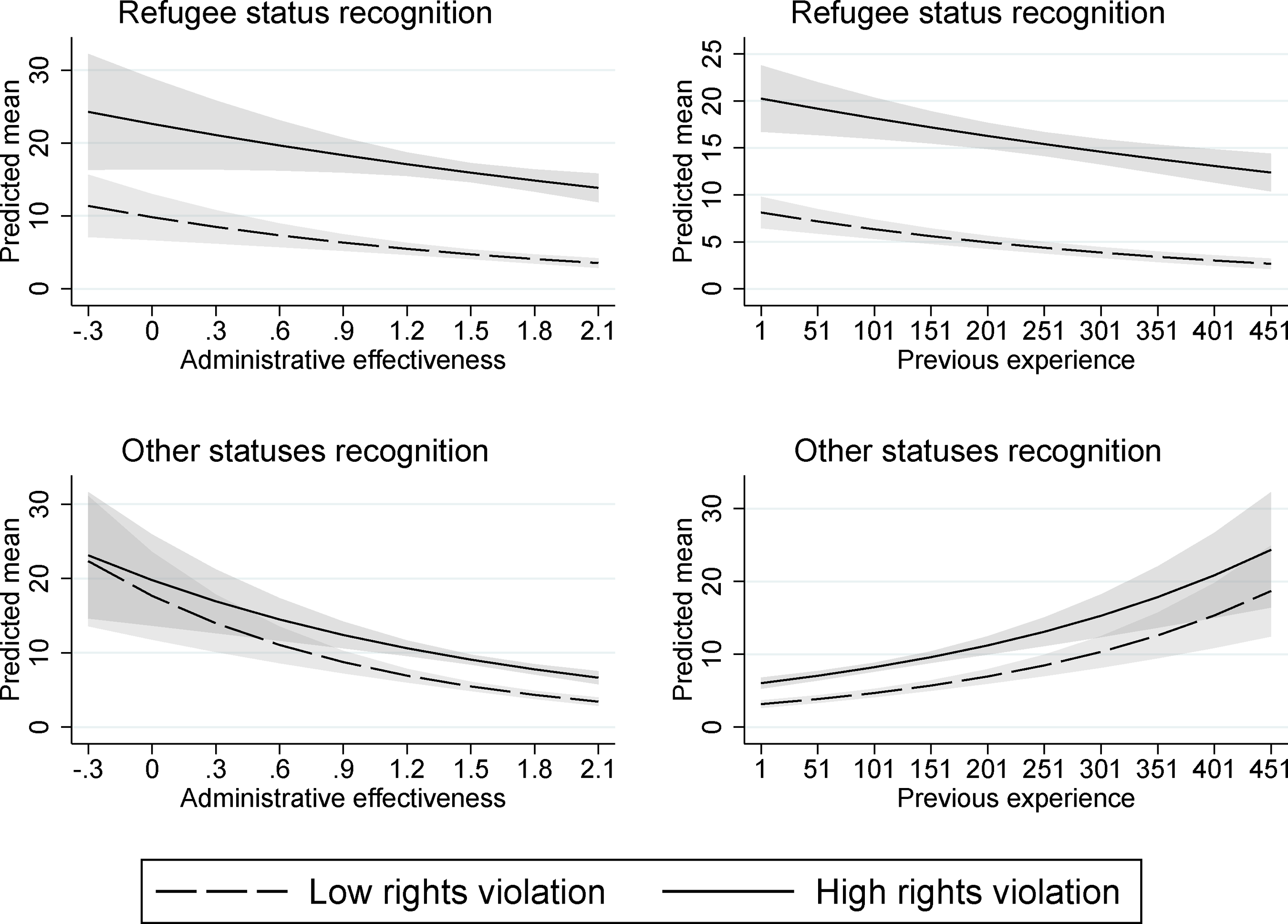
Recognition rates for the two types of statuses at different levels of rights violation and administrative effectiveness or previous experience (estimation based on M5-M6).
These patterns are also robust to different specifications as the introduction of the politics variables do not alter the coefficient's magnitude much (M3-onwards).
In order to test the effect of total administrative capacity, that is, the combined effect of effectiveness and experience with asylum matters (H3), we introduce an interaction term between the two variables (M7-M8 in Table 2) in the full models; this proves statistically significant for both refugee status and other statuses recognition rates, which we investigate further by computing the predicted means of the dependent variables at different levels of administrative effectiveness where experience to asylum matters is set to high and low levels 7 . To account for different conditions in origin-countries, we add rights violation as a third interaction term (not reported; displayed in Figure 3).
Most importantly, at high levels of experience and violation of rights, recognition rates for refugee status increase as effectiveness increases too, thus confirming, in part, H3. Differently, this relationship is inverse for lower experience and high levels of rights violation, for which recognition rates are higher at low levels of effectiveness. For low levels of rights violation, we observe that more experience translates into lower recognition rates; especially so as effectiveness increases. For other statuses, the predicted means at high and low values do not add relevant information to the effect of the variables considered separately.
Altogether, our findings partly validate H1: higher effectiveness does translate in higher recognition rates if one considers different levels of rights violation but, at parity of said violation, the effect of effectiveness for refugee status and other statues is negative. H2 is partly verified as previous experience appears to shrink refugee recognition rates whilst it increases that of other statuses. We find evidence in support of H3 for recognition of refugee status, especially at high level of experience and violation of rights but this does not hold for other statuses. Considered together, the results presented thus far suggest that, more than higher recognition rates, higher administrative capacity may well be conducive of more stringent evaluation of claims. As Figure 3 shows, effectiveness decreases recognition of refugee status but it also does so, in greater proportions, for other statuses. Likewise, previous experience decreases refugee recognition rates but it increases recognition for other statuses, thus suggesting the possibility of a transfer from one category to the other: those who do not fulfil the conditions for the refugee status obtain other forms of protection, more likely so in cases in which the conditions in the origin country do not guarantee safe return. Figure 4, instead, demonstrates that, where the administration is highly capable (i.e., effective and with experience), refugee status is more likely granted, provided the situation in the origin country is characterized by high levels of rights violation. In cases of low levels of rights violation, higher administrative capacity translates into low recognition rates. The fact that the pattern differs between the two types of statuses concurs to the stringency argument whereby a capable administration, made up of trained, rule-abiding professionals, processes claims with more scrutiny, thus placing greater burden of proof on claimants.
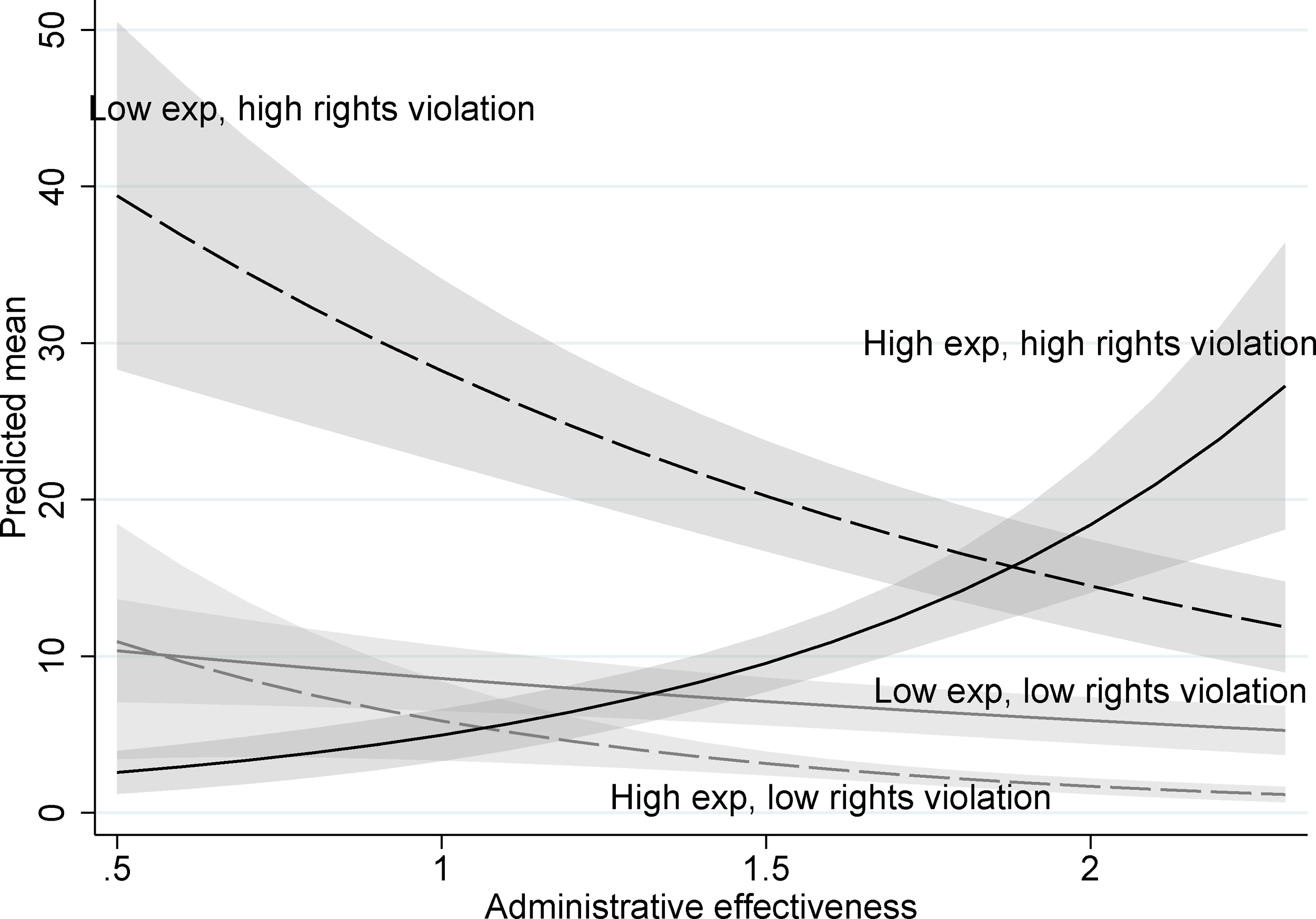
Predicted means of refugee status recognition rates at low and high levels of previous experience, rights violation, and different levels of administrative effectiveness (estimation based on M7).
The role of political preferences
Turning to the effect of politics on the recognition of protection, we start by computing the effect of position of government on migration issues with salience of said issues for government (M3-M4). We also control for whether the government is backed by a majority in the lower chamber and whether there exist dissensus on migration issues within the coalition in office. We then add elements aimed at capturing the political context in destination country d at time t to assess the effect of situational preferences (M5-M6); namely, vote for the far-right and supply of migration policy.
Government position seems to have little to no effect on refugee status recognition as its coefficients are never statistically significant (unless they are interacted with another variable). Salience, however, is systematically associated with decreased refugee recognition so that the more important the issue is for government, the less refugee status is granted. For other statuses, position and salience only matter where political context variables are included: more favourable and more salient positions translate into higher recognition rates. This puzzling result suggests two possibilities. On the one hand, politics affects the granting of refugee status less than that of other statuses. The latter being more discretionary, they allow for greater room for political influence on asylum decision-making, a hypothesis we formulated above. As the issue becomes more salient, though, recognition of refugee status decreases. On the other hand (and in line with the preceding argument), there may be a relationship between salience and position. More salient positions, be they positive or negative, are likely more associated with the outcome. We explore this possibility further below.
Controlling for the overall political context (M5-M6) presents contrasting results, indicating that supply of migration policy matters significantly, for both categories of statuses. When supply for migration policy is generally more favorable to migration, recognition of refugee status increases dramatically (by 23%; M5) while recognition for other statuses decreases radically (by about 46%; M6). This could mean that a more favorable context pushes decision-makers to grant more generous rights enshrined in the refugee status, as opposed to lesser rights associated with other sorts of protection.
Regarding the relationship between position and salience, government's interest in asylum policy may vary and thus the effect of position could be a function of its salience. We test this hypothesis by interacting the two variables. The interaction is only significant for other statuses but does not add information to the separate effects of the two variables: more positive and more salient positions translate in increased recognition rates for other statuses.
Moving to testing H5, the introduction of an interaction term between administrative effectiveness and position proves statistically significant at the 99.9% level for refugee status but not at all for other statuses (M11-M12). To investigate our hypothesis further, we look at the marginal effects of positive and negative positions at different levels of administrative effectiveness 8 . As Figure 5 suggests, the effect of government preferences on refugee recognition decreases as administrative effectiveness increases. At lower levels of capacity, the estimates show a greater positive effect where position on migration is positive. At the highest levels of effectiveness (1.5 upwards), the coefficients turn negative. The overlapping curves indicate that, be they positive or negative, positions have the same effect on recognition rates, thus reflecting the effect of administrative effectiveness alone. Put differently, at high effectiveness, government position does not matter anymore, the administration will likely process claims in the same manner.
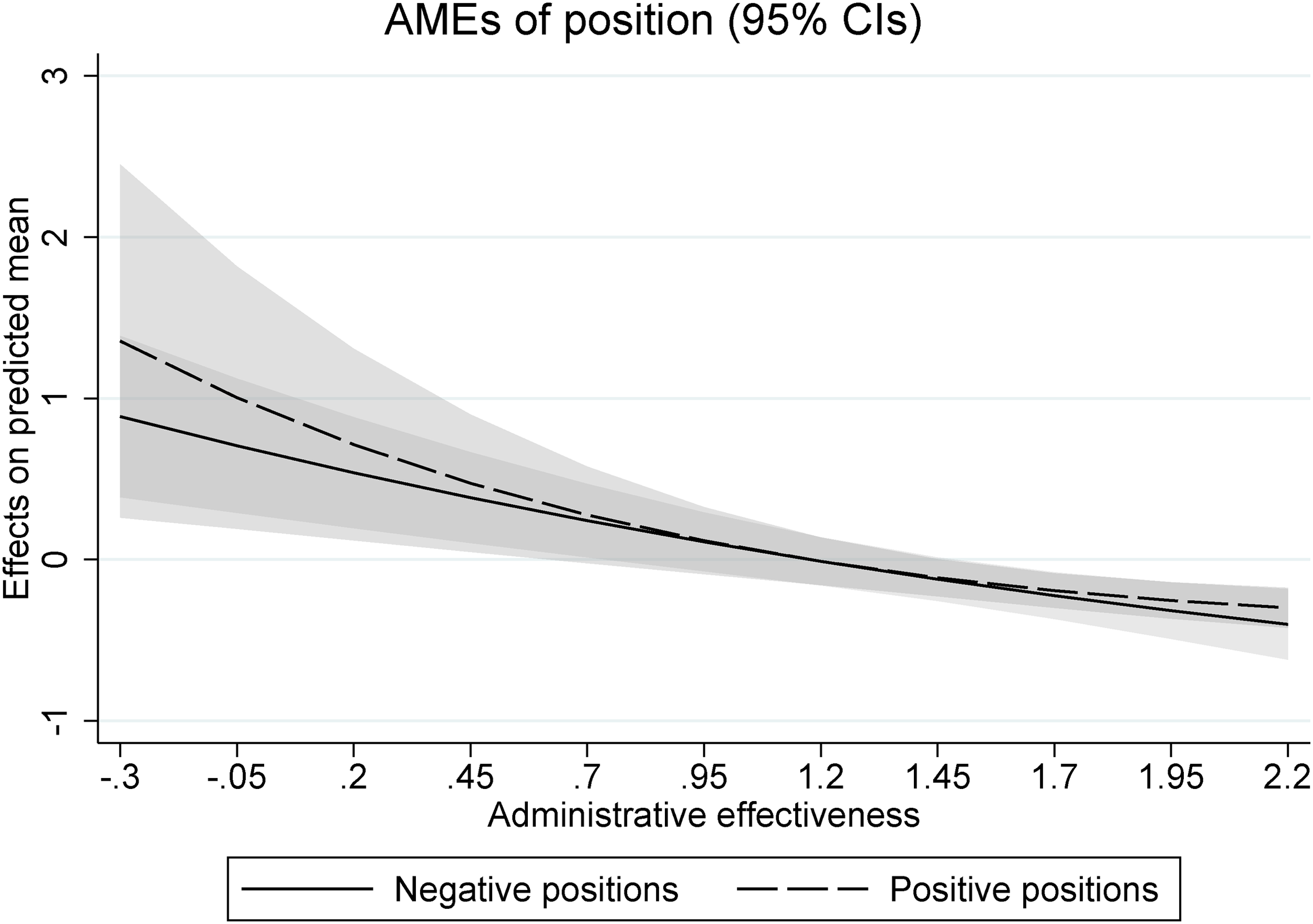
Average marginal effects of positive and negative positions at different levels of administrative effectiveness (estimation based on M11).
Conclusion
Processing asylum claims equates to transforming a variety of situations into a binary outcome: either protection is granted or it is not. This complex process takes place at the heart of states’ administration and thus likely depends on the capacity of the latter to process applications in a predictable and legitimate manner. Our study sheds light on the role of the state apparatus in the recognition of protection. Our empirical results point to a series of robust findings. Firstly, and perhaps most importantly, we show that there exist two distinct patterns of protection recognition that vary according to the status we consider. Refugee recognition is negatively affected by the administration's effectiveness and previous experience with asylum matters when the two aspects are considered separately. This suggests more stringency in the processing of claims on the part of a capable administration, thus placing greater burden of proof on claimants. Notwithstanding, the combined effect of effectiveness and experience is likely to lead to higher recognition rates, provided the conditions in origin-countries warrant it. Political preferences of government in office significantly affects recognition rates, an effect that is however mitigated by a capable administration, less prone to yielding to political pressure. For other protection statuses, effectiveness systematically decreases recognition whilst previous experience increases it.
Considered together, these results point to the existence of a trade-off between the one status and the other, as the importance of the political context suggests. Namely, where the overall political climate is rather open to migration, more asylum seekers are granted refugee status, which is more favorable to its holder. When the political context is more restrictive, then asylum seekers are granted lower protection statuses. The capable administration, which is itself embedded in the overall political context, carries its tasks accordingly, with a tendency to decrease recognition rates altogether, albeit less so for refugee status.
Under international and EU law, states are to give fair treatment to those who seek asylum in their territory. Because all EU member states are implementing the Geneva Convention, they are expected to have comparable refugee status recognition rates for asylum seekers fleeing similar circumstances; all the more so in the framework of the Common European Asylum System. This article seeks to explain why, despite states’ commitment to high international protection standards, there is still significant variation in recognition rates for similar applicants. Our findings show that this variation is most likely due to a combination of the features of states’ administrative machineries and the political context in countries of destination. From a legal perspective, these factors should be irrelevant for the outcomes of decision-making on asylum applications. Yet, they matter, and this presents additional risks for the success of the international community's refugee protection effort.
The findings presented in this article contribute to the literature in three ways. In general, they are of special interest for our knowledge of the relationships between bureaucracy and politics. They indicate that the legal rational logic of the administration and the logic of politics – competition for positions – may well be conflicting, even when it comes to refugee protection. In this relationship, politics may tend to force bureaucracy to operate at the edge of the law. On the other hand, our results suggest that a professional and capable administration may be more equipped to resist political pressure.
Secondly and more specifically, we show that the legal-administrative processes of asylum recognition are open to politicization where administrative capacity is low. When such politicization occurs as debates and discussions within the domain of politics – e.g., party politics, election campaigns, citizen politics, etc. – this is within the confines of established democratic norms and practices. However, when politics causes administration to deviate from the laws it is supposed to implement, questions of legality and legitimacy arise. Thus, it would be misleading to regard asylum recognition as a mere legal-administrative enterprise.
Thirdly, these findings have important implications for rights in general, and refugee rights in particular. They suggest that the administrative processes that lead to claim recognition (or rejection) better explain the variation in protection recognition rates than previous explanations. Rights already enshrined in EU member states’ legal orders may come under threat when they are politicized, and creating a strong administration around these rights could reduce the risk of their being violated. This requires establishing a complex set of institutions, specific procedures, and rules of conduct. Our findings constitute an incentive to refocus the study of protection recognition on proximate explanations; they point to the necessity to investigate the institutional frameworks and procedures able to ensure international protection is granted where needed, in full abidance with asylum and refugee law.
Supplemental Material
sj-do-1-eup-10.1177_14651165221135113 - Supplemental material for Asylum seekers in the machinery of the state: administrative capacity vs. preferences. Recognition rates in EU member states
Supplemental material, sj-do-1-eup-10.1177_14651165221135113 for Asylum seekers in the machinery of the state: administrative capacity vs. preferences. Recognition rates in EU member states by Pierre Georges Van Wolleghem and Hakan G. Sicakkan in European Union Politics
Supplemental Material
sj-dta-2-eup-10.1177_14651165221135113 - Supplemental material for Asylum seekers in the machinery of the state: administrative capacity vs. preferences. Recognition rates in EU member states
Supplemental material, sj-dta-2-eup-10.1177_14651165221135113 for Asylum seekers in the machinery of the state: administrative capacity vs. preferences. Recognition rates in EU member states by Pierre Georges Van Wolleghem and Hakan G. Sicakkan in European Union Politics
Supplemental Material
sj-pdf-3-eup-10.1177_14651165221135113 - Supplemental material for Asylum seekers in the machinery of the state: administrative capacity vs. preferences. Recognition rates in EU member states
Supplemental material, sj-pdf-3-eup-10.1177_14651165221135113 for Asylum seekers in the machinery of the state: administrative capacity vs. preferences. Recognition rates in EU member states by Pierre Georges Van Wolleghem and Hakan G. Sicakkan in European Union Politics
Footnotes
Acknowledgements
We wish to thank Prof. Caestecker, Ghent University, Belgium, for the time he dedicated to reading and commenting our article. His insights have been invaluable. We also wish to thank the anonymous reviewers for their challenging but essential comments.
Authors contributions
PGVW and HGS drafted the article and revised the manuscript; contributed to conception and interpretation. PGVW contributed to data collection and analysis.
Funding
The author(s) disclosed receipt of the following financial support for the research, authorship, and/ or publication of this article: This article is part of PROTECT The Right to International Protection: A Pendulum between Globalization and Nativization? ( ), a research and innovation project which is funded by the European Union's Horizon 2020 Framework Programme and coordinated by the University of Bergen (Grant Agreement No 870761).
Supplemental material
Supplemental material for this article is available online.
Notes
References
Supplementary Material
Please find the following supplemental material available below.
For Open Access articles published under a Creative Commons License, all supplemental material carries the same license as the article it is associated with.
For non-Open Access articles published, all supplemental material carries a non-exclusive license, and permission requests for re-use of supplemental material or any part of supplemental material shall be sent directly to the copyright owner as specified in the copyright notice associated with the article.
