




Abstract
Despite the large number of studies on asylum burden-sharing, there is still no consensus on the most effective method for reducing cross-country inequalities. A benchmark model for equitable distribution could combine the Gini coefficient method with the ‘asylum multi-criteria index’, based on the country’s gross domestic product, population and territory. The method is implemented to measure the inequalities in the distribution of asylum-seekers among 30 European countries over a five-year period and solve an optimisation problem in 2017. The findings show that the unequal distribution worsened with the increase in the number of asylum-seekers while the optimisation model led to an approximate 60% reduction in the cross-country inequality in burden-sharing relative to the actual distribution. The results are compared with the burden-sharing formula proposed by the European Commission in 2015.
The distribution of asylum-seekers among countries continues to be one of the critical problems in the European Union (EU) (Hatton, 2017; Thielemann and Dewan, 2006). The lack of an effective and binding burden-sharing mechanism results in distributional inequalities, reinforced by the Dublin Regulation (Thielemann and Armstrong, 2012). Prior research has studied inequalities in asylum burden-sharing by using both unidimensional (Böcker and Havinga, 1998; Bovens et al., 2011) and multi-dimensional capacity indices (Angenendt et al., 2013; Parusel and Schneider, 2017; Thielemann et al., 2010; Wagner and Kraler, 2014).
To understand and solve inequalities in the distribution of asylum-seekers, this study implements a multi-dimensional capacity index proposed by Germany in 1994, during its presidency of the Council of the EU, and recalled by a study of the European Commission (EC) (2010) and by numerous authors (e.g. Boswell, 2003a; Hatton, 2005; Neumayer, 2004; Thielemann, 2018). According to the German proposal, the burden-sharing scheme should include a distribution key based on gross domestic product (GDP), population size and territory size, with all criteria equally weighted. The asylum multi-criteria index (AMI) can be expressed by the following formula:

Contrary to the criteria used for refugee distribution (Bansak et al., 2018; Berger and Heinemann, 2016), the AMI does not include the country’s unemployment rate. Asylum-seekers have usually not yet been granted neither refugee status nor free access to the labour market. There are countries that impose labour market restrictions for asylum-seekers while their asylum cases are pending (Angeloni and Spano, 2018; Constant and Zimmermann, 2016). However, unemployment rates do not account for labour market peculiarities in different states (Grech, 2017). Moreover, the unemployment rate is excluded from the AMI due to its correlation with GDP (Okun, 1963).
The AMI has the advantage of encapsulating all parameters traditionally used by institutions such as the United Nations High Commissioner for Refugees (2013) to monitor universal data on human displacement. Moreover, the formula suggested here has the advantage of being a justice-based system (Boswell, 2003b), computationally less demanding and based on objectively established criteria (Wagner and Kraler, 2014). Despite the merits recognised in the distribution key expressed by the AMI, researchers have not used the Gini coefficient to test inequalities in the distribution of asylum-seekers and solve optimisation problems. There is a study that employed the AMI formula to estimate such inequalities in the distribution of asylum-seekers in the EU 28 (Wagner and Kraler, 2014). However, this study did not use the Gini coefficient while it computed the deviation between mean numbers for a five-year period and not on a yearly basis.
This note employs the Gini coefficient, the most commonly used measure of inequality (Jenkins, 2017). In line with other studies using non-monetary variables (Druckman and Jackson, 2008), distribution inequalities in asylum applications are examined with the Gini coefficient. A similar approach was adopted in an article that measured cross-country inequalities in the application load by using several unidimensional indices for absorption capacity (Bovens et al., 2011). Instead, this research computes the Gini coefficient related to a multi-criteria index, such as the AMI, by implementing the method applied in other studies to solve allocation problems involving different parameters (Sun et al., 2010).
Essentially, the Gini coefficient related to the AMI (GAMI) is obtained by summing the values of the Gini coefficients (Gj) for each capacity index j included in the multi-criteria index. 1 Since Gj ranges from 0 (complete equality) to 1 (complete inequality), the GAMI, which combines the GGDP, GPopulation and GTerritory, has values ranging from 0 to 3 with higher values indicating greater inequality. Such a wide scale of Gini values enables recording the inequalities in the distribution of asylum-seekers based on economic, social and geographical aspects without renouncing the advantages offered by one synthetic measure of burden-sharing.
The study focuses on the distribution of asylum-seekers across 30 countries during the 2013–2017 period. The analysis omits two countries (Iceland and Liechtenstein) because of missing data on the number of first-time asylum applicants in the years before 2016. 2 The values and trend lines for the Gini coefficients related to each (unidimensional and multi-dimensional) index are highlighted in Figure 1 (see also the Online appendix). 3 The highest value of the GAMI was observed in 2016, as denoted by the grey line, while it started to decrease only in 2017, when all the Gini coefficients for unidimensional capacity indices decreased along with the number of asylum-seekers. The results suggest that the unequal distribution worsened with the increase in the number of individuals searching for protection, probably because the exceptional wave of migration in 2015 and 2016 caught many European states unprepared.
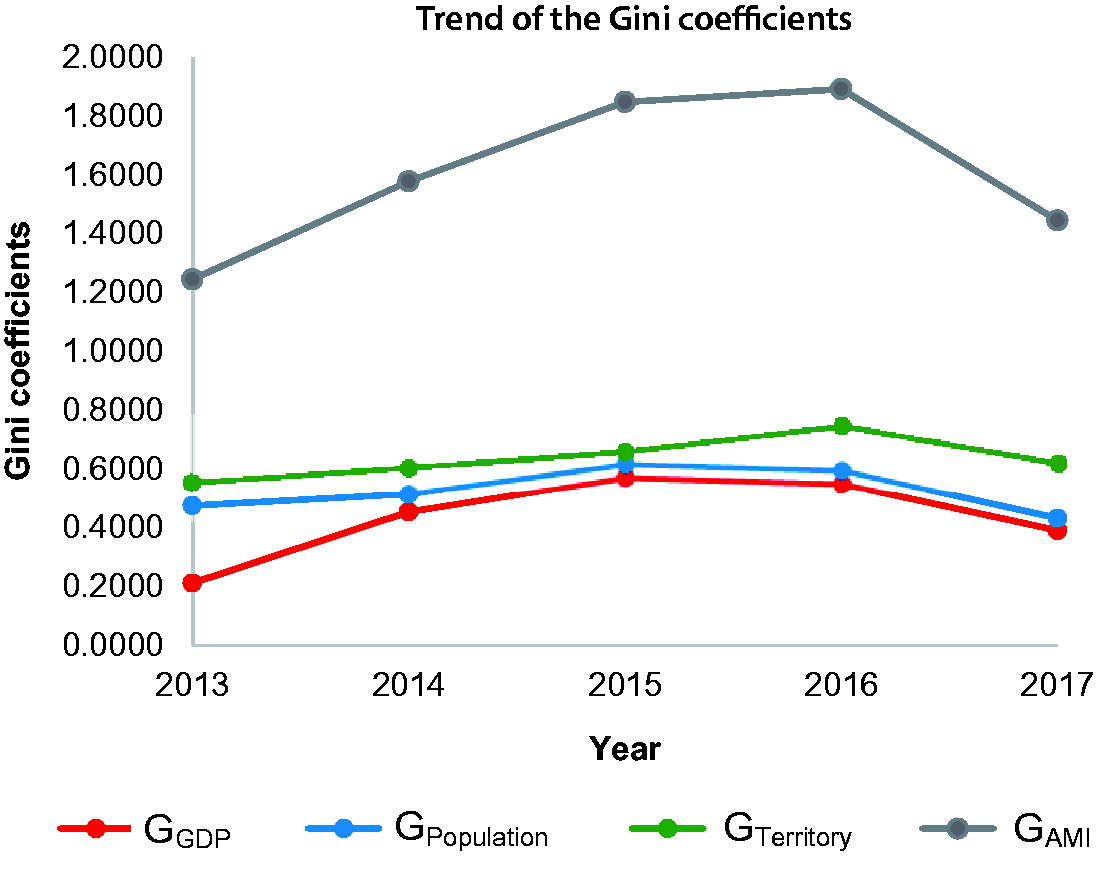
Trend of the Gini coefficients of the distribution of asylum-seekers based on the AMI and unidimensional criteria.Note: For each year, the GGDP, GPopulation and GTerritory are the Gini coefficients obtained by ordering the EU/EFTA states on the variables ‘applicants per unit of GDP’, ‘applicants per unit of population’ and ‘applicants per unit of territory’, respectively. The GAMI is the Gini coefficient based on the ‘asylum multi-criteria index’ (AMI) and it is obtained by summing the values of the GGDP, GPopulation and GTerritory.
The findings also highlight the importance of using a multi-criteria approach to assess burden-sharing. The values of the Gini coefficients based on unidimensional criteria do not account for complex inequalities in the distribution of asylum-seekers. Imagine a situation in which, for instance, all countries guarantee a fair distribution of asylum-seekers allocated to each country based on relative GDP shares (so that the GGDP is equal to 0). However, when analysed in relation to the respective shares of territory, this distribution of asylum-seekers may be very unequal (e.g. with a GTerritory of 0.7). Since unidimensional capacity indices risk to benefit some countries and penalise others without a reasonable foundation, only a mix of the three criteria could guarantee a fair allocation of asylum applications among countries.
Given its capability of recording simultaneously the inequalities in the distribution of asylum-seekers from economic, social and geographical dimensions, the AMI was used as the starting point to solve an optimisation problem in 2017. In the proposed model, the minimal value of the GAMI is used as the objective function to achieve a fairer distribution of asylum-seekers among countries with varied GDP levels, population and territory size. The decision variables were the shares of asylum-seekers to be allocated to each country under given constraints. 4 The gains resulting from the optimisation model are remarkable, as shown in Figure 2. A change in the shape of the Lorenz curves before and after the optimisation becomes evident, when the GAMI is 1.44 and 0.59, respectively. Therefore, the optimisation model led to an approximate 60% reduction in the cross-country inequality in asylum burden-sharing relative to the actual distribution.
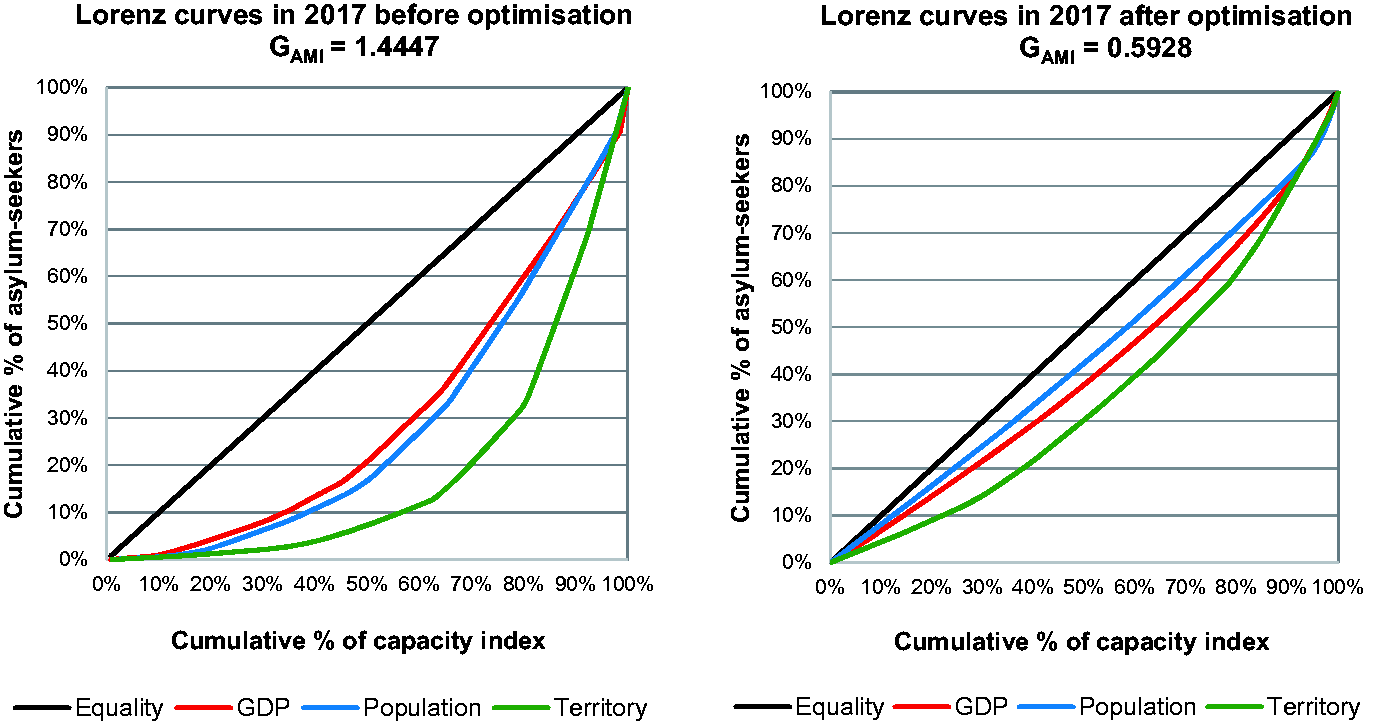
Lorenz curves of the allocation of asylum-seekers based on the AMI before and after optimisation.Note: The Lorenz curves are drawn by connecting the dots arising from the intersections between the cumulative percentage of a given capacity index (Xi) – namely the gross domestic product (GDP), population and territory – and the cumulative percentage of asylum applicants (Yi) in the ith country, after having ranked the EU/EFTA states (from the smallest to the largest) by ‘applicants per unit of capacity index’. The diagonal is the line of equality.
The 2017 data were used to compute the allocation of asylum-seekers to the 30 EU/EFTA states according to the proposal issued by the EC (2015). Based on this proposal, the share of each country is computed by applying a formula which considers four factors: (a) population (40% weighting); (b) GDP (40% weighting); (c) average number of asylum applications per one million inhabitants over the previous five-year period with a cap of 30% of the population and GDP (10% weighting); (d) unemployment rate with a cap of 30% of the population and GDP (10% weighting). To simplify the discussion, the EC formula was applied without considering the corrective factor (c), so that its result can be compared with the distribution obtained from the optimisation model. 5
Figure 3 provides a graphic illustration of asylum shares for EU/EFTA states according to the actual allocation, the optimised AMI allocation and the EC’s distribution key (for detail see the Online appendix, reporting also the differences between the actual shares and the optimised AMI/EC shares for each country). 6
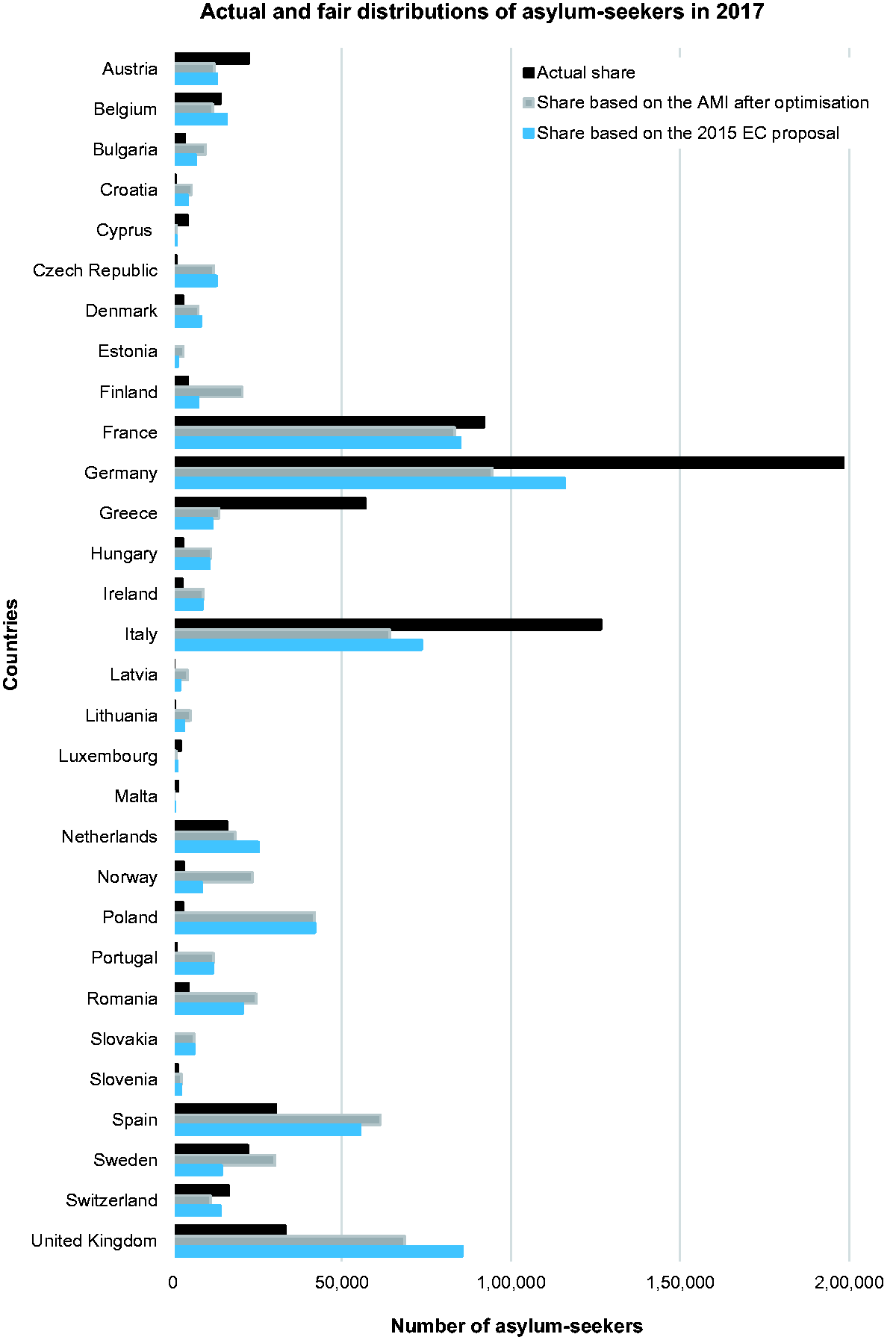
Differences in asylum burden-sharing between actual and fair shares based on the AMI and EC criteria.Note: For each country, the actual number of asylum-seekers is compared with the fair number of asylum-seekers based on the optimisation of the ‘asylum multi-criteria index’ (AMI) and the fair number of asylum-seekers based on the formula proposed by the European Commission (EC) in 2015.
It is noteworthy that, apart from a few exceptions (France, Germany, Greece, Italy, Spain and the United Kingdom (UK)), the factor (d) (10% weighting) entered in the EC formula as 30% of the sum of the population and GDP percentages due to the cap, applied by most EU/EFTA states for their distribution key. Thus, for most countries the asylum share should not be affected by the actual unemployment rate, but it should be determined by the sum of about 50% (i.e. 51.1%) of Population i /Population EU/EFTA and GDP i /GDP EU/EFTA . However, based on the EC criterion, which does not envisage the territorial index and its normalisation effect on burden-sharing, a country like Belgium, having a relatively small territory, did not fulfil its fair share (−1883) while the same country received more asylum-seekers than those required by the AMI criterion (+2242). The opposite applies to Sweden, which exceeded its fair number of asylum-seekers based on the EC criterion (+7757) while it failed to meet its application load using the AMI criterion (−8020).
Combining all basic measures of an economy’s size, the AMI criterion should be considered fairer than the EC criterion. If a country is rich and populous but with a limited territory (i.e. the UK), it would consider as unfair the allocation of the same number of asylum-seekers assigned to a relatively larger country with about the same GDP and population (i.e. France). The EC proposal considers the GDP and population as major factors of the distribution key based on the assumption that the strongest economies and largest populations will also be able to shoulder the greatest burdens. However, the third factor of geographical area pursues a similar goal, especially addressing the ‘space problem’ raised by smaller countries such as Malta (Parusel and Schneider, 2017). In terms of burden-sharing, the AMI is considered fairer than the EC’s proposal since it considers all basic measures which give a broad indication of actual and potential resources available to countries. Moreover, when compared to other approaches, the method recommended here has evident advantages in terms of objectivity, equality, rationality, completeness, transparency and acceptability. 7
This note makes several contributions to the literature on burden-sharing. First, it applies the Gini coefficient to a sustainable multi-criteria index to study the pattern of inequalities in the distribution of asylum-seekers over time, showing that a worsened trend could be neglected by unidimensional capacity indices, causing a loss of information relevant to European and national policy-makers. Second, the study reveals that the size of the inequality in the application load tends to worsen with an increase in the number of asylum-seekers. Third, the study demonstrates the usefulness of applying the Gini coefficient to the AMI by solving an optimisation problem and thereby minimising inequalities. Finally, the optimised allocation is compared with the recent proposal of the EC, by highlighting unfair changes in fair shares when the criterion of burden-sharing omits the territorial size of countries.
It should be noted that the Gini approach is only one of several methods for measuring cross-country inequality in the allocation of asylum-seekers across Europe. Moreover, the AMI could be adjusted in future research by replacing the size of territory with the habitable area. Furthermore, the fair distribution of asylum-seekers was calculated without considering the number of asylum applicants already residing in a country. This variable could be included by adding further constraints to the optimisation problem, which should be solved by also considering the average number of asylum applications over the five preceding years per million inhabitants. Nevertheless, the balanced approach evaluated in this note may provide European and national policy-makers with a practical and cost-efficient tool that could be effectively shared and implemented to equalise the allocation of asylum-seekers across countries. Lastly, the same systemic approach could be easily applied to identify and solve inequalities in the distribution of asylum-seekers at the sub-state level.
Supplemental Material
Supplemental Material1 - Supplemental material for Improving the distribution of asylum-seekers through a multi-criteria index
Supplemental material, Supplemental Material1 for Improving the distribution of asylum-seekers through a multi-criteria index by Silvia Angeloni in European Union Politics
Supplemental Material
Supplemental Material2 - Supplemental material for Improving the distribution of asylum-seekers through a multi-criteria index
Supplemental material, Supplemental Material2 for Improving the distribution of asylum-seekers through a multi-criteria index by Silvia Angeloni in European Union Politics
Footnotes
Funding
The author(s) received no financial support for the research, authorship, and/or publication of this article.
Notes
References
Supplementary Material
Please find the following supplemental material available below.
For Open Access articles published under a Creative Commons License, all supplemental material carries the same license as the article it is associated with.
For non-Open Access articles published, all supplemental material carries a non-exclusive license, and permission requests for re-use of supplemental material or any part of supplemental material shall be sent directly to the copyright owner as specified in the copyright notice associated with the article.
