



Abstract
Leader evaluations are a crucial aspect in representative democracy. We analyse the patterns, antecedents and consequences of European Union leader evaluations against the backdrop of the 2019 European Parliament elections in ten countries. The article shows, firstly, that leader evaluations are unidimensional, both among voters with low and high knowledge as well as partisans and non-partisans. Secondly, among the antecedents of leader evaluations, European Union trust and performance evaluations are positively associated with leader evaluations, while European identity hardly plays a role compared to other factors. Lastly, the positive effect of leader evaluations on vote choice is conditional upon the individual leader and their party affiliation. Our results have important implications for expectations towards and evaluations of European Union leadership in the long term.
Introduction
The European Union (EU) has undergone a number of pivotal moments in recent history. These comprise both changes to the polity, such as new treaties, enlargement and Brexit and external shocks, including the financial crisis, the so-called refugee crisis and most recently the Covid-19 pandemic. They have thereby contributed to the increased contestation within and of the EU (see Van der Brug et al., 2022). Political observers and scholars perpetually emphasize the (limited) role of EU leadership in times of crisis (e.g. Tömmel, 2020; Van Esch, 2017). However, most studies have approached EU political leadership from the perspective of inter- or intra-institutional relations at the EU level (e.g. Cini, 2008; Kassim and Laffan, 2019; Tömmel and Verdun, 2017). We know little about citizens’ perceptions of EU leadership, although the question of EU leadership contests that are decided by European voters is increasingly being considered important for the EU's legitimacy (e.g. Føllesdal and Hix, 2006; Hobolt and Tilley, 2014).
In response to rising legitimacy concerns, the European Parliament (EP) designed the so-called Spitzenkandidaten procedure for the 2014 EP elections, by which pan-European party families nominate lead candidates for the President of the European Commission. The procedure was discontinued with the nomination and election of Ursula von der Leyen, who had not been a Spitzenkandidat during the campaigns, as Commission President. Indeed, a growing body of research has thus far mainly dealt with questions pertaining to the effectiveness of the procedure with respect to media attention paid to Spitzenkandidaten (e.g. Schulze, 2016), party campaigns (e.g. Braun and Schwarzbözl, 2019; Popa et al., 2020), voter awareness (e.g. Gattermann and de Vreese, 2020), political attitudes (Maier et al., 2018; Popa et al., 2016) and electoral behaviour (Gattermann and Marquart, 2020; Schmitt et al., 2015). However, research has thus far not examined the extent to which European voters consider lead candidates ‘fit for office’. This question does not have a direct bearing on the debate about the procedure's effectiveness, but it is central in research on political leadership and a crucial aspect in representative democracy, which is particularly relevant amid the EP's aim to ‘(reinforce) the political legitimacy of both Parliament and the Commission by connecting their respective elections more directly to the choice of the voters’ through the Spitzenkandidaten procedure. 1
Against this backdrop, the aim of this article is three-fold. Firstly, we seek to understand the patterns of EU leader evaluations, particularly the extent to which these are multidimensional (RQ1). Secondly, we are interested in the antecedents of leader evaluations and specifically in the role that party preferences, information and attitudes towards the EU play for the images voters have of EU leaders (RQ2). Thirdly, we enquire about the consequences of EU leader evaluations for vote choice in EP elections (RQ3).
The article proceeds by underlining the relevance of understanding patterns and antecedents of EU leader evaluations in the first place and discusses possible scenarios. After that, we explore leader evaluations provided by panel survey data from the 2019 EP elections from ten EU member states (Goldberg et al., 2019), which include questions about how respondents evaluate five attributes – leadership skills, empathy, reliability, competence and charisma – for outgoing Commission President Juncker and the Spitzenkandidaten Manfred Weber (European People's Party, EPP) and Frans Timmermans (Party of European Socialists, PES). Regarding the patterns of leader evaluations, we find that despite variation across different leaders, voters do not distinguish between attributes; rather, their evaluations are unidimensional. The findings are similar for both voters with high or low levels of knowledge and partisans and non-partisans. Secondly, among the antecedents of leader evaluations, EU trust and performance evaluations are positively associated with leader evaluations. Compared to other EU attitudes, feelings of European identity hardly matter, while the associations between EU strengthening and utilitarian considerations and leader evaluations vary across leaders and attributes. Lastly, we briefly discuss and assess the (mixed) consequences of leader evaluations for vote choice. We conclude with a discussion of the findings and derive implications for leadership perceptions in EU politics.
The particularity of leader evaluations in the EU
Before the introduction of the Spitzenkandidaten procedure in 2014, little was known about the attitudes of European citizens towards individual EU leaders or candidates in EP elections. Rather, extant research focussed on the role of political parties in both channelling representations of citizen interests in EU politics and as determinants of attitude formation towards the EU. Regarding the former, much of the research on EP elections has investigated patterns and causes underlying vote choices for political parties (e.g. De Vries, 2010; Hobolt and Spoon, 2012; Pellegata and Visconti, 2022). As regards the latter, prominent studies examined the extent to which parties provide EU citizens with certain cues that help them evaluate either the EU more generally or specific EU policies (e.g. Hobolt, 2009; Hooghe and Marks, 2005; Pannico, 2017; Stoeckel and Kuhn, 2018). Once the Spitzenkandidaten procedure was put in place, a growing body of research has taken interest in studying EU electoral politics against the backdrop of the personalization of politics – a phenomenon that is understood as the extent to which individual politicians become more important at the expense of parties and institutions in the political process, in campaigning and media coverage and ultimately in the eyes of citizens and voters (e.g. Karvonen, 2010; Langer and Sagarzazu, 2018; Rahat and Sheafer, 2007).
Up until now, these studies have pointed to the limited personalization of political communication during EP election campaigns (e.g. Braun and Schwarzbözl, 2019; Schulze, 2016), which may also explain why personalized voting behaviour has thus far played a subordinate role in EP elections (Gattermann and de Vreese, 2017; Gattermann and Marquart, 2020; Schmitt et al., 2015). After all, only few voters recognise candidates standing in EP elections and the extent to which they do so depends on the information provided by political parties (Popa et al., 2020), campaign-specific information (Gattermann et al., 2016; Schmitt et al., 2015) and news exposure (Gattermann and de Vreese, 2017). As the available information provided through campaigns or media coverage to voters tends to focus on political parties and institutions, individual politicians are not yet considered effective cue-providers that help voters form their opinion in European elections (Gattermann, 2020). 2
In light of previous findings, we might expect that only the most sophisticated voters are likely to align evaluations of EU leaders with their vote choice, thus underlining the potentially limited consequences of personalization in EP elections. This article thus pursues a different approach to shed further light on the phenomenon: we are first and foremost interested in the patterns and antecedents of EU leader evaluations, before we examine the consequences. Although leader evaluations are also contingent upon the extent to which voters recognise individual leaders, there is also likely variation concerning their political preferences and awareness of EU politics which affects their assessment of political leaders in the EU. Specifically, we are interested in the following questions: to what extent are leader evaluations multidimensional (RQ1) and what role do party preferences, information and attitudes towards the EU play for the images voters have of EU leaders (RQ2)?
With few exceptions (e.g. Bartels, 2002; Brettschneider and Gabriel, 2002; Dumitrescu et al., 2015; Huber, 2014), the literature on comparative political behaviour has largely dealt with leader evaluations as an explanatory factor for vote choice (e.g. Bittner, 2011; Garzia, 2014; Karvonen, 2010); also in the context of EU politics (Gattermann and de Vreese, 2017; Gattermann and Marquart, 2020). In doing so, research has either treated leader evaluations as unidimensional by measuring them on single scales (e.g. Gattermann and de Vreese, 2017; Holmberg and Oscarsson, 2011; Michel et al., 2020) or distinguished several leader characteristics or personality traits (e.g. Bittner, 2011; Gattermann and Marquart, 2020; Ohr and Oscarsson, 2011). These either concern a candidate's competence, such as leadership, knowledge or intelligence, or their integrity, including empathy, reliability and honesty among others (e.g. Bittner, 2011; Costa and Silva, 2015; Kinder 1986). Additional attributes include personal appeal (e.g. Brettschneider and Gabriel, 2002; Ohr and Oscarsson, 2011).
In this article, we are, for one part, interested in the extent to which evaluations of EU leaders are multidimensional. This has two reasons. First, personalization has the potential to bring EU politics closer to European citizens (see Gattermann and Marquart, 2020). If that were the case, it would also enable the latter to assess different strengths and weaknesses of EU leaders and ultimately hold them accountable for their political behaviour and integrity. Second, with the rising politicisation of European integration, public opinion towards the EU and its representatives has also become increasingly multidimensional over time (Boomgaarden et al., 2011; de Vreese et al., 2019). In other words, European citizens distinguish between different aspects of European integration and evaluate these aspects to a differentiated degree, although attitudes on various dimensions are still correlated. Would this also be the case for individual EU leaders?
We consider five different attributes, namely leadership, empathy, reliability, competence and charisma. These cover the breadth of different candidate attributes identified by the aforementioned literature and allow us to examine whether European voters distinguish between different leader attributes. For example, pundits and scholars have considered leadership by the Commission President as a crucial aspect in the performance evaluation of the Commission as a whole – and former Presidents have been considered either weak or strong leaders among officials and experts (Kassim et al., 2013; Tömmel, 2013). Given the public attention to political leadership at the EU level, the attribute of leadership is therefore likely to stand out among evaluations by European voters. If voters do not distinguish between leadership and competence, these two attributes likely form one dimension among the umbrella of political experience and skills. Charisma, on the other hand, is also likely to be distinct from the other attributes, potentially because voters may find it difficult to assess EU leaders on that aspect given that they are less present in the domestic public sphere than national politicians, such as through television interviews. Additionally, research suggests that the rhetoric in formal communication by former Commission President José Barroso has become less charismatic and more managerial during the Eurozone crisis (Olsson and Hammargård, 2016) – a trend which may have continued with additional crises over time and ultimately shown in media coverage. There are similar reasons to expect empathy and reliability to potentially form another dimension in line with existing research. On the one hand, research shows that issue engagement of national leaders increases during economic crises in Europe (Traber et al., 2020), which suggests that leaders are openly compassionate in times of crisis. On the other hand, EU leaders rarely speak the same language as voters from a certain country (e.g. a Slovenian leader in Sweden), which makes it likely that voters do not receive the full picture to evaluate the character of an EU leader on different dimensions.
Our second research question asks whether attitude formation towards EU leaders is contingent on certain voter characteristics, including the level of specific information, party preferences and EU attitudes. As the most sophisticated voters are more likely to recognise EU leaders in the first place (Gattermann and de Vreese, 2020; Popa et al., 2020), there may be less variation among them when it comes to images of EU leaders. Nonetheless, one could expect that multidimensional evaluations are more likely to apply to those voters who have acquired additional, specific information than those who do not. This is related to information processing, which is the way by which voters rely either on memory-based or online processing to formulate their opinions (e.g. Hastie and Park, 1986; Lodge et al., 1989). If voters have little knowledge about individual leaders, they likely base their evaluations on memory, that is not up-to-date while those who have acquired more specific information are able to rely on a summary of the information that they have encountered thus far. A similar empirical argument was put forward by Huber (2014): respondents in a three-country experiment more often evaluated a candidate's character when they received additional information about their issue position compared to those who did not receive such information. However, there are also alternative considerations: those who are less likely to hold additional information about EU politics could value certain leader attributes more than others, such as those that are distinct for an individual leader or those that are particularly important to voters, for example, leadership and empathy. If that was the case, their overall image is likely more multidimensional compared to those who have formed their attitudes of EU leaders over a longer period of time. Similar alternative explanations may underlie the possible distinction between those who strongly support the national party of a certain leader compared to those who are less likely to vote for that party. On the one hand, the former may again have more information that would potentially enable them to develop a specific image of a respective leader. On the other hand, they could simply evaluate a leader based on their own party preference and do not distinguish between politicians and the party (see Bittner, 2011), which may explain why some scholars observe only a limited impact of leader evaluations on vote choice (Bartels, 2002; see also Holmberg and Oscarsson, 2011; Karvonen, 2010). These considerations will be explored in the analyses below.
Lastly, it is important to investigate the extent to which leader evaluations in the EU are distinct from EU attitudes. Since EU attitudes are multidimensional (e.g. Boomgaarden et al., 2011; de Vreese et al., 2019), they are also likely to be associated to a differing degree with leader evaluations. If not, we would conclude that voters hardly distinguish between the polity and its key representatives. Put differently, individual leaders, including their leadership skills, competence and reliability, would not make a difference for EU politics in the eyes of European voters. This would be a likely finding if voters rely on their evaluations of the EU as a heuristic to assess EU leaders about whom they likely have less information compared to the EU more generally (see Gattermann, 2020). Bartels’ (2002: 55) findings, for example, suggest that the political context ‘rather than differences in the various candidates’ intrinsic personal qualities’ plays an important role for voters’ assessment of US Presidential candidates over time. This in turn means that if there were differentiated relationships between EU attitudes and leader evaluations, we would derive that voters distinguish between EU integration and the political system, on the one hand, and the quality of EU leadership, on the other, which would be a positive development for the democratic functioning of and representation in the EU. The following analyses will therefore shed light onto these relationships.
Data and measures of EU leader evaluations
We rely on original panel survey data (Goldberg et al., 2019; data version 2) to explore the core research questions. The survey was administered by Kantar using Computer Assisted Web Interviewing in ten EU countries between September 2017 and April 2019. 3 Light quotas on age, education, gender and region were implemented. The countries comprise the Netherlands (five waves), Denmark, Germany, Hungary and Spain (each two relevant waves), as well as Czech Republic, France, Greece, Poland and Sweden (each one relevant wave) prior to the 2019 EP elections (see the Online appendix for an overview). These countries represent a geographically diverse selection and also vary with respect to Spitzenkandidaten origin with several candidates from the Netherlands, Denmark, Germany and Czech Republic having contested the elections.
Evaluations of outgoing Commission President Juncker were surveyed in December 2018 in five countries (Netherlands, Denmark, Germany, Hungary and Spain; N = 13,128). We include Juncker in our analysis as more voters were likely aware of him compared to the Spitzenkandidaten, which allows for a comprehensive answer to our first two research questions. The question wording was the same as evaluations of the lead candidates, which were subject to the April 2019 wave in all countries and which has a maximum number of respondents of 17,027. Regarding the latter, respondents were first asked to indicate about which Spitzenkandidaten out of a total list of seven candidates they had heard before. The lead candidates were listed in random order. Their party affiliation and nationality were not disclosed. In other words, voters received no additional cues that would have helped them to formulate opinions towards the candidates. The included lead candidates were Bas Eickhout (European Greens, NL), Ska Keller (European Greens, DE), Frans Timmermans (PES, NL), Guy Verhofstadt (Renew Europe, BE), Margrethe Vestager (Renew Europe, DK), Manfred Weber (EPP, DE) and Jan Zahradil (European Conservatives and Reformists, CZ). 4
If respondents indicated that they had heard about a certain lead candidate, they were then asked to evaluate him or her. For survey efficiency reasons, we asked for evaluations of a maximum of three Spitzenkandidaten. If respondents indicated that they had heard of between one and three Spitzenkandidaten, they were asked to provide evaluations on all of them. If they recognised more than three, they were asked to evaluate three randomly selected lead candidates out of those they recognised. In this case, preference was given to Weber and Timmermans as the leaders of the two largest European party families. Thus, if respondents had heard of either of those two before, they were always asked to provide an evaluation for these lead candidates plus one (or two) randomly allocated lead candidate(s). If neither Timmermans nor Weber were among the recognised lead candidates, but more than three lead candidates had been recognised, a random selection of the remaining lead candidates was provided for evaluation.
Specifically, we asked for both Juncker and the Spitzenkandidaten: ‘In your opinion, how well does each of the following attributes describe (NAME POLITICIAN)? Please indicate to what extent you agree or disagree with the following statements’. There were five attributes in total (not randomized, 7-point scale): He/she is a strong leader (leadership), he/she cares about European citizens (empathy), he/she is trustworthy (reliability), he/she is knowledgeable (competence), he/she is charismatic (charisma).
Examining EU leader evaluations
The unidimensionality of EU leader evaluations
We conducted exploratory rotated principal components factor analysis with oblique rotation (direct oblimin) for Juncker and each Spitzenkandidat within each country sample to answer RQ1 concerning the multidimensionality of EU leader evaluations. The results show that all five attributes load into one single factor per leader/country sample with an Eigenvalue greater than one (for details see the Online appendix). However, there are differences in the number of evaluations provided per leader which are probably due to the large variation in Spitzenkandidaten recognition. Recognition levels appear to correlate with explained variance as there are large differences across countries and leaders, while variance levels are generally very high in the case of Juncker (ranging from 72.64 to 83.75%). Variance levels are lower for those lead candidates who tend to be less well known (lowest value for Eickhout in the Spanish sample, 54.8%) and higher for those with whom respondents are more familiar (highest value for Verhofstadt among Polish voters, 87.14%). Generally, the reliability of the scale of all items is (very) high with Cronbach's α ranging from .786 to .963 (concerning the same individuals/country samples as before, respectively). In a few instances, reliability scores would be slightly higher if charisma, leadership or reliability items were removed, but not considerably so and not in the case of Juncker.
Next, we split each country sample into: (a) voters who have acquired specific information about EU politics and those who have not 5 ; and (b) those who have a high and low propensity to vote (PTV) for the domestic party that is affiliated with either the EPP in case of Juncker and Weber or the PES, of which Timmermans was the Spitzenkandidat in the 2019 EP elections. 6 We focus on Juncker, Weber and Timmermans in the remainder of the manuscript because all of these three leaders had more than 100 respondents evaluating them in each country sample. Furthermore, Weber and Timmermans represented the two biggest European party families, EPP and PES, with one of them having been likely to be selected as Commission President had the procedure been successful in 2019. The partial answer to RQ2 is rather short in this respect: all variables load into one factor regardless of varying specific knowledge levels among voters and of propensities to vote for the respective national parties (see the Online appendix). Levels of explained variance differ across both countries and leaders. These tend to be generally highest for Dutch, German, Hungarian and Polish respondents and lowest among Czech, French and Swedish respondents. Moreover, variance levels often tend to be higher for Juncker or Timmermans compared to Weber. Cronbach's α ranges from .790 (Timmermans, highly knowledgeable Czech voters) to .968 (Timmermans, highly knowledgeable Hungarian voters). Sometimes, Cronbach's α would be slightly higher if charisma was excluded, particularly among Dutch, Danish, German, Hungarian, Czech and Swedish voters. It would also be higher in the case of disregarding competence for Weber among Spanish and Greek voters with a low PTV for the EPP, while the reliability of the combined measure would generally be higher if the leadership item was removed among French voters. In sum, there are some indications that individual attributes of EU leaders slightly stand out among those with different levels of specific knowledge and those with either high or low propensity to vote for the respective domestic parties affiliated with the European party of a leader, but that does not affect the unidimensionality of leader evaluations.
Antecedents of EU leader evaluations
Before providing the remaining answer to RQ2, Table 1 compares how the three leaders are evaluated on each trait. It shows that all leaders are least favourably evaluated regarding charisma. Their ratings on reliability are equally low as their perceived charisma compared to other items (in case of Juncker there is also no difference to leadership and empathy). All three leaders score highest on competence, while leadership and empathy take the middle-ground for Weber and Timmermans.
Comparing evaluations within each leader.
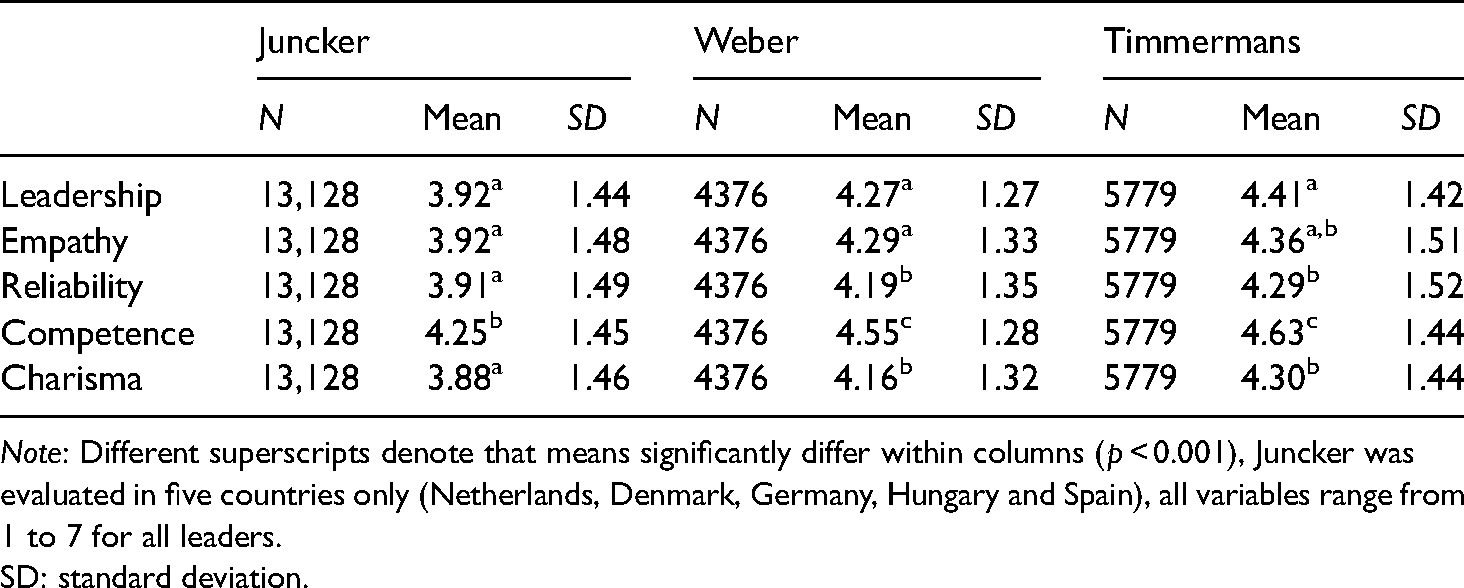
Note: Different superscripts denote that means significantly differ within columns (p < 0.001), Juncker was evaluated in five countries only (Netherlands, Denmark, Germany, Hungary and Spain), all variables range from 1 to 7 for all leaders.
SD: standard deviation.
Taking a closer look at Weber and Timmermans, i.e. the lead candidates of the EPP and PES, respectively, Table 2 shows that Timmermans scores better than Weber on all items bar competence. Dutch respondents evaluated Timmermans more positively than Weber on all traits. Surprisingly, Weber did not score better than Timmermans among German respondents suggesting that in this case a nationality effect is absent, i.e. German respondents did not appear to favour Weber just because he is German. German respondents rated Timmermans as being more charismatic than Weber.
Comparing evaluations between Timmermans (T) and Weber (W).
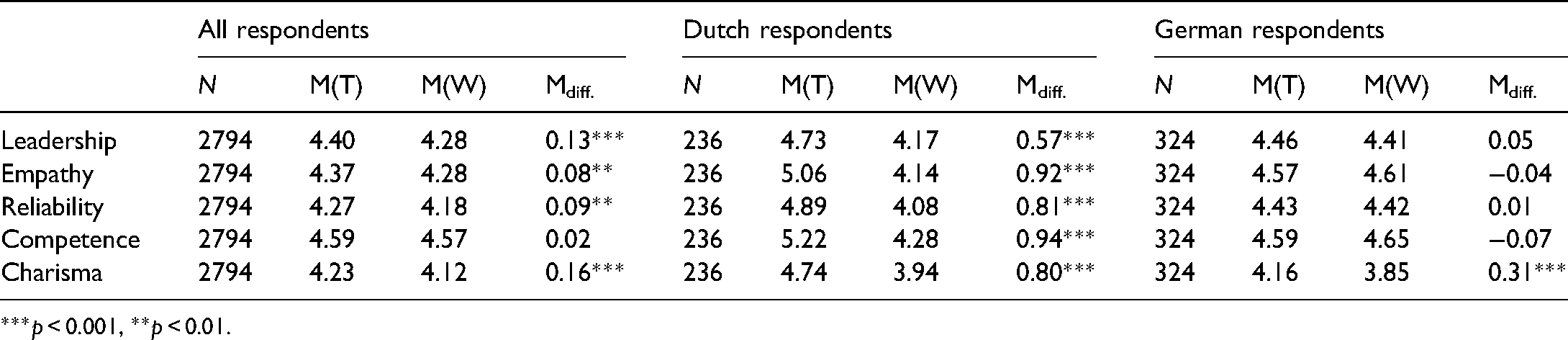
***p < 0.001, **p < 0.01.
To shed more light onto the antecedents of the EU leader evaluations, the following figures report the average marginal effects of ordinary least square regressions with individual evaluation items as dependent variables. The main independent variables are PTVs, EU attitudes and specific knowledge. EU attitudes consist of five distinct dimensions. They each comprise three items and have been applied by the survey designers (Goldberg et al., 2019) following Boomgaarden et al. (2011). The dimensions are identity (e.g. ‘being a citizen of the EU means a lot to me’), trust (e.g. ‘I trust EU politicians’), strengthening (e.g. ‘The EU should be allowed to collect tax money’), utilitarianism (e.g. ‘(COUNTRY) has benefited from the membership in the EU’) and performance (e.g. ‘Leaders of member states work efficiently in taking decisions together’). Each dimension ranges from −3 to +3; the minimum reliability score is .79 (Goldberg et al., 2020). All dimensions correlate with one another; and, there are also positive bivariate associations between each of them and the five evaluation items for each leader (see the Online appendix). In accordance with research on Spitzenkandidaten recognition (Gattermann and de Vreese, 2020; Popa et al., 2020), all models additionally include stable knowledge, 7 political interest in EU politics (which is measured on an ordinal 7-point scale that ranges from no to high interest), gender (female), age and education.
Figures 1–3 report the results for the individual evaluations of Juncker, Weber and Timmermans, respectively. Generally, the cross-country variation in leader evaluations is larger for Juncker compared to Weber (and Timmermans). Dutch voters appear more positive towards Timmermans compared to voters from other countries. Regarding individual voter characteristics, PTVs are positively associated with all leader items, except for the assessment of Juncker's empathy and competence (Figure 1). Specific knowledge does not matter in the case of Juncker and Weber, but it has a negative association with all of Timmermans’ attributes, bar competence (Figure 3). It thus appears that more sophisticated voters tend to be more critical towards Timmermans. Likewise, political interest in EU affairs is negatively associated with voters’ evaluations of Juncker regarding his leadership, reliability and charisma. Contrariwise, those with higher levels of stable knowledge evaluate EU leaders more positively, particularly Timmermans on all items, Weber on leadership and competence (Figure 2) and Juncker on competence.
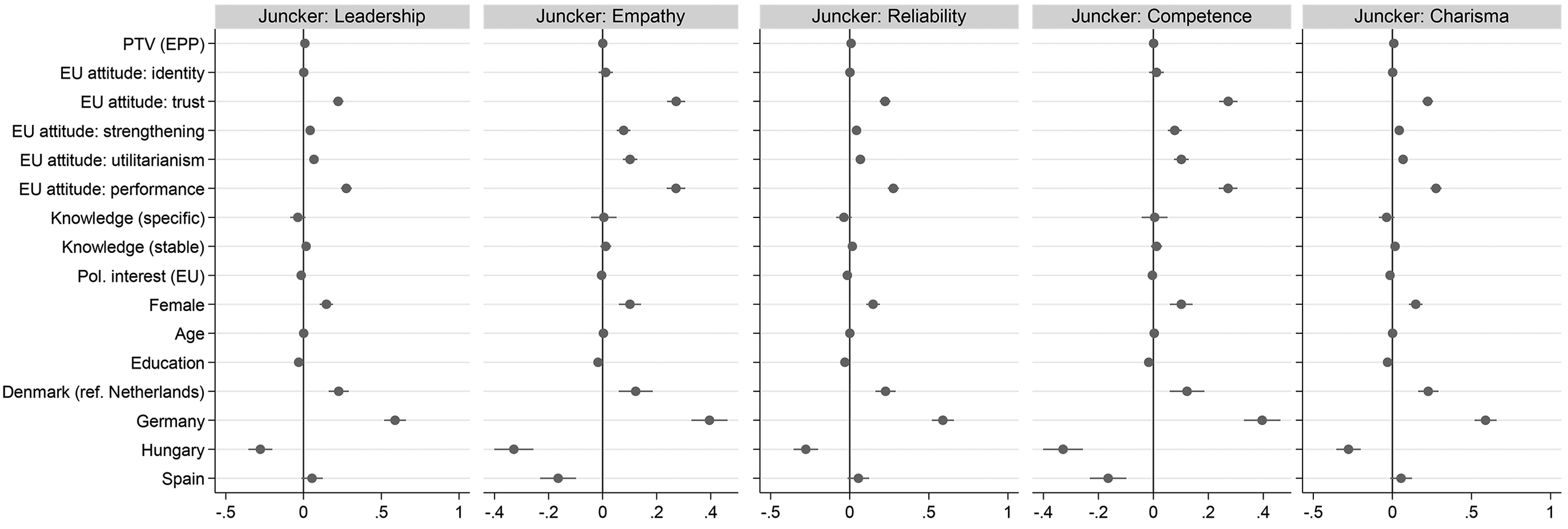
Average marginal effects of PTVs, knowledge and EU attitudes on Juncker's evaluation.
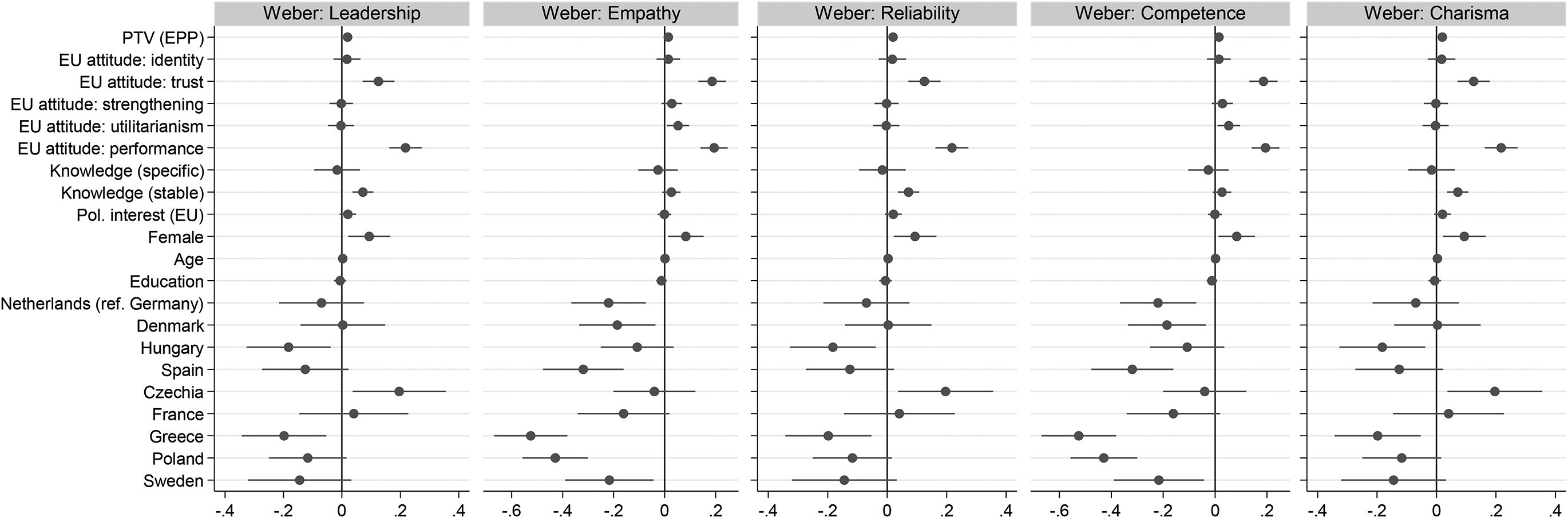
Average marginal effects of PTVs, knowledge and EU attitudes on Weber's evaluation.
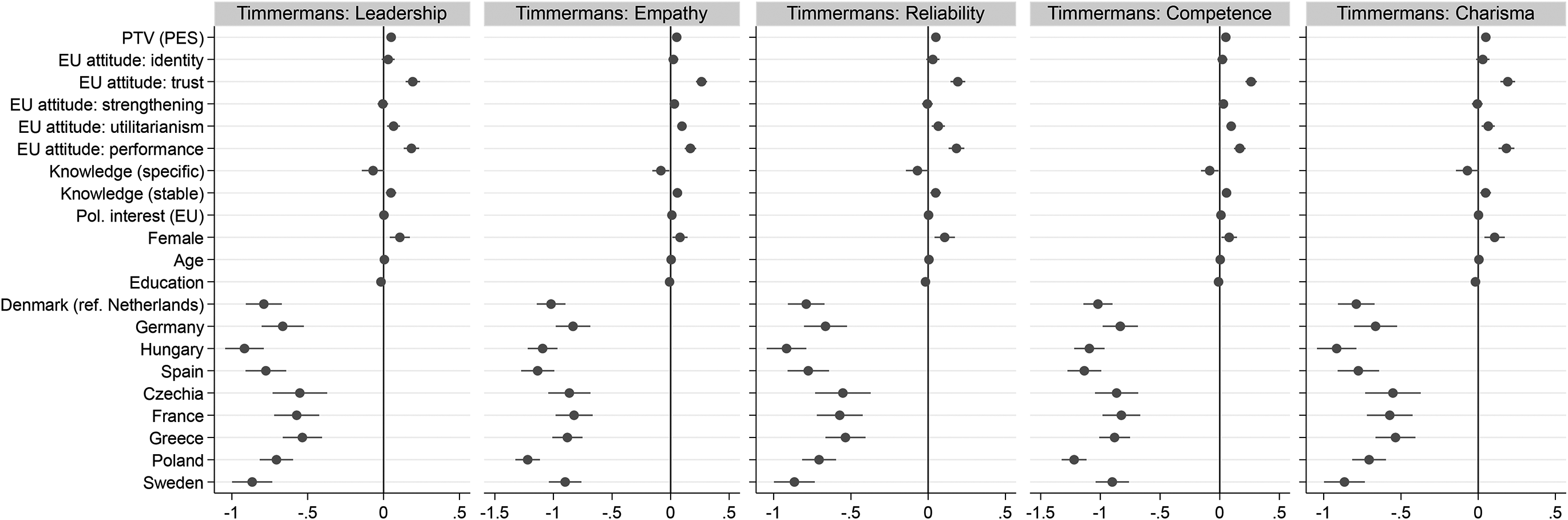
Average marginal effects of PTVs, knowledge and EU attitudes on Timmermans’ evaluation.
Turning to EU attitudes, identity hardly matters for leader evaluations relative to the other items, although there are weak (Timmermans) to moderate correlations (Juncker, Weber) between identity and leader evaluations (see the Online appendix). The positive associations of trust and EU performance evaluations with individual leader evaluations hold in all models. These effects are rather sizeable compared to those of other voter characteristics across the board. Attitudes towards strengthening EU integration are positively associated to the evaluations of Juncker on all items, while they do not play a role for the assessments of Weber when considered together with other EU attitudes. In case of Timmermans, the positive relationship is only significant (p < 0.1) with respect to empathy and reliability. Lastly, utilitarian attitudes are positively associated with the evaluations of Juncker and Timmermans on all items, but have varying associations with Weber's evaluations. Compared to other EU attitudes, they do not play a role for the assessment of his leadership and reliability. The utilitarian attitudes have a positive association with empathy and competence, but a negative relationship with the evaluation of his charisma. In other words, the more voters agree that the EU has brought benefits, the less likely they evaluate Weber as charismatic.
The consequences of EU leader evaluations for vote choice
Having explored the dimensionality and antecedents of EU leader evaluations, our final objective is to examine the consequences for voting behaviour. A popular hypothesis in the personalization literature is that leader or candidate evaluations have a causal effect on the party vote, although there has thus far been mixed evidence in support for this hypothesis (e.g. Bartels, 2002; Brettschneider and Gabriel, 2002; Garzia, 2014; Holmberg and Oscarsson, 2011; Karvonen, 2010). We, therefore, ask whether EU leader evaluations matter for vote choice (RQ3). This question is important because the Spitzenkandidaten have been introduced in 2014 in order to raise voter awareness and interest to take part in EP elections and the relationship between evaluations of the Spitzenkandidaten and party vote has thus far only been investigated in an experimental setting (Gattermann and Marquart, 2020).
The particularity of the Spitzenkandidaten procedure is that these are pan-European lead candidates. In other words, for most European voters, these are foreign leaders, who either made their previous career in another national context or at the EU level and have thus little direct exposure to citizens and voters in a certain domestic political context. Thus, any leader effects on voting behaviour in EP elections are likely to be constrained by the pan-European set up of the procedure itself. We have thus to bear in mind that – when trying to explain any possible relationship between leader evaluations and vote choice – the sample mostly comprises those voters who are politically aware (Gattermann and de Vreese, 2020). This, on the other hand, may also lead us to expect that the baseline assumption should hold: those voters who are able to evaluate lead candidates given prior knowledge most likely also align these evaluations with their party preferences.
To investigate this relationship, we estimated mixed effects logistic regression models with random effects at the individual level and country fixed-effects. Our dependent variable is vote choice in all models. The respective question was asked in the April 2019 wave, i.e. in the same wave as our main independent variables and read ‘Which party would you vote for if the EP elections were held tomorrow?’. Respondents were provided with a list of domestic parties. We recoded vote choice into binary variables (1 = would vote for this party; 0 = would not vote for this party) and aligned the respective domestic parties with the PES and the EPP (see the Online appendix). We fitted separate models for the vote choice of parties belonging to the PES and the EPP and aligned them with the evaluations of Timmermans and Weber, respectively. 8 Given that all attributes load into one single factor for each leader/country, we consider the overall assessment, which is an average scale of all five items per leader/country sample (see the Online appendix). A t-test (t(2793) = 4.208; p < 0.001) reveals that Timmermans is also better evaluated (M = 4.37; standard deviation (SD) = 1.37) than Weber (M = 4.29; SD = 1.20) on aggregate. Since vote choice could also affect leader evaluations, our key control variable is PTV for the domestic party belonging to a Spitzenkandidat's European party family. The remaining controls are the same as reported above except that we replaced specific knowledge with average news exposure. 9 The specific knowledge question appears to have been rather difficult (see endnote 5) while average news exposure is more comprehensive and available in the April 2019 wave.
The results show that there is a positive association between leader evaluations and vote choice in the case of Timmermans and the PES (b = 0.13, p < 0.01), but not with respect to Weber and the EPP (b = 0.07, p = 0.185, see the Online appendix) while holding everything else constant. In other words, the more positively Timmermans is evaluated, the more likely voters will vote for his domestic party. 10 Since PTVs have sizable positive effects in all models, it appears that these mitigate the specific effects of leader evaluations which nonetheless adds validity to the findings.
Discussion and conclusion
In a time when ‘(c)risis appears to be the new normal for the EU’ (Haugthon, 2016: 5), calls for leadership of and within the EU have become ever more important (e.g. Tömmel, 2020; Van Esch, 2017). Given the EU institutional set up, executive leadership can be found in several institutions and personalities, ranging from the European Council over the European Commission to the Eurogroup and their respective members and leaders. In this article, our focus lay on the President of the European Commission and the two main contestants for that office in the 2019 EP elections. Outgoing President Juncker was elected by the EP in 2014 following the newly established Spitzenkandidaten procedure and its advocates expected that European voters would also have an indirect say over the next Commission President in 2019. Irrespective of the success of the procedure in the long-run, we argued at the outset that these stipulations require that we learn about the extent to which voters consider these (aspiring) leaders ‘fit for office’. In particular, we were interested in the extent to which EU leader evaluations are multidimensional (patterns), how leader evaluations come about (antecedents) and how voter preferences translate into vote choice (consequences).
In a first empirical step, we provided an overview of our measures of leader evaluations, which consisted of five items measuring leadership skills, empathy, reliability, competence and charisma. We explored the degree to which leader evaluations – like EU attitudes (Boomgaarden et al., 2011; de Vreese et al., 2019) – are multidimensional. Our analysis showed that all items load into one single factor for each leader in each country sample. This is remarkable because research on national leaders often identified several different dimensions that distinguish between politically relevant and non-political attributes (e.g. Brettschneider and Gabriel, 2002; Meeks, 2017; Ohr and Oscarsson, 2011), or that tap affection, qualification and electability (Dumitrescu et al., 2015: 48). Yet, not even leadership skills stand out, even though it has been a distinct scholarly assessment in the literature of the European Commission and its President (e.g. Kassim et al., 2013; Tömmel, 2013). One potential explanation for this unidimensionality is that voters have only a vague image of European leaders and hardly distinguish between their political and personal qualities. The findings of Gattermann and Marquart (2020) support these assumptions as they also identified one single scale for similar items with respect to Green Party candidates in the 2019 EP elections. Moreover, our findings show that leader images are not conditional on specific knowledge or partisanship. Advocates of the Spitzenkandidaten procedure had hoped that the personalization of EP election campaigns made EU politics, candidates and issues more salient and that voters get a clearer sense of the lead contestants (e.g. Schmitt et al., 2015). However, it appears that even those voters who come from a country that is also home to one of the Spitzenkandidaten hardly distinguish between the different political and personal leader attributes. What leaders often have in common, however, is that they are most positively evaluated on competence and least positively on charisma. This suggests that voters trust that EU leaders have the necessary political experience and professional skills, but may not be too familiar with them in order to rate them charismatic or not, although we cannot rule out a potential ordering effect either.
While our descriptive analysis showed that Timmermans was evaluated more positively than Weber, the antecedents of leader evaluations are largely similar across EU leaders, including Juncker. We find that PTVs are mostly positively associated with all leader attributes as is stable political knowledge. Furthermore, if specific knowledge and interest in EU politics play a role, they tend to have negative effects on leader evaluations. Particularly, the results suggest that more sophisticated voters tend to be more critical towards Timmermans. Finally, EU attitudes matter to a differentiated degree for leader evaluations: trust and EU performance assessments tend to have the largest positive associations with the evaluations of all leader attributes which suggests that voters align their assessment of EU politics with that of their leaders. Comparatively speaking, feelings of European identity, on the contrary, hardly play a role for EU leader evaluations, while attitudes towards EU integration and utilitarian considerations have weaker and different ties to EU leader evaluations. This implies that voters distinguish between the polity and its idea, on the one hand, and their leaders, on the other. Attitudes towards strengthening EU integration are positively associated to the evaluations of Juncker on all items, while they either play no (Weber) or a limited role (Timmermans) for the evaluations of the Spitzenkandidaten. This suggests that voters recognise the Commission President as an advocate of further European integration, whereas they may not (yet) have knowledge about the Spitzenkandidaten's position towards EU integration. The differentiated effects of utilitarian considerations across leaders may have to do with the difficulty of assessing those leaders who are less visible across the EU compared to the Commission President (see Gattermann, 2020).
Lastly, we asked whether leader evaluations have consequences for vote choice. Our analysis considered only the aggregate measure of leader evaluations with an additional focus on Weber and Timmermans who headed the two main European party families, the EPP and PES. Our analysis showed that positive leader evaluations are associated with a higher likelihood to vote for a domestic party that is affiliated with Timmermans’ PES; but we find no such relationship with respect to Weber and the EPP. However, we have to bear in mind that controlling for PTVs increases the thresholds for leader evaluations to have any effect as they are strong predictors of vote choice in European elections (e.g. Gattermann and de Vreese, 2017). Future research needs to address the extent to which leaders can indeed draw voters away from other parties. Such closer examination is relevant against the backdrop of political observers claiming that there had been a so-called ‘Timmermans effect’ in the Netherlands following the substantial increase in the Dutch social democrats’ vote share compared to previous national and European elections. Moreover, Weber's Bavarian Christian Social Union has also received slightly more votes in 2019 compared to 2014 (and an increase from 5 to 6 seats in the EP), but we do not yet know whether this is due to the Spitzenkandidat himself. Citizens could be motivated to vote for a certain party because its Spitzenkandidat shares the same nationality or because the candidate is indeed considered suitable for the position. To study this, comparative analyses with data from 2014 are needed to increase the pool of the candidates.
Our study is not without limitations. With respect to the antecedents of leader evaluations, previous research has shown that mediated leader images can shape perceptions of politicians (Aaldering et al., 2018; Bos et al., 2011). We did not pursue this question here since we do not have media exposure and leader evaluations for all combinations. Generally, while traditional media can bring news from Brussels closer to EU citizens, in the digital age we must ask not only how prominent EU leaders are on social media (e.g. Daniel and Obholzer, 2020) but also whether online and social media influence attitude formation towards them (see Meeks, 2017). However, attention paid to European lead candidates in both media coverage and party campaigns has been rather limited so far (Braun and Schwarzbözl, 2019; Schulze, 2016). Regarding the electoral consequences, future research should also enquire the extent to which media exposure moderates leader effects, although news about national lead candidates has not been found to moderate the effect of evaluations on vote choice in EP elections (Gattermann and de Vreese, 2017).
Furthermore, we acknowledge that a conditional logit model would allow us to compare the relationships between leader evaluations and party choice across European party families. However, we are unable to test the effects of lead candidates Tomić and Cué of the European Left Party on vote choice for radical left domestic parties. Likewise, no Spitzenkandidat for the radical right was nominated prior to the 2019 EP elections. Our sample is thus limited to voters and parties of moderate Spitzenkandidaten (except for those affiliated with the European Conservatives and Reformists as well as the Hungarian party Fidesz, which we still aligned with the EPP and Weber because their members continued to sit with the EPP in the EP after the elections). Likewise, in some cases we considered the vote choice for several domestic parties that are members of a European party group. However, in the Danish case, we only considered Vestager's party Radical Venstre and not Venstre as well.
Future research needs to unpack to what extent our findings correspond to leader evaluation dynamics as such (e.g. Bittner, 2011; Brettschneider and Gabriel, 2002; Ohr and Oscarsson, 2011) and the degree to which they are contingent upon EU-specific dynamics of public opinion formation (e.g. de Vreese et al., 2019). The constraints in our data with respect to the sample – which is conditional on Spitzenkandidaten recognition, number of observations and detected mechanisms – have additional implications. If we expect political behaviour to function like in national politics, a certain threshold is needed, namely both for the mechanism to work and for our ability to study it. Thus, if only few voters are able to evaluate EU leaders, let alone develop a comprehensive image, this hinders us to provide a full account of the relevance of EU leaders from the perspective of voters and ultimately leads us to conclude that the extent to which individual leaders matter is rather limited. In other words, for the time being, we have little knowledge about the extent to which leaders and their images among voters affect political behaviour in EU politics.
Supplemental Material
sj-pdf-1-eup-10.1177_14651165211046108 - Supplemental material for Understanding leader evaluations in European Parliament elections
Supplemental material, sj-pdf-1-eup-10.1177_14651165211046108 for Understanding leader evaluations in European Parliament elections by Katjana Gattermann and Claes H. de Vreese in European Union Politics
Footnotes
Acknowledgements
We would like to thank the participants of the ‘The European Elections 2019’ Workshop at the Amsterdam Centre for European Studies in January 2020, particularly Erika van Elsas, Miriam Sorace and James Wilhelm, as well as the two anonymous reviewers at EUP for their excellent comments.
Declaration of conflicting interests
The authors declared no potential conflicts of interest with respect to the research, authorship, and/or publication of this article.
Funding
The authors disclosed receipt of the following financial support for the research, authorship, and/or publication of this article: The study was funded by the European Research Council (ERC), grant number 647316 (Principal investigator: Claes H. de Vreese). Part of the time invested in this research was additionally funded by Katjana Gattermann's personal grant from the Nederlandse Organisatie voor Wetenschappelijk Onderzoek (NWO Veni Grant, project no. 451-15-003).

Supplemental material
Supplemental material for this article is available online.
Notes
References
Supplementary Material
Please find the following supplemental material available below.
For Open Access articles published under a Creative Commons License, all supplemental material carries the same license as the article it is associated with.
For non-Open Access articles published, all supplemental material carries a non-exclusive license, and permission requests for re-use of supplemental material or any part of supplemental material shall be sent directly to the copyright owner as specified in the copyright notice associated with the article.
